The “Science of Reading” Ushers in NAEP Reading Decline: Time for a New Story

With the release of the 2024 NAEP reading results, a disturbing new story is developing:

The media has long been obsessed with reading in the US, crying “crisis” every decade over the past century. The most recent media-based reading crisis has prompted aggressive and new reading legislation reaching back over a decade, policy and programs identified as the “science of reading” (SOR).

The hand wringing over the 2024 NAEP reading results, however, seems to focus on learning loss and post-Covid consequences—not that reading achievement on NAEP was flat during the balanced literacy era and now has dropped steadily during the SOR era:

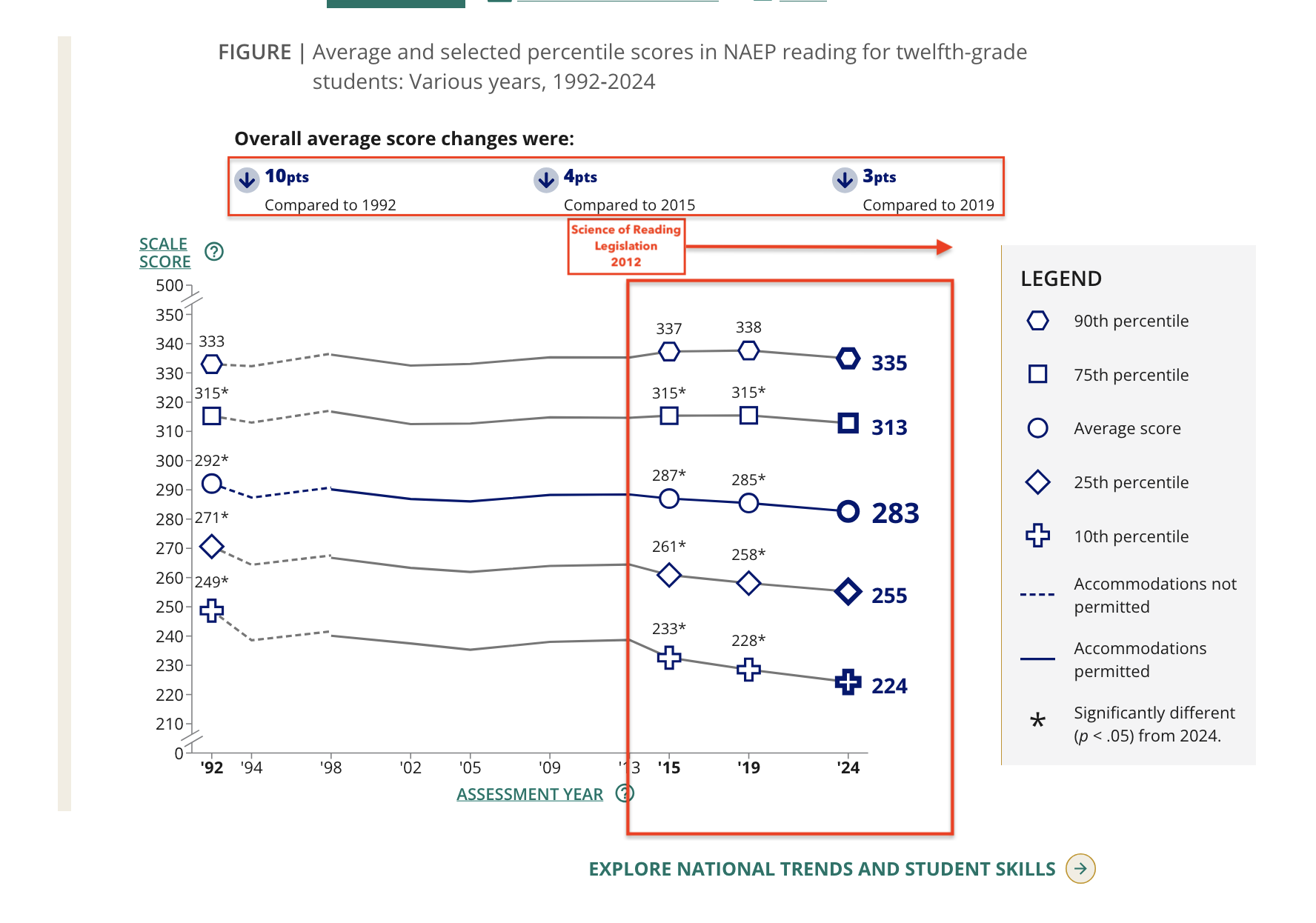
The senior cohort in the 2024 NAEP reading scores represent the SOR era begun in 2012.

Suddenly, media appears to forget that the SOR movement was built on a series of baseless claims: the US has a reading crisis (despite NAEP score being flat for decades) because teachers do not know how to teach reading and rely on failed reading programs and balanced literacy.

The foundational claim of the SOR movement has been firmly discredited: “[T]here is no indisputable evidence of a national crisis in reading, and even if there were a crisis, there is no evidence that the amount of phonics in classrooms is necessarily the cause or the solution.”

But a key element of the SOR story is often overlooked: “One of the excuses educators have long offered to explain America’s poor reading performance is poverty.”

In other words, the SOR story argues that the US has a reading crisis that is entirely the result of in-school policies and practices, that SOR-based reading instruction guarantees 95%+ of students will achieve reading proficiency.

How then is the recent 5-year decline in NAEP scores being blamed on out-of-school factors, Covid learning loss? The story being sold is such blame is merely an excuse.

The problem here is that the entire SOR story is a series of misrepresentations and ideological claims not grounded (ironically) is research or evidence.

As I have noted, NAEP achievement levels are confusing since “proficient” is well above grade level and “basic” tends to correlate with most state metrics for “proficient” (see here for a full explanation and state/NAEP correlations).

However, journalists persists is misrepresenting NAEP scores in order to feed their manufactured “crisis” story: Two-Thirds of Kids Struggle to Read, and We Know How to Fix It.

With the release of 2024 NAEP scores on reading, we have an opportunity to embrace a different story, a credible story, by examining scores from Department of Defense (DoDEA) schools as well as Mississippi and Florida.

First, note that DoDEA schools again are the top scoring schools in grade 4 reading, but MS and FL rank in the top 25% of states despite challenging populations of students being served (both states appear to be outliers defying the odds):

Both MS and FL have been praised for their reading and education reform; however, there are two parts to this “miracle” story that are often left out, that show there is a mirage, not a miracle.

First, MS and FL join many states that have enacted SOR reading reform over the past decade-plus, yet the research on that reading reform highlights something other than reading instruction or programs.

Westall and Cummings concluded in a report on reading policy: “[S]tates whose policies mandate third-grade retention see significant and persistent increases in high-stakes reading scores in all cohorts…. [T]here is no consistent evidence that high-stakes reading scores increase in states without a retention component [emphasis added].”

States implementing K-3 grade retention are gaming the system by pulling out the lowest performing students and then re-inserting them into the testing population when older.

In fact, MS has been retaining about 9000-10,000 K-3 students a year since 2014, and FL retains about 17,000 students annually. [1]

Beyond the impact of grade retention on test scores, we should also ask: If SOR “works,” why do states continue to retain about the same number of students per year?

But NAEP also tells a story about SOR that has been ignored for years. Both MS and FL rank in the top 25% of grade 4 but the bottom 25% by grade 8 while DoDEA remains the top scoring schools in both grades:

Grade retention creates a mirage of achievement in grade 4 that disappears by grade 8, further evidence that SOR is not working at either grade.

Reading achievement as measured on testing has never been about reading instruction, teacher quality, or reading programs.

DoDEA school reading achievement is a testament to what research has shown for decades about student achievement:

Almost 63% of the variance in test performance was explained by social capital family income variables….The influence of family social capital variables manifests itself in standardized test results. Policy makers and education leaders should rethink the current reliance on standardized test results as the deciding factor to make decisions about student achievement, teacher quality, school effectiveness, and school leader quality. In effect, policies that use standardized test results to evaluate, reward, and sanction students and school personnel are doing nothing more than rewarding schools that serve advantaged students and punishing schools that serve disadvantaged students.

DoDEA student populations are diverse, often coming from impoverished and working class backgrounds; these schools also serve vulnerable and challenging populations of students.

However, teacher pay is high, and those students have healthcare, food and housing security, and parents with stable work.

DoDEA students almost all have the advantages mostly afforded children living in privilege so that how and what they are taught can matter.

If reading and literacy matter—and they do—and education matters in the US, we are well past blaming teachers, declaring false “miracles,” and jumping on the reading program merry-go-round once again.

Students must have their lives addressed so that their education can serve them well.

NAEP scores tell us little about reading (or math), but confirms again and again that the US is a country determined to ignore the corrosive impact of inequity on the lives and education of children.


Update

Media has only one story—a false one—about outliers in NAEP scores. Compare the coverage of MS in 2019 with LA 2024:

[1] Note that in the early 2000s, FL was the “miracle” state and established the Florida Model that essentially became the MS “miracle.”

Next up is Louisiana, and most of the coverage is claiming LA’s success is because the state has copied MS.

And a part of the lineage is more grade retention. Here are the currently available data on LA grade retention:

64

[Header Photo by Gift Habeshaw on Unsplash]

Regret

More than a decade ago, close to one of the most celebrated birthdays, turning 50, I was ghosted.

Although I understand why, and even in some ways, accept that may have been the only option, since this was a person for whom I cared deeply, the experience was difficult—for many years.

Life altering.

But one thing just before that event has stayed with me; the person acknowledged we could no longer have a relationship but stressed they had no regrets.

In my last couple of days at 63—turning 64 Sunday—I know that I have made many mistakes but also that I have a life now that is often quite wonderful despite the inevitable tensions of living across seven decades.

Big picture, then, I do not regret the life that I have lived to get to the life I have.

Yes, I regret I forgot my father’s birthday (also my parents’ anniversary) just a year or so before he died. I realized that the next day and felt truly horrible—so lost in my own daily life, so unnecessarily lost in my daily life.

Yes, I regret that the night my mother died in Hospice, I was home, asleep; I slept through the call. I wasn’t there when she died.

But at nearly 64, I am aware that we mostly can only be the person we are capable of being at any moment in this life.

I simply don’t have time for regret—or blame.

I am fond of giving myself and others a break more often than not.

There may be some use in regret when we fall short of who we are and who we expect ourselves to be.

But most of the things of my life that others would judge me for, frankly, I don’t find to be anything done wrong; in fact, those are often those things that best reflect who I am and not who others expect me to be.

Melancholia

After I finished classes and lunch today, I had my usual nearly-hour drive home ahead of me. For an early birthday present to myself, I listened to The National’s First Two Pages of Frankenstein.

Lately, a couple of those songs have been on repeat in my mind—”Grease in Your Hair” and “Ice Machines.”

But the album is book-ended by two beautiful songs filled with melancholia—”Once Upon a Poolside” and “Send for Me.”

The first time I listened to “Send for Me,” I was in New Orleans the day after giving an invited presentation. F2PF was released that morning, so I sat in the hotel room after waking up early, my partner sleeping, to have a first listen.

When the final song played, I wept through it entirely. I was wrenched by the sweetness, the sadness, and the gentle humanity of the song.

Less than 48 hours from turning 64, I am filled with melancholia because aging is a heaviness.

I am fighting literal heaviness with my weight ticking up slightly year after year (and for someone who has lived as a serious cyclist weight has been an ever-present obsession for someone who looks mostly thin but persists in fretting over a bit of new weight here and there).

But aging is another heaviness.

The heaviness of awareness, the heaviness of knowledge.

I know a great deal, but most of all, I know what I don’t know.

The heaviness of the unknown, the heaviness of the unknowable.

Growing older may be as much bittersweet as melancholia because I am not sad. I am maybe as happy and content as ever.

It can be easier to come to peace with yourself and others with age.

And in the last days of my year 63, David Lynch died, just 5 days before his January birthday.

His creative works were incredibly important throughout my life so his death near my birthday feels heavier than it probably should.

As I told my students, I cried in public reading a story about Lynch requesting Cheetos in his dressing room in his last performance as an actor.

I have cried over the death of Kurt Vonnegut (when he died and when he died again in a biography).

I have cried over the death of George Carlin (when he died and at the end of a documentary on Carlin’s life).

There is something sweet and frail about someone of Lynch’s stature making a demure request for Cheetos.

And as sad as his death is, it has brought day after day of articles and videos sharing the quirky man Lynch was—a man at a sort of peace and self-awareness that makes me jealous, gives me hope.

As is usual, people I love and people who love me have asked what I want for my birthday, and I give my usual reply—nothing.

At least no gift, nothing special.

I want to wake up Sunday and continue with this life, this thing that is what it is and will be something I cannot predict.

I am better at this now, one advantage of aging, following Kurt Vonnegut’s advice:

So I hope that you will do the same for the rest of your lives. When things are going sweetly and peacefully, please pause a moment, and then say out loud, “If this isn’t nice, what is?”

This is a simply thing, a true thing.

It is quite a nice thing to be here still.

Poem: knowledge

[Header Photo by Gabriella Clare Marino on Unsplash]

i didn’t know
what i was doing

it was like
falling through the ice

when you didn’t know
you were walking on a frozen lake

and the last thing
you heard before sinking

slipped out of your mind
because of the shock

frigid water pulling you
into darkness and forgetting

you should have known
(you whisper over my shoulder)

and i suddenly realize
the stiffness of my fingers

even as i am awash
with the urge to touch your skin

i turn to reach for you
silhouetted by a setting sun

i should have known
what i was doing

—P.L. Thomas

A Man’s World (pt. 3): Gaiman Edition

[Header Photo by Museums of History New South Wales on Unsplash]

I am currently reading Haruki Murakami’s newest novel, The City and Its Uncertain Walls. In some ways, the story is not as typical of his other novels (I have read all of his work and co-edited a volume on him).

However, this novel maintains a recurring aspect of his works—men who have lost or been left by women (directly expressed in his short story collection Men Without Women).

Reading this novel comes after I recently submitted a chapter on Murakami expanded from a blog post about his 2017 story collection; in that, I address concerns about whether Murakami’s fiction slips too often into sexism and objectifying women.

While the questions about how Murakami deals with women in his fiction creates tension in me as a reader and scholar, I am more disturbed and struggle much more with the men writers and creators who persist in proving that they mistreat, abuse, and assault women in their (sometimes mostly) secret lives.

My reading and fandom life is littered with men writers I once admired but now find it hard to appreciate their work because of their failings as men, as humans—Woody Allen, J.D. Salinger, e.e. cummings, Cormac McCarthy, and Neil Gaiman (see several posts below addressing these men).

The debate about where the line is between a person’s creative work and their personal lives has a long history—and many people disagree about being able to respect that work while acknowledging or even rejecting the personal flaws (and much worse).

For example, Ryunosuke Hashimoto frets about Murakami: “The negative image that has been associated with Murakami is so frequently spotted on social media as a consequence of the new generational standard that one wrong cancels out all of the good that is contained in a work.”

The recent revelations about McCarthy and Gaiman seem to rise far above “one wrong” into predatory patterns and abhorrent abuse.

Concurrent with reading the seemingly late mainstream coverage of Gaiman in Vulture, I have been watching the series House for the first time (while my partner is re-watching one of her favorite series).

House is challenging us in similar ways, considering how much the problems with the episodes weigh against the compelling aspects of the show.

To me, House tries to be topical but can fall cartoonishly flat, such as Spin (S2E6) about a professional cyclist. The cycling and discussions around cheating (EPO and blood doping) are wildly bad, especially the scene of actual bicycle racing.

But we also had just watch Skin Deep (S2E13) a day before the Gaiman article dropped in Vulture.

Skin Deep, for me, has many of the flaws found in the Spin episode, likely from trying to hard to address then-current controversies.

The episode covers a great deal of controversial topics—sexualizing and objectifying young women (the main character is a 15-year-old supermodel), sexual abuse (the father admits sex with his daughter), and then the disturbing big reveal (the young woman is discovered to be intersex with cancerous testes).

Dr. House’s behavior is glib, offensive, and disturbing, including misinformation and not-so-subtle bigotry.

Re-watching Friends, Seinfeld, and The Office has left us cringing as well.

So from what to do about Gaiman’s work to navigating Murakami and series such as House, I remain troubled about where the line is between the creative works and the flawed to despicable humans, those men.

I also must stress that we are in a political moment where the consequences for being a sexual predator or committing sexual assault are being lessened, even erased. The rights of women are being eroded; yes, it is more and more a man’s world, a world hostile and calloused to the lives of girls and women.

The Gaiman moment is an(other) opportunity to say there is a line, it has been crossed, and there must be consequences.

There are thousands of wonderful creative works by people who do not have these transgressions, these failures to respect the humanity of others, hanging over them and their works.

I’ll keep watching House, and I am pretty comfortable with how I understand and appreciate Murakami (and I could be wrong). But Gaiman deserves consequences of a magnitude from which he will not recover as an artist—and others will (maybe) learn as well.


See Also

“He knows, or thinks he knows”: It’s Still a Man’s (Hostile) World

True Detective: It’s Still a Man’s (Hostile) World, pt. 2

Flawed Men Artists and Their Crumbling Art

The Woody Allen Problem Is Our Problem

Recommended: Larcenet’s Graphic Adaptation of McCarthy’s The Road

Writing Process: Scholarly/Academic Writing Edition

[Header Photo by 🇸🇮 Janko Ferlič on Unsplash]

Like many academics working in higher education, I spent several days over my holiday break preparing my courses for spring (two first-year writing seminars and one upper-level writing/research course) and then an intense three days writing and submitting a scholarly chapter on growth mindset and grit for an upcoming book.

I am fortunate, I think, because my teaching life and my writing life continually inform each other. Especially when teaching my writing-intensive courses, I teach as a writer and scholar, fore-fronting my writing/scholarship in my teaching.

My chapter on mindset and grit gave me a perfect opportunity to think deeply about and prepare new materials for my courses this spring (access those artifacts in this folder: Scholarly Essay Process).

As a writing teacher, I have been struggling throughout my 40-plus-year career with the negative impact of templates and scripts for students developing the skills and knowledge they need to be autonomous and compelling writers.

I have rejected, for example, the five-paragraph essay model, and I have challenged the mechanical implementation of the writing process as a sequential series of steps.

The problem is that this crusade against templates and scripts is not as simple (or effective) as I initially believed many decades ago.

Another problem with rejecting templates and scripts is that a significant amount of scholarly and academic writing is bound by scripts, word-count limits, formatting requirements, and citation/style guidelines.

My evolved and more nuanced position on templates and scripts in writing instruction and assignments acknowledges that beginning writers need opportunities to read widely in order to develop their own “scripts” for a wide variety of writing types. Of course they also need structure, but starting with the rigid template does far more harm than good for emerging writers.

Then, as students-as-writers move into high school and college, they need more experiences with authentic templates and guidelines found in much of academic and scholarly writing.

The editors of the chapter I just completed, for example, sent writers an content outline for chapters to follow as well as a word count limit and citation/style sheet requirements (APA).

When I write reviews for a think tank, I receive the same structures and very rigid expectations for staying within those limits (including their own in-house style sheet).

The irony, then, is that this spring, my first-year writing seminar will focus on challenging scripts and “rules” for essays and writing while my upper-level writing/research class will be writing a strictly scripted major scholarly essay (I assure upper-level students that this experience will prepare them for graduate school, and I recently received an email from a former student in this course telling me “thank you” for just that).

While I feel like my teaching of writing has better bridged the gap between helping students acquire the broad concepts of effective and compelling writing (versus imposing on them artificial templates and “rules”), I continue to struggle with fostering in students the sort of writing process that would better serve them.

Similar to my stance on the essay form, I teach that the writing process is not sequential or a rigid template, but a set of concepts that most writing addresses to help produce a writing final product needed for the purposes of that project. In other words, these broad concepts are fairly stable but the so-called “steps” may differ and the time spent on each “step” likely will vary for different writing purposed.

For scholarly writing, the writing process includes much more than composing sentences and paragraphs. Here, then is a brief overview of my recent process this week writing and submitting my book chapter on mindset and grit.

Let me start with a caveat that I think should be shared with students.

When most scholars start a writing project, we are dealing with content that we have expertise in; my project on mindset and grit has years of blogging and gathering research behind the brief process I followed over three days.

My first steps included revisiting the chapter guidelines sent by the editors, confirming formatting, citation, word count, etc.

Then, as I stress to students, I prepared my Word document, conforming to APA guidelines and inserting the subheads, etc., along with the chapter template required by the editors. One concern I have with students is they tend to address formatting last, and I urge them to address this tediousness first. (See my submitted and not yet edited copy here.)

Next, I put the required page break in the end of the document and prepared my working references list. To create the list, I reviewed my many blogs on the topics, searched through my library data bases, reached out to other scholars for recommendations, and carefully culled sources from the references of the sources I had gathered (working from the most recent publications).

Let me stress here that as I detail my process, as I worked, these “steps” became more and more recursive in that as I worked in one “step” I would invariably return to and revise other “steps” (I caught simple formatting edits and typos, for example, in many of the “steps” being detailed here even as that is considered the editing “step”).

One goal as I worked was to create a compelling opening that included a thesis paragraph clearly aligned with the subheads and organization of the chapter. I drafted that opening on the first day and then I carefully edited and formatted all of my references, checking APA and loosely thinking about removing or adding needed sources. See the opening here:

Literacy educator and scholar Lou LaBrant (1947) asserted almost eight decades ago: “A brief consideration will indicate reasons for the considerable gap between the research currently available and the utilization of that research in school programs and methods” (p. 87). While valid in the mid-2020s, a slightly more nuanced argument needs to be proposed: Scientific research on teaching and learning is often lost in translation once it is packaged by the education marketplace and reduced to legislation and policy. In other words, what is popular, packaged, and mandated in education is too often an oversimplified and even misguided version of scientific findings, nothing more than a fad. An even more complicating problem, as well, is that classroom practices likely should be guided by more than experimental and quasi-experimental research (Wormeli, n.d., The problem).

Over the past decade-plus, two examples of research lost in translation include growth mindset and grit. Carol Dweck (2008), often publishing with others (Dweck & Yeager, 2019) examines the role of mindset is academic success. Grit is grounded in the research and advocacy of Angela Duckworth (2018); however, a great deal of the popularization of grit occurred through the journalism and advocacy of Paul Tough (2013) who promoted “no excuses” charter school practices, specifically the Knowledge Is Power Program (KIPP) charter chain (Abrams, 2020). While growth mindset and grit are distinct concepts and educational movement, they tend to share similar spaces and problems in practice.

This chapter explores the central claims of growth mindset and grit before considering the validity of those claims in the context of the following critical questions: How are growth mindset and grit grounded while also perpetuating bootstrapping, rugged individualism and meritocracy myths? What are the roles of deficit ideologies (word gap, victim blaming, racism, sexism, classism, etc.) in popular advocacy for growth mindset and grit? As well the research and popular claims about growth mindset and grit are interrogated at three levels: (1) research validity and robustness, (2) evidence-based or ideologically based, and (3) racism and classism.


The next morning I reviewed and organized all of sources to comply with the structures required in the chapter. Here, I think, is where students are lost because of their previous experiences writing inauthentic research papers (in which many students gather the required number of sources and then simply walk the reader through their sources, writing about the sources and not their topic).

I created a table by my topics, mindset and grit, and then by the three major themes/patterns I planned to address; the key here, for students, is recognizing the need to focus on the patterns in their discussion and to cite multiple sources for those patterns.

I also created a listing of sources by my major topics, and then carefully reviewed them all to be sure I had classified them correctly and to identify the few I wanted to cite or quote more fully (I stress to students who have more experience with MLA and textual analysis that quoting is only one way to give evidence in scholarly writing and is often discouraged in many disciplines when not doing textual analysis).

Analyzing and organizing my evidence is designed to creating writing that offers a compelling generalization that is valid followed by a representative source or two to support the pattern; for example:

However, the current public discourse around mindset has made a significant turn to being critical and even skeptical (Study finds, 2018; Tait, 2020; Young, 2021a, 2021b). This shift is spurred by the growing research base that fails to replicate the primary claims of mindset advocacy or shows negative correlations or harm in implementing mindset intervention over other aspects of learning and achievement (Brez et al., 2020; Burgoyne et al., 2020; Burnette et al., 2018; Dixson et al., 2017; Ganimian, 2020; Li & Bates, 2019; Macnamara & Burgoyne, 2023; Sisk et al., 2018; Schmidt et al., 2017). Brez at al. (2020) conclude: “The pattern of findings is clear that the intervention had little impact on students’ academic success even among sub-samples of students who are traditionally assumed to benefit from this type of intervention (e.g., minority, low income, and first-generation students)” (p. 464). And Macnamara and Burgoyne (2023) make a more problematic assertion:

Taken together, our findings indicate that studies adhering to best practices are unlikely to demonstrate that growth mindset interventions bene t students’ academic achievement. Instead, significant meta-analytic results only occurred when quality control was lacking, and these results were no longer significant after adjusting for publication bias. This pattern suggests that apparent effects of growth mindset interventions on academic achievement are likely spurious and due to inadequate study design, flawed reporting, and bias. (p. 163)


Again, I need to emphasize that students must understand that several of these steps require and prompt continuous revision and editing. I returned to my title and the thesis paragraph for revision as I drafted the two major subhead sections and the subheadings under those. In other words, I was then in a constant state of seeking coherence in the chapter whereby all the parts match and create the whole (which then is reinforced by the final section/closing of the chapter).

For students, I will stress that I drafted an opening on the first day, drafted the first major subheading section the second day, and then drafted the second major section and closing the third day. But the writing parts were embedded in a great deal of reading, cataloguing, and organizing.

I also completed a full initial draft, but then let that sit for a while before doing a full re-read, revision, and editing session with the entire chapter in front of me; I did several re-read-revise-edits along the way as well.

For students, then, here is what they should see as elements of a writing process for academic/scholarly writing:

  • Identify writing assignment guidelines, formatting requirements, and citation style.
  • Prepare your Word document per those guidelines, creating your initial title, subheads, and any guiding bullet points or questions detailed in the assignment.
  • Create working references list, addressing citation formatting before working further.
  • Create an initial compelling opening (multiple paragraphs) with a thesis paragraph that correlates with the title, the organization, and subheads of the essay.
  • Read, re-read, organize, and catalogue (patterns/themes) references based on the organization of the assignment; identify the representative anchor sources that will be used to elaborate on the patterns identified and cited with multiple valid sources. Be sure to carefully identify direct quotes and include citation, page or paragraph numbers, etc., when creating a matrix of patterns and analyses of the evidence.
  • Revise and edit throughout these steps, even significant revisions such as addressing the title, the thesis paragraph, or organization if the review of the evidence prompts those revisions.
  • Create a full first draft, and then let that sit. The final step should be a careful re-read to revise and edit before submitting.

The essay form and the writing process are important concepts for developing writers and students to understand, and that understanding must come from authentically engaging with both in supportive environments.

The challenge with teaching students to write generally and then as academics/scholars is that there are too many moving parts and simply no hard and fast “rules” to govern either the essays they write or the process they use to write them.

The Outlier Story: How Education Journalism (Almost) Always Gets It Wrong

[Header Photo by Will Myers on Unsplash]

The first two decades of my career as a literacy educator were spent as a high school English teacher in rural Upstate South Carolina, the high school I had graduated from and my home town.

This began in 1984 when SC had passed sweeping education legislation that would become the standard legislative approach across the US—accountability policy grounded in state standards, high-stakes testing (grades 3 and 8 with exit exams in high school starting in grade 10), and school report cards.

SC was an early and eager adopter of the “crisis” rhetoric fueled by A Nation at Risk report released under the Reagan administration.

That high school and town were populated mostly by working-class and poor people; the town and smaller towns served by the high school were dead or dying mill towns.

Schools had far more poverty than the data showed because rural Southerners often refused to accept free and reduced meals (the primary data point for measuring poverty in schools).

However, for many years the high school ranked number 1 in the entire state for student exit exam scores in math, reading, and writing. Because of our student demographics (and notably because these students had relatively low or typical scores in grade 8 testing), we were what many people would refer to as a “high flying” or “miracle” school.

In more accurate statistical terms, we were an “outlier” data point in the state.

I have been in SC education for an ongoing five decades, and the overwhelming body of data related to student achievement in the state has matched what all data show across the US—measurable student learning is most strongly causally related to the socioeconomic status and educational levels of those students’ parents.

Further, the full story about how we achieved outlier status includes two aspects.

One is that from grade 8 to grade 10 testing, the population of students changed because of students dropping out of school (and these were among the lowest scoring students in grade 8). In fact, students were often encouraged to drop out and enroll in adult education (a two-fer win for the school because they would not be tested and enrolling in adult ed removed them from the drop-out data).

A second part of the story is that students scoring low in grade 8 were enrolled in two math and two ELA courses in grade 10. The “extra” courses were specifically designed as test-prep for state testing. We rigorously adopted a teach-to-the-test culture.

For the state writing exam, for example, we discovered that the minimum text a student could produce was an “essay” with a three-sentence introduction, a five-sentence body, and a three-sentence conclusion. Students in the “extra” ELA course wrote dozens of 3-5-3 essays in grade 10 with the teacher focusing on helping students avoid the “errors” that would flag the text as a below standard.

Many of us found the 3-5-3 approach to writing became a huge problem when students were required to write in other courses; even as students “passed” the state writing exam, they were not performing well as writers in other courses, and even refusing at times to write more than 3-5-3 essays.

For the high-stakes accountability era, we did do a great deal of good because many students across the US passed all their courses but could not receive a diploma because of exam exams. Most of our students graduated, and not because we did anything underhanded.

Yet, I must stress that how we accomplished our outlier status was likely not scalable, but more importantly, our approach should not be replicated by other schools.

Fast-forward 40 years, and education journalism has written hundreds and hundreds of stories not only in pursuit of “outlier” schools, but carelessly framing them as both proof of the on-going (permanent) education crisis and that “status quo” education refuses to implement what we know “works.”

The newest iteration of this misleading story in education is the “science of” movement grounded in the “science of reading” story first popularized by Emily Hanford, who wrote about a “miracle” school in Pennsylvania. This compelling but false story has been parlayed into an even more successful podcast as well as spawning dozens of copy-cat articles by education journalists across the country.

Media, however, never covered Gerald Coles’s careful debunking of the “miracle” school Hanford featured. Similar to my story above about the beginning of my teaching career, the full story of that school was quite different than what was covered in the media.

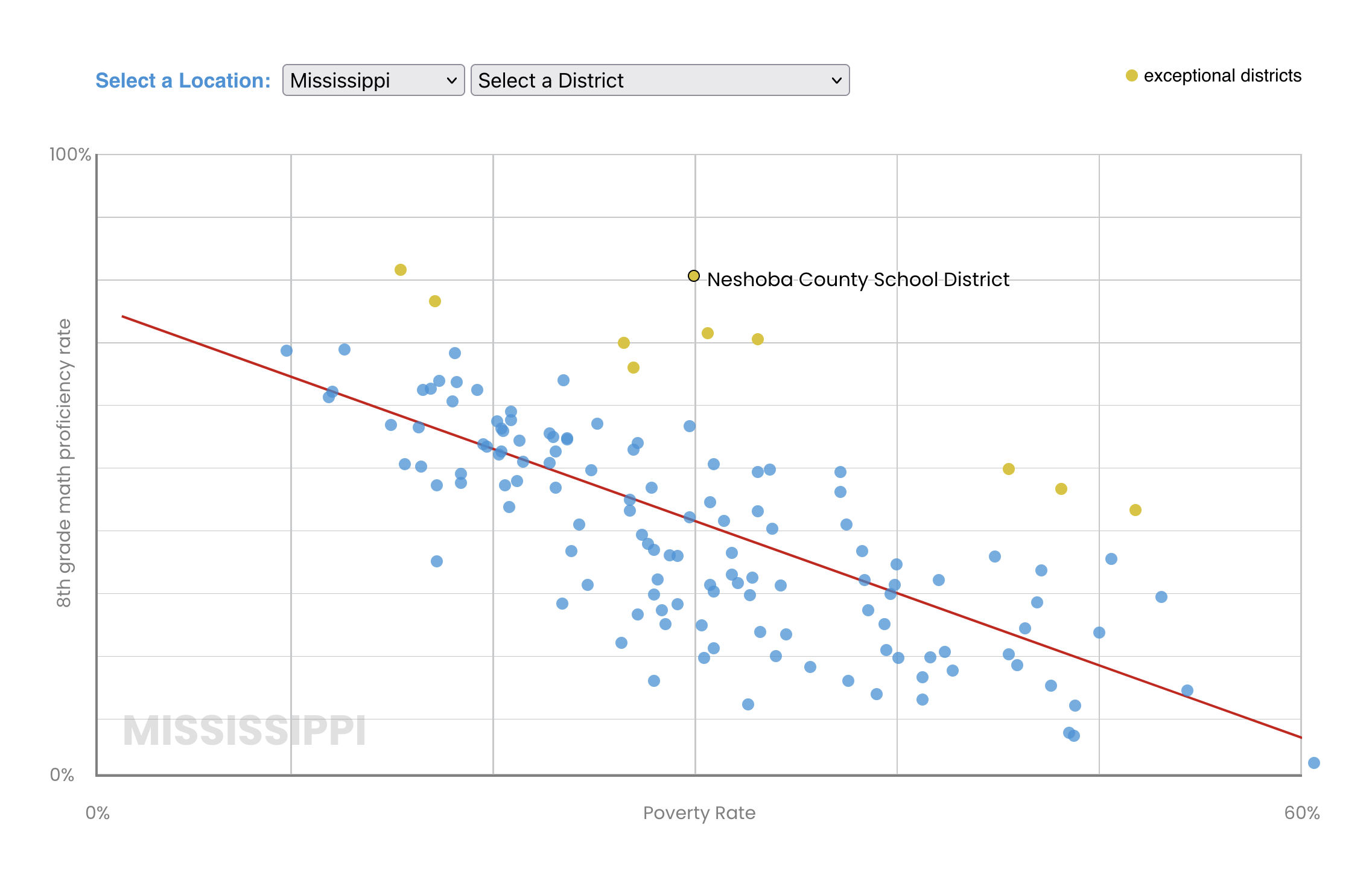
And as 2024 drew to a close, education journalists simply have no other lens that this: Which School Districts Do the Best Job of Teaching Math?

To be blunt, education journalists are mistakenly compelled to focus on the “exceptional” districts (outliers) while ignoring the more compelling red line that, again, shows what, in fact, is normal and what can and should be addressed in terms of educational reform—the negative impact of poverty on educational attainment.

So here is a story you likely will not read: Education journalism is failing public education, and has been doing so for decades.

Education journalists are blindly committed to the “crisis” and “outlier” stories because they know people will read and listen to them.

The “outlier” story makes for a kind of “good” journalism, I suppose, but the problem is that these stories become popular beliefs and then actual legislation and policy.

The current”science of” movement is riding a high wave because of the “science of reading” tsunami. But like all the misguided reforms since the original false education story, A Nation at Risk, this too will crash and reveal itself as a great harm to students, teachers, and our public school system.

This is boring, I know, but most outlier stories are ultimately false or they simply are not replicable or scalable, as I explained in my opening story.

If we genuinely care about student learning, teaching, and the power of public education, we need education journalists more dedicated to the full story and the not the outliers that help drive their viewing numbers.


Recommended

Big Lies of Education: A Nation at Risk and Education “Crisis”

Big Lies of Education: Reading Proficiency and NAEP

Big Lies of Education: National Reading Panel (NRP)

Big Lies of Education: Poverty Is an Excuse

Big Lies of Education: International Test Rankings and Economic Competitiveness

Big Lies of Education: Grade Retention