

[Header Photo by Will Myers on Unsplash]
The first two decades of my career as a literacy educator were spent as a high school English teacher in rural Upstate South Carolina, the high school I had graduated from and my home town.
This began in 1984 when SC had passed sweeping education legislation that would become the standard legislative approach across the US—accountability policy grounded in state standards, high-stakes testing (grades 3 and 8 with exit exams in high school starting in grade 10), and school report cards.
SC was an early and eager adopter of the “crisis” rhetoric fueled by A Nation at Risk report released under the Reagan administration.
That high school and town were populated mostly by working-class and poor people; the town and smaller towns served by the high school were dead or dying mill towns.
Schools had far more poverty than the data showed because rural Southerners often refused to accept free and reduced meals (the primary data point for measuring poverty in schools).
However, for many years the high school ranked number 1 in the entire state for student exit exam scores in math, reading, and writing. Because of our student demographics (and notably because these students had relatively low or typical scores in grade 8 testing), we were what many people would refer to as a “high flying” or “miracle” school.
In more accurate statistical terms, we were an “outlier” data point in the state.
I have been in SC education for an ongoing five decades, and the overwhelming body of data related to student achievement in the state has matched what all data show across the US—measurable student learning is most strongly causally related to the socioeconomic status and educational levels of those students’ parents.
Further, the full story about how we achieved outlier status includes two aspects.
One is that from grade 8 to grade 10 testing, the population of students changed because of students dropping out of school (and these were among the lowest scoring students in grade 8). In fact, students were often encouraged to drop out and enroll in adult education (a two-fer win for the school because they would not be tested and enrolling in adult ed removed them from the drop-out data).
A second part of the story is that students scoring low in grade 8 were enrolled in two math and two ELA courses in grade 10. The “extra” courses were specifically designed as test-prep for state testing. We rigorously adopted a teach-to-the-test culture.
For the state writing exam, for example, we discovered that the minimum text a student could produce was an “essay” with a three-sentence introduction, a five-sentence body, and a three-sentence conclusion. Students in the “extra” ELA course wrote dozens of 3-5-3 essays in grade 10 with the teacher focusing on helping students avoid the “errors” that would flag the text as a below standard.
Many of us found the 3-5-3 approach to writing became a huge problem when students were required to write in other courses; even as students “passed” the state writing exam, they were not performing well as writers in other courses, and even refusing at times to write more than 3-5-3 essays.
For the high-stakes accountability era, we did do a great deal of good because many students across the US passed all their courses but could not receive a diploma because of exam exams. Most of our students graduated, and not because we did anything underhanded.
Yet, I must stress that how we accomplished our outlier status was likely not scalable, but more importantly, our approach should not be replicated by other schools.
Fast-forward 40 years, and education journalism has written hundreds and hundreds of stories not only in pursuit of “outlier” schools, but carelessly framing them as both proof of the on-going (permanent) education crisis and that “status quo” education refuses to implement what we know “works.”
The newest iteration of this misleading story in education is the “science of” movement grounded in the “science of reading” story first popularized by Emily Hanford, who wrote about a “miracle” school in Pennsylvania. This compelling but false story has been parlayed into an even more successful podcast as well as spawning dozens of copy-cat articles by education journalists across the country.
Media, however, never covered Gerald Coles’s careful debunking of the “miracle” school Hanford featured. Similar to my story above about the beginning of my teaching career, the full story of that school was quite different than what was covered in the media.
And as 2024 drew to a close, education journalists simply have no other lens that this: Which School Districts Do the Best Job of Teaching Math?
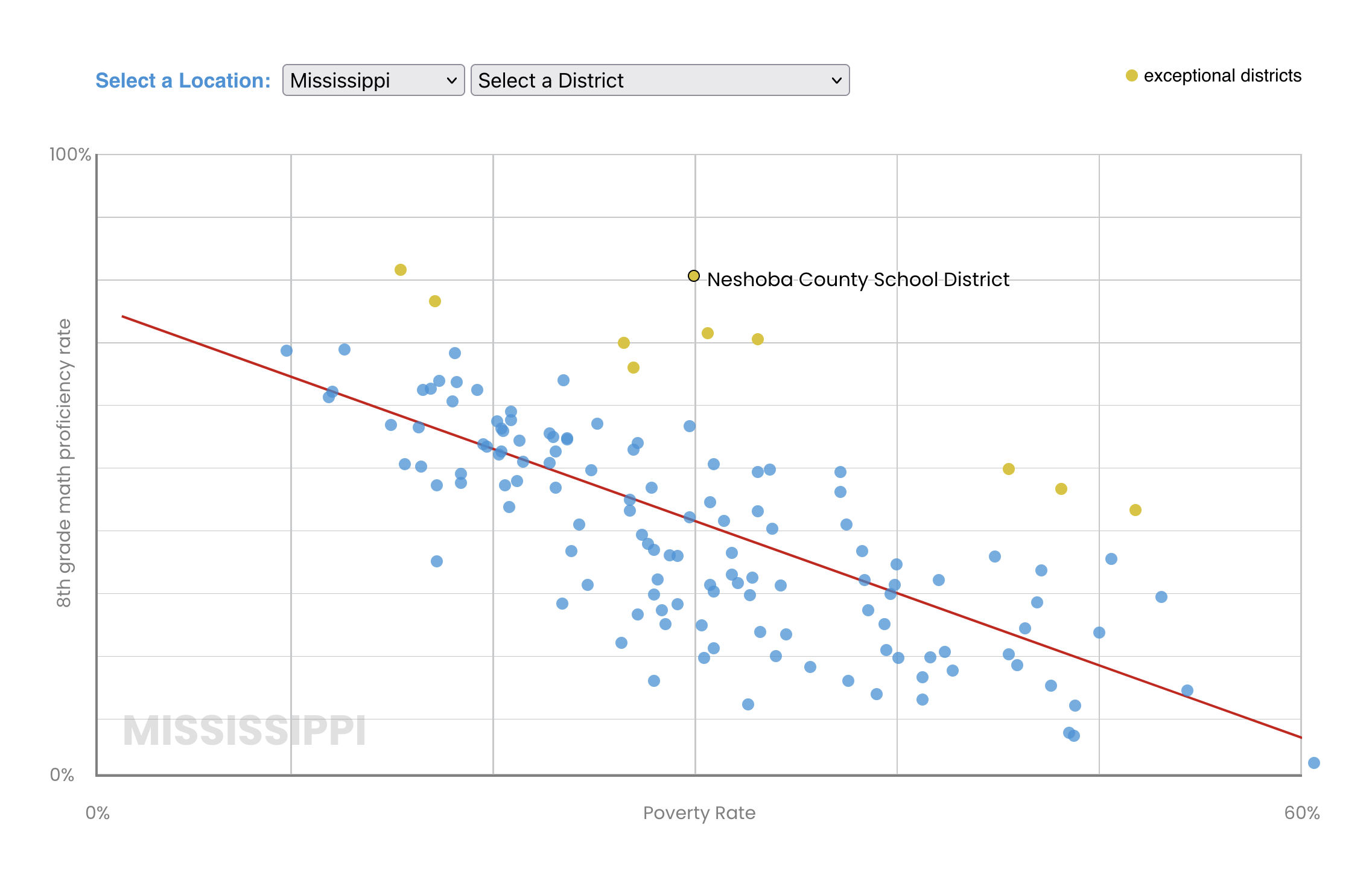
To be blunt, education journalists are mistakenly compelled to focus on the “exceptional” districts (outliers) while ignoring the more compelling red line that, again, shows what, in fact, is normal and what can and should be addressed in terms of educational reform—the negative impact of poverty on educational attainment.
So here is a story you likely will not read: Education journalism is failing public education, and has been doing so for decades.
Education journalists are blindly committed to the “crisis” and “outlier” stories because they know people will read and listen to them.
The “outlier” story makes for a kind of “good” journalism, I suppose, but the problem is that these stories become popular beliefs and then actual legislation and policy.
The current”science of” movement is riding a high wave because of the “science of reading” tsunami. But like all the misguided reforms since the original false education story, A Nation at Risk, this too will crash and reveal itself as a great harm to students, teachers, and our public school system.
This is boring, I know, but most outlier stories are ultimately false or they simply are not replicable or scalable, as I explained in my opening story.
If we genuinely care about student learning, teaching, and the power of public education, we need education journalists more dedicated to the full story and the not the outliers that help drive their viewing numbers.
Recommended
Big Lies of Education: A Nation at Risk and Education “Crisis”
Big Lies of Education: Reading Proficiency and NAEP
Big Lies of Education: National Reading Panel (NRP)
Big Lies of Education: Poverty Is an Excuse
Big Lies of Education: International Test Rankings and Economic Competitiveness
 dr. p.l. (paul) thomas