

[Header Photo by Gaelle Marcel on Unsplash]
You know the story: Students today can’t read.
And those who can, don’t read.
But there is more.
Children who can’t read have been cheated by their teachers, who fail to teach reading skills such as phonics.
And our national reading crisis is a threat to our very nation, especially our international economic competitiveness.
However, there are a few problems with this story.
If you were to find a Time Machine, you could travel to any year over the past century and hear the exact same story.
As well, this crisis rhetoric has been used historically and currently with math—and every other content area tested in the US.
Here is a story about reading you probably are not familiar with: There is no reading crisis, and there is no evidence that reading test scores are driven by reading instruction or programs.
Further, again, there is nothing unique or catastrophic about reading test scores or reading achievement by US students.
Historically and currently, reading test scores and achievement reflect a fact that has been replicated for decades:
Almost 63% of the variance in test performance was explained by social capital family income variables….The influence of family social capital variables manifests itself in standardized test results. Policy makers and education leaders should rethink the current reliance on standardized test results as the deciding factor to make decisions about student achievement, teacher quality, school effectiveness, and school leader quality. In effect, policies that use standardized test results to evaluate, reward, and sanction students and school personnel are doing nothing more than rewarding schools that serve advantaged students and punishing schools that serve disadvantaged students.
Now, consider a newer story: Post-Covid students are suffering a historic learning loss:
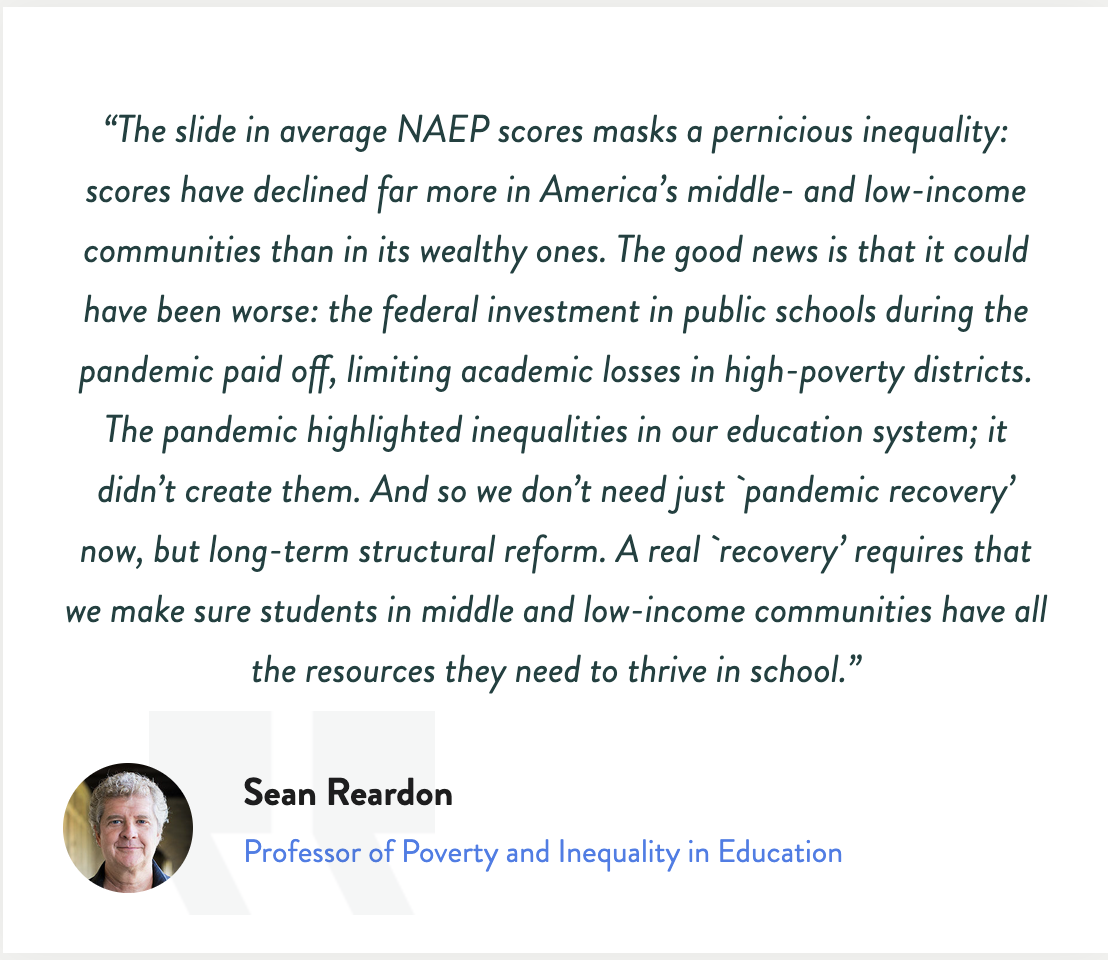
Reardon’s call for “long-term structural reform” must follow a new story about reading and a different approach to reading reform.
First, since the vast majority of causal factors reflected in reading standardized test scores are out-of-school conditions, the new reading story and different reform must address universal healthcare, food security and eliminating food deserts, home and housing stability, and stable well-paying job for parents.
Another out-of-school reform needed for reading is guaranteeing students have access to books and texts in their homes, communities (public libraries), and then in their schools (school and classroom libraries).
A simple program that gives every child from birth to high school graduation 20 books a year (10 chosen by the child/parents and 10 common texts) would build a library and ensure access to texts, one of the strongest research-based elements of reading acquisition.
Without social reform, reading scores will likely remain flat and inadequate.
The most important different aspects of a new story and reading reform is confronting traditional approaches to in-school reform in the US common since the 1980s. A different approach to reading reform must include the following:
- De-couple reading reform and instruction from universal or prescribed reading programs and center teaching children to read (not implementing reading programs with fidelity). Admit there is no one way to teach all students to read, and provide the contexts that allow teachers to serve individual student needs.
- Reform the national- and state-level testing of reading. The US needs a standard metric for “proficient” and “age level” (instead of”grade level”) shared on NAEP and state tests in grades 3 and 8; and that achievement level needs to be achievable and not “aspirational” (such as is the case with NAEP currently). National and state testing must be age-based and not grade-based to better provide stable data on achievement.
- End grade retention based on standardized testing. Retention is punitive, and it harms children while also distorting test data.
- Monitor and guarantee vulnerable populations of students who are below “proficient” to insure they are provided experienced and certified teachers and assigned to classes with low student/teach ratios.
- Address teaching and learning conditions of schools, including teacher pay and autonomy.
- Honor and serve students with special needs and multi-lingual learners.
While we have no unique or catastrophic reading crisis in the US—and even hand wringing over learning loss seems unfounded—we have allowed a century (or more) of political negligence to ignore the negative impact of children’s lives on their learning.
We have remained trapped in a manufactured story of reading crisis and that poverty is an excuse.
All the available evidence suggests otherwise.
Crisis, miracles, blame, and punishment have been at the center of the story everyone is familiar with. That story has never served the interests of students, teachers, or public education.
In an era of intense political hatred and fearmongering, this is a tenuous call, but if we really care about students learning to read, and if we truly believe literacy is the key to the economic and democratic survival of our country, reading deserves a new story, an accurate story, and a different approach to reform grounded in the evidence and not our cultural mythologies and conservative ideologies.
See Also
 dr. p.l. (paul) thomas