Mainstream media loves a compelling story. And, regretfully, media tends to care very little how accurate or complete that story is.
Media coverage of education is almost entirely a series of misleading stories grounded in either crisis or miracle rhetoric.
One of the darlings of the media is the charter school, the one aspect of the school choice movement that has garnered bipartisan support.
However, as a type of school choice, charter schools must market themselves and recruit. So when media and school marketing combine, I urge “Buyer Beware”:
Here, The State (Columbia, SC) has platformed the principal of a charter school, who makes a couple important (but misleading) claims: the charter school is exceptional and that is because the school practices separating boys and girls for instruction.
“Exemplary High Performing School” is causally connected by Wooten to the boy/girl instructional segregation; however, rarely can a school conduct the sort of scientific research in-house to determine causation, and more importantly, student achievement (test scores) remain overwhelmingly a reflection of the students’ socioeconomic status (60+%), not the school, instruction, or teacher quality.
Here is the missing parts to this story:
Note that Langston Charter Middle has the third lowest poverty index (PI) in the state (12.9), and for comparison, in the same district, the Washington Center has one of the highest PI (96) in the state. [Note that Greenville has a incredibly wide range of low and high poverty schools because the district is large and covers an area of the state with significant pockets of poverty and affluence; and thus, neighborhood schools tend to reflect that socioeconomic reality.]
Further, if we look at Langston Charter Middle’s state report card, the “exceptional” seems to be missing:
Yes, the academic achievement is “excellent,” but again, this data point reflects mostly the very low PI for the students being served.
Note that when Langston Charter Middle is compared to schools with similar student demographics (Daniel Island School, 8.2PI, and Gold Hill Middle, 11.5 PI), the “exceptional” appears to be typical among similar schools:
Media and marketing do more harm than good for public education. When the media is fixated on incomplete and misleading stories and schools feel compelled to market themselves for customers, we all lose.
The OpEd run by The State is not about an exceptional school or the success of separating girls and boys for instruction (although that does speak into a current political ideology that wants this to be true).
The story, as usual, is incomplete, and the marketing is at best misleading.
Once again, many in the US do not want to hear or see the full story: Our schools and student achievement mostly reflect the socioeconomic status of the students’ parents, homes, and communities.
When it comes to media coverage of our schools, I must emphasize: Don’t buy the story being sold.
My mother was extremely smart and had a remarkable sense of humor. Even at the worse moments in her life, she found humor and insight. One day, as my sisters and I were playing (and fighting) in the house because of rainy weather, she called out to none, some or all of her three children, “Hey, do you want to know a way to lose twenty pounds of ugly fat?” We stopped our bickering and turned to her, waiting for her to reply to her own question. “Cut off you’re your head,” she said and quietly continued making dinner. Her remark cut through the tension and led to some whole-hearted laughter.
I think of my mom today as I try to understand what it means for a country to work on becoming more efficient. My mom was right: your body would be twenty pounds lighter if you removed your head. That’s an efficient solution to a weight problem. The problem is the effect: you’d most certainly die. Indiscriminately removing something that’s weighty may not be good for the body of the whole.
In a country striving to be a democracy, the tension between efficiency and effect is crucial. Tom Paine said that in a democracy, law is king, and in a monarchy, the king is law. The latter is an efficient way to get laws made and enforced, with the king having power over both the laws and their implementation. The problem is the effect on the people living within the country in that they all work for the king, for the perpetuation of the monarchy, and suffer at the king’s whims, desires, moods, needs, and temperament. The effect on the people is that they are essentially enslaved.
In contrast, in a democracy, when the law is the king—meaning it’s the center of organization, structure, and power—things are much more complicated because the government is obligated to consider its impact on all the people. In a representative democracy, like the one in our country, those that represent us are morally, ethically, and legally bound to the good of all. A democracy is organic, meaning that it changes over time as our understandings of life, liberty, and the pursuit of happiness are informed by our deepening understanding of what it means to be a human being. We learned about, understood and acted upon slavery, putting Japanese people in internment camps, workers’ rights, women’s right, voting rights, civil rights, and so much more.
Our growing knowledge also causes tension as, for example, outlawing the owning of slaves affected the economy and led to war. But we adjust because of our deep-rooted belief in and commitment to a country that offers the potential for every human being to realize and act upon all that they can do. In other words, a democracy is not always efficient because the effects that efficiency has matter.
Cutting Medicaid is efficient: money is saved. The effect is that people without economic means lose access to medical care that keeps them alive.
Cutting social security is efficient: money is saved. The effect is that people lose their earned deferred income—money they were forced by law to set aside for their future and their quality of life deteriorates to the point of losing their homes, dignity, and peace in their later years.
Cutting the department of education is efficient: money is saved. The effect is that schools lose essential aid, programs that protect health and civil rights, support for reading instruction, research programs, and even statistical analyses of progress.
Cutting funding of scientific research is efficient: money is saved. The effect is that research that can save lives, improve our food and water, keep our air clean, make communities safer, improve mental health and so much more is lost.
Cutting funding for the arts is efficient: money is saved. The effect is that beauty does not matter, expression is marginalized, and the voices that push our thinking and being are silenced.
Cutting support for programs in other countries is efficient: money is saved. The effect is that more people die of AIDS and other diseases, more children die of starvation, countries are left unprotected against radicals, and oppressed people no longer hear voices of hope.
We should not fall prey to chaos, attacks on a free press that expose chaos and selfishness, and the push to simplify the complexity of our democracy. We need to demand that every member of our government safeguards our well-being, demands that programs for the good of all are replenished, and uncovers who is getting the money that is supposedly being saved. We need to make sure that our heads are not being cut off to reduce our weight.
Rick is an activist and retired literacy researcher.
Born in 1961, I experienced pop culture during the formative decades of the 1960s and 1970s.
The foundation of my pop culture awareness and fandom was my mother, who loved science fiction and horror B-movies from the first half of the twentieth century.
But my pre-teen and early teen years were grounded in rogue police and vigilante films by Clint Eastwood and Charles Bronson.
I was, as seems expected, immediately a fan of Spider-Man, who was in those years strongly connected to Kingpin and The Punisher. But soon, I found myself gravitating to Daredevil.
Recently, I recommitted to collecting and reading comics, completing a full run of Daredevil. And I also am an ardent fan of the Netflix/Disney+ Daredevil series.
With the Disney+ reboot currently being released, I want to speak to Episode 4 of Daredevil: Born Again as a way to examine why Daredevil is a compelling character and how the motif of vigilantism is central to the wider public appeal of Daredevil as well.
“You and your goddam system”
Marvel in print comic books and film/series adaptations has many iterations of narratives around the ethics of superhero vigilantism as well as the often catastrophic collateral damage created by superheroes defending mere mortals.
The current story line of Born Again repeats at least two versions of Marvel exploring Wilson Fisk/Kingpin as Mayor of New York hell-bent on erasing masked vigilantes from the city (see Mayor Fisk and Devil’s Reign).
Born Again E4 also reintroduces the classic ethics debate between Matt Murdock (Daredevil) versus Frank Castle (The Punisher).
Murdock as lawyer and masked vigilante is resolute about his no-kill rule as well as working somewhat within the legal system or at least contributing to the existing system.
Castle as The Punisher is an ethical vigilante who directly rejects the system as corrupt, and thus, personifies a sort of utilitarian approach to eradicating evil in order to protect the good and innocent.
When Murdock and Castle reunite in E4, then, we have this powerful and foundational scene:
i like how frank just casually calls dex bullseye, like dex has been called it for a while now off screen pic.twitter.com/Dfok4jHhcR
With “You and your goddam system” Castle serves as sort of a perverse moral compass, suggesting for the series that eventually Murdock will break and return—with vengeance—to his role as Daredevil (and thus the final scene of E4).
While these motifs and narratives are nothing new in Daredevil lore (and seem almost tired or derivative at this point), Born Again is a fresh re-examination in live action of a powerful ethical dilemma: What do good people with unique powers do when the “system” is profoundly corrupt?
Fisk now is very much a commentary on Trump and the blurring of who is a criminal or a political leader.
But one of the most interesting elements of Born Again is the growing negative portrayal of the police in the series. Murdock’s apartment fight in E2, the Punisher tattoos on police, and the Punisher t-shirt of White Tiger’s killer all suggest that the real ethical battle will be against these corrupt police and Fisk’s corrupt administration.
And the irony, of course, will be that while in power, Mayor Fisk can have the superheros labeled criminals.
Power (and superpower), corruption, and what counts as right and wrong/ good and bad have long served as the core of why, I think, Daredevil has endured in the Marvel Universe (and MCU now).
Murdock as lawyer and Murdock as a reluctant superhero often seems naive, especially against the blunt realism of Castle as The Punisher.
Born Again began (E1) with Daredevil seeming to cross his line (the roof-top scene with Bullseye) and repeats the line crossing when Murdock brutally beats two policemen (E2).
Like the Netflix series, Born Again appears committed to the foundational Daredevil narrative while also finding ways to breath fresh approaches to enduring themes and questions about justice and moral actions.
In 2025, Castle’s disgust with the “system” resonates more powerfully than ever, and as viewers, we are poised and even eager to watch as Murdock/Daredevil finds his way past the paralysis of that “system” commitment and back to doing the good he was called to do.
It seems not just a different time, a naive time, but an entirely different world—the conservative backlash against “Black Lives Matter” spawning the “All Lives Matter” response.
Even the “Blue Lives Matter” companion backlash now feels far less sinister than at the time.
But many of us always knew these conservative slogans were insincere, masking a much more insidious intent.
Now that we have allowed Trump 2.0 and the full rise of the MAGA movement (recall when people believed that Project 2025 wasn’t part of the Trump 2.0 plan?), the veneer has been dropped.
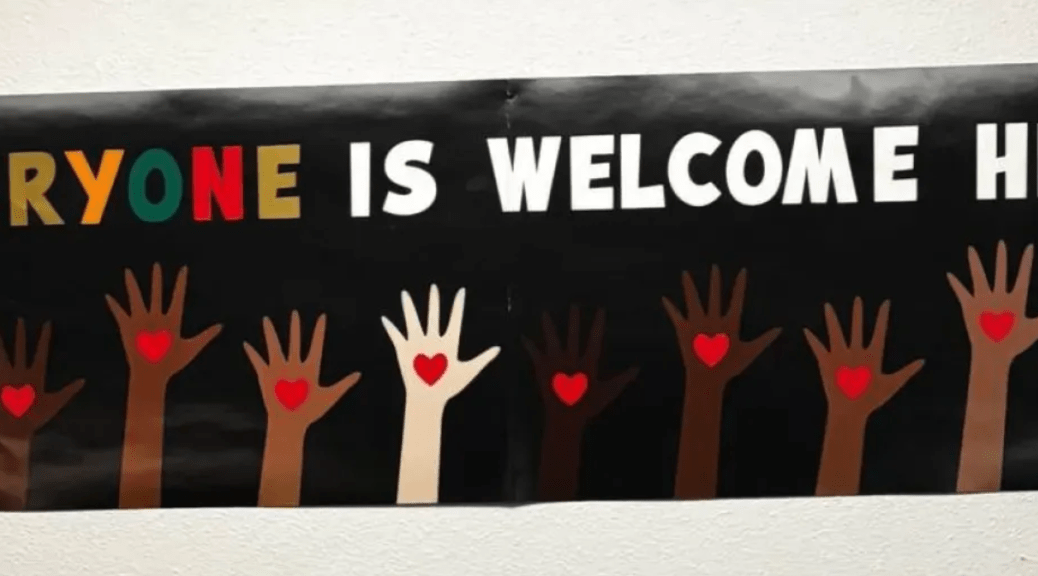
A teacher in Idaho has been told to take down her “Everyone Is Welcome Here” signs. But the most disturbing aspect of this event is the explanation:
In emails shared by the district with the Idaho Statesman, Marcus Myers, the district’s chief academic officer, told Inama to remove the signs because they violated Idaho’s Dignity and Nondiscrimination in Public Education Act, as well as school policy, which requires signs to be “content neutral and conducive to a positive learning environment.”
The district also mentioned to the Statesman that, if it is enacted into law this legislative term, House Bill 41 will force schools to comply with a measure that bans “flags or banners that present political, religious, or ideological views, including but not limited to political parties, race, gender, sexual orientation, or political ideologies.”…
When discussing the “Everyone is welcome here” sign, the district told the Statesman that it was not the message that was at issue, but rather the hands of different skin tones on the poster.”
While ‘Everyone is welcome here’ is a general statement of being welcoming, concerns arose around the specific visual presentation of the signs in question and whether they aligned with district policies on classroom displays,” Scheppers said in an email.
A visual representation of different races now breaks the law in public schools serving the children of this country.
Public schools serving a population of students who themselves are different races.
Those of us warning about the racism and the rise of white Christian nationalism in the Republican party have been rejected, marginalized, and even attacked for decades now.
Not Reagan.
Not Bush One.
Not W. Bush.
And Trump 1.0 was just a buffoon, a clown.
The veneer mostly worked across mainstream America, and anyone seeing behind the facade was the enemy. The problem with this country.
At the end of Trump 1.0, the veil was pulled back as the attacks on CRT ramped up in his last months in office.
Regretfully, the Biden respite allowed mainstream apathy to win out. Again.
Statistically, almost no one in the US is trans, and certainly, almost no athletes are trans in high school and college sports.
But the outsized rage over a minority group tells a story that we cannot ignore. Or we can ignore, but it will be to the peril of everyone.
Because everyone is not welcome here.
MAGA is a people obsessed with other people’s lives and not their own. MAGA is driven by hate, fear, and spite for other people’s happiness because MAGA believe they are safely the “normal” people and they are simply demanding everyone else be normal too.
This is the essential problem with “normal,” since it almost always becomes “right” and then a way to weaponize political power.
History and diversity are being attacked and erased to create a white nationalist state in the US.
Anyone now seeing that claim as extreme is simply being willfully ignorant of the gears of history grinding over a nation that never achieved the freedom it espoused, but until recently seemed mostly committed to that aspiration.
Denying rights and deporting human beings are now the American values replacing life, liberty, and the pursuit of happiness.
“Black Lives Matter” was never an offensive or divisive slogan.
“Give me your tired, your poor, Your huddled masses yearning to breathe free, The wretched refuse of your teeming shore. Send these, the homeless, tempest-tost to me, I lift my lamp beside the golden door!”
My cynical self believes this was always a lie, an aspiration for humans that was beyond our capacity as a species.
My cynical self comes back to this again and again, an eerily relevant warning about our current second coming:
Turning and turning in the widening gyre The falcon cannot hear the falconer; Things fall apart; the centre cannot hold; Mere anarchy is loosed upon the world, The blood-dimmed tide is loosed, and everywhere The ceremony of innocence is drowned; The best lack all conviction, while the worst Are full of passionate intensity.
sometimes she would forget and begin to draw intently in the head of her beer with her little finger nail painted dark dark green
he would watch her rapt (three healing blisters on her palm from climbing) before softly saying and smiling you going to drink that
sometimes she would forget anyone else could be beside her slipping into her solitary garden until a gentle hand or word startled her back to the moment
so when she was alone right there beside him he felt like a fingernail drawing disappearing in the head of a beer no one was drinking
sometimes they would talk about god like playing chess blindfolded or she would take his hand in hers or text him while he was away i have a story for you when you get home
Superhero Black Widow/ Natasha Romanov has endured more than 60 years in the Marvel Universe before becoming a prominent character in the Marvel Cinematic Universe with the Avengers; however, this volume examines how this woman character has mostly been underestimated and hypersexualized. The overview and analysis explore the contradiction between Black Widow’s enduring popularity and the limited commitment to her solo series and character development in print. This discussion centers Black Widow as a representation of the inadequate care and commitment given to women characters in mainstream superhero comics.
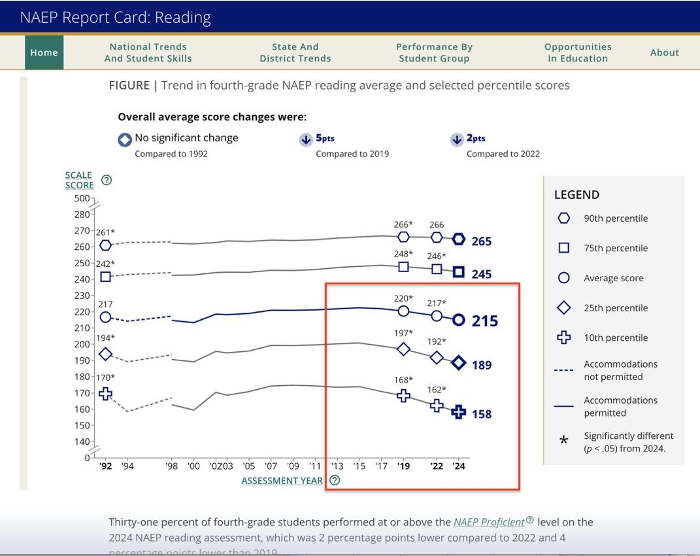
Every two years reading scores make headlines. And this year, as has been the case since COVID, the news is not good. Scores are down (again), and the causes being pointed to for the drop are also wrong (again).
National Assessment of Educational Progress (NAEP) is the national program mandated with tracking student achievement. The 2024 results reveal that reading scores have hit their lowest point in 32 years. This decline is notable because in recent years many states have passed aggressive reading legislation, often labeled as the “science of reading” (SOR).
The SOR movement makes a few key claims: the US has a reading crisis, teachers fail to use “scientific” evidence for instruction, and educators and policymakers are making excuses by acknowledging poverty when addressing low reading proficiency.
However, the Mississippi “miracle” story was an incomplete misreading of reading proficiency and policy.
With the average 2024 NAEP reading scores in further decline, the SOR era in reading reform appears to be failing. This is especially true for vulnerable students whose scores have dropped the most. Interpreting these scores correctly is key to forging a better path forward.
Thus, we must seek a more credible story about 2024 NAEP reading scores.
Let’s consider three sets of data from the Department of Defense schools (DoDEA), Florida, and Mississippi. These student populations include significant racial and socioeconomic diversity as well as multilingual learners and other vulnerable populations of students.
Florida and Mississippi have long been applauded for aggressive education and reading reform, and in 2024, their grade 4 reading scores remained in the top 25% of states, seemingly defying the odds. But Florida and Mississippi scored again well below top-scoring DoDEA schools.
Although many rush to ascribe this success to SOR policies, we should really be looking at a different (ultimately harmful) policy: third-grade retention based on state testing.
As education analysts John Westall and Amy Cummings concluded in a report on reading policy: “[S]tates whose policies mandate third-grade retention see significant and persistent increases in high-stakes reading scores in all cohorts…. [T]here is no consistent evidence that high-stakes reading scores increase in states without a retention component.”
Inflated scores are not learning; by eighth grade NAEP reading scores for Florida and Mississippi drop into the bottom 25% of states. The widely applauded “gains” in grade 4 are, in fact, a mirage.
Here is a different story: DoDEA schools are the top-scoring schools on NAEP tests and tell a story we’ve resisted admitting in the US. Maroun and Tieken found in 2024, replicating decades of similar research, that 60+% of student test scores are not linked to teacher quality, instruction, or programs but to out-of-school factors like socioeconomic background, home environment, and parental involvement to name a few.
While DoDEA schools have significant populations from poor and working-class backgrounds and serve diverse as well as vulnerable populations of children, these students have healthcare, food security, stable housing, and parents with stable work—and consistently high reading scores.
NAEP reading scores, again, are not a story about teacher and reading program failure or even student reading proficiency. These scores tell a complex story about a long history in the US of negligence, the lack of political will to address not only the education of all our children, but also their lives outside of school.
I almost feel sorry for Louisiana. (See Update 2 below)
When the 2024 reading scores for NAEP were released, LA seemed poised to be the education “miracle” of the moment for the media and political leaders.
Since mainstream media seems to know only a few stories when covering education—outliers, crises, and miracles—the outlier gains by LA compared to the rest of the nation, reportedly still trapped in the post-Covid “learning loss,” was ripe for yet another round of manufacturing educational “miracles.”
To maintain the MS “miracle” message, journalists must work incredibly hard to report selectively, and badly.
For example, Aldeman celebrates, again, MS as a outlier for for the achievement of the bottom 10% of students (carelessly disregarding that outlier data is statistically meaningless when making broad general claims):
But one state is bucking this trend: Mississippi. Indeed, there’s been a fair amount of coverage of Mississippi’s reading progress in recent years, but its gains are so impressive that they merit another look.
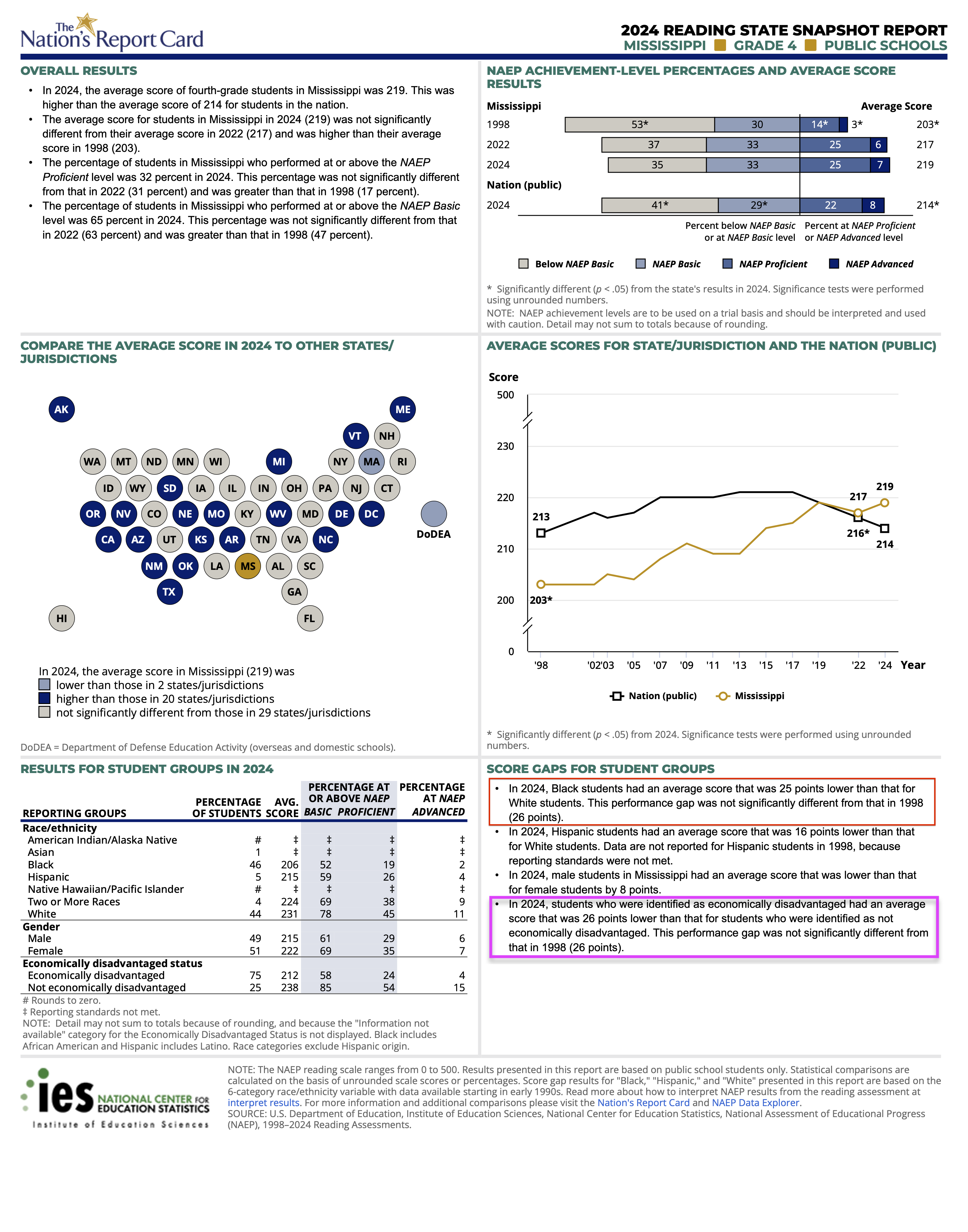
Next, Aldeman highlights reading gains by Black students in MS, omitting a damning fact about the achievement of Black (and poor) students in MS (which mirrors the entire nation):
That’s right, MS has the same racial and socio-economic achievement gaps since 1998, discrediting anything like a “miracle.”
But the likely most egregious misrepresentation of MS as a reading “miracle” is Aldeman “debunking” claims that MS gains are primarily grounded in grade retention, not the “science of reading.”
Notably, Aldeman seems to think linking to the Fordham Institute constitutes credible evidence; it isn’t.
So let’s look at the full picture about grade retention and MS’s reading scores on NAEP.
First, the research on increased reading achievement has found that only states with retention have seen score increases. Westall and Cummings concluded in a report on reading policy: “[S]tates whose policies mandate third-grade retention see significant and persistent increases in high-stakes reading scores in all cohorts…. [T]here is no consistent evidence that high-stakes reading scores increase in states without a retention component [emphasis added].” [Note that Aldeman selective refers to this study late in the article, but omits this conclusion.]
The positive impact of retention on test scores has not been debunked, but confirmed. What hasn’t been confirmed is that test score gains are actual achievement gains in reading acquisition.
Next, MS (like FL and SC, for example) has risen into the top 25% of states in grade 4 reading on NAEP, but then plummets into the bottom 25% of states by grade 8 (despite their reading reform having been implemented for over a decade), suggesting those grade 4 scores are a mirage and not a miracle:
A final point is that media always omits the most important story, what research has shown for decades about student achievement:
Almost 63% of the variance in test performance was explained by social capital family income variables…. The influence of family social capital variables manifests itself in standardized test results. Policy makers and education leaders should rethink the current reliance on standardized test results as the deciding factor to make decisions about student achievement, teacher quality, school effectiveness, and school leader quality. In effect, policies that use standardized test results to evaluate, reward, and sanction students and school personnel are doing nothing more than rewarding schools that serve advantaged students and punishing schools that serve disadvantaged students.
High-poverty states and states with high percentages of so-called racial minorities are not, in fact, beating the odds—again, note that states have not closed the racial achievement gap or the socio-economic achievement gap.
Yes, too often our schools are failing our most vulnerable students. But the greater failures are the lack of political will to address the inequity in the lives of children and the lazy and misleading journalism of the mainstream media covering education.
The goal is de-professionalizing teachers and teaching, not improving student reading proficiency.
Updated 2
The political, market, and media hype over both MS and LA are harmful because that misrepresentation and exaggeration drive the fruitless crisis/reform cycles in education and distracts reform from the larger and more impactful causes of student achievement.
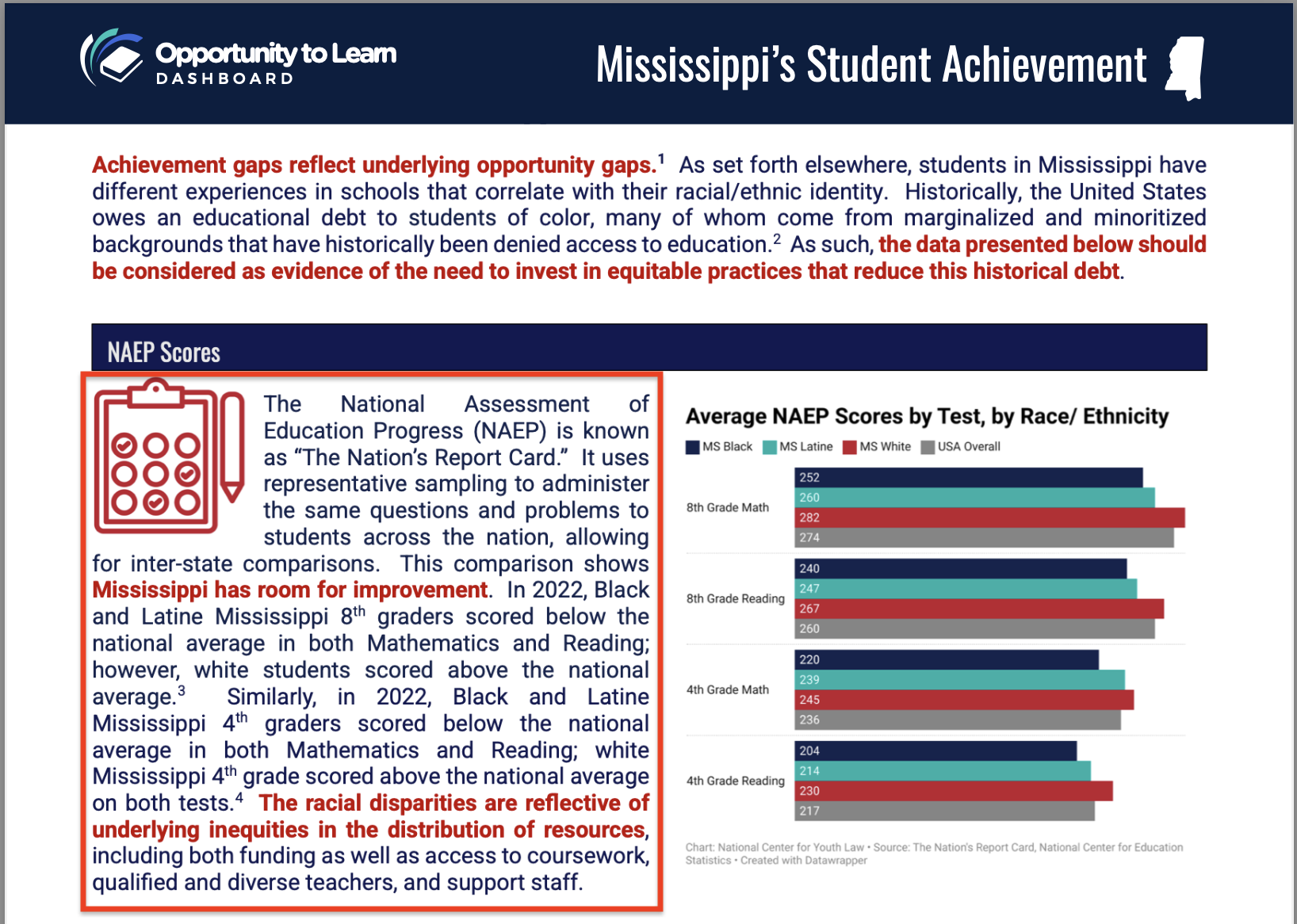
Funded and maintained by the National Center for Youth Law (NCYL) and The Schott Foundation for Public Education, the Opportunity to Learn Dashboard tracks 18 indicators across 16 states. The project seeks to provide information about factors impacting the degree to which children of different ethnicities and races are exposed to environments conducive to learning.
However, indicators directly related to schools explain only a minority of the variation in achievement-related outcomes. Therefore, the dashboard includes out-of-school factors such as access to health insurance and affordable housing, as well as within-school factors such as exposure to challenging curricula and special education spending.
For both MS and LA, we must acknowledge the significant and robust systemic (out-of-school) disadvantages minoritized and impoverished students continue to face in both states:
Note here my points raised about lingering opportunity/achievement gaps exposed by NAEP scores in both states:
To emphasize again, NAEP scores do not reveal education “miracles” in either MS or LA. In fact, NAEP scores continue to show that education reform as usual is a failure.
Arthur Young graduated from high school with honors. However, as an adult, he was illiterate.
Literacy expert Helen Lowe featured Young and concluded:
Arthur could not read, even at a primer level. He could not drive a car, because he could not pass the test for a driver’s license; he could not read the street signs or traffic directions. He was unable to order from the menu in a restaurant. He could not read letters from his family and he could not write to them. He could not read the mixing directions on a can of paint or the label on a shipment of sheet rock. He had been cheated.
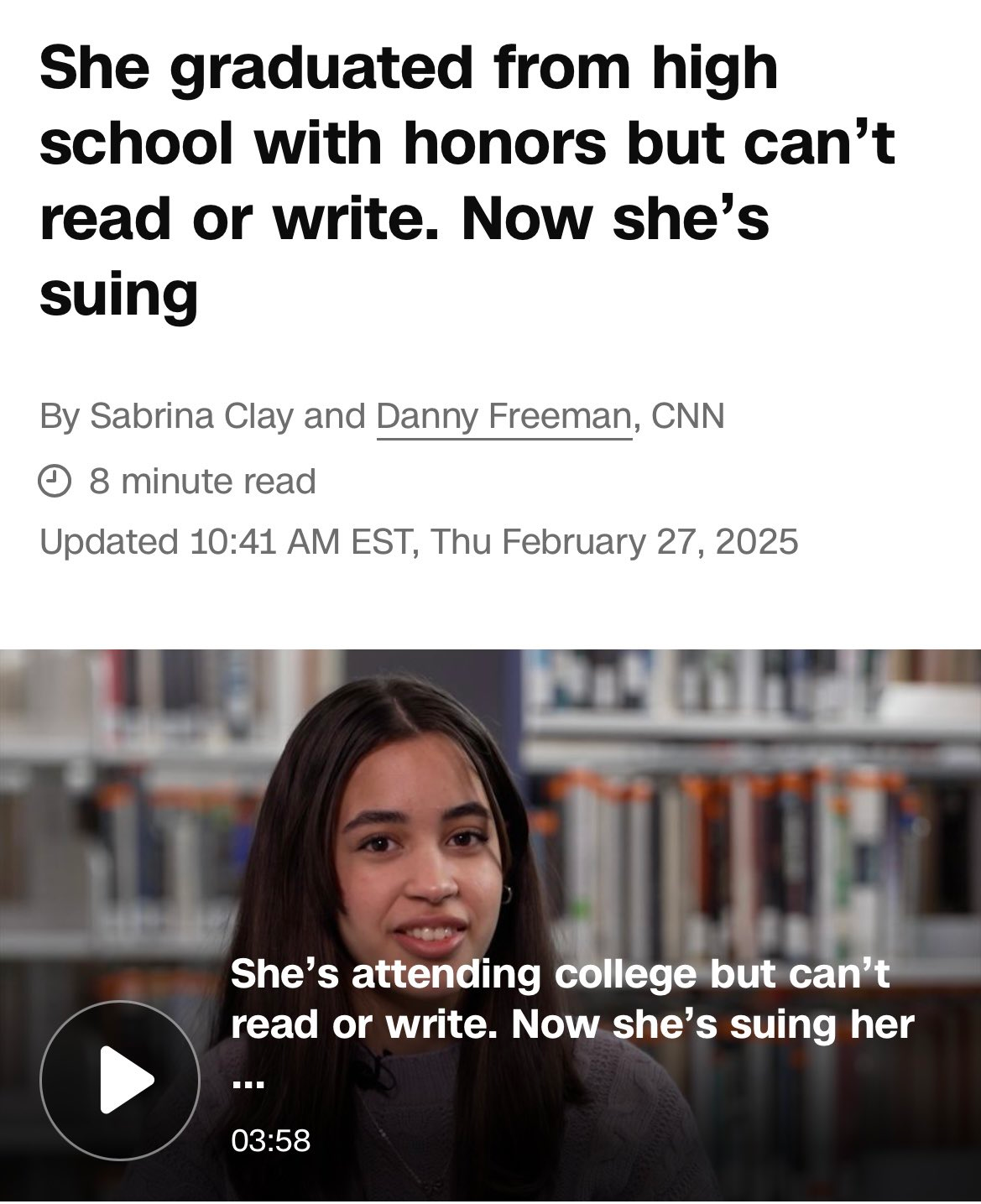
This story may be shocking but also sounds disturbingly familiar to a recent story on CNN:
This young woman, of course, has also been “cheated.”
Both problematic stories seven decades apart are outlier narratives that are both inexcusable failures but are not evidence of any generalizations about education, teaching, or literacy.
Stated bluntly, outliers can never lead to any sort of generalizations.
One of the great failures of public discourse and policy around reading and literacy in the US has been perpetual crisis rhetoric used to drive ideological agendas about what counts as literacy and how best to teach children and young adults to read and write.
If you had a time machine, you could visit any year over the past century in the US and discover that “kids today” can’t and don’t read because the education system is failing them.
These histrionic stories are compelling because they often include real children and adults whose lives have been reduced because of their illiteracy or inadequate literacy.
Ideally, of course, no person in the richest and most powerful country in the world should ever be cheated like that.
But here is the paradox: These outlier stories are distractions from doing the reform and work needed to approach all children and adults being literate.
Once again, reading test data for decades has shown exactly the same reality as all other forms of tests of student learning (math, science, civics, etc.): Over 60% of test scores are causally linked to factors beyond the walls of schools—access to healthcare, food security, housing security, access to books in the homes and communities, and thousands of factors impacting the lives and learning of children.
At best, teacher impact on measurable student literacy is only about 1-14%.
Yet, year after year, decade after decade, the US focuses on teacher quality, curriculum and standards, reading programs, and reading test scores without acknowledging or addressing the overwhelming impact of out-of-school factors on people acquiring the literacy they need and deserve to live their full humanity.
The two stories seven decades apart from above are likely far more complicated than any coverage could detail; the are both compelling and upsetting human stories that deserve our attention, in order to address their individual tragedies as well as taking greater care that others do not suffer the same fate.
However, misreading outlier distractions is not the way to honor that these people have been cheated.
Two things can be true at once: Outlier stories are heartbreaking and inexcusable; however, they prove nothing beyond the experiences they detail.
CNN uses outlier stories for traffic and profit.
Literacy ideologues use outlier stories to drive their agendas as well as to feed the education market.
We are all cheated, once again, when we play the outlier distraction game and refuse to acknowledge and address the crushing realities of inequity in the lives and learning of children.
Each child matters, and all children matter.
Yet, only the adults have the political and economic power to make that a reality.
educator, public scholar, poet&writer – academic freedom isn't free



















 dr. p.l. (paul) thomas