
[This piece has been submitted to national newspapers with no responses.]
[Header Photo by Kelly Sikkema on Unsplash]
Every two years reading scores make headlines. And this year, as has been the case since COVID, the news is not good. Scores are down (again), and the causes being pointed to for the drop are also wrong (again).
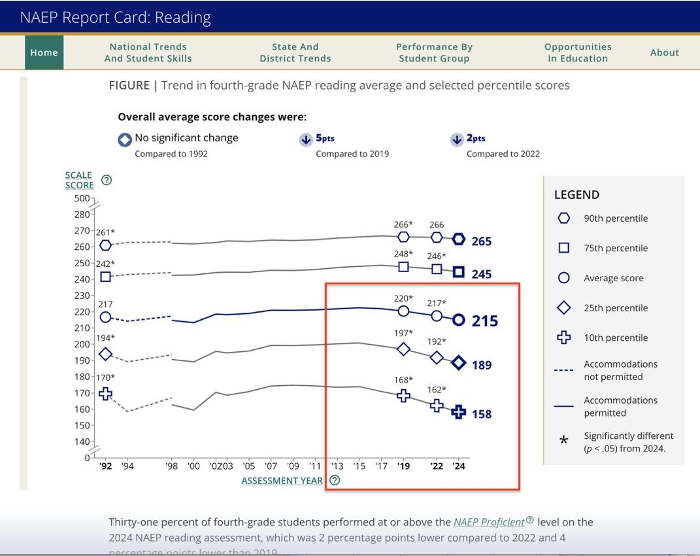
National Assessment of Educational Progress (NAEP) is the national program mandated with tracking student achievement. The 2024 results reveal that reading scores have hit their lowest point in 32 years. This decline is notable because in recent years many states have passed aggressive reading legislation, often labeled as the “science of reading” (SOR).
The SOR movement makes a few key claims: the US has a reading crisis, teachers fail to use “scientific” evidence for instruction, and educators and policymakers are making excuses by acknowledging poverty when addressing low reading proficiency.
When 2019 NAEP reading scores were released, Mississippi was proclaimed a “miracle” state for improving grade 4 reading scores despite being a high-poverty state, implying (without evidence) that those increases were caused by Mississippi implementing SOR policy. In the years that followed, the Mississippi “miracle” became the poster child for other states following the SOR legislative formula; to date 40 states and the District of Columbia have passed SOR legislation.
However, the Mississippi “miracle” story was an incomplete misreading of reading proficiency and policy.
With the average 2024 NAEP reading scores in further decline, the SOR era in reading reform appears to be failing. This is especially true for vulnerable students whose scores have dropped the most. Interpreting these scores correctly is key to forging a better path forward.
Thus, we must seek a more credible story about 2024 NAEP reading scores.
Let’s consider three sets of data from the Department of Defense schools (DoDEA), Florida, and Mississippi. These student populations include significant racial and socioeconomic diversity as well as multilingual learners and other vulnerable populations of students.
Florida and Mississippi have long been applauded for aggressive education and reading reform, and in 2024, their grade 4 reading scores remained in the top 25% of states, seemingly defying the odds. But Florida and Mississippi scored again well below top-scoring DoDEA schools.
Although many rush to ascribe this success to SOR policies, we should really be looking at a different (ultimately harmful) policy: third-grade retention based on state testing.
As education analysts John Westall and Amy Cummings concluded in a report on reading policy: “[S]tates whose policies mandate third-grade retention see significant and persistent increases in high-stakes reading scores in all cohorts…. [T]here is no consistent evidence that high-stakes reading scores increase in states without a retention component.”
In other words, by holding back the lowest performing students in third grade, grade 4 scores appear higher. Florida and Mississippi retain thousands of K-3 students annually.
Inflated scores are not learning; by eighth grade NAEP reading scores for Florida and Mississippi drop into the bottom 25% of states. The widely applauded “gains” in grade 4 are, in fact, a mirage.
Here is a different story: DoDEA schools are the top-scoring schools on NAEP tests and tell a story we’ve resisted admitting in the US. Maroun and Tieken found in 2024, replicating decades of similar research, that 60+% of student test scores are not linked to teacher quality, instruction, or programs but to out-of-school factors like socioeconomic background, home environment, and parental involvement to name a few.
While DoDEA schools have significant populations from poor and working-class backgrounds and serve diverse as well as vulnerable populations of children, these students have healthcare, food security, stable housing, and parents with stable work—and consistently high reading scores.
NAEP reading scores, again, are not a story about teacher and reading program failure or even student reading proficiency. These scores tell a complex story about a long history in the US of negligence, the lack of political will to address not only the education of all our children, but also their lives outside of school.

 dr. p.l. (paul) thomas