
Teaching high school English has a Groundhog Day dynamic that people who have not taught may never consider.
Over my 18-year career as a teacher of high school English, I taught some works of literature more times than I’d like to admit. But let me also note that I often taught some works of literature several times a day and then year after year.
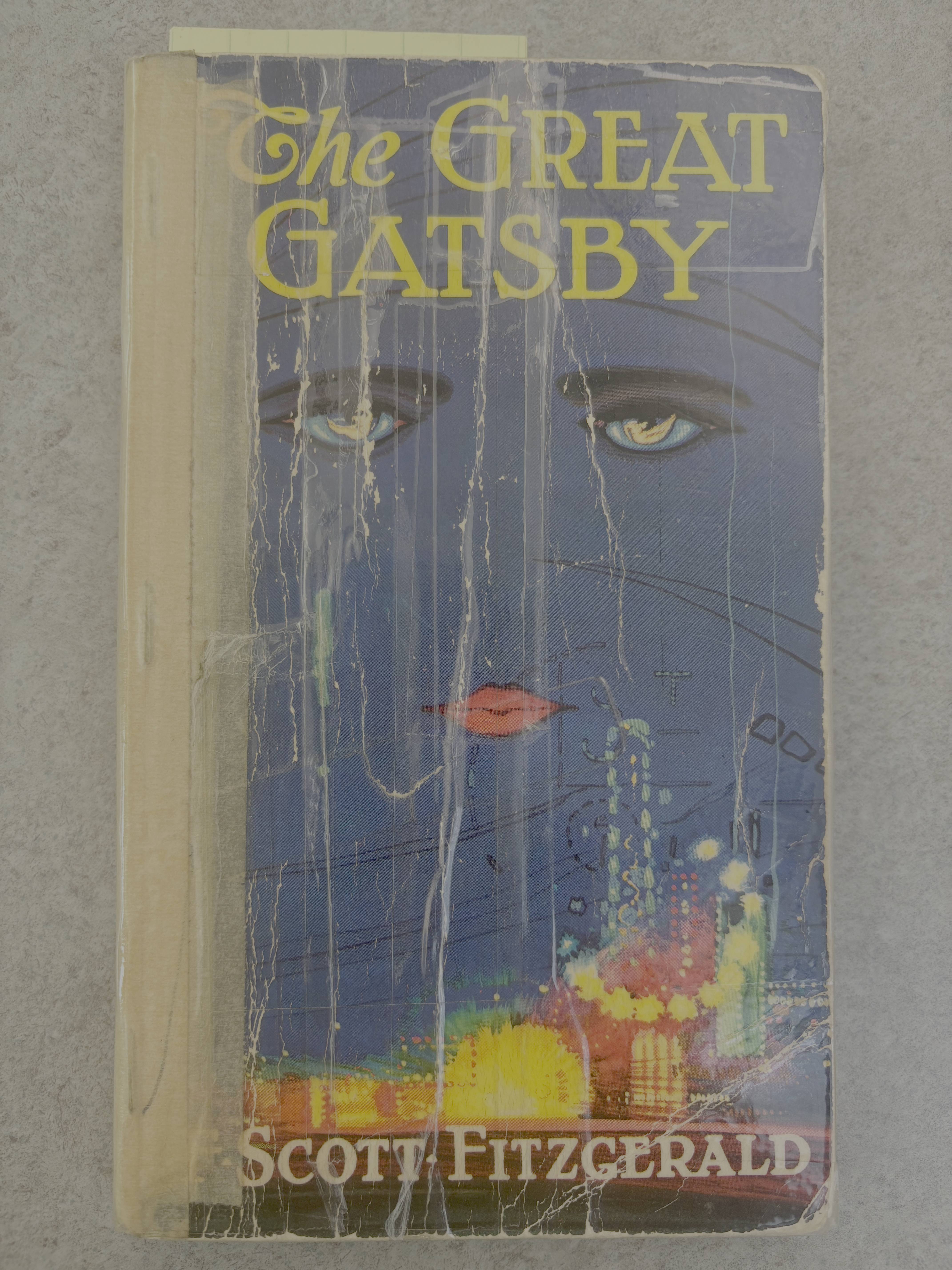
One of those works—that I in some ways loathe—is F. Scott Fitzgerald’s The Great Gatsby, which turned 100 this week in 2025.
Setting aside my own skepticism about the canon and requiring all students to read certain so-called “classics,” among the American literature works I was required to teach year after year after year—The Great Gatsby, The Scarlet Letter, The Crucible, and The Sun Also Rises at the core of those required lists—I must admit that Gatsby was often the most accessible for students (easy to read and the Robert Redford film was a great supplement to the unit).
I prefer Hemingway as a writer to Fitzgerald, but I prefer student choice and more diverse and contemporary works as well.
However, a century on and many students in the US still read and study Gatsby in high school along with a fairly conservative list of works from the slightly expanding canon of American literature.
My point here is not to crucify Gatsby or Fitzgerald or modernist literature (lots there that is worth interrogating), but to confront that how secondary (and college) teachers teach along with how students read and learn from Gatsby in traditional and reductive ways that cheat the novel, cheat students, and ultimately cheat the democratic purposes of public education in a (for now) free country.
“Gatsby Believed in the Green Light”
In a bit of ironic symbolism, if you want to see (literally) my concern about the cultural failure of Gatsby, click here: The Empire State Building is turning into a green light for The Great Gatsby’s centennial (See also It’s Gatsby’s World, We Just Live in It).
This act, of course, is a nod to the color imagery running through Gatsby, culminating in the penultimate paragraph of the novel:
Gatsby believed in the green light, the orgiastic future that year by year recedes before us. It eluded us then, but that’s no matter—tomorrow we will run faster, stretch out our arms farther … And one fine morning—
This reductive and figurative language approach to what this novel shows the reader is about more than the often mechanical way students are required and taught to analyze text (more on that next); while teachers, students, and then the public often “get” that Gatsby is about the American Dream, too often that becomes completely disconnected from the novel itself.
Partly, that happens because that next-to-the-last paragraph can become a sort of idealistic doubling-down on the American Dream that Fitzgerald pretty clearly dismantles over fewer than 200 pages.
When I taught Gatsby, in fact, I required students to read John Gardner’s bi-centennial essay, “Amber (Get) Waves (Your) of (Plastic) Grain (Uncle Sam),” where he makes a distinction that is often missed when studying Gatsby:
That idea—humankind’s inalienable right to life, liberty, and the pursuit of happiness—coupled with a system for protecting human rights—was and is the quintessential American Dream. The rest is greed and pompous foolishness—at worst, a cruel and sentimental myth, at best, cheap streamers in the rain. (p. 96)
Taking Gardner’s figurative language, then, Gatsby’s American Dream (a sort of singular obsession with wealth and Daisy) is just “cheap streamers in the rain,” what has for the most part replaced the essential American Dream—life, liberty, and the pursuit of happiness.
Fitzgerald’s own life being sold to the capitalism of Jazz Age America, both in his relentless production of short stories for income and his alcoholism and partying, sits behind the fictional dramatization of what America had become, what America kept becoming, and how America now has nearly fully erased “life, liberty, and the pursuit of happiness” for “filthy lucre” (as D.H. Lawrence warned just a year after Gatsby was published).
Two dynamics are at play here, I think.
The first is most students like Gatsby because it is short and easy to read (notably more so than reading Edgar Allan Poe or Nathaniel Hawthorne, for example); students also enjoy the melodramatic plot of the novel centered on partying, violence, and adultery.
The second is my larger concern—how we traditionally teach literature in high school through a narrow and distorted New Criticism lens.
Not to wander to deep into the weeds of literary criticism and classroom pedagogy, but most of us can recognize how often high school English classes become “guess what the English teacher wants you to say about this text”—and that guess often includes some literary technique, what I call the “literary technique hunt.”
For high school teachers and students, then, Gatsby become likes most texts being studied—a vehicle for identifying techniques.
Students begin what amounts to an Easter egg hunt; there’s lots of green and yellow (gold) throughout the novel (hint: money), and the job students have is to find the color and identify the symbolism. (It’s how we ruin poetry, for example.)
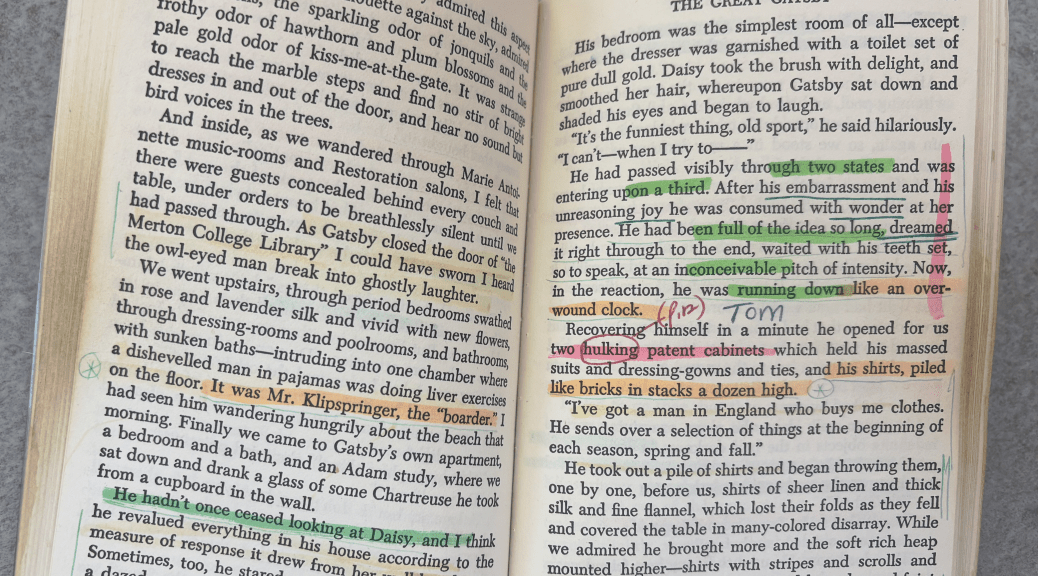
About mid-way through the novel, Daisy encounters Gatsby’s “‘beautiful shirts'” (her own Easter egg hunt), and readers encounter the green light:
“If it wasn’t for the mist we could see your home across the bay,” said Gatsby. “You always have a green light that burns all night at the end of your dock.”…
Now it was again a green light on a dock. His count of enchanted objects had diminished by one.
I want to emphasize here, I am not blaming high school English teachers necessarily because the “literary technique hunt” is a consequence of how formal public education has been reduced to testing (easier to test students finding and identifying literary terms than having them do complex analysis of texts) and teachers and schools are expected to be non-political.
The reductive New Criticism of high school English classes seems objective, then, and offers what appears to be a fixed way to assess students.
It is frustrating, however, that Gatsby is reduced to color imagery and symbolism while most of the racism and bigotry are skirted over or ignored entirely.
“They Were Careless People, Tom and Daisy”
Not that I want to “save” Gatsby on its centennial anniversary, but I am particularly invested in literature and how we teach it (and how we often ruin it for students)—and I am also deeply committed to the role of literature/literacy in our democracy, which is currently in Hospice.
But if we could set aside our reductive New Criticism approaches, and then shift our focus away from Nick and Gatsby and toward Tom and Daisy, we could make Gatsby work for our students and for this country that we seem uninterested in saving.
In the last pages, Nick explicates Tom, and Daisy:
I couldn’t forgive him or like him, but I saw that what he had done was, to him, entirely justified. It was all very careless and confused. They were careless people, Tom and Daisy—they smashed up things and creatures and then retreated back into their money or their vast carelessness, or whatever it was that kept them together, and let other people clean up the mess they made … .
Fitzgerald showed us 100 years ago that America was a wasteland, a product of “vast carelessness.”
Because of our idealism, “our rigid refusal to look at ourselves,” we have chosen to walk to the precipice of America no more.
We seem eager and even gleeful to have chosen “cheap streamers in the rain.”
This is not who we have become, this is who we always were.
Recommended
 dr. p.l. (paul) thomas