
[Header Photo by Tingey Injury Law Firm on Unsplash]
While many fear the irrevocable decline of the US from Presidential executive orders, there appears to be some hope that courts may save us—and recently specifically save public education.
The Supreme Court allowed the Oklahoma Supreme Court’s rejecting religious charter schools to stand, and a federal judge “blocked President Donald Trump’s executive order to dismantle the Education Department and ordered the agency to reinstate employees who were fired in mass layoffs.”
Although likely not as prominent on the national radar, more good news:
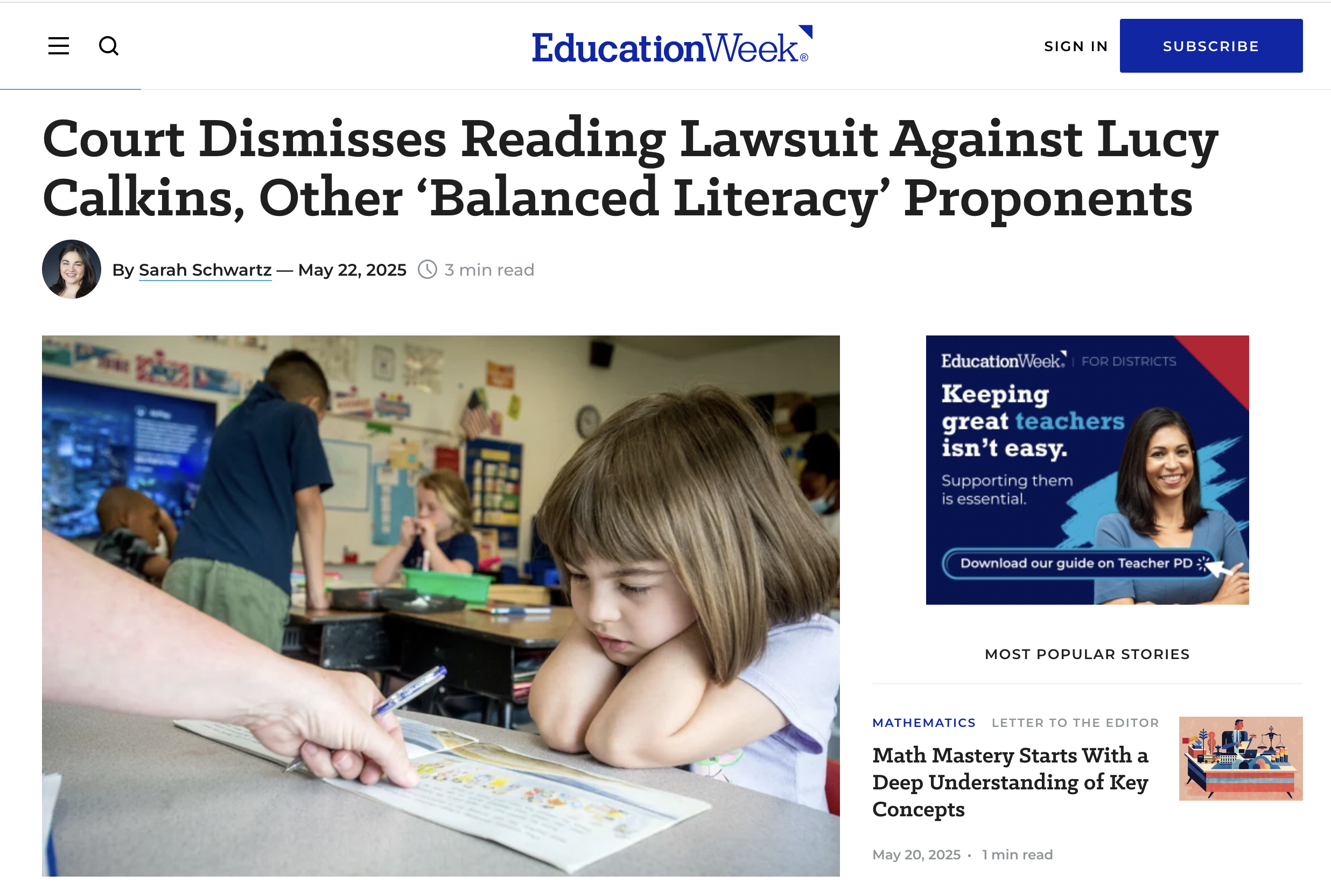
While parents, the media, and political leaders have uncritically supported false claims about reading for about a decade now, this ruling supports what scholars have noted about the “science of reading” (SOR) movement.
For example, Elena Aydarova explains:
Now moving to the reading instruction, there’s a narrative that has been sold to the American public and policymakers. There’s a literacy crisis because teachers do not teach the science of reading because they were not taught the science of reading in colleges of education. I have tried to identify the evidence that was used to construct this claim, and I actually have not found this evidence yet.
And Reinking, Hruby, and Risko directly assert:
A perceived crisis demands attention and creates an impetus for urgently needed solutions. The Course takes that tack, arguing that there is a national crisis in reading and then promoting phonics as the cause (there is not enough of it) and the solution (more of it is needed). As we argue here, there is no indisputable evidence of a national crisis in reading, and even if there were a crisis, there is no evidence that the amount of phonics in classrooms is necessarily the cause or the solution.
To be blunt, the mainstream argument that the US has a reading crisis caused by a few balanced-literacy based reading programs lacks scientific research—a disturbing fact considering that claim is the basis for the SOR movement.
This court decision also comes on the heals of Snopes confronting Secretary of Education McMahon’s claim on social media, “When 70% of 8th graders in the U.S. can’t read proficiently, it’s not the students who are failing—it’s the education system that’s failing them”:
National Assessment of Educational Progress scores are not representative of grade-level performance, per the Department of Education’s website. According to 2022 data, most state reading standards are closer to the NAEP Basic level, and 67% of eighth-graders in 2024 met that standard.
You can add to the fact-free claims of the SOR movement, then, that 2/3 of students are not “proficient” (used incorrectly to mean not on “grade level”) readers based on misrepresenting or misunderstanding NAEP data.
As a country, we have never been happy with the reading achievement of our students. But decades of education reform and the current reading crisis based in misinformation and hyperbole are not serving our students, teachers, or schools well.
All of this reinforces a garbled truism: “A lie can travel halfway around the world while the truth is still putting on its shoes” (a quote misattributed to Mark Twain, somewhat ironically).
Maybe the truth about reading is finally putting on its shoes and will finds its legs.
 dr. p.l. (paul) thomas