Media Manufactured Education Crisis? You Can Count on It

[Header Photo by American Jael on Unsplash]

This fall was the start to year 42 for me as an education, the first 18 as a high school English teacher and the rest as a college professor. I have been noting that career in my presentations at NCTE 2025 in Denver, adding that I am toying with at least making it to year 50.

As I ponder that number, I often return to the sense of awe I always feel when I mention my doctoral work, an educational biography of Lou LaBrant—a former NCTE president (1954) who lived to be 102 and taught for a staggering 65 years (1906-1971).

Approaching 100 and with declining eyesight, LaBrant typed her memoir for the head of the Museum of Education at the University of South Carolina and a key member of my doctoral committee, Craig Kridel.

I was thinking about LaBrant during my presentation yesterday, Recovering Our Reading Dream from a Long Crisis Nightmare, because in her memoir, LaBrant expressed her frustration with the back-to-basics movement during the Reagan administration that orchestrated the 80s education crisis with the melodramatic and misleading A Nation at Risk.

LaBrant noted that over eight decades as an educator she worked through several education crisis cycles and multiple back-to-basics movements—notably the 1940s reading crisis spurred by low literacy rates for draftees during WWII.

While my career pales in many ways compared to LaBrant’s, I feel her pain; with education crisis it is déjà vu all over again.

The only thing, it seems, as common as the media announcing yet another education crisis is people rejecting my arguments against education crisis rhetoric.

And right on cue, after my reading crisis presentation about Tomorrow’s Illiterates: The State of Reading Instruction Today (1961) where I mentioned that our colleagues in math education are now in the crisis crosshair, joining the hyper-intense reading crisis boiling over with “science of reading” advocacy, this morning, I saw this: Editorial: For too many American kids, math isn’t adding up.

The media obsession with declaring an education crisis is so commonplace that I started to just scroll on, but, regretfully, I began to read:

Math scores in the U.S. have been so bad for so long that teachers could be forgiven for trying anything to improve them. Unfortunately, many of the strategies they’re using could be making things worse. It’s a crisis decades in the making.

In the early 20th century, education reformers including John Dewey and William Heard Kilpatrick developed a theory – drawing from the work of Jean-Jacques Rousseau – that came to be known as constructivism. The idea was that learning happens best when students immerse themselves in a problem and find their own solution. By the late 1980s, math standards had embraced “discovery-based learning.”

I expected the lazy and unsupported “math scores” opening, but that second paragraph is the stunner. In 2025, the media still looks for a way to blame John Dewey for the education crisis they repeatedly manufacture.

It was at the core of the reading crisis in the 1940s, and again, in Tomorrow’s Illiterates (1961) noted above

Also in my presentation yesterday, I uttered Dewey’s name and suggested the attendees track down Alfie Kohn’s Progressive Education: Why It’s Hard to Beat, But Also Hard to Find, which does an excellent job of detailing how Dewey’s progressive education is simultaneously blamed and almost never implemented in formal schooling [1].

I immediately posted on social media that the editorial writers could have just search on Wikipedia and avoided the utter nonsense they wrote about constructivism.

Just a few weeks ago, as well, I covered in my 100-level educational philosophy course that behaviorism and constructivism are educational theories (grounded in the scientific method), distinct from philosophies (grounded in rhetoric and logic, such as Dewey’s progressivism).

Learning theories like educational philosophies are contested spaces, but as I plan to share tomorrow in a roundtable presentation, this math crisis editorial triggers several red flags, notably opening the commentary by exposing the editors lack the basic expertise on education to be making any claim of crisis.

If they wanted to blame constructivism, they could have and should have invoked Piaget and Vigotsky (and plenty of “science of learning” folk have already been doing that, often badly and with the sort of caricature I expect).

The media’s education crisis narrative, however, follows a script you can count on—including misunderstanding or misrepresenting test scores, ignoring social context for educational outcomes, and blaming some cartoon version of a leftist education system that, again, has never existed in the US.

When I mentioned Dewey in my presentation, I joked that almost nobody understood Dewey, including Dewey, which, I think, is a pretty good joke because Dewey (and LaBrant) represented a sort of beautiful and illusive scientific approach to their philosophy of education and their instructional practices.

You see, when Dewey progressives say “scientific,” they mean an organic type of experimentation whereby the educator is always in the process of experimenting and drawing real world conclusions that are evolving (it is better, in fact, to think of Dewey’s ideology as pragmatism, associated with William James).

Theirs is a science of teaching and learning that is grounded in and starts with each individual student in the pursuit of skills, knowledge, and critical awareness. This is distinct from essentialist and perrenialist beliefs that begin with knowledge, basic skills, and Great Books, for example.
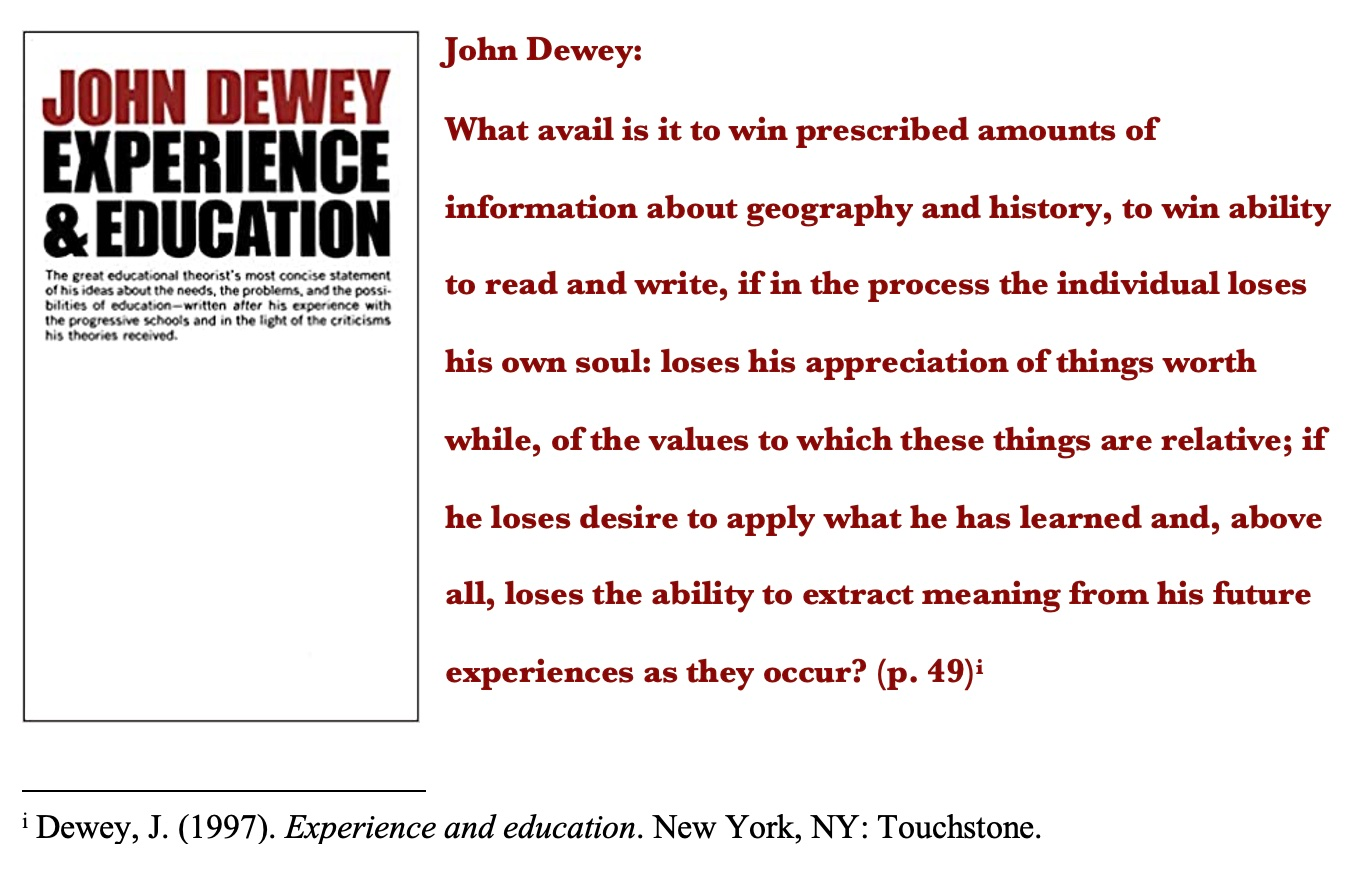
Teaching as an experiment only matters in the practical, not any Platonic ideal, and thus, is never settled (one red flag is when anyone makes a claim and bases that on settled science [2]).

A key reason blaming Dewey or progressive education for any education crisis is misguided is that Dewey himself refused to offer prescriptions, calling for every school and every teacher to seek what works best in the evidence before them, the unique set of students who always change.

In short, in teaching and learning, there is no silver bullet, no script, no program that can or will serve the needs of all students.

You can, if you must, insert any content area—math, reading, writing, civics, science, etc.—and shout “Crisis!” But you will be embarrassing yourself.

Just do a little searching, and I dare you to find a single moment over the past century when someone declared that “kids today” are excelling in math, reading, etc.

My point, which is often as misunderstood as Dewey, is not that current teaching and learning are fine, that I am somehow endorsing the status quo.

I am a critical educator; I became an educator to change teaching and learning, and I am disappointed to say that over my 5-decades career, very little has changed, including the popular urge to declare education crisis.

And what remains most disturbingly unchanged is that a vulnerable population of students have always been and continue to be under-served or nearly completely ignored.

But my point also includes that education reform alone (while needed, just not the mainstream way most often tried over and over) will never serve those vulnerable students, whose measurable education outcomes mostly reflect the inequity of their full lives of which the school day is only a fraction:

Almost 63% of the variance in test performance was explained by social capital family income variables that influence the development of background knowledge. Background knowledge is a known predictor of standardized test results. Family income variables are immutable by schools. Only public policies, outside the control of school personnel, can influence family income.

There is some math the education crisis folk never want to calculate.

If you find yourself worrying about your child’s ability to read or do math, I promise you that Dewey is not to blame.

If you find yourself worrying about other people’s children’s ability to read or do math, I promise you that Dewey is not to blame.

Crisis rhetoric, however, doesn’t help; it never has.

Finger pointing and blame probably aren’t very useful either, especially when those pointing fingers go out of their way to show their blame doesn’t quite add up.

In formal education, we have always had and will always have a range of students who excel, struggle, and fail.

As teachers, our job is to serve them all, and serve them better based on who they are and what they need.

However, teachers and schools alone can never be successful.

If evidence of student failure means anything (and those test scores often don’t), it is that we as a democracy are failing not only those students, but also those children, teens, and young adults—many of whom do not have adequate healthcare, food or home security, or the sorts of lives that universal public education, the so-called Founding Fathers, and, yes, John Dewey envisioned that a free people could guarantee.

If you are looking for someone to blame because of those disappointing math scores, well, I hate to tell you that the enemy is us.


[1] I highly recommend also: LaBrant, L. (1931, March). Masquerading. The English Journal, 20(3), 244-246. http://www.jstor.org/stable/803664. Here LaBrant rejects the misunderstood and misapplied project method in the teaching of literature:

The cause for my wrath is not new or single. It is of slow growth and has many characteristics. It is known to many as a variation of the project method; to me, as the soap performance. With the project, neatly defined by theorizing educators as “a purposeful activity carried to a successful conclusion,” I know better than to be at war. With what passes for purposeful activity and is unfortunately carried to a conclusion because it will kill time, I have much to complain. To be, for a moment, coherent: I am disturbed by the practice, much more common than our publications would indicate, of using the carving of little toy boats and castles, the dressing of quaint dolls, the pasting of advertising pictures, and the manipulation of clay and soap as the teaching of English literature. (p. 245)

[2] For example, the math crisis editorial announces authoritatively and with no links to proof:

Unfortunately, a robust body of research has since found that such approaches often fail early math learners (and readers, for that matter). Math rules and facts such as multiplication tables must be taught explicitly, memorized and mastered through practice. Only when this foundation is established can students progress to more complex concepts. Math, it’s often said, is cumulative.


Recommended

Beyond Caricatures: On Dewey, Freire, and Direct Instruction (Again)

Caricature, Faddism, and the Failure of “My Instruction Can Beat Up Your Instruction”

Deja Vu All Over Again: The Never Ending Pursuit of “Scientific” Instruction
Reading Matters

Poem: be careful (DMZ)

[Header Photo by Антон Дмитриев on Unsplash]

There is only dance music in times of war

“100 Horses,” Geese


be careful
what you allow Them
to call War

Casualties
Collateral Damage
The Enemy

someone should take your hand darling
whisper softly in your ear

there is no DMZ
be careful
what you allow


those bullets are for us
those bullets are for everyone

there are landmines all around
the placement indiscriminate
the destruction is on purpose

and this callousness
is never ending
never ending

there is no DMZ
be careful
what you allow


—P.L. Thomas

The Zombie Politics of Merit Pay for Teachers

[Header Photo by Yohann LIBOT on Unsplash]

The metaphors for education reform are far too easy, and thus, becoming themselves cliches—deja vous all over again, beating a dead horse, and for me, the most apt, zombies.

Education reforms are championed, and then implemented; invariably, these reforms never achieve what is promised—charter schools/ school choice, reading reform, accountability built on (new) standards and (new) standardized tests, and then, of course, merit pay for teachers.

The Editorial Staff at the Post and Courier are trying to resurrect the zombie politics of merit pay: SC teacher bonuses show promise, but rules need spelling out:

It took a whole lot of years, and a state education superintendent who advocates some really smart ideas and some really bad ones, but the S.C. Legislature seems finally to have settled into supporting the idea of paying at least a few teachers based at least partially on performance, rather than simply the amount of time they’ve been teaching and the degrees they have.

This lede seems as hastily written (the double “at least) and thought out. However, one aspect of politics and education reform that my students are currently analyzing is that people tend to rely on their beliefs over empirical evidence when advocating for policies.

Further, “performance” and “simply” are doing some heavy and misleading lifting.

Over 15 years ago while I was researching and writing a book on school choice, I found a fascinating research report from a conservative think tank in Wisconsin (renamed in 2017 from the Wisconsin Policy Research Institute), which had one of the longest and most robust school choice policies in the US.

Despite the study [1] finding choice ineffective, George Lightbourn introduced the report as a Senior Fellow, admitting:

The report you are reading did not yield the results we had hoped to find. We had expected to find a wellspring of hope that increased parental involvement in the Milwaukee Public Schools (MPS) would be the key ingredient in improving student performance.

And later on the WPRI web site (no longer available online), Lightbourne emphasized:

So that there is no misunderstanding, WPRI is unhesitant in supporting school choice. School choice is working and should be improved and expanded. School choice is good for Milwaukee ‘s children.

Here is a key moment in education reform: Despite the evidence to the contrary, the reformers remain steadfast in supporting the policy because they believe in it. [2]

And that brings us to merit pay for teachers, a policy that has been tried over and over (as well as often in the private sector) without ever yielding the outcomes promised.

In fact, research has shown that merit pay produces negative consequences without the positives promised.

A significant aspect of that failure is that decades of research has shown that cooperation and collaboration are more effective that competition, which is at the core of merit pay schemes.

And in education, we must acknowledge that competition is incompatible with the work of educators; under merit schemes, teachers are being incentivized to have their students outperform other teacher’s students—a gross distortion of the ethics of teaching.

Let’s turn back to “performance,” which suggests that all teachers can be objectively or fairly evaluated for the quality of their teaching in the context of dozens of students with an incredibly wide range of abilities.

This always means standardized testing (note here that many teachers work in areas that are not tested, making the merit schemes a nightmare of evaluation or an astronomical increase in testing of students).

The US is only about a decade away from one of the most intense eras of teacher evaluation based on “merit,” the value-added methods policies under the Obama administration.

And here is what the American Statistical Association concluded in 2014:

VAMs should be viewed within the context of quality improvement, which distinguishes aspects of quality that can be attributed to the system from those that can be attributed to individual teachers, teacher preparation programs, or schools. Most VAM studies find that teachers account for about 1% to 14% of the variability in test scores, and that the majority of opportunities for quality improvement are found in the system-level conditions. Ranking teachers by their VAM scores can have unintended consequences that reduce quality.

Teachers have extremely small measurable impacts on tested student learning, and, this is key to note, “the majority of opportunities for quality improvement are found in the system-level conditions.”

Again, the research conflicts with bootstrapping myths in the US, but decades of evidence shows what the ASA discovered, notably in a 2024 study from Maroun and Tienken:

Almost 63% of the variance in test performance was explained by social capital family income variables that influence the development of background knowledge. Background knowledge is a known predictor of standardized test results. Family income variables are immutable by schools. Only public policies, outside the control of school personnel, can influence family income….

The influence of family social capital variables manifests itself in standardized test results. Policy makers and education leaders should rethink the current reliance on standardized test results as the deciding factor to make decisions about student achievement, teacher quality, school effectiveness, and school leader quality. In effect, policies that use standardized test results to evaluate, reward, and sanction students and school personnel are doing nothing more than rewarding schools that serve advantaged students and punishing schools that serve disadvantaged students.

The evidence is overwhelming, then, that there simply is no justification for advocating for or trying again merit pay for teachers.

The scheme will invariably be costly, produce negative outcomes, and not worked as promised by those who simply believe merit pay is the thing to do.

We should pay teachers more, and we should fund and support our public schools in ways that improve the teaching and learning conditions in those schools.

However, the policies that will have the greatest impact on teaching and learning remain social policies such as universal healthcare, food security, housing and home security, access to books in the home, and as Mauron and Tienken argue, a matrix of “public policies, outside the control of school personnel.”

You see, what we need to do is not supported by what many in the US choose to believe despite what the evidence shows us.


[1] Dodenhoff, D. (2007, October). Fixing the Milwaukee public schools: The limits of parent-driven reform. Wisconsin Policy Research Institute Report, 20(8). Thiensville, WI: Wisconsin Policy Research Institute. https://www.badgerinstitute.org/wp-content/uploads/2022/08/vol20no8.pdf

[2] Note that choice advocates in Wisconsin have persisted:

NEPC Review: Wisconsin’s Most Cost-Effective K-12 Program (School Choice Wisconsin, August 2025) https://nepc.colorado.edu/sites/default/files/reviews/NR%20Baker_23.pdf

Poem: the you you used to be

[Header Photo by stefan moertl on Unsplash]

there are moments
i remember
the you
you used to be

they fill my heart
and a piece of me
misses the you
you used to be

although i would never
want to replace
the you you are
with that you before now

because the you
you are now
is all your yous
you have been

except the you
you will be tomorrow
who i will choose over
the you you used to be

—P.L. Thomas

The Reading Crisis that Always Was and Never Is

[Header Photo by Towfiqu barbhuiya on Unsplash]

In 1961, scholar Jacques Barzun declared “we who run businesses, carry on professions, work for the government, or engage in teaching itself are forced to admit that illiteracy is still with us” (xii-xiii).

This was in an introduction to Tomorrow’s Illiterates: The State of Reading Instruction Today.

Well, it is tomorrow, which is today, and here we are: Many Young Adults Barely Literate, Yet Earned a High School Diploma.

I suppose, if you want to look on the bright side of life, we have progressed from “illiterate” to “barely literate.”

But seriously, the reading crisis rhetoric is a paradox because it is a thing that always was and never is.

I strongly recommend Ch. IV: The Whole-Word and Word-Guessing Fallacy, Helen R Lowe from Tomorrow’s Illiterates as a companion to The 74 article for context.

And I highly recommend: Loveless, T. (2023, June 11). Literacy and NAEP proficient (Web log). https://tomloveless.com/posts/literacy-and-naep-proficient/

In short, declaring “kids today” as illiterate or barely literate is mostly adult bloviating for adult purposes.

Yes, we fall short on literacy and we certainly can and should do better, especially for the most vulnerable students.

We shouts of “Crisis!” have never been effective for helping those students, but certainly sells.


NCTE 2025 Individual Presentation: Recovering Our Reading Dream from a Long Crisis Nightmare

11/21/2025 – 2:45 – 3:15, Mile High Ballroom 1A/1B

Access a PDF of presentation HERE

In 1961, Jacques Barzun in Tomorrow’s Illiterates declared “illiteracy is still with us.” Charles Child Walcutt added: “[N]o further ‘research’ into methods of reading instruction is necessary.” This session examines reading crisis/reform cycles to reconsider the stories told about reading and offer a new approach for reform that serves the needs of students and supports teacher professionalism.


Research Highlights “Science of Reading” Fails Equity, Teacher Autonomy, and Social Media Discourse

[Header Photo by Jansen Yang on Unsplash]

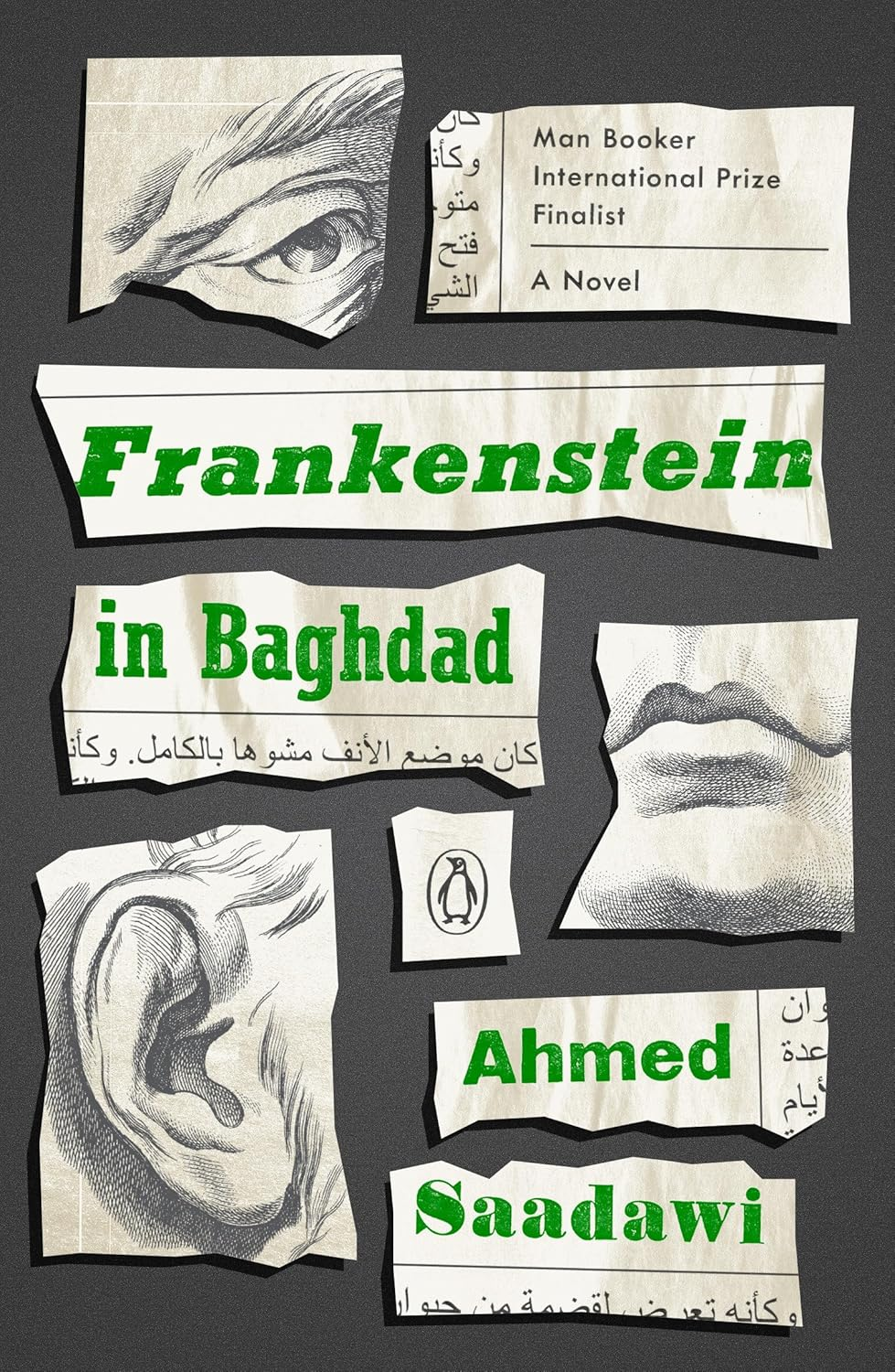
I am currently reading two engaging and often challenging novels—Roberto Bolano’s huge 2666 and Ahmed Saadawi’s Frankenstein in Bagdad.

As an avid reader, writer, and teacher of literacy for over 42 years, I am deeply moved by stories, and both of these novels are engaging because they weave stories together while also forcing the reader to critically engage with the act of story telling itself (especially in Saadawi’s monstrous recreation of the Frankenstein myth).

As a writing teacher I seek to foster in my students not only an awareness of the power of story—the importance of vivid details and the narrative mode—but also the ethical implications of the stories we choose to tell as well as the stories we choose to ignore.

In public discourse, however, we are at the mercy of how traditional and social media portray complex and important topics.

Media creators who are successful are vividly aware of the power of story, and my fields of education and literacy, regretfully, suffer the brunt of compelling but misleading stories across all types of media. For media creators, compelling stories often trump accurate and credible stories.

Ironically, at the foundation of the current reading crisis labeled the “science of reading” (SOR) is a podcast, Sold a Story, that research is gradually exposing for being the mechanism for selling a story that is not credible and is in turn causing more harm than good (except for those profiting off the story).

Here are three relatively recent open-access publications that highlight SOR failing equity, teacher autonomy, and social media discourse:

Dimensions of Equity in the Science of Reading Research: A Systematic Review of Actual, Artificial, and Absent Up-Takes of Equity

JaNiece Elzy-Palmer, Alexandra Babino, Tee Hubbard

Abstract

The Science of Reading (SoR) movement is positioned as a pathway to equity in literacy development, yet little is known about how equity is defined and enacted within SoR scholarship. This systematic review examined 36 peer-reviewed studies published between 2014 and 2024 that addressed both SoR and equity. Using a framework of nine equity dimensions, we analyzed how equity was conceptualized and operationalized across this body of research. Findings reveal that only 17% of screened articles (36/211) engaged with equity dimensions in substantive ways. Analysis showed that equity was primarily conceptualized through access (n = 69) and opportunity (n = 83), with most studies giving limited attention to race, power structures, and the systems that uphold inequities. SoR research primarily focused on three student groups: emergent bilinguals, “struggling” readers without disabilities, and students from low socioeconomic backgrounds, while largely employing race-evasive language such as “diverse” or “struggling students.” By contrast, actual uptakes of equity, though limited, were most often found in international contexts where inclusion and representation were embedded through culturally and linguistically responsive adaptations. These findings highlight a persistent disconnect between SoR’s equity claims and its research base, underscoring the need to integrate transformative justice approaches so that equity efforts move beyond access and opportunity toward systemic change in literacy development.

Teacher Autonomy in Text Choices for Elementary Reading Instruction

Allison Ward Parsons, Kristin Conradi Smith, Margaret Vaughn, Holly Klee, Leslie La Croix, Jane Core Yatzeck

Abstract

Reading in elementary school is central to supporting student reading development. However, a gap exists in current research regarding the types of texts that teachers select for reading instruction and the instructional contexts in which that reading occurs. Teachers’ autonomy to select texts and activities for reading instruction is complex and not well understood. In this exploratory study, we surveyed a stratified sample of elementary teachers (n = 1250) in the United States to understand their perceptions of autonomy surrounding text use. Chi-squared analysis results raise questions of autonomy, access, and equity, particularly regarding digital text usage in younger grades and schools with fewer economic resources. Discussion highlights the differences in teacher autonomy regarding text use across school demographics and instructional contexts. Implications for practice and future research are discussed.

The Science of Reading on Social Media: TikTok Content Creators’ Discourse Patterns and Bodies of Knowledge

Lindsey W. Rowe, Sarah Jerasa, Heather Dunham, C. C. Bates, Tobi Pirolla, Meghan J. Malloy

Abstract

The Science of Reading (SOR) has become a public discourse with educational stakeholders, impacting legislative policy, reading content, curricula, and pedagogy across schools. Public engagement in this movement has transpired on social media, including TikTok, where viral content often promotes narrow or binary viewpoints through an authoritative discourse. Using a digital ethnography and walkthrough method, we collected and examined 156 TikTok videos on #ScienceofReading to address the following research questions: (1) What categories of SOR content are present on TikTok? (2) What are the common narrative trends and bodies of knowledge used to promote the SOR conversation on TikTok? Analyses found that SOR-related TikToks fell into four categories: (1) professional content knowledge, (2) direct demonstration, (3) resources and materials, and (4) identity formation. Furthermore, close analysis of all videos related to professional content knowledge gave insight into the narrative trends used by content creators to convey claims (plain speak, stop/start, brain research, rhetorical question, I used to… now I…), as well as the bodies of knowledge content creators drew on to make these claims (research, SOR, theory or scholar, deep personal experience, no source). Finally, implications are discussed for how this public discourse can shape policies that will ultimately impact schools, classrooms, and literacy instruction.


Related

Thomas, P.L. (2025, Spring). Crisis as distraction and erasure: How SOR fails diversity and urban students. Journal of Literacy and Urban Schools (1), 6-23. https://theliteracyandurbanschoolsjournal.com/wp-content/uploads/2025/10/issue-1-journal-of-literacy-and-urban-schools.pdf

Thomas, P.L. (2025). Breaking free of the “war,” “crisis,” and “miracle” cycles of reading policy and practice. In T.A. Price & M. McNulty (eds.), Public spaces, politics, and policy: historical entanglements with irrational momentism (pp. 93-112). Bloomsbury.

Thomas, P.L. (2025, July 28). There is no literacy crisis in the U.S. Here’s what’s really happening. The Washington Post. https://wapo.st/474j758

Thomas, P.L. (2025). Navigating (another) reading crisis as an administrator: Rethinking the “science of reading” movement. Journal of School Administration, Research and Development, 10(1), 38-48. https://ojed.org/JSARD/article/view/6706

Thomas, P.L. (2024, November). We teach English in times of perpetual crisis: For all ELA teachers, “the time is always now.” English Journal, 114(2), 21-26. https://publicationsncte.org/content/journals/10.58680/ej2024114221

Thomas, P.L. (2024, September). We teach English in times of perpetual crisis: The media continue to misread teaching reading and literacy. English Journal, 114(1), 14-19. https://publicationsncte.org/content/journals/10.58680/ej2024114114

Thomas, P.L. (2024, May). Teaching English in the “science of reading” era: We teach English in times of perpetual crisis: Selling a story of reading. English Journal, 113(5), 16-22. https://publicationsncte.org/content/journals/10.58680/ej2024113516

Thomas, P.L. (2024, March). We teach English in times of perpetual crisis: The long (and tedious) history of reading crisis. English Journal, 113(4), 21-26. https://publicationsncte.org/content/journals/10.58680/ej2024113421

Thomas, P.L. (2023, November). Everything you know is wrong: The “science of reading” era of reading legislation. Perspectives and Provocations, (11), 1-17. https://drive.google.com/file/d/12fAfLV1pCh7ZXV-UFsTftFd7y_MLSK-O/view

Compton-Lilly, C., Spence, L.K., Thomas, P.L. & Decker, S.L. (2023). Stories grounded in decades of research: What we truly know about the teaching of reading. Reading Teacher, 77(3), 392-400. https://doi.org/10.1002/trtr.2258