P. L. Thomas, Professor of Education (Furman University, Greenville SC), taught high school English in rural South Carolina before moving to teacher education. He is a former column editor for English Journal (National Council of Teachers of English), current series editor for Critical Literacy Teaching Series: Challenging Authors and Genres (Brill), and author of Teaching Writing as Journey, Not Destination: Essays Exploring What ‘Teaching Writing’ Means (IAP, 2019) and How to End the Reading War and Serve the Literacy Needs of All Students: A Primer for Parents, Policy Makers, and People Who Care (IAP, in press). NCTE named Thomas the 2013 George Orwell Award winner. He co-edited the award-winning (Divergent Book Award for Excellence in 21st Century Literacies Research) volume Critical Media Literacy and Fake News in Post-Truth America (Brill, 2018). Follow his work @plthomasEdD and the becoming radical (https://radicalscholarship.wordpress.com/).
Join us for a timely and vital conversation on April 16 at 6:30 p.m. ET with Dr. P.L. Thomas, Professor of Education at Furman University. For decades, media and policymakers have pushed a narrative that America’s public schools are “failing.” But who benefits from this story, and who is harmed by it? Dr. Thomas will expose how the education reform industry has fueled a false crisis, undermining trust in public schools while advancing corporate-driven reforms. Drawing on his experience as a teacher, scholar, and national award-winning writer, Dr. Thomas will offer critical insights into how we can challenge disinformation and reclaim a narrative rooted in equity, democracy, and community empowerment.
In light of the PISA 2022 student results, which showed a decline in performance in basic reading skills across Europe, this report presents a detailed literature review of the most recent European and international research on effective approaches to literacy teaching. It highlights practices that have been properly evaluated and are supported by evidence of impact.
Targeted primarily at policymakers, but also relevant to teachers, parents, and all those contributing to children’s literacy development, the report analyses over 600 studies on effective teaching practices (both pedagogical and content-specific), support programmes, and policies that promote literacy for all children across the EU. It covers different levels of education and takes into account gender perspectives as well as the needs of vulnerable and special needs groups.
Based on the key findings, the authors discuss the teaching of comprehension beyond letters and words (e.g. drawing inferences, judging relevance and trustworthiness), the role of dispositional characteristics such as motivation, metacognition, and world knowledge, and the teaching of digital literacy skills, including critically evaluating online information. Building on these findings, they present 20 research-informed recommendations for policymaking.
Teaching high school English has a Groundhog Day dynamic that people who have not taught may never consider.
Over my 18-year career as a teacher of high school English, I taught some works of literature more times than I’d like to admit. But let me also note that I often taught some works of literature several times a day and then year after year.
One of those works—that I in some ways loathe—is F. Scott Fitzgerald’s The Great Gatsby, which turned 100 this week in 2025.
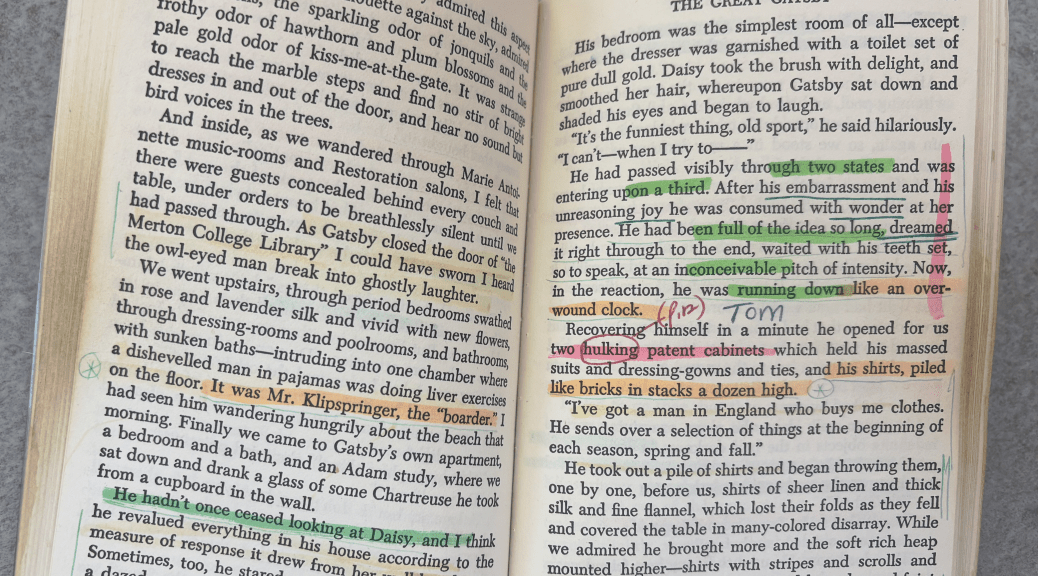
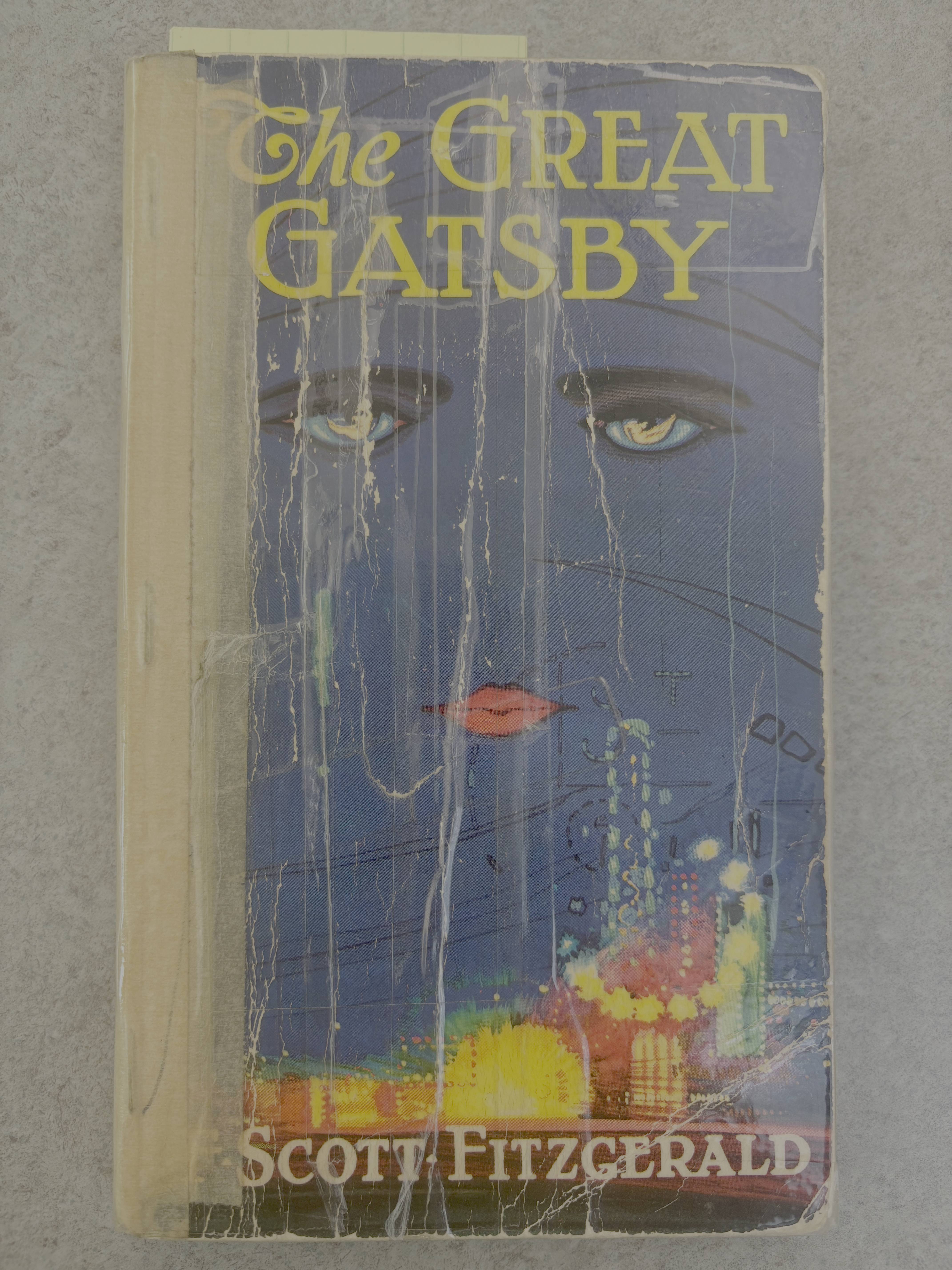
My well-worn teaching copy of The Great Gatsby used to teach high school English from 1984 until 2002.
Setting aside my own skepticism about the canon and requiring all students to read certain so-called “classics,” among the American literature works I was required to teach year after year after year—The Great Gatsby, The Scarlet Letter, The Crucible, and The Sun Also Rises at the core of those required lists—I must admit that Gatsby was often the most accessible for students (easy to read and the Robert Redford film was a great supplement to the unit).
I prefer Hemingway as a writer to Fitzgerald, but I prefer student choice and more diverse and contemporary works as well.
However, a century on and many students in the US still read and study Gatsby in high school along with a fairly conservative list of works from the slightly expanding canon of American literature.
My point here is not to crucify Gatsby or Fitzgerald or modernist literature (lots there that is worth interrogating), but to confront that how secondary (and college) teachers teach along with how students read and learn from Gatsby in traditional and reductive ways that cheat the novel, cheat students, and ultimately cheat the democratic purposes of public education in a (for now) free country.
This act, of course, is a nod to the color imagery running through Gatsby, culminating in the penultimate paragraph of the novel:
Gatsby believed in the green light, the orgiastic future that year by year recedes before us. It eluded us then, but that’s no matter—tomorrow we will run faster, stretch out our arms farther … And one fine morning—
This reductive and figurative language approach to what this novel shows the reader is about more than the often mechanical way students are required and taught to analyze text (more on that next); while teachers, students, and then the public often “get” that Gatsby is about the American Dream, too often that becomes completely disconnected from the novel itself.
Partly, that happens because that next-to-the-last paragraph can become a sort of idealistic doubling-down on the American Dream that Fitzgerald pretty clearly dismantles over fewer than 200 pages.
That idea—humankind’s inalienable right to life, liberty, and the pursuit of happiness—coupled with a system for protecting human rights—was and is the quintessential American Dream. The rest is greed and pompous foolishness—at worst, a cruel and sentimental myth, at best, cheap streamers in the rain. (p. 96)
Taking Gardner’s figurative language, then, Gatsby’s American Dream (a sort of singular obsession with wealth and Daisy) is just “cheap streamers in the rain,” what has for the most part replaced the essential American Dream—life, liberty, and the pursuit of happiness.
Fitzgerald’s own life being sold to the capitalism of Jazz Age America, both in his relentless production of short stories for income and his alcoholism and partying, sits behind the fictional dramatization of what America had become, what America kept becoming, and how America now has nearly fully erased “life, liberty, and the pursuit of happiness” for “filthy lucre” (as D.H. Lawrence warned just a year after Gatsby was published).
Two dynamics are at play here, I think.
The first is most students like Gatsby because it is short and easy to read (notably more so than reading Edgar Allan Poe or Nathaniel Hawthorne, for example); students also enjoy the melodramatic plot of the novel centered on partying, violence, and adultery.
Not to wander to deep into the weeds of literary criticism and classroom pedagogy, but most of us can recognize how often high school English classes become “guess what the English teacher wants you to say about this text”—and that guess often includes some literary technique, what I call the “literary technique hunt.”
For high school teachers and students, then, Gatsby become likes most texts being studied—a vehicle for identifying techniques.
Students begin what amounts to an Easter egg hunt; there’s lots of green and yellow (gold) throughout the novel (hint: money), and the job students have is to find the color and identify the symbolism. (It’s how we ruin poetry, for example.)
About mid-way through the novel, Daisy encounters Gatsby’s “‘beautiful shirts'” (her own Easter egg hunt), and readers encounter the green light:
“If it wasn’t for the mist we could see your home across the bay,” said Gatsby. “You always have a green light that burns all night at the end of your dock.”…
Now it was again a green light on a dock. His count of enchanted objects had diminished by one.
I want to emphasize here, I am not blaming high school English teachers necessarily because the “literary technique hunt” is a consequence of how formal public education has been reduced to testing (easier to test students finding and identifying literary terms than having them do complex analysis of texts) and teachers and schools are expected to be non-political.
The reductive New Criticism of high school English classes seems objective, then, and offers what appears to be a fixed way to assess students.
It is frustrating, however, that Gatsby is reduced to color imagery and symbolism while most of the racism and bigotry are skirted over or ignored entirely.
“They Were Careless People, Tom and Daisy”
Not that I want to “save” Gatsby on its centennial anniversary, but I am particularly invested in literature and how we teach it (and how we often ruin it for students)—and I am also deeply committed to the role of literature/literacy in our democracy, which is currently in Hospice.
But if we could set aside our reductive New Criticism approaches, and then shift our focus away from Nick and Gatsby and toward Tom and Daisy, we could make Gatsby work for our students and for this country that we seem uninterested in saving.
In the last pages, Nick explicates Tom, and Daisy:
I couldn’t forgive him or like him, but I saw that what he had done was, to him, entirely justified. It was all very careless and confused. They were careless people, Tom and Daisy—they smashed up things and creatures and then retreated back into their money or their vast carelessness, or whatever it was that kept them together, and let other people clean up the mess they made … .
Fitzgerald showed us 100 years ago that America was a wasteland, a product of “vast carelessness.”
Every white person in this country—and I do not care what he or she says—knows one thing. They may not know, as they put it, “what I want,” but they know they would not like to be black here. If they know that, then they know everything they need to know, and whatever else they say is a lie.
And then, just a few years later, there is Margaret Atwood’s The Handmaid’s Tale, specifically the closing “Historical Notes” where readers learn about the context behind how Gilead comes about.
At a satirical symposium in Gileadean studies dated June 25, 2195, the keynote, Professor James Darcy Pieixoto, explains that context:
Men highly placed in the regime [of Gilead] were thus able to pick and choose among women who had demonstrated their reproductive fitness by having produced one or more healthy children, a desirable characteristic in an age of plummeting Caucasian birthrates, a phenomenon observable not only in Gilead but in most northern Caucasian societies of the time.
The reasons for the decline are not altogether clear to us. Some of the failure to reproduce can undoubtedly be traced to the widespread availability of birth control of various kinds, including abortion, in the immediate pre-Gilead period. Some infertility, then, was willed, which may account for the differing statistics among Caucasians and non-Caucasians.
…But whatever the causes, the effects were noticeable, and the Gilead regime was not the other one to react to them at the time. Rumania, for instance, had anticipated Gilead in the eighties by banning all forms of birth control, imposing compulsory pregnancy tests on the female population, and linking promotion and wage increases to fertility.
What are these texts from over four decades ago telling us about the current political and cultural state of the US during the era of Trump/MAGA?
White Americans, notably the white political and cultural leaders, are openly concerned about the low birthrate among white people. And thus, restricting and banning abortion have swept much of the country after the overturning of Roe v. Wade. [1]
Not that long ago, mainstream thinkers believed Roe v. Wade and abortion rights were safe in the US; people raising concerns were considered alarmists.
Now, as Republicans and conservatives seem to be coming after birth control next, we cannot hesitate as we did before the dismantling of women’s rights came as we should have known it would.
In the passage from the “Historical Notes,” we have a key point about the birthrates of white people falling against the rise of birthrates about other races.
And thus, the connection to Baldwin’s confronting “every white person in this country—and I do not care what he or she says—knows one thing. … [T]hey would not like to be [B]lack here.”
Not to speak for or over Baldwin, but to help us tease out this connection in 2025, white fear in the US is fear not singularly grounded in race but ultimately fueled by the fear of becoming a minority.
We must next consider fully Baldwin’s recognition that for white people, Black people and the consequences of their minority status in the US are a mirror for who white people are—more so than any commentary on Black people themselves.
For all the histrionics denying white privilege, white people know one thing—that white people as the majority, that white people with the balance of power, used that majority status and power to the detriment of any and all minorities.
If and when white people become the minority, they fear that they will then suffer the same consequences of minority status that white people have imposed on other races in the US.
White people cannot fathom a world in which majority and minority statuses do not result in some winning because others are losing.
The Great Whitewashing is upon us—one foreseen by Baldwin and Atwood.
One that is coming to fruition before our eyes.
What every white person knows may destroy everything for everyone.
What each white person does now will tell everyone everything we need to know.
Through my journey with clinical anxiety, I have come to realize that anxiety is not a monolithic thing for all of us even as our own personal anxiety may be of a specific kind.
None the less, I think it is fair to say that anxiety comes from a disconnect between our inner selves and the the world around us, especially when that disconnect seems oppressive, judgmental, and inescapable.
Sometimes anxiety is the result of recognizing who we truly are is unlike how we are expected to be or how we perceive most other people to be. Other times, anxiety is the result of becoming (too) aware of impending doom—both the possibility of something real that is foreboding but (too) often a manufactured doom that isn’t realistic or rational.
For what most or many people simply consider living or the human condition, we anxious are fully charged with an awareness, an expectation of impending doom.
I suspect that all humans long for a sort of life that allows us to be fully who we are, and thus, I have always been drawn to a simple but now fully dismantled American ideal, guaranteeing all humans life, liberty, and the pursuit of happiness.
What a beautiful thing, filled with a sort of relief that allows our full humanity—the pursuit of happiness.
My existential self finds this wonderful because I believe the pursuit of happiness is itself happiness, like Sisyphus and his rock, “The struggle itself toward the heights is enough to fill a [hu]man’s heart. One must imagine Sisyphus happy.”
There is a sort of paradox to this pursuit of individual happiness, however, a paradox that is expressed by Eugene V, Debs:
Your Honor, years ago I recognized my kinship with all living beings, and I made up my mind that I was not one bit better than the meanest on earth. I said then, and I say now, that while there is a lower class, I am in it, and while there is a criminal element I am of it, and while there is a soul in prison, I am not free.
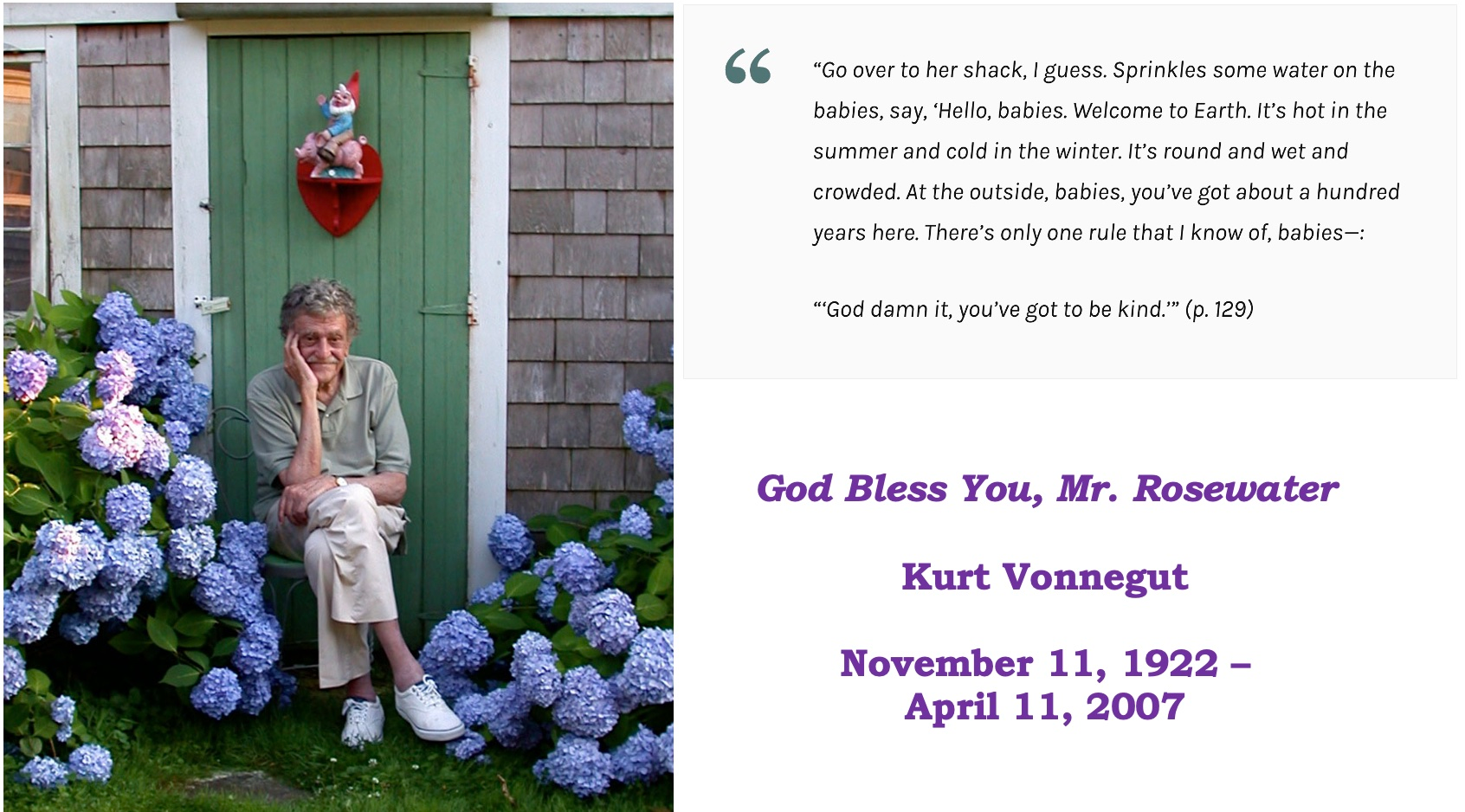
And then, in this fiction of Kurt Vonnegut, whose life and work were inspired by Debs:
There is another paradox.
Writers and thinkers were the first experiences I had with recognizing other people who thought like me existed, unlocking a sort of awareness that I was mostly unlike the people and place of my birth and young life.
One of those first authors for me was J.D. Salinger and the small novel-in-two-parts Franny and Zooey.
Salinger appeared to be himself on a sort of personal journey to awareness, one that was grounded in something like a Christian mysticism. Eventually the bulk of Salinger’s work was grounded in the Glass family with a Christ-figure, Seymour, who commits suicide but remains the moral core for his siblings.
That is where Franny and Zooey sits, one of Seymour’s brothers, Zooey, and his sister, Franny, continuing their own spiritual quests—”a sort of prose home movie.”
While Salinger’s fiction laid the groundwork for me as a reader and writer, he also taught me a much harder and uglier lesson. Salinger himself, Salinger the real-world man, proved to be not only incapable of fulfilling the idealized spiritual goals he wrote about through Seymour, but also incapable of being a decent human being.
And despite his failures as a person and the now insensitive choices he made for Seymour as the speaker of Jesus-like parables, the end of Franny and Zooey fits into the continuum the reached my embracing Debs and Vonnegut (above) and then, below, David Lynch.
Seymour mentored his siblings while all the children were performers on a radio show; Seymour implored them all the be their best for the “Fat Lady,” his metaphor for the least among us, an uncomfortable but sincere effort at teaching these children Christian charity and love.
As Franny is crumbling mentally, Zooey explains: “But I’ll tell you a terrible secret—Are you listening to me? There isn’t anyone out there who isn’t Seymour’s Fat Lady.”
And then Zooey continues: “Don’t you know the goddam secret yet? And don’t you know—listen to me now—don’t you know who that Fat Lady really is? … Ah, buddy. Ah, buddy. It’s Christ Himself. Christ Himself, buddy.”
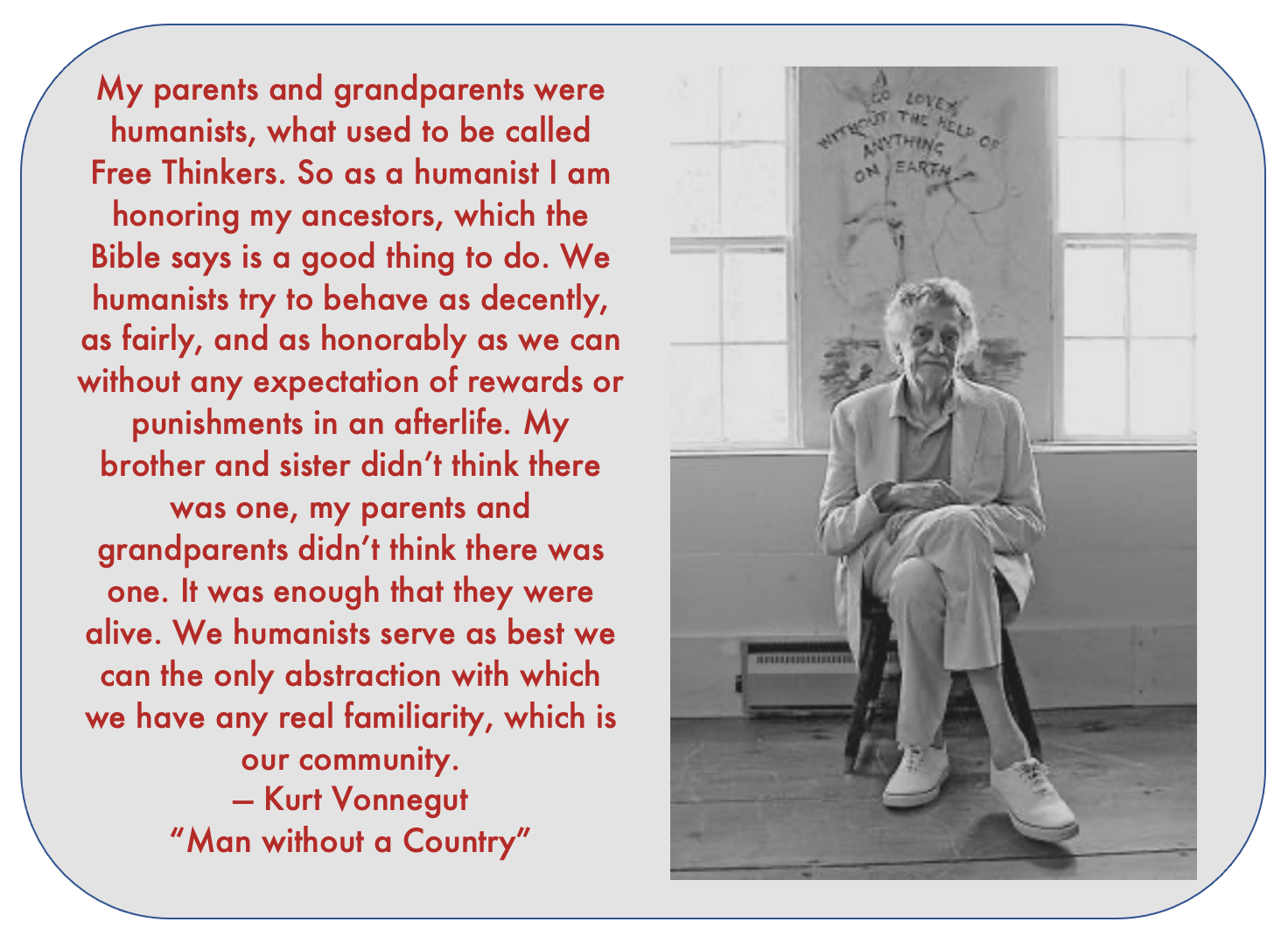
Not a paradox at all, but Salinger’s humanistic and even practical rendition of Christianity makes perfect sense as I found and settled into Vonnegut’s persistent efforts to spread the message of Christian kindness through his own humanism and atheism:
On a smaller scale than Salinger, I had to realize that Vonnegut, too, struggled to be the human he asked all of us to be—although on balance, I think Vonnegut was just flawed in the ways most of us are because we are human.
What causes me greater sadness and, yes, anxiety, is that in our current world, the dominant Christians in the US are collectively as horrible as Salinger was on the individual level.
We are a people bereft of kindness, Christian charity, Christian love.
We are a people aggressively imposing hatred and fear onto others.
I have always been a skeptical person, but now I am slipping—as many do as they grow older—into perpetual cynicism.
I want to believe that it is possible to live the life we want, to be our full and true selves—life, liberty, and the pursuit of happiness—while dedicating ourselves to insuring that everyone has that freedom as well.
Our happiness and the happiness of others are not in tension, in competition.
Our happiness and the happiness of others are dependent on each other.
The weight of my cynicism is harder and harder to carry into my mid-60s.
But there is one person who seems to have found something, found some way to live the ideals that I also embrace and believe with my entire self would make our lives collectively happier, erasing our anxieties.
Maybe these ideals are beyond the capabilities of human beings.
Now we are back to Vonnegut who played around with the essential flaw in humans—”the only true villain in my story: the oversized human brain.”
It is harder and harder each day, but I keep trying to have hope, hoping Maggie Smith is right: “This place could be beautiful,/right? You could make this place beautiful.”
My high school English teacher and eventual mentor, Lynn Harrill, told me in my junior year that I should be a teacher.
I laughed, and certainly as teens are apt to do, hurt his feelings.
Almost fifty years later, and I have been a career educator since 1984.
I realized I wanted to be a teacher and a writer during my junior college years—the former because I had a job as a tutor and the latter because my speech teacher, Steven Brannon, introduced my to e.e. cummings.
I declared my secondary English education major when I transferred the fall of my junior year. And then, almost immediately, I learned a harsh lesson about becoming an education major: It was a “lesser” degree.
I took as many English courses as I could as an undergrad, and in ever class, I had to out myself as an education major, not an English major (almost most of my close friends were English majors).
Over the next five decades, I have had to navigate that “lesser” status when I tried to enter an MFA program while teaching high school full-time (nope), tried to apply for a PhD in English while teaching high school full time (nope), and then completed an EdD (yet another “lesser” degree to go with with my BA in English Education and MEd).
And since 2002, I have had to correct people who assume I am in the English department; nope, I am in Education.
In the good ol’ U.S. of A., as well, the standard beliefs are that education is failing, teachers are people who can’t do (and were mostly weak students themselves), and the discipline of education is a joke.
Just as a recent example, see this on social media:
Why does Hattie's plagiarism & misconduct matter?
Because it exposes the lie at the heart of what is called the 'science of learning', 'evidence-based' or 'education reform' movement.
This movement is not about 'science', but about 'management science', and it's destructive ⬇️ https://t.co/ODuGOTdAX5
Visible Learning, promoted by Tom Bennett, Nick Gibb, Carl Hendrick, & Daisy Christodoulou in the most glowing terms, is a far deeper & more pernicious myth than any of these.
I have recently submitted a book chapter, in fact, on two “pernicious” fads in education—grit and growth mindset.
However, I believe the standard attacks on education, teachers, and then the discipline of education are gross oversimplifications that miss almost entirely the real problems (what Vainker is addressing above and what I am confronting in my chapter on grit and growth mindset).
There are layers to the problem.
First, education as a discipline is robust and valid. My own recognition of that, however, did not fully develop until my EdD program where I was engaged with the scholarship, philosophy, and theory of the field of education—and not distracted by issues of certification and bureaucracy.
Now, that means when people are attacking “education” and the “pernicious fads” they are in fact not criticizing the discipline.
Here are the layers of problems that dilute a valid field:
Certification and accreditation bureaucracy. Regretfully, education is a profession that feels compelled to mimic more respected fields like medicine and law, where credentials are required. However, that layer has more often than not been reductive for the discipline because of the inherent flaws with credentialing and bureaucracy.
The education market place. The current “science of reading” (SOR) movement is repeating what happened during the Common Core era—the education market place using branding (SOR, CC) to spur purchasing cycles in education. To be blunt, the single most powerful and corrupting aspect of education as a field is the market. Any credible or valid education research is necessarily reduced when it is packaged and sold; this is exactly what happened with multiple intelligences, learning styles, grit, growth mindset, etc., creating the perception that the research isn’t credible instead of acknowledging that the marketing is the problem (although in some cases, the market is perpetuating flawed research as well). In short, education reform is an industry, not a process for improving teaching and learning in the US.
Education celebrities. A parallel problem with education market forces is the education celebrity who corrupts the field of education by selling programs, fads, or themselves as “experts” (and sometimes, all of these at once). This is a problematic concern since many of us who work in education, of course, are paid as professionals. Simply being paid as a professional is not something to criticize in a capitalistic society, of course, but money can and does corrupt. One of the best (worst?) examples of how an education celebrity can distort significantly credible and valid research is Ruby Payne, who cashed in (literally) on NCLB mandates and funding. Payne peddled stereotypes about poverty and teaching children in poverty—even though a robust body of research on poverty refuted nearly everything she packaged, promoted, and sold. Part of the problem here is that education celebrities and the market can easily prey on education and educators because the US has been politically negligent in providing schools, teachers, and students the sort of conditions in which all children can learn.
Sexism. Here is a fact at the core of many problems in education: More than 7 out of 10 K-12 teachers and most teacher educators/scholars are women. I leave this as the last point for emphasis because I believe sexism is the foundation of why education remains disrespected as a field and why there is so little political and public support for teachers as professionals (note the current rush to support scripted curriculum as one example). The current focus on “science,” as well, is another sexist movement (repeating the same sort of claims during NCLB) since the quantitative/qualitative divide in what research matters is highly gendered (men do “hard” science, but women do “soft” science).
Bashing student achievement, school and teacher quality, and teaching as a profession as well as education as a field are all a sort of lazy and unexamined national past time in the US.
These sorts of attacks and criticisms are shrugged off as common knowledge and even jokes; again, I believe, primarily because we still see teaching as just something women do with children.
While there is some validity to criticizing educational research that is packaged and sold, this is not something unique to education as a field.
Consider as just one example the perversion of the 10,000 rule in psychology, and the power of Malcolm Gladwell as “celebrity” to do just that.
Psychology and economics, in fact, have experienced crises of replication that should tarnish those fields at least as much as how we marginalize education.
Yet, psychology and economics are seen as men’s professions, and thus, professions, and receive a huge pass when they simply do not deserve that.
We should stop bashing education as a field, but we should also be far more vigilant about protecting educational research and practice from the corrosive impact of bureaucracy, the market, celebrities, and sexism.
The article below appears in Rethinking Schools and brings together several problems with and connections between the “science of reading” and book banning/censorship movements that I have been address since 2018.
Although the “culture war” and “reading war” have been described as separate causes promoted by disparate organizations, their stories are more connected than they appear. Both book banning and SoR dogmatism limit what teachers can teach and what students can read, narrowing the ability of public schools to address children’s diverse needs. We see this most explicitly in conservative parent groups, including Moms for Liberty, who have made it clear they endorse both. This should be a wake-up call to critically examine the potential impact of phonics-based policies on public school students and teachers.
Thomas, P.L. (2024, May). Teaching English in the “science of reading” era: We teach English in times of perpetual crisis: Selling a story of reading. English Journal, 113(5), 16-22. https://publicationsncte.org/content/journals/10.58680/ej2024113516 [Access HERE until open access at EJ]
Thomas, P.L. (2023). The “science of reading,” education faddism, and the failure to honor the intellectual lives of all children: On deficit lenses and ignoring class and race stereotyping. Voices in the Middle, 30(3), 17-21. https://publicationsncte.org/content/journals/10.58680/vm202332439
Education reform, however, was never about improving learning or teaching, but about ideological agendas, conservative agendas.
The crisis/miracle cycles started with that Texas “miracle,” but included the Chicago “miracle” (to bolster Arne Duncan), the DC “miracle” (to promote Michelle Rhee’s grift), and the Harlem “miracle” (that solidly merged education reform as bi-partisan under Obama with the help of grifter Duncan).
What may prove to be the most successful (and harmful) “miracle,” however, is the media manufactured Mississippi “miracle,” grounded in 2019 NAEP scores.
Six years later, the real end game of these manufactured and false “miracles” are merging with an initial effort by W. Bush—de-professionalizing teachers with scripted curriculum. Note the connection in a recent misleading but recurring endorsement by Patrinos (from the Department of Education Reform, funded by Walton money in Arkansas) of that Mississippi “miracle”:
After taking a swipe at NCTE, Korbey makes the same but false connection as Patrinos above:
Nearly all the states that have seen reading scores improve recently – including Mississippi, Louisiana, Tennessee and Alabama – have changed state law to encourage districts to choose from approved lists of HQIM.
Conveniently omitted in public advocacy and endorsements of scripted curriculum, is that this is a correlation; however, research has shown that curriculum, instruction, and teacher training are not the keys to increased test scores. Grade retention is:
[S]tates whose policies mandate third-grade retention see significant and persistent increases in high-stakes reading scores in all cohorts…. [T]here is no consistent evidence that high-stakes reading scores increase in states without a retention component.
And another omission is that research has shown scripted reading programs de-professionalize teachers, fail to serve the individual needs of students, and have “whitewashed” the curriculum, alienating the most under-served students in our schools [see Recommended below].
And thus, the end game:
Musk: If you have a classroom of 25 or 30 kids, it is literally impossible to spend time with every kid individually or you can spend to little time.. But what you can do is set them up with ai.. pic.twitter.com/tAcySW2zTE
Education reform is dedicated to perpetual education crisis for market and political goal.
Scripted curriculum, then, is not designed to improve reading proficiency, but to create one more step toward AI replacing teachers the same way self-checkout replaced cashiers in our grocery stores.
Mainstream media loves a compelling story. And, regretfully, media tends to care very little how accurate or complete that story is.
Media coverage of education is almost entirely a series of misleading stories grounded in either crisis or miracle rhetoric.
One of the darlings of the media is the charter school, the one aspect of the school choice movement that has garnered bipartisan support.
However, as a type of school choice, charter schools must market themselves and recruit. So when media and school marketing combine, I urge “Buyer Beware”:
Here, The State (Columbia, SC) has platformed the principal of a charter school, who makes a couple important (but misleading) claims: the charter school is exceptional and that is because the school practices separating boys and girls for instruction.
“Exemplary High Performing School” is causally connected by Wooten to the boy/girl instructional segregation; however, rarely can a school conduct the sort of scientific research in-house to determine causation, and more importantly, student achievement (test scores) remain overwhelmingly a reflection of the students’ socioeconomic status (60+%), not the school, instruction, or teacher quality.
Here is the missing parts to this story:
Note that Langston Charter Middle has the third lowest poverty index (PI) in the state (12.9), and for comparison, in the same district, the Washington Center has one of the highest PI (96) in the state. [Note that Greenville has a incredibly wide range of low and high poverty schools because the district is large and covers an area of the state with significant pockets of poverty and affluence; and thus, neighborhood schools tend to reflect that socioeconomic reality.]
Further, if we look at Langston Charter Middle’s state report card, the “exceptional” seems to be missing:
Yes, the academic achievement is “excellent,” but again, this data point reflects mostly the very low PI for the students being served.
Note that when Langston Charter Middle is compared to schools with similar student demographics (Daniel Island School, 8.2PI, and Gold Hill Middle, 11.5 PI), the “exceptional” appears to be typical among similar schools:
Media and marketing do more harm than good for public education. When the media is fixated on incomplete and misleading stories and schools feel compelled to market themselves for customers, we all lose.
The OpEd run by The State is not about an exceptional school or the success of separating girls and boys for instruction (although that does speak into a current political ideology that wants this to be true).
The story, as usual, is incomplete, and the marketing is at best misleading.
Once again, many in the US do not want to hear or see the full story: Our schools and student achievement mostly reflect the socioeconomic status of the students’ parents, homes, and communities.
When it comes to media coverage of our schools, I must emphasize: Don’t buy the story being sold.
My mother was extremely smart and had a remarkable sense of humor. Even at the worse moments in her life, she found humor and insight. One day, as my sisters and I were playing (and fighting) in the house because of rainy weather, she called out to none, some or all of her three children, “Hey, do you want to know a way to lose twenty pounds of ugly fat?” We stopped our bickering and turned to her, waiting for her to reply to her own question. “Cut off you’re your head,” she said and quietly continued making dinner. Her remark cut through the tension and led to some whole-hearted laughter.
I think of my mom today as I try to understand what it means for a country to work on becoming more efficient. My mom was right: your body would be twenty pounds lighter if you removed your head. That’s an efficient solution to a weight problem. The problem is the effect: you’d most certainly die. Indiscriminately removing something that’s weighty may not be good for the body of the whole.
In a country striving to be a democracy, the tension between efficiency and effect is crucial. Tom Paine said that in a democracy, law is king, and in a monarchy, the king is law. The latter is an efficient way to get laws made and enforced, with the king having power over both the laws and their implementation. The problem is the effect on the people living within the country in that they all work for the king, for the perpetuation of the monarchy, and suffer at the king’s whims, desires, moods, needs, and temperament. The effect on the people is that they are essentially enslaved.
In contrast, in a democracy, when the law is the king—meaning it’s the center of organization, structure, and power—things are much more complicated because the government is obligated to consider its impact on all the people. In a representative democracy, like the one in our country, those that represent us are morally, ethically, and legally bound to the good of all. A democracy is organic, meaning that it changes over time as our understandings of life, liberty, and the pursuit of happiness are informed by our deepening understanding of what it means to be a human being. We learned about, understood and acted upon slavery, putting Japanese people in internment camps, workers’ rights, women’s right, voting rights, civil rights, and so much more.
Our growing knowledge also causes tension as, for example, outlawing the owning of slaves affected the economy and led to war. But we adjust because of our deep-rooted belief in and commitment to a country that offers the potential for every human being to realize and act upon all that they can do. In other words, a democracy is not always efficient because the effects that efficiency has matter.
Cutting Medicaid is efficient: money is saved. The effect is that people without economic means lose access to medical care that keeps them alive.
Cutting social security is efficient: money is saved. The effect is that people lose their earned deferred income—money they were forced by law to set aside for their future and their quality of life deteriorates to the point of losing their homes, dignity, and peace in their later years.
Cutting the department of education is efficient: money is saved. The effect is that schools lose essential aid, programs that protect health and civil rights, support for reading instruction, research programs, and even statistical analyses of progress.
Cutting funding of scientific research is efficient: money is saved. The effect is that research that can save lives, improve our food and water, keep our air clean, make communities safer, improve mental health and so much more is lost.
Cutting funding for the arts is efficient: money is saved. The effect is that beauty does not matter, expression is marginalized, and the voices that push our thinking and being are silenced.
Cutting support for programs in other countries is efficient: money is saved. The effect is that more people die of AIDS and other diseases, more children die of starvation, countries are left unprotected against radicals, and oppressed people no longer hear voices of hope.
We should not fall prey to chaos, attacks on a free press that expose chaos and selfishness, and the push to simplify the complexity of our democracy. We need to demand that every member of our government safeguards our well-being, demands that programs for the good of all are replenished, and uncovers who is getting the money that is supposedly being saved. We need to make sure that our heads are not being cut off to reduce our weight.
Rick is an activist and retired literacy researcher.
educator, public scholar, poet&writer – academic freedom isn't free












 dr. p.l. (paul) thomas