All posts by plthomasedd

P. L. Thomas, Professor of Education (Furman University, Greenville SC), taught high school English in rural South Carolina before moving to teacher education. He is a former column editor for English Journal (National Council of Teachers of English), current series editor for Critical Literacy Teaching Series: Challenging Authors and Genres (Brill), and author of Teaching Writing as Journey, Not Destination: Essays Exploring What ‘Teaching Writing’ Means (IAP, 2019) and How to End the Reading War and Serve the Literacy Needs of All Students: A Primer for Parents, Policy Makers, and People Who Care (IAP, in press). NCTE named Thomas the 2013 George Orwell Award winner. He co-edited the award-winning (Divergent Book Award for Excellence in 21st Century Literacies Research) volume Critical Media Literacy and Fake News in Post-Truth America (Brill, 2018). Follow his work @plthomasEdD and the becoming radical (https://radicalscholarship.wordpress.com/).

Real-World Citation versus the Drudgery of Academic Writing

Throughout my 34-plus years as a teacher, my life as a writer has powerfully informed my work as a writing teacher. Often, however, my teaching of writing has lagged just behind my writer self.

For example, my two most distinct writer selves are as a poet and (for lack of better labels) as a scholar/public scholar. Despite my early urge to write short fiction and novels, my career as a writer took a much different turn once I completed my doctorate and moved to higher education.

I have a robust publishing record as an academic and blog as well as publish public work as a regular part of my daily writing life.

As a first-year writing professor, I remain deeply committed to teach more effectively writing to students, and one aspect of that has been inviting students to write on-line essays that use hyperlinks for citation and as a scaffolding process for their submitting a traditionally cited essay using APA and sources anchored with high-quality peer-reviewed journal articles.

So when I found David Theriault’s The Missing Link In Student Writing, I was inspired to examine here more fully both my process and reasoning for teaching citation, and to address my own use of hyperlinks in my poetry, much as the student assignment in Theriault’s post.

Citation as a Concept and Real-World Essays

Currently, I ask students to produce four multi-draft essays over a semester. That requirement includes a first full submission of the essay (with evidence of rough drafting), a conference with me after I provide written feedback (using Word, track changes, and comments), and then at least one revision (students are allowed to revise as often as they like until the final portfolio).

The four essay are broadly scaffolded: the first grounded in personal narrative and coming to rethink what the essay form is; the second, an on-line essay that incorporates hyperlinks for citation and images/video; the third, a scholarly essay using APA citation and format guidelines, and then the fourth, a choice essay that helps me see what students have learned about the essay form, writer choices, and audience.

Let me focus here on Essay 2.

Students, I find, come to college with a distorted concept of the essay as a form (usually something akin to the five-paragraph essay and mostly an act driven by a prompt and limited to literary analysis). Students also tend to see MLA as a universal, not discipline-based, approach to citation and essay formatting.

On-line essays using hyperlinks as citation help expand students’ awareness of form and purpose, but it also forces students to become better at evaluating on-line sources, which too often are simply banned in many classrooms. Requiring students to incorporate images or video also addresses copyright, fair use, and what counts as “text” in communication.

This on-line essay assignment allows students to focus on choosing and incorporating support and evidence without the tedium of scholarly citation formats that govern in-text citations and bibliographies.

The unique and important aspects of hyperlinking, however, offer something scholarly citing does not: stylistic concerns about what words to hyperlink (and how hyperlinking actually emphasizes words for effect) and writing in a way that assumes readers do not click the links (links are essential as evidence but the writer must write in a way that readers do not need to click the link).

The on-line essay continues my emphasis on openings and closings begun in the first essay and then transitions the students on their journey to so-called academic citation and library-based research for scholarly support for their own original writing.

As well, the on-line essay assignment affords students a wide and engaging range of mentor texts [ 1] that help build their form awareness about what sorts of essays people write: movie, book, and music reviews; analysis of current events; Op-Eds and commentary; personal essays and thought pieces; examination for the public of research from many different disciplines, etc.

One interesting aspect of my process is that many students choose to do an on-line essay for their fourth, choice essay.

Another important element of hyperlinking and asking students to focus on the unique formatting requirements of on-line text (single spacing, block paragraphing [no indents], etc.) is fostering students’ word processor skills, something they sorely lack (see Theriault’s post, which guides students through hyperlinking in a Word document).

In both the on-line and then the formal APA essay, students in my class are required to use Word effectively (margins, spacing, block quoting, paragraphing, font style and size, etc.) as well as learning how to navigate track changes and comments when they revise.

And while students often find all formatting requirements drudgery, the on-line essay and formal scholarly essay assignments help them develop their own care for submitting work as required and understanding that formatting is context-based (my samples for them are my on-line and scholarly submission files, for example).

Poetry and Hyperlinks

The process above reflects my own journey as a writer who teaches writing and how that has informed my teaching writing since I do much more public and on-line writing than traditional scholarship. Further, Theriault’s lesson asking students to incorporate hyperlinks in original poetry also overlaps with my own work as a poet.

While I mostly abandoned my pursuits as a fiction writer, I have been an active poet for over thirty years, publishing occasionally, but focusing primarily, as with my public writing, on posting my poetry through a blog.

One experiment because of that on-line medium has been incorporating hyperlinks into my poetry. A recent poem, ‘Merica (Charles Manson is dead),  shows how hyperlinks can weave in current events and literary/ historical allusions.

I also often use hyperlinks in opening quotes from music, essays, and poetry as well.

The use of hyperlinks as a craft elements, then, as Theriault argues, is both a powerful and real-world aspect of writing that all students should have incorporated into their journeys as writers, and thinkers.

With any luck, hyperlinking—more elegant and immediate—will soon replace the drudgery and mind-numbing variety that academic citation poses for even the most seasoned scholar.


[1] Essay 2 assignment from my syllabus:

Essay 2: Compose and draft an essay of about 1250-1500 words in blog/online format (see examples below) that offers an expository or argumentative mode for a general public audience from the perspective of expertise. Incorporate images, video, or other media.

SAMPLE submission format.

Examples:

Should We Marvel at a Black Captain America?

[See scholarly version: Can Superhero Comics Defeat Racism?]

There is no debate about hitting children – it’s just wrong

Corporations Are Behind The Common Core State Standards — And That’s Why They’ll Never Work
Gaiman’s Mythical Folding of Childhood into Adulthood

28 November 2017 Education Reader

I am the teacher South Carolina wants to retain, and I am barely hanging on, Rachel Caulder

Teachers need autonomy. Thankfully, I teach in a school that does not use curriculum alignment documents or strict pacing guides, and my administration values the judgment of teachers within our classrooms. Teachers in districts that are solely focused on numbers are restricted, and students suffer because no allowance is made for differentiation or reteaching for content-mastery. In districts with strict pacing guides, teachers are left with no option but to stay the course — even when they know they are failing their students.

Why do schools use grades that teach nothing? Jonathan Lash

At the college where I serve as president, we do evaluate student work; we just use a higher-quality method. Our students receive written evaluations not only on every assignment, but also for every course and learning activity. These evaluations are designed to be formative teaching tools.

For similar reasons, we completely stopped accepting SAT and ACT for admissions two years ago, after an internal study revealed standardized test scores are poor predictors of student success at Hampshire. We also recognized the bias of standardized tests against low-income students, and the negative influence of standardized testing on education.

A North Carolina Teacher’s Guest Post on His/Her EVAAS Scores

NEPC Review: Tackling Gaps in Access to Strong Teachers: What State Leaders Can Do (The Education Trust, October 2017)

The Every Students Succeeds Act (ESSA) directs states and districts to identify equity gaps in students’ access to excellent educators and transformative school leaders. States are encouraged to use Title II funds strategically in order to identify and remedy these gaps. A new report from The Education Trust draws on ESSA documents and state teacher equity plans to provide guidance to state leaders, including some sound advice—but with significant omissions. The report does not engage with thorny issues around alternative pathways into teaching, and it largely skirts issues around incentives for supporting teacher recruitment and retention in hard-to-staff schools. The report also does not consider what attracts teachers into the profession and into particular school environments. Likewise, the report fails to draw on the explicit remedies sought by ESSA to link high-quality leadership with strong teacher recruitment and retention. Instead, the report casts the teacher equity problem primarily in terms of labor supply shortages and treats teachers like interchangeable widgets. Relying heavily on advocacy sources, it misses an opportunity to unpack the root causes of the teacher retention problem, particularly the corrosive impact of past federal and state policies on the teaching profession. The report does not help state leaders understand how they might build incentives and cultures that draw strong teachers into high-need schools, and they will thus be left with an incomplete and insufficient set of tools for ensuring that all students have equitable access to excellent educators.

Go public and perish? Supporting the engaged scholar, Jennifer Ditchburn

Despite the fact that university presidents and the people who run university communication departments are only too happy to have their scholars out building a profile, the academic system is not set up to help them connect with the public. Writing a piece for Maclean’s or appearing on CBC’s The National doesn’t count toward tenure or get you a promotion: publish or perish is about peer-reviewed journals and books.

Time for public engagement is not often budgeted into a professor’s employment – scholars do this on top of their personal and academic responsibilities (I always feel a bit sheepish when I approach a busy prof to write something for me). The challenges are arguably tougher for some women in academia, whose pursuit of tenure or awards is already interrupted by maternity leave or childcare responsibilities.

The Missing Link In Student Writing

Judicial Negligence Compounds Political Negligence in South Carolina

Conservative politics as a very thin veneer for racism and class warfare has long characterized the South, including South Carolina, regardless of party affiliation—once Democratic and now the same sort of recalcitrant Republican.

Strom Thurmond personified this ugly fact of my home state—him a brash racist and among the now seemingly endless line of powerful white men who also viewed and treated women as subhuman as well. The current disaster of Roy Moore stands as yet more of that same, embodying a crass blend of political, judicial, and morally bankrupt popular in the South, the Bible Belt.

The twenty-first century, regretfully, has not exorcised these ghosts in the machine, as SC remains nearly a cartoon version of Southern stereotypes.

SC public schools (and public universities, in fact) exist in 2017 as a bold middle finger to everything promised by a democratic nation. But despite the political rhetoric, SC has failed its public schools; public schools have not failed our state, whose political leaders care none at all about poor, black, or brown children being currently (and historically) mis-served by K-12 education.

Political negligence of public schools—or more accurately, negligence of public schools that serve the most vulnerable children and communities in the state—is one of the perverse traditions that defines SC.

That tradition has a willing accomplice in the judicial negligence of the state as well. Cindi Scoppe explains:

In the three years since the S.C. Supreme Court ruled that the Legislature had to provide a decent education to all children, one justice wrote in this month’s final chapter of the quarter-century-old school adequacy case, “we have had the benefit of seeing the defendants make steady progress toward remedying their failure to provide our state’s children with a minimally adequate education.”

Particularly encouraging, he wrote, is the fact that the state has “recently come to realize that merely pouring more money into an outmoded system will not lead to success.”

Popularized as the Corridor of Shame, political and judicial negligence actually thrives in pockets all over SC, not just along the I-95 corridor that does in many ways bisect the more affluent midlands and upper state from the crippling rural poverty dominating much of the lower state except for pockets of affluence in coastal havens for the wealthy and the riches of tourism.

The conservative ideology driving political negligence has withstood the slow drag of the courts in SC, which has now fallen lockstep into that same sterile argument about “pouring more money into an outmoded system”—as if SC has even flooded public institutions with money.

Political and judicial negligence in SC—a microcosm of the same negligence nationally—remains entrenched in commitments to ideology over evidence, hard truths neither political leadership nor judicial pronouncements will admit.

First, and foremost, one hard truth is that public schools in SC are mostly labeled failures or successes based on the coincidence of what communities and students those schools serve. Schools serving affluent (and mostly white) communities and students are framed as “good” schools while schools serving poor (and often black and brown while also over-serving English language learners and students with special needs) communities and students are framed as “bad” or “failing.”

This political lie is grounded in the three-decades political charade called education reform—a bureaucratic nightmare committed to accountability, standards, and testing as well as a false promise that in-school only reform could somehow overcome the negative consequences of social inequity driven by systemic racism, classism, and sexism.

The ironic and cruel lesson of education reform has been that education is not the great equalizer.

Education reform is nothing more than a conservative political fetish, a gross good-ol’-boy system of lies and deception.

Second, and in most ways secondary, another hard truth is that while education is not the great equalizer, public schooling tends to reflect and then perpetuate the inequities that burden the lives of vulnerable children.

In-school only reform driven by accountability, standards, and testing fails by being both in-school only (no education reform will rise about an absence of social/policy reform that addresses racism and poverty) and mechanisms of inequity themselves.

Affluent and white students are apt to experience a higher quality of formal schooling than black, brown, and poor students, who tend to be tracked early and often into reduced conditions that include test-prep, “basic” courses, and teachers who are early career and often un-/under-certified.

Nested in this hard truth is that much of accountability-based education reform depends on high-stakes standardized testing, which is itself a deeply flawed and biased instrument. Tests allow political negligence since data appear to be objective and scientific; in fact, standardized testing remains race, class, and gender biased.

Like school quality, test scores are mostly a reflection of non-academic factors.

Ultimately, SC’s children and then the state itself are being cheated by a failure to admit hard truths. I agree, then, with the big picture conclusion drawn by Scoppe:

It was never clear to me whether our constitution requires the state to provide a good education to all children, or simply to operate public schools. What was always more than clear was that it is the job of the Legislature to provide an education to every child in this state. And that it is insane — and morally indefensible — not to provide a decent education to all children. What was always more than clear was that it is up to the Legislature not only to provide the funding but also, as Justices Beatty and Toal and Kay Hearn always emphasized, to make sure the districts are organized appropriately and school officials have the right powers and duties and we have the right laws about what is taught and how it is taught and that the problems are corrected when the schools don’t deliver.

This is a moral imperative about children, about human dignity and agency.

Let me end with the ignored but obvious hard truth: Education funding matters, but doing the same thing over and over while expecting different results is insanity.

Millions and millions of tax dollars in SC have been squandered on ever-new standards and ever-new tests; where is the political and judicial rhetoric about that? SC for decades now has spent hundreds of thousands of dollars on school report card that have accomplished nothing except demonizing schools that happen to serve poor and black/brown children.

SC must seek instead the political will to implement first social policy that addresses the scar of poverty and racism in our state. Concurrent with that, education reform must end its affair with accountability and begin a journey committed to education equity.

Our children deserve more than the accidents of their births, and then, as a people, we owe every child an equitable and challenging education that invites them into an honest attempt at democracy and freedom.

Political and judicial negligence is inexcusable, but remains a SC tradition.

Mama’s Boy: The Anxious Are Poor Comfort for the Anxious

Mamma’s gonna make all of your nightmares come true
Mamma’s gonna put all of her fears into you
Mamma’s gonna keep you right here, under her wing
She won’t let you fly, but she might let you sing

“Mother,” Pink Floyd

I’d rather walk all the way home right now than to spend one more second in this place
I’m exactly like you Valentine, just come outside and leave with me

“Day I Die,” The National

Like my life, my anxiety and hypochondria began with my mother; she and I have shared for over 50 years now a morbid fear of her death.

Yesterday morning, I answered my phone despite no ID for the number. The voice on the other end was the doctor who has been treating my mother since she was admitted to the hospital, again, over the weekend while I was out of town.

Since my mother’s stroke in early June of this year, she has experienced a seemingly endless series of health issue, and worst of all, her lifelong battle with anxiety has nearly enveloped her—now a much reduced person with almost no ability to communicate.

The doctor’s message: My mother likely has lung cancer.

This is the sort of message people confront all the time, but of course, for each of us, these moments are individual. I finished the phone call calmly, and then, I cried one hard burst of sadness.

That crying had been waiting since the day before when I visited her. A week or so ago, my mother had a brief few days of near calmness and much improved talking.

Her franticness and wild-eyed mumbling have been nearly unbearable over the past five months; the anxious are poor comfort for the anxious—especially, I think, when there is some intimacy between them.

I have had to ration my time with my mother because everything about her depletes my batteries—until I am on the verge of tears, until I have to convince myself not to run—I mean run—as far as possible from this reduced woman buried under her anxiety and inadequate brain.

For the anxious, for the hypochondriacs, bad news comes in a perverse duality—the terror of the news laced with the relief of the news, always, always expected, and almost never true.

My middle nephew and I visited her yesterday after a second procedure to relieve her of fluid on her lungs, she was asleep, and never woke fully so I am not sure if she knows we were there.

The doctor said that my mother wasn’t told the expected diagnosis that hasn’t been medically confirmed, but the “likely” is a technicality.

We have all agreed my mother’s anxiety is simply too much for her, this weight of the world is too much already without adding what I imagine is her greatest life’s fear and expectation, cancer.

#

I did not have a name for it until I was 38, but my anxiety, in retrospect, began with my mother—certainly in some combination of genetics and the environment of a home including her pervasive anxiety.

As a child, I lay in bed unable to sleep as I fretted about my mother dying. The first time occurred when I was probably no more than 5 or 6, and my mother went into the hospital to have a lump removed from her breast.

It was benign, but the entire experience introduced me to the mortality of my parents and the fear I saw in my father’s face, a man who had always seemed unable of such fear.

Over the next fifty or so years, few moments of my life have been absent some impending illness related to my mother.

Before my father died this summer, just a couple weeks after my mother’s stroke, he had been in declining health for a long time. But when I talked to him on the phone—as he had been doing for decades—he worried aloud about my mother’s health.

She was always, always not doing well.

Any time I visited, especially in the last months, however, my father was visibly a very sick man, and my mother remained relatively vibrant.

Theses interactions with my parents were preparation for the new world of my father deceased and my mother reduced, practice with interactions that drain me to the point that I am simply no use to anyone.

In that state, of course, I begin a cycle of self-loathing, wishing I could rise above this and knowing there is really nothing I can do except steel myself against the exhaustion and wait it out.

Silence and disassociation as defense mechanisms are profoundly inadequate.

#

My last class before the Thanksgiving break asked what I was doing for the holiday. When I told them I hate Thanksgiving, I hate holidays, they wanted to know what I do like.

I routinely exaggerate my professor persona with students, but that persona remains grounded in who I really am. I do hate all holidays—everything about holidays instills suffering in those who are anxious, introverts.

Thanksgiving and Christmas are uniquely awful since they fall in the contracting of daylight leading to the winter solstice.

The human condition also includes by necessity that the deaths of people we love too often fall on or near holidays, dark clouds for space intended to be vacations from the weight of living.

It is Thanksgiving and I am haunted by my mother’s exhaustion, her frailty.

I find her suffering unbearable because I am disturbingly aware that no one should suffer this way.

I am disturbingly aware that many people throughout history and now do suffer this way—although we have the capacity for reducing human suffering.

Anxiety. Hyperawareness about everything. I mean. Every. Thing.

My middle nephew and I have coordinated when we will visit my mother today around the expectations of Thanksgiving.

It is mid-morning. I begin to steel myself for the day of Thanksgiving with family.

I do not want to talk, especially about my mother.

I do not want to be anywhere I have to be.

I will be in a continuous conversation with myself, trying not to run—I mean run—as far as possible from all of this.


God Bless You, Jacqueline Woodson

Moving to higher education from high school teaching has afforded me the annual joy of a national conference each November. This year’s conference is in St. Louis, MO, and I spent my Saturday morning listening to writer Jacqueline Woodson.

When an early-career teacher and I were making plans for the conference, she noted Woodson would be talking, and I pointed out that Woodson was about my age—surprising my former student.

Woodson herself made a passing comment about looking much younger than her age, being born in 1963 just two years younger than I.

In most ways that we identify people, Woodson and I are unalike—race and gender the most obvious.

Woodson’s talk was engaging, beautiful as expected of a writer, but also equal parts kind and confrontational. She weaved a talk with stories of who she is as well as reading from her works.

Literature and writing, I share with Woodson, but we also have some geography in common—Woodson having lived for a while in Greenville, SC, where I now teach and only a thirty-minute drive from my home town.

While I am deeply and permanently Southern, Woodson stressed that she is a New Yorker, joking about how fast she talks now.

However, Woodson and I shared formative years, highlighted by her cultural references in her works that she noted young readers should be researching to understand the context of her references.

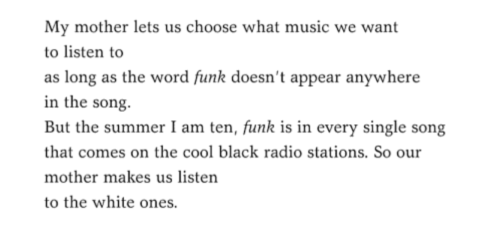
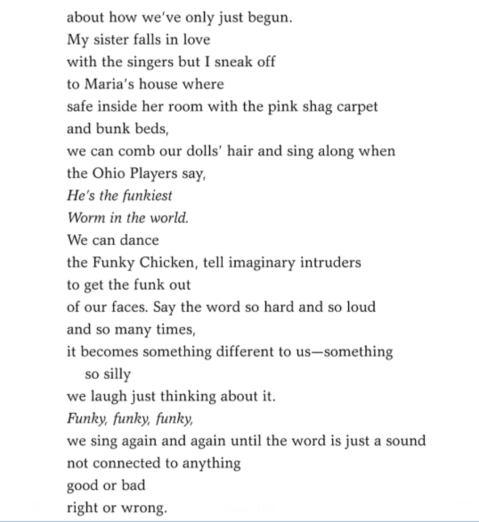
As Woodson read from Black Girl Dreaming, I was transported back to my youth. Woodson offers in “music”:

funk 1

funk

A skinny and deeply insecure white kid, I was enamored with The Ohio Players, and I can recall vividly being mesmerized by the word “funk” because it sounded so close to profanity and clearly was a powerful word that carries elements of sex and cool that were way beyond my realm of awareness, my lived experiences as a nerdy white boy.

During this period of my life, Wild Cherry’s “Play that Funky Music, White Boy” was a Top 40 hit, and I listened to raucous and theatrical groups such as Earth, Wind, and Fire, and Parliament-Funkadelic, fronted by flamboyant personalities like George Clinton and Bootsy Collins.

As I listened to Woodson quilting her talk with her published writing, I felt myself letting down my usual guard against all that defines me for other people; I felt community with her as well as the people laughing and nodding in the audience.

Unlike most of life these days in the U.S., that room felt safe and filled with peace—even as we were nested in St. Louis, a city now infamous for Ferguson and Michael Brown, the pervasive danger in the U.S. for those merely trying to live while being black.

Who are we? and What defines us? always sit just below the surface of my conscious self, a self ensconced in my whiteness, privilege, and being a man.

The first morning at the conference, as I was leaving a small coffee and breakfast shop, a woman asked where all the people outside were going. As I answered her, she interrupted me with “You are Southern”—an intense declaration that made me half expect her to back away as if redneck is contagious.

I thought about this encounter when Woodson took questions from students, one of which asked her if she were afraid of moving back to the South.

She replied that she wouldn’t move back South but “it ain’t cause I’m scared”—although, she added, she would be concerned for the safety of her family.

Like me, Woodson is projecting her fear around those she loves; unlike me, Woodson, simply due to all the ways she is unlike me, is aware that she does have much to fear, all that I am shielded from by my privileges.

Woodson’s talk catapulted me back to my teen years and the transformational power of “funk”—the word and the music—in my tentative white boy life.

As an aging (old?) white man, I am now more acutely aware of the alternative meaning of “funk”—to be in a funk, to be weighed down by the world, our fears, our fears in the name of the ones we love.

Joy and that funk reside together in my heart and bones as I think of my granddaughter—wild-haired, just a girl-child, innocent and fragile, bi-racial—and the delicate threads of my life linking me to all that is beautiful in this life despite all that is horrible.

“You have a right to be here fabulously,” Woodson told us at the beginning of her talk.

Yes we do, and I want so badly to hope that this is true.

God bless you, Jacqueline Woodson.


The Tyranny of Canonical Texts

I, too, dislike it: there are things that are important beyond
all this fiddle.

“Poetry,” Marianne Moore

As a sophomore in high school, I was a nerdy good student who had succeeded in schooling by transferring his mama’s-boy skills into teacher-pleasing dexterity. I was, however, enamored with math and science and just tolerated English and history.

My sophomore and junior years with the same English teacher, Lynn Harrill, were wonderful because of Lynn—not English, which to me was a mind-numbing series of vocabulary tests and a lot of reading I couldn’t have cared less about.

English in junior high had been torture, years and years of grammar book exercises and sentence diagramming.

Once while my tenth-grade peers were suffering through a week-long exploration of Charles Dickens’s A Tale of Two Cities, I was home on the couch, sick. That unit on Tale culminated in a long multiple-choice test, which my classmates scored very low on.

When I returned to class, I had never read that book—started it, of course being a good student, but found it insufferable (I still loath Dickens, much as I do Shakespeare, Austen, and a whole host of canonical authors). Before taking a make-up exam, I chose the Cliff’s Notes route, and scored a sweet 96 on the test—best by far in the class.

Over the next four or so years, a weird thing happened: I graduated high school planning to be a physics major, was enlisted by an English professor to tutor a survey course my first year of college, and then became an English education major at the beginning of my junior year—along the way discovering I was a writer and someone who loves literature as much or more than any other person I have ever met.

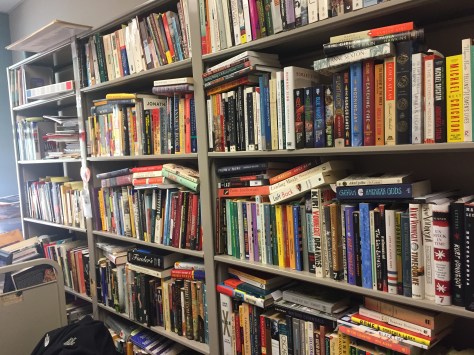
books
When my college students enter my office for the first time, they invariably pause at this view of my bookshelf, asking, “Have you read all these books?”

I also love English majors; they say things like “canonical” and “epistolary” without any hint that this is not the way humans communicate.

But I have to confront that the biggest obstacle to my life of words was English courses throughout my junior and senior high school years, and a key element of that negative influence was being assigned canonical texts, most of which I found then and continue to find to be dreadful reading.

Concurrent with those cloying experiences with texts, I was collecting and reading thousands of comic books (I had about 7000 Marvel comics when I graduated high school) as well as science fiction novels by Arthur C. Clarke and others.

As I have examined before, my very serious experiences with William Faulkner in high school set me up to be embarrassed when I rediscovered Faulkner in upper-level college English courses.

While teaching high school English for 18 years and then moving to teacher education for 16 years-and-counting now (primarily working with future teachers of English), I remain powerfully aware of the me who was alienated from the things I would come to love—the things that mostly define who I am as a human—by the very environment that should have been the place I discovered what I love.

That alienation I call the tyranny of the canonical text, and it hurts me to watch as many English teachers continue to be agents of that tyranny or co-victims of that tyranny with their students.

As chair of the English department while teaching high school, I worked for years to end or at least modify the required novel and play lists we used in our department. Those efforts were met with a great deal of resistance from my colleagues.

My argument then (and now) was grounded in the fact that between me and the most ardent advocate for canonical texts and required reading lists, we had vastly different reading backgrounds, and none the less were both highly literate, well-read people.

I have read every work by Milan Kundera, Haruki Murakami, Franz Kafka, William Faulkner, Margaret Atwood, Kurt Vonnegut, and many others—but only  a few pages of many of the books canon advocates would argue are essential. I have written and edited volumes on Barbara Kingsolver, Kurt Vonnegut, Ralph Ellison, Margaret Atwood, Haruki Murakami, and James Baldwin.

My literary life is an example of literacy triumphing over the tyranny of canonical texts. However, I wonder why anyone should have to fight through that tyranny to discover the joy and value of the written word.

Yes, I understand and appreciate the allure of teaching a valued text; I, too, have works that I love to teach, several of which were pure tyranny for my students.

Yes, I understand that reasonable people can agree that some works of literature are, in fact, superior to others; I, too, cringe at the Twilight and 50 Shades of Grey sorts of popular novels.

And, yes, I recognize that teaching English includes both an obligation to the discipline (composition and literature) and our students.

Ultimately, I have committed in my career to begin with (and to seek never to fail) my obligations to students and their literacy (both the so-called practical aspects of that literacy and the much more important role literacy plays in any person’s full humanity, agency, and joy for living)—some times necessarily sacrificing the finer points of covering canonical texts and authors.

An important element in that commitment is coming to see that when any student balks at a text, I first challenge the text selection, and resist assuming some problem lies in the student.

My deeply insecure self in junior and high school, mortified in the full body brace I wore for scoliosis, would have appreciated greatly someone offering me that opportunity then; instead, my life in literacy came later and only because I somehow fought through the tyranny of canonical texts.

Men in a Time of Reckoning

This is my mistake
Let me make it good

R.E.M., “World Leader Pretend,” Green

I’m sorry, I’m sorry, I’m sorry, I’m sorry

R.E.M., “So. Central Rain (I’m Sorry),” Reckoning

“Believing women about assault,” writes Caitlin Flanagan, “even if they lack the means to prove their accounts—as well as an understanding that female employees don’t constitute part of a male boss’s benefits package, were the galvanizing consequences of Anita Hill’s historic allegations against Clarence Thomas in 1991.”

Flanagan’s piece examines the 1990s and the era of Bill Clinton in the context of our current #MeToo reckoning that appears to involve men great and small in virtually every walk of life.

Flanagan shreds the veneer of party politics and confronts directly:

If it is possible for politics and moral behavior to coexist, then this grave wrong needs to be acknowledged. If Weinstein and Mark Halperin and Louis C.K. and all the rest can be held accountable, so can our former president and so can his party, which so many Americans so desperately need to rise again.

Two powerful aspects of this current flirtation with reckonings now haunt me, even as I am skeptical that any sort of sustained reckoning will occur beyond a few specific men, even as I am cynical that men will suffer any sort of sustained reckoning.

First, as #MeToo has begun to multiply seemingly at an exponential rate, and as more and more men are being named despite the backlash women as victims continue to suffer, a troubling refrain has developed from men, a fear of the unknown as threatening as the alien microorganism in The Andromeda Strain.

After Harvey Weinstein’s reckoning, Woody Allen uttered the most prominent version of this fear—What if this becomes a witch hunt? Allen whined.

Among my peer group, I have heard friends forefront as fact: Innocent men are going to be accused.

And then novelist John Grisham held forth about men like him already trapped in a cycle of unjustified incarceration: “We have prisons now filled with guys my age. Sixty-year-old white men in prison who’ve never harmed anybody,” these men victims of criminalizing those drawn to child pornography.

That men have responded to this reckoning by being hypersensitive to the plights of the innocent men is just as damning as revelations of so many men being physically and sexually abusive.

Once again, men have turned the daily and life-long terrors of being a women or a child into the irrational fears of men, mostly white men.

Any man who now suddenly fears being “falsely accused” of sexual aggression or worse must check that fear against the lived reality of women and children who exist now and have always existed with a rational fear of the horrors associated with simply being a woman/girl or a child—because men are often monsters, because any man represents for every woman/girl and child the potential for being a monster.

Here is reality: Countless innocent women/girls and children have been sacrificed throughout history, and this continues now. It is likely that most abused and assaulted women/girls and children have never exposed those men due to the very real double fear of being demonized themselves. Far more guilty men go completely free (except for their conscience) than those guilty men who are exposed and held accountable. If this reckoning includes some innocent men falsely accused, and that likelihood remains incredibly small, the balance of justice has still not been swung even minutely toward equal and just.

A second aspect of the reckoning centers on Richard Dreyfuss confessing (while denying) he “thought it was a ‘consensual seduction ritual.'”

This second consequence of the current reckoning is complex, but it offers a possible path toward that reckoning spreading in ways that benefit everyone.

Dreyfuss seems trapped in the norm of sex and love being circumscribed as a struggle of power with its most reductive version being men as predators and women as prey.

That dynamic erases entirely the woman’s role in consent and being sexual, autonomous beings, and it normalizes men as aggressors, initiators, predators.

The irony of Dreyfuss’s wording is that there can never be anything consensual about such seduction rituals grounded in inequitable power and male aggression as well as imbued with a perverse materialistic and idealized view of women’s chastity and sexuality (nested in both their consent and their bodies).

The #MeToo reckoning, then, will be either a passing blip on the radar of men as monsters or something sustained for the good of all humanity.

The latter depends on men’s ability to respond in two ways, two ways unlike the examples above: “I’m sorry,” followed by “This is my mistake/Let me make it good.”

Both are precarious responses requiring men to be essentially better humans than the evidence has shown so far.


See Also

Can Penitent Sexual Predators Ever Be Granted Redemption?, Vanessa A. Bee

Reporting sexual assault

There Are No Innocent Men: Sacrificed/ Sacred Women and Children

In The Washington Post—not The Onion or McSweeney’sMichelle Boorstein reports:

“Take Joseph and Mary. Mary was a teenager and Joseph was an adult carpenter. They became parents of Jesus,” Alabama State Auditor Jim Zeigler told The Washington Examiner. “There’s just nothing immoral or illegal here. Maybe just a little bit unusual.”

Mary, Joseph, and Jesus as Christian mythology are being contorted into a disturbing Trumplandian justification of Roy Moore. While the overwhelming evidence against Moore appears quite likely to have no effect in the same way as video evidence of Trump as sexual predator slipped by, there are problems with the traditional story of Mary, Joseph, and Jesus that have served this new abnormal.

The Mary used to justify Moore is framed both as a teenager and a virgin—an idealizing of womanhood that erases huge elements of any woman’s full humanity.

The Moore controversy and its unmasking of evangelical Christianity is a growing subset of the larger confrontation of how many men fail women and children as sexual predators, abusers, and aggressors—names now without any need for elaboration: Harvey Weinstein, Woody Allen, Louis CK, Bill Cosby.

Like politics, entertainment and especially comedians have carried the brunt of the unmasking so far. As some reconsider comedy routines of Louis CK, for example, many things once considered funny now seem horrifyingly missed.

Mary as sacred teen virgin—and Jesus as superhuman because he was born of the sacred teen virgin—is a parallel problem to “the Sacred Soldier, nameless and faceless, used as both sword and shield against the enemies of power and the status quo,” as William Rivers Pitts explains.

There is, in fact, no ultimate difference between treating anyone (or any group) as subhuman and treating anyone (or any group) as worthy only in the ideal.

The very ugly open secret of white evangelical Christianity includes grooming girls in childhood and during puberty to be a perverse mix of sexual and virginal, but fully in the service of a man.

Physical and sexual violence against women and children has its roots in both seeing women and children as less than human and framing women and children as sacred.

Both are dehumanizing and both are the consequence of the male gaze.

In his stand-up comedy heydays of the late 1970s and early 1980s, Steve Martin was a staple of Saturday Night Live. One of his routines, “What I Believe,” has kernels of deeply disturbing realities being confronted now. The first half goes as follows:

I believe in rainbows and puppy dogs and fairy tales.

And I believe in the family – Mom and Dad and Grandma.. and Uncle Tom, who waves his penis.

And I believe 8 of the 10 Commandments.

And I believe in going to church every Sunday, unless there’s a game on.

And I believe that sex is one of the most beautiful, wholesome and natural things.. that money can buy.

And I believe it’s derogatory to refer to a woman’s breasts as “boobs”, “jugs”, “winnebagos” or “golden bozos”… and that you should only refer to them as “hooters”.

And I believe you should put a woman on a pedestal.. high enough so you can look up her dress.

Martin’s satire of belief imbued with both a passing image of the predatory man in everyone’s (?) family as well as harsh critiques of religion and the dark underbelly of idealizing women captures the open secrets being dismantled in 2017.

If manipulating the foundational story of Mary, Joseph, and Jesus to protect a predatory man isn’t enough—and I would argue this is beyond enough—consider novelist John Grisham’s egregious defense of men like him:

“We have prisons now filled with guys my age. Sixty-year-old white men in prison who’ve never harmed anybody, would never touch a child,” he said. “But they got online one night and started surfing around, probably had too much to drink or whatever, and pushed the wrong buttons, went too far and got into child porn.”

This rests inside the same genre as Woody Allen’s fear of witch hunts.

But Grisham’s argument exposes how the sacrificed and sacred coin works to render women and children as less than human while maintaining a culture in which men are always fully human regardless of even the most inexcusable failures.

Grisham, Allen, and Louis CK (using child molestation as fodder for humor) may sound extreme, but only if we remain trapped in a narrative of women and children as either sacrificed or sacred while all men are fully human, every flaw forgiven.

So I return to Martin’s “Uncle Tom, who waves his penis” and offer Richard Dreyfuss exposing himself and his own rebuttal that he “thought it was a ‘consensual seduction ritual,'” adding:

The fact that “I did not get it”, he said, “makes me reassess every relationship I have ever thought was playful and mutual.”

Louis CK, in his apology, also claimed he had never felt he was harming women since he always asked before exposing himself.

Like Kevin Spacey, Louis CK’s career is in jeopardy, his newest film’s distributor has dropped the project. But in that film, one scene offers yet another out for what appears to be an essential flaw in men:

The movie, which premiered at the Toronto Film Festival in September, is about a TV writer (played by C.K.) whose 17-year-old daughter forms a relationship with a 68-year-old filmmaker.

“I mean, everybody’s a pervert. I’m a pervert. We’re all perverts. Who cares?” one character says in the trailer.

“Men have not succeeded in spite of their noxious behavior or disregard for women; in many instances, they’ve succeeded because of it,” writes Rebecca Traister, adding later: “That’s because this world is stacked in favor of men, yes, in a way that is so widely understood as to be boring, invisible, just life.”

Invisible like the women and children rendered either less than fully human or sacred, the first of which Traister confronts:

But here’s a crucial reason he behaved so brazenly and badly for so long: He did not consider that the women he was torturing, much less the young woman who was mutely and nervously watching his performance (that would be me), might one day have greater power than he did. He didn’t consider this because in a basic way, he did not think of us as his equals.

Traister then concludes: “The only real solution may be one that is hardest to envision: equality.”

A solution still ironically controlled by men.

Traister explores how she and other women have been complicit in the culture being exposed by #metoo, admitting, “as a young woman I could never truly believe that members of the opposite sex could be as cartoonishly grotesque as they sometimes were.”

Now, the question appears to be about the fundamental nature of men and how they navigate those weaker than them—perceived as or actually weaker such as women and children.

What is without question, however, is there are no innocent men.

Confessions of a Born Again Agnostic

I am a humanist, which means, in part, that I have tried to behave decently without any expectation of rewards or punishments after I’m dead.

Kurt Vonnegut, God Bless You, Dr. Kevorkian

Born November 11, 1922, Kurt Vonnegut has been dead a few months more than a decade now. For all his dark humor and fantastic stories, it seems impossible to believe he could have imagined the U.S. in 2017.

President George W. Bush left Vonnegut in a near-constant state of exasperation so a country now led by Trump with Republicans and conservative Christians scrambling to excuse every indecency known to humanity, including crimes against women and children, would make even Vonnegut shrug, “Nobody would buy it.”

On this day of Vonnegut’s birth, I am witnessing a world I could have never imagined—especially considering my lifelong mostly closeted existence as an atheist/agnostic.

I came to recognize that atheism/agnosticism in the first years of college, and I also realized this was no choice, but who I am to the bone.

During intense years of reading Sartre, Camus, Kierkegaard, and other existentialists mostly, I was an aggressive atheist, mostly outing myself and obnoxiously confronting peers who were themselves equally obnoxious as witnessing Christians.

Being born, growing up, and living in the deep South, the Bible Belt, I was confronting this aspect of my Self with a great deal of angst, fear, and self-loathing. Once I graduated and entered my profession as a public school English teacher—at the same high school I had attended in my home town—this important aspect of who I was as a young adult was quickly packed back into the closet.

The four schools of the district I taught in literally surrounded the dominant church in the small town, the steeple towering above the horizon when looking from any of the school buildings.

Many students attended that church, but everyone in the school confronted everyone about what church they attended.

The great paradox about my early years teaching was that I was adamant about not sharing my atheism with my students, about not in any way imposing my nontraditional beliefs on my students who were in most ways as I was growing up in that town.

Yet, gradually and increasingly, students were more and more aggressive about asking and even explicitly pushing me to confirm or deny a rumor I was an atheist.

This was incredibly stressful for my early years. I literally feared for my job each time these situations popped up, some of them reaching administration and causing me to be quizzed by the principal as well.

Later in my time at that school for almost two decades, this became something of a joke, that I refused to answer what I did or did not believe. But it lingered as a threat none the less.

I tried to play along; it was a defense mechanism about the closeted life.

Once, when one of the office staff asked me just to tell her the truth, I looked around to make sure we were alone, and then whispered, “I am an agrarian,” before walking away with a smile.

The next day when I saw her, she apparently had shared my confession with someone, unaware of the joke, so I followed up with, “That’s right. I work the land!”

Being atheist/agnostic, however, has never been anything other than stress for me, as an outlier, someone who simply sees the world unlike the vast majority of people. Even moving to higher education, I am moment by moment confronted by traditionally religious students and the norm of being Christian and attending church.

Once while in a diversity training session for faculty, the facilitator had people stand by their religious identities. The list worked through virtually every faith and many Christian denominations, but non-believers were excluded by omission.

In my row were two colleagues who are atheists as well. We made eye contact, one shaking her head, and I simply stood, leaving the session.

From those early days of college, my embarrassing certainty and in-your-face atheism, to my much more reserved and comfortable understanding that I am a born again agnostic, I have continued to suffer under the weight of how angry traditional Christians make me with their conservative politics and egregious hypocrisy.

I want to bite my tongue, but it is challenging, especially in political discussions.

The Moral Majority, the Religious Right, and the Reagan era—these were the sort of perverse marriages of politics and religion that confirmed by humanistic commitments, ones espoused by Vonnegut, and my inability to commit to the petty God and spurious dogma of organized religion, often brilliantly skewered by George Carlin.

So I sit here on Vonnegut’s birthday genuinely stunned at the U.S., this bastardized Christian nation in which white evangelicals overwhelmingly voted for a sexual predator and continue to support him.

This bastardized Christian nation in which so-called Christians contort themselves in whatever way necessary to justify child abusers and sexual abusers, abdicating any semblance of moral or ethical beliefs for crass political affiliation.

This, then, is what I could have never imagined: The religious right is so morally bankrupt that I am for the first time in my nearly six decades entirely comfortable to be out of the closet as a born again agnostic committed, as Vonnegut wrote, “to behave decently without any expectation of rewards or punishments after I’m dead.”

With the current unmasking of very awful men living their lives mostly without any consequences for being very awful, I must admit Vonnegut himself was a flawed man, embodying the tension in the spotlight now between artist and his art.

In Vonnegut’s case, I do not justify or excuse his flaws as a man—just as I admit my own—but I do hold tight to the many wonderful and enduring codes he at least promoted with his writing, and best expressed in God Bless You, Mr. Rosewater, where the titular character of the novel, Eliot Rosewater, implores:

“Go over to her shack, I guess. Sprinkles some water on the babies, say, ‘Hello, babies. Welcome to Earth. It’s hot in the summer and cold in the winter. It’s round and wet and crowded. At the outside, babies, you’ve got about a hundred years here. There’s only one rule that I know of, babies—:

“‘God damn it, you’ve got to be kind.’” (p. 129)

Everything else, including religion in the service of politics, is, as Carlin charged, bullshit.