All posts by plthomasedd

P. L. Thomas, Professor of Education (Furman University, Greenville SC), taught high school English in rural South Carolina before moving to teacher education. He is a former column editor for English Journal (National Council of Teachers of English), current series editor for Critical Literacy Teaching Series: Challenging Authors and Genres (Brill), and author of Teaching Writing as Journey, Not Destination: Essays Exploring What ‘Teaching Writing’ Means (IAP, 2019) and How to End the Reading War and Serve the Literacy Needs of All Students: A Primer for Parents, Policy Makers, and People Who Care (IAP, in press). NCTE named Thomas the 2013 George Orwell Award winner. He co-edited the award-winning (Divergent Book Award for Excellence in 21st Century Literacies Research) volume Critical Media Literacy and Fake News in Post-Truth America (Brill, 2018). Follow his work @plthomasEdD and the becoming radical (https://radicalscholarship.wordpress.com/).

A Love Letter to the Anxious

I’m sorry, and I love you.

I’m sorry. I love you.

I’m sorry I love you.

October of 1999—I was forced to confront that I have lived nearly four decades with anxiety and had been suffering panic attacks in silence, closeted, that entire time.

Living inside the protective silence I had manufactured was a sense of extreme alienation from almost everyone and a persistent feeling of being an imposter.

After the panic attacks of that October, I then went on a four-year journey with anxiety medication, gaining weight and begining to understand my anxiety and its relationship to my world, people I had hurt and experiences I inevitably either avoided or ruined for myself and others.

Not long into those four years, I was with a dear friend cycling who experienced a panic attack, which I missed entirely and failed miserably to support because her panic attacks were nothing like mine.

Sitting here now almost 20 years into awareness about anxiety, I am nearly expert about my anxiety; I am off medication, but I managed the anxiety in a variety of healthy and not-so-healthy ways—and I still routinely fail myself and others, especially the people I care most deeply about.

We manage anxiety—I suppose like alcoholism—but I think we are never cured of anxiety. That, I fear, would require a full removal of our bones, or at least a thorough cleaning of those skeletons.

But here are some things I do know—although these are not promises.

Anxiety is mostly when our inner selves are out of joint with the outer world. Often because we perceive there is an outer world of expectations, judgment; and thus, we are haunted with “Am I doing the right thing?”

Won’t someone please tell us we are doing the right thing.

This will not help, but let me assure you there is no right thing and there is no one except you who can confirm if you are being the you that you should be.

And that makes me anxious—to acknowledge that we are ultimately alone in all this; that is the human condition people without anxiety can ignore and the anxious cannot set aside.

Even for a second.

Here is something else that I know: Two people who are anxious and friends or intimates want desperately to be someone soothing for the other’s anxiety, and that makes each of you anxious, and then guarantees that you will not be soothing, cannot be soothing.

And that makes me anxious because in true existential reality, our passions are our sufferings. Nothing can make us more anxious than to care, to love, to desire.

Although feeling nothing comes pretty damn close—like being on anxiety medication.

Maybe the only thing we have is “I wish I could have done better by you because I love you in a way that makes me incapable of being the one who doesn’t need to apologize.”

I’m sorry, and I love you.

I’m sorry. I love you.

I’m sorry I love you.

Women and Children Last

I am always hesitant to suggest anything is unique to now, as if history isn’t right there for us to recognize our enduring human failures. So I will refrain from evoking “unique,” but I am convinced this is distinctly relevant for the now of 2017: In the U.S., the real and the satirical seem nearly indistinguishable.

Take for example Monologue: Dad of Newborn Girl Explains the Importance of Women’s Issues to a Table of Women at a Coffee Shop, a piece as brilliantly satirical as it is disturbing when revisited in the wake of revelations about Harvey Weinstein among a people who elected Donald Trump president.

On social media, I witnessed some misread the McSweeney’s article, missing the satire, and concurrently watched as many confronted the exact phenomenon occur in response to Weinstein’s sexual violence grounded in his wealth and power: Men expressing how they understand women’s issues because they are sons, fathers, or husbands.

Possibly my greatest existential angst as a white man is grounded in the weight of how often men have failed women and children through physical violence and sexual coercion and assault.

Weinstein has triggered my own discomfort and anger at Hollywood, personified for me by Woody Allen, and a powerful problem I have been wrestling with my entire adult life: the tension between the work of art (Can it still be “great”?) and the horribly flawed artist.

Several films, for example, remain burned into my soul because of this:

Cinematic rape and the killing of children—these films are nearly unwatchable for me, even when I appreciate their artistic value.

I have written about a similar tension when watching True Detective (HBO).

And I anticipate the same sort of discomfort I feel each time I watch Blade Runner (the aggressive kissing scene) when I eventually watch Blade Runner 2049, confronted for whether or not it portrays futuristic sexism or simply is sexist.

But this tension about art and artist as a problem, a question, is in no way concurrent in the reality of men as violent, as sexual predators.

There simply is no room for equivocation, as Allen and Oliver Stone, among many others, have offered.

There simply is no room to suggest these abuses are more about power than the men who are abusers.

The fact is that men have a default position of power over women and children; men as violent, as sexual predators and rapists, exist regardless of social status of those men.

Poor men hit their children, abuse their women partners, and poor men rape.

Only two facts exist with any credibility here.

First, as Arundhati Roy has explained, “We know of course there’s really no such thing as the ‘voiceless.’ There are only the deliberately silenced, or the preferably unheard.”

Therefore, the voices of women and children matter first, foremost, as the targets of violence by men.

Second, this is a problem nested in men and perpetuated by the social norms created by and maintained by men.

Therefore, only men can end rape culture, toxic masculinity, and the abuse of children.

Laurie Penny, in a piece that should be read fully, confronts the ways in which terms such as “consent” as well as a woman’s right to her sexuality are used in ways that are themselves oppressive even when they appear to be otherwise:

The first thing you need to understand about consent is that consent is not, strictly speaking, a thing. Not in the same way that teleportation isn’t a thing. Consent is not a thing because it is not an item, nor a possession. Consent is not an object you can hold in your hand. It is not a gift that can be given and then rudely requisitioned. Consent is a state of being. Giving someone your consent — sexually, politically, socially — is a little like giving them your attention. It’s a continuous process. It’s an interaction between two human creatures. I believe that a great many men and boys don’t understand this. I believe that lack of understanding is causing unspeakable trauma for women, men, and everyone else who is sick of how much human sexuality still hurts.

And while I have examined the importance of intimacy, privacy, and consent—not as well as Penny, however—I am more fully aware of the inherent flaws with the seeming chivalry of “women and children first,” a concept grounded in paternalism that acknowledges a sort of comparative vulnerability between women/children and men.

The real world, however, paints a different picture—women and children last.

Men who view the world, including women and children, as their spoils, to do with as they please.

Again, speaking as a man, we are the problem, and we must be the solution.


See Also

Hollywood and Academia: Is the problem the same?

The Horizon of Desire

Intimacy, Privacy, and Consent

The Universal Lie

Education and journalism often are similar windows into the power of bias in the U.S.

Consider first a somewhat innocuous media report about sports:

BREAKING: United States misses first World Cup since 1986.

— The Associated Press (@AP) October 11, 2017

Much more disturbing, also consider the media coverage of the Las Vegas mass shooting:

As the news broke, major outlets across the country wrote headlines that humanized [Stephen] Paddock…

Past mass shooters who were nonwhite or Muslim have been depicted quite differently ― and so have people of color who were victims of gun violence.

“There’s a clear difference in the way this kind of incident is treated and the way it would be treated if it were actually associated with Islam or Muslims,” Ibrahim Hooper, spokesperson at the Council on American-Islamic Relations, told HuffPost. “It would be instantly called an act of domestic or even international terrorism; it wouldn’t be individualized, but collectivized to the entire Muslim community or faith of Islam.”

The seemingly harmless report about U.S. soccer and the mainstream coverage of Paddock expose how the media works in ways that establish men and whiteness as the norms, the given, and thus somehow the most important (or only) statuses.

As many noted, U.S. soccer has had tremendous success in the women’s team—essentially rendered invisible by the coverage of the failure of the men’s squad this year. Paddock, as white man, floats above corrosive myths about Muslim terrorists and violent black men—both of which are statistically far more rare than violent and abusive white men, who constitute the largest percentage of mass shooters.

Now, let’s consider education.

Sarah Donovan, who blogs at Ethical ELA, posted a question on social media: “Teachers, scholars, authors, please weigh in. What is the value of the plot diagram in literature instruction? Is the language of rising action, etc. relevant, important?”

My first response to Donovan’s question was to point to Kurt Vonnegut’s mostly satirical but also illuminating “Shapes of Stories”[1]:

Vonnegut is an interesting and contradictory steward of both the modernist and post-modernist periods of so-called “Great Literature”:

Instead, the female characters [in his short fiction] are furniture or bouncing, pink operators. Of course you can’t blame Vonnegut for society’s sexism (in the 1950s, or now) but if these are indeed moral stories, it’s a male, white, affluent morality. Vonnegut himself, as Wakefield writes, puzzled over his inability to “do women well.”

Similarly, the dialects of some black waiters and soldiers and the poor will induce groans. As for the five stories from the archives, “City” has a lovely back-and-forth alternating point of view between a boy and a girl meeting on a bus, but the rest might have stayed lost.

As a white male, Vonnegut was afforded gender and race privileges that likely allowed him to be a somewhat rebellious writer who flaunted and broke the rules handed down by the New Criticism gods, blurring fiction and non-fiction as well as making himself a primary character of his genre-defying narratives.

Since I have examined before the power of mechanical evaluations of literature, often about New Criticism, and how the canon is mostly a white, male mythology, I next turned to a recent examination of the Nobel Prize in literature, awarded in 2017 to Kazuo Ishiguro:

The Nobel is the premier institution of elite literary prestige, conferring authority on what is already taken to be worthy of acclaim within the literary field….Conferring the Nobel also solidifies Euro-American cultural power (members of the adjudication committee often have American graduate degrees), as the Nobel institution positions itself as naturally authorizing and emboldening, in its own dispassionate assessment, what is inherently worthy of commendation. It’s a classic case: an institution of elite cultural power that hides its biases in claims to universality.

So if we consider plot diagrams as “dispassionate assessment,” we can begin to unpack how the concurrent concept of universality is, in fact, a lie—a sort of god creating “man” in “his” own image.

Like the flawed five-paragraph essay template that induces both bad writing and bad thinking in students, mechanical scripts for how fiction (or poetry, or any form) works are misleading but also perpetuate the inherent biases of the formulas.

The fathers of New Criticism were in many ways self-serving—arguing for prescriptions and structures that they themselves then followed in order to create the circular reasoning of “Great Literature.” Along the way, of course, mechanistic traditional education—mostly in English courses—provided a powerful ally in that process.

From plot diagrams to the literary technique hunt, mechanical approaches to texts are reductive and thus fail the critical literacy test: How is this text positioning the reader and in whose interest is the text working?

Let me close by nudging a bit beyond the narrow question about plot diagrams for fiction (usually the short story), and ask that we consider how the universal functions to mask and distort through W.B. Yeats “Leda and the Swan” and Adrienne Rich’s “Rape.”

In most traditional English/literature courses, Yeats likely is taught far more often than Rich, and then, his poem retelling a classic myth carries the heft of being a praised structured form (sonnet) and by an oft-anthologized white male Great Poet.

Rich, however, tends to be swept aside as a free verse poet who is too political, often code for “just a woman” (see Anne Sexton).

Yeats’s poem uses rape as a plot element, seemingly “dispassionate,” while rape in Rich’s poem is a confrontation about the physical terror women face in a man’s world (is that not universal?) and the concurrent metaphorical assault women must suffer to seek justice for the actual rape.

Ultimately, there is something insidious about allowing the normalization of the powerful to sit beside the marginalization of the powerless—calling the experiences of one (white men) “universal” and the experiences of the other (women), “political.”

So what do we do with Donovan’s question?

Critical literacy guides us here as we must be diligent in making our students aware of traditional structures and approaches to literature and writing, but also we must go beyond that awareness and invite them to unpack critically why those structures exist—again, in whose interest do they work?


[1] See also Vonnegut’s essay included in Chapter 3 (“Here is a lesson in creative writing”) of A Man without a Country.

Humanity Has a Serious White Man Problem

Have you ever watched reality TV shows such as Hoarders? A disgusting but all-too-common urge to both glamorize and demonize, all in the name of entertainment and celebrity?

Have you ever wondered why pop culture often turns our gaze on these people (or any group deemed profitable fodder for such filth)—and thus, turning our gaze away from other groups?

This didn’t take much effort, but let me try my hand at a similar technique, although I am merely working here in words. Consider the following:

Feel free to let me do the heavy lifting here, but also, I invite you to wade into the above for yourself: The thread running through these pieces gathered quickly and easily the day after Columbus Day is the violent, rapacious white man who hoards money and power at the expense of and on the backs of others and then uses that money and power too often to abuse and even kill those deemed weaker or lesser than these white men.

That we have failed to address the white man disease in humanity is not some great accident, however. Once with power, white men have carefully orchestrated how we view the world through keeping our gaze elsewhere, such as our manufactured fear of Muslim terrorists and centuries-long narratives of violent black men.

This slight of hand has mesmerized us into worshipping these horrible, often soulless men—Hugh Hefner, Christopher Columbus, Donald Trump—because of their bravado, wealth, and power.

White men, often themselves mediocre, have parleyed their amassed wealth (typically begun in eras characterized by the very worst of human nature) into assuring that the general public has developed a skewed system for evaluating self-worth: white men are forgiven any and every flaw because “he built this,” but everyone else cannot survive even one flaw, unless s/he is conveniently associated with the right white man.

The power of the arrogant white man is so intense, so capable of charming a people, that in the U.S. many excuse Trump minute by minute for the deplorable human he proves himself to be while following his Pied Piper lead to demonize Colin Kaepernick.

And while the rise of Trump is one of the most disgusting and oft-repeated narratives of U.S. history, it is a slow-boil story, and we are the willing lobsters who gleefully offer ourselves up for the pot.

More catastrophic—and all the more hard to understand as worthy of our disregard—is Stephen Paddock, murderous white man who is the most recent recipient of the inordinate passes white men receive: media headlines never offering his race and refusing to call him “terrorist,” family and friends shocked and confirming he was just your Average Joe, and the ultimate tone-deaf claim that there was simply nothing to tip us off about his reign of horror (because a certain kind of white man can walk through this world without any sort of scrutiny, even as he amasses an arsenal—or systematically sexually abuses women).

So let’s turn here to thinking carefully about this world built by white men—because the architects have insured this world protects them and as a consequence it works against everyone else.

While these rapacious white men use “I built this” as their shield, we must recognize it as supreme distraction; they are hiding something very insidious behind that shield, in fact: their mediocrity, their soullessness, their monstrosity.

As a white man, I speak from experience; the shield is powerful, more powerful than we tend to admit.

But also as a white man who believes to my marrow in a better world where equity and justice are achieved for every human, I am left with a disturbing quandary.

I have a fantasy that one day every worker in the service industry simply refuses to work; this act of resistance would highlight the inherent scam that is capitalism (the white man’s paradise), the false narrative that the owners and bosses are worth more than the workers.

That fantasy has a new version—one in which every black athlete in the NFL takes a knee and refuses to play a down of any NFL game so that the league and our so-called political leaders are forced to eat their words, called on their bluffs as the blow-hard balloons they are.

But these fantasies are the musings of a white man who recognizes that it is not the responsibility of the oppressed to end such inequities. yet, this system built by white men is a trap: workers are enslaved by hourly wages and tethered to work-bound insurance and retirement so that those workers have no real humanity left, no option to assert their dignity, their voices.

Even very wealthy black NFL athletes who are taking ethical positions are being cast as the bad guy—a perverse rebooting of the white hat/black hat Hollywood whitewashing of cowboys and Indians:

It’s the propaganda that irks [James Baldwin] most, the betrayal of the imagination. Baldwin has predictable issues with John Wayne, but the squeaky-clean Gary Cooper puts the most deceptive face on the killing of Indians. If you’re black, Baldwin says, you identify with Coop until you realize that the Indians are you, and that Coop, and Wayne, is a symptom of a culture that won’t “grow up” and face a history that has “no moral justification.” It’s “the lie of pretended humanism.” It’s Coop and it’s — wait for it — Doris Day.

Like Baldwin, we need this moment of recognition—that we have been duped, conned, hypnotized.

It no easy thing to admit that we are patsies, but we are being used.

Now, there is no question about white men being outnumbered, but there remains a question about whether or not everyone else is really any better than these mediocre white men ruling us.

That question terrifies me nearly as much as all the Trump-hoarders ruling this world.

Fatalism Ate Our Democracy: “Today. Tomorrow. Always”

Forget it, nothing I change changes anything

“Walk It Back,” The National

On social media and in real life (IRL), I am experiencing a pattern.

For more than three decades now, mainstream education reformers have told me that there is nothing we can do about childhood poverty, racism, sexism, etc., so we must “fix” our schools and those students struggling because of all those inequities we simply cannot change.

Every time a mass shooting happens, people wave their arms and tell me that gun laws won’t stop violence; there simply is nothing we can do.

Over the last several months as I have witnessed my mother suffering in the wake of a stroke exponentially worsened by the U.S. healthcare and medical insurance monstrosities, even healthcare professionals respond to arguments for single-payer universal healthcare with “Good luck with that!” Never going to happen.

Fatalism appears more pervasive that the new national hobby of staring at a smart phone—joined only by the long-standing practice of most people existing as a heaping mound of contradiction.

The “nothing we can do about guns” crowd tends to be the same people who do want to regulate a woman’s ability to choose her reproduction options, do want demand that people show proper types of uniform patriotism, do staunchly advocate for the death penalty, mass incarceration, and militarized policing—but there is *sigh* just nothing we can do about gun violence because of that darn Second Amendment and, you know, people would still kill each other with knives and baseball bats.

Fatalism, then, is a convenient cover for those seeking ways to impose their political will on others; and thus, Paul Freire asserts: “I have always rejected fatalism. I prefer rebelliousness because it affirms my status as a person who has never given in to the manipulations and strategies designed to reduce the human person to nothing.”

Fatalism’s mantra—”Don’t bother!”—”reduce[s] the human person to nothing”—it de-democratizes, dehumanizes.

Like Freire, James Baldwin, then, expresses the antithesis to fatalism, hope: “I love America more than any other country in this world, and, exactly for this reason, I insist on the right to criticize her perpetually” (Notes of a Native Son, 1955).

“[T]o criticize…perpetually” is to cast off “Don’t bother,” to recognize that our ideals have merit but that we have failed to reach those ideals—and then we still have the capacity to do so.

And so I come back to the U.S. as a disturbing outlier in gun violence. These gruesome realities are not about the enormity of how a people can at least decrease the senseless loss of life that comes with our gun-lust; but this debate is about political and cultural will.

For a people seemingly obsessed with choice, we are far too willing to choose fatalism when it suits us, to become passive and “o, well” when the consequences somehow seem to be in someone else’s interest.

And for a people so eager to shout “American exceptionalism!” I wonder how we can ignore that many other countries insure all their citizens, have reduced their gun violence, and have created a culture that genuinely seeks to honor the meek and weak and vulnerable.

Freire recognized that the “freedom that moves us, that makes us take risks”—risks for a better world—is in fact a threat to those who believe the status quo is worth maintaining. Those beholden to the status quo—good for some, unfair to many—call for “conformity in the face of situations considered to be irreversible because of destiny”—thus, gun laws won’t change anything, or we’ll never have universal healthcare.

And a cousin to our fostered fatalism is our ahistorical mind, one that clings to traditional history but somehow rejects “revisionist” history:

To the degree that the historical part if not “problematized” so as to be critically understood, tomorrow becomes simply the perpetuation of today. Something that will be because it will be, inevitably. To that degree, there is no room for choice. There is only room for well-behaved submission to fate. Today. Tomorrow. Always.

Our fatalism has eroded our souls as a people, consumed our democracy.

We are a people more offended by black athletes kneeling during the national anthem than free people slaughtered while attending a music concert, children slaughtered while attending school.

Today. Tomorrow. Always?

Gun-Lust: This Is America. This Is Who We Are. Pt. II


I was neither surprised or even disappointed when comments on my Facebook page were shallow, insensitive, and simply ridiculous in response to my post against the gun-lust that defines the U.S.: Know guns, know violence; no guns, no violence.

The most ridiculous was the counter argument that if we had no guns people would still be violent with ball bats.

Not kidding. That was a rebuttal.

For the record, I am in full support for a complete exchange in the U.S.—all gun owners swapping those weapons for bats.

I shouldn’t have been surprised, and I was disappointed, however, when I waded into the Las Vegas shooting with my college students. My university population is skewed socially and politically conservative as well as traditionally Christian. Although the college was once affiliated with the Southern Baptist church, that ended decades ago and the school was never a religious college.

I always die a little on the inside when I share the research base solidly refuting corporal punishment, prompting several students to respond angrily in favor of spanking: “I was spanked and I turned out fine,” the typical rebuttal as hollow as the bat argument above.

Three first year students were more than bothered and eager to challenge the concerns I raised in our first-year seminar about access to guns in the U.S. and the uniquely violent culture of our country when compared internationally.

Their arguments fell into three categories: adamant commitments to owning guns for self defense (with the undercurrent that home invasions are somehow an ever-present danger), a belief that the Second Amendment was in part designed to allow U.S. citizens to defend themselves against a rogue U.S. government (and that remains relevant in 2017), and the recognition that many in the U.S. cling to gun ownership as a symbol for individual freedom (one student noted that his family owns several guns but they never use them in any way).

One similarity to my students’ arguments and the push-back on Facebook has been the sense of fatalism—there simply is no way to end all gun violence or all violence so let’s not restrict our freedom, again represented by merely owning a gun.

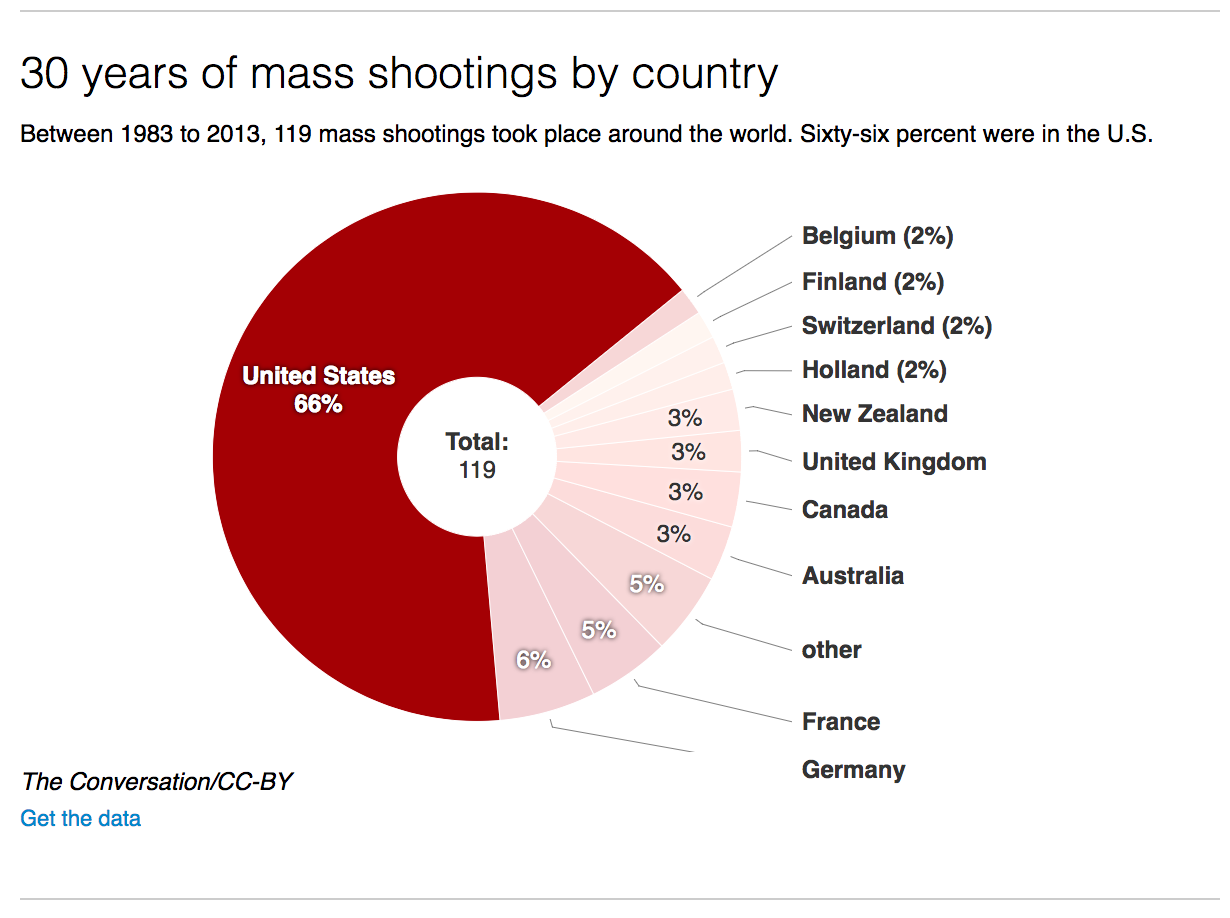
In class, I found data on international comparisons showing that the U.S. is an extreme outlier for rates of gun violence, and I posed the idea that wouldn’t we all take the rates of next highest nation (a much lower rate) if that were possible through policy change.

30 yrs mass shootings.png
Six things to know about mass shootings in America (The Conversation)

And with that, I argued that we are all complicit in our violent nation, our gun-lust: This is America. This is who we are.

My students who defended gun rights immediately balked at the carnage of LasVegas is something the citizens of the U.S. have chosen.

Facebook ignorance has become nearly as commonplace as mass shootings in the U.S. But I have tried to remain hopeful about young people, that the future can hold a better us: “This place could be beautiful,/right? You could make this place beautiful.”

As my students demonstrate, young people have been engrained with irrational but compelling beliefs that are not supported by evidence; entrenched symbolism remains powerful in the U.S. well beyond the origins of those symbols.

The practical and very real importance of guns in the founding and expansion of the U.S. certainly contrasts significantly with today—but the symbolism (guns equal freedom) endures.

Symbolism and the resulting fatalism are the death of us as a people—unless somehow we are able to make facts matter. Otherwise, our future is as dim as our past and our present.

Suggested Readings

How dangerous people get their weapons in America

Six things to know about mass shootings in America

When gun control makes a difference: 4 essential reads

1,516 mass shootings in 1,735 days: America’s gun crisis – in one chart

America’s unique gun violence problem, explained in 17 maps and charts

Visualizing gun deaths: Comparing the U.S. to rest of the world

@JamesFallows offers two dark American truths from Las Vegas

In the U.S., Where the Female Nipple Is More Dangerous Than a Gun

The Lingering, and Powerful, Legacy of “Scientific Racism” in America

Writing about the class of 2017’s performance on the newly redesigned SAT, Catherine Gewertz notes, “The number of students taking the SAT has hit an all-time high,” and adds cautiously:

What appear to be big scoring increases should be understood not as sudden jumps in achievement, but as reflections of the differences in the test and the score scale, psychometricians said.

More test takers and higher scores, albeit misleading ones, are the opening discussion about one of the most enduring fixtures of U.S. education—standardized testing as gatekeeping for college entrance, scholarships, and scholastic eligibility.

However, buried about in the middle of Gewertz’s article, we discover another enduring reality:

The 2017 SAT scores show inequities similar to those of earlier years. Asian (1181), white (1118), and multiracial (1103) students score far above the average composite score of 1060, while Hispanic (990) and African-American (941) students score significantly below it.

Throughout its long history, the SAT, like all standardized testing, has reflected tremendous gaps along race, social class, and gender lines; notable, for example, is the powerful correlation between SAT scores and takers’ parental income and level of education as well as the fact that males have had higher average scores than females for the math and verbal sections every year of SAT testing (the only glitch in that being the years the SAT included a writing section).

The SAT is but one example of the lingering and powerful legacy of “scientific racism” in the U.S. Tom Buchanan, in F. Scott Fitzgerald’s The Great Gatsby, punctuates his racist outbursts with “‘It’s all scientific stuff; it’s been proved.'”

Buchanan represents the ugly and rarely confronted relationship between “scientific” and “objective” with race, social class, and gender bigotry. In short, science has often been and continues to be tainted by bias that serves the dominant white and wealthy patriarchy.

Experimental and quasi-experimental research along with so-called standardized testing tends to avoid being implicated in not only identifying racism, classism, and sexism, but also perpetuating social inequity.

As I noted recently, since Carol Dweck and Angela Duckworth have produced mainstream scientific studies and published in reputable peer-reviewed journals, their inherently biased work has been nearly universally embraced—among the exact elites who tend to ignore or outright reject the realities of inequity and injustice.

As just one example, Duckworth grounded her work in and continues to cite a Eugenicist, Francis Galton, with little or no consequences.

Racism, classism, and sexism are themselves built on identifying deficits within identifiable populations. Science allows these corrupt ideologies to appear factual, instead of simple bigotry.

“Scientific” and “objective” are convenient Teflon for bias and bigotry; they provide cover for elites who want evidence they have earned their success, despite incredible evidence that success and failure are more strongly correlated with the coincidences of birth—race, social class, gender.

It takes little effort to imagine a contemporary Tom pointing to the 2017 SAT data and arguing, “‘It’s all scientific stuff; it’s been proved.'”

Such ham-fisted scientism, however, mutes the deeper message that SAT data is a marker for all sorts of inequity in the U.S. And then when that data have the power to determine college entrance and scholarships, the SAT also perpetuates the exact inequities it measures.

The SAT sits in a long tradition including IQ testing that speaks to a jumbled faith in the U.S. for certain kinds of numbers and so-called science; when the data and the science reinforce our basest beliefs, we embrace, but when data and science go against out sacred gods, we refute (think climate change and evolution).

Science that is skeptical and critical, questioning and interrogating, has much to offer humanity. But science continues to be plagued by human frailties such as bias.

Science, like history, is too often written by the winners, the oppressors. As a result, Foucault details, “[I]t is the individual as he[/she] may be described, judged, measured, compared with others, in his[/her] very individuality; and it is also the individual who has to be trained or corrected, classified, normalized, excluded, etc.” [1]

“Scientific racism,” as a subset of science that normalizes bigotry, allows the accusatory white gaze to remain on groups that are proclaimed inherently flawed, deficient, in need of correction. “Scientific racism” distracts us from realizing that the tests and science themselves are the problem.

And thus, we must abandon seeking ever-new tests, such as revising the SAT, and begin the hard work of addressing why the gaps reflected in the tests exist—a “why” that is not nested in any group but our society and its powerful elite.


[1] Foucault, M. (1984). The Foucault reader. Ed. P. Rabinow. New York: Pantheon Books, p. 203.

See this thread:


The “Vast Carelessness” of White America

The gulf between our dream and the realities that we live with is something we do not understand and do not want to admit.

James Baldwin, “Lockridge: ‘The American Myth,'” 1948

Myrtle Wilson mangled and left for dead in the middle of the road, Jay Gatsby’s gold Rolls Royce driven by Daisy Buchanan disappearing into the night.

Gatsby face down and dead in his opulent pool with George Wilson, Gatsby’s murderer, nearby, also dead at his own hand.

These are the images that resonant with me from F. Scott Fitzgerald’s The Great Gatsby—juxtaposed with these words by narrator Nick Carraway:

I couldn’t forgive [Tom] or like him, but I saw that what he had done was, to him, entirely justified. It was all very careless and confused. They were careless people, Tom and Daisy—they smashed up things and creatures and then retreated back into their money or their vast carelessness, or whatever it was that kept them together, and let other people clean up the mess they had made….

Fitzgerald’s so-called American classic, what some call the Great American Novel, is an incredibly dark work that mostly paints America as a soulless white nation of “vast carelessness.”

While I cannot claim Fitzgerald omits black America on purpose to make a point, the absence of blacks among the decadence of Gatsby’s obsessions beside Nick’s mesmerized impotence as well as Tom and Daisy’s carelessness remains a powerful commentary on the state of this nation in 2017.

Myrtle, George, and Gatsby are sacrificed on the alter of the American Dream and material wealth. While Tom and Daisy directly and indirectly are agents in this tragedy, they mostly survive unscathed.

America today has chosen not to address the rendered invisible—black America in Fitzgerald and directly addressed in Ralph Ellison—or the working class/ poor personified by the delusions of Myrtle and George, but to embrace and worship Tom, privileged white supremacist (in many ways now echoed by Trump):

“Civilization’s going to pieces,” broke out Tom violently. “I’ve gotten to be a terrible pessimist about things. Have you read ‘The Rise of the Colored Empires’ by this man Goddard? … Well, it’s a fine book, and everybody ought to read it. The idea is if we don’t look out the white race will be—will be utterly submerged. It’s all scientific stuff; it’s been proved.” [1]

Noticeably less celebrated, sitting beside Fitzgerald’s “vast carelessness” of white America was Langston Hughes:

Being me, it will not be white.
But it will be
a part of you, instructor.
You are white—
yet a part of me, as I am a part of you.
That’s American.
Sometimes perhaps you don’t want to be a part of me.
Nor do I often want to be a part of you.
But we are, that’s true!
As I learn from you,
I guess you learn from me—
although you’re older—and white—
and somewhat more free. (“Theme for English B”)

I am the poor white, fooled and pushed apart,
I am the Negro bearing slavery’s scars.
I am the red man driven from the land,
I am the immigrant clutching the hope I seek—
And finding only the same old stupid plan
Of dog eat dog, of mighty crush the weak….

O, let America be America again—
The land that never has been yet… (“Let America Be America Again”)

Decades after Hughes and many years after the Civil Rights movement, James Baldwin made a powerful and pointed observation:

Every white person in this country—and I do not care what he or she says—knows one thing. They may not know, as they put it, “what I want,’ but they know they would not like to be black here. If they know that, then they know everything they need to know, and whatever else they say is a lie. (On Language, Race and the Black Writer, Los Angeles Times, 1979)

Several years before that, Baldwin also confronted white America:

The truth is that the country does not know what to do with its black population now that the blacks are no longer a source of wealth, are no longer to be bought and sold and bred, like cattle; and they especially do not know what to do with young black men, who pose as devastating a threat to the economy as they do to the morals of young white cheerleaders. It is not at all accidental that the jails and the army and the needle claim so many, but there are still too many prancing about for the public comfort. (“No Name in the Street,” 1972)

The “vast carelessness” of white America in 2017 includes white denial of racism as well as outlandish claims that somehow white America is under attack.

The truth remains, as Hughes and Baldwin observed, white America would never trade being white for being black—considering the state of racial inequity now:

What this report finds: Black-white wage gaps are larger today than they were in 1979, but the increase has not occurred along a straight line. During the early 1980s, rising unemployment, declining unionization, and policies such as the failure to raise the minimum wage and lax enforcement of anti-discrimination laws contributed to the growing black-white wage gap. During the late 1990s, the gap shrank due in part to tighter labor markets, which made discrimination more costly, and increases in the minimum wage. Since 2000 the gap has grown again. As of 2015, relative to the average hourly wages of white men with the same education, experience, metro status, and region of residence, black men make 22.0 percent less, and black women make 34.2 percent less. Black women earn 11.7 percent less than their white female counterparts. The widening gap has not affected everyone equally. Young black women (those with 0 to 10 years of experience) have been hardest hit since 2000.

Why it matters: Though the African American experience is not monolithic, our research reveals that changes in black education levels or other observable factors are not the primary reason the gaps are growing. For example, just completing a bachelor’s degree or more will not reduce the black-white wage gap. Indeed the gaps have expanded most for college graduates. Black male college graduates (both those with just a college degree and those who have gone beyond college) newly entering the workforce started the 1980s with less than a 10 percent disadvantage relative to white college graduates but by 2014 similarly educated new entrants were at a roughly 18 percent deficit.

Race, gender, and social class inequity remains persistent in the U.S.—matched in resilience only by the “vast carelessness” of white America, refusing to acknowledge and thus act in any way to end the ill-gotten advantages of white privilege, and as Hughes implored, “Let America be America again./ Let it be the dream it used to be.”

Four decades ago, Baldwin recognized the failure of American politics, also victim to the “vast carelessness” of white America: “There is a carefully muffled pain and panic in the nation, which neither candidate, neither party, can coherently address, being, themselves, but vivid symptoms of it” (“A Review of Roots,” 1976).

Spoken today, these words send the same relevant message that partisan politics cannot save us because partisan politics is part of the problem.

White America must shed its “vast carelessness,” its commitment to our dark and sordid Tom core.

Otherwise, white America embraces callously the carnage by a free people who lack a soul, the nightmare instead of the dream.


[1] Late in the novel, when the tension among Tom, Daisy, and Gatsby reaches a climax, Tom, the scientific racist and adulterer, becomes self-righteous:

“Self control!” repeated Tom incredulously. “I suppose the latest thing is to sit back and let Mr. Nobody from Nowhere make love to your wife. Well, if that’s the idea you can count me out…. Nowadays people begin by sneering at family life and family institutions and next they’ll throw everything overboard and have intermarriage between black and white.”

The hypocrisy mixed with Tom’s racism creates even more tension, broken momentarily by Jordan: “‘We’re all white here,’ murmured Jordan.”

A seemingly minor comment by a minor character resonates today as not only the historical view in America but the mantra of the rise of white nationalism today.