All posts by plthomasedd

P. L. Thomas, Professor of Education (Furman University, Greenville SC), taught high school English in rural South Carolina before moving to teacher education. He is a former column editor for English Journal (National Council of Teachers of English), current series editor for Critical Literacy Teaching Series: Challenging Authors and Genres (Brill), and author of Teaching Writing as Journey, Not Destination: Essays Exploring What ‘Teaching Writing’ Means (IAP, 2019) and How to End the Reading War and Serve the Literacy Needs of All Students: A Primer for Parents, Policy Makers, and People Who Care (IAP, in press). NCTE named Thomas the 2013 George Orwell Award winner. He co-edited the award-winning (Divergent Book Award for Excellence in 21st Century Literacies Research) volume Critical Media Literacy and Fake News in Post-Truth America (Brill, 2018). Follow his work @plthomasEdD and the becoming radical (https://radicalscholarship.wordpress.com/).

Becoming and Being a Writer

She’s suddenly beautiful
We all want something beautiful
Man I wish I was beautiful

“Mr Jones,” Counting Crows

For two summers overlapping with my last two years as a high school English teacher before moving to higher education, I was a lead instructor for the summer institute of the Spartanburg Writing Project.

Hindsight can be a powerful thing, and through that lens, I am not being hyperbolic or nostalgic when declaring that was a powerful transition in my life as a writer: Teaching as a writer while mentoring and fostering teachers as writers.

That first summer, I can still recall vividly working with a beginning teacher (now a dear friend and amazing educator/writer) who was eagerly seeking how to become and be a writer. She shared with me a redneck past (our birth-homes relatively close in the rural upstate of South Carolina) and a deep love of books, reading, and language.

Her prose was beautiful and compelling, and narrative seemed to flow almost effortlessly from her. The writer problem she faced, however, was how to write poetry.

I set out to help her develop a foundational writer move—the form our writing takes is, in part, driven by the conventions we associate with the form. Prose (whether fiction or nonfiction) rests inside a sense that expression is bound by forming sentences and paragraphs.

The poet steps away from paragraphs, remains bound to sentences, and then begins to shape something within poetic constructions—lines and stanzas, how language sounds aloud, how words look on the page.

We set out, then, that summer investigating lination, how a writer begins to think as a poet nested within thinking like a writer.

#

Becoming a writer, I think, tends to come about in two way. One is by necessity, which is the path for many academics and scholars, and another, by recognition, something in the bones that you either embrace or try to ignore like that same place that itches in the middle of your back.

I am not convinced, however, that the becoming and being a writer is any different for those in either category.

The difference seems to be mostly internal. For most moments of my life since I was in my late teens or early 20s, I have existed and still exist in a continual state of words that want to be formed into something else I will write.

This is an auto-state, not a conscious or even welcomed state. It is a sort of running monologue in my mind that I somewhat meta-think about as recognition that I am writing something.

As a writer and a teacher, I am often asked about how anyone knows they are writers, and this is one of the ways in which I try to explain the recognition, and that this is distinct from those of us who must write as part of a separate calling (again, academics and scholars).

Here is what it is like for me in 2017.

Words and phrases just come to me, often in the hazy transition from sleep to waking. A couple days ago “i bought boxes of sequins and glitter” came to me. It seemed silly and likely just my brain working overtime after a very fertile day of writing a new poem.

I began playing with the idea of “filled to bursting” and that resulting in someone exploding into a shower of sequins and glitter. To be honest, this isn’t the sort of poetry I write, or type of ideas that tends to compel me so I just pecked out a stanza that I believed was no more than a little word game, an insignificant aftershock of more substantial writing:

i bought boxes of sequins and glitter
because you fill me near to bursting
and if i explode
when i explode
it might as well be a party

However, that next morning, a related image came to me as I was waking up—a stanza I quickly typed into the Notes App on my phone and emailed to myself (this, my friends, is how I write, frantically typing into Notes and sending to myself):

covering my mouth
i cough
and then wipe glitter from my palm
across the thigh of my pants
as i hum “happy birthday”

Still, this seemed less like a serious piece and more like my writer-brain in overdrive (The National released a new song, I had just received Haruki Murakami’s new volume of short stories), but the monologue continued as I drove to work, my brain slipping into dialogue about driving toward a full moon at dusk with the sun rising and reflected in the rearview mirror.

I began to recognize patterns of size and color, but more importantly, this initial patchwork of seemingly silly words and images had demanded that it was a poem, something rich and filled to bursting itself:

party.png

To become and be a writer, then, is about giving into the writerly moment or creating the writerly moment.

Neither is necessarily easy or pleasurable. Being a writer is always a luxury of sorts, and there is little about the realities of life that defer to something as removed from those realities as writing.

#

Although I suspect this isn’t unique to writing, I can attest to a fact: writing is a terrible combination of arrogance and crippling insecurity.

My foundational moment of knowing I am a writer is that I am a poet; poems simply come to me, demand they be written, and then I am compelled to follow through. But along with the compulsion to write (as opposed to the practical necessity to publish ones scholarship) is the compulsion to have readers, to publish.

Tremendous amounts of time and energy were spent in my 20s and 30s submitting work for publication—mostly short fiction and poetry, but one novel manuscript as well. This Sisyphean adventure wore thinner and thinner, eventually soothed when I moved to higher education in my early 40s and found I was much more adept at academic publishing.

I think I can make this claim while also not sounding arrogant, so I believe I can safely say I am well-published; I also have little trouble finding places for much of my work.

Despite this great fortune (one spurred by the late and wonderful Joe Kincheloe), I routinely find myself deeply despondent, work rejected. I try to move my public work (on my blog) into more formal publications, and despite my resolve to avoid this painful process, I occasionally submit poems to journals.

Silence. Rejection.

Writing is a terrible combination of arrogance and crippling insecurity.

#

With regularity, I hear these words: How do I become a writer?

It begins with confessing why you ask that in the first place. Have you found yourself a writer by necessity or have you finally recognized in yourself the compulsion to write?

Here a fork in the road appears.

If you write out of necessity, my answer is as practical as the writing before you: Create and meet a process and schedule. This is the becoming and being a writer of necessity that really is about meeting an external obligation.

If you write out of compulsion, my answer is much more esoteric.

Give into and create the writerly moments; cultivate them as often and for as long as you can.

Becoming and being a writer is a concurrent condition without a final destination.

It is reading, listening, watching, and thinking as a writer. Eating dinner as a writer. Drinking a pint as a writer. Sitting on the floor playing with a child as a writer. Kissing an intimate’s lips as a writer.

This is the disembodied tyranny of being a writer, inescapable.

It is writing, and writing, and writing—with both the hope of readers and publication as well as doing so without any hope of readers or publication.

Regardless of the reason for the question, this is a solitary adventure in most ways, especially the act itself. And there isn’t a single fun thing about it—although it can be fleetingly satisfying.

Until the crippling insecurity swoops back in, snatches the satisfaction in its claws, and screeches off into the distance.

Teaching Grounded in Compassion

For almost five months now, I have been mourning the premature demise of my road cycling life, brought about by the negligence of a motorist.

Cycling has been a tremendous part of my recreation and social life for over three decades; for more than the last decade, in fact, I have been cycling about 8,000-10,000+ miles per year.

The cycling community is a wonderful and diverse group of people, but we are often bonded by a not-so subtle type-A predisposition to obsessive and extreme physical efforts, especially among those who compete and those drawn to endurance sport.

Cyclists in our group range from their teens and 20s through many in our 50s and 60s, and while in organized groups, we often ride at high speeds and intensive intervals as well as extremely long days in the saddle, notably an annual 220-240+-mile ride over about 11-12 hours of cycling in a 14-15-hour days.

To understand cycling culture, you should peruse The Rules, part brutal Truth about cycling and cyclists, and part parody of that Truth.

The essence of cycling culture is Rule #5: Harden The Fuck Up, which we soften to “HTFU” for public consumption.

When new people have joined our cycling group, especially when they ask to be a part of the weekly zone rides that include attack sections in which stronger riders leave slower ones behind (before we regroup), we offer something similar to The Rules’ mixture of Truth and satire: “When you feel like you are getting dropped,” we say with straight faces, “pedal faster.”

This is mostly bluster, however, since most of the elite and veteran riders are more than eager to mentor new and developing cyclists. “Mostly bluster” is key here because in its essence cycling is a very demanding and harsh sport at elite levels of competition and endurance events.

You simply cannot be an cyclist and avoid the need to have a high pain threshold while also maintaining a strict level of focus on yourself and the pack along with prioritizing many simultaneous cycling-specific skills (holding your line, braking, shifting gears, communicating with other cyclists).

Over the more than three decades of my life as a road cyclist, I aspired to and then was a vocal embodiment of HTFU. Suffering, I discovered, was the one athletic skill I was fairly good at doing in my lifelong quest to be a good athlete.

While I find the Social Darwinism and HTFU-culture of cycling endearing, something I genuinely believe has enhanced me as a person, I am routinely mortified that this same dynamic often drives how most adults interact with children and how many teachers deal with students.

I must fully and clearly reject that contemporary child rearing and formal education must function in a way that tempers children and students for surviving in a harsh and calloused world.

To be blunt, the world, life, simply doesn’t have to be that way.

Since I often interact with teachers and professors working on their teaching and assessment practices, I witness far too much anger, far too many attitudes about “teaching students a lesson” in the most pejorative way that can be expressed—punishment as preparation for a life of punishment.

As an existentialist, I have always suffered under the complete mainstream misunderstanding of what I do believe; yes, life itself is hell, and, yes, hell is other people, and, yes, our passions are our sufferings.

Existential philosophy, however, is about acknowledging these facts of the human condition as a salve, not as a fatalistic excuse to perpetuate human pain and suffering. Think about the Bergens in Trolls:

So I have taken a long route here to make a plea that teaching (and child rearing) must always be grounded in compassion—that we must resist the urge to temper children for the cold cruel world.

As adults, we can and should be working to lessen and then eradicate the coldness and cruelty of the world; concurrently, we can and should be nurturing children, offering them the sort of ideal modeling of how the world can be in our teaching and parenting.

The tension between the Trolls and the Bergens (and within the Trolls, in fact) is the possibility of the good life against the fatalism of life without happiness. This is a child’s film with many of the Trolls embodiments of the most wonderful qualities associated with childhood (poo-pooed as “childish” by those embittered with the Bergen angst).

Teaching (and parenting) is about the possibility of the good life, an enduring faith in the light in the human spirit that is often brilliant in children and young people if we are willing to see and celebrate it instead of being the sacrificial messenger of doom.

If we are not teaching always grounded by compassion, we should not be teaching.

Let me emphasize here that this is not about not challenging students (we must challenge), about not being demanding (we must be demanding).

But, as LaBrant admonished, “we should not, under the guise of developing literary standards [or high expectations], merely pass along adult weariness.”

The HTFU approach to teaching is exposed by its commitment to rigor, a word rooted to rigor mortis (that which is stiffened by death).

I must admit that the cupcakes-and-rainbows approach to life by the Trolls is simply not my thing; this is not about breaking into song and dance, decorating the world in glitter, or being idealistic to the point of being naive.

This about teaching grounded in compassion and patience, teaching committed to the possibility of a good life.

Life, I regret, is far too often cruel and horrible for far too many people, disproportionately children and young people. I have no interest in ignoring that fact, or lying to children about the inequity of privilege and poverty.

But acknowledging the harshness and inequity of the human condition must not be the boulder that traps us in fatalism about now, preventing us from teaching committed to the possibility of the good life, for everyone.

Lost in Space with Jaroslav Kalfar: So It Goes in One Man’s Nightmare of Errors

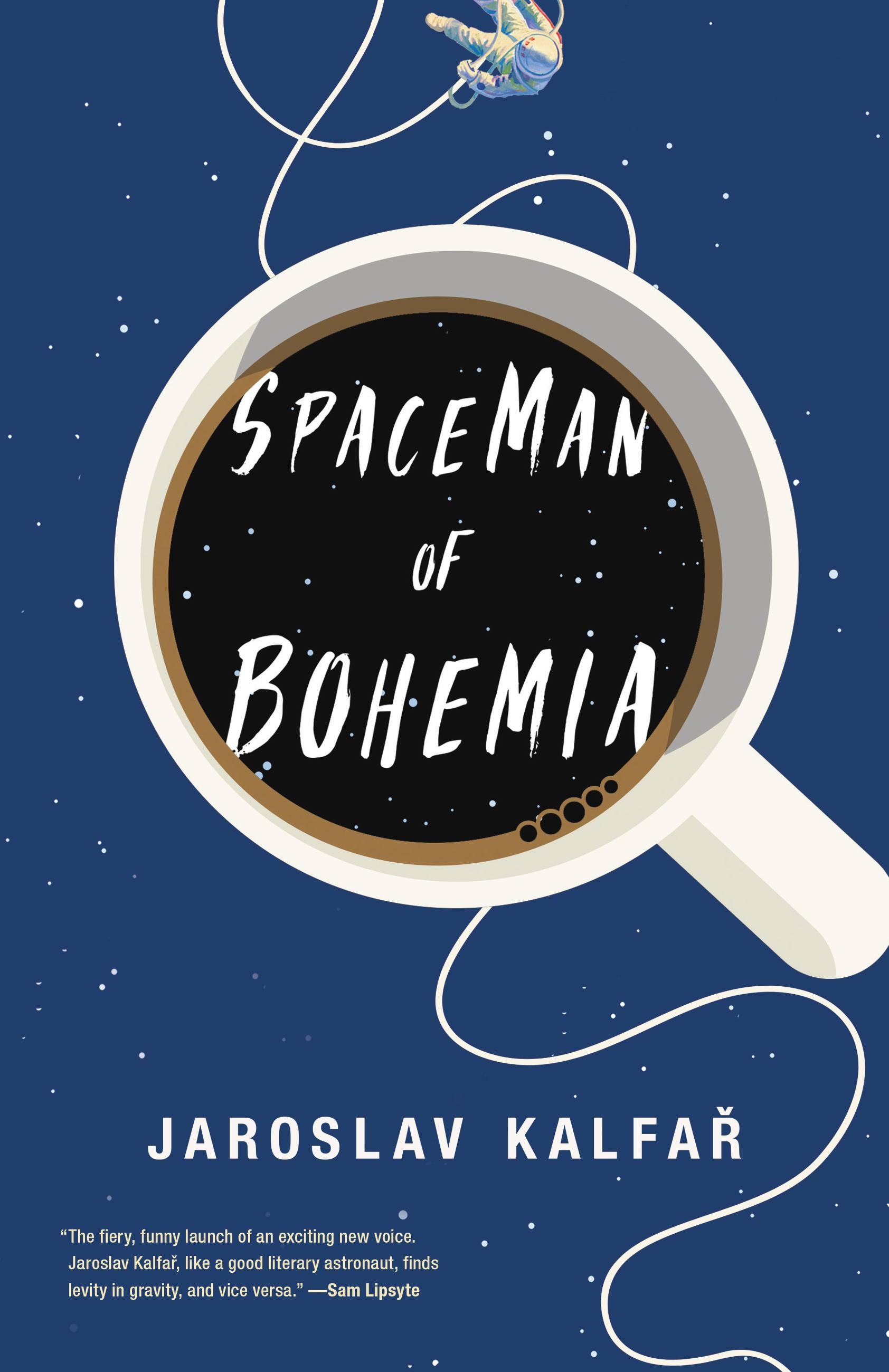
Spaceman of Bohemia by Jaroslav Kalfar immediately appealed to me as a very near-future, 2018, science fiction story by an intriguing new novelist. Kalfar was born in Prague, Czech Republic, but came to the U.S. as a teenager, completing his education here and now residing in Brooklyn.

The story seems relatively simple for much of the novel: Jakub Prochazka, a scientist, is enlisted to be the first Czech astronaut to explore a phenomenon of space particles that could be crucial to all of humanity—but also may gain his home country the sort of influence and significance that has been dominated by the U.S. and Russia (powers that lurk throughout the novel).

As I was reading, I became intrigued at how Kalfar’s space odyssey seemed a powerful and superior companion to Andy Weir’s novel, The Martian, and the film Gravity.

Spaceman of Bohemia sputters some with managing time and maintaining the delicate tension in tone, mostly tragi-comic early and then sporadically through the middle and end. But on balance, Kalfar avoids the critical pitfalls of The Martian (glorifying the sacred white male) and Gravity (subsuming the female lead in masculinity), while depending on the plot tricks of both—being lost in space and manipulating the possibility that the protagonist will not survive.

But as my mind was parsing Spaceman against the lesser novel and film, Prochazka alone in his spacecraft encounters (or imagines) an alien, eventually gifted the human name Hanus (one of many aspects of the novel that highlights and also satirizes Czech history, its national heroes and its political unrest driven by Cold War communism/capitalism anxieties).

Kalfar’s writing had already triggered my love for Franz Kafka, maybe too easy a notice, but it was at the philosophical exchanges between Prochazka and spider-like Hanus that I recognized Kurt Vonnegut’s Slaughterhouse-Five—Billy Pilgrim, time (not space) traveller and Tralfamadorians debating free will and human nature as well as concepts of time.

Kurt Vonnegut also had a career as a visual artist.

Pervasive throughout Spaceman, in fact, are both the weight and levity of Kafka’s existential metaphor of human existence as a nightmare and Vonnegut’s fatalistic refrain, “So it goes”—possibly (but definitely beautifully) captured by the ever-present allure of Nutella, nectar of the gods, it seems.

Kalfar embodies Czech/Russian-European ideologies and historical/political groundings—distinct from the worldview of U.S. literature or even Margaret Atwood’s Canadian-fueled literary speculative fiction.

Spaceman falls into the genre, then, literary science fiction, that is Vonnegut’s (and Atwood’s) domain; in other words, the conventions of lost in space and an alien are vehicles for a dark satire of the human condition, the fact of humans as pawns of their own devices (politics, technology, the pursuits of knowledge and power, love, and capitalized materialism).

There is a melancholy and even fatalism to the novel, of love, loss, distance, and time, yes, but more overwhelmingly something more biblical—the sins of the father are the sins of the son.

Prochazka’s father becomes a political pariah, and his grandfather tries to help Prochazka cope as a child while the grandfather skins a rabbit:

“You know that the world is always trying to take us. This country, that country. We can’t fight the whole world, the ten million of us, so we pick the people we think should be punished, and we make them suffer the best we can. In one book, your father is a hero. In another book, he is a monster. The men who don’t have books written about them have it easier.”

The weight of history, familial history, shapes and even twists Prochazka, reminding me of the violent urges experienced by Offred in The Handmaid’s Tale: “I think about the blood coming out of him, hot as soup, sexual over my hands.”

While Billy Pilgrim literally travels back and forth in time, Kalfar stylistically shifts the narrative back and forth in time, where readers witness the young Prochazka struggle with the personal against the political:

I don’t care what reigns outside our house—capitalism, communism, or anything else—as long as my parents will return to me and keep me safe from men like the stranger [a man tortured by his father before the fall of communism]. Yes, perhaps my father could even torture him a little. I would allow it. I would ask my father to torture the man until he stopped hating me.

And like the alien Hanus, the grandfather becomes a philosophical voice of doom: “‘Different lords and the same shit for the commoners.'” And eventually, Prochazka appears to have drawn a similar conclusion: “Now I am a cadaver in waiting….The body is the worker and the soul the oppressor.”

Ultimately in that existential despair, however, Prochazka as scientist seems to survive, somewhat hopeful nonetheless: “If a sequence of random events is repeated many times, patterns can be detected and studied, thus creative the illusion that human observers can truly know and understand chaos.”

Spaceman of Bohemia ends with Prochazka pummeled by that weight of history, the existential facts dramatized in the novel—Nutella smeared on his arm to attract the spider (substituting for Hanus) in his dilapidated childhood home.

The fantastical of science fiction and the ambiguity of a psychotic main character or a human having a close encounter with an alien build to a harshly realistic ending, winding through echoes of Vonnegut to something we can imagine a twenty-first century Kafka would have penned.

Against Spaceman, The Martian (novel and film) and Gravity are exposed as propaganda and careless, even when they are compelling and grand.

Kalfar’s first novel is satisfying, although a bit uneven, and extremely promising—especially for those who are drawn to the sort of science fiction that embraces the conventions as a captivating way to help us continue, like Prochazka, to make meaning out of the chaos that is being a human on a tiny, fragile planet in the infinity of the universe.

UPDATED: Black Power and the Rise of Trumplandia

During my formative years of the 1960s and 1970s, the political unrest driven by race and racism churned somewhat innocuously for me in the dim background. Several aunts and an uncle lived in Asheville, North Carolina, and their school lives were punctuated with protests, my mother receiving frequent updates by phone as we lived about an hour and a half south of there in South Carolina.

The working class white racism of my family and being a son of the recalcitrant South significantly skewed the ongoing version of history occurring around me—the othering of black people (protests in Asheville were always “riots”) and the discrediting of the Civil Rights movement and its black leaders.

Then, “black power” existed for me in two forms—pop culture versions of blaxploitation media, including Luke Cage, Hero for Hire and Shaft, and real-world protest such black gloves and fists raised, John Carlos and Tommy Smith at the 1968 Olympics.

After the election of Donald Trump as president, many have continued to scramble to explain the rise of Trumplandia, often falling into two opposing camps—one arguing Trump’s support is because more people were hurting under Obama than the pundits ever admitted and the other demanding that we admit Trump’s rise was fueled by racism, now neatly cloaked in terms such as “nationalism” and “alt-right.”

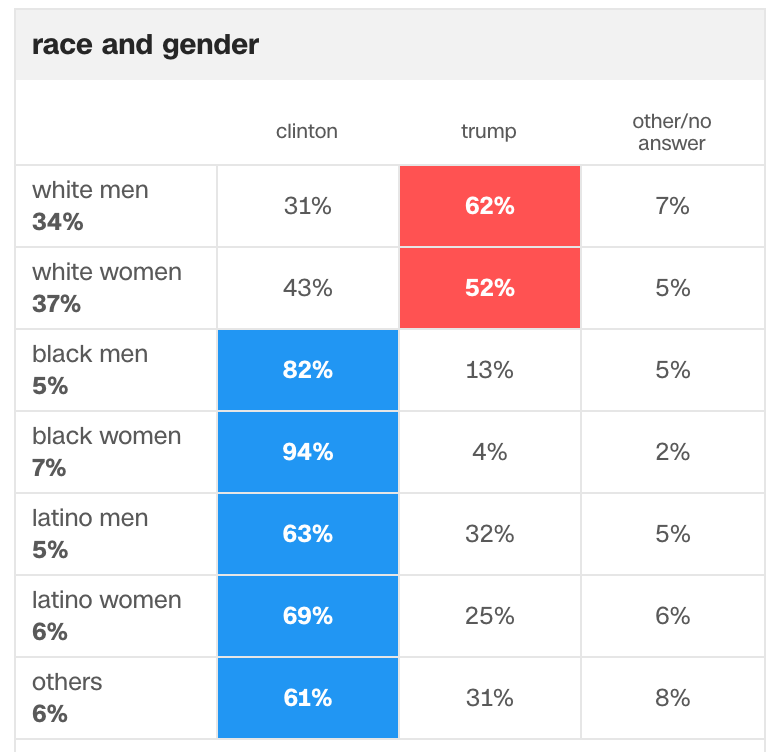
I am of the second camp because the data are overwhelmingly compelling about how white men and women voted for Trump in large percentages:

trump race gender
CNN Politics

We stand in 2017 continuing a corrosive tradition confronted by James Baldwin—”this rigid refusal to look at ourselves.”

“White” remains unspoken as the normal, as the given, and then any excuse is embraced in order to ignore the lingering weight of racism in the U.S.

As might be expected, “black power” in 2017 is before us in the form of economic power, a rising economic autonomy by blacks that likely played a major role in motivating Trump’s supporters who seek to keep the U.S. white.

Two recent controversies may serve as evidence of this: LaVar Ball creating a a sports brand around his soon-to-be-drafted son, Lonzo, and former president Barack Obama’s speaking engagements and fees.

The backlash against both Ball and Obama are interesting and telling since the critics are often those who elected Trump—a bravado and hollowness that dwarf anything Ball has said or done—and who worship Ronald Reagan—who earned millions speaking in Japan after leaving office.

The problems are not bravado, self-promotion, or capitalizing on political careers; the problems are when blacks seek the same avenues as whites to fortune and power.

Moments of this racial anger occurred under George W. Bush as well when his administration sought to dismantle affirmative action, racial preferential treatment for college admission; although Bush himself had benefitted from legacy admission to college.

Trump’s wealth and political success began with an inheritance, one that he has squandered and continued to grow on the backs of others, at the expense of others. Trump now right in front of the entire world works daily to pass on that unearned privilege to his family.

But we are somehow offended by Ball and Obama’s speaking fees—somehow offended that these black men are doing exactly what the capitalistic American Dream says we are supposed to do.

And swirling around all this are black superheroes returning to pop culture prominence—Luke Cage on Netflix and The Falcon as well as the Black Panther in the Marvel film universe.

And just as it did when I was growing up, as long as these black heroes generate money for the right people (“right” means “white”), all is good.

But those same people paying to watch black superheroes, as my family did about Carlos and Smith, turn their scorn on #BlackLivesMatter, rigidly refusing to look at themselves.

Twenty-first century black power is LeBron James, who demands not only the wealth he earns but the power to control that wealth.

Trumplandia is a self-defeating racist response to black power, one that is a real-world dystopia not far removed from another message of pop culture begging for our viewing dollars, The Handmaid’s Tale on Hulu.

We must admit black power spawned Trumplandia, a white fright, and we can only hope, in part, black power will be able to dismantle it.


Recommended

Status threat, not economic hardship, explains the 2016 presidential vote

More Evidence That Racism and Sexism Were Key to Trump’s Victory

Understanding White Polarization in the 2016 Vote for President: The Sobering Role of Racism and Sexism – Schaffner – 2018 – Political Science Quarterly – Wiley Online Library

Does White America Fear Black Equality? The Economic Forces Behind Trump’s Win

Top Democrats are wrong: Trump supporters were more motivated by racism than economic issues, Mehdi Hasan

Race, Religion, and Immigration in 2016 | Democracy Fund Voter Study Group, John Sides

Ultimately, the 2016 campaign helped make attitudes related to immigration, religion, and race more salient to voter decision making in a way that many other attitudes were not. This was particularly consequential for Clinton because a substantial number of white Obama voters had less favorable views of immigrants, Muslims, and black people. Of course, these attitudes were not the only thing associated with how people voted in 2016. Moreover, the findings I have presented here characterize the entire sample of white voters; they are not an account of how any single voter, or every voter, made his or her choice. Nevertheless, these findings suggest that, compared to the 2012 election, the 2016 election was distinctively about attitudes related to racial, ethnic, and religious minorities.

Economic Anxiety Didn’t Make People Vote Trump, Racism DidSean McElwee and Jason McDaniel

Analysis | Racism motivated Trump voters more than authoritarianism, Thomas Wood

Trumpism: It’s Coming From the Suburbs, Jesse A. Myerson

Analogies Like Land Mines: Treading Carefully When We Discuss Teaching Writing

Metaphor is a powerful element in the craft of language. Writers and speakers seek metaphors, similes, and analogies to produce rich expression, but the analogy is a part of everyday discourse and all types of public expression and debate.

One of the staples of my years teaching high school English was Flannery O’Connor’s “A Good Man Is Hard to Find,” a dark satire and enduring example of the brilliance found in Southern literature.

My students and I always paused early in that story, the second paragraph, that begins:

Bailey didn’t look up from his reading so she wheeled around then and faced the children’s mother, a young woman in slacks, whose face was as broad and innocent as a cabbage and was tied around with a green head-kerchief that had two points on the top like a rabbit’s ears.

As a cabbage? we would always ponder. The early descriptions establish O’Connor’s use of contrast to cause tension between some of the cartoonish elements with the grim reality of the story’s plot.

But I also feel in the cabbage simile that O’Connor was poking a bit at metaphorical language itself—something like a meta-metaphor.

Less as craft and more as a strategy for argument, however, Donald Trump, apparently, has posed that he avoids exercise because, he claims, humans are like batteries, having a finite amount of energy. He believes we waste that energy store when exercising.

Both of these example highlight, I think, that we must always investigate the use of analogy for the essential validity of the relationship being presented.

At different times in the past, the mind, for example, has been characterized as a blank slate and a muscle—and then, evidence and careful consideration of these analogies have been discredited.

Where analogy fails, it seems, is when we take a position and then reach for a comparison that confirms the position. Trump, in his baseless battery analogy, simply clamored for something to justify his position—one that falls apart if we interrogate the comparison.

Yet, the analogy is a powerful tool, and often compelling because analogy brings the concrete and the understood into complex and often abstract settings: the mind as a blank slate or muscle is far more manageable for the average person than how the mind actually functions, a domain for specialists.

As a writer and a teacher, my world is often deeply entrenched not only in language, but also in investigating how language works (and doesn’t) to create warranted meaning.

Both as a writer and reader, I have come to live by a guideline that helps remind me of the need to resist the uncritical allure of the analogy: Just because someone can make a comparison doesn’t mean that the comparison is valid.

Writing Is Like?

Recently, I have had several experiences with people making analogies in order to understand writing (composing) and teaching writing: writing like learning to ride a bicycle (starting with training wheels to justify teaching the five-paragraph essay), writing like playing a piano (moving from scales to playing a full piece).

Both of those are recurring analogies, and thus, they must be compelling. However, here I am asking us all to think more carefully about these analogies.

Writing (composing) is nothing like riding a bicycle, and is also nothing like playing the piano, because writing (composing) is creating something from nothing, an act of synthesis.

“Writing” as a term can cause some of the problem, in fact, so let’s first consider writing (as handwriting) versus writing (as composing).

Even in behaviors that depend on something like rote actions (such as handwriting, riding a bicycle, and playing a piano) [1], the repetition of behaviors must be “correct” (or you are learning to do something “wrong”) while also incrementally moving from something like novice to proficient to expert.

Let me risk next an analogy between coaching a scholastic sport and teaching.

As a soccer coach, I worked hard to maintain some level of quality in drills during practice (isolated and rote), for the fact above, to prepare players for playing an actual soccer match (holistic and autonomous, although conforming to a body of rules); but my work as a coach would have been much different if I were helping the team create a whole new game instead of teaching them how to conform to an existing system.

Now we have come against the inherent flaw in the analogies about writing like riding a bicycle or playing a piano because writing (composing) is not of the same kind of behavior. Instead, writing is more validly analogous to visual art such as painting or drawing.

While writing (composing) and visual art do in fact have discrete skill sets that can and should be honed in isolated and somewhat artificial ways, practice, composing a written piece and visual art come from trying the whole thing inexpertly at first and then continuing to do the whole thing in incrementally more proficient ways until some level of expertise is achieved.

Writing (composing) and visual art begin by facing blank paper, acts of synthesizing and creating from nothing to something.

And thus, in pursuit of a more valid analogy, just as we do not teach painting by first asking students to paint-by-number, we should avoid at least an overuse of templates (five-paragraph essay, etc.) when teaching composition.

Further, the field of composition has ample evidence (as do those of us who teach writing/composition) that once students have been prompted to conform to a template, they are dogged in never letting go; the template, sigh, is not a set of training wheels easily removed.

Metaphor, simile, and analogy are powerful tools, but the pursuit of analogy is like navigating a field littered with land mines; we should tread more carefully when making our comparisons, avoiding the Trump error above (selecting the analogy to confirm a belief without investigating if the comparison is accurate, without starting with a credible claim itself).

Just as we scramble to understand better how the brain/mind works, often resorting to analogy, we who write and teach writing (composing) are confronted with something equally complex, and are rightfully looking for how to better navigate that understanding.

In that pursuit, I believe the bicycle and piano analogies to writing mis-serve us and our students. Let us seek instead analogies grounded in capturing the holistic and chaotic nature of rendering meaning from nothing and presenting comparisons that are of the same kind.


[1] I urge you to look into how the 10,000-hour rule was misrepresented in the media by Gladwell and others.

Accreditation: “‘relatively superficial, extremely time-consuming and doesn’t lead us to a goal of significant improvement'”

For well over three decades, I have been both a full-time educator (high school English teacher for 18 years and currently a college professor, going on 16 years) and a writer. As a high school teacher, I also taught journalism and was the faculty sponsor for the school newspaper and literary magazine over about 10-11 years.

Therefore, I have a great deal of experience in the fields of education and journalism, experience that has revealed to me a rather damning fact: One can be well trained in educational pedagogy or the craft and conventions of journalism, but without nuanced and deep knowledge of the content of that teaching and writing, the outcome can and often is quite awful.

In journalism, for example, the vaunted New York Times publishes and fails to recognize blindly awful articles about poverty. And Education Week regularly features the worst of edujournalism.

And let me emphasize here, these criticisms are about the very best of the field.

The rise of Trumplandia has also birthed a renewed concern about the media and journalism—much gnashing of teeth about fake news and post-truth—so this announcement from Northwestern University may seem ill-suited in the context of those concerns:

In a nontraditional move, officials at Northwestern University‘s prestigious journalism and communications school have decided not to renew the program’s accreditation, letting the designation lapse.

The dean of the Medill School of Journalism, Media, Integrated Marketing Communications said Monday that school officials chose not to pursue renewed accreditation, which provides outside approval of academic programs, because the process is “flawed” and not useful.

More pointedly, the dean explains:

“Our goal is always to be the best in the world, and this process doesn’t get us there,” Hamm said in an interview Monday afternoon. “We just don’t find that the review provides us with anything beyond what we already know today. It’s relatively superficial, extremely time-consuming and doesn’t lead us to a goal of significant improvement. It’s sort of a low bar.”

The current hyper-focus on media and journalism has been a parallel reality in the field of education over the last three decades-plus; therefore, there is much to unpack about the parallels in the two fields.

As a lifelong educator, I had to seek certification during my formal college education, I worked as a classroom teacher in public schools under standards and testing, and I now must conform to the mandates of teacher certification and program accreditation as a teacher educator.

In all of those contexts, I am a witness to that accreditation (like certification) is, in fact, “’relatively superficial, extremely time-consuming and doesn’t lead us to a goal of significant improvement. It’s sort of a low bar.’”

All types of bureaucratic accountability—such as the thirty years of standards and high stakes testing in public education reform—are ultimately reductive by shifting the focus toward meeting standards and requirements that are secondary and tertiary approximations of authentic goals (holistic goals that have been cannibalized into discrete elements for the sake of efficiency).

Why, we should be asking, do disciplines such as journalism and education feel the need to add the layer(s) of accreditation (and certification) onto their degrees—when other disciplines trust that the degrees themselves are enough?

Two reasons are practitioners in both disciplines suffer from the low self-esteem of the fields and the twin-tyrannies of the market place and bureaucrats.

Since I focused on journalism above, let me shift here to education.

No discipline or profession has suffered more under the weight of political and public marginalizing and de-professionalization than education—in part as a consequence of sexism (teaching long associated with being a woman’s job) and in part due to the burden of K-12 and many college teachers/professors being agents of the state, working in tax-funded public institutions.

Education currently labors under a nearly unmanageable matrix of mandates related to degrees, certification, and accreditation; and these requirements are in constant flux—standards and mandates for proving those standards have been met shifting every 3-5 years.

Over the accountability era, then, many teacher certification programs have dropped educational philosophy courses, foundations courses, and what many people would consider the more academically challenging knowledge base of education degrees (degrees, by the way, that have historically been slandered as “too easy”).

Education programs are in constant flux, changing courses and programs to meet state certification mandates and accreditation mandates—neither of which are being driven by scholars or practitioners but by bureaucrats.

The most perverse of ironies has occurred, then, in education because those who claimed education degrees are flimsy have successfully made them a maze of nothingness through certification and accreditation mandates.

Ultimately, we must face these realities:

  • Increasing an emphasis on the technical aspects of education and journalism distorts the importance of both and has created practitioners who may perform with proficiency while failing miserably at the larger responsibility to what is being taught and what is being expressed as well as who is being taught and who is being informed.
  • No generic teaching or journalism skills exist absent the content of what is being taught or written about, and therefore, reducing teaching or journalism to discrete skills necessarily dilutes holistic professions to simplistic bureaucracy.
  • There is no option for objectivity in education or journalism; both are political acts that require moral and ethical distinctions as well as seeking out the Truth/truth.
  • Accreditation (and certification) is more about power and political grandstanding than about the integrity of any discipline. In fact, accreditation is necessarily counter to the integrity of any discipline.

Reaching back to Franz Kafka and then recurring throughout pop culture (mainly satire such as Dilbert and Office Space), the folly of bureaucracy has been exposed time and again; yet, it remains entrenched in some of the foundational disciplines in our democracy—education and journalism.

Northwestern University has taken a bold but necessary step that should be a beacon for all of journalism and education; we are well past time to end accreditation (certification) as the process that strangles the vibrancy out of any discipline.

Intimacy, Privacy, and Consent

Tom. Look—I’ve got no thing, no single thing—

Amanda. Lower your voice!

Tom. In my life here that I can call my own!

The Glass Menagerie, Tennessee Williams

I am in high school, junior or senior year, I think, playing pick-up basketball on the concrete court in my yard with several friends and my father.

At some point, I say something wrong to my father as the game heats up, and he slaps me hard across the face—bringing the game to a sudden stop and silence.

I had—as I did more and more often as a late teen—breached the respect line due all adults engrained in me by my father. I had been slapped before walking down the street when I failed to say “yes, sir” to someone we had spoken with in our hometown.

To this day, as reflex, I say “yes, sir” and “yes, ma’am” to almost everyone, from my students to my peers and always those older than me. To most people, it seems quaint, I am sure, and yet another marker of my very Southern Self.

On balance, however, my father was unflinchingly wonderful to me; my childhood, nearly idyllic—although I have had to cast aside many of the beliefs and practices my father passed onto me.

The iron-fisted authoritarianism of my childhood and teen years harvested the opposite effect intended. To this day, I bristle at all authority, mostly because I recognize in it such crass hypocrisy that I can barely hold my tongue—just as I often could not hold my tongue with my father triggering him to throw me across my bedroom and into the wall even though I was an inch taller then he, triggering him to wrestle me to the ground, pinning me down and demanding that I just not say one more word.

Straining against his weight and strength, I would add: “Word.”

In the wake of the four decades between then and now, I often think about that day I was slapped in front of all my friends. I do not recall it, and cannot make some dramatic claim that the slap still burns on my cheek.

I think about it, often.

During just under thirty years as a father, more than thirty as a teacher, and almost three as a grandfather, I think about that slap as I work moment by moment to be a kinder and more patient human, especially to children, young people, and anyone in my care.

“All we gotta do is be brave/And be kind,” guides me along with “I’m so sorry for everything.”

I urge my teacher candidates to say “please” and “thank you” to their students; I beg them to have higher standards for themselves than for the students in their care—always to walk the walk instead of or before talking the talk.

It is ours to be that which we expect in others, to earn and deserve the respect that my father demanded by default.

And without fail, my teacher candidates report to me that teachers in the field tell them to stop the “please,” stop the “thank you” because children don’t work that way, and often this is code for “those children”—black, brown, poor unlike the teachers embodying the same sort of stoic harshness of my father.

I was well on my way in this journey before the birth of my granddaughter almost three years ago, but that tiny human has accelerated my efforts, and sharpened my resolve.

I have helped with daycare with my granddaughter, Skylar, and now also my grandson, at least once a week throughout her life.

As a toddler, Skylar on those days when we were alone would often take my finger and guide me to the floor. I sat cross-legged, and she would use me as a chair; she would also just as often pull me next to her just to be touching as she played.

She still climbs onto the couch just to be close, taking my hand and guiding it to hold her foot or leaning into my hand as I scratch her tiny head beneath that wild flourish we call her hair.

I am now very conscious that she needs but is also learning about what healthy and promised intimacy means, how it looks and feels.

My granddaughter is also learning about this in the context of how men and women interact. It will be an ongoing journey for her—one about which I am terrified because the world remains a horrible and violent place for children and women.

Skylar, approaching three, also seeks from time to time her privacy, becoming aware that some of human behavior is ours alone, and not the loneliness alone, but the privacy alone.

We know when she hides around the corner or goes to another room, we need to change her diaper, which has also become a delicate matter between her and the people who love her, care for her.

I ask her gently for permission to change her diaper because she hates this necessary act; she is aware of its encroachment on her privacy, her emerging awareness of her physical privacy, her physical spaces that are hers to share or not.

I seek her consent, her understanding that I am a caregiver and simply fulfilling a duty she will be able to do on her own someday.

As I change her, especially as I wipe her, I say over and over, “I’m sorry. I’m sorry.”

Skylar has embraced this as well; her sweet refrain, “I’m sorry,” lacing any time she feels she has somehow breached expectations—prompting my always: “It’s ok.”

We talk softly to each other in these exchanges.

Because making mistakes is being a child, being fully human. Who among us is above that?

My dear Skylar, unlike me, has never been and will never be hit by me as a caretaker because this is something unlike my upbringing I have brought to my family, to my daughter’s family.

And so, this becoming fully human child, Skylar, rudders me, will not allow me to ignore the sanctity of intimacy, privacy, and consent.

These, I am resolute, shall not be breached; these remain inviolate.

Because “I’m so sorry for everything.”

The Illusion of Free Speech and Democracy in a Culture of Capitalist-Consumerism

All along the incredibly compressed political/ideological spectrum in the U.S., hand wringing has begun about free speech—mostly because right-wing racist academics and hate-mongering pundits-for-hire have been blocked from speaking or challenged on college campuses.

It seems to me we should pause the melodrama, then, and consider what I believe is the most important koan-type question to ponder concerning free speech: Is it OK to shout “theater” in a crowded firehouse?

Now let’s unpack this as important.

Key here is the question is a satire of the Urban-Legend reduction of free speech couched as “Is it OK to shout ‘fire’ in a crowded theater?”

The satire adds nuance and complexity to considering and understanding free speech since, as the current pontificating shows once again, the public debate about free speech is typically awful in its laziness and lack of context .

Ulrich Baer’s response is a rare recognition of that lack of context and laziness:

The idea of freedom of speech does not mean a blanket permission to say anything anybody thinks. It means balancing the inherent value of a given view with the obligation to ensure that other members of a given community can participate in discourse as fully recognized members of that community. Free-speech protections — not only but especially in universities, which aim to educate students in how to belong to various communities — should not mean that someone’s humanity, or their right to participate in political speech as political agents, can be freely attacked, demeaned or questioned.

So here are a few problems with the All Voices Matter approach to demanding that colleges must protect even the most horrible speech on their campuses.

“Free speech” is a constitutional term about the role of government to protect and not impede any citizen’s right to expression. As noted above, “free speech” is not any damn body gets to say any damn thing any damn time.

If we persist in this debate without including the context of the government’s role, then we are being terribly lazy and ultimately dishonest.

Now, yes, tax-supported public universities and colleges certainly create a complicated context for the role of government in protected or limited speech—if we consider administration and faculty as agents of the government in these institutions.

What we are then arguing, I believe, is academic freedom, a much different concept.

Academics and scholars rightly call for and defend academic freedom, but it too is not license for anyone to say anything any time.

As a professor of history, one may acknowledge to students that Holocaust deniers exist, but that would come with a clear denouncing of that position. As important here is that academics and scholars take great care to represent the weight of voices along with the credibility of voices.

Holocaust deniers, academics would stress, are in a significant minority, and their scholarship is deeply flawed, therefore invalid.

For comparison, let’s return to satire and look at the media in the U.S.

Like the imbalance of Holocaust deniers to Holocaust scholars, the climate change debate is greatly skewed—the vast majority of environmental scientists verify climate change is a fact while a few (usually without credentials in the field) deny climate change, also without valid science behind their claims.

Yet, as John Oliver has shown through the power of satire to render the oversimplified complex, the mainstream media, in its ham-fisted effort at being fair and balanced, routinely have two people present “both sides” on issues such as climate change.

This standard of journalism completely misrepresents the weight of informed opinion and the significance of expertise—whose voice matters and how much that voice is amplified.

All of the current lazy bluster, then, is failing the importance of free speech and academic freedom by oversimplifying the principles, blurring the concepts, and, worst of all, completely ignoring the real threats to free speech—capitalist-consumerism.

There is no free speech in the U.S., and what academic freedom exists is small and cloistered in select classrooms, often hidden and thinly shielded from the Institutions themselves—as public and private education remains prisoner to consumerism and the all-mighty dollar.

Whose voice matters in the U.S. is determined by wealth and still governed by, mostly, white men.

Free speech ultimately is not just about who gets to speak and if, but about the platform as well as the weight behind the who and the what—and mostly that is determined by the weight of money, gender, and race.

If you don’t believe me, just ask Mark Zuckerberg.

O, wait, that’s already happened.

School Choice Advocacy Exposes Political Cowardice

It has become fashionable for pundits to argue that fake news has created a post-truth America; however, mainstream media, in fact, carry the brunt of the responsibility because too often journalists are trapped in press-release journalism and traditional expectations of objectivity.

Evidence of this can be found in how the media routinely cover education and education reform—even when good journalists with good intentions seek to be objective and fair by covering a topic.

Paul Hyde’s Advocates tout the benefits of school choice (25 January 2017) represents the ultimate failure of covering what advocates claim instead of confronting whether or not those claims are credible.

Regularly, the public is bombarded with school choice advocacy and proposals that school choice can somehow address the historical and persistent problems we rightfully recognize in South Carolina’s public schools. These arguments are compelling for a public in the U.S. that believes in choice and idealizes parental choice.

But here is the problem: The evidence rejects that market forces (through vouchers, tuition tax credits, charter schools, and even public school choice, which is in place in South Carolina’s Greenville county) are effective but indirect methods for education reform.

School choice is an ideological argument that exposes political cowardice (let the Invisible Hand do what political leaders refuse to do), and it ignores that public institutions should make choice unnecessary (think about why we do not privatize the judicial system, the police force, roads and highways).

First, the problems with our public schools are primarily strongly connected to large gaps in outcomes among identifiable groups of students by race, social class, special needs, and home languages.

All across South Carolina, for example, and notably along its Corridor of Shame, schools serving low-poverty populations have strong outcomes while schools burdened with high poverty and high percentages of students with special needs and English language learners have weak outcomes.

What we must acknowledge is first that struggling schools and students are not struggling because of a lack of choice, and then, all choice models for reform are indirect ways to make the changes that should be accomplished by public policy directly.

Here is the fact that political leaders are avoiding by abdicating their responsibilities to address inequity: Between 60-80% of measurable student outcomes are connected to students’ lives outside of school—home income, access to medical care, food and living security, and stable and well-paying jobs for the parents.

If public policy were to address these social inequities directly, student outcomes would improve with no in-school reform at all.

But our current schools also require direct reform, some of which could correct the negative consequences of choice—increasing segregation, creating unnecessary shuffling of student populations, diverting funds from public schools for charter and private schools that do not have better outcomes.

Too often, public school practices reflect and perpetuate the exact inequities in society that are overburdening our schools.

Instead of hoping that market forces create equity (and they will not), new direct policy should confront the following: vulnerable populations of students are assigned disproportionately new and un-/under-certified teachers, tracking and selective programs (Advanced Placement, International Baccalaureate) benefit advantaged students while vulnerable students are often barred, discipline practices and consequences perpetuate inequity, and too often school facilities and materials reflect the socioeconomic status of the community.

Ultimately, mainstream media failing to provide a critical response to school choice advocates allows yet more political cowardice.

School choice—from vouchers to charter schools to public school choice—over the past 20-30 years has never produced the miracles advocates promise. Despite public perception, charter schools and public schools do not have higher outcomes than public schools when adjusted for the characteristics of students served.

Types of schooling simply do not make a difference, but practices do—although no in-school practices have yet to overcome the influence of out-of-school influences beyond the scope of teachers and schools to control.

Allowing powerful people with vested interests to advocate for failed policy without any media, political, or public challenges is cheating our schools, our students, and our democracy.

The weight of evidence does not validate school choice advocacy, but more important than that, we know what needs to be reformed to insure better opportunities for all students.

We need politicians themselves to embrace choice, choosing direct action instead of continuing to hide behind the political cowardice of hoping parents-as-customers can force schools to accomplish the impossible.

Think Tank Advocacy Reports Not Credible for Education Policy: SC Edition

The Palmetto Promise Institute‘s report authored by Adam CrainMoney doesn’t translate into student results, is a follow-up to their 2013 report also comparing South Carolina education to Florida education reform.

Although this report offers several charts detailing an analysis of SC and FL National Assessment of Educational Progress (NAEP) tests data (some of which is aggregated by race, disabilities, and poverty, but focusing on 4th grade reading), the report proves to be overly simplistic and an incomplete picture of student achievement in both states—with the ham-fisted data analysis serving as a thin veneer for advocacy unsupported by valid research and a more nuanced analysis of data.

In short, this report proves to be significantly inadequate evidence to support the ideologically-driven recommendations offered at the end—recommendations this conservative think tank would make regardless of the evidence (mostly a mishmash of school choice policy). There simply is no credible link between the shallow analysis of SC/FL NAEP scores and the call for policy as solutions to the manufactured problems.

Let me outline here both the flaws of the data analysis and then the folly of the recommendations.

The foundational flaw of both reports is suggesting some sort of value in comparing SC to FL and the persistent but discredited claim that FL has successful education reform. In fact, the so-called Florida “miracle” has been strongly refuted, notably its grade-retention policy based on high-stakes test scores.

By comparison, SC is slightly more impoverished than FL, and SC (27%) has a higher percentage than FL (16%) of blacks (both metrics used in the report analysis). However, this report from PPI makes no effort to show how their raw comparisons are actually apples-to-apples, or valid.

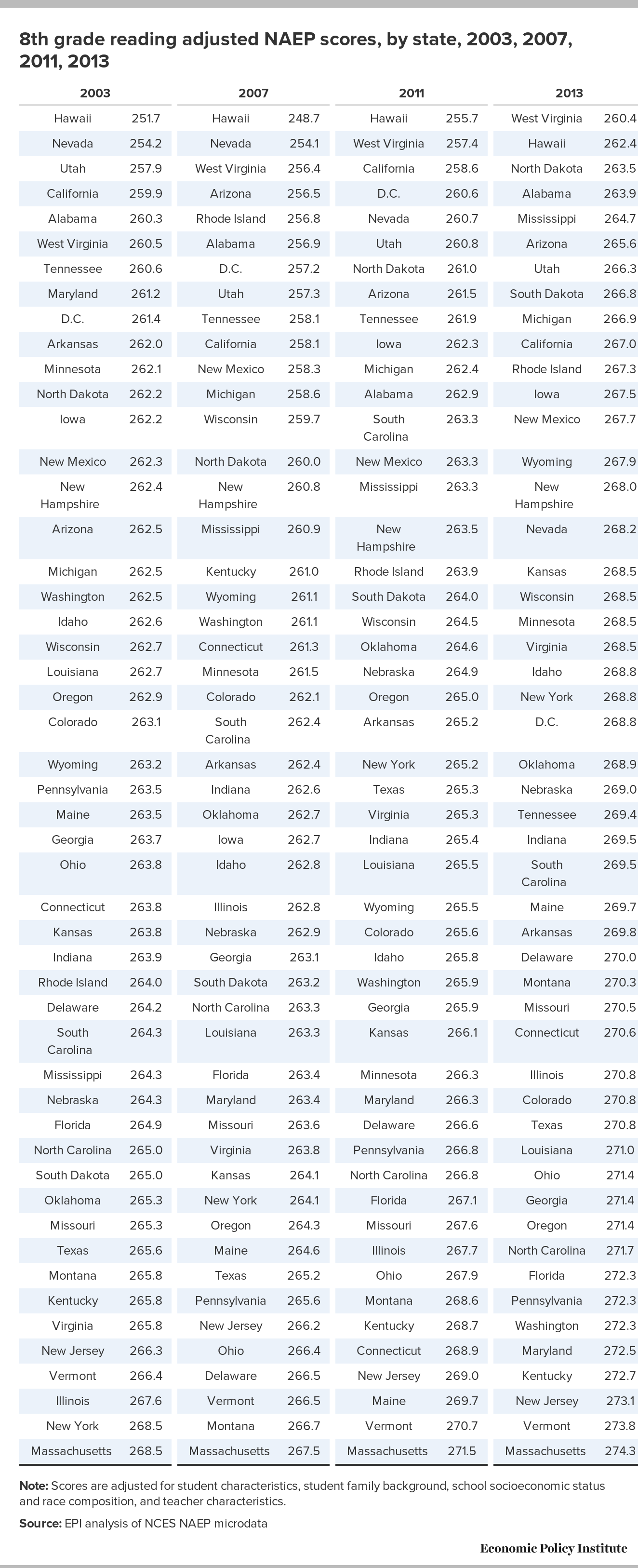
Another analysis of NAEP data that adjusts for factors impacting test scores reveals a much more nuanced and important picture, one that exposes a huge flaw with the FL model of reform [1] and depending on test data.

While adjusted trend data on NAEP continues to show 4th grade FL reading scores better than SC scores, by 8th grade (see Table 6B1, 2013 data) SC (269.5) and FL (272.3) have nearly identical adjusted scores.

Here is a key point about FL’s retention policy: Retaining students can inflate short-term test data, but those gains erode over time. Further, grade retention [2] maintains a strong correlation with students dropping out of school and an inverse correlation with students receiving a diploma (see Jasper, 2016 [3]).

Ultimately, the data analysis and charts in this report are overly simplistic on purpose because PPI has an agenda: argue against increased school funding and promote school choice.

The report uses bold face, lazy math, and insufficient statistical methods to dramatize a baseless claim: “Simple funding comparisons indicate quite the opposite. Over the twelve year period between 1999 and 2011, South Carolina spent a total of $6,920 more per student, or an average of $692 per year.

Without proper statistical analysis, using controls and making causal claims, this raw data approach, like the NAEP analysis, means almost nothing.

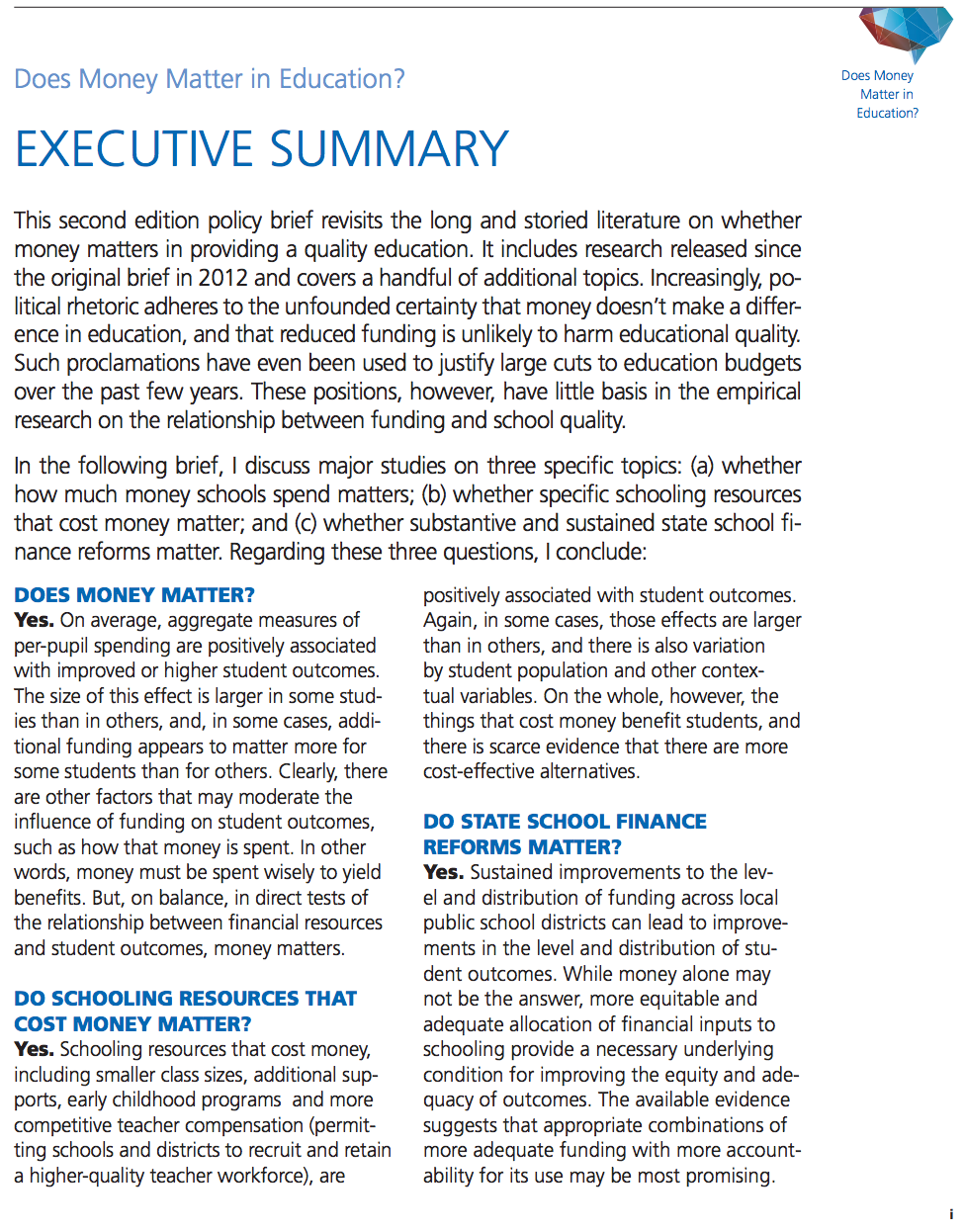
The body of educational research, in fact, shows that funding does matter (see Baker, 2016) [4].

Both, then, the NAEP analysis and the related argument that SC school funding is somehow excessive/wasteful are statistically inadequate and useless for making the recommendations at the end of the report.

Those recommendations fall into two broad categories: accountability and school choice.

SC and FL jumped on the accountability bandwagon early, about three decades ago, and remain completely unsatisfied with their educational outcomes, despite huge amounts of tax dollars and immeasurable time spent on ever-new standards and ever-new high-stakes tests.

Calling for accountability ignores the research base that shows accountability based on standards and testing has failed, will continue to fail:

There is, for example, no evidence that states within the U.S. score higher or lower on the NAEP based on the rigor of their state standards. Similarly, international test data show no pronounced tests core advantage on the basis of the presence or absence of national standards. Further, the wave of high-stakes testing associated with No Child Left Behind (NCLB) has resulted in the “dumbing down” and narrowing of the curriculum….

As the absence or presence of rigorous or national standards says nothing about equity, educational quality, or the provision of adequate educational services, there is no reason to expect CCSS or any other standards initiative to be an effective educational reform by itself. (Mathis, 2012)

The evidence on school choice also contradicts the report because choice fails to increase student achievement, but it is strongly associated with increasing segregation and inequity (see here and here).

Let’s summarize the major points of the report:

  • The report claims SC lags FL in academic achievement and education reform while spending more per pupil. However, the analysis offered here is an incomplete picture and statistically flawed. None of the claims made in the report are proven, and more nuanced and longitudinal analyses of NAEP greatly erode the premise of PPI’s report (grounded also in the debunked Florida “miracle” claim).
  • The report’s major recommendations about school funding, accountability, and school choice are all strongly contradicted by the research base, which the report fails to acknowledge.

Ultimately, as a colleague responded when I shared this report, PPI has published “a five page Op-Ed with bar graphs,” and I would add, not a very good one at that.

SC should in no way be influenced by this report when making education policy.

However, SC should heed a kernel the report’s conclusion: “The disparity between the stewardship of resources in Florida and our struggling education system in South Carolina is apparent.”

As I have detailed, while most educational rankings and comparisons prove to be hokum, what evidence from our schools and reform policies shows is that SC ranks first in political negligence.

Ironically, this report is calling for more negligence in the pursuit of market ideology.


[1] See evidence discrediting Florida “miracle” and FL’s reading policyhow SC could benefit from looking at Oklahoma, not FL; and why FL reform is harmful for students and literacy.

[2] See the National Council of Teachers of English’s Resolution on Mandatory Grade Retention and High-Stakes Testing:

Grade retention, the practice of holding students back to repeat a grade, does more harm than good:

  • retaining students who have not met proficiency levels with the intent of repeating instruction is punitive, socially inappropriate, and educationally ineffective;
  • basing retention on high-stakes tests will disproportionately and negatively impact children of color, impoverished children, English Language Learners, and special needs students; and
  • retaining students is strongly correlated with behavior problems and increased drop-out rates.

[3] Jasper’s abstract captures the ultimate failure of FL’s reform:

In 2003-2004 approximately 23,000 third graders were retained in Florida under the third grade retention mandate outlined in the A+ Plan. Researchers in previous studies found students who were retained faced difficulty in catching up to their peers, achieving academically, and obtaining a high school diploma (Anderson, Jimerson, & Whipple, 2005; Andrew, 2014; Fine & Davis, 2003; Jimerson, 1999; Moser, West & Hughes, 2012; Nagaoka, 2005; and Ou & Reynolds, 2010). In this study I examined educational outcomes of students retained in a large southwest Florida school district under the A+ Plan in 2003-2004. I used a match control group, consisting of similarly nonretained students, who scored at level one on the Grade 3 Reading FCAT. I then compared the control group to the retained group. I also compared achievement levels on the Grade 10 Reading FCAT of the retained and non-retained group. I evaluated longitudinal data, for both the retained and non-retained students, and found 93% of the retained students continued to score below proficiency (below a level 3) seven years after retention on the Grade 10 Reading FCAT as compared with the 85.8% of the non-retained students. I also compared standard diploma acquisition of the retained and non-retained group. The non-retained group was 14.7% more likely to obtain a standard high school diploma than the retained group. Finally, I used data from previous studies to extrapolate economic outcomes.

[4] Baker’s analysis has key points detailed in the Executive Summary (p. i):

baker funding 2016.png