All posts by plthomasedd

P. L. Thomas, Professor of Education (Furman University, Greenville SC), taught high school English in rural South Carolina before moving to teacher education. He is a former column editor for English Journal (National Council of Teachers of English), current series editor for Critical Literacy Teaching Series: Challenging Authors and Genres (Brill), and author of Teaching Writing as Journey, Not Destination: Essays Exploring What ‘Teaching Writing’ Means (IAP, 2019) and How to End the Reading War and Serve the Literacy Needs of All Students: A Primer for Parents, Policy Makers, and People Who Care (IAP, in press). NCTE named Thomas the 2013 George Orwell Award winner. He co-edited the award-winning (Divergent Book Award for Excellence in 21st Century Literacies Research) volume Critical Media Literacy and Fake News in Post-Truth America (Brill, 2018). Follow his work @plthomasEdD and the becoming radical (https://radicalscholarship.wordpress.com/).

Complicit

Brent Staples, editorial writer for The New York Times, has committed to Tweeting at intervals this same message:

I admire his resolve and wish that mainstream media would embrace his dictum—although I am not holding my breath.

On a much smaller scale, I have been as determined to hold to this: Supporting Donald Trump—and unequivocal racist and misogynist, to name just some of his bigotry—is racist and sexist.

Responses to my claim are often met with harsh denials, typically to the extreme. Recently on social media, I was chastised that it was ridiculous to call half of the U.S. racist—to which I noted only about 26% of eligible voters supported Trump, just 19% of the total population.

Racism denial, specifically the refusal to call any person “racist,” is nearly a national past-time in the U.S.

One factor in the denial is misunderstanding what racism is—a systemic dynamic about both race and power.

But another reason for racism denial, for the knee-jerk “I am not a racist,” is much more complex, I believe, because much of the racism that exists in the U.S. today is less about oafish racism, and more about implicit bias (holding racist beliefs at the unconscious level) and about our being complicit in systemic racism, either unaware or justifying the contradictions in our complicity and our stated beliefs.

#

In 1971, my family moved from renting a house in Woodruff, South Carolina—a step up from my first childhood home in Enoree nearby—to the house my parents built on the first lot purchased at Three Pines Country Club.

Yes, this redneck lived from about age 10 and until just after college on a golf course.

My working-class parents scraped and worked themselves into ill health (notably my father) to make their American Dream come true—their own house and on a golf course at that.

I lived this life as most people do, completely uncritically and almost universally committed to the ideals stated and implied by our family of four achieving home ownership at something as seemingly elite as a country club.

But then there was the discord, unexamined then but nearly deafening now.

I grew up playing golf and basketball as my primary efforts at being an athlete. My golf life was spent mostly at Three Pines and other golf courses around the upstate of South Carolina, and then I played basketball on school-based teams.

As you may be able to guess, golf was an entirely white world, and basketball, often nearly all black—including my sophomore year of high school when I was the only white player along with 12 blacks on the B team.

But the reality beneath that is even more disturbing. Three Pines did not allow blacks to join the club or play on the course throughout my youth.

I worked and played golf among the members for many years—mostly very friendly people who were also close with my parents. My father was an avid golfer and my mother worked as the bookkeeper at the club for years.

Growing up in the South for me was often like this throughout my childhood and teen years because I was enculturated into the racist norms but often intellectually sensed I did not believe what most around me did about race. My basketball teammates and school classmates included blacks who were some of my closest friends; they were smart and gifted people who contradicted the ugliness of Southern racism.

The transition from being oblivious to the corrosive racism of my upbringing to awareness and then rejecting that racism was in part spurred by two events while working at Three Pines: a member marrying a Native American woman and a family from India joining the club.

The Native American woman and Indian family spurred numerous horrible incidences in which members charged into the clubhouse announcing that blacks were at the course and that needed to be addressed.

The ugliness beneath many people who I had believed to be perfectly good people was exposed—as well as the arbitrary nature in the U.S. of white racism toward blacks.

And here is something very important to emphasize: as an oblivious child, as a semi-aware teen, and as a young adult, I was complicit in the racism, and no claim that I was not a racist was credible.

Being complicit in racism is racism.

#

I can say I am pro gay rights, that I reject and contest homophobia of all kinds. But doing business with Chick-fil-A, who actively supports anti-gay rights movements, makes me complicit in denying equal rights to gays.

I can say I believe in public schools, that I reject school choice and other policies that undermine public schools. But doing business with Walmart, since the Walton family funds significantly school choice and charter legislation, makes me complicit in undermining public schools.

I can say I am for safe working conditions and good worker pay. But doing business with Nike, who has a long and complex history with using sweatshops, makes me complicit with endangering and abusing workers.

And thus, you can say you are not racist. But supporting the racist language and policies of Trump makes you complicit in that racism.

In practice, then, the outcomes of being an oafish racist and being complicit in other people’s racism are no different.

I am mortified by my racist past, and I have spent many decades working to move beyond that blight on who I was.

But I also continue to struggle as I sit in line at Chick-fil-A to buy my granddaughter nuggets or purchase something from Nike or Under Armour, trying to rectify the discord between what I genuinely believe and the concurrent awareness that what I am doing contradict those beliefs.

In those moments “I am not…” is a lie, and that lie is part of being complicit.

Are Trump supporters often KKK members, neo-Nazis, and oafish racists shouting racial slurs in public forums? No, because we have reached at least the point in the U.S. where even when those beliefs remain, most people know they are not tolerated in the mainstream, or at least carry some consequences.

But Trump supporters are complicit in racism, and that really isn’t a distinction that makes any real difference.

Being complicit in racism is racism.

See Also

The Masters presents a phony, sanitized South, Thomas Hackett

VAM, Teacher Bashing, and Unintended Outcomes: “[A]ll [teacher] exits increased under the new evaluations”

Research analysis at Shanker Blog is among the very best available online, notably the work of Matthew Di Carlo.

The posts there are predictably nuanced and careful, dispassionate—to a fault. As a critical educator, I am on edge when I read these careful explications of educational research because they tend to stand so far back from drawing critical conclusions that they leave a great deal of room for forgiving awful and baseless policy.

Teacher Evaluations And Turnover In Houston is an extremely important post as it unpacks new research on the current era of teacher evaluations spawned during the Obama years, notably the increased use of value-added methods (VAM) that link teacher quality to student test scores.

I highly recommend reading the post in full, but here I want to add a few annotations to address both my concerns the analysis tip-toes when it should stomp and to emphasize a few key takeaways well addressed by Di Carlo.

Let me share a few passages, and I will boldface what I want to address; first, the opening:

We are now entering a time period in which we might start to see a lot of studies released about the impact of new teacher evaluations. This incredibly rapid policy shift, perhaps the centerpiece of the Obama Administration’s education efforts, was sold based on illustrations of the importance of teacher quality.

The basic argument was that teacher effectiveness is perhaps the most important factor under schools’ control, and the best way to improve that effectiveness was to identify and remove ineffective teachers via new teacher evaluations. Without question, there was a logic to this approach, but dismissing or compelling the exits of low performing teachers does not occur in a vacuum. Even if a given policy causes more low performers to exit, the effects of this shift can be attenuated by turnover among higher performers, not to mention other important factors, such as the quality of applicants (Adnot et al. 2016).

To address incredibly flawed educational policy, I believe we must be much more careful about distinguishing between political/public claims and then how the research community poses the same issues.

As Adam Bessie has outlined, the “bad” teacher myth was never “sold” in the ways Di Carlo notes above. The film Waiting for Superman is a powerful example of how political and public discourse about “bad” teachers was primarily an argument that teacher quality was the singular or most important factor in student learning, period; politicians and the public almost never added the caveat “most important in-school factor.”

And we must acknowledge that the “bad” teacher movement driving new teacher evaluations including VAM was significantly grounded in anti-union sentiment and union-busting objectives—not about teacher quality or student learning.

The nuanced argument about teacher quality, in fact, was most often expressed among some researchers, while mostly absent from the media or political discourse, such as Di Carlo (from 2010):

But in the big picture, roughly 60 percent of achievement outcomes is explained by student and family background characteristics (most are unobserved, but likely pertain to income/poverty). Observable and unobservable schooling factors explain roughly 20 percent, most of this (10-15 percent) being teacher effects. The rest of the variation (about 20 percent) is unexplained (error). In other words, though precise estimates vary, the preponderance of evidence shows that achievement differences between students are overwhelmingly attributable to factors outside of schools and classrooms (see Hanushek et al. 1998; Rockoff 2003; Goldhaber et al. 1999; Rowan et al. 2002; Nye et al. 2004).

Next, further into the recent post:

Prior to ETI, there was a negative relationship between teacher effectiveness and exits – i.e., less effective teachers were more likely to exit than their more effective colleagues, with effectiveness here defined in terms of validated measures of teachers’ ability to raise students’ test scores (in part because the original value-added scores, unlike the other components of the system, are available both before and after the new evaluations were implemented).

A strong footnote for this important point—so-called weaker teachers were already leaving—is that the real teacher quality problems facing schools, notably high-poverty schools serving vulnerable populations of students, are a lack of equity in terms of teacher assignment (poor students, black/brown students, ELL students, and special needs students disproportionately are assigned year after year to new or inexperienced and un-/under-certified teachers; white and affluent students are gifted the most experienced and certified teachers) and the debilitating grind of high teacher attrition, turnover, in high-poverty and majority-minority schools.

Just as school choices increases educational problems such as segregation, VAM-based teacher evaluation does not address the real problems—equitable access to experienced and qualified teacher, and teacher turnover in high-poverty schools—while also increasing those problems.

And finally:

The big finding of Cullen et al. is that the relationship was stronger after the onset of the new evaluation system, with the estimated effects concentrated among low-performing teachers in schools serving low-performing students, who were more likely to exit the district than they were before ETI.

On the one hand, this suggests that the new evaluations worked as intended. Under a system in which principals were armed with better information about their teachers’ performance (full evaluation results instead of single year value-added scores), teachers who were less effective in raising test scores were more likely to exit the district (or be dismissed) post-ETI than they were prior to ETI, particularly in schools serving lower performing students. On the other hand, all exits increased under the new evaluations — including among teachers who were rated as average and high performers. The extent to which this spike is attributable to the new evaluation system per se is unclear, but it served to “dilute” the impact on student achievement of the increase in exits among low performers. There is also some indication that higher-rated teachers were more likely to switch out of schools with low-performing students after ETI (versus before the policy), which would also attenuate the impact of the policy.

The Big Caveat, of course, is that this evaluation process and concurrent analysis remain trapped in the efficient (read: lazy) use of test scores by students to determine teacher quality and effectiveness. That said, this study seems to show that VAM-type evaluations may actually push out so-called weak teachers—while also pushing out so-called effective and experienced teachers.

This preliminary evidence supports what many of us have been warning about during the Obama era of education reform: The “bad” teacher approach to education reform causes more harm than good because it misrepresents teacher quality and further de-professionalizes teaching, such as eroding the current teacher work force and discouraging the so-called “best and brightest” from choosing education as their career.

Di Carlo continues to offer incredibly important education research analysis, and I highly recommend anyone interested in education reform to return to this blog regularly. There you will find careful and crisp analysis—although I will continue to hope for the sort of analysis that will critically confront what lies beneath the political and public discourse about schools, education, teachers, and students.

The story inside the story of the research analyzed above is that beneath the “bad” teacher approach to education reform is a great deal of bad politics and bad media; and we must stop tip-toeing around those facts.

NEW RELEASE NOW AVAILABLE: United We Stand Divided We Fall: Opposing Trump’s Agenda – Essays on Protest and Resistance

United We Stand Divided We Fall: Opposing Trump’s Agenda – Essays on Protest and Resistance

Full List of Contributing Authors

Yohuru Williams: Yohuru R. Williams is Professor of History and Author of Black Politics/White Power: Civil Rights Black Power and Black Panthers in New Haven

Denny Taylor: Denny Taylor is Professor Emeritus of Literacy Studies, Novelist, Children’s Author, and Founder of Garn Press

Jonathan Foley: Jonathan Foley is a World-Leading Environmental Scientist and Executive Director of the California Academy of Sciences

Charlene Smith: Charlene Smith is a Journalist, Documentary Film Maker, Author and Biographer of President Nelson Mandela

David Joseph Kolb: David Joseph Kolb is a Prize Winning Reporter, Editor and Columnist, and Author of Devil Knows: Tale of Murder and Madness in America’s First Century (Garn Press)

P.L. Thomas: P.L. Thomas is a Recipient of the NCTE George Orwell Award and Author of Beware the Roadbuilders and Trumplandia (Garn Press)

Jennifer C. Berkshire: Jennifer Berkshire is a Writer, Editor, and Author of the Have You Heard Blog and Co-Host of its Weekly Podcast on Education in the Time of Trump

Morna McDermott: Morna McDermott is Professor of Education and Co-Editor of Testing Our Courage: United Opt Out and the Testing Resistance Movement

Steven Singer: Steven Singer is a Public School Teacher, Education Advocate and Author of the Gadfly on the Wall Blog

Russ Walsh: Russ Walsh is a Public School Teacher, Literacy Specialist, Curriculum Supervisor and College Instructor, and Author of A Parent’s Guide to Public Education (Garn Press) and the Russ on Reading Blog

Katie Lapham: Katie Lapham is a NYC Public School Teacher and Author of the Critical Classrooms, Critical Kids Blog

Anne Haas Dyson: Anne Haas Dyson is Professor of Education, a Recipient of the NCTE Outstanding Educator of the Year Award, and Author of Negotiating a Permeable Curriculum (Garn Press)

Esther Sokolov Fine: Esther Sokolov Fine is Professor Emerita of Education, Former Elementary School Teacher in Downtown Public Housing Communities and Alternative Programs, and Author of Raising Peacemakers (Garn Press)

Vanessa Barnett: Vanessa Barnett is School District Arts Program Coordinator, University Arts Instructor, and Museum Arts Consultant

Carolyn Walker: Carolyn Walker is a journalist, memoirist, essayist, poet, and creative writing instructor nominated for a Pushcart Prize, and Author of Every Least Sparrow (Garn Press)

Steve Nelson: Steve Nelson, Head of Calhoun School 1998-2017 in NYC, one of America’s most notable progressive schools, and Author of First Do No Harm: Progressive Education in a Time of Existential Risk (Garn Press)

George Lakoff: George Lakoff, Professor Emeritus of Cognitive Science and Linguistics, is a World Renowned Linguist Integrating Studies of Social Issues and Politics from a Neural Linguistics Perspective

“So We must meet apart”: #NationalPoetryMonth 2017 and My Journey with Emily Dickinson

So We must meet apart –
You there – I – here –
With just the Door ajar
That Oceans are – and Prayer –
And that White Sustenance –
Despair –

“[I cannot live with You (640)],” Emily Dickinson

I stumbled into college a hyper-student, with greater parts ignorant arrogance than knowledge or awareness.

By traditional schooling metrics, I was a very smart redneck.

Formal education had convinced me I was a math and science person; therefore, I often stated in my first two years attending a local junior college that I intended to major in physics—that wonderful nexus of math and science.

But then college intervened. During my first survey literature course, my professor, Dean Carter, asked me to tutor for all his classes. I was stunned and initially balked at the idea.

Dean Carter was effusive in his praise of my work in the course, and I gave in, mostly, I think, because tutoring was a paying position. This moment, however, is the foundation of my becoming both a teacher and a writer, I believe.

During my first year of college because of a speech class where I discovered e.e. cummings, I also started writing poetry. Yet, making the transition from math/science guy to English guy was still slow in coming.

My junior college experience, as you may be able to tell already, was extremely important in steering me toward who I am as a person and professionally. Those years, though, were not without bumps.

There, I found myself in Mr. Pruitt’s class for the second time, the first being a positive experience in which we covered some standard American literature I had enjoyed in high school—Thoreau and Emerson standing out in my memory.

This second class began by covering what felt like at the time every single poem by Emily Dickinson, who I genuinely did not enjoy.

Mr. Pruitt had a condition causing him to shake, his head always in motion, and he, like my French professor, was a chain smoker. (This was the late 1970s, early 1980s when smoking was common in every situation casual or formal.)

And Mr. Pruitt loved Emily Dickinson.

These were the days of ditto machines, a copying process that involved typing onto paper with a purple ink sheet behind it in order to create a master to run through the ditto machine; the product was a slightly damp stack of papers reeking of chemicals.

Mr. Pruitt’s Dickinson test was on 8.5 x 14 paper with prompts and questions squeezed into every inch of white space, even sideways along the left and right margins as well as crammed against the top and bottom edges.

Let me return for a second here to the hyper-student claim in the opening: throughout high school, I was capable of making As and Bs without much effort, very little studying.

Before Mr. Pruitt’s Dickinson test, I likely spent more time recreational beer drinking than studying or even reading the poems by Dickinson assigned.

I made a 62.

At that point of college, I was already more of an A student than the A/B student of high school so that 62 soured my attitude about Mr. Pruitt and English, but it completely poisoned my view of Dickinson.

After junior college, I declared a secondary education major when I transferred to a local hyphenated campus of the state university, focusing on English certification. I also dedicated myself to taking as many upper-level courses as the so-called “straight” English majors did.

I graduated college very dedicated to a career as a teacher and extremely aware that I was a writer, specifically a poet. For about a decade or more, I must confess, I carried my disdain for Dickinson into my high school English classes.

And then, from 1995 until 1998, I continued to teach high school full time, adjuncting as well at local colleges, and enrolled in my doctoral program, where I wrote a biography of English educator Lou LaBrant for my dissertation.

My doctoral work included my own commitment to read as many biographies of women as possible along with my scholarly examination of feminist theory on biography, education biography, and the history of education in the U.S.

Toward the end of my program, I discovered The Passion of Emily Dickinson by Judith Farr, a literary biography that carefully confronted Dickinson’s life in a way I had never experienced before. Farr anchored her biographical considerations in Dickinson’s poetry and letters, emphasizing poems often not a part of the traditional canon of what we teach, which tells students Dickinson is obsessed with death, and once wrote about a snake [1].

Of course, despite my being a poet and an avid reader/writer, I had simply failed to see Emily Dickinson reflected in the grandeur of her work, her words. And that was traceable back to how she had been taught, misrepresented, in formal English classrooms, including the singular daguerreotype:

Yale University Manuscripts & Archives Digital Images Database

Several things changed for me then.

I pledged to be more intentional about what I taught my students in terms of author biography, and I began to work even more carefully about honoring the sanctity of what I taught over other less important objectives: echoing Dewey [2] from my doctoral work, I began to ask what did it avail me or my students to badger them with canonical poetry and scansion if that experience made them not want to read poetry.

Just as men “edited” Dickinson’s found treasure of poetry to make it publishable, Dickinson has been reduced to a caricature, and the canon of her poems further misrepresents her, glossing over her full humanity, her womanhood, and her richness as an artist/poet.

My journey with Dickinson also included Adrienne Rich’s brilliant and revolutionary examination, “Vesuvius at Home.” My classes already included joyful lessons on Rich, Sylvia Plath, and Anne Sexton, all of whom had been taught wonderfully to me by Dr, Nancy Moore over my junior and senior years of college.

After my conversion, then, I began to include “Wild Nights—Wild Nights! (249)”—yes, Dickinson was sexual, even erotic, and she played with gender expectations of her poem’s personas—and “This World is not Conclusion (373),” my favorite Dickinson because the first line includes a period, creating tension with “not Conclusion” and student expectations of Dickinson’s use of punctuation.

“I cannot live with You – ,” Dickinson’s speaker begins, adding later: “I could not die – with You –.” And then the tension that in many ways defines her life and her poetry:

They’d judge Us – How –
For You – served Heaven – You know,
Or sought to –
I could not –

“So We must meet apart – ,” the speaker concludes, Dickinson ending the poem with the single “Despair – .”

And there we are confronted with poetry—the human compulsion to capture our experience through words, as expression and investigation.


Notes

[1] The traditional canon and formalized ways of teaching women writers often, I think, is at least shaded by the misogynistic “hysterical” marginalizing of women. Male writers return again and again to universal themes or are hard drinkers and womanizers, but women writers are “obsessed” or disproportionately reduced to suicidal and/or psychotic.

[2] John Dewey:

What avail is it to win prescribed amounts of information about geography and history, to win ability to read and write, if in the process the individual loses his own soul: loses his appreciation of things worth while, of the values to which these things are relative; if he loses desire to apply what he has learned and, above all, loses the ability to extract meaning from his future experiences as they occur? (Experience and Education, p. 49)

“Ignoreland” Realized: Trumplandia 2017

Bertis Downs, lawyer and everything-man for Athens-based group R.E.M., asked on social media what Automatic for the People song is most under-appreciated.

As this album approaches its 25-year anniversary—and in the weakening wake of the band calling it a day—we may be hard pressed to argue that any song on that collection is more relevant than “Ignoreland.”

The career of R.E.M. has some relatively clear eras—the independent phase spanning the 1980s, the popular phase associated with the Warner Brothers contract and the 1990s, and then the post-Bill Berry R.E.M.

It seems fair to argue that Automatic represents what makes R.E.M. an elite example of how a group can achieve significant popularity while maintaining artistic independence and credibility. In short, this is a beautiful album that may in fact have a collection of songs that are all under-appreciated.

Throughout their independent years as playing so-called college alternative rock, R.E.M. developed a reputation as a political band; Michael Stipe’s lyrics unpacked as such, even when they remained elliptical and more evocative than declarative, and then band mates themselves politically vocal and active beyond their music.

R.E.M. fandom seems to fall along the three eras above, with some clinging to the independent 1980s band but balking at popular R.E.M. and then abandoning post-Berry R.E.M. However, “Ignoreland” in many ways is a powerful link between the independent and popular phases.

From 1987, Document lays the groundwork for “Ignoreland” with “Exhuming McCarthy,” pop-song catchy and politically scathing. A compact distant cousin to Arthur Miller’s The Crucible, “Exhuming McCarthy” takes aim at the Reagan administration as a manifestation of all-that-is-wrong with U.S. corporate-capitalism as well as the need to keep the public afraid of creeping threats such as the 1950s Red Scare echoed in Reagan’s “Tear down this wall.”

It is damned hard to find better pop-culture political literature than “Look who bought the myth/ By Jingo, buy America.”

The U.S. did just that for twelve years—eight of Reagan and then four more with George H. W. Bush, who appears in “Ignoreland” with equally incisive lyrics: “How to walk in dignity with throw-up on your shoes.”

A great bittersweet reality of my life is that I no longer can anticipate a new R.E.M. album, no longer feel that rush of the first listen to unpack what I knew would be something that would make me a different person, a happier person.

I recall that first listen to Automatic and how I marveled at “Ignoreland”—what felt to me as a writer, a teacher, and a part of the political Left to be a perfect metaphor for the U.S.

The politics of ignoring reality—tremendous and grinding inequity—in the glare of rhetoric about the American Dream captured in e.e. cummings’s “‘next to of course american i.”

As in “Exhuming McCarthy,” cummings confronts U.S. jingoism—”by jingo by gee by gosh by gum”—linking the paradox of extremely inward-gazing nationalism and the simultaneous failure of the American character unmasked by James Baldwin: “This rigid refusal to look at ourselves may well destroy us.”

“Ignoreland” begins causticly and rings as if written in recent months: “These bastards stole their power from the victims of the Us v. Them years.”

The rise of Reagan/Bush is detailed twenty-five years ago by exposing divisive politics, sword rattling, and hollow promises of trickle-down economics. But “Ignoreland” also warns about the failure of media, predating significantly the recent hand wringing about fake news: “The information nation took their clues from all the sound-bite gluttons/ Nineteen eighty, eighty-four, eighty-eight, ninety-two too, too.”

The U.S. as a media-centric people who are paradoxically, again, un-/misinformed—Stipe’s catalogue also triggers George Orwell’s 1984, a work recently regaining popularity along with other works of dystopian science fiction because Orwell focused on how often those who control language control everything:

TV tells a million lies
The paper’s terrified to report
Anything that isn’t handed on a presidential spoon

If we truly want to know how we have arrived here, what I have christened Trumplandia, the bread crumbs of that decline can be followed through “Exhuming McCarthy” and “Ignoreland” to finding ourselves in the witch’s cauldron.

Trumplandia is a people willingly filing into what was sold as a Jacuzzi, only to find ourselves the meat of a meal to feed the 1%.

To ignore—this must not be ignored now. It is an act of will, a decision.

I argued during the presidential election of 2016 that voters had to compromise their morals to vote for Hillary Clinton, but to vote Trump was a complete abandoning of any moral grounding.

To vote Trump is the ultimate act of ignoring found in the majority of white women voting for a misogynist, in the religious Right voting for a serial adulterer, and in the media happily skipping along hand-in-hand with a pathological liar.

Twenty-five years ago, “Ignoreland” captured the toxic mix of political anger and political resignation:

If they weren’t there we would have created them
Maybe, it’s true
But I’m resentful all the same
Someone’s got to take the blame

Trump ascending and fabricating an administration of billionaires, “Ignoreland” realized because we chose the road of least resistance—we created them.


Understanding Racism as Systemic and about Power

You are an hourly worker in a non-union (euphemistically called “right-work-work”) state. Your immediate boss is abusive and unfair often, but in ways that are nearly impossible to prove.

This is your first real job, and you develop a deep resentment for that boss—eventually coming to despise all bosses and people in authority.

That manager uses tactics that workers believe are abusive and unfair because the manager has decided all workers are lazy and unwilling to work without threats and constant authoritarian oversight.

The worker attitude about bosses and the boss attitude about workers are, however, not the same because of the imbalance of power.

In the beginning, I mention “non-union” because unionization grew out of a recognition that an imbalance of power (owners/bosses/managers versus individual workers) was often conducive to abusive working conditions (think Upton Sinclair’s The Jungle).

Now let’s transfer this workplace dynamic to how people (usually white people) misread racism.

Too often individuals with race or class privilege respond to charges of racism at the individual level: “What about black people who hate white people?” or “What about this white cop shot by a black man? Nobody’s making a fuss about this incident!” or “I am not a racist!”

Decades after his death—and much like the warped legacy of Martin Luther King Jr.—Malcolm X lingers in the white psyche as proof of black racism toward whites because of his “white devil” refrain.

And just as my hypothetical workplace scenario above shows, there exists, in fact, whites who reject all blacks simply for being black and blacks who reject whites for being white.

But, as with bosses and workers, several aspects of these facts expose how they are not the same.

The worker above develops antagonism for all bosses based on actually being mistreated by a boss; now this is possibly an unfair overgeneralization, but it is grounded in real evidence.

Black distrust, black anger—these are expressed in the context of real historical and current inequities that give whites privilege and negatively impact the lives of most if not all blacks.

Both white privilege (advantages not earned) and white animosity to all blacks simply for being black (what most people view as “racism”) are primarily grounded in inequitable systems and stereotypes (not credible evidence).

To make understanding racism even harder, we must try to untangle the recognition that race is not a biological fact (and thus, racial tags cannot be used as valid claims that whites are smarter or blacks are faster, etc.), but a social construct.

And here is where, despite that complexity, racism can be better understood.

Racism cannot be proven or disproven by an individual example. One white person refusing to hire one black person does not prove racism (even when it is clearly a racist act); one black man shooting a white police officer does not prove “reverse racism” or disprove racism.

This individual-gaze has made examining racism and admitting racism a persistent social problem in the U.S. Barack Obama being elected president was never proof of a post-racial society because one event cannot prove (or disprove) a systemic reality.

We are left then with some important elements to understanding—and thus, for many whites, resisting and denying—racism.

Racism is systemic, and while race is not a biological fact, it is a social construction that can be relatively easily managed (we can usually see race, or most people believe they can).

That “believe” is important because racism remains a reality because it, like privilege, works mostly in invisible ways.

Yes, some people remain overt in their oafish racism—the KKK, etc.—but most racism occurs along with privilege without people making conscious decisions to be racist (since virtually everyone is aware that “racism” is a negative behavior) or consciously benefitting from their privilege (a person inherits money or parents secure him a nice profession, after which that person genuinely works hard and is very successful; for that person, the initial privilege is invisible).

So let’s think of another parallel: While men certainly can be raped and physically abused just as women can, virtually all women walk around with a pervasive sense of threat to them physically and sexually because men tend to be physically bigger and stronger but also disproportionately have more power and wealth—while men rarely consider the threats of rape or violent attack.

And this is where understanding racism raises the central element of power.

Systemic racism in the U.S. is exclusively white power over black and brown people—just as sexism is exclusively men’s power over women. When black or brown people hate or demonize whites, this is racial, but not racism because black and brown people lack the systemic power to create the large scale consequences that whites can and do for black and brown people.

Despite being well educated, black women in the U.S. on average earn less than white males because of systemic and inequitable forces, racism and sexism.

Just as we can prove and should be able to see sexism in domestic violence data, rape culture, and inequitable workplace pay and promotion, we can prove and should be able to see racism in access to all sorts of opportunities in the U.S. (education, work), inequitable incarceration rates for blacks and shootings by police, and disproportionate underrepresentation in positions of authority.

Denying racism—as with proving racism—cannot be accomplished at the individual level and and cannot be treated as if race is the singular element in racism.

Racism is systemic and about imbalanced power dynamics that can be correlated with socially constructed racial categories.

Privilege and power are inequitably pooled among white straight men, and thus, a key to eradicating all types of inequity—racism, sexism, homophobia, etc.—is for anyone with privilege to resist denying inequity, especially by focusing on individual examples and by ignoring the central role of power in all types of inequity such as racism.

When confronted with claims of racism, then, “I am not a racist” fails, turning all of the gaze onto the self and thus failing to see—leaving racism both invisible and corrosive.

Dear People with Privilege: On Freeing the Pelican

The first men to deny sexism are sexists themselves; the first white people to deny racism are racists themselves.

One of the profound tensions of the U.S. is that the country founded on the ideals of individual liberty—life, liberty, and the pursuit of happiness—was in fact built by sexists and racists. This is no easy or comfortable contradiction.

We have settled into an ends justifying the means narcotic as a people to avoid that contradiction.

The great praise the U.S. does deserve (although not unique to the U.S.) is the concept of pursuit; a great many people have pursued and continue to pursue the elusive equity of our founding principles.

To identify, admit to, and then confront racism or sexism, we must reach to the people with the most power in the country—white men, who believe they have earned that power, their success.

Racism and sexism are not mere abstractions because some people must be complicit in the perpetuation of both.

Even among the victims of racism and sexism, we find people complicit, but the main people responsible for our failures in the pursuit of equity are the ones with the most power, power gained from privilege.

Most of us, then, when confronted with the ugliest truths of racism and sexism immediately tell our stories of struggle: “I cannot have privilege,” we proclaim, “because I have struggled!”

So consider the invisibility of privilege to those with privilege.

You buy a pair of Nike shoes, and if someone asks you if you are for child labor or slave wages for women forced to work in cramped factories as their homes, you are very likely to strongly reject being for those abstractions—while wearing the shoes made in horrifying conditions for women and children workers earning slave wages.

The problem of privilege is that most of us with privilege are complicit through negligence, not through conscious decisions to oppress.

Consequences, however, make those distinctions irrelevant.

As Roxane Gay navigates wonderfully in Peculiar Benefits, many people have contexts within which they have privilege, unearned advantages—even people for whom much of their life is spent as the victim of other people’s privileges.

And white heterosexual men can struggle mightily in life, even as we celebrate the apparent success of a black homosexual woman.

Outliers are some of the most powerful blinders for confronting privilege.

But I believe I can offer here a simple test.

First, to admit to having privilege is not opening yourself to scorn; the fact of having privilege is not justification for condemning anyone.

From there, then, we must move to the key question: What do you do with your privilege(s)? Perpetuate your own needs and desires? Or use your privilege(s) in the service of others who are oppressed, who are victims of other people’s privileges?

Some tests include whether or not you acknowledge your own and systemic privilege (racism and sexism, for example), and then if or not you develop an ability to feel compassion for anyone who is struggling, recognizing that human failure may often be the consequence of systemic forces and not individual flaws.

This last point is important. Racism, for example, persists because as a culture, people in the U.S. have made the default stance about human struggle and failure to be flawed individuals: People who succeed, we assume, worked hard, and people who struggle and fail, we assume, are lazy.

Each of us must come to acknowledge our privilege(s) and proceed with the understanding that systemic inequity is the root cause of individual struggle and failure.

To use your privilege in the service of others [1] even when that act creates risk for you and especially when that act works to dismantle the privilege that allows you to serve others.

A picture (or in this case, a video [2]) is worth a 1000 words, so let me end by suggesting, this is what it looks like to acknowledge your privilege, to identify those who suffer inequity, and then to act in the service of that other:


[1] To serve others, as well, must avoid paternalism. It is not substituting arrogance for your privilege in order to save those who are lesser than you; it is seeking out anyone without your privileges and then asking, How may I help you?

[2] Too often, when confronted with systemic inequity (racism, sexism, etc., represented by the fishing line on the pelican’s beak), people either refuse to acknowledge the fishing line, blame the pelican for being in the situation that caused the line tangle, or argue, “I didn’t put the fishing line around the beak.” Yet, we are complicit if we fish (even carefully), eat fish, or if we do nothing while aware of the dangers of fishing for pelicans and other animals—even if we believe we are compassionate to or hold no prejudice against pelicans.

See Also

Montclair SocioBlog: The Winds of Privilege

How to Expose Racists: Simply Mention Racism

I was pleasantly surprised when Education Week published Why Are We Criminalizing Black Students? by Tyrone C. Howard.

Regretfully, this blog is gorged with posts about EdWeek routinely failing the education discussion, but Howard’s commentary confronts well a hard topic in education.

And then came the comments—tone deaf at best, defensive and racist themselves as worst (first three opening rebuttals):

mcruiz

I’m amazed. I truly didn’t know we teachers had that much power, and the propensity to use it for evil deeds. Wow! Imagine that, we have the power to criminalize Black students. Wow, again!

LynnG

This is a ridiculous article and the author’s bias is so heavy handed that he’s made his argument a joke. Talk about confirmation bias.

Paul D. White

One more racist rant from a Black college professor who doesn’t have the courage to tell the truth, and one more worthless posting by Ed Week for what? A desire to show how “tolerant” they are to biased, ignorant positions regarding race and performance in the schools?

The great failure of the U.S. which has brought us to Trumplandia is, as I have pointed out often, James Baldwin’s “this rigid refusal to look at ourselves” that must be aimed with laser focus on white America.

In schools, black and brown children are disproportionately targeted and punished for the same behaviors as white children, and then in society, black and brown people suffer more inequitable treatment by police and the judicial system.

As Thomas Rudd explains about school discipline:

Contrary to the prevailing assumption that African American boys are just getting “what they deserve” when they are disciplined, research shows that these boys do not “act out” in the classroom any more than their White peers.

For example, in a study conducted by the Indiana Education Policy Center, researchers conclude that:

“Although discriminant analysis suggests that disproportionate rates of office referral and suspension for boys are due to increased rates of misbehavior, no support was found for the hypothesis that African American students act out more than other students. Rather, African American students appear to be referred to the office for less serious and more subjective reasons. Coupled with extensive and highly consistent prior data, these results argue that disproportionate representation of African Americans in office referrals, suspension and expulsion is evidence of a pervasive and systematic bias that may well be inherent in the use of exclusionary discipline (Skiba, 2000).”

And the ACLU reports: “Staggering Racial Bias: Marijuana use is roughly equal among Blacks and whites, yet Blacks are 3.73 times as likely to be arrested for marijuana possession.”

Michelle Alexander’s The New Jim Crow details that policing and the judicial system routinely practices inequitable targeting, convicting, and sentencing along racial lines for the same behaviors—blacks disproportionately suffering for acts no different than whites.

This begins in our schools because the white power structure cannot or will not see the bias in order to eradicate it.

The seeds of the wider post-truth U.S. have been sown by the white “rigid refusal” to admit and then confront the racism that continues to fester in the country.

This is old fake news, but as the posts on the EdWeek commentary reveal, racists respond to facts about racism by calling the messenger a racist. That’s the nastiest fake news there is, especially when it is coming in a publication about the education of our children—the first victims of racism, the most powerless victims of racism.


See Also

Racial Disproportionality in School Discipline: Implicit Bias is Heavily Implicated, Thomas Rudd

The War on Marijuana in Black and White (ACLU, 2013)

Education Reform in the New Jim Crow Era

Toxic Masculinity, Predatory Men, and Male Paralysis

How can anybody know
How they got to be this way?

“Daughters of the Soho Riots,” The National

This is my sixth decade as a human, as a white, straight male.

Here I want to attempt confession, possibly seeking greater understanding, but fully aware of the huge complexities of making these claims, raising these personal struggles in the context of my many privileges.

I am treading lightly but committed to rise above the problematic satire of Ben Folds’ “Rockin’ the Suburbs”—which both speaks to me and makes me cringe:

Let me tell y’all what it’s like
Being male, middle-class, and white
It’s a bitch, if you don’t believe
Listen up to my new CD

My formative years over the 1960s and 1970s were spent in the redneck South. Just as I was reared to be a racist, I was taught very clearly to objectify women, even as that was tempered in my immediate family by direct and indirect messages about respecting and loving women/girls.

Growing up, I was a Mama’s boy, I was very close to my sister (my only sibling), and I had strong and warm relationships with aunts and my maternal grandmother.

As a so-called pre-sexual boy, then, I genuinely learned to feel deep and healthy affection for women/girls—to whom I have always been drawn more strongly than any male bonds.

As a teen, however, I was significantly enculturated into objectifying women, sowing the seeds for potentially behaving in ways that fed into and participated in predatory masculinity and even the various degrees of rape culture.

My classroom was, at first, superhero comic books and then soft-core pornography (such as Playboy and Penthouse)—but the wider popular culture was always reinforcing the worst possible models for how men treat women.

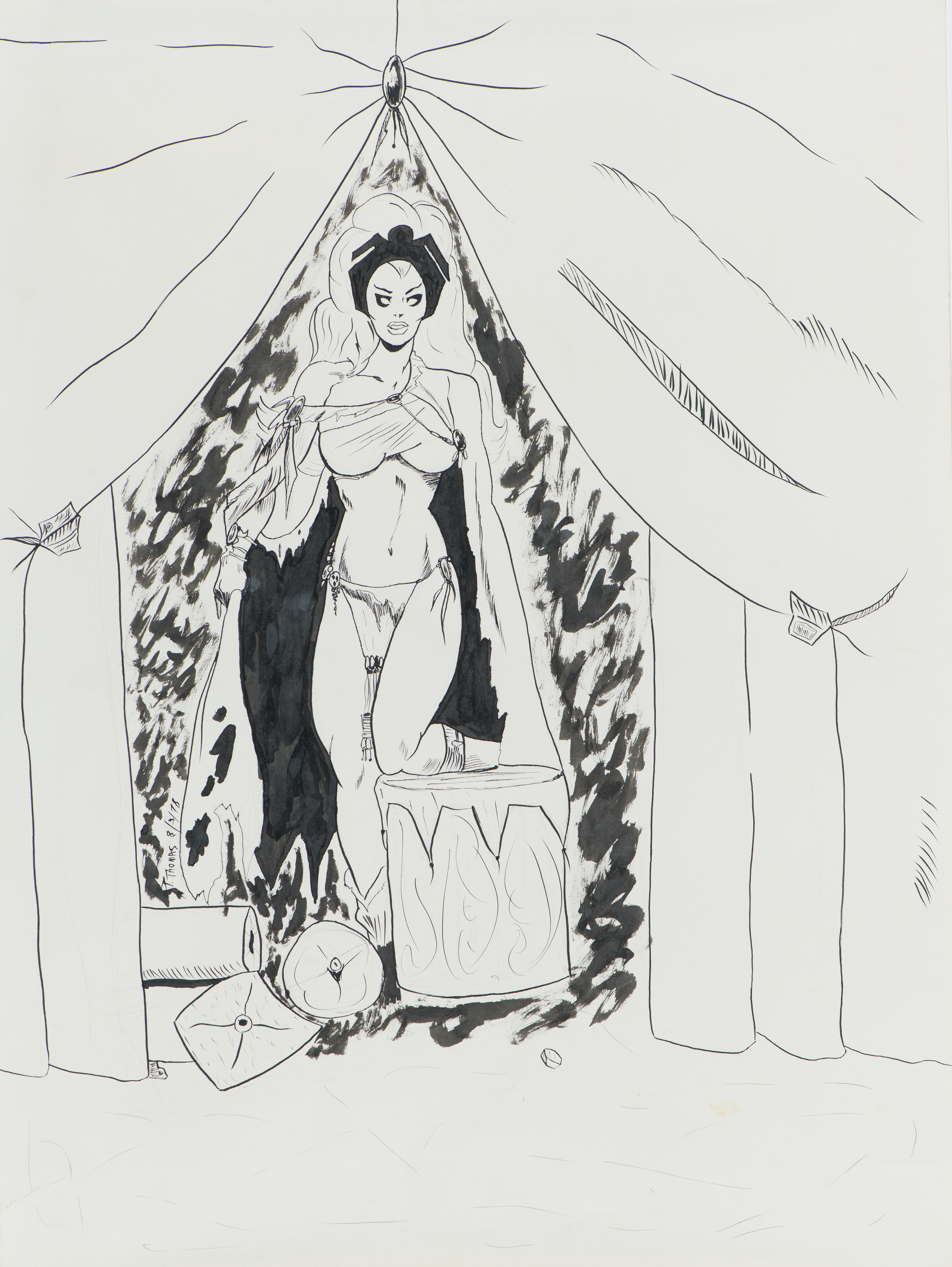
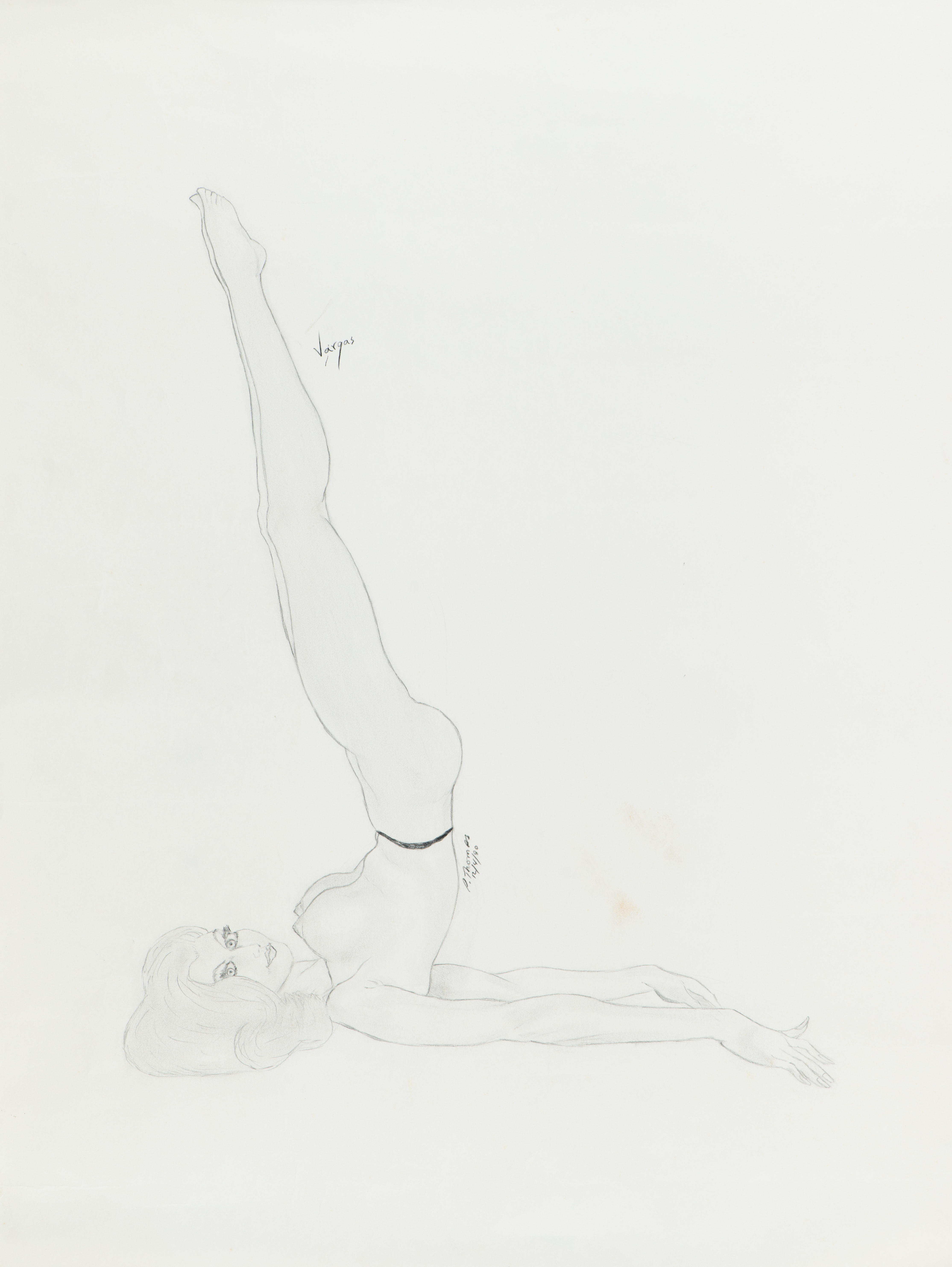
But as all this colored my attempts to be a sexual person, seeking out romantic relationships throughout high school and college, I was also being shaped in how I interacted with the world aesthetically, notably in that I was actively teaching myself visual art by drawing from both comic books and nude photography in the euphemistically named men’s magazines.

One can see a theme in my adolescent artwork:

Storm
Storm from the X-Men

Vargas
I shifted from comic books to men’s magazines and copying the objectifying artwork of Alberto Vargas, popularized in Playboy.

As a teen and young man, I was certainly trapped in very unhealthy but subtle patterns that could only be overcome by gaining critical awareness over my mid-20s into and my mid-30s (when I completed my doctoral program).

Some of that critical awareness was powerfully acquired through my commitment to learning from and teaching important literature such as Alice Walker’s The Color Purple and Margate Atwood’s The Handmaid’s Tale as well as poetry units I taught on Adrienne Rich, Anne Sexton, and Sylvia Plath.

Ultimately, writing an educational biography grounded in feminist theory stands in hindsight as the crowning experience as I approached 40 for a healthy awakening into fully appreciating toxic masculinity, predatory men, objectifying women, the male gaze, and rape culture.

Just as I would explain about my racial awareness, my sexual and gender awareness remains a journey, and as such, I find myself often paralyzed because, as a man, I represent still the potential for abuse through my status, the threat men pose for women in a society that continues to objectify and marginalize females—especially in terms of failing to listen to women who risk telling of their experiences with predatory men and rape culture.

My adult life has been spent as a partner, friend, parent, grandparent, teacher, and coach—all requiring me to monitor my status of power granted by being male and by my professional and familial positions in relationship with females.

As a coach and teacher, I have been (and continue) to be prone to call young women “darling” in casual moments—rightfully prompting some of my closest friends and colleagues who are women to call me on the language, the positioning.

I remain aesthetically drawn to photography and artwork of women nudes—entirely unsure if I can disentangle my toxic past from what I consider non-objectifying appreciation of art.

And so, as I noted above, I stumble toward 60, a man with good intentions who understands that is never enough; I am often reduced to paralysis in how to navigate the world in ways that are equitable and healthy for everyone regardless of race, gender, sexuality, or class.

I am genuinely terrified of ever making any woman/girl feel discomfort because of my masculine presence, my inadvertent gaze, my language, or the implicit threat of my status in relationship to her.

Often these days, I must confront these tensions as I snuggle with my granddaughter who I dearly want to grow up with healthy views of gender and sexuality, who I want to avoid any sort of predatory world.

My daughter was raised without corporal punishment, and now her children have been gifted that same dignity.

I work hard to practice what I preach and feel I make contributions small and even large to a kinder and more compassionate world—a world in which women and children need not ever fear men.

But even the best men walk in the wake of the worst men have given this world—the worst men continue to give to this world, and the women and children who must suffer for that.

Each man must moment by moment examine how he is culpable, where and how he stands in this world in relationship to women and children.

The dilemma of navigating the world as a man is couched in the unearned privilege, the potential for an abuse of unearned power that shouts out “First, do no harm.”

For a man committed to that, however, how does he live a full life without being paralyzed by the worst of being a man, behaviors that often go unpunished and even masked to protect some men from consequences.

How does any man avoid paralysis reading about the Stanford rape case or the stories of women as victims of predatory men?

This remains a rhetorical question for any man with an ethical imperative for his life—not a question for any woman or any child to offer their compassion.

For any man, for each man, this is ours to confront, to answer, and to act.

As long as men hold most of the power that shapes the world, it is ours to build a consensual environment in which human dignity supersedes the brute force of power.

Between acquiescing to the basest of male behaviors and paralysis is the true way, about which Franz Kafka wrote: “The true way is along a rope that is not spanned high in the air, but only just above the ground. It seems intended more to cause stumbling than to be walked upon.”

Pause. Listen. Look carefully before taking any step.


For Further Reading

Experts in the FieldBonnie Nadzam

Roxane Gay, Aimee Bender, and More on Assault and Harassment

The Predatory Men of Academic Creative Writing, John Warner

“He knows, or thinks he knows”: It’s Still a Man’s (Hostile) World

True Detective: It’s Still a Man’s (Hostile) World, pt. 2

Doubling Down (Again) on the White Man’s World

“Gravity”: The Unbearable Lightness of Being a Woman

In the U.S., Where the Female Nipple Is More Dangerous Than a Gun

“We Teach English” Revisited

At times quaint and oddly misguided but unflinchingly confrontational and assertive—the signature tone of her work—Lou LaBrant’s We Teach English (1951) was a rare book-length text over her 65 years as an educator.

While this text for teachers of ELA/English never garnered the status of Louise Rosenblatt’s Literature as Exploration (LaBrant and Rosenblatt were colleagues at NYU), both works represent a long history of trying to coral the field of ELA/English teaching.

A recent conversation and debate on NCTE’s Connected Community about teaching whole-class, assigned novels has reminded me of the enduring tensions of what it means to teach ELA/English—tensions that span K-12 grade levels as well as being grounded in responsibilities to student needs and interests, the field or discipline of English, and literacy broadly.

Historically and then magnified during the past thirty years of high-stakes accountability, ELA/English has shared with math demands and expectations that are not as pronounced in other disciplines; despite the limitations and problems with the terms, I characterize those demands as addressing disciplinary knowledge (or content) and literacy skills.

Our disciplinary knowledge obligations rest with the compulsion to cover established content, such as identifying the parts of speech, analyzing the main characters in The Scarlet Letter, or explaining the key ideas expressed by Ralph Waldo Emerson and Henry David Thoreau as American Transcendentalism.

Literacy skills comprise reading, writing, speaking, and listening—how we as humans navigate the world through literacy. Some see these skills as a different way to think about content, skills such as comprehension, predicting, narration, and persuasion.

At best, these obligations can and possibly should work in tandem. When we teach a poem, Langston Hughes’s “Harlem,” for example, we are introducing students to key content about American literature and the Harlem Renaissance while also teaching them about the elements poetry, reading skills (such as analysis), and reading like a writer so they can transfer those rhetorical and literary strategies into their own writing.

Let me pause here to stress that at all levels from K-12, this is a damn high bar for any teacher. It takes a great deal of time and expertise to learn to manage all that effectively.

At worst, these obligations become professional and disciplinary battles—ones waged among practitioners often at the expense of students we should be serving.

We must teach phonics, but what about the children acquiring the desire and ability to read?

We must teach grammar, but what about the children acquiring the desire and ability to write?

Everyone must read The Great Gatsby, but what if that requirement creates nonreaders?

When we form ideological camps about disciplinary knowledge or literacy, we often fail both our field of ELA/English and students.

We teach English means something extremely complex and difficult, something that in fact may be too much to expect of any teacher.

But this is what we do, this is who we are.

If we return to the debate and discussion about teaching whole-class novels, we are revisiting an enduring debate that captures exactly what teaching English means.

To resolve that debate, I believe, we must remain focused on our students, and not on whether or not we address either area of demands in our field.

It is not a simple way to resolve the questions, but it is rather simple: When we attend to either disciplinary knowledge (and we should) or literacy skills (and we must), what are the consequences of those lessons in the evidence of learning by our students?

If we require our students to read Charles Dickens, and many do not read because they dislike the work, and many begin or continue the journey to being a nonreader, then we have failed dramatically any obligations as teachers of ELA/English.

If a whole-class unit on Lord of the Flies or The Hunger Games becomes a vibrant adventure in the novel and literacy, and most if not all read the novel, if several become hooked on literature, then we have accomplished everything that can be expected of teaching ELA/English.

In terms of both student reading and writing, there are decades of evidence that show how student choice in what they read and write is most effective in both fostering disciplinary knowledge (because they actually read and write) and literacy skills as well as literacy engagement (because they become eager to read and write).

But we as teachers of ELA/English are confronted with the essential problem beneath the call for student choice: students must have acquired some disciplinary and skills knowledge and proficiencies in order to make those choices.

If we can keep a critical eye on the outcomes of the instructional decisions we make—if we can resist dogged commitments to ideologies—then we can make informed choices about what best serves our students in terms of both what disciplinary knowledge they acquire and whether or not they develop as proficient and eager readers and writers.

Staying big picture is important—always asking what we are trying to accomplish with students and then paying close attention to what our students show us we are teaching.

In 2004, Donald Graves looked over his career seeking ways to teach students writing; he offered some enduring ideas about “what remains the same”:

The following fundamentals have remained unchanged in the teaching of writing:

  1. Children need to choose most of their own topics. But we need to show them all the places writing comes from, that it is often triggered by simple everyday events.
  1. Children need regular response to their writing from both the teacher and other readers.
  1. Children need to write a minimum of three days out of five. Four or five days are ideal.
  1. Children need to publish, whether by sharing, collecting, or posting their work.
  1. Children need to hear their teacher talk through what she is doing as she writes on the overhead or the chalkboard. In this way, the children witness their teacher’s thinking
  2. Children need to maintain collections of their work to establish a writing history. Collections show that history when they are used as a medium for evaluation. (Language Arts, Vol. 82 No. 2, November 2004)

In the same way as the debate over whole-class novel instruction, if we view Graves’s fundamentals as strict rules and teach to these rules—instead of to how we are fostering students as writers—we become lost, and we likely fail.

So, yes, students choosing what they read, especially something as daunting as a novel, is a fundamental, but that doesn’t necessarily discredit the possibility of whole-class novels.

To answer any instructional questions, then, as a teacher of ELA/English is in our students, not our obligations to disciplinary knowledge or literacy skills—and especially not in covering the mandated standards or preparing students for high-stakes tests.

The questions are worthy of discussion and debate among teachers of ELA/English, but ultimately we must each answer them with each unique group of students we teach.

When faced with the debates and questions about teaching ELA/English, LaBrant could be harsh and demanding—often seeming to teeter on the edge of, if not crossing over into, prescription. However, what LaBrant was demanding about in terms of “we teach English” is not that we follow her rules, or any rules, but that we remain committed to our students and their journeys in both literature and literacy.

During war, in 1942, LaBrant became frustrated with national concerns about literacy:

The induction of American youth into the armed forces, and the attendant examinations and classifications have called attention to a matter long of concern to those who teach reading or who are devoted to the cause of democracy: the fact that in a land which purports to offer universal education we have a considerable number of youth who cannot read intelligently. We are disturbed now because we want these men to be able to read military directions, and they cannot. A greater tragedy is that they are and have been unable to read with sufficient understanding to be constructive peace-time citizens.

As is to be expected, immediate explanations have been forthcoming, and immediate pointing-of-fingers has begun. Most of the explanations and pointing have come from those who have had least to do with teaching reading, and who are least conversant with the real problem.

Sound familiar?

LaBrant argued against what became a recurring political and public hand wringing about a reading crisis:

An easy way to evade the question of improved living and better schools for our underprivileged is to say the whole trouble is lack of drill. Lack of drill! Leťs be honest. Lack of good food; lack of well-lighted homes with books and papers; lack of attractive, well equipped schools, where reading is interesting and meaningful; lack of economic security permitting the use of free schools—lack of a good chance, the kind of chance these unlettered boys are now fighting to give to others. Surround children with books, give them healthful surroundings and an opportunity to read freely. They will be able to read military directions—and much more.

Here and for over six decades, LaBrant was a champion of the we who teach English but in the name of those students we teach, especially the most vulnerable students.

To that end, when we teach English, we teach students.

And there is where our commitments must lie.