P. L. Thomas, Professor of Education (Furman University, Greenville SC), taught high school English in rural South Carolina before moving to teacher education. He is a former column editor for English Journal (National Council of Teachers of English), current series editor for Critical Literacy Teaching Series: Challenging Authors and Genres (Brill), and author of Teaching Writing as Journey, Not Destination: Essays Exploring What ‘Teaching Writing’ Means (IAP, 2019) and How to End the Reading War and Serve the Literacy Needs of All Students: A Primer for Parents, Policy Makers, and People Who Care (IAP, in press). NCTE named Thomas the 2013 George Orwell Award winner. He co-edited the award-winning (Divergent Book Award for Excellence in 21st Century Literacies Research) volume Critical Media Literacy and Fake News in Post-Truth America (Brill, 2018). Follow his work @plthomasEdD and the becoming radical (https://radicalscholarship.wordpress.com/).
That’s right, it appears Warner is swearing off essays and students in his role as a writing instructor for first-year college students.
I immediately pounced on Warner’s post and Tweets by sharing a key article I come back to often—especially in my work at a selective liberal arts university: The Good Student Trap by Adele Scheele.
“The odd thing about life is that we’ve been taught so many life-less lessons,” Scheele laments, and then hits the key point about how school creates the “good student trap”:
We were learning the Formula.
• Find out what’s expected.
• Do it.
• Wait for a response.
And it worked. We always made the grade. Here’s what that process means: You took tests and wrote papers, got passing grades, and then were automatically promoted from one year to the next. That is not only in elementary, junior, and senior high school, but even in undergraduate and graduate school. You never had to compete for promotions, write résumés, or rehearse yourself or even know anyone for this promotion. It happened automatically. And we got used to it.
Until the formula doesn’t work, of course. “All that changes once you find that studying history or art or anthropology can be so much more than just jumping through hoops,” Scheele explains. “Your academic pursuits can lead to new experiences, contacts, and jobs. But so much disappointment has resulted from misusing college, treating it as school instead of life [emphasis added].”
And here is where my work as an educator significantly overlaps with Warner’s two assertions: (1) the need to end the template-approach to essays that exists almost exclusively in formal classroom settings, and (2) the inherent failure of training young people in student behaviors, which are like the canned essay, unlike human behaviors in the real world.
So in most of my classes, we start by having frank discussions about behaviors of students and how they appear if we step back from them. For incoming first-year students, I typically start with the need to use the restroom during class.
K-12 formal schooling has equated normal human urinary and bowel needs with something just short of a high crime. In K-12 schooling, your restroom needs must be conditioned to the school’s schedule, and when that fails, you must raise your hand and ask permission.
In college, however, you simply get up and go to the restroom.
This transition away from the K-12 dehumanizing of students to normal adult behavior helps my students begin to investigate how we (professor/students) behave in class settings, how they should view their roles in learning (doing assignments instead of “homework,” and completing the learning experiences for themselves and not the professor), and what scholarship means instead of “being a student.”
I have linked the end of the school essay and the call for my students to drop student behaviors as essential for the sort of education I believe all young people deserve, a liberatory one.
These goals merge in my writing-intensive courses in which I ask students to stop behaving as students and to begin to behave as writers (and what that entails is a long process we explore throughout the semester)—so that we can learn to write together in ways that serve their personal, academic, and career wants and needs.
I hope more educators follow Warner’s lead—although these sorts of transitions I ask of my students are painful—and that we can all soon come together by swearing off essays and students.
They are not dead. They are near death. There’s a difference.
They are not imaginary.
They do not eat human flesh.
They cannot eat salt.
They do not walk around with their arms and legs locked stiffly.
They can be saved.
“So what were zombies, originally?” asks Victoria Anderson, Visiting Researcher in Cultural Studies, Cardiff University, explaining:
The answer lies in the Caribbean. They weren’t endlessly-reproducing, flesh-eating ghouls. Instead, the zombie was the somewhat tragic figure of a human being maintained in a catatonic state – a soulless body – and forced to labour for whoever cast the spell over him or her. In other words, the zombie is – or was – a slave. I always find it troubling that, somewhere along the line, we forgot or refused to acknowledge this and have replaced the suffering slave with the figure of a mindless carnivore – one that reproduces, virus-like, with a bite.
The zombie narrative has captivated pop culture in the U.S. now for several years, notably the AMC series The Walking Dead and the comic book it is based on and novels such as World War Z. With the release of Pride and Prejudice and Zombies, Anderson expects this popularity to continue—along with the reimagined but mischaracterized zombie conventions.
For the classroom—especially when we are addressing reading and writing—the zombie narrative in its many iterations is an ideal entry point into investigating genre. Zombie narratives are a specialized sub-genre and blending of horror and science fiction.
Since zombie narratives in print and film have been in U.S. pop culture for about 8 decades, teachers can expect students at all levels to come to class with some existing assumptions about what zombies are and what zombie narratives entail—in other words, the conventions of zombie narratives as a genre.
As a writing teacher, I ascribe to Johns’s emphasis on building genre awareness (as opposed to genre acquisition) in developing writers and readers. Here, then, I want to outline briefly how to use zombie narratives as part of fostering genre awareness in students.
First, I would have students in small groups identify their own experiences with zombie narratives—naming what they have read or viewed. From that, students would then construct “what we know about zombies.”
This focus on starting with what conventions students already possess helps generate engagement and context for the larger lesson on genre awareness.
Next, I would ask students to read Gay’s short story (or another that is age appropriate since Gay’s story is for older readers) as a model text for comparing how that story matches or contrasts with the “what we know about zombies” list each group has created.
Finally, I would share Anderson’s article above in order to have a discussion about the concept of conventions—how expectations for a certain type of writing (or film) are shifting but bound to a time and place. The concept of zombies is much different now than in its origin.
Since superhero films are now also all the rage, a companion activity to support helping students investigate the concept of conventions and genre is to allow them to research the many different versions for key superheroes—such as Spider-Man or Batman—that have existed over the 50-70 years of mainstream comic book superheroes.
Some key caveats about fostering genre awareness are helpful for designing and implementing many lessons such as the one above:
Fostering genre awareness as part of the writing and/or reading curriculum is an ongoing process. You can never “finish” that process, and all students at all levels need to be engaged continually with the questions of genre, form, and mode. Above, for example, asking: What makes a short story, a short story, or what makes Anderson’s essay, an essay, and how might the public piece of hers compare to a scholarly essay on zombies?
Genre awareness helps students build their own emerging and developing “rubrics” about how to tackle a writing project or interrogate a text. For example, a student learns to start with “what I know about X,” and then while writing or reading to use that to inform how she/he proceeds in making meaning through composing or reading.
Conventions serve communication as fluid frames that texts conform to or break; in other words, the structure helps create meaning, but the specifics of that structure are not as important as the structure itself.
“It’s a call to memory because the zombie – the actual zombie – reminds us of something very important,” Anderson concludes:
It reminds us to remember – who we are, and where we came from, and how we came to be – individually and collectively – especially for those of us whose personal and community histories are caught up in the blanketing fog of cultural amnesia. The zombie reminds us to taste salt.
Anderson’s meditation on the shifting conventions of zombies, I think, speaks to the power of conventions themselves since how we construct our genres and what genres we embrace in pop culture are as much about us as about the narratives themselves.
Ultimately fostering genre awareness is about helping students know who they are as well as about the world in which they live.
“The politics of hip hop education are complex,” explains Brian Mooney in his discussion of teaching Kendrick Lamar, adding:
Students are assigned Vonnegut for summer reading, complete with multiple uses of the word “fuck” and a voyeuristic sexual scene that makes many adults uncomfortable, but we allow this, and in fact require it, because Vonnegut is white. He’s been accepted into the literary canon, and thus, his writing is considered “high art.” Hip hop is still the subject of intense, misdirected hatred and discrimination in schools. We aren’t protecting students from vulgarity when we forbid hip hop in the classroom. We are protecting ourselves from our fears about race – while simultaneously robbing our students of authentic opportunities to think critically about the media they consume. Literacy in the 21st century means bringing all different kinds of “text” into the classroom – especially hip hop.
As a sometimes Vonnegut scholar, an avid Vonnegut reader, and a teacher, I paused at Mooney’s incisive confrontation of the whitewashed canon while also smiling at the thought of Vonnegut being the exemplar since Vonnegut himself struggled with being marginalized as only a genre writer, science fiction.
Mooney is interrogating what we choose to teach and how, but he is also situating teaching within the locus of authority belonging to students. Canonized profanity juxtaposed to pop culture profanity—reminding me of wonderful and animated discussions with my Advanced Placement students about the use of “fuck” in a key chapter of Margaret Atwood’s The Handmaid’s Tale, conducted without laughter or any real controversy or complaints.
Teens and young adults have heard, used, and even done these words we have tabooed except when they fall within whitewashed contexts rendered acceptable by some authority.
I think of John Updike’s short story “A & P,” in which a young girl in a resort town wears a bikini into a grocery store and is asked by the store manager to leave. She enters the store in her new sweet bathing suit, excited for a summer day, and exits with a crushed spirit and an uncomprehending feeling of guilt. I think of women in their workplaces worrying about how their sexuality might accidentally offend, excite, or create envy. I think of mothers trying to explain to their daughters that while it wasn’t their fault, they should cover up next time.
As with Mooney’s piece, Ratajkowski’s reference to Updike catapulted me back to my A.P. classrooms where we annually dissected “A&P.”
“In walks these three girls in nothing but bathing suits,” the story begins—and it was here that what we teach and how becomes much more disturbing in the context of Mooney and Ratajkowski.
Updike’s story is canonized in literature anthologies, particularly the ones designed for A.P. courses and first-year or introductory college courses. In those anthologies, typically, stories are identified by how they lend themselves to teaching some aspects of literature: Kate Chopin’s “The Story of an Hour” for irony, for example, and then Updike’s “A&P” for mythological allusion.
With that first sentence, students were duly told that Updike has written a precise modernist work ripe for a New Critical approach to uncovering the sustained allusion to the three graces (or charities) in the form of teenagers in bathing suits.
And thus the story is reduced to a machine and our analysis, a mechanical drawing showing how all the parts work together: the three girls inspire a teenaged boy to quit his checkout job, leaving him in the parking lot facing “some young married screaming with her children.”
“A&P” as a story of maturation, a universal tale in all its middle-class whiteness left mostly unspoken, unacknowledged.
What was disturbingly absent in all those many years of dissecting “A&P” like surgeons-in-training, however, was that simple but biting insight shared by Ratajkowski above—how the story included young females with whom she could identify because of her own experiences under the male gaze: “She must have felt in the corner of her eye me and over my shoulder Stokesie in the second slot watching, but she didn’t tip,” the story’s narrator, Sammy, recognizes.
In her personal response to “A&P,” Ratajkowski concludes:
I refuse to live in this world of shame and silent apologies. Life cannot be dictated by the perceptions of others, and I wish the world had made it clear to me that people’s reactions to my sexuality were not my problems, they were theirs.
And so, like Updike’s Sammy (who while quitting argues, “‘You didn’t have to embarrass them'”), I stand staring at my own harsh realities—although not yet another female allegory (“some young married”)—in the form of Moon and Ratajkowski who pose powerful questions about what we teach, and how.
“Educators can learn a lot from [Lamar’s] album,” Mooney ends, “and its relationship to the young people in our classrooms.”
And if we reconsider what we teach, and how, we educators have a lot to learn from those young people if they are given the time and space to teach us about that which matters in their own lives.
As a teacher of writing, I immediately connected Nine Ways to Improve Class Discussions with George Hillocks’s Teaching Writing as Reflective Practice. Not to oversimplify, but Hillocks’s work emphasizes several key points about effective writing instruction, captured well in a chart at the end of the volume:
Hillocks revealed that many so-called traditional approaches to writing instruction were far less effective than many of the practices at the core of writing workshop—notably that direct, isolated grammar instruction has a negative impact on student writing while free writing (without direct instruction) improves student writing.
At all grade levels, then, if our goals of instruction include improving students as writers, we must acknowledge and then implement practices that honor first student choice and engagement.
There exists a historical research base as well as a more complex research base that all elements of student writing are improved (grammar/mechanics, content, organization, claims/evidence) if students choose the topics they write about and the forms/genres their writing takes—especially when that choice is grounded in classroom activities that engage them in the topics before they compose (see Hillocks).
Assigning students a literary analysis essay on The Scarlet Letter after weeks in which the students are guided through the novel has two potential outcomes that are both problematic: (1) students write horrible essays or (2) students produce clone essays.
The problem with (1) is that we typically place the blame for the horrible essays in the students although the source of those horrible essays is mostly the assignment.
The problem with (2) is that these clone essays probably reflect compliance, not high quality writing abilities.
Our students need and deserve the time and space to become writers through choice and engagement—not by parroting what we tell them text is about, not by filling in the templates we provide.
Our students need and deserve rich reading experiences in which they begin to gather mentor texts that inform the choices they make, how they engage in forming words about the topics that matter to them.
As writing teachers, then, we must design classroom discussions that put students at the center through choice and engagement as a powerful way to increase the quality of student writing.
As an undergraduate, I fell in love with the British Romantics—in part, I think, because of their melodramatic bombast about Art! and Poetry! and Beauty!
“I fall upon the thorns of life! I bleed!” writes Percy Bysshe Shelley, who I must confess I preferred among the lot.
And all this stuff about art and beauty has not left me as both a poet/writer and a teacher because I do believe in art for art’s sake as well as art as activism.
Between the two, however, I have grown to recognize a serious tension that is problematic for my critical consciousness. The art-for-art’s-sake crowd has always pressed and continues to press, both consciously and unconsciously, I think, for the possibility of art that is somehow apolitical—to which I say poppycock.
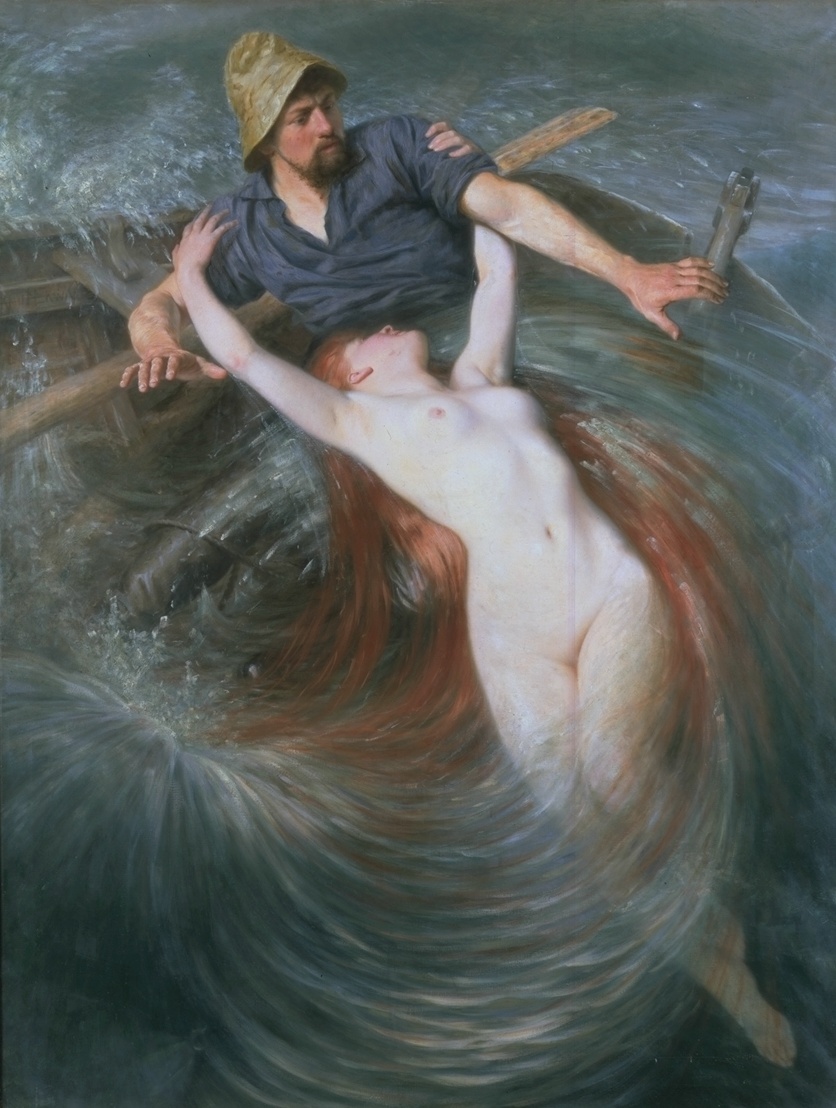
So as I was reposting a poem of mine about a Knut Ekwall painting, which is itself a rendering of mythology, I was drawn again to the painting that depicts a fisherman flailing against the clutches of a prominently nude siren who is pulling him quite literally into the vortex of her seduction:
Knut Ekwall (Swedish, 1843-1812) A Fisherman engulfed by a Siren, c. 1860s, oil on canvas, 194 x 149 cm, private collection. (Source)
And here we are confronted with aesthetic beauty, the question of whether it can exist in something like an objective context. The siren of Ekwall’s painting is but one of uncountable thousands of such representations of women in literature as well as visual art—Pandora, the sirens, Eve—that reduce the female to seductress and centers that seduction in her nudity.
The female nipple has been tabooed to such a degree in contemporary Western culture that we are now more frightened of the exposed female nipple than gun violence. But while Ekwall’s nude siren is from a much different era, viewing this painting today must also recognize the role of taboo in defining beauty, must confront the very white representation of the siren and beauty as well.
The female as allegory—whether Hester in The Scarlet Letter, Eve in the Garden of Eden myth, or a tempting but unnamed siren in a realistic painting—persists in so-called serious art but also in pop art. Our films in the U.S. remain an endless stream of functional females serving the needs of the white male savior: the fetishized Eastern woman; the white, blonde, young Girl-as-Trophy.
So in 2016, we can have a painting of this siren, nipples and all, yet women cannot by choice post pictures on Instagram that include their nipples, even if the photographs are deemed art—the first, of course, proclaimed as art by a man, and in the case of social media, let us not honor a woman’s right to choose if and how the world views her own body.
In 2016, as well, we are witnessing the demise of nudity in Playboy, that perversely sophisticated publication of objectifying an incredibly sterilized and idealized female as allegory. Some have noted that Playboy‘s no-nude policy has simply shifted how the publication panders to fetishes that continue to dehumanize women by reducing them to mechanisms of those fetishes.
The Internet has neutered the tabooing of nudity and graphic sex so Playboy has had to shift its game plan—but it is the same old game plan rendered in a really thin veneer (likely often to be quite literally a really thin veneer).
As a critical white male, I am confronted, then, by the world of art and the world of pop art as they have shaped my perception of females, from the female form to the fully realized female as a real person walking this planet.
That is my vortex, I believe, and thus, my poem sought to wrestle from the painting and the myth some balance that may occur between two lovers, caught in their love and desire but also trapped in a wider vortex that shapes them as unequal.
Love and desire, like art, are never apolitical—as Laurie Penny recognizes in her musing about Valentine’s Day:
Buried under the avalanche of hearts and flowers is an uncomfortable fact: romantic partnership is, and always has been, an economic arrangement. The economics may have changed in recent decades, as many women have gained more financial independence, but it’s still about the money. It’s about who does the domestic labour, the emotional labour, the work of healing the walking wounded of late capitalism. It’s about organising people into isolated, efficient, self-reproducing units and making them feel bad when it either fails to happen or fails to bring them happiness.
And in her Drawing Blood, Molly Crabapple connects the dots:
Artists are not supposed to care about commerce. The lies told to artists mirror the lies told to women: Be good enough, be pretty enough, and that guy or gallery will sweep you off your feet, to the picket-fence land of generous collectors and 2.5 kids. But make the first move, seize your destiny, and you’re a whore.
My poet/writer Self, my teacher Self, and my authentic Self as a man have always recoiled in fear that none of us can ever pull free of the very real vortex that is patriarchy, that casts and recasts the female as allegory—to be worshipped, to be owned, to be guarded.
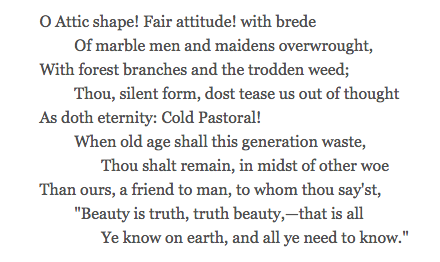
But it is my poet/writer Self who continues to believe that “Beauty is truth, truth beauty,” and hopes there is love and desire that can honor lovers as equals who rise above the larger failures of humanity.
My Romantic side persists—despite all the evidence to the contrary.
A couple years before I would discover that I am a teacher (the fall of my junior year of college), I was sitting in my first-year dorm room in the spring when I wrote my first real poem, and thus, had that quasi-religious experience of becoming a poet.
Being a poet is not something I chose to do, not something I can control. There are weeks, maybe months, when no poems come, and then there are manic days and days and days when they come like tidal waves, avalanches—unbidden but gathered frantically out of the writer’s fear that at any moment this may end, abrupt as a fatal aneurism.
Now comes the really embarrassing part, where poet/writer intersects with teacher.
The first moment my foot touched the floor of my classroom, I envisioned myself as a teacher of writing, but also a teacher who would instill in my students my love for reading (devouring) literature, especially poetry.
I worked hard, intensely—as I am prone to do—to teach my students to write, willing all the while the love of literature and poetry into their adolescent hearts and minds.
Yet—this is embarrassing—I was casually murdering everything I loved, and scrubbing the life and blood from my students’ possibilities as writers, poets, and the sorts of joyous readers I had envisioned.
The most important aspect of ending these horrible practices as a teacher who had divorced himself uncritically from his Poet Self was dropping my transactional methods (opening the poetry unit by giving students “the four characteristics of poetry” [all nonsense, by the way] and then asking them to apply those to their analysis of a poem they chose [I thought the choice part was awesome]) and embracing an overarching discovery approach driven by a broad essential question: What makes poetry, poetry?
Early and often as we meandered through dozens of poems and R.E.M. lyrics, my students and I kept returning to a Thoreau moment: “Simplify, simplify, simplify.”
No matter how hard we tried, we could discover nothing a poet did that writers of other types of writing didn’t also do—except for the purposeful formation of lines and stanzas (including that prose poets create poetry by the negative of avoiding the conventions of lines and stanzas in poetry).
Prose, we recognized, is driven by the formation of sentences and paragraphs, as a contrast, but poetry is almost exclusively as well composed of complete sentences (despite the argument by most students that poetry is a bunch of “fragments,” leading to examinations of enjambment).
Reading and writing poetry became investigations, opportunities to play with words and witness the joy they can bring.
All writing, including the work of the poet, including the work of any artist, is a creative act endured in the context of some structures that the writer/artist either embraces or actively reaches beyond.
What makes poetry, poetry? The purposeful construction of words into lines and stanzas.
“A poem should not mean/But be,” poses Archibald MacLeish. But as a young teacher, I sullied that simple dictum.
Instead, I committed the act of teaching, about which Marianne Moore declares: “I, too, dislike it: there are things that are important beyond/all this fiddle.”
School and teaching can and often are the death of poetry, of writing, of the magnificent joy of human expression.
As poet/writer and teacher, mine is to resist “all this fiddle,” and to allow for students the moment when poetry comes, unexpectedly while your dog sleeps on your feet.
Buried under the avalanche of hearts and flowers is an uncomfortable fact: romantic partnership is, and always has been, an economic arrangement. The economics may have changed in recent decades, as many women have gained more financial independence, but it’s still about the money. It’s about who does the domestic labour, the emotional labour, the work of healing the walking wounded of late capitalism. It’s about organising people into isolated, efficient, self-reproducing units and making them feel bad when it either fails to happen or fails to bring them happiness.
My darling, the wind falls in like stones from the whitehearted water and when we touch we enter touch entirely. No one’s alone. Men kill for this, or for as much.
I don’t need any help to be breakable, believe me I know nobody else who can laugh along to any kind of joke I won’t need any help to be lonely when you leave me
In a piercing letter to his brother, Vincent van Gogh captured the mental anguish of depression in a devastatingly perfect visceral metaphor: “One feels as if one were lying bound hand and foot at the bottom of a deep dark well, utterly helpless.” Anyone who has suffered from this debilitating disease knows that the water in that well is qualitatively, biochemically different from the water in the puddle of mere sadness. And yet, even as scientists are exploring the evolutionary origins of depression and the role REM sleep may play in it, understanding and articulating the experience of the disease remains a point of continual frustration for those afflicted and a point of continual perplexity for those fortunate never to have plummeted to the bottom of the well.
(i do not know what it is about you that closes and opens;only something in me understands the voice of your eyes is deeper than all roses) nobody,not even the rain,has such small hands
here is the deepest secret nobody knows (here is the root of the root and the bud of the bud and the sky of the sky of a tree called life;which grows higher than soul can hope or mind can hide)
Why do you look at the speck of sawdust in your brother’s eye and pay no attention to the plank in your own eye?
Matthew 7:3
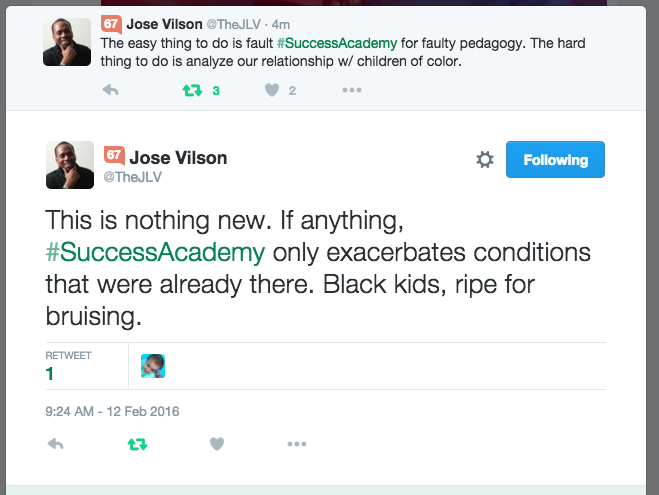
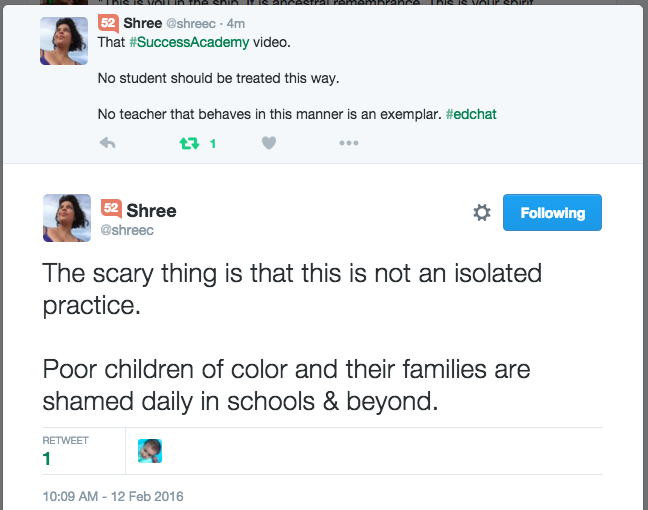
I resist as least weekly, it seems, to name directly yet another disturbing example of how “no excuses” approaches to teaching mostly black/ brown and poor children are inexcusable, abusive, and disgusting.
But a recent video prompted two responses that are important to highlight and need no further explanation—from Jose Vilson and Shree Chauhan:
“The King will reply, ‘Truly I tell you, whatever you did for one of the least of these brothers and sisters of mine, you did for me.'”
Matthew 25:40
The gold standard, I think, for thinking about education reform and more narrow concerns such as teacher quality is the complex and confrontational approach of Lisa Delpit, who anchors her perspective with how we teach and treat “other people’s children”—black and brown children, impoverished children.
And from that perspective we have the ugly “good teacher” discussion few are willing to confront: Vulnerable populations of children and their families are where and how we experiment with education, where and how we adopt policies and practices no affluent and white families would tolerate for their children: Teach For America, “no excuses,” zero tolerance.
High-poverty and majority-minority schools are burdened not just with social inequity hurdles but also with systemic and often unspoken practices that include having incredibly high teacher turn over because these “problem” schools are entry points for teachers to find “better” jobs (see Teachers at Low-Income Schools Deserve Respect).
Just as insidious is the systemic and often unspoken practice in all schools that “low-level” classes of students are assigned new teachers, who must endure those populations of students until they can have the “good” classes within that school.
These ugly practices grounded in racism and classism are at the root of why advocates for education reform who focus on race and class remain mostly dissatisfied with both sides of the mainstream education reform debate.
The edu-reformers are all-in on race and class tone-deaf practices—TFA, “no excuses,” zero tolerance—but the advocates for public education and progressive reform have failed to admit how the traditional public school system has historically failed “other people’s children” through the wink-wink-nod-nod approach to assigning teachers.
Too often, teachers are complicit in and fail to confront the system that marginalizes vulnerable populations of students as collateral damage of teacher advancement.
During my 18 years of public school teaching, even among teachers, the common sense attitude was that “good” teachers were assigned Advanced Placement, and teaching “low-level” classes was a negative commentary on the teacher’s ability. As department chair, I worked to assign each teacher a couple classes she/he requested, and then tried to balance every teacher’s load with a range of class levels and types.
While I was working on my dissertation, writing a biography of educator Lou LaBrant, I was profoundly struck by a point of irritation she expressed in her memoir. LaBrant noted that she had her best teachers in her doctoral program, at the end of her formal education, but that progression, she believed, is backward in that children need their best teachers in the beginning of formal education, not the end.
Our vulnerable populations of students must be served first in our public school system: assigned experienced and qualified teachers, placed in classes with low teacher/student ratios, guaranteed access to the most challenging courses and curriculums, and promised safe, diverse schools with equitable, supportive disciplinary practices.
Everything else is a distraction from what truly matters.
educator, public scholar, poet&writer – academic freedom isn't free




 dr. p.l. (paul) thomas
