All posts by plthomasedd

P. L. Thomas, Professor of Education (Furman University, Greenville SC), taught high school English in rural South Carolina before moving to teacher education. He is a former column editor for English Journal (National Council of Teachers of English), current series editor for Critical Literacy Teaching Series: Challenging Authors and Genres (Brill), and author of Teaching Writing as Journey, Not Destination: Essays Exploring What ‘Teaching Writing’ Means (IAP, 2019) and How to End the Reading War and Serve the Literacy Needs of All Students: A Primer for Parents, Policy Makers, and People Who Care (IAP, in press). NCTE named Thomas the 2013 George Orwell Award winner. He co-edited the award-winning (Divergent Book Award for Excellence in 21st Century Literacies Research) volume Critical Media Literacy and Fake News in Post-Truth America (Brill, 2018). Follow his work @plthomasEdD and the becoming radical (https://radicalscholarship.wordpress.com/).

On Misreading: The Critical Need to Step Back and See Again

The moment a person forms a theory, his imagination sees, in every object, only the traits which favor that theory.

Thomas Jefferson to Charles Thomson, 1787

Teaching literature as a high school English teacher often requires covering the canon through survey courses. This means, of course, we teachers of English often assign and discuss writers and works we simply do not like.

One writer I don’t particularly care for is [gasp] Robert Frost—the poems aren’t my cup of tea and his attitude about free verse rubs me the wrong way.

But unlike my ambivalent thoughts about Frost’s poetry and snobbery, I simply detest misreading Frost and those incessant posters:

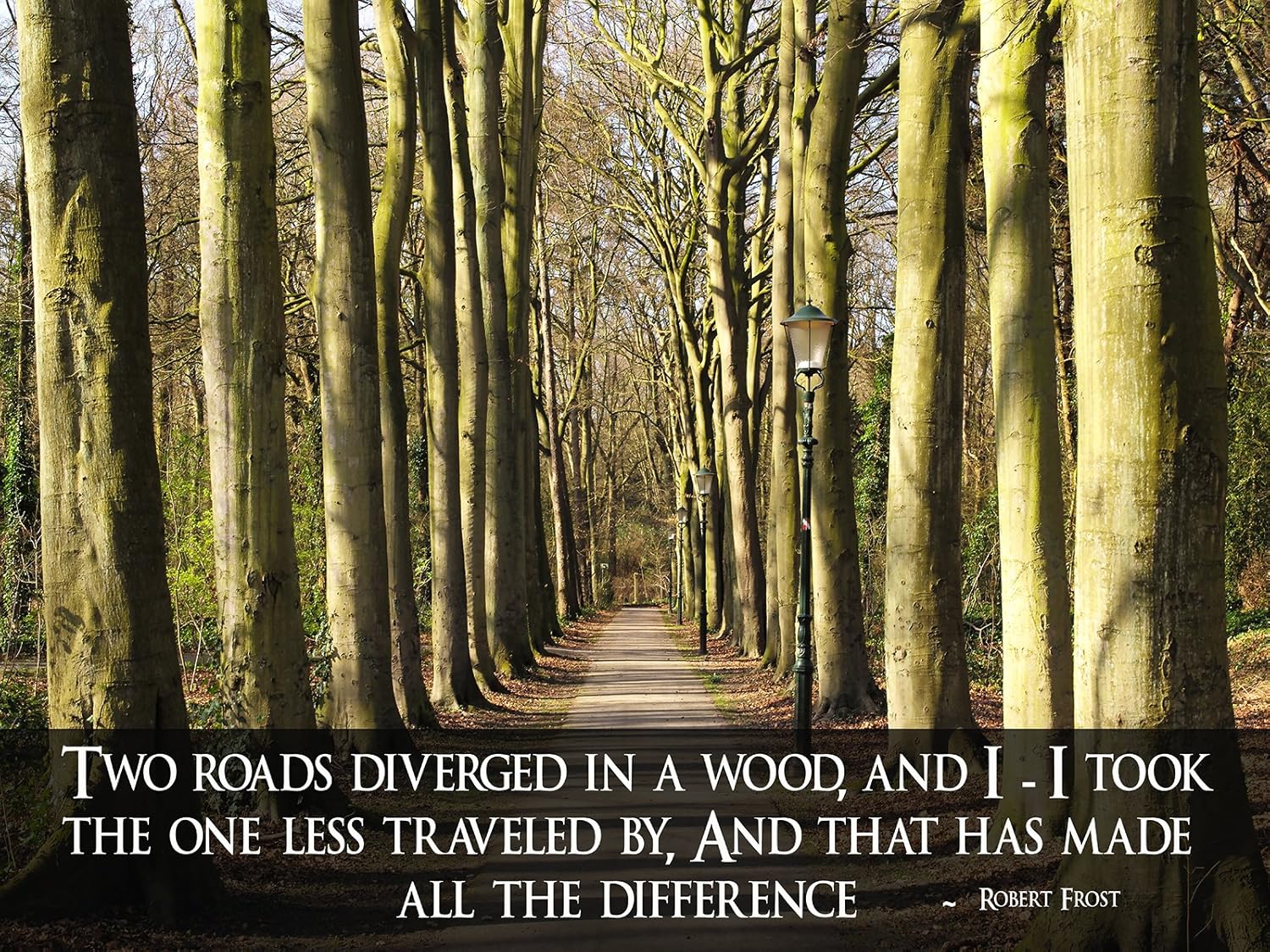
In fact, one of my favorite, ironically, poems to teach was “The Road Not Taken”—first, because it lends itself to stressing the importance of reading the text carefully to students, and second because many if not most of my students had seen the posters and had the poem mis-taught to them in previous grades.

Typically, the end of the poem is used to make vapid and inspirational claims about being different, taking the path others have failed to try.

However, even a slightly careful reading of the poem reveals that the text itself no fewer than three times states the two roads are essentially the same: “as just as fair,” “Had worn them really about the same,” and “And both that morning equally lay.”

So when I came across Stephen Lynch’s article on David Orr’s The Road Not Taken, I was nearly giddy:

The poem is praised as an ode of individuality, to not follow the pack even though the path may be more difficult.

Except Frost notes early in the poem that the two roads were “worn . . . really about the same.” There is no difference. It’s only later, when the narrator recounts this moment, that he says he took the road less traveled.

“This is the kind of claim we make when we want to comfort or blame ourselves by assuming that our current position is the product of our own choices (as opposed to what was chosen for us, or allotted to us by chance),” Orr writes.

“The poem isn’t a salute to can-do individualism,” he continues. “It’s a commentary on the self-deception we practice when constructing the story of our own lives.”

And thus we are forced to confront the Jefferson quote above: many in the U.S. see a message of rugged individualism in everything they see regardless of that theme existing or evidence confirming that ideology.

If this were confined to poetry, we could simply let it lie, but consider two aspects of Ronald Reagan’s political career—long enough in the past to view somewhat dispassionately but recent enough to remain relevant during the 2015-2016 presidential campaign years.

Reagan gained a tremendous amount of political capital on his “welfare queen” refrain, and somehow maintained his Teflon image despite George H.W. Bush’s charge that Reaganomics was “voodoo economics.”

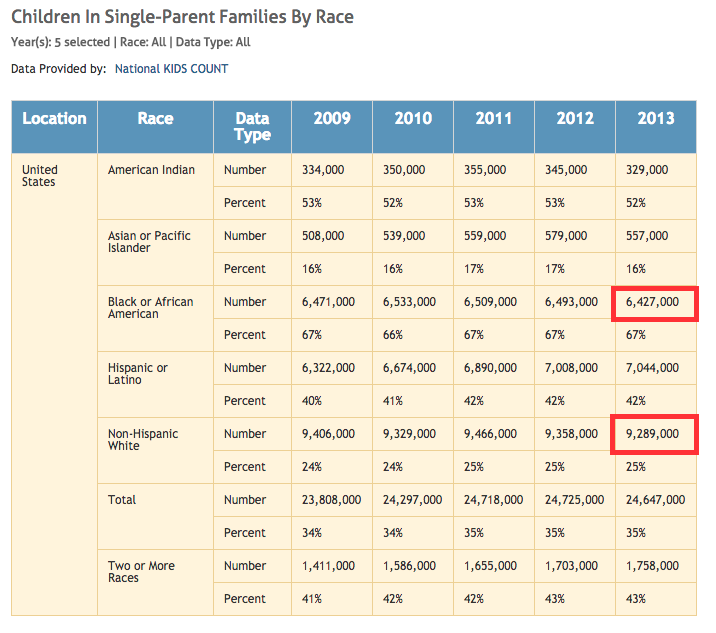
Both can be traced to the public’s tendency to see what they want to see despite evidence to the contrary. The U.S. public believes poverty is the result of laziness and continue to harbor racist associations with both poverty and that laziness. As I have shared, just recently I received a negative response to a piece I wrote on racism that blamed inequity on single black mothers, despite single white mothers far outnumbering and Hispanic/Latino single mothers surpassing single black mothers.

The Great American Myth includes that the wealthy have earned their wealthy, the poor (lazy) deserve their poverty, education is the great equalizer, and anybody can succeed if he/she would just work hard enough, and evidence (the abundance of evidence) to the contrary is nearly worthless against that mythology.

This is not simply about partisan politics—because the same proclivity to see what we believe and thus not recognize systemic forces corrupts mainstream efforts at both education reform and daily teaching.

Just as a few examples, policies and practices built on “grit” research and narratives as well as “growth mindset” are essentially flawed because they fall victim to gazing on the individual, diagnosing deficits, and then correcting those deficits—a misdiagnosis that misread the consequences of systemic inequity as individual culpability.

The harsh reality is that in the U.S. educational and social/economic success are the result not of effort or merit, but the coincidence of any person’s socioeconomic and racial backgrounds.

Claims that teaching poor and black/brown children “grit” and a “growth mindset” will reap great rewards for those students are trapped in the deficit gaze narrowly on individuals—not unlike those who misread Frost or continue to cling to Reagan’s nasty “welfare queen” scapegoat.

This is where the critical imperative requires that we always step back from our belief systems and force ourselves to consider the entire and complex reality driven by both systemic and individual dynamics.

So if we loop back to the actual woman Reagan used to create the “welfare queen” smear campaign on all single black mothers who are poor, we discover a very complicated reality about this individual woman, but we also must temper ourselves against drawing sweeping generalizations that are not supported by easily accessible evidence.

And we should also ask why many are apt to make such damning jumps from one black woman to all black women when those same people do not make such leaps about individual serial killers, often white males who are well educated.

It is a trivial nerd/teacher fantasy to hope that we stop the misreading of a rather boring Robert Frost poem, but it is no small thing to expect us to stop allowing claims that are at their core racist and classist (“grit,” “growth mindset,” the “word gap,” etc.) to hide behind the mask of science or the cult of celebrity driving them, it is no small thing to speak against presidential candidates who continue to race-bait (black-on-black crime) and poverty-bait (dead-beats on welfare) the public as Reagan did.

To do so, we must have the courage to choose a road “less traveled by,” a journey that begins with taking one step back.

Please View (and Listen)

James Baldwin and Black Lives, Eddie Glaude
The Legacy of James Baldwin

James Baldwin: Two Recent, Relevant Videos

James Baldwin and Black Lives (C-Span) 5/18/15

Professor Eddie Glaude talked about James Baldwin, the underlying meanings of race in America, and the emergence of the phrase “black lives matter” on social media. He discussed the tradition of Black Democratic Perfectionism, the idea of democratic individuality in the service of justice. He argued that the phrase “black lives matter,” which emerged on social media after the death of Trayvon Martin in 2012, is rooted in Black Democratic Perfectionism and is a tool that reflects African American social, economic, and political struggles, and rejects the idea of white supremacy.

The Legacy of James Baldwin (John F. Kennedy Presidential Library and Museum) 6/11/15

Following a screening of the newly restored documentary, James Baldwin: The Price of the Ticket, the filmmaker Karen Thorsen; Tufts professor Peniel Joseph; poets Nikky Finney and Rose Styron; and James Baldwin’s niece, Aisha Karefa-Smart discussed his call for equality and its relevance today. Kim McLarin, a frequent contributor to WGBH’s Emmy-award winning program, Basic Black, moderates. This forum was in partnership with PEN New England.

More on Critical Pedagogy, Critical Thinking, and the Other: “Critical pedagogy wants to know who’s indoctrinating whom”

Students at my university are required to attend Cultural Life Programs (CLPs) as part of their graduation requirements. Once several years ago, I was the featured speaker at a CLP on education reform, and during that talk I noted I was against accountability.

The Q and A prompted by the talk was vibrant, but after the talk, I was approached by a colleague who asked if I were being provocative—not serious, in other words—about being against accountability. I assured him I was in fact against accountability, which left him so frazzled the discussion ended there.

After posting a blog about critical pedagogy and the Other, I received similar and numerous comments about critical thinking—educators who likely believe that they and I are mostly in agreement on education but cannot fathom my rejecting how traditional schooling approaches so-called “critical thinking skills.”

As well, the Twitter conversation among Angela DyeSherri Spelic, and me exposed the need to examine more fully the concept of the Other.

First, there is no way to frame identifying and teaching (as well as lessons involving worksheets and testing) critical thinking skills and remain critical.

The essential flaw with critical thinking skills (see HERE and HERE) is, as I noted in the previous post, the reductive nature of a technocratic approach to knowledge, teaching, and learning. In other words, to isolate (and thus, approach analytically) a series of “critical” skills in order to deposit them in students in the hopes that those skills added up equal critical thinking is the problem.

And as I have noted about accountability, that skills approach is at least the dominant, if not the only way in which “critical thinking” is framed in traditional schooling.

Being critical is not a collection of isolated skills, but a way of being that can be fostered, not imposed (see Paulo Freire on the banking concept of education). Therefore, at best we can model being critical and provide for students examples of critical confrontations such as Ta-Nehisi Coates on the film Crash or Son of Baldwin on Straight Outta Compton.

Let me stress, then, that my rejecting the technocratic approach to “critical thinking” cannot be solved through technocratic means: defining, teaching skills, etc.

Next, and more complex, I think, is the concept of the Other in terms of how that relates to critical pedagogy.

My critical scholarship and my critical public work prompt oddly parallel responses, for example.

Traditional scholarship frames my critical work as the Other because critical perspectives reject the norms of the academy—quantitative data and objectivity most significantly. Instead, critical pedagogy starts here:

Thus, proponents of critical pedagogy understand that every dimension of schooling and every form of educational practice are politically contested spaces. Shaped by history and challenged by a wide range of interest groups, educational practice is a fuzzy concept as it takes place in numerous settings, is shaped by a plethora of often-invisible forces, and can operate even in the name of democracy and justice to be totalitarian and oppressive.

Joe Kincheloe, Critical Pedagogy Primer

The claimed apolitical pose of traditional scholarship marginalizes as the Other critical perspectives. However, Kincheloe explains:

Recognition of these educational politics suggests that teachers take a position and make it understandable to their students. They do not, however, have the right to impose these positions on their students [emphasis in original]….

In this context it is not the advocates of critical pedagogy who are most often guilty of impositional teaching but many of the mainstream critics themselves. When mainstream opponents of critical pedagogy promote the notion that all language and political behavior that oppose the dominant ideology are forms of indoctrination, they forget how experience is shaped by unequal forms of power. To refuse to name the forces that produce human suffering and exploitation is to take a position that supports oppression and powers that perpetuate it. The argument that any position opposing the actions of dominant power wielders is problematic. It is tantamount to saying that one who admits her oppositional political sentiments and makes them known to students is guilty of indoctrination, while one who hides her consent to dominant power and the status quo it has produced from her students is operating in an objective and neutral manner.

“Critical pedagogy wants to know who’s indoctrinating whom,” Kincheloe concludes.

But my public work is often challenged for being too academic, too scholarly since critical perspectives are prone to wax philosophic (using “the Other,” for example) or depend on terms such as “hegemony.”

Regardless of the context, then, critical perspectives are themselves likely to be marginalized (not rigorous or too esoteric), ignored, or silenced—especially as Dye and Spelic have stressed if you are a woman, or even more significantly, if you are a black woman.

And therein lies the next level of the Other I haven’t teased out well enough so far.

Yes, critical perspectives are brushed off as the Other, but more importantly, to be critical means to always listen [1] to, consider, and be empathetic to the perspective of the Other.

Being critical means that we take the pose of the Other in all the forms that exist. This requires the setting aside of ones privilege and even ones status as the Other.

It is in that context that Paulo Freire confronts how norms act against the Other:

To the extent that I become clearer about my choices and my dreams, which are substantively political and attributively pedagogical, and to the extent that I recognize that though an educator I am also a political agent, I can better understand why I fear and realize how far we still have to go to improve our democracy. I also understand that as we put into practice an education that critically provokes the learner’s consciousness, we are necessarily working against the myths that deform us. As we confront such myths, we also face the dominant power because those myths are nothing but the expression of this power, of its ideology. (p. 41)

Being critical is about self-awareness, empathy, and the perpetual state of questioning the nature of assumptions in the context of how those assumptions work to perpetuate power as well as to deny power.

Being critical becomes in traditional contexts, both academic and public, simultaneously the state of being the Other as well as assuming the perspective(s) of the Other.

Posters, worksheets, skills lists, and tests—none of these address being critical because all of these are trapped inside the so-called objective and analytic assumptions about knowledge, teaching, and learning.

They are as lifeless as they are void of critical—and they do not serve students or anyone well.

Any questions?

See Also

“Click, Clack, Moo”: Why the 1% Always Wins

Revisiting “Theme for English B” by Langston Hughes

[1] For example, in whose interest is it to shame a writer for splitting an infinitive? And what is the historical and linguistic context of that so-called rule? How does focusing on a linguistically questionable construction allow the masking of the substance of the claims?

Critical Pedagogy: Being the Other

Last week, I began my fall semester a few weeks before my university because we place our teacher certification candidates in year-long placements, including the first couple weeks of school, during their senior year. As a result I conducted four school visits to talk with our candidates and their cooperating teachers about the program and what to expect over this academic year that culminates in the spring with an extended practicum experience that looks a great deal like student teaching.

While walking out of one school, I noticed a series of posters hanging from the ceiling, and the final one facing me as I was heading out read “Find a way to think critically.”

I turned and noticed the back of the same slogan was “Find a way to be on time.”

Throughout my 18 years teaching public high school, I resisted the focus on school and classroom rules; we were supposed to post them in our room prominently, we had to lay them out for students on the first day, and our students had to pass a school handbook test before they could begin their classes each year (which meant we spent days reviewing the handbook with our advisees).

Part of my resistance included that instead of posting rules in my room, I made my own poster announcing:

Any fool can make a rule, and any fool will mind it.

Henry David Thoreau

The reality is that if we consider the front-and-back poster above, schools (and businesses) do not really want critical thinking from students (workers), but instead want compliance.

After teaching and resisting for over a decades, I discovered in my doctoral program William Ayers’s To Teach, which was the first organized confrontation of education-as-compliance I had ever read and likely my first step into critical pedagogy.

As I have discussed before, the term “critical thinking” and its companion “higher order thinking skills (HOTS)” are in fact not about being critical, but are technocratic ways of defining and thus controlling what counts as appropriate thinking. “Critical thinking” as a learning objective in formal schooling is an ironic term, much like the two-sided poster stressing punctuality on the flip side of thinking critically.

Critical pedagogy is a wholesale rejection of those technocratic approaches to teaching (objectivity, behaviorism, high-stakes testing, prescriptive standards, rote lesson plans) that requires each of us to investigate, interrogate (see Ta-Nehisi Coates), witness (see James Baldwin), challenge, and confront knowledge, claims, texts, people, and even (or especially) ourselves about the nature of power being served.

Unlike the systematic “critical thinking,” a critical perspective asks, “Whose interests are being served by punctuality and what power dynamic does that punctuality preserve or create?”

In other words, a directive—”Find a way to think critically”—can never be critical since the essential critical pose is the question.

2015 is the twentieth year of my critical journey as an educator, student, and person—marked formally by beginning a doctoral program in 1995.

This year has been punctuated by an ongoing discussion with Angela Dye on Twitter about what it means to be a critical educator.

Dye and I have been joined lately by Sherri Spelic while we all wrestle with holding critical perspectives in the midst of education reform wars that demand somewhat extreme binaries [1], both of which struggle under the bright light of critical investigation

As we struggle through social media with critical pedagogy in practice, I have stated to Dye directly that being critical puts anyone always in the position of the Other, and that necessity is alienating, isolating—suggesting the possibility of futility since large-scale change in a democracy tends to require numbers, some sort of collaboration.

Being critical is essential for social and education justice and equity, but I can also attest that maintaining a critical grounding creates tension among those on the so-called “both sides” of traditional and progressive arguments—such as the current education reform war.

I’m afraid I do not yet have a solution to this problem, except among Dye, Spelic, and me, while we likely have substantive disagreements about this or that, we have found community in the struggle itself.

And that in fact may be the answer, but even so, we must continue to question even that.

See Also

remnant 17: “we came to the world in order to remake the world” Paulo Freire

[1] See Dye’s The Need for a Deeper Dive and Reformers and Anti-Reformers: An Underwater Perspective, Spelic’s Knee-Jerk vs. A Stone’s Throw, and my Beware the Roadbuilders Redux: Education Reform Wars Fail Race, Again, which is strongly influenced by Andre Perry’s Education reform is working in New Orleans – just like white privilege.

Beware the Roadbuilders Redux: Education Reform Wars Fail Race, Again

A classic analogy is Mothra vs. Godzilla, but a more contemporary comparison—and one to be highlighted in upcoming Marvel superhero films—is Marvel’s Civil Wars.

First, the larger situation involves two powerful forces, both of which are driven by the missionary zeal of being on the right side, that wage war against each other while those who both sides claim to serve is trampled beneath them as collateral, and mostly ignored, damage.

More specifically, Marvel’s Civil War involves two legions of superheroes (and villains) who side with either Iron Man or Captain America (the two powerful forces characterized by missionary zeal and reckless disregard for citizens), but notable in this war is that the X-Men are neutral, as is Black Panther—serving as embodiments in the comic book universe of the Other (identified groups marginalized by status: race, sexual/gender identities, poverty).

Finally, what does this template represent? I recommend reading carefully Andre Perry’s Education reform is working in New Orleans – just like white privilege—notably:

White critics of education reform should especially include themselves in the power structure. Yes, the neo-liberal, market-driven, corporate anti-reform critique isn’t the only frame that robs black people of their voice.

I wish white folk would hear me when I say the pro-/anti-reform frame doesn’t work for black folk. If anything, our position in the social world makes us reformers. Black folk never had the luxury of defending status quo. New Orleans needed to make radical changes in education as part of larger hurricane preparedness plan. Getting a college degree is the kind of protection black people need. Cynicism isn’t protection.

Perry confronts that the rise of education reformers dedicated to bureaucratic and technocratic reform as well as the concurrent reaction to that reform agenda among those championing an idealized faith in public education have in common their willingness to both trample and ignore the black and high-poverty communities, parents, and students both groups often claim to represent.

This education reform war, like Marvel’s Civil War, fails, as Perry has noted before, the problems of race and racism: “But let’s also stipulate that overwhelmingly white movements pursuing change for black and brown communities are inherently paternalistic.”

Perry concludes about the “overwhelmingly white” education reform wars: “We need less ‘reform’ and more social justice.”

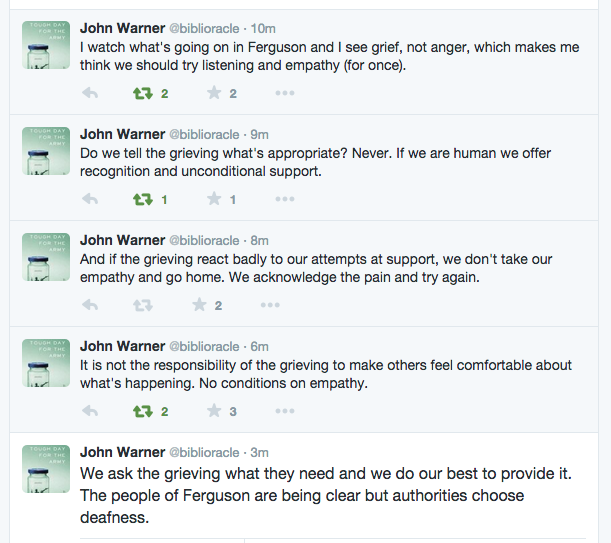
Posting on Twitter in the wake of the anniversary of Ferguson, John Warner strikes a similar chord in terms of broader failures of social justice advocacy:

listening and empathy

While I entered public education dedicated to teaching as a form of activism for social justice, I can speak hear as someone who has certainly failed my own goals (confronting poverty and racism) by allowing much of my work both to feed and appear to feed the exact failure Perry and others have identified.

As I have been addressing for some time, the tensions of race and racism have been a central struggle of doing public work—although in my daily teaching, during my 18 years as a high school teacher and then more than a decade as a teacher educator, has remained more securely tethered to causes of social justice related to poverty and racism.

Lashing out against Teach For America and charter schools (among all school choice) by me and others has certainly served to ignore and even erase voices and issues connected to race.

But I also recognize the ineffectiveness of nuanced positions since my approach to Common Core has not fit within either the so-called reformer stance (pro Common Core) or the jumbled stance among idealistic public school advocates (some are for and some are against Common Core).

It is well past time, then, to emphasize that the recent thirty-years of education reform characterized by accountability built on standards and testing as well as the rise of TFA and charter schools would never have occurred if public education had been serving black and poor children as well as all formal schooling has served white and affluent children.

Education policy, then, is as complicated as social policy in the U.S.—where those in power and the public appear either reluctant or resistant to confronting the entrenched weight of race and class on social and educational equity.

And while political and public opinion are against us, those concerned with social justice linked to race and class equity must commit first to listening to and working with (not for) the communities, parents, and students who have been mis-served for decades by social and educational institutions and policies, specifically black and impoverished communities, parents, and students.

Missionary zeal and paternalism are burdens of both the education reformers and the public school advocates taking up arms against those reforms.

Broad stroke support for and rejections of any of these reforms are prone to be tone deaf and detrimental to claimed commitments for equity and social justice.

Evoking the very real and devastating realities mirrored in bad science fiction and Marvel’s Civil War, Perry argues: “New Orleanians don’t need an all-or-nothing, slash-and-burn system. We have inevitable hurricanes for that.”

And then:

Black folk are always the collateral damage of privileged people’s broad-stroke critiques. And the white criticisms of reform always negate black involvement and dare I say positive contribution toward change. We should validate the suffering, death and destruction that occurred during and in the aftermath of Katrina. But “awfulizing” isn’t the way to get there.

We don’t need the white, privileged, anti-reform framework developed by three or four white critics to deny the voices we need to uplift.

For me, the image I have evoked of political education reformers as the roadbuilders remains a valid metaphor, but it is incomplete and has too often served as just more noise drowning out those who must be heard.

So who is willing to stop the uproar against misguided and often tone-deaf education reform from the political elite long enough to listen to the black and poor communities who have witnessed decades of negligence by public institutions?

Reminder

Good intentions are not enough: a decolonizing intercultural education, Paul C. Gorski

High Cost of White Denial (Updated)

My Op-Ed in The State (Columbia, SC) paper, Entrenched racism drives down SC child-well-being scores, prompted both email responses and a few posted comments online.

A recurring theme of the negative feedback reflects entrenched white denial, offering insight to why our political leadership tends to avoid addressing directly systemic racism and social class inequity and exposing why the Republican candidates thrive despite what should otherwise be viewed as a collection of buffoons at best and racists, sexists, and classists at worst.

Any time racism and class inequity are confronted, the “individual responsibility” response rings strong. As well, the “I was poor but succeeded” mantra is shuffled out.

What is always notable, however, is that the overwhelming evidence of racism and classism is never directly addressed. White denial always remains trapped in slogans and anecdote.

For example, one online comment addresses the evidence I provided with “if whites are getting paid more than blacks.” If?

The pattern of race-based inequity within the same educational level is not a question, but a fact.

Yet, white denial must hedge evidence in order to continue to cling to the delusion of racial fairness.

How does individual responsibility instead of systemic racism explain the race-based income inequity above? How does individual responsibility instead of systemic racism explain that white high school dropouts have the same probability of employment as blacks with some college?

probability employment

The social and policy implications of white denial are significant, but white denial also pervades our schools, notably in schools that serve black and brown children living in communities experiencing concentrated poverty such as New Orleans, Detroit, or the Corridor of Shame in my own South Carolina.

In that context, one comment online is particularly disturbing since it is from a white person who claims to have taught for decades in SC, including years in the Corridor of Shame. This educator blames the parents and students, concluding “I didn’t see any entrenched racism, there is no institutional racism.”

No child should be taught by teachers who blame them for their disadvantages. Of all institutions, schools cannot tolerate white denial.

Destroying the promises of democracy and universal public education, white denial is the warm blanket of delusion that comforts the privileged and keeps them slumbering at the expense of those adults and children suffering the weight of racism and classism.

We must not compound that further by denying that the current race for the presidency is a reflection of that white denial and its power to embrace slogans over reality.

Race and class nastiness resonates among those suffering from white denial, but facts fall on deaf ears.

White denial has real consequences; thus, we must keep in mind that clowns have nowhere to perform without someone building the circus.

Postscript

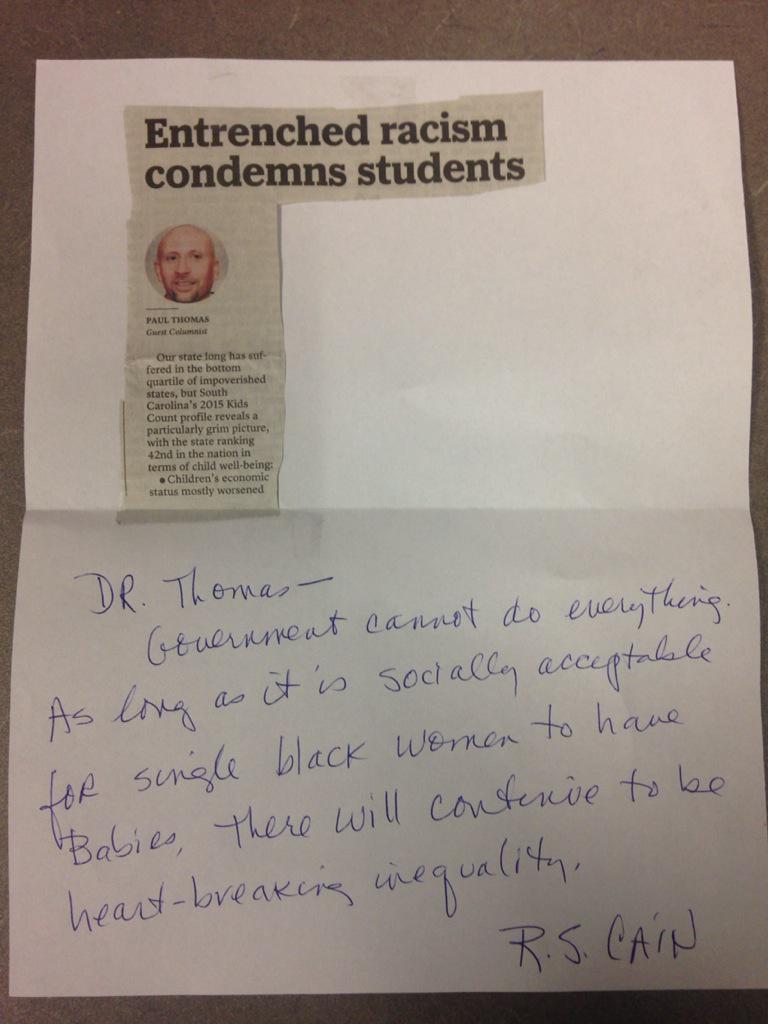
White denial sent by postal mail:

government

And for the record:

U.S. Children in Single-Mother Families

white single parent famsSingle Parents Aren’t the Problem, Ivory A. Toldson

Children In Single-Parent Families By Race

single parent by race

Post-postscript

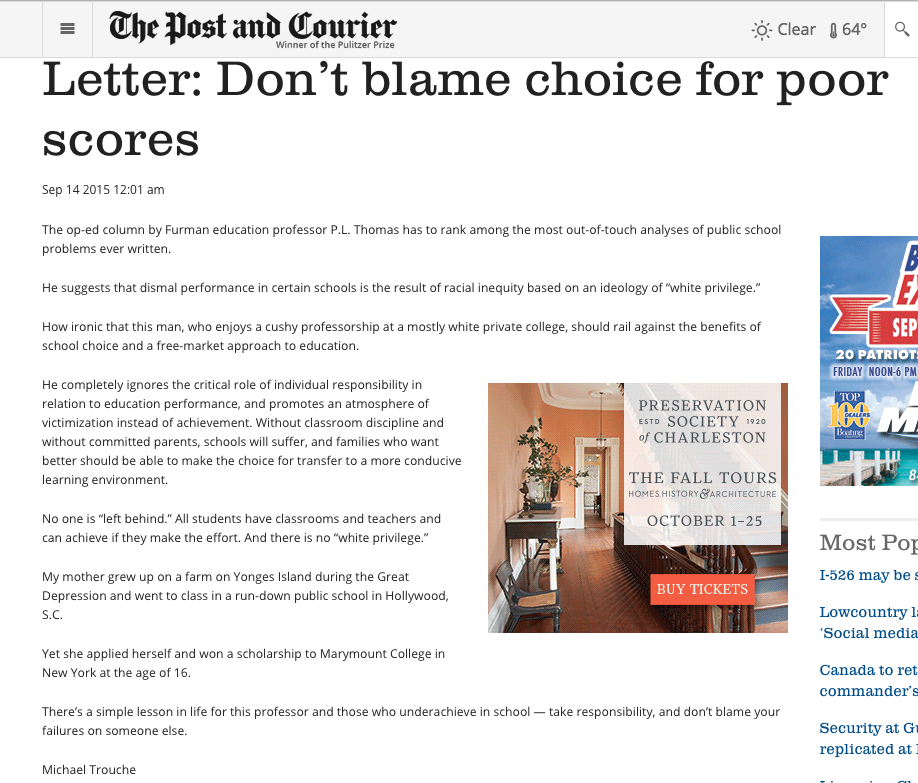
After my Op-Ed on school choice ran in the Post and Courier, the P&C ran a letter that literally states, “And there is no ‘white privilege.'” Also great and disturbing evidence of the fight we face since the writer uses every tactic imaginable except addressing the evidence—attacking me, using one example to claim a generalization:

white denial PandC

The State (Columbia, SC): Entrenched racism drives down SC child-well-being scores

Entrenched racism drives down SC child-well-being scores

[full unedited text below]

Two facts about children and poverty are especially disturbing: children make up about 1/3 of people in the U.S. in poverty, but raising children expands those in poverty to 43%.

For South Carolina, children and poverty present a particularly challenging reality, captured by the Annie E. Casey Foundation’s 2015 Kids Count data book.

Our state has long suffered in the bottom quartile of impoverished states in the U.S., but SC’s 2015 Kids Count profile reveals a grim picture with the state ranking 42nd in the nation in terms of child well-being:

  • SC children’s economic status has mostly worsened from 2008 to 2013 with 290,000 children in poverty, 376,000 children with parents lacking secure employment, and 349, 000 children in households with burdensome housing costs.
  • SC children’s educational opportunities remain inequitable. The percentage of children attending preschool has worsened, and so-called proficiency levels in math and reading have mixed results while high school graduation remains, although improved overall, elusive to those young people most in need of education.
  • Healthcare for SC’s children has improved, but 73,000 children remain without healthcare in the state.
  • SC’s children also face harsh community challenges. 420,000 children live in single-parent homes, an increase from 2008 to 2013, and more children, 161,000, live in high-poverty communities now than a few years ago.

The summer of 2015 has brought an intense spotlight on SC with the racist shooting of nine black citizens gathered in their church. Along with that tragedy, many in the state have continued to claim that we as a people embrace heritage and not hate.

However, political leaders and the public rarely identify the exact and real conditions behind claims of “heritage” and “tradition.” In SC and all across the South, our heritage includes crippling economic inequity and entrenched racism—both of which condemn our children to their ZIP codes, not the content of their character, being their destiny.

In the U.S., despite lingering and false stereotypes of “welfare queens,” 80% of people in poverty are from vulnerable populations: children, the elderly, the disabled, students, and the working poor.

As well, despite educational attainment, racial inequity remains powerful. Even with the same level of education, whites earn more than Hispanics and blacks. And blacks with some college have the same probability of employment as white high school dropouts.

Congressman James E. Clyburn has called for SC both to appreciate the symbolism of removing the Confederate battle flag from state grounds and to commit to substantive policy addressing the great weight of poverty and racism that our state still carries, a weight that is particularly harmful to our children.

Clyburn identifies healthcare and voting rights as policy SC must address, but there are many commitments to the lives of our children we could make to give substance to refrains of “heritage”:

  • Insure, as Clyburn notes, that all children in SC have healthcare from conception until their early 20s.
  • Seek public policy that supports all families with children, focusing on ensuring that having children doesn’t push any family into poverty.
  • Abandon the fruitless education accountability process and replace our school reform efforts with a focus on equity of opportunity: equitable K-12 and higher education funding across the state, equitable teacher assignments for all students, access to high-quality courses for all students, and quality alternatives for anyone to complete high school and college degrees despite age or background with substantial financial support.
  • Create stable and well-paying work for the people of SC that reinforces everyone’s access to healthcare and retirement/savings.
  • Confront directly and comprehensively the reality in SC that the state has enough money, but that our problem is the inequitable distribution of that capital. The infamous Corridor of Shame was not created by our school system, but the education inequity that it reveals is a reflection of the larger socioeconomic injustice across our state.

American novelist and public intellectual James Baldwin confronted Noble Prize winning author William Faulkner in the early years of the civil rights struggle in the U.S. because Faulkner called for patience among blacks in the South.

Baldwin responded with words that should resonate today in SC: “There is never time in the future in which we will work out our salvation. The challenge is in the moment, the time is always now.”

At-Risk Students, Bad Teachers, Failing Schools: Our Blinding Accusatory Finger Pointing

Questions of science, science and progress
Do not speak as loud as my heart

“The Scientist,” Coldplay

The absolute greatest gift of being a teacher by profession is accumulating throughout your career the young people gifted you by your classroom.

A few days ago, I was having lunch with a former student and current teacher, Ali Williams, who teaches English at a majority-minority, high-poverty high school in the school district that serves the county where I teach.

Among the ramblings of our nerdfest, we talked about language, about the challenges of trying to be a good teacher, and about the fields of psychology and sociology, a tension that has more and more fascinated me over a thirty-plus years career as a teacher.

For anyone who doesn’t know Ali personally or who has never spent time at her school or with her students (I have had several teacher candidates placed at the school and thus have observed there often), the reality today is that the students are likely and uncritically viewed as at-risk, the school is believed to be failing, and Ali could very easily be labeled a bad teacher.

Those pronouncements occur all across the state of South Carolina and the U.S.—an accusatory finger pointing that blinds political leaders and the public from the corrosive social forces that are reflected by students, teachers, and schools (but not created by those students, teachers, or schools).

Because the U.S. remains trapped within the lies of rugged individualism and believing the country is a meritocracy, the influence of psychology (mostly quantified claims about individual qualities and behaviors) is more readily and almost entirely uncritically and inaccurately embraced while sociology (often broad and descriptive explorations of social forces) is either ignored or carelessly discounted—often as “excuses.”

If we did deeper, another division is embedded in the disciplinary tension above—the power of numbers.

Numbers give the compelling appearance of objectivity and certainty while rich description offers complexity and uncertainty.

And the U.S. has a disturbing propensity for being a blowhard nation; we seem to like our columnists, radio personalities, and even presidential candidates to hold forth with the simplistic bloviating found among privileged white men who have never reconsidered anything, especially their own privilege.

The 10,000-hour rule, humans use only 10% of their brains, poor children have smaller vocabularies that wealthy children, high rates of black-on-black crime—each of these remains incredibly common claims throughout mainstream media, politics, and private conversations, but each is also bad numbers—at best cited in misleading ways and at worst simply wrong.

Numbers are compelling, especially when they can be used to promote “objectively” our worst prejudices.

If we focus on the black-on-black crime claim (which I believe is representative of this problem), that data are misleading because essentially most crime is within race (white-on-white crime is about 84% and black-on-black, 91%).

Crime is also strongly connected with poverty, and then poverty disproportionately impacts blacks.

In other words, a rich and detailed description of crime, one that is more accurate and not accusatory, pulls back from focusing the gaze on individuals and raises questions about why so much crime is among family members and acquaintances, why so much crime is within lives overburdened by poverty, and why the criminal justice system also disproportionately targets some people (blacks, the poor) while somehow turning away from other people (whites, the affluent).

The black-on-black crime lie is not much different than the at-risk students, bad teachers, and failing schools lies.

The accountability movement in education has embraced and perpetuated high-stakes testing in order to increase the quantification of blame, to make sure the accusatory finger pointing remains on individuals and not the social forces creating those things being measured.

As a result, satire is hard to separate from reality:

In an effort to hold classroom instructors more accountable, the Illinois State Board of Education unveiled new statewide education standards Friday that require public school teachers to forever change the lives of at least 30 percent of their students. “Under our updated educator evaluation policy, teachers must make an unforgettable, lifelong impact on at least three of every 10 students and instill a love of learning in them that lasts the rest of their lives,” said chairman James Meeks, adding that based on the annual assessments, if 30 percent of students don’t recall a particular teacher’s name when asked to identify the most influential and inspiring person in their lives, that instructor would be promptly dismissed. “We are imposing these standards to make certain that a significant proportion of students in any given classroom can someday look back and say, ‘That teacher changed the course of my life, making me who I am today, and there’s no way I could ever repay them.’ Anything less is failure.” Meeks also confirmed the implementation of another rule aimed at ensuring that no more than 40 percent of a teacher’s students end up in prison.

How is this substantially different than No Child Left Behind requiring 100% proficiency by 2014? How is this substantially different than legislation demanding teachers and schools close the achievement gap (a coded lie again no different from the black-on-black crime claim)?

Labeling students at-risk, teachers bad, and schools failing is itself the real failure because it keeps our eyes focused on the consequences—not the causes—of the problems we claim to be addressing.

My former student Ali who is now a wonderful and dedicated young teacher can never be accurately reduced to a number, just as her students can never be rightfully represented by a number.

But our words matter also.

Overwhelmingly, the labels we assign to students, teachers, and schools reflect the conditions of lives and communities not created by those being labeled.

We must end the use of deficit language that points the accusatory finger at people who are the victims of situations beyond their control because that absolves the few who do have the power both to create and tolerate the great inequities that now characterize the U.S.

Distorting numbers and simplistic labels, in fact, make it less likely that we can and will confront when individuals are to blame and when we do fail students, education, and our communities (and, yes, those failures do exist, although not in the ways we hear daily among those prone to blame).

At-risk students? How about looking at some data and asking some fundamental questions?

Those students we tend to label “at-risk”—black, brown, poor, ELL, and special needs—are disproportionately likely to be taught by un-/under-qualified and early career teachers. Why?

If we answer that—along with why they live in homes and communities overburdened by poverty—and then do something about those conditions, we would find our urge to label those students suddenly different.

If we somehow swapped children in so-called failing schools with so-called exemplary schools (both in their homes and their schools), the labels would stick with the conditions, not the children.

This would hold true if we swapped faculty between so-called failing and so-called exemplary schools.

If we genuinely believe in universal public education as essential to democracy and equity, then we must resist the corrosive power of quantifying and labeling that has become entrenched in how we talk about students, teachers, and schools.

I am a teacher, and many of my former students, like Ali, are teachers.

“Nobody said it was easy,” could be about this profession we share. “No one ever said it would be this hard.”

As formal schooling begins again this fall, however, many students, teachers, and schools are facing conditions that now make education even more difficult because of accusatory finger pointing, numbers and labels that mask the lingering stereotypes and biases that create so called at-risk students, bad teachers, and failing schools.

What I’m Reading: August 2015

Trying to keep the momentum from posting my June/July 2015 reading.

Haruki Murakami’s first two novels, 2/3rds of a trilogy that English language readers have had only the final 1/3 available, are now published together: Hear the Wind Sing and Pinball, 1973 as Wind/Pinball.

Since the Rat trilogy ends with A Wild Sheep Chase, a reread is up after the above.

The controversy surrounding both publishing and then the content of Harper Lee’s Go Set a Watchman is in line after the Murakami-fest.

“Education” Journalism’s Hollow Echo Chamber: New Orleans Edition

What’s in a publication’s name? Apparently when the publication’s title includes “Education,” the lesson is “reader beware.”

First, the ever-misleading Education Next trumpets: Good News for New Orleans, concerning the Recovery School District created post-Katrina, which eradicated public schools in the city.

Essentially and uncritically parroting that piece, Education Week proclaims: New Orleans Test Scores Have ‘Shot Up’ 10 Years After Katrina, Report Says.

We have been here before since mainstream media—even the so-called “liberal media”—are prone to whitewashing the story of disaster capitalism in New Orleans education reform. And I have discussed recently the need to have a nuanced and complicated examination of both public and charter schools, inspired by Andre Perry’s impassioned and blunt confrontation of why black parents have embraced charter schools in New Orleans.

So it is in that spirit that I note, Salon (no “Education” in the title, by the way) has run a much better and more complex look at post-Katrina education reform in New Orleans: “Reform” makes broken New Orleans schools worse: Race, charters, testing and the real story of education after Katrina.

Much of Berkshire’s investigation parallels the concerns anticipated by the National Education Policy Center’s press release about claims and research coming out of the 10th anniversary of Katrina, which concludes:

Ten years after Hurricane Katrina and the subsequent reforms, there remain more questions than answers. Even if the reforms implemented under such a hyper-politicized arrangement show some clear gains in student achievement, as seems to be the case, it is important to attend to the serious equity concerns that remain in the system, and to examine other outcomes, beyond test scores. The preliminary evidence, from a combination of news reports and research studies, suggests that the New Orleans reforms disproportionately benefit more advantaged students, relative to the most at-risk and under-served students. In light of these concerns, there is a need for more research that systematically examines whether the reforms have truly altered the structure of opportunities for students who are low-income, of color, English Language Learners, or have disabilities. Given the additional resources and the unique New Orleans experience, there are also questions about how sustainable and replicable the New Orleans model is, even though many cities are adopting similar reforms.

It is also important to ask how much local, democratic oversight the public is willing, or should be willing, to trade for somewhat higher test scores. In New Orleans, as well as in many other cities and states seeking to adopt a “recovery” or “portfolio” model, policymakers should ensure that the temporary turnaround measures do not permanently disenfranchise local actors.

So we are left with two truisms about education publications and education reform: (1) If “Education” is in the publication title, you better do your homework, and (2) if education reform is touted to achieve outcomes that seem too good to be true, then they likely aren’t true.