All posts by plthomasedd

P. L. Thomas, Professor of Education (Furman University, Greenville SC), taught high school English in rural South Carolina before moving to teacher education. He is a former column editor for English Journal (National Council of Teachers of English), current series editor for Critical Literacy Teaching Series: Challenging Authors and Genres (Brill), and author of Teaching Writing as Journey, Not Destination: Essays Exploring What ‘Teaching Writing’ Means (IAP, 2019) and How to End the Reading War and Serve the Literacy Needs of All Students: A Primer for Parents, Policy Makers, and People Who Care (IAP, in press). NCTE named Thomas the 2013 George Orwell Award winner. He co-edited the award-winning (Divergent Book Award for Excellence in 21st Century Literacies Research) volume Critical Media Literacy and Fake News in Post-Truth America (Brill, 2018). Follow his work @plthomasEdD and the becoming radical (https://radicalscholarship.wordpress.com/).

SC’s Market Ethics and Moral Vacuum

Charleston, South Carolina in just a few months has forced the state and the nation to witness the racial injustice of law enforcement and the horror of violent racism, but these incidences that reflect a larger culture of violence and racism in the U.S. have spurred media and political insult in the form of denial.

The Wall Street Journal, as examined by Scott Eric Kaufman, declared an end to systemic racism:

“The universal condemnation of the murders at the Emanuel AME Church” demonstrates that — Walter Scott notwithstanding — “the system and philosophy of institutionalized racism identified by Dr. King [in his response to the Birmingham bombing] no longer exists.”

And SC governor Nikki Haley continued her refrain reaching back to her campaign mantras:

“What I can tell you is over the last three and a half years, I spent a lot of my days on the phones with CEOs and recruiting jobs to this state,” Haley said. “I can honestly say I have not had one conversation with a single CEO about the Confederate flag.”

Conceding that South Carolina had suffered an image problem in the past, Haley asserted that the state had moved beyond those days.

The mainstream media and elected officials reflect that—despite claims of the U.S. being a Christian nation and the South being the Bible Belt—responses to the racist massacre at the AME church in Charleston exposes we are a people existing in a moral vacuum, we are a people shackled to market ethics.

Governor Haley believes that CEOs outside of SC have the power to determine for the people of the state what is or isn’t offensive. Her comment is a stark testament to her political commitments—but Haley is also a typical if not universal embodiment of politics-as-market-ethics.

And the media share poll after poll—a sort of perverse popularized market-democracy—as well as measured debates of “both sides” to entrench further that those sides have equal moral weight.

Moral imperatives are above market forces, above democratic mechanisms, above debate.

The market and even democracy remained, at best, often silent during all sorts of assaults on human dignity; U.S. slavery, women’s equality, civil rights, marriage equality—all of these existed with the market and popular opinion in support of (and often depending on) denying fellow humans their humanity.

Moral imperatives require leaders with integrity, open eyes, open ears, and open minds for human dignity.

Many people have lamented that after the mass shooting of children at Sandy Hook Elementary, we failed to let go of the death-grip on our sacred guns. And many have gone further to admit that the mass shooting of nine blacks in church is doomed to the same failure to see, to confront, and to act.

These are not cynical responses to horrors; these are admissions of our moral vacuum.

Just as the racist murderer of people gathered in their place of worship is not some isolated incident, the WSJ and Haley are not isolated examples of tone-deaf media and politicians.

The WSJ and Haley are who we are.

The market has spoken.

“To Dismantle Systems of Violence”

The geographical coincidence of my birth often leaves me disappointed and embarrassed—mortified.

I am a son of the South, more specifically South Carolina. And while my birthplace and current home are in the Upstate and nearly as far from Charleston, SC, as one can be and remain in the state, the massacre, the racist terrorism now known as #AMEShooting left me yesterday certain that words were destined to be inadequate.

So when I read Sally Kohn on Twitter, I was compelled to respond:

While tone-deaf and insincere political rhetoric neither starts nor ends with Nikki Haley, Mark Sanford, or Lindsey Graham in SC or across the U.S., there is a certain inexcusable arrogant nastiness I hear when these so-called leaders speak.

Why? Because I am from here, and as a white male Southerner, I know what white people say when only white people are around, what men say when only men are around, what straight people say when only straight people are around.

I have done it. I bear witness to it daily.

I live among the Bible thumping “heritage is not hate” crowd that knows next to nothing about either religious charity or the scarred history to which they cling like a decaying corpse.

I have also witnessed a nation morn heinous violence followed by President Obama making a plea for “all our children”—only to witness also how nothing changed because the real American value is not being a Christian nation or protecting the land of the free but a commitment to unadulterated violence and hatred symbolized by the insult to human decency known as the right to bear arms.

As I was wrestling with the futility of words, I read Nicole Nguyen’s Education Scholars: Challenging Racial Injustice Begins With Us, in which she offers a powerful challenge:

As public transit riders shuffled on and off the train, I began to understand that we cannot solve complex social problems like institutional racism within the prototypical ivory tower as armchair critics. Our scholarship cannot merely inform our own ideas and advance our own careers. If we are to train future teachers, principals, and education researchers, we must recognize how schools perpetuate and disrupt systems of inequality, nourish the critical consciousness of our students, model antiracist and decolonizing pedagogies, and build the tool kits necessary for creating more-democratic schools.

If we are to counter the oppressive systems of inequality that brutalize youths, we cannot do it alone. We must marshal the intellect of all those who board the train, young people in particular. We do not need university solutions to public problems.

Nguyen’s words should be read in full, but she concludes with a clear “mission of colleges of education: to serve as political allies of the young people in our communities to dismantle systems of violence.”

I humbly add this is the mission of every denizen of a place called “free,” called “just.”

I also read Ta-Nehisi Coates’s Take Down the Confederate Flag—Now, pausing at his “Cowardice, too, is heritage.”

Violence through the barrel of a gun, violence spat in a racial slur, violence flapping in the breeze on statehouse grounds—these are all cowardice.

As is the paralysis that follows that violence each time.

Because not taking action seems to be a heritage that unites every region of this country.

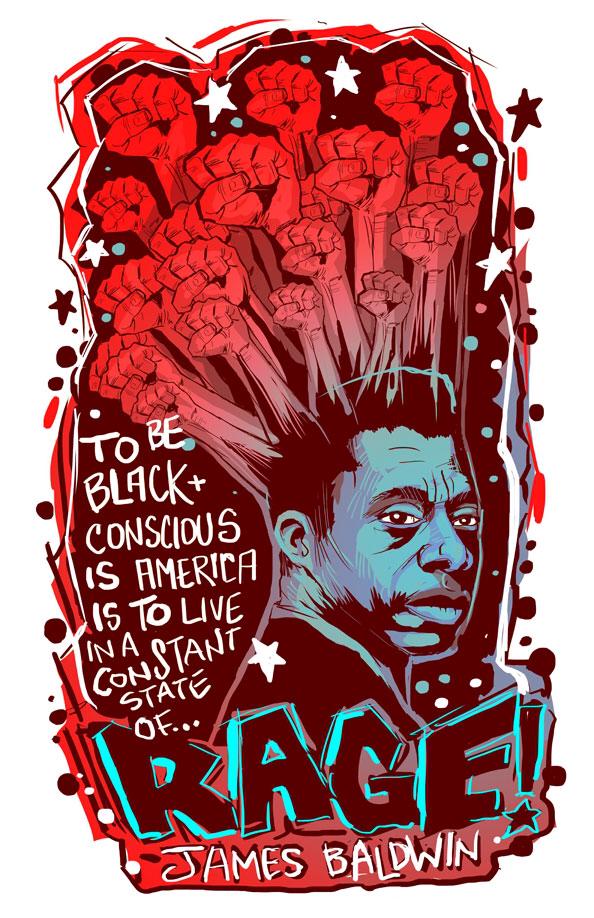
Baldwin

English Journal — Call for Manuscripts: Submission Deadline: March 15, 2016

English Journal — Call for Manuscripts

Visible Teaching: Open Doors as Resistance
Editors: Julie Gorlewski, David Gorlewski, P. L. Thomas, and Sean P. Connors
Submission Deadline: March 15, 2016
Publication Date: November 2016

Under pressure to adhere to a scripted curriculum or to conform to standardized instructional practices, educators might choose to adhere to a popular adage that recommends that they “close the door and teach,” presumably as an act of resistance. This advice is problematic, however, because it denies the agency of teachers, as professionals, to effect change in their schools. It willfully conceals alternative instructional practices that might otherwise benefit students, and it ignores the role that shared knowledge can play in sustaining a community.

Alternatively, teaching with our doors open establishes agency where the system has denied it; offers direct alternatives to the practices we reject, especially those that are not supported by the evidence of our field; and models for students how professionals behave.

This issue of English Journal explores how a decision to “teach with our doors open” can be interpreted as a form of empowerment and an act of resistance. It acknowledges teachers as agentive, and aims to understand how making one’s practices visible to others can disrupt standardizing forces and disciplinary mechanisms that are intended to promote conformity and compliance.

Contributors might consider questions such as: What conditions prompt teachers to teach behind closed doors, and how can they productively be addressed? How do you negotiate space to teach with your door open, and what advice would you offer others interested in doing so? How have you engaged with colleagues who respond differently to mandated and prescribed practices that you feel are not valid or effective? If you have experienced a transformative moment—moving from teaching with your door closed to teaching with your door open—how did that look and what advice can you offer those interested in making the same transition? How can teachers work with school leaders to create a school culture that values the open exchange of ideas and embraces evidence-based practices that push against mandates? We welcome educators to share experiences that investigate this important topic in the context of scholarly literature.

We invite manuscripts of 2,500-3,750 words, written to an audience of educators in grades 7-12 English classrooms.

More on Solidarity: “Speak to Shared Goals,” Not “Speak with One Voice”

Responding to my musing about the lack of solidarity among new media resistance to education reform, Sherri Spelic cautioned:

Solidarity, yes. However, in movements in which the aim is to “speak with one voice” whose voices are most likely to be quieted or softened or pushed to the edges? I fear it is often women’s voices which are sacrificed more often than not.

Certainly the number of voices in the ed reform push back camp is growing and we have to realize that new readers, writers, lurkers are finding their way into social media daily. The edu blogosphere is expanding as educators attempt to keep up with what appears to be a runaway train. They are told they must blog and pin and tweet in order to call themselves “connected.” And that’s when folks who were here earliest and built those initial cults of edu personalities began to talk about how shallow and repetitive twitter was becoming and asking whether they shouldn’t move on….

We can add to the solidarity not by limiting our use of voice but by lending it where it may be needed: to uplift one or more of our colleagues in need, in support of the policies and movements which align with our common cause.

My initial response was appreciation for the ideal and thoughtful framing, and then, because of Spelic’s challenge, I was pushed to think better about what I was asking, to state better what I envision.

Solidarity, for me, does not require speaking with one voice, but speaking to shared goals.

Here, then, possibly to continue the conversation, I want to explore what those shared goals may be, keeping in mind we need them to be clear, attainable, and few:

  • Seeking an end to one (preferred) educational experience for privileged children and another (worse) educational experience for “other people’s children.”
  • Seeking a greater appreciation and realization of teaching as an autonomous profession.
  • Confronting and ending inequitable punitive policies (academic and disciplinary) for marginalized populations of students along race, class, gender, and other status categories (English language learners, special needs students).
  • Ending high-stakes accountability focusing on outcomes and implementing a structure that addresses equity of opportunity metrics.
  • Calling for social reform that guarantees for all children that the coincidence of birth is not the dominant factor in their opportunities in life and education.

Among educators, researchers, political leaders, and the public, we will likely disagree about how to achieve these goals—that disagreement is likely important, in fact—but I believe we can and should be in solidarity for achieving these goals.

Divided, Conquered: “Everybody blogs. Nobody reads.”

In her 14 June 2015 email update about her blog, Susan Ohanian offered an opening statement:

When I started this website of resistance 13 years ago, I posted a lot of outrage, outrage I tried to buttress with research. Of late, I’ve cut way back because I feel there’s far too much jabber filling the air–too much rage and not enough explanation. Everybody blogs. Nobody reads. I figure whatever I might say just gets lost in the cacophony so I’ve turned my efforts elsewhere. Right now I’m working on a big project that I hope will startle you with originality. At the very least, it won’t be part of the chorus.  

I’m not abandoning the site–just cutting back on its size.

Well before the education reform debate blossomed on social media, Ohanian was dissecting and challenging the most recent cycle of high-stakes accountability—from the perspective of a classroom teacher.

I very much feel compassion for Ohanian’s concerns, having begun writing against accountability and specifically high-stakes testing in the 1990s, also as a classroom teacher. Once I moved to higher education in 2002, my access to public work was significantly expanded so my public commentaries reach back about as long as Ohanian’s (although my move to blogging is about half that span).

The powerful refrain—”Everybody blogs. Nobody reads”—resonates, I think, because it touches on how social media has in many ways had the opposite effect than its great promise: Instead of building solidarity, blogging, Facebook, Twitter, and all the rest have allowed factions to develop and has reduced much of the vibrant and important discourse to be subsumed by the great failure of social media—the cult of personality.

The online world of public debate about education and education reform has included the ugliest part of social media—anonymous vitriol—but it has also, for me, created a much more troubling dynamic. On more than one occasion, I have been refuted and attacked (based on false assumptions) by those with whom I share solidarity.

It is all too easy, then, for those of us who share the same mission to turn on each other while those who are running the education reform machine sit by mostly untouched.

In fact, that is what the minority in power thrive on—divide and conquer.

Part of my advocacy includes making a case for the importance of workers so I often ask people to consider if all service workers in the U.S. (mostly poorly paid and many part-time without benefits including the horribly under-paid wait staff) simply did not work tomorrow, how would that compare in impact to if all the CEOs did not go to work tomorrow?

And how does that impact expose real value to society versus how we compensate work in the U.S.?

One wait staff compared to one billionaire is a tale of supreme inequity.

Without solidarity, without a moral grounding among those who still may disagree, each of us is ripe for the sort of resignation that happens in isolation and powerlessness.

Each time I post on Common Core and the views increase and then I post on race and the views drop, I contemplate simply walking away from trying to make a difference.

The reason I have shifted from traditional scholarship and toward public work stems from the echo chamber that is scholarship where, to paraphrase Ohanian, everybody publishes, but nobody reads.

Social justice and educational equity are, simply put, the defining goals of a free people, and it seems these are the anchors for a solidarity that could bring about change.

Partisan politics, the cult of personality, building a brand, blogging and not reading/talking but not listening—these, however, are the antidotes to solidarity, and the fuel of the status quo of inequity that poisons our society and our schools.

Without solidarity, each of us is destined to resignation, failing to hold hands and realize our collective power against the few who can afford simply to wait us out.

We are a people, I fear, tragically trapped in individual ownership and competition, denying the essential communal nature of being fully human.

Dedicating the self to the public good is the ultimate act of selfishness. Solidarity is not, then, self-sacrifice, but self-preservation.

We have passion (Ohanian’s “rage”) and we have explanations, but we are doomed by a poverty of solidarity in our pursuit of social and educational equity.

Dueling Frying Pans: O, Arkansas

As are many states, Arkansas is trapped in a silly but expensive game of dueling frying pans: PARCC or ACT?

Political leaders and the public appear unable to understanding the bitter lessons of chasing better tests.

So, let’s consider this: Everything you need to know about the world (and frying pans) can be learned on Saturday morning cartoons—as Cyril from Break Away explains:

Cyril: You know what I’d like to be? A cartoon of some kind. You know, like when they get hit in the head with a frying pan or something, and their head looks like the frying pan, with the handle and everything? They they just go *booiing*

[shakes head]

Cyril: and their head comes back to normal? Wouldn’t that be great?

Mike: How’d you get to be so stupid, Cyril?

Cyril: I don’t know… I guess I just have a dumb heredity. What’s your excuse, Michael?

Of course, Tom and Jerry provides the ultimate visual:

And so we are left with a truly disturbing soundtrack to the standards and high-stakes testing Merry-Go-Round:

Recommended: Reaching and Teaching Students in Poverty, Paul C. Gorski

The propagandist’s purpose is to make one set of people forget that certain other sets of people are human.”

Aldous Huxley, The Olive Tree (1936)

While working on a piece for The Conversation US rejecting the increased focus on teaching struggling students (mostly poor, black, Latino/a, special needs students as well as English language learners) “grit,” I came across yet another report on poor students disproportionately being assigned to inexperienced and un-/under-certified teachers (including Teach for America candidates) and the inequitable as well as negative consequences of underfunded and poorly maintained school facilities.

Children in the U.S. are increasingly the victims of inequitable social, economic, and educational circumstances not of their making, and mostly ignored by those with power in the country.

Too few educators and academics, I think, are enraged about that inequity; too few are moved to action even if they are enraged.

And that is a large part of the reason I was drawn to the work of Paul Gorski several years ago as I began to compile the growing counter-arguments against the popular but deeply flawed poverty “framework” and concurrent book and workshop being sold by Ruby Payne [1] to schools across the U.S.

Gorski is passionate, measured, and informed about race, class, and gender inequity; he is also a dedicated soldier in taking action against that inequity.

Associate professor at George Mason University and founder of EdChange, an organization dedicated to social justice and educational equity, Gorski has written an incredibly accessible, powerful, and relatively brief alternative to the many careless “culture of poverty” books, workshops, and programs: Reaching and Teaching Students in Poverty: Strategies for Erasing the Opportunity Gap (Teachers College Press, 2013).

As an educator and academic with a working-class background rooted in rural poverty, I recognize in Gorski a shared journey that informs out world-view as well as our belief in advocacy.

Gorski offers several stories of his own working-class and impoverished family while he seeks always to offer readers a compassionate, compelling, and practical journey that asks each of us to confront our biases in order “to take a stand when one of our students is being shortchanged—not standing in front of or standing in place of, but standing next to, standing with low-income students and families” (p. 155).

Gorski’s Equity Literacy Approach: Rejecting “Culture and Mind-Set of Poverty” Frameworks

While Gorski’s book examines specifically issues related to social class and education—and remains mostly concerned with in-school practices—while speaking to a teacher audience, this work is suitable for all sorts of people navigating inequity of many kinds, inside and outside of school.

Gorski frames his discussion around Equity Literacy, defined “as the skills and dispositions that enable us to recognize, respond to, and redress conditions that deny some students access to the educational opportunities enjoyed by their peers and, in doing so, sustain equitable learning environments for all students and families” (p. 19). He outlines the ten principles of Equity Literacy and uses these principles to anchor the remaining chapters of the book.

After detailing Equity Literacy, Gorski continues his discussion by helping readers rethink and understand class and poverty before working through the following: (1) rejecting popular “culture of poverty” claims and other stereotyping of social class, (2) recognizing the out-of-school influences on teaching and learning, (3) reframing the achievement gap as the opportunity gap, (4) debunking popular but flawed approaches to teaching impoverished students, (5) detailing effective practices for students in poverty, (6) advocating for working with (and not on) impoverished families, and (7) calling for teacher advocacy beyond the classroom.

Several important themes run through this volume that should resonate with teachers faced with the significant and complex challenges of working with children and families living in poverty.

Broadly and throughout the book, Gorski asks readers to reconsider our faith in the U.S. being a meritocracy: “[M]eritocracy assumes a level playing field that…simply does not exist. Context counts” (p. 17). And this also challenges our trust in the power of the work ethic, about which he argues, “Working hard is no guarantee, especially not when, on top of your poverty, you’re denied equal educational opportunities” (p. 17).

Next, readers must step back from assumptions about class characteristics and then also reconsider stereotypes about people in poverty specifically. Gorski cautions that no social class is easily reduced to a set of qualities, and that we continue in the U.S. to demonize people in poverty by “blaming the victim” despite “most of what poor people have in common has nothing to do with their culture or dispositions [laziness]. Instead, it has to do with what they experience, such as the bias and lack of access to basic needs” (p. 26).

Here, Gorski warns, is why “culture of poverty” approaches fail—both as stereotyping of people in poverty (and thus not supported by the abundance of research in social class and poverty) and misguided for seeking ways to “fix” the people in poverty instead of poverty and its corrosive consequences directly (see p. 109):

In other words, to use an education example, we deny people in poverty access to equal educational opportunity, access to healthcare, and even access to air unspoiled by environmental hazards. We do this for generations and then, when some low-income youth don’t do well on standardized tests or drop out of school or seem disengaged in class, we forget about these inequities and blame it on their “culture.” (p. 54)

Once we can reject stereotypes about poverty and people in poverty—specifically by refusing the deficit perspective (see p. 111)—we can recognize that children and families in poverty “demonstrat[e] impressive resilience” (p. 60).

Differences among people in identifiable social classes, such as behaviors, are “marker[s] of access and opportunity” (p. 80) but not inherent character differences in those people (see also Mullainathan and Shafir below).

Despite Gorski’s primary focus on how we can better serve impoverished populations through formal education, he stresses “[w]e never will realize educational equity in any full sense until we address bigger economic justice concerns” (p. 118).

That admitted, the discussion warns readers about “missionary zeal,” the desire to impose on children and families in poverty instead of asking how we can use our relative privilege in their service. It is here that Gorski calls on our “humility” (p. 135).

However, Gorski does recognize that current efforts to reform education—often accompanied by claims of “closing the achievement gap”—work in the service of doing just the opposite, further oppressing impoverished and other marginalized students—for example, targeting those students for mostly test-prep.

Faculty and Individual Commitments to Students in Poverty

Ultimately, Gorski’s book is an anti-dote to the “culture of poverty” workshop approach to addressing high-poverty student populations, an approach that is neither supported by the evidence nor effective for specific schools or individual students.

Despite the popularity of poverty simulations and workshops, we must admit, as Kincheloe (2005) explains:

Shaped by history and challenged by a wide range of interest groups, educational practice is a fuzzy concept as it takes place in numerous settings, is shaped by a plethora of often-invisible forces, and can operate even in the name of democracy and justice to be totalitarian and oppressive [emphasis added]. (p. 2)

And as Gorski has written elsewhere, good intentions are not enough if those with good intentions are not well informed.

As faculties and individual teachers confronted with the considerable challenge of teaching students living in poverty, then, we are tasked with first confronting ourselves, and then, taking the time and care to look carefully and listen intently to the specific communities and students we serve so we can, as noted above, “[stand] next to, [stand] with.”

High-poverty students are cheated out of the education they deserve when their school day is reduced to worksheets and workbooks. Educators who believe they can reach and teach students in poverty through workbooks and workshops are equally as destined to failure.

It, then, remains not enough to have good intentions. As Gorski urges, “The good news is, we can stand up….We can listen” (p. 156).

Note

[1] The framework and workshops marketed by Payne are completely lacking in credibility; in fact, her claims about people in poverty are themselves classist and racist stereotypes. See a significant body of scholarship debunking her work.

See Also

Scarcity: The New Science of Having Less and How It Defines Our LivesSendhil Mullainathan and Eldar Shafir

The Payne of Addressing Race and Poverty in Public Education: Utopian Accountability and Deficit Assumptions of Middle-Class America, P. L. Thomas

How School Taught Me I Was Poor, Jeff Sapp

The “Word Gap”: A Reader

Journal of Educational ControversyVolume 4, Number 1 (2009) The Hidden Dimensions of Poverty: Rethinking Poverty and Education

Journal of Educational ControversyVolume 9, Number 1 (2014) Challenging the Deficit Model and the Pathologizing of Children: Envisioning Alternative Models

Jumping Out of the Frying Pan into the Fire, and Other Anti-Common Core Nonsense

“Arkansas Gov. Asa Hutchinson has decided that the state should drop the Partnership for Assessment of Readiness for College and Careers (PARCC) test,” reports Andrew Ujifusa in Education Week, adding, “and instead use the ACT Aspire test.”

Also in Education Week, Ujifusa explains:

South Carolina was one of three states last year—along with Indiana and Oklahoma—to require a replacement for the Common Core State Standards, amid a volatile political climate and challenges states have faced in implementing the standards.

SC has also opted for ACT Aspire testing, and all these changes are characterized as follows:

That shift has led to what state officials say is a calmer political climate for South Carolina’s public schools, support from a broad spectrum of K-12 and higher education leaders, and new standards that the state itself says are very closely aligned to the common core.

If fact, many states have begun to backpedal away from Common Core as well as the related PARCC and Smarter Balanced testing—so much so that many have begun to announce the end of Common Core before the national standards have really been implemented.

Release the doves! Raise the horns! Hallelujah!!!

Well, no, these and other anti-Common Core nonsense are more literary than religious: Much ado about nothing.

Careful examination of both adopting Common Core and then the backlash resulting in dropping Common Core reveals that states remain firmly entrenched in the same exact accountability based on standards and high-stakes testing that has overburdened education since the 1980s.

The names and letters change, but not much else—except for throwing more money at a game of wasteful politics labeled “reform.”

Political posturing and public responses to all this Common Core puffery suggest that the next time a hurricane is plowing toward U.S. soil, the Weather Channel can lessen public panic by simply announcing a kitten is off the coast of Florida.

New and different standards and tests—these are jumping out of the frying pan into the fire, rearranging chairs on the Titanic.

We need to abandon ship.

Let’s stop trying to win the (fixed) game of accountability, and instead create a new, fair game that addresses equity of opportunity for all students.

High-stakes, Standardized Tests Are “Master’s Tools,” Not Tools for Social Justice

Christina Duncan Evans argues that the high-stakes testing opt-out movement “ignores a major function of testing,” which she identifies as: “A major reason we use standardized tests is to make the case that there’s large-scale educational injustice in our nation.”

As an advocate for educational equity and social justice, Evans explains:

States don’t have a very good track record of providing equitable access to education to all of their students, and the federal government should ensure that American school quality is consistent. This has made me an advocate of standardized testing, following the logic that we can’t solve achievement gaps unless we measure them first.

Before examining this commitment to standardized testing (also found among civil rights organizations), I want to highlight that public education and state government have had a long history, continuing today, of failing miserably black, brown, and poor children and adults.

The evidence of lingering race and class inequity in the U.S. is staggering, and that inequity is too often replicated and perpetuated in public schooling—through inequitable access to rich curriculum and experienced, qualified teachers, for example.

As well, there is a troubling aspect to the opt-out movement along with the backlash against Common Core; as Andre Perry states, reinforcing Evans:

Take it from black and brown children who are used to being tested. Students will overcome. However, privileged adults who aren’t used to being tested may never stop crying.

The opt-out and Common Core backlash have exposed an unintended lesson about U.S. public education and society: As long as punitive and biased practices impact mostly or exclusively black, brown, and poor children (think “grit” and “no excuses”), the mainstream world of white privilege and wealth remains silent.

However, Perry also concedes that “having the ability to compare performances among groups hasn’t brought educational justice to black and brown students.”

In other words, and this is my main concern, the accountability era over the past thirty years—based significantly on standards and high-stakes testing—has not confronted and eroded race and class inequity, but in fact, and notably because of the central roles of standardized testing, race and class inequity has become even more entrenched in our schools and society.

Standardized testing remains biased by race, class, and gender, and thus, continues a warped tradition in the U.S. of masking bias as science; consider IQ testing and the current claims about “grit.”

High-stakes, standardized tests are, as Audre Lorde stresses, “the master’s tools.”

For those of us seeking educational and social equity and justice, then, we must heed Lorde’s call:

For the master’s tools will never dismantle the master’s house. They may allow us temporarily to beat him at his own game, but they will never enable us to bring about genuine change….

The essential flaw with continuing to cling to high-stakes standardized testing is two-fold: (1) the tests are race, class, and gender biased, and (2) the demand that we raise test scores keeps all the attention on outcomes (and not the policies and practices that create the inequity).

As such, the demand remains that black, brown, and poor children (and adults) are themselves flawed and must be “fixed” (see Paul Gorski on “blaming the victim”).

This second flaw is also addressed by Lorde: “This is an old and primary tool of all oppressors to keep the oppressed occupied with the master’s concerns.”

Testing is never any better than a proxy, a representation of something else (student learning, teacher quality, school quality), but testing is never a valid proxy for equity or justice—always instead a fatal distraction. As I have argued before:

Testing, in effect, does not provide data for addressing the equity/achievement gap, testing has created those gaps, labeled those gaps, and marginalized those below the codified level of standard.

The accountability movement and the increased stakes linked to standardized testing have focused the gaze even more narrowly on individual children and educators. That tunnel-vision allows the privileged to avoid addressing social and educational inequity because marginalized groups are forced to work at the “master’s concerns,” not their own.

If we are determined to find data to highlight educational inequity so that we can address it, let us turn that gaze to the inequity of opportunity. For example, Rebecca Klein reports:

In Mississippi’s Carroll County school district, there are no advanced placement courses, no foreign language classes and not enough textbooks for children to take home at night. Until last year, students on the high school football team had to change clothes in a makeshift room that previously functioned as a chicken coop….

Schools in Mississippi are provided with some of the lowest levels of state and local funding in the nation, according to two reports released simultaneously Monday detailing disparities in school resources around the country. For most of the past 10 years, the state has failed to live up to its own law requiring certain funding levels for schools.

Unfortunate circumstances like the ones in Carroll County can be seen across the country, say the reports from the Leadership Conference Education Fund and the Education Law Center, a New Jersey legal and advocacy group.

The abundance of evidence of social and educational inequity is overwhelming, and continuing to mis-measure it through relentless and punitive standardized testing is inexcusable.

Lorde concludes:

Racism and homophobia are real conditions of all our lives in this place and time. I urge each one of us here to reach down into that deep place of knowledge inside herself and touch that terror and loathing of any difference that lives there. See whose face it wears. Then the personal as the political can begin to illuminate all our choices.

Advocating for social justice in our schools must include the choice not to bend to high-stakes standardized testing, but to unmask “raising test scores” as the “master’s tools”—and then to demand we turn our gaze to the inequity of opportunities condemning another generation of children to the “master’s concerns,” and not their own.

O, Genre, What Art Thou?

“What is genre in the first place?” asks novelist Kazuo Ishiguro during a conversation with writer Neil Gaiman, who reviewed Ishiguro’s novel, The Buried Giant. Ishiguro continues: “Who invented it? Why am I perceived to have crossed a kind of boundary?”

Ishiguro then makes an interesting speculation about focusing on genre:

Is it possible that what we think of as genre boundaries are things that have been invented fairly recently by the publishing industry? I can see there’s a case for saying there are certain patterns, and you can divide up stories according to these patterns, perhaps usefully. But I get worried when readers and writers take these boundaries too seriously, and think that something strange happens when you cross them, and that you should think very carefully before doing so.

As I have grown older as both a teacher and a writer, I have become both more interested in genre (as well as medium and form—the distinctions and intersections) and less certain, like Ishiguro, about the utility of the labels.

Over the past several years, in fact, I have stumbled over publishers labeling Haruki Murakami‘s 1Q84 and Neil Gaiman’s American Gods as “science fiction.”

While I love both books and authors, I am hard-pressed to define either novel as science fiction; in fact, I am like Gaiman confronting Ishiguro’s Giant:

Fantasy and historical fiction and myth here run together with the Matter of Britain, in a novel that’s easy to admire, to respect and to enjoy, but difficult to love. Still, “The Buried Giant” does what important books do: It remains in the mind long after it has been read, refusing to leave, forcing one to turn it over and over. On a second reading, and on a third, its characters and events and motives are easier to understand, but even so, it guards its secrets and its world close.

Ishiguro is not afraid to tackle huge, personal themes, nor to use myths, history and the fantastic as the tools to do it.

Just as many enduring writers do, Ishiguro, Murakami, Gaiman, Margaret Atwood, and Kurt Vonnegut—just to name a few—weave genre conventions together, working within, against, and beyond the so-called boundaries of genre, medium, and form.

Unfortunately, formal education (and thus students and teachers) tends to remain trapped in the rote, the narrow, and the prescribed—or genre acquisition:

…GENRE ACQUISITION [is] a goal that focuses upon the students’ ability to reproduce a text type, often from a template, that is organized, or ‘staged’ in a predictable way. The Five Paragraph Essay pedagogies, so common in North America, present a highly structured version of this genre acquisition approach. A much more sophisticated version, introduced in Australia but now popular elsewhere, has been devised by the proponents of Systemic Functional Linguistics (Christie 1991; Martin 1993; Eggins 2004). Using well-established pedagogies, practitioners follow a teaching/learning cycle as students are encouraged to acquire and reproduce a limited number of text types (‘genres’) that are thought to be basic to the culture (Macken-Horarik 2002).

However, for the skilled writer, genre awareness is part of the craft of writing, but not templates that dictate:

A quite different goal is GENRE AWARENESS, which is realized in a course designed to assist students in developing the rhetorical flexibility necessary for adapting their socio-cognitive genre knowledge to ever-evolving contexts. Though there are few genre awareness curricula, for a number of reasons (see Freedman 1993), I will argue here that a carefully designed and scaffolded genre awareness program is the ideal for novice students – and for other students, as well.

Investigating Text as a Writer

For my first-year college students, we start the writing experience by cataloguing everything they have been taught about writing essays in school (concepts about introductions, bodies, conclusions, thesis sentences, and paragraphing, for example), and then we investigate the Prologue to Louise DeSalvo’s memoir Vertigo.

That investigation asks students to consider how this piece of nonfiction compares to what they have been taught about writing in school, but we also examine what the term “memoir” means against other terms such as “autobiography,” “biography,” and the fiction/nonfiction dichotomy.

Now I will add this exchange that sets as rule one for writing memoir: “Don’t try to ‘fit’ the genre.”

Learning to write becomes a continual tension between what we think we know about text as that is confirmed and contradicted by what we read—as preparation for what we write.

Being a writer is inseparable from being a reader, but both are ways of being that are always evolving, never fixed just as no genre, medium, or form is ever truly fixed.

As Gaiman and Ishiguro discuss genre, and Gaiman explains, “I think that there’s a huge difference between, for example, a novel with spies in it and a spy novel; or a novel with cowboys in it and a cowboy novel,” Ishiguro adds:

So we have to distinguish between something that’s part of the essence of the genre and things that are merely characteristic of it. Gunfights are characteristic of a western, but may not be essential to making the story arresting.

So there is where I am guiding my students as emerging writers and developing readers—to have the sense of purpose and awareness to recognize “essence” versus “characteristic,” to attain a level of sophistication that informs them in their writing and reading but doesn’t artificially restrain them.

For both the reader and the writer, then, genre is a question, one to ask continually and not a definition or a prescription.

And then, we must admit, the ultimate question remains: Was the text satisfying? That, too, becomes the source of even more debate, which, I would add, is the real essence of writing and reading because as long as there are readers the text always lives.

That, of course, if what every writer wants, to live forever:

NG I know that when I create a story, I never know what’s going to work. Sometimes I will do something that I think was just a bit of fun, and people will love it and it catches fire, and sometimes I will work very hard on something that I think people will love, and it just fades: it never quite finds its people.

KI Even if something doesn’t catch fire at the time, you may find it catches fire further down the line, in 20 years’ time, or 30 years’ time. That has happened, often.

See Also

Kazuo Ishiguro, The Art of Fiction No. 196. Interviewed by Susannah Hunnewell