All posts by plthomasedd

P. L. Thomas, Professor of Education (Furman University, Greenville SC), taught high school English in rural South Carolina before moving to teacher education. He is a former column editor for English Journal (National Council of Teachers of English), current series editor for Critical Literacy Teaching Series: Challenging Authors and Genres (Brill), and author of Teaching Writing as Journey, Not Destination: Essays Exploring What ‘Teaching Writing’ Means (IAP, 2019) and How to End the Reading War and Serve the Literacy Needs of All Students: A Primer for Parents, Policy Makers, and People Who Care (IAP, in press). NCTE named Thomas the 2013 George Orwell Award winner. He co-edited the award-winning (Divergent Book Award for Excellence in 21st Century Literacies Research) volume Critical Media Literacy and Fake News in Post-Truth America (Brill, 2018). Follow his work @plthomasEdD and the becoming radical (https://radicalscholarship.wordpress.com/).

Bicycling and Education: More on the Burden of the Impossible

I have been both a serious educator and cyclist for around 30 years, and I am often struck how competitive group cycling offers us important lessons about how we tend to fail the promise of universal public education.

Competitive cycling—many people probably do not realize—is a team sport, and even recreational cyclists (as my friends and I are) often ride within the same principles of team competitive cycling.

As well, professional cycling (which has several layers similar to Major League baseball in the U.S.) has a long history of corruption—doping (performance-enhancing drugs, or PEDs).

Both the principles of group cycling and the culture of doping help explain some of the failures of how we do schooling in the U.S.

Collaboration Trumps Competition

I have been cycling in the Greenville-Spartanburg area of Upstate South Carolina for three decades—as a part of a very organized cycling community (we post group rides 6-days a week throughout the entire year) and several different bicycle clubs and teams (currently globalbike Spartanburg).

Over those years, we have maintained a nucleus of cyclists and a revolving door of new riders, often runners and other elite athletes looking for a different challenge.

One of the recurring problems of integrating new riders into cycling is the complex culture of the sport (road cycling is tradition-rich, and also a bit insular) as well as the principles guiding riding in an organized pack, specifically participating in a paceline:

Members of globalbike Spartanburg 2015 participate in a paceline while doing a spring training ride in the North Carolina mountains.
Members of globalbike Spartanburg 2015 form a paceline while doing a spring training ride in the North Carolina mountains.

A group of organized cyclists (a paceline or eschelon) can ride faster and longer than a cyclist on her/his own. The key to that group advantage is that the principles governing a paceline are built on cooperation and not competition.

Cyclists in a paceline work in ways that consider the impact of the wind, the abilities of the cyclists (strong riders taking longer pulls with weaker riders sitting on, or not participating in the pulls), and the advantages/disadvantages of drafting.

For example, a paceline is constructed of two lines of riders, one driving the pace forward and another receding (to allow riders to rest and to block sidewind from the advancing riders who are pulling). If there is sidewind, the receding line should be on the side that blocks that sidewind from the advancing line, but always, the advancing line must create a pace that is consistent (riders must not surge when pulling through, and as well, after taking a pull, the rider pulling through to the receding line must ease off the pace slightly):

A paceline with a group of committed riders is an amazing thing to watch. A paceline with riders trying to disrupt the group (attacking or flicking [purposefully creating gaps for weaker riders in order to drop her/him from the group]) or without any regard for the principles of cooperation is a nightmare.

And that is the central problem with education and education reform in the U.S. over the last thirty years—a culture of competition instead of cooperation.

Demanding that each group of students surpass the group of students coming before is the same sort of disruption, the same sort of failure to understand key principles that we witness as cyclists when “that guy” surges through each time he rotates to the front in a paceline.

Group cycling is beautiful, efficient, and effective when everyone works collaboratively, but falls apart even when one or two riders decide to compete, choose to ignore the common good of the group. The best cyclists are always aware of both their own cycling as well as the entire pack of cyclists—a supple balance of the individual and the community.

Each fall, a group of 15 or so of my cycling community does a 220-240-mile ride in one day (11-12 hours of cycling and a 14+-hour day) from the Upstate of SC to the coast. This ride seems impossible for regular people who have jobs and ride bicycles for a hobby, but it is a testament to collaboration since the riders have a wide range of ability and fitness, but our goal is always having everyone arrive safely and together.

We all ride with both our own success and the success of the entire group guiding how we ride.

The single greatest reform we need in public education in the U.S. is to adopt a culture of cooperation (reject merit pay; reject VAM; reject testing students to label, rank, and sort; reject labeling and ranking schools and states by test scores; reject international rankings by test scores; reject school choice—vouchers, charter schools, etc.) and not competition.

“The Burden of the Impossible” and the Inevitable Allure of Cheating

Beyond the abundant evidence that collaboration is more powerful in most ways than competition, collaboration trumps competition since competition has many negative consequences.

Few examples are more powerful for those negative consequences than professional cycling and recently the cheating scandals in education.

Human athletic achievements are plagued by the pursuit of the amazing—less often are we willing to marvel in the essential. The U.S. sporting public struggles to understand the “beautiful game,” football/soccer matches that end nil-nil, because of the lust for scoring without an appreciation for the artistry of playing the sport.

Professional cycling has suffered—and failed to address—the direct relationship between creating “the burden of the impossible” and the inevitable cheating that has followed, over and over for decades.

Spring classics—one-day races often over cobbled roads, undulating terrain, and hellish spring weather—can cover 150-180 miles, and the grand tours (Tour de France, Giro d’Italia) last three weeks, averaging 100 miles a day and including the highest mountains of Europe. In fact, professional cycling seeks conditions (cobbles, mountains) that insure natural selection will separate cyclists despite the efforts of teams to work collaboratively.

The most recent, and possibly the most publicized, example of doping in professional cycling is personified by Lance Armstrong; two aspects of the Armstrong doping scandal are underemphasized, I think.

First, Armstrong and dozens of the best cyclists of his era (1990s and through the first decade of the 2000s) all have confessed to organized doping, noting that the decision to use PEDs was strongly influenced by a culture of competition that essentially required doping.

Cyclists who chose to ride clean tended to ride in obscurity, or eventually simply quit the sport.

Next, the revelation of doping by Armstrong and most elite cyclists of his era has resulted in demonizing and punishing individual cyclists—with Armstrong the most vilified.

Hundreds of race organizers, corporations, cycling team owners and leaders, and media outlets raked in millions and millions of dollars during the peak of Armstrong’s career because of the amazing and record-breaking (and PED-fueled) exploits of Armstrong—but essentially none of them have been asked to return that money, none held culpable for the culture within which those cyclists felt compelled to dope.

Especially in the U.S., the accusatory gaze focuses on failed individuals but refuses to consider the cultural or social norms that shape individual behavior.

It takes little imagination, then, to see how the culture of doping in professional cycling informs the rise of test cheating in U.S. public education under the “burden of the impossible”—the accountability mandates of education reform.

Prosecute and imprison educators who cheated, but ask not what led these people to such extremes, consider not that humans faced with the “burden of the impossible” are being completely rational to behave in ways that would not be reasonable if the rules were fair.

Serious recreational cyclists have much different reasons for cycling than professional cyclists, and for the most part, we create and maintain a culture of collaboration and cooperation so that everyone can excel, everyone can enjoy the beauty that is cycling.

Spaces dedicated to formal education are best served by that spirit of collaboration and cooperation, but are corrupted by a culture of competition.

While professional cycling (and all huge-money professional sport) may be beyond repair, education could be otherwise.

In order to end the rise of cheating in education (among educators or students), in order to close the so-called achievement gap, in order to end the inequity of opportunity and outcomes that characterize our public schools—end competition in education in all forms and begin a new era of collaboration and cooperation.
Why Is (Some) Test Cheating Wrong, But “Miracle” School Lies Are OK?

Of course, this all began with a bombshell announcement from the Reagan administration: A Nation at Risk.

So it started with a lie.

As governor of Texas, George W. Bush, and superintendent of Houston schools, Rod Paige, the Texas “miracle” led to the presidency of the U.S. and Secretary of Education.

But it was all a lie.

While Secretary of Education following Paige, Margaret Spellings proclaimed the federal legislation, NCLB, modeled on the Texas “miracle” a success.

But that too was a lie.

As the founder of the Harlem Children’s Zone, Geoffrey Canada was lionized as “Superman.”

But it was at best half-truth, if not a lie.

Creating a culture of fear herself, Michelle Rhee turned her role as Chancellor of DC public schools into a glorifying Time cover and story.

But it was all a lie, built on cheating no less.

Arne Duncan, credited with the Chicago “miracle”—see the Paige path above—was appointed Secretary of Education.

But, another lie.

Maybe some will find the word “lie” too harsh because most of the examples above (except for the Rhee tenure that did appear to be built on test cheating) and most of the “miracle” claims are misrepresenting data, manipulating data, or presenting partial data.

The media is eager to cover these claims, but nearly silent in covering the debunking—and there has always been debunking.

So I am now baffled about a truly important question: Why is (some) cheating wrong (for example, Atlanta), but “miracle” school lies (and SOE misrepresentations) are OK? No only OK, but those lies appear to be very lucrative for the liars (all of the people identified above have continued to prosper—not suffering significantly or legally for their false claims).

Anyone have a credible answer?

“Miracle”School and Data Distortions: A Reader

Stop Counting on Education ‘Miracles,’ Elaine Weiss

Education at Risk: Fallout from a Flawed Report, Tamim Ansary

We’re a Nation At Risk (Happy April Fool’s Day), Gerald Bracey

A Nation at Risk Revisited, Gerald Holton

From Spellings to Duncan: Using NAEP as Policy Propaganda

The “Texas Miracle,” Rebecca Leung

The Myth of the Texas Miracle in Education, Walt Haney

miracleschools wiki

Just How Gullible Is David Brooks?, Aaron Pallas

Education Secretary Arne Duncan’s legacy as Chicago schools chief questioned, Nick Anderson

No Child Left Behind fails to work ‘miracles,’ spurs cheating

From “Bad” Teachers to Teachers as Cheaters: The Burden of the Impossible

Taking the Fall in Atlanta, Richard Rothstein

Lessons from SC 4K Program

An editorial in The State (South Carolina), offers two lessons from a study on 4K programs in SC:

Early intervention programs such as 4-year-old kindergarten can be life-altering, but they have to [be] done properly. Done properly means providing actual teachers who put together smart lesson plans to stimulate the growing brain, rather than simply providing glorified baby sitters whose main job is to provide a place to keep the kids for several hours a day.

And while poverty alone is a strong predictor of poor school results, living and going to school surrounded by lots of other poor children — in what are called concentrations of poverty — is a separate risk factor above and beyond that.

We should applaud the recognition of these lessons, along with the nuance and the important and unqualified confronting of the double and even triple weight of poverty on children’s lives and learning.

But the third lesson not noted here is that 4K or any in-school program alone will remain insufficient without broader social reform that addresses directly childhood and family poverty—health care, food security, work security, living wages.

The incessant refusal to couple social and educational reform—as well as the bankrupt rhetoric of posing poverty as only an excuse—will always insure that even the best education reform efforts will appear ineffective, inadequate.

Teaching, learning, and the lives of children are all very complex; our efforts at reform must be equally complex and wide-reaching.

See Also

Report: Poor children lag behind despite 4K

Report on the South Carolina Child Early Reading Development and Education Program (2015)

SC and Education Reform: A Reader

CQ Researcher: Does Common Core help students learn critical thinking? No.

The April 2015 issue of CQ Researcher includes a question on Common Core: Does Common Core help students learn critical thinking?

My answer is: No, and I argue in part:

Accountability and standards intended to drive higher expectations of students — expectations labeled today as “critical thinking” or “higher-order thinking skills” — always come down to this: What is tested is what is taught. Because all states implementing Common Core have also adopted high- stakes testing, students will not be asked to think critically. They will be prepared to take tests.

In the context of standardized testing, higher-order thinking skills are not critical but are discrete skills that lend themselves to efficient teaching and testing formats. True critical thinking involves investigating a text — moving beyond decoding and comprehension to challenging claims and agendas and examining historical influences. Thus, it is difficult to test in multiple-choice formats….

Ironically, a critical reading of Common Core standards exposes a commitment to more of the same failed approach that masks yet more test prep as critical thinking.

While CQ Researcher is subscription-only, if you are university-based, you are likely to have access.

See Teaching Critical Thinking, and then Pro/Con.

Related

New Criticism, Close Reading, and Failing Critical Literacy Again

Research-based Options for Education Policymaking: Common Core State Standards, William Mathis

White Denial

[Atypical of my blog posts, please note that words often deemed offensive are included below.]

During the controversy over former LA Clippers’ owner Donald Sterling expressing racist comments on a recording by a companion, I highlighted Ta-Nehisi Coates confronting “oafish racists” as a public and political target to express token outrage but ignore systemic and lingering racism.

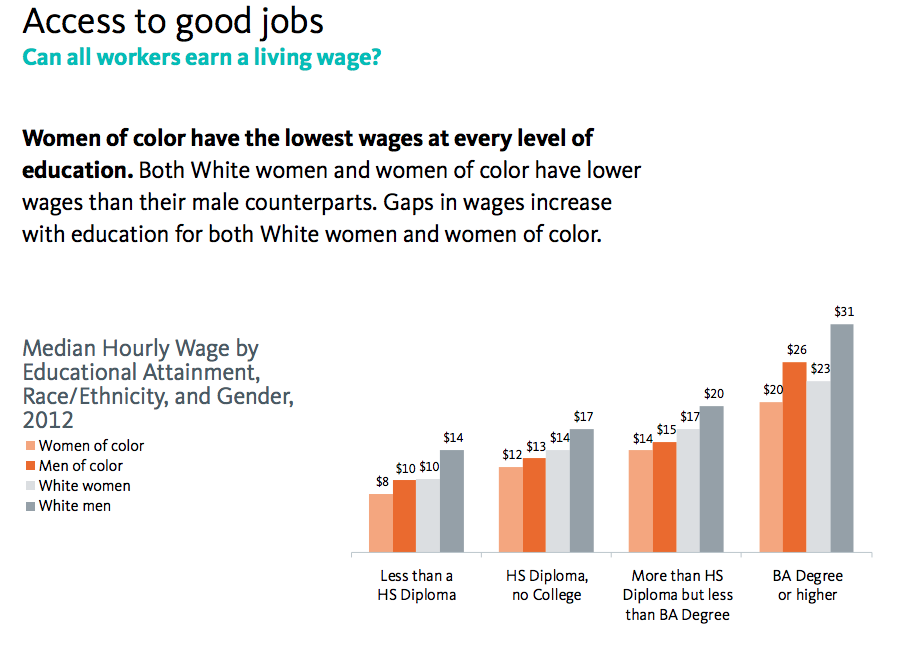
In many ways, businesses placing “No Blacks” signs in their windows were easier to refute than the less overt racism found when blacks and whites with the same education from elite universities receive inequitable opportunities for work, skewed in favor of whites. Or the blunt racism and sexism exposed by data:

access to good jobs race gender

That context serves well to understand how a young college student-athlete whispering “nigga” with a live mic nearby and a police shooting and killing of an unarmed black man in North Charleston, SC again speak to how white denial of racism perpetuates racism, especially when that denial is subtle.

First, a Kentucky basketball player trash talking off the court—when he should have been better aware of his surroundings—appears (and in many ways is) less significant than the shooting and killing of an(other) unarmed black male by a white police officer who also, as the video reveals, went to extraordinary and disturbing lengths to create a lie about his inexcusable actions.

However, the reactions to these separate events are very much equally illustrative of white denial of racism as a mechanism for perpetuating racism.

As a life-long Southerner and 30-plus-year educator, I have witnessed both the most vile use of “nigger” as a dehumanizing racial slur and a common response to blacks using “nigger”/”nigga”: Why can blacks say that to other blacks but whites can’t say it?

This is a common-sense mask for racism.

The common sense mistake in this claim is placing the offensive power within the word itself, instead of the context of its use and the agents involved, who uses the word and toward whom.

As listed below [1], marginalized and oppressed groups have often reappropriated slurs as an act of empowerment. Thus, the use of “nigger”/”nigga” between equals and the intent of that use are profoundly different than a white person (as an agent of white privilege) using that term to “put in her/his place” a black person (a target of oppression).

Since “nigger” is a volatile word (one I do not use and prefer that others do not use), let me offer another example.

I have also witnessed the use of “boy” as a way to demean others, both as a racist slur and as an attack on manhood—particularly in the South. In almost all ways, “boy” is a harmless word, but when an adult white male uses “boy” toward an adult black male, the word carries a level of offense nearing “nigger”; in fact, as the direct racial slur has become more publicly taboo, words such as “boy” and “thug” have gained weight as offensive words that seem covert to the users.

And yet, I hear no one claiming that “boy” should be banished from use by everyone.

Further, the evidence of the use of “nigger”/”nigga” in non-offensive ways within a racial minority comes from the slurred/marginalized people themselves. To reject or discount that claim is itself an act of marginalization, a denunciation of the value of a people’s voice—and thus, racism.

Next, the shooting and killing of Walter Scott by a police officer has entered the seemingly endless narrative of the U.S. that itself reveals the country is not post-racial. Shootings of black males by police are stunningly common, often controversial, and nearly always coupled with equivocation by the white/privileged majority.

That Scott’s killing is documented by a video that also exposes the officer’s horrifying dishonesty, one would expect the equivocations to be nearly silent; however, the subtle racism following Scott’s shooting is the “rogue cop” argument, the concession that all professions have some “bad apples” (that phrasing particularly tone deaf and offensive since a 50-year-old, unarmed man was shot 8 times in the back and killed by an officer sworn to protect and serve). Or as Leonard Pitts Jr. confronts, discounting each shooting as an “isolated incident.”

Reducing Scott’s shooting to “one bad apple” is denying systemic racism in the U.S. judicial system. It is turning a blind eye to the reality than many countries have police forces that rarely, almost never, use deadly force. It is embracing a culture of violence that remains unpunished among the ordained, glorified in popular media and entertainment, and swiftly punished among the marginalized.

The “one bad apple” denial keeps the gaze superficial, in order to deny systemic racism, and fails to witness when even black police officers are agents of a racist system (in ways replicated all throughout history and society when individuals from an oppressed group are themselves drawn into the bigotry codified by policy, law, or tradition).

To remain unable to listen to the context of a racial slur while also waving off the shooting of an unarmed black man by a police officer as a regrettable outlier—these are acts of subtle racism that perpetuate systemic racism.

And here, once again, we must return to Coates, and we must listen—especially whites in denial:

Elegant racism is invisible, supple, and enduring. It disguises itself in the national vocabulary, avoids epithets and didacticism. Grace is the singular marker of elegant racism. One should never underestimate the touch needed to, say, injure the voting rights of black people without ever saying their names. Elegant racism lives at the border of white shame. Elegant racism was the poll tax. Elegant racism is voter-ID laws….

A racism that invites the bipartisan condemnation of Barack Obama and Mitch McConnell must necessarily be minor. A racism that invites the condemnation of Sean Hannity can’t be much of a threat. But a racism, condemnable by all civilized people, must make itself manifest now and again so that we may celebrate how far we have come. Meanwhile racism, elegant, lovely, monstrous, carries on.

[1] See on language/slur reappropriation:

The Reappropriation of Stigmatizing Labels: Implications for Social Identity, Adam D. Galinsky, Kurt Hugenberg, Carla Groom and Galen Bodenhausen

The semantics of slurs: A refutation of pure expressivism, Adam M. Croom

Appropriating a Slur: Semantic Looping in the African-American Usage of Nigga, Andrew T. Jacobs

Matt Barnes, the N-Word and Reappropriation, Jonah Hall

‘Cunt’ Should Not Be a Bad Word, Katie J.M. Baker

Laurie Penny: In defence of the “C” word

Reclaiming “Cunt,” “Bitch,” “Slut,” and more

The feminist mistake, Zoe Williams


O, Chicago …

This is a difference between the passive be and the active being….
For the master’s tools will never dismantle the master’s house.

Audre Lorde, The Master’s Tools Will Never Dismantle the Master’s House

The best lack all conviction, while the worst
Are full of passionate intensity.

William Butler Yeats, “The Second Coming”

When he composed his gritty paean to the “City of the Big Shoulders,” Carl Sandburg may have been idealizing the complicated working-class American Dream he witnessed in the city of Chicago, but then, that dream may have seemed possible—a decade before F. Scott Fitzgerald’s unmasking in the wake of WWI.

But Sandburg was also prescient:

Chicago

After the 2015 mayoral election in Chicago, “wicked,” “crooked,” and “brutal” ring harshly in the ears of advocates for equity and public education, leave a bad taste in our mouths—those of us who were on the ground and virtually watching on social media only to rise today to this: Rahm Emanuel wins second term as Chicago mayor.

I have dear friends (real and virtual) who are from and currently work and teach in Chicago so this mayoral race has been painful to witness.

And there is a coincidence here I must highlight.

Months before Hurricane Katrina crushed New Orleans, I was attending an education convention there with a friend. One afternoon as we we preparing to head out, I was watching George Carlin on a TV interview with Charlie Rose (I think).

I recall vividly Carlin explaining that he was tired of people assuming him to be a Democrat, adding that Carlin was a dedicated non-voter.

And that is me. I am a Carlin-inspired non-voter. It pains me to watch wonderful and good people participate in U.S. partisan politics, but the Chicago mayoral race is yet another bitter lesson that Carlin was right.

Partisan politics in the U.S. is the “master’s tools.”

Many people—especially those living in privilege—do not see what we see, do not seek what we seek. Advocates for public education and social equity must confront that we are a serious minority:

chicago voting

Pretending that Candidate X is better than Candidate Y for reasons related to education or equity is an idealism that we cannot afford.

Shouting “neoliberalism!” and “corporate education reform!” does not resonate in the U.S. the way it does among our own—just as we should recognize when a major mainstream media outlet presents both sides of a situation that has only one side—the callous mistreating of black and poor children—the public likely cannot see the abuse.

Groups in the U.S. marginalized because of race, class, gender, or sexuality have been told they do not matter, told with deadly force that their voices cannot count. The current political system is, like the rest of the country, a plaything of the wealthy.

Political action that is “bad” impacts mostly the poor and disenfranchised; political action that is “good” serves the wealthy and privileged. Elections—as in the Chicago mayoral race—are a reflection of privilege and disenfranchisement, not of the quality of any candidates.

Activism in the name of equity cannot afford idealism, cannot change anything if we remain trapped inside the “master’s tools” and a refusal to admit we see a different world than those in power and those who serve the ruling elite.

Sandburg’s Chicago as the promise of hard work has certainly been replaced today as another lesson in what the U.S. has become despite political rhetoric to the contrary: We are not a country built by workers or a country that treasures it workers, but a country that allows a few to feed off the blood, sweat, and tears of its replaceable workers—including teachers—and a country that casts aside many of its children (especially those that are black, brown, and poor).

Chicago joins New Orleans, then, as a very ugly lesson that a few see but most do not.

Chicago today reinforces my refrain, beware the roadbuilders because they will always win the game they invented.

Race to Disgrace

A society is defined by what is tolerated and for whom—and by whom.

In a country with a moral center, or at least a moral free press, this story would be a scathing exposé, spurring public denunciation.

But in the U.S., it is a story about “polarizing methods and superior results”—a gutless mess of misinformation and “fair and balanced” journalism that includes this dispassionate reporting:

At one point, her leadership resident — what the network calls assistant principals — criticized her for not responding strongly enough when a student made a mistake. The leadership resident told her that she should have taken the student’s paper and ripped it up in front of her. Students were not supposed to go to the restroom during practice tests, she said, and she heard a leader from another school praise the dedication of a child who had wet his pants rather than take a break.

What is the common characteristic of students in punitive, test-prep “no excuses” charter schools, like the one above, all across the U.S.?

What is the common characteristic of the teachers found guilty in the Atlanta cheating scandal?

What is the common characteristic of the professional educators fired (and replaced by TFA recruits) after Hurricane Katrina in New Orleans?

The answer is the same as, What is the characteristic of who is disproportionately in U.S. prisons? Disproportionately arrested, charged, and convicted of crimes? Disproportionately disciplined in U.S. public and charter schools, expelled as early as pre-K?

The answer: The race to disgrace is black in the U.S.—a country without a moral center, without a moral free press.

School Library Month 2015

While April is receiving attention as National Poetry Month, many of us may have missed April is also School Library Month.

I must admit that I am a book person more than a library person, and by that I mean I am compelled to own books instead of borrow them.

But I vividly recall my junior high library, where I found a book with Mark Twain’s signature reproduced and decided at that young age a person’s signature matters—creating then what has endured as my own swirling signature that is a very important icon of my Self (especially as a writer).

As a literacy educator, I also know that access to books at school and home is a foundational part of any child’s literacy—one we have ignored for reading programs and punitive legislation masked as reading policy (see Stephen Krashen).

As a public school teacher, I also witnessed—and resisted—book banning attempts from parents as well as the school’s librarian.

My doctoral work, writing a biography of educator and former NCTE president Lou LaBrant, helped solidify my appreciation for the key role of librarians as scholars and teachers; LaBrant co-authored several scholarly works with a librarian, Frieda M. Heller.

So here for School Library Month 2015, let me repost my presentation from NCTE 2014.

Teaching Reading and Children: Reading Programs as “Costume Parties”*

“It is 1956, and I am thirteen years old,” begins Louise DeSalvo’s memoir Vertigo.  The opening scene reveals DeSalvo’s teenage angst and her desire to flee:

I have begun my adolescence with a vengeance. I am not shaping up to be the young woman I am supposed to be. I am not docile. I am not sweet. I am certainly not quiet. And, as my father tells me dozens of times, I am not agreeable. If he says something is true, I am sure to respond that it is most certainly not true, and that I have the evidence to prove it. I look up at the ceiling and tap my foot when my father and I argue, and this makes him furious.

In the middle of one of our fights, the tears hot on my cheeks, I run out of the house, feeling that I am choking, feeling that if I don’t escape, I will pass out. It is nighttime. It is winter. I have no place to go. But I keep running.

There are welcoming lights a few blocks away. It is the local library. I run up the stairs. I run up to the reading room, sink into one of its comforting, engulfing brown leather chairs, pull an encyclopedia down from the shelf, hold it in front of my face so that no one can see me, so that no one will bother me, and pretend to read so that I won’t be kicked out. It is warm and it is quiet. My shuddering cries stop. My rage subsides. (Prologue, p. xiii)

Libraries, librarians, and teachers return often throughout DeSalvo’s life story that reads as a slightly revised version of Tennessee Williams’s fictional “kindness of strangers”—this a retelling of the kindness of teachers, and of the library as sanctuary.

“There is more than one way to burn a book” (p. 209), Ray Bradbury warns in the “Coda” included in the 60th anniversary edition of Fahrenheit 451—a comment that motivated a poem of mine, “The 451 App (22 August 2022),” a speculative poem about how the move to electronic books could lead to the dystopian end to books and reading.

Bradbury’s novel, of course, emphasizes the importance of books, and of reading, but Bradbury’s writing of the novel and life also present powerful messages about libraries.

Jonathan R. Eller explains, “Bradbury virtually lived in the public libraries of his time” (p. 168). Further, Bradbury drafted early versions and then Fahrenheit 451 itself in the UCLA Library, working at a dime-per-half-hour typewriter.

Bradbury explains as well in the audio introduction to Fahrenheit 451:

I’m a library-educated person; I’ve never made it to college. When I left high school, I began to go to the library every day of my life for five, ten, fifteen years. So the library was my nesting place, it was my birthing place, it was my growing place. And my books are full of libraries and librarians, and book people, and booksellers. (p. 196)

It makes a great deal of sense and offers some literary symmetry, then, that Neil Gaiman wrote the Introduction to Bradbury’s 60th anniversary edition—Gaiman who is the source of a mostly satiric piece I wrote calling for Gaiman to replace Arne Duncan as the U.S. Secretary of Education.

Gaiman, like, Bradbury is an advocate of books, of reading, of libraries, and then of children choosing what they read:

It is obviously in my interest for people to read, for them to read fiction, for libraries and librarians to exist and help foster a love of reading and places in which reading can occur….

The simplest way to make sure that we raise literate children is to teach them to read, and to show them that reading is a pleasurable activity. And that means, at its simplest, finding books that they enjoy, giving them access to those books, and letting them read them….

Well-meaning adults can easily destroy a child’s love of reading: stop them reading what they enjoy, or give them worthy-but-dull books that you like, the 21st-century equivalents of Victorian “improving” literature. You’ll wind up with a generation convinced that reading is uncool and worse, unpleasant….

Another way to destroy a child’s love of reading, of course, is to make sure there are no books of any kind around. And to give them nowhere to read those books. I was lucky….

They were good librarians. They liked books and they liked the books being read. They taught me how to order books from other libraries on inter-library loans. They had no snobbery about anything I read. They just seemed to like that there was this wide-eyed little boy who loved to read, and would talk to me about the books I was reading, they would find me other books in a series, they would help. They treated me as another reader – nothing less or more – which meant they treated me with respect. I was not used to being treated with respect as an eight-year-old.

But libraries are about freedom. Freedom to read, freedom of ideas, freedom of communication. They are about education (which is not a process that finishes the day we leave school or university), about entertainment, about making safe spaces, and about access to information.

While writing this, it was late in the year 2014. No dystopia like Bradbury envisioned had happened, and at least potentially, books now are more abundant than ever—both in print and electronically.

But a much more insidious dystopia does exist, one that is little different than decades before us and one that comes in the form of policy and what former NCTE president Lou LaBrant called “adult weariness” (p. 276).

Reading and books—and children—have long been the victims of prescribed reading lists, reading programs, and reading legislation. By mid-twentieth century, LaBrant (1949) had identified the central failure of teaching reading: “Our language programs have been set up as costume parties and not anything more basic than that” (p. 16).

Nearly 65 years later, Common Core, the related high-stakes tests, and rebranded concepts such as “close reading” are poised to have the same chilling effect Bradbury dramatized in Fahrenheit 451, and directly warned about, again: “There is more than one way to burn a book.”

From LaBrant to Stephen Krashen, literacy teachers and scholars have called repeatedly for access to books in the home, well-funded public libraries, and children having choice in what they read.

Instead, we close libraries (and public schools), we defund and underfund what libraries (and schools) remain, and we invest in reading programs and reading tests. That is a very real and painful dystopia.

Like DeSalvo, Gaiman recalls the library as a safe haven:

Nobody is giving you a safe space. I used to love libraries at school. Because school libraries had an enforced quiet policy, which meant they tended to be bully-free zones. They were places where you could do your homework, you could do stuff, whether it was reading books, or getting on with things that you wanted to get on with, and know that you were safe there. And people responded to your enthusiasms. If you like a certain writer, or a certain genre, librarians love that. They love pointing you at things that you’ll also like. And that gets magical.

Here, Gaiman answers his question from his Introduction to Bradbury’s Fahrenheit 451: “Why do we need the things in books?” (p. xv).

Books as magic, libraries as sanctuaries—we must cast spells, then, to erase the dystopia before us in the form of yet more standards and test, yet more libraries closed, and then yet more children taught to hate the very things and the very places that have made life worth living for so many.

Books and libraries created Gaiman, spawned his belief: “The world doesn’t have to be like this. Things can be different.”

Let’s hope so.

References

LaBrant, L. (1949, May). Analysis of clichés and abstractions. English Journal, 38(5), 275-278.

LaBrant, L. (1949). A genetic approach to language. Unpublished manuscript, Institute of General Semantics, Lakeville, CT.

LaBrant, L. (1947). Um-brel-la has syllables three. The Packet, 2(1), 20-25.

*Portions adapted from the following blog posts:

Teaching Reading and Children: Reading Programs as “Costume Parties”

Common Core in the Real World: Destroying Literacy through Standardization (Again)

“Fahrenheit 451″ 60 Years Later: “Why do we need the things in books?”

Neil Gaiman Should Be U.S. Secretary of Education: “Things can be different”

See Also

Neil Gaiman: Libraries are cultural ‘seed corn’

It’s a Book, Lane Smith

Magical Murakami Nightmares

From “Bad” Teachers to Teachers as Cheaters: The Burden of the Impossible

The guilty verdict in the Atlanta cheating scandal seems to be a logical conclusion to the “bad” teacher myth confronted nearly five years ago by Adam Bessie.

As a 30-plus-years educator, I have daily witnessed a not-so-subtle disdain for teachers, directly as people and broadly as a profession.

One situation that captures that, I think, is the many times among my cycling group years ago when people would discover I was then an English teacher. Each time, the person would say, “I better watch what I say then”—not so jokingly.

The stereotype of the authoritarian and humorless English teacher—gray hair in a bun, red pen at the ready—is likely the image many people conjure when they think about teachers.

Not all, but many.

School for too many children is something to endure, a place that seems impossible to navigate without getting into trouble, and especially for children of color, the first confrontation with discipline and punishment that are inequitable and inevitable.

So I regret to admit that a significant reason the “bad” teacher myth works politically and there seems a great deal of glee about teachers/educators being busted for cheating is our faultour fault each time we have created or perpetuated authoritarian schooling.

That said, I must then stress here it isn’t that simple.

I have, then, a few questions.

The first, Why are 11 educators being convicted in Atlanta, but Michelle Rhee continues to skip along scot-free?

Another, Why did professional educators commit these crimes?

And finally, What does the popular glee over these convictions reveal about justice in the U.S. as well as lingering racism and sexism?

I have some ideas about how all of these are connected.

Let me start with Rachel Aviv’s headline about the Atlanta scandal, by focusing on the subhead: Wrong Answer: In an era of high-stakes testing, a struggling school made a shocking choice.

My first idea is that there is nothing “shocking” about the cheating scandal, but that it is entirely predictable, if not reasonable.

I recommend Margaret Atwood’s The Handmaid’s Tale which dramatizes the consequences of “reduced circumstances.”

Adults, children, and animals backed into a corner will behave in ways that are unlike their normal behavior.

Offred/June fantasizes about murder with a knitting needle; she had been a “normal” wife and mother before the events creating the dystopia that reduces her.

Teachers/educators and students who find themselves in high-stakes situations and almost no power, then, have often and will often seek any means necessary to avoid the injustice of punishment over which that have no control.

As a high school teacher, I witnessed time and again that students who faced impossible expectations either quit or cheated, often. The problem was not the student, but the expectations and the burden of the impossible.

But here is the problem: In the U.S., we have a cultural belief that human goodness/badness is almost entirely a consequence of the individual—despite that cultural belief being mostly refuted by what research shows about the power of social forces to shape individual behavior.

I recommend in that context the research-based Scarcity: Why Having Too Little Means So Much by Sendhil Mullainathan and Eldar Shafir and the literary (as well as beautiful) The Very Persistent Gappers of Frip, written by George Saunders and wonderfully illustrated by Lane Smith (I have examined how these two works complement each other).

Let me end this by stressing that I am not calling for excusing any and all behavior because of social forces; nor am I necessarily saying that the educators convicted in the Atlanta scandal are somehow above punishment.

I do argue what the punishment should be for those educators needs careful deliberation.

I also think the greater issue is that we must confront the reasons these cheating scandals are occurring under the high-stakes accountability mandates, which is the lesson from the Atlanta cheating scandal:

ATL cheatingI think a great illustration of what must be done is how the tide is turning about the legalization of marijuana.

For those who think right/wrong is simple, consider that one day possessing marijuana was illegal in Colorado, for example, but the next day it wasn’t.

The solution to ending cheating among educators under the impossible weight of high-stakes accountability (just as the solution to stop student cheating in school) is to end the conditions creating it.

The Atlanta cheating scandal is not a major lesson about “bad” teachers, but it is yet another lesson about the bankrupt education reform movement, the one that made Michelle Rhee rich and famous and thus above the law (a situation that oddly seems to draw little fire from those dancing about teachers getting busted).

Particularly in high-poverty, majority-minority schools, students and teachers are living a dystopia not of fiction, but a daily experience.

“No excuses,” zero tolerance, high-stakes testing—these are the conditions that reduce good children and adults to behaviors that are unlike who they are.

High-stakes accountability must be put on trial, convicted, and sent away for life without parole.

See Also

Taking the Fall in Atlanta, Richard Rothstein

Revisiting “Theme for English B” by Langston Hughes

Bookending my higher education experience is a common situation: finding myself in an intense dialogue with the professor and then realizing I was essentially the only student participating in that discussion.

As a first-year (actually first semester) student, Mr. Pruitt and I were enthusiastically exploring Henry David Thoreau, and maybe Ralph Waldo Emerson. During a doctoral course on educational theory, Dr. Holton and I were wrestling with Joseph Schwab.

My life as a student was mostly a good one, and I needed little prompting to enjoy learning or to appreciate and marvel at my teachers and professors—this the result of being a mama’s boy, she my first and a wonderful teacher.

During my junior and senior years as an undergraduate, Dr. Nancy Moore—short hair, button-down collar shirts, and slacks—was a recurring professor in my program. Nancy was incredibly kind to me, supportive and complimentary in a way that lifted me out of my essential low self-esteem.

Nancy’s courses, as well, were my first introductions to diverse literature—Ralph Ellison, Alice Walker, Toni Cade Bambara, Langston Hughes, Countee Cullen, Toni Morrison.

Although a nearly terminal redneck, I was a white, male student who had been gifted (both genetically and culturally) the socially valued verbal and mathematical skills considered “smart.” And thus, my venture into formal education was mostly unlike that of Langston Hughes.

Revisiting “Theme for English B” by Langston Hughes

The Harlem Renaissance and Langston Hughes’s life-/career-span (1902-1967) likely seems to be the distant past for many high school or undergraduate students. But one of the most powerful aspects of poetry by Hughes for me is how present his work is, every time I return to it.

As a reader and a poet, I am drawn to work that appears simple (as if anyone could have written it) and simultaneously reveals that only this poet could have shaped this verse, that the accessible words and phrasing disguise something rich, complex, and enduring.

“The instructor said,” opens “Theme for English B”—establishing one of the poem’s major themes, the imbalance of power.

“Theme for English B” is a narrative in poetic form that weaves race, place, and power in order to challenge the inequity inherent in all “[t]hat’s American.”

The writing prompt at the opening of the poem strikes me as surreal—far too open and inviting for what traditionally is a writing prompt in English courses, but Hughes immediately shakes the reader: “I wonder if it’s that simple?” because “I am the only colored student in my class.”

And now the poem runs.

The poem’s speaker details his race and his place (actually places) in order to confront truth:

It’s not easy to know what is true for you or me
at twenty-two, my age. But I guess I’m what
I feel and see and hear, Harlem, I hear you.

The poem has now complicated the speaker’s situation with both black/white and South/North dichotomies—the latter, I think, is wonderfully enriched by also reading Countee Cullen’s “Incident.”

For the speaker, despite the careful outlining of his humanity as beyond racial or regional stereotypes, the issue remains, “So will my page be colored that I write?/Being me, it will not be white.”

There is a tinge of defiance along with both youthful exuberance and wiseness beyond his 22 years, and then a heavy awareness by the end:

As I learn from you,
I guess you learn from me—
although you’re older—and white—
and somewhat more free.

As a writer/poet and teacher, I am then profoundly—and every time I re-read this poem—moved by the last line signifying that this student under the weight of race, place, and an unfair imbalance or power has submitted an essay that is true in the same simple language used to open the poem: “This is my page for English B.”

A poem that is a student’s college essay—this becomes an enduring lesson about race, place, and the imbalance of power.

See Also

Culturally Responsive Teaching: The Harlem Renaissance in an Urban English Class, Andrea J. Stairs