
All posts by plthomasedd

P. L. Thomas, Professor of Education (Furman University, Greenville SC), taught high school English in rural South Carolina before moving to teacher education. He is a former column editor for English Journal (National Council of Teachers of English), current series editor for Critical Literacy Teaching Series: Challenging Authors and Genres (Brill), and author of Teaching Writing as Journey, Not Destination: Essays Exploring What ‘Teaching Writing’ Means (IAP, 2019) and How to End the Reading War and Serve the Literacy Needs of All Students: A Primer for Parents, Policy Makers, and People Who Care (IAP, in press). NCTE named Thomas the 2013 George Orwell Award winner. He co-edited the award-winning (Divergent Book Award for Excellence in 21st Century Literacies Research) volume Critical Media Literacy and Fake News in Post-Truth America (Brill, 2018). Follow his work @plthomasEdD and the becoming radical (https://radicalscholarship.wordpress.com/).

Road Cycling, the Little Things (Or, Are You a Fred?)

The first rule of Fight Club is: you do not talk about Fight Club.
The second rule of Fight Club is: you DO NOT talk about Fight Club!
Fight Club (1999)

For my local cycling community, I have written often about what I would call first level issues related to road cycling: holding your line, holding the wheel in front of you, proper fit and positioning on the bicycle, riding in a paceline, and recognizing when you should contribute in a paceline or stay out of the mix.

Here, however, I want to address second level issues related to road cycling, the social or aesthetic elements of the recreational sport. And those second level issues can more efficiently be covered by the simple question, Are you a Fred?

First, let me caution that parts of speech matter here, notably the article “a.” This is not about being named Fred, but being a Fred. In fact, my lessons in not being a Fred were handled classically and ironically by Fred Gobillot in the 1980s. Fred was the most not-a-Fred among our cycling group, and he would regularly drop me, only to ease back in order to pull me up to the group so he could drop me again (often berating me and questioning my humanhood; think the drill sergeant in An Officer and a Gentleman, but not as compassionate).

Next, it helps to recall those glorious days of middle or high school—or those rush weeks in college—when you either witnessed or were a part of the ugliest possible clique you can remember. Road cycling’s social dynamics are about 300% worse than that.

Road cycling is about bodily fluids—sweat, urine, and occasionally blood—intense physical pain, and relentless public shaming. In fact, the greatest moments of recreational road cycling are those in which you can maintain intense pain longer than others, ideally by causing that intense pain; and then the best of the best is when you pop or drop a close friend during all this pain so that you can mention that event as often as possible over the next 3 decades.

Now, again keeping in mind that first level issues of road cycling are in fact primary, let’s examine those second level issues. In other words, Are you a Fred?

  • Do you use the plastic cap and fixing bolt that come with inner tubes? You’re a Fred. Pro Tip 1: The technical term for both that cap and fixing bolt is “garbage,” thus toss both in the trash or recycling bin. Pro Tip 2: If your stem rattles, take a 1-inch piece of black electrical tape, poke a small hole in the middle, and then carefully slip it over the stem, sticking it neatly to your rim.
  • Do you have the plastic spoke protector behind your cassette, the reflectors in your spokes—both of which come with bicycles purchased in shops? You’re a Fred. See Pro Tip 1 above as same applies—’tis all garbage.
  • Is your rear wheel skewer pointing backward? You’re a Fred. Pro Tip 3: Close your rear skewer into the rear seat/chain stay angle; close your front skewer pointing backward and parallel to the ground.
  • Is your stem pointing upward? Are your hoods and handlebars turned slightly upward also? You’re a Fred. Pro Tip 4: For stems, hoods, and handlebars, flat is where it’s at.
  • Do you call your tires “wheels,” as in “I need new wheels” when you mean tires? Do you call your saddle a “seat”? You’re a Fred. Pro Tip 5: Know all the proper names of the parts of a bicycle.
  • Do you not shave your legs? You’re a Fred. Pro Tip 6: Shave your legs or be better than average at first level issues of road cycling.
  • When you have a flat, do you: (i) exclaim that you have never changed a flat before, (ii) tell everyone you do not know how your CO2 cartridge head works, (iii) not have an extra tube, Co2, boot, etc., with you? You’re a Fred. Pro Tip 7: Know how to change a flat and use your equipment; in other words, practice.

I know all of this may seem juvenile and trivial—because it all is juvenile and trivial, much like recreational road cycling. Keep in mind that most recreational road cycling involves grown men [1] with shaved legs wearing lycra while riding a mechanism most strongly associated with children, a bicycle.

Two final points: (i) there is no shame in being a Fred, and luckily, it isn’t terminal (thus, I share remedies above), but (ii) road cycling is a lot like Fight Club because I have broken the sacred rule: Don’t tell a Fred he/she is a Fred.

But I am willing to sacrifice myself, now that I am aging and see the likelihood of being thinned from the herd, I mean pack soon simply because whether you are a Fred or not, if you are younger and stronger, you’ll be able to pop and drop me soon enough.

[1] Women constitute a minority in all this ugliness, and of course, the leg shaving thing is inconsequential for them as it comes with all the other social norms that make being a woman a struggle that dwarfs all the silliness I am discussing above (seriously).

ADDENDUM

Melissa Storm asks:

Being one of the shaven-by-social-norm gender, I need a little clarification here. If I can change a tube on my properly de-cluttered bicycle, and know I’m certainly not needed in a pace line right now, but have my handle bars and stem as not-slammed as possible, am I a Fred? Or am I a hardass for getting on my bike during my third trimester? Are there ever exceptions? I’m just wondering since I don’t seem to remember any of TheRules addressing the issue. You seem like the one to ask. I don’t mind at all if you deem my sadly mismatched kit to be over the Fred line.

Excellent question, Melissa, which brings us to one zero tolerance area and the appropriate exception.

First, regardless of Fred or non-Fred status, there is zero tolerance for being unsafe.

That said, there is a hardass/badass exception (note from above: dropping everyone while having not shaved your legs). Thus, riding your bicycle while in your third trimester clearly affords you the hardass exception, and notably in a way no male rider can equal. Bravo.
Proposal: Invisible Young Men: 21st Century Reports from Occupied Territory

Below is a draft proposal for an edited volume. I am seeking possible co-editor(s) as well as potential contributors. Please contact me at paul.thomas@furman.edu if you are interested in either co-editing or contributing. Once I have interest and a revised proposal, I will seek a publisher and then post a formal call for chapter proposals.

Invisible Young Men: 21st Century Reports from Occupied Territory

P.L. Thomas, editor

Publisher: TBD

With his Invisible Man, Ralph Ellison’s narrator announced on the first page: “I am invisible, understand, simply because people refuse to see me.” Ellison was soon embraced by the mainstream world of literary fiction at mid-twentieth century, but he also created tensions among those identifying with left-leaning African American arts and civil rights movements—especially among the radicals.

Now at one hundred years since Ellison’s birth and more than fifty years since Invisible Man was published, the rich paradox of the invisible black man in the U.S. at mid-twentieth century must be viewed through the lens of Martin Luther King Jr.’s and Malcolm X’s assassinations—and the more recent controversies surrounding the shootings of Trayvon MartinJordan Davis, and Michael Brown as well as the controversies surrounding Richard Sherman and Marcus Smart.

Ellison’s invisible man recognized that mainstream (and white) America refused to see him, but African American males in the second decade of the twenty-first century are now faced with another reality of being mis-seen as “thugs”—criminals by their very existence.

African American males know this reality of being mis-seen as soon as they enter school or walk the streets. In his 1966 “A Report from Occupied Territory,” James Baldwin confronted the African American experience for young men—a confrontation that echoes across the U.S. today:

This is why those pious calls to “respect the law,” always to be heard from prominent citizens each time the ghetto explodes, are so obscene. The law is meant to be my servant and not my master, still less my torturer and my murderer. To respect the law, in the context in which the American Negro finds himself, is simply to surrender his self-respect….

These things happen, in all our Harlems, every single day. If we ignore this fact, and our common responsibility to change this fact, we are sealing our doom. Here is the boy, Daniel Hamm, speaking—speaking of his country, which has sworn to bung peace and freedom to so many millions. “They don’t want us here. They don’t want us—period! All they want us to do is work on these penny-ante jobs for them—and that’s it. And beat our heads in whenever they feel like it. They don’t want us on the street ’cause the World’s Fair is coming. And they figure that all black people are hoodlums anyway, or bums, with no character of our own. So they put us off the streets, so their friends from Europe, Paris or Vietnam—wherever they come from—can come and see this supposed-to-be great city.”

There is a very bitter prescience in what this boy—this “bad nigger”—is saying, and he was not born knowing it. We taught it to him in seventeen years. He is draft age now, and if he were not in jail, would very probably be on his way to Southeast Asia. Many of his contemporaries are there, and the American Government and the American press are extremely proud of them. They are dying there like flies; they are dying in the streets of all our Harlems far more hideously than flies. A member of my family said to me when we learned of the bombing of the four little girls in the Birmingham Sunday school, “Well, they don’t need us for work no more. Where are they building the gas ovens?” Many Negroes feel this; there is no way not to feel it. Alas, we know our countrymen, municipalities, judges, politicians, policemen and draft boards very well. There is more than one way to skin a cat, and more than one way to get bad niggers off the streets. No one in Harlem will ever believe that The Harlem Six are guilty—God knows their guilt has certainly not been proved. Harlem knows, though, that they have been abused and possibly destroyed, and Harlem knows why—we have lived with it since our eyes opened on the world. One is in the impossible position of being unable to believe a word one’s countrymen say. “I can’t believe what you say,” the song goes, “because I see what you do”—and one is also under the necessity of escaping the jungle of one’s situation into any other jungle whatever. It is the bitterest possible comment on our situation now that the suspicion is alive in so many breasts that America has at last found a way of dealing with the Negro problem. “They don’t want us—period!” The meek shall inherit the earth, it is said. This presents a very bleak image to those who live in occupied territory. The meek Southeast Asians, those who remain, shall have their free elections, and the meek American Negroes—those who survive—shall enter the Great Society.

In these historical and contemporary contexts, this volume seeks to gather a wide range of voices addressing the following:

  • Racial inequity in formal education disproportionately impacting African American males—expulsion and suspension, teacher quality access, course access.
  • African American males and the allure of sports as a “way out.”
  • Mass incarceration and the African American male.
  • Additional?

References

Alexander, M. (2012). The new Jim Crow: Mass incarceration in the age of colorblindness (Rev. ed.). New York, NY: New Press.

Baldwin, J. (1966, July 11). A report from occupied territory. The Nation. Retrieved from http://www.thenation.com/article/159618/report-occupied-territory

Baldwin, J. (1998). James Baldwin: Collected essays. New York, NY: Library of America.

Carr, S. (2013). Hope against hope: Three schools, one city, and the struggle to educate America’s children. New York, NY: Bloomsbury Press.

The Center for Civil Rights Remedies. (2013, January). A summary of new research. Closing the school discipline gap: Research to policy. Los Angeles, CA: The Civil Rights Project. Retrieved from http://civilrightsproject.ucla.edu/events/2013/summary-of-new-research-closing-the-school-discipline-gap-research-to-policy/

Christensen, L. (2011/2012 Winter). The classroom-to-prison pipeline. Rethinking Schools, 26(2). Retrieved from http://www.rethinkingschools.org/restrict.asp?path=archive/26_02/26_02_christensen.shtml

Criminalizing children at school. (2013, April 18). The New York Times. Retrieved from http://www.nytimes.com/2013/04/19/opinion/criminalizing-children-at-school.html

Deleuze, G. (1992, Winter). Postscript on the societies of control. October, 59, pp. 3-7. Retrieved from https://files.nyu.edu/dnm232/public/deleuze_postcript.pdf

Delpit, L. (2006). Other people’s children: Cultural conflict in the classroom. New York, NY: The New Press.

Ellison, R. (1952). Invisible man. New York, NY: Vintage International.

Foucault, M. (1995). III. Discipline. 3. Panopticism. Discipline & punish: The birth of the prison. Trans. A Sheridan. Vintage, 2nd ed. Retrieved fromhttp://foucault.info/documents/disciplineAndPunish/foucault.disciplineAndPunish.panOpticism.html

Foucault, M. (1984). The Foucault reader. Ed. P. Rabinow. New York, NY: Pantheon Books.

Freire, P. (1998). Pedagogy of freedom: Ethics, democracy, and civic courage. Trans. P. Clarke. New York, NY: Rowman & Littlefield Publishers, Inc.

Gilliam, W. S. (2005, May 4). Prekindergarteners left behind: Expulsion rates in state prekindergarten systems. Yale University Child Study Center. Retrieved from http://www.hartfordinfo.org/issues/wsd/education/NationalPreKExpulsionPaper.pdf

Jones, S., & Maurer, M. (2013, April 29). Ronald Reagan made the war on drugs a race to incarceration. Truthout. Retrieved from http://www.truth-out.org/opinion/item/16065-ronald-reagan-made-the-war-on-drugs-a-race-to-incarcerate

Kaba, M., & Edwards, F. (2012, January). Policing Chicago public schools: A gateway to the school-to-prison pipeline. Project NIA. Retrieved fromhttp://policeinschools.files.wordpress.com/2011/12/policing-chicago-public-schools-final2.pdf

Lewin, T. (2012, March 6). Black students face more discipline, data suggests. The New York Times. Retrieved from http://www.nytimes.com/2012/03/06/education/black-students-face-more-harsh-discipline-data-shows.html

Miron, G., Urschel, J. L., Mathis, W, J., & Tornquist, E. (2010). Schools without Diversity: Education management organizations, charter schools and the demographic stratification of the American school system. Boulder, CO and Tempe, AZ: Education and the Public Interest Center & Education Policy Research Unit. Retrieved from http://epicpolicy.org/publication/schools-without-diversity

Nolan, K. (2011). Police in the hallways: Discipline in an urban high school. Minneapolis, MN: University of Minnesota Press. [Kindle edition]

Peske, H. G., & Haycock, K. (2006, June). Teaching inequality: How poor and minority students are shortchanged on teacher quality. Washington DC: The Education Trust, Inc. Retrieved from http://www.edtrust.org/sites/edtrust.org/files/publications/files/TQReportJune2006.pdf

Siegel-Hawley, G., & Frankenber, E. (2012, September). Southern slippage: Growing school segregation in the most desegregated region of the country. Los Angeles, CA: The Civil Rights Project. Retrieved from http://civilrightsproject.ucla.edu/research/k-12-education/integration-and-diversity/mlk-national/southern-slippage-growing-school-segregation-in-the-most-desegregated-region-of-the-country/hawley-MLK-South-2012.pdf

Thomas, P. L. (2014). Invisible young men: African American males, academics, and athletics English Journal, 104(1), 75-78.

Wagner, P. (2012, August 28). Incarceration if not an equal opportunity punishment. Prison Policy Initiative. Retrieved from http://www.prisonpolicy.org/articles/notequal.html

Woodson, C. G. (1933). The mis-education of the negro. New York, NY: Tribeca Books.

Teaching Essay Writing through Poetry

As a writer and teacher, I am pained to admit, but in the big picture I do agree with Kurt Vonnegut who opens “Teaching the Unteachable” with “You can’t teach people to write well. Writing well is something God lets you do or declines to let you do. Most bright people know that….”

My caveat, however, is about what we mean by “writing well.” Vonnegut above and my agreement are confronting what I would call those who are by their nature and inclinations writers first—those who labor over poetry, fiction, essays, and the like for months and even years (and decades) without any real hope anyone will ever publish that work. These are writers who write because they have to, but not necessarily because they want or need to.

For over thirty years now, I have taught primarily high school and undergraduate students to write—but that effort is rarely about the sort of writer mentioned above; instead I am teaching writing that is essentially functional and disciplinary. And it is there that I diverge from Vonnegut because I know for a fact that we can teach people to write well in the disciplines, often extremely well even when they do not particularly like to write, even when they insist they are not very good writers.

One of the most effective approaches to teaching disciplinary-based essay writing is to focus on large concepts about effective writing and then grounding that in examining poetry in order to teach those concepts. Using poetry to reinforce essay writing helps highlight the universal qualities of powerful writing and continues to push students in their awareness of genre, form, and medium as they impact expression.

This fall, in fact, I have had several students directly challenge my focus on being specific—the importance of details, concrete language, and, as Flannery O’Connor has argued, triggering as many of the reader’s senses as possible.

Kingsolver’s “What the Janitor Heard in the Elevator” and the Essay

Barbara Kingsolver from her collection Another America/Otra America begins “What the Janitor Heard in the Elevator” with “The woman in the gold bracelets tells her friend:,” and then continues:

I had to fire another one.
Can you believe it?
She broke the vase
Jack gave me for Christmas.
It was one of those,
you know? That worked
with everything. All my colors.
I asked him if he’d mind
if I bought one again just like it.
It was the only one that just always worked.

Her friend says:
Find another one that speaks English.
That’s a plus.

The woman in the gold agrees
that is a plus.

In class, we begin to read and examine this poem, but I use this discussion to highlight the craft of writing (especially as that relates to disciplinary essay writing), not to do the traditional poetry analysis most students expect.

Here are some of the elements of effective writing I highlight:

  • After we begin discussing the poem, I steer the students back to the title, which in this case is extremely important. Thus, I emphasize the importance of the title as well as discuss the art and craft of subheads in disciplinary essays. Many students have not focused on titles, and often submit essays without titles so this is typically a key lesson for first year students.
  • Next, we highlight the use of “gold” in the opening line and the final stanza. The points I stress are about word choice, connotation, and framing. I believe essay writing must begin at the word level for young writers; they need a greater sense of purpose in the words they choose, notably specificity, concreteness, appropriateness (key here is that words have specialized meanings in the disciplines), and clarity. And that connects with connotations of words; in the poem, “gold” carries a great deal of important information about the scene, issues related to wealth and privilege. My students are quick to admit that Kingsolver has chosen “gold” with intent, purpose. Further, “gold” serves as a framing motif since she incorporates the word in the opening line and the end. I stress to students that essays are often framed (and to avoid the mechanistic introduction and conclusion format they have learned in high school). Framing and motifs add powerful and concrete elements to writing that young writers often lack.
  • We also confront Kingsolver’s use of “one” and “it,” especially the latter since I have stressed the problems with the pronoun to my students. In this poem, “one” and “it” create meaning in their repetition but also in their mixed implications about both the domestic worker and the vase. The point of emphasis is that Kingsolver, again, chooses and repeats words with purpose to create meaning, and this contrasts with how students are apt to repeat and use empty or vague language from carelessness.
  • Finally, we discuss the effectiveness of writing with characters and plot as well as the impact of showing versus telling. People doing things are powerful, much more powerful than abstractions. Kingsolver in her poem trusts the reader to know the abstractions she is showing; however, young writers tend to make many grand announcements (often overstated) and fail to show or support those claims.

This fall I followed the discussion of Kingsolver’s poem with Martin Luther King Jr.’s “Letter from Birmingham City Jail,” and the result was impressive. We were able to identify these craft lessons immediately in King’s essay; students were also significantly more willing to embrace the concepts once we worked through the poem and then into King’s writing.

While there is a cynical irony to Vonnegut’s claims about teaching the unteachable—written by a writer who often taught at writing conferences and legendary writing workshops—ones that do elicit laugher, I am convinced that we teachers of writing who serve primarily students who will have to write while in formal education and then may go on to write in the disciplines can be very successful, but only if we take the teaching of writing seriously, and seek ways in which students can grow as writers.

Focusing on the universals of effective writing and then allowing students to examine and practice those universal are essential. And to do that, I find that poetry is an excellent resource for teaching the writing of essays.

For Further Reading

Are we teaching students to be good writers? 

Why Are We (Still) Failing Writing Instruction?

More on Failing Writing, and Students

From Failing to Killing Writing: Computer-Based Grading

Misguided Reading Policy Creates Wrong Lessons for Students as Writers

Teaching English as “the most intimate subject in the curriculum”

On Twitter, John Warner offered a few reviews of his new book of short stories, Tough Day for the Army, followed by this Tweet:

Warner’s comment is grounded in his being a writer, but I suspect also in his being a reader and a teacher. I want to stress his #agoodthing and use this brief but insightful moment to push further against the mostly dispassionate academy where New Criticism has flourished and laid the foundation for its cousin “close reading.”

With a sort of karmic synergy, I read Warner’s Tweet above just as I was diving into a new Haruki Murakami short story, “Scheherazade,” and the companion interview with Murakami about the story.

“Scheherazade” is classic Murakami—odd, awkward, and then ultimately an unmasking of the human condition. As a writer myself (my creative, expressive writing exclusively now poetry), I was laid bare as a reader and writer toward the end of the story:

It was also possible that he would, at some point, be deprived of his freedom entirely, in which case not only Scheherazade but all women would disappear from his life. Never again would he be able to enter the warm moistness of their bodies. Never again would he feel them quiver in response. Perhaps an even more distressing prospect for Habara than the cessation of sexual activity, however, was the loss of the moments of shared intimacy. What his time spent with women offered was the opportunity to be embraced by reality, on the one hand, while negating it entirely on the other. That was something Scheherazade had provided in abundance—indeed, her gift was inexhaustible. The prospect of losing that made him saddest of all.

A recurring motif of my creative self is confronting exactly what Murakami states directly: “Perhaps an even more distressing prospect for Habara than the cessation of sexual activity, however, was the loss of the moments of shared intimacy.”

And it is this type of lucidity in stories, novels, poems, and films when I often cry because I am filled too full of feeling deeply what the author has both expressed and felt (I assume), what I know as well.

If we turn to the interview by Deborah Treisman, however, we can see Warner’s point above clearly since Murakami repeatedly deflects Treisman’s efforts to mine meaning from the story; for example, Murakami replies to two separate questions with:

Sorry, but I don’t know the exact circumstances that brought about the situation, either….Because what’s important isn’t what caused Habara’s situation but, rather, how we ourselves would act in similar circumstances….

I don’t know, but things certainly don’t look very good for Habara….

What matters to Treisman as a reader (and interviewer) appears insignificant to Murakami.

These exchanges highlight that text has both author intent and reader inference (think Rosenblatt’s reader, writer, text triangle)—but the exchanges also allow us to consider (or reconsider) that text meaning often depends on a power dynamic that involves who decides what matters and how.

Murakami’s “Scheherazade” focuses on an unnamed character (called “Scheherazade” by Habara, the other character in the story) who is a source of both sex and storytelling for Habara, who is mysteriously restricted to his house:

Habara didn’t know whether her stories were true, invented, or partly true and partly invented. He had no way of telling. Reality and supposition, observation and pure fancy seemed jumbled together in her narratives. Habara therefore enjoyed them as a child might, without questioning too much. What possible difference could it make to him, after all, if they were lies or truth, or a complicated patchwork of the two?

Whatever the case, Scheherazade had a gift for telling stories that touched the heart. No matter what sort of story it was, she made it special. Her voice, her timing, her pacing were all flawless. She captured her listener’s attention, tantalized him, drove him to ponder and speculate, and then, in the end, gave him precisely what he’d been seeking. Enthralled, Habara was able to forget the reality that surrounded him, if only for a moment. Like a blackboard wiped with a damp cloth, he was erased of worries, of unpleasant memories. Who could ask for more? At this point in his life, that kind of forgetting was what Habara desired more than anything else.

As readers, we share with Habara a brief journey through Scheherazade’s episodic tales of her own adventures, leading to the end where Murakami appears to suggest that her storytelling is more intimate for Habara, and thus more important, than the sex she shares.

Just as Murakami’s interview reveals the range of what matters in text, that Habara “enjoyed [Scheherazade’s stories] as a child might, without questioning too much” (and we might add, as Treisman does in the interview) speaks against the dispassionate ways in which formal schooling frames text and dehumanizes the reading experience for and with children and young adults (hence, New Criticism, close reading, and the enduring “evidence hunt” of reducing text to what can—or should—be mined from that text).

In her “Language Teaching in a Changing World,” Lou LaBrant (1943) warned:

Too frequently we give children books which have enough value that we call them “good,” forgetting that there are other, perhaps more important values which we are thereby missing. It is actually possible that reading will narrow rather than broaden understanding. Some children’s books, moreover, are directed toward encouraging a naive, simple acceptance of externals which we seem at times to hold as desirable for children….Let us have no more of assignments which emphasize quantity, place form above meaning, or insist on structure which is not the child’s. (p. 95)

LaBrant, then, builds to her key point: “Teachers should consider carefully what they are doing with the most intimate subject in the curriculum” (p. 97).

Teaching English as “the most intimate subject in the curriculum” is connected to, as LaBrant explains in “The Place of English in General Education” (1940), the essential element of being human: “Language is a most important factor in general education because it is a vital, intimate way of behaving. It is not a textbook, a set of rules, or a list of books” (p. 364).

Seven decades since LaBrant made these arguments, we must ask—especially in the context of Warner’s Tweet and Murakami’s story and interview—why do we persist in reducing text to the dispassionate responses demanded in the academy, whether that sits within the mechanistic processes of New Criticism or the decontextualized demands of close reading? Where in formal schooling is there room to “[enjoy] [text] as a child might, without questioning too much”?

In the answer-driven classrooms that have traditionally and currently mis-served both the text being analyzed and the students evaluated by how they analyze those texts, Murakami sends a much different message:

Habara is a man who has experienced an irrevocable turning point in his life. Was the turning point moral, or legal, or was it a metaphorical, symbolic, psychological kind of thing? Did he turn the corner voluntarily, or did someone force him? Is he satisfied with the results or not? I don’t know the answers to any of these questions. The instant he turned that corner, though, he became a “desert island.” Things can’t go back to the way they were, no matter what he does. I think that is the most important aspect of this story.

As author of this story, Murakami is interested in the questions raised, what is left unknown to him: “I don’t know. Scheherazade is a riddle to me, as well—what she is thinking, what she is looking for.”

Fiction and poetry seek the mysteries of the human condition, the unknown, the unanswerable. As LaBrant and Murakami tell us, language and teaching are about the intimacy of being human—not about the dispassionate calculation of meaning, the objective pose that is both misleading and efficient as well as manageable.

Unlike Habara, we are not in fact trapped in the house of such dispassion; we have chosen to remain there. Instead we should step outside, to enjoy text “as a child might, without questioning too much.”

On Parenting and Teaching: Confronting Regret and Rejecting Perfect

Regret is a significant part being human—especially for parents and teachers.

If I must confront my greatest regrets, most would be those too many times I have fallen short as a parent; close behind would be my failures as a teacher.

My parenting regrets are most weighty because I have one daughter, and thus, had only one chance each time along the way of both parenting and learning to parent. With students, we teachers suffer the delusion of starting over a little better each academic year with new students so the stumbles and falls sort of blend into all the years, as well as into all the many successes.

Kind words, loving words from a daughter or a student can mean the world, but I have noticed my daughter and many of my students are far too kind, far too forgiving, far too likely to have seen when I got things (mostly) right. And for that, I am eternally thankful.

But I have noticed during the recent debates and discussions of Adrian Peterson’s physically harming his child while practicing what Peterson has described as simply how he was disciplined as a child that many people extend that nostalgic view of their parents and teachers in ways that demand perfection in order to be good.

In other words, embracing “my parents did X, thus it must be OK” creates the necessity of being perfect in order to have been good. And this in turn fails, actually, the very best parents and the very best teachers who, in fact, often present us with negative examples—by having failed, we learn what not to do.

One of the most fortunate events of my life was being assigned Lynn Harrill’s tenth and eleventh grade English classes when I entered high school. It was those years, looking back, that turned me toward the man I have become and the careers that define me—teaching and writing.

Other than my blood kin, I cannot imagine anyone more important in the first decades of my life. But Lynn and I have often talked about the many ways he feels he failed us as an English teacher because he was in his first few years.

Of course, I had only seen the good—the kindness, the patience, the challenges, and most of all the free-wheeling and energetic class discussions that Lynn was a master at fostering among us.

In my tenth grade, however, I was an uber-nerd, reading science fiction and collecting comic books. And here Lynn and I many years later recognized that his negative attitude about those hobbies were well off base—passions of mine he should have fostered instead of telling me to move on from such childishness and to more serious stuff.

And despite Lynn being well ahead of his time as a teacher of English (one of the early few influenced by the National Writing Project), his class remained trapped inside several traditional practices that were torture for me—notably the vocabulary workbook and tests merry-go-round.

I loathed those homework assignments and my course grade was lowered significantly because of my poor vocabulary test grades.

About five years after high school, I found myself in Lynn’s seat, the English teacher replacing him as he moved to the district office.

And I taught high school English for 18 years, daily trying my best to do his name and work justice by being the best English teacher possible, including often implementing practices because I had learned from Lynn what to do but also what not to do.

And then several years later, when my daughter was born, I embarked on the hardest thing I have ever done, parenting. And I botched that often.

I had wonderful and playful parents growing up, but one of the worst experiences of that childhood included being spanked (often with a belt) and much of that punishment came from a “do as I say, not as I do” mindset that ruled our home.

Children were to be seen and not heard, and when food was put before you, you were to eat it, regardless.

The greatest honor I have maintained of my parents’ love and my mostly wonderful childhood was that my daughter was never spanked and she ate as she pleased.

Teachers and parents do not have to be perfect to be good, or even great.

The people who shape us and guide us do not have to be viewed through a distorting nostalgia in order to remain the ones we love and cherish.

In this my 31st year of teaching, my 25th year of parenting, and my first year of grand-parenting, I am moved and honored as I watch my daughter be the parent I was not as that rests comfortably with all the ways that she has committed to many of my better qualities as a father.

Yes, the human condition is often about regret, but we also are afforded possibly more than we deserve the cycles that are life.

Like the seasons circling back around onto themselves, we are presented the same opportunities again and again. It is not about being perfect, but about seeing where we did well in order to repeat and where we failed in order to do better next time.

My parents and many of my best teachers were far from being perfect, and I love them all—and I can honor that love only by my commitments to not be them when they failed me each time my new chance comes around again.

Like Emily in Our Town, we must recognize that regret comes from not looking hard enough—and looking hard enough includes seeing the wonderful and the misguided.

Instead of claiming or seeking perfect, then, we might better navigate around and through regret if we simply commit to looking hard enough and then to following a path to happiness.

Kurt Vonnegut’s in “Knowing What’s Nice” offers:

I urge you to please notice when you are happy, and exclaim or murmur or think at some point, “If this isn’t nice, I don’t know what is.”

Jesusland?: Bible Belt Raises Welt of Corporal Punishment

“Jesusland” by Ben Folds includes a powerful verse against the energetic piano and soaring harmonies:

Town to town
broadcast to each house, they drop your name
but no one knows your face
Billboards quoting things you’d never say
you hang your head and pray

While the music and rhythm sound uplifting, the message of the lyrics is a sharp criticism of the Bible Belt, where I grew up, where I live. Folds confronting the disconnect between the ideology found in the words of Jesus in the Bible and then how Christians have manipulated those words and ideals for justifications significantly not Christ-like sits in a long tradition including Thomas Jefferson stating that he believed everything said by Jesus but little said about him (and revising his own version of the Bible to reflect that stance):

Had the doctrines of Jesus been preached always as pure as they came from his lips, the whole civilized world would now have been Christian. (To Dr. Benjamin Waterhouse Monticello, June 26, 1822)

To the corruptions of Christianity I am indeed opposed; but not to the genuine precepts of Jesus himself. (Letter from Thomas Jefferson to Benjamin Rush, May 21, 1803)

I was born and then have lived all of my 53 years in the South, the upstate of South Carolina, a stark example of a Bible Belt state where fundamentalist Christianity is blended seamlessly and unselfconsciously with rabid state’s-rights commitments and fervent patriotism as a veneer for a solid faith in the free market.

I have labeled my home region of the U.S. the self-defeating South because these often contradictory ideologies not only have created scars on our history but also continue to leave us in a constant state of being battered and bruised, especially children, women, and people of color.

My South has often used and still uses the Bible as a weapon.

My South raised the Bible in defense of slavery.

My South outlawed interracial marriage while waving the Bible.

My South fought the integration of schools, including whites shouting hate and scripture at children being escorting into Little Rock Central.

My South remains the primary region—the Bible Belt—where children are legally subject to corporal punishment not only in their homes but also in their public schools.

Like the angry white Christians shouting hate and their narrow faith at the Little Rock Nine, “Spare the rod, spoil the child” quickly follows the defenses of corporal punishment as the topics of domestic violence and child abuse have been spurred by controversies surrounding NFL players.

As Larry Morrison details about Biblical arguments for slavery—”The emphasis from proslavery defenders was always upon a literal reading of the Bible which represented the mind and will of God himself” (p. 16)—so too are Biblical arguments for spanking children.

Unlike me, Kurt Vonnegut was born and raised in the Midwest. In his collection Palm Sunday, Vonnegut confessed, “Toward the end of our marriage, it was mainly religion in a broad sense that Jane and I fought about” (p. 175).

And then Vonnegut—as he often did—shared his upbringing as a Free Thinker, leading to his casual references to himself as an atheist or agnostic. In a speech delivered at Hobart and William Smith College (May 26, 1974), Vonnegut explained:

So a modern, secular education is often painful. By its very nature, it invites us to question the wisdom of the ones we love….

I have said that one guess is as good as another, but that is only roughly so. Some guesses are crueler than others—which is to say, harder on human beings, and on other animals as well….

But it is reasonable to suppose that other bad guesses are poisoning our lives today. A good education in skepticism can help us to discover those bad guesses, and to destroy them with mockery and contempt. (pp. 178-179)

Vonnegut as Free Thinker recognized that “bad guesses” were often most corrosive when linked to the Word of God; therefore, he called for “a new religion” (p. 181)—necessary to combat “hypocrisy”:

I am willing to drop the word religion, and substitute for it these three words: heartfelt moral code….The trouble with so many of the moral codes we have inherited is that they are subject to so many interpretations….This is good news for hypocrites, who enjoy feeling pious, no matter what they do. (p. 184)

Vonnegut in this speech focused on the tragedies of continuous war and rampant consumerism to the expense of the survival of humans—concluding as only Vonnegut could about the need “to do whatever we need to do in order to have life on the planet go on for a long, long time”:

This is bad news for business, as we know it now. It should be thrilling news for persons who love to teach and lead. And thank God we have solid information in the place of superstition! Thank God we are beginning to dream of human communities which are designed to harmonize with what human beings really need and are.

And now you have just heard and atheist thank God not once, but twice. And listen to this:

God bless the class of 1974. (p. 191)

In 1974, I didn’t know about Vonnegut, but I was on the cusp of two important realizations of my life: the need “to question the wisdom of the ones we love” (my parents and community) and my own aversion to the hypocrisy of the Bible Belt I called home.

A decade later, 1984, I was teaching English in the high school I had attended, in the classroom where my favorite teacher, Lynn Harrill, had taught before moving on to administration. And then, about another decade later, my students—most of whom attended the Southern Baptist church that sat literally in the middle of the district’s four public schools—joined the national fad of wearing What Would Jesus Do (WWJD) bracelets and T-shirts.

Teaching public school in the Bible Belt throughout the 1980s and 1990s, I can attest that religion was never absent from school, including prayers still be announced each morning over the intercom.

The WWJD movement highlighted for me, however, how in the South superficial religiosity trumps any genuine heartfelt moral code, as Vonnegut called it. Students leading lives that were in fact not Christ-like were the most fervent about the WWJD paraphernalia, creating a great deal of tension with students who were acting Christ-like (in many ways) but not calling attention to it.

Two things remain with me about those years teaching, watching young people too often slip comfortably into the hypocrisy of the Bible Belt (something about which I blame the adults, and not those students).

First, and ironically, the WWJD merchandising was an accurate portrayal of commitments in the U.S. to the market, to consumerism over all else (especially ethics).

And second, what a wasted moment.

Like Vonnegut and Jefferson, I too am comfortable with embracing a world in which humans behave in ways that are Christ-like:

You have heard that it was said, “Eye for eye, and tooth for tooth.” But I tell you, do not resist an evil person. If anyone slaps you on the right cheek, turn to them the other cheek also. (Matthew 5: 38-39)

Jesus answered, “If you want to be perfect, go, sell your possessions and give to the poor, and you will have treasure in heaven. Then come, follow me.” (Matthew 19:21)

Again I tell you, it is easier for a camel to go through the eye of a needle than for someone who is rich to enter the kingdom of God. (Matthew 19:24)

I have a Who Would Jesus Bomb bumper sticker on a file cabinet in my office, and am certain that if this guided our policy in the U.S., we’d be a much better people.

It is 2014, 40 years since Vonnegut’s essentially optimistic speech.

I fear I cannot share his optimism, having slipped from the healthy skepticism Vonnegut endorsed into a solid cynicism.

As I have written about and raised in my classes my strong stance against all corporal punishment, based on decades of solid research, I have been bombarded with “My parents spanked me, and I turned out OK” as well as the expected refrain: “Spare the rod, spoil the child.”

All while I lie down each night still living in Jesusland, the Bible Belt where we endorse teaching children lessons with fear and pain.

I am left to muse as Vonnegut did four decades ago, but I think about Who Would Jesus Spank and simply cannot find a credible answer other than not a single child.

“Human dignity,” Vonnegut offered in a 1980 speech at the First Parish Church in Cambridge, Massachusetts, “must be given by people to people”:

If you stand before me, and I do not credit you with dignity, then you have none. If I stand before you, and you do not credit me with dignity, then I have none….

What could be more essential in a pluralistic society like ours than that every citizen see dignity in every other human being everywhere? (p. 194)

I can’t imagine anything different uttered by Jesus, and I can only add, including children.

So it goes.

Misguided Reading Policy Creates Wrong Lessons for Students as Writers

Having taught writing to teenagers and young adults at the high school and undergraduate levels for over thirty years now, I have a standard approach to the first few classes: We identify and then unpack and challenge the lessons the students have learned about writing.

For these foundational lessons to work, however, I have to gain the trust of my students so that they are open and honest about the real lessons (or more accurately framed as “rules” they have conformed to implementing). One of the best moments in this process is when I very carefully ask them to explain to me how they decide when to use commas.

Usually someone is willing to confess: “I put commas when I pause.” And then I ask who else uses that strategy, and essentially every time most, if not all, of the students raise their hands.

Next, I help them trace just how this completely flawed rule entered into their toolbox as writers. I note that when they were first learning to read, especially when they were being taught to read aloud, teachers in the first, second, and third grades likely stressed how we pause slightly at commas and a bit more at periods when reading aloud.

Students usually nod their heads, recalling those early lessons, and even specific teachers.

The next part is tricky and really important. Throughout elementary, middle, and high school, then, students receive a good deal of direct grammar instruction, often framed as rules (although this is a key problem of such instruction), often done in isolation (the ultimate fatal flaw of grammar instruction), and almost universally offered well before students have reached the level of abstract reasoning (brain development) necessary to understand how grammar works as a system [1].

Throughout most of my teaching career at the high school level, students were issued a traditional grammar text (Warriner’s [2]), and in that text, commas had an entire chapter and something like 47 rules. Since most students were uninterested, unmotivated, and incapable of understanding all that dense information on commas, they simply did what most humans would do—fabricate something they could manage from the information they understood.

Thus many students flip a reading aloud guideline that associates commas with pausing into a horribly inadequate “rule” for punctuating sentences.

As a teacher of writing, then, I am vividly aware of how we have traditionally misled students with both our reading and our writing policies, significantly grounded in prescriptive and mechanistic approaches to language—approaches that teach the wrong lessons and do more harm than good.

That awareness leads me to recognize that the current Common Core movement is likely to increase that problem, not address the need to implement effective and thoughtful reading and writing policy.

For one example is the concern raised in Common Core calls for kids to read books that ‘frustrate’ them. Is that a good idea? by Russ Walsh:

The Common Core, in its pursuit of “college and career readiness,” calls for ramping up the complexity of texts read by children in all grades after second grade. Some reading educators, including University of Illinois Professor Emeritus Tim Shanahan, have argued that this means we should not be focused on having students read in texts at their instructional level, but in texts that are at their frustration level.

This call for students reading at the “frustration level,” sadly, is nothing new.

Student have typically been required to read texts that don’t match either their language development or their background or perceptions of existence—works that are to them needlessly complex and difficult simply to comprehend (much less interpret).

Take for example nearly any student reading Shakespeare or Nathaniel Hawthorne’s The Scarlet Letter. Setting aside that plays were never intended to be read texts, both of these works are variations of English so far removed from contemporary students that (just as they have done with comma/pausing rules) they decide that all good writing must be impenetrable—arcane words, labyrinthine sentences.

As a result, when I stress that good writing must be specific, concrete, coherent, and above all else clear, students are baffled.

Common Core, again, appears to me nothing new; as I have noted “close reading” is New Criticism repackaged. But I do fear that calls for students reading at frustration levels are likely to perpetuate the very worst of traditional reading policies and practices.

Reading and writing are the core of all learning, and as such, we should take much greater care that our reading and writing policy is grounded in healthy and effective approaches to literacy. We must also recognize that our reading practices feed our writing practices.

As has been all too common in formal schooling, Common Core appears poised to once again drive misguided reading policy that will teach our students the wrong lessons as young writers.

And if nothing else, that puts me at a constant frustration level.

[1] See Ann L. Warner’s “If the Shoe No Longer Fits, Wear It Anyway?” English Journal, (September 1993):

Why Do Students Not Retain Knowledge of Grammar?

We English teachers must ask ourselves why students do not retain what they learn about grammar. Is it because we don’t hold them accountable for it? Are high-school teachers right to complain that they shouldn’t have to teach grammar because their students should already know it? Or is it possible that students don’t retain this knowledge because they aren’t intellectually ready to understand it before high school? Are the linguistic concepts of grammar too abstract for younger students?Jean Piaget, Laurence Kohlberg, and other psychologists maintain that individuals experience sequential levels of cognitive development. Some studies suggest that only about half the adolescent and adult population reaches the highest levels of formal operational thinking (Reimer 1983, 37)—which may well be the level of abstraction required to grasp the fundamentals of traditional English grammar. Jean Sanborn, in her article “Grammar: Good Wine Before Its Time,” maintains that “The study of grammar, of the ‘rules,’ belongs at the end of this process of linguistic development…” (1986, 77).

Tate Hudson’s dissertation work, reported briefly in “Great, No, Realistic Expectations: Grammar and Cognitive Levels” (1987), confirms Sanborn’s position. In her research, Hudson found that failure rates on grammar tests were dramatically higher for students not yet functioning at the abstract or formal stage of development. Only fourteen percent of the middle-school students she tested were at the stage of formal operations.

Perhaps the reason many students don’t retain grammar information is because they can’t. Ironically, the least verbally capable students are often the ones subjected to the most grammar instruction.

[2] I recommend instead Style, Joseph Williams

Banned in the U.S.A.

When students come to my university office for the first time, they typically utter, “You have a lot of books,” followed by noting the clutter.

For those students, they cannot see the lineage I can now recognize: Go, Dog. Go!, Green Eggs and Ham, One Fish Two Fish Red Fish Blue Fish, Stuart Little, Charlotte’s Web, 7000 Marvel comic books, Arthur C. Clarke, and then that day in my high school sophomore English teacher’s classroom during break.

In the mid- and late-1970s, I was a so-called good student, making mostly As and some Bs, but I considered myself solidly a math and science student, planning upon graduation to major in physics in college. Sitting in my English teacher’s room during breaks, we would talk. On one occasion when I was a tenth grader, Mr. Harrill began recommending that I read real literature, and not the science fiction (SF) I was consuming at high rates.

Since he knew my parents and what they allowed me to read, he nudged me toward D.H. Lawrence—and thus my transition to literary fiction began.

During those same formative years in my teens, my mother and her family had introduced me to The Firesign Theatre, George Carlin, and Richard Pryor.

It was books and comedians, then, who have been and continue to be banned that who I am was built on—the reason I have an office packed with books (and even more on shelves at home, and even more stacked here and there waiting to be read since I buy at a rate with which I cannot keep pace) and write every day.

So during Banned Book Week 2014, I am compelled to recall some of my experiences with books being challenged during my 18 years as a public high school English teacher in rural South Carolina.

Likely my first experience came relatively early in my career when I taught American literature to advanced sophomores tracking into Advanced Placement. I was deeply into John Gardner and learning to write myself so I assigned Gardner’s Grendel.

This was a powerful learning experience because it combined a young and idealistic teacher, bright and excited students, the power of a few angry parents, and the essentially conservative nature of public school administration.

Several years later, when I was English department chair, we revisited our required reading list, seeking ways to add female and minority authors to the Old White Male canon. We did add Zora Neale Hurston’s Their Eyes Were Watching God, to be taught primarily by our African American female teacher in the department.

The first time we assigned Hurston’s classic, a challenge was submitted by a parent, a parent who was a leader of a local KKK chapter. It wasn’t difficult to see through the challenge to the ugliness driving the complaint, but nonetheless, this challenge also exposed the power of parents despite their lack of credibility in traditional schooling.

And my final example of the threat of censorship while I was teaching remains the most troubling since the school’s own librarian considered challenging my use of Alice Walker’s The Color Purple in my AP Literature course for seniors, a course her child was scheduled to take the next year. Again, the concerns were being raised by the librarian, who argued with me that the work wasn’t literature despite her own library shelves holding several books of criticism addressing The Color Purple as just as credible as the so-called classics (again, mostly authored by Old White Men).

Censorship to shield children. Censorship as a weapon of racism. Censorship as a conservative ideal.

I must add here that censorship is even more insidious and pervasive in our public schools in the form of self-censorship—teachers seeking works that will not cause complaints and avoiding works that may be controversial.

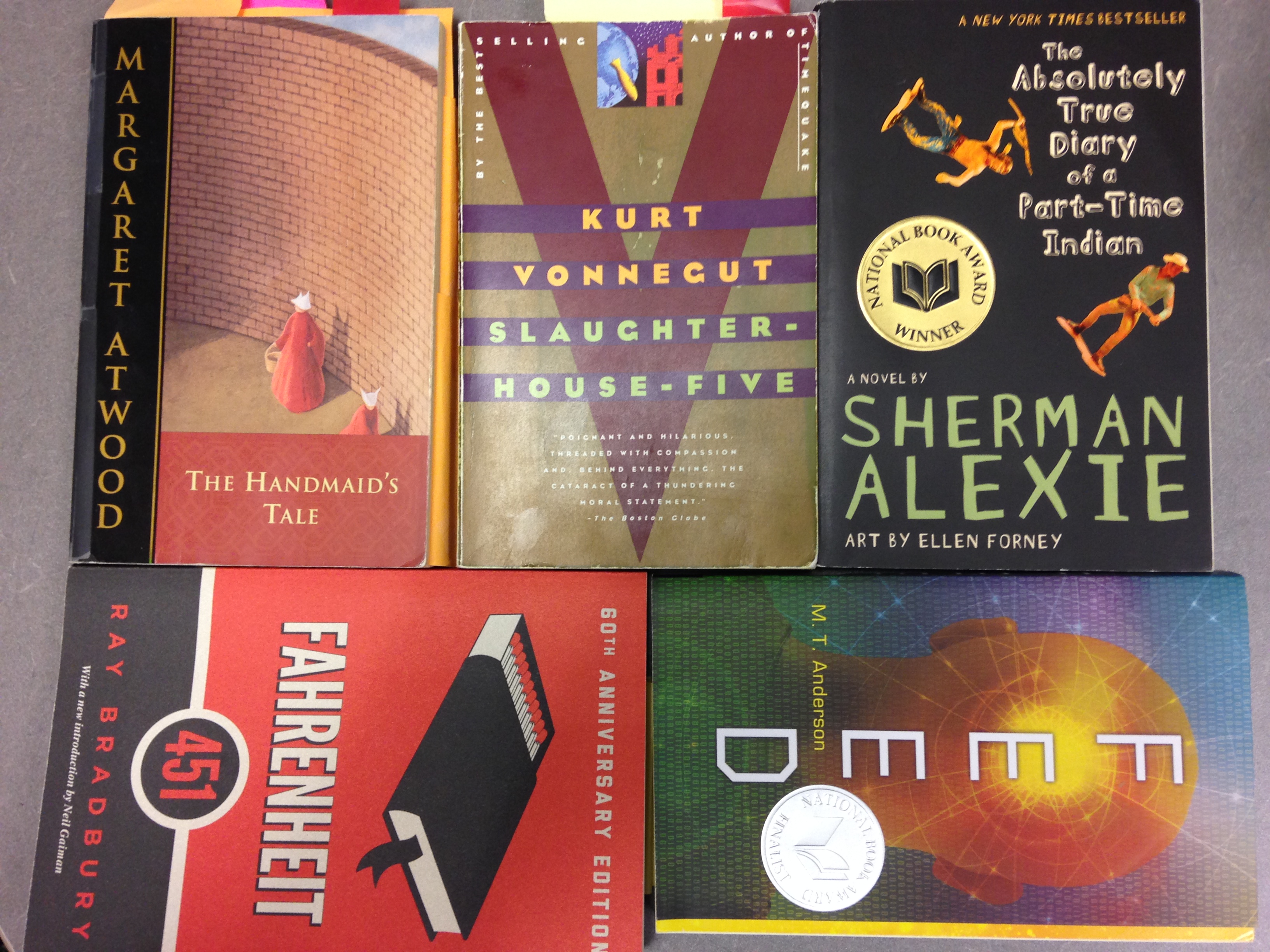
So banned in the U.S.A. remains powerful often in forms that are mostly invisible, mostly part of the norm feared by Ray Bradbury and dramatized in his Fahrenheit 451.

In the 60th anniversary edition of Fahrenheit 451, several of Bradbury’s essays (and a brilliant introduction by Neil Gaiman) are included, one of which notes: “There is more than one way to burn a book. And the world is full of people running about with lit matches” (p. 209).

Like Bradbury, Kurt Vonnegut and Sherman Alexie have confronted the power of censorship as well as the misguided desire of a free people to ban not just books, but ideas.

ban2

Vonnegut’s letter to those who sought to ban his work explains:

If you were to bother to read my books, to behave as educated persons would, you would learn that they are not sexy, and do not argue in favor of wildness of any kind. They beg that people be kinder and more responsible than they often are. It is true that some of the characters speak coarsely. That is because people speak coarsely in real life. Especially soldiers and hardworking men speak coarsely, and even our most sheltered children know that. And we all know, too, that those words really don’t damage children much. They didn’t damage us when we were young. It was evil deeds and lying that hurt us.

Alexie’s powerful Why the Best Kids Books Are Written in Blood builds to his personal defense of books:

And now I write books for teenagers because I vividly remember what it felt like to be a teen facing everyday and epic dangers. I don’t write to protect them. It’s far too late for that. I write to give them weapons–in the form of words and ideas-that will help them fight their monsters. I write in blood because I remember what it felt like to bleed.

As a lover of books, as a writer, and as a life-long teacher, I am indebted to my childhood and teenage freedom to read, to listen to, and to consider ideas other than the ones endorsed by my home, my community, and my school.

George Carlin and Richard Pryor talked about the world in ways that my parents, my peers, and my community never did; they both praised Muhammad Ali with language both profane and poetic as was fitting for their comedy and for Ali’s own bravado against an inequitable world to which he would not bend a knee—a quality admirable and shared among Ali, Carlin, and Pryor.

“A book must be the axe for the frozen sea within us,” Franz Kafka wrote in his Letter to Oskar Pollak 1904.

Books are sacred because ideas are sacred, or must be if a people truly seeks to be free. Talking about Fahrenheit 451 in 1993, Bradbury said, “You don’t have to burn books to destroy a culture. Just get people to stop reading them.”

Banning books has no place in a free society, but each time we remain passive, allowing a book to be silenced, we are “running about with lit matches.”

Preserving access to all books for all people, especially children, is at the core of our humanity because the only dangerous idea is the one not allowed.

How We Raise Our Children: On “Because” and “In Spite Of”

While I am disheartened by the cultural tolerance of all sorts of violence that remains in the U.S.—and then particularly in my home region, the South—I am deeply puzzled by a distinction between the public discussions surrounding the NFL’s twin scandals so far this season related to domestic violence and child abuse.

In the domestic violence public discourse, one refrain is prominent: “No man should ever hit a woman.” As well, although some people do support a husband’s right to hit his wife (often calling on Biblical passages, however manipulated), that perspective has been given no credible space in the controversy, and domestic violence has not be framed as a debate.

However, in the child abuse discourse, the public and media have embraced the issue as a debate, and those endorsing some appropriate use of physical punishment of children have been given space as credible perspectives.

Justification for spanking or paddling children, and the concurrent claims that those practices can be distinguished from abuse, include two dominant lines of reasoning: one is (again however manipulated) calling on Biblical scripture (“spare the rod, spoil the child”), and another is personal reflection: “I was spanked as a child and I turned out OK.”

Corporal punishment continues to be relatively common and widespread in homes across the U.S. and even legal in public schools in about 20 states, most of those in the South.

That corporal punishment is legal at all in the U.S. is a scar on a country that continues to hold itself up as exceptional, a country that invokes God and Flag as if its people have some moral authority over the rest of the world. But the two typical justifications above simply fail when unpacked.

Biblical justification for all sorts of unjustifiable acts—slavery, most notably, but racists stances as well—certainly make claims that hitting a child can be viewed as Christ-like nothing more than twisted theology.

But the common-sense personal arguments remain pervasive, despite the weight of research that leads Jessica Samakow to clarify:

However, there is overwhelming evidence that physical punishment is both ineffective and harmful to child development. Former HuffPost Senior Columnist Lisa Belkin has argued that the word “debate” should be left out of the spanking conversation, because the science against it is so clearly one-sided.

“There aren’t two sides. There is a preponderance of fact, and there are people who find it inconvenient to accept those facts,” Belkin wrote in a 2012 column.

So I want to focus for a moment on my South—where I spent my childhood in the 1960s and 1970s, followed by teaching throughout the 1980s and 1990s in my hometown. Consider for a moment my first-hand account of how children were commonly raised over those four decades, and also consider that the vast majority of these children grew up and “turned out OK”:

  • Many of us were spanked, paddled, and even beaten with belts until welts were visible on our backsides and legs. These acts of corporal punishment were also part of our school experiences—large wooden paddles, some with holes drilled in them to make the case more clear. As a student teacher in the early 1980s (and although my university would not allow us to witness or participate in corporal punishment), I was placed with a teacher who, while 6 or 7 months pregnant, would take middle schoolers out in the hall and paddle them.
  • Many of us sat in homes and cars while our parents chain smoked.
  • During my childhood years, most of us rode in cars with no seatbelts.
  • Most of us rode our bicycles for hours a day without wearing helmets.
  • And in my South, many of us who were white were raised in homes aggressively teaching us racist and homophobic beliefs, typically grounded in Biblical principles. Once while I was teaching high school English, a student wrote a persuasive essay arguing against interracial relationship. The student’s support was simply stating, “It’s in the Bible.” I refused to accept the essay on the grounds he didn’t have evidence for his claim, and after a few rounds of my stressing that if that were true, he would have to quote and cite his evidence, his father, enraged, asked for a conference. With the student, my principal, and me in the room, the father explained that he and his son had reached out to their preacher who assured them the Bible did denounce interracial relationships, but that he was unable to find the scripture.

I tuned out OK, and so did most of the children who lived these childhoods. But does it make any sense to argue for any of these practices to continue—including hitting children?

Absolutely not. And anyone who does is confusing their own nostalgia (they turned out OK because of these experiences) with the stark reality that they turned out OK in spite of these experiences.

As Jeb Lund examines, those justifying the hitting of children because they were hit are likely dealing not with the credibility of the practice, but their own demons:

The pernicious, toxic and inescapable lifelong effect of being disciplined physically – either to the point of abuse, or to the point that the distinction between acceptable and unacceptable blurs in your mind – is that you almost have to say you turned out fine, just to redeem the fact of being who you are. That you “turned out fine” is the only way to make sense of having once felt total terror or uncontrollable shaking rage at the sight of one (or both) of the two people expected to care most for you in the world. The thought that you might have ended up relatively OK or perhaps even better without all that fear is almost unbearable: the suffering only doubles if you admit that it truly had no purpose.

“My parents spanked me and I turned out OK so I support spanking” has the moral equivalence of “My parents raised me to be a racist and I turned out OK so I support raising children to be racists.”

If you use corporal punishment on your children because your parents practiced it with you, the truth is you didn’t turn out OK. You have failed to learn the lesson that often we must set aside the mistakes of those raising us in order to create a better world, especially a better world for children.