All posts by plthomasedd

P. L. Thomas, Professor of Education (Furman University, Greenville SC), taught high school English in rural South Carolina before moving to teacher education. He is a former column editor for English Journal (National Council of Teachers of English), current series editor for Critical Literacy Teaching Series: Challenging Authors and Genres (Brill), and author of Teaching Writing as Journey, Not Destination: Essays Exploring What ‘Teaching Writing’ Means (IAP, 2019) and How to End the Reading War and Serve the Literacy Needs of All Students: A Primer for Parents, Policy Makers, and People Who Care (IAP, in press). NCTE named Thomas the 2013 George Orwell Award winner. He co-edited the award-winning (Divergent Book Award for Excellence in 21st Century Literacies Research) volume Critical Media Literacy and Fake News in Post-Truth America (Brill, 2018). Follow his work @plthomasEdD and the becoming radical (https://radicalscholarship.wordpress.com/).

Ending Poverty Requires Community, Not War

Many, if not most, wars have failed to salvage victory from the inherent destruction war brings.

All wars leave collateral damage in their wake.

A big picture message offered in Michelle Alexander’s The New Jim Crow is that the war on drugs, a key part of the larger era of mass incarceration, has devastated the lives and futures of African American males in ways that are nearly incomprehensible. That collateral damage, as well, has been disproportional—accentuated by the fact that AA and whites use illegal drugs in the same percentages but AA shoulder the burden of punishment.

The era of mass incarceration and the war on drugs are evidence of the nightmare of codifying behavior as illegal as a context for punishment. Is it possible that the legalizing of marijuana in Colorado represents a move away from the “war” approach to recreational drugs—a recognition, again, almost a century after the failure of prohibition?

Laws and wars, then, define the lines between combatants and the conditions of criminality; those lines and conditions, easily shifted, determine who matters, and who does not.

As the public discourse rises about the 50th anniversary on the war on poverty, we are being asked if the war on poverty worked and if we need a new war on poverty. These are the wrong questions, especially the latter.

In my work on ignoring poverty in the U.S., I raise the possibility that contemporary political strategies surrounding poverty include the paradox of constantly mentioning and highlighting poverty in order to ignore it. Over the past decades, “poverty” is repeatedly on the lips of political leaders and in the pronouncements of the mainstream and “new” media.

Yet, childhood poverty in the U.S. continues to rise, that childhood rate remains at the bottom of international comparisons, and the gap between the top 1% and everyone else in the U.S. grows.

Has the war on poverty worked? No.

But the problem with that one-word answer is that despite abundant evidence that some social programs do alleviate poverty (prompting many to say the war on poverty has worked as an argument for more and direct social intervention), the failure is that we have been conducting a war.

Ending poverty in the U.S. requires community, not war.

If we as a people genuinely wish to end poverty, genuinely believe in equity for every human regardless of her/his coincidences of birth, we must first set aside the war approach (as we must with the war on drugs and the era of mass incarceration).

That first step must then create a spirit of community that ends what truly was occurring during the war on poverty—a war on the people trapped in poverty.

Behind the political rhetoric of the war on poverty lies a cultural myth in the U.S. that individuals are to blame for their lot—that somehow those people with the least (and sometimes no) political capital are causing the exact forces that trap them.

A commitment to community over war acknowledges, as Kristof does, basic political facts:

The best example of how government antipoverty programs can succeed involves the elderly. In 1960, about 35 percent of older Americans were poor. In 2012, 9 percent were. That’s because senior citizens vote, so politicians listened to them and buttressed programs like Social Security and Medicare.

In contrast, children are voiceless, so they are the age group most likely to be poor today. That’s a practical and moral failure.

I don’t want anybody to be poor, but, if I have to choose, I’d say it’s more of a priority to help kids than seniors. In part, that’s because when kids are deprived of opportunities, the consequences can include a lifetime of educational failure, crime and underemployment.

The war on poverty fails as long as it remains a war, and not a moral imperative among a community of people.

Ending poverty must no longer be trivialized, then, as political expediency—the consequences of creating through state and federal policy a war on poverty. That approach can become only a running tally of manufactured winners and losers.

While any are in poverty, everyone is a loser.

As we end the war on poverty as our primary approach, as we end the war on people trapped in poverty by no longer blaming them for their situations or for the broader facts of poverty and inequity, and as we commit instead to community and the moral imperative of ending poverty, we must also end the empty claim that schools primarily or alone can eradicate poverty—a jumbled message advocated within a larger commitment to “big business.”

As we confront 50 years of war waged on poverty, we must be sure to acknowledge the collateral damage—the stereotype of the welfare queen, that misrepresents people living in poverty but reflects the classism and racism tarnishing our democracy, shredding the fabric of human kindness and dignity.

As we confront 50 years of war waged on poverty, we must be sure to name and see the very real consequences of addressing poverty mainly as it impacts those with political, cultural, and economic capital; ending childhood poverty through direct social commitments, then, is an announcement that poverty and inequity are inexcusable in a free society, and not merely a partisan political talking point.

As we confront 50 years of war waged on poverty, we must admit that mass incarceration and accountability-based education reform contribute to and do not address the plight of poverty. An end to the punitive war on poverty must be joined with ending equally flawed approaches to punitive legal and educational policies.

As we confront 50 years of war waged on poverty, we must push aside the passive radical mask we use to honor a Martin Luther King Jr. facade allowing that war on poverty to exist; instead, we must champion the radical anti-war King, whose messages near the end of his life called for a direct end to poverty:

In the treatment of poverty nationally, one fact stands out: there are twice as many white poor as Negro poor in the United States. Therefore I will not dwell on the experiences of poverty that derive from racial discrimination, but will discuss the poverty that affects white and Negro alike.

Up to recently we have proceeded from a premise that poverty is a consequence of multiple evils:

  • lack of education restricting job opportunities;
  • poor housing which stultified home life and suppressed initiative;
  • fragile family relationships which distorted personality development.

The logic of this approach suggested that each of these causes be attacked one by one. Hence a housing program to transform living conditions, improved educational facilities to furnish tools for better job opportunities, and family counseling to create better personal adjustments were designed. In combination these measures were intended to remove the causes of poverty.

While none of these remedies in itself is unsound, all have a fatal disadvantage. The programs have never proceeded on a coordinated basis or at a similar rate of development.

  • Housing measures have fluctuated at the whims of legislative bodies. They have been piecemeal and pygmy.
  • Educational reforms have been even more sluggish and entangled in bureaucratic stalling and economy-dominated decisions.
  • Family assistance stagnated in neglect and then suddenly was discovered to be the central issue on the basis of hasty and superficial studies.

At no time has a total, coordinated and fully adequate program been conceived. As a consequence, fragmentary and spasmodic reforms have failed to reach down to the profoundest needs of the poor.

In addition to the absence of coordination and sufficiency, the programs of the past all have another common failing — they are indirect. Each seeks to solve poverty by first solving something else.

I am now convinced that the simplest approach will prove to be the most effective — the solution to poverty is to abolish it directly by a now widely discussed measure: the guaranteed income….

We are likely to find that the problems of housing and education, instead of preceding the elimination of poverty, will themselves be affected if poverty is first abolished. The poor transformed into purchasers will do a great deal on their own to alter housing decay. Negroes, who have a double disability, will have a greater effect on discrimination when they have the additional weapon of cash to use in their struggle.

A war on poverty is an indirect and piecemeal approach to poverty. As King implored, we need a direct plan to end poverty, requiring a new commitment to community and an end to social policies as war.

Standards Won’t Change Inequity: A Reader

The new Common Core and related tests are likely to continue a three-decade pattern of traditional schooling either integrating the new standards and tests into the existing structure of schools or using the new standards and tests to justify existing practices. And thus, I offer a reader below, highlighting a demonstrable set of interrelated problems with U.S. public schools and higher education—inequitable discipline, retention, and other school-based dynamics disproportionately impacting African American males negatively and college graduation inequity for AA male athletes:

“We often talk about solving this problem as if it’s an easy problem to solve,” said James Forman Jr., a clinical professor at Yale Law School. “Actually creating a positive school climate, particularly in schools that are in communities that are themselves not calm and orderly, is hard work.”

Mr. Forman added that because school accountability systems focus on student test scores and other academic measures, rather than on reducing suspensions, schools might not have much incentive to keep troubled students in class [emphasis added]. “Sometimes getting rid of these kids can help you do better on the metrics that you are evaluated on,” he said. “If a kid is causing trouble, that’s probably not a kid who is testing well, and it may be a kid who is making it hard for teachers to teach other kids.”

K-12 and higher education are failing African American males; high-stakes accountability based on standards and testing is unlikely to change that fact—but is likely to increase it.

Tone, pt. 4: Dystopian Fiction, Passion, and the Education Reform Debate

Two early scenes in Shaun of the Dead require viewers to understand zombie narrative tropes in order to achieve the film’s satirical intent—distinguishing Shaun of the Dead from the zombie horror films it skewers: Shaun makes nearly identical trips from his apartment to a local convenience store, the first involving a normal day and the second after the (unknown to him) zombie apocalypse.

Throughout the film, a running joke involves that humans are pretty much zombies as a modern condition; this is achieved through the zombie-like movements by the surrounding characters, even when characters are not zombies. But during the parallel scenes, Shaun does not immediately recognize the before and after (including bloody handprints and slipping on a bloody floor at the convenience store the second time) because he hasn’t yet had the possibility of zombies enter into his consciousness.

In The Walking Dead (AMC series), viewers are often manipulated by the characters’ ability (and inability) to recognize and distinguish both zombies from living humans and whether or not zombies are animated. This recognition plot element is played out in the film version of World War Z as well as Zombieland—the former, serious zombie horror and the latter, another satire in the tradition of Shaun of the Dead.

Other sub-genres, such as superhero comic book narratives, depend on the recognition plot element as well; Unbreakable examines in sort of a meta-analysis of who constitutes the hero and who constitutes the villain in superhero comic book narratives:

Elijah Price: Now that we know who you are, I know who I am. I’m not a mistake! It all makes sense! In a comic, you know how you can tell who the arch-villain’s going to be? He’s the exact opposite of the hero. And most times they’re friends, like you and me! I should’ve known way back when… You know why, David? Because of the kids. They called me Mr Glass.

Running through this recognition plot element is a message: To the uninformed, to the novice, to the unsuspecting, opposing forces (even though one may be “good” and the other, “bad”) may appear to be identical.

Dystopian Fiction, Passion, and the Education Reform Debate

Science fiction (SF), especially dystopian SF, and fantasy often work on two levels—the primary narrative serving as an imagined and metaphorical canvas allowing the author to analyze and critique the very real world. Zombie narratives are often commentaries on consumerism, for example.

Dystopian novels—such as George Orwell’s 1984 and Margaret Atwood’s The Handmaid’s Tales—provide readers a psychic distance that contributes to their being able to re-see aspects of the normal real world that are often clouded by living in those moments. Atwood explains, in “Writing Utopia” included in Writing with Intent, that she did not manufacture the atrocities in The Handmaid’s Tale, but instead weaved real-world events into one imagined narrative. Orwell’s 1984 accomplishes much the same effect.

Writers of SF and dystopian fiction realize that there appears to be something anesthetic about the news and history; therefore, they reach for the readers’ heart, souls, and minds through hyperbole.

SF writers, in fact, are often deeply passionate people, almost single-mindedly driven to expose the wrongs they render metaphor in their writing. It seems likely, as well, that their novels and films come off far less looney than when they speak directly about the causes they champion in their fiction.

Atwood’s Oryx and Crake, The Year of the Flood, and MaddAddam trilogy, I believe, remains far more socially embraced and possibly considered than when Atwood the person holds forth in public about genetically manufactured foods, climate change, or other topics quickly dismissed by the general public as looney left-wing conspiracy theories. (Barbara Kingsolver exists both as a beloved novelists and as a looney left-wing ideologue, only distinguished by her novelist persona and her speaking or writing essays as a living, breathing real person.)

And that brings me back to the education reform debate, played out primarily on social media, and the problem of tone (see my previous three posts on tone: part 1, part 2, and part 3).

The Recognition Plot Element and the Education Reform Debate

Let me start with an example.

At his Living in Dialogue blog (Education Week), Anthony Cody posted Chicago School Rations Bathroom Visits to Help Prepare for Common Core Tests—in which Cody shared a memo from a school instituting new restroom policies and linking those policies to “maximiz[ing] student learning and reduc[ing] the loss of instructional time.” The memo also explains the new policy has additional benefits:

Have students fill in the “time out” and “time in” and then turn the pass in to the teacher when finished. This will help them practice the CCS of telling time with both digital and analog clocks.

I have written an extended blog about this memo, connecting it to David Kaib’s analysis of misguided outrage—Kaib’s about outrage targeting David Brooks, the columnist, and mine about knee-jerk outrage over the restroom policy as a single incident at the exclusion of confronting  systemic and historical hierarchical structures mis-serving students.

By the time I finished that blog, Ken Libby on Twitter and Sherman Dorn commenting at Cody’s blog had challenged that the headline and blog were misleading—Dorn stating directly:

This is petty bureaucracy (even if some students abuse hall passes). There is NOTHING in this that justifies the policy based on CCSS or testing — the mention of standards towards the end is silly, but not as silly as the headline here. [1]

Unless I am completely misreading people, by the way, this disagreement among Cody, Libby, and Dorn is not among people committed to dramatically different ideologies; I suspect that all three seek very similar conditions for students, teachers, and public schools.

This is a clash over tone, a real-world cautionary tale about recognition plot elements.

A few years ago, the Common Core debate was far less complicated in that the players in the debate were fewer, the power balance was terribly skewed (toward those designing CC, mostly because few people even knew about CC), and the debate was relatively insular.

As we slide into 2014, however, CC debates are much more public, and far more players are involved. Possibly the oddest and most complicated reality of the change is that two very different camps have gained fairly high profiles refuting CC—what I have labeled Libertarian Reformers and Critical Reformers.

A Tea Party-like, libertarian (popular, not pure) voice has begun to grow among parents, the public, and far right politicians, rejecting CC as (among other things) communist propaganda written by Bill Ayers (villain), brainwashing by the Obama (villain) administration, and Big Government (villain) corrupting children in the U.S.

Critical reformers are mostly educators and scholars who challenge CC as inseparable from high-stakes testing, driving huge costs (and corporate profit) associated with new standards and tests, and instrumental in corporate takeover and privatizing of public schools—with Bill Gates, Arne Duncan, and Michelle Rhee as the “villains.”

If we pause, then, and consider the lessons of SF and dystopian fiction—to the uninformed, to the novice, to the unsuspecting, opposing forces (even though one may be “good” and the other, “bad”) may appear to be identical—the entire tone (and related “hyperbole” argument) debate now must be viewed in a new light. As Diane Ravitch has addressed, will CC challenges have unintended consequences?

To the uniformed public, foaming at the mouth about the socialist Obama is indistinguishable from foaming at the mouth about evil genius and billionaire Gates (the general public sees Mr. Burns from The Simpson, I suspect). As I have discussed time and time again, evidence is relatively inconsequential in the education reform debate—again because determining the credibility of evidence asks a great deal of an audience.

If we become perplexed about why demonstrably untrue narratives (Bill Ayers did not write the CC) exist nearly on equal footing with evidence-based challenges to CC (Gates and his funding have had a disproportionate impact on CC adoption, as well as influence over a number of education policies not supported by the research base, such as VAM and merit pay), we must confront the recognition plot element.

From a distance, or through uniformed eyes, the looney and the passionate look the same, and most people don’t have the time or inclination to get closer to make a distinction.

While I remain firm in my previous examinations of tone—raising the tone complaint tends to show that someone doesn’t wish to address the substance below the tone—and I do not discredit the possibility that hyperbole and metaphor can be accurate and effective, I now have to acknowledge that those positions mean little if my audience cannot distinguish me from Glenn Beck.

I want to end by returning to Cody’s blog post and the complaints from Libby and Dorn. In my opinion, all three are in part correct.

Many of us who embrace evidence-based challenges to CC have and do reach in our passion to make our (to us) credible case against CC; Cody’s headline may in fact do just that, reach—especially if his blog post suggests that CC is uniquely causing what Dorn accurately calls “petty bureaucracy.” As my blog post connected to Cody’s piece explains, “petty bureaucracy” reaches far back before CC—although my years teaching all fell under the current accountability era in education.

In their quest to hold CC critics accountably, Libby and Dorn, I think, also reach: “There is NOTHING in this that justifies the policy based on CCSS or testing,” complains Dorn. Nothing? Even though CC is directly mentioned in the memo?

CC is not an apocalyptic plot to devour our babies and children (although that may make a damn fine dystopian novel or film), but neither is CC some innocuous and inconsequential minor issue.

I agree with Libby and Dorn that CC did not cause that restroom policy, but I am convinced—based on about 2 decades of teaching in the first part of the accountability era—that standards and testing are routinely used to justify a whole host of detrimental policies and behaviors that constitute the status quo of much that is wrong with traditional public schooling—such as enforcing dehumanizing restroom policies for children and justifying that by claiming teaching, learning, and yes, even test scores, are sacred.

I do not pretend to speak for anyone else, nor do I hope to tell others how to conduct themselves, but I have been learning a valuable lesson over the past year, a lesson about the recognition plot element.

Yes, my passion has often made me indistinguishable from the looneys. That’s on me.

Passion, confrontation, and a style prone to metaphor, if not hyperbole (English major, of course), have clearly distinguished me from CC advocates. But at what cost, if I come off as half-cocked and rabid, no different than Beck asserting CC is a Marxist plot by Obama?

And thus, as a SF and dystopian fiction devotee, as a serious and dedicated public scholar, I have to consider the lesson before me: to the uninformed, to the novice, to the unsuspecting, opposing forces (even though one may be “good” and the other, “bad”) may appear to be identical.

[1] The exchange beneath Dorn’s initial comment is also illustrative of the recognition plot element:

MGunderson

1:28 PM on January 5, 2014

Sherman, I think what you are pointing to is that this communication memo is wrong on many levels. I have trouble with giving very young children (this is a Prek-8th grade building) incentive to NOT use the bathroom.

I believe using the principal’s CCSS justification in the headline was Mr. Cody’s way of pointing out the silliness. Are we on the same page, or have I misread your comment?

Sherman Dorn

1:55 PM on January 5, 2014

MGunderson,

It’s clear from the headline and the bold-faced intro remarks that Anthony Cody really is trying to claim that CCSS is responsible for this memo. That claim holds no water, at least by this memo.

MGunderson

2:39 PM on January 5, 2014

Ah, I take it in reverse. The principal wants to mandate something ridiculous so uses CCSS as justification for his actions. Not the other way around.

Sherman Dorn

10:11 PM on January 6, 2014

Yep, that’s how I see it.

King’s Next Shining Novel: More “True History of the Torrance Family”

Stephen King’s career reminds me of the career of Kurt Vonnegut in three ways: (1) they suffered the negative consequences of being associated with writing genre fiction, (2) they are often devalued as being too popular to be credible “literary” authors, and (3) as many popular writers are, they are often associated with one work—King with The Shining and Vonnegut with Slaughterhouse-Five. King, as well, has been further marginalized by the stigma that being prolific means a writer can’t possibly be high quality.

Doctor Sleep, Stephen King

With Doctor Sleep, then, King takes on some monumental challenges since this 2013 novel is a sequel of possibly his most treasured work, The Shining, from 1977. King confronts the task of writing a sequel, as well as the weight of the popular film adaptation, in a concluding Author’s Note:

Did I approach the book with trepidation? You better believe it. The Shining is one of those novels people always mention…when they talk about which of my books really scared the bejeezus out of them….

I like to think I’m still pretty good at what I do, but nothing can live up to the memory of a good scare, and I mean nothing, especially if administered to one who is young and impressionable….

And people change. The man who wrote Doctor Sleep is very different from the well meaning alcoholic who wrote The Shining, but both remain interested in the same thing: telling a kick-ass story. (pp. 529-530)

Like many people, I was first drawn to King’s The Shining after seeing the 1980 film adaptation made popular by Jack Nicholson’s role. While I am certain I read the novel, I also realize I tend to recall more vividly the film version (the culturally iconic “Here’s Johnny!” and “Redrum”), which King warns about in a parenthetical comment in his Author’s Note: “If you have seen the movie but not read the novel, you should note that Doctor Sleep follows the latter, which is, in my opinion, the True History of the Torrance Family.”

I should also add that I am no fan of King’s primary genres, such as horror, and have not been an avid reader of King over the years. During a couple summers in the early 2000s when I was an instructor in a regional National Writing Project institute, we assigned King’s On Writing, solidifying my argument that King remains a writing treasure as well as a writer’s writer, one who informs what we know and understand about the craft of narrative.

In 2013, I had bought several King novels, deciding once and for all to spend more time with his work because an avid reader I trust deeply is a devoted King fan, but had yet to find one that grabbed me. Then I came across Adam Roberts’s Best science fiction books of 2013, in which he praised Doctor Sleep along with Margaret Atwood’s MaddAddam.

Although not intended as a book review, I want to offer first that Doctor Sleep delivers on King’s stated goal, “telling a kick-ass story.”

Dan Torrance is a fully developed and compelling character as a haunted adult, and his new shining companion, Abra Stone, is equally engaging as a child character replicating but also expanding some of the power found in Danny as a child in The Shining. If you are looking for a novel worthy of your commitment as a “ling-distance reader,” this is more than worthy of your time and investment.

But there are two aspects of the work I want to highlight beyond a recommendation.

First, as a regular and enthusiastic beer drinker who knows the horrors of alcoholism among men on my mother’s side of the family, the most haunting aspect of the novel is the examination of alcoholism and the personal yet not idealistic dramatization of Alcoholics Anonymous. At over 500 pages in hardback, the book took several days to read and it bore into my thoughts deeply and pervasively, making me contemplative about even raising a pint of beer with a meal.

The weight and terror associated with the life of alcoholism are rendered far more frightening in this work than the vampire-like threat of the True Knot. For readers, the damage done by alcoholism is real, and the damage done to humans in its wake, including children, haunts Dan and the reader as powerfully as the apparitions expected in a King work of horror.

Many so-called types of genre fiction—such as science fiction, fantasy, and horror—incorporate social commentary through allegory. In Doctor Sleep, King does not hide his examination of alcoholism, however, beneath a metaphorical veneer; instead he pairs the twin demons of alcoholism and the supernatural—resulting in a work that may be more disturbing in the real rather than the imagined.

The second powerful aspect of the work involves the relationship between being a child and also being vulnerable because of that mere status as well as because of nearly debilitating fears that you are alone because you are different.

Much of Doctor Sleep for me is about childhood, itself a scary thing. When Dan as a struggling adult crosses paths with Abra, their shared shining creates a compelling look at how any child and all humans must come to terms with the Self, even or especially when that Self feels or is dramatically unlike social norms or what appears to be normal: “’I’m okay,’ [Abra] said. ‘Really. I’m just glad not to be alone with this inside my head’” (p. 236). You don’t have to have the shining to understand Abra’s relief.

Even as Abra finds solace in her connection with Dan—and their shared shining—she remains a victim of her own anxieties, especially as she feels compelled to hide her differences from her parents in order to protect them.

Abra also has a terrifying connection with a murdered boy—again speaking to both the fragility of being a child in a harsh adult world and the weight of isolation and bonds that are beyond any person’s control. This connection is stunning and, like the focus on alcoholism, haunts the reader:

They cut him up and licked his blood and then they did something even worse to him [emphasis in original]. In a world where something like that could happen, mooning over a boy band seemed worse than wrong. (p. 209)

Abra’s story is more than the narrative of a paranormal girl; it is the story of the collision between childhood and adulthood, and the potential of that childhood and even children being left in the wake. Again, this very real element is somehow much more terrifying than the supernatural.

King’s noting he is a different man than the one who wrote The Shining informs the big picture about Doctor Sleep since this novel of horror has a compassionate and soothing narration to it—the gift of a master storyteller—that keeps the reader somewhere between Abra’s anxiety and the eternal drift into slumber—both the daily ritual of sleep and the inevitable exit from this mortal coil.

Yes, Doctor Sleep is “a kick-ass story,” but it also much more; it will not soon leave you once you’ve returned to, or entered for the first time, the Torrance Family Album.

Capitalism, Silencing Women, Silencing Teachers

A central aspect of my blog about Classroom Teaching Experience and Whose Voice Matters highlights that the silencing of teachers is a subset of the silencing of women. That post followed my claim that teaching is an invisible profession.

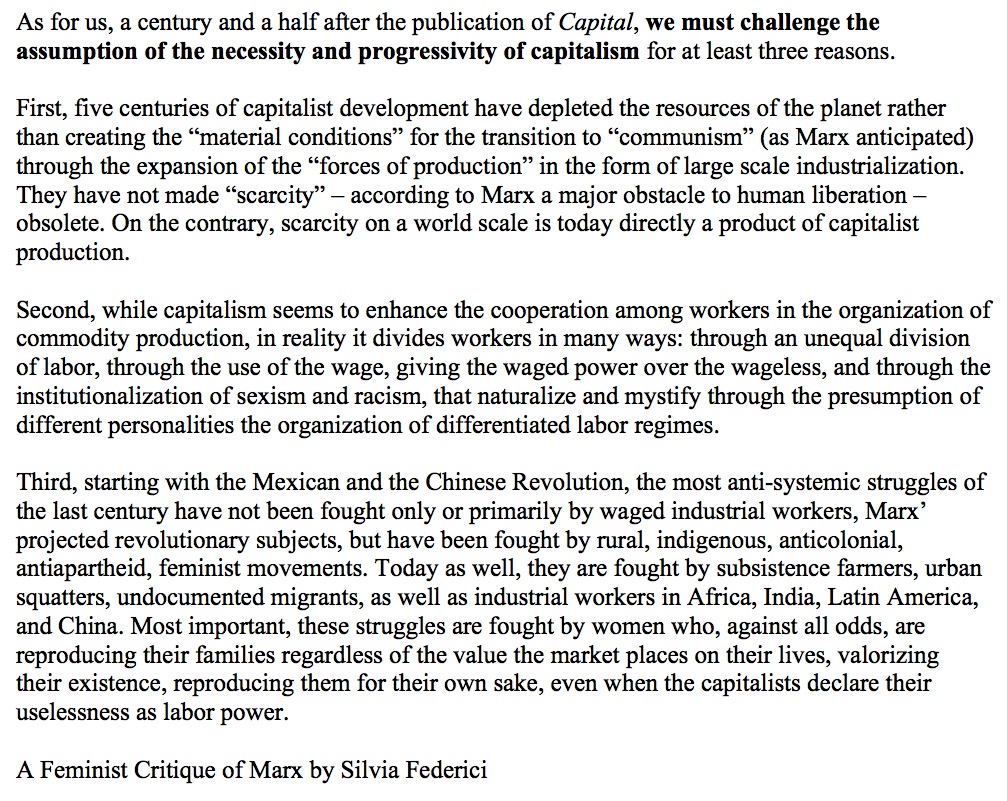
Since posting that blog, I have read A Feminist Critique of Marx by Silvia Federici, which in part asserts the invisibility of women in Marx’s analysis of capitalism:

At the center of this critique is the argument that Marx’s analysis of capitalism has been hampered by his inability to conceive of value-producing work other than in the form of commodity production and his consequent blindness to the significance of women’s unpaid reproductive work [her emphasis] in the process of capitalist accumulation. Ignoring this work has limited Marx’s understanding of the true extent of the capitalist exploitation of labor and the function of the wage in the creation of divisions within the working class, starting with the relation between women and men.

And then:

Federici

[click above to enlarge]

From the above, Federici’s first point about scarcity invites a reading of Scarcity (Sendhil Mullainathan and Eldar Shafir) as well as considering how scarcity in the lives of people trapped in poverty as a consequence of a market economy that pools wealth in a small number of people at the top impacts every aspect of their lives, including their ability to learn.

Seeking gender, race, and class equity cannot be separated from the need for wholesale workers’ solidarity—a solidarity that requires teachers to envision themselves as workers and to embrace the status of worker as a noble possibility for free people.

Trickle-Down Administration: Education Reform in a Culture of Distracting Outrage

“One of the strange things about our politics is the disconnect between what sorts of things lead us, collectively, to express outrage and what sorts of things we don’t notice,” David Kaib begins in an examination of outrage centering on a marijuana Op-Ed by David Brooks, adding:

I’m thinking specifically of how a statement can set off outrage while the background behaviors, activities or policies that the statement expresses or seeks to justify do not….

I think this dynamic is a product of two things.  First, a great deal of our politics concerns people’s motives and character, which are largely unknowable, as opposed to assessing their actions on their own terms.  So when someone says something, potentially revealing their intentions, it seems powerful.  Second, and I suspect more importantly, it’s hard to get upset about long-standing, entrenched conditions.  We do better trying to oppose some deviation from the norm, or at least, things that are understood that way.

Kaib, I think, is confronting a socio-political and popular tendency to express outrage only at outliers and mistakenly within a cult of personality—all of which offers a powerful lens for reconsidering how teachers, scholars, academics, and public school advocates can better respond to the education reform movement.

For example, Anthony Cody shared a school memo that details how a school is instituting restroom policies “[i]n order to maximize student learning and reduce the loss of instructional time”—including justifying the policies in part by connecting the restroom guidelines to Common Core standards:

Have students fill in the “time out” and “time in” and then turn the pass in to the teacher when finished. This will help them practice the CCS of telling time with both digital and analog clocks.

First, restroom policies are a nearly universal norm of traditional schooling; thus, the likelihood that this memo will spur outrage is greatly reduced, per Kaib’s point above. However, one aspect of the policy does achieve outlier status (connecting the practices to CC) so we may anticipate outrage focusing primarily if not exclusively on that—reinforcing Kaib’s central argument that the norm of institutional and hierarchical control will remain mostly unchallenged.

Now, let me illuminate this further with an anecdote from my own career as a high school teacher. While I believe the memo above is a powerful artifact of many elements found in traditional schooling worthy of our outrage, I also think we must continue to see how policies manifest themselves in the day-to-day lives of students, teachers, and administrators.

I grew up in a small and deeply conservative (read: racism, classism, and sexism were norms and thus unexamined) Southern town in rural upstate South Carolina. After attending high school in my home town and completing college fewer than thirty minutes away, I returned to my alma mater to teach high school English for 18 years.

That school had when I was a student and continued while I was a teacher incredibly rigid and authoritarian policies for student behavior and dress. Many stereotypically strict private schools paled in comparison.

Included in those school rules (by the way, students had to pass a school handbook test at the beginning of each year) were restroom policies that mandated automatic demerits for any restroom visit during class (implicit in such rules were arguments similar to the new policies in the memo shared by Cody—protecting instructional time). The school had a demerit system connected to an in-school suspension structure governing these rules.

One year, I taught a young man who was an elite student and athlete (athletes were under a double set of extremely rigid and harsh guidelines, meaning any school infractions tended to be replicated and intensified by their coaches). During class one morning, this young man stood up quietly, walked to the trash can near the door, and then vomited (almost noiselessly) in the trash can before returning to his seat.

Once I realized what had happened, I calmly told him he needed to go to the restroom. He very politely explained he couldn’t risk the demerits.

And so let me stress here that while the new restroom policy shared by Cody and the student’s behavior in my class may appear to be outlier examples within perfectly normal and reasonable in-school policies, I must contend that they are neither outliers nor reasonable.

A comment, I believe, at Cody’s blog post helps make my case. Sarah Puglisi posted this response to the restroom policy: “Said Admin will no doubt pee as needed.”

For classroom teachers, and all workers under hierarchical structures, Puglisi’s comment is a succinct and powerful point. Let me return to my student who felt compelled to vomit in my trash can and remain in class to avoid the automatic (and I’d add “no excuses” and zero tolerance) punishment he was to receive for a situation beyond his control: The principal who sat as the personification of authority over this policy chain had his own bathroom in his office.

In the context of Kaib’s examination of distracting outrage and Cody’s exposing new restroom policies connected with CC, I want to stress several important points related to the central threads of the education reform debate:

  • We must be willing to highlight and then confront the norms of traditional schooling within which education reforms are being implemented. To continue to argue that CC is separate from high-stakes testing or simply a matter of implementation fails to acknowledge the growing evidence that adopting new standards and requiring different tests have never changed and continue not to disrupt many powerful ways in which schools function. The restroom memo is not an outlier; it is yet another artifact of how normal practices and new policies do not disrupt each other but inform and maintain the status quo.
  • Beware the hypocrisy of authoritarian and hierarchical structures, particularly as they include children. I think it is no exaggeration to compare how adults are allowed a different level of dignity in their restroom needs compared to the restrictions controlling the children under those adults’ care with the lack of accountability experienced by those imposing intensifying accountability mandates on schools, teachers, and students. The norm of accountability being inversely proportional to the hierarchical chain must be confronted in the education reform debate—not as a series of disconnected moments of outrage, but as a measured recognition that this norm is dehumanizing and incompatible with democratic ideals.
  • We must elevate the voices of teachers and students as we consider the claims and policies promoted by a social and political structure that is driven by leadership without public school teaching experience—not simply because that leadership lacks that experience but because the claims and policies are contradicted by the real world of teaching and learning.
  • We cannot afford to address social and educational issues as unrelated. Race, class, and gender inequity exists in society and is replicated in traditional schooling (for example, school discipline inequity as that mirrors the continuing era of mass incarceration). Our outrage must be at systemic policies and practices, and not diluted by targeted outrage at isolated events only, allowing an outlier mentality to suggest racism, classism, and sexism no longer exist, or can be easily overcome by in-school-only reform.

A pattern of education crisis and outrage has characterized the education reform debate for nearly 150 years. The result has been that education reform looks like the conditions of an overcrowded Emergency Room. While ERs often achieve laudable outcomes under stressful conditions, medicine is certainly better administered within a preventative care model.

The conditions of an ER are likely beyond our control to eradicate; people will continue to experience traumatic injury.

Our schools, however, need not be ERs. If we are willing to step back from crisis/outrage and then change the larger norms that tend to go unnoticed, starting with norms that are dehumanizing, as Kaib explains, we can reform our schools in ways that respect the basic dignity of children as well as honoring larger social commitments.

Civil Rights Issue of Our Time?

While the credibility of challenges leveled at the current education reform agenda—such as commitments to Common Core or the rise of “no excuses” charter schools—is often called into question throughout social and mainstream media, I see little to no questioning of political mantras of education crisis, utopian expectations for schools, and the consistent refrain of education reform being the civil rights issue of our time.

In fact, even reports coming from the USDOE show that if education reform is the civil rights issue of our time, the policies are certainly not doing what is needed to combat the demonstrable failures of the public school system.

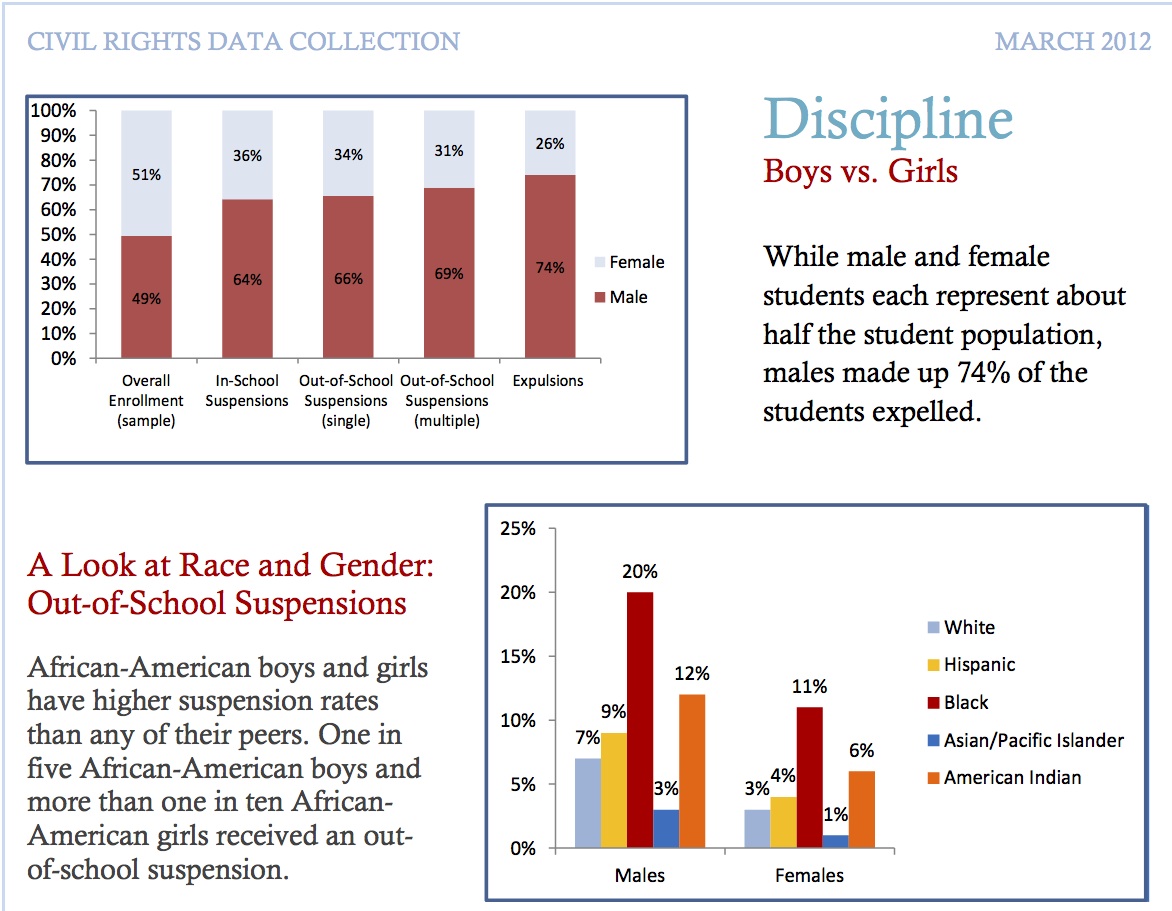
Problem #1: Discipline in schools remains incredibly inequitable by race:

Disparate Discipline Rates and Arrests and Referrals to Law Enforcement

[click to enlarge]

Problem #2: Discipline in schools is inequitable by gender, complicating inequity by race:

Discipline Boys vs. Girls and A Look at Race and Gender: Out-of-School Suspensions

[click to enlarge]

Problem #3: Access to advanced courses and retention rates are inequitable by race:

GandT.suspension
Access to Gifted and Talented Education (GATE) Programs and Retention Rates

[click to enlarge]

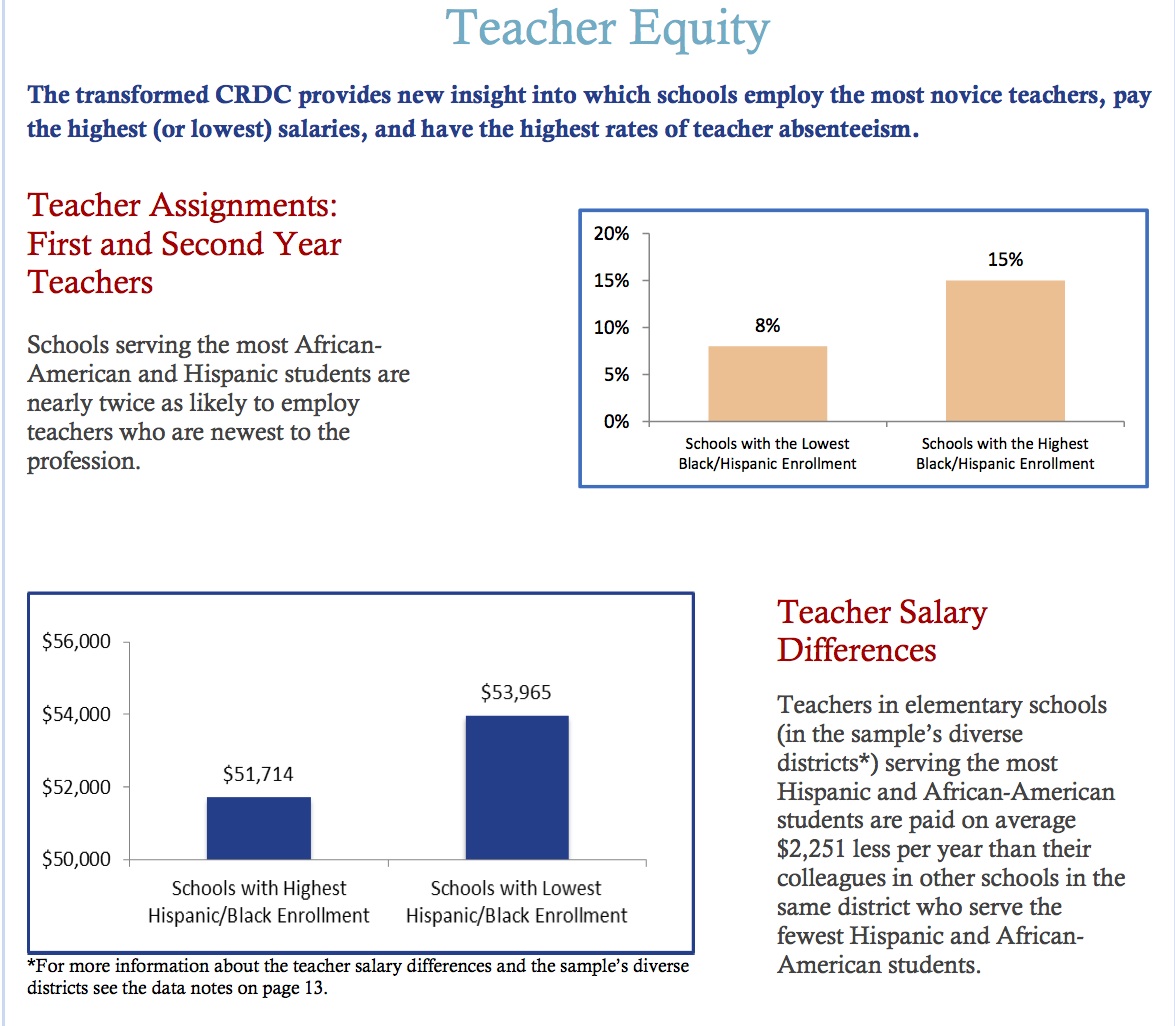
Problem #4: Teacher assignment and compensation are inequitable by race:

Teacher Assignments: First and Second Year Teachers and Teacher Salary Differences

[click to enlarge]

Problem #5: School discipline policies such as zero tolerance policies are racially inequitable and parallel to the current era of mass incarceration disproportionately impacting African American males:

There is abundant evidence that zero tolerance policies disproportionately affect youth of color. Nationally, black and Latino students are suspended and expelled at much higher rates than white students. Among middle school students, black youth are suspended nearly four times more often than white youth, and Latino youth are roughly twice as likely to be suspended or expelled than white youth. And because boys are twice as likely as girls to receive these punishments, the proportion of black and Latino boys who are suspended or expelled is especially large.  Nationally, nearly a third (31 percent) of black boys in middle school were suspended at least once during the 2009–10 school year. Part of this dynamic is that under-resourced urban schools with higher populations of black and Latino students are generally more likely to respond harshly to misbehavior. (p. 3)

As I have stated before, if education reform is the civil rights issue of our time, federal and state reform agendas would end zero tolerance policies, eradicate “no excuses” ideologies, and stop retention practices—as well as address the measurable inequities by race, class, and gender marring public schools in the U.S.

Conditions of Teaching Are Conditions of Learning: On Students

I’m not prone to New Year’s resolutions, but I have decided that with the arbitrary designation of a new calendar year, I have a way to focus on new commitments, specifically in how I interact in the virtual world. So when I read a derogatory comment on one of my blog posts (describing my post with “stupidest” and then making a word choice error or typo), I resisted the urge to comment, but posted how painful it was not to do so on Facebook.

Many of my wonderful former students commented, leading to two threads and many comments that genuinely made my day and evening—justifying my decision not to interact with the person leaving the comment.

From that exchange, I wrote Classroom Teaching Experience and Whose Voice Matters because I began to think about my 18 years teaching high school English as well as how I both failed my students and served them well (by the way, my former students tend to be stunningly kind and recall our days and years together with a fondness that makes my heart enlarge like the final scene of How the Grinch Stole Christmas).

The reason my exchange with former students spurred a blog about teacher autonomy and classroom experience is that, upon reflection, I believe when I was at my best as a high school teacher, I was functioning at an autonomous level—doing what I knew to be best for what any one of my students needed (especially when that meant listening to them while they struggled under the weight of crying about a boyfriend or girlfriend)—and when I was at my worst, I was complying with mandates I felt were at least misguided.

So as I blogged about the need for listening to teachers’ voices, for honoring classroom experiences not solely but initially, I was making a case about the conditions of teaching—a case that I failed to connect to the conditions of learning and how teacher autonomy is inextricable from student autonomy.

While I remain, frankly, stunned at the antagonism expressed when I call for teacher autonomy and voice, I am equally dismayed that we tend to render both teachers and students essentially invisible and mute.

Two comments on pieces of mine, then, need to be highlighted.

On my teacher invisibility post included at The Answer Sheet, StudentsLast added: “If teachers are invisible to policy makers, what then are students? Non-existent?”

To which I must respond, yes.

And responding to Classroom Teaching Experience and Whose Voice Matters, Martha Kennedy highlighted:

Something I have never seen brought into this conversation is the fact that many people look at teachers through the lens of their own experience in school. I don’t think most people liked school. Judging from my university students, the teacher is viewed as an adversary, classes are obstacles, it’s all just “hoops to jump.” I think as long as this is true, teachers will have a hard time with “the public.” There’s also the fallacy that if a kid hasn’t learned, the teacher hasn’t taught. Judging from my students, many don’t even really understand WHAT the teacher is teaching. This is a larger problem since the advent of NCLB where students are taught to pass exams. Students are conditioned to find a discrete answer to every question. This pretty much steals from questions their intrinsic interest.

The first point above is extremely important: How often are the actions of teachers inculcating in students negative associations with not only school but also teachers? How often are those actions the result of misguided mandates imposed on those teachers? How might all teachers embrace their autonomy so as to avoid these conditions in the classroom?

So as I return to my blog post about honoring teacher voice and classroom experience, I must emphasize that calling for a reconsideration of how we view teachers, how we honor (or don’t) teacher autonomy, and whose voice matters, I must stress that the conditions of teaching are the conditions of learning.

And how teachers feel as well as how students feel about those conditions matters in ways that must not be ignored, must not be marginalized against a normalized rational view of the world.

As we become more and more entrenched in “an age of infinite examination” where teachers and students are “never finished with anything,” we must begin to ask new questions and then seek different answers. And as we seek ways in which teachers and workers can embrace a new solidarity, let’s not forget our solidarity with the students in our care.