
All posts by plthomasedd
Political Cowardice Is Political Courage – @ THE CHALK FACE
Teacher Quality, Wiggins and Hattie: More Doing the Wrong Things the Right Ways
Update
The career of John Hattie: Plagiarism, misconduct, and the coarsening of education, Stephen Vainker
In a blog titled “To my critics” as a follow up to his critique of Diane Ravitch’s Reign of Errors, Grant Wiggins seeks to clarify his central arguments:
My point was merely to ask those who speak only of forces outside of our immediate control as educators to attend to what is not only in our control but can make a big difference….
Teachers and schools make a difference, a significant one. And we are better off improving teaching, learning, and schooling than anything else as educators because that’s what is in our control. Am I denying or tolerating poverty? Of course not. I decry the increased poverty and wealth inequality in this country. I vote democratic and give to liberal causes such as MoveOn and SPLC. I agree with Diane that there are nasty people and groups trying to subvert public education for their own ideologies and gain.
In this blog post, Wiggins returns to citing and praising the work of New Zealand scholar John Hattie. Wiggins has endorsed Hattie’s work in earlier blogs, such as:
I have been a fan of John Hattie’s work ever since I encountered Visible Learning. Hattie has done the most exhaustive meta-analysis in education. Thanks to him, we can gauge not only the relative effectiveness of almost every educational intervention under the sun but we can compare these interventions on an absolute scale of effect size.
I came to this debate and the connection between Wiggins and Hattie during a Twitter exchange with Wiggins. And as Twitter discussions go, I think we started off contentious, but eventually reached a genuine exchange; however, I could not fully or adequately explore what needs to be explored on Twitter so I began to research Hattie, and I want to place this recent exchange with Wiggins in a much larger context, one that includes the apparently growing interest in Hattie’s work.
My short and opening point is this: If in-school factors, notably teacher quality, are in fact the most pressing issues in education reform, and if in-school factors are the only things within our control, and if we are committed to accountability based on standards and high-stake testing as the only reform paradigm, then Wiggins (and maybe Hattie) would be credible.
Ultimately, however, Wiggins and Hattie represent even more doing the wrong things the right ways.
While I share the frustration expressed by Jersey Jazzman about the implied and direct claims Wiggins makes about teachers—in our Twitter exchange Wiggins was comfortable stating that many or most teachers use poverty as an excuse because he “hears it all the time”—and I also have grown tired of education reform punditry that seems imbalanced toward teacher bashing and marginalizing further the teaching profession, I want to focus on the limitations of in-school only reform and measuring teacher quality, and then highlight that the teacher quality debate fails for the same reason the push for Common Core fails (the real-world implementation has always failed, and it will fail this time also).
Now, let me go back to my first encounter with Wiggins, which was his co-authored Understanding by Design. As part of the process for my adding gifted and talented to my teaching credentials, I took a seminar that used Understanding.
Like many educators, I found the backward design model compelling at first. The best aspects of Wiggins and McTighe’s work, I think, are their criticisms of traditional practices:
- Traditional approaches to teaching focused on objectives and teachers often were careless about matching their assessments to those objectives. In short, Wiggins and McTighe made a valid case that teaching was too often disjointed among objectives, classroom practices, and assessment.
- The best point about traditional practices offered by Wiggins and McTighe was confronting that testing in many classes was essentially a “gotcha” experience for students. Students were left, they argued, either partially or completely blind to what was being asked of them.
I shared then and do now hold serious concerns about traditional pedagogy and assessment. In fact, I have been my entire career a strong advocate for systemic educational reform. I think we have failed and continue to fail the promise of universal public education as a foundational institution among a free people.
And there is the problem.
Wiggins and McTighe’s solutions—backward design, sharing detailed rubrics with students, etc.—are certainly the right way to do teacher-centered, standards-driven education based on measurable outcomes.
But teacher-centered, standards-driven education based on measurable outcomes is the wrong paradigm for democratic and liberatory education; thus, embracing understanding by design is simply doing the wrong things the right ways.
When schools have failed and when they do fail, they are teacher- and content-centered. The entire accountability era has intensified the very worst of education, and while the best way to do accountability education based on standards and testing is something like what Wiggins and McTighe offer, this commitment fails to step back even further and recognize what Ravitch and Wiggins’s critics are acknowledging: U.S. society and schools are plagued with inequity, and in order to overcome the negative consequences of inequity (one of which is low achievement by some students), social and school reform must address directly that inequity.
To put it in simple and direct terms: A powerful and identifiable problem in schools is inequitable access to certified and experienced teachers; instead of focusing on measuring, ranking, and rewarding teachers based on test scores (all shown in research to cause more harm than good), we should first address that students with the most need (high-poverty students, English language learners, special needs students, minority students) have equitable access to experienced and certified teachers as affluent and white students do.
Wiggins has positioned himself on some tenuous ground with claims that many or most teachers use poverty as an excuse, that outlier data somehow show what should be normal, and that Hattie’s research is justification for his positions. But the larger problem here is that Wiggins and the entire education reform movement over the past thirty years are trapped in a flawed solution model for a discounted set of problems.
Next, even if we conceded that we want to do the wrong things the right ways, Wiggins and Hattie represent the exact problem with Common Core: Once these grand ideas are implemented—and that implementation is guaranteed to be a failure—the good intentions do not matter.
For example understanding by design has become an industry for ASCD:
Thousands of educators across the country use the Understanding by Design framework, created by Grant Wiggins and Jay McTighe, to get a handle on standards, align programs to assessments, and guide teachers in implementing a standards-based curriculum that leads to student understanding and achievement.
Harvey Daniels’s experience with the commodification of literature circles and best practice is a representative cautionary tale about the negative consequences of reducing pedagogy and educational research to programs, consultation workshops, and how-to guides. Daniels, speaking at a state English teachers’ convention, explained that the terms “literature circles” and “best practices” can be found splattered across books and on web sites to such an extent that the original intent of both has been lost.
And here is the crux of the problem with Hattie as well as Wiggins endorsing Hattie.
Wiggins and Hattie share the charge that in-school reform is the only thing in the control of teachers, but they also share central roles of influence —direct and indirect—in the education reform bureaucracy and industry.
Hattie’s influence in New Zealand, in fact, prompted this:
The political and media stir caused by professor John Hattie’s research on student achievement has prompted a group of academics to look closely at his work.
The authors were particularly concerned that politicians might use Hattie’s work to justify ill-informed policy decisions.
Hattie’s work [1] is poised to support in NZ and the U.S. increasing class size and implementing merit pay, for example—both of which are not supported by large bodies of research.
Wiggins and Hattie are trapped, then, in the measurable and the visible—paralyzed by a world in which we focus on control.
As Neil Gaiman has stated, however, “The world doesn’t have to be like this. Things can be different.”
Ultimately, Wiggins and Hattie are offering the right ways to do the wrong things, again. Just as Common Core and new high-stakes testing are digging a failed accountability hole that much deeper.
We can do better.
Part of better, then, is yet more moratoriums.
We need moratoriums on educational research, educational consultation, and educational materials—as well as an end to our fetish with testing and measurement.
If these moratoriums seem extreme, let me point out a couple things:
- In 1947, Lou LaBrant wrote: “A brief consideration will indicate reasons for the considerable gap between the research currently available and the utilization of that research in school programs and methods.”
- The exact same fact exists today: Every major element of the education reform movement is either not supported by research or is directly refuted by research.
We currently have ample evidence about the problems in education (and society) and we have ample evidence of how to address those problems.
Spending millions and even billions of dollars on more measures of teacher quality and student achievement is an inexcusable waste of time and money.
Inexcusable.
Poverty as one of the most profound aspects of scarcity cripples human capacities. As Mullainathan and Shafir detail, scarcity drains anyone’s bandwidth (mental capacty): “Scarcity captures the mind”:
Scarcity is more than just the displeasure of having very little. It changes how we think. It imposes itself on our minds….
Being poor, for example, reduces a person’s cognitive capacity more than going one full night without sleep. It is not that the poor have less bandwidth as individuals. Rather, it is that the experience of poverty reduces anyone’s bandwidth…
One cannot take a vacation from poverty. Simply deciding not to be poor—even for a bit—is never an option….
Our data suggest causality runs at least as strongly in the other direction: that poverty—the scarcity mindset—causes failure. (pp. 7, 13, 148, 155)
To place this research on scarcity/poverty in the context of in-school only reform:
Children cannot take a vacation from poverty during the school day. Simply deciding poverty is beyond our control during the school day is a myopic option for failure.
Claiming poverty lies beyond our control is simply false. The Joseph Rowntree Foundation has evidence that ending money scarcity will eliminate poverty and by doing so academic improvement follows:
The impact of increases in income on cognitive development appears roughly comparable with that of spending similar amounts on school [emphasis added] or early education programmes. Increasing household income could substantially reduce differences in schooling outcomes, while also improving wider aspects of children’s well-being.
If we want better teachers and higher student achievement, let’s, then, stop wasting money on the unsupported array of in-school only, teacher-centered, standards-and-testing driven reforms, and directly address poverty in children’s lives and inequity in their schools.
Continuing down the path Wiggins and Hattie advocate, we remain mired in doing the wrong things the right ways. Let’s take a better path.
[1] See the following reviews and critiques of Hattie’s work:
- Horizons, whirlpools, Sartrean secrets, John Hattie and other symptons of the continuing education tragedy
- Exchange between Hattie and Arne Kare Topphol (Associate Professor, University College of Volda) about Visible Learning
- Critic and Conscience of Society: A Reply to John Hattie, New Zealand Journal of Educational Studies, 45(2) (2010)
- Invisible Learnings? A Commentary on John Hattie’s book: Visible Learning: A synthesis of over 800 meta-analyses relating to achievement. Note from the abstract: “They claim that the research in the book is limited to one area of schooling and may not be applicable to ordinary teachers.” (See here)
- Has John Hattie really found the holy grail of research on teaching? An extended review of Visible Learning, Journal of Curriculum Studies, 43(3), 425-438.
- John Hattie admits that half of the Statistics in Visible Learning are wrong
- Half of the Statistics in Visible Learning are wrong (Part 2)
- Book Review: Visible Learning
- Can we trust educational research? (“Visible Learning”: Problems with the evidence)
- ‘The Cult of Hattie’: ‘willful blindness’?
- Seven reasons to question the hegemony of Visible Learning
- Visible Learning (blog)

On Children and Kindness: A Principled Rejection of “No Excuses”
In matters of style, swim with the current; in matters of principle, stand like a rock.
—Thomas Jefferson
The Furman University spring commencement in 2008 was mostly overshadowed by two events—the speech presented by President George W. Bush and the protest and controversy surrounding that speech in the weeks leading up to and during the speech.
A concurrent controversy to Bush’s commencement address centered on the large number of faculty at the center of the protest, a protest named “We Object.” South Carolina is a traditional and deeply conservative state, and Furman tends to have a distinct contrast between the relatively conservative student body and the moderate/leaning left faculty. The Bush protest of 2008 exaggerated that divide—notably in the reaction of the Conservative Students for a Better Tomorrow (CSTB) organization and an Op-Ed in The Greenville News by two Furman professors opposing the protesting faculty.
The conservative faculty view expressed in the Op-Ed is important because it characterized the protesting faculty as post-modern, the implication being that protesting faculty held liberal/left views that were grounded in relativism (a common use of “post-modern” in public discourse). In other words, the implication was that protesting faculty were motivated by an absence of principle, or at least only relative principle.
The irony here is that the protesting faculty (among whom I was one, despite my having not yet achieved tenure) tended to reject both the post-modern label and post-modernism; in fact, our protests were deeply principled.
Having been born and raised in SC and having now lived my entire life and taught for over thirty years in my home state, I am an anomaly in both my broad ideology (I lean Marxist—although it is more complicated than that) and my principles (I am deeply principled in ways that contrast with the dogma and tradition of my treasured South).
My focal point during the Bush debate and protest (my name was frequently in news accounts and in rebuttals from CSTB) was an exaggerated but representative example of the tension that my ideology and principles create in my daily work at Furman, particularly in the classroom.
For example, I often teach an introductory education course, and one topic we address in that course very much parallels the more publicized conflicts surrounding Bush’s appearance at the 2008 graduation—corporal punishment.
When the topic comes up, students tend to support corporal punishment, reflecting the general embracing of the practice throughout the South. Many students are quick to qualify their support for corporal punishment with the “spare the rod, spoil the child” justification of their Christian faith.
I often explain to my students that I was spanked as a child in the 1960s, but that I had not spanked my daughter (who often announced to her friends that I didn’t spank, including a story of the one time I did when she ran away from us in the mall as a small child). I then add that a considerable body of research [1] has shown that corporal punishment has overwhelming negative consequences and only one so-called positive outcome (immediate compliance).
My principled stance against corporal punishment creates noticeable tension with students’ dogmatic faith in corporal punishment. This same dynamic occurs when I confront the public and political support for grade retention, which I regularly refute—again based on a substantial body of evidence (which parallels in many ways the research on corporal punishment in that both practices have some quick and apparently positive outcomes but many long-term negative consequences).
As the Jefferson quote implores, in my positions on corporal punishment and grade retention, I stand like a rock.
And this helps explain my principled stance rejecting “no excuses” ideologies and practices as well as deficit views of children, race, and class.
Some Issues Beyond Debate
Three ideologies are powerful and foundational in both traditional educational practices and recent education reform agendas over the past thirty years—paternalism, “no excuses” ideology, and deficit perspectives (of children and impoverished people).
Traditional schooling is typified by behaviorism: in the grading, in the classroom management. Punishing and rewarding are types of paternalism and are justified by the belief that children are lacking something that some authority must provide.
Ironically, education reform committed to accountability driven by standards and high-stakes testing is really no reform at all since many of the reform policies are simply exaggerated versions of traditional practices—both of which are grounded in paternalism, “no excuses” ideology, and deficit perspectives.
“No excuses” practices (represented by KIPP charter schools, but certainly not exclusive to that chain or charter schools since the ideology permeates almost all schooling to some degree) match social norms in the U.S., and in fact, aren’t very controversial. Yet, since “no excuses” policies are part of the dominant reform agenda, advocates feel compelled to justify those policies and practices.
To be honest, critics of “no excuses” ideology are in the minority and tend to be powerless. Nonetheless, Alexandra Boyd, Robert Maranto and Caleb Rose have published an article in Education Next designed to refute “no excuses” critics and to justify KIPP charters narrowly and “no excuses” ideology more broadly.
While I will not elaborate here on this, advocates of deficit-based strategies aimed at children in poverty and popularized by Ruby Payne tend to make parallel arguments as those endorsing “no excuses” schools and practices.
Corporal punishment, grade retention, paternalism, “no excuses” ideologies, and deficit perspectives of children, class, and race—all of these ideologies and concurrent practices conform to social norms of the U.S. (politicians and the public support them overwhelmingly) and tend to be discredited by large and robust research bases. All of these ideologies and practices also produce the appearance of effectiveness in the short term but create many long-term negative outcomes.
Paternalism, “no excuses” ideologies, and deficit perspectives reflect and perpetuate racism, classism, and sexism—even though many of the people who are and would be negatively impacted by these beliefs are often actively participating in and supporting institutions, policies, and practices driven by all three.
History has revealed numerous examples of people in reduced circumstances behaving in ways that were counter to their and other people’s freedom and equity. Margaret Atwood’s The Handmaid’s Tale remains to me one of the best literary cautionary tales of that disturbing and complicated reality; Atwood dramatizes the historical reality of women contributing to the oppression of women. As a powerful work of scholarship, Michelle Alexander’s The New Jim Crow details well that a culture of mass incarceration (an era paralleling the accountability era in education) has reduced the lives of many minorities living in poverty to the point that they appear to support practices that, in fact, as Alexander describes, constitute the new Jim Crow—as I have explained while connecting mass incarceration with education reform:
This last point – that African Americans seem to support both the war on crime and “no excuses” charter schools – presents the most problematic aspect of charges that mass incarceration and education reform are ultimately racist, significant contributions to the New Jim Crow.
For example, Carr reports that African American parents not only choose “no excuses” charter schools in New Orleans, but also actively cheer and encourage the authoritarian policies voiced by the schools’ administrators. But Alexander states, “Given the dilemma facing poor black communities, it is inaccurate to say that black people ‘support’ mass incarceration or ‘get-tough’ policies” because “if the only choice that is offered blacks is rampant crime or more prisons, the predictable (and understandable) answer will be ‘more prisons’” (p. 210).
New Orleans serves as a stark example of how this dynamic works in education reform: Given the choice between segregated, underfunded and deteriorating public schools and “no excuses” charters – and not the choice of the school environments and offerings found in many elite private schools – the predictable answer is “no excuses” charters.
And all of this, I suppose, may have been more than many people wanted to read for me to reach my big point, which is this:
There is no evidence that will convince me to reverse my stance against “no excuses” practices.
There is no evidence that will convince me to reverse my stance against deficit perspectives.
There is no evidence that will convince me to reverse my stance against paternalism.
There is no evidence that will convince me to reverse my stance against corporal punishment.
There is no evidence that will convince me to reverse my stance against grade retention.
Period.
Especially when it concerns children, the ends can never justify the means so I couldn’t care less about test scores at KIPP schools.
Can we debate these? Sure, but if you want to debate me in order to change my mind, you would be wasting your time.
I am approaching 53, and I remain a work in progress. There is much I do not know, and there remains much that I am deeply conflicted about. But there is one thing that I know deep into my bones—children are wonderful and precious.
Children are wonderful and precious and there isn’t a damned thing you can show me or argue that can justify anything that is unkind to a child.
Not one damn thing.
For the adults who disagree with me and believe I am wrong or fool-headed, I love you too. But if you force me to choose, you lose.
Few things fill me with confidence in my principles like the novels of Kurt Vonnegut. Vonnegut and I see the same world, have the same regrets about that would, but also share the same idealistic hope. In the beginning of his Slaughterhouse-Five, Vonnegut blends confessional memoir with his fiction as he explains how the novel came to have the full title Slaughterhouse-Five, or The Children’s Crusade: A Duty-Dance with Death.
While visiting a fellow veteran of WWII and his friend Bernard V. O’Hare, Vonnegut is confronted by O’Hare’s wife Mary, who is angry about Vonnegut’s considering writing a novel about his experience at the firebombing of Dresden:
“You were just babies then!” [Mary] said.
“What?” I said.
“You were just babies in the war—like the ones upstairs!”
I nodded that this was true. We had been foolish virgins in the war, right at the end of childhood. (p. 14)
And from this Vonnegut promised Mary not to glorify war and to add the extended title.
There is something sacred about childhood, about innocence. Something sacred that deserves and should inspire all humans toward kindness.
I see little evidence we are inspired, but I remain committed to the possibility of the kindness school—and even a kind society populated by kind people.
Nothing there to debate.
For Further Reading
anyone lived in a pretty how town, e. e. cummings
[1] See Is Corporal Punishment an Effective Means of Discipline? (APA); and Spanking and Child Development Across the First Decade of Life.
When a “Visit” Trumps Expertise and Experience: A New Deal
I have already addressed the distortions and outright misinformation in a new piece on Knowledge Is Power Program (KIPP) charter schools. But a few issues raised in this claim of a “softer” side to “no excuses” practices need to be addressed more fully.
I have discovered that “no excuses” advocates now routinely push any critic about whether or not the critic has visited a KIPP school; note this paragraph early in the Education Next piece:
Also not surprisingly, KIPP and other No Excuses schools have no shortage of critics. Furman University education professor P. L. Thomas, who admitted in a recent speech at the University of Arkansas to never having been in a No Excuses charter school, complains in a widely referenced 2012 Daily Kos post that in such schools, “Students are required to use complete sentences at all times, and call female teachers ‘Miss’—with the threat of disciplinary action taken if students fail to comply.” Regarding KIPP in particular, Cambridge College professor and blogger Jim Horn, who admits to having never been inside a KIPP school, nonetheless has referred to KIPP as a “New Age eugenics intervention at best,” destroying students’ cultures, and a “concentration camp” at worst.
Horn and I are immediately marginalized because of the claims that we have never visited a KIPP school (for the record, I responded to a question about whether I have visited an Arkansas KIPP school, which I have not).
The push on the need to visit KIPP schools has raised two issues for me.
First, there are now abundant publications offering detailed evidence from many different people who have visited KIPP schools: Sarah Carr’s excellent Hope Agains Hope, Gary Rubinstein’s series on his visits, and Russ Walsh’s blog post, just to note a few.
Visiting a KIPP or “no excuses” school, it seems, doesn’t really change anything for those of us who hold foundational stances that reject the central ideology of “no excuses” practices. I reject authoritarianism regardless of the type of school in which it is practiced, and I abhor deficit perspectives, again regardless of the school type.
Whether I visit a school or rely on my analysis of other people’s details or data from “no excuses” schools, I am quite capable of drawing valid and evidence-based conclusions. And, frankly, I don’t have to ever set a foot in an actual school.
My best proof of this is the Education Next piece itself. While the authors believe they are discrediting the concerns of “no excuses” critics, the piece reinforces my central reasons for rejecting the policies, including the disturbing picture of three students participating in “Stereotypical Geek Day.” The picture itself feels exploitive and the activity, ridiculous.
That “no excuses” start out strict and ease off doesn’t excuse the abusive nature of the practices. And the larger concerns I have are not addressed at all: that minority and high-poverty students are disproportionately served and segregated from privileged and white students, that students wear uniforms, that “no excuses” schools tend to be selective and create a great deal of attrition, that KIPP schools are prone to hire Teach for America recruits (inexperienced and uncertified teachers for minority and impoverished students).
I remain opposed to all charter schools, not just “no excuses” charter schools, as well, and I reject any form of school choice.
Nothing in the Education Next article addresses that “other people’s children” are being served and treated in ways that affluent children are not; and that is my biggest complaint.
All children should have access to the sorts of schools and policies that affluent children enjoy. Period.
Second, however, is the more urgent issue I see with the insistence that “no excuses” critics visit “no excuses” schools: “no excuses” advocates and education reformers are overwhelmingly people who have never taught in public schools.
Is the new reformer message that visiting a school trumps having actually taught in a school?
If so, I propose a compromise:
No one can criticize a “no excuses” school unless she/he has visited the school and no one can lead education reform unless she/he has taught in public school.
“No excuses” advocates and reformers, deal?
Methinks KIPP Advocates Protest Too Much
Methinks KIPP Advocates Protest Too Much
The U.S. Formula for Children and the Choices We Refuse to Make
The formula for children in the U.S. can be summed up in one word, I think: “harsh.” And the response we should have to this formula is “inexcusable.”
Let’s consider the U.S. formula for children:
- Corporal punishment—persists in 19 states in the U.S.
- Medication—ADHD diagnoses and medications have risen in the U.S. during the same 30-year period as the current accountability era in education.
- Grade retention—one of the most popular forms of reading policy in the U.S. is retaining children in 3rd grade based on one high-stakes testing, despite 40 years of research about the overwhelming negative impact of grade retention.
- Testing, more testing, and even more testing—over the past thirty years, U.S. schools have increased dramatically both the time spent testing, the time spent on test-prep, the funding spent on testing, the funding spent on test-prep materials, and the consequences of high-stakes testing.
- Segregation by race and class—both public schools and charter schools can be accurately described as reflecting and perpetuating the return of segregation in the U.S.
- “No excuses” schools and demands for “grit”—especially children who live in poverty are segregated in schools where their days are characterized by “no excuses” policies that include authoritarian demands on their behavior.
- Children must prove they are deserving—childhood is social Darwinism in the U.S.
If children in the U.S. can survive the gauntlet that is the national formula for children, as young adults they can look forward to crushing debt to attend college so that they can enter a nearly non-existent workforce.
But there is a caveat to this formula: The U.S. formula for children above is for “other people’s children,” that new majority in U.S. public schools and those children living in homes of the working poor, the working class, and the dwindling middle class.
Children of the privileged are exempt.
And what are the choices we refuse to make?
The Joseph Rowntree Foundation (UK) has released “Does money affect children’s outcomes?”—based in part on “many studies…from the US.” The key points include:
- This review identified 34 studies with strong evidence about whether money affects children’s outcomes. Children in lower-income families have worse cognitive, social-behavioural and health outcomes in part because they are poorer, not just because low income is correlated with other household and parental characteristics.
- The evidence was strongest for cognitive development and school achievement, followed by social-behavioural development. Income also affects outcomes indirectly impacting on children, including maternal mental health, parenting and home environment.
- The impact of increases in income on cognitive development appears roughly comparable with that of spending similar amounts on school or early education programmes. Increasing household income could substantially reduce differences in schooling outcomes, while also improving wider aspects of children’s well-being.
- A given sum of money makes significantly more difference to children in low-income than better-off households (but still helps better-off children).
- Money in early childhood makes most difference to cognitive outcomes, while in later childhood and adolescence it makes more difference to social and behavioural outcomes.
- Longer-term poverty affects children’s outcomes more severely than short-term poverty. Although many studies were from the US, the mechanisms through which money appears to affect children’s outcomes, including parental stress, anxiety and material deprivation, are equally relevant in the UK.
The third bullet point should not be ignored: The key to eradicating poverty and the negative consequences of poverty for children is to address poverty directly in the lives of children—money—and to address inequity directly in the education of children.
There is no either/or, then, in the education reform debate. It is imperative that we do both.
Ultimately, the U.S. formula for children is based on flawed assumptions. Before we can change that formula, we must change our views of poverty as well as people and children trapped in poverty.
Scarcity and abundance are powerful forces; in the U.S., both are allowed to exist as an ugly game of chance.
The choice of abundance for all is there to be embraced, however, if compassion and community are genuinely a part of the American character.
Beyond Doing the Wrong Thing the Right Way
My nephew is in elementary school, and my parents drive him to school each morning and arrive at his school an hour or two before school lets out each afternoon. This is a rural community in the South where many family members do the same—surrounding the school well before dismissal and often socializing.
Recently, my mother told me about parents of a child at that school who are refusing to allow their son to be placed in a test-prep class (and removed from his normal class) because of his low score on a MAP test. The parents are adamant that his test grades in class are high 90s, and they see no reason for his being out of that class to prepare for a test. [1]
Over the past year, I have also been a part of or observed two situations with education policy: one involving a compromise about reading legislation linked to retaining 3rd graders and another about language in the state’s science standards.
In both cases, good pedagogy and foundational aspects of the fields have been sacrificed for political expediency.
The situation at my nephew’s school and both of these education policy developments represent for me the central problem with the Common Core and high-stakes testing arguments: We are content to find the right ways to do the wrong things.
For example, a new report Data-Driven Improvement and Accountability by Andy Hargreaves, Henry Braun, and Kathleen Gebhardt for NEPC is excellent work that confronts how accountability has failed as well as how data should be used more effectively.
However, despite the high quality of this report, it doesn’t allow us to move a few steps further back and consider not using the accountability paradigm at all.
While there are certainly some outrageous claims made against the Common Core (the Tea Party railings against Obama and big government that often play loose with facts) and some passionate arguments against CC that are credible but tarnished by that passion (concerns about Gates money and its influence as well as the role of David Coleman), the dominant narratives about CC and the high-stakes testing connected with the new standards are about how critics are focusing on bad implementation, and not flaws in the standards or the tests. From that, the arguments are how to implement CC and the tests right.
And here is where we are failing.
Setting aside the impassioned arguments against CC and more high-stakes testing, a good deal of evidence shows that most of our educational problems have nothing to do with either the presence or quality of standards or tests (see Mathis, 2012, for example).
As well, we have considerable reason to be concerned about accountability based on high-stakes tests—Campbell’s Law and Gerald Bracey’s caution about what is tested is what is taught.
Simply put, there is no right way to implement standards and high-stakes tests in an accountability framework because neither the goals/purposes nor problems of U.S. public education call for that paradigm; schools are not failing due to a lack or poor quality of accountability.
And that leads to the next typical response: All critics do is criticize. Where is your alternative?
Let’s consider that, then.
Is there any value in a cohesive body of knowledge associated with the major disciplines (what we typically call standards)? Yes.
So what is wrong with Common Core? CC is a bureaucratic, top-down mandate. In all fields, there exists a cohesive body of agreed upon knowledge, a set of contemporary debates, and a set of enduring debates. Public school standards fail because they are primarily bureaucratic and essentially partisan political documents.
Building on that essential problem, then, a cohesive body of knowledge identified for a field of study that is a resource for an autonomous teacher—this should be the starting point of education reform.
However, even if we address re-tooling how we view standards, even if we drop high-stakes testing (and we should), and even if we afford teachers the professional autonomy they deserve, schools will still ultimately fail unless we address equity and opportunity both in the lives and in the education of all children.
We now face a tremendous wake-up call since—despite the increasingly influential and pervasive accountability movement in our schools—the majority of students in U.S. public schools in the South and urban schools live in poverty.
That fact itself calls into question our social policy and the likelihood that schools alone can overcome social dynamics.
There are no right ways to do the wrong things. CC, new high-stakes testing, and more accountability are simply the wrong things.
[1] Evidence from the SAT seems to support these parents’ wishes since GPA remains a better predictor of college success than SAT scores. Despite claims to the contrary, teachers’ subjective grading is quite powerful, and more powerful than a so-called objective measure.
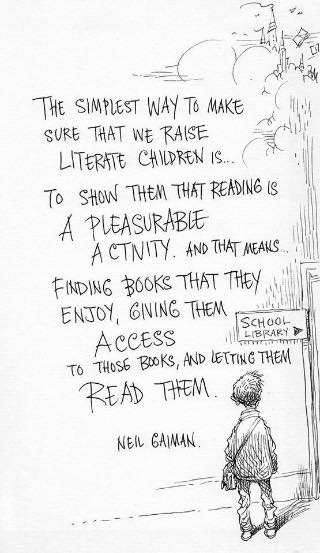
Gaiman, Prisons, Literacy, and the Problems with Satire
Regarding my recent blog about Neil Gaiman for Secretary of Education (and the edited version at The Answer Sheet), Ken Libby took me to task on Twitter for, among other things, Gaiman’s comment about prisons and literacy:
I was once in New York, and I listened to a talk about the building of private prisons – a huge growth industry in America. The prison industry needs to plan its future growth – how many cells are they going to need? How many prisoners are there going to be, 15 years from now? And they found they could predict it very easily, using a pretty simple algorithm, based on asking what percentage of 10 and 11-year-olds couldn’t read. And certainly couldn’t read for pleasure.
It’s not one to one: you can’t say that a literate society has no criminality. But there are very real correlations.
My immediate point after quoting Gaiman was: “Gaiman even understands the difference between causation and correlation—a dramatic advantage over Secretaries of Education in the past two administrations.”
I have also received a friendly and much appreciated email from Chris Boynick addressing the same issue, noting that it is an urban legend that prisons use child literacy to predict prison needs. See “Prisons don’t use reading scores to predict future inmate populations” and “Kathleen Ford says private prisons use third-grade data to plan for prison beds.”
Boynick sent that same information to Neil Gaiman who responded on Twitter with: “@CBoynick Interesting. The person who told me that was head of education for New York city.”
So let me make a few clarifications addressing all this:
- My Gaiman piece is satire (and to be honest, that should put all this to rest). I don’t really endorse or want Gaiman as Secretary of Education, although I think Gaiman is brilliant (as one Gaiman fan noted, we don’t want to detract from his life as a writer!). My real point is the calamity that is those who have served at Secretaries of Education—especially in the George W. Bush and Barack Obama administrations.
- Nonetheless, Gaiman only relays a fact: He did hear this stated as a truth. So maybe we can level some blame at his believing this, but apparently a person with some authority who should have known the truth did state this in front of Gaiman.
- Has Gaiman, then, been a victim (like many of us) of an urban legend? It appears so.
- But, does Gaiman then make some outlandish or flawed claim based on misinformation? Not at all. In fact, I highlighted that Gaiman immediately made a nuanced claim: “It’s not one to one: you can’t say that a literate society has no criminality. But there are very real correlations.” And that claim helps him move into a series of powerful and valid points. I should emphasize that most politicians and political appointees start with misinformation and then make ridiculous and flawed proposals. On that comparison, Gaiman wins.
And for good measure, I suggest “Do prisons use third grade reading scores to predict the number of prison beds they’ll need?” by Joe Ventura, which addresses the urban legend, concluding with an important point relevant to this non-issue about Gaiman’s speech and my blog:
Perhaps it’s best to call this a distortion of the truth. While there isn’t evidence of State Departments of Corrections using third- (or second- or fourth-) grade reading scores to predict the number of prison beds they’ll need in the next decade (one spokesperson called the claim “crap”), there is an undeniable connection between literacy skills and incarceration rates.
You see, a student not reading at his or her grade level by the end of the third grade is four times less likely to graduate high school on time–six times less likely for students from low-income families. Take that and add to it a 2009 study by researchers at Northwestern University that found that high school dropouts were 63 times (!) more likely to be incarcerated than high school grads and you can start to see how many arrive at this conclusion.
But once incarcerated, not all hope is lost. In fact, literacy instruction can help on both ends of the correctional system; studies have shown that inmates enrolled in literacy and other education programs can substantially reduce recidivism rates. One study of 3,000 inmates in Virginia found that 20% of those receiving support in an education program were reincarcerated, while 49% not receiving additional support returned to prison after being released.
So, while prison planners do not use third grade reading scores to determine the number of prison beds they’ll need in the decade to come, there is a connection between literacy rates, high school dropout rates, and crime. While we should file this claim as an urban legend, let’s recognize why it resonates with us: it speaks to the important ways that poor reading skills are connected with unfavorable life outcomes [his emphasis].
With that, I rest my case: Gaiman’s speech is overwhelming on target, moving, and brilliant, and he deserves a bit of space for a small error of fact, and the current Secretary of Education is incompetent.
This leads me to wonder why so much concern about one detail in an author’s speech and my satirical blog, but so little concern for the incompetence of the Secretary of Education and the entire education agenda at the USDOE.
Pop Culture and the Mutant Narrative: X-Men Endure
The late 1930s and early 1940s birthed the superhero comic book fascination that despite several bumps along the way has endured into the twenty-first century where superhero films are huge box-office successes and pop culture gold mines.
In both the comic book and film universes, superhero reboots are common: Batman, Superman, and Spider-Man have all experienced revised origins in the pages of their comics as well as multiple cycles of films dedicated to the superheroes. The X-Men films from 2000 to 2006 may have had as much to do with the adaptation success of comic books to film as Batman, Superman, and Spider-Man.
X-Men: First Class in 2011 was one such re-boot and enough of a success that X-Men: Days of Future Past is slated for 2014.
Alexander Abad-Santos discusses how the mutant aspect of X-Men narratives can be found nearly universally in pop culture:
In about seven months, I along with a lot of X-Men fans will be getting to the theater an hour early, lining up, and then watching to see if Days of Future Past is what I’ve imagined it would be. What’s kinda great for an X-Men fans, though, is that we don’t have to wait until then to get an X-Men story. Pop culture is filled with them.
Recently, I was interviewed by a local journalist about zombie culture; the journalist was investigating why zombies are so popular. I tried to explain that pop culture has all sorts of cycles. Some periods when vampires are hot, some periods when something else is hot. But I also conceded that certain elements of pop culture trends are enduring; for example, something about zombies certainly remains captivating with the public.
I believe the same case can be made for mutants: mutant narratives are compelling and ripe for making important social commentary. And to that I wrote about X-Men and the Hunger Games trilogy as they speak to wider issues, such as education:
Separate, Unequal…and Distracted*
When research, history, and allegory all converge to tell us the same story, we must pause to ask why we have ignored the message for so long and why are we likely to continue missing the essential thing before us.
The New York Times and Education Week reveal two important lessons in both the message they present and the distinct difference in their framing of that message:
“Black Students Face More Discipline, Data Suggests [sic]” headlines the NYT’s article with the lead:
Black students, especially boys, face much harsher discipline in public schools than other students, according to new data from the Department of Education.
And EdWeek announces “Civil Rights Data Show Retention Disparities,” opening with:
New nationwide data collected by the U.S. Department of Education’s civil rights office reveal stark racial and ethnic disparities in student retentions, with black and Hispanic students far more likely than white students to repeat a grade, especially in elementary and middle school.
One has to wonder if this is truly news in the sense that this research is revealing something we don’t already know—because we should already know this fact:
America’s public schools and prisons are stark images of the fact of racial, gender, and socioeconomic inequity in our society—inequity that is both perpetuated by and necessary for the ruling elite to maintain their artificial status as that elite.
The research, coming from the U.S. Department of Education, and the media coverage are not evidence we are confronting that reality or that we will address it any time soon. The research and the media coverage are proof we’ll spend energy on the research and the coverage in order to mask the racism lingering corrosively in our free state while continuing to blame the students who fail for their failure and the prisoners for their transgressions.
X-Men and The Hunger Games: Allegory as Unmasking
Science fiction allows an artist to pose worlds that appears to be “other worlds” in order for the readers to come to see our own existence more clearly.
In the re-boot film version of Marvel Comics superhero team, X-Men: First Class, the powerful allegory of this comic book universe portrays the isolation felt by the mutants—one by one they begin to discover each other and share a common sentiment: “I thought I was the only one.”
These mutants feel not only isolation, but also shame—shame for their looks, those things that are not their choices, not within their direct power to control. While this newest film installment reveals the coming together of the mutants, this narrative ends with the inevitable division of the mutants into factions: Professor X’s assimilationists and Magneto’s radicals.
It takes only a little imagination to see this allegory in the historical factionalism that rose along with the Civil Rights movement between Martin Luther King Jr. and Malcolm X.
In whose interest is this in-fighting?
Although written as young adult literature, The Hunger Games trilogy is beginning to spread into mainstream popular consciousness. The savage reality show that pits children against children to the death gives the first book in the series its title, but as with the research on racial inequity in our schools, I fear we fail to look at either the purpose of these Hunger Games in that other world of the novel or how it speaks to us now.
In Catching Fire, Katniss Everdeen, the narrator, confronts directly that her country, Panem, has created stability by factionalizing the people into Districts, ruled by the Capitol.
Panem exists because of the competition among the Districts, daily for resources and once a year personified by two lottery losers, children form each district.
In this second book, Katniss learns something horrifying but true when the winners of the most recent Games, Katniss and Peeta, visit District 11—home of Katniss’s friend killed in the Games, Rue: During the celebration, the people of District 11 repeat Katniss’s act of rebellion:
What happens next is not an accident. It is too well executed to be spontaneous, because it happens in complete unison. Every person in the crowd presses the three middle fingers of their left hand against their lips and extends them to me. It’s our sign from District 12, the last good-bye I gave Rue in the arena. (p. 61)
Then as Katniss and Peeta are rushed from the stage, they witness Peacekeepers executing people in the District 11 crowd. As President Snow has warned Katniss about the possibility of uprisings:
“But they’ll follow if the course of things doesn’t change. And uprisings have been known to lead to revolution….Do you have any idea what that would mean? How many people would die? What conditions those left would have to face? Whatever problems anyone may have with the Capitol, believe me when I say that if it released its grip on the districts for even a short time, the entire system would collapse.” (p. 21)
What maintains the stability of Panem? Competition, division, and fear.
What threatens the stability of Panem and the inequity it maintains? Solidarity, compassion, cooperation, and rebellion.
Separate, Unequal…and Distracted
U.S. public education has always been and remains, again like our prisons, a map of who Americans are and what we are willing to tolerate.
Children of color and children speaking home languages other than English are disproportionately likely to be punished and expelled (especially the boys), disproportionately likely to be retained to suffer the same grade again, disproportionately likely to be in the lowest level classes with the highest student-teacher ratios (while affluent and white children sit in advanced classes with low student-teacher ratios) in order to prepare them for state testing, and disproportionately likely to be taught by un- and under-certified teachers with the least experience.
And many of these patterns are distinct in pre-kindergarten.
We don’t really need any more research, or history lessons, or sci-fi allegory, or comic books brought to the silver screen.
We need to see the world that our children live in and recognize themselves (just ask an African American young man), and then look in the mirror ourselves.
Why do those in power remain committed to testing children in order to label, sort, and punish them?
Who does the labeling, sorting, and punishing benefit? And what are the reasons behind these facts, the disproportionate inequity in our schools and in our prisons?
We only need each minute of every day to confront what the recent data from the USDOE reveal, but it is always worth noting that this sentiment is often ignored despite its value:
…I recognized my kinship with all living beings, and I made up my mind that I was not one bit better than the meanest on earth. I said then, and I say now, that while there is a lower class, I am in it, and while there is a criminal element I am of it, and while there is a soul in prison, I am not free. (Eugene V. Debs: Statement September 18, 1918)
How and why?
Eugene V. Debs is marginalized as a socialist, a communist so no one listens to the solidarity of his words. Because this sentiment is dangerous for the Capitol.
If we persist in being shocked by the research or enamored by the exciting story of Katniss, we will remain divided and conquered.
Katniss in Catching Fire responds to the president with: “‘It [Panem] must be very fragile, if a handful of berries can bring it down.'”
To which the president replies, “‘It is fragile, but not in the way that you suppose'” (p. 22).
The fragility is masked by the 99% as separate, unequal, and distracted—fighting among ourselves in fear of what we might lose otherwise.
It is time to suppose otherwise.
Reference
Atwood, M. (2011). In other worlds: SF and the human imagination. New York: Nan A. Talese/ Doubleday.
* Originally posted at Daily Kos March 6, 2012
 dr. p.l. (paul) thomas