All posts by plthomasedd

P. L. Thomas, Professor of Education (Furman University, Greenville SC), taught high school English in rural South Carolina before moving to teacher education. He is a former column editor for English Journal (National Council of Teachers of English), current series editor for Critical Literacy Teaching Series: Challenging Authors and Genres (Brill), and author of Teaching Writing as Journey, Not Destination: Essays Exploring What ‘Teaching Writing’ Means (IAP, 2019) and How to End the Reading War and Serve the Literacy Needs of All Students: A Primer for Parents, Policy Makers, and People Who Care (IAP, in press). NCTE named Thomas the 2013 George Orwell Award winner. He co-edited the award-winning (Divergent Book Award for Excellence in 21st Century Literacies Research) volume Critical Media Literacy and Fake News in Post-Truth America (Brill, 2018). Follow his work @plthomasEdD and the becoming radical (https://radicalscholarship.wordpress.com/).

Medicating ADHD in the Brave New World of High-Stakes Accountability

Miranda: O wonder!
How many goodly creatures are there here!
How beauteous mankind is! O brave new world,
That has such people in’t.

—William Shakespeare, The Tempest, Act V, Scene I, ll. 203–206

—–

Utopias seem much more attainable than one may have previously thought. And we are now faced with a much more frightening thought: how do we prevent their permanent fulfillment?…Utopias are attainable. The way of life points towards them. But perhaps a new century will begin, a century in which intellectuals and the educated class will find means of preventing utopias, and we will return to a non-utopian society, which may be less perfect, but will offer more freedom.

—Nicolas Berdiaeff

My love of science fiction (SF) has its roots firmly in Marvel comic books from the 1970s and the SF novels of Arthur C. Clarke and Niven/Pournelle. When I became acquainted with what teachers called “good” and “real” literature, I was immediately drawn to George Orwell and Aldous Huxley as anointed SF writers.

As an adult, I am the sort of SF reader who treasures Kurt Vonnegut and Margaret Atwood, and if I am pushed, I have to admit I value Orwell more as an essayist than novelist and always enjoyed Huxley’s Brave New World over 1984—believing both works are brilliant, but preferring BNW as a reader.

The opening passages are two foundational quotes behind the message of BNW, the Shakespeare the source of the title and the Berdiaeff a nod to Huxley’s parody of utopian fiction.

In his Foreword to the Perennial Classic edition of BNW, Huxley explains:

But Brave New World is a book about the future and, whatever its artistic or philosophical qualities, a book about the future can interest us only if its prophesies look as though they might conceivably come true….The theme of Brave New World is not the advancement of science as such; it is the advancement of science as it affects human individuals. (p. ix)

Beyond purpose, Huxley continues, speculating about “A really efficient totalitarian state”

would be one in which the all-powerful executive of political bosses and their army of managers control a population of slaves who do not have to be coerced, because they love their servitude. To make them love it is the task assigned, in present-day totalitarian states, to ministries of propaganda, newspaper editors and schoolteachers….The great triumphs of of propaganda have been accomplished, not by doing something, but by refraining from doing. Great is truth, but still greater, from a practical point of view, is silence about the truth. (p. xii)

SF, at its best, however, is not predictive, but cautionary; as Neil Gaiman has reminded us, “The world doesn’t have to be like this. Things can be different.” Thus, Huxley warns:

Round pegs in square holes tend to have dangerous thoughts about the social system and to infect others with their discontents….In conjunction with the freedom to daydream under the influence of dope and movies and the radio, it will help to reconcile his subjects to the servitude which is their fate….Indeed, unless we choose to decentralize and to use applied science [1], not as the end to which human beings are to be made the means, but as the means to producing a race of free individuals, we have only two alternatives to choose from: either a number of national, militarized totalitarianisms…or else one supra-national totalitarian. (pp. xiii, xiv)

And then, Huxley conclude: “You pays your money and you takes you choice” (p. xiv).

The speculative and cautionary possibilities found in SF rarely come to fruition in the real world in the dramatic ways of novels or films (or in the somewhat looney ways political factions rant and rave in public discourse). So it seems likely that we are apt never to listen or to act in ways that we should and could.

Huxley, I think, was in many ways speaking to this—“The Not-So-Hidden Cause Behind the A.D.H.D. Epidemic”:

Between the fall of 2011 and the spring of 2012, people across the United States suddenly found themselves unable to get their hands on A.D.H.D. medication. Low-dose generics were particularly in short supply. There were several factors contributing to the shortage, but the main cause was that supply was suddenly being outpaced by demand.

The number of diagnoses of Attention Deficit Hyperactivity Disorder has ballooned over the past few decades. Before the early 1990s, fewer than 5 percent of school-age kids were thought to have A.D.H.D. Earlier this year, data from the Centers for Disease Control and Prevention showed that 11 percent of children ages 4 to 17 had at some point received the diagnosis — and that doesn’t even include first-time diagnoses in adults. (Full disclosure: I’m one of them.)

That amounts to millions of extra people receiving regular doses of stimulant drugs to keep neurological symptoms in check. For a lot of us, the diagnosis and subsequent treatments — both behavioral and pharmaceutical — have proved helpful. But still: Where did we all come from? Were that many Americans always pathologically hyperactive and unable to focus, and only now are getting the treatment they need?

Probably not. Of the 6.4 million kids who have been given diagnoses of A.D.H.D., a large percentage are unlikely to have any kind of physiological difference that would make them more distractible than the average non-A.D.H.D. kid. It’s also doubtful that biological or environmental changes are making physiological differences more prevalent. Instead, the rapid increase in people with A.D.H.D. probably has more to do with sociological factors — changes in the way we school our children, in the way we interact with doctors and in what we expect from our kids.

As disturbing as this is, the final paragraph of this article may be the most significant:

Today many sociologists and neuroscientists believe that regardless of A.D.H.D.’s biological basis, the explosion in rates of diagnosis is caused by sociological factors — especially ones related to education and the changing expectations we have for kids. During the same 30 years when A.D.H.D. diagnoses increased, American childhood drastically changed. Even at the grade-school level, kids now have more homework, less recess and a lot less unstructured free time to relax and play [emphasis added]. It’s easy to look at that situation and speculate how “A.D.H.D.” might have become a convenient societal catchall for what happens when kids are expected to be miniature adults. High-stakes standardized testing, increased competition for slots in top colleges [emphasis added], a less-and-less accommodating economy for those who don’t get into colleges but can no longer depend on the existence of blue-collar jobs — all of these are expressed through policy changes and cultural expectations, but they may also manifest themselves in more troubling ways — in the rising number of kids whose behavior has become pathologized.

The rise of ADHD diagnoses and medications has run concurrent to the accountability era in education, sharing the same thirty-year history. O brave new world of high-stakes accountability and the ADHD medication needed to make the students love their servitude to the tests…
[1] Paul Boyle, “A U.K. View on the U.S. Attack on Social Sciences,” Science, 341 (August 16, 2013), p. 719.

Scarcity: A Few Thoughts While Reading

Scarcity: Why Having Too Little Means So Much, Sendhil Mullainathan and Eldar Shafir

Having bought Scarcity several weeks ago, I have finally begun reading, and while I anticipate using this work in my scholarship and blogging once I have finished, I feel compelled to offer some evolving thoughts as I read.

My interest in the book is grounded in my own work on the relationship between poverty/affluence and education, particularly in terms of how public and political perceptions of poverty/affluence impact public/political discourse and ultimately policy.

Thus, a few thoughts while reading:

  • Mullainathan and Shafir offer a compelling and readable Introduction. I trust the scholarship of the work, and appreciate that it begins as an engaging narrative.
  • “By scarcity, we mean having less than you feel you need” (p. 4). Here is a important point, I believe, related to the cultural assumptions about people living in poverty. In the U.S., poverty is associated with individual choices and weaknesses, ignoring, I think, the more powerful impact of social norms. In a consumer culture that shows citizens that their self-worth is directly related to the possessions, people living in poverty are profoundly impacted by “having less than you feel you need.” That sense, then, directly drives the behavior of people living in poverty. The privileged in the U.S. typically discount people living in poverty as lazy and/or careless based on people in poverty owning flat-screen TVs, iPhones, or new cars. I anticipate this book contributing powerfully to that misguided and hypocritical way of thinking about poverty and people in poverty.
  • “Scarcity captures the mind. Just as the starving subjects had food on their mind, when we experience scarcity of any kind, we become absorbed by it….Scarcity is more than just the displeasure of having very little. It changes how we think. It imposes itself on our minds” (p. 7). The consequences of thoughts and actions driven by scarcity, then, are important for understanding poverty. As Mullainathan and Shafir explain later, “So when the hungry recognize CAKE [in an experiment detailed in the Introduction] more quickly, it is not because they choose to focus more on this word. It happens faster than they could choose to do anything. This is why we use the word capture when describing how scarcity focuses the mind” (pp. 8-9). This discussion reminds me of Gladwell’s arguments posed in Blink related to racism (with the caveat that Gladwell poses some real problems related to his allegiances and work).
  • “But we suggest that while physical scarcity is ubiquitous, the feeling of scarcity is not” (p. 11). Attitudes about poverty in the U.S. tend to refuse to acknowledge the power of relative wealth—how the culture imposes views of poverty/affluence onto people. To pretend poverty and behavior related to poverty are somehow not socially constructed is at the center of why and how U.S. attitudes about poverty are deforming (see Freire).
  • “Being poor, for example, reduces a person’s cognitive capacity more than going one full night without sleep. It is not that the poor have less bandwidth [We can directly measure mental capacity or, as we call it, bandwidth] as individuals. Rather, it is that the experience of poverty reduces anyone’s bandwidth” (p. 13). This directly calls into question “no excuses” policies that suggest schools alone can overcome the impact of poverty.
  • “There is one particularly important consequence [of scarcity]: it further perpetuates scarcity….Scarcity creates its own traps” (p. 14). The so-called cycle of poverty may be a cycle of scarcity—beyond the power of individuals to create or change. According to Mullainathan and Shafir, “Scarcity forces all choices. Abstractions become concrete” (p. 20).
  • “In the real world, the poor and rich differ in so many ways” (p. 26).
  • “Focusing on on thing means neglecting other things….Instead of saying that scarcity ‘focuses,’ we could just as easily say that scarcity causes us to tunnel: to focus single-mindedly on managing the scarcity at hand….Tunneling is not [a positive]: scarcity leads us to tunnel and neglect other, possibly more important, things” (p. 29). There is a luxury of time and focus found in affluence, but not in poverty. The rules of life change within both affluence and poverty. To judge behavior of the impoverished by the rules of the affluent, then, is a fatal flaw of understanding poverty.

Ignoring the New Majority: Education Reform behind Blinders

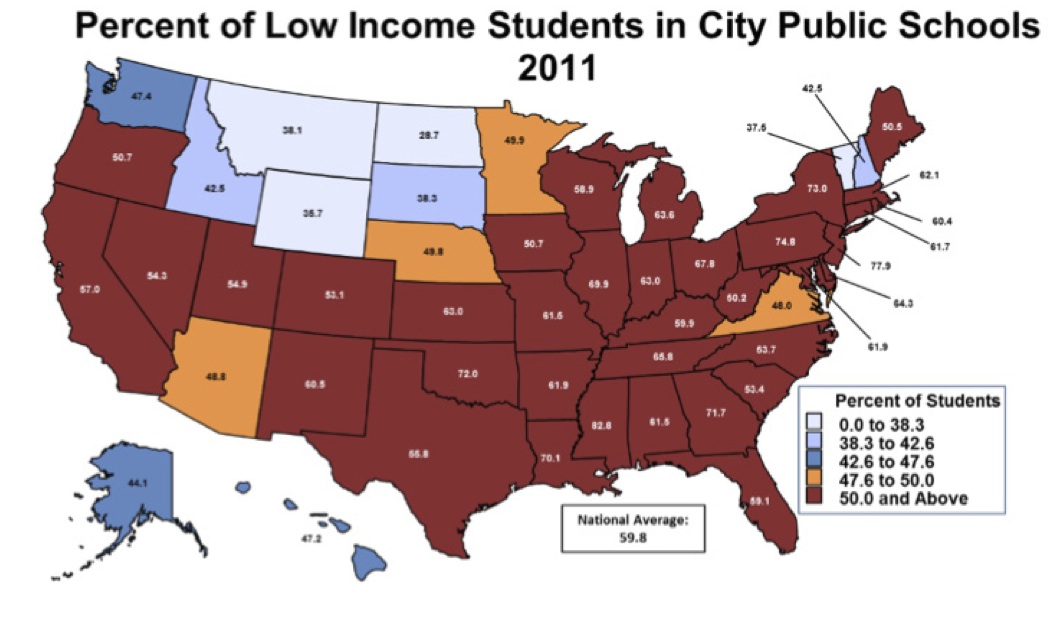
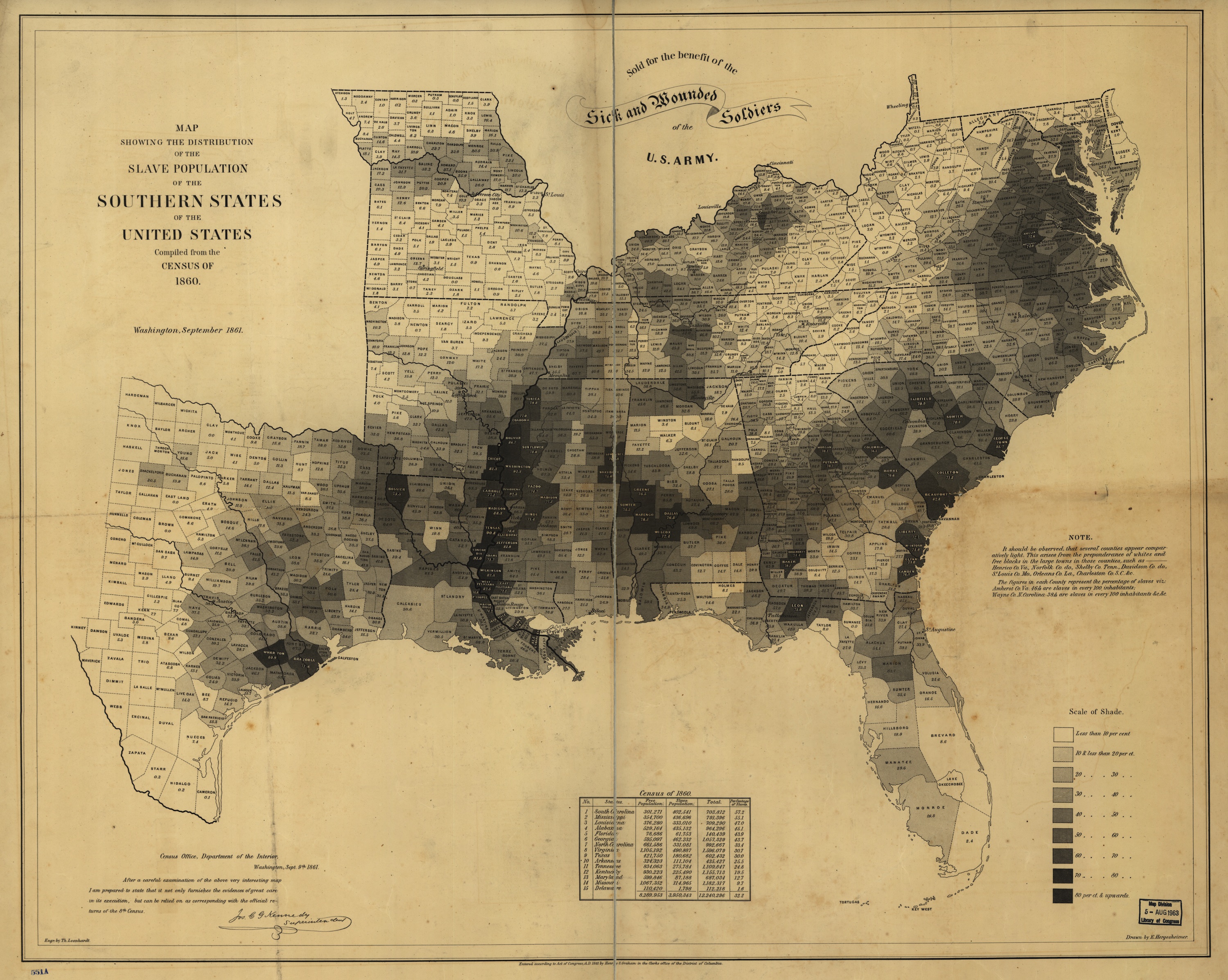
Consider three maps—one using data from the 1860 Census, one focusing on public schools in 2011, and one detailing the remaining states allowing corporal punishment in schools:

BigSlaveryMap

[1860; click to enlarge]

Perc of low income students public schools copy

[2011; click to enlarge]

[2005-2006; click to enlarge]

“A majority of students in public schools throughout the American South and West are low-income for the first time in at least four decades, according to a new study that details a demographic shift with broad implications for the country,” explains Lyndsey Layton, based on the report from the Southern Education Foundation (SEF).

The data in the SEF report parallel in many ways the documenting of in-school segregation lingering in the South as portrayed in the HBO film Little Rock Central: Fifty Years Later and reported by Felicia Lee:

On a recent visit to Central High, Ms. Trickey spoke to a self-segregated classroom: whites on one side, blacks on the other. An African-American student apparently dozed as she spoke. Students and teachers alike spoke blithely or painfully of the low educational aspirations and achievements of too many black students. Central, many said, is now two schools in one: a poor, demoralized black majority and a high achieving, affluent white minority.

And five years after the documentary, The Civil Rights Project detailed the extent of re-segregated schools across the South:

  • Since 1991, black students in the South have become increasingly concentrated in intensely segregated minority schools (defined as 90-100% minority students). This represents a significant setback. Though for decades Southern black students were more integrated than their peers in other parts of the country, by 2009-10 the share of Southern black students enrolled in intensely segregated minority schools (33.4%) was fast closing in on the national figure (38.1%).  By comparison, in 1980, just 23% of black students in the South attended intensely segregated schools.
  • For the last four decades, contact between black and white students has declined in virtually all Southern states.  In schools across the region, white students make up 30% or less of the enrollment in the school of the typical black student for the first time since racial statistics pertaining to schools were collected by the federal government.
  • Most of the largest Southern metro areas also report declining black-white exposure. The Raleigh, NC metro had the highest black-white contact although this too has fallen in recent years.  In 2009, the typical black student in the metro went to a school where whites accounted for about 45% of their peers, compared to about 54% in 2002).
  • In 2009, black-white exposure in the metropolitan area of Raleigh was relatively similar to the overall white percentage in the metro (54%)–indicating fairly stable levels of desegregation.  Future enrollment data for the Raleigh metro should be closely monitored to ascertain the impact of recent policy changes to the district’s voluntary integration policy.
  • Two metros, Memphis, TN and Miami, FL, had the lowest exposure of black students to white students in 2009, under 15%. (Siegel-Hawley & Frankenberg2012, September 19)

In Western states with high Latino/a populations, race and poverty patterns constitute double segregation:

  • The typical black or Latino today attends school with almost double the share of low-income students in their schools than the typical white or Asian student.
  • In the early 1990s, the average Latino and black student attended a school where roughly a third of students were low income (as measured by free and reduced price lunch eligibility), but now attend schools where low income students account for nearly two-thirds of their classmates.
  • There is a very strong relationship between the percent of Latino students in a school and the percent of low income students. On a scale in which 1.0 would be a perfect relationship, the correlation is a high .71.  The same figure is lower, but still high, for black students (.53).  Many minority-segregated schools serve both black and Latino students.  The correlation between the combined percentages of these underserved two groups and the percent of poor children is a dismaying .85. (Orfield, Kucsera, & Siegel-Hawley, 2012, September 19)

Combined with the growing trends in the U.S. related to increased inequity, rising child poverty, and re-segregating of schools by class and race, the 2013 SEF report on low-income students being the new majority in public schools should be a wake-up call to the current in-school only focus of education reform. While race and class segregation has proven to be entrenched in U.S. society, education reformers must admit that social institutions such as public schools do not lift children out of poverty but play two roles reformers prefer to ignore—they reflect social inequity and they tend to perpetuate that inequity:

A majority of public school children in 17 states, one-third of the 50 states across the nation, were low income students – eligible for free or reduced lunches – in the school year that ended in 2011. Thirteen of the 17 states were in the South, and the remaining four were in the West. Since 2005, half or more of the South’s children in public schools have been from low income households. During the last two school years, 2010 and public schools. (SEF 2013)

Also hard hit by these social and academic realities are urban public schools:

city public schools

[click to enlarge]

In other words, while the South and West are crucibles for historical and current negative consequences associated with racial and class inequity and segregation, urban areas of the U.S. show that these same problems infect essentially the entire country:

In each of the nation’s four regions, a majority of students attending public schools in the cities were eligible for free or reduced lunch last year. The Northeast had the highest rates for low income school children in cities: 71 percent. The next highest rate, 62 percent, was found in Midwestern cities. The South had the third highest percentage of low income students in the cities – 59 percent.

The SEF report ends with the dilemma facing education reformers who promote a “no excuses” ideology grounded in market-based policies:

There is no real evidence that any scheme or policy of transferring large numbers of low income students from public schools to private schools will have a positive impact on this problem. The trends of the last decade strongly suggest that little or nothing will change for the better if schools and communities continue to postpone addressing the primary question of education in America today: what does it take and what will be done to provide low income students with a good chance to succeed in public schools? It is a question of how, not where, to improve the education of a new majority of students.

The lingering legacy of segregation as well as the rise of impoverished students constituting the new majority in public schools is evidence that ignoring poverty does not make it go away.

Arguing that in-school reform alone can eradicate the scars of slavery that remain vivid in the two maps included above is beyond idealism and approaches inexcusable irresponsibility of a type that is exposed by the data presented by SEF’s report.

With impoverished students now the new majority in public schools, a new era of education reform is unavoidable—one that begins with social reform addressing racial and class inequity and then continues by redesigning a public school system that itself is dedicated to equity of opportunity.