
All posts by plthomasedd

P. L. Thomas, Professor of Education (Furman University, Greenville SC), taught high school English in rural South Carolina before moving to teacher education. He is a former column editor for English Journal (National Council of Teachers of English), current series editor for Critical Literacy Teaching Series: Challenging Authors and Genres (Brill), and author of Teaching Writing as Journey, Not Destination: Essays Exploring What ‘Teaching Writing’ Means (IAP, 2019) and How to End the Reading War and Serve the Literacy Needs of All Students: A Primer for Parents, Policy Makers, and People Who Care (IAP, in press). NCTE named Thomas the 2013 George Orwell Award winner. He co-edited the award-winning (Divergent Book Award for Excellence in 21st Century Literacies Research) volume Critical Media Literacy and Fake News in Post-Truth America (Brill, 2018). Follow his work @plthomasEdD and the becoming radical (https://radicalscholarship.wordpress.com/).

The Unintended Lessons from Florida: Class Grades, pt. 2

After recognizing the excellent analysis by Michael Vasquez and David Smiley of Florida’s school grades being strongly correlated with out-of-school factors associated with the students*, I have received several important related points from Vasquez about the unintended lessons coming from one of the most often cited reform states in the U.S.

First, Vasquez pointed me to Matthew DiCarlo’s What Florida’s School Grades Measure, And What They Don’t, in which DiCarlo explains:

A while back, I argued that Florida’s school grading system, due mostly to its choice of measures, does a poor job of gauging school performance per se. The short version is that the ratings are, to a degree unsurpassed by most other states’ systems, driven by absolute performance measures (how highly students score), rather than growth (whether students make progress). Since more advantaged students tend to score more highly on tests when they enter the school system, schools are largely being judged not on the quality of instruction they provide, but rather on the characteristics of the students they serve.

New results were released a couple of weeks ago. This was highly anticipated, as the state had made controversial changes to the system, most notably the inclusion of non-native English speakers and special education students, which officials claimed they did to increase standards and expectations. In a limited sense, that’s true – grades were, on average, lower this year. The problem is that the system uses the same measures as before (including a growth component that is largely redundant with proficiency). All that has changed is the students that are included in them. Thus, to whatever degree the system now reflects higher expectations, it is still for outcomes that schools mostly cannot control.

The really important aspect of DiCarlo’s analysis is that Florida’s accountability system has likely caused harmed instead of attaining the lofty goals often associated with accountability policies, as DiCarlo concludes:

In other words, there are many Florida schools with lower-performing students that are actually very effective in accelerating student performance (at least insofar as tests can measure it). This particular ratings system, however, is so heavily driven by absolute performance – how highly students score, rather than how much progress they have made – that it really cannot detect much of this variation.

Closing or reconstituting these schools is misguided policy; their replacements are unlikely to do better and are very likely to do worse. Yet this is what will happen if such decisions are made based on the state’s ratings.

Florida will have to do a lot more than make tweaks to truly improve the high-stakes utility of this system. In the meantime, one can only hope that state and district officials exercise discretion in how it is applied.

Both Vasquez and Smiley’s 2013 analysis and DiCarlo’s 2012 analysis, however, are even more troubling in light of a St. Petersburg Times (Florida) March 21, 1999, article, “A lesson in grading schools,” by Kent Fischer and Geoff Dougherty:

Bush believes the grades, A through F, will make it easier for parents to compare schools and assess how they are doing. A noble goal.

But a St. Petersburg Times analysis indicates his school-grading system may be fundamentally flawed.

It takes no account of the impact poverty has on student achievement, though many studies have proven that children from wealthy families generally outscore children whose parents are poor. So Bush’s grades are more apt to reflect the relative wealth of a school’s student body rather than the competency of its teachers, the newspaper’s analysis shows.

Fourteen years ago, then, Fischer and Dougherty accurately identified the flawed Florida school grading plan, but also acknowledged the key ignored hurdle facing education, poverty:

If there’s one thing that has been firmly established by research, it is the impact social factors have on student achievement. This does not mean poor kids can’t achieve. Many do. But poor children often lead transient lives, may suffer from malnutrition and endure higher rates of abuse and neglect than other children. They also tend not to be exposed to books, music and other cultural influences that help ready young minds for school.

Research – and the Times’ analysis – shows that when large numbers of students are considered, poverty reliably predicts test scores. The Times’ analysis found that depending on which test is given, from 69 to 79 percent of the difference in test scores among schools is explained by poverty.

That seems to ignore several significant demographic factors, like single-parent homes and student mobility. But many of those factors have an extremely high correlation to poverty and thus are effectively included in the analysis.

The bottom line, according to many experts: Any grading system that fails to take poverty into account is flawed.

Ultimately, Fischer and Dougherty offered Florida parents a message still relevant today: “There’s more to a school than good test scores. When trying to gauge school quality, educators suggest parents do some investigating.”

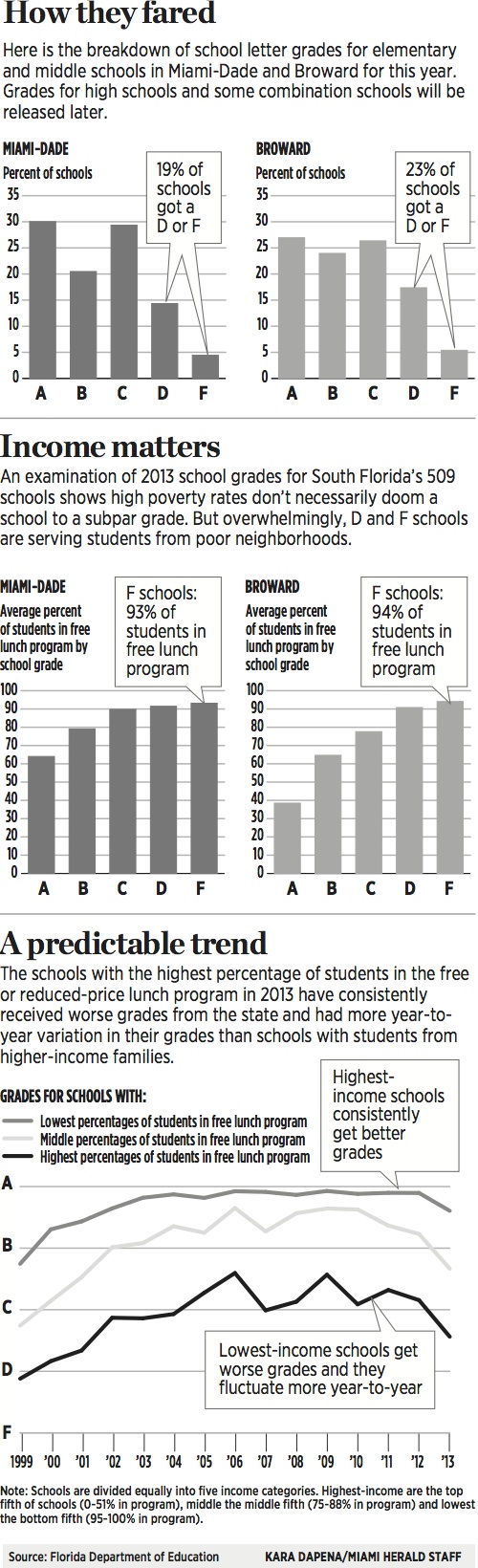
* See below a graphic (click to open and then click again to enlarge) related to Vasquez and Smiley’s article they were unable to include in the online article:
gradeschart copy

Class Grades

Since I am quick to criticize the media for its role in the failures of the current education reform movement—such as PBS, The Charleston Post and Courier, and Education Week—I must also recognize when a media outlet provides much needed insight into education policy that has clearly run off the tracks, such as the so-called Florida miracle and the enduring practice of assigning letter grades to schools.

In “Low-income schools struggle under state’s grading system” (Miami Herald, August 10, 2013), Michael Vasquez and David Smiley offer a clear but disturbing picture of accountability in Florida:

With dozens of changes in just the past three years, the formula behind Florida’s A-to-F school grading system has been criticized as a confusing mess. But there’s been at least one constant in Miami-Dade and Broward results: The wealthiest schools never get Fs, and schools with high populations of poor students face an uphill battle to even get a C.

The trend is visible through a decade-plus of school grade results, dating back to the first grades issued in 1999.

Vasquez and Smiley, along with the Miami Herald, represent a needed aspect of journalism addressing education reform: Recognizing large and compelling patterns, and thus the consequences of education policy.

The analysis of assigning letter grades to schools in Florida exposes some important conclusions:

•  Although high poverty rates don’t necessarily doom a school to a subpar grade, D and F schools are overwhelmingly serving students from poor neighborhoods, and the few schools that do overcome poverty to achieve an A are outliers. (There were nine such schools this year, all in Miami-Dade).

•  Of the 209 schools in Miami-Dade and Broward with at least 90 percent of students receiving free or reduced lunch, 78 percent received a grade of C or worse. Roughly 39 percent of these high-poverty schools received a D or F.

•  Of the 43 local schools with much lower poverty rates (30 percent or fewer students receiving free or reduced lunch), 86 percent received an A, and none received a D or F.

Despite efforts to identify educational quality among schools by focusing on growth models, data used in accountability policies remain primarily a reflection of out-of-school factors. Further, the schools that sit outside the typical patterns are rightfully identified by Vasquez and Smiley as “outliers.”

This analytical report on letter grades for schools in Florida is a strong example of quality journalism that seeks out and presents complex and detailed evidence, placing that data in the broader context of the many factors that impact not only the evidence we gather on our schools but also what conclusions we draw as well as how we draw those conclusions.

In the article, Miami-Dade Superintendent Alberto Carvalho explains, “‘Just as much as poverty can’t be an excuse, the exclusion of poverty as a factor is immoral.'”

Rare is the news article that allows a perspective this complex.

No Child Left Behind (NCLB) ushered in several grand promises in 2001, such as closing the achievement gap, but one of the central requirements of the legislation—the use of scientifically based research—is now poised to dismantle the entire accountability movement, including policies such as labeling schools with letter grades based primarily on test scores.

The evidence is clear that thirty years of accountability built on standards and high-stakes testing has failed. The next step is composing and sharing a unified message of that fact, while also building a coalition to reset the reform agenda so that we address poverty, equity, and opportunity in the lives of children and their families as well as in the schools those children attend.

SPECIAL CALL: Speaking Truth to Power (English Journal)

SPECIAL CALL

For my January 15, 2014, CALL for my English Journal column, Speaking Truth to Power, I am seeking a column that combines the column focus with the special issue, with guest editors Alan Brown and Chris Crowe and focusing on the theme “A Whole New Ballgame: Sports and Culture in the English Classroom.”

Please contact me with a query or draft that combines these elements as detailed below.

Speaking Truth to Power

Editor: P. L. Thomas

“If education cannot do everything, there is something fundamental that it can do. In other words, if education is not the key to social transformation, neither is it simply meant to reproduce the dominant ideology. . . . The freedom that moves us, that makes us take risks, is being subjugated to a process of standardization of formulas, models against which we are evaluated. . . . We are speaking of that invisible power of alienating domestication, which attains a degree of extraordinary efficiency in what I have been calling the bureaucratizing of the mind” (110–11). (Freire, 1998, Pedagogy of Freedom: Ethics, Democracy, and Civic Courage)
This column seeks to explore the experiences and possibilities that arise when educators speak Truth to power. It is also intended to be an avenue for teachers to speak Truth to power through teacher narratives about the “the bureaucratizing of the mind,” about best practice in critical literacy against scripted and tested literacy, and about creating classrooms that invite students to discover, embrace, and develop their own voices and empowerment.
Submit an electronic Word file attached to your email to the column editor, P. L. Thomas, atpaul.thomas@furman.edu.

A Whole New Ballgame: Sports and Culture in the English Classroom

Deadline: January 15, 2014

Publication Date: September 2014

Guest Editors: Alan Brown and Chris Crowe

Love sports or hate them, it’s hard to deny their prominence in American society and their popularity with 21st-century adolescents. Interscholastic athletics in particular can play a significant role in the overall culture of a school and have a substantial impact on students’ daily lives. Despite this influence, the topic of sports in society is often absent from the professional conversations of English teachers, an exclusion that could prove to be a missed opportunity. This issue will examine the possibilities for both utilizing and critiquing the culture of sports as a means of increasing student engagement and promoting student learning in the English classroom. Within this context, we seek manuscripts that explore the intersection of literacy, sport, culture, and society, and we encourage column submissions devoted to this same theme.

A number of important questions guide this issue: What connections or disconnections exist between the perceived physical nature of athletics and the mental nature of academics? What real-world associations have you made between sports and the English curriculum? How can sports-related texts (e.g., young adult literature, canonical literature, graphic novels, poetry, nonfiction, magazines, newspapers) be integrated into the academic culture of an English class? How have you promoted the teaching of 21st-century skills through the use of sports-related media, film, and technology? What possibilities exist for interdisciplinary (e.g., historical, political, scientific, social) connections to sports across content areas? How have you engaged students in critical dialogue about our societal emphasis on sports? How can we extend the definition of sport to be more inclusive for students of diverse cultures, races, genders, ethnicities, and abilities? How can an examination of sports culture open the door to discussions of other cultures that exist in school and society?

New Media, New Public Intellectuals

At the beginning of January 2010, I received an email prompting me to watch a video of Diane Ravitch making a speech. My knee-jerk reaction was to delete the email because I had long rejected Ravitch’s work, associating her with the standards/testing movement and a traditional view of literacy that I firmly refuted.

Instead I clicked the link and was quickly puzzled, wondering who this Diane Ravitch was and what had happened to the Ravitch I had walked out on at a National Council of Teachers of English session several years before. Ravitch’s talk was so compelling I sought out her email, sent her an apology, and within the hour received a reply.

Diane and I exchanged a few emails; she was gracious and open about her recent change in stances related to public education reform (all detailed in her popular and influential book, The Death and Life of the Great American School System: How Testing and Choice Are Undermining Education). This event has since grown into a virtual friendship and collegiality that I would have never predicted, but the intervening years have also revealed more than Ravitch’s new positions on accountability and preserving the promise of public education. Those months and years have also highlighted the role of the new media (Twitter, Facebook, blogging, google+, and the ever-growing virtual world of social media and communication) in the rise of the new public intellectual.

By most any definition of public intellectual (see Possner, Jacoby, and Fish, among many careful looks at public intellectuals), Ravitch had established herself as a respected academic, a popular public intellectual, and even a public servant, having held political appointments in the U.S. Department of Education. When Ravitch was closely associated with conservative and traditional ideology and policy, her scholarly books sold well, and she also garnered invitations to speak widely on issues related to education.

What is particularly interesting about Ravitch 2.0, however, is that once she expressed considerable and distinct changes in her stances on education reform and policy—again, all presented in traditional format, a book—Ravicth also embraced the new media by establishing herself on Twitter (where she is approaching 60,000 followers) and eventually committing to regular (often multiple times a day) blogging on her own site.

While Ravitch’s recent journey from traditional and conservative scholar and public intellectual to Ravitch 2.0 is itself interesting, and even inspiring, I believe it warrants some consideration as a harbinger of the new public intellectual.

Primarily motivated by Ravitch’s use of Twitter, I joined Twitter more than a year ago, and fairly recently shifted my public work away from blogging at The Daily Kos and The Daily Censored and toward original blogging at my own WordPress site. While my impact and influence are dwarfed by Ravitch’s, I believe I have joined a new frontier for educators, academics, and scholars—a door opening to the life of the public intellectual that was often closed or at least hard to open in the recent past.

Before the new media exploded, public intellectuals depended on the traditional media—newspapers, magazines, and TV—for access to the public. Educators and academics had to find time to submit Op-Eds or public writing (and then that work had to be accepted and published) or had to wait for invitations to participate in that traditional media. As scholars have shown (see above), public intellectuals thrived in the twentieth century, but many were “rock star” public intellectuals, creating a narrow avenue for educators, academics, and scholars to form public voices.

As Ravitch has shown, however, Twitter and blogging can be powerful mechanisms for creating a public presence, mechanisms that circumvent traditional barriers to becoming a public intellectual.

The new public intellectual thriving in the new media, however, still faces tremendous hurdles and daunting negative consequences.

Professors with tenure and emeriti professors (such as Ravitch, Stephen Krashen, and me) are notably emboldened by the new media since those barriers and consequences are greatly subdued. Certainly academic and scholarly public intellectuals must navigate challenges to their credibility and traditional biases against public work, but in general, those threats are minor for tenured and emeriti professors.

More problematic are K-12 teachers (some unionized and many not) and junior tenure-track professors. For these educators and academics, public work itself poses great dangers, some of which jeopardize their jobs and routes to tenure.

For both K-12 education and universities, I think, a challenge now stands before administrative and academic leaders in charge of retention, evaluation, and promotion. Some of the changes that need to occur include the following:

  • Recognizing and honoring public intellectual work in ways that do not marginalize that work and that do not subordinate that work to more traditional forms of scholarship (peer-reviewed print publications, for example).
  • Recognizing and honoring the new media presentation of that public work.
  • Incorporating public work and new media formats into hiring, retaining, evaluating, and promoting processes.
  • Creating and insuring professional cultures that recognize and honor public and new media work by educators, academics, and scholars.

These transformations, then, will not only address the rise of new public intellectuals and the new media but also help reconcile the lingering disjuncture between most mission statements of schools and universities (nearly all expressing some social function of the school or university) and policies that remain somewhat or strongly hostile to educators and academics who are actively engaged with the public or with activism.

Despite the enduring arguments for the dispassionate and neutral educator/professor, the school and its educators are ultimately important only in the ways in which they engage with and change the world.

At least in the world we now inhabit, that may be happening one Tweet at a time, and we need to embrace this new frontier before that too is a relic of the past and the public intellectual 3.0 is upon us.

Missionary Zeal and the Paradox of Paternalism

The United States of America fails Allie Fox, pushing him to abandon his homeland and to drag his family to the coast of Honduras in Paul Theroux’s Mosquito Coast, popularized by the Harrison Ford and River Phoenix film adaptation:

“That’s business,” the captain said.

“That’s ruin,” Father [Allie Fox] said. “We eat when we’re not hungry, drink when we’re not thirsty, buy what we don’t need, and throw away everything that’s useful. Don’t sell a man what he wants—sell him what he doesn’t want. Pretend he’s got eight feet and two stomachs and money to burn. That’s not illogical—it’s evil.” (p. 75)

The novel, narrated by Allie’s son, Charlie, presents Allie as a gifted scientist/inventor with socialistic ideals and an aggressive humanism: “Father said, ‘Man is God'” (p. 85). In fact, Charlie notes, “It seemed as if Father could work miracles” (p. 63).

However, one character, Polski, recognizes danger lurking beneath Allie’s missionary zeal: “‘Your father’s the most obnoxious man I’ve ever met,’ Polski said”:

“He’s the worst kind of pain in the neck—a know-it-all who’s sometimes vight.”

Then, with all the sawdust in him stirring, he added, “I’ve come to see he’s dangerous….Tell him he’s a dangerous man, and one of these days he’s going to get you al killed….” (p. 55)

Theroux’s novel echoes and parallels other works about hubris and missionary zeal—Joseph Conrad’s Heart of Darkness, Samuel Taylor Coleridge’s  “Rime of the Ancient Mariner,” and Barbara Kingsolver’s The Poisonwood Bible. Yet, in Theroux’s narrative Allie is one type of missionary who sees himself above the religious missionaries in the novel. Reverend Spellgood is mocked by Allie, but the reverend’s daughter, Emily Spellgood, explains to Charlie, “‘My father’s real famous there. We’ve got a mission in the jungle. It’s really neat'” (p. 71).

Allie, however, seems comfortable with his own mission: “‘I was sent here,’ Father said” (p. 136)—a mission that involves buying land and imposing his Utopia on the native people of that land and his own family.

The novel builds to a predictable end, revealing that despite Allie’s considerable gifts and altruism, his missionary zeal reduces him to a careless tyrant, an embodiment of evil.

As a grand allegory, Theroux’s novel raises questions about paternalism, the quest by some agent of privilege to help others who appear to be in need.

Traditional religious missionary work certainly confronts that paradox of paternalism inherent in their missionary zeal, but education also faces this dilemma, broadly in commitments such as service learning and more narrowly in the mission of Teach for America, an organization that champions its missionary zeal.

In “Why Service-Learning Is Bad,” John W. Eby (1998) identifies the often ignored negative consequences of the good intentions behind service learning:

The excitement and euphoria of the service-learning movement, fueled by dramatic stories of the benefits of linking learning and service masks underlying troubling issues. The limitations of service done in the name of service-learning are often overlooked and possible harm done by to communities by short term volunteers is ignored. Conversations about negative aspects of service-learning do surface occasionally in the hallways of the academy and in the lounges of service-learning conferences. There is talk of McService, service bites, quick fix service, happy meal community service, or service in a box. Discussions of the limits service-learning have surfaced on the Internet. Community leaders and agency representatives concerned about fundamental community change raise significant questions when given opportunity.

Unfortunately these voices are often informal and sporadic. Much of the discussion about service-learning is carried on by advocates. Most of the published research about service-learning is done by academicians particularly interested in the learning side of the equation. Community leaders and residents do not have a voice in the dialogue. (p. 2)

The potential for imposed and misguided paternalism in service learning highlights the essential paradox of both service and teaching: What is the role of the population being served and/or taught, and even more complex, if that population is genuinely in need, how do those with privilege seeking to help or teach provide for others who may be unaware of those needs?

In service learning contexts, Eby does not suggest abandoning service learning, but does raise cautions about the dangers he outlines. In short, service learning helps both populations being served and the learners charged with conducting service learning when all stakeholders have equal and powerful voices guiding the projects.

A far more problematic situation, however, is the high-poverty and predominantly minority populations being served by TFA. As Sarah Car has documented in New Orleans, despite many critics condemning TFA for its missionary zeal and classist/racist practices, impoverished and minority families often eagerly choose and embrace TFA and the highly authoritarian charter schools that have flooded the city.

Carr’s work as well as Michelle Alexander’s The New Jim Crow exposes the problem of choice underneath the paradox of paternalism. Just as Carr’s narrative forces readers to consider why impoverished minorities embrace TFA and “no excuses” charter schools, Alexander directly confronts the fact that high-poverty and African American neighborhoods appear to support the mass incarceration Alexander characterizes as the new JimCrow:

Given the dilemma facing poor black communities, it is inaccurate to say that black people “support” mass incarceration or “get-tough” policies [because] if the only choice that is offered blacks is rampant crime or more prisons, the predictable (and understandable) answer will be “more prisons.” (p. 210)

The world controlled by Allie Fox in The Mosquito Coast is eventually revealed as a world with artificial choices, choices that back innocent people into corners, choices that mask the corrosive influence of privilege and rendering people being served as the Other.

Just as Eby recognizes how service learning can fall prey to forces that corrupt its mission, TFA (and “no excuses” charter schools) often falls prey to their missionary zeal, like Allie, and causes far more harm than good—despite their stated mission.

The troubling difference between TFA and Theroux’s novel, of course, is that TFA is a reality for children and communities, not simply an engaging and disturbing novel/film.

The paradox of paternalism inherent in service and teaching is not an easy problem to overcome—although awareness is a first step—but when it is compounded with missionary zeal, the outcomes are too easily predicted—children, adults, and communities underserved by a traditional system once again being mis-served by an organization promising a land of milk and honey.

Allie’s death in the novel reveals that he has become the thing he mocked: “But a white man’s death was news—a missionary, they called him. How he would have hated that!” (p. 373).

Those of us drawn to service and teaching, then, should beware missionary zeal and be aware of the paradox of paternalism.

Graphic Journalism and Graphic Scholarship: The New Public Intellectual?

I am currently in a faculty seminar at my university addressing the public intellectual. One aspect of academics, scholars, and educators assuming the role of public intellectual that now confronts us is how the New Media (blogs, Facebook, Twitter, Reddit, LinkedIn, etc.) has and will reshape the role of public intellectuals, especially in the education reform debate.

Even farther at the margins, I think, of that new frontier is the role of graphic journalism and graphic scholarship. Consider some of the powerful examples of both here:

Open Letter to the Media, Politicians, Reformers, B/Millionaires, and Celebrities

First, some context for the problem with education reform and how we discuss the topic.

Cindy Scoppe, associate editor at The State, addresses grading schools, drawing several conclusions:

What we need is a single grading system, which wasn’t possible before the Obama administration decided to let states apply for waivers from No Child Left Behind….

We’re never going to make the progress we need unless we demand an increasingly higher level of performance, but we need to make sure everyone understands that, rather than mistakenly believing that lower school scores mean schools are doing worse….

Actually requiring that each subgroup meet expectations is important, because without that, schools can ignore the difficult-to-teach students, knowing that their low scores will be masked by the high scores of easier-to-teach students….

South Carolina Superintendent Mick Zais continues to push his version of accountability:

South Carolina has two systems for education accountability. One was developed in 2011 by the S.C. Department of Education and was approved by the U.S. Department of Education as meeting federal requirements. The other was developed in 2001 by the state’s Education Oversight Committee. These dual systems are redundant, confusing and expensive….

Finally, in any situation, timely information is necessary to make informed decisions. The letter grade system tells parents, educators and the public how each school and district performed the previous year. This information is publicized in early August so educators can use the data to make adjustments prior to the beginning of a new school year and so parents can make decisions about where their children are educated.

And while the media and political leadership wrangle with education reform and accountability, yet another wealthy celebrity enters the reform arena, M. Night Shyamalanhas:

Until recently, he says, moviemaking was his real passion. “I’m not a do-gooder,” he says. Still, after the commercial success of his early movies, he wanted to get involved in philanthropy. At first, he gave scholarships to inner-city children in Philadelphia, but he found the results disheartening. When he met the students he had supported over dinner, he could see that the system left them socially and academically unprepared for college. “They’d been taught they were powerless,” he says.

He wanted to do more. He decided to approach education like he did his films: thematically….

Much of his initial research was contradictory. When he asked experts which improvements would close the gap, some said smaller classes, others said school vouchers and still others said school spirit. He discovered that none of these reforms had worked across the board, but this finding, paradoxically, encouraged him. He knew he had to think more broadly.

An idea came to him over dinner with his wife and another couple who were both physicians. One of them, then the chief resident at a Pennsylvania hospital, said that the first thing he told his residents was to give their patients several pieces of advice that would drastically increase their health spans, from sleeping eight hours a day to living in a low-stress environment. The doctor emphasized that the key thing was doing all these things at the same time—not a la carte.

“That was the click,” says Mr. Shyamalan. It struck him that the reason the educational research was so inconsistent was that few school districts were trying to use the best, most proven reform ideas at once. He ultimately concluded that five reforms, done together, stand a good chance of dramatically improving American education. The agenda described in his book is: Eliminate the worst teachers, pivot the principal’s job from operations to improving teaching and school culture, give teachers and principals feedback, build smaller schools, and keep children in class for more hours.

The problem highlighted and represented in these three examples involves several key flaws inherent in education reform being analyzed and driven by people without expertise and experience as educators themselves. The media, politicians, reformers, b/millionaires, and celebrities dominate the debate, formation, and implementation of education policy—all of which focuses on how best to design (and redesign) accountability plans and thus ignores the possibility that accountability based on standards and high-stakes testing is the problem.

Scoppe, Zais, and Shyamalanhas offer common sense claims that ring true with the public, building compelling narratives of what is wrong with education and what, then, would serve as credible solutions.

Common sense claims, however, are often misleading and misguided, especially in the education reform debate. Let’s consider just a couple concerns I have about the dominant arguments found in these three pieces but typical of the wider reform debate during the past thirty years.

I taught high school English in a public school in SC for eighteen years before entering teacher education at the university level for the past twelve years, thus, when I read commentaries and media reports related to education, I feel compelled to ask the following:

“We’re never going to make the progress we need unless we demand an increasingly higher level of performance.”* Really? Does this mean that a student scoring an average score on a test in 8th grade should score above average on the 9th grade test? Or does that mean that eighth graders in 2012 should score higher than different 8th graders in 2011? In other words, the claim of constantly increasing achievement is much more rhetoric than a credible expectation. It ignores that different populations of students are incredibly difficult to compare fairly (and possibly that making such comparisons is of little value); that much that we call academic achievement may be a reflection of brain development, effort, or circumstances beyond anyone’s control and not learning; and that in an environment of ever-changing standards and tests, making valid comparisons of data grows nearly impossible as well. For just one complicating example, consider two populations of students tested in 8th and 11th grades:

2009 8th grade math score — 87

2010 8th grade math score — 72

2012 11th grade math score — 85

2013 11th grade math score — 83

It appears, if we focus on simple increases from one year to the next, that the 2013 scores dropped 2 points from 2012. But a close inspection shows that the 2009/2012 scores (same population of students plus/minus drop-outs and other population shifts) remained about the same (a small drop), but that the 2013 score of 83 may easily be a really impressive increase of the 2010 score, from 72 to 83 by the same population of students. However, what if the 2010-2013 increase was the result of an unusual loss of low scoring students due to drop outs, expulsions, and a shifting population of non-native language learners?

In short, ever-increasing outcomes is neither something we should seek, nor something we can make simple claims about. The hypothetical data above could reveal dozens of conclusions, with few having anything to do with achievement, teaching quality, or school quality.

“Over the course of his research, Mr. Shyamalan found data debunking many long-held educational theories. For example, he found no evidence that teachers who had gone through masters programs improved students’ performance; nor did he find any confirmation that class size really mattered. What he did discover is plenty of evidence that, in the absence of all-star teachers, schools were most effective when they put in place strict, repetitive classroom regimens.” Again, really? If fact, the many claims in this passage are a series of powerful public narratives (ones found,  and debunked, in the propagandistic Waiting for “Superman”) that themselves are not reflected in educational research (for example, class size, or better described as student/teacher ratio, does matter—as revealed in rigorous research and as a market mechanism represented by the small class sizes found in elite K-12 schools and universities).

The piece on Shyamalan having an epiphany about education while talking with friends who are doctors is strikingly similar to the Bill Gates phenomenon, both revealing a message that is being ignored: Wealth, celebrity, and success in one field does not guarantee expertise in other fields.

As an educator myself, one who has studied the history of educational thought from the late 1900s until today very closely, I am compelled to ask Shyamalan and Gates why they believe they have discovered ideas that no one else spending her/his whole life and career on education has considered before Shyamalan or Gates. How credible does it seem that a movie director and two medical doctors chatting could suddenly imagine ways to do schools that no one else in the field has imagined?

I’m not saying there is no chance, but it takes a great deal of arrogance and an absence of awareness to make the claims Shyamalan and Gates have made—notably since many of those claims are in fact not supported by research although Shyamalan and Gates claim they are.

There’s more, of course, because despite the simplistic claims surrounding education and education reform (“poverty is not destiny,” “no excuses”), education is a complex process that is rarely predictable and essentially never completed.

However, I remain compelled to ask the media, politicians, reformers, b/millionaires, and celebrities to set aside their assumptions and reset the education reform debate by beginning again but this time begin with the expertise and experience that already exist among educators and within the field of education.

And let me suggest that we step back from how best to create an accountability system, recognizing that accountability, new standards, and new tests have not succeeded for thirty years and thus are unlikely to work now because the key challenges of education have nothing to do with a lack of or the quality of accountability, standards, and testing.

That new beginning, then, must stop focusing on outcomes and start focusing on input and the conditions of teaching and learning. Ironically, that change is likely to bear fruit, the types of outcomes we have asked for all along.

* Zais’s argument builds on a similar argument: “This new system has many advantages over the old federal and the current state accountability systems. The new system has three important elements we are committed to maintaining: yearly progress, transparency and timeliness.”