All posts by plthomasedd

P. L. Thomas, Professor of Education (Furman University, Greenville SC), taught high school English in rural South Carolina before moving to teacher education. He is a former column editor for English Journal (National Council of Teachers of English), current series editor for Critical Literacy Teaching Series: Challenging Authors and Genres (Brill), and author of Teaching Writing as Journey, Not Destination: Essays Exploring What ‘Teaching Writing’ Means (IAP, 2019) and How to End the Reading War and Serve the Literacy Needs of All Students: A Primer for Parents, Policy Makers, and People Who Care (IAP, in press). NCTE named Thomas the 2013 George Orwell Award winner. He co-edited the award-winning (Divergent Book Award for Excellence in 21st Century Literacies Research) volume Critical Media Literacy and Fake News in Post-Truth America (Brill, 2018). Follow his work @plthomasEdD and the becoming radical (https://radicalscholarship.wordpress.com/).

The (Lingering) Bill Gates Problem in School Reform

In his Washington Post Op-Ed (28 February 2011), Bill Gates builds to this solution to education reform*:

“What should policymakers do? One approach is to get more students in front of top teachers by identifying the top 25 percent of teachers and asking them to take on four or five more students. Part of the savings could then be used to give the top teachers a raise. (In a 2008 survey funded by the Gates Foundation, 83 percent of teachers said they would be happy to teach more students for more pay.) The rest of the savings could go toward improving teacher support and evaluation systems, to help more teachers become great.”

Gates also includes his own foundation’s survey to give his claims the appearance of evidence-based reform (although he misrepresents even that), but this claim, as well as the continuing free pass Gates and other education hobbyists and celebrities receive from the media and the public (see the softballs tossed to Gates in an interview at Newsweek, for example), proves to reveal several ironic lessons in education reform:

Wealth and celebrity do not equal expertise. The United States is a celebrity culture, and we revere wealth because we aspire to wealth. Why do we listen to Dr. Phil and Dr. Oz? Because Oprah endorsed them—not because they offered the public credible expertise in their fields. The current education reform debate is being driven by wealth, celebrity, and life-long bureaucrats—not by the expertise and experience of millions of teachers, scholars, and researchers who have credible evidence about the problems that face our public education system and the likely solutions that would move us closer to the promise of that system in our democracy.

Calls for accountability tend to come from those outside and above that accountability. As I will discuss later, the role of evidence is interesting and disturbing in the claims made by the new reformers, including Gates. A central part of the push to hold teachers accountable is tying teacher pay to evidence, but when these claims are made, Gates and others are never required to show any evidence themselves about their claims. As well, billionaires, millionaires, celebrities, and politicians all exist in lives in which they are less often held accountable for their actions when compared to the vast majority of Americans.

Teaching and learning are not the simple transmission of a set body of knowledge from an authoritarian teacher and to a passive classroom of students. The smoldering charges that our schools are overburdened by “bad” teachers, and thus we need to improve our teaching core, has distracted us from considering first exactly what the teaching/learning process should look like in universal public education system built to support a free people and a democracy.

The new reformers have framed teaching as both the most important element in educational outcomes (although evidence refutes that simplistic claim) and a simple act of transmitting knowledge to a large group of students to raise test scores linked to national standards.

If we need the best and the brightest and if teachers alone can overcome the weight of poverty, then reducing teaching to a service industry contradicts internally an argument that is also easily disproved since both initial claims are false. Teaching and learning are messy, idiosyncratic, and nearly impossible to measure or trace to single points of causation.

The political and corporate elite as well as the general U.S. public simply do not respect teachers and do not value education. The United States, as the wealthiest and most powerful country in the history of humanity, has and can make anything happen we want. We move forward with wars when we decide we should, we bail out failing banks when we feel we should, we make a whole host of celebrities wealthy when we want (and we never hold them accountable for their egregious lack of respect for anything), and we could eradicate childhood poverty and support fully a vibrant and world-class education system–if we wanted to. But we don’t.

Evidence doesn’t matter, but it should. As the first point above suggests, the public seems content with celebrity and wealth, but skeptical of evidence. I have had dozens of experiences offering public commentary on education, citing extensively why I hold the positions I do, but one of the most common replies I receive is, “Anybody can make research say whatever they want.” While I empathize with the sentiment, this belief is flawed because it oversimplifies the research debate in the same way that the new reformers oversimplify the education reform debate. The truth about research is that one study is interesting, but that one study proves little.

Once research has been peer-reviewed, while no guarantee, that study gains credibility. Then, as research builds to a body of peer-reviewed research with clear patterns, we reach safe ground for public claims and policy (see this about charter schools, for example). Neither cherry-picking studies to advance an agenda nor being cavalier and cynical about research is conducive to advancing humanity through our greatest gifts as human — our minds.

Poverty is the unspoken and ignored weight on education outcomes, and while U.S. public education needs significant reforms, education reform will never succeed without the support of social reforms addressing childhood poverty and income equity.

This final ironic lesson from a billionaire holding forth repeatedly on education reveals its problem by the obvious complexity of the statement itself. The sentence is too much for our sound-bite culture that politicians feel compelled to appease. While we revel in making international comparisons to demonize our schools (falsely), we fail to acknowledge international evidence of how to address school reform.

Let me suggest two international approaches we should be considering, both from the Joseph Rowntree Foundation (UK)—a compilation of evidence on the impact of poverty on educational success and adetailed consideration of wide-scale social and education reform.

In 2013, again, U.S. political leaders and the public appear disgusted with a public education system, but this sentiment has been with us since the Committee of Ten declared education inadequate in the 1890s. We must, then, come to terms with two facts: (1) We must drop Utopian claims about education because education is not the sole key to overcoming social failures, but a single element in the larger working of our society, (2) claims of crisis in education are misleading since the problems we are considering (student outcomes and drop-out rates, for example) are patterns that have existed for over a century.

Many are arguing that the new reformers must be valued since they are creating a debate about education and rattling the cage of an entrenched status quo that is failing. I find this argument weak since we have no evidence that inexpert celebrity claims are resulting in a close consideration of what is truly wrong with our schools and what should be pursued to create the world-class schools we claim we want.

In fact, this current round of school bashing and calls for accountability and reform are an intensifying of the exact same failed solutions we have tried for three decades–all the while ignoring the genuine problems and the weight of evidence for what reforms would work

And this leads to a question I have: If Bill Gates had no money, who would listen to him about education reform? No one–the same as who should listen to him now.

* Reposting of original piece from The Answer Sheet (March 2, 2011). See why Gates remains a lingering problem at Jersey Jazzman.
A Call for Non-Cooperation: So that Teachers Are Not Foreigners in Their Own Profession

Gandhi’s views on enhancing the vernaculars…so that Indians are “not foreigners in their own land” are directly tied to his opinions on developing communities (for “the poorest of the poor” ) and making community service an integral part of any education. (Ramanathan, 2006, pp. 235-236)

Standing in the middle of the road offers some statistical advantage to avoiding being run over since you aren’t in the prescribed lanes of traffic, but standing in the middle of the road can never assure the safety that refusing to walk into the road to begin with does.

Writing about a call for a moratorium on implementing and testing Common Core State Standards (CCSS) from union leadership, Anthony Cody ends his blog post with three questions:

What do you think? Should we join Randi Weingarten in pushing for one year’s delay in the harsh consequences attached to Common Core assessments? Will this year put the project on sound footing?

These questions about CCSS have been joined by two other calls for compromise and civility—Matthew Di Carlo challenging charges that value-added methods (VAM) of teacher evaluation are “junk science” and Jennifer Jennings penning an apology to Secretary of Education Arne Duncan for protests at his 2013 talk at American Educational Research Association (AERA). [1]

Weingarten, Di Carlo [2], and Jennings share a call for standing in the middle of the road, a quest for ways to compromise, and these all appear reasonable positions. Ultimately, however, moratoriums, compromise, and civility are all concessions to the current education reform movement and the policies at the center of those reforms, specifically CCSS and VAM.

Teachers as Foreigners in Their Own Profession

Briefly, I want to identify how arguments about a CCSS moratorium, implementing VAM properly and cautiously, and the need for civility are concessions that render teachers foreigners in their own profession.

As long as the debate about CCSS and VAM remain how best to implement them, the essential questions remain unasked, and the agenda behind both are assured success. While I want to address the civility argument next, let me note here that calls for CCSS and VAM are inherently civil and derogatory, exposing the myopic concern for the civility of those rejecting Duncan’s discourse and policies.

The implied and stated messages of calls for CCSS and more high-stakes testing include the following: (1) Teachers do not know what to teach, or how, and (2) teachers are unlikely to perform at the needed levels of effort in their profession unless they are held accountable by external and bureaucratic means.

The implied and stated messages of calls for VAM and merit pay include the following: (1) The most urgent problem at the core of educational outcomes is teacher quality, and (2) teachers are unlikely to perform at the needed levels of effort in their profession unless they are held accountable by external and bureaucratic means.

Calls for CCSS and VAM also share another implied and stated message: Failed educational outcomes are the result of in-school deficiencies; in effect, out-of-school factors are irrelevant in the pursuit of education reform.

These messages are factually false and, despite the civility of the language, irrevocably offensive.

Standing in the middle of the road of bureaucratic, accountability-based school reform, then, may decrease the likelihood of being run over, but it concedes the road itself to those who have built it, to those who govern the laws of transportation.

To answer Cody’s second and third questions, then, No. And now to his first.

Civility: Standing in the Middle of the Road of Accountability

The call for civility exposes a foundational problem with the current education reform debate because, for all practical purposes, there is no debate.

Civility, CCSS, and VAM may all have some appeal in theory, but all of them fall apart in reality, in their implementation.

Civility is the last recourse of the powerful, those who can afford to appear civil because they hold all the power.

Through the lens of history, we must recognize that CCSS will become “what is testing is what is taught,” as all standards movements have shown.

VAM also sits in a long history of the corrosive consequences of stack ranking, merit pay, and competition.

And this brings us back to standing in the middle of someone else’s road.

Education reform and policy have been historically and are currently under the control of political and corporate leadership who are not educators—many of whom did not even attend public schools, many of whom send their own children to schools unlike the environments they promote and implement.

The locus of power in education is catastrophically inverted; thus, we do not need more or different mechanisms for accountability-based education reform, but we do need a new era of non-cooperation.

The goal of non-cooperation must include seeking ways in which to shift the priorities of the locus of power:

  • First, the central locus of power in education is the student, situated in her/his home and community.
  • Next in importance is the locus of power afforded the teacher in her/his unique classrooms.
  • These must then merge for a locus of power generated within the community of the school.
  • Finally, the locus of power in this school-based community must radiate outward.

A Call for Non-Cooperation

Non-cooperation, as found in the philosophy and actions of Gandhi, represents another inversion—away from in-school only education reform and toward, as Ramanathan explains, “communal and educational change”:

As is evident, the take on “education” presented here is not the usual one—of teaching and learning in formal contexts of classrooms and institutions—but one that is intended to move us toward becoming collectively open to realizing that very valuable “education” often goes on outside the constraints of classrooms: in ashrams, in madrassas, in extracurricular programs, by local, politically minded youth, all drawing on local vernacular ways of healing rifts. Indeed, “education” in both these institutions is civic and community education that seems to assume Gandhian ideals of “Non-Cooperation” (and nonformal education) and that is aimed at primarily effecting changes in the community, sometimes before addressing issues relevant to formal education. (p. 230)

Non-cooperation, then, moves beyond a call for teacher autonomy; instead, non-cooperation is the act of the autonomy by “people directly involved” (Ramanathan, p. 231):

Not only do they have Gandhi’s larger philosophy of Non-Cooperation against political hegemonies  [emphasis added] at their core…, but they also opened up for me a way of understanding both how Gandhianism is situated and how particular dimensions of the identities of participants (Kanno, 2003; Menard-Warwick, 2005; Norton, 2000; Pavlenko & Blackledge, 2004) get laminated. I was able to see how Gandhianism is first collaboratively interpreted in workshops, then applied and translated on the ground in most local of contexts, and then recast and reinterpreted by individuals and groups as they regroup. (Ramanathan, p. 232)

Non-cooperation is a new paradigm that begins with those most directly impacted by the institution (here, education)—parents, students, teachers. In other words, the people most directly impacted ask the foundational questions: Do we need formal education? And if so, what does that include and how should that be implemented?

This is not about seeking compromise at someone else’s table, not about standing still in the middle of someone else’s road.

The purposes of universal public education, then, is refocused in the ways that address the needs of the least among us, as Gandhi envisioned:

[Nonformal education] … will check the progressive decay of our villages and lay the foundation for a juster social order in which there is no unnatural division between the “haves” and the “have nots” and everybody is assured a living wage and the rights to freedom.…It will provide a healthy and a moral basis of relationship between the city and village and will go a long way towards eradicating some of the worst evils of the present social insecurity and poisoned relationship between the classes. (Harijan, 9-10-37, cited in Prasad, 1924…). (qtd. in Ramanathan, p. 236)

Bureaucratic accountability-based reform is ill equipped to address inequity, mismatched with goals of social justice since the paradigm is authoritarian, the locus of power exclusively with the “haves.”

Non-cooperation seeks instead, as Ramanathan explains:

[an orientation] toward viewing education in broader, community-oriented terms to draw out “the best in children,” to build a “healthy and moral” base for both “the city and the village,” to be entirely secular in its orientation (with “no room … for sectional religious training,” and to eventually transform the “homes of the pupils”[)]. (p. 237)

As well, this call for non-cooperation reframes the civility debate, as Gandhi recognized: “We must welcome them to our political platforms [emphasis added] as honoured guests. We must meet them on neutral platforms as comrades” (qtd. in Ramanathan, p. 237). Civility then follows the re-imagining of the locus of power: “Non-Cooperation…emerges as a deeply historicized awareness committed to doing the opposite of repressive, silencing ills. The quiet way in which both projects bridge perceived gulfs are reminiscent of Gandhi’s insistence on responding to tyranny by searching for nonviolent, quiet alternatives that tap the moral instincts of humans” (Ramanathan, p. 238).

Currently, since calls for CCSS, VAM, and civility all work as “repressive,” “silencing,” and “tyranny,” non-cooperation is the only alternative remaining.

The results must be “interpreting all education as ‘civic education’ and on attending to the most basic of human needs—food, clothing, shelter—before addressing any issues related to formal learning”  (Ramanathan, pp. 241-242) as direct action refusing to compromise on in-school only education reform that drives arguments for how best to implement CCSS and VAM:

This close attention to “educating oneself,” of figuring out and questioning one’s own default assumptions, has echoes of Gandhi’s Non-Cooperation, and finds interesting articulation in the idea that we each need to “not cooperate” with our default views but attempt to step outside them by “educating ourselves” by learning from others. (Ramanathan, pp. 244)

In the West, specifically in the United States, we are deeply entrenched in our “default views,” most of which are tinted by commitments to competition, authoritarian structures, and the sanctity of the individual. This call, however, is a call to recognize the importance of community and social justice in our national pursuit of democracy.

Arundhati Roy confronts the tensions at the core of why compromise, moratoriums, and civility fail the narrow education debate as well as the broader democracy:

Fascism is about the slow, steady infiltration of all the instruments of state power. It’s about the slow erosion of civil liberties, about unspectacular, day-to-day injustices.…It means keeping an eagle eye on public institutions and demanding accountability. It means putting your ear to the ground and listening to the whispering of the truly powerless. It means giving a forum to the myriad voices from the hundreds of resistance movements across the country that are speaking about real issues….It means fighting displacement and dispossession and the relentless, every violence of abject poverty. (Roy, 2002; qtd. Ramanathan, pp. 246)

Now is the time for non-cooperation, not moratoriums, not compromise, and not civility on other people’s terms.

Now is the time for non-cooperation so that teachers are not foreigners in their own profession and students are not foreigners in their own classrooms.

[1] See also Jeff Bryant.

[2] Of the three calls for moderation, I do not place Di Carlo’s position as essentially equal to those by Weingarten and Jennings. Di Carlo’s nuanced and detailed discussion of VAM contributes a credible position that I find compelling to a point (such as Di Carlo conceding: “Now, I personally am not opposed to using these estimates in evaluations and other personnel policies”); however, Weingarten and Jennings present far more problems and suffer from a much greater degree of lacking credibility.

Many Closets, One Fear: How Not to Be Seen

This starts with caveats and clarifications so please be patient.

I am white, male, and heterosexual—by the coincidences of my birth, many of my defining characteristics place me in the norm of my culture and combine to bestow upon me through no merit on my part a great deal of privilege.

Below, then, I am making no claim that the closets I have suffered and that others suffer share some sort of ultimate equivalence even though they share the crippling power of fear. I remain deeply angered at the scars of racism, sexism, and homophobia that linger in my country that claims to be a beacon of life, liberty, and the pursuit of happiness. I remain deeply angered at the scar of poverty that flourishes in that same country wrapping its crass consumerism and capitalism in the flag in order to continue to ignore inequity.

But as a privileged person, I too understand the weight of the closet and the paralysis of fear so I am venturing into this not as a pity party, not as navel gazing, and not to make some grand claim that I know what it is like to be the daily victim of racism, sexism, or homophobia, what it is like to be homeless or hungry.

I don’t.

This, however, is a place to offer a few words about the intersections that may at first not seem like intersections at all: Jason Collins coming out of the closet, the Boston Marathon bombing, Common Core State Standards (CCSS), Knowledge Is Power Program (KIPP) and other “no excuses” schools.

“Stones can make people docile and knowable,” writes Foucault [1]. “The old simple schema of confinement and enclosure—thick walls, a heavy gate that prevent entering or leaving—began to be replaced by the calculation of openings, of filled and empty spaces, passages and transparencies” (p. 190).

Here, Foucault is being literal, confronting the culture of control that is housed in social institutions such as hospitals, prisons, and schools. But I want to consider the enclosure of the metaphorical closet before coming back to the role of the brick-and-mortar school below.

My privilege built on gender, race, and sexuality (all elements of my being I have not chosen, but essentials of whom I am) has contributed to my existential angst of coming to recognize throughout my life the equally important aspects of my Self that are distinctly outside cultural norms.

In my late 30s, I began to experience panic attacks, notably ones not directly associated with an event but attacks that were, as best as I can describe them, the manifestation of a war with myself. The attacks came upon me any time I tried to sleep, relax, and this was when my Normal Self let down the guard enough for the real and true me to begin to fight for the surface.

Again, I don’t want to belabor my personal struggles, but I do want to emphasize that the human condition is fraught with closets of many kinds that are joined by fear.

My closeting has always been an existential one: I have never felt the sort of normal response to religion that others appear to embrace (a powerful closeting condition in the South), but even more profoundly, I recognize my worldview as completely out of kilter with almost all other humans. It has created for me an often overwhelming sense of alienation.

What often is left unspoken is that it is in the moments of conflict between who we truly are and who we are expected to be that we feel self-conscious, we imagine that all eyes are on us, judging us, recognizing us for who we truly are in order to banish us from the community. For me, it is the never-ending ritual of “Let us pray…” or that split second when someone says something and everyone else nods in agreement while I calculate the damage that would be done if I said my piece. Both of these seem trivial to me in the text I just typed, but the cumulative effect of this daily, I think, must not be discounted—particularly as it occurred in my childhood and youth.

Closets exist because humans come to recognize two forces—who we truly are and who the World around us demands that we be. If who we truly are doesn’t match the demand, we often gather the stones to build our closets because above all else we are afraid of not being accepted, not being loved, not being cherished for who we truly are.

Even in our moments of such recognitions, we reach out for someone to join us:

I’m Nobody! Who are you? (260)

Emily Dickinson

I’m Nobody! Who are you?
Are you – Nobody – too?
Then there’s a pair of us!
Don’t tell! they’d advertise – you know!

How dreary – to be – Somebody!
How public – like a Frog –
To tell one’s name – the livelong June –
To an admiring Bog!

The closet, then, is a place to hide, how not to be seen. However, the human condition involves a drive not only to be seen, but also to be accepted, embraced. This has been profoundly demonstrated in Jason Collin’s own words about his motivation for confronting his sexuality within the exponentially judgmental worlds of social and athletic homophobia and normative expectations for being fully a man.

This tension between being seen and not being seen is at the center of Foucault’s culture of control: “This infinitely scrupulous concern with surveillance is expressed in the architecture by innumerable mechanisms….The perfect disciplinary apparatus would make it possible for a single gaze to see everything constantly” (p. 191).

Constant surveillance, then, achieves two ends: The power and coercion of normalizing (control, obedience), and the creation of anxiety, fear, where neither are warranted: “The perpetual penality that traverses all points and supervises every instant in the disciplinary institutions compares, differentiates, hierarchizes, homogenizes, excludes. In short, it normalizes” (p. 195).

The existential angst within the human condition, made more pronounced from within our many closets, confronts the concrete structures recognized by Foucault—hospitals, schools, prisons—but also now confronts a pervasive surveillance that was identified and then normalized itself because of the Boston Marathon bombing—the Brave New World of constant surveillance through smart phones, ubiquitous surveillance cameras, and the interconnectivity afforded through the Internet.

The normalizing came in the form of repeated comments from political leaders, law enforcement, and the media that the constant surveillance has now shown itself as essential for our safety—from the (criminal) Other, our mechanisms for the middle-class cocoon.

“Similarly,” Foucault explains, “the school building was to be a mechanism for training” (p. 190).

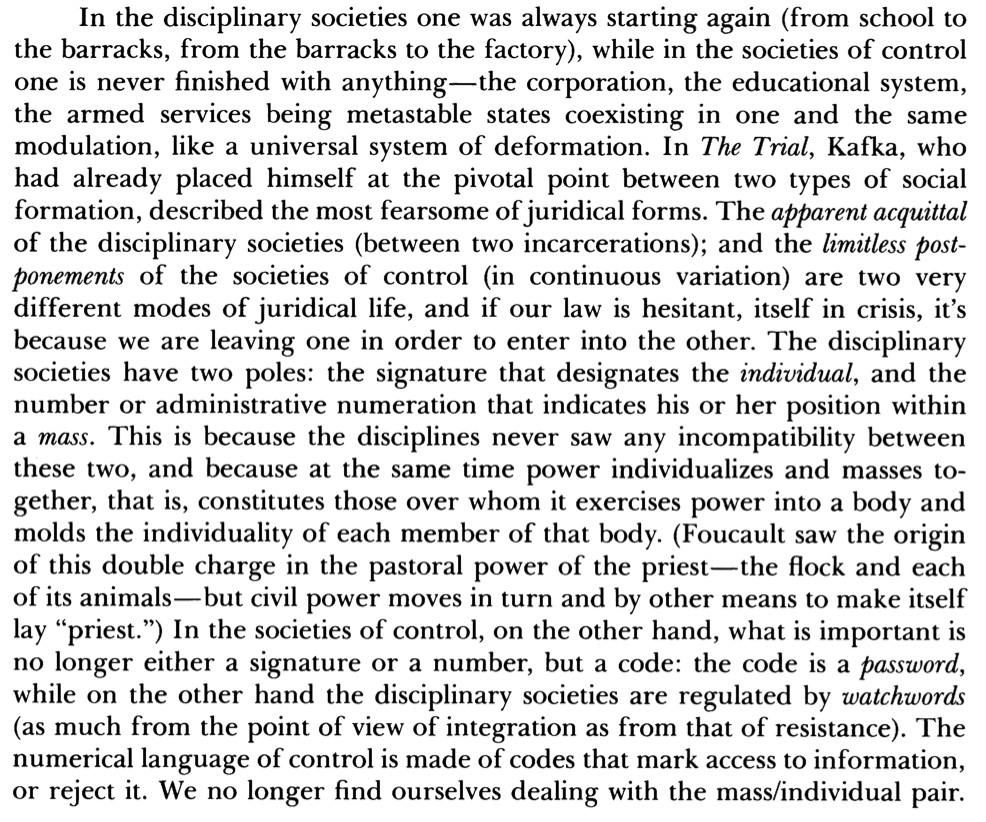
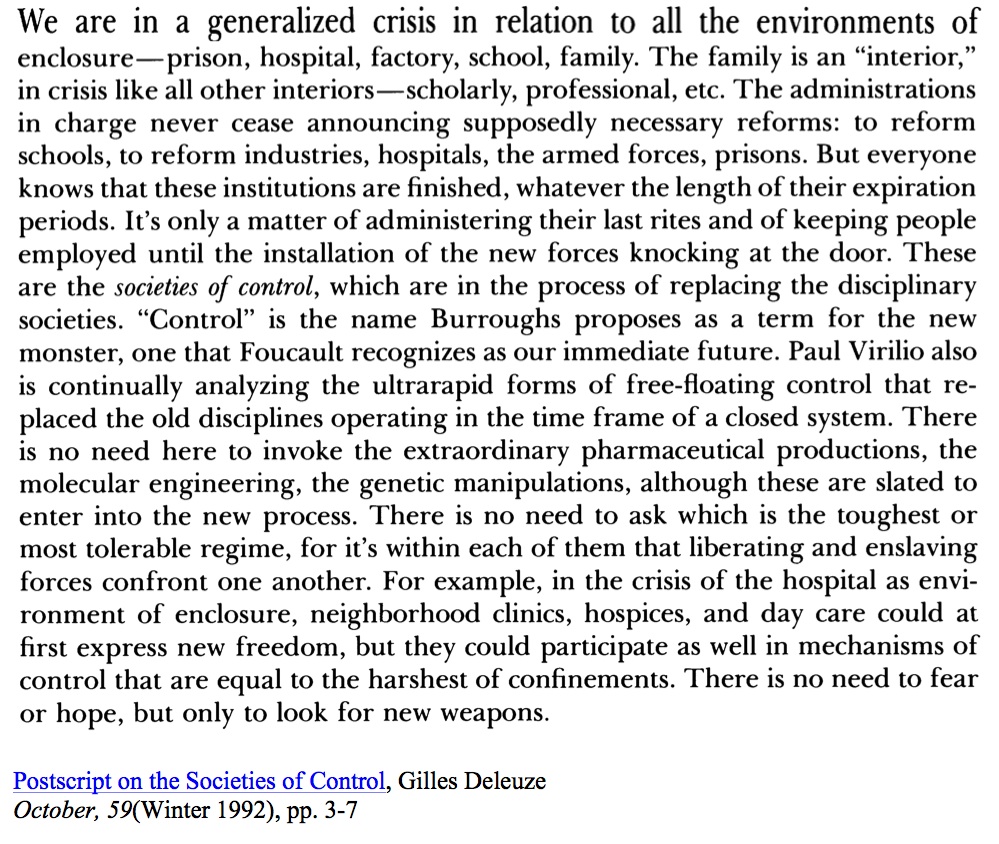
Building on Foucault’s recognition of the structures within a culture of control, DeLeuze details:

We are in a generalized crisis in relation to all the environments of enclosure—prison, hospital, factory, school, family….The administrations in charge never cease announcing supposedly necessary reforms: to reform schools….But everyone knows that these institutions are finished….These are the societies of control, which are in the process of replacing the disciplinary societies….In the disciplinary societies one was always starting again (from school to the barracks, from the barracks to the factory), while in the societies of control one is never finished with anything [emphasis added]. (pp. 3, 5)

And now the intersections among closeted existences, fear, constant surveillance and the Boston Marathon bombing, and the “age of infinite examination” that is education reform built on accountability, standards, and high-stakes testing.

First let’s zoom in to the life of the student, specifically the student marginalized in her/his home and community and then marginalized in her/his school: “a pupil’s ‘offense’ is not only a minor infraction, but also an inability to carry out his tasks,” Foucault explains (p. 194), predating significantly the new norm of “no excuses” school cultures as captured by Sarah Carr’s look at post-Katrina New Orleans and the rise of KIPP and similar charter schools:

The reformers approach students they perceive as disadvantaged in much the same way they do struggling teachers….[L]ow income children must be taught, explicitly and step-by-step, how to be good students. Staff at a growing number of “no-excuses” charter schools…are prescriptive about where new students look (they must “track” the speaker with their eyes), how they sit (upright, with both feet planted on the ground, hands folded in front of them), how they walk (silently and in a straight line, which is sometimes marked out for them by tape on the floor), how they express agreement (usually through snaps or “silent clapping” because it’s less disruptive to the flow of class), and, most important, what they aspire to (college, college, college). This conditioning (or “calibration” or “acculturation”…) starts with the youngest of students. (pp. 42-43) [2]

“The disciplinary mechanisms,” Foucault explains, “secreted a ‘penalty of the norm,’ which is irreductible in its principles and functioning to the traditional penalty of the law” (p. 196). Carr and Nolan, in her ethnography of zero tolerance policies in urban high schools [3], shine a light on how schools and the penal system have merged in the U.S. for “other people’s children”—creating both a school-to-prison pipeline and schools as prisons.

CCSS and the high-stakes tests designed to enforce those standards, then, are yet a logical extension of the broader purposes of school to control, an institution that “compares, differentiates, hierarchizes, homogenizes, excludes[,]…normalizes” through the mechanism of tests:

The order that the disciplinary punishments must enforce is of a mixed nature: it is an “artificial” order, explicitly laid down by a law, a program, a set of regulations. But it is also an order defined by natural and observable processes: the duration of apprenticeship, the time taken to perform an exercise, the level of aptitude refer to a regularity that is also a rule. (Foucault, pp. 194-195)

As well, Deleuze recognizes education is in a contant state of crisis, reform, and standardization, within which schools, teachers, and students can never finish. Our Brave New World of standardization and “infinite examination” is one of international rankings, school rankings, teacher rankings, and student rankings—all of which assure that virtually everyone cannot possibly measure up; number two is perpetually the first loser.

“The power of the Norm appears throughout the disciplines,” adds Foucault:

The Normal is established as a principle of coercion in teaching with the introduction of a standardized education and the establishment of the ecoles normales (teachers’ training college)….Like surveillance and with it, normalization becomes one of the great instruments of power at the end of the classical age. (p. 196)

A culture of control is the antithesis of a community.

A culture of control uses the normative gaze to breed conformity and to excise the Different from the herd.

A community reaches out, lends a hand, opens arms. A community is an invitation to the recognition of the humanity that joins all people despite the diversity among us individually.

Many closets, one fear—this should speak to our hearts in a way that moves us beyond cultures and societies of control and toward a community.

We should also come to see that our culture of control is built upon and perpetuated by a dehumanizing education mechanism grounded in surveillance and fear.

Just as fear is the wrong motivation for embracing the perpetual surveillance created by smart phones, cameras on every street corner, and the Internet, fear is the wrong motivation for how we build our schools.

Ultimately, KIPP and other “no excuses” charter schools, CCSS, and the perpetual churn of education reform are the consequences of fear.

Ceaseless school reform is irrational and heartless; it is building closets from the stones of test scores.

Ceaseless school reform creates schools and a society in which we all must find ways not to be seen, fearful if we take the risk to stand as our true selves in that open field we too will be shot down like a punch line in a comedy sketch.

[1] Foucault, M. (1984). The Foucault reader. Ed. P. Rabinow. New York: Pantheon Books. See “The means of correct training” from Discipline and punish.

[2] Carr, S. (2013). Hope against hope: Three schools, one city, and the struggle to educate America’s children. New York, NY: Bloomsbury Press.

[3] Nolan, K. (2011). Police in the hallways: Discipline in an urban high school. Minneapolis, MN: University of Minnesota Press.

Baldwin and Woodson: Lingering Legacy of Failing Education System

I am currently drafting a chapter on schools as prisons (a product of zero tolerance and “no excuses” ideologies and policies), and along with the words of James Baldwin being relevant today—

The truth is that the country does not know what to do with its black population now that the blacks are no longer a source of wealth, are no longer to be bought and sold and bred, like cattle; and they especially do not know what to do with young black men, who pose as devastating a threat to the economy as they do to the morals of young white cheerleaders. It is not at all accidental that the jails and the army and the needle claim so many, but there are still too many prancing around for the public comfort. Americans, of course, will deny, with horror, that they are dreaming of anything like “the final solution”—those Americans, that is, who are likely to be asked: what goes on in the vast, private hinterland of the American heart can only be guessed at, by observing the way the country goes these days. (Baldwin, 1998, pp. 432-433) [1]

—so are the words of Carter Godwin Woodson:

[T]he educational system as it has developed both in Europe and America [is] an antiquated process which does not hit the mark even in the case of the needs of the white man himself….The so-called modern education, with all its defects, however, does others so much more good than it does the Negro, because it has been worked out in conformity to the needs of those who have enslaved and oppressed weaker people….The same educational process which inspires and stimulates the oppressor with the thought that he is everything and has accomplished everything worth while, depresses and crushes at the same time the spark of genius in the Negro by making him feel that his race does not amount to much and never will measure up to the standards of other peoples. The Negro thus educated is a hopeless liability of the race. (pp. 4-5) [2]

[1] Baldwin, J. (1998). James Baldwin: Collected essays. New York, NY: The Library of America. Originally published in 1972, No Name in the Street.

[2] Woodson, C. G. (1933). The mis-education of the negro. New York, NY: Tribeca Books.