All posts by plthomasedd

P. L. Thomas, Professor of Education (Furman University, Greenville SC), taught high school English in rural South Carolina before moving to teacher education. He is a former column editor for English Journal (National Council of Teachers of English), current series editor for Critical Literacy Teaching Series: Challenging Authors and Genres (Brill), and author of Teaching Writing as Journey, Not Destination: Essays Exploring What ‘Teaching Writing’ Means (IAP, 2019) and How to End the Reading War and Serve the Literacy Needs of All Students: A Primer for Parents, Policy Makers, and People Who Care (IAP, in press). NCTE named Thomas the 2013 George Orwell Award winner. He co-edited the award-winning (Divergent Book Award for Excellence in 21st Century Literacies Research) volume Critical Media Literacy and Fake News in Post-Truth America (Brill, 2018). Follow his work @plthomasEdD and the becoming radical (https://radicalscholarship.wordpress.com/).

The Ignored Arm of the Commons and the Invisible Hand of the Market

Education Week has posted a new report on charter school funding, the blog titled “Charter Schools’ Funding Lags, Study Finds”:

Charter school students receive about $4,000 less in per-pupil funding than their regular public school peers according to an analysis of five regions across the U.S., a new report has found.

The report, conducted by the University of Arkansas and funded by the Walton Family Foundation, compared per-pupil funding rates between charter and regular public schools in Denver, Los Angeles, Milwaukee, Newark, and the District of Columbia from 2007-2011.

The Walton Family Foundation has been a major backer of school-choice, including charters and private school vouchers. (The Walton Family Foundation also supports coverage of parent empowerment issues at Education Week.)

…Many of the same researchers that conducted the Ball State University study participated in the University of Arkansas research.

What should anyone make about a report coming from the Department of Education Reform Walmart housed at the public University of Arkansas?

First, the charter school movement, good or bad, depends on the existence of public schools—a fact of the Commons often ignored.

The Invisible Hand of the Market sits at the end of the Ignored Arm of the Commons.

Try running your great new business without public streets and highways, public law enforcement, or public schools educating the vast majority of workers and consumers in the U.S.

As Bruce Baker has shown [1], the charter shuffle and its dependence on public schools must never be discounted; note this graphic:

Figure 1. The General Model

—–

As Kelvin Smythe notes:

The education situation is dire, western economies are struggling, with one of its manifestations being the rich and powerful acting to undermine public schools. Charter schools not being about charter schools is emblematic of that dire situation.

Charter schools and charter school reports coming from thinly veiled free market think tanks housed inside public universities are about unfairly discrediting public schools and the wider Commons as well as misrepresenting the power and importance of the free market.

The Invisible Hand of the Market can never conduct its magic without a powerful but Ignored Arm of the Commons to guide it.

[1] See also COMPARING CHARTER SCHOOL AND LOCAL PUBLIC DISTRICT FINANCIAL RESOURCES IN NEW YORK, OHIO, AND TEXAS, Baker & Wiley (2012); and FISCAL DISPARITIES AND PHILANTHROPY AMONG NEW YORK CITY CHARTER SCHOOLS, Baker & Ferris (2011)

Consumed by Manufactured Demons: The “-ism’s” that Blind

Science fiction and horror are two genres that often find themselves intersecting where some form of power reduces humans to mere cogs in the machine. Technology, the future, aliens, and the like, it seems, can be terribly frightening.

George Orwell’s Nineteen Eighty-Four stands as one of the most comprehensive and enduring examinations of when that power abuse is in the hands of a totalitarian government. Dystopian SF that explores the dangers of “big government” resonates with the Libertarian thread running through the American public, but SF also aims its detailed satire and allegory at the nuances of just how governments become totalitarian.

Ridley Scotts’ Alien and more recent Prometheus share more than a director and some sort of lineage in their narratives: Both SF films are horrifying tales of oppressive corporations. [Scott’s Blade Runner can be included here are these films also include the dangers of megalomaniacs, especially corporatists and industrialists who use their ill-got billions for something other than the common good.]

While the mid-1950s spawned SF/horror films as thinly disguised propaganda matching the public hysteria about the Red Scare—the immediate and insidious threat of Communism (see Invasion of the Body Snatchers for a tour de force of such)—the Cold War eventually proved that the creeping cancer of Communism wasn’t as powerful as political leadership and pop culture claimed.

What, then, does SF say about more credible fears facing humanity?

In Cat’s Cradle, Kurt Vonnegut (1963) introduces into his fictional world Bokononism, a religion in which its messiah through the sacred text, The Books of Bokonon, confesses: “‘All of the true things I am about to tell you are shameless lies'” (p. 5).

The government of San Lorenzo finds its stability built on a fabricated conflict between General McCabe and the founder of Bokononism, Bokonon:

“‘Well, when it became evident that no governmental or economic reform was going to make the people much less miserable, the religion became the one real instrument of hope. Truth was the enemy of the people, because the truth was so terrible, so Bokonon made it his business to provide the people with better and better lies.'” (p. 172)

The charade driven by McCabe outlawing Bokononism and declaring Bokonon a fugitive continues at the expense of McCabe and Bokonon as men until their manufactured war between the righteous McCabe and renegade holy man Bokonon becomes essential itself:

“‘McCabe was always sane enough to realize that without the holy man to war against, he himself would become meaningless.'” (p. 175)

Cat’s Cradle examines the power of creating a demon for the public in order to keep that public distracted while the privileged remain privileged. Yet, Vonnegut’s often slapstick and always raucous narrative could just as easily be about the U.S. at almost any point in the past century.

What should be feared about the U.S. government and society is better captured, in fact, by Cat’s Cradle, Alien, and Prometheus than Invasion of the Body Snatchers. In other words, Communism and Socialism remain much invoked demons, but the dangers lie somewhere else entirely.

In 2013, two ideologies are intersecting—not unlike SF and horror—the progressive and often liberal education community and the libertarian and populist rightwing commentators and public. The common demon?

Common Core State Standards (CCSS).

While the progressive education community tends to reject CCSS as yet more of the failed accountability, standards, and high-stakes testing paradigm (the insanity of doing the same thing over and over while expecting different results) as well as a distraction from the need to address poverty and inequity, the libertarian/populist rejections of CCSS tend toward a fear of an Orwellian Big Brother or subversive curriculum as pods placed beside the beds of our children; thus, all over Facebook, CCSS are being linked to the Great Evils—Communism and Socialism.

While there is much to be feared about CCSS, that fear need not be grounded on its use to instill communism and/or socialism in America’s youth.

“Communism” and “Socialism” are terms tossed about without much regard for what they mean, but like Bokononism in San Lorenzo, the terms are “ism’s” that blind; they are manufactured demons that allow genuine threats to exist and prosper.

In both Alien and Prometheus, main characters and the audience soon discover that under the guise of science and exploration, the evils of corporate greed—controlling government and its military—are far more horrifying and real than any Red Scare or any form of government, in fact.

Ironically, while I contend we don’t need CCSS, the ability of corporate America to so easily and persistently manipulate the public’s lack of understanding of “-ism’s” seems to beg for a close inspection of just what is being taught in our schools. And if I were going to implement a core curriculum in the U.S., it would include a careful and extensive consideration of some foundational terms:

  • Communism
  • Socialism
  • Capitalism
  • Fascism
  • Oligarchy
  • Indoctrination
  • Consumerism

Condemning CCSS as a government plot to brainwash America’s children with Communism or Socialism ignores some basic points of fact:

  1. Socialists and communists have no power and almost no voice in the U.S.; for at least sixty years, both terms have been used in public discourse to demonize and marginalize (even as both terms are almost always misused in that discourse).
  2. The CCSS were created by and are overwhelming endorsed by the power and corporate elite—who benefit from a consumer culture, not a communist or socialist society.

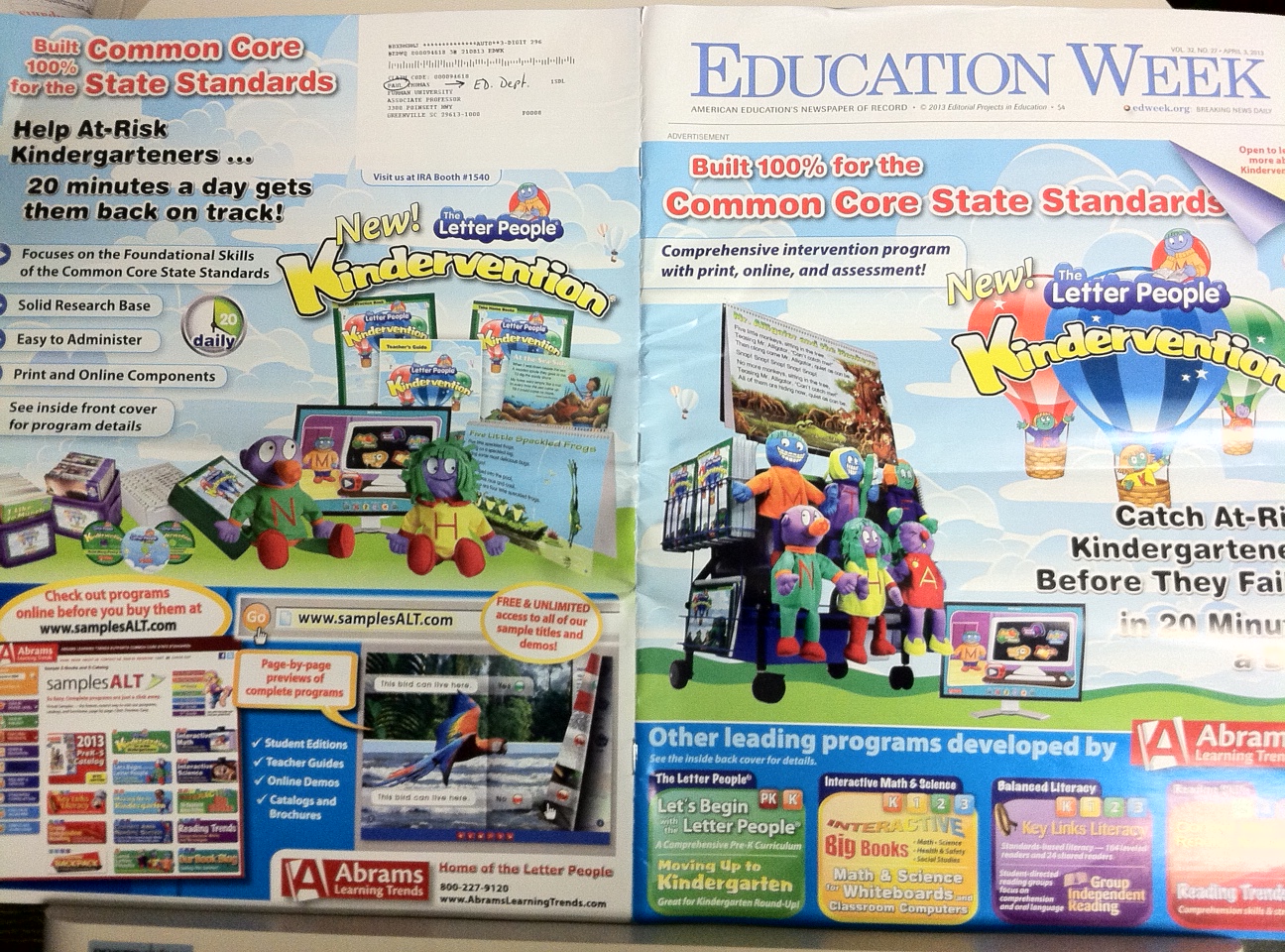
For those who fear the CCSS, I want to remind you once again: Look carefully at this entire cover of Education Week exposing that CCSS is consumerism and commodification—not communism and socialism:

EW.CCSS

The crass commercialism covering a major education publication reads like an infomercial:

“Catch At-Risk Kindergarteners Before They Fail…in 20 Minutes a Day!”

“Help At-Risk Kindergarteners…20 minutes a day gets them back on track!”

But a letter from the company vice president doesn’t inspire much confidence about high standards: “Kindervention is the most unique program in our history…,” it opens.

Most unique? Maybe words that can’t be qualified aren’t in the CCSS.

Ultimately, CCSS are a distraction.

And cries that CCSS are a communist, socialist, or government plot are distractions.

So the odd intersection of progressives and libertarians rejecting the CCSS fails ultimately since the reasons are deeply divided, but there is a reason that we all—every citizen of the U.S. regardless of ideology—should unite against CCSS and most other corporate manipulations of our Commons:

Being consumed by manufactured demons is a self-defeating American tradition that needs to be set aside.

Like the crews in both Alien and Prometheus, Americans are blinded, and often asking the wrong questions (“Why is Common Core not requiring cursive writing instruction?”)—or worse yet, not asking any questions at all about the power of corporate America over the government we fail to see as “we the people.”

“What You Say about Somebody Else, Anybody Else, Reveals You”

In a clip from Take this Hammer (1963), James Baldwin speaks pointedly and thoughtfully about “Who is the Nigger?”

—–

In this explication of the racial slur now rendered taboo, Baldwin explains that “What you say about somebody else, anybody else, reveals you.” His examination asks his listeners to turn the racism and demonizing of people positioned as “Others” back on those using language as both a sword and a mask.

Currently, in 2013, racial slurs as taboo words have resulted in an ironic silencing of discussions of race as well. Polite company—that middle-class norm of civility—will not allow racial slurs, but that censoring of a word also becomes a more insidious form of oppression, a verbal shielding of the remaining racism that strangles the American democracy.

Nearly fifty years later, during the 2012 Republican primaries for president, Americans found themselves confronted by the most corrosive forms of racism in the candidacy of Newt Gingrich, but few strayed outside the confines of civility to name it for what it was.

[As SC Republicans have joined the rise of voters supporting Donald Trump, the discussion below remain relevant, and Trump has followed an even more aggressively racist and fascist pattern than Gingrich.]

“I’m Going to Continue to Help Poor People Learn How to Get a Job”

During Gingrich’s rise to winning the South Carolina presidential primary in January 2012, Gingrich built a steady platform about “poor people”—including the following:

• Repeating the refrain that Obama is the “food stamp president.”

• Calling for “poor children” to be given work in schools as janitors because:

“Really poor children in really poor neighborhoods have no habits for working and have nobody around them who works. So they literally have no habit of showing up on Monday,” Gingrich told more than 500 employees inside the Nationwide Insurance lunchroom, NBC News reported. “So they literally have no habit of showing up on Monday. They have no habit of staying all day. They have no habit of ‘I do this and you give me cash,’ unless it’s illegal.”

• Assuming the pose of professor and job creator by announcing he was “…going to continue to help poor people learn how to get a job, learn how to get a better job, and someday learn how to own the job.”

Gingrich’s racism and his speaking to the racism of his constituency were in many ways more insidious than the racial slur confronted by Baldwin in 1963 because Gingrich’s ploy allowed him to mask his intent one or two layers beneath his words. “Food stamps,” “janitor,” “no habit” (laziness), and “illegal” trigger the racial stereotypes that drive racism—stereotypes that have no basis in fact, but remain robust in America’s social norms and uncritical acceptance of myths such as the culture of poverty.

As a fifty-plus-year-old white man living my entire life in the South, I am well acquainted with the pervasive direct racism as well as the wink-wink-nod-nod racism not just a legacy of the South but a daily reality remaining in 2013. As Gingrich mined and as Obama remained mostly silent on that racism, Americans and their leaders must confront the realities of the land of the free and the home of the brave:

• Males constitute about half the U.S. population, but represent by 10 to 1 the prison population; white men outnumber black men about 5 to 1, but black men fill U.S. prisons at a rate 6 to 1 compared to white men.

• According to 2005 research by Walter Gilliam, prekindergarten expulsion rates mirror U.S. prison dynamics: “Black boys receive less attention, harsher punishments, and lower grades in school than their White counterparts”:

African-American preschoolers were about twice as likely to be expelled as European-American (both Latino and non-Latino) preschoolers and over five times as likely as Asian-American preschoolers. Boys were expelled at a rate over 4½ times that of girls. The increased likelihood of boys to be expelled over girls was similar across all ethnicities, except for African-Americans (?2 = 25.93, p < .01), where boys accounted for 91.4% of the expulsions.

• Childhood poverty has accelerated in the U.S. (22%) and ranks far below countries similar to the U.S. throughout the world (see HERE, HERE, and HERE).

• The wealth gap has increased significantly among racial groups:

The racial wealth gap has been enormous ever since the Census Bureau began measuring it 25 years ago. But it has never been larger than today. The median wealth of a white family is now at least 20 times higher than that of a black family and 18 times that of a Latino family, according to an analysis by the Pew Research Center.

• The welfare myth remains powerful but also inaccurate—specifically in terms of who receives food stamps:

Gingrich, meanwhile has been criticized not only for singling out Obama as the “food stamp president” but for specifically linking the program to minorities. The NAACP and the National Urban League sharply criticized him for comments in early January that “the African-American community should demand paychecks and not be satisfied with food stamps,” accusing him of feeding stereotypes about the black poor. In fact, 22% of SNAP recipients are black, compared to 36% for whites, 10% for Latinos and 18% from unknown racial backgrounds.

Equity, especially among the races, and upward mobility have eroded in the U.S., often dwarfed by greater equity and upward mobility in other countries. Timothy Smeeding explains:

Higher levels of economic inequality are associated with lower rates of mobility. But children are more upwardly mobile in some nations than in others. How do countries like Canada, with above-average inequality and above-average child poverty rates, do so well on mobility outcomes compared with the United States? Canada has more effective public investments in education, including nearly universal preschool, effective secondary schools and high rates of college completion. And the Canadians are much more generous to low- and middle-income families, including child allowances and tuition breaks for university education.

• While “No Excuses” education reformers simultaneously decry public education a historical failure and the sole mechanism for social reform, children of color and children in poverty are routinely assigned to classrooms taught by the least experienced and un-/under-qualified teachers—including a rise in hiring Teach for America (TFA) recruits to staff high-poverty schools and in corporate charter schools that are re-segregating public education.

The reality of racism and inequity in America is being ignored, and politicians, such as Gingrich, bait racists and perpetuate racism, directly and indirectly.

A recent Room for Debate (The New York Times) includes George Lakoff identifying why and how politicians continue to misrepresent the state of America:

But more often politicians lie to protect or advance what they see as a moral endeavor (e.g., the invasion of Iraq, Reagan’s war on nonexistent ‘welfare queens, Johnson on the Tonkin Gulf). In the conservative moral system, the highest value is protecting and extending the moral system itself. When conservative icons or ideas themselves are threatened, it is not uncommon for conservative politicians to lie in their defense (Reagan never raised taxes; there’s no evidence for global warming; “government takeover”).

It is politically advantageous to claim that America is post-racial, that America has achieved equity, but as the evidence above shows, those claims are political lies.

We may say that Gingrich’s campaign strategy included race-baiting or class warfare, but that would be yet more masking and avoiding the harsh reality that Gingrich’s strategy was racism—and it often worked.

To paraphrase and extend Baldwin’s perceptive understanding of a racial slur, what Gingrich said about poor people was telling us about him, and by association, those who voted for him.

Racism remains a vivid and crippling scar on the American character in 2013, and America needs leadership and voices that will name that reality and call for a commitment to seeking the ideals of equity and post-racial America. But that will never occur if we hide behind the masks of middle class civility and political expediency that claim we have achieved the ideals we debase every day.

Recommended James Baldwin

Who is the Nigger? -James Baldwin

Baldwin’s Nigger 1 of 3

Baldwin’s Nigger 2 of 3

Baldwin’s Nigger 3 of 3

James Baldwin on Education

Where Is Our “Sense of Decency”?

Before teaching The Crucible in my American literature courses during my two decades as a high school English teacher in rural Upstate South Carolina, I played the students R.E.M.s “Exhuming McCarthy,” which “makes an explicit parallel between the red-baiting of Joe McCarthy‘s time and the strengthening of the sense of American exceptionalism during the Reagan era, especially the Iran-Contra affair” (Wikipedia).

The song includes an audio from the McCarthy hearings, including this soundbite of Joseph Welch confronting Joe McCarthy:  “Let us not assassinate this lad further, Senator….You’ve done enough. Have you no sense of decency, sir, at long last? Have you left no sense of decency?”

Part of The Crucible unit asked students to examine how societies continue to repeat the basic flaws of abusing power and oppressing powerless groups of people. Despite the lessons of the Witch Trials and the Red Scare/McCarthy Era (with the Japanese Internment in between), Americans seem hell-bent on doubling down on policies and practices that are authoritarian, hypocritical, and simply mean—especially if those policies can be implemented by people with power onto the powerless.

Current education reform needs a McCarthy hearing, and we need to confront those driving those reforms with “You’ve done enough. Have you no sense of decency, sir, at long last? Have you left no sense of decency?”

For example, consider the following:

History is replete with evidence that the ends do not justify the means.

While there remains great political and public support for grade retention, for example, a huge body of evidence shows that retention negatively impacts students retained, taxpayers, and peers not retained—all for mixed results of short-term test scores.

The only justification for grade retention is giving the appearance of being tough (raising a key question about how tough any adult is for lording him/herself over a child).

Americans’ puritanical roots are some of our worst qualities, and especially where children and other marginalized groups are concerned, Americans need to regain our sense of decency.

We would be well advised to begin with how we reform our schools.

Columbia, SC: Thomas: Florida offers flawed formula for SC schools | Opinion Columns | The State

Columbia, SC: Thomas: Florida offers flawed formula for SC schools | Opinion Columns | The State.

SC Senate Majority Leader Harvey Peeler, R-Cherokee, has introduced an education bill modeled on a third-grade retention policy widely promoted by Jeb Bush as one aspect of the larger so-called Florida formula. Superintendent Mick Zais has endorsed the bill as well as suggested implementing similar policies at seventh grade.

SC political leadership must not follow Florida’s lead in reading or grade retention policy for several reasons, including the following: the Florida formula has been thoroughly discredited as a basis for policy, grade retention has no support in the research that shows retention produces mixed positive outcomes along with many negative consequences for children and tax payers, and initiatives such as Just Read, Florida ignore and replace credible literacy policy desperately needed in high-poverty states such as SC.

First, an essential problem with determining whether or not third graders pass or are retained based on high-stakes test scores is the powerful correlation between test scores and out-of-school factors. Increasing the stakes associated with test scores is guaranteed to impact disproportionately and negatively the most high-needs populations currently struggling in SC schools—high-poverty students, minority students, English language learners, and special needs students.

High-stakes test scores in reading are weak evidence of any child’s literacy, and measures such as “on grade level” are equally flawed. Instead of creating a punitive policy, SC needs to move beyond test-based educational practices, especially with our youngest and highest needs students.

Second, SC political leadership and the public must acknowledge that the “Florida Miracle”—like the “Texas Miracle,” the “Harlem Miracle,” and the “Chicago Miracle”—has been discredited as incomplete data, misrepresented accomplishments, or outright failures masked by political advocacy.

Matthew Di Carlo, a fellow at the Shanker Institute, acknowledges some basic gains in reading made by Florida students, but offers a strong caution:

“That said, the available evidence on these policies, at least those for which some solid evidence exists, might be summarized as mixed but leaning toward modestly positive, with important (albeit common) caveats. A few of the reforms may have generated moderate but meaningful increases in test-based performance (with all the limitations that this implies) among the students and schools they affected. In a couple of other cases, there seems to have been little discernible impact on testing outcomes (and/or there is not yet sufficient basis to draw even highly tentative conclusions). It’s a good bet – or at least wishful thinking – that most of the evidence is still to come….Whether we like it or not, real improvements at aggregate levels are almost always slow and incremental. There are no ‘miracles,’ in Florida or anywhere else. The sooner we realize that, and start choosing and judging policies based on attainable expectations that accept the reality of the long haul, the better.”

Third, while the Florida formula is not a credible basis for any state to create new policy, the most disturbing element of the proposal in SC is that all evidence on grade retention reveals only negative consequences for children (academic and emotional) and taxpayers, the public.

While public sentiment leans toward grade retention based on a popular rejection of social promotion, decades of research show that retention and social promotion are academically ineffective while retention also leads to powerful negative consequences for students. Grade retention has only one clear outcome: increasing the likelihood of a student becoming a drop-out.

In a high-poverty state such as SC, test-based grade retention policies based on reading proficiency will guarantee an increase in the negative outcomes currently being experienced by high-poverty minority students. Following the Florida formula will, then, perpetuate and increase the exact problems education reform should be alleviating.

Kevin Welner, director of the National Education Policy Center, has detailed that retention fails students and ultimately taxpayers because retention increases drop-out rates:

“1. She may drop out, meaning she will pay about $60,000 less in taxes over her lifetime, be more likely to commit crimes, and be more likely to depend on government assistance; or

“2. She may complete high school, at a cost of an extra year of school – about $10,000. If retention had a substantial payoff, paying for an extra year of school would be worthwhile (although it nationally adds up to billions of dollars each year). But there’s no benefit. With grade retention, we are paying more and getting a worse outcome.”

Instead of following the punitive and ineffective Florida formula, SC reading reform should include low-cost but evidence-based policy changes that include increasing students’ access to books in their homes and schools, supporting students reading by choice for extended periods during the school day, and creating holistic and authentic models for assessing reading.