
All posts by plthomasedd

P. L. Thomas, Professor of Education (Furman University, Greenville SC), taught high school English in rural South Carolina before moving to teacher education. He is a former column editor for English Journal (National Council of Teachers of English), current series editor for Critical Literacy Teaching Series: Challenging Authors and Genres (Brill), and author of Teaching Writing as Journey, Not Destination: Essays Exploring What ‘Teaching Writing’ Means (IAP, 2019) and How to End the Reading War and Serve the Literacy Needs of All Students: A Primer for Parents, Policy Makers, and People Who Care (IAP, in press). NCTE named Thomas the 2013 George Orwell Award winner. He co-edited the award-winning (Divergent Book Award for Excellence in 21st Century Literacies Research) volume Critical Media Literacy and Fake News in Post-Truth America (Brill, 2018). Follow his work @plthomasEdD and the becoming radical (https://radicalscholarship.wordpress.com/).

Recommended: Educational Documentaries

I teach a May Experience course, The Reel World: The Depiction of Schools on Film. A colleague of mine in the education department and I designed the course before Waiting for “Superman,” but the course is intended as a way to examine how political and public discourse shapes perceptions about public schools as well as policy. The course was revised to include Poverty Studies credit so many of the films explore how education intersects class and race.

This May X, I added the choice of reading either Police in the Hallways: Discipline in an Urban High School, by Kathleen Nolan, or Hope Against Hope: Three Schools, One City, and the Struggle to Educate America’s Children, by Sarah Carr.

The focus of the discussion, however, remains on the eight documentaries below with some annotations about what aspects of education each film highlights. I do recommend all of these films, although each has some limitations as most documentaries do.

Recommended Documentaries on Education:

Corridor of Shame

This documentary focuses on a court case in South Carolina initiated by high-poverty school districts surrounding primarily the I-95 corridor of the state, paralleling the east coast and stretching from the NE to the SE region. The documentary suffers from melodramatic production values (music, slow-motion panning of sad children’s faces), but the essential claim of the film is important for confronting the social inequity that is reflected in educational inequity, particularly in the South. Issues included in the film are school funding, community-based schools, access to high-quality educational opportunities and facilities, teacher assignments related to student characteristics, and state education accountability mechanisms. Some related resources (SC school report cards, poverty indices, related blog posts) to the documentary can be found HERE.

Heart of Stone

Ron Stone stands at the center of this film about an urban high school in New Jersey. The film is solid and interesting—while also creating a good deal of tension and presenting a surprise ending. Many important issues are raised, notably the controversial stance of Stone as principal toward gangs and gang leaders attending the high school. This is an ideal companion to Police in the Hallways and it confronts several important issues about education and education reform—urban schools, high-poverty/majority-minority schools, zero tolerance policies, deficit views of minorities and impoverished children, gang presence and violence, leadership styles, police in schools.

Flock of Dodos

The controversy, teaching evolution in public schools, that will not die—although it has evolved, ironically—is explored by this film that is engagingly personal and often humorous. The Intelligent Design (ID) movement is the approach of the moment for creating debates about if and how evolution should be taught in schools. While the filmmaker is upfront with his allegiances to science, the documentary is fair, almost to a fault as it allows the scientists to show why their expertise is often lost in their arrogance. The film successfully helps viewers navigate the definitions of science, evolution, ID, and creationism; it also confronts the roles of religion, ideology, and politics (specifically the power of school boards) in the “teach the controversy” assertions found among ID advocates. An interesting connection to this documentary is the news coverage of a creationist test given to students in a SC private school.

Little Rock Central: 50 Years Later

These documentaries often soar because of the people allowed to speak for themselves. This excellent HBO film opens with Minnijean Brown Trickey returning to Little Rock Central High, and then it never fails to deliver throughout. I would rate this a must-see among the selections in this course. The film confronts Brown v. Board, separate and unequal, schools within schools, the return of segregation (especially in the South), and the lingering tensions between the ideal and reality of racial harmony. Related pieces on the rise of the segregated South and education reform in the New Jim Crow Era are recommended. Alexander’s The New Jim Crow is also an excellent connection.

Hard Times at Douglass High

When Waiting for “Superman” was released and disproportionately praised in the media, I wrote a piece on this documentary to suggest it is far superior and to ask viewers what these administration and teachers at Douglass High were supposed to do. The focus of this film is No Child Left Behind (NCLB) in the context of a high-poverty, majority minority urban high school. Some of the most significant moments of the documentary are disturbing scenes of violence in the hallways and one female student recounting a fight with an adult male relative. Teachers struggling with the students, including one TFA recruit, are included, and this is also a strength of the film. The film addresses accountability, administrator/faculty relationships, the roles of teachers (especially young teachers), the influence and struggles of parents, the voices of students, the significance of extracurricular activities, and the limitations of school-only reform and accountability under the weight of poverty and racial inequity.

Clearcut

Who controls the money, controls everything—or at least who controls the money wants to control everything. This documentary examines the clash between a family funding scholarships and the science curriculum in a logging community. This is a powerful pairing with Flock of Dodos since both documentaries dramatize the debate over who should determine the curriculum in public schools serving a free society. Clearcut and Flock of Dodos also highlight the culture war that simmers beneath almost all educational controversies. The issues raised in this documentary can be linked to the influence of entrepreneurs in the current reform movement, such as Bill Gates, and the role of school boards is also a central issue, again as in Flock of Dodos.

Prom Night in Mississippi

Morgan Freeman challenges his childhood hometown to integrate the prom, and he’ll foot the bill; this is the focus of an engaging and powerful documentary on the persistence of segregated proms in the twenty-first century. The voices of students, parents, and administrators drive this film, and the intersection of racism and public education takes center stage through those voices. A potential pairing (non-education related) is the documentary The Loving Story about the 1967 Supreme Court case addressing interracial marriage. The 2013 prom integration in Georgia also is a suitable companion to this film.

Grain of Sand

Neoliberalism driving education reform in Mexico is confronted in this documentary, which provides a strong conclusion to the May experience addressing education. Corporations (Walmart, Coca-Cola, Ford), corrupt unions, and President Fox provide a matrix of influential forces shaping and even dismantling public education in Mexico, paralleling the same neoliberal agenda highlighted under George W. Bush and increased under Obama. A combative and disturbing documentary, Grain of Sand forces viewers to consider the value of the Commons and the dangers of privatization. Like Hard Times at Douglass High, this film suggests that accountability reform based on high-stakes testing poses much greater harm than good for schools and students.

—–

A companion video worth pairing with any of the above films is Tupac Shakur at 17 discussing education.
I Love My Students

Recently, I was at the window of my allergist, paying for my allergy shots. The receptionist asked me something about enjoying my break, but I noted I was currently teaching a May course. Her response was something like “Sorry.”

I said that I enjoyed my May class and ended with “I love my students.” The receptionist stopped typing my information into the computer and looked up at me, her brow furrowed.

“Are you being serious?” she asked.

“Yes,” I explained, “I love my students, I love teaching.”

She explained to me that another professor came to the same office and only said that sarcastically so she assumed I was also.

This moment came back to me as I watched CNN’s coverage of the tornado destroying a school in Moore, OK. Anderson Cooper, echoing comments made by the media during the Sandy Hook Elementary shootings, interviewed a teacher who had gathered all of her students under their desks during the storm—and no children from her class were injured—and stated that teachers do amazing things every day, heroic things every day, but this women had gone above her duty.

I have now grown tired of this token and blatantly superficial (and insincere) praise of teachers.

Token praise cannot, or at least should not, mask the disdain expressed about not only teachers but also workers in general in the U.S. The reposted blog below, then, remains a valid concern.

Teachers and the Death of the American Worker *

The first decade of the 21st century has been an ominous harbinger for the American worker.

Children and adults in poverty, the working poor, and the working class are increasing; the middle-class is eroding; and the pooling of capital among the 1% is expanding, forming the anchor stalling the progress of the USS Democracy.

In The State of Working America (12th ed), Mishel, Bivens, Gould, and Shierholz identify the disturbing trends that signal the approaching death of the American worker:

America’s vast middle class has suffered a ‘lost decade’ and faces the threat of another (p. 5)….

Income and wage inequality have risen sharply over the last 30 years (p. 6)….

Rising inequality is the major cause of wage stagnation for workers and of the failure of low- and middle-income families to appropriately benefit from growth (p. 6)….

Economic policies caused increased inequality of wages and incomes (p. 7)….

Claims that growing inequality has not hurt middle-income families are flawed (p. 8)….

Growing income inequality has not been offset by increased mobility (p. 9)….

Inequalities persist by race and gender. (p. 9)

Currently, the American worker—like those trapped in poverty and the working poor—have no political party because, ironically, the democratic process in the U.S. has been bought by Corporate America and democracy has been left in that wake.

Public school teachers also have no political party, and since the Chicago teachers’ strike, teachers now more than ever represent the political and public failure to appreciate and recognize the importance of the American worker.

Teachers as Workers

Early and mid-twentieth century America may have been a turning point for unionization in a country that lives more by ideology than evidence, but even that assessment may be tinted by the rose-colored glasses of hindsight.

The truth is likely that Americans’ embracing of rugged individualism has always been an impenetrable wall between the American character and the community and solidarity at the core of unions.

Nonetheless, the American public school teacher has over the past decade—during the demonstrable decline of the working and middle class as well as the rise of poverty in the U.S.—gradually become the target of the popular corporate agenda to end tenure and break unions, despite the essential democratic nature of both.

Politicians, corporate advocates, and the media have fed a willing public a steady diet of false but robust narratives that characterize teachers as the sole force behind misleading claims of failed public schools. Any evidence- and experience-based rebuttal to the “bad” teacher claim or the corrupt union mantra has been met with a “no excuses” ideology that chants “poverty is not destiny.”

This corporate agenda has no basis in fact, but the abundant commentaries and scholarship refuting this drum beat have failed to pierce the American public’s self-defeating faith in America the meritocracy.

The political and corporate elite know this, and they have little motivation to set aside their lies since they work, and since they benefit in the end.

And during the teachers’ strike in Chicago, the media and political leaders mischaracterized unions and teachers in Chicago and across the U.S.—more laziness and greediness heaped on teachers, and more evidence that the Democratic party is indistinguishable from the Republican party in terms of education and labor policy.

What is most disturbing ultimately about the demonizing of teachers and in effect all American workers is that most Americans are and will always be those exact workers who are being stripped of their rights, dignity, and access to the American Dream that the political and corporate elite along with the public claim to be protecting.

The Chicago teachers’ strike was yet another referendum on the failing education reform agenda that is destined to strip teachers of their professionalism and to further stratify the education system of the U.S. so that affluent children (mostly white) gain even more advantage in their schooling than they have in their lives over children living in working class, working poor, and impoverished homes (disproportionately people of color).

It was a political lie to claim that the Chicago teachers’ strike was the fault of lazy and greedy teachers supported by their corrupt union. It was a political lie to ignore the central demand of those teachers—a stand against test-based teacher accountability.

But neither the political elite nor the corporate elite will eventually lose in this debate because a public embracing of the corporate agenda and rejection of the striking teachers is a self-defeating commitment that will guarantee what appears inevitable now—the death of the American worker.

Teachers are not alone in this, but public school teachers are great American workers. I cannot fathom how we have come to a day when Americans no longer value something that cannot be more American than workers in solidarity.

* Reposted from Daily Kos, Teachers and the Death of the American Worker (September 11, 2012) 

Limes or Leeches: A Thought Experiment about High-Stakes Accountability

History is a powerful teacher—if we are willing to learn.

Many educators and scholars have triggered the truism “Insanity is doing the same thing over and over while expecting different results,” but that argument seems always to fall on deaf ears among our self-chosen education reformers, the media, and the public.

So let’s venture into history and explore a thought experiment: Would you prefer limes or leeches?

Study the history of identifying and treating scurvy, including how British sailors became known as “limeys.”

Now study the history of blood letting, and the use of leeches.

Solutions, history shows, must be built on a clear identification of the problems and then a careful analysis of what those solutions must be.

Limes and citrus fruits proved credible solutions for preventing scurvy—while “[i]n the overwhelming majority of cases, the historical use of bloodletting was harmful to patients.”

High-stakes accountability built on standards and high-stakes testing is the type of insanity found in bloodletting because the overwhelming majority of educational problems have nothing to do with accountability, standards, or testing—not the lack of accountability, standards, or testing, not the quality of accountability, standards, or testing.

Nothing.

In the education of your child, would you prefer limes or leeches? [And now let’s apply that answer to “other people’s children” because “they’re all our children.”]

Let’s stop the bloodletting.

First Name and then Act

If we cannot even name the reality we claim we want to change, then we will never change that reality.

—–

There are two points that I make in my scholarship and public writing that are certain to prompt reactions from both friends and foes that suggest I may have just run down someone’s grandmother with a bus:

Let me try once again to clarify both that these claims are true and necessary to name in order to change.

“Poverty is destiny” is a normative [1] fact of the United States. For most children, the social class they are born into predicts the trajectory of their lives, independent of their self-worth, effort, and all sorts of other factors we are more likely to associate with the individual child.

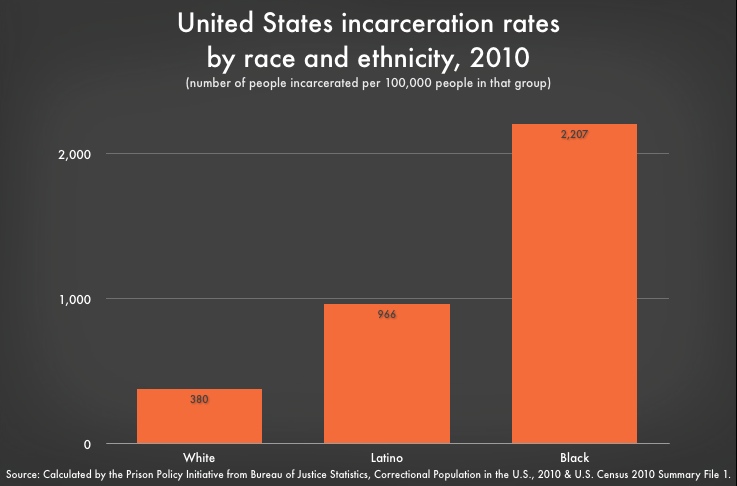
That this is a normative statement includes a concession that outliers exist (some people fall out of and rise above the social class of their births), but outliers do not discredit a normative statement just as we must caution against making an outlier status the rubric for normalized behavior. In other words, that African American men have scaled to the presidency and supreme court stands as outliers against the disproportionate number of AA men incarcerated in our country:

Michelle Alexander has embodied the need to name in order to change by confronting the normative facts of mass incarceration as well as the indisputable fact that mass incarceration is the New Jim Crow, thus racist.

And Sean Reardon has now offered a powerful case that “poverty and affluence are destiny”:

Here’s a fact that may not surprise you: the children of the rich perform better in school, on average, than children from middle-class or poor families. Students growing up in richer families have better grades and higher standardized test scores, on average, than poorer students; they also have higher rates of participation in extracurricular activities and school leadership positions, higher graduation rates and higher rates of college enrollment and completion….

In the 1980s, on an 800-point SAT-type test scale, the average difference in test scores between two such children would have been about 90 points; today it is 125 points. This is almost twice as large as the 70-point test score gap between white and black children. Family income is now a better predictor of children’s success in school than race….

We are still talking about this despite decades of clucking about the crisis in American education and wave after wave of school reform.Whatever we’ve been doing in our schools, it hasn’t reduced educational inequality between children from upper- and lower-income families….

The income gap in academic achievement is not growing because the test scores of poor students are dropping or because our schools are in decline….

It may seem counterintuitive, but schools don’t seem to produce much of the disparity in test scores between high- and low-income students. We know this because children from rich and poor families score very differently on school readiness tests when they enter kindergarten, and this gap grows by less than 10 percent between kindergarten and high school. There is some evidence that achievement gaps between high- and low-income students actually narrow during the nine-month school year, but they widen again in the summer months….

The more we do to ensure that all children have similar cognitively stimulating early childhood experiences, the less we will have to worry about failing schools. This in turn will enable us to let our schools focus on teaching the skills — how to solve complex problems, how to think critically and how to collaborate — essential to a growing economy and a lively democracy.

Alexander and Reardon are naming normative facts—ones that many all along the ideological spectrum not only refuse to do themselves, but rush to silence others who do name in order to change.

If the patterns of mass incarceration and “no excuses”/”zero tolerance” schools and policies even impacted privileged white males proportionately in the U.S., the outcry would be deafening.

The current and historical racially disproportionate and negative patterns of the U.S. penal and judicial systems and the rise of highly segregated “no excuses” charter schools and “zero tolerance” urban public schools must be named and then we must act t change that which is racist, that which is classist, that which is sexist.

Refusing to name, refusing to act guarantees poverty will remain destiny and the current education reform movement will continue to mirror the New Jim Crow of mass incarceration.

If you are uncertain about the messages our culture sends about race, view the video below:

This Is The Worst Thing I Have Ever Heard A Child Say

[1] “Normative” is being expressed as “typical,” that which can fairly be called “normal” in the sense of mode and/or more than half of a population exists in that condition.

“Eager to Recreate the Same Old Nightmare”: Revisiting Vonnegut’s Player Piano

Few people could have imagined the acceleration of corporate influence that has occurred in the last two years despite the economic downturn associated with those corporations and the election of Barak Obama, who was repeatedly demonized as a socialist. *

More shocking, possibly, has been the corporate influence on the public discourse about universal public education, driven by Secretary of Education Arne Duncan and promoted through celebrity tours by billionaire Bill Gates, ex-chancellor Michelle Rhee, and “Superman” Geoffrey Canada.

Adam Bessie has speculated about the logical progression of the current accountability era built on tests and destined to hold teachers accountable for their students’ test scores (despite the evidence that teachers account for only about 10-20% of achievement)—hologram teachers. And Krashen believes that the corporate takeover of schools is at the center of the new reformers’ misinformation tour. For Anthony Cody, the future is a disturbing dystopia.

While Bessie’s, Krashen’s, and Cody’s commentaries may sound like alarmist stances–possibly even the stuff of fiction—I believe we all should have been seeing this coming for decades.

The science fiction (SF) genre has always been one of my favorites, and within that genre, I am particularly found of dystopian fiction, such as Margaret Atwood’s brilliant The Handmaid’s Tale, Oryx and Crake, and The Year of the Flood. Like Atwood, Kurt Vonnegut spoke and wrote often about rejecting the SF label for his work (See Chapter 1 of Wampeters, Foma & Granfalloons), but Vonnegut’s genius includes his gift for delivering social commentary and satire wrapped in narratives that seemed to be set in the future, seemed to be a distorted world that we could never possibly experience.

In 1952, Kurt Vonnegut published Player Piano, offering what most believed was a biting satire of corporate American from his own experience working at GE. A review of the novel describes Vonnegut’s vision of our brave new world:

The important difference lies in the fact that Mr. Vonnegut’s oligarchs are not capitalists but engineers. In the future as he envisages it, the machines have completed their triumph, dispossessing not only the manual laborers but the white collar workers as well. Consequently the carefully selected, highly trained individuals who design and control the machines are the only people who have anything to do. Other people, the great majority, can either go into the Reconstruction and Reclamation Corps, which is devoted to boondoggling, or join the army, which has no real function in a machine-dominated world-society.

Yes, in Vonnegut’s dystopia, computers are at the center of a society run itself like a machine, with everyone labeled with his or her IQ and designated for what career he or she can pursue (although we should note that women’s roles were even more constrained than men’s, reflecting the mid-twentieth century sexism in the U.S.). Where corporations end and the government begins is difficult in this society that is simply a slightly exaggerated of the life Vonnegut had witnessed while working at GE before abandoning corporate America to be a full-time writer.

For me, however, Vonnegut’s Player Piano is as much a warning about the role of testing and labeling people in our education system as it is a red flag about the dangers of the oligarchy that we have become.

Today, with billionaire Bill Gates speaking for not only corporate America but also for reforming public education, how far off was Vonnegut’s vision?

In the first decade of the twenty-first century, how different is Vonnegut’s world to what we have today, as income inequity and the pooling of wealth accelerates?

We have witnessed where political loyalty lies during the bailouts as corporate America collapsed at the end of George W. Bush’s presidency. With corporate America saved, and most Americans ignored, the next logical step is to transform public education by increasing the corporate model that has been crippling the system since the misinformation out of Ronald Reagan’s presidency grabbed headlines with the release of A Nation at Risk.

If Vonnegut had written this storyline, at least we could have been guaranteed some laughter. But this brave new world of public education is more grim—like George Orwell’s 1984.

Our artists can see and understand when many of the rest of us are simply overwhelmed by our lives. In Player Piano, we see how successfully corporate life disorients and overwhelms workers in order to keep those workers under control. And in the relationship between the main character Paul and his wife Anita, we watch the power of corporate life—and the weight of testing and reducing humans to numbers—being magnified by the rise of computers when Paul makes a plea to his wife:

“No, no. You’ve got something the tests and machines will never be able to measure: you’re artistic. That’s one of the tragedies of our times, that no machine has ever been built that can recognize that quality, appreciate it, foster it, sympathize with it.” (p. 178)

In the novel, Paul’s quest and the momentary rise of a few rebels appear to be no match for corporate control. Today, I have to say I am no more optimistic than Vonnegut.

When Secretary Duncan offers misleading claims about international test scores and bemoans the state of public schools for failing to provide us with a world-class workforce, and almost no one raises a voice in protest (except those of us within the field of education, only to be demonized for protesting), I am tempted to think that we are simply getting what we deserve—like Paul at the end of Player Piano: “And that left Paul. ‘To a better world,’ he started to say, but he cut the toast short, thinking of the people of Ilium, already eager to recreate the same old nightmare” (p. 340).

* Slightly revised reposting from OpEdNews (1/3/2011)

See Also

Engineers Own The Future, And Maybe Even Us, Jamie Condliffe