All posts by plthomasedd

P. L. Thomas, Professor of Education (Furman University, Greenville SC), taught high school English in rural South Carolina before moving to teacher education. He is a former column editor for English Journal (National Council of Teachers of English), current series editor for Critical Literacy Teaching Series: Challenging Authors and Genres (Brill), and author of Teaching Writing as Journey, Not Destination: Essays Exploring What ‘Teaching Writing’ Means (IAP, 2019) and How to End the Reading War and Serve the Literacy Needs of All Students: A Primer for Parents, Policy Makers, and People Who Care (IAP, in press). NCTE named Thomas the 2013 George Orwell Award winner. He co-edited the award-winning (Divergent Book Award for Excellence in 21st Century Literacies Research) volume Critical Media Literacy and Fake News in Post-Truth America (Brill, 2018). Follow his work @plthomasEdD and the becoming radical (https://radicalscholarship.wordpress.com/).

Test-Based Achievement Mirages: Florida Edition

One of the key flaws of education reform since the 1980s is that education policy tends to be more about political and popular fads resulting in copy-cat state education policy than about addressing provable educational need.

For example, as Cummings, Stunk, and De Voto show about state reading policy:

Florida, which passed it’s Just Read, Florida! retention-based third-grade literacy policy in 2002, is largely considered the trailblazer of such policies (CCSSO, 2019). Florida’s policy includes several provisions designed to improve students’ literacy in grades K-3, including early identification of students who need additional supports, ongoing monitoring and communication with families, a range of literacy interventions, and third-grade retention for students who do not meet a certain score on the state assessment. By 2021, 19 states had adopted retention-based third-grade literacy policies that contained several elements of Florida’s policy.

Cummings, A., Strunk, K.O., & De Voto, C. (2021). “A lot of states were doing it”: The development of Michigan’s Read by Grade Three law. Journal of Educational Change. https:// link.springer.com/article/10.1007/s10833-021-09438-y

However, with the release of the 2019 NAEP reading scores, Mississippi supplanted Florida as the miracle-du-jour.

These copy-cat urges have been grounded in almost exclusively grade 4 standardized test scores.

As I have documented about the over-reaction to Mississippi, the 2019 grade 4 scores were in line with decades of steady progress (thus no miracle), but most people failed to put the grade 4 scores in broader contexts that showed Mississippi grade 8 scores remained low and the racial gap remained steady even as Mississippi improved average scores.

Mississippi, in fact, was benefitting from the Florida model, mostly driven by grade retention.

New for 2023 is a moment of reckoning for Florida: “a Stanford University study of state-level standardized tests showed that Florida’s ‘learning rate’ was the worst in the country — by a wide margin.”

This analysis is taking into account longitudinal test scores instead of focusing only on early grades:

· Florida kids regress dramatically as they age in the system. Since 2003, Florida’s eighth grade rank as a state has never come close to its fourth grade rank on any NAEP test in any subject.

· The size of Florida’s regression is dramatic and growing, especially in math. Florida’s overall average NAEP state rank regression between fourth and eighth grade since 2003 is 17 spots (math) and 18 spots (reading). But since 2015, the averages are 27 spots (math) and 19 spots (reading).

Florida’s education system is vastly underperforming

Therefore, political leaders have tried to keep the focus on grade 4: “Tellingly, DeSantis ignored the eighth grade results, which came out far worse than fourth grade — just as they have in every NAEP cycle since 2003.”

So here is the dirty little secret about education reform and education policy.

First, test data are weak reflections of learning, and how we measure learning significantly impacts those scores.

Next, at the earlier grades, testing tends to reflect reductive versions of skills. For example, many states test pronunciation of nonsense words (thus, there is no meaning or comprehension) and call that “reading.”

Research for decades has shown that systematic phonics instruction can raise those scores, especially for young students, but that increase in pronunciation is not correlated with comprehension and that advantage disappears by middle school.

There is a similar pattern to how grade retention can raise test scores in the short term but those retained students fall behind again in a few years and are more likely to drop out.

In short, increased test scores in the early grades are often test-based achievement mirages, not increased learning.

As students and assessments become more sophisticated, these early increases are much harder to maintain for a number of reasons—some related to brain and overall development, and some related to teaching and learning conditions as well as instructional challenges.

This reckoning for Florida is a clarion call for all education reform across the U.S.

We must stop playing partisan politics with our schools, and we must resist copy-cat fadism when it comes to education reform.


Recommended Resources

A Critical Examination of Grade Retention as Reading Policy (OEA)

Reading Science Resources for Educators (and Journalists): Science of Reading Edition [UPDATED]

Thomas, P.L. (2022). The Science of Reading movement: The never-ending debate and the need for a different approach to reading instruction. Boulder, CO: National Education Policy Center. http://nepc.colorado.edu/publication/science-of-reading

Daredevil 7 (2023): “Protecting Property over People”

[Header and all images property of Marvel and artists]

Growing up in the 1960s and 1970s, I watched several popular versions of vigilante films, notably starring Charles Bronson (Death Wish), Clint Eastwood (High Plains Drifter, Hang ‘Em High), and Tom Laughlin (Billy Jack).

Simultaneously, I became a reader and collector of superhero comic books by Marvel. At the core of superhero comics—both the problem with and within the sub-genre—is the moral and ethical elements of vigilanteism and the tension between the rule of law and justice.

Virtually every superhero narrative is directly or indirectly addressing that moral dilemma, but many superhero characterizations have alluded to the real-world conflict between Martin Luther King Jr.’s commitment to nonviolence as a path to justice and Malcolm X’s embracing “by any means necessary.”

Too often those allusions are simplified if not ham-fisted; consider for example Professor X and Magneto in both films and print comic books.

One of the better efforts to interrogate the role of violence in seeking justice, I think, is the Daredevil/Punisher arc in the Netflix Daredevil series. It is “better,” I think, because the characterizations of both Daredevil and the Punisher are messier and slightly more realistic than print comic books.

Season 2 of Netflix’s Daredevil centers the essential differences between Daredevil and the Punisher as vigilantes.

The Daredevil reboot in 2022, volume 7, has been working back to this confrontation. I have examined how this storyline initially made me very nervous, and then, in issue 6, took a turn toward the complicating elements that are at the core of the original Netflix series.

Daredevil 7 (v7) is written by Chip Zdarsky and drawn by Rafael De Latorre with the cover by  Marco Checchetto and Matthew Wilson

Issue 7 opens by framing the Punisher, Frank Castle as a murderer, insane, and a pawn of The Hand:

This framing complicates both the act of vigilanteism as well as the different moral imperatives that guide Daredevil and the Punisher. For Daredevil, he must see himself as substantially distinct from the Punisher in mentality, intent, actions, and outcomes; remember, Daredevil has evoked that he knows the mind of god:

Another excellent complication in issue 7 is the role of free will [1], a tension that rests at the center of faith, religion, and perceptions of g/God: If g/God is all powerful and all knowing, where does that leave human free will?

Daredevil, of course, must believe simultaneously in a world of god and that he has free will to behave in ethical ways, with moral imperatives that the Punisher chooses to ignore.

And here this issues evokes a powerful and, again, complex examination of the rule of law:

This is the sort of nuanced distinctions Martin Luther King Jr. made during his non-violent protests:

You express a great deal of anxiety over our willingness to break laws. This is certainly a legitimate concern. Since we so diligently urge people to obey the Supreme Court’s decision of 1954 outlawing segregation in the public schools, it is rather strange and paradoxical to find us consciously breaking laws. One may well ask, “How can you advocate breaking some laws and obeying others?” The answer is found in the fact that there are two types of laws: there are just laws, and there are unjust laws. I would agree with St. Augustine that “An unjust law is no law at all.”

Now, what is the difference between the two? How does one determine when a law is just or unjust? A just law is a man-made code that squares with the moral law, or the law of God. An unjust law is a code that is out of harmony with the moral law. To put it in the terms of St. Thomas Aquinas, an unjust law is a human law that is not rooted in eternal and natural law. Any law that uplifts human personality is just. Any law that degrades human personality is unjust.

Letter from Birmingham Jail, Martin Luther King Jr.

Man-made law versus the law of God as well as the purposes and consequences of laws/breaking the law sits at the center of Daredevil’s quest continued in issue 7:

Directly and indirectly, Zdarsky has been exploring the tensions between capitalism/materialism and socialism/spirituality; here, the police state is framed as a tool of capitalism (“protecting property over people”), thus justifying Daredevil’s lawbreaking.

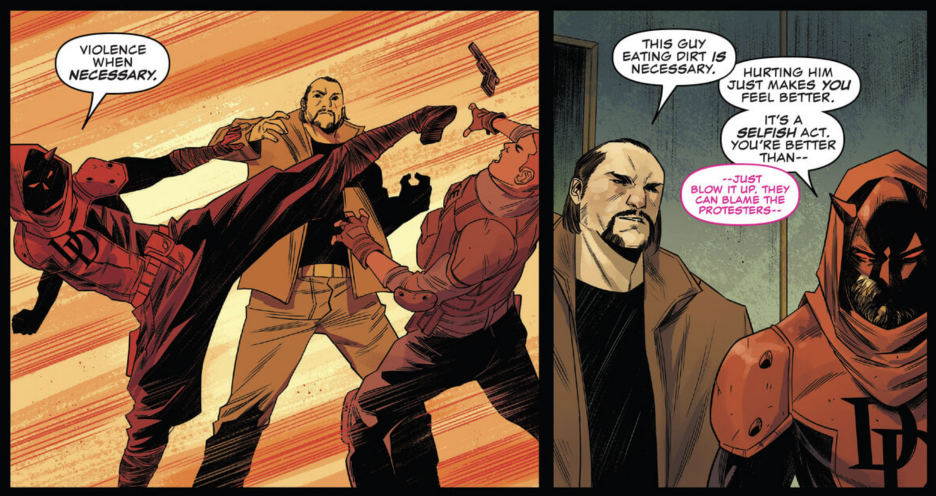
The code of ethics for the Fist becomes “help people” and “violence when necessary”:

While the narrative so far of Daredevil v7 has focused almost entirely on a new iteration of Daredevil, issue 7 reminds us that Matt Murdock is an (at least) equal partner in the quest for justice:

Daredevil as “decent superhero,” and Matt Murdock as “damned good lawyer” (with the added ironic layer of “damned”).

Bullet proves to be an important character in the Daredevil/Punisher dynamic because he adds complexity and confrontations to their differences and ultimately introduces important elements, a child and overt references to socialism/capitalism (linked to the philosophies of Jesus and property over people in the storytelling):

What and who is being consumed in capitalism/consumerism and who is allowed to go hungry [2]—these social commentaries hang over the more melodramatic aspects of superhero narratives.

While great efforts (especially by Daredevil) are made to distinguish Daredevil from the Punisher, we learn that their common ground is children:

The issue ends by returning to enduring Biblical questions about the sin’s of the father and the sins of the son as well as the pervasive presence of evil.

Readers are now poised to watch mere mortals battle in the names of god and evil, and we must wonder if any real distinction exists when violence is always an option.


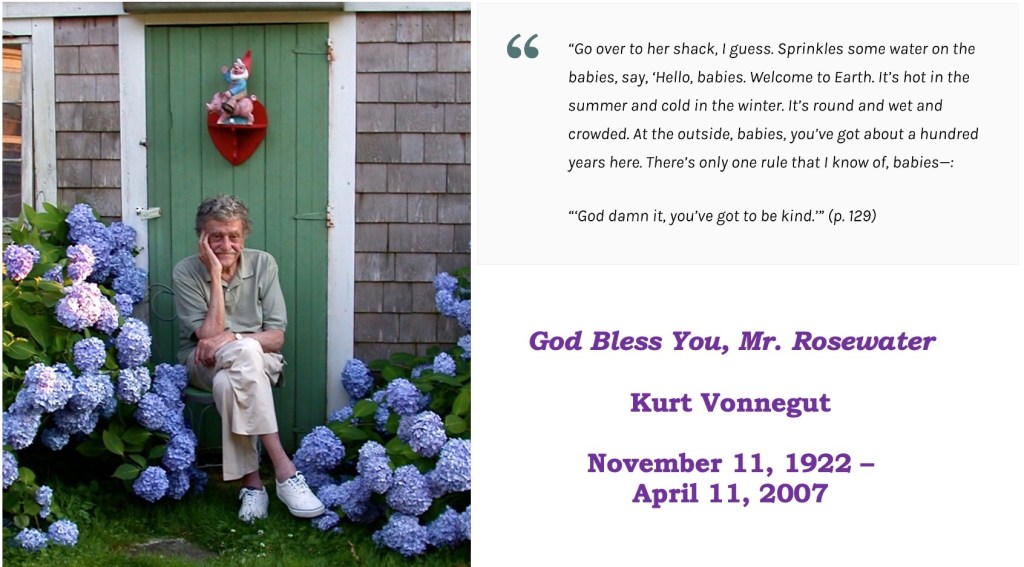
[1] The iconic aliens of Kurt Vonnegut’s Slaughterhouse-Five marvel at the idealistic delusion of the human race when challenged by Billy Pilgrim about free will:

“If I hadn’t spent so much time studying Earthlings,” said the Tralfamadorian, “I wouldn’t have any idea what was meant by ‘free will.’ I’ve visited thirty-one inhabited planets in the universe, and I have studied reports on one hundred more. Only on Earth is there any talk of free will.”

[Vonnegut, Kurt. Slaughterhouse-Five (Kindle Locations 1008-1010). RosettaBooks. Kindle Edition.]

[2] See:

If the child were brought up into the sunlight out of that vile place, if it were cleaned and fed and comforted, that would be a good thing, indeed; but if it were done, in that day and hour all the prosperity and beauty and delight of Omelas would wither and be destroyed. Those are the terms. To exchange all the goodness and grace of every life in Omelas for that single, small improvement: to throw away the happiness of thousands for the chance of happiness of one: that would be to let guilt within the walls indeed.

The Ones Who Walk Away From Omelas, Ursula K Le Guin

See Also

Letter from Birmingham Jail, Martin Luther King Jr.

The Ones Who Walk Away From Omelas, Ursula K Le Guin

Should We Be Nice?: The Banshees of Inisherin

I’d sooner chew my leg off
Than be trapped in this
How easy you think of all of this as bittersweet me

“Bittersweet Me,” R.E.M.

The gods had condemned Sisyphus to ceaselessly rolling a rock to the top of a mountain, whence the stone would fall back of its own weight. They had thought with some reason that there is no more dreadful punishment than futile and hopeless labor.

“The Myth of Sisyphus,” Albert Camus

I fell in love with In Bruges for many of the same reasons I have watched repeatedly the early films of Guy Ritchie; they all create a wonderful and disturbing tension between humor and violence wrapped in a glorious adventure of how we navigate the world through regional dialects.

In many ways, these films document that how we talk about this world and the human condition—the words we use, the ways we pronounce and utter meaning aloud—not only describes that world and being human but also shapes them as well.

Written and directed by Martin McDonagh, In Bruges is hauntingly beautiful to look at and glorious to hear because the film is meticulously written, filmed, and acted—notably including the leads Colin Farrell and Brendan Gleeson as well as the genius of Ralph Fiennes.

I love language and I love dialect (we Southerners owe a great deal to Irish roots across much of Appalachia) so this film has always been in my top two or three favorites; it is hard to identify a film more compelling, hilarious, and violently disturbing than In Bruges.

Of course, the arrival of The Banshees of Inisherin immediately drew my attention since the film is another collaboration among McDonagh, Farrell, and Gleeson.

The main characters are Pádraic Súilleabháin (Farrell) and Colm Doherty (Gleeson), and the central plot is directly stated in the promotional material; Colm abruptly ends his friendship with Pádraic with shocking consequences that constitute most of the film.

I am not compelled to review the film, but I do highly recommend it. I also think I can navigate this without spoilers so the discussion is mostly spoiler free (at least of key details) except to acknowledge that the film has many of the same features as In Bruges that make for a roller coaster viewing filled with laughing aloud, cringing, and even considering not being able to finish the viewing.

Again, if you love scenic films and dialect, this film is a lovely but unnerving two-hour trip.

One of the motifs of the film is confronting what it means to be nice. In the context of the film, “nice” is presented as at least two things—kind as well as being a bit dim witted.

Pádraic embodies both being nice and the tyranny of niceness; in fact, he and his sister are often characterized as mostly nice people, although their existence on an isolated Irish island in the 1920s during civil war provides a really complex historical and setting challenge to humans simply trying to live and even survive.

McDonagh’s The Banshees of Inisherin is set a century ago and echoes Camus’s Myth of Sisyphus if it were refashioned by Franz Kafka’s sense of absurdity and dark humor (something many people miss in Kafka’s The Metamorphosis).

The film explores isolation, loneliness, violence and abuse, and a seemingly endless and somewhat matter-of-fact fatalistic view of war.

Viewers, like Colm, should and likely do struggle with Pádraic, the nice guy.

Pádraic seems sincere, but his niceness is not a call to being nice (kind) but an interrogation of what nice actually is.

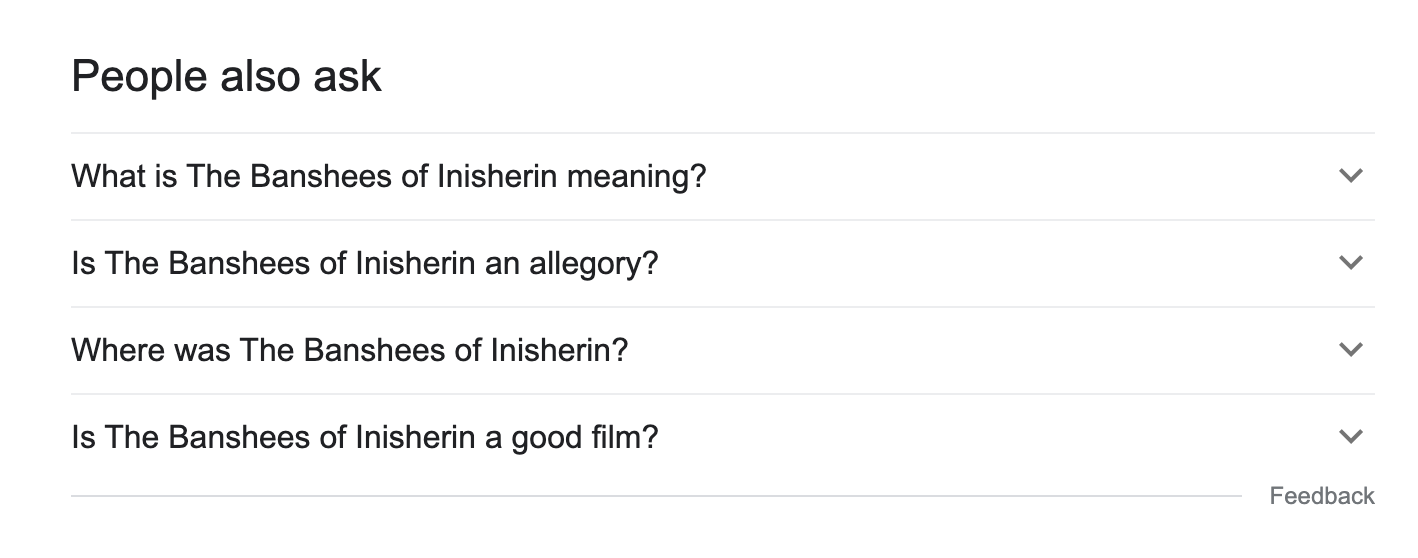
A Google search of The Banshees of Inisherin reveals something interesting about the film:

Viewers of this film want meaning, but I believe reducing art to simplistic messaging misses that most art is about raising questions, not offering simplistic themes on life and the human condition.

And the meaning of life is often as much laughing at as struggling against or coming to understand (something Colm is battling somewhat horribly).

In fact, in odd and mostly unpredictable ways, many characters and moments in the film dramatize acts of being nice (kindness)—even by characters who are otherwise not so nice—against the paradox of Pádraic’s development as a character after Colm ends the friendship.

[One of the best scenes involves Pádraic being confronted about his being nice by Dominic Kearney (Barry Keoghan), a character who in many ways adds texture to the motif of nice against Pádraic’s centered character.]

Being nice, it seems, is being interrogated in this film that is populated with non-romantic relationships—friends, siblings, parent/child, community members.

In that context, is there meaning in The Banshees of Inisherin?

I think so, of course, but I am more compelled by the questions it raises:

  • What does it mean to be “nice”?
  • What does any person owe another person in terms of their lives and their relationships?
  • Where is the line between nice/kindness and selfishness?
  • How are we shaped by our environment?
  • How do we come to know and recognize the impact of mental health on our ability to navigate the world? [While the film directly considers Colm’s mental health, we cannot ignore Pádraic.]

In the classic sense of the word, this film dramatizes the lives of pathetic people. But our hearts and our minds are often set against each other as the narrative develops in macabre ways that likely could make Edgar Allan Poe and Stephen King anxious.

My heart ached much of the film. Colm admits, “I do worry sometimes I might just be entertaining myself while staving off the inevitable.”

And he also prompts us to consider: “Niceness doesn’t last.”

There we may find a meaning, but I am not sure what we are supposed to do with that.


The Empty Politics of Teacher Attrition: SC Edition

Former South Carolina Governor Richard Riley, who would go on to be Secretary of Education, remains, for me, the gold standard of education governors.

Riley established education as a central agenda of a governor by launching SC’s commitment to the accountability movement linked to increasing teacher pay. My first year teaching in SC was the fall after Riley helped pass a significant teacher pay raise, in fact.

Over the next several decades, for example, George W. Bush parlayed education reform in Texas (the now discredited “Texas miracle”) into the White House and the historic No Child Left Behind (NCLB) era.

My entire career as a teacher has been in the hyper-accountability era of K-12 education grounded in accountability, standards, and high-stakes testing. I have offered critiques and advocated for finding a different way to do education because the accountability merry-go-round hasn’t served anyone well except politicians and the education market place.

Those good intentions and politically thoughtful strategies used by Riley in the early 1980s have, regretfully, devolved through W. Bush’s failed NCLB, Obama’s doubling down on accountability (focusing harsh accountability and bad science on teacher accountability and reform), and finally to today’s even more hostile environment toward teachers, who are routinely characterized as indoctrinators and groomers by Republican governors and other elected officials.

Only 14 years ago, this was the national antagonism toward teachers and teaching:

How to Fix America’s Schools, Time (8 December 2008)

The Bill Gates/Michelle Rhee era of stack ranking and value-added methods of evaluating teachers not only failed but also it further eroded the value of teaching and being a teacher.

While many of us in education felt that this had to be the low point of teacher bashing and education reform designed to dismantle education, we could not have envisioned the last few years, anchored in the final months of the Trump administration’s attack on the 1619 Project and diversity, equity, and inclusion initiatives in education.

Along with Covid, curriculum bans targeting (falsely) Critical Race Theory (CRT), book bans and attacks on libraries, and charging educators with being indoctrinators and groomers have now resulted in historic teacher shortages and likely one of the national low points for being a teacher in a country founded in part on a commitment to universal public education as a corner stone of being a vibrant democracy.

One of the more virulent anti-teacher and anti-education governors in the nation (likely just behind Gov. Abbott in Texas and the worst, Gov. DeSantis in Florida) is right here in my home state of SC, Governor Henry McMaster.

Yet, Gov. McMaster wants to have his cake and eat it to—but this will prove to be mere rhetoric and a disturbing example of how far the governorship has fallen since Riley:

Calling for a pay raise and a bonus to address the abysmal conditions of being a teacher in 2023 is yet another example of the empty politics of teacher attrition.

Should teachers be paid more?

Of course.

Is pay the root cause or even a major cause of teacher attrition?

No.

For many decades, research has shown that teachers value far above pay how they are treated professionally within the building and by parents and the public, the teaching and learning conditions within which they work, and a whole host of issues that speak to their professional autonomy and authority.

For the sake of the field of education and teaching as a profession, we must stop taking politicians seriously who are unserious about education and teaching.

McMaster followed Abbott’s playbook early on by calling for book bans and suggesting teachers and schools use literature to groom children

McMaster speaks into the ugly and false narrative that teachers are “woke” indoctrinators who have infiltrated K-12 schools with CRT.

Waving a few dollars in one hand while stabbing people in the back with the other isn’t political leadership, and it certainly is not a solution for teacher attrition.

Beleaguered Speaker of the House Kevin McCarthy didn’t take even a few breaths before declaring that his Congress will end woke indoctrination in schools; McMaster and most Republicans have committed entirely to that playbook filled with lies and distortions.

I do hope teachers receive significant pay raises, but that will not save teaching or education.

Political assaults on curriculum, libraries and books, and teacher professionalism must stop immediately.

Political and public narratives accusing falsely teachers of being indoctrinators and groomers must stop immediately.

Teachers deserve first and foremost in 2023 a huge public apology by the Republican Party, and then, teachers deserve a commitment to teacher professionalism and autonomy as well as a different approach not grounded in accountability but in reforming teaching and learning conditions so teachers can teach better and students can learn more.

Political leaders must

  • address poverty and inequity in our children’s lives,
  • fully fund public education,
  • reject school choice and other schemes that divert from public schools,
  • address in-school inequities such as class size and access to courses and programs,
  • and start education reform with teachers, not political fads and boondoggles.

There is a bit more than irony to Republicans who have historically been politically negligent with the refrain “You can’t just throw money at it” but who can’t imagine anything past a meager pay raise and a bonus to address teaching and education—especially when they have been the key architects in their destruction.

We can do better. We should do better. We must do better.

How we treat and support teachers is how we treat and support students; teaching conditions are learning conditions.

Maxine Greene has implored us in her Releasing the Imagination: “Community cannot be produced simply through rational formulation nor through edict,” Greene recognizes (p. 39), adding:

Community is not a question of which social contracts are the most reasonable for individuals to enter. It is a question of what might contribute to the pursuit of shared goods: what ways of being together, of attaining mutuality, of reaching toward some common world. (p. 39)

Releasing the Imagination

Yes, teachers are the key to public education, which is the key to democracy and freedom. But Greene’s call now stands as the opposite of the education system being created by Republicans

This brings me back to my argument that we teachers must make an intensified effort to break through the frames of custom and to touch the consciousness of those we teach. It is an argument stemming from a concern about noxious invisible clouds and cover-ups and false consciousness and helplessness. It has to do as well with our need to empower the young to deal with the threat and fear of holocaust, to know and understand enough to make significant choices as they grow. Surely, education today must be conceived as a model of opening the world to critical judgments by the young and their imaginative projections and, in time, to their transformative actions. (p. 56)

Releasing the Imagination

Republicans are unserious about teaching, teachers, and education. We cannot afford to continue to take them seriously.

What Reading Program Should Schools Adopt?

[Header Photo by Thought Catalog on Unsplash]

The TL;DR answer is “none.”

The conventional wisdom answer of the day is “one that is proven effective by independent scientific research.”

The reason the first answer is correct is that this is the wrong question, and wrong approach that has plagued the teaching of reading for most of modern education.

Yes, the conventional wisdom answer sounds compelling, but it is fool’s gold because there can never be a program “proven effective” since teaching and learning to read are quite complex and dependent on individual student strengths and challenges (as well as a whole host of contexts in any student’s home or school).

The reading program adoption merry-go-round is doing the same thing over and over while expecting different results.

Every reading program replaced was promised effective in the same ways as the one replacing it. (See also the constant changing of standards.)

Schools should take at least one long step backward and start with having teachers identify what is working, what isn’t working, and how typical populations of students being taught in that school present identifiable needs that teachers must address.

The source of decisions about teaching reading materials must begin with populations of students being served and teacher expertise on both reading and that unique population.
Reading material needs in the rural South are never going to be the same as reading material needs in the urban Midwest.
Keeping reading programs central to teaching reading creates several key flaws that are insurmountable:

  • Adopting reading programs results in focusing teaching accountability on how well the program is being implemented and not on student progress and struggles.
  • Reading programs feed a silver-bullet, one-size-fits-all mentality.
  • Reading programs shift the locus of authority to the program and not the teacher.
  • Reading programs are driven by market propaganda that distorts the evidence about effectiveness.

While I remain committed to the “none” answer, that genuinely is not a practical answer at the moment.

Schools will in all likelihood continue to adopt reading programs (or continue using the currently adopted program); therefore, here are some practical guidelines that merges my ideal (“none”) and the reality of day-to-day teaching:

  • As noted above, schools must do an assessment of their current student population, their current status of programs/materials, and their practical goals for improving student progress as readers.
  • That assessment must then guide analysis of the current program (how well and poorly it is meeting needs) or provide the framework for selecting a new program.
  • Schools must critically and even skeptically address that adopting new programs often always incurs excessive costs that may not be effective use of funding since teachers with autonomy may be able to make almost any program or set of materials work.
  • Reading program adoption must not be seen as all-inclusive of the school’s reading program, but as part of the entire reading materials package and as resources for teacher implementation.
  • Schools must resist scripted programs, period.

Ultimately, schools must shift their focus away from programs-based reading instruction and toward student-need-based reading instruction.

That shift would create space to maintain the teaching/learning of reading as the goal of accountability and move reading program fidelity out of the equation since programs and materials serve the expertise of the teacher guided by student needs.

As I have noted before, historically and currently, reading programs put reading last.

If we are genuinely dedicated to teaching all students to read better, we have to (finally) do things differently.

A good start would be recognizing that “What reading program should schools adopt?” is the wrong question and then stepping back to ask bigger and better questions grounded in the students being taught and the teachers charged with a better reading program.


See Also

Lessons in (In)Equity: An Evaluation of Cultural Responsiveness in Elementary ELA Curriculum

The Unnecessary Collateral Damage in the Misguided Reading Programs War

Reading Programs Put Reading Last

Teaching Reading and Children: Reading Programs as “Costume Parties”

Money: “don’t give me that do-goody-good bullshit”

Money, it’s a crime
Share it fairly, but don’t take a slice of my pie
Money, so they say
Is the root of all evil today
But if you ask for a rise, it’s no surprise
That they’re giving none away

“Money,” Pink Floyd

I prefer to keep my personal life personal, not exactly private but I am not apt to volunteer my personal life since it involves other people. It is impossible to share my personal life without making a decision for those people.

I don’t like decisions being made for me so I try hard to respect that with others.

However, about my life—five or so years ago I started a journey toward a new life, a journey that involved a few years of therapy.

That previous life spanned about four decades, the vast majority of my adult life. The therapy focused on my coming to terms with living with extreme anxiety, depression, and isolation for most of two decades.

And the root of that anxiety, depression, and isolation was money.

I felt—with a great deal of evidence to support my feelings—that I had become primarily my income for my family; and yet, despite having a very comfortable income, I was constantly putting out financial fires I didn’t start.

I was, as is the expectation in the good ol’ U.S. of A., making a living by giving up my life.

Cars, cell phones, home ownership, college, income taxes, etc.—these things became essential to our lives and constant sources of financial burdens laid at my feet despite my best and careful efforts to manage all the bills and expenses.

Since this was my family, I felt responsible, guilty, and increasingly resentful.

As an English teacher, I came to understand this scene in The Glass Menagerie in vivid and painful ways:

TOM: Look !- I’ve got no thing, no single thing !

AMANDA: Lower Your Voice !

TOM: In my life here that I can call my OWN ! Everything is –

AMANDA: Stop that shouting !

TOM: Yesterday you confiscated my books ! You had the nerve to –

AMANDA: I took that horrible novel back to the library- yes ! That hideous book by that insane Mr. Lawrence. [Tom laughs wildly.] I cannot control the output of diseased minds or people who cater to them – [Tom laughs still more wildly.] BUT I WON’T ALLOW SUCH FILTH BROUGHT INTO MY HOUSE ! NO, no, no, no, no !

TOM: House, house ! Who pays rent on it, who makes a slave of himself to –

The Glass Menagerie, Tennessee Williams

To have ones life turned almost entirely into being the responsible one, the one who makes the money, and then to recognize that the people for whom you dedicate your life-as-work are repeatedly careless with those efforts—this is among the many dehumanizing consequences of living in a culture that worships and centers money.

There was never enough money.

There was no way for there to be enough money.

Because disaster after disaster was perpetually burning it up even faster than I could make it.

I was always working 2 or 3 jobs (even while in a doctoral program, and as a full-time school teacher, I worked during Christmas at Sears), and there was no option to quit even one of those. I couldn’t even die, I thought, because I owe money, perpetually.

But here is the paradox.

Of course there was always more than enough money, and to be perfectly clear, this was never really about the money.

This is about basic human autonomy: Who has a right to how you spend your life and for what?

“Spend your life.”

This is the rhetoric we have chosen because we cannot, no, we refuse to exist in any other way not anchored to money.

My world became a struggle to be the careful one in a building storm of carelessness. Sisyphus had his rock; mine was money and debt.

“I still owe money to the money to the money I owe/ I never thought about love when I thought about home” (“Bloodbuzz Ohio,” The National).

I had lost (abdicated?) my humanity, my basic human dignity, and all I could feel was guilt and resentment.

This also is not about other people, the people of my family over those 40 years. In my very early 20s, I eagerly built that life—although in hindsight I did so in small increments that were not true to who I am (or was) as a human.

We allow and encourage people to build their lives in their 20s and 30s without really helping anyone recognize that they are making life decisions before they are even remotely fully formed (if any of us can ever be fully formed).

This is, of course, about me and my relationships with people and (regretfully) with money.

My transition to a new life included using the small amount of money we received from selling my parents’ house after they died to pay off my car and vowing never again to have a car payment. I believe in my bones that this decision would have made my parents happy.

My parents, you see, quite literally worked themselves into early graves, bound to money as the primary mechanism of love and family; these were working-class people tragically enamored with the American Dream and playing the part of Making It, of being upper-middle-class folk.

And I inherited mostly that dysfunction because they exhausted almost all of the material world they had sacrificed their lives to (see HERE and HERE).

Again, that isn’t their fault. My parents didn’t invent this rat race, this treadmill to nowhere with a few dollars waved in front of our faces to keep us stumbling along.

So this new life, or this next stage of life.

I want no longer to be resentful. I try also not to be angry or to blame anyone else for my station in life because I am at a place where most of that is well within my control.

“I don’t care what you say anymore, this is my life/Go ahead with your own life, leave me alone” (“My Life,” Billy Joel) plays in my young man’s memory, a young man who failed to listen to himself above the Ka-ching! of making a living..

And yet money still hovers there, blanketing everything.

Money is a ghost haunting the relationships I have lost with the family of those first 40 years.

Money is not the root of all evil.

Conceding our lives, our souls, to money—that is evil, a carelessness that can consume anyone who isn’t diligent about listening to their own heartbeat and not the rattling allure of a few coins.


Wonder Woman Historia: The Amazons (Book Three): “Born to Die”

You like your girls insane
So choose your last words, this is the last time
‘Cause you and I, we were born to die

“Born to Die,” Lana Del Rey

Wonder Woman Historia: The Amazons (Book Three) continues exploring the tensions between gods and mortals as well as between men and women. “Born to die” proves to be a chilling and powerful refrain (establishing the duality of birth/death) throughout this chapter concluding a three-issue arc written by Kelly Sue DeConnick with art from Nicola Scott.

Kelly Sue DeConnick (writer), Nicola Scott (artist), Annette Kwok (colorist), Clayton Cowles (letterer)

Scott continues the awe inspiring artwork by Phil Jimenez (Book One) and Gene Ha (Book Two) with DeConnick weaving an allusive and powerful re-imagining of the Amazons as well as speaking to enduring themes about humanity and human frailties as well as triumphs.

“She Believes Her Sin Set the War in Motion”

While Book Three offers an incredibly compelling narrative both in the writing and the visual dynamics, here I want to focus on the rich allusive and referential elements that reach out beyond that story.

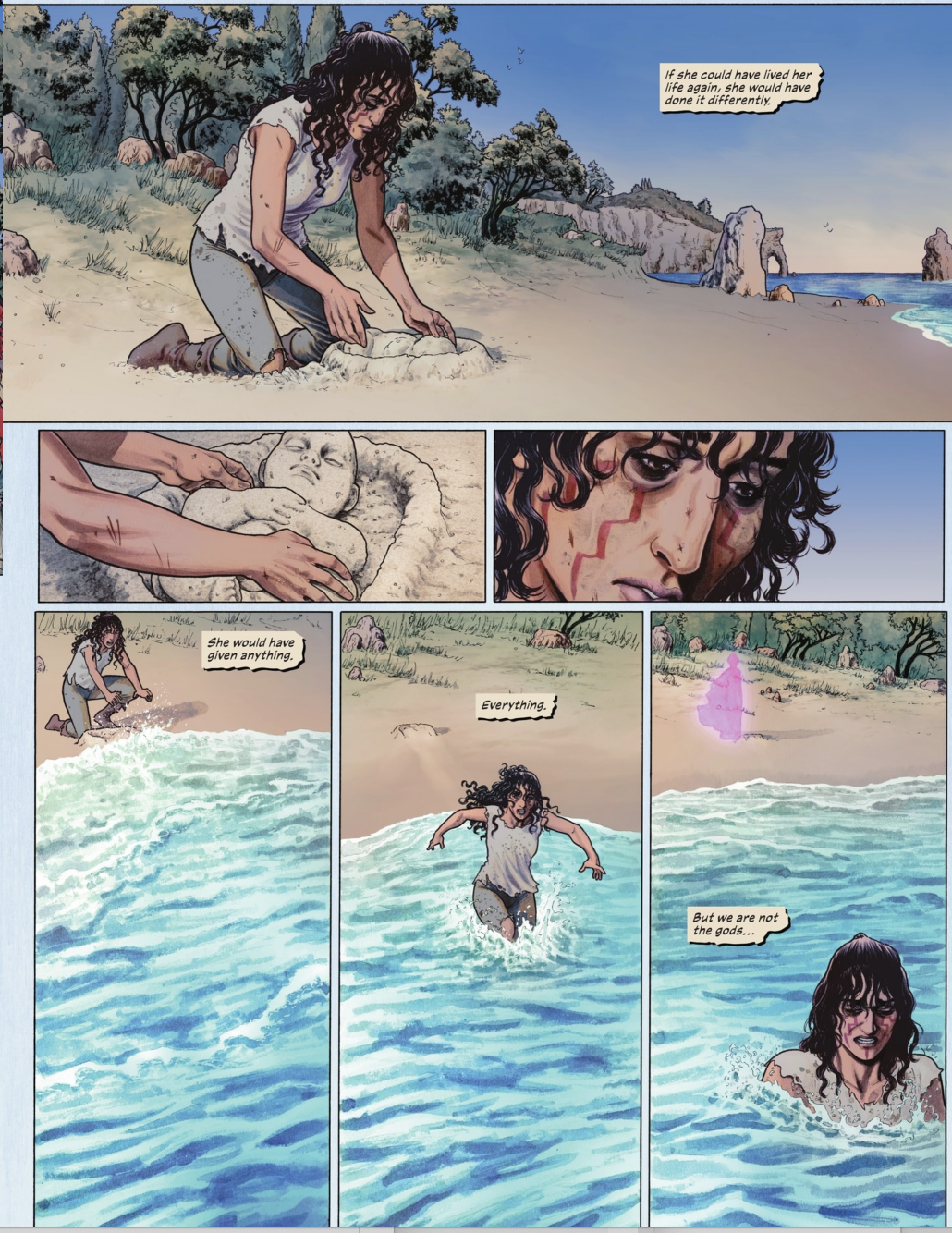
Book Three opens with stunning spreads, the artwork and coloring invite the reader to linger on pages in order to grasp the grandeur that envelopes this world, this story of the Amazons.

The opening scenes include a serpent theme, complicating and flipping the Garden of Eden iconography with Demeter as the serpent transforming to talk with Hera and then the ultimate human frailty, sin, and of course human guilt: “She believes her sin set the war in motion.”

Dualities build, then, throughout adding innocence versus experience to birth/death, gods/mortals, and men/women. And now, “[s]omething terrible is coming.”

The next duality is both a dramatic element of this story and a new duality that reinforces the man/woman tensions—the rugged individual versus collective power wrapped in the classic theme of hubris. DeConnick works elegantly within mythological archetypes and turns them into lenses for our contemporary realities.

Heracles, son of Zeus, represents masculine hubris and serves as a catalyst for the disaster to come because the Amazons embody a higher form of power in their shared commitments.

Using dynamic ant imagery, this scene reminds me of Adrienne Rich’s poem confronting “the book of myths” and masculine/feminine power:

my mask is powerful
it pumps my blood with power
the sea is another story
the sea is not a question of power

“Diving into the Wreck,” Adrienne Rich

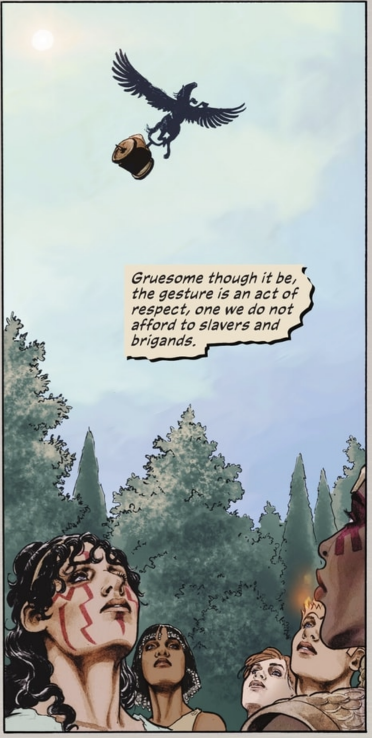
In victory, the Amazons show respect and care for the vanquished:

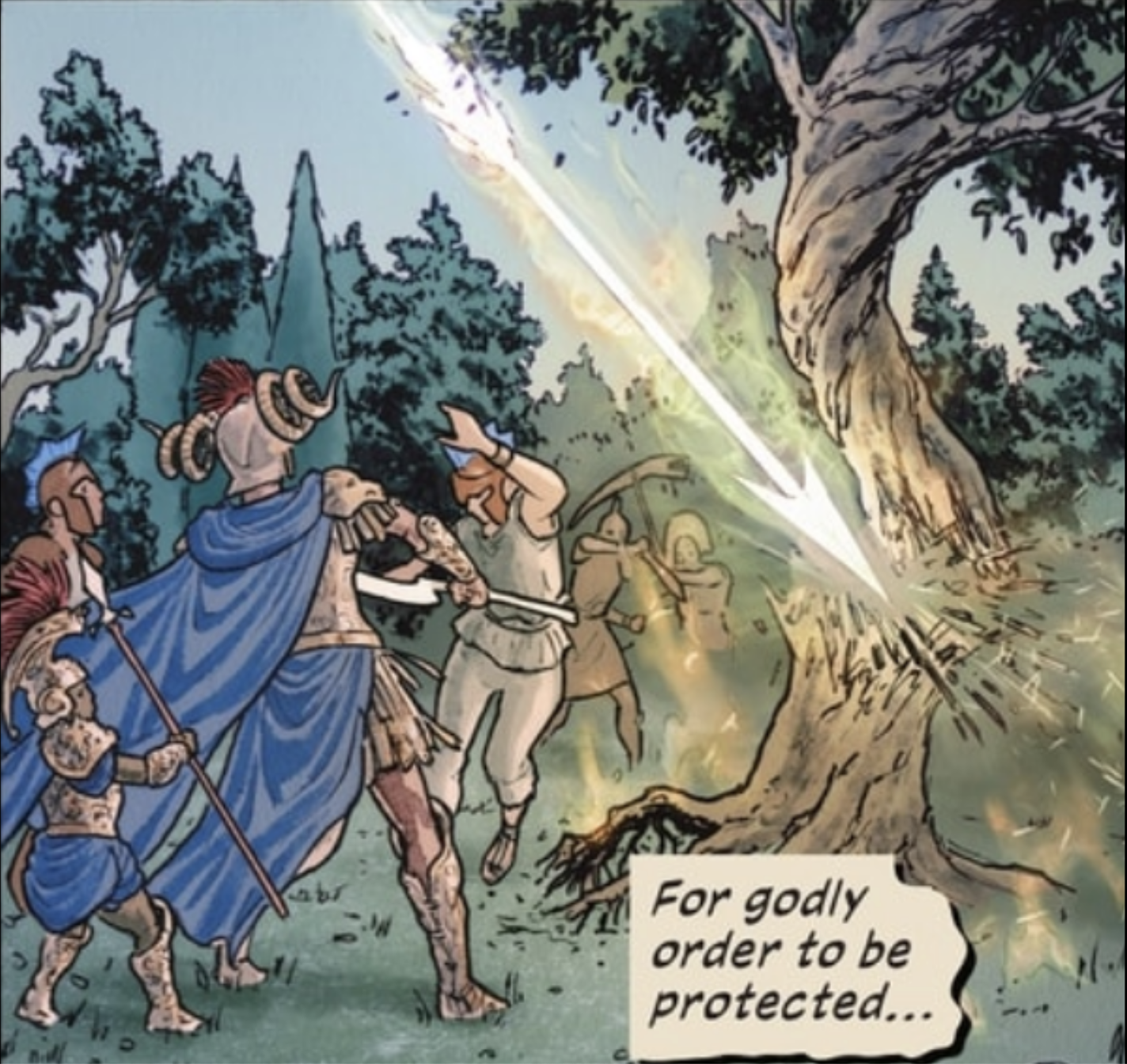
But the consequences of these women and their power are monumental since they invoke the ire of the god of gods:

Scott’s use of silhouette throughout adds a chilling element to the central tensions of Book Three.

At the core of the story of gods versus mortals, DeConnick and Scott show readers that death begets death—and that “might makes right” remains when men rule over all, especially when women assert their power.

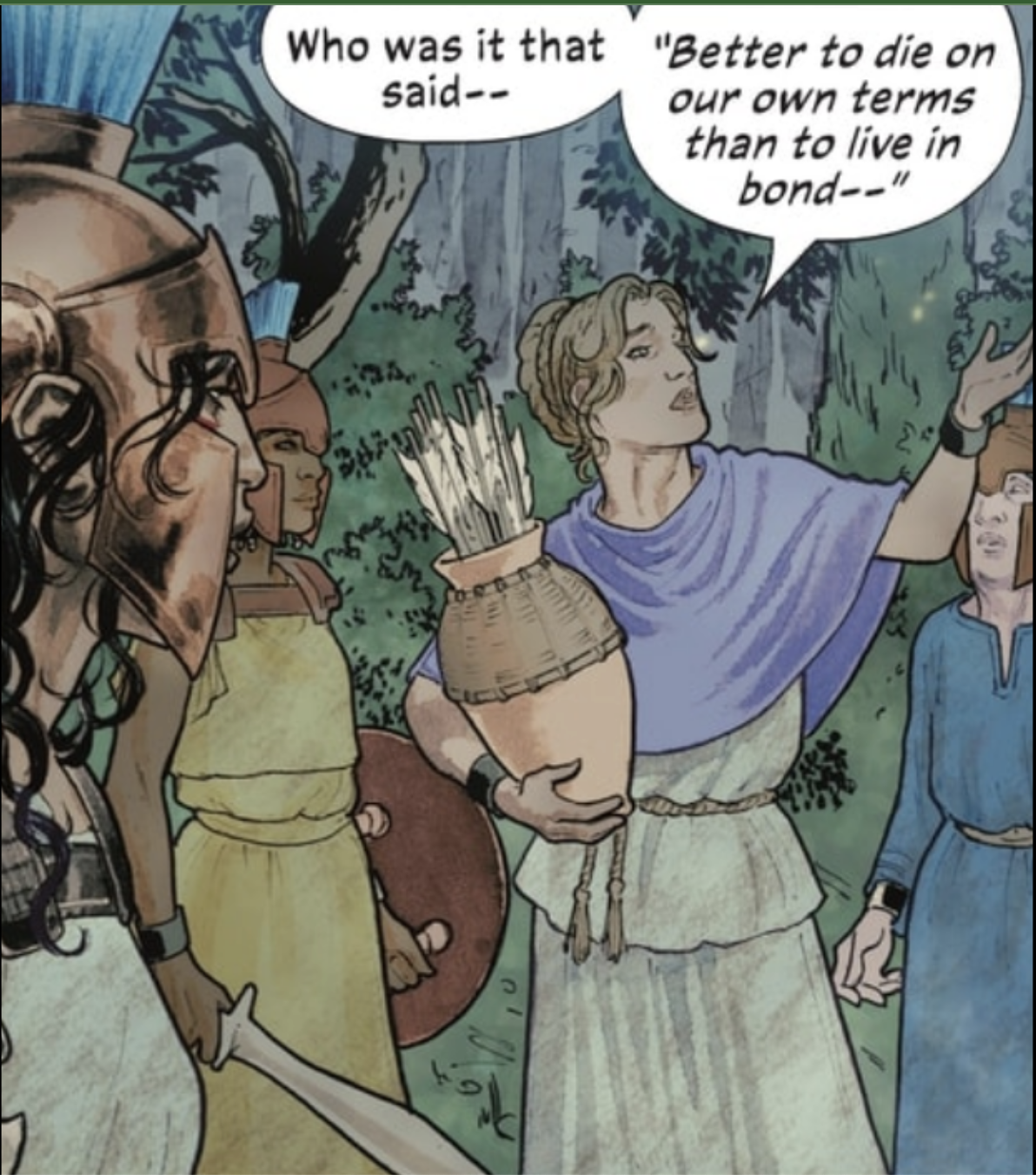
DeConnick also includes literary nods to Aristophanes, with the Amazons performing Thesmophoriazusae, a play about women subverting patriarchy, and quoting Euripides:

Death and honor are framed against the greatest of powers, the will of the gods, echoing the Garden of Eden allusion from the beginning and raising the issue of power again:

This leads us to the key refrain: “We are—all of us—born to die.”

“You Treat Us as Livestock”

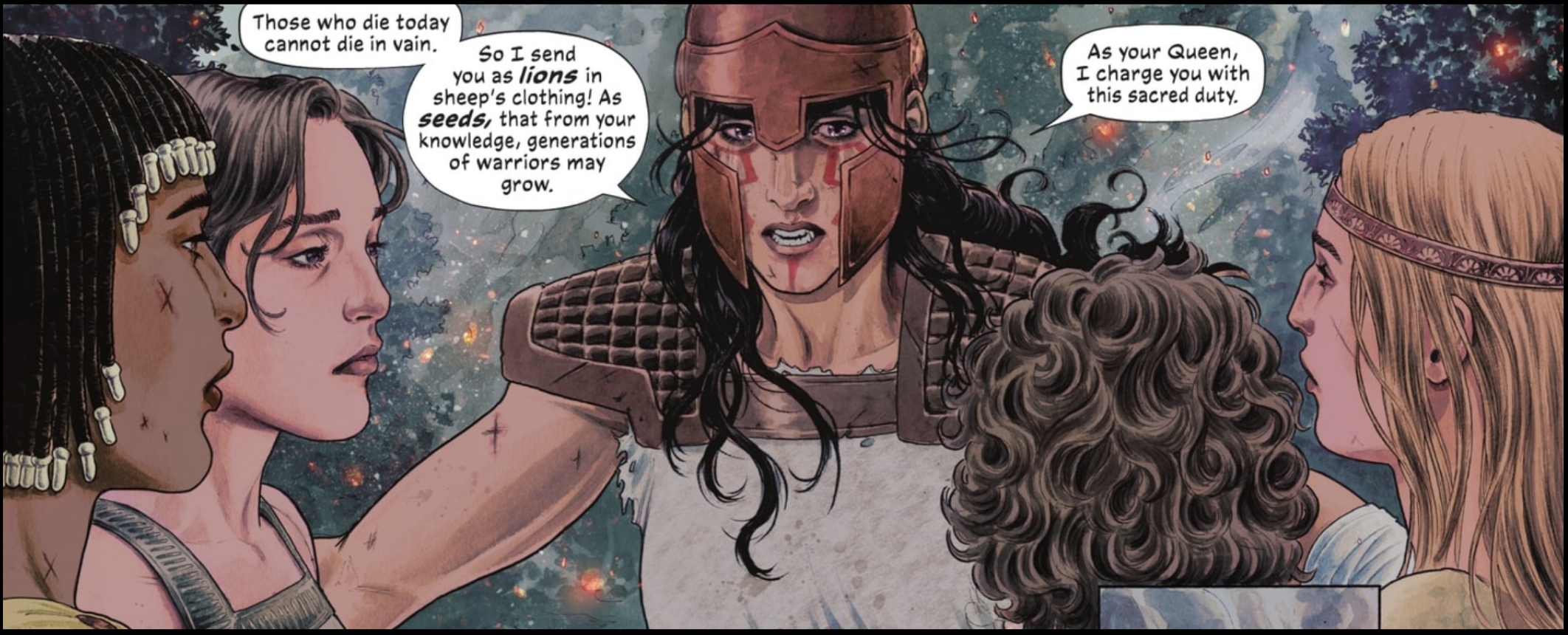
It is this issue of power within masculine/feminine dualities that DeConnick continues to explore through the lion/sheep duality:

The Amazons find power in being a community but also in the mentoring relationship (not antagonism) between those who are innocent and those with experience.

Just as a different kind of power is detailed among the women, the Amazons, so is a different way to interrogate the classic motif of hubris found in Greek tragedy:

The hubris/humility duality reveals the “complicating” consequences of aging, experience, which sets adults apart from children.

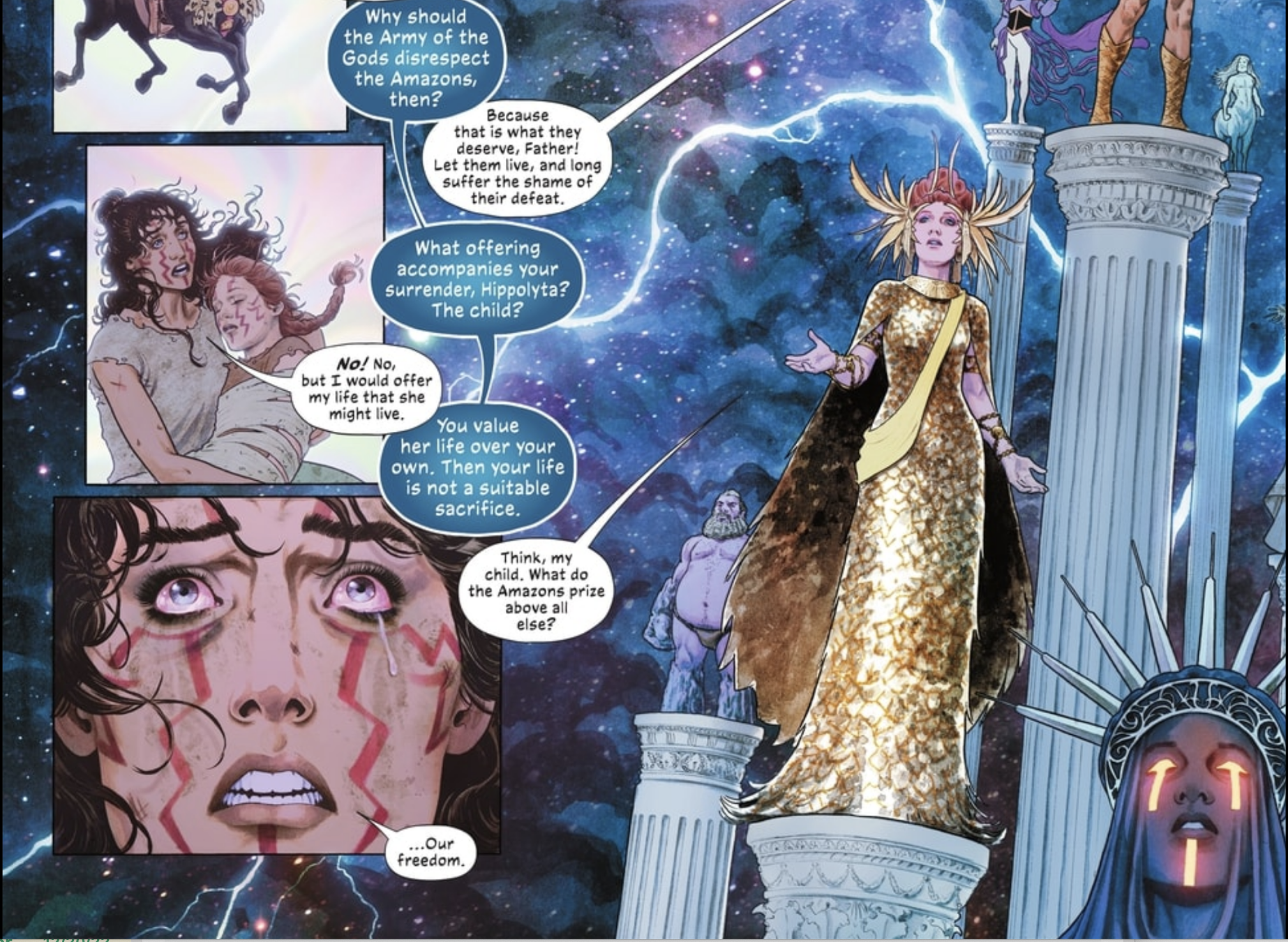
The central tension of Book Three is the wrath of Zeus and the consequences of the Amazons’ power and resistance. This ultimately creates the duality of life versus freedom:

Of course this is a fabricated duality because of the capriciousness and shallowness of a god who represents patriarchy and misogyny:

The shepherd/sheep duality fits into a literary history of confronting patriarchy and misogyny through using women-as-animal imagery (see Zora Neale Hurston’s mule imagery in Their Eyes Were Watching God).

Power in the hands of gods, the patriarchy, is exposed as capricious and cruel versus the contrast of justice and mercy:

Here the sacrificing nature of women along with the death/birth duality begins to build to the climax of these tensions:

Wonder Woman Historia across three books proves to be a work that portrays and confronts dualities in ways that force readers to rethink enduring motifs and themes within and beyond mythology.

While there is great loss and often violence, Book Three ends with triumph, hope, and birth/rebirth rising out of that loss:

By the end of Book Three, even “born to die” is turned onto itself as a superhero is born into the matriarchy of goddesses and Amazons—although the very real threats of the world and beyond remain ever in the background.

Books 1-3 of Wonder Woman Historia offer a compelling and visually stunning exploration of heroism that is solidly situated in superhero royalty (Wonder Woman among DC’s Big Three), yet this is not predictable superhero story.

DeConnick along with Jimenez, Ha, and Scott tells stories of dualities and confrontations by turning those dualities around and inviting readers to rethink those tensions in ways that speak to the very real world we walk in today.


See Also

Just in Time: Wonder Woman Historia: The Amazons

Wonder Woman Historia: The Amazons (Book Two): Women and Children, Goddesses/Gods and Mortals

Thomas, P.L. (2018). Wonder Woman: Reading and teaching feminism with an Amazonian princess in an era of Jessica Jones. In S. Eckard (ed.), Comic connections: Reflecting on women in popular culture (pp. 21-37). New York, NY: Rowman and Littlefield.

Black Widow Series

[Review] WONDER WOMAN HISTORIA: THE AMAZONS #3 (SPOILERS!), Robert Jones, Jr.