All posts by plthomasedd

P. L. Thomas, Professor of Education (Furman University, Greenville SC), taught high school English in rural South Carolina before moving to teacher education. He is a former column editor for English Journal (National Council of Teachers of English), current series editor for Critical Literacy Teaching Series: Challenging Authors and Genres (Brill), and author of Teaching Writing as Journey, Not Destination: Essays Exploring What ‘Teaching Writing’ Means (IAP, 2019) and How to End the Reading War and Serve the Literacy Needs of All Students: A Primer for Parents, Policy Makers, and People Who Care (IAP, in press). NCTE named Thomas the 2013 George Orwell Award winner. He co-edited the award-winning (Divergent Book Award for Excellence in 21st Century Literacies Research) volume Critical Media Literacy and Fake News in Post-Truth America (Brill, 2018). Follow his work @plthomasEdD and the becoming radical (https://radicalscholarship.wordpress.com/).

Bully Politics and Political Theater in an Era of Racial Shift

Florida Governor Ron DeSantis (R) recently bullied students about wearing masks as he prepared to give a press conference. DeSantis called wearing masks “Covid theater,” but it seems more likely his petulant behavior is his own political theater since DeSantis immediately turned the embarrassing behavior into a fundraising gimmick.

That a sitting governor publicly and brazenly chastised students—behavior that no student would be allowed toward other students or adults while in school—is a snapshot of the broader attack on K-16 education in the U.S., also driven entirely by Republicans.

Curriculum gag orders, anti-CRT legislation, and book bans all seek to censor any mentioning of race or racism as well as topics related to gender or sexuality (the latter repeatedly identified by Republicans as “pornography”).

Copy-cat legislation across Republican-led states is far less about teaching and learning than about the tremendous racial shift occurring in the U.S.—and the immediate tension in K-12 public education because of that shift.

The 2020 Census has revealed, as reported in USA Today: “The white, non-Hispanic population, without another race, decreased by 8.6% since 2010, according to the new data from the 2020 census. The U.S. is now 57.8% white, 18.7% Hispanic, 12.4% Black and 6% Asian.”

In short, the white racial majority in the U.S. is shrinking quickly, and the future of racial balance in the U.S. is now reflected in K-12 education, where white students constitute less than half of students:

However, K-12 education remains a very white space except for that student population.

Almost 80% of teachers are white, and despite the false claims made in curriculum gag orders and anti-CRT legislation, K-12 curriculum and texts remain disproportionately white:

Research on U.S. history textbooks indicate White, European Americans are featured in over half of pictorials and illustrations. In some cases, it is more than 80 percent. Representation of people from BIPOC backgrounds are rarely featured, with some ethnic groups featured as low as 1 percent.

These racial and ethnic representations do not reflect demographics given in the 2020 U.S. Census, where 61.6 percent of the population is identified as White, 18.7 percent Hispanic or Latinx, 12.4 percent Black or African American, 6 percent Asian, 1.1 percent American Indian and Alaska Native, 0.2 percent Native Hawaiians and other Pacific Islanders, 8.4 percent some other racial population, and 10.2 percent multiracial….

In sum, studies on books and other materials reveal that White characters are more prominent than BIPOC characters. The data suggest that it is likely that students who identify as White will see mirrors of themselves more often than students from BIPOC communities.

The Representation of Social Groups in U. S. Educational Materials and Why it Matters, Amanda LaTasha Armstrong

DeSantis, then, personifies the resulting bully politics of Republicans as a response to the racial shift occurring in the U.S.

An examination of bullying in academia offers an important frame for understanding the larger phenomenon of bully politics:

What makes bullying an unethical, yet effective, means to rise through the ranks? An emerging body of research suggests that mediocre academics in particular resort to bullying, to remove their competition. Experimental research has shown that when male hierarchies are disrupted by women, this incites hostile behaviour specifically from poorly performing men, because they stand to lose the most.

Members of underrepresented groups report they are the targets of bullying with the intent to sabotage their careers. Some anecdotes suggest that bullies spring into action when their targets become too successful for their liking — and thus viable competition.

How bullying becomes a career tool, Susanne Tauber and Morteza Mahmoudi

This unpacking of bullying in academia fits well into understanding the bully politics of Republicans, often mediocre white men, like DeSantis, who feel threatened and cultivate political capital by stoking racial animosity through misinformation.

As I have noted before, K-12 public education is quite conservative and, as shown above, very white. While curriculum gag orders have characterized teachers and schools as hostile to white students (legislating bans on making students uncomfortable)—without evidence—and rampant with CRT—which isn’t occurring in K-12 schools—few people are directly exposing why bully politics is on the rise—the significant racial shift in society and schools in tension with the static whiteness of teachers and curriculum.

Unlike the ways in which Republicans have characterized U.S. schooling, Ranita Ray has witnessed a much different reality for students:

What I discovered was rampant racism, cruelty, and indifference from teachers working inside public schools. Most of the teachers I observed were not, in fact, teaching about America’s racist history but instead were perpetuating everyday racial violence against their students inside the classroom. While the idea is not prominent in public discourse, I am not alone in finding teacher racism to be an everyday presence in the American classroom. One recent study, for example, found that teachers hold as much implicit and explicit pro-white racial bias as nonteachers do. Education scholar Michael Dumas has written about teacher racism and Black suffering inside the classroom, showing that these attitudes have concrete outcomes. And students themselves know this. Social media is replete with students talking about teacher racism, and they have often taken to the streets to protest it.

It Never Seems to Be a Good Time to Talk About Teachers’ Racism

The irony of the racial shift spurring bully politics lies in ground zero, the backlash against the 1619 Project, which represents not a rewriting of history but a confronting of what history is—stories of the past shaped by who ever has power.

The facts of history do not necessarily change but the power behind what facts are told and why does shift. The 1619 Project changes what is centered in the telling of U.S. history (moving it away from the idealized founding and toward the grim reality of the institution of slavery)—in a similar way to the shifting racial centering of the U.S. in the 2020s.

Republicans are scrambling not to protect history or Truth, but to further entrench a mythology, an aspirational white-washed version of the country.

The impetus behind the 1619 Project and diversity, equity, and inclusion efforts is well expressed in Adrienne Rich’s poem:

I came to explore the wreck.

…the thing I came for:
the wreck and not the story of the wreck
the thing itself and not the myth
the drowned face always staring
toward the sun
the evidence of damage
worn by salt and sway into this threadbare beauty
the ribs of the disaster
curving their assertion
among the tentative haunters.

“Diving into the Wreck”

The facts of history and even the present—and not the myths—are disturbing, uncomfortable (“the drowned face always staring”).

Some of us, like the speaker in Rich’s poem, accept the discomfort as motivation to work toward a better world for everyone.

Others are petulant, bullies, carelessly grabbing all their toys and threatening to go home.

DeSantis and the other mediocre Republicans are playing political theater but their bully politics is all too real and has devastating consequences for academic freedom and democracy.

Histrionics characterizing masks as “Covid theater” are masking white fear that has reduced the Republican Party to bully politics in the service of a misguided whiteness—and to the exclusion of democracy and basic human dignity.
Gag Orders, Loyalty Oaths, and the New McCarthyism

Out of the rack and ruin of our gangster death,
The rape and rot of graft, and stealth, and lies,
We, the people, must redeem
The land, the mines, the plants, the rivers.

“Let America Be America Again,” Langston Hughes

An avalanche of gag order bills are being proposed in South Carolina—H.4325H.4343H.4392H.4605, and H.4799. While my home state of SC often likes to brag about being the first state to secede in order to maintain slavery (an uncomfortable fact many of these laws would ban from being taught), these bills represent the sort of crass copy-cat legislation that is also sweeping across other Republican-led states.

Not only is there nothing original in these bills (or even evidence-based or logical), but also there is a profoundly disturbing repetition of one of the lowest points in U.S. history—the New McCarthyism.

Let’s start with facts, which Republican legislation seeks to censor:

  • “Critical Race Theory” as it is mischaracterized by Republicans does not exist in K-12 schools.
  • CRT as properly defined (a scholarly theory created primarily by Black scholars for the the field of law and adapted in a few other fields such as education and sociology) does not exit in K-12 schools.
  • Systemic racism is a fact of the founding of the U.S. and a fact of the U.S. in 2022, supported by irrefutable evidence that defies simplistic explanations (such as individual racism).
  • Race is a social construct and not a matter of biology.
  • History is a living field for considering the facts of the past; there is no one true history.
  • Intellectual discomfort is often a necessary aspect of new learning when anyone must confront misconceptions or missing knowledge in order to better understand and navigate the world.

The gag orders such as those listed above in SC are blunt partisan politics driven by orchestrated lies that have nothing to do with protecting students or with teaching factual history or excellent literature/texts.

Curriculum and book censorship in 2022 is our New McCarthyism because the CRT veneer is being used to promote ideological agendas aimed at Black people and LGBTQ+ people.

The McCarthy Era, also known as the Red Scare, was confronted in The Crucible by Arthur Miller, who uses allegory to warn the U.S. at mid-twentieth century that McCarthy’s cries of “communism” were partisan lies similar to the Salem witch trials.

There were no witches.

There were no lists of communists.

There is no CRT poisoning U.S. schools.

Yet, in their extreme forms, some gag orders include requirements for loyalty oaths and mechanisms for withholding state funding for a decade. Even for private organizations.

The ultimate horror of these gag orders from Republicans is that by legislating censorship of what history and texts students are allowed to learn, we will be insuring the most damning of ideas about history itself—those who ignore history are doomed to repeat it, often the very worst of it.

Yesterday I saw the following Tweet about the Russia invasion of Ukraine:

While I endorse the sentiment, I have been watching for over a year while most of the U.S. fails to resist censorship right here in the so-called land of the free and home of the brave.

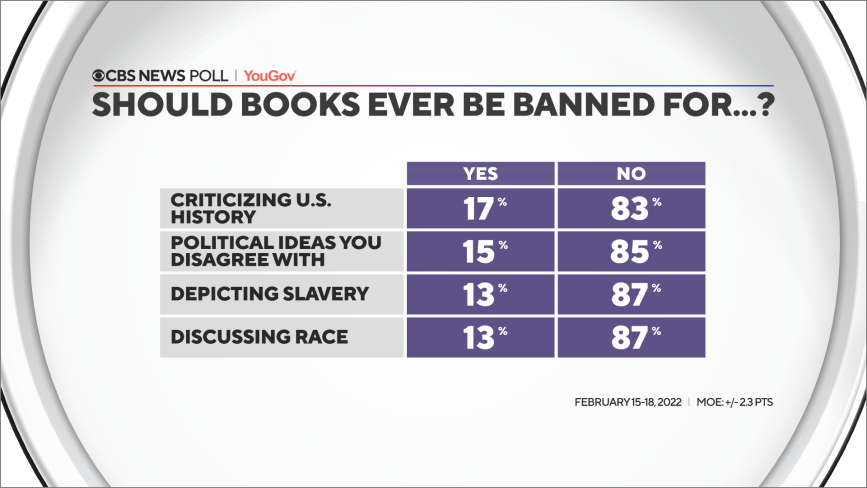
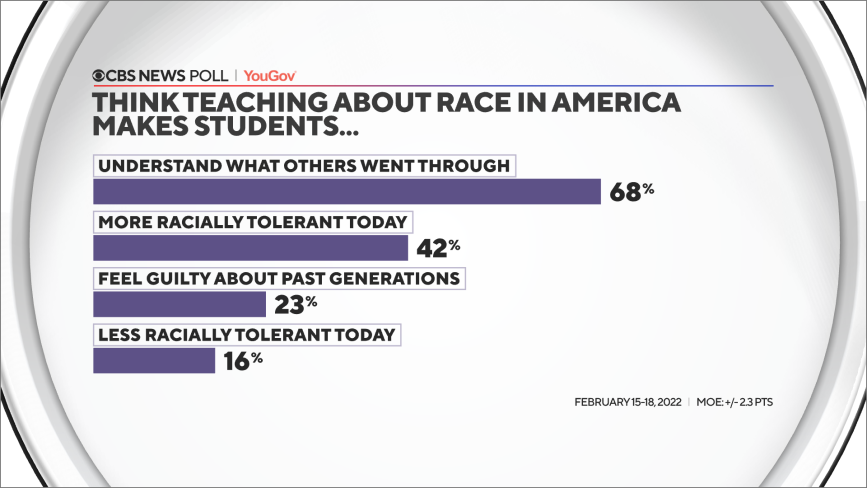
Republicans are running roughshod over freedom, pushing the U.S. toward banning abortion (despite a majority of Americans supporting maintaining Roe v. Wade) and enacting curriculum and book bans (despite large majorities of Americans rejecting censorship):

CBS news poll

Ultimately, gag orders, loyalty oaths, and censorship are un-American and anti-democratic, as ALAN notes in their Intellectual Freedom Statement:

We know that intellectual freedom is foundational to an educated citizenry and essential to the preservation and practice of democracy. We are dedicated to protecting this natural human right, and therefore, we insist on open access to all school reading materials for all students.

Intellectual Freedom Statement

The New McCarthyism exposes the Republican Party as a party of oppression, the exact sort of fact that should make everyone of us uncomfortable.


Black Widow Series

[Header image property of Marvel and artist(s)]

Please read and follow my Black Widow series posting at Comics Bookcase (blogs 1-5) and here (6-8).

The series will be updated below as each post is published.

Blog 1: Black Widow Underestimated – An Introduction (24 February 2022)

Blog 2: Black Widow Underestimated – Tortured Beginnings and Solo Black Widow (24 March 2022)

Blog 3: Black Widow Underestimated: A New Start? – ‘He Underestimates Me’ (28 April 2022)

Blog 4: Black Widow Underestimated: ‘It’s Not the Length of Life that Matters…’ (12 May 2022)

Blog 5: Black Widow Underestimated: Black Widow Unbound – Past, Present, Future (26 May 2022)

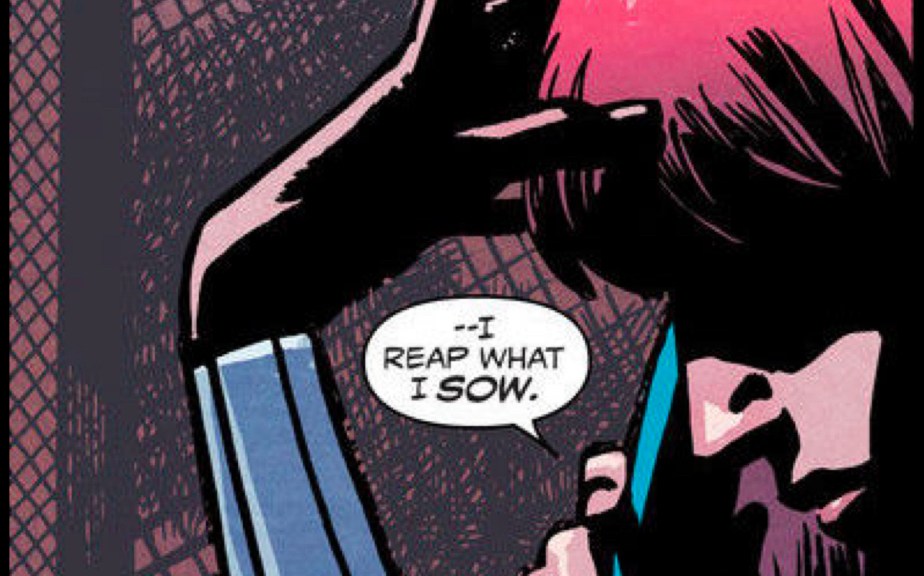
Blog 6: Black Widow Underestimated: “I Reap What I Sow” (15 August 2022)

Blog 7: Black Widow Underestimated: “I Am What I Am” (4 September 2022)

Blog 8: Black Widow Underestimated: “I Remember Everything” (3 October 2022)


See Also

The Unintended Multiverse of Black Widow’s Origin

Anti-CRT Gag Orders Lack Evidence, Logic

My home state of South Carolina, one of the solid red states in the U.S., is jumping on the anti-CRT gag order bandwagon, proposing copy-cat legislation that is repeated across Republican-led states.

As Dr. Susi Long carefully detailed, anti-CRT legislation lacks evidence since CRT is not being taught in K-12 schools and since the laundry list of what the legislation is supposed to prohibit in SC schools simply does not occur in our schools either.

That is part of the reason I have called anti-CRT gag orders a manufactured crisis.

But these partisan attacks on schools and teachers lack more than evidence; they lack a fundamental logic.

The racial make up of SC is 64% white (non-Hispanic), 27% Black, and 6% Hispanic.

However, the public school student population is 48% white, 32% Black, and 12% Hispanic. Like the rest of the U.S., SC public schools are now majority-minority schools.

Here is where anti-CRT gag orders make no sense; the teacher demographics in SC are 79% white, 13% Black, and 3% Hispanic.

SC public schools have a student population significantly unlike the racial demographics of the state, and then teacher demographics are dramatically unlike the state as well as the student population they serve.

Here is where logic falls apart. If we believe anti-CRT gag orders are needed, we must believe that teachers who are almost entirely white are making white students uncomfortable because they are spreading CRT propaganda.

These demographics not only challenge the logic of anti-CRT gag orders, they also expose what is really driving this legislation—white fright.

Demographics of U.S. public schools are a harbinger of the reality that white people will soon constitute less than 50% of the country, while likely remaining the largest racial group for some time.

Schools, curriculum, and teachers are not hostile to white students or white people, but white fright is targeting schools as one of many ways white Americans are clinging to their majority status, a majority status that has an ugly history and an ugly present that some white Americans want hidden.

One of the ugliest truths beneath this fear is that white Americans know exactly what many white people did with majority power—and now they fear what may happen when someone else has that power.

Despite the shifting demographics of students and false claims made by Republicans pushing anti-CRT gag orders, schools remain extremely white-centered and white friendly. And that is the real problem that should be addressed for the good of those students.

National Days of Teaching Truth to Power

Speaking at a recent hearing on yet another copy-cat bill in South Carolina to censor curriculum (targeting Critical Race Theory [CRT]), Dr. Susi Long, professor of early childhood education (University of South Carolina) offered a measured but pointed dismantling of the partisan misinformation in this legislation:

Not to oversimplify, but Long clarifies that CRT is not taught in K-12 (or even K-16) education, adding specifically that the laundry list of issues addressed in these bills are not how teachers teach or treat our students.

Last summer, I emphasized similar points, adding what does occur in schools in terms of race and equity. At one point, Long calmly suggests legislators should be learning from educators instead of legislating what teachers can and cannot teach, what students can and cannot learn.

One of the great ironies of efforts to ban CRT (beyond that CRT isn’t something taught in K-12 education) is that a key tenet of CRT is in order to overcome racism/inequity, everyone needs to be better educated, better informed—exactly what teachers offer students across the U.S.

Here, then, is my modest proposal: National days of teaching truth to power.

As a recent post of mine details, students and teachers are vividly aware of the rise in censorship as well as the potential negative consequences of those bans, such as self-censorship grounded in fear.

Will, for example, Paul Laurence Dunbar be erased from classrooms or will teachers be fired for honoring Dunbar’s voice that continues to resonate in 2022?:

“We Wear the Mask,” Paul Laurence Dunbar

Let’s identify days when we will target lessons and texts that are being misrepresented purely for political gain.

Lessons on race and racism, lessons on academic freedom and censorship, lessons on gender and sexuality—ultimately lessons one what it means to be educated in a country that claims to be free.

This semester I plan to dedicate a day in my courses to Langston Hughes’s “Let America Be America Again.”

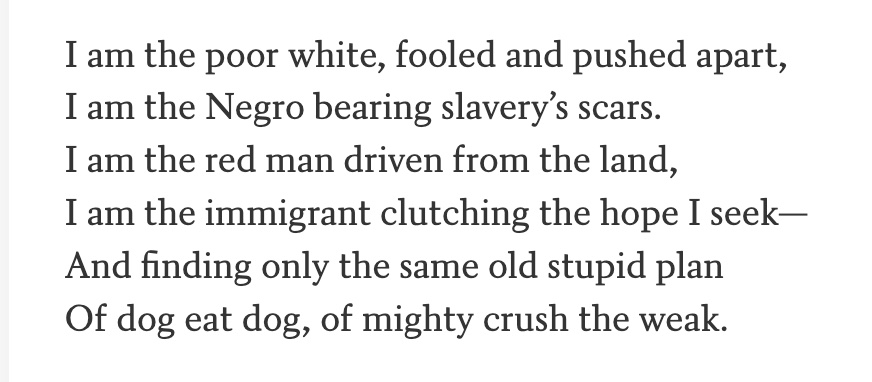
Like Dunbar’s poem reflecting the realities of being Black during Reconstruction and Jim Crow, Hughes creates a complex unpacking of many minoritized groups during the 1930s:

And Hughes also resonates today in his confronting of the failures of the American Dream, an ideal not yet realized even in 2022:

“The land that never has been yet” is facing us all now in the U.S. as Republicans are in denial and have turned to the antithesis of freedom, censorship, in order to cling to power.

As educators, as professionals charged with honoring the dignity of every student’s mind, we have only truth to break the cycle of oppressive power.

Teaching truth is the key. Can we do this, and do this now?

As James Baldwin implored, “[T]he time is always now.”

If you will join me, I will identify dates and lessons below, updating over the coming weeks with full lesson plans, texts being taught, etc.

[email: paul.thomas@furman.edu]


P.L. Thomas, Furman University

Lesson: “Let America Be America Again,” Langston Hughes

Date: TBD


Thoughts from Moon Knight and Saga in Days of Darkness

Throughout the last century, education and intellectual freedom have suffered a persistent assault from ideologues on the right—conservatives determined to protect tradition.

In the wake of Trump, the U.S. is currently experiencing one the most intense such moments, very dark days for teachers, students, education, and intellectual freedom.

Recently, I have begun catching up with Saga by reading Compendium One, which collects the first half, 54 issues, of the series that has recently restarted. Just before that, I had added Moon Knight to my collecting and reading commitments.

In the context of our dark days in education, those readings have struck me in powerful ways.

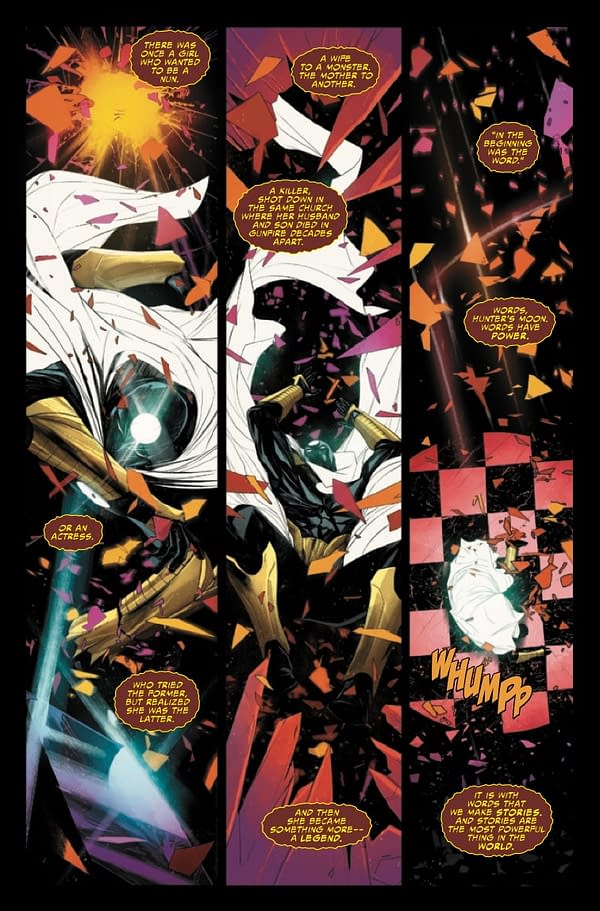
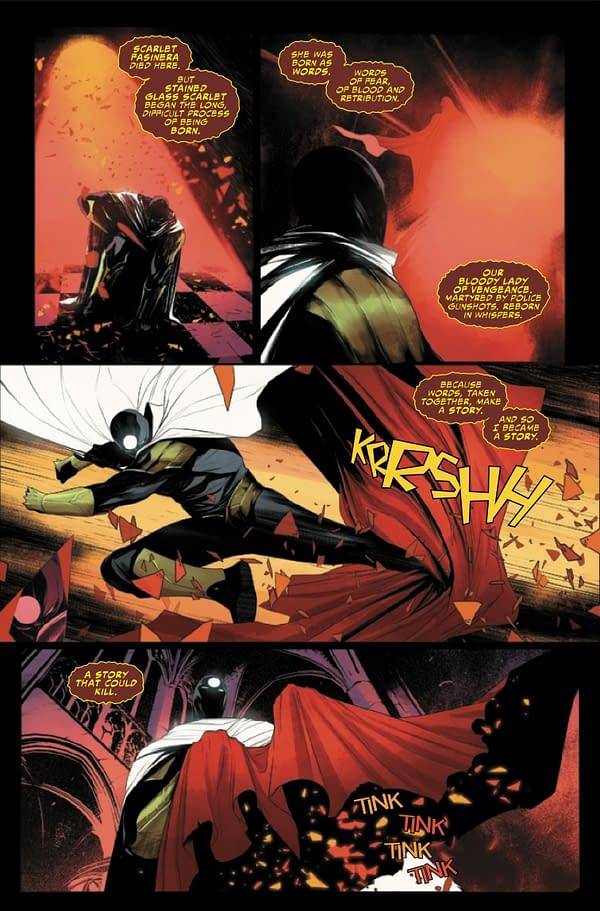
Moon Knight 8 (v.9) presents two dynamic pages that resonate beyond the narrative itself:

Moon Knight 8 (v.9) (Jed MacKay, writer; Alessandro Cappuccio, artist)

“And then she became something more—a legend,” Flint explains about Scarlet, adding:

In the beginning was the word.

Words, Hunter’s Moon, words have power.

It is with words that we make stories. And stories are the most powerful thing in the world….

She was born of words. …

Because words, taken together, make a story. And so I became a story.

A story that could kill.

Moon Knight 8 (v.9)

Beyond the Moon Knight narrative, this scene captures both the importance of story, books/texts, and reading as well as why people in power fear story, books/texts, and reading.

Banning and censoring books/texts and ideas are acts of power, always, and acts of power in a state of fear.

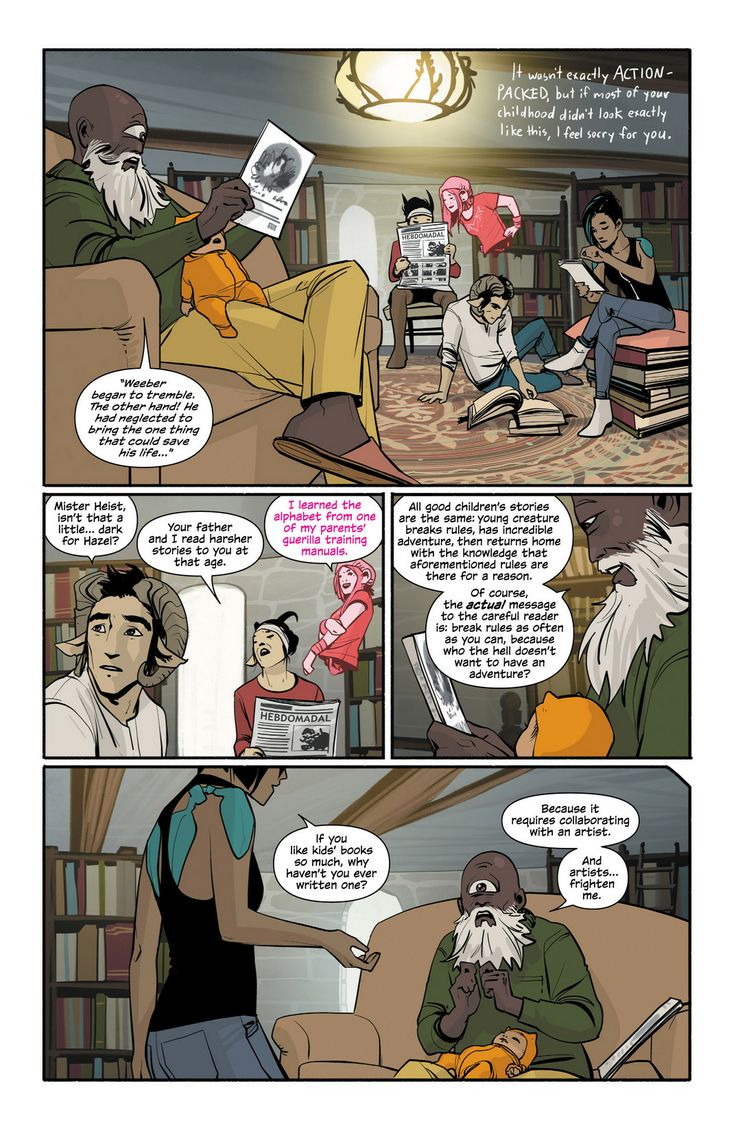
Chapters Sixteen and Seventeen of Saga also interrogate the power of stories. First in Chapter sixteen:

Saga Chapters Sixteen (Brian K. Vaughan, writer; Fiona Staples, artist)

“Mister, Heist, isn’t that a little … dark for Hazel?” Marko asks. And the reply:

All good children’s stories are the same; young creature breaks rules, has incredible adventure, then returns home with the knowledge that aforementioned rules are there for a reason.

Of course, the actual message to the careful reader is: break rules as often as you can, because who the hell doesn’t doesn’t want to have an adventure?

Saga Chapters Sixteen

Along with the pages from Moon Knight, again, we must acknowledge why people in power fear children reading freely.

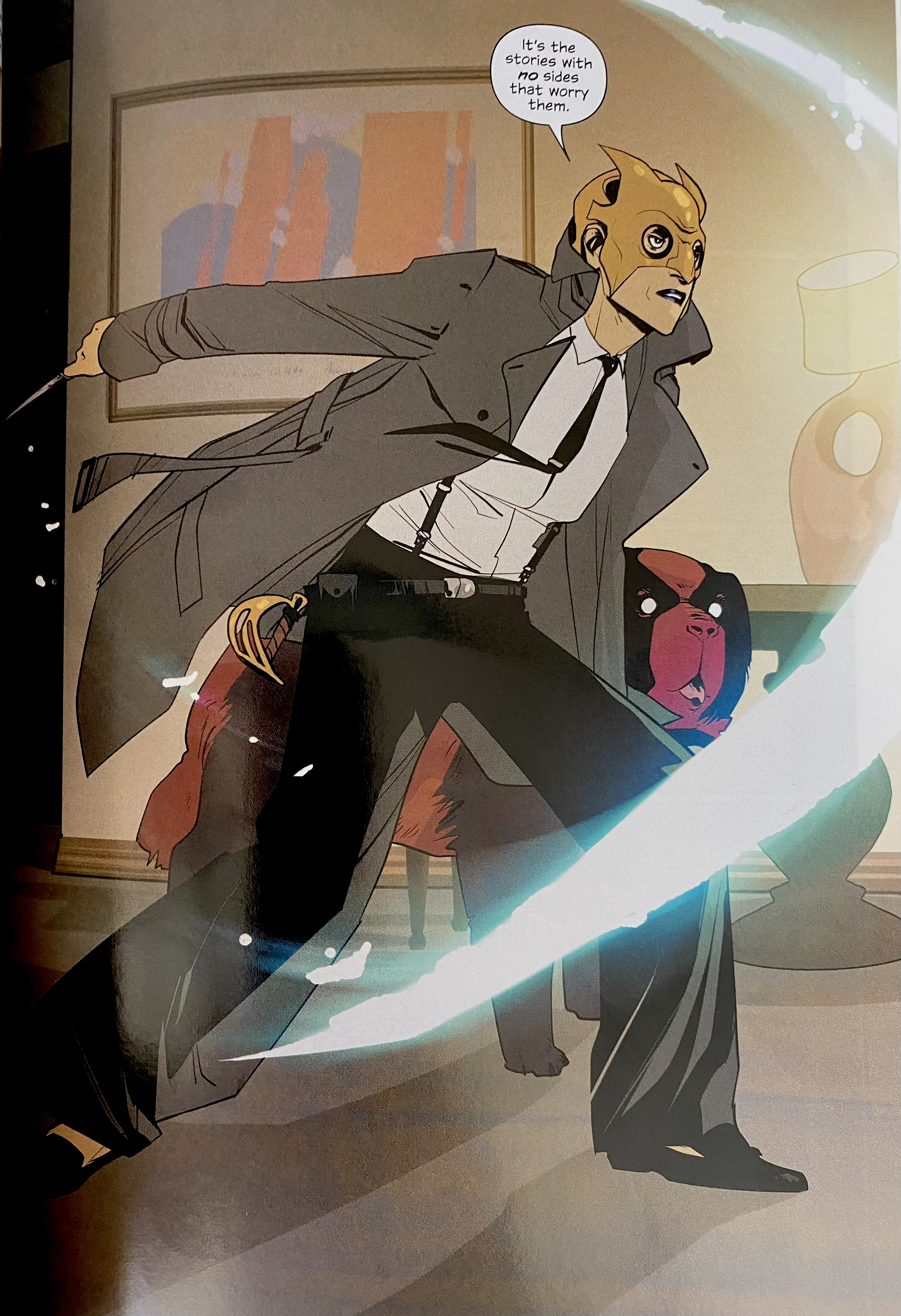
And then in Chapter Seventeen:

Saga Chapters Seventeen (Brian K. Vaughan, writer; Fiona Staples, artist)

This full-page panel, dazzling and concise, fits perfectly into the core of the efforts by conservatives to censor and ban—the fear of confronting racism, a story of the U.S. that has only one Truth, only one side.

People in power fear Truth, and depend on compromise, especially in contexts where there is no room for compromise, to hold power for as long as possible.

Returning to Chapter Sixteen, Izabel reminds us of the accidents inherent in what anyone reads and how reading is what matters, not exclusively what is read: “I learned the alphabet from one of my parents’ [guerrilla] training manuals.”

Bans and censorship are always acts of fear and power; nothing can justify them, especially in the lives of children.

Don’t Buy It: The Marketing Scam of MSM and the “Science of Reading”

Since 2018, Education Week has published a steady stream of click-bait press-release journalism promoting the “science of reading” (SoR).

So the latest scare-article is not surprising: More Than 1 in 3 Children Who Started School in the Pandemic Need ‘Intensive’ Reading Help. Now let’s look at the details:

That’s according to a new study by the testing group Amplify, based on data from more than 400,000 students in kindergarten through 5th grades who participated in the Dynamic Indicators of Basic Early Literacy Skills, which Amplify administers. The research, released late Wednesday, shows that though students have begun to recover lost academic ground in the last year, big holes remain in students’ fundamental reading skills.

Researchers compared students’ reading achievement from 2019 through 2022 on DIBELS, one of the most commonly used diagnostic assessments for reading.

More Than 1 in 3 Children Who Started School in the Pandemic Need ‘Intensive’ Reading Help

That’s right Amplify and DIBELS have found that students urgently need … their products.

Imagine a publication called Medical Week in decades long ago when the tobacco industry did “research” and found no link between smoking and cancer. Imagine MedWeek publishing pro-smoking articles grounded in the tobacco industry’s “research.”

Well, you don’t have to imagine with EdWeek.

EdWeek and mainstream media have been complicit for almost four years now in the SoR marketing scam that uses “science” like a baseball bat to disorient the public and political leaders so non-scientific products and policies are slipped into the education system.

SoR cites NCTQ, an organization that releases “reports” that are not peer-reviewed (and third-party reviews discredit all of them). [1]

SoR legislation overwhelmingly includes grade retention, a practice refuted by decades of research for being harmful to students.

And SoR is in bed with phonic-intensive programs that are not supported by science; for example, phonics-heavy training for teachers, LETRS:

A growing number of U.S. states have funded and encourage and/or require teachers to attend professional development using Moats’s commercial LETRS program, including Alabama, Arkansas, Kansas, Mississippi, Missouri, Oklahoma, Rhode Island, and Texas. This is despite the fact that an Institute of Education Sciences study of the LETRS intervention found almost no effects on teachers or student achievement (Garet et al., 2008). (p. S259)

Hoffman, J.V., Hikida, M., & Sailors, M. (2020). Contesting science that silences: Amplifying equity, agency, and design research in literacy teacher preparation. Reading Research Quarterly, 55(S1), S255-S266. https://doi.org/10.1002/rrq.353

DIBELS is a widely refuted screening tool that narrowly defines reading around decoding (including an emphasis on nonsense words, which are completely absent comprehension measures).

The public and political leaders must resist the marketing scam being promoted by mainstream media around reading. But there is a common thread.

EdWeek? Nonsense.

DIBELS? Nonsense.

SoR? Nonsense.

LETRS? Nonsense.

Don’t buy it.


[1] See How to Navigate Social Media Debates about the “Science of Reading” [UPDATED] for all the ways SoR is connected to policies and practices not supported by science/evidence.

Teaching in a Time of Conservative Tyranny

My spring 2022 schedule includes three classes, two sections of upper-level writing/research and one first-year writing seminar. During my second class today, while students were completing individual work before a class discussion, I scrolled through Twitter and found this:

I quickly Googled the poem, and decided to interject an impromptu mini-lesson between students completing the individual assignment and the class discussion.

Although I have been a teacher educator (and first-year writing professor) for twenty years now, I quickly put on my high school English teacher hat and conducted a lesson on Dunbar’s poem, reading it aloud and asking students questions along the way.

I repeated the lesson (also not on the schedule) in my third class, where students offered similar responses to the discussion.

Overwhelmingly, students identified the mask motif as an exploration of putting on an emotional front, noting, for example, the juxtaposition of “smile” and “cry” in the line “We smile, but, O great Christ, our cries.” (Interestingly, one student immediately contextualized the mask motif in the current Covid era.)

When I directly asked students to identify the “we,” most immediately spoke about a universality of the poem being about “society” or anyone who identifies with the speaker in the poem.

After walking through the poem (and confirming that students were not familiar with the poem or Dunbar), I pulled up the Wikipedia page on the poem to highlight that it had been published in 1895 and that Dunbar was a Black poet who was born during U.S. Reconstruction and published in the Jim Crow Era.

I then noted the poem is about Black people masking for white people—the core of Chanea Bond‘s Tweet and the student’s awareness that at least 4 out of 10 students in the U.S. are now being taught in states with educational gag orders, a growing list of state-level legislation being proposed and passed by Republicans from Florida to Virginia to Texas to Oklahoma to Indiana and anywhere Republicans have unlimited power.

These educational gag orders include curriculum bans (often directly and indirectly invoking Critical Race Theory), book/text bans, and so-call parental rights bills that allow any parent to trigger censorship or reprimanding a teacher. While this legislation is devastating to public institutions (K-16), some bills include potential fines for private schools who take any public funds.

Attacks on books have spread beyond assigned reading, classroom libraries, and school libraries to include public libraries as well.

This wave of gag orders and censorship has included violence and threats as well as overwhelmingly impacting Black texts and topics along with any writers or works that deal with LGBTQ+ topics or experiences.

The mask being used to hide the racism and bigotry of these complaints and legislation is an insincere claim that student discomfort must be curtailed.

Some of the most extreme versions of gag order bills include requirements that teachers provide a year of lesson plans before the academic year in order for parents and others to review and approve them.

First, let me confront that last point; my impromptu lesson today was one of the best I have done in recent memory. Students were engaged, and I watched in real time as my students confronted ideas, as my students learned and became different people than when they walked into class today.

While lesson plans are important, they simply are not as valuable as being prepared to teach, and being prepared to engage with your students; a fundamental misunderstanding about teaching is that (as these gag orders and parental rights bills reveal) too many people think the job of the teacher is to transfer knowledge/content to students.

As most any teacher will tell you, we teach students—not lessons, not history or English or even The Great Gatsby.

As students and as future educators, my students today needed and deserved the lesson that came from a teacher’s Tweet. They also benefitted from a brief experience with how to read and engage with poetry along with the tyranny of partisan politics that is shutting the door on their lives as free individuals.

But my impromptu lesson today grounded in a text that may soon be banned from classrooms exposes the catastrophic misunderstanding of texts. Not a single student today recognized the powerful racial message intended by Dunbar because those students lacked historical and literacy context that is already missing from their formal education without the educational gag orders.

As I have stressed during this manufactured outrage from the Right, traditional education is already incredibly conservative.

Reading Dunbar’s poem, in fact, for its universal appeal strips it of its radical power—and cheats students from confronting the historical realities of Reconstruction and Jim Crow for Black Americans.

In 2022, students, teachers, teaching/learning, and academic freedom are under assault by conservative tyranny. There is nothing American or noble about censorship.

“A mind is a terrible thing to waste” is a seven-decades long slogan of the UNCF, and with the greatest of ironies, it now seems a central goal of Republicans to insure all minds are wasted.

Bond’s student is our canary in a coal mine, and soon, every classroom may be just as dangerous, literally, as a coal mine if we refuse to heed that student’s concern.

Curriculum as Windows, Mirrors, and Maps

Maybe these maps and legends/Have been misunderstood

“Maps and Legends,” R.E.M.

[Header Photo by Nik Shuliahin 💛💙 on Unsplash]

The metaphors of literature as windows and mirrors have become standard ways to advocate for diversity in the texts we invite our students to read [1]. Texts that are windows provide students opportunities to witness and understand people, lives, and cultures unlike their own; texts that are mirrors reflect people, lives, and culture similar to their own.

As an educator, I have been compelled by Walter Dean Myers and Christopher Myers, who both make incredibly powerful and personal cases for mirrors in the reading and lives of minoritized and marginalized students as well as how those texts provide windows for students with race and gender privilege.

My journey as a reader and human has been profoundly impacted by texts as windows; particularly during my undergraduate years when my ideology was transformed by Langston Hughes, Alice Walker, Ralph Ellison, Richard Wright, and other Black writers and thinkers.

The importance of windows and mirrors extends beyond the texts included in our classrooms, however, and must be a commitment to the curriculum of all courses our students navigate.

In 2022, curriculum, instruction, and text/book selection are under assault. State legislators are proposing and passing legislation banning curriculum and texts/books; further, additional legislation seeks to expand the role of parents in not only having access to curriculum and instruction, but also to review and over-ride teacher autonomy in curriculum and instruction.

The most extreme example of the latter is a mandate for teachers to submit a year of lesson plans by mid-summer for review and approval.

At their core, these partisan bills reveal a fundamental misunderstanding about lesson plans, instruction, curriculum, and the complexity of teaching and learning.

The curriculum/text/book bans as well as the parental rights bills are rooted in a White backlash, a fear that White students are being taught in w ays that cause them harmful discomfort.

A few aspects of this must be unpacked.

First, why have these same advocates not raised concerns about the discomfort of girls/young women confronted for decades by texts and curriculum that are male-centric and often portray negative messages about women; why no concern about the discomfort of Black and Brown students who must read texts that include racist language and hateful stereotypes; why no concern for LGBTQ+ students who must navigate texts and curriculum almost entirely populated by people unlike them (or worse, presented with narratives that suggest simplistic views of gender and sexuality)?

Second is the broader failure to recognize the need for curriculum as windows and mirrors for all students to instill self-awareness and empathy—and the related need for learning to be, at time, uncomfortable.

Discomfort is an essential element with changing and growing.

Intellectual and ideological discomfort is distinct from discomfort due to emotional, psychological, or physical discomfort grounded in fear. Education requires the former and is corrupted by the latter.

Despite the White backlash against a more diverse curriculum, a backlash that believes the Whiteness of that curriculum has disappeared, evidence shows that marginalized and minoritized students remain under-represented:

Findings from the report suggest there is disparity in representation of characters from different racial, ethnic, and gender groups. When portrayals of these groups are present, they tend to be affirming and authentic portrayals. However stereotypes, limited roles and inaccurate information are still present and tend to be unique to specific communities. Based on the review, the results indicate a need for educational materials that create a sense of belonging, develop cultural authenticity, and recognize nuanced identity in different characters.

The Representation of Social Groups in U. S. Educational Materials and Why it Matters [2]

Current education legislation de-professionalizes teaching, but that legislation is also suggesting solutions to problems that simply do not exist (such as banning CRT, which isn’t present or even relevant to K-12 education).

In 2014, Christopher Myers confronted the “apartheid of literature,” how Blackness remained mostly absent or misrepresented in the texts published and thus the texts students read. He addresses the value of texts as windows, but deems that inadequate; Myers argues:

Academics and educators talk about self-esteem and self-worth when they think of books in this way, as mirrors that affirm readers’ own identities. I believe that this is important, but I wonder if this idea is too adult and self-concerned, imagining young readers as legions of wicked queens asking magic mirrors to affirm that they are indeed “the fairest of them all.”…

The children I know … see books less as mirrors and more as maps. They are indeed searching for their place in the world, but they are also deciding where they want to go. They create, through the stories they’re given, an atlas of their world, of their relationships to others, of their possible destinations.

The Apartheid of Children’s Literature

We must acknowledge that the curriculum and book/text bans are coming in a time of U.S. public education when over half of students are Black/Brown while teachers remain overwhelming White (and mostly women). What possibilities are Black/Brown students witnessing daily simply by being students in schools?

And, more broadly, we must accept that whoever decides what students can or cannot read or learn is also deciding who students can become.

At the core of teaching, our commitments should be grounded in what we teach (curriculum) and how we teach (instruction) as that serves who we teach (students).

All students deserve, then, curriculum as windows and mirrors that will serve them in building the map of who they become.


[1] Sims Bishop, R. (1990). Mirrors, windows, and sliding glass doors. Perspectives, 1(3), ix–xi.

[2] See a review of this report here.

Recommended

Erasing the Black Freedom Struggle: How State Standards Fail to Teach the Truth About Reconstruction

“The Woods Are Burning”: If Not Unprecedented, Urgent Times for Education

“I’m not interested in stories about the past or any crap of that kind because the woods are burning, boys, you understand? There’s a big blaze going all around …” — Willy Loman

Death of a Salesman, Arthur Miller

Especially when discussing education, I am deeply skeptical of crisis rhetoric, and I absolutely reject ignoring the importance of historical context.

So during a debate about the obligation of organizations to speak publicly against the rising firestorm of curriculum and book/text bans, I felt compelled to call the current anti-CRT mania “unprecedented,” [1] but that feels as if it breaks my two concerns above—suggesting crisis and failing to note that any moment in history is essentially unprecedented.

In A Long Way Together, a history of the National Council of Teachers of English (NCTE), J.N. Hook documents NCTE’s response to the McCarthy Era, when “McCarthy’s unscrupulous tactics attempted to ban school use of books that were at all liberal politically, liberal very often being equated with factual” (p. 169). As a response, NCTE published “Censorship and Controversy, a fifty-six-page pamphlet … presented to the membership at the 1953 convention” (p. 169).

How aggressively did NCTE take this work to the public? Was there media coverage in the mid-1950s of NCTE rejecting this wave of censorship? Did NCTE lobby legislators? To these questions, Hook does not speak; therefore, we may be faced with the reality that even during the Red Scare, NCTE remained mostly inward in their efforts to challenge censorship—a powerful pamphlet at an annual convention.

And McCarthy’s tactics above certainly sound very similar to the weaponizing of false claims about CRT in order to control and ban “liberal” teaching and texts in U.S. schools.

Adam Laats, as well, documents that curriculum and book/text banning plus bills granting parents dramatic control over schools fits into a long history of this over-reach:

For a full century now, conservative politicians have attacked teachers to score easy political points. This, despite the fact that teachers, as a group, tend to consider themselves “moderate” (43 percent) or even “conservative” (27 percent), and their political views have long tended to match those of their local communities. Nevertheless, scare tactics about subversive teachers have been too tempting for politicians to resist. But although targeting teachers might score a short-term payoff at the ballot box, those attacks have always harmed public schools by driving teachers away.

How Picking On Teachers Became an American Tradition

So if the fire raging around education today is not unprecedented, I am convinced it is urgent—and potentially catastrophic.

2022 is not 1953, and the connected world of social media, in my opinion, allow any person or organization with power to create a public voice for or against causes that matter to that person or organization.

Words matter, but words must be followed by action. And where there are no words, we must be suspicious there is no action.

According to a report from UCLA, at least 4 in 10 students in the U.S. are being negatively impacted by anti-CRT legislation and book/text bans. This is likely a low estimate, and certainly will grow, as this stunning list of such legislation documents.

Vague and sweeping language in passed and proposed legislation is already creating a chilling effect for teachers and students alike.

While Tennessee continues its assault by banning books, and Florida joins the move to wipe classrooms clean of discomfort, all of us with individual or collective voices are confronted with our own self-censorship.

Will we speak, will we act.

Before it is too late.


The 451 App (22 August 2022)

[1] From Toni Morrison novel The Bluest Eye off banned list in St Louis schools:

According to the American Library Association, which monitors challenges to books, calls for bans are increasing.

“It’s a volume of challenges I’ve never seen in my time at the ALA – the last 20 years,” the director of the ALA office of intellectual freedom, Deborah Caldwell-Stone, told the Guardian in November.

“We’ve never had a time when we’ve gotten four or five reports a day for days on end, sometimes as many as eight in a day.

Toni Morrison novel The Bluest Eye off banned list in St Louis schools