P. L. Thomas, Professor of Education (Furman University, Greenville SC), taught high school English in rural South Carolina before moving to teacher education. He is a former column editor for English Journal (National Council of Teachers of English), current series editor for Critical Literacy Teaching Series: Challenging Authors and Genres (Brill), and author of Teaching Writing as Journey, Not Destination: Essays Exploring What ‘Teaching Writing’ Means (IAP, 2019) and How to End the Reading War and Serve the Literacy Needs of All Students: A Primer for Parents, Policy Makers, and People Who Care (IAP, in press). NCTE named Thomas the 2013 George Orwell Award winner. He co-edited the award-winning (Divergent Book Award for Excellence in 21st Century Literacies Research) volume Critical Media Literacy and Fake News in Post-Truth America (Brill, 2018). Follow his work @plthomasEdD and the becoming radical (https://radicalscholarship.wordpress.com/).
This public statement by NCSS was bold and proved the organization was willing to place professional commitments to the fields of history and social studies over the fear of taking so-called “political” risks.
Labeled “A Current Events Response,” the statement begins: “National Council for the Social Studies (NCSS), the largest professional association in the country devoted solely to social studies education, strongly rejects the recent development of proposed bills in state legislatures which are designed to censor specific curricular resources from being used for instruction in K-12 schools.”
After I posted my blog raising concerns about NCTE’s silence and inaction during the rise of book/text and curriculum censorship as well as the controversy over putting the Doublespeak Award on hiatus (resulting in some committee members resigning), I have heard from many NCTE members, former NCTE members, and even past presidents of NCTE—all agreeing with the concerns being raised.
In the context of NCSS’s direct and early response, I want to address a few of the points in NCTE’s statement from 7 February 2022, a year after NCSS’s public stance.
First, this statement is a reaction to criticism, not a proactive stance against book/text and curriculum censorship. Others and I have been calling for proactive and public statements.
Second, the statement, ironically in the context of the Doublespeak and Orwell Awards, seems to be massaging if not rewriting the history of putting the Doublespeak Award on hiatus; I am not aware of a single person claiming NCTE “canceled” the award (their first bullet point). The concern was clearly that the hiatus seems to have been an effort to avoid making NCTE look “political,” again an ironic context given the awards.
Next, the statement feels to many of us as an unfair framing of the committee members who resigned on principle; we do not have to agree with those members (I do), but I think we must respect the professional ethics involved in resigning.
Ideally, NCTE would have better served the Council by simply admitting that the hiatus and how it occurred was a mistake that would be corrected—instead of putting so much focus on the principled committee members.
Finally, I want to address a comment in the statement’s penultimate paragraph: “We want NCTE members to know—NCTE has not remained on the sidelines in regard to intellectual freedom and censorship matters, and has no intention of doing so in the future.”
Let me be very clear again: I deeply respect and appreciate my colleagues who signed the statement as the faces and names of leadership for NCTE; however, I respectfully disagree and think the statement as a reaction to criticism and the continued lack of a public statement similar to NCSS (a year later) are proof that NCTE leadership continues to fail the larger fields of literacy and literature, students across the U.S., and all teachers of English/ELA.
Yes, as some NCTE members have noted on social media, NCTE has been a stellar organization inwardly with powerful position statements and a diversity-rich 2021 annual convention. But that serves and speaks to a very small fraction of teachers of English/ELA—and likely has no impact on public opinion/discourse or political policy.
NCTE needs to back up and re-address the Doublespeak mistake again, but also, NCTE must acknowledge the larger concern about remaining on the sidelines because that is where the organization is while our classrooms are being dismantled and our professions are being destroyed.
Many NCTE members are frustrated because NCTE has a powerful infrastructure to speak Truth to power the way NCSS did. Currently, we are in the final days of members voting on a new and important resolution: Resolution on Supporting Educators’ Right and Responsibilities to Engage in Antiracist Teaching.
But what good is all this if NCTE keeps the work inward and refuses to take the principled stands needed to change the public and political narratives about books, texts, and curriculum?
Laws are being passed; books are being removed from classrooms, school libraries, and public libraries because of the complaint of a single parent; teachers are being fired; and board members have called for book burnings.
If you Google “governor” and “pornography” today, you do not find articles on scandal but dozens of media articles on multiple governors across the U.S. (Texas and South Carolina, notably) calling award-winning literature “pornography.”
And as the report from UCLA clearly notes, the anti-CRT movement is itself an Orwellian attack on facts as well as teaching and learning:
We put “CRT” in quotation marks throughout this report because so often the conflict campaign’s definition of “CRT” (like its description of actual K–12 practice) is a caricatured distortion by loud opponents as self-appointed “experts.” The conflict campaign thrives on caricature — on often distorting altogether both scholarship and K–12 educators’ efforts at accurate and inclusive education, deeming it (and particularly K–12 efforts to discuss the full scope of racism in our nation) wholly inappropriate for school. (Pollock, & Rogers, et al., 2022, p. vi)
Pollock, M., & Rogers, J., et al. (2022, January). The conflict campaign: Exploring local Experiences of the campaign to ban “Critical Race Theory” in public K-12 education in the U.S., 2020-2021. UCLA’s Institute for Democracy, Education, and Access. https://idea.gseis.ucla.edu/publications/the-conflict-campaign/
Regretfully, 2021 and now 2022 are demanding principled stands such as the Doublespeak and Orwell Awards from NCTE; but students, teachers, literacy, and literature need NCTE to take a principled stand beyond the NCTE bubble.
Many of us remain concerned that NCTE is content with being reactionary and, yes, there on the sidelines.
Currently nearly 4 out of 10 students in the U.S. are being impacted by CRT/1619 Project bans and a rising tide of book censorship. Many educators are being silenced, often fearing (rightfully) for their careers.
Do state social studies educational standards for K–12 schools recommend or require students to learn about Reconstruction?
Is the content that state standards recommend or require on Reconstruction historically accurate and reflective of modern scholarship?
What would an ideal set of historically accurate state standards on Reconstruction look like?
What are some efforts underway to give the Reconstruction era the time and perspective it deserves?
Educators and the public must confront and reject efforts to erase and silence history, and this report is a powerful and evidence-based step in that direction.
I have been a literacy educator for 38 years and counting; throughout the 1980s and 1990s, I taught high school English in rural South Carolina, and then I moved to higher education in 2002, where I am in teacher education and teach first-year and upper-level writing.
Along with being a career educator, I am a writer. I can identify the beginning of my real life as a writer and scholar with three publications: first, Oregon English (published by a state affiliate of the National Council of Teachers of English [NCTE]) in 1989, and then English Journal (a flagship journal of NCTE) in 1991 and 1998.
When I made my move to higher education, I also began a twenty-year and counting relationship with NCTE that has been among the most rewarding elements of my career as teacher and writer/scholar.
While my colleagues and friends discovered through NCTE are too many to list here, at NCTE San Francisco (2003), I attended a presentation and met Ken Lindblom; we began talking, and eventually our connection led to my editing/co-editing a column in English Journal for 10 years under several editors (also counted among my friends and colleagues), including Ken.
In 2013, NCTE named me recipient of their George Orwell Award—one of the proudest moments of my career—acknowledging not only my work that spoke truth to power but highlighting the significance of my public work (blogging, which is often marginalized in academia). Then, after my work on the committee preparing for NCTE’s Centennial at the Chicago annual convention (2011), I served as the Council Historian from 2013-2015.
Until the interruptions of Covid, one of the highlights of each year included attending and presenting at NCTE’s annual conventions.
I share all this not to aggrandize myself, but to establish a fact of my life and career: I love NCTE and the people who have enriched my life because NCTE brought us together.
And thus, I write here in the spirit of James Baldwin: “I love America more than any other country in this world, and, exactly for this reason, I insist on the right to criticize her perpetually” (Notes of a Native Son).
Since I do love NCTE, and since I am troubled at this moment of literary and educational crisis, I feel obligated to criticize NCTE, asking, Wherefore art thou, NCTE?
Novices to Shakespeare often misread “wherefore” as simply “where,” but, of course, Juliet is asking “why” Romeo exists, specifically why is she being confronted with the challenge of Romeo’s family name.
Why, I am asking, does NCTE exist? And more pointedly, why is NCTE choosing silence, why is NCTE choosing to take a false apolitical pose—at this moment of literary and educational crisis?
First, let me stress the context of my question.
Across the U.S., Pollock and Rogers, et al., have authored a report from UCLA that analyses the wildfire spreading across the U.S.—curriculum, instruction, and book/text bans:
We found that at least 894 school districts, enrolling 17,743,850 students, or 35% of all K–12 students in the United States, have been impacted by local anti “CRT” efforts. Our survey and interviews demonstrate how such restriction efforts have been experienced inside schools as well as districts. We found that both state action and local activity have left many educators afraid to do their work.
Notable, these attacks on what and how teachers teach, on what and how students learn, are grounded in dishonest claims and misrepresentations, as the UCLA report notes:
We put “CRT” in quotation marks throughout this report because so often the conflict campaign’s definition of “CRT” (like its description of actual K–12 practice) is a caricatured distortion by loud opponents as self-appointed “experts.” The conflict campaign thrives on caricature — on often distorting altogether both scholarship and K–12 educators’ efforts at accurate and inclusive education, deeming it (and particularly K–12 efforts to discuss the full scope of racism in our nation) wholly inappropriate for school.
(Pollock, & Rogers, et al., 2022, p. vi)
The news reports are chilling: A teacher fired in Tennessee for teaching Ta-Nehisi Coates (a featured speaker at an annual NCTE convention); a superintendent of education in North Carolina banning a book from one parent complaint, and without reading the book; and high-profile coverage by NBC and The Atlantic detailing the magnitude of the censorship movement, which has included bans of one of the most celebrated graphic novels ever, Maus.
With that context in mind, I want to add I am guided by two more commitments.
Martin Luther King Jr., in Strength to Love (1963), warned: “The ultimate measure of a man is not where he stands in moments of comfort and convenience, but where he stands at times of challenge and controversy. The true neighbor will risk his position, his prestige, and even his life for the welfare of others.”
And Howard Zinn [1], whose work has been prominent at NCTE’s annual convention, who titled his memoir, You Can’t Be Neutral on a Moving Train, argued:
This mixing of activism and teaching, this insistence that education cannot be neutral on the critical issues of our time, this movement back and forth from the classroom to the struggles outside by teachers who hope their students will do the same, has always frightened the guardians of traditional education. They prefer that education simply prepare the new generation to take its proper place in the old order, not to question that order.
As of today, I am deeply concerned that NCTE, as the premiere national professional organization for literacy and literature in the U.S., has chosen the path of neutrality, of silence, to strike an apolitical pose in order to avoid risk.
In November before the 2021 annual convention, I reached out to some leaders of NCTE and implored that NCTE take a leadership role in speaking out against the creeping threat of state legislation banning curriculum and the rising number of books being banned across the country.
Although I was assured this would happen, there has only been silence.
And then, this: Members of NCTE’s Public Language Awards Committee posted on social media that NCTE has put the Doublespeak Award on hiatus indefinitely in order to avoid looking “political.”
Some members have resigned in protest.
The disappointment and irony of this move is that the Doublespeak Award, a companion of the Orwell Award, is designed to offer an “ironic tribute to public speakers who have perpetuated language that is grossly deceptive, evasive, euphemistic, confusing, or self-centered.”
If you return to the report from UCLA, it is obvious we are in the midst of an educational and literary/literature crisis that screams for the Doublespeak Award (“[t]he conflict campaign thrives on caricature”), that demands public-facing, risk-embracing leadership from NCTE.
Why does NCTE exist, if not for this moment?
The current anti-CRT/book banning movement is politically partisan only because Republicans have chosen to make it so. And as King and Zinn noted throughout their careers, taking a neutral pose, pretending to be apolitical, is a political concession to support the status quo.
Since curriculum bans, book censorship, and parental oversight legislation are occurring exclusively among Republican-controlled states, the teachers and students impacted are mostly in right-to-work (non-union) situations; therefore, they are the most vulnerable, and most in need of advocacy from organizations and people with power.
NCTE is the collective voice of literacy educators, scholars, and creators.
I want to remain hopeful, but I am deeply disappointed and increasingly skeptical of that hope.
NCTE’s leaders must look in the mirror, ask “why,” and then act.
Returning to Baldwin, I end with this: “There is never time in the future in which we will work out our salvation. The challenge is in the moment, the time is always now” (Nobody Knows My Name).
[1] Trying to confirm if/when Zinn spoke at an annual NCTE convention [edit].
Let me start with a caveat: Don’t debate “science of reading” (SoR) advocates on social media.
Ok, so I suspect some of you will enter the fray, and I must caution that you are not going to change the minds of SoR advocates; therefore, if you enter into a social media debate, you must keep your focus on informing others who may read that debate, others who genuinely want a discussion and are looking to be better informed (SoR advocates are not open to debate and do not want an honest discussion).
First, expect to be attacked and swarmed.
Next, keep focused on the claims made by SoR advocates, and you can anticipate those pretty easily (see below). An important way to hold SoR advocates accountable is to point out the contradictions between calling for a narrow view of “science” and then referring to reports that are released with no peer review (not scientific), such as reports released by NCTQ, and also misrepresenting challenged reports, such as the reports from the National Reading Panel (NRP) under George W. Bush.
Finally, I recommend making evidence-based challenges to the two broad claims of SoR advocacy—that the “science of reading” is simple and settled.
Your best approach is to counter with “not simple, not settled.”
Here, then, let me offer the main claims you will likely confront and resources for responding (also see resources linked after the post).
SoR Claim: Dyslexia is under-diagnosed and students with dyslexia need intensive systematic phonics (likely Orton-Gillingham–based approaches).
Counter: Research does not support one way to address or diagnose dyslexia, there isn’t a strong consensus on what constitutes dyslexia (no unifying definition), and research does not support O-G phonics for all dyslexia issues.
As yet, there is no certifiably best method for teaching children who experience reading difficulty (Mathes et al., 2005). For instance, research does not support the common belief that Orton-Gillingham–based approaches are necessary for students classified as dyslexic (Ritchey & Goeke, 2007; Turner, 2008; Vaughn & Linan-Thompson, 2003). Reviews of research focusing solely on decoding interventions have shown either small to moderate or variable effects that rarely persist over time, and little to no effects on more global reading skills. Rather, students classified as dyslexic have varying strengths and challenges, and teaching them is too complex a task for a scripted, one-size-fits-all program (Coyne et al., 2013; Phillips & Smith, 1997; Simmons, 2015). Optimal instruction calls for teachers’ professional expertise and responsiveness, and for the freedom to act on the basis of that professionalism.
Currently, there is a well-organized and active contingent of concerned parents and educators (and others) who argue that dyslexia is a frequent cause of reading difficulties, affecting approximately 20 percent of the population, and that there is a widely-accepted treatment for such difficulties: an instructional approach relying almost exclusively on intensive phonics instruction. Proponents argue that it is based on “settled science” which they refer to as “the science of reading” (SOR). The approach is based on a narrow view of science, and a restricted range of research, focused on word learning and, more recently, neurobiology, but paying little attention to aspects of literacy like comprehension and writing, or dimensions of classroom learning and teacher preparation. Because the dyslexia and instructional arguments are inextricably linked, in this report, we explore both while adopting a more comprehensive perspective on relevant theory and research.
JOHNSTON, P., & SCANLON, D. (2021). AN EXAMINATION OF DYSLEXIA RESEARCH AND INSTRUCTION WITH POLICY IMPLICATIONS. LITERACY RESEARCH: THEORY, METHOD, AND PRACTICE, 70(1), 107–128. HTTPS://DOI.ORG/10.1177/23813377211024625
Johnston and Scanlon answer 12 questions and then offer these important policy implications (quoted below):
There is no consistent and widely accepted basis – biological, cognitive, behavioral, or academic – for determining whether an individual experiencing difficulty with developing word reading skill should be classified as dyslexic. (Questions 1 and 10).
Although there are likely heritable and biological dimensions to reading and language difficulties, there is no way to translate them into implications for instructional practice. (Questions 2 and 11).
Good first instruction and early intervention for children with a slow start in the word reading aspect of literacy, reduces the likelihood they will encounter serious difficulty. Thus, early screening with assessments that can inform instruction, is important. Screening for dyslexia, particularly with instructionally irrelevant assessments offers no additional advantage. (Questions 5 and 6).
Research supports instruction that purposely develops children’s ability to analyze speech sounds (phonological/phonemic awareness), and to relate those sounds to patterns of print (phonics and orthographics), in combination with instruction to develop comprehension, vocabulary, fluency, and a strong positive and agentive relationship with literacy. (Questions 7 and 12).
Evidence does not justify the use of a heavy and near-exclusive focus on phonics instruction, either in regular classrooms, or for children experiencing difficulty learning to read (including those classified as dyslexic). (Questions 7, 8 and 12).
Legislation (and district policies) aligned with the SOR perspectives on dyslexia will necessarily require tradeoffs in the allocation of resources for teacher development and among children having literacy learning difficulties. These tradeoffs have the potential to privilege students experiencing some types of literacy learning difficulties while limiting instructional resources for and attention available to students whose literacy difficulties are not due (exclusively) to word reading difficulties. (Question 12).
SoR Claim: SoR advocates rely on a narrow definition of “science,” emphasizing cognitive science and brain research over a broad range of research covering a century in literacy.
Counter: A complex and full understanding of the term “science,” and recognizing evidence on teaching reading must include more than cognitive science and brain research.
Hoffman, J.V., Hikida, M., & Sailors, M. (2020). Contesting Science That Silences: Amplifying Equity, Agency, and Design Research in Literacy Teacher Preparation. Reading Research Quarterly, 55(S1), S255-S266. https://doi.org/10.1002/rrq.353
Abstract:
In this article, we argue that the “science of reading” (SOR) construct is being used to shape the future of literacy teacher preparation and silence the voices and work of literacy teacher education researchers to the detriment of quality science, quality teaching, and quality teacher preparation. First, we briefly inspect the SOR movement in terms of its historical roots in experimental psychology. Next, we examine the claims being made by SOR advocates regarding the absence of attention to the SOR literature in teacher preparation programs, and the related claims for the negative consequences that occur when these so-called underprepared teachers enter the workforce. Then, we present literature reviews, drawn from a large and dynamic database of research on literacy teacher preparation (over 600 empirical studies that were published between 1999 and 2018); the studies in the database have been excluded from the SOR. Finally, we conclude with a discussion of equity, agency, and design as a pathway forward in improving literacy teacher preparation. (p. S255)
Hoffman, J.V., Hikida, M., & Sailors, M. (2020). Contesting Science That Silences: Amplifying Equity, Agency, and Design Research in Literacy Teacher Preparation. Reading Research Quarterly, 55(S1), S255-S266. https://doi.org/10.1002/rrq.353
Note also about the lack of science behind LETRS:
A growing number of U.S. states have funded and encourage and/or require teachers to attend professional development using Moats’s commercial LETRS program, including Alabama, Arkansas, Kansas, Mississippi, Missouri, Oklahoma, Rhode Island, and Texas. This is despite the fact that an Institute of Education Sciences study of the LETRS intervention found almost no effects on teachers or student achievement (Garet et al., 2008). (p. S259)
Hoffman, J.V., Hikida, M., & Sailors, M. (2020). Contesting Science That Silences: Amplifying Equity, Agency, and Design Research in Literacy Teacher Preparation. Reading Research Quarterly, 55(S1), S255-S266. https://doi.org/10.1002/rrq.353
See also:
Specifically, we address limitations of the science of reading as characterized by a narrow theoretical lens, an abstracted empiricism, and uncritical inductive generalizations derived from brain-imaging and eye movement data sources….
Unfortunately, we believe that in many cases, the cloak of science has been employed to elevate the stature of SOR work and to promote the certainty and force of its advocates’ preferred explanations for what reading is and how it should be taught (e.g., Gentry & Ouellette, 2019; Schwartz & Sparks, 2019). What we suggested in this article is that the SOR, when so used in the reading wars, is not science at all in its fullest sense. It neglects an entire domain that influences and shapes human experience. It does so with an unmitigated confidence that evidence from one side of a binary can establish a final truth and that such a truth creates a single prescription for all instruction. Taking that stance, however, is outside the pale of science and dismisses work that has both merit on its own terms and a critical role in advancing the aims motivating reading research and instruction.
Yaden, D.B., Reinking, D., & Smagorinsky, P. (2021). The Trouble With Binaries: A Perspective on the Science of Reading. Read Res Q, 56(S1), S119– S129. https://doi.org/10.1002/rrq.402
When it comes to reading instruction, an “all or nothing” approach is actually unscientific.
Every January, my social media feeds fill with ads, free trials, and coupons from the diet and wellness industry, promising to help me with my (presumed) resolutions to be better, faster, leaner, and healthier. Every diet program claims some type of relationship to science.
The same is true with reading instruction. Most programs or approaches claim to be based on “science.” But consider the many possible meanings of this claim. Some approaches to reading instruction are developed as part of rigorous, peer-reviewed research and are continuously evaluated and refined. Others are designed by practitioners who draw on experience, and whose insights are validated by inquiry after development. Many are based on well-known principles from research or assumptions about learning in general, but haven’t themselves been tested. Some “research-based” instructional tools and practices have been shared, explained, interpreted, misinterpreted, and re-shared so many times that they bear little resemblance to the research on which they were based (Gabriel, 2020). Others rack up positive evidence no matter how many times they’re studied. Then there are practices that have no evidence behind them but are thought to be scientific—because they’ve always been assumed to be true.
SoR Claim: SoR advocates attack misrepresentations of balanced literacy and whole language.Neither WL nor BL can credibly be called “failures” in any distinct way from other philosophies or practices in literacy.And claiming WL or BL does not include teaching of phonics is false (see Krashen farther below on types of phonics).
Counter: Detail strong historical context and accurate definitions of BL and WL; also note that programs labeled as “BL” may not be BL, and may be implemented poorly.
In this historical analysis, we examine the context of debates over the role of phonics in literacy and current debates about the science of reading, with a focus on the work and impact of the late literacy scholar Jeanne Chall. We open by briefly tracing the roots of the enduring debates from the 19th and 20th centuries, focusing on beginning reading, decoding, and phonics. Next, we explore insights drawn from the whole language movement as understood by Kenneth Goodman and Yetta Goodman, as well as a synthesis of key ideas from Chall’s critique of the whole language approach. We then analyze the shifts across the three editions of Chall’s Learning to Read: The Great Debate and summarize major ideas from her body of work, such as the stage model of reading development. We suggest that reading instruction should be informed by a broader historical lens in looking at the “science of reading” debates and should draw on a developmental stage model to teaching reading, such as the six-stage model provided by Chall. We describe implications for educators, textbook publishers, researchers, and policymakers that address the current reading debates and provide considerations of what Chall might say about learning to read in a digital era given the pressures on teacher educators and teachers to align their practice with what is deemed to be the science of reading.
Semingson, P., & Kerns, W. (2021). Where Is the Evidence? Looking Back to Jeanne Chall and Enduring Debates About the Science of Reading. Read Res Q, 56(S1), S157– S169. https://doi.org/10.1002/rrq.405
SoR Claim:Reading programs, such as those by Lucy Calkins, and Fountas and Pinnell, have failed students because they rely on balanced literacy.(SoR advocates tend to rely on reviews by EdReports, which has been challenged for biased analyses skewed by the interests of publishers.)
Counter: The problem is strict and misguided dependence on any reading program. After NCLB and the National Reading Program required schools to adopt “scientifically-based reading programs,” evidence shows that scripted, phonics-intensive programs such as Open Court “failed.”
See:
This means teachers did actually implement the program as it was intended, so we can’t blame the results on teachers not doing what they were supposed to do. The randomized design helps ensure (but not guarantee, of course) that the results are due to the treatment and not some other factor. Random assignment is sometimes called the “gold standard” in research design….
This is the key finding: no “main” effects means that the overall impact of the program on reading scores during the first year of the study was zero, nada. By year two of the program, it was slightly negative. Oops.
SoR Claim:SoR advocates support the “simple” view of reading as “settled science.”
Counter: “[T]he simple view of reading does not comprehensively explain all skills that influence reading comprehension, nor does it inform what comprehension instruction requires” (see Filderman, et al., 2022).
The simple view of reading is commonly presented to educators in professional development about the science of reading. The simple view is a useful tool for conveying the undeniable importance—in fact, the necessity—of both decoding and linguistic comprehension for reading. Research in the 35 years since the theory was proposed has revealed additional understandings about reading. In this article, we synthesize research documenting three of these advances: (1) Reading difficulties have a number of causes, not all of which fall under decoding and/or listening comprehension as posited in the simple view; (2) rather than influencing reading solely independently, as conceived in the simple view, decoding and listening comprehension (or in terms more commonly used in reference to the simple view today, word recognition and language comprehension) overlap in important ways; and (3) there are many contributors to reading not named in the simple view, such as active, self-regulatory processes, that play a substantial role in reading. We point to research showing that instruction aligned with these advances can improve students’ reading. We present a theory, which we call the active view of reading, that is an expansion of the simple view and can be used to convey these important advances to current and future educators. We discuss the need to lift up updated theories and models to guide practitioners’ work in supporting students’ reading development in classrooms and interventions.
Duke, N.K., & Cartwright, K.B. (2021). The Science of Reading Progresses: Communicating Advances Beyond the Simple View of Reading. Read Res Q, 56(S1), S25– S44. https://doi.org/10.1002/rrq.411
Theoretical models, such as the simple view of reading (Gough & Tunmer, 1986), the direct and inferential mediation (DIME) model (Cromley et al., 2010; Cromley & Azevedo, 2007), and the cognitive model (McKenna & Stahl, 2009) inform the constructs and skills that contribute to reading comprehension. The simple view of reading (Gough & Tunmer, 1986) describes reading comprehension as the product of decoding and language comprehension. The simple view of reading is often used to underscore the critical importance of decoding on reading comprehension; however, evidence suggests that the relative importance of decoding and language comprehension changes based on students’ level of reading development and text complexity (Lonigan et al., 2018). Cross-sectional and longitudinal studies demonstrate that decoding has the largest influence on reading comprehension for novice readers, whereas language comprehension becomes increasingly important as students’ decoding skills develop and text becomes more complex (e.g., Catts et al., 2005; Gough et al., 1996; Hoover & Gough, 1990; Proctor et al., 2005; Tilstra et al., 2009). However, the simple view of reading does not comprehensively explain all skills that influence reading comprehension, nor does it inform what comprehension instruction requires.
Filderman, M. J., Austin, C. R., Boucher, A. N., O’Donnell, K., & Swanson, E. A. (2022). A Meta-Analysis of the Effects of Reading Comprehension Interventions on the Reading Comprehension Outcomes of Struggling Readers in Third Through 12th Grades. Exceptional Children, 88(2), 163–184. https://doi.org/10.1177/00144029211050860
Reading a philosophical investigation, Andrew Davis
SoR Claim: SoR advocates argue SoR-based reading policies will accomplish what no other programs or standards have (consider NCLB and Common Core, both of which claimed “scienticfic”).[SoR advocates will reference Mississippi and the 2019 NAEP scores as “proof” of this.]
Counter:State legislation and policy are often deeply flawed, and prone to failure.No research has been conducted on 2019 reading scores on NAEP for MS, but the likely cause of the score bump is grade retention:
In many U.S. states, legislation seeks to define effective instruction for beginning readers, creating an urgent need to turn to scholars who are knowledgeable about ongoing reading research. This mixed-methods study considers the extent to which recognized literacy experts agreed with recommendations about instruction that were included on a state’s reading initiative website. Our purpose was to guide implementation and inform policy-makers. In alignment with the initiative, experts agreed reading aloud, comprehension, vocabulary, fluency, phonological awareness, and phonics all deserve a place in early literacy instruction. Additionally, they agreed some components not included on the website warranted attention, such as motivation, oral language, reading volume, writing, and needs-based instruction. Further, experts cautioned against extremes in describing aspects of early reading instruction. Findings suggest that experts’ knowledge of the vast body of ongoing research about reading can be a helpful guide to policy formation and implementation.
Collet, Vicki S.; Penaflorida, Jennifer; French, Seth; Allred, Jonathan; Greiner, Angelia; and Chen, Jingshu (2021) “Red Flags, Red Herrings, and Common Ground: An Expert Study in Response to State Reading Policy,” Educational Considerations: Vol. 47: No. 1. https://doi.org/10.4148/0146-9282.2241
Recommended:
Cummings, A. (2021). Making early literacy policy work in Kentucky: Three considerations for policymakers on the “Read to Succeed” act. Boulder, CO: National Education Policy Center. https://nepc.colorado.edu/publication/literacy
To make his case, Reeves — much like the Mississippi Department of Education itself — is chronically selective in his statistics, telling only part of the story and leaving out facts that would show that many of these gains are either illusory or only seem to be impressive because the state started so far behind most of the rest of the nation.
SoR Claim: All students should receive intensive systematic phonics instruction.
Counter: Research does not support intensive systematic phonics for all students. Research does support basic phonics (see Krashen below) and a balanced approach to literacy instruction (see Wyse & Bradbury).
Intensive Systematic Phonics
[abstract] The aims of this paper are: (a) to provide a new critical examination of research evidence relevant to effective teaching of phonics and reading in the con-text of national curricula internationally; (b) to report new empirical findings relating to phonics teaching in England; and (c) examine some implications for policy and practice. The paper reports new empirical findings from two sources: (1) a systematic qualitative meta-synthesis of 55 experimental trials that included longitudinal designs; (2) a survey of 2205 teachers. The paper concludes that phonics and reading teaching in primary schools in England has changed significantly for the first time in modern history, and that compared to other English dominant regions England represents an outlier. The most robust research evidence, from randomised control trials with longitudinal designs, shows that the approach to phonics and reading teaching in England is not sufficiently under-pinned by research evidence. It is recommended that national curriculum policy is changed and that the locus of political control over curriculum, pedagogy and assessment should be re-evaluated.
[from the full report] Our findings from analysis of tertiary reviews, systematic reviews and from the SQMS do not support a synthetic phonics orientation to the teaching of reading: they suggest that a balanced instruction approach is most likely to be successful.
Wyse, D., & Bradbury, A. (2022). Reading wars or reading reconciliation? A critical examination of robust research evidence, curriculum policy and teachers’ practices for teaching phonics and reading. Review of Education, 10, e3314. https://doi.org/10.1002/rev3.3314
It will help to distinguish three different views of phonics: (1) intensive, or heavy phonics, (2) basic, or light phonics, and (3) zero phonics. Basic phonics appears to have some use, but there are good reasons why intensive phonics is not the way to improve reading.
Intensive Phonics. This position claims that we learn to read by first learning the rules of phonics, and that we read by sounding out what is on the page, either out-loud or to ourselves (decoding to sound). It also asserts that all rules of phonics must be deliberately taught and consciously learned.
Basic Phonics. According to Basic Phonics, we learn to read by actually reading, by understanding what is on the page. Most of our knowledge of phonics is subconsciously acquired from reading (Smith, 2004: 152).
Conscious knowledge of some basic rules, however, can help children learn to read by making texts more comprehensible. Smith (2004) explains how this can happen (p. 152): The child is reading the sentence ‘The man was riding on the h____’ and cannot read the final word. Given the context and recognition of h, the child can make a good guess as to what the final word is: the reader will know that the word is not donkey and mule. This won’t work every time (some readers might think the missing word was ‘Harley’), but some knowledge of phonics can restrict the possibilities of what the unknown words are.
Basic Phonics is the position of the authors of Becoming a Nation of Readers, a book widely considered to provide strong support for phonics instruction: ‘…phonics instruction should aim to teach only the most important and regular of letter-to-sound relationships … once the basic relationships have been taught, the best way to get children to refine and extend their knowledge of letter-sound correspondences is through repeated opportunities to read. If this position is correct, then much phonics instruction is overly subtle and probably unproductive’ (Anderson et al., 1985: 38).
Zero Phonics. This view claims that direct teaching is not necessary or even helpful. I am unaware of any professional who holds this position.
There is a widespread consensus in the research community that reading instruction in English should first focus on teaching letter (grapheme) to sound (phoneme) correspondences rather than adopt meaning-based reading approaches such as whole language instruction. That is, initial reading instruction should emphasize systematic phonics. In this systematic review, I show that this conclusion is not justified based on (a) an exhaustive review of 12 meta-analyses that have assessed the efficacy of systematic phonics and (b) summarizing the outcomes of teaching systematic phonics in all state schools in England since 2007. The failure to obtain evidence in support of systematic phonics should not be taken as an argument in support of whole language and related methods, but rather, it highlights the need to explore alternative approaches to reading instruction.
A focus on synthetic phonics comes at a high cost. Not only in terms of the money it costs to purchase these huge, labor-intensive packages that take many hours of time for struggling readers and their teachers to complete and then test, but also in terms of being relevant to contemporary lifeworlds in which meaning-making and comprehension are critical to successfully navigating everyday life in diverse contexts. They are reductionist, simplistic, and do not provide emerging readers with the functional strategies to make meaning from multimodal texts. It elevates one aspect of our language acquisition above all others when in contemporary times we need to be able to interconnect the meaning forms (text, image, space, object, sound, and speech) and not consider them as separate entities.
A final point: While SoR advocates will rarely acknowledge the harmful consequences of their advocacy in terms of state policy being adopted that is refuted by research, anyone venturing into social media debates about SoR should emphasize that SoR is often linked with grade-retention legislation, even though grade retention has been discredited by decades of research.
See:
Short-term gains produced by test-based retention policies fade over time with students again falling behind but with a larger likelihood of dropping out of school. These unintended consequences are most prevalent among ethnic minority and impoverished students.
If you want to understand the Taylor Swift v. Damon Albarn public dispute, I suggest exploring the history of super hero comics in the U.S.
I know that may seem odd, but from the wonderful novel by Michael Chabon, The Amazing Adventures of Kavalier & Clay, to the infamous fights over who created what at Marvel (Stan Lee v. Jack Kirby and many, many others), to the rising awareness the the Marvel Cinematic Universe is generating huge amounts of wealth on the backs of ignored and marginalized creators, we have ample evidence that identifying single creators of complex art is much more difficult than people tend to imagine.
While there is no question that Albarn was factually wrong in his claim that Swift doesn’t write her songs, and glaringly inept in his sweeping discounting of the value of co-writing, I think the debate offers an excellent opportunity to interrogate how people often use the word “write” to mean “create,” and how the rugged individual myth (or better framed as a lie or delusion) distorts the power and reality of collaboration in almost all creative acts.
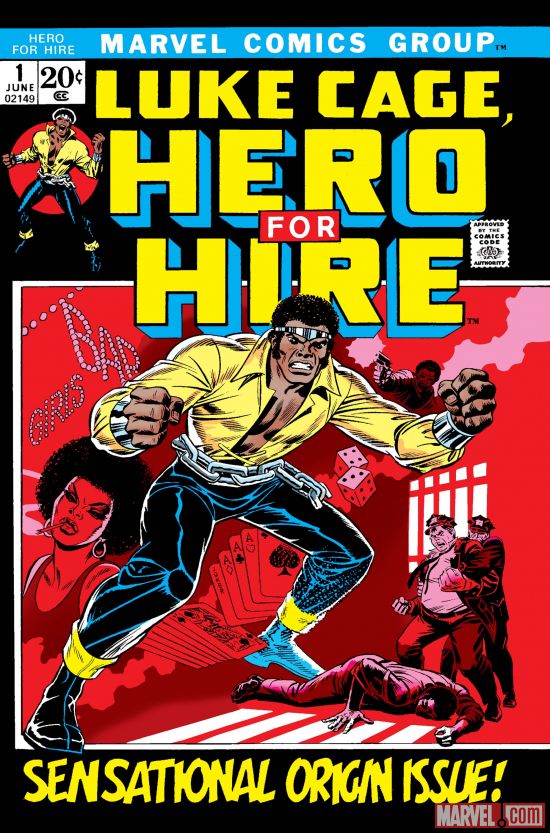
While rewatching some of the Netflix series based on Marvel characters, I noticed, for example, four creators identified for Luke Cage—Archie Goodwin, George Tuska, Roy Thomas, and John Romita Sr. This list identifies both writers and artists as creators, highlighting the essential problem that has existed in the super hero comic book business since the beginning.
Essentially, the comic book industry over the past century is an embarrassing story of denying creative contributions and resisting the essential nature of collaboration. Ironically, Marvel infamously experienced a crisis in the 1990s because a new wave of celebrity artists/creators began to assert their roles in creating comic books.
Throughout pop culture, what is created and consumed by audiences and who actually creates the product are overwhelmingly about collaboration—not only comic books (typically created by scripters/writers; pencil, ink, and color artists; and letterers) but TV series and films, and of course, pop music.
In a ham-fisted way, Albarn is speaking from and into an idealized view of the rugged individual as Artist.
The silly part of all this, of course, is that everyone knows the pop music industry is necessarily collaborative. In my own music fandom, for example, I learned to appreciate groups and solo acts that viewed pop music as both popular and art—notably my fandom of R.E.M., CAKE, Ben Folds (and Ben Folds Five), and The National.
And while there is a sort of wonderment to believing that performers such as Prince and Ben Folds created and performed entire albums “on their own,” and to watching Folds perform solo in live concerts, the truth is that nothing is really created in a complete vacuum of rugged individualism.
During the 1980s and 1990s when the disaster was brewing at Marvel, Athens, GA-based R.E.M. was rising to prominence and made the only right decision a musical group could make—assigned equal credit for all song to all four founding members of the band—Berry, Buck, Mills, Stipe. For many years, R.E.M. also did not include lyrics with their album releases to maintain (some claimed) a focus on the whole product.
I don’t see much value in teasing out the Swift/Albarn back-and-forth itself because, frankly, Albarn’s comments were daft and even his apology is lacking. Swift is the creator of her catalogue; she, like all artists, did not do that alone, but the work is still unequivocally hers even if and when it isn’t only hers.
But Albarn’s original comments are worth unpacking in terms his use of “writes.”
Since I am a pop music fan, I have always noticed a jumbled overlap of fans who use “writes” to mean lyrics and fans who use “writes” to mean music (and then subgroups of different instruments, song parts, etc.).
Whether it is super hero comics, pop music, or film/TV shows, people are apt to look for ways to identify who deserves the real credit for “writing” a product.
That urge, I think, is driven by the rugged individual myth that pervades U.S. culture, and that ultimately distorts the power and importance of collaboration.
Michael Stipe, formerly of R.E.M., has recently begun working more seriously on solo music and has openly acknowledged his role as mostly the lyricist for R.E.M. and thus needing others to help him (re)learn how to write music as well.
Folds rose to fame with his group, Ben Folds Five, but his transition to a solo career was quite different since Folds worked as a writer of lyrics and music in the band [1].
And if we circle back to Swift, she is a powerful example of creative ownership since she has begun to reclaim her catalogue, including famously working with Aaron Dessner (of The National) to critical success (Dessner also defended Swift against Albarn).
Were the original songs under a different producer Swift’s? Are the new versions Swift’s? And is her “ownership” or “writing” diminished by collaboration?
It seems beyond silly (and mostly sexist) to challenge Swift as a writer/creator of her work, and it also seems careless not to acknowledge that her collaborators do matter; the collaboration is an important element of creativity that is undervalued in American culture (as a subset of the larger sexism driving who is allowed to be individually great).
I think we should take much more time to acknowledge and celebrate collaboration, assuming it is nested there in virtually all creative acts and products; “no [hu]man is an island,” and all that.
But we should also take better care of how we talk about creativity; in many cases, we should prefer “creates” instead of “writes” because art/products often include initial ideas, more detailed fleshing out into products, and the performances of many people with gifts and talents.
Especially with pop music, we should also acknowledge that part of creativity is performance; Swift is an artists and a performer (and as many people have pointed out, Frank Sinatra, Elvis, etc., can be described as entertainers more so than artists in terms of their lack of creating/writing songs by comparison).
The Swift/Albarn clash is a great deal of mansplaining rubbish; Albarn simply shouldn’t have made those comments. But it is also a powerful message about the distorted view of creativity and art in the U.S. because of our rugged individual myth-delusion grounded in a pervasive sexism.
[1] Folds’s “One Down” has great lines about the role of the pop music song writer:
Ben, just make up junk And turn it in But i could never could quite bring myself To write a bunch of shit I don’t like wasting time On music that won’t make me proud But now I’ve found a reason To sit right down and shit some out
We are now in Year 4 of the “science of reading” (SoR) movement.
The SoR movement has directly influenced many states introducing new or revising existing reading legislation. However, the SoR movement is characterized by mostly misinformed, misleading, and over-simplified claims.
Similar to the larger accountability movement begun in the 1980s, the SoR influence on reading legislation and instruction is doomed to fail because it misidentifies the problems with teaching reading and learning to read.
Here, then, briefly, I outline the real problems with teaching reading and reading achievement among students in the U.S.:
The greatest barriers to all formal learning are out-of-school (OOS) factors such as household poverty, parental job security, food security, access to healthcare, and access to books/texts in the home. Decades of research have shown that about 60%-80+% of measurable student achievement is casually related to OOS factors; this holds true for reading achievement as well.
In-school barriers to reading achievement include teaching/learning conditions (class size, teacher expertise and experience) and inequitable access to learning (tracking, gate-keeping for so-called advanced programs—gifted and talented, Advanced Placement, International Baccalaureate, etc.).
Teacher education being bound to accountability mandates for accreditation and then teachers being held accountable for standards and high-stakes test scores are powerful barriers to individual student reading achievement.
The most important negative instructional barrier to reading achievement is holding teachers accountable for implementing reading programs instead of providing teachers support for addressing individual student needs.
Because of many of the barriers noted above, reading instruction is standards- and program-centered, not student-centered, and thus, many unique and complex needs of students are not addressed (special needs such as dyslexia, for example).
A significant cultural barrier to reading achievement is the ahistorical “crisis” rhetoric around student reading achievement; for well over a century, media, public, and political narratives have claimed that students are failing to read. We have never paused to ask why there is not one single year in which we declared reading achievement adequate.
Another conceptual barrier to reading achievement is a blind faith in grade-level reading. We have failed to recognize that decades of flat high-stakes test scores and a wide variety of rates among students for reading development refute a narrow technocratic view of reading development occurring in a prescribed sequence and conforming to biological age.
Similar to several Reading War movements reaching back to the 1940s, the current SoR movement is misidentifying barrier to teaching reading and reading achievement, and thus, the proposed changes to instruction and legislation are misguided, ultimately causing far more harm than good.
For about three years, states across the U.S., including South Carolina, have been adopting new reading legislation. This recent movement has been driven by a media fascination with the “science of reading.”
Proponents of the “science of reading” have made some dramatic claims: teachers are not teaching reading based on the current research base because teacher educators have failed to prepare those teachers, and students are struggling to read because of those failures.
The “science of reading” movement has also taken aim at popular reading programs—notably those by Lucy Calkins and Fountas and Pinnell—arguing that they lack the support of research.
As a result, we are now in the midst of yet another Reading War, pitting systematic intensive phonics (supported by the “science of reading” advocates) against balanced literacy (which has its roots in the whole language movement).
While public education certainly has an obligation to focus on literacy for all students, especially students living in poverty as well as those struggling to read, the “science of reading” movement is causing far more harm than good.
Reading Wars and debates over the proper place of systematic intensive phonics happen in English-speaking countries all over the world, including England where a shift to systematic intensive phonics occurred almost two decades ago. Dominic Wyse and Alice Bradbury detail the transition:
Prior to 2006 the teaching of reading in most classrooms in England is best described as balanced instruction, in which some phonics teaching has always been part of the teaching of reading typically for children in the infant years (aged five to seven) although not necessarily ‘systematic phonics’ instruction…. However in 2006 the Rose Report recommended that there should be even more emphasis on phonics teaching….
This was followed by the increased emphasis on discrete teaching of phonics recommended by the Rose Report and the PNS from 2006 onwards. Further intensification of synthetic phonics teaching was seen in England’s national curriculum of 2014, along with a range of other measures to ensure teacher compliance with the prescribed method of teaching reading, including the use of the PSC; the vetting of phonics teaching schemes; and the use of the inspectorate to focus on outcomes in statutory reading assessments as a prime focus in school inspections.
In other words, England shifted away from balanced literacy and toward systematic intensive phonics—the goal of the “science of reading” movement—about 16 years ago.
Therefore, Wyse and Bradbury’s analysis of this shift is a powerful message for the current call to drop balanced literacy for systematic intensive phonics (what advocates call the “science of reading”).
Wyse and Bradbury use a meta-synthesis of experimental research (the “science of reading”) and a survey of 2205 teachers to draw the following conclusions: “Our findings from analysis of tertiary reviews, systematic reviews and from the SQMS do not support a synthetic phonics orientation to the teaching of reading: they suggest that a balanced instruction approach is most likely to be successful.”
The “science of reading,” in fact, supports balanced literacy and not prioritizing systematic intensive phonics.
Further, Wyse and Bradbury offer important recommendations:
In addition to the importance of contextualised reading teaching as an evidence-based orientation to the teaching of reading we hypothesise the following pedagogical features that are likely to be effective. Phonics teaching is most likely to be effective for children aged five to six. Phonics teaching with children younger than this is not likely to be effective. A focus on whole texts and reading for meaning, to contextualise the teaching of other skills and knowledge, should drive pedagogy. Classroom teachers using their professional judgement to ensure coherence of the approach to teaching phonics and reading with other relevant teaching in their classroom is most likely to be effective. Insistence on particular schemes/ basals, scripted lessons, and other inflexible approaches is unlikely to be optimal. Well-trained classroom assistants, working in collaboration with their class teachers, could be a very important contribution to children’s reading development.
Another key problem with the “science of reading” movement is state’s adopting prescriptive phonics training for teachers (such as LETRS), a move doomed to failure as this study confirms.
Although too many states have jumped on the “science of reading” bandwagon already, this important research from England is an opportunity to pause, readjust, and not waste another decade or two making the same mistake England made in 2006.
At first, this seems like a really simple question: Do you believe in Santa Claus?
But scholars and researchers know that this question is actually a mine field of problems.
“Believe” is a problematic verb, and before anyone can answer or anyone can interpret the answers, we must all agree on what “Santa Claus” means.
Does “Santa Claus” mean a literal man who travels the world and crawls down chimneys to deliver toys? Or does it mean some historical “Santa Claus” who has become mythologized and represents a spirit of Christmas?
In other words, especially in polling designed to uncover better understanding of an issue or phenomenon, the questions asked and how the terms in those questions are defined (if at all) create the answers and thus shape the conclusions drawn from those answers.
This poll gathers data on several aspects of the Critical Race Theory debates driven by Republicans and conservatives across the U.S. But the framing skews (and likely distorts) what people know, what people think, and what people believe about CRT and white privilege. Consider the following:
Two problems are created by the framing above. First, note how “white privilege” is defined for the respondents: “White people in the U.S. have certain advantages [emphasis added] because of the color of their skin.”
Notably during the Trump era, certain segments of white people who support Trump have been very vocal about rejecting the concept of “white privilege.” Typically, these white people point to white poverty and white failure to reject—with evidence, they think—the concept of “advantage.”
The question defining “white privilege” as an “advantage” very likely reduces the number of respondents expressing support for or nuanced understanding of the concept. And that framing is inaccurate.
“White privilege” is better defined as the lack of barriers that are race-based for white people.
When white people find themselves in poverty, it is rarely because they are white; when white people fail, it is rarely because they are white.
There is not pop culture rhetoric about “driving while white” or “jogging while white” because race is rarely the key factor in negative interactions for white people, notably interacting with police or other authority figures (or other white people).
Systemic racism manifests itself in pervasive ways for Black people in that being Black is often the key factor in life experiences for Black people. Black people do fail and suffer primarily because they are Black, and not because of their behavior or character.
White privilege is about an absence (lack of race-based barriers) and about being allowed to exist as if your race doesn’t define you. Black people do not have that opportunity; being Black is a state of perpetual awareness of being Black.
Unlike white people, then, Black people do experience existentially and systematically barriers that are race-based.
Describing “white privilege” as an advantage suggests guarantees of wealth or success that simply are not true—and thus easy to reject.
Framing “white privilege” as the absence of race-based barriers both better defines the concept and increases the likelihood that respondents can acknowledge that reality.
The second problem is the use of the word “beliefs” with CRT, which distorts and misrepresents CRT as a “theory.”
Similar to the jumbled discourse around evolution (people often claim “I don’t believe in evolution”), respondents are likely misled by the word “beliefs” since it implies the lack of empirical data and suggests CRT is simply someone’s beliefs—and not a carefully formulated theory based on rigorous scholarship.
CRT, as a scholarly theory, has a set of claims, or principles. The use of those words, “claims” or “principles,” provides, again, a fairer framing and should provide more valid data.
Together, these examples show how research erodes the validity (do the data and conclusions drawn reflect what they claim to reflect?) of a poll by the questions asked, the framing and defining of the key terms.
In the “CRT beliefs” data also note that the “white privilege” framing as an “advantage” is reinforced by the use of “enjoy”: “Whites Enjoy Certain Privileges.”
Creating a set of questions for polling requires statistical expertise, but also scholarly knowledge and experience. In this case, the poll itself seems poorly reviewed for framing in terms of fully understanding either “white privilege” or “CRT.”
Since the entire cultural debate around race, racism, white privilege, and CRT is being driven by dishonest actors and misinformed media, politicians, and members of the public, a valid poll of those topics requires accurate and nuanced clarity on the questions being asked and definitions of the terms being examined.
This poll is ambitious, but it is likely doing more harm than good for that debate.
Republicans and conservatives have been depending for a long time on a truism with an ambiguous source: “A lie can travel halfway around the world while the truth is still putting on its shoes.”
The anti-Critical Race Theory movement has fully committed to this strategy; just lie quickly and then spend most of your time ranting as if the lie is true.
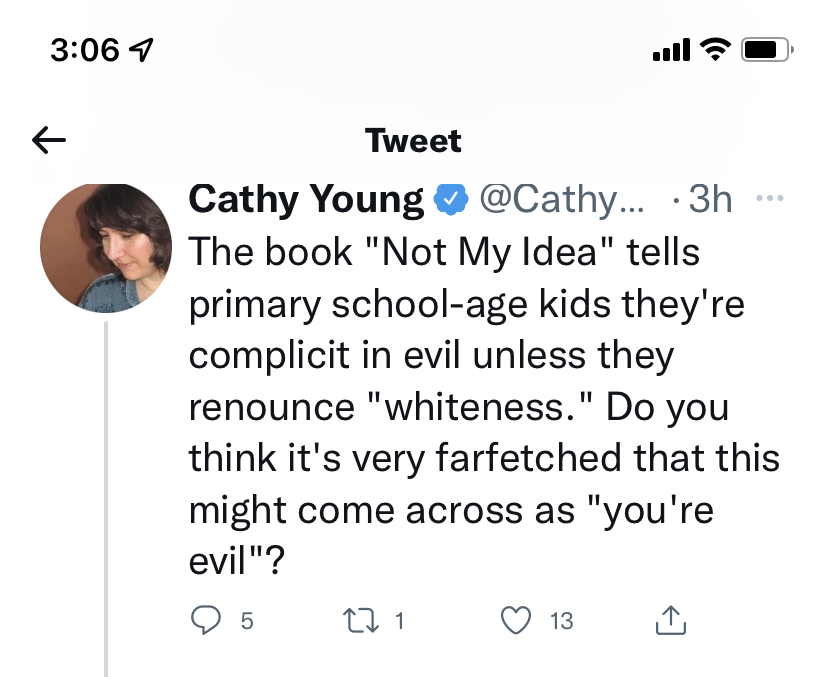
Here is but one of many examples:
While the claim here is a blatant lie, we should note that anti-CRT advocates are the ones who repeatedly conflate “whiteness” with “racism.”
Not My Idea, by Anastasia Higginbotham, in fact, goes to great lengths to recognize white people throughout history who have stood firm against racism; in other words, one of the strongest messages of the book is “not all white people.” The title and motif of the book is that white children are not the ones who created racism, “not my idea”—“Racism was not your idea. You don’t need to defend it.”
And here is the real issue: The book makes a strong case not for rejecting whiteness, but for rejecting racism when you are white.
As is the case is almost all efforts to censor, people have likely never read the book. So here you are, listen and hear the truth:
If you have to advance your beliefs through lies, you should interrogate those beliefs.
I am deeply skeptical about two things—criticism of “young people today” as if this younger generation is somehow significantly less capable than older generations and student evaluations of teaching (SETs).
So nothing would be worse, in my opinion, than launching into a “young people today” screed based on SETs. Therefore, what follows is intended as an evidence-based observation toward understanding, not a criticism, grounded in both recent SETs and my 20 years teaching at a selective liberal arts university (after teaching 18 years at a rural high school).
My almost four decades of teaching have been in two contexts with significant social class differences. My high school students were mostly working class and poor; my university students are quite privileged in terms of social class but also in terms of the quality of education they received before entering high education (many are from private school backgrounds).
Across both populations, I often am perceived (at first) as extremely demanding, and even harsh (or “mean”).
My high school students, many working class as I was (and I also attended the school where I taught), within a few weeks tended to flip in their opinion of my courses and even me. Many years later, I have very warm relationships with many of those students; and even those who still openly express that they aren’t fans of me as a person confirm that they appreciate the work I did as a teacher.
Achieving that level of connection and warmth with my university students has been rare to mostly absent. My university students, overwhelmingly privileged in many ways, are quite unlike me, having grown up working class and receiving my BA, MEd, and EdD from state universities.
I just reviewed my fall 2021 SETs, and despite efforts to address the negativity (and even antagonism) in my spring 2021 SETs, I once again read a significant amount of negative, angry, and harsh responses to my courses.
A few things are going on, I think. First, I believe the Covid-era has in many ways inflated student stress, which is reflected in the increase of negative comments (a point I am making not to criticize students, but to acknowledge the larger forces at work and how SET data are rarely about teacher quality).
Second, while I reject the credibility and validity of SETs (as reflected in research on the practice), I do think the data say less about teacher quality and more about the students themselves.
Now, putting those two points together allows me to draw some important conclusions about privilege as a barrier to learning.
Before I explore that thought, let me offer a few caveats.
Socioeconomic status is the strongest correlation to measurable student achievement; therefore, wealthy and white students disproportionately are labeled as “good” or “excellent” students.
However, if you dig deeper in that data, you discover that eduction is not the “great equalizer” but a marker for privilege; privilege itself actually trumps having more and so-called better education (extensive research supports that claim); for one example, see the following data:
People born into socioeconomic and/or race privilege tend to navigate and achieve advanced education degrees, but the privilege itself is the primary driver of their “success” (attaining high-paying jobs), not the education.
My university students often have backgrounds in selective private schools, and almost all of them have completed high school as top students (many having made As throughout their schooling).
When I examine the types of things students are critical of and even angry about, I am increasingly concerned that privilege is a barrier to learning even as these students successfully navigate college and continue to earn high grades.
Here are the types of things privileged students are critical of in my courses recently (again, I am not criticizing these students but offering this as a way to describe and understand why they are struggling):
Privileged students are disproportionately offended by feedback and requirements for revision*. Living in privilege that contributes to years of praise and success have created students who are very thin-skinned and frail. As I have examined before, many students perceive all feedback as negative. Many of these students want to submit work once and have it immediately praised, and assigned an A. Being show ways to revise and improve, being asked to revise—these approaches trigger students of privilege.
Privileged students have a “banking” concept of teaching and learning (that Paulo Freire criticized). In other words, my privileged students view my job as dispensing for them knowledge as capital; I, however, reject the “banking” concept of teaching and see the role of teacher as facilitator. Privileged students tend to resist having their autonomy as learners increased, viewing a teacher-as-facilitator as negligent or even lazy (not doing their job).
Privileged students are very skeptical of and often paralyzed by de-grading practices. Grades for privileged students have been positive experiences that confirm their belief that they are “good” students who have earned those grades. People in privilege often interpret success as mostly a reflection of their effort—and not their privilege. Removing grades removes their safety blanket. (One student from last fall claimed they were reduced to crying often in my course due to my non-grading practices.)
Privileged students prefer knowledge-based courses to process-and-product-based courses. Although certainly not exclusively so, privileged students seem to view knowledge as “objective” and process/product as “subjective”; therefore, the latter creates anxiety in them that they will not be successful (not make an A).
Privileged students perceive “being smart” as something you achieve and not a journey. Since they have often been told they are smart, they can misinterpret “smart” as their being “finished”; being challenged to learn more or, especially, to re-think their learning is perceived as an attack on their Selves.
Privileged students are hyper-sensitive to decorum, formality, and tone. While I recognize some of this point is grounded in my personality, I am increasingly aware that some of the tone tension between my students and me is class-based. I despise formality and do my work at a very high level of efficiency; my emails and my written feedback are terse and direct. Privileged students tend to interpret that style as mean, harsh, and discouraging. This issue with tone overlaps, I think, with my efforts to shift responsibility away from me doing work for students and toward students taking agency over their own learning (many students dislike my use of highlighting when I return written work, for example). As one of the most unexpected examples from my fall SETs, a student recommended I start using “Hi” to start my emails.
Privileged students cling desperately to playing school and performing as students. Tests, grades, assignment rubrics and grade scales/weights, lectures, etc., are the environment where they have flourished; anything that deviates from these traditional practices creates anxiety—and skepticism about the teacher.
Privileged students (like their conservative parents) fear radical ideas and change. This is basic human nature; when the world works for you, you fear change to that system. I am a critical educator and scholar so my approach to ideas and the world are perceived as not just radical, but threatening to their way of life.
In the grand scheme of my career as a teacher, I realize the folly in SETs because, once again, my fall SETs included dramatically contradictory responses side-by-side—praise for my feedback and willingness to help students learn followed by claims that my feedback is “vague” and “mean,” ultimately discouraging the student to learn.
Again, the feedback says far more about the students than my work as a teacher.
None the less, I believe I have turned a corner in my understanding of the complex nature of privilege in the teaching/learning dynamic.
Yes, on balance, of course, privilege is an incredible advantage, but like being labeled gifted, privilege can also be a barrier to learning—and being happy.
*
educator, public scholar, poet&writer – academic freedom isn't free







 dr. p.l. (paul) thomas