All posts by plthomasedd

P. L. Thomas, Professor of Education (Furman University, Greenville SC), taught high school English in rural South Carolina before moving to teacher education. He is a former column editor for English Journal (National Council of Teachers of English), current series editor for Critical Literacy Teaching Series: Challenging Authors and Genres (Brill), and author of Teaching Writing as Journey, Not Destination: Essays Exploring What ‘Teaching Writing’ Means (IAP, 2019) and How to End the Reading War and Serve the Literacy Needs of All Students: A Primer for Parents, Policy Makers, and People Who Care (IAP, in press). NCTE named Thomas the 2013 George Orwell Award winner. He co-edited the award-winning (Divergent Book Award for Excellence in 21st Century Literacies Research) volume Critical Media Literacy and Fake News in Post-Truth America (Brill, 2018). Follow his work @plthomasEdD and the becoming radical (https://radicalscholarship.wordpress.com/).

The Good Student Trap: Research Paper Edition

I teach good students.

I write that with no sarcasm, or cynicism.

For the past 20 years, I have been teaching at a selective liberal arts university, and the students are mostly high-achieving young adults who graduated high school as A or B students.

Like me, my students also have a tendency toward the often ignored consequences of being gifted or smart—anxiety, depression, imposter’s syndrome, perfectionism.

While “good student” is a compliment, I remain convinced that performing as a good student is also, as Adele Scheele argued, a trap. Scheele posed that students learn good student habits in high school that they then apply in college, but often find those behaviors no longer are successful—or even valued by professors:

We were learning the Formula.
• Find out what’s expected.
• Do it.
• Wait for a response.

And it worked.

The Good Student Trap (excerpt), Adele Scheele

But more powerful that acknowledging that good student behavior doesn’t translate into college, Scheele also confronts how the good student trap creates irrational fear:

So what’s the problem? The problem is the danger. The danger lies in thinking about life as a test that we’ll pass or fail, one or the other, tested and branded by an Authority. So, we slide into feeling afraid we’ll fail even before we do—if we do. Mostly we don’t even fail; we’re just mortally afraid that we’re going to. We get used to labeling ourselves failures even when we’re not failing. If we don’t do as well as we wish, we don’t get a second chance to improve ourselves, or raise our grades. If we do perform well, we think that we got away with something this time. But wait until next time, we think; then they’ll find out what frauds we are. We let this fear ruin our lives. And it does.

The Good Student Trap (excerpt), Adele Scheele

I often watch these dynamics with my first-year students, which I anticipate. But the most dramatic example of this tension is in my upper-level writing/research course, notably when students submit this assignment:

Assignment

Students will conduct a research project in which they critically analyze how the above chosen issue is presented in the mainstream media, and write in a workshop format (multiple drafts, conferencing) an 8-10 page essay using APA format (see link above and student resources provided) detailing how well or not the media has presented the research. See Sample APA 7e with comments. NOTE: This cited essays is primarily a critical analysis of media coverage, and not simply an essay on your chosen education topic. The essay should include the following major sections: opening, literature review, media coverage, relationship between research and media, and closing/conclusion.

For 8-10 pages, a proposed structure:

Opening – about 1 page (2-4 paragraphs); be sure to include essay focus on media

literature review – 2 pages; focus on *patterns* in the sources (write about your topics, not the sources)

media coverage – 2 pages; focus on *patterns* in the media and include several examples

relationship between research and media – 2 pages; this is the most important goal of the essay so connect research and media examples

closing/conclusion – about 1 page (2-4 paragraphs); must emphasize essay focus, media analysis

Assignment for EDU 250, Paul Thomas, Furman University

Despite the highly structured details in the assignment, and despite students having several class sessions devoted to workshopping the assignment (and two scaffolded assignments—submitting a working references list and submitting annotated bibliographies for their sources), they struggle with completing the assignment as assigned, resulting in intense and negative responses to the feedback I provide on the first full submission.

The good student trap experienced by students here is that instead of conducting, writing, and submitting a media analysis project, students fall back to writing a high school research paper.

The reductive and inauthentic research paper students learn in high school is essentially behaving and writing like a student—collecting and writing an overview of “sources,” typically plowing through those sources one at a time and heavily quoting from each source.

The assignment I ask students to engage in requires that they move away from student behaviors and toward writing as scholars; that shift means that they gather and student scholarly sources in order to provide themselves a lens for writing an original essay (in this case, becoming expert on an educational topic in order to analyze the quality of media coverage of that topic).

For example, students tend to write “research papers” that explicitly state “my sources” and “my media articles” in order to detail “what I learned about X topic” instead of analyzing how media covers that topic.

My feedback includes nudging them (again) not to write like students, stressing that they are not doing the assignment (I refer them to the outline provided and the need to focus on “media analysis”), and warning them about citation concerns (including carelessness that rises to technical plagiarism).

With my feedback, the fear and negative response cycle kicks in. Students seem unable to trust a workshop environment in which draft submission, feedback, and revision are not only expected but required.

The good student trap has also trained students to see all feedback as evaluation, judgment, and to fear that not being immediately perfect is a signal that they have failed, or that they are going to fail.

Anticipating their fear and expecting they received my feedback negatively, I emailed them and assured them that revision was expected and that everyone was still capable of making an A in the course regardless of how well their initial submission had fulfilled the assignment.

In the first class after returning their essays with comments, however, they were mostly frantic; many of their comments were dramatic distortions of the feedback they received.

None the less, once they had their draft in front of them, they admitted seeing the gap between the assignment and what they submitted was much clearer to them.

So here is what my good students teach me over and over.

First, they confirm that prescriptions and templates are not nearly as effective as many people believe; I have always rejected prescriptions, templates, rubrics, and prompts for teaching writing—despite their all being common in traditional classrooms.

Students respond better to direct instruction once they have an artifact in front of them for context.

Next, they demonstrate for me the negative power of prior behavior that is successful, regardless of the credibility of that behavior. In this case, students struggle mightily to let go of the research paper.

And finally, they embody the paralysis of fear of not being good enough, not being perfect.

Unless traditional schooling changes—and I suspect it will not—I am faced with this reality continuing, and ultimately, I regret that the ones who suffer most in the good student trap are students themselves.
The Politics of Calling for No Politics: 2022 Edition (South Carolina)

My home state of South Carolina appears determined to join the misleading and misguided “anti-CRT” bandwagon that mandates curriculum gag orders, centers parental control over schooling, and legislates a simplistic and nonsensical characterization of “ideology.”

After weeks of deliberation and public testimony opposing a flurry of five bills (H.4325, H.4343, H.4392, H.4605, and H.4799), the SC House Education and Public Works Committee passed a unified bill (H. 5183) that wasn’t made public until after the vote.

While maintaining much of the copy-cat language from similar bills being proposed and passed across the U.S., the bill appears to compile many of the worst features of these attacks on academic freedom—curriculum and instruction gag orders, parental trigger mechanisms, and vague as well as contradictory language.

The opening section on “intent” seeks to frame the bill in positive terms; however, the content of the rest of the bill directly and repeated contradicts those stated intentions, suggesting either they are insincere or that legislators, again, have no business prescribing and mandating curriculum and instruction.

By the third subsection of section 2, the crux of the problem with the bill is stated:

Section 59-29-620. (A) The following prohibited concepts may not be included or promoted in a course of instruction, curriculum, assignment, instructional program, instructional material, or professional educator development or training:

South Carolina Transparency and Integrity in Education Act

Regardless of what is listed next (and the listing is incredibly problematic, as I will examine), this is not an acceptable approach to legislating education in a free democratic nation. This is a disturbing example of people with political power trying to erase the politics of other people through that power—the politics of calling for no politics.

The damning irony of this bill is that it is an ideological treatise with real-world consequences that legislates the exact conditions the bill purports to be eradicating from public schools.

The only way to identify “prohibited concepts” is through an ideological lens. The only way to have a free and open educational environment is to protect academic freedom, the opposite of curriculum and instruction bans.

The ideology behind the prohibition of concepts is exposed in several of the list of gag orders:

  • “an individual, by virtue of the race, sex, ethnicity, religion, color, or national origin of the individual, inherently is privileged, racist, sexist, or oppressive, whether consciously or subconsciously” — This banned concept includes factual content (privilege, conscious and unconscious bias) that is well supported by research in several academic fields, and by banning factual content, legislators are imposing their ideologies onto the classroom, which they claim is the condition they are trying to erase from the classroom.
  • “meritocracy or traits such as a hard work ethic: (a) are racist or sexist; or (b) were created by members of a particular race or sex to oppress members of another race, sex, ethnicity, color, or national origin; and” — Here, legislators are imposing their ideology onto protected concepts (again, exposing an ideological bias) that are no longer open for critique or debate (a direct contradiction of an opening intent stated in the bill: “high school students graduate having learned critical thinking skills and being college ready and career ready”). No one can learn and practice critical thinking in an environment where some concepts are banned and other concepts are protected.

The list of prohibited concepts ends with a caveat of sorts, which proves to be equally problematic:

(D) Notwithstanding subsection (A), LEAs are not prohibited from including concepts as part of a course of instruction, in a curriculum or instructional program, or through the use of supplemental instructional materials if those concepts involve:…

(2) the impartial discussion of controversial aspects of history; or

(3) the impartial instruction on the historical oppression of a particular group of people based on race, ethnicity, class, nationality, religion, or geographic region.

South Carolina Transparency and Integrity in Education Act

The focus on “impartial” fits into the opening statements of intent, and “impartial” is a traditional expectation of teaching and scholarship; however, since this and other bills like this are often vague in the rhetoric, what exactly “impartial” means in different contexts should be a concern.

In other words, does this bill prohibit teachers and students declaring horrific events in history (such as the Holocaust and slavery in the U.S.) as morally wrong?

Impartiality can be as distorting as bias, in fact.

A final monumental ideological problem the bill is that it centers parents in the role of policing curriculum (content) and instruction (including lesson plans)—an ideological decision that ignores the autonomy and interests of children.

After providing guidelines for parents monitoring and complaining about curriculum and instruction, the bill would codify the role of parents in their children’s education:

SECTION 3. Section 59-28-180 of the 1976 Code is amended to read:

“Section 59-28-180. (A) Parent involvement influences student learning and academic performance; therefore, parents are expected to: …

(14) be the primary source of their student’s education in regard to learning morals, ethics, and civic responsibility.

South Carolina Transparency and Integrity in Education Act

Not only does this bill idealize parental ideology, but also it ignores that the purposes of universal public education are designed for individual liberty (students) and for democratic ideals (the community0; in other words, public schools are not designed to impose the unique ideology of each parent.

As I have detailed often in my writing, I was raised in a racist home and community; I was exposed to a better ideology through my formal schooling.

Ultimately, this bill is mandating parental indoctrination to the exclusion of students’ right and democracy.

Republicans are declaring themselves the party of their indoctrination is more important than anyone’s academic freedom. The party of the politics of calling for no politics.

IndoctriNation: Can We Avoid Our Dystopian Republican Future?

“I guess irony can be pretty ironic sometimes,” Commander Buck Murdock (William Shatner) muses in Airplane 2: The Sequel.

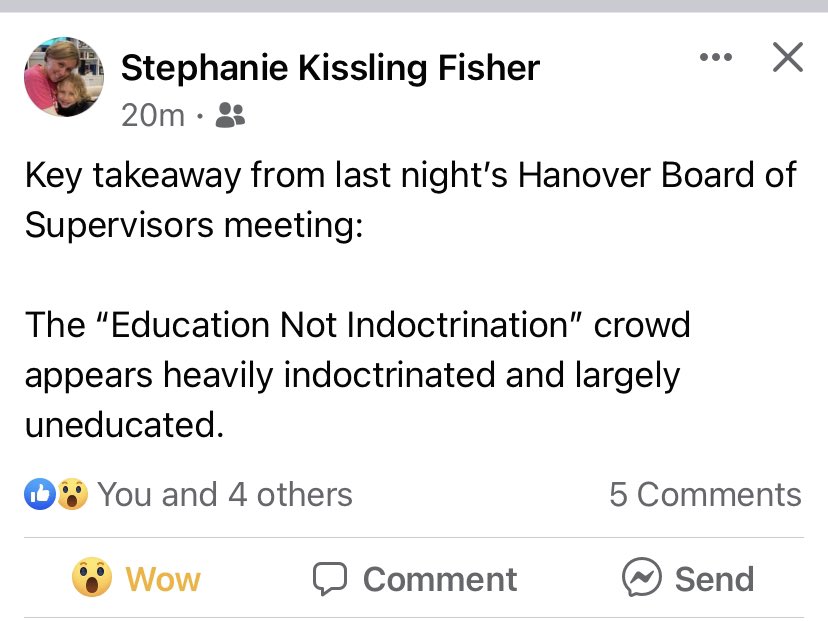
I immediately thought of this iconic Shatner scene from the Jerry Zucker-Jim Abrahams-David Zucker film when I saw a brilliant and urgently serious post on Facebook from a former student of mine currently advocating for all that is Good and Right in her crumbling state of Virginia:

While Stephanie hits succinctly right at the heart of the irony surrounding the current push by Republicans to mandate educational gag orders, parental trigger bills, and a wide range of censorship for not only school and colleges but also throughout society, I want to highlight how the irony is a veneer for the Republican long game.

Many people have now exposed that the Republican use of “Critical Race Theory” is an orchestrated lie for larger political goals since their definitions of CRT are distortions and misinformation.

But what exactly is that end game?

First, let’s unpack the monumental irony in the “Education Not Indoctrination” claims of Republicans.

A related element of the anti-CRT movement is linking CRT to “Marxism” (itself a distortion bordering on a lie), but the more telling aspect of that connection is that Marxist and critical educators forefront a genuine and resolute rejection of indoctrination. As Joe Kincheloe details, seeking out and exposing those who indoctrinate is a “central tenet” of being critical:

Thus, proponents of critical pedagogy understand that every dimension of schooling and every form of educational practice are politically contested spaces. Shaped by history and challenged by a wide range of interest groups, educational practice is a fuzzy concept as it takes place in numerous settings, is shaped by a plethora of often-invisible forces, and can operate even in the name of democracy and justice to be totalitarian and oppressive….

Recognition of these educational politics suggests that teachers take a position and make it understandable to their students. They do not, however, have the right to impose these positions on their students. This is a central tenet of critical pedagogy.

In this context it is not the advocates of critical pedagogy who are most often guilty of impositional teaching but many of the mainstream critics themselves. When mainstream opponents of critical pedagogy promote the notion that all language and political behavior that oppose the dominant ideology are forms of indoctrination, they forget how experience is shaped by unequal forms of power. To refuse to name the forces that produce human suffering and exploitation is to take a position that supports oppression and powers that perpetuate it. The argument that any position opposing the actions of dominant power wielders is problematic. It is tantamount to saying that one who admits her oppositional political sentiments and makes them known to students is guilty of indoctrination, while one who hides her consent to dominant power and the status quo it has produced from her students is operating in an objective and neutral manner. Critical pedagogy wants to know who’s indoctrinating whom. (pp. 2, 11)

JOE KINCHELOE, CRITICAL PEDAGOGY PRIMER

Therefore, if an educator is leftist, Marxist, or critical, they are dedicated to not only seeking out and contesting anyone who indoctrinates, but also working continuously to avoid allowing their own teaching to devolve into indoctrination.

To indoctrinate is to be authoritarian (see Paulo Freire’s distinction between “authoritarian” and “authoritative” in the context of critical pedagogy).

Along with the foundational strategy of using lies and mischaracterized terms to advance a political agenda, Republicans also are guilty of projection: Almost everything Republicans attribute to the “Left” is what they actually do (Republicans decry a false specter of “cancel culture” while actually passing legislation that censors, cancels, and bans materials and ideas) or what they would do given the opportunity and the power.

And that leads to the end game.

To understand the Republican end game, you must address that “Education Not Indoctrination” is yet another Orwellian misdirection. Republicans are not anti-indoctrination; in fact, Republicans are actually seeking a world in which they completely control the indoctrinating.

In short, Kincheloe’s “who’s indoctrinating whom” can be addressed simply by acknowledging that given the opportunity and power (see legislation in Republican-led states) the “who” will always be Republicans and the “whom” will be the rest of us.

Republicans are organizing and enacting a broad campaign to create their dystopia, IndoctriNation.

They are counting on a common flaw in the U.S.: “The best lack all conviction, while the worst/Are full of passionate intensity” (“The Second Coming,” William Butler Yeats).

The Politics of Reading Proficiency (and Charter Schools)

It seems almost quaint now, except for the racism, but in 2009, Representative Joe Wilson (R-SC) shouted “You lie” at Barack Obama. Post-Obama, the issue of political lies intensified dramatically, however, with Donald Trump building his presidential campaign on an extreme practice of lies that was well outside the norm of the sorts of lies people tend to expect from politicians.

In the wake of Trump, political lies have maintained the new low bar set by Trump; however, as I have detailed, there is a long history now of political leaders building their political careers on education reform, recently reading legislation, and that strategy in part depends on politicians, not educators, having the power to mandate standards, high-stakes testing, and most important of all, what counts as “proficiency” for reading achievement (currently, by the way, “proficiency” is set by each state with no federal oversight [see explanation here]—despite the stated goals of the Common Core movement to address that).

Many elements of the education reform movement begun in the early 1980s have served a similar political function, especially charter schools; the Obama administration, for example, solidified charter school expansion as a bi-partisan political strategy.

Since the release of the 2019 NAEP data on reading and after high-profile media coverage, a key example of politicians using reading achievement as political capital is Mississippi. The so-called “Mississippi Miracle” (a haunting cousin of the “Texas” and “Harlem” miracles that proved to be lies) is easily unmasked as a mirage (a lie) once the data is contextualized.

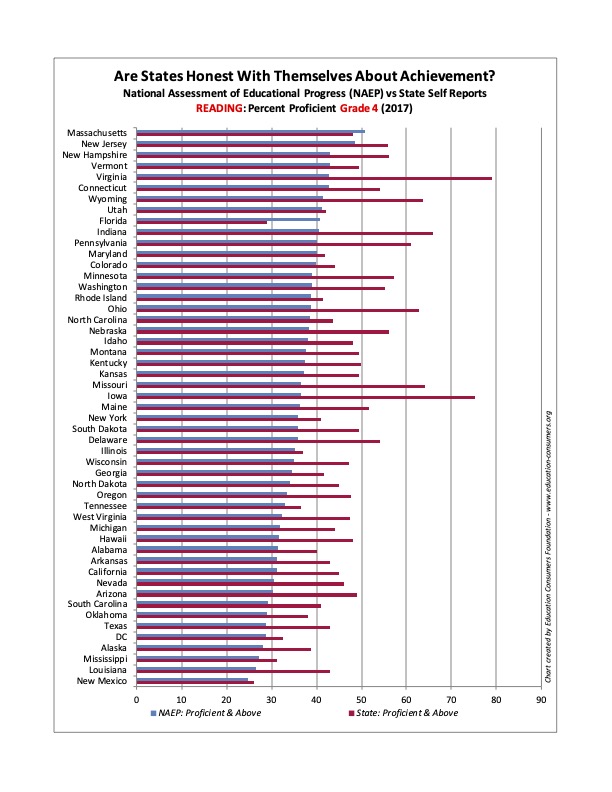
While Mississippi’s 2019 NAEP reading scores for 4th grade were heralded as an aspirational outlier, Mississippi is not alone in its effective political game of smoke and mirrors using reading proficiency scores; see the following comparison of state proficiency scores compared to national NAEP data:

Most states have some degree of lower standards for proficiency than NAEP, but the issue is not that NAEP is a credible measure of reading (it isn’t); the issue is that state-level reading proficiency is a political tool of elected officials.

While the media and political leaders in Mississippi have claimed “miracle” for the state, the data show otherwise:

As the scatterplot suggests, Mississippi has a fairly normal strong correlation between socioeconomic status and reading achievement (low poverty correlated with high scores and high poverty correlated with low scores). Yes, Mississippi has had a long pattern of raising reading scores since the 1998 while not closing key achievement “gaps” (see NAEP longitudinal data), but the state is not somehow miraculously serving high-poverty students (because of the “science of reading”) in a way that is superior to other states (whose failures are being falsely attributed to an absence of the “science of reading”).

While a perverse way to say it, Mississippi reading achievement isn’t a “miracle” (and there currently is no scientific evidence that reading achievement gains are caused by a switch to the so-called “science of reading”) but is mostly “normal” in terms of producing measurable student achievement that is more a reflection of socioeconomic status (and race) that actual achievement.

In short, if you look at the data from all states, you will find a pattern of political hype (lies) not matching the data.

Similar to Mississippi, my home state of South Carolina tends toward that normal, but since this tool allows adding charter schools, please note how charter school (red dots) achievement (as I have documented before) mostly matches traditional publics schools (TPS), with a few outperforming and several underperforming when compared based on similar demographics:

The key to charter school analysis is to compare charter and traditional public schools with similar demographics (in the scatterplot above, that is the vertical axis); note that most charter schools cluster with TPS, but several fall lower on achievement when compared to TPS.

None the less, a great deal of political capital has been and is currently being spent on claiming the “science of reading” has created “miracles” (a lie) and that charter schools save children in poverty and Black/brown students (another lie).

Reading achievement is once again a hot media and political topic, but that discourse and legislation coming from it, are mostly lies that are serving the needs of political leaders and not students.

Dear Legislators: Your Job Is Funding, Not Dictating, Education

Let’s start with a thought experiment.

Your elected state legislators are confronted with a series of bills addressing crumbling bridges and roads in your state. After a period of typical partisan debate, a final bill is proposed that not only funds new bridge and road construction, but also dictates how those bridges and roads must be constructed.

Most of the legislators who wrote and voted on the bill have laws degrees or career experiences in business; none of the legislators are structural engineers, and thus, no expertise in constructing bridges or roads.

Structural engineers and those whose profession is building bridges and roads note that the legislation is dangerous, ill conceived, and certainly will result in bridges and roads that will cost people’s lives.

None the less, the bill passes and then is signed by your governor.

This thought experiment likely seems outlandish, but it represents a key distinction about the role of legislators as that impacts public institutions (in this hypothetical situation, our highway/road infrastructure). In brief, it is the role of legislators to fund and ensure at least adequate if not excellent public institutions; it is not the role of legislators to dictate how those public institutions should be realized since a legislative body often lacks the expertise to create those mandates.

This brings me to my primary area of expertise, education.

Specifically since the last months of the Trump administration, there has been a wave of state-level legislation censoring curriculum, banning books and ideas, and mandating all aspects of formal education (curriculum and instruction)—often including mechanisms for parents to trigger censorship and even dismissal of teachers and professors based on personal ideologies and perceived “discomfort” by students.

This partisan political trend fits into a larger contemporary and century-long history of legislators mandating not just that education by provided but what and how that education must include.

As one example, since about 2018, states have proposed and passed very detailed and prescriptive reading legislation, a movement that fits into the accountability era of education that began in the late 1970s and early 1980s.

My home state of South Carolina is a powerful example of good intentions that have gone terribly wrong.

Under the guidance of then-governor (and future Secretary of Education under Bill Clinton) Richard Riley, SC established the now-familiar structure of K-12 public education, broadly labeled as accountability—state-level standards (approved by legislators), state-level high-stakes testing (approved by legislators), and various consequences for schools and teachers meeting or not those mandated parameters.

Throughout the 1980s and into the 1990s, bolstered by the misleading and partisan A Nation at Risk report released under Ronald Reagan, governors increasingly discovered that focusing on education reform paid significant political dividends (regardless of political party).

The narrative was simple, although deeply misleading: U.S. public education is failing students and the country because of the inherent flaws of the education establishment; therefore, it is the responsibility of elected officials to mandate all aspects of education.

By the mid-1990s into the 2000s, George W. Bush pushed the envelope of being an education governor onto the national stage; Bush created another false narrative around his so-called “Texas Miracle” (along with Rod Paige as Texas superintendent of education) that helped propel Bush to the White House and then take the state-level template for education reform to the federal level with No Child Left Behind (NCLB).

While NCLB floundered, never producing the results promised in the same ways that state-level accountability never fulfilled promises, the template was set for governors and presidents; the Obama administration (embodied by Arne Duncan as Secretary of Education) doubled-down on the Bush/ Paige/ Spellings model, in fact.

In many ways, the current wave of curriculum gag orders and book censorship (as well as the copy-cat legislation imposing a misguided “science of reading” mandate on reading instruction) is the logical progression within that accountability approach to education.

In that model, authority is centered in elected officials, and expertise is trumped by that political authority.

Since the 1980s, accountability legislation and political micromanaging have not improved education in the U.S. (at regular intervals, the same crisis discourse is repeated, followed by the same strategies for reform, just under different political leaders), but that model has served political careers well at the expense of education, democracy, and now, academic freedom.

Legislators, then, have replaced their democratic responsibilities for funding and ensuring public institutions with using education, for example, as a political football for their own careers.

Just as legislators should fund but not mandate how to build our roads and bridges, they should fully fund but not dictate how or what teachers teach—especially when their mandates are serving ideological agendas and not teaching or learning in a country that claims to respect individual liberty, democracy, and academic freedom.

The “Science of Reading” Multiverse

Published in 1947 in The Elementary English Review, a flagship journal of the National Council of Teachers of English (NCTE) that later became Language Arts, “Research in Language” is one of the most cited pieces by Lou LaBrant in my scholarship and public writing about education and literacy.

LaBrant served as president of NCTE in the 1950s, and along with being an active and influential literacy scholar, LaBrant was a practitioner over a staggering 65 years of teaching.

LaBrant made two incisive claims in this article:

A brief consideration will indicate reasons for the considerable gap between the research currently available and the utilization of that research in school programs and methods. (p. 87)

It is not strange, in view of the extensive literature on language, that the teacher tends to fall back upon the textbook as authority, unmindful of the fact that the writer of the text may himself be ignorant of the basis for his study. (pp. 88-89)

LaBrant, L. (1947, January). Research in language. Elementary English, 24(1), 86-94. http://www.jstor.org/stable/41383425

Having written an educational biography of LaBrant for my doctoral dissertation, I am vividly aware that LaBrant taught and wrote as a complex progressive who used the term “research” in broad Deweyan terms that included everything from gold-standard experimental research to the daily observations made by classroom teachers.

I cite her because as a practitioner and scholar I also embrace a very complicated understanding of “research,” “evidence,” and the word of the moment, “science.” I am also deeply skeptical of textbooks and programs.

Since early 2018, the phrase “science of reading” has entered and often dominated media, public/parental, and political discourse around the teaching and learning of reading in the U.S.

Almost for as long—I discovered the movement a few months after it began—I have been waving a red flag, advocating for skepticism and extreme caution about that discourse, the media, public/parental, and political rhetoric. For that reason, I persist in placing the phrase in quote marks since I am specifically criticizing the discourse.

If anything, my criticism is having far too little impact on the consequences of the “science of reading” discourse that is driving many states to adopt new reading legislation. And on social media, I am routinely attacked, often quite aggressively, as a science denier and someone intent on hurting children (although I have been a life-long educator across five decades as both a K-12 classroom teacher and a college professor).

I am also often discredited and told that journalists, parents, and politicians understand my own field better than I do.

Part of the problem with debating the “science of reading” movement is the term itself, one that has at least three different meanings, a multiverse if you will (although absent, darn it, Doctor Strange or Wanda).

Before anyone can, or should, answer “Do you support/reject the ‘science of reading’?” we must first clarify exactly what the term means; therefore, here, then, I want to detail the three ways the phrase currently exists since it entered mainstream use in the media during 2018.

“Science of Reading” as Media, Public/Parental, and Political Discourse. Beginning with Emily Hanford and then perpetuated by mainstream media (Education Week and the New York Times, notably), the “science of reading” is a narrative that claims teachers are not teaching students to read using the “science of reading” because teacher educators have failed to teach the “science of reading” in teacher prep programs. Concurrently, this discourse also blames low student reading achievement on the dominance of balanced literacy reading programs (often erroneously) since, as advocates claim, balance literacy is not grounded in the “science of reading.” This version of the “science of reading” maintains that primarily (or even only) cognitive science research is the “science” that counts and that the “simple view” of reading is the one valid theory of reading supported by the “science of reading.” [Note: This is the version of the “science of reading” that most of my scholarly and public writing challenges as misguided and harmful; see here, here, and here.]

“Science of Reading” as Marketing and Branding. Since the “science of reading” advocacy identified above has been extremely effective, states are adopting new reading legislation, some of which directly bans popular reading programs and then narrowly mandates the use of materials and programs that meet the narrow characterization above. This means education companies, especially ones focusing on literacy, have begun to brand and rebrand their materials as programs with the “science of reading.” For example:

As a market response to legislation, as well, some popular reading programs have responded to this version of the phrase. This marketing dynamic is very common in education. Many years ago, I attended a state-level literacy conference where Smokey Daniels spoke. Daniels is one of the top literacy scholars associated with the term “best practice”; however, he warned then that the term had been quickly co-opted by textbook publishers and that there was no mechanism for insuring that something labeled “best practice” was, in fact, demonstrating those concepts (the same problem exists for “whole language” and “balanced literacy”).

“Science of Reading” as Shorthand for the Research Base for Teaching Reading. This is what LaBrant referred to as the “research currently available” in 1947. The irony in this use of the phrase is that many people have been using some form of this phrase for a century—”research,” “science,” “evidence.” And of course, scholars and practitioners are often aware of and practicing many aspects of that “science”—even though science, research, and evidence are all necessarily in a state of flux (and thus, LaBrant’s nod to “currently available”). To be blunt, no reasonable or informed person would reject this use of the “science of reading.” However, I must note that this use is almost entirely absent in public discourse; it remains used almost exclusively among researchers and some practitioners. Another irony, in fact, is that the first use of the phrase above is itself a gross mischaracterization of this complex and broad use.

Because of these different and often conflicting uses of the “science of reading,” we are experiencing incredibly jumbled and even nonsensical outcomes such as teachers being required to attend training in programs that are not supported by research (LETRS) and states adopting reading legislation that implement practices that are not supported by research (grade retention).

So, if you return to LaBrant’s claims above, you may notice an eerie similarity between her valid assertions and the current “science of reading” discourse that is not credible even as it is highly effective.

The problem is that teaching, learning, and literacy are extremely complex human behaviors that resist simple labels or explanations—and also defy efforts to prescribe templates that will magically fulfill the urge for “all students must.”

Alas, in this multiverse there is no magic.


Recommended

Dr. Paul Thomas on the Multiverse that is the Science of Teaching Reading

Paul Thomas How to End the Reading War and Serve the Literacy Needs of All Students