All posts by plthomasedd

P. L. Thomas, Professor of Education (Furman University, Greenville SC), taught high school English in rural South Carolina before moving to teacher education. He is a former column editor for English Journal (National Council of Teachers of English), current series editor for Critical Literacy Teaching Series: Challenging Authors and Genres (Brill), and author of Teaching Writing as Journey, Not Destination: Essays Exploring What ‘Teaching Writing’ Means (IAP, 2019) and How to End the Reading War and Serve the Literacy Needs of All Students: A Primer for Parents, Policy Makers, and People Who Care (IAP, in press). NCTE named Thomas the 2013 George Orwell Award winner. He co-edited the award-winning (Divergent Book Award for Excellence in 21st Century Literacies Research) volume Critical Media Literacy and Fake News in Post-Truth America (Brill, 2018). Follow his work @plthomasEdD and the becoming radical (https://radicalscholarship.wordpress.com/).

MLK and “the Guaranteed Income”

[Header Photo by Katie Harp on Unsplash]

“President-elect Joe Biden will seek to increase the federal minimum wage to $15 an hour as part of his relief bill,” reported Alina Selyukh for NPR.

Across social media, people began doing calculations of what $15/hour translates into for annual salaries, and here are a couple responses from white Christian conservatives:

McChristian, personifying the relationship between a McNugget and real chicken, seems to be aware that teachers are underpaid, but lacks any Christian compassion for other workers also being underpaid (such as minimum-wage workers often constituting the working poor and living without healthcare or retirement—or job security).

Rachel, hollow mouthpiece for the equally vapid TPUSA, doesn’t just lack compassion; she also lacks any grasp of basic facts, embodying not only the hypocrisy of the Christian conservative movement but also the complete misunderstanding of how the free market works.

Note that “[r]aising wages for fast-food workers to $15 an hour would lead to a noticeable but not substantial increase in food prices, according to a new study by Purdue University’s School of Hospitality and Tourism Management,” as reported by Sally French at Market Watch.

Social media, as well, was quick to point out that in areas such as DC and the San Francisco Bay, where the minimum wage is already $15 and above, Taco Bell burritos remain below $4 at the most expensive.

In the U.S., we are well beyond the point of needing to acknowledge that there is nothing Christian or honest about the conservative movement in the U.S.

And few times a year are more likely to expose that than Martin Luther King Jr. Day—when those on the Right scramble to cherry-pick one or two quotes from MLK to wave in front of their hypocrisy and lies.

The debate about the $15/hour minimum wage (as well as college debt relief and universal healthcare) is an ideal opportunity to examine the MLK that almost everyone in mainstream America chooses to ignore.

brown concrete statue during daytime
Photo by Clay Banks on Unsplash

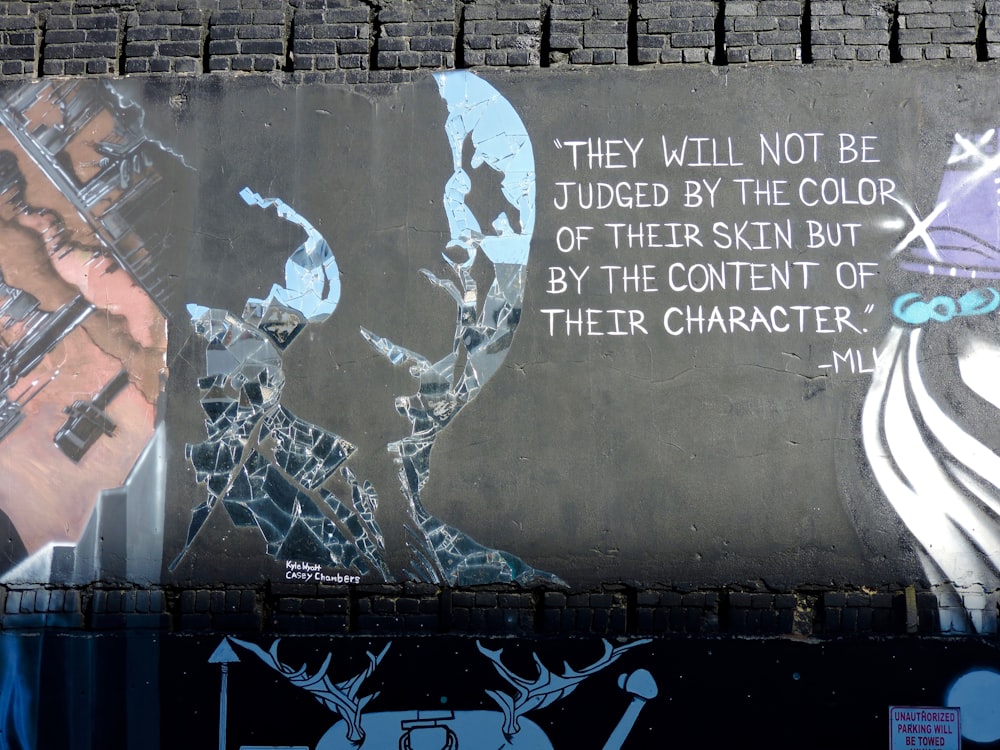
A couple favorite mis-uses and distortions of appropriating MLK is, first, characterizing King as a “passive radical” in order to violence-shame groups or paint a distorted “both sides” false equivalency between right-wing white nationalism and social justice advocates focusing on race and racism, and second, plastering the “content of their character” quotes everywhere to perpetuate the colorblind argument that, in fact, is itself racist.
text
Photo by LeeAnn Cline on Unsplash

Rare is the reference to King who strongly rejected the Vietnam War, but almost entirely absent from the public consciousness in the U.S. is King’s 1967 work, Where Do We Go from Here: Chaos or Community?

Here, King offers his criticism of the standard approach to eradicating poverty (approaches that persist in 2021):

Up to recently we have proceeded from a premise that poverty is a consequence of multiple evils:

• lack of education restricting job opportunities;

• poor housing which stultified home life and suppressed initiatives;

• fragile relationships which distorted personality development.

The logic of this approach suggested that each of these causes be attacked one by one. Hence a housing program to transform living conditions, improved educational facilities to furnish tools for better job opportunities, and family counseling to create better personal adjustments were designed. In combination these measure were intended to remove the causes of poverty.

Wealth and Want

King was confronting that U.S. political will could only admit indirect ways to address poverty—despite, as King pointed out, that more whites than Black people suffered under the weight of economic inequity.

“In addition to the absence of coordination and sufficiency, the programs of the past all have another common failing — they are indirect. Each seeks to solve poverty by first solving something else,” King noted, adding: “I am now convinced that the simplest approach will prove to be the most effective — the solution to poverty is to abolish it directly by a now widely discussed measure: the guaranteed income.”

Not only did King call for a guaranteed income, he asserted the essential need to be direct:

We are likely to find that the problems of housing and education, instead of preceding the elimination of poverty, will themselves be affected if poverty is first abolished. The poor transformed into purchasers will do a great deal on their own to alter housing decay. Negroes, who have a double disability, will have a greater effect on discrimination when they have the additional weapon of cash to use in their struggle.

Wealth and Want

Unlike McChristian and Rachel above, MLK as a progressive, as a Leftist (often slurred as a “communist”), understood the foundational need in a capitalist society that all people have capital:

Beyond these advantages, a host of positive psychological changes inevitably will result from widespread economic security. The dignity of the individual will flourish when the decisions concerning his life and in his own hands, when he has the assurance that his income is stable and certain, and when he know that he has the means to seek self-improvement. Personal conflicts between husband, wife and children will diminish when the unjust measurement of human worth on a scale of dollars is eliminated.

Wealth and Want

But King was profoundly aware of the problems with “minimum” wages, arguing about the guaranteed income:

Two conditions are indispensable if we are to ensure that the guaranteed income operates as a consistently progressive measure.

• First, it must be pegged to the median income of society, not the lowest levels of income. To guarantee an income at the floor would simply perpetuate welfare standards and freeze into the society poverty conditions.

• Second, the guaranteed income must be dynamic; it must automatically increase as the total social income grows. Were it permitted to remain static under growth conditions, the recipients would suffer a relative decline. If periodic reviews disclose that the whole national income has risen, then the guaranteed income would have to be adjusted upward by the same percentage. Without these safeguards a creeping retrogression would occur, nullifying the gains of security and stability.

Wealth and Want

King makes a purely Christian argument about economic policy in a capitalist democracy that should and could center human dignity and equity over greed:

The curse of poverty has no justification in our age. It is socially as cruel and blind as the practice of cannibalism at the dawn of civilization, when men ate each other because they had not yet learned to take food from the soil or to consume the abundant animal life around them. The time has come for us to civilize ourselves by the total, direct and immediate abolition of poverty.

Wealth and Want

The Right is wrong about what it means to be Christian.

The Right is wrong about what makes democracy and capitalism work for people and not against human dignity.

And the Right over the next few days will once again be offensively wrong about MLK.
MLK Jr. Day Reader 2021

Photo by History in HD on Unsplash

From 1984 until 2002, 18 years, I taught high school English in the town and school where I grew up and graduated, moving into the classroom of my high school English teacher, Lynn Harrill, where I had sat as a student just six years earlier.

My first few years were overwhelming and at times terrifying; I taught five different preparations—managing fifteen different textbooks—and several of the classes were filled to capacity, 35 students packed into the room.

Throughout those two decades spanning the 1980s and past the 1990s, I was a student-centered teacher who had a wonderful relationship with my students—lots of mutual love and respect. However, there was always some tension between me and white redneck boys.

Again, these white redneck boys were who I had been growing up, and even the least aware among them likely sensed deep down inside that I knew who they were.

One of the worst days of my teaching career—sitting among having to confront a student gunman and returning to school after three children burned down the school building—included the actions of one white redneck boy.

A significant sub-unit of my nine-week non-fiction unit included walking students through the concept of civil disobedience, starting with Emerson and Thoreau but spending far more time on a mini-unit in Black history grounded in ideas and texts by Marcus Garvey, Booker T. Washington, W.E.B. Du Bois, Malcolm X, and Martin Luther King Jr.

We capped off that unit with Gandhi, but the grounding text of this nine weeks was always King’s “Letter from Birmingham City Jail” paired with different excerpts from Malcolm X.

One day as I was passing out King’s “Letter” (I always provided students their own copies of texts to annotate and keep), a white redneck boy slapped the handout off his desk and announced, “I ain’t reading that [N-word].”

In many ways, this was a defining moment for me as a teacher and a human. I was very aware that I had Black students in the room and that this teenager was much larger and angrier than was safe for me or the classroom of students.

I calmly returned the handout to the desk, my hand firmly on the paper while I leaned toward the student, and I said without hesitation that he would read the essay and that he would never utter that word in class again.

It seems odd to me now, but that is exactly what happened as I continued handing out the essay before we began reading and discussing the essay as a class.

This is no after-school special, and I never had any sort of deep conversation with that student—and I suspect he never changed his beliefs, except keeping his bigotry to himself, at least in my class.

I do suspect that for him and others in the classroom, I was the first white man to take a stand against racism and racist language that they had ever experienced.

It is embarrassing to admit, but that unit was a huge risk for me throughout my 18 years teaching. It even prompted not-so-veiled attacks from local preachers during sermons that my students attended on Sunday mornings (oddly, Southern Baptists seemed very offended by students studying Gandhi, who they dismissed as “not a Christian”).

There are many things I would change about my first two decades of teaching, being charged with the learning of hundreds of teenagers; there are many things I did inexcusably wrong, things for which I remain embarrassed and wish I had the power to return to those moments in order to make amends.

But that sub-unit, and specifically how I taught MLK and what works of his I exposed students to, is important still to me because we did not read “I Have a Dream,” and we did not mythologize MLK as a passive radical, rejecting the whitewashing far too common with King’s ideas and life.

I also exposed students to a wide range of Black writers and thinkers, emphasizing the importance of recognizing Malcolm X and taking his arguments seriously.

None the less, I could have done better—and even today in 2021, King’s life and legacy are woefully mis-served, especially in classrooms (as well as crossing the lips of politicians who cannot even for one day practice an iota of the ideals of King).

Here, then, is a reader for serving King better and expanding the voices and ideas with which we invite our students to engage:

Martin Luther King Jr., “The Drum Major Instinct” Sermon

Final Words of Advice/ “Where do we go from here?” (1967), Martin Luther King Jr.

The Trumpet of Conscience, Martin Luther King Jr.

“Letter from Birmingham City Jail,” Martin Luther King Jr.

Read This Before Co-Opting MLK Jr., Jose Vilson

The Revisionist’s Martin Luther King Jr., “I Have A Dream For Most Of Us,” Jose Vilson

Harlem, Langston Hughes

Let America Be America Again, Langston Hughes

The Forgotten, Radical Martin Luther King Jr., Matt Berman

James Baldwin: “the time is always now”

“Every white person in this country…knows one thing,” James Baldwin (1979) (incl. What Can a Sincere White Person Do? Malcolm X)

James Baldwin from “The Negro and the American Promise”

They Can’t Turn Back, James Baldwin

A Report from Occupied Territory, James Baldwin

“Peculiar Benefits,” Roxane Gay

You Want a Confederate Monument? My Body Is a Confederate Monument, Caroline Randall Williams

Lockridge: “The American Myth,”James Baldwin

If Black English Isn’t a Language, Then Tell Me, What Is? James Baldwin

“The Baldwin Stamp,” Adrienne Rich

Black Body: Rereading James Baldwin’s “Stranger in the Village,” Teju Cole

The Transformation of Silence into Language and Action, Audre Lorde

Bayard Rustin (March 17, 1912 – August 24, 1987): A Reader

The Mis-Education of the Negro, Carter Godwin Woodson

Nina Simone on the Role of the Artist

Republicans Usher in the Land Free from the Truth: Free Speech v. Free Markets

We know of course there’s really no such thing as the “voiceless.” There are only the deliberately silenced, or the preferably unheard.

Arundhati Roy: The 2004 Sydney Peace Prize lecture

Labeled as “surreal” by Emilia Petrarca, Marjorie Taylor Greene (R – Georgia) wore as “censored” face mask while speaking from the floor on Congress.

First, we must recognize that statistically no one in the U.S. has the sort of access to a bully pulpit that a member of Congress has (535 out of 330 million people), and then, we must consider whether Greene is incredibly dishonest, spectacularly ignorant, or both.

After the insurrection at the Capitol by rightwing domestic terrorists supporting Trump—and emboldened by Trump and many Republicans in office—conservatives and Republicans across the U.S. have evoked “censorship,” “First Amendment,” and “freedom of speech” tirades in response to Trump being banned from several social media platforms as well as many Republicans losing followers on those platforms.

Here is the disturbing thing that Greene represents among conservatives and Republicans: There appears to be the same sort of dishonesty/ignorance running rampant because there is essentially no relationship between private businesses and free speech guaranteed in the Constitution since the First Amendment is about the role of government in protected speech.

Let’s not forget very recent history when Republicans and conservatives scrambled to support the right of companies not to serve or even hire LGBTQ+ individuals (recall the wedding cake).

Private companies banning anyone is not an issue of free speech grounded in the First Amendment since government plays no role in that, and (ironically), anyone losing Twitter followers is a consequence of market forces, how the free market works.

In the jumbled surreal-reality of Republicans, it seems they want some entity (the government?) to monitor the free market so that all voices are heard—regardless of truth and irrespective of inciting violence (seemingly now, conservatives support yelling “Fire!” in a crowded theater).

As a writer, I have been submitting letters to the editor and Op-Eds to local, state, and national media for decades; most of those submissions are rejected. Is that censorship? A denial of freedom of speech? A breech of my First Amendment rights?

Of course not.

It is the free market—as right-wingers would say, the marketplace of ideas.

There are some really important and likely disorienting elements to this jumbled message created by Republicans and conservatives.

One seems to be why does Greene (and Trump, et al.) lie and misrepresent to the American public as agents of the government with impunity? In other words, what is the role of truth in governing?

Free speech and the First Amendment have continued to be areas of debate in the U.S. in terms of inciting violence and pornography, and we must admit that free speech is not a clear-cut or absolute thing even when recognizing only the role of government.

The level of lies and disinformation under Trump, I think, now calls for a serious interrogation of what free speech allows in those contexts—especially in terms of elected and appointed members of the government.

It seems obvious that agents of government must not incite violence or promote false information.

When people with power (from the wealthy to police to elected officials, including the president) function above truth and the law, it is unlikely that free speech matters for anyone.

A second element that is being almost entirely ignored because of the lies and ignorance on the Right is the question of free speech and the free market; in other words, we are not confronting the role played by private companies in whose voice is amplified and whose voice is muted or ignored.

Twitter bans and people losing followers on Twitter are not the purview of government, and both exist in the mechanics of the free market—which many of us on the Left have warned are amoral dynamics.

Supply and demand left unchecked has nothing to do with ethical or moral concerns. There is a demand for child sex trafficking, for example, and without government intervention (a moral/ethical imperative), it would flourish within the parameters of those consumers.

Many aspects of the U.S. function this way without being so immediately disgusting and inhuman—and thus, remain unchecked.

Those of us on the Left, as well, recognize the amoral aspect of the market and therefore call for universal healthcare, for example, since market forces are inappropriate for determining who does and does not receive medical care.

Trump sycophants such as Greene are backing themselves into some complicated ideological and political corners since their outrage over social media is challenging the efficacy of the free market (misidentified as free speech because of their dishonesty/ignorance).

While I see no hope that Republicans have any interest in the truth—or freedom of speech—I think that this nonsense from the Right offers yet another opportunity for people in the U.S. to reconsider the relationship between government/democracy and capitalism.

Despite a related lie from the Right, we Leftists are rarely calling for full-blown socialism or communism; we are, however, arguing that far too much of human dignity and freedom is left to the free market—such as healthcare—and the whims of the states—such as women’s reproductive rights.

Should we be concerned that Twitter and Facebook banned Trump, and that Parler was de-platformed?

I suspect we should, but not because these events have violated the First Amendment.

The problem is us and the lack of political will in the U.S. to reconsider our overblown commitments to the free market at the expense of democracy and truth as well as life, liberty, and the pursuit of happiness.

On Reading and Comic Books: A Journey from 1975 to 2021 (and Beyond)

She was born in November 1963/The day Aldous Huxley died/And her mama believed/That everyone could be free

“Run, Baby, Run,” Sheryl Crow

The summer of 1975, I was diagnosed with scoliosis and fitted with a form-fitting plastic body brace anchored with aluminum rods and spanning from my pelvic bone to my chin. This was a hell of a way to start my ninth grade at Woodruff Junior High.

I would wear that brace 23 hours a day, gradually weaning myself off the support as my vertebrae both (mostly) repaired their disfigurement and eventually stopped growing; this meant I wore the brace for much of my high school experience as well.

My childhood and teen years were a contradiction of Southern racism, ignorance, and bigotry warmly wrapped in the blanket of my loving and doting working-class parents. My scoliosis was a significant financial burden on my parents (who never flinched at the medical care it required), but it also in some ways broke their hearts.

I was a skinny and very anxious human, deeply self-conscious and introverted before the years of the brace came upon me in the roiling shit-storm of adolescence.

It was at this juncture of my life that I discovered comic books, what now seems like a logical extension of the fascination I inherited from my mom for science fiction (she loved classic black-and-white B-movies, always claiming The Day the Earth Stood Still as her favorite film).

Once again, my parents never wavered when I began collecting and drawing from Marvel comics in the mid-1970s. They drove me to the local pharmacies to buy new comics and even bought a pretty large and important collection from a guy selling hundreds of comics in the local newspaper.

By high school graduation, I had amassed essentially every comic book Marvel published in the 1970s.

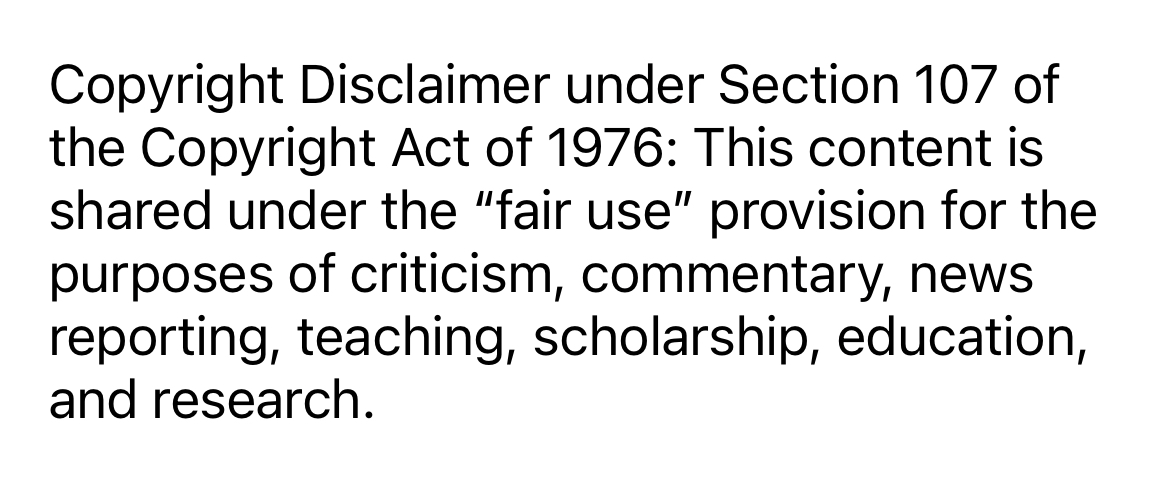
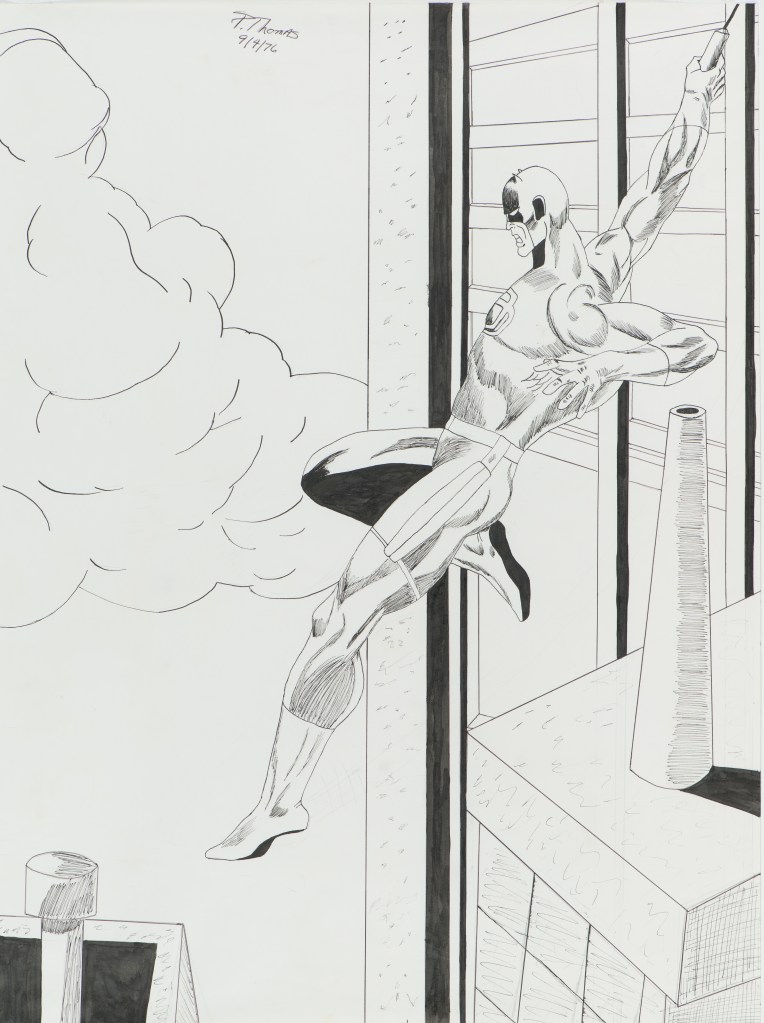
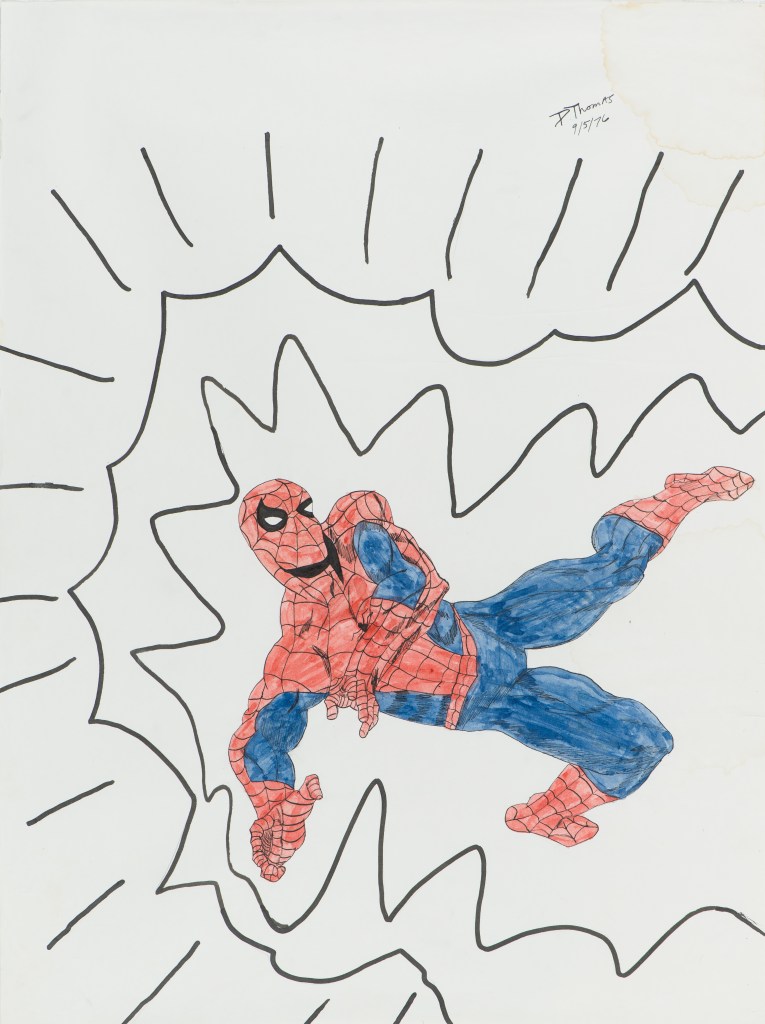
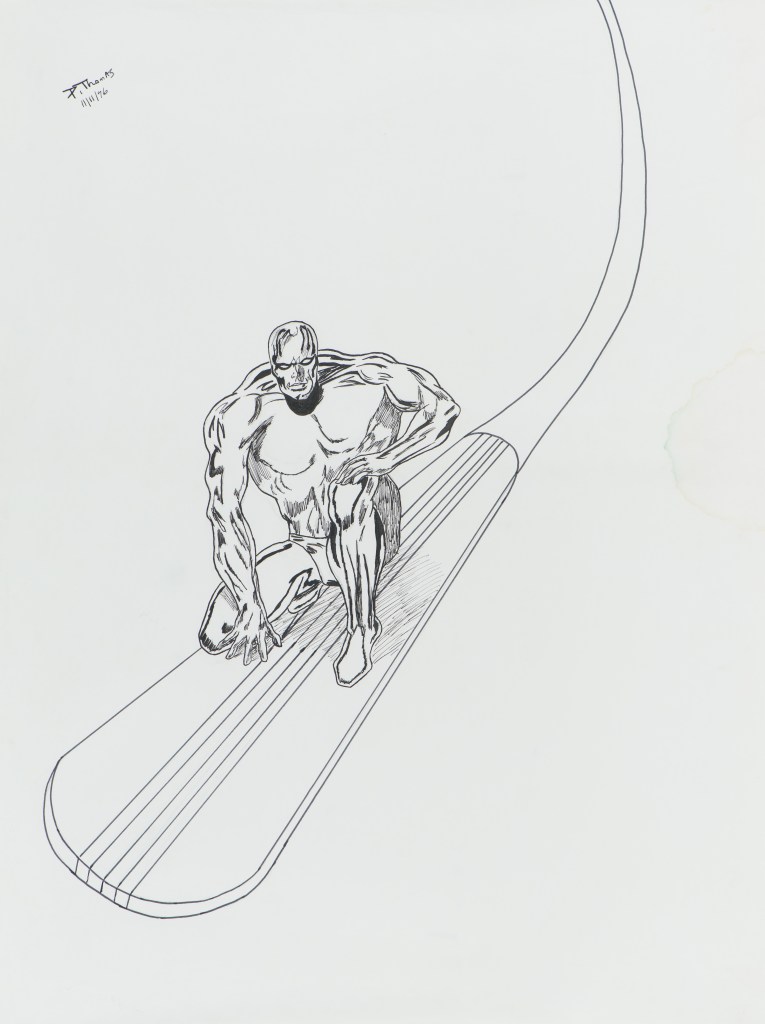
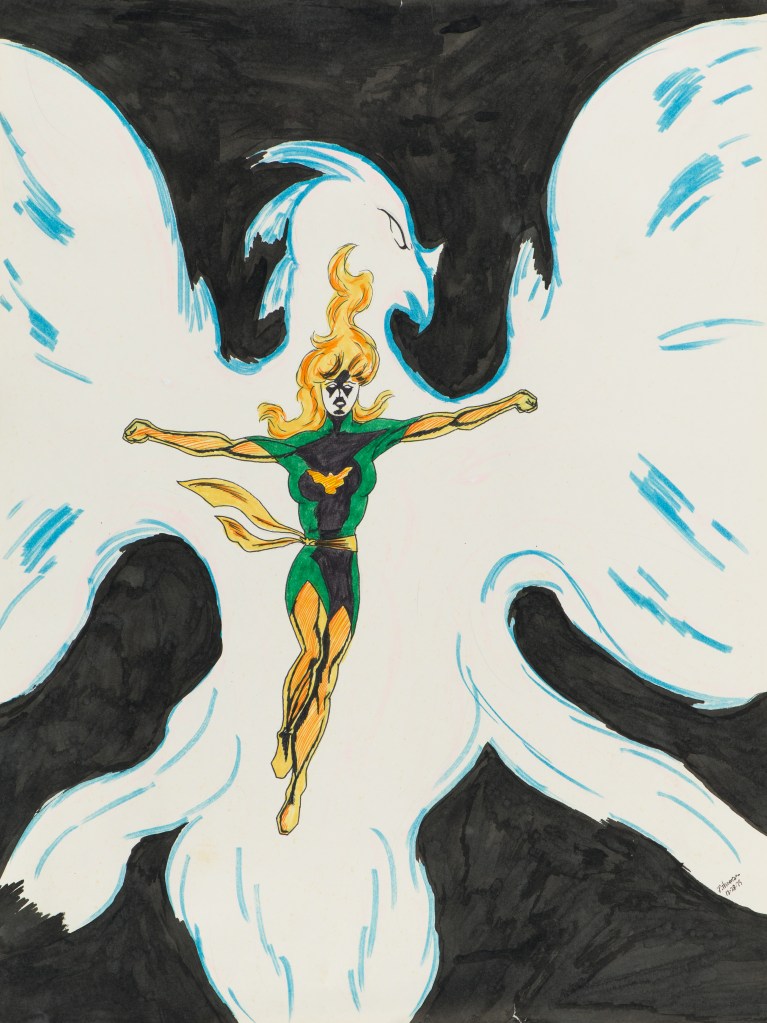
It would take me many years to recognize that my comic book collecting and science fiction reading were the foundation upon which I eventually chose to be a high school English teacher and came to recognize that I am a writer (although I initially clung to being a comic book artist since I spent hours and hours standing at our kitchen bar drawing from the comics I collected). (See my original artwork from the mid-/late 1970s below.)

Just thirteen days away from turning 60, I am baffled at not being able to specifically identify when I stopped collecting comics some time around graduating high school and attending college. I assume it seemed childish at some point even though I kept my 7000-book collection well into marriage.

I do know that when we bought our first townhouse, I sold that collection for way less than it was worth in both dollars and for my soul. I held onto the full run of Howard the Duck, but let everything else fund my misguided pursuit of the corrupted American Dream—home ownership.

At some point in the late 1980s and early 1990s, I briefly returned to collecting, prompted by several of my high school students and the Frank Miller rebooting of Batman as well as the Tim Burton/Michael Keaton films. This coincided with the 1990s boom/bust of mainstream comics by Marvel and DC, and once again, adult life kept me from really fully engaging in something I love.

When I moved to higher education in 2002 after 18 years teaching high school English, I found a way to merge my adolescent love for comic books and my adult life—comic book scholarship and blogging. I also published one book on comic books, which allowed me a justification for buying comics and graphic novels once again (and a way to move beyond super hero comics). I learned a great deal (and made several embarrassing mistakes) when I merged my fandom with my scholarship, but that work about a decade ago, once again, didn’t really stick—although it certainly didn’t fade away either.

Recently, I allowed myself to re-commit to collecting, focusing on Daredevil and then adding the newest Wolverine run. I am back engaged with a local comic book store just minutes from where I live, and I also collected the recent X of Swords run from Marvel. (See part of my Xmas haul below.)

And yesterday, something very interesting happened for me, again just two weeks from turning 60.

Concurrent with my reconnecting with comic book collecting, I have been embroiled in the newest reading war around the “science of reading” and also making a very feeble attempt at learning to play video games (initially Minecraft).

I never became a gamer because I always have struggled with the controls, and in my advancing age, that has been a real hurdle even more pronounced. But I also experienced a significant amount of disorientation as well as feeling extremely (for lack of a better word) dumb.

Starting a game left me paralyzed, repeatedly asking what I was supposed to do. I often was coached with this advice: Just explore and watch for what the game shows you to do.

That meant nothing to me, even less than nothing. In fact, I soon realized that I was simply unable to read the video games while experienced gamers have internalized hundreds of signals and cues to the point that “what you are supposed to do” seems obvious (see this on gaming, for example).

One of my foundational complaints about the “science of reading” movement has been its embracing a simple view of reading, and here I was, at 60, experiencing how incredibly complex reading is—that reading is far more than decoding print (and is even often apart from print).

Gaming like reading comic books is a holistic experience with text as well as images all guided by prior knowledge and experiences, and the blending of many different kinds of codes that are both unique to a single environment as well as common across the medium/genre/form.

The subgenres of gaming have commonalities like the subgenre of comic books, super hero comics.

Although I have recognized myself as a writer for forty years now—and never lift a pencil to draw any more—I was pulled back into comic book collecting because of the artwork, first Daredevil (a series that has always had distinct and powerful artists working on the character, in my opinion), then the rebooted Wolverine series, and now the incredible artists working on X-Men.

X-Men vol. 5, issues 5 and 6 (cover art: Leinil Francis Yu and Sunny Gho)

In several of my college courses, I have integrated comic books and graphic novels, often to students who have never read comics. They almost always admit that reading comics is much harder and takes much longer than they expected. It wasn’t, they discovered, like reading a text-only essay or book.

As I have been diving back into the X of Swords series and the rebooted X-Men series spearheaded by Jonathan Hickman, I have noticed my haphazard reading style of comics, very art-based and not very sequential (I glance around the entire spread and often dart back and forth among the text and panels).

And so here is the very interesting thing from yesterday.

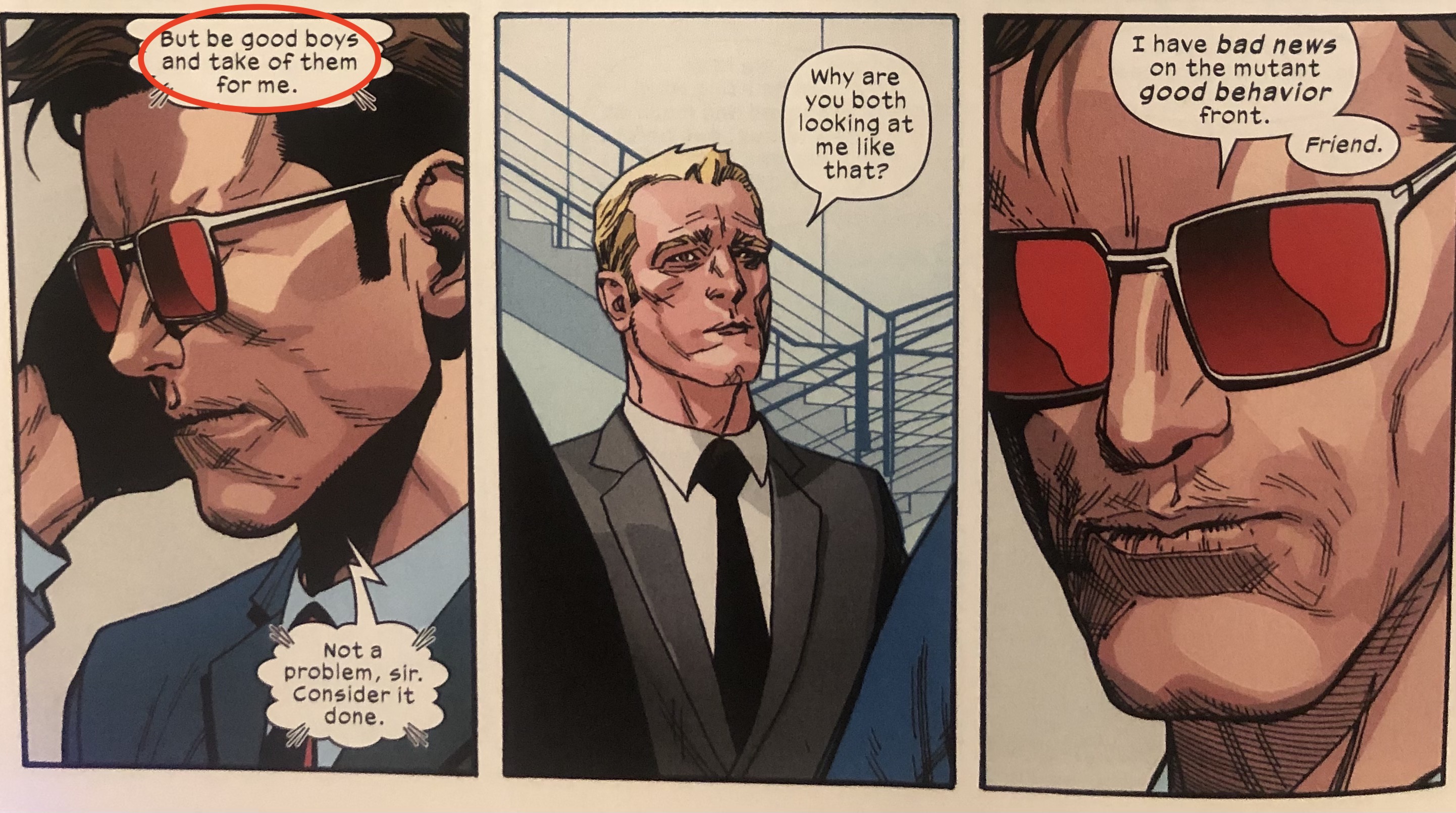
In issue 4 of X-Men (vol. 5), Magneto quotes Aldous Huxley:

A sucker for literary references, I paused to search the quote, and then returned to reread the pages leading up to and after the use of the quote. Then, I realized something unusual that I had not noticed when first reading:

X-Men vol. 5, issue 4 (Hickman/Yu)

The omission of “care.”

Every time I read this, I still insert “care” automatically and have to force myself to see that it isn’t there (as if Professor X is doing it for me each time).

There are dozens of cues in those three panels, some of them text (and one of them the absence of assumed text).

As I count down the days until I turn 60, I am living some of the fantastical elements we associate with children’s stories, comic books, and science fiction—a pandemic, a Capitol siege, and the many eras of my own life overlapping with each other as if I am both living my current life and going back in time.

Life is no comic book or video game, but I am tasked with making sure as I explore the things around me that I pay attention to all the cues of what I am supposed to do—and it remains a very complicated task in 2021 as it was in 1975.

Thinking Critically about Critical Thinking in the Era of Trump and TikTok

While it now seems like generations ago, in the spring of 2008, I joined other faculty at Furman University in an organized protest labeled “We Object.” Through the university’s connections with FU graduate and former governor of South Carolina Mark Sanford, George W. Bush was invited to speak at commencement.

Recent university tradition was to have two students speak, but did not include outside speakers. None the less, students and the community (overwhelmingly conservative) seemed to welcome the opportunity to have a two-term Republican president speak to graduates.

The protest took many forms, including reaching out to the media, posting an official “We Object” statement, and wearing a “We Object” shirt, revealed from beneath professor’s gowns during the speech.

I did not yet have tenure as an assistant professor, but I was active in the organized resistance that included a wide range of reasons why professors were objecting. I attended meetings, helped with the statement, and provided interviews to the media (I did not stand and protest during graduation, however).

One aspect of that spring that now looks like a harbinger of the world in which we live today was an Op-Ed published by two conservative professors in political science. In that piece, they discounted the professors protesting as postmodernists.

Two problems stand out from that commentary. First, as is typical of conservative thinkers, they either did not understand postmodernism or willfully misrepresented postmodernism in order to have a strawman to attack. Second, when those of us protesting gathered after the piece was published, we uniformly confirmed that not a single one of us considered ourselves postmodernists (an intellectual movement now well in the past, supplanted by the ever-inane, in fact, post-postmodernism).

Conservatives have long posed postmodernism as a full rejection of truth/Truth (which it isn’t), but the great irony of being falsely slandered as postmodernists is that we objecting were all doing so on very clear ethical grounds.

A logical and dangerous extension of postmodernism’s challenge to the nature of truth/Truth is, of course, that there is no truth; many academics quickly rejected that path. In its purest form, however, postmodernism attempted to emphasize that truth/Truth is never objective but always a pawn of those in power.

In other words, postmodernism posed that truth/Truth is almost always what people in power say is truth regardless of empirical evidence (truth couched in power versus truth gleaned from evidence).

While scholars in philosophy, literature, and the arts had moved through and past postmodernism in many ways, this moment in 2008 certainly was a harbinger for the conservative and popular bastardization of postmodernism by Trump and the youngest generations in the U.S.—fake news and the power of social media to create (distort) truth/Truth.

The paradox of Trump is that he has become the embodiment of “there is no truth except what I declare is true” (even when those claims are baseless and repeatedly self-contradictory). Yes, Trump’s appropriating “fake news” to prop up his pathological lies and power-mania are exactly the worst of problems with truth/Truth that postmodernism was confronting.

Even Trump’s use of the term “fake news” is itself false (an ignorant or willfully planned use similar to the one used by the two conservative professors), but Trump’s mendacity and megalomania have both spoken to and emboldened a much wider and more insidious faction of the U.S. who function with the same sort of misguided approach to truth/Truth as Trump.

Not so long ago, Fox News and Rush Limbaugh seemed like mostly harmless sideshows, things of a very small minority of people in the U.S.

In 2021, Parler and Breitbart have far surpassed what was once rightwing media—and then there is QAnon.

Just as there was a logical and dangerous natural conclusion to postmodernism, there is now a very real and dangerous outcome of simplistic approaches to critical thinking as well as honoring the democracy of ideas.

The Right in the U.S. has leveraged challenging any and every idea, fact, and authority into a chaos that allows even a greater concentration of power among very few (mostly white and male) Americans.

Republicans have aligned themselves with both Evangelical Christian conservatism and authoritarianism; democrats have increasingly become the party of ethical challenges to the status quo (a party that at least pays lip service to gender, race, and sexuality equity).

Trump’s “fake news” ploy is a scorched-Earth policy for political and financial gain.

What has happened, however, in the wider society is much more disturbing in the sense that we can see some possible end to Trump as president.

Here is just one odd and troubling example: Young people (often expressed on TikTok) in the U.S. do not “believe” in Hellen Keller.

Writing on Medium, Isabella Lahoue concludes:

Maybe we [Gen Z] don’t believe in her [Hellen Keller] because we’re growing up in a world of fake news. We know the power of manipulation and lies in the media, and we’re losing faith in the sources everyone once trusted. There’s too much data and too many lies circulating for us to process and believe it all….

We don’t have to believe in Helen Keller, and it shouldn’t be surprising if we don’t. The world we were born into makes us profoundly different than other generations, and hopefully, it will also make us into change agents.

The Generation that Doesn’t Believe Helen Keller Existed by Isabella Lahoue

In 2021, then, there are now at least three Hellen Kellers: the historical Keller (the radical socialist and activist), the myth of Keller as rugged individual [1] (the distorted version often taught in school through The Miracle Worker), and the “fake news” Keller who did not (could not?) exist.

At the root of this is critical thinking, how formal education fails to teach it by mis-teaching it (see here and here).

Questioning authority and hearing all sides have long been a part of American culture.

Like postmodernism, “critical” is too often misunderstood and almost entirely absent from formal education.

Traditional schooling has reduced “critical thinking” to skills (such as HOTS, high-order thinking skills). This approach reduced being critical to a checklist of skills and a mechanical approach to interrogating texts and ideas.

But while education has been lazy and superficial in its approach to being critical, popular culture has gone off the rails, specifically because of the power of social media to allow and foster insular communities in which that community establishes truth/Truth and controls what counts as evidence (Facebook, Twitter, reddit, etc.).

To be blunt, the anti-vaccination movement has gone mainstream—and widespread [2].

Since the insurrection at the Capitol, I have circled back to 2008, when I was mis-labled a postmodernist.

Not a postmodernist, I am a critical educator, my work grounded in Paulo Freire’s critical pedagogy.

Unlike those who suggest I believe there is no truth/Truth, my critical teaching and writing are a pursuit of both truth/Truth and that which is ethical and moral.

Critical thinking, then, is not about rejecting truth/Truth, but acknowledging that truth/Truth is always couched in power. Critical thinking, then, is not about hearing all sides, but recognizing that it is a complicated but necessary thing to recognize what is credible and what is not when interrogating a text or idea.

Critical think allows anyone to realize that Hellen Keller was a real person, a complicated human made exceptional due to challenges beyond her control. But critical thinking also allows anyone to know that rugged-individual Keller is in many ways a lie, part theater and part ideological myth-making—and that Keller denial is a dangerously frivolous thing (several magnitudes less so but overlapping with Holocaust denial).

Critical thinking allows anyone to realize there is a wide and complicated gray area between “Believe no one” and “Listen to everyone.”

Those two extremes, in fact, have joined hands and are poised to destroy democracy and the sort of slow and painful arc of history reaching for justice on a darkening horizon.

If and when Trump leaves office, and if and when he fades from public spaces, we will still have TikTok (or something like it) and Parler (or something like it) and tens of millions of people who don’t believe in Keller but do believe Trump (or someone like him).

It is again a critical time for truth/Truth.


[1] See also how Pat Tillman suffered a similar fate, being misrepresented for ideological/political purposes.

[2] I recommend A Game Designer’s Analysis Of QAnon by Rabbit Rabbit as one interesting look at how this happen with QAnon.

The Politics of Calling for No Politics: 2021

As a part of the education community, I noticed two immediate responses to the insurrection of the U.S. Capitol by domestic terrorists seeking to disrupt the confirmation of the next President of the U.S.

One response anticipated that (once again) teachers would be on the front line of addressing trauma by suggesting ways that examining the riot in DC could be (should be) incorporated into the classroom—notably for those teachers dealing with history.

Another response, however, was the both-sides warning calling for no politics in the classroom.

Some educators received the identical email shared after the November elections, essentially telling teachers not to take political sides in the classroom.

We stand in the first weeks of 2021 once again needing to clarify language and confronting just what being “political” means.

First, to remain neutral or to use the “both sides” approach (or to remain silent) is a form of politics—often imposed by those with power onto those who fear for their jobs (notably teachers in non-union states).

“Politics” is simply the negotiation of power between and among humans; in other words, all human behavior is political.

Many demanding “no politics” are in fact confusing “political” with “partisan.”

2021 is providing a vivid and disturbing example of “partisan” though the behavior of Republicans who have for four years yielded all ethical ground to Trump in order to protect their partisan power in the White House and Senate.

With the insurrection at the Capitol, we have witnessed cowardly backpedaling (Lindsay Graham) and the most disturbing doubling-down on partisanship (Ted Crus et al.).

The politics of calling for no politics is both a paradox (since the ones in power demanding “no politics” are themselves being political) and the worst sort of ethical abdication.

The horrific four years of Trump has been fueled in part by calls for civility and by a simplistic belief that people can just get along if they have a difference of “politics.”

The last weeks of Trump have proven beyond a shadow of a doubt that rejecting Trump is not about his being a Republican. We are rejecting Trump on moral and ethical grounds; there is no compromise between white supremacy and human equity, no compromise between fascism and democracy, no compromise between lies and truth.

Trump’s minions storming the Capitol must not be read along partisan lines even though it is an easy thing to do.

For example, in 2016, Hillary Clinton gained 3+ million more popular votes than Trump, but lost in the Electoral College. Certainly we can all agree that most of Clinton’s supporters were at least as angry about Trump’s win as Trump supporters are of Biden’s win.

However, Clinton conceded, and the transition to Trump occurred without any disruption from Clinton’s majority of voters. Notable is that Trump won key states by even fewer votes than Biden won in 2020, yet no weeks and weeks of false claims of voter fraud.

The boundaries in 2020 and 2021 of democracy, however, have now been crossed, and Republicans have made that decision for the political party.

Regardless of our professions or stations in life, we cannot take the “both sides” or neutral approach to that line crossing without also being complicit in the insurrection.

Neutral is a political stance that endorses the status quo through silence and inaction.

Calling for no politics is always a political move of the powerful, who worship few things more than the status quo that allows their power.

Calling for no politics is always a political move of the powerful who depend on individual compliance and fear collective ethical resolve.

The worst and best examples of power in the U.S. is Trump and Mitch McConnell, both embodying the very worst of partisan and personal dishonesty and blatant loyalty only to their own fortunes; in other words, they have clung desperately to the status quo and their behavior has no ethical underpinning except to keep their own butts on their different thrones.

If the COVID-19 pandemic has taught us anything, we should now recognize that we are all in very tenuous circumstances; life has no guarantees.

But in our daily lives, we must eat, cloth ourselves, and sleep somewhere while we also have families and loved ones who need us so that they can live; calling for no politics where we work and because of our professions is the most insidious way to keep the status quo of inequity in place.

As adults, if we genuinely seek a country that honors life, liberty, and the pursuit of freedom for all people, we must take clear stands, especially in our work puts us in front of children and young people.

There is nothing partisan about calling fascism “fascism,” calling racism “racism,” and calling lies “lies.”

To name those wrongs is the very best of being political and remaining neutral and silent, then, is the very worst of being political.

We must not allow the latter.

See Also

The Politics of Calling for No Politics

Thinking Beyond Bean Dad: A Reader

First, Bean Dad (as he would become known) posted a Twitter thread about teaching his daughter a lesson. The thread was flippant, snarky—and about a child not knowing how to use a can opener.

I was, frankly, surprised that Bean Dad took a beating on this because his approach to his child is essentially the foundational belief system in the U.S. about child rearing: The world is dangerous so I better pound on my kid before the world does so she/he is prepared for the Real World.

In far too much of the U.S., that pounding is literal—corporal punishment—but the pounding takes many forms such as grade retention and “no excuses” policies and practices in K-12 schooling.

Gradually, the clever thing to do about the Bean Dad trending on social media was to interrogate the phenomenon as an example of everything-that-is-wrong-with-Twitter. While a valid take, I think, it is also careless to set aside how this thread (whether it was hyperbole, as he claims, or not) is one small but ugly picture of how we mistreat children in the U.S., both in our families and in our institutions such as formal schools.

Let me offer an analogy.

One of the most important moments in the U.S. for the safety of children was recognizing the dangers of lead paint. This moment also is a powerful illustration of the need to target the external danger and not the child.

Instead of teaching children a lesson about lead paint—somehow toughening up those kids so that when they did consume lead paint, they would survive the experience—we used the power of public policy to remove lead from paint—to eradicate the danger, instead of pounding on the children.

Bean Dad quipped about his own compulsion to prepare his daughter for the apocalypse—some sort of version of The Road where the child is always alone?—but there seems never to be any consideration, as Maggie Smith concludes, for a better world: “This place could be beautiful,/right? You could make this place beautiful.”

A child is not an inherently flawed human that must be “fixed,” corrected, or improved. A child is a developing human that must be nurtured, and nurturing requires love, patience, and safe spaces.

If nothing else, we must all check our impulses to be Bean Dad so I offer here some reading to reconsider the many ways we fail that calling:

On Children and Childhood

Rethinking grade retention

Rethinking corporal punishment

Rethinking “grit”

Rethinking growth mindset

Resisting deficit ideologies

Capitalism Is Your Daddy: “what sort of person to die as”

From “you are what you eat” to “when you have sex with someone, you are having sex with all of their sexual partners,” we seem obsessed with fear-mongering in order to shape how people behave, and thus, who people become.

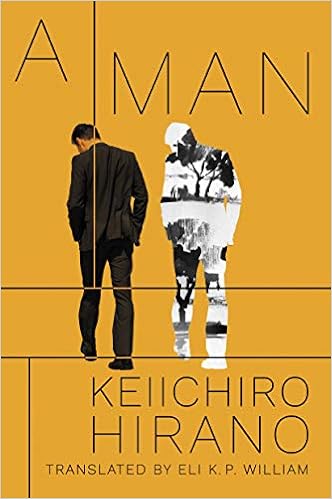
About fifty pages into Keiichiro Hirano’s A Man, the reader experiences the first hints of what becomes one motif of the novel:

In the end, although Kido would only drift to law school in the grips of the fuzzy thinking that plagues many students of the humanities, his father’s words would contribute to his firm decision, while enrolled there, to try to see things through and become a lawyer.

Keiichiro Hirano, A Man (p. 56)

A work written by a Japanese author about a Korean naturalized as Japanese (Akira Kido) resonates in several ways with growing up and making career choices in the U.S.

In less than fifty more pages, Kido is gripped in a panic attack identified as “existential anxiety”: “Kido’s fear of the same thing [death] happening to him made him painfully sensitive to the minutiae of life” (p. 99).

Kido recognizes as he approaches middle age that he is revisiting similar questions he faced as a teenager:

As was typical of someone that age, in the process of trying to decide what he wanted to be, he had thought long and hard about what kind of person he was. In the end he had drifted along and become a lawyer in accordance with his father’s advice. His doubts about whether this was truly the right path had never completely left him, but he went on looking to the future, telling himself that the person he was meant to be would be realized through the profession ha had chosen.

Keiichiro Hirano, A Man (p. 99-100)

Kido had lived “[f]or fifteen years now” complacent in those choices, who he had become—a lawyer with a wife and child. Yet in his new surge of existential anxiety, he recognized “steady work was no longer as common as it once had been, and many in his generation were denied the opportunity” he had received (p. 100):

He understood the struggles such people faced all too well because he dealt with many of them as clients. Forced to accept a life in which their social position and income were always unstable, they could never hope to self-actualize their profession as he had.

Keiichiro Hirano, A Man (p. 100)

Despite feeling fortunate, Kido must confront renewed angst prompting a new question: “Did I make the right choice?” (p. 100). And Kido becomes starkly aware “there might have been other paths he could have taken and therefore other people he might have been”:

The problem now was not who he was in the present but who he’d been in the past, and the solution he sought was no longer supposed to help him live but to help him figure out what sort of person to die as.

Keiichiro Hirano, A Man (p. 100)

For Kido, “the minutiae of life”—career as a lawyer, his family, and his Korean race beneath his naturalized Japanese citizenship—resulted in his “reignited existential anxiety:

The judicial order that Kido worked hard as a lawyer to preserve propped up his quotidian life. It protected his family’s human rights and maintained their status as sovereign citizens.

Keiichiro Hirano, A Man (p. 101)

I am now in the late fall/early winter of a life and my so-called career; I turn 60 in about three weeks.

Regrets linger around me, but they are not primary my existential anxiety (that has been my companion since birth); although I do recognize in Kido’s dilemmas my own mixed feelings about who I have become and what sort of person I will die as—since I can recognize on the horizon many endings such as my career and my ability to do some of the things associated with younger humans.

My body’s deteriorations seem exponential by not the year, but the month and even day.

What strikes me about this aspect of the novel is that we rarely utter what Kido is confronting: you are your job (especially for those of us living in capitalism). I suspect this is one fear-inspiring slogan we don’t launch at children because it is the most frightening of all.

In capitalism, we must work in order to be fully human, especially in the U.S. where working is the only access to even marginal health insurance and care as well as livable retirement savings.

During the COVID-19 pandemic, U.S. government has been the least responsive internationally in providing financial support, but one of the most aggressive about maintaining the economy (which, in fact, really means keeping workers on the job).

Millionaire U.S. senators held forth about the dangers of sending citizens money and expanding unemployment payments because of the cancerous dangers of “handouts.”

And there has been during the election cycle the ever-present mantra about “socialism” (a red herring, but common from the Right none the less).

I have been talking with a family member and close friend, one in their 30s and on in their 20s, and hearing a common theme; they are both not just disillusioned about their professions/jobs, but about working.

Why, they are asking, should someone work five days every week for the brief two days of the weekend? And why work forty or fifty years just so you can retire in your dotage?

And like Kido, I think of my father, a young man in the 1950s and young husband/parent in the 1960s who bought the work-yourself-into-the-grave mentality hook, line, and sinker.

Then, of course, he passed it onto me; he imprinted it in me.

To these questions by young people, I can honestly say that the answer is capitalism is your Daddy.

You are your job, and if you are not careful, if you fail to ask these questions and then act, that’s the person you will die as.

Just an EdD from a State University

I’m Nobody! Who are you?

Emily Dickinson

Several years ago I was on a panel for a public forum held on my university’s campus. At the Q&A ending the panel talk, a colleague from another discipline asked a detailed question grounded in their discipline.

I watched their face and eyes as I navigated not only the arcane and somewhat navel-gazing elements of the question (we academics love to hold forth with questions that are thinly veiled opportunities to hear ourselves talk) but also that this conversation between the two of us was almost entirely alienating for 75% of the audience, which included several of my students.

Referencing key scholars from my colleague’s field, I did a bit better than hold my own—although I just have an EdD from a state university.

Because of the lingering Jill Biden controversy—using “Dr.” with people holding doctorates and working as professors—the public has been exposed to the ugliness surrounding and within the academy that includes classism (one detractor of Jill Biden clearly also disrespects community college students), sexism (the original swipe at Jill Biden that isn’t even thinly veiled misogyny), and degree stigmas (even in this excellent rebuttal of all the nonsense tossed at Jill Biden, the EdD is framed as a lesser degree).

My journey to academia and an advanced, terminal degree (EdD in Curriculum and Instruction) began in junior college after I left high school an avid math/science student set on majoring in physics (one of the most prestigious disciplines in academia).

However, while in junior college where I spent an inordinate amount of time playing pick-up basketball and drinking, I was approached by a Dean who taught my British lit intro course. Dean Carter asked me to tutor English in the college’s academic assistance office.

A bit disoriented, I asked why, and he said I was the best student in the class. At that point, a first-year student who had made almost all his As in high school in math and science (although my favorite teacher was Mr. Harrill, my English teacher), I never considered myself a literary person—and certainly had never entertained any proclivity for teaching (I laughed in high school, in fact, when Mr. Harrill one day suggested I consider teaching).

That moment with Dean Carter changed my life.

I soon fell in love with tutoring, and by the spring of my first year of college, I had fallen in love with poetry (thanks to my speech class taught by Mr. Steve Brannon) and discovered that I am a writer (having written my first “real” poems that spring after immersing myself in the poetry of e.e. cummings).

From 1983 until 1998, I completed three (shitty, in seems) degrees in education—a BA in secondary English education, an MEd in secondary English education, and an EdD in Curriculum and Instruction—all from (shitty, it seems) the state system where I live.

I am well aware that K-12 teaching isn’t very highly regarded, that many people see teachers as academically weak themselves (the Urban Legend about education majors having the lowest SATs, GPAs, etc.). I am also well aware that my education degrees are viewed as pre-professional and not academically rigorous.

As I noted above, even an impassioned and detailed defense of Jill Biden using “Dr.” included a swipe at the EdD degree:

Jill Biden does not have a PhD. She has an Ed.D. in Educational Leadership. It’s an applied doctorate, designed to certify rising administrators in the field of education….

At the outset I mentioned that Biden has “an Ed.D. in Educational Leadership” and not a PhD. The Department’s website provides a handy summary of the difference at Delaware.

Dan Nexon

That “handy summary,” however, is not a definition of EdDs, but of that particular degree and program, but even as there is an emphasis on being a practitioner, the summary ends with this: “The Doctor of Education represents the highest level of scholarly attainment in the professional field of education.”

Now honestly, there is a lot of coded language here that links “scholarly” with “professional field” and speaks into a cultural and disciplinary marginalizing of education as a pre-professional and not academic field.

Here is a significant distinction that many do not acknowledge about education as a discipline. Much of education in the academy is grounded in teacher certification (an area in which I work and strongly criticize), but education as a discipline is a social science, a cousin to psychology.

My graduate degrees (MEd and EdD) included many advanced courses in statistics and qualitative/quantitative research, educational philosophy, and educational psychology. I am willing to concede that education as a field is a hybrid of other disciplines, but I can hold my own among researchers regardless of the field, among complex discussions of philosophy and psychology (not just education), and among debates about the challenges of realizing theory/philosophy in day-to-day practice.

But many have also criticized Jill Biden for her dissertation, again the implication being that EdDs are less academically rigorous:

Some critics have honed in on the fact that Biden’s dissertation is not a PhD thesis but an “Executive Position Paper.”…

For that matter, we can argue, as Volokh does, that a PhD thesis “is generally a dissertation that constitutes a substantial original work of scholarship,” but it should be pretty clear that “generally” is doing a lot of work here. This is why writing a crappy thesis doesn’t mean that Gorka can’t call himself “Dr. Gorka.” It means his PhD doesn’t certify him as an expert on terrorism or in political science. Biden isn’t trying to pass herself off as a leading expert on educational reform or whatever….

For that matter, we can argue, as Volokh does, that a PhD thesis “is generally a dissertation that constitutes a substantial original work of scholarship,” but it should be pretty clear that “generally” is doing a lot of work here. This is why writing a crappy thesis doesn’t mean that Gorka can’t call himself “Dr. Gorka.” It means his PhD doesn’t certify him as an expert on terrorism or in political science. Biden isn’t trying to pass herself off as a leading expert on educational reform or whatever.

Dan Nexon

This defense, you see, of Jill Biden is grounded in the argument that she did in fact meet the requirements of her EdD, which is a doctoral degree, and therefore, assigning “Dr.” to her name while she is a professor is entirely reasonable.

This defense glides right past making any concession that EdD programs may in fact have rigorous dissertation requirements that result in a “a substantial original work of scholarship.”

My own experience with graduate school was not like my colleagues’ programs since I completed my MEd at a satellite campus (degree was based in the main campus, however) and then completed the EdD with very lenient residency requirements (I did not quit my teaching job or live on campus, meeting residency by taking a certain number of main-campus listed courses over several consecutive semesters).

And my dissertation does meet the threshold of being “a substantial original work of scholarship,” but it is an educational biography—a qualitative research paradigm and a sub-genre of history, both of which are stigmatized in academia (once again, shitty and shitty).

Tracing the life and career of Lou LaBrant through much of the twentieth century required my completing a literature review of biography/educational biography grounded in feminism and critical pedagogy (that grounding, you guessed it, shitty and shitty), reading dozens of works by LaBrant and about LaBrant that form the skeleton of my field of literacy and English education, and then writing a book-length biography (which has since been published).

I was well equipped during my years in graduate education to have written a traditional dissertation driven by a quantitative study (I found none of that compelling and chose my program specifically because it included a key figure in education biography, Craig Kridel, and because I could write a biography).

My work on LaBrant, as Kridel declared at my dissertation defense, is a unique contribution to the field of education (as a social science), rich in history as well as robust debates about philosophy, theory, and practice.

My challenge is that I wonder how many economists, political scientists, psychologists, and almost all the other disciplines awash in PhDs could have done the type of work I did, academically advanced writing (not to a dissertation temple) that grounded a prominent figure over almost a century of thought in that field.

I suspect few of the academic snobs pontificating on Jill Biden could have done the work I did, and part of their condescension is a way to avoid that fact.

It’s not, then, that my terminal degree is just an EdD from a state university; it’s all the layers of shitty I have trafficked in along the way—just the field of education, just a biography.

The Jill Biden debate is mostly about sexism and misogyny; it is unwarranted and petty.

I know from first-hand witnessing that there are plenty of charlatans in all the disciplines—small-minded and weak thinkers about even mundane topics. I have to stand in proximity to their PhDs as if I don’t count because of the simple difference in letters.

We call them “Dr.” and don’t bat an eye.

These hierarchies and professional/personal pettiness are embarrassing among people who are supposed to be well educated.

But there is no place for any of that in our public debates either. I know that despite my shitty degree.

Writing as an Academic and Scholar

My transition to being an academic and scholar occurred in the mid-1990s after I had been a public school English teacher for more than a decade and a writer for almost two decades.

Looking back, one of the most pivotal moments of that transition was when Craig Kridel, a leading scholar of educational biography who would become the anchor on my doctoral committee, stood at the first organizing meeting of new doctoral students and announced the importance of being able to write well. He introduced me to Joseph Williams’s Style and forever changed me as a writer and a teacher.

I was in my mid- to late 30s when I completed that doctoral program, and I chose the degree primarily because I had the opportunity to write an educational biography (a non-traditional dissertation form and an under-appreciated research type, qualitative) and work with Kridel. You see, I wanted to write a real book and not a formulaic doctoral dissertation.

Of course, entering the doctoral program, I had yet to experience or fully understand just what writing a dissertation entailed—or what it would mean to be an academic and scholar.

At this writing, I am 19 years into a career in higher education and have been teaching 37 years as well as publishing for over 30 years.

Despite the recent public criticisms of academics—and specifically those of us with EdDs and not PhDs—I have witnessed some problems within the academy that often go unaddressed, notably the assumption that someone with a terminal degree can teach and write with little or no preparation in either.

Writing as an academic and scholar, I think, receives even less attention than teaching in higher education; people with doctorates have almost all completed book-length studies and then continue to write and publish as a key component of their careers as professors.

As I have noted often, there seems to be a flawed assumption, in fact, that professors can not only all write well but can teach writing.

At the end of this fall semester, I completed an editorial review of a policy brief and was immediately struck with how my comments in many ways matched much of what I emphasized for my first-year writing students.

The brief was written by a very bright scholar and the content was excellent. However, this experience pushed me to interrogate for myself that writing by academics and scholars often exhibits an intense focus on being careful and meticulous with the content and ideas of the text while falling quite short on the art and craft of writing at the sentence and paragraph levels as well as not fully keeping the audience in mind.

Academics and scholars can find themselves writing in a wide variety of contexts—to a specialized audience, often their peers in their discipline; to an informed and educated audience outside their field of specialization; or to a public audience, possibly not well informed or highly educated.

Yet, academic and scholarly writing tends to remain in the first register, to a specialized audience, and includes highly structured (and stilted) organizational features, specialized terminology and academic language, long and complex sentences and paragraphs, and somewhat traditional expectations to depersonalize the text (as if the academic and the audience do not exist).

When I am working with first-year students, I spend a great deal of time and energy helping them unlearn practices that tarnish their writing, and their credibility.

A lesson those beginning writers (and potential scholars) and seasoned academic and scholars need to learn is that how we write and how we engage our audiences are essential elements of our authority and credibility.

One of the paradoxes of writing by academics and scholars is that the focus on fidelity to the content and ideas at the exclusion of accessible and engaging expression serves to discredit and devalue that content and those ideas.

Here, then, are some entry points for academics and scholars to re-imagine themselves as writers:

  • Rethink the structures of writing, particularly the essay as a form. Traditional approaches to introduction, direct thesis sentences, and conclusions are not only weak writing but also harmful to the goal of any piece of writing—to engage and persuade or inform the reader. Openings and closings often have profound influence over whether or not the reader actual reads as well as what that audience takes from the text. Academics and scholars need to add to their goals as writers being engaging and vivid instead of simply complying with templates.
  • Reject de-personalizing writing by fore-fronting real people (including “I,” the academic/scholar) doing real things. Traditional scholarly writing still avoids first person as well as anecdotes and narrative. These expectations come out of a (simplistic) concession to objectivity and a valid concern for representing accurately research and evidence (acknowledging, for example, that anecdotes may be outliers or cherry picking). Pursuing objectivity is a trap; instead academics and scholars can improve their writing by seeking to be transparent and adding context (both of which make writing richer and more engaging). Also, simply because anecdote and narrative can be distorting doesn’t mean that they must be distorting; writing as an academic and scholar includes an ethical expectation that the anecdote is representative, not that the writing cannot be vivid and engaging.
  • Start any text with the audience, not the content or ideas. Keep in mind that the final text of writing need not look the same as the early drafts; in other words, many academics and scholars likely should start their drafting with their content and ideas, shaping them and wrestling with them in ways that allow a later draft to forefront the audience and write in ways that are engaging and vivid.
  • Begin to interrogate your writing at the word (diction), sentence, and paragraph levels. One of the greatest challenges of writing as an academic and scholar is that the content of specialized fields often includes arcane terms and sophisticated ideas that are so complex they resist simple writing. None the less, making academic and scholarly writing accessible as well as credibly accurate is part of the authority in that writing. When academic and scholarly writing is too dense, inaccessible, and overwhelming, it is likely either misunderstood or outright ignored. One writing strategy that can improve academic and scholarly writing is revising sentences and paragraphs for length (shorter is better than longer) and variety.
  • Cultivate a peer group of readers that can provide feedback during drafting that includes people who are themselves writers and people both a part of and outside the intended audience of the text being drafted. Here is a simply tip: Don’t write in isolation. Meaning derived from reading a text is a communal experience (reader, writer, and text interact to create meaning); therefore, creating meaning through text should also be communal.

In several of my classes, I have students prepare two different but related assignments—one is scholarly (an informed audience and using academic citation) and the other is a public text (general audience and using hyperlinks for citation). Students often are required to address the same topic in these pieces, and thus, must begin to investigate how to express themselves well while adapting their diction, tone, and style to different audiences and in different writing formats.

This is the domain of being a writer.

I have always thought that we ask far too little of students as writers, doing most the writer’s work for them when we provide detailed writing prompts, intricate rubrics, and essay templates.

Many if not most academics and scholars carry that baggage into their professional writing. I also think we ask far too little of academics and scholars as writers.

Writing well, being engaging and vivid, should not be some afterthought, or simply no thought at all. Writing as an academic and scholar can only serve their content and research well if they invite in and engage an audience.

If an academic/scholar writes an essay and no one reads it, does it make a sound?