
Category Archives: Academic Freedom

Resignation

NOTE: Below is a real letter of resignation, specific details redacted in order to protect the teacher. The teacher was early career, and this represents the state of the field of teaching in SC and across the US.


[Principal],

Please accept this document as notification of my resignation, effective June 6, 2022.

While I have appreciated my tenure as a teacher in [district], I feel it’s in my best interests and also my moral responsibility to reject any further offers of employment from [district]. I have been disappointed by several of my interactions with administration, both in [school] and at the district office. I pride myself in advocating for the teaching profession and for the needs of teachers, because I understand the essential democratic importance of education. It has been difficult to feel alone in that work of advocacy, and worse to have to justify myself, and I feel compelled to move into a profession that is better positioned to hear the concerns of its professionals and react meaningfully.

I was especially and painfully disappointed by [district]’s reaction to the fearmongering of South Carolina’s governor over the presence of Black and queer narratives in our libraries and curricula. [District]’s response, to call the texts “pornography” and then to remove them from all choice spaces, was wrong. Not only was it a breach of trust between the district and already vulnerable teachers, and not only did it add a significant amount to the (already impossible) teacher workload, but it will effectively end reading all but canonized texts, as those are the only texts that it is likely three teachers would have read and can approve per the new district guidelines for selection of texts. The district’s choices will serve primarily to keep students from reading and certainly to keep students from reading texts that they would enjoy; the policies the district has created are antithetical to our supposed goals of creating life-long, enthusiastic readers.

I also know that much of the concern over texts driving the changes in [district] is cloaked in a veneer of concern about “obscenities.” I think it’s important to challenge that concern and call it out for what it is: bigotry. No one is concerned about the suggestive material in Shakespeare, or Fitzgerald, or Steinbeck. We seem to be deeply concerned, however, when the authors are a part of or are speaking to a marginalized community. Providing texts that acknowledge the realities of our students along all axes of identity is best practice, but we are only allowed, effectively, to provide best practice opportunities for students whose identities fit an Evangelical agenda. Where is this concern when we force Black students to read racial slurs in To Kill a Mockingbird, or Huckleberry Finn, or The Great Gatsby? We do not censor these books because we recognize that while they contain sensitive and disturbing material, they have something of value to offer our students. We seem incapable of seeing that same value in works who empathize with marginalized people, and insistent on reading that empathy as an attack on traditional values.

[District]’s selective censorship is a failure to support significant portions of our community who already experience systemic inequities; we compound the damage already done to our marginalized students by not allowing them to see themselves in books, which then further erodes the trust that our communities place in us to make every child in our care feel seen and understood. I would ask anyone in the district who is in a position to advocate for teachers at the state level to read the National Council of Teachers of English’s (NCTE) position on censorship of texts. NCTE has multiple position statements affirming students’ right to read, and have expressly condemned the very types of censorship policies [district] is now implementing, as has every other national professional organization for teachers.

When teachers challenged this censorship and the removal of a district-approved book list in a faculty meeting and pointed out that most of the works students read in class contain “obscenities,” the response, that “Shakespeare was okay because most students don’t understand the language” deeply disturbed me, because my job, of course, is to help students understand the language. Our job as teachers and English teachers specifically is to clarify; to give students the ability to see more clearly and critically the world around them. When a minority of the community screams loudly enough that they do not want students to see, do not want students to learn, do not want students to have access to reality, entertaining their concerns and appeasing them is not harmless; it does violence to students whose humanity is now being denied, to teachers and staff members whose identities are among the disparaged, and to every student who loses an opportunity to see the world from a different perspective. Even worse, we are not just removing these texts from the spaces where students can engage and receive support from a professional in critical conversation (the classroom) but we are removing them from all spaces, even choice spaces such as the library. Students deserve to see themselves in the texts around them, and to have their identities treated with care and seriousness, not as problems to be ignored or wished away.

As a final note on [districts]’s political censorship: many of the texts that have been challenged are taught in courses that are meant to replace college level courses, such as Advanced Placement courses and International Baccalaureate courses. Teachers have an obligation to provide the same level of complexity and rigor in their classrooms that those students would receive if they were in college, as the course is for college credit. The idea that students from our district will receive expurgated versions of collegiate education to appease a small subset of parents and community members should anger everyone, because all of us have to live in and with the ramifications of a community where the citizens are losing access to quality education.

The current climate of teaching in [district] is a microcosm of the state of our profession in South Carolina, and it has made my job, especially over the last two years, infinitely more challenging and stressful. The work of teaching is vital, and I sincerely hope that the administration of [district] is willing to do better in the work of advocating to protect the professional integrity of their employees than they have shown themselves willing to do previously. In particular, the wave of bills and policies currently under review at the state level, such as the affirmation of our existing no promo homo laws and the new parental trigger laws, will succeed only in creating a climate of fear and censorship in the classroom and in moving the authority of education out of the hands of educators and into the hands of parents. These bills are an existential threat to public education. Because the viability of our democracy is contingent upon having informed and educated citizens, it is not hyperbole to say that these bills are an existential threat to democracy. Students have a right to receive a quality education regardless of, and often in spite of, their parent’s beliefs. Our students deserve better than what [district] and the State of South Carolina are currently willing to provide for them. Teachers also deserve better. Teachers, however, have the choice to leave the profession. A critical examination of the expectations we place on and the miracles we expect of teachers is in order. I will continue to watch this examination with hope and idealism, but I can no longer do it from anywhere but the gallery seats.

Sincerely,

[Teacher]


See Also
Lehre Ist Tot

Academic Freedom Isn’t Free

My poem The 451 App (22 August 2022) is a science fiction/dystopian musing about the possibility of technology providing a comforting veneer to the creeping rise of totalitarianism—a simple App appearing on everyone’s smartphone before erasing all our books.

The point of the poem is less about technology and a dystopian future (alluding of course to Fahrenheit 451) and more about another work of literature: “The best lack all conviction, while the worst/Are full of passionate intensity” (“The Second Coming,” William Butler Yeats).

For me, this unmasking of the human condition has always been haunting; it also has become disturbingly relevant in the Trump/post-Trump present in which we live.

Real life is always far more mundane than speculative fiction—and far more shocking.

The “worst,” “full of passionate intensity,” launched an assault on academic freedom in the final months of the Trump administration. The initial wave seemed poised at The 1619 Project and a manufactured Critical Race Theory scare.

By January of 2022, a report found that educational gag orders passed in states across the U.S. were having a significant and chilling effect:

We found that at least 894 school districts, enrolling 17,743,850 students, or 35% of all K–12 students in the United States, have been impacted by local anti “CRT” efforts. Our survey and interviews demonstrate how such restriction efforts have been experienced inside schools as well as districts. We found that both state action and local activity have left many educators afraid to do their work.

The Conflict Campaign (January 2022)

As bills have increased since this report, the number of teachers and students impacted are certainly higher.

Concurrent with educational gag order legislation, book banning has increased dramatically, as reported by PEN America:

• In total, for the nine-month period represented, the Index lists 1,586 instances of individual books being banned, affecting 1,145 unique book titles. This encompasses different types of bans, including removals of books from school libraries, prohibitions in classrooms, or both, as well as books banned from circulation during investigations resulting from challenges from parents, educators, administrators, board members, or responses to laws passed by legislatures. These numbers represent a count of cases either reported directly to PEN America and/or covered in the media; there may be other cases of bans that have not been reported and are thus not included in this count.

• The Index lists bans on 1,145 titles by 874 different authors, 198 illustrators, and 9 translators, impacting the literary, scholarly, and creative work of 1,081 people altogether.

• The Index lists book bans that have occurred in 86 school districts in 26 states. These districts represent 2,899 schools with a combined enrollment of over 2 million students.

Banned in the USA: Rising School Book Bans Threaten Free Expression and Students’ First Amendment Rights

Republicans and conservatives have steadily created an environment of fear around teaching and learning, which is being detailed now by teachers experiencing that fear (with many leaving the field):

Last year, I was quoted in an article in the School Library Journal about how I discussed toxic masculinity with my high school students when we read Shakespeare’s “Romeo and Juliet”togetherWithin days, far-right publications twisted my words to denounce “woke liberal indoctrination in schools.”

Strangers sent me messages on social media accusing me of indoctrinating students, of being unprofessional and unintelligent. I received a handwritten letter addressed to me at school. The letter accused me of being a “low-life, pseudo-intellectual, swallow-the-lib/woke/b—s— koolaid a — h—-.” [The hyphens were added to replace letters because of Washington Post style and not in the original].

‘Educators are afraid,’ says teacher attacked for ‘Romeo and Juliet’ unit, Sarah Mulhern Gross

This movement is driven by lies and fear mongering, but it depends on the missionary zeal of the liars and fear mongers as well as the passivity of “the best” among us.

My childhood and adolescence were profoundly shaped by books and movies—often the science fiction loved by my mother.

Along with The Andromeda Strain (film adapted from Michael Crichton’s novel), two films based on Ray Bradbury’s work remain with me today—The Illustrated Man and Fahrenheit 451.

There is a profound darkness and fatalism in these works, but in Fahrenheit 451, I was struck by the optimism and power of the individuals who walked around repeating the books they had become.

These people, the best among us, seem to suggest Bradbury held on to some sliver of hope.

It seems overwhelming to consider that as sentient creatures we are doomed to not recognize that things matter until they have been taken from us—taken from us with almost no resistance, with almost no recognition of the book being gently slipped from our hands and then our minds.

Academic freedom isn’t free, but without free minds—freedom to teach, freedom to learn, freedom to read and consider—we are no longer fully human.


Recommended

National Days of Teaching Truth

My 31 texts for 31 days in May

Freedom to Teach: Statement against Banning Books (NCTE)

Banning Books Is Un-American

Banned in the U.S.A. Redux 2021: “[T]o behave as educated persons would”

Censorship and Book Burning: A Reader [Updated]

Furman faculty pass resolution rejecting pending state legislation aimed at academic freedom

Educators’ Right and Responsibilities to Engage in Antiracist Teaching (NCTE)

Lehre Ist Tot

This past week an early career teacher, highly regarded in the classroom and very accomplished in the field of education, received a parental request that a student not be required to read The Great Gatsby. That parent, however, had signed a consent agreement with all texts, including that novel, identified as required reading at the beginning of the course.

The parent then reached out to the administration, who confirmed that the teacher had to assign a different work. This, of course, undermines the teacher and the process established, but it also creates more work for teachers already under incredible strain.

While parental oversight of assigned reading has been common in education for decades, this situation comes as states are increasingly passing parental trigger legislation, which moves the parental power from each parent’s own children to parents being able to ban works for all teachers or students to explore in classes.

That same teacher, frustrated and disillusioned, later that day read aloud their resignation letter to me in the context of telling me that much that they had taught in the first three years of teaching could no longer be taught in the last couple years—and increasingly will be directly banned in the coming year (as my home state is poised to pass its own educational gag order this spring).

The teacher cried while reading the letter aloud, and added that the resignation was depressing; this, you see, was a career they had been working toward since high school—and within 6 years, teaching is dead.

The current anti-teacher climate in the U.S. is incredibly harsh and driven by orchestrated false narratives:

Right-wing media are creating parental trigger structures even without the concurrent legislation:

While teacher and school bashing (notably as “liberal indoctrination”) has a long history in the U.S., reaching back to Catholic schools fighting for market space as public schooling increased in the 19th century, the current anti-teacher climate has its roots not in Republican politics but in the Obama administration’s education agenda.

Obama’s appointment of Arne Duncan as Secretary of Education heralded an era of education reform that actually doubled-down on the worst aspects under George W. Bush, and that doubling down feed into a growing media attack on “bad teachers.”

Instead of rejecting the standard approaches to education reform begun under Reagan and federalized under W. Bush, the Obama administration turned their blame to teachers and teacher quality. During the Obama years, the great experiment in value-added methods (VAM) devastated the teaching profession.

The perennial paradox of education has always been that teacher quality matters but it remains a very small part of measurable student achievement (only about 10-15%). Therefore, the Holy Grail of the VAM experiment—identifying “good” and “bad” teachers through standardized test scores of students—was always doomed to fail.

But it did accomplish planting the seeds of today’s multi-pronged attack on teachers—the “science of reading” movement blaming teachers and teacher educators for student reading achievement and the anti-CRT/educational gag order movements being linked to parent trigger laws.

Throughout the education reform era over the past 40 years, many of us in education have argued that education reform initiatives are less about improving education and more about killing public education and the teaching profession—charter schools and voucher schemes, Teach For America, VAM and merit pay, demonizing and dismantling unions and tenure, etc., to name a few.

From Fox News lies to parental trigger laws and education gag orders, the evidence is very clear now that this current wave of teacher bashing is definitely about killing the profession, and not about student discomfort.

Let me return to the opening teacher story.

When the parent was asked for reasons why they wanted their child not to read The Great Gatsby—so the teacher had context for choosing an alternate text—the parent responded that they did not want the child (a high school student) to read about inappropriate relationships and sexual content. So here is a point of fact about the insincerity of these challenges; that student had already read and studied The Crucible, without any complaint, a play grounded in adultery.

I am certain some parents challenging what their children are being taught are sincere, but I am also certain the larger political motivation among conservatives is to completely dismantle public education.

Just as I have explained that there simply is no CRT propaganda agenda in K-12 schools, there is no liberal indoctrination/grooming occurring in K-12 (or K-16) education either.

The Ingraham rants are simply political lies.

And these lies are not improving education.

They have one goal and it seems to have been effective: Teaching is dead.

IndoctriNation: Can We Avoid Our Dystopian Republican Future?

“I guess irony can be pretty ironic sometimes,” Commander Buck Murdock (William Shatner) muses in Airplane 2: The Sequel.

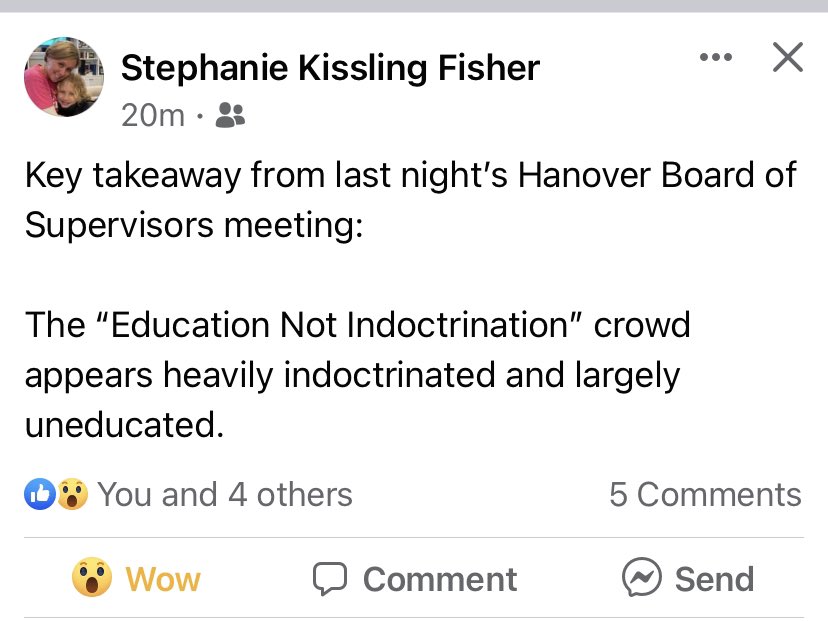
I immediately thought of this iconic Shatner scene from the Jerry Zucker-Jim Abrahams-David Zucker film when I saw a brilliant and urgently serious post on Facebook from a former student of mine currently advocating for all that is Good and Right in her crumbling state of Virginia:

While Stephanie hits succinctly right at the heart of the irony surrounding the current push by Republicans to mandate educational gag orders, parental trigger bills, and a wide range of censorship for not only school and colleges but also throughout society, I want to highlight how the irony is a veneer for the Republican long game.

Many people have now exposed that the Republican use of “Critical Race Theory” is an orchestrated lie for larger political goals since their definitions of CRT are distortions and misinformation.

But what exactly is that end game?

First, let’s unpack the monumental irony in the “Education Not Indoctrination” claims of Republicans.

A related element of the anti-CRT movement is linking CRT to “Marxism” (itself a distortion bordering on a lie), but the more telling aspect of that connection is that Marxist and critical educators forefront a genuine and resolute rejection of indoctrination. As Joe Kincheloe details, seeking out and exposing those who indoctrinate is a “central tenet” of being critical:

Thus, proponents of critical pedagogy understand that every dimension of schooling and every form of educational practice are politically contested spaces. Shaped by history and challenged by a wide range of interest groups, educational practice is a fuzzy concept as it takes place in numerous settings, is shaped by a plethora of often-invisible forces, and can operate even in the name of democracy and justice to be totalitarian and oppressive….

Recognition of these educational politics suggests that teachers take a position and make it understandable to their students. They do not, however, have the right to impose these positions on their students. This is a central tenet of critical pedagogy.

In this context it is not the advocates of critical pedagogy who are most often guilty of impositional teaching but many of the mainstream critics themselves. When mainstream opponents of critical pedagogy promote the notion that all language and political behavior that oppose the dominant ideology are forms of indoctrination, they forget how experience is shaped by unequal forms of power. To refuse to name the forces that produce human suffering and exploitation is to take a position that supports oppression and powers that perpetuate it. The argument that any position opposing the actions of dominant power wielders is problematic. It is tantamount to saying that one who admits her oppositional political sentiments and makes them known to students is guilty of indoctrination, while one who hides her consent to dominant power and the status quo it has produced from her students is operating in an objective and neutral manner. Critical pedagogy wants to know who’s indoctrinating whom. (pp. 2, 11)

JOE KINCHELOE, CRITICAL PEDAGOGY PRIMER

Therefore, if an educator is leftist, Marxist, or critical, they are dedicated to not only seeking out and contesting anyone who indoctrinates, but also working continuously to avoid allowing their own teaching to devolve into indoctrination.

To indoctrinate is to be authoritarian (see Paulo Freire’s distinction between “authoritarian” and “authoritative” in the context of critical pedagogy).

Along with the foundational strategy of using lies and mischaracterized terms to advance a political agenda, Republicans also are guilty of projection: Almost everything Republicans attribute to the “Left” is what they actually do (Republicans decry a false specter of “cancel culture” while actually passing legislation that censors, cancels, and bans materials and ideas) or what they would do given the opportunity and the power.

And that leads to the end game.

To understand the Republican end game, you must address that “Education Not Indoctrination” is yet another Orwellian misdirection. Republicans are not anti-indoctrination; in fact, Republicans are actually seeking a world in which they completely control the indoctrinating.

In short, Kincheloe’s “who’s indoctrinating whom” can be addressed simply by acknowledging that given the opportunity and power (see legislation in Republican-led states) the “who” will always be Republicans and the “whom” will be the rest of us.

Republicans are organizing and enacting a broad campaign to create their dystopia, IndoctriNation.

They are counting on a common flaw in the U.S.: “The best lack all conviction, while the worst/Are full of passionate intensity” (“The Second Coming,” William Butler Yeats).

Dear Legislators: Your Job Is Funding, Not Dictating, Education

Let’s start with a thought experiment.

Your elected state legislators are confronted with a series of bills addressing crumbling bridges and roads in your state. After a period of typical partisan debate, a final bill is proposed that not only funds new bridge and road construction, but also dictates how those bridges and roads must be constructed.

Most of the legislators who wrote and voted on the bill have laws degrees or career experiences in business; none of the legislators are structural engineers, and thus, no expertise in constructing bridges or roads.

Structural engineers and those whose profession is building bridges and roads note that the legislation is dangerous, ill conceived, and certainly will result in bridges and roads that will cost people’s lives.

None the less, the bill passes and then is signed by your governor.

This thought experiment likely seems outlandish, but it represents a key distinction about the role of legislators as that impacts public institutions (in this hypothetical situation, our highway/road infrastructure). In brief, it is the role of legislators to fund and ensure at least adequate if not excellent public institutions; it is not the role of legislators to dictate how those public institutions should be realized since a legislative body often lacks the expertise to create those mandates.

This brings me to my primary area of expertise, education.

Specifically since the last months of the Trump administration, there has been a wave of state-level legislation censoring curriculum, banning books and ideas, and mandating all aspects of formal education (curriculum and instruction)—often including mechanisms for parents to trigger censorship and even dismissal of teachers and professors based on personal ideologies and perceived “discomfort” by students.

This partisan political trend fits into a larger contemporary and century-long history of legislators mandating not just that education by provided but what and how that education must include.

As one example, since about 2018, states have proposed and passed very detailed and prescriptive reading legislation, a movement that fits into the accountability era of education that began in the late 1970s and early 1980s.

My home state of South Carolina is a powerful example of good intentions that have gone terribly wrong.

Under the guidance of then-governor (and future Secretary of Education under Bill Clinton) Richard Riley, SC established the now-familiar structure of K-12 public education, broadly labeled as accountability—state-level standards (approved by legislators), state-level high-stakes testing (approved by legislators), and various consequences for schools and teachers meeting or not those mandated parameters.

Throughout the 1980s and into the 1990s, bolstered by the misleading and partisan A Nation at Risk report released under Ronald Reagan, governors increasingly discovered that focusing on education reform paid significant political dividends (regardless of political party).

The narrative was simple, although deeply misleading: U.S. public education is failing students and the country because of the inherent flaws of the education establishment; therefore, it is the responsibility of elected officials to mandate all aspects of education.

By the mid-1990s into the 2000s, George W. Bush pushed the envelope of being an education governor onto the national stage; Bush created another false narrative around his so-called “Texas Miracle” (along with Rod Paige as Texas superintendent of education) that helped propel Bush to the White House and then take the state-level template for education reform to the federal level with No Child Left Behind (NCLB).

While NCLB floundered, never producing the results promised in the same ways that state-level accountability never fulfilled promises, the template was set for governors and presidents; the Obama administration (embodied by Arne Duncan as Secretary of Education) doubled-down on the Bush/ Paige/ Spellings model, in fact.

In many ways, the current wave of curriculum gag orders and book censorship (as well as the copy-cat legislation imposing a misguided “science of reading” mandate on reading instruction) is the logical progression within that accountability approach to education.

In that model, authority is centered in elected officials, and expertise is trumped by that political authority.

Since the 1980s, accountability legislation and political micromanaging have not improved education in the U.S. (at regular intervals, the same crisis discourse is repeated, followed by the same strategies for reform, just under different political leaders), but that model has served political careers well at the expense of education, democracy, and now, academic freedom.

Legislators, then, have replaced their democratic responsibilities for funding and ensuring public institutions with using education, for example, as a political football for their own careers.

Just as legislators should fund but not mandate how to build our roads and bridges, they should fully fund but not dictate how or what teachers teach—especially when their mandates are serving ideological agendas and not teaching or learning in a country that claims to respect individual liberty, democracy, and academic freedom.