In a country where patriots are apt to wave fervently the nation’s flag, we are witnessing (mostly passively) in 2017 a professional athlete who took a knee in nonviolent and silent protest become a professional and public pariah.
Yet we in the U.S. routinely express pride for having been birthed out of protest, the Boston Tea Party, and revolution.
It is 2017, and the home of that seminal protest, Boston, remains the most racist fan base in the U.S. and city for a professional football team with owner, coach, and quarterback all supporting Donald Trump—but without any negative consequences for their overt politics.
Free speech in the U.S. is increasingly circumscribed by nationalism as a proxy for race—”Make America Great Again” as code for preserving whiteness.
In Notes of a Native Son (1955), James Baldwin poignantly captured the nature of his intense feelings for his nation of birth in stating: “I love America more than any other country in this world, and, exactly for this reason, I insist on the right to criticize her perpetually” (9).
Baldwin, like Muhammad Ali, represents the living ghost haunting Kaepernick’s nightmare—a contemporary resurrection of praise that was contradicted while Baldwin (and Ali) was most prominent and confrontational.
Richard Nixon was elected, many seem to ignore, in the wake of 1960s social unrest, anchored in the Civil Rights movement as well as the counter culture often stereotyped as Hippies.
Trumplandia is the logical extension of that history—where American exceptionalism, our hypocrisy and delusion, has moved beyond empty political rhetoric (“by gorry/ by jingo by gee by gosh by gum”) to crass nationalism fueled by rhetoric-as-truth (regardless of the evidence otherwise).
The tribalism of crass nationalism denies, as Judith Butler explains, “We are worldless without one another”:
What worries me is that many of us form our sense of obligation toward another on the basis of feelings of identification. If someone else is like us, and that likeness is readily recognizable, then we are more inclined to respond in the way that we would have others respond to us. The harder task is to maintain an obligation to those by whom we feel ourselves to have been injured, to those we fear, or to those whose difference from us seems to be quite severe. This is why I do not think that global obligations can rest on identification, even expanded or expanding identifications; they have to claim us quite regardless of whether or not we feel love or sympathy, for the simple reason that the world is given to us in common and that without each other the world is not given. If the self is the basis of sympathy, our sympathy will be restricted to those who are like us. The real challenge occurs when that extrapolation of the self is thwarted by alterity.
Butler’s insistence for cohabitation feels akin to Baldwin’s refrain about love, a powerful element of his work too often glossed over. Butler argues: “I suppose it is first important to honor the obligation to affirm the life of another even if I am overwhelmed with hostility. This is the basic precept of an ethics of nonviolence, in my view.”
And this bring us full circle to Kaepernick, nonviolent and protesting for equity, ostracized as Baldwin and Ali were in their lifetimes—reduced to “unAmerican” in order to cast him among the Others and to render invalid his refusal to separate his personal and professional ethics (or better yet, his recognition that no one can separate them).
Maybe my opening claims are ill-founded, however. Not that the U.S. is hypocritical and delusional, but that these qualities are somehow exceptional.
Maybe beneath the glitz of consumerism, Americans are merely victims of the worse aspects of being human.
Democracy hasn’t failed, but quite possibly humans are incapable of reaching the high ideals of democracy, equity, and justice.
We have created words for ideas that are just too far beyond our reach as living creatures.
When does one move from “This isn’t working” to “This cannot work”?
This is my sixth decade as a human, as a white, straight male.
Here I want to attempt confession, possibly seeking greater understanding, but fully aware of the huge complexities of making these claims, raising these personal struggles in the context of my many privileges.
I am treading lightly but committed to rise above the problematic satire of Ben Folds’ “Rockin’ the Suburbs”—which both speaks to me and makes me cringe:
Let me tell y’all what it’s like
Being male, middle-class, and white
It’s a bitch, if you don’t believe
Listen up to my new CD
My formative years over the 1960s and 1970s were spent in the redneck South. Just as I was reared to be a racist, I was taught very clearly to objectify women, even as that was tempered in my immediate family by direct and indirect messages about respecting and loving women/girls.
Growing up, I was a Mama’s boy, I was very close to my sister (my only sibling), and I had strong and warm relationships with aunts and my maternal grandmother.
As a so-called pre-sexual boy, then, I genuinely learned to feel deep and healthy affection for women/girls—to whom I have always been drawn more strongly than any male bonds.
As a teen, however, I was significantly enculturated into objectifying women, sowing the seeds for potentially behaving in ways that fed into and participated in predatory masculinity and even the various degrees of rape culture.
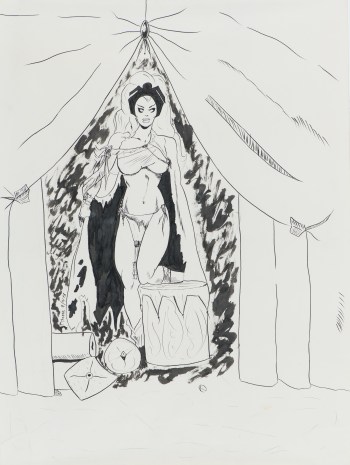
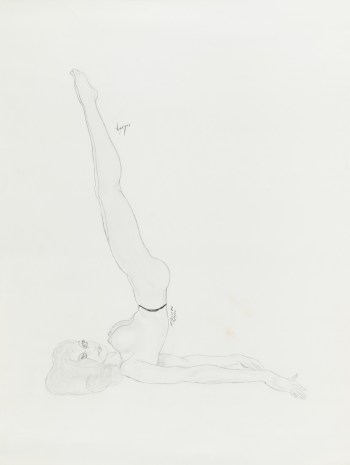
My classroom was, at first, superhero comic books and then soft-core pornography (such as Playboy and Penthouse)—but the wider popular culture was always reinforcing the worst possible models for how men treat women.
But as all this colored my attempts to be a sexual person, seeking out romantic relationships throughout high school and college, I was also being shaped in how I interacted with the world aesthetically, notably in that I was actively teaching myself visual art by drawing from both comic books and nude photography in the euphemistically named men’s magazines.
One can see a theme in my adolescent artwork:
Storm from the X-MenI shifted from comic books to men’s magazines and copying the objectifying artwork of Alberto Vargas, popularized in Playboy.
As a teen and young man, I was certainly trapped in very unhealthy but subtle patterns that could only be overcome by gaining critical awareness over my mid-20s into and my mid-30s (when I completed my doctoral program).
Some of that critical awareness was powerfully acquired through my commitment to learning from and teaching important literature such as Alice Walker’s The Color Purple and Margate Atwood’s The Handmaid’s Tale as well as poetry units I taught on Adrienne Rich, Anne Sexton, and Sylvia Plath.
Ultimately, writing an educational biography grounded in feminist theory stands in hindsight as the crowning experience as I approached 40 for a healthy awakening into fully appreciating toxic masculinity, predatory men, objectifying women, the male gaze, and rape culture.
Just as I would explain about my racial awareness, my sexual and gender awareness remains a journey, and as such, I find myself often paralyzed because, as a man, I represent still the potential for abuse through my status, the threat men pose for women in a society that continues to objectify and marginalize females—especially in terms of failing to listen to women who risk telling of their experiences with predatory men and rape culture.
My adult life has been spent as a partner, friend, parent, grandparent, teacher, and coach—all requiring me to monitor my status of power granted by being male and by my professional and familial positions in relationship with females.
As a coach and teacher, I have been (and continue) to be prone to call young women “darling” in casual moments—rightfully prompting some of my closest friends and colleagues who are women to call me on the language, the positioning.
I remain aesthetically drawn to photography and artwork of women nudes—entirely unsure if I can disentangle my toxic past from what I consider non-objectifying appreciation of art.
And so, as I noted above, I stumble toward 60, a man with good intentions who understands that is never enough; I am often reduced to paralysis in how to navigate the world in ways that are equitable and healthy for everyone regardless of race, gender, sexuality, or class.
I am genuinely terrified of ever making any woman/girl feel discomfort because of my masculine presence, my inadvertent gaze, my language, or the implicit threat of my status in relationship to her.
Often these days, I must confront these tensions as I snuggle with my granddaughter who I dearly want to grow up with healthy views of gender and sexuality, who I want to avoid any sort of predatory world.
My daughter was raised without corporal punishment, and now her children have been gifted that same dignity.
I work hard to practice what I preach and feel I make contributions small and even large to a kinder and more compassionate world—a world in which women and children need not ever fear men.
But even the best men walk in the wake of the worst men have given this world—the worst men continue to give to this world, and the women and children who must suffer for that.
Each man must moment by moment examine how he is culpable, where and how he stands in this world in relationship to women and children.
The dilemma of navigating the world as a man is couched in the unearned privilege, the potential for an abuse of unearned power that shouts out “First, do no harm.”
For a man committed to that, however, how does he live a full life without being paralyzed by the worst of being a man, behaviors that often go unpunished and even masked to protect some men from consequences.
This remains a rhetorical question for any man with an ethical imperative for his life—not a question for any woman or any child to offer their compassion.
For any man, for each man, this is ours to confront, to answer, and to act.
As long as men hold most of the power that shapes the world, it is ours to build a consensual environment in which human dignity supersedes the brute force of power.
Between acquiescing to the basest of male behaviors and paralysis is the true way, about which Franz Kafka wrote: “The true way is along a rope that is not spanned high in the air, but only just above the ground. It seems intended more to cause stumbling than to be walked upon.”
Pause. Listen. Look carefully before taking any step.
The study of silence has long engrossed me. The matrix of a poet’s work consists not only of what is there to be absorbed and worked on, but also of what is missing, desaparecido, rendered unspeakable, thus unthinkable.
Since this is a voluntary gathering of concerned faculty, I am going to risk assuming we are here mostly in solidarity.
None the less, I recognize I am offering at least two controversial points and asking that you afford them your immense breadth and depth of knowledge as well as your patience.
First, while it is now popular in this time of Trump for pundits and the media to wring their collective hands about post-truth and fake news, my opening controversial claim is that despite that attention, neither of these is something manufactured by Trump, and fake news is not the primary problem.
Please consider this Twitter exchange between me and Juana Summers, a well-respected journalist at NPR in 2014, the time of the exchange., and now with CNN:
@plthomasEdD I’m not sure it’s my place to say whether the study is credible, but we both note the significant criticism of the methods.
Summers represents here a tradition that journalists and educators, including professors, assume a neutral pose, honoring a call that they remain apolitical.
The headline and the article itself are mainstream media, not fake news; yet, what that distinction reveals is that our day-to-day public discourse is often indistinguishable from the click bait and false content we are lamenting in fake news.
O’Connors article cites a study from the USDA, which along with this being in the NYT, appears to be credible and compelling.
However, Joe Soss, writing in Jacobin and professor in the Humphrey School of Public Affairs at the University of Minnesota, has exposed that O’Connor’s article badly misrepresents the USDA study and expresses instead ugly stereotypes about people in poverty, what many in the public believe about people depending on food stamps.
So my first controversial claim, which leads into the second, is that public discourse has crossed the Bigfoot line. While there is a spectrum from fake news (entirely false and created to generate clicks online and thus revenue) to mainstream journalism, virtually all of that fails policy and the public because of traditional and misguided commitments to neutrality, objectivity.
There was a time when the National Enquirer depended on a facile commitment to report without unpacking the credibility of the person making a claim; thus, “Hiker has close encounter with Bigfoot!”
Might we imagine that journalist deflecting: “I’m not sure it’s my place to say whether the hiker is credible”?
In that era, mainstream media mostly refused to cross that Bigfoot line. But today, major media outlets are debating if journalists should report “Trump makes claim X” or “Trump makes false claim X”—or even more astounding “Trump lies.”
So I want to end with my second controversial claim.
I think this is not a trivial connection as we gather in our concern as university faculty, intellectuals, serving the liberal arts and our disciplines.
Across our campus, across our disciplines, the liberal arts is an argument that each of our fields is one way of coming to know the human condition. From biology to religion, from economics to philosophy, from psychology to education, and everything in between, we are carefully considering not only what knowledge exists, but what knowledge matters.
Our collective knowledge, or collective pursuit of knowledge, is more likely to serve us well than any one alone.
And then, there is the whole world beyond our beautiful fountains.
Therefore, when Donald Trump says torture works, or when his final TV ad in SC blatantly falsified data on the employment and crime rates, I think about fake news, hot new smartphone Apps, and the failures of mainstream media—each of which fails us if we resist looking at this world informed, if we pretend we can be apolitical, if we close our eyes to larger questions of ethics and morality.
The responsibility of the intellectual—and that includes us—is not about taking a neutral pose, but about speaking beyond those fountains, about modeling what it means to be well informed, to honor the truth, as difficult as at that is to attain, and to model for everyone what it looks like to work in the service of humanity, and not simply to say what you are paid to say, not simply to advocate for your own self-interest.
The responsibility of the intellectual is inescapably political, even as we pledge rightfully to be non-partisan.
Now, I end by appealing as an old English teacher, a writer, must—through metaphor.
Activist historian Howard Zinn’s memoir argues that the human condition is a moving train, and any of us who choose to sit quietly are in effect endorsing where that train is heading.
And thus, as Zinn believed and practiced, ours is always a political act—whether in our passivity or our action.
The responsibility of the intellectual?
For me, it is acknowledging that you cannot be neutral on a moving train, and I must add, you must not be neutral on a disaster-bound train—so I urge that we express our concern as action, informed and ethical.
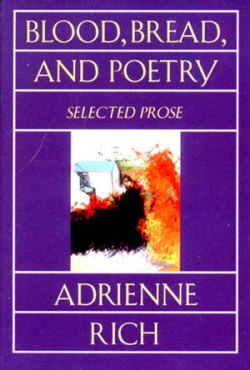
“Yes, she is a problem for me,” Adrienne Rich opens in her “The Problem of Lorraine Hansberry” (Blood, Bread, and Poetry: Selected Prose 1979-1985), “as I read and reread the published work and some of the unpublished—copies of letters, interview transcripts, essays.”
To follow is a series of parallel “As I” sentences in which Rich muses on Hansberry (“a Black woman trying to write both from ‘within the Veil,’ as she once put it, and for a public which included Black women and men, but whose dominant expectations and mythic opinions about the world were shaped by white males”), leading to:
Lorraine Hansberry is a problem to me because she is Black, female, and dead….The problem begins for me when, in reading Les Blancs, I do not know when I am reading dialogue written by Hansberry and when I am reading the end product of the process Nemiroff describes….All this may be forthright and devoted enough, and it may seem graceless to question the end result. But I do question it….But biography by a former husband and literary executor is not the same as autobiography.
This “problem” builds to Rich acknowledging “the limitations of my experience as a white woman.” Rich confronts that “within white feminist criticism itself there have been notable silences, erasures”—and “[t]he Black woman writer, as Barbara Smith has noted, suffers from double erasure.”
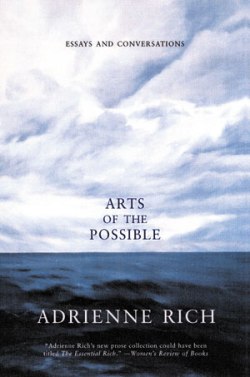
In fact, “[t]he study of silence has long engrossed me,” Rich writers in her “Arts of the Possible,” the eponymous essay of her 2001 collection of essays:
The matrix of a poet’s work consists not only of what is there to be absorbed and worked on, but also of what is missing, desaparecido, rendered unspeakable, thus unthinkable. It is through these invisible holes in reality that poetry makes it way—certainly for women and other marginalized subjects and for disempowered and colonized peoples generally, but ultimately for all who practice art at any deep levels. The impulse to create begins—often terribly and fearfully—in a tunnel of silence.
Rich as woman, as gay. Rich as poet, essayist—artist at “deep levels.”
She has presented to us in autobiography/biography that is a poet’s/artist’s work a series of resurrections, exposing who she has been and who she becomes. She has been daughter, wife, and mother; she has been lesbian lover—just as one way through association (the sorts of associations Rich exposed and confronted, “shaped by white males”) to view her metaphorical deaths and resurrections.
Rich struggling through Hansberry is Rich wrestling with her many selves—none of them perfect but all of them the richness of words crafted.
With Rich’s literal death, a new door of resurrections has opened—post mortem biographies, literary criticism, and unpublished works.
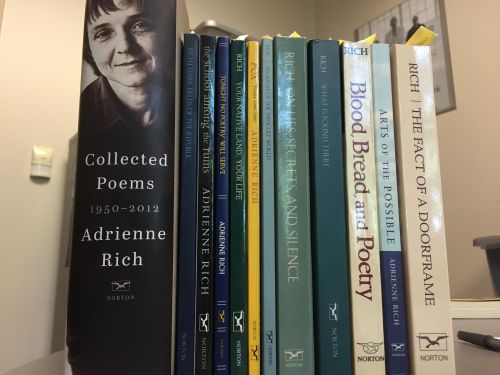
It is a simple, understated cover for a work of great physical heft, over 1100 pages in hardback—a work that resurrects Rich the poet in toto. What more could a poet want? What more could a poet dread?
If you have been on Rich’s journey for many, many years—as I have—this volume is redundant but inescapable and invaluable, a Siren’s call to those of us who love books, desire collecting.
1119 pages into her body of work, Rich leaves us with words that seem haunted with James Baldwin (see her “The Baldwin Stamp”):
The signature to a life requires
the search for a method
rejection of posturing
trust in the witnesses
a vial of invisible ink
a sheet of paper held steady
after the end-stroke
above a deciphering flame
To read Rich’s entire body of published poetry draws me back to her “Diving into the Wreck,” a tour de force of personal and social commentary as poetic genius.
In death, Rich’s collected poetry presents “a book of myths” as revolt, as liberation—as a problem for everyone holding this heaviest of resurrections that is Rich and is not Rich.
A decade ago, I was confronted with an incredibly uncomfortable situation when my first-year English class overwhelmingly believed the Duke lacrosse team was innocent and the woman accusing them of sexual assault was fraudulent.
There was a significant mixture of irony in the tension resulting from my trusting that the class—atypically majority male at a university consisting of mostly privileged and white students—was biased by their collective and individual privilege as that conflicted with the eventual revealing that the Duke lacrosse team was in most ways innocent (although I would argue that is a simplistic conclusion supported by technicalities of law): the irony, of course, being that I—white, male, and privileged—was proven wrong about my claims of the U.S. being, in the language of today, a country in which white male lives matter most.
Just this May, another class included, again atypically, about a third black students, some of whom were eager to argue for corporal punishment and then several of the black male students felt compelled to speak up for males wrongly accused of sexual assault.
But I could not have anticipated both the Baylor University scandal and then the Brock Turner rape judgment and sentence, which has been followed by a disturbing pair of commentaries by Turner’s father and a female childhood friend.
The light sentence of Turner, by a judge who like Turner attended Stanford University, was justified because of the consequences this rape would have on Turner’s life. Turner’s victim has rebuked this decision in her own statement.
Both the Turner sentence and the Baylor scandal returned me to my examination of The Martian, an unintended allegory of the hyperbolic concern in the U.S. for the white male at the expense of women and people of color.
Having been raised in the sexist and racist South, I have spent my adult life—going on four decades—working against my privilege and learned bigotries.
I am aware of and fearful of whitesplaining and mansplaining, the white gaze and the male gaze in every interaction I have in both the real and virtual worlds. I shudder to think, on social media especially, how often I creep toward the line crossed by vicious male trolls, how often women and people of color see in my words the very things I abhor.
As a writer, I am hyper-aware that my one-more-white-man’s voice is crowding out space for women and people of color; we simply do not need more white male perspectives.
As a scholar and academic, now full professor and tenured with a significant body of published works, I am equally hyper-aware I continue to do the same in academia.
Much of my work has been devoted to calling out racism, but I have also addressed misogyny and mansplaining often. In both cases, I have tried to confront the inevitable “yes, but” from men and whites.
But I look at the one picture of Turner, and I see me—white male. I think about the judge in the case, and I am among the disproportionate number of white males in power in the U.S.
What woman would trust me, especially from a distance? Why would black and brown people believe my solidarity?
And while I am writing about me, this is not about me; this is about the daily doubling down in the U.S., proving that white male lives matter most—and the corrosive consequences for everyone.
That fact—the light sentence for Turner, the failure to hold police officers accountable for taking black lives—sustains a hostile world for everyone; we are pitted daily against each other because the greatest threat to power is solidarity.
I will continue to name misogyny, racism, and child abuse—even as that work pushes my voice farther the margins.
As a privileged white male, I am insulated enough that I can offer these observations that remain mostly about my own minor inconveniences that are devastating realities for vulnerable populations and people oppressed because of race, gender, sexuality, or age. As a privileged white male, I seek to use my privilege to eradicate privilege.
But most of all, my greatest act of solidarity remains my role as a student—I listen, I read, I heed.
And even then, I fall short.
I have failed enough women, children, and people of color to last a dozen life times—and “I’m sorry” seems trivial against that.
White male privilege has created a vicious world that needs to be dismantled, and in its place, we must imagine something better, a world brought forth from the mouths and minds of those rendered less human and thus more aware of the beauty and grandeur of being human.
•
As Adrienne Rich offers, “the sea is another story/ the sea is not a question of power.”
Most people know “Power tends to corrupt and absolute power corrupts absolutely,” but the Turner verdict and sentencing remind us of what Lord Acton offered next: “Great men are almost always bad men.”
Daily, this is proven true as we watch white males double down again and again on white male lives mattering most.
A former student and current wonderful early-career teacher texted me yesterday because someone had shared with her the inane “I’m not going to apologize for my white privilege” article that is all the rage among white privilege deniers.
Nearly as disturbing as the pervasive and corrosive influence of racism is the reality that the more whites are confronted with evidence of white privilege and racism, the more likely whites are to cling to their denial. Research from 2015 confirms:
What happens when people are faced with evidence that their group benefits from privilege? We suggest such evidence will be threatening and that people will claim hardships to manage this threat. These claims of hardship allow individuals to deny that they personally benefit from privilege, while still accepting that group-level inequity exists. Experiments 1a and 1b show that Whites exposed to evidence of racial privilege claim to have suffered more personal life hardships than those not exposed to evidence of privilege.
Humans are drawn to patterns, both the recognition of patterns and the creation of patterns. Maybe anthropologists and sociologists would argue that in part that attraction is about survival and comfort. I suspect this pattern fetish in humans is also at the root of seeking out others like us (see any school lunch room where students are allowed to sit where they please), and I fear it is also the foundation for the very worst of humans—our racism, sexism, classism, and seething anger at the Other.
This is not some historical low point of human history—U.S. slavery, the Holocaust, the Japanese internment—but a seemingly credible point of debate among presidential hopefuls and their supporters who are calling from banning Muslims from U.S. soil.
And as the hashtags have continued to increase (#BlackLivesMatter, #TamirRice, and then too, too many to list) so has the backlash, the denial—just as the research above confirms.
We stand at the cusp of one of our greatest pattern urges, the arbitrary designating of the passing of time. Soon a new year will be upon the West (yes, even the calendar is a force of privilege, a way to mask subjectivity as objective, universal), and at least one voice has suggested there is hope: “I believe – I hope – that a great rewriting is slowly, surely underway,” writes Laurie Penny.
Penny’s examination of the latest Star Wars film offers a much more detailed and powerful investigation than my own look at The Martian, but we do tread similar ground; notably Penny explains:
The people who are upset that the faces of fiction are changing are right to worry. It’s a fundamental challenge to a worldview that’s been too comfortable for too long. The part of our cultural imagination that places white Western men at the centre of every story is the same part that legitimises racism and sexism. The part of our collective mythos that encourages every girl and brown boy to identify and empathise with white male heroes is the same part that reacts with rage when white boys are asked to imagine themselves in anyone else’s shoes.
I struggle to share Penny’s optimism—because of the horrifying specter of the unfathomable nastiness in both our presidential politics and our pop culture, both of which expose the “white interpretive horizon.”
Yet, I think Penny makes a powerful observation that may be the key to believing change is upon us:
Let’s not get carried away here. These stories and retellings are still exceptions. Women are still paid less, respected less and promoted less at almost every level of every creative industry. For every Jessica Jones there’s a Daredevil, whose female characters exist solely to get rescued, provide the protagonists with some pneumatic exposition, or both. For every Orphan Black there’s Mr Robot and Narcos and you know, sometimes I wonder if perhaps I watch too much television. The point is that what we have right now isn’t equality yet. It’s nothing like equality. But it’s still enough to enrage the old guard because when you’ve been used to privilege, equality feels like prejudice. [emphasis added]
White privilege is an iceberg; very little is visible above the surface, and for those of us with that privilege, it is ours to interrogate what lies beneath in order to understand and dismantle it.
“I came to explore the wreck,” explains the speaker of Adrienne Rich’s “Diving into the Wreck”:
the thing I came for:
the wreck and not the story of the wreck
the thing itself and not the myth
As Penny explains when unpacking “[t]he rage that white men have been expressing, loudly, violently”:
Like a screaming toddler denied a sweet, it becomes more righteous the more it reminds itself that after all, it’s only a story.
Only a story. Only the things we tell to keep out the darkness. Only the myths and fables that save us from despair, to establish power and destroy it, to teach each other how to be good, to describe the limits of desire, to keep us breathing and fighting and yearning and striving when it’d be so much easier to give in. Only the constitutive ingredients of every human society since the Stone age.
Only a story. Only the most important thing in the whole world.
This is our wreck, a story of a people blinded by the myth of meritocracy while steering the ship headlong into the iceberg we pretend isn’t there.
We must write better stories, fictional and real. A new year is arbitrary, yes, but it serves us well to listen to the refrain “the time is always now.”
When writing about my redneck past—born, raised, and now having lived my entire life in the upstate of South Carolina—I reached back to my grandparents and parents as a way to give context to who I am and how I “got to be this way.”
In the waning days of June 2015, in the sort of near-100-degree heat we tend to suffer in July and August, SC has been exposed to the rest of the U.S. and world in a way that is hard for me as a Southerner to face: nine innocent souls slaughtered in a racist rage.
While the domestic terrorist responsible for this logical consequence of a people hopelessly clutching a culture of violence in the form of the right to bear arms and willfully blind to the lingering racism that stains our refrain of “life, liberty, and the pursuits of happiness” sought to start a race war, instead a state and national conversation has begun about the embarrassment that is Southern Heritage, raised like a petulant bully’s middle-finger on the grounds of SC’s Capitol.
I have never felt pride about being a South Carolinian, a Southerner, or an American—these are all mere coincidences of my birth.
It makes no real sense to me, this personalizing geography and then mangling history and ideology in order to create barriers among people.
As a high school teacher in SC for nearly two decades, my students often bristled at my confronting them about the flag fetish among many white students, mostly males.
As a life-long witness to Southern Heritage, I have come to recognize that we are not unique but representative in the South of the worst aspects of patriotism, nationalism, and jingoism—making a commitment to a false narrative to preserve an ideology that ultimately is self-defeating and dehumanizing.
Those most fervent about Southern Heritage and fundamentalist faith in the South have something important in common: an incomplete at best and missing at worst understanding of either the history of the South (and the Confederacy) or the Bible.
There is a selectivity to calling on history and scripture that exposes the real commitments of the fervent: holding onto a world that insures other people remain inferior.
“Heritage Not Hate” is propaganda, and as Aldous Huxley notes: “The propagandist’s purpose is to make one set of people forget that certain other sets of people are human.”
It is the cruelest sort of irony that Southern Heritage advocates misrepresent history as many fundamentalists misrepresent Christianity because those false narratives seek to dehumanize and divide.
Yes, my family and community shaped who I am and how I “got to be this way.” And I am certain the South and SC have played roles in that story of me as well.
But I have no specific idea if any of my ancestors participated in any way in the Civil War or slavery; I must imagine that those ancestors in the South during those eras were like most people—in most ways directly or indirectly complicit in horrible human acts.
I must imagine that because we are directly and indirectly complicit now in horrible human acts—some so large and pervasive that most cannot see them (our consumer culture that includes the wealth of the few on the labor of the discardable many).
I have no desire to contort reality around my ancestors or the history of the region I happen to be born in as a act of somehow justifying my own value as a person.
Southern Heritage and Pride are abstractions that allow a callous disregard for the very real world around us—a world that is unnecessarily violent of our own making, a world that is horribly inequitable of our own making, and a world trapped in the labels of “heritage” and “Christian” but unwilling to learn from history or act on “Love your neighbor as yourself.”
I simply cannot embrace a past that reveals all the ways we have failed each other.
It seems instead that today and every “today” we are called to imagine how the world can be better and then do something to make that happen.
I am grateful in many ways for the life my grandparents and parents afforded me, but my life has also included making choices to set aside many things that redneck past inculcated in me, things that do not fill me with pride, but shame.
The enduring possibilities of human dignity have been my guideposts that I found in literature (not garbled and romanticized history or cherry-picked bible verses): William Faulkner and Flannery O’Connor, Ralph Ellison and Alice Walker, Langston Hughes and e.e. cummings, Margaret Atwood and Haruki Murakami, Milan Kundera and Adrienne Rich.
But the moral barometers who ultimately saved me remain the voices I hear daily: Kurt Vonnegut and James Baldwin.
“Go over to her shack, I guess. Sprinkles some water on the babies, say, ‘Hello, babies. Welcome to Earth. It’s hot in the summer and cold in the winter. It’s round and wet and crowded. At the outside, babies, you’ve got about a hundred years here. There’s only one rule that I know of, babies—:
It took many years of vomiting up all the filth I’d been taught about myself, and half-believed, before I was able to walk on the earth as though I had a right to be here.
I feel no pride in being a South Carolinian, a Southern or an American; I did not choose any of that geography.
But when I read Vonnegut and Baldwin, I am proud to be a fellow human and I feel a sudden rush of hope found in the pages of literature—as author Neil Gaiman recognizes:
You’re also finding out something as you read vitally important for making your way in the world. And it’s this:
The world doesn’t have to be like this. Things can be different.
And this is my confession: While white parents gave me life, black authors saved my life.
I have debts to pay, and I must pay them forward—things I cannot do clutching a past that has failed us all.
24 August 1922—Howard Zinn was born. His life and career spanned the twentieth century and into the first decade of the twenty-first. It is his memoir, You Can’t Be Neutral on a Moving Train: A Personal History of Our Times, for me, that speaks to the enduring power of Zinn’s metaphor, particularly for teachers.
Historically and currently, teacher remain under the demand that their teaching—and even their lives—remain neutral, not political. University professors—such as Zinn—also face disciplinary and public expectations of objectivity, dispassion—their work as public intellectuals either shunned or unrecognized.
So on the day of Zinn’s birth, it continues to be important not only to read and listen to Zinn, but also to act on Zinn, for it is action, after all, that Zinn lived and called for.
“When I became a teacher,” Zinn explains in You Can’t Be Neutral on a Moving Train, “I could not possibly keep out of the classroom my own experiences”:
I have often wondered how so many teachers manage to spend a year with a group of students and never reveal who they are, what kind of lives they have led, where their ideas come from, what they believe in, or what they want for themselves, for their students, and for the world.
Does not the very fact of that concealment teach something terrible—that you can separate the study of literature, history, philosophy, politics, the arts, from your own life, your deepest convictions about right and wrong?
Concealment is a political act, and in the face of the tragedy surrounding the police shooting of Michael Brown, the educational response has been exactly that, concealment. But as poet Adrienne Rich has confronted:
The study of silence has long engrossed me. The matrix of a poet’s work consists not only of what is there to be absorbed and worked on, but also of what is missing, desaparecido, rendered unspeakable, thus unthinkable.
Instead of striking the masked political poses of neutrality, objectivity, and dispassion, Zinn called for transparency:
In my teaching I never concealed my political views: my detestation of war and militarism, my anger at racial inequality, my belief in democratic socialism, in a rational and just distribution of the world’s wealth. I made clear my abhorrence of any kind of bullying, whether by powerful nations over weaker ones, governments over their citizens, employers over employees, or by anyone, on the Right or the Left, who thinks they have a monopoly on the truth.
Having taught in rural Southern public schools for 18 years and then 13 more years in higher education, I can attest that Zinn’s argument is challenged only because of the positions he holds and not because he took positions. You see, in K-12 classrooms, especially in history classes, textbooks, curriculum, and teachers always represented positions by framing as neutral the mainstream perspectives found among them all: a blind allegiance to capitalism, representing the U.S. as a righteous military victor, whitewashing every struggle in the country’s history, celebrating the wealthy and powerful while turning a blind eye to their many sins.
It has never been that our classrooms are neutral, as Zinn confronts, but that our classrooms have been passive passengers on the moving train of social and cultural indoctrination, the sort of indoctrination that benefits the few who have wealth and power built on their privilege at the expense of the many—workers, racial minorities, women, children, and the impoverished.
As Zinn recognized:
This mixing of activism and teaching, this insistence that education cannot be neutral on the critical issues of our time, this movement back and forth from the classroom to the struggles outside by teachers who hope their students will do the same, has always frightened the guardians of traditional education. They prefer that education simply prepare the new generation to take its proper place in the old order, not to question that order.
And although written well before the current education reform movement built on accountability, standards, and high-stakes testing, Zinn’s memoir has identified the Orwellian reality of that movement: Those decrying the status quo are those in service of the status quo. Education reform is the pursuit of maintaining, not reforming.
This call for teaching as activism was join by Zinn’s disciplinary challenge as well:
History can come in handy. If you were born yesterday, with no knowledge of the past, you might easily accept whatever the government tells you. But knowing a bit of history—while it would not absolutely prove the government was lying in a given instance—might make you skeptical, lead you to ask questions, make it more likely that you would find out the truth.
Here, Zinn recognizes both the power of disciplinary knowledge and the concurrent danger of codified disciplinary knowledge (prescriptive standards, curriculum). Zinn’s confrontation, then, speaks to the foundational principles expressed by critical scholar Kincheloe:
Thus, proponents of critical pedagogy understand that every dimension of schooling and every form of educational practice are politically contested spaces. Shaped by history and challenged by a wide range of interest groups, educational practice is a fuzzy concept as it takes place in numerous settings, is shaped by a plethora of often-invisible forces, and can operate even in the name of democracy and justice to be totalitarian and oppressive.
These critical principles replace the dissembling of neutrality in the classroom, as Kincheloe explains:
Recognition of these educational politics suggests that teachers take a position and make it understandable to their students. They do not, however, have the right to impose these positions on their students [emphasis in original]….
In this context it is not the advocates of critical pedagogy who are most often guilty of impositional teaching but many of the mainstream critics themselves. When mainstream opponents of critical pedagogy promote the notion that all language and political behavior that oppose the dominant ideology are forms of indoctrination, they forget how experience is shaped by unequal forms of power. To refuse to name the forces that produce human suffering and exploitation is to take a position that supports oppression and powers that perpetuate it. The argument that any position opposing the actions of dominant power wielders is problematic. It is tantamount to saying that one who admits her oppositional political sentiments and makes them known to students is guilty of indoctrination, while one who hides her consent to dominant power and the status quo it has produced from her students is operating in an objective and neutral manner.
“Critical pedagogy wants to know who’s indoctrinating whom,” Kincheloe concludes. Teaching and history as activism, for Zinn, were moral imperatives, and thus:
From that moment on, I was no longer a liberal, a believer in the self-correcting character of American democracy. I was a radical, believing that something fundamental was wrong in this country—not just the existence of poverty amidst great wealth, not just the horrible treatment of black people, but something rotten at the root. The situation required not just a new president or new laws, but an uprooting of the old order, the introduction of a new kind of society—cooperative, peaceful, egalitarian.
Zinn, activist, radical, speaks to us now, the “us” of any classroom, the “us” charged with the learning and lives of any child:
From the start, my teaching was infused with my own history. I would try to be fair to other points of view, but I wanted more than “objectivity”; I wanted students to leave my classes not just better informed, but more prepared to relinquish the safety of silence, more prepared to speak up, to act against injustice wherever they saw it. This, of course, was a recipe for trouble.
Today on the date of Zinn’s birth, I argue, it is a recipe we must follow.
January 1, 2000, exposed a truly baffling phenomenon about most humans: A silly fascination with numbers that end in zero that completely renders those humans irrational. In the land of the arbitrary where people fear that arbitrary dates can spawn the Apocalypse, the irrational can’t even manage those arbitrary dates as January 1, 2001 (not 2000), was the turning point of the millennium.
And so we now witness a flurry of articles about James Baldwin, mostly ignored over the past few decades, because August 2, 2014, would have been Baldwin’s 90th birthday—somehow signifying he is more important now than when he would have turned 89.
As someone who has come to cherish Baldwin the essayist and Baldwin the public intellectual, I welcome this sudden burst of sunlight on one of the most daring and perceptive voices ever among writers in the U.S. I cannot stress enough in print that I find Baldwin as valuable today as ever, and often feel deeply inadequate as a writer and would-be public intellectual against the power of Baldwin.
To join in with this celebration, I want to recommend primarily that Baldwin’s voice be read and viewed/heard—that we do not allow all being said and written about him to suffice. And on August 2, 2014, we have so much of Baldwin before us, so much that we have failed to embrace, to consider carefully, to allow these words to complete their unmasking:
No rhetorical sleight of words should mask that Trayvon Martin was a son. He had parents. No rhetorical sleight of words should allow us to ignore that any child is everyone’s child.[i]
Trayvon Martin was killed February 26, 2012, in part because he was reduced to a stereotype, and after his death, Trayvon was again reduced—often by well-meaning people—to an icon, the hoodie. In his death, as well, Trayvon has been spoken about, spoken for—and I am compelled to argue that he has also been rendered voiceless. But, as Arundhati Roy (2004) has explained, “We know of course there’s really no such thing as the ‘voiceless.’ There are only the deliberately silenced, or the preferably unheard” (n.p.).
In this introduction to a volume on the work of James Baldwin, I, like Roy, am compelled to speak beyond Trayvon about “the deliberately silenced, or the preferably unheard”—about those Others: African American males.
At mid-twentieth century, as the U.S. was fighting against its racist heritage, African American males demanded to be heard—Martin Luther King Jr., Malcolm X, Ralph Ellison, James Baldwin, Richard Wright and many others took the stage as artists, public intellectuals, and civic leaders. Wright’s Black Boy and Ellison’s Invisible Man represent in fictional narrative a powerful and disturbing image of the African American male; for Ellison, the guiding metaphor of that narrative is invisibility. The killing of Trayvon and the subsequent trial may suggest that African American males no longer suffer from invisibility but from how they are seen, how they are silenced, and how they are unheard: Trayvon seen (and reduced) as black male, thus necessarily a thug, a threat, and then Trayvon, the hoodie, the icon of the disposable African American male.
The fact of being seen and reduced as African American males too often result in violent deaths and prison. And the intersection of race, class, and gender with education has paralleled the rise of mass incarceration (Thomas, 2013) over the past thirty-plus years. While Wright’s and Ellison’s novels continue to capture the African American male experience—including the entrenched conditions that contributed to Trayvon’s killing—Ellison’s and Baldwin’s concerns about the failure of education to see clearly and holistically—and humanely—the plight of African American males continue to send an ominous and powerful message today (see Chapter 9 for a fuller discussion).
In 1963, Ellison (2003) spoke to teachers:
At this point it might be useful for us to ask ourselves a few questions: what is this act, what is this scene in which the action is taking place, what is this agency and what is its purpose? The act is to discuss “these children,” the difficult thirty percent. We know this very well; it has been hammered out again and again. But the matter of scene seems to get us into trouble. (p. 546)
Ellison recognized the stigma placed on African American students, a deficit view of both an entire race and their potential intelligence (marginalized because of non-standard language skills). But Ellison rejected this deficit perspective: “Thus we must recognize that the children in question are not so much ‘culturally deprived’ as products of a different cultural complex” (p. 549). Ultimately, Ellison demanded that the human dignity of all children be honored.
Baldwin (1998) addressed teachers in that same year, 1963:
Let’s begin by saying that we are living through a very dangerous time. Everyone in this room is in one way or another aware of that. We are in a revolutionary situation, no matter how unpopular that word has become in this country. The society in which we live is desperately menaced, not by Khrushchev, but from within. (p. 678)
Then, Baldwin unmasked the cruel tension between the promise of universal public education and the inequity found in the lives of African American children. Education, for Baldwin, must be revolutionary, an act of social justice. In Baldwin’s words, I hear a refrain: No rhetorical sleight of words should mask that Trayvon Martin was a son. He had parents.No rhetorical sleight of words should allow us to ignore that any child is everyone’s child.
However, if the killing of Trayvon does not haunt us, if the killing of Trayvon slips beneath the next tragedy-of-the-moment—as the Sandy Hook school shooting (December 14, 2012) has beneath the George Zimmerman trial—then society and schools will continue to be mechanisms that shackle “the deliberately silenced, or the preferably unheard.” And I suppose that is ultimately the cruel paradox, rendering Trayvon a ghost in this American house he was never allowed to enter, invisible again as Ellison’s unnamed narrator.
To Jimmy (and Jose), with Love
When teacher and blogger Jose Vilson[ii] posts a blog, I read carefully and don’t multitask. Why? I am a privileged, white male who has lived his entire life in the South where racism clings to the region like the stench of a house razed by fire.
And as a result, I walk freely among racism because I am white. So when Vilson (2013) posted “An Open Letter From The Trenches [To Education Activists, Friends, and Haters],” I listened, and I recognized:
Anger isn’t a title we parade around like doctorates, followers, and co-signers; it’s the feeling before, during, and after we approach things with love and earnest….
However, for anyone to say that racial insults are “no big deal” speaks volumes to the sorts of work people of color and anyone who considers themselves under the umbrella have to do in order to make things right. As colleague Kenzo Shibata once said, “You can’t build a movement by making allies feel unwelcome and telling them to get over it.” I’d take it one step further and say that we can’t build coalition if we continue to think we have to build a movement under one or two people’s terms. I refuse to believe that we can’t coalesce around building a better education system for all children, regardless of background.
How can you say you care about children of color, but ostracize adults of color with the same breath?…
Adults, on the other hand, don’t get excuses. The privilege is in the hopes and dreams we have for our students, not in the ways we act towards our fellow man or woman. The privilege, to convert the anger over how our kids are treated in the system into a passion for student learning, remains at the forefront. (n.p.)
I have learned to read and listen to Jose as I do with New York Times columnist Charles Blow and writer Ta-Nehisi Coates, as I do with Martin Luther King Jr., Malcolm X, Ralph Ellison, and now more than ever, James Baldwin, who is the focus of this volume.
I have learned daily—I continue to learn today—that America the Beautiful has failed an entire race of people, specifically African American males. I have learned daily, I continue to learn today that in my half-century-plus life, the most hateful people I have encountered have been white men—yet, daily brown and black faces smile at me (even or especially when we are strangers) and speak with kindness and joy when we approach each other on the street, in restaurants, and where we all work and live. I have learned daily, I continue to learn today that in my half-century-plus life, the most beautiful humans—and the greatest reason to live on this planet—are children of every possible shade. They laugh and sing and dance and run with the beauty of life that has nothing at all to do with race or the supreme and inexcusable failures of the adults in whose care they reside.
America the Beautiful created a minority class out of a race of people who are as rich, vibrant, and beautiful as anybody else. America the Beautiful has also created a criminal class out of African American men, building a new Jim Crow system (Alexander, 2012) with mass incarceration masked as a war on drugs. America the Beautiful created a dropout class and future criminal class out of African American young men, building school-to-prison pipelines and schools-as-prisons as zero-tolerance schools imprisoning urban communities (Nolan, 2011).
These are not angry and hyperbolic claims about the soot-stained American past; these are claims about the roots that continue to thrive and bear bitter fruit. Baldwin (1998), in “A Report from Occupied Territory” (originally published in The Nation, July 11, 1966), confronted an “arrogant autonomy, which is guaranteed the police, not only in New York, by the most powerful forces in American life” (p. 737) and the corrosive deficit view of race it is built upon: “‘Bad niggers,’ in America, as elsewhere, have always been watched and have usually been killed”:
Here is the boy, Daniel Hamm, speaking—speaking of his country, which has sworn to bring peace and freedom to so many millions. “They don’t want us here. They don’t want us—period! All they want us to do is work on these penny-ante jobs for them—and that’s it. And beat our heads in whenever they feel like it. They don’t want us on the street ’cause the World’s Fair is coming. And they figure that all black people are hoodlums anyway, or bums, with no character of our own. So they put us off the streets, so their friends from Europe, Paris or Vietnam—wherever they come from—can come and see this supposed-to-be great city.”
There is a very bitter prescience in what this boy—this “bad nigger”—is saying, and he was not born knowing it. We taught it to him in seventeen years [emphasis added]. He is draft age now, and if he were not in jail, would very probably be on his way to Southeast Asia. Many of his contemporaries are there, and the American Government and the American press are extremely proud of them…. (pp. 737-738)
These realities of racism from 1966 linger today—the scar of racism cloaked, as Baldwin recognized, with claims of justice:
This is why those pious calls to “respect the law,” always to be heard from prominent citizens each time the ghetto explodes, are so obscene. The law is meant to be my servant and not my master, still less my torturer and my murderer. To respect the law, in the context in which the American Negro finds himself, is simply to surrender his self-respect. (p. 734)
And thus, Baldwin’s conclusion about the Harlem Six rings true still:
One is in the impossible position of being unable to believe a word one’s countrymen say. “I can’t believe what you say,” the song goes, “because I see what you do”—and one is also under the necessity of escaping the jungle of one’s situation into any other jungle whatever. It is the bitterest possible comment on our situation now that the suspicion is alive in so many breasts that America has at last found a way of dealing with the Negro problem. “They don’t want us—period!” The meek shall inherit the earth, it is said. This presents a very bleak image to those who live in occupied territory. The meek Southeast Asians, those who remain, shall have their free elections, and the meek American Negroes—those who survive—shall enter the Great Society. (p. 738)
Today, racism is thinly masked, and many refuse to see it.
In 1853, Frederick Douglass recognized what would 100 years later be portrayed as invisibility by Ralph Ellison:
Fellow-citizens, we have had, and still have, great wrongs of which to complain. A heavy and cruel hand has been laid upon us.
As a people, we feel ourselves to be not only deeply injured, but grossly misunderstood. Our white fellow-countrymen do not know us. They are strangers to our character, ignorant of our capacity, oblivious of our history and progress, and are misinformed as to the principles and ideas that control and guide us as a people. The great mass of American citizens estimate us as being a characterless and purposeless people; and hence we hold up our heads, if at all, against the withering influence of a nation’s scorn and contempt. (qtd. in Alexander, 2012, p. 140)
Douglass’s charges are echoed in Baldwin’s (1998) “No Name in the Street,” which points a finger at the entrenched American problem with race:
The truth is that the country does not know what to do with its black population now that the blacks are no longer a source of wealth, are no longer to be bought and sold and bred, like cattle; and they especially do not know what to do with young black men, who pose as devastating a threat to the economy as they do to the morals of young white cheerleaders. It is not at all accidental that the jails and the army and the needle claim so many, but there are still too many prancing around for the public comfort. Americans, of course, will deny, with horror, that they are dreaming of anything like “the final solution”—those Americans, that is, who are likely to be asked: what goes on in the vast, private hinterland of the American heart can only be guessed at, by observing the way the country goes these days. (pp. 432-433)
America doesn’t know what to do, but it is startlingly clear that we should know what not to do: Don’t suspend and expel young black men without just cause, don’t incarcerate young black men without just cause, don’t lure and then send young black men to war, and without a doubt, don’t allow anyone to demonize anyone else with racial slurs.
Maybe, in the end, racism remains a cancer on America the Beautiful because we will not face it or unmask it—and because we have become so cynical that the solution seems trite: As Jose stated, as King repeated, and as James (“Jimmy”) Baldwin demanded, the solution is love. Love everyone, but be vigilant about loving the least among us—children, the impoverished, the imprisoned, the hungry, the sick, the elderly—and do so color-blind.
As stated above, I offer these words because I walk freely among racism and because I, like Vilson (2013), refuse to believe “that we can’t coalesce around building a better education system for all children, regardless of background” (n.p.). Or, as Baldwin (1998) himself said: “‘I can’t believe what you say,’ the song goes, ‘because I see what you do’” (p. 738)—and we all must hear what everyone else says—especially the words they choose—never offering excuses for the racism of policy, the racism of action, or the racism of language.
James Baldwin: Challenging Authors
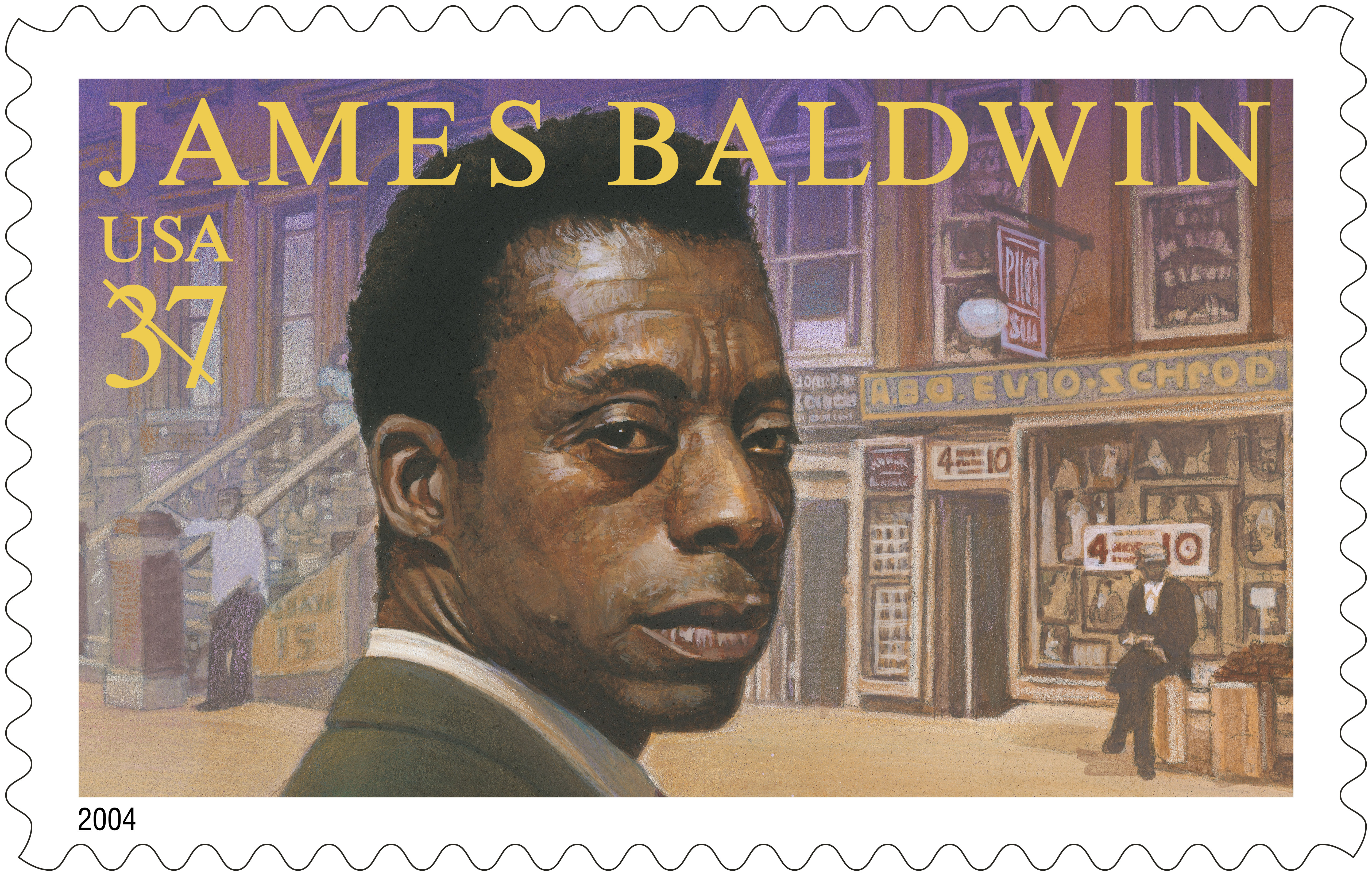
In 2004, poet Adrienne Rich (2009) wrote about a postage stamp bearing the face of American ex-patriot writer James Baldwin: “the stamp commemorates Baldwin’s birthday, August 2: he would have been eighty that year” (p. 49). This volume appears in 2014, the year that Baldwin would have turned ninety.
Rich’s essay reads as the journey of one writer’s experience embracing the other, but Rich also highlights what this volume seeks to address as well—the lack of attention that Baldwin receives in the twenty-first century U.S. Why, Rich asks, does a country still laboring under the same issues of race continue to ignore a powerful voice, as Americans certainly did when Baldwin spoke of racism?
Quoting from “Lockridge: ‘The American Myth,’” Rich (2009) includes the following:
The gulf between our dream and the realities that we live with is something that we do not understand and do not wish to admit. It is almost as though we were asking that others look at what we want and turn their eyes, as we do, away from what we are. I am not, as I hope is clear, speaking of civil liberties, social equality, etc., where indeed strenuous battle is yet carried on; I am speaking instead of a particular shallowness of mind, an intellectual and spiritual laxness….This rigid refusal to look at ourselves may well destroy us; particularly now since if we cannot understand ourselves we will not be able to understand anything. (p. 52; Baldwin, 1998, p. 593)
Baldwin’s challenge here should haunt us because it remains the challenge before us—“[t]his rigid refusal to look at ourselves.”
The following chapters—based on both scholarly and experiential perspectives—make significant contributions to the astonishingly slim amount of research and discussion that exists on one of the twentieth century’s most important public intellectuals. They provide key insights into Baldwin’s literary skills, his political views, and the impact his life and work had on historic, as well as ongoing, policy debates. They reveal a complicated, often tormented, and always provocative individual who confronted racism, imperialism, and homophobia as a black, gay pacifist. It should therefore come as little surprise that his work maintains its relevance as American society continues to grapple with racial, social, and political challenges.
[ii] Vilson offers about himself at his blog, The Jose Vilson (http://thejosevilson.com/): “José Luis Vilson is a math educator for a middle school in the Inwood / Washington Heights neighborhood of New York, NY. He graduated with a bachelor’s degree in computer science from Syracuse University and a master’s degree in mathematics education from the City College of New York. He’s also a committed writer, activist, web designer, and father. He co-authored the book Teaching 2030: What We Must Do For Our Students and Public Schools … Now and In The Future with Dr. Barnett Berry and 11 other accomplished teachers. He currently serves as the president emeritus of the Latino Alumni Network of Syracuse University, as a board member on the Board of Directors for the Center for Teaching Quality, and has been a part of the Acentos Foundation, LATinos In Social Media (LATISM), the Capicu Poetry Group, BlogCritics, and the AfroSpear.”
In late November of 2003, I sat on the floor in a crowded luncheon just a few feet and slightly behind Adrienne Rich, speaking and reading her poetry at the annual convention of the National Council of Teachers of English, held that year in San Francisco.
Appropriately, Rich was reading from her upcoming collection, The School among the Ruins, and talking about teaching, teachers, and education. I was struck by many things that day, and eventually I wrote a poem to capture the moment (see below).
As a poet, teacher, reader, and human, I have been deeply and permanently moved and changed by the poetry and essays of Rich, from the genius of “Diving into the Wreck” and “Aunt Jennifer’s Tigers” to the reconsideration of Emily Dickinson in “Vesuvius at Home: The Power of Emily Dickinson” (see On Lies, Secrets, and Silence) to her remarkable and soaring Arts of the Possible, that includes one of the most cited passages in my scholarly works:
Universal public education has two possible—and contradictory—missions. One is the development of a literate, articulate, and well-informed citizenry so that the democratic process can continue to evolve and the promise of radical equality can be brought closer to realization. The other is the perpetuation of a class system dividing an elite, nominally “gifted” few, tracked from an early age, from a very large underclass essentially to be written off as alienated from language and science, from poetry and politics, from history and hope—toward low-wage temporary jobs. The second is the direction our society has taken. The results are devastating in terms of the betrayal of a generation of youth. The loss to the whole of society is incalculable. (p. 162)
For Rich, the human condition is a fact of what is spoken and unspoken:
The study of silence has long engrossed me. The matrix of a poet’s work consists not only of what is there to be absorbed and worked on, but also of what is missing, desaparecido, rendered unspeakable, thus unthinkable. (p. 150)
When I discovered that Rich had passed, I recognized that while she would no longer speak again to us, she would never be unspoken. With her work, Rich remains the artist of the possible.
Woman as Poet: Possibilities
The life and writing of Rich are testaments to and challenges against the hegemonies of gender, marriage, sexuality, and human agency. She lived many lives in her one life, a fact common for women trapped in the expectations of gender that often create burdens that are nearly impossible to carry.
Her early life included marriage and three sons, and then she lived a much different life after separating from her husband, a life often characterized by a sort of radical feminism that celebrated her lesbianism. Her life as a poet/writer paralleled this personal transformation, with Rich acknowledging that her early success as a poet was built on her embracing modernist traditions, leading to her “Aunt Jennifer’s Tigers” being both, according to her, a rejection (somewhat unconsciously) and model of those traditions. The poet Rich, however, became a radical as well, resulting in canon czars such as Harold Bloom marginalizing Rich as merely political—missing entirely Rich’s powerful argument that political is all that poetry and a poet can be: “I take it that poetry—if it is poetry—is liberatory at its core” (Arts of the Possible, p. 116).
Rich’s poetry and her critical work on Dickinson were central parts of my teaching during my nearly two decades as an ELA high school teacher. In fact, one of the most important and influential units I eventually included in the quarter we explored poetry included Rich’s work paired with the poetry of Sylvia Plath and Anne Sexton. Along with these poets, we viewed the film Pleasantville, framing the lives and poetry of Rich (1929-2012), Plath (1932-1963), and Sexton (1928-1974) against the Betty Parker (Joan Allen) character in the film, the TV mother trapped in the norms of 1950s American.
This unit asked students to consider the suicides of Plath and Sexton against the life and poetic transformations of Rich; we also discussed how the film portrayed Betty Parker, both as a model of the norms of 1950s America and the real person trapped under her make up and the oppressive roles of wife and mother (dramatizing the poetry of Rich’s “Aunt Jennifer’s Tigers”: “The massive weight of Uncle’s wedding band/ Sits heavily upon Aunt Jennifer’s hand”).
And for the words Rich brought to my classroom and my life, I am forever in her debt. She validated things I had dared to think but feared to speak. She reminds me daily of the humility that should be at my core, a paradoxical radical humility, a commitment to human dignity and agency that are both threatened by the mere fact of my being a man in a world and society that allows the norm of manhood to oppress and silence.
It is deeply sad to lose Adrienne Rich, and profoundly uplifting to know all that remains forever from her words and her life:
The possibilities that exist between two people, or among a group of people, are a kind of alchemy. They are the most interesting thing in life. The liar is someone who keeps losing sight of these possibilities….
It isn’t that to have an honorable relationship with you, I have to understand everything, or tell you everything at once, or that I can know, beforehand, everything I need to tell you. It means that most of the time I am eager, longing for the possibility of telling you. That these possibilities may seem frightening, but not destructive, to me. That I feel strong enough to hear your tentative and groping words. That we both know we are trying, all the time, to extend the possibilities of truth between us.
The possibility of life between us. (Arts of the Possible, pp. 39-40)
It cannot be coincidence that just a few days before Rich’s death I sat in my office talking with one of my students; I pulled four books of Rich’s from the shelf and recommended her to the student.
The morning after Rich’s passing that student walked into my office with a New York Times article on Rich.
No, this could not be a coincidence, and yes, it must be the bittersweet symmetry of the universe that reminded me during my moments of sadness of the possibilities.
Rich cited another catalyst for ‘The School Among the Ruins’ in an e-mail interview from her Santa Cruz home — the school, in Brooklyn, where her son teaches.
“I knew his love for the school, for those children,” she said.
[The volume is s]et during a nonspecific wartime in which children and their teachers are hostages to horror.
We are now faced again with the incomprehensible intersection of children, teachers, schools, and unspeakable violence. It is ours to honor those taken from us by seeking the rational among the irrational.
Seeking the Rational among the Irrational
Let us commit ourselves to a vigilance, to protecting this moment against the petty, against the call to heap irrational upon irrational, against allowing the needed confrontations and discussions to become too narrow.
We must confront our culture of violence and the fetish with guns within that culture of violence, and not just gun control.
We must confront health care access and mental health care access, and not just mental illness.
We must confront our negative national discourse about teachers and schools—that misrepresents the sacred duties of those teachers and schools that are now memorialized in the names of innocent lives lost in an elementary school.
We must admit that we have been too quick to police children, and too slow to protect, cherish, and serve those children—particularly some children, too often “other people’s children.”
To allow the gaze of blame to be focused too narrowly absolves the larger root causes to remain, to thrive, to perpetuate further the ruins.
Words matter, yes, but actions speak louder than words.
How children matter, whose children matter—our commitments daily send messages.
The world we have created is the world we want, or at least the world we allow; as Kingsolver notes:
In the United States, where people like to think that anyone can grow up to be President, we parents are left very much on our own when it comes to the little Presidents-in-training. Our social programs for children are the hands-down worst in the industrialized world, but apparently that is just what we want.
In a poem of mine, I end with the following: “the world was exactly as they expected/ exactly as they knew it to be/ and mostly not as it could have been/ or should have been.”
To build that world out of the ruins requires action, action built on principles, to build monuments of peace and love against violence and destruction.
“upon hearing adrienne rich speak and read her poetry”
P. L. Thomas, 2003
i cannot shake the rush of my own grandmother— hair cropped short— rush over me whenever i see adrienne rich—
this time—in person— i felt the hunger to cry as i watched her— cane in hand—shuffle on stage like but not my grandmother—
my chest and eyes welled again and again from her words— speaking about teaching the frailty of teaching in America—America—
because she knows— if “knows” means “tastes in the air” if “knows” means “feels with her blood”— because she knows what no one can teach
this mother of us teachers who lives that which cannot be taught— the doubling over in pain from other people’s suffering that is surely not of this America—
and if i told her “adrienne, my lives have split me into pieces, pieces” she might cry right there her eyes welled as mine
because it is that knowing that makes us cry at the slightest suffering of any anyone who hurts and struggles against this whip





 dr. p.l. (paul) thomas