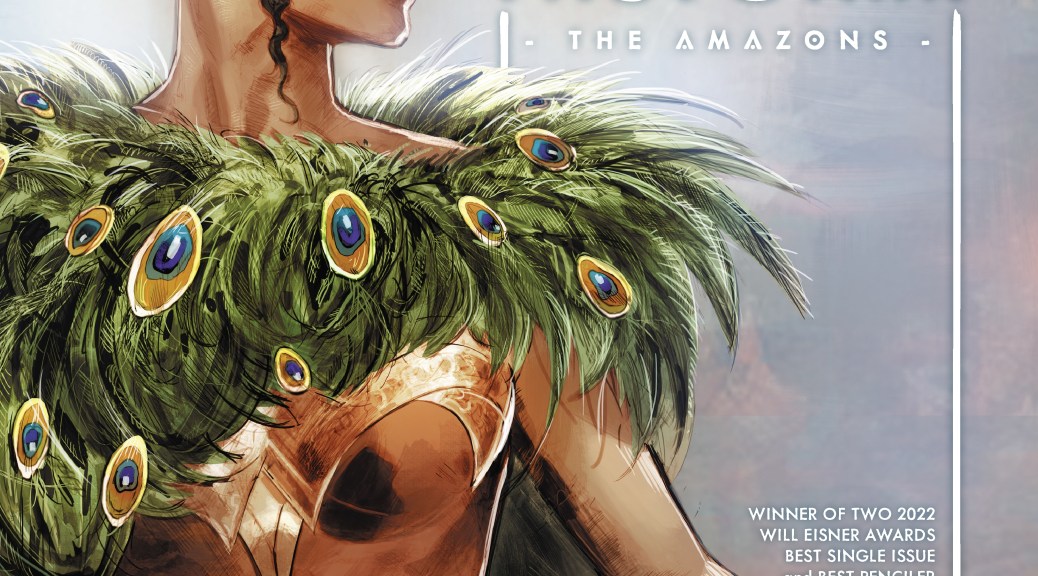
“What would I write if I could write literally anything in the DC Universe?” writes Kelly Sue DeConnick in her preface to The Pitch for Wonder Woman Historia (the hardback collecting the three volume series), adding, “What was the comic I had always wanted to read?”
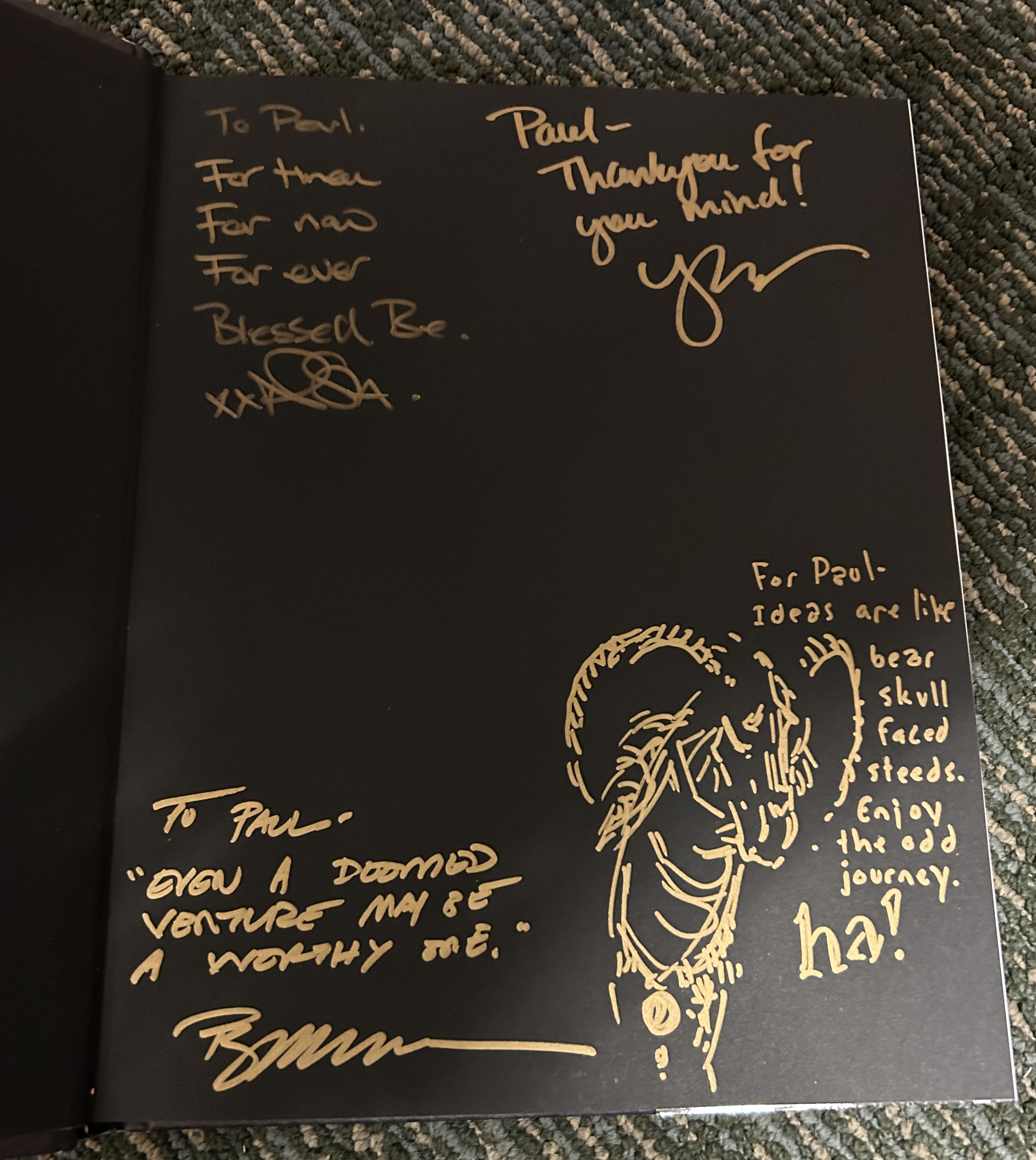
A very fortunate 62-year-old reader and collector of comic books, I am reading a copy signed by the wonderful creative team including DeConnick, Phil Jimenez, Gene Ha, and Nicola Scott:
In the second point DeConnick makes about The Pitch, she focuses on what I think must be acknowledged about this thoughtful interrogation of the Wonder Woman myth as well as much of what makes us human (especially issues related to gender):
I honestly don’t think any of my favorite moments appear in the pitch—they were all discovered later, in the writing, the rewriting, or the alchemy of collaboration.
As an avid reader, a writer, and a teacher of writing, I wish I could bottle that thought and pour it into my students—and anyone who seeks to be a writer, to be creative.
That’s it, that’s the path to the beautiful that is Wonder Woman Historia, a work that she be read and reread, a work that should be careful savored by looking carefully at the stunning artwork at both the close-up and at the widest possible angels that reveal some of the best work ever done in comic books.
I cannot recommend this work enough, both for readers but also for anyone who has the opportunity to bring this text into a classroom.
There isn’t much new I can offer so I collect below the four posts I have written already hoping you find a moment to read—but after you read, and reread Wonder Woman Historia.
At my core, I remain an English teacher, and in that role, I have always loved inviting students into interrogating paired texts, especially texts that mix and blend various genres and media/forms.
I essentially do not go to the theater any more to see movies, having become pretty content to view films on streaming services. But I splurged and found myself in a nearly empty theater yesterday to watch Barbie.
I have been agnostic about the social buzz around the film, but I must confess that many years ago I accepted that any movie with Ryan Gosling in it is likely worth the time of viewing.
The film not only fulfilled all my expectations from what I have read, but far exceeded what I anticipated. The short response is Barbie is a very smart and purposeful film, filled with excellent writing, filming, and acting. But most of all, Barbie confronts complex topics in simple but not simplistic ways.
And the topics are quite extensive:
Gender
Social norms
Capitalism and materialism
Democracy
Idealism and reality
Patriarchy
Family
Self-awareness, identity, and the existential crisis of being human
Certainly, the film isn’t exhaustive on these topics, and there are moments that feel shallow. But it works so well at making the viewer able to enter into a consideration of issues that are, frankly, extremely difficult to maneuver because the human condition is complex and these topics are fraught with ideological and political triggers.
I suspect, however, that the people who need the invitation Barbie offers are still not likely to reconsider or even consider what the film graciously offers.
If you don’t feel compassion for the close ups of stereotypical Barbie after she is crying and you can see the tears have created little rivers of no make up on her face, well, I dont’ have much hope for you.
But the people I remain forever hopeful about are students.
As sequential art (comic book/graphic novel), this reimagining of Wonder Woman and the Amazons overlaps with Barbie as a feminist text that refuses to be simplistic.
What pairing the texts add is how the works use mythology as an entry point to interrogate gender, norms, and human frailty in ways that are deeply compelling. And of course, at the heart of both works is the insidious influence of power that can be arbitrary and corrosive to human dignity.
The Ken/patriarchy motif of Barbie is brilliant and provides an excellent space for discussing Historia and the Amazons.
The Barbies and the Amazons represent a woman-centered culture, but both are juxtaposed to the real world that is man-centric. And Historia weaves in classic mythology which is a wonderful pairing with the use of Barbies (women) and Kens (men) as types, even as the main Barbie expresses, stereotypes.
The two works also allow discussions of genres and media/forms since the film is primarily satire and has strong fantasy elements that contrast with the darker and more -hyper-realism of Historia.
Both, although in different ways, provide excellent texts for discussing the impact of the visual on engaging with and understanding these texts. Both works are visually stunning.
And finally, the most important aspect of pairing Barbie and Wonder Woman Historia: The Amazons as a unit for students is that the texts are the antithesis of the caricatures conservatives are attacking in the culture war against anything diverse, what they slur as “woke.”
Education is about asking hard and complex questions and coming to know what we don’t know, what we don’t yet fully understand.
Barbie and Wonder Woman Historia: The Amazons never stoop to indoctrination, never slip into unfair or sweeping ideological pandering.
Especially when experienced together, it is hard to be on the other side with more answers than questions. And that might be the most beautiful gifts they offer us as their audience.
Thomas, P.L. (2018). Wonder Woman: Reading and teaching feminism with an Amazonian princess in an era of Jessica Jones. In S. Eckard (ed.), Comic connections: Reflecting on women in popular culture (pp. 21-37). New York, NY: Rowman and Littlefield.





 dr. p.l. (paul) thomas