As an educator spanning five decades and as an education scholar, I fully endorse the following coverage of the CRT debate as an exceptionally accurate and complex examination of this manufactured crisis:
Florida Governor Ron DeSantis (R) recently bullied students about wearing masks as he prepared to give a press conference. DeSantis called wearing masks “Covid theater,” but it seems more likely his petulant behavior is his own political theater since DeSantis immediately turned the embarrassing behavior into a fundraising gimmick.
That a sitting governor publicly and brazenly chastised students—behavior that no student would be allowed toward other students or adults while in school—is a snapshot of the broader attack on K-16 education in the U.S., also driven entirely by Republicans.
Curriculum gag orders, anti-CRT legislation, and book bans all seek to censor any mentioning of race or racism as well as topics related to gender or sexuality (the latter repeatedly identified by Republicans as “pornography”).
Copy-cat legislation across Republican-led states is far less about teaching and learning than about the tremendous racial shift occurring in the U.S.—and the immediate tension in K-12 public education because of that shift.
The 2020 Census has revealed, as reported in USA Today: “The white, non-Hispanic population, without another race, decreased by 8.6% since 2010, according to the new data from the 2020 census. The U.S. is now 57.8% white, 18.7% Hispanic, 12.4% Black and 6% Asian.”
In short, the white racial majority in the U.S. is shrinking quickly, and the future of racial balance in the U.S. is now reflected in K-12 education, where white students constitute less than half of students:
However, K-12 education remains a very white space except for that student population.
Almost 80% of teachers are white, and despite the false claims made in curriculum gag orders and anti-CRT legislation, K-12 curriculum and texts remain disproportionately white:
Research on U.S. history textbooks indicate White, European Americans are featured in over half of pictorials and illustrations. In some cases, it is more than 80 percent. Representation of people from BIPOC backgrounds are rarely featured, with some ethnic groups featured as low as 1 percent.
These racial and ethnic representations do not reflect demographics given in the 2020 U.S. Census, where 61.6 percent of the population is identified as White, 18.7 percent Hispanic or Latinx, 12.4 percent Black or African American, 6 percent Asian, 1.1 percent American Indian and Alaska Native, 0.2 percent Native Hawaiians and other Pacific Islanders, 8.4 percent some other racial population, and 10.2 percent multiracial….
In sum, studies on books and other materials reveal that White characters are more prominent than BIPOC characters. The data suggest that it is likely that students who identify as White will see mirrors of themselves more often than students from BIPOC communities.
DeSantis, then, personifies the resulting bully politics of Republicans as a response to the racial shift occurring in the U.S.
An examination of bullying in academia offers an important frame for understanding the larger phenomenon of bully politics:
What makes bullying an unethical, yet effective, means to rise through the ranks? An emerging body of research suggests that mediocre academics in particular resort to bullying, to remove their competition. Experimental research has shown that when male hierarchies are disrupted by women, this incites hostile behaviour specifically from poorly performing men, because they stand to lose the most.
Members of underrepresented groups report they are the targets of bullying with the intent to sabotage their careers. Some anecdotes suggest that bullies spring into action when their targets become too successful for their liking — and thus viable competition.
This unpacking of bullying in academia fits well into understanding the bully politics of Republicans, often mediocre white men, like DeSantis, who feel threatened and cultivate political capital by stoking racial animosity through misinformation.
As I have noted before, K-12 public education is quite conservative and, as shown above, very white. While curriculum gag orders have characterized teachers and schools as hostile to white students (legislating bans on making students uncomfortable)—without evidence—and rampant with CRT—which isn’t occurring in K-12 schools—few people are directly exposing why bully politics is on the rise—the significant racial shift in society and schools in tension with the static whiteness of teachers and curriculum.
Unlike the ways in which Republicans have characterized U.S. schooling, Ranita Ray has witnessed a much different reality for students:
What I discovered was rampant racism, cruelty, and indifference from teachers working inside public schools. Most of the teachers I observed were not, in fact, teaching about America’s racist history but instead were perpetuating everyday racial violence against their students inside the classroom. While the idea is not prominent in public discourse, I am not alone in finding teacher racism to be an everyday presence in the American classroom. One recent study, for example, found that teachers hold as much implicit and explicit pro-white racial bias as nonteachers do. Education scholar Michael Dumas has written about teacher racism and Black suffering inside the classroom, showing that these attitudes have concrete outcomes. And students themselves know this. Social media is replete with students talking about teacher racism, and they have often taken to the streets to protest it.
The irony of the racial shift spurring bully politics lies in ground zero, the backlash against the 1619 Project, which represents not a rewriting of history but a confronting of what history is—stories of the past shaped by who ever has power.
The facts of history do not necessarily change but the power behind what facts are told and why does shift. The 1619 Project changes what is centered in the telling of U.S. history (moving it away from the idealized founding and toward the grim reality of the institution of slavery)—in a similar way to the shifting racial centering of the U.S. in the 2020s.
Republicans are scrambling not to protect history or Truth, but to further entrench a mythology, an aspirational white-washed version of the country.
The impetus behind the 1619 Project and diversity, equity, and inclusion efforts is well expressed in Adrienne Rich’s poem:
I came to explore the wreck.
…the thing I came for: the wreck and not the story of the wreck the thing itself and not the myth the drowned face always staring toward the sun the evidence of damage worn by salt and sway into this threadbare beauty the ribs of the disaster curving their assertion among the tentative haunters.
The facts of history and even the present—and not the myths—are disturbing, uncomfortable (“the drowned face always staring”).
Some of us, like the speaker in Rich’s poem, accept the discomfort as motivation to work toward a better world for everyone.
Others are petulant, bullies, carelessly grabbing all their toys and threatening to go home.
DeSantis and the other mediocre Republicans are playing political theater but their bully politics is all too real and has devastating consequences for academic freedom and democracy.
Histrionics characterizing masks as “Covid theater” are masking white fear that has reduced the Republican Party to bully politics in the service of a misguided whiteness—and to the exclusion of democracy and basic human dignity.
Out of the rack and ruin of our gangster death, The rape and rot of graft, and stealth, and lies, We, the people, must redeem The land, the mines, the plants, the rivers.
An avalanche of gag order bills are being proposed in South Carolina—H.4325, H.4343, H.4392, H.4605, and H.4799. While my home state of SC often likes to brag about being the first state to secede in order to maintain slavery (an uncomfortable fact many of these laws would ban from being taught), these bills represent the sort of crass copy-cat legislation that is also sweeping across other Republican-led states.
Not only is there nothing original in these bills (or even evidence-based or logical), but also there is a profoundly disturbing repetition of one of the lowest points in U.S. history—the New McCarthyism.
Let’s start with facts, which Republican legislation seeks to censor:
“Critical Race Theory” as it is mischaracterized by Republicans does not exist in K-12 schools.
CRT as properly defined (a scholarly theory created primarily by Black scholars for the the field of law and adapted in a few other fields such as education and sociology) does not exit in K-12 schools.
Systemic racism is a fact of the founding of the U.S. and a fact of the U.S. in 2022, supported by irrefutable evidence that defies simplistic explanations (such as individual racism).
Race is a social construct and not a matter of biology.
History is a living field for considering the facts of the past; there is no one true history.
Intellectual discomfort is often a necessary aspect of new learning when anyone must confront misconceptions or missing knowledge in order to better understand and navigate the world.
The gag orders such as those listed above in SC are blunt partisan politics driven by orchestrated lies that have nothing to do with protecting students or with teaching factual history or excellent literature/texts.
Curriculum and book censorship in 2022 is our New McCarthyism because the CRT veneer is being used to promote ideological agendas aimed at Black people and LGBTQ+ people.
The McCarthy Era, also known as the Red Scare, was confronted in The Crucible by Arthur Miller, who uses allegory to warn the U.S. at mid-twentieth century that McCarthy’s cries of “communism” were partisan lies similar to the Salem witch trials.
There were no witches.
There were no lists of communists.
There is no CRT poisoning U.S. schools.
Yet, in their extreme forms, some gag orders include requirements for loyalty oaths and mechanisms for withholding state funding for a decade. Even for private organizations.
The ultimate horror of these gag orders from Republicans is that by legislating censorship of what history and texts students are allowed to learn, we will be insuring the most damning of ideas about history itself—those who ignore history are doomed to repeat it, often the very worst of it.
Yesterday I saw the following Tweet about the Russia invasion of Ukraine:
Bloody hell. Looking at a message from the Ukraine Library Association concerning the cancellation of their forthcoming conference. it basically says "We will reschedule just as soon as we have finished vanquishing our invaders". Ukrainian Librarians, I salute you
While I endorse the sentiment, I have been watching for over a year while most of the U.S. fails to resist censorship right here in the so-called land of the free and home of the brave.
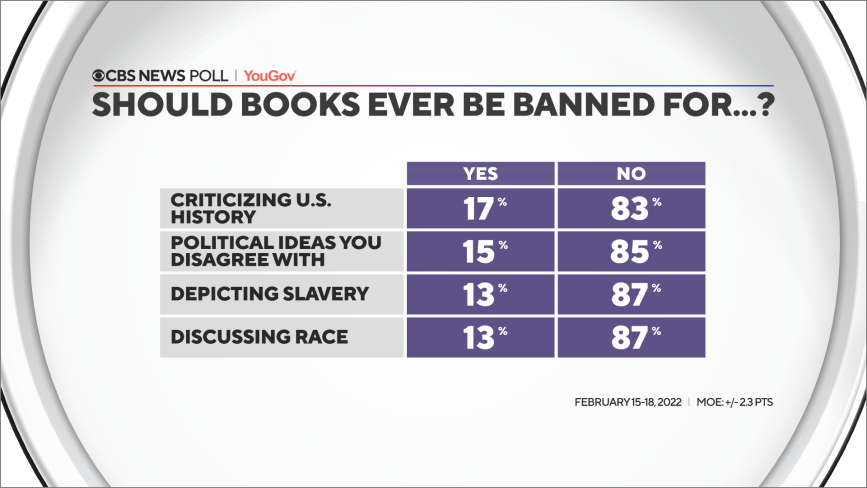
Republicans are running roughshod over freedom, pushing the U.S. toward banning abortion (despite a majority of Americans supporting maintaining Roe v. Wade) and enacting curriculum and book bans (despite large majorities of Americans rejecting censorship):
We know that intellectual freedom is foundational to an educated citizenry and essential to the preservation and practice of democracy. We are dedicated to protecting this natural human right, and therefore, we insist on open access to all school reading materials for all students.
My home state of South Carolina, one of the solid red states in the U.S., is jumping on the anti-CRT gag order bandwagon, proposing copy-cat legislation that is repeated across Republican-led states.
As Dr. Susi Long carefully detailed, anti-CRT legislation lacks evidence since CRT is not being taught in K-12 schools and since the laundry list of what the legislation is supposed to prohibit in SC schools simply does not occur in our schools either.
That is part of the reason I have called anti-CRT gag orders a manufactured crisis.
But these partisan attacks on schools and teachers lack more than evidence; they lack a fundamental logic.
The racial make up of SC is 64% white (non-Hispanic), 27% Black, and 6% Hispanic.
However, the public school student population is 48% white, 32% Black, and 12% Hispanic. Like the rest of the U.S., SC public schools are now majority-minority schools.
Here is where anti-CRT gag orders make no sense; the teacher demographics in SC are 79% white, 13% Black, and 3% Hispanic.
SC public schools have a student population significantly unlike the racial demographics of the state, and then teacher demographics are dramatically unlike the state as well as the student population they serve.
Here is where logic falls apart. If we believe anti-CRT gag orders are needed, we must believe that teachers who are almost entirely white are making white students uncomfortable because they are spreading CRT propaganda.
These demographics not only challenge the logic of anti-CRT gag orders, they also expose what is really driving this legislation—white fright.
Demographics of U.S. public schools are a harbinger of the reality that white people will soon constitute less than 50% of the country, while likely remaining the largest racial group for some time.
Schools, curriculum, and teachers are not hostile to white students or white people, but white fright is targeting schools as one of many ways white Americans are clinging to their majority status, a majority status that has an ugly history and an ugly present that some white Americans want hidden.
One of the ugliest truths beneath this fear is that white Americans know exactly what many white people did with majority power—and now they fear what may happen when someone else has that power.
Despite the shifting demographics of students and false claims made by Republicans pushing anti-CRT gag orders, schools remain extremely white-centered and white friendly. And that is the real problem that should be addressed for the good of those students.
Speaking at a recent hearing on yet another copy-cat bill in South Carolina to censor curriculum (targeting Critical Race Theory [CRT]), Dr. Susi Long, professor of early childhood education (University of South Carolina) offered a measured but pointed dismantling of the partisan misinformation in this legislation:
Not to oversimplify, but Long clarifies that CRT is not taught in K-12 (or even K-16) education, adding specifically that the laundry list of issues addressed in these bills are not how teachers teach or treat our students.
Last summer, I emphasized similar points, adding what does occur in schools in terms of race and equity. At one point, Long calmly suggests legislators should be learning from educators instead of legislating what teachers can and cannot teach, what students can and cannot learn.
One of the great ironies of efforts to ban CRT (beyond that CRT isn’t something taught in K-12 education) is that a key tenet of CRT is in order to overcome racism/inequity, everyone needs to be better educated, better informed—exactly what teachers offer students across the U.S.
Here, then, is my modest proposal: National days of teaching truth to power.
As a recent post of mine details, students and teachers are vividly aware of the rise in censorship as well as the potential negative consequences of those bans, such as self-censorship grounded in fear.
Will, for example, Paul Laurence Dunbar be erased from classrooms or will teachers be fired for honoring Dunbar’s voice that continues to resonate in 2022?:
Let’s identify days when we will target lessons and texts that are being misrepresented purely for political gain.
Lessons on race and racism, lessons on academic freedom and censorship, lessons on gender and sexuality—ultimately lessons one what it means to be educated in a country that claims to be free.
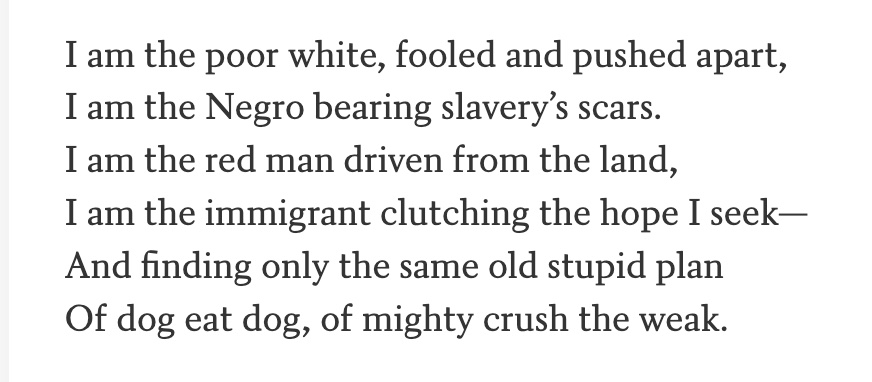
Like Dunbar’s poem reflecting the realities of being Black during Reconstruction and Jim Crow, Hughes creates a complex unpacking of many minoritized groups during the 1930s:
“The land that never has been yet” is facing us all now in the U.S. as Republicans are in denial and have turned to the antithesis of freedom, censorship, in order to cling to power.
As educators, as professionals charged with honoring the dignity of every student’s mind, we have only truth to break the cycle of oppressive power.
Teaching truth is the key. Can we do this, and do this now?
My spring 2022 schedule includes three classes, two sections of upper-level writing/research and one first-year writing seminar. During my second class today, while students were completing individual work before a class discussion, I scrolled through Twitter and found this:
The poem is “We Wear the Mask” by Dunbar. It’s not even that wild.
I quickly Googled the poem, and decided to interject an impromptu mini-lesson between students completing the individual assignment and the class discussion.
Although I have been a teacher educator (and first-year writing professor) for twenty years now, I quickly put on my high school English teacher hat and conducted a lesson on Dunbar’s poem, reading it aloud and asking students questions along the way.
I repeated the lesson (also not on the schedule) in my third class, where students offered similar responses to the discussion.
Overwhelmingly, students identified the mask motif as an exploration of putting on an emotional front, noting, for example, the juxtaposition of “smile” and “cry” in the line “We smile, but, O great Christ, our cries.” (Interestingly, one student immediately contextualized the mask motif in the current Covid era.)
When I directly asked students to identify the “we,” most immediately spoke about a universality of the poem being about “society” or anyone who identifies with the speaker in the poem.
After walking through the poem (and confirming that students were not familiar with the poem or Dunbar), I pulled up the Wikipedia page on the poem to highlight that it had been published in 1895 and that Dunbar was a Black poet who was born during U.S. Reconstruction and published in the Jim Crow Era.
I then noted the poem is about Black people masking for white people—the core of Chanea Bond‘s Tweet and the student’s awareness that at least 4 out of 10 students in the U.S. are now being taught in states with educational gag orders, a growing list of state-level legislation being proposed and passed by Republicans from Florida to Virginia to Texas to Oklahoma to Indiana and anywhere Republicans have unlimited power.
These educational gag orders include curriculum bans (often directly and indirectly invoking Critical Race Theory), book/text bans, and so-call parental rights bills that allow any parent to trigger censorship or reprimanding a teacher. While this legislation is devastating to public institutions (K-16), some bills include potential fines for private schools who take any public funds.
Attacks on books have spread beyond assigned reading, classroom libraries, and school libraries to include public libraries as well.
This wave of gag orders and censorship has included violence and threats as well as overwhelmingly impacting Black texts and topics along with any writers or works that deal with LGBTQ+ topics or experiences.
The mask being used to hide the racism and bigotry of these complaints and legislation is an insincere claim that student discomfort must be curtailed.
Some of the most extreme versions of gag order bills include requirements that teachers provide a year of lesson plans before the academic year in order for parents and others to review and approve them.
First, let me confront that last point; my impromptu lesson today was one of the best I have done in recent memory. Students were engaged, and I watched in real time as my students confronted ideas, as my students learned and became different people than when they walked into class today.
While lesson plans are important, they simply are not as valuable as being prepared to teach, and being prepared to engage with your students; a fundamental misunderstanding about teaching is that (as these gag orders and parental rights bills reveal) too many people think the job of the teacher is to transfer knowledge/content to students.
As most any teacher will tell you, we teach students—not lessons, not history or English or even The Great Gatsby.
As students and as future educators, my students today needed and deserved the lesson that came from a teacher’s Tweet. They also benefitted from a brief experience with how to read and engage with poetry along with the tyranny of partisan politics that is shutting the door on their lives as free individuals.
But my impromptu lesson today grounded in a text that may soon be banned from classrooms exposes the catastrophic misunderstanding of texts. Not a single student today recognized the powerful racial message intended by Dunbar because those students lacked historical and literacy context that is already missing from their formal education without the educational gag orders.
As I have stressed during this manufactured outrage from the Right, traditional education is already incredibly conservative.
Reading Dunbar’s poem, in fact, for its universal appeal strips it of its radical power—and cheats students from confronting the historical realities of Reconstruction and Jim Crow for Black Americans.
In 2022, students, teachers, teaching/learning, and academic freedom are under assault by conservative tyranny. There is nothing American or noble about censorship.
“A mind is a terrible thing to waste” is a seven-decades long slogan of the UNCF, and with the greatest of ironies, it now seems a central goal of Republicans to insure all minds are wasted.
Bond’s student is our canary in a coal mine, and soon, every classroom may be just as dangerous, literally, as a coal mine if we refuse to heed that student’s concern.
The metaphors of literature as windows and mirrors have become standard ways to advocate for diversity in the texts we invite our students to read [1]. Texts that are windows provide students opportunities to witness and understand people, lives, and cultures unlike their own; texts that are mirrors reflect people, lives, and culture similar to their own.
As an educator, I have been compelled by Walter Dean Myers and Christopher Myers, who both make incredibly powerful and personal cases for mirrors in the reading and lives of minoritized and marginalized students as well as how those texts provide windows for students with race and gender privilege.
My journey as a reader and human has been profoundly impacted by texts as windows; particularly during my undergraduate years when my ideology was transformed by Langston Hughes, Alice Walker, Ralph Ellison, Richard Wright, and other Black writers and thinkers.
The importance of windows and mirrors extends beyond the texts included in our classrooms, however, and must be a commitment to the curriculum of all courses our students navigate.
In 2022, curriculum, instruction, and text/book selection are under assault. State legislators are proposing and passing legislation banning curriculum and texts/books; further, additional legislation seeks to expand the role of parents in not only having access to curriculum and instruction, but also to review and over-ride teacher autonomy in curriculum and instruction.
The most extreme example of the latter is a mandate for teachers to submit a year of lesson plans by mid-summer for review and approval.
At their core, these partisan bills reveal a fundamental misunderstanding about lesson plans, instruction, curriculum, and the complexity of teaching and learning.
The curriculum/text/book bans as well as the parental rights bills are rooted in a White backlash, a fear that White students are being taught in w ays that cause them harmful discomfort.
A few aspects of this must be unpacked.
First, why have these same advocates not raised concerns about the discomfort of girls/young women confronted for decades by texts and curriculum that are male-centric and often portray negative messages about women; why no concern about the discomfort of Black and Brown students who must read texts that include racist language and hateful stereotypes; why no concern for LGBTQ+ students who must navigate texts and curriculum almost entirely populated by people unlike them (or worse, presented with narratives that suggest simplistic views of gender and sexuality)?
Second is the broader failure to recognize the need for curriculum as windows and mirrors for all students to instill self-awareness and empathy—and the related need for learning to be, at time, uncomfortable.
Discomfort is an essential element with changing and growing.
Intellectual and ideological discomfort is distinct from discomfort due to emotional, psychological, or physical discomfort grounded in fear. Education requires the former and is corrupted by the latter.
Despite the White backlash against a more diverse curriculum, a backlash that believes the Whiteness of that curriculum has disappeared, evidence shows that marginalized and minoritized students remain under-represented:
Findings from the report suggest there is disparity in representation of characters from different racial, ethnic, and gender groups. When portrayals of these groups are present, they tend to be affirming and authentic portrayals. However stereotypes, limited roles and inaccurate information are still present and tend to be unique to specific communities. Based on the review, the results indicate a need for educational materials that create a sense of belonging, develop cultural authenticity, and recognize nuanced identity in different characters.
Current education legislation de-professionalizes teaching, but that legislation is also suggesting solutions to problems that simply do not exist (such as banning CRT, which isn’t present or even relevant to K-12 education).
In 2014, Christopher Myers confronted the “apartheid of literature,” how Blackness remained mostly absent or misrepresented in the texts published and thus the texts students read. He addresses the value of texts as windows, but deems that inadequate; Myers argues:
Academics and educators talk about self-esteem and self-worth when they think of books in this way, as mirrors that affirm readers’ own identities. I believe that this is important, but I wonder if this idea is too adult and self-concerned, imagining young readers as legions of wicked queens asking magic mirrors to affirm that they are indeed “the fairest of them all.”…
The children I know … see books less as mirrors and more as maps. They are indeed searching for their place in the world, but they are also deciding where they want to go. They create, through the stories they’re given, an atlas of their world, of their relationships to others, of their possible destinations.
We must acknowledge that the curriculum and book/text bans are coming in a time of U.S. public education when over half of students are Black/Brown while teachers remain overwhelming White (and mostly women). What possibilities are Black/Brown students witnessing daily simply by being students in schools?
And, more broadly, we must accept that whoever decides what students can or cannot read or learn is also deciding who students can become.
At the core of teaching, our commitments should be grounded in what we teach (curriculum) and how we teach (instruction) as that serves who we teach (students).
All students deserve, then, curriculum as windows and mirrors that will serve them in building the map of who they become.
[1] Sims Bishop, R. (1990). Mirrors, windows, and sliding glass doors. Perspectives, 1(3), ix–xi.
This public statement by NCSS was bold and proved the organization was willing to place professional commitments to the fields of history and social studies over the fear of taking so-called “political” risks.
Labeled “A Current Events Response,” the statement begins: “National Council for the Social Studies (NCSS), the largest professional association in the country devoted solely to social studies education, strongly rejects the recent development of proposed bills in state legislatures which are designed to censor specific curricular resources from being used for instruction in K-12 schools.”
After I posted my blog raising concerns about NCTE’s silence and inaction during the rise of book/text and curriculum censorship as well as the controversy over putting the Doublespeak Award on hiatus (resulting in some committee members resigning), I have heard from many NCTE members, former NCTE members, and even past presidents of NCTE—all agreeing with the concerns being raised.
In the context of NCSS’s direct and early response, I want to address a few of the points in NCTE’s statement from 7 February 2022, a year after NCSS’s public stance.
First, this statement is a reaction to criticism, not a proactive stance against book/text and curriculum censorship. Others and I have been calling for proactive and public statements.
Second, the statement, ironically in the context of the Doublespeak and Orwell Awards, seems to be massaging if not rewriting the history of putting the Doublespeak Award on hiatus; I am not aware of a single person claiming NCTE “canceled” the award (their first bullet point). The concern was clearly that the hiatus seems to have been an effort to avoid making NCTE look “political,” again an ironic context given the awards.
Next, the statement feels to many of us as an unfair framing of the committee members who resigned on principle; we do not have to agree with those members (I do), but I think we must respect the professional ethics involved in resigning.
Ideally, NCTE would have better served the Council by simply admitting that the hiatus and how it occurred was a mistake that would be corrected—instead of putting so much focus on the principled committee members.
Finally, I want to address a comment in the statement’s penultimate paragraph: “We want NCTE members to know—NCTE has not remained on the sidelines in regard to intellectual freedom and censorship matters, and has no intention of doing so in the future.”
Let me be very clear again: I deeply respect and appreciate my colleagues who signed the statement as the faces and names of leadership for NCTE; however, I respectfully disagree and think the statement as a reaction to criticism and the continued lack of a public statement similar to NCSS (a year later) are proof that NCTE leadership continues to fail the larger fields of literacy and literature, students across the U.S., and all teachers of English/ELA.
Yes, as some NCTE members have noted on social media, NCTE has been a stellar organization inwardly with powerful position statements and a diversity-rich 2021 annual convention. But that serves and speaks to a very small fraction of teachers of English/ELA—and likely has no impact on public opinion/discourse or political policy.
NCTE needs to back up and re-address the Doublespeak mistake again, but also, NCTE must acknowledge the larger concern about remaining on the sidelines because that is where the organization is while our classrooms are being dismantled and our professions are being destroyed.
Many NCTE members are frustrated because NCTE has a powerful infrastructure to speak Truth to power the way NCSS did. Currently, we are in the final days of members voting on a new and important resolution: Resolution on Supporting Educators’ Right and Responsibilities to Engage in Antiracist Teaching.
But what good is all this if NCTE keeps the work inward and refuses to take the principled stands needed to change the public and political narratives about books, texts, and curriculum?
Laws are being passed; books are being removed from classrooms, school libraries, and public libraries because of the complaint of a single parent; teachers are being fired; and board members have called for book burnings.
If you Google “governor” and “pornography” today, you do not find articles on scandal but dozens of media articles on multiple governors across the U.S. (Texas and South Carolina, notably) calling award-winning literature “pornography.”
And as the report from UCLA clearly notes, the anti-CRT movement is itself an Orwellian attack on facts as well as teaching and learning:
We put “CRT” in quotation marks throughout this report because so often the conflict campaign’s definition of “CRT” (like its description of actual K–12 practice) is a caricatured distortion by loud opponents as self-appointed “experts.” The conflict campaign thrives on caricature — on often distorting altogether both scholarship and K–12 educators’ efforts at accurate and inclusive education, deeming it (and particularly K–12 efforts to discuss the full scope of racism in our nation) wholly inappropriate for school. (Pollock, & Rogers, et al., 2022, p. vi)
Pollock, M., & Rogers, J., et al. (2022, January). The conflict campaign: Exploring local Experiences of the campaign to ban “Critical Race Theory” in public K-12 education in the U.S., 2020-2021. UCLA’s Institute for Democracy, Education, and Access. https://idea.gseis.ucla.edu/publications/the-conflict-campaign/
Regretfully, 2021 and now 2022 are demanding principled stands such as the Doublespeak and Orwell Awards from NCTE; but students, teachers, literacy, and literature need NCTE to take a principled stand beyond the NCTE bubble.
Many of us remain concerned that NCTE is content with being reactionary and, yes, there on the sidelines.
Currently nearly 4 out of 10 students in the U.S. are being impacted by CRT/1619 Project bans and a rising tide of book censorship. Many educators are being silenced, often fearing (rightfully) for their careers.
Do state social studies educational standards for K–12 schools recommend or require students to learn about Reconstruction?
Is the content that state standards recommend or require on Reconstruction historically accurate and reflective of modern scholarship?
What would an ideal set of historically accurate state standards on Reconstruction look like?
What are some efforts underway to give the Reconstruction era the time and perspective it deserves?
Educators and the public must confront and reject efforts to erase and silence history, and this report is a powerful and evidence-based step in that direction.
At first, this seems like a really simple question: Do you believe in Santa Claus?
But scholars and researchers know that this question is actually a mine field of problems.
“Believe” is a problematic verb, and before anyone can answer or anyone can interpret the answers, we must all agree on what “Santa Claus” means.
Does “Santa Claus” mean a literal man who travels the world and crawls down chimneys to deliver toys? Or does it mean some historical “Santa Claus” who has become mythologized and represents a spirit of Christmas?
In other words, especially in polling designed to uncover better understanding of an issue or phenomenon, the questions asked and how the terms in those questions are defined (if at all) create the answers and thus shape the conclusions drawn from those answers.
This poll gathers data on several aspects of the Critical Race Theory debates driven by Republicans and conservatives across the U.S. But the framing skews (and likely distorts) what people know, what people think, and what people believe about CRT and white privilege. Consider the following:
Two problems are created by the framing above. First, note how “white privilege” is defined for the respondents: “White people in the U.S. have certain advantages [emphasis added] because of the color of their skin.”
Notably during the Trump era, certain segments of white people who support Trump have been very vocal about rejecting the concept of “white privilege.” Typically, these white people point to white poverty and white failure to reject—with evidence, they think—the concept of “advantage.”
The question defining “white privilege” as an “advantage” very likely reduces the number of respondents expressing support for or nuanced understanding of the concept. And that framing is inaccurate.
“White privilege” is better defined as the lack of barriers that are race-based for white people.
When white people find themselves in poverty, it is rarely because they are white; when white people fail, it is rarely because they are white.
There is not pop culture rhetoric about “driving while white” or “jogging while white” because race is rarely the key factor in negative interactions for white people, notably interacting with police or other authority figures (or other white people).
Systemic racism manifests itself in pervasive ways for Black people in that being Black is often the key factor in life experiences for Black people. Black people do fail and suffer primarily because they are Black, and not because of their behavior or character.
White privilege is about an absence (lack of race-based barriers) and about being allowed to exist as if your race doesn’t define you. Black people do not have that opportunity; being Black is a state of perpetual awareness of being Black.
Unlike white people, then, Black people do experience existentially and systematically barriers that are race-based.
Describing “white privilege” as an advantage suggests guarantees of wealth or success that simply are not true—and thus easy to reject.
Framing “white privilege” as the absence of race-based barriers both better defines the concept and increases the likelihood that respondents can acknowledge that reality.
The second problem is the use of the word “beliefs” with CRT, which distorts and misrepresents CRT as a “theory.”
Similar to the jumbled discourse around evolution (people often claim “I don’t believe in evolution”), respondents are likely misled by the word “beliefs” since it implies the lack of empirical data and suggests CRT is simply someone’s beliefs—and not a carefully formulated theory based on rigorous scholarship.
CRT, as a scholarly theory, has a set of claims, or principles. The use of those words, “claims” or “principles,” provides, again, a fairer framing and should provide more valid data.
Together, these examples show how research erodes the validity (do the data and conclusions drawn reflect what they claim to reflect?) of a poll by the questions asked, the framing and defining of the key terms.
In the “CRT beliefs” data also note that the “white privilege” framing as an “advantage” is reinforced by the use of “enjoy”: “Whites Enjoy Certain Privileges.”
Creating a set of questions for polling requires statistical expertise, but also scholarly knowledge and experience. In this case, the poll itself seems poorly reviewed for framing in terms of fully understanding either “white privilege” or “CRT.”
Since the entire cultural debate around race, racism, white privilege, and CRT is being driven by dishonest actors and misinformed media, politicians, and members of the public, a valid poll of those topics requires accurate and nuanced clarity on the questions being asked and definitions of the terms being examined.
This poll is ambitious, but it is likely doing more harm than good for that debate.
educator, public scholar, poet&writer – academic freedom isn't free







 dr. p.l. (paul) thomas