Republicans and conservatives have been depending for a long time on a truism with an ambiguous source: “A lie can travel halfway around the world while the truth is still putting on its shoes.”
The anti-Critical Race Theory movement has fully committed to this strategy; just lie quickly and then spend most of your time ranting as if the lie is true.
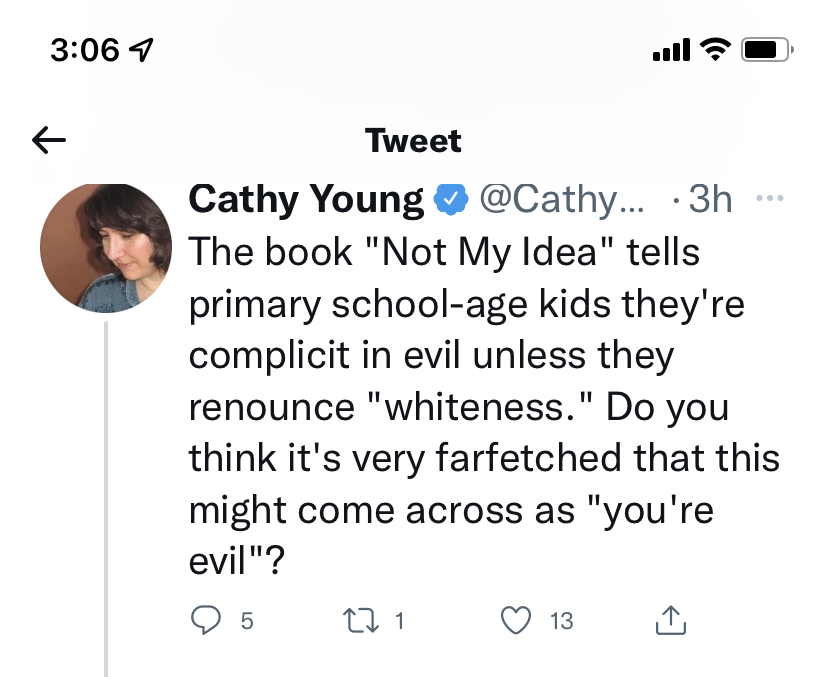
Here is but one of many examples:
While the claim here is a blatant lie, we should note that anti-CRT advocates are the ones who repeatedly conflate “whiteness” with “racism.”
Not My Idea, by Anastasia Higginbotham, in fact, goes to great lengths to recognize white people throughout history who have stood firm against racism; in other words, one of the strongest messages of the book is “not all white people.” The title and motif of the book is that white children are not the ones who created racism, “not my idea”—“Racism was not your idea. You don’t need to defend it.”
And here is the real issue: The book makes a strong case not for rejecting whiteness, but for rejecting racism when you are white.
As is the case is almost all efforts to censor, people have likely never read the book. So here you are, listen and hear the truth:
If you have to advance your beliefs through lies, you should interrogate those beliefs.
The Tennessee General Assembly has banned the teaching of critical race theory, passing a law at the very end of the legislative session to withhold funding from public schools that teach about white privilege.
Republicans in the House made the legislation a last-minute priority, introducing provisions that ban schools from instructing students that one race bears responsibility for the past actions against another, that the United States is fundamentally racist or that a person is inherently privileged or oppressive due to their race.
As Allison reported in May, several states across the U.S. have filed or passed copy-cat legislation aimed at banning the teaching of Critical Race Theory.
By October and November, the consequences of Tennessee’s law have moved from silencing and canceling teachers to attempts to cancel curriculum [1]:
The Tennessee Department of Education recently declined to investigate a complaint filed under a new state law prohibiting the teaching of certain topics regarding race and bias.
The 11-page complaint alleged that the literacy curriculum, Wit and Wisdom, used by Williamson County Schools and at least 30 other districts, has a “heavily biased agenda” that makes children “hate their country, each other and/or themselves.”
Although the complaint was rejected, Mangrum noted, “The group detailed concerns with four specific books on subjects like the Rev. Martin Luther King Jr.’s March on Washington, the integration of California schools by advocate Sylvia Mendez and her family, and the autobiography of Ruby Bridges, adapted for younger learners.”
A teacher fired for teaching Ta-Nehisi Coates, parents calling for bans on MLK and teaching about Ruby Bridges—these events are not unique to Tennessee, but they reflect a pattern of efforts to control not only teachers, but what students are allowed to learn and read.
Notable in these examples is that many of the consequences of legislation are canceling Black writers and key aspects of Black history; additionally, legislation and calls for book banning are targeting LGBTQ+ writers and topics.
Teaching and curriculum in the U.S. are being systematically and politically whitewashed.
One aspect not being addressed often is that political dynamic. Parents, politicalactivists, and politicians are impacting who teaches and what is being taught in the context of a historical and current demand that teachers themselves remain apolitical, both in their classrooms and their lives beyond school.
For teachers, then, we must recognize that calls for teachers to be objective, neutral, and apolitical are themselves political acts. Currently, laws being passed and parents/activists confronting school boards are exercising their political power at the expense of teachers and schools—both of which are required to remain somehow politically neutral.
From historian/activist Howard Zinn to critical scholars such as Joe Kincheloe and to poet Adrienne Rich, we have ample evidence that taking a neutral stance is a political act that passively endorses the status quo and that silencing words is an act of canceling thought, eradicating ideas.
Zinn’s commitment to transparency as a teacher and activist is hauntingly relevant to the current political attack on teachers and curriculum:
This mixing of activism and teaching, this insistence that education cannot be neutral on the critical issues of our time, this movement back and forth from the classroom to the struggles outside by teachers who hope their students will do the same, has always frightened the guardians of traditional education. They prefer that education simply prepare the new generation to take its proper place in the old order, not to question that order [emphasis added]….
From the start, my teaching was infused with my own history. I would try to be fair to other points of view, but I wanted more than “objectivity”; I wanted students to leave my classes not just better informed, but more prepared to relinquish the safety of silence, more prepared to speak up, to act against injustice wherever they saw it. This, of course, was a recipe for trouble.
And Kincheloe confronted not only who is actually indoctrinating students but the imperative that teachers recognize teaching as inherently political:
Thus, proponents of critical pedagogy understand that every dimension of schooling and every form of educational practice are politically contested spaces. Shaped by history and challenged by a wide range of interest groups, educational practice is a fuzzy concept as it takes place in numerous settings, is shaped by a plethora of often-invisible forces, and can operate even in the name of democracy and justice to be totalitarian and oppressive [emphasis added].
The great irony is that critical educators (often smeared as “Marxists”) are committed, as Kincheloe asserts, to a foundational concern: “Critical pedagogy wants to know who’s indoctrinating whom.”
The Orwellian named “Moms for LIberty,” then, by calling for canceling curriculum are in fact being “totalitarian and oppressive,” calling for not education, but indoctrination. To ban words and ideas is to ban the possibility of thinking, of learning:
The study of silence has long engrossed me. The matrix of a poet’s work consists not only of what is there [emphasis in original] to be absorbed and worked on, but also of what is missing, desaparecido [emphasis in original], rendered unspeakable, thus unthinkable.
A final powerful point is that many of these political acts to silence teachers and cancel curriculum are occurring in right-to-work states controlled by Republicans. Teachers not only are expected to be neutral, objective, and apolitical, but also work with a distinct awareness they have almost no job security.
Hawn fired in Tennessee simply taught a text and now is fighting for his career; the text in most ways just a year ago was considered non-controversial and even celebrated as Coates had attained recognition as one of the country’s leading Black voices.
During this holiday season at the end of 2021, teachers honestly have no decision about whether or not to be political. We are faced with only two political choices: conform to the demand that we take a neutral pose, resulting in endorsing whatever status quo legislators and parents/activist impose on schools; or recognize and embrace the essential political nature of being a teacher by actively opposing efforts to cancel teachers and curriculum.
[1] Twitter thread:
A Tennessee chapter of "Moms for Liberty" filed a complaint with the Tennessee Department of Education alleging that assigning 2nd Graders a book about MLK Jr's March on Washington violated the state's new law banning Critical Race Theory pic.twitter.com/STDiPY48jH
The Tennessee Department of Education declined to "investigate" but for a technical reason. The complaint dealt with curriculum during the 2020-21 school year and not the current school year. https://t.co/gWfsn6rhLB
So Moms for Liberty could refile the complaint and they might be successful next time. Their issue with the MLK book are two images that are historically accurate.
Moms for liberty also objects to the TEACHERS MANUAL suggesting that notorious segregationist Eugene "Bull" Connor was not a nice guy pic.twitter.com/UN8ybP9LVu
In Season 4, episode 3 of Seinfeld, the show becomes a meta-sitcom. George and Jerry pitch a sitcom to NBC, Jerry, and establish what would become the short-hand way to describe the actual show, expressed by George:
George Costanza: I think I can sum up the show for you in one word. Nothing.
But, if you dig deeper, ironically, Seinfeld is not just a “show about nothing,” but the characters themselves are, well, let’s allow Jerry to explain (after being challenged by his girlfriend that he never gets mad):
Patty: OK, Jerry, enough. I’m not buying it.
Jerry: You’re damn right you’re not buying it!
Patty: You shouldn’t have to try. It’s just being open.
In 2021, Seinfeld the show and Jerry are perfect metaphors for conservatives and Republicans in the U.S.—”there’s just nothing there.”
Consider a hypothetical first.
Imagine liberals and Democrats in the U.S. misrepresenting Ayn Rand or Jerry Falwell and Jerry Falwell Jr. in order to claim that these conservative figures actually are leftists, or Marxists.
Sounds preposterous because that doesn’t happen. At the center of that fact is that the Left has a solid intellectual base on its own. Progressivism has a strong roll call to draw from, reaching back to John Dewey and working through Martin Luther King Jr.
Next, however, we don’t have to imagine.
Republicans and conservatives routinely appropriate by misrepresentation MLK, typically reducing King to a color-blind caricature. Just recently that conservative lie has taken on a new twist, an Op-Ed claiming that MLK would have rejected Critical Race Theory—despite the fact that the founding Black intellectuals who developed CRT identified specifically that the concepts grew from MLK’s ideology, words, and practices. See for example how MLK is anything but a color-blind passive radical:
The moral and racial bankruptcy on the Right is exposed by conservatives’ need to co-opt MLK because with them “there’s just nothing there.”
A newer grasp for liberal thinkers has been a right-wing distortion of George Carlin, who has been trending often on social media. Carlin’s misappropriation is a powerful example of the intellectual bankruptcy on the right because Carlin is complex, easy to misread, and also a perfect example of the difficulty of reducing anyone to a blunt label.
We must imagine how conservatives claiming Carlin ignore his career-long attacks on police (Carlin took great pleasure in announcing “Fuck the police” in his stand-up routines), religion, and anti-abortion activists—just to name a few areas where Carlin is clearly not conservative.
The misunderstanding from the Right, and much of the general public, exposes—as Carlin would argue—that too many people in the U.S. simply do not think critically (Carlin would possibly argue that most people can’t think critically).
Carlin was a stand-up comedian, writer, and actor, but at his core, Carlin was anti-establishment, anti-authority while practicing as an amateur linguist and implementing critical discourse analysis.
Trying to place Carlin on a political spectrum is nearly impossible, more akin to historian Howard Zinn’s own political revelation:
From that moment on, I was no longer a liberal, a believer in the self-correcting character of American democracy. I was a radical, believing that something fundamental was wrong in this country—not just the existence of poverty amidst great wealth, not just the horrible treatment of black people, but something rotten at the root. The situation required not just a new president or new laws, but an uprooting of the old order, the introduction of a new kind of society—cooperative, peaceful, egalitarian.
To understand Carlin, you must recognize his history, one grounded in fighting censorship.
Yes, Carlin always trashed “the government,” but he was expressing a critique of corporate owned government, and not the ideal of what democratic government could and should do (Carlin often called for better public schools and health care, especially for the elderly).
And Carlin was a product of corporate-government war, the Vietnam War that provided Carlin a career of being an avid anti-war advocate.
Maybe the greatest misunderstanding of Carlin is his (seemingly) libertarian musings about individuals, often sounding like a twentieth century Thoreau. But Carlin was not a rugged individualist as much as he believed in the sanctity of the humanity of every individual and freedom for all people; in fact, Carlin was a champion for racial and gender equity before that was commonplace, and he never shied away from evoking that policing in the U.S. is racist (his voice would fit well into BlackLivesMatter) and that the U.S. was founded by slave holders (a bit ahead of his time on the 1619 Project as well).
And it takes care to listen to Carlin, not just his stand-up, by the way. In interviews, you can hear the clarity in his anger against government as corporate, not government as a democracy:
It says “we the people” in the preamble…. People who hate the government are involved in a form of suicide because government is self-government, and if you hate the government, you hate yourself.
An even more powerful interview, however, guides us through Carlin’s essentially “left of center” ideology that was paired with his commitment as a non-voter (see W.E.B. Du Bois on not voting as well):
14:24
George Carlin: No, I don’t vote. Voting implies the consent to be governed and I — between you and me, I do not consent to be governed. I prefer to —
…
14:34
George Carlin: Yes, I prefer to be outside of it. It gives me my freedom. But my brother made a good point, because we were pulling for Clinton, being somewhat left of center in general.
…
14:41
Charlie Rose: Right (crosstalk) Clinton/Bush and you said Clinton (inaudible).
14:45
George Carlin: He [his brother] said, you know, he says, I think if there were just one cherry pie and Clinton had it, I think I’d get a piece. And I think if Bush had it, he’d keep the whole pie. And I believe that. And therefore I’m rooting for him.
George Carlin: He’d buy 100 more pies and I still wouldn’t have a piece. That was my addendum to what my brother said, but I pull for Clinton because people are going to invest hope in him and I think people — I think the — I think being on this planet, one of the first things people would say — if we were all dumped down here, let us say there were only ten of us.
George Carlin: And we dropped into this planet already formed, one of the first things we would say would — after a moment or two would be, Is everybody okay? Let’s get something to eat. And that should be the first thing any society said: Is everybody okay? Let’s get something to eat. And we don’t, because we have this private property thing, property. Property rights over people’s rights. And I just think that competition got the upper hand over cooperation.
…
15:53
George Carlin: The verge of failure that we’re on is because two wonderful qualities that made us a successful species, cooperation and competition, are way of balance now. Competition is everything. Cooperation happens after a flood. Happens for a few days. Everybody goes back to
…
George Carlin: And we need — we need to get that balance back. If we can get that balance back, there’s hope.
Carlin mentions to Rose that he loves any individual he meets, but he remains leery of organized groups, like churches or political parties.
Unlike the character of Jerry, there is a lot there in Carlin. Not perfect, but a lot.
And the “there” in Carlin is attractive to the hollowness of conservatives, morally and intellectually bankrupt.
Someone trying to appropriate Carlin posted on Twitter that a conservative comedian was today’s Carlin; another person posted that this conservative Trumpster comic is just like Carlin, except he isn’t funny or smart.
The Right, you see, is a movement about nothing, and all they have is grasping at other people’s ideologies in an effort to make them their own.
George Carlin was raised in a Dewey school, a Catholic education.
This too is a message about learning to think for yourself. That Deweyan Catholic upbringing equipped Carlin with the mind and will to reject the Church, religion, and even God.
As he joked throughout the end of his life, Carlin worshipped the sun and prayed to Joe Pesci:
We are a people ruined by private property, Carlin noted, and we would all be much better off spending our brief time on the planet we are destroying simply saying, “Is everybody okay? Let’s get something to eat.”
Beyond my face-to-face life, few people have impacted my development more than comedian George Carlin. Along with Richard Pryor (and indirectly, Lenny Bruce), Carlin entered my consciousness while I was a teenager in the 1970s, a redneck mired in the racist provincialism of rural upstate South Carolina.
Of course, teachers and writers—along with a wide array of artists, thinkers, etc.—shaped my Self and my mind, but Carlin and Pryor were essential doorways into critical thought. Notably, Carlin and Pryor taught me the importance of language and its relationship to power, foundational concepts that would in many ways lead to Paulo Freire as well as my careers as a teacher and writer.
So when Carlin was trending recently—a video clip of him talking on Larry King with many people connecting Carlin’s comments about comedian Andrew Dice Clay to the current controversies around Dave Chappelle—I felt I had to explore the Tweets and how people were navigating Carlin today:
First, I believe it is important to stress that Carlin clearly begins these comments by supporting Andrew Dice Clay’s right to be the sort of comedian who people found to be deeply offensive, offensive in ways that were not funny (homophobia and misogyny, specifically). Carlin is weighing in but distinguishing between “can” and “should.”
As well, Carlin checked King about “we” laughing at Clay, suggesting that Carlin did not find Clay funny even as he supported something like free speech for comedians.
In many ways, Carlin was way ahead of his time and this on-air discussion fits well into the larger “cancel culture” debate among comedians (see the Jerry Seinfeld/Bobcat Goldthwait situation, for example); but of course, Carlin’s tempered comments also match perfectly the Chappelle controversy.
The world of the comedian is filled with violent-adjacent language—”punch line” and the common claim that comedians “kill” when jokes or sets work really well. (Carlin has brilliant, early jokes from the 1970s about replacing “kill” with “fuck” in movie dialogue, highlighting the essential violent nature of American culture.)
But Carlin makes a case for the importance that comedians punch up, using comedy to challenge power, and that Clay tended to punch down, specifically at the expense of marginalized groups such as homosexuals and women.
I think, as many on Twitter claimed, that Carlin’s comments are relevant to Chappelle even as some try to justify Chappelle’s trans-phobic rants as attacks on outsized influence by what Chappelle and his supporters see as misguided trans-rights activists. Chappelle apologists, then, seem to believe Chappelle is punching up.
That argument is nonsense, missing a bigger point, one also made by Carlin but somewhat glossed over.
At its core, the problem with Clay and Chappelle is less with them, and more with their audience. One common justification expressed for Chappelle’s recent comedy special is that his garbled perspective on trans people is embraced by his audience and that those he criticizes (trans-rights activists) are the ones out of the mainstream.
Chappelle apologists argue that the court of public opinion supports Chappelle, and thus Chappelle is justified, if not right.
As Carlin notes, Clay had an audience, many white males who, as Carlin notes, were deeply insecure and prone to a wide array of bigotry (that likely would have included anti-semitism, Carlin adds since Clay is Jewish).
If we set aside whether or not Clay and Chappelle crafted funny jokes, if we set aside whether or not Chappelle is punching down or up, we cannot set aside that Chappelle is speaking into and directly fueling environments of hate and exclusivity.
Trans people live delicate lives and their margins are frail, thin, and Chappelle is being cavalier and calloused, placing his right to free speech (in wrong-headed ways) above the lives and rights of marginalized and oppressed people.
Chappelle is certainly aware that there was a fairly recent world where white comedians made their livelihoods on racist jokes and the most aggressive and offensive use of racial slurs; maybe they had the right to that language, and yes, they certainly had audiences who agreed.
But mainstream acceptance of racist jokes and racial slurs were contributing to environments of hate that directly impacted Black people in negative and horrible ways.
Clay and Chappelle should be bright and perceptive enough not to need these comparisons to their own potential frailties, but these points do highlight that comedy is not in some sort of joke vacuum; there are consequences for jokes told and the laughter that often occurs about the Others used in the pursuit of those jokes.
Chappelle’s doubling down on trans-phobia isn’t funny and it isn’t inconsequential.
Finally, while I do support Carlin’s video clip going viral, and I do agree Carlin’s perceptive analysis of punching up and the audience for comedy is directly applicable to the Chappelle debate as well as the current discourse around “cancel culture” (where I side with Goldthwait, not Seinfeld), I have a huge caveat for the added belief that we need Carlin alive today since he would be a solid and powerful voice in this situations.
As much as it pains me to write this, I am certain that given time and space, Carlin would, in fact, disappoint us now. There is a bittersweet advantage to having the ability to cherry pick from Carlin’s brilliance (a real thing, in my opinion) and to ignore that as he grew older, Carlin lived up to his standard less and less.
The Carlin of my teen years, the 1970s, is a sort of peak Carlin, one I tend to idealize; the Carlin of the King interview is the mostly sober and mature Carlin of 1990 (Carlin was being interviewed, not on stage performing).
Carlin tended to devolve into the angry old man, and his comedy content and targets became sloppier and sloppier even as his delivery and craft remained impressive.
I think Carlin alive now would slip and fall on his face right before us—similar to the recent crumbling of the ways some of us have idealized Margaret Atwood.
Carlin’s comments on Clay are worth highlighting, and his analysis speaks to how we can and should navigate Chappelle and cancel culture.
But this is also a lesson in the dangers of idealizing and idolizing.
In my own way, I love Carlin and am eternally grateful for his contribution to my mind.
Carlin was, ultimately, a man, a human, frail and flawed. He occasionally said some really stupid shit.
We don’t need him alive now to recognize that he is right about the direction of punch lines. And we would all be better off if we simply used his words from 1990 to recognize the importance of everyone’s humanity.
There is no punch line more valuable than our collective humanity—and about that, even if he would fail us today, I feel certain Carlin would agree if he were still alive.
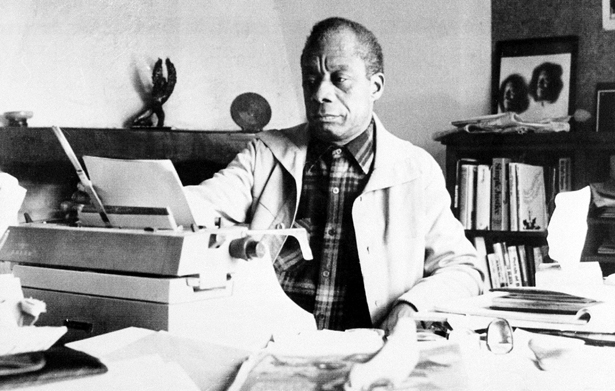
James Baldwin wrote in 1966 about the antagonistic relationship between Black Americans and the police; his willingness to interrogate that dynamic provides a powerful framework for rethinking the antagonism between educators and students. (The Nation)
Teaching in my third academic year impacted by the Covid pandemic, I am feeling nostalgic for some (but not all) of the pre-pandemic dynamics in the classroom.
My university established and followed strict protocols throughout the 2020-2021 academic year that allowed many courses to be taught face-to-face (while professors were allowed to teach remotely and courses provided many hybrid opportunities to address student needs). But last year was a very stilted teaching and learning experience with faculty and students fully masked and social distancing (maintaining the six-feet requirement typical pre-vaccine).
This fall we are face-to-face, masked, but not social distancing; therefore, I am enjoying being able to do small group work in class again. A return to semi-normalcy in the classroom means that Monday, as my first-year writing seminar students formed groups to discuss their reading of Baldwin, I waited a few minutes before strolling around the room to listen to the discussions.
Anyone who teaches knows what happened; as I approached each group, students fell silent, and several looked up, concerned.
I always take these moments to begin a discussion about the antagonistic relationship that exists between teachers and their students. Students admit that a teacher approaching makes them afraid they are doing something wrong, even when they are fully engaged in the assignment.
Many of us who went through teacher training or conduct teacher training have discussed walking toward students as a classroom management technique.
It does work, but we rarely unpack why and almost never interrogate that the technique should not “work.”
My first-year students at a selective liberal arts college (having almost all been very successful in K-12, either straight-A students or close to that) are quick to acknowledge the many ways that they feel antagonism from and toward their teachers. From dress codes to bathroom restrictions to grading policies to late-to-class rules—students find the school days filled with landmines policed by their teachers.
Of note is how difficult it is for first-year college students to shift away from student behaviors (raising hands, asking to go to the bathroom) and toward autonomous adult behaviors (we explicitly focus on the difference between access to going to the bathroom in high school and college).
Part of this reductive and dehumanizing dynamic is the prevalence of uncritical embracing of simplistic behaviorism grounded most vividly in the punishment/reward elements of school rules and grading.
Despite my commitment to creating a classroom environment driven by collaboration and not antagonism, students still primarily experience antagonistic relationships with their teachers/professors when learning formally.
As a professor, I witness that reality because of one of the worst aspects of the teaching profession—educators publicly shaming student behaviors.
When I started teaching high school in 1984, I quickly learned to avoid the teachers’ lounge, where my colleagues tended to gather and endlessly rail against (by name) students that I taught (and loved). What I noticed was a proclivity for teachers to angrily berate teenagers for behaving like teenagers.
One of my fortunate gifts as a teacher is that I chose to teach high school and that I genuinely love teenagers because they have reached an early stage of adulthood but also maintain some of the most endearing qualities of childhood. I very much enjoyed discovering and unpacking the world with teenagers who found everything to be new (even as I realized that none of it was new).
Jump about four decades later, and I see that played out just a bit differently on social media, where teachers and professors routinely hold forth in anger about a student’s email asking if they missed anything when absent. This sort of public (although anonymous) student shaming seems to be common at the beginning and end of semesters so there has been a flurry of them over the past few weeks.
Tip toeing the line of subtweeting, I Tweeted this yesterday with those type of social media posts in mind:
I do not grade and do not take off for being late …
My composition class is *low-stakes with high expectations* where students can work on behaviors that have high-stakes consequences in other environments @TG2Chat
Throughout my career as a high school teacher and now a college professor, I have worked diligently to be student-centered in the way that honors the autonomy and human dignity of my students; I have also embraced Paulo Freire’s concepts of choosing to be authoritative and not authoritarian as a teacher, parent, and coach.
This critical commitment has often been well embraced by my students (although not all of them) but rebuffed by many, if not most, of my colleagues. A typical criticism I hear (which I confront in the second Tweet above) is that if adult authority figures are not authoritarian, students will take advantage of them.
The nasty (and false, I think) Puritanical belief that humans (especially children and teenagers) left alone will behave in base and selfish ways seems to be how many teachers/professors view their students. This deficit perspective is pervasive in education, often manifested as racism, classism [1], sexism, and agism but masked as “necessary” lest we lose all control!
I firmly reject that my job as a teacher is to “fix” inherently flawed young humans and instead embrace that to teach is to provide the guidance necessary for young people to develop their autonomy and recognize their and other’s basic human dignity.
Over almost 40 years of teaching, I have had very few students attempt to take advantage of me, and most of them have suffered the consequences they deserved for that behavior while many of them have directly reached out to me over the years to apologize.
A low-stakes teaching and learning environment has allowed me to be very demanding, having extremely high standards for students, and I have found that students respond well to high expectations couched in clear expectations, detailed support and feedback, and patience paired with firm guidelines for student behavior and artifacts of their learning.
I have documented on social media several times that my students submit work on time at well over 90-95% rates although I do not grade assignments and do not record or deduct for late work. Almost all the work that is late can be traced tp legitimate reasons (the types of real-world justifications for late work that adults enjoy).
Students and educators deserve a teaching/learning environment grounded in collaboration and not antagonism—where everyone has their autonomy and human dignity honored, and even celebrated.
If K-12 and undergraduate students already knew and behaved in all the ways adults want, why would they need to be in our classes?
When Student Y sends a preposterous email, our job as educators is to teach the student why it is preposterous, and how to engage with another human in ways that show respect to both the student and the teacher.
And that teaching—even when our last nerve is tested—must be as patient as possible, although firm, and our students must trust that we are here to work with them for their success, not to police them for their flaws until they are properly “fixed.”
At its core, I think James Baldwin’s view of policing serves us well here: “The law is meant to be my servant and not my master, still less my torturer and my murderer.”
And so, many days while teaching, I explain to students that I work for them, and when all is going as it should, I actually am there to work with them.
None the less, every time I walk toward a small group of students, they fall silent and look up, faces expecting antagonism and not yet sure we are there for the same thing—whatever any student needs to live autonomous lives where their human dignity is seen and appreciated.
[1] See:
The return of the deficit signifies a depressing symmetry in demographic trends and public policy. Deborah Stone (1997), writing on the art of political decisionmaking, argues that “political reasoning is [about] metaphormaking and categorymaking . . . strategic portrayal for persuasion’s sake, and ultimately for policy’s sake” (p. 9). Portraying disproportionate school failure among Black and Hispanic youth in terms of “personal troubles” (Mills, 1959) or cultural deficiencies sustains public policies that emphasize individual self interest and personal responsibility (e.g., welfare reform, high stakes testing), leaving no reason to consider the effects of poverty and discrimination or underfunded schools and deteriorating facilities on children’s learning.
Dudley-Marling, Curt (2007) “Return of the Deficit,” Journal of Educational Controversy: Vol. 2 : No. 1 , Article 5. Available at: https://cedar.wwu.edu/jec/vol2/iss1/5
I entered the classroom as a high school English teacher in Upstate South Carolina in the fall of 1984, coinciding with the start of the high-stakes accountability movement in my home state as well as across the U.S.
Many people identify the Nation at Risk report under Ronald Reagan as ground zero for the accountability movement that entrenched patterns of school reform lasting until today—ever-changing standards, ever-changing high-stakes tests, and a never-ending refrain that schools are failing.
George W. Bush brought state-level education reform/accountability to the federal level with the bi-partisan No Child Left Behind, and then Barack Obama doubled down on the same basic concepts and approaches despite decades of accountability measures not working.
As a result, when I entered the world of blogging and public commentary during Obama’s administration, I found two enduring and powerful metaphors for the essential flaws of the accountability/education reform movement.
One is from Oscar Wilde: “But their remedies do not cure the disease: they merely prolong it. Indeed, their remedies are part of the disease.”
And the other is inspired by a scene from Alice Walker’s The Color Purple, detailed in a letter from Nettie to Celie:
The first thing I should tell you about is the road. The road finally reached the cassava fields about nine months ago and the Olinka, who love nothing better than a celebration, outdid themselves preparing a feast for the roadbuilders who talked and laughed and cut their eyes at the Olinka women the whole day. In the evening many were invited into the village itself and there was merrymaking far into the night. I think Africans are very much like white people back home, in that they think they are the center of the universe and that everything that is done is done for them. The Olinka definitely hold this view. And so they naturally thought the road being built was for them [emphasis added]. And, in fact, the roadbuilders talked much of how quickly the Olinka will now be able to get to the coast. With a tarmac road it is only a three-day journey. By bicycle it will be even less. Of course no one in Olinka owns a bicycle, but one of the roadbuilders has one, and all the Olinka men covet it and talk of someday soon purchasing their own.
Well, the morning after the road was “finished” as far as the Olinka were concerned (after all, it had reached their village), what should we discover but that the roadbuilders were back at work. They have instructions to continue the road for another thirty miles! And to continue it on its present course right through the village of Olinka. By the time we were out of bed, the road was already being dug through Catherine’s newly planted yam field. Of course the Olinka were up in arms. But the roadbuilders were literally up in arms. They had guns, Celie, with orders to shoot!
It was pitiful, Celie. The people felt so betrayed! They stood by helplessly—they really don’t know how to fight, and rarely think of it since the old days of tribal wars—as their crops and then their very homes were destroyed. Yes. The roadbuilders didn’t deviate an inch from the plan the headman was following. Every hut that lay in the proposed roadpath was leveled. And, Celie, our church, our school, my hut, all went down in a matter of hours. Fortunately, we were able to save all of our things, but with a tarmac road running straight through the middle of it, the village itself seems gutted.
Immediately after understanding the roadbuilders’ intentions, the chief set off toward the coast, seeking explanations and reparations. Two weeks later he returned with even more disturbing news. The whole territory, including the Olinkas’ village, now belongs to a rubber manufacturer in England. As he neared the coast, he was stunned to see hundreds and hundreds of villagers much like the Olinka clearing the forests on each side of the road, and planting rubber trees. The ancient, giant mahogany trees, all the trees, the game, everything of the forest was being destroyed, and the land was forced to lie flat, he said, and bare as the palm of his hand.
From this, I drew a conclusion that has served as a guiding metaphor for my criticism of the education reform movement and the title of one of my books, Beware the Roadbuilders: Literature as Resistance (Garn Press): “Beware the roadbuilders. They are not here to serve you, they are on their way to bulldoze right over you.”
I have come back to this metaphor as both ongoing criticism and confirmation that accountability is a failed approach to education reform.
One element of the tension between the accountability/education reform movement and those of us committed to education and social reform grounded in equity (and not accountability) is the shared acknowledgement that universal public education has a long history of failing marginalized and oppressed populations of students, reflecting the larger failures of communities, states, and the broader U.S. to serve marginalized and oppressed people.
It is 2021, and in my home state of SC, the metaphor I have depended on is being vividly and callously brought to reality:
The dismantling of Black communities for state and federal highways is not just a thing of the past. It’s happening now a few miles north of Charleston with the proposed West I-526 Lowcountry Corridor, at a time when President Biden and his transportation secretary have vowed to stop it.
South Carolina is proposing to sweep aside dozens of homes, and potentially hundreds of people, to widen a freeway interchange choked with traffic in this booming coastal region. The $3 billion project is expected to begin about two years after the plan becomes final. …
Under the state’s preferred proposal for the interchange upgrade, 94 percent of people and structures that would be displaced live in environmental justice communities mostly composed of Black and Brown residents.
It is 2021, and I must reach the same conclusion I drew in 2014: Beware the roadbuilders. They are not here to serve you, they are on their way to bulldoze right over you.
Racial and economic segregation in urban communities is often understood as a natural consequence of poor choices by individuals. In reality, racially and economically segregated cities are the result of many factors, including the nation’s interstate highway system. In states around the country, highway construction displaced Black households and cut the heart and soul out of thriving Black communities as homes, churches, schools, and businesses were destroyed. In other communities, the highway system was a tool of a segregationist agenda, erecting a wall that separated White and Black communities and protected White people from Black migration. In these ways, construction of the interstate highway system contributed to the residential concentration of race and poverty, and created physical, economic, and psychological barriers that persist.
Today, the interstate highway system is on the verge of transformational change as aging highways around the country are crumbling or insufficient to meet growing demand and must be rebuilt or replaced. The possibility of significant infrastructure development offers an opportunity to redress some of the harm caused by the interstate highway system, to strengthen impacted communities, and to advance racial equity. Still, there is a risk that federal, state, and local highway builders will repeat the sins of the past at the expense of communities of color whose homes, businesses, and community institutions again stand in the path of the bulldozers. Moreover, there is reason to believe that traditional civil rights laws, standing alone, are insufficient to redress the structural and institutional racism that shaped the interstate highway system and continues to threaten communities of color as the highways are rebuilt.
This Article is the first in the legal literature to explore in depth the racial equity concerns and opportunities raised by modern highway redevelopment. It also builds upon the work of legal scholars who advocate for addressing systemic racial inequality by requiring that policymakers conduct a thorough and comprehensive analysis of how a proposed action, policy, or practice will affect racial and ethnic groups. The Article concludes by proposing a way forward for highway redevelopment projects: requiring jurisdictions to complete comprehensive racial equity impact studies prior to any construction. Racial equity impact studies have been used or proposed in various contexts to reform racialized institutions and structures. This Article argues that highway redevelopment projects should join this growing list.
Archer, Deborah N., ‘White Men’s Roads Through Black Men’s Homes’: Advancing Racial Equity Through Highway Reconstruction (February 18, 2020). 73 Vanderbilt Law Review 1259 (2020), NYU School of Law, Public Law Research Paper No. 20-49, Available at SSRN: https://ssrn.com/abstract=3539889
Misattributed quotes can still be valid, and such is the case with the often repeated, “There are three kinds of lies: lies, damned lies, and statistics,” typically associated with Mark Twain (possibly the first person to attribute the saying to the wrong person).
Statistics are a powerful kind of lie because data allow people to state factually true statistics that still mislead or distort the topic being addressed.
Republicans and conservatives have used the statistical lie often as a dog whistle for their racist base. Two of those issues are fatal police shootings and black-on-black crime.
Yes, police shoot and kill more white people per year than Black people, but a statistical fact of this data is that there are about 5 times as many white people in the U.S. as there are Black people; therefore, for this data set to be equitable, about 5 times more white people would be killed than Black people (note that the difference is only about twice as many).
Therefore, fatal police shootings are racially imbalanced (Black people shot and killed at about 2.5 times higher rate than white people), if not racist.
In the case of fatal police shootings, then, the raw data are both accurate and misleading when trying to understand racial inequity.
A much more insidious use of statistics is the overuse of black-on-black crime in media, public, and political discourse.
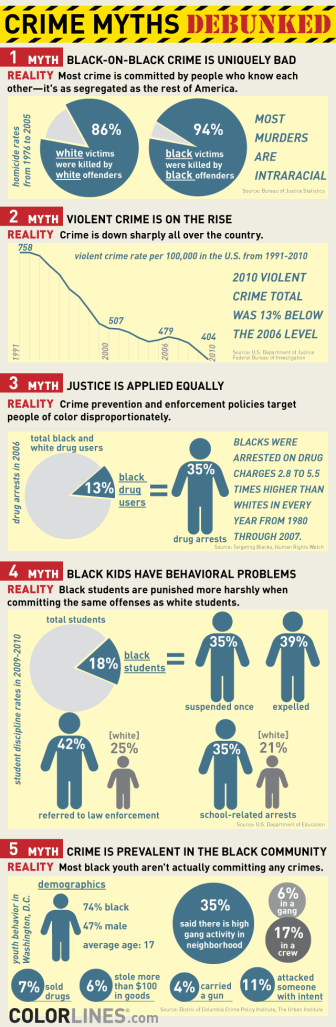
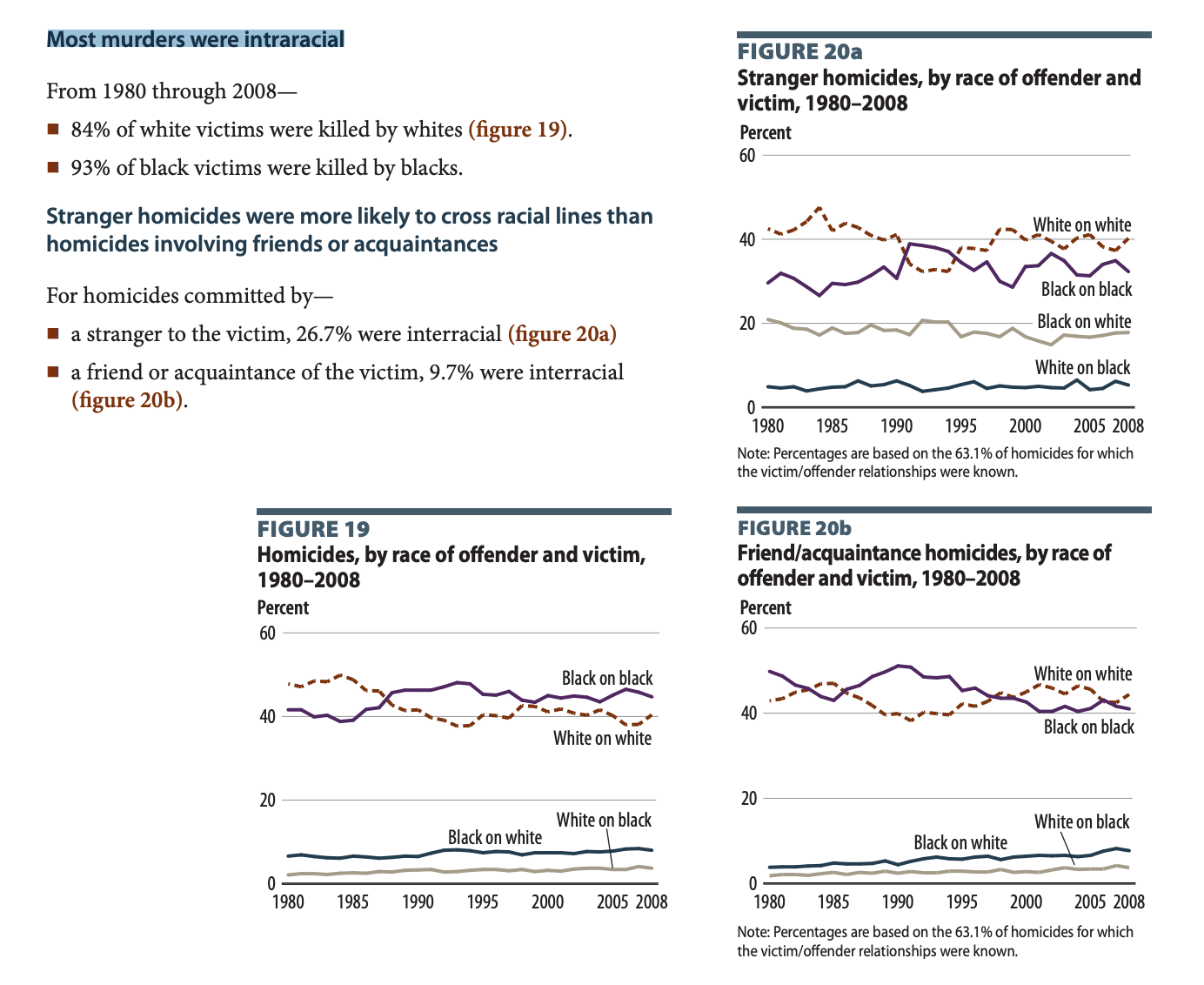
Black-on-black crime rates are extremely high, often at a 90%+ rate.
But there is almost no media, public, or political rhetoric around the white-on-white crime rate, which is about statistically the same (high 80% rate). [1]
Crime rates are almost entirely within races in the U.S. (see p. 13 from the U.S. Department of Justice [2]) because the country is still strongly racially and economically stratified.
While highlighting the very high black-on-black crime rate is factually correct, omitting that most crime is intraracial makes that emphasis misleading, and another dog whistle for racists.
But Republicans aren’t stopping there; consider the Lt. Governor of Texas who has now blamed Black Texans for being unvaccinated and causing the newest Covid spike:
Texas Lt. Gov. Dan Patrick blames unvaccinated Black people for Covid spread in his state pic.twitter.com/CfwajqECLM
Once again, Republicans are using the statistical lie as a dog whistle for racist constituents.
Many racial groups are under-vaccinated, and there certainly is a significant issue with vaccine hesitancy and resistance among Black Americans, but the sheer numbers in Texas make Patrick’s careless and racist claim more than preposterous.
Further, raw data on low vaccination rates among races also ignore causes for those rates. Black Americans are disproportionately poor and live in areas were vaccine access has been weak or even suppressed.
There is ample evidence that political leaders have always cherry-picked statistics and data to promote agendas, but there is also ample evidence that Republicans target statistics as part of their larger strategy to court their racist base.
Patrick’s most recent egregious use of the statistical lie is further proof that Trump did not create the Republican Party as a party of lies, but he certainly helped the strategy gain momentum.
My neighboring state of North Carolina has filed copy-cat legislation being proposed across the U.S. by Republicans as part of the manufactured Critical Race Theory (CRT) crisis.
As Justin Parmenter explains, “Among other things, the bill would make it illegal for teachers to promote feelings of racial discomfort and would require schools to prominently post information about diversity training on their websites for public review.”
Republicans and conservatives have launched a campaign grounded primarily in several false claims, including a drastic misrepresentation of what CRT is (a graduate-level theoretical lens primarily found in law schools) and that CRT exists in any significant way in K-12 public education (it doesn’t).
Since the public and political rhetoric is both misleading and false, and since the legislation is written in coded ways, those of us who recognize that this movement is an insidious lie (political leaders claiming to be protecting academic freedom by banning CRT from academic spaces) must now call Republicans on their bluff, specifically addressing the concept of “racial discomfort.”
As an educator for almost 40 years, I find no real evidence that white third graders across the U.S. are being told in schools that they are personally culpable for racism and slavery simply because they are white.
And as a scholar who understands and embraces CRT, I also know if CRT were being practiced with children across the U.S. in public school, that theoretical lens focuses on systemic racism, not individual racism. In other words, white students in U.S. public education would be well served by CRT that emphasizes the role of systemic racism regardless of individual beliefs.
CRT is one way to raise everyone’s awareness of racism and inequity so that we can all behave in ways that lead the country toward equity and meritocracy.
The only blame anyone should suffer (in the context of CRT) is a refusal to recognize systemic racism and then a refusal to behave in ways that are equitable.
Republican legislation is prescribing, then, that students remain ignorant, and ironically, passively complicit in systemic racism.
But the primary unwritten/unspoken given in the claimed concern about “racial discomfort” is that the term addresses only white racial discomfort—as if being white is somehow a greater burden, for example, than being Black and actually experiencing racism.
Is hearing or reading “n—–” not a form of racial discomfort?
Is being told you are “articulate” while Black not a form of racial discomfort?
Is being asked “Can I touch your hair?” while Black not a form of racial discomfort?
Is being paid less even though you the same educational attainment while Black not a form or racial discomfort?
Since this movement is ambiguous on the surface, we must call their bluff by acknowledging “racial discomfort” among all races.
Black students, for examples, must not be asked to read The Adventures of Huckleberry Finn, To Kill a Mockingbird, Of Mice and Men, or The Great Gatsby.
Imagine being a Black teenager in a room filled with white peers and a white teacher, reading from Gatsby [1]:
“Civilization’s going to pieces,” broke out Tom violently. “I’ve gotten to be a terrible pessimist about things. Have you read The Rise of the Colored Empires by this man Goddard? … Well, it’s a fine book, and everybody ought to read it. The idea is if we don’t look out the white race will be – will be utterly submerged. It’s all scientific stuff; it’s been proved … This fellow has worked out the whole thing. It’s up to us, who are the dominant race, to watch out or those other races will have control of things … The idea is that we’re Nordics. I am, and you are, and … And we’ve produced all the things that go to make civilization – oh, science and art, and all that. Do you see?”
Or the repeated use of “n—–” in Huck Finn, Mockingbird, and Of Mice and Men.
And let’s not stop there.
Shakespeare is filled with sexism, bigotry, and racism It must go. No more Shakespeare because children and teens might feel discomfort.
And honestly, who didn’t feel discomfort when confronted with the Pythagorean Theorem.
It must go also.
In the context of the legislation being proposed and passed, we must demand that all texts and topics causing anyone (regardless of race) “racial discomfort” be removed from the curriculum.
The logical extension of this nonsense is the total erasure of curriculum; there simply is nothing left to teach if we mobilize and demand that legislation be applied evenly for everyone.
It shouldn’t be on the shoulders of minoritized peoples to call this bluff, but a widespread effort to take this legislation to its logical conclusions would cause the movement to collapse under its own dishonesty.
Republicans and conservatives do not care about everyone’s discomfort, let’s note. How trans students feel has been repeatedly disregarded, for example.
Legislation aimed at CRT is a Great White Lie, but if we call them on their bluff, that lie will be exposed when we find ourselves with a total erasure of the curriculum.
While Republicans continue to claim the U.S. “is not a racist country” and passing legislation directly and indirectly banning critical race theory (CRT) and the 1619 project, the recent comments by former VP Mike Pence capture the real message behind these events:
It is time for America to discard the left-wing myth of systemic racism. America is not a racist Nation—America is the most just, righteous, noble and inclusive Nation that has ever existed on the face of the earth!
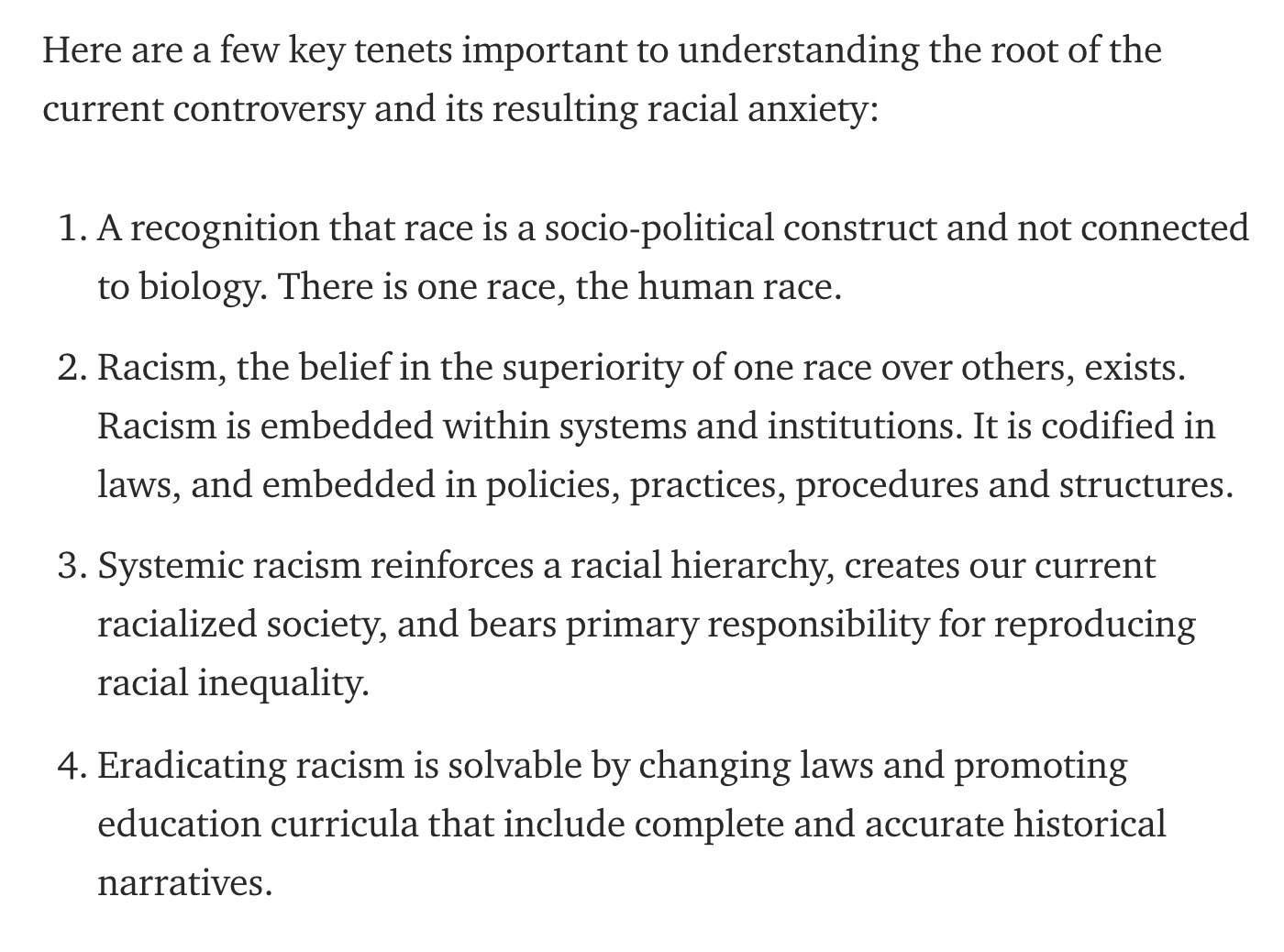
For Republicans and conservatives who reject systemic racism as a “left-wing myth,” there remains a significant challenge: How can we explain the tremendous racial gaps (see below) that exist in the U.S. between Black and white Americans?
These attacks are directly effecting K-12 and higher education; therefore, educators must be well informed about these issues. Here are valuable resources for understanding CRT, the 1619 Project, and systemic racism:
The social category “children” defines a group of individuals who are perceived to be distinct, with essential characteristics including innocence and the need for protection (Haslam, Rothschild, & Ernst, 2000). The present research examined whether Black boys are given the protections of childhood equally to their peers. We tested 3 hypotheses: (a) that Black boys are seen as less “childlike” than their White peers, (b) that the characteristics associated with childhood will be applied less when thinking specifically about Black boys relative to White boys, and (c) that these trends would be exacerbated in contexts where Black males are dehumanized by associating them (implicitly) with apes (Goff, Eberhardt, Williams, & Jackson, 2008). We expected, derivative of these 3 principal hypotheses, that individuals would perceive Black boys as being more responsible for their actions and as being more appropriate targets for police violence. We find support for these hypotheses across 4 studies using laboratory, field, and translational (mixed laboratory/field) methods. We find converging evidence that Black boys are seen as older and less innocent and that they prompt a less essential conception of childhood than do their White same-age peers. Further, our findings demonstrate that the Black/ape association predicted actual racial disparities in police violence toward children. These data represent the first attitude/behavior matching of its kind in a policing context. Taken together, this research suggests that dehumanization is a uniquely dangerous intergroup attitude, that intergroup perception of children is underexplored, and that both topics should be research priorities.
Journal of Personality and Social Psychology, 2014, Vol. 106, No. 4, 526 –545
Students of color are underrepresented in gifted programs relative to White students, but the reasons for this underrepresentation are poorly understood. We investigate the predictors of gifted assignment using nationally representative, longitudinal data on elementary students. We document that even among students with high standardized test scores, Black students are less likely to be assigned to gifted services in both math and reading, a pattern that persists when controlling for other background factors, such as health and socioeconomic status, and characteristics of classrooms and schools. We then investigate the role of teacher discretion, leveraging research from political science suggesting that clients of government services from traditionally underrepresented groups benefit from diversity in the providers of those services, including teachers. Even after conditioning on test scores and other factors, Black students indeed are referred to gifted programs, particularly in reading, at significantly lower rates when taught by non-Black teachers, a concerning result given the relatively low incidence of assignment to own-race teachers among Black students.
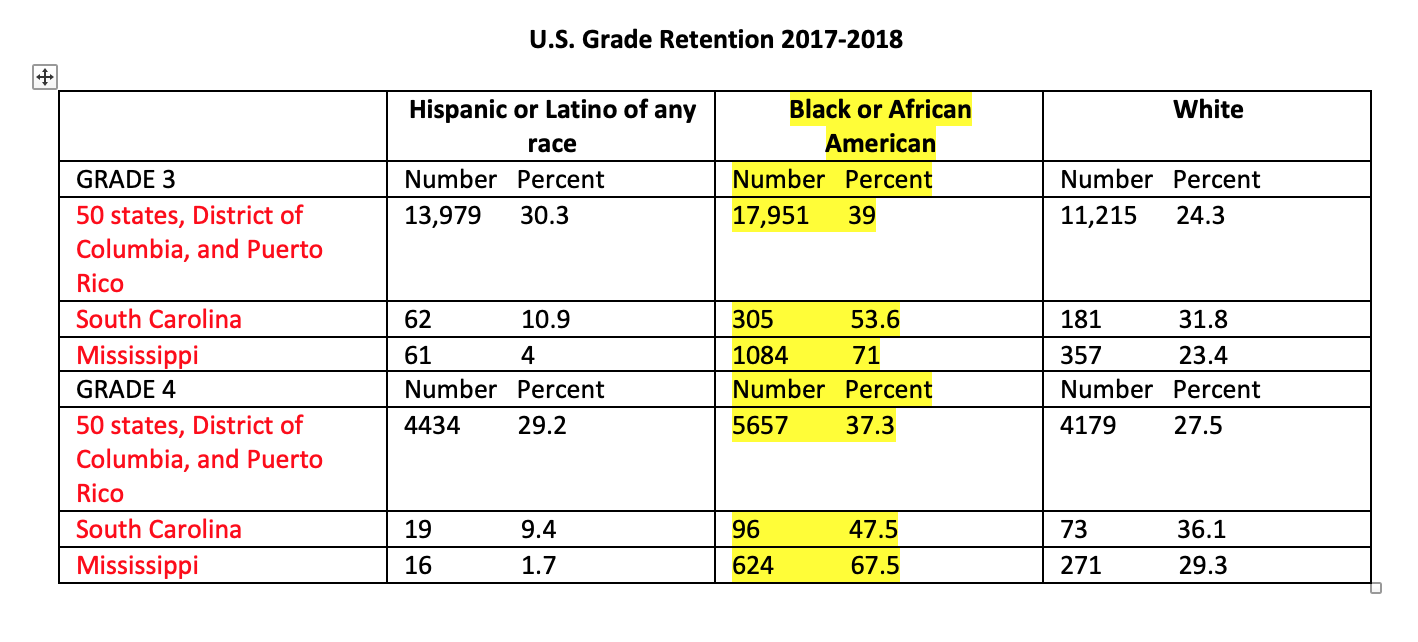
Grade Retention and Expulsions/Suspensions: Black students disproportionately retained (grades 3 and 4) and expelled (USDOE/Office of Civil Rights) – Data 2017-2018
There are substantial gaps in educational outcomes between black and white students in the United States. Recently, increased attention has focused on differences in the rates at which black and white students are disciplined, finding that black students are more likely to be seen as problematic and more likely to be punished than white students are for the same offense. Although these disparities suggest that racial biases are a contributor, no previous research has shown associations with psychological measurements of bias and disciplinary outcomes. We show that county-level estimates of racial bias, as measured using data from approximately 1.6 million visitors to the Project Implicit website, are associated with racial disciplinary disparities across approximately 96,000 schools in the United States, covering around 32 million white and black students. These associations do not extend to sexuality biases, showing the specificity of the effect. These findings suggest that acknowledging that racial biases and racial disparities in education go hand-in-hand may be an important step in resolving both of these social ills.
“In total, lawmakers in at least 15 states have introduced bills that seek to restrict how teachers can discuss racism, sexism, and other social issues,” reports Sarah Schwartz for Education Week.
The key problem with this copycat legislation is CRT isn’t implemented in K-12 education and the 1619 Project is not adopted curriculum.
CRT is rare in higher education, reserved for some graduate programs (specifically among legal scholars), but CRT provides a way to examine systemic racism, not simply the actions of individual racists.
Ultimately, legislation aimed at CRT or the 1619 Project is misleading, a threat to academic freedom and the education of students in SC. As Eesha Pendharker reports in Education Week: “[E]xperts say the laws ultimately will unravel years of administrators’ fitful efforts to improve educational opportunities and academic outcomes for America’s children of color, who today make up the majority of the nation’s student body.”
What, then, is occurring in SC K-12 education in terms of race and racism?
Diversity, equity, and inclusion (DEI) training that covers implicit bias, systemic racism and racial privilege, and microaggressions. This training is now common for educators and students, but worth monitoring because DEI training is often not effective and can serve as superficial distractions allowing schools to avoid harder diversity work.
Diversifying faculty and the curriculum. Public school teachers are about 80% white, less diverse than society and the population of students in public schooling (increasingly Black and brown). Also, for many years, a greater representation of Black and brown voices and history have been included in what students are taught (typically in English/ELA and history/social studies). Diversifying the curriculum has prompted controversial legislation by Republicans, however.
Implementing culturally relevant teaching. The work of Gloria Ladson-Billings has gained momentum in K-12 education. Culturally relevant teaching, as she defines it, is “a threefold approach to ensuring that all children are successful. That approach requires a focus on students’ learning, an attempt to develop their cultural competence, and to increase their sociopolitical or critical consciousness.” This focus seeks to honor all children while acknowledging that differences remain among students by race, gender, culture, etc.
Adopting responsive discipline. Decades of research have revealed racially inequitable discipline in schools, popularly known as the school-to-prison pipeline. Many schools have begun to reconsider inequitable practices such as zero-tolerance policies and expulsion/suspension, for example.
Expanding educational access and improving educational quality for children of color. Black and brown students are under-represented in advanced programs (such as Advanced Placement and gifted programs), and often are taught by teachers with the least experience, who are under-/un-certified, and sit in classrooms with the highest student/teacher ratios. Public schools are not the “great equalizers” politicians claim, and often reflect and perpetuate inequity.
State legislation and the Superintendent of Education targeting CRT and the 1619 Project is political theater, a solution in search of a problem. Race and racism remain a significant part of life as well as education in SC. Republicans are poised to ruin the very good and needed, but incomplete, work identified above.
It is critical that teachers and students are free to examine the truth of our past and our present so that we can create the future we believe is possible.
educator, public scholar, poet&writer – academic freedom isn't free




 dr. p.l. (paul) thomas