Category Archives: #BlackLivesMatter

A Case for Critical Race Theory, and More

White privilege is a system of advantage that benefits all white people (or to be more clear, all people who are perceived of as white).

That racial privilege, however, is no guarantee of success or shield of protection for some individual people who are white. White people fail, white people suffer inequity and disadvantages (such as poverty), and white people in some individual cases are substantially worse off than individual Black people.

Racism is a system of power and race that disadvantages all Black people in the U.S. (or to be more clear, all people who are perceived of as Black).

Racism is not a universal barrier to success or happiness or achievement, but it is a pervasive burden that tints every aspect of living for any Black person.

Black people are typically more starkly aware of racism (nearly moment by moment) than white people are of white privilege; white privilege works in an invisible way for white people while racism is a blunt object for Black people.

Race, however, is not biological; race is a social construction that has very real consequences because of the systems of white privilege and racism.

Conservative white men with power, political power, have launched a campaign against their own distorted and purposefully misleading characterization of critical race theory (CRT), a narrow and complicated legal and academic term and concept.

First, CRT is not practiced or implemented in the vast majority of K-12 schools, and is rare in higher education. I am speaking as someone who has taught about 20 years each in K-12 and higher education while being a critical educator.

Critical educators are rare, and at best, we are tolerated; but being a critical educator has professional negative consequences because being “critical” is a commitment to challenging systemic forces.

As the attack on CRT shows, people take personal and individual offense when systems are challenged.

Even though white people in the U.S. on average earn more and hold disproportionate positions of power than Black people, white people perceive anti-racism efforts (which are designed to dismantle white privilege) as an attack; white people perceive a creeping loss of their privilege even as they deny that privilege exists.

To be blunt, reaching a state of equity and equality in the U.S. would be a material change in the lives of white people. Change is terrifying to those who are born into a state of advantage.

Equity and meritocracy realized, then, in the U.S. is a threat to white privilege.

Anti-racism efforts, which include concepts such as CRT, are not some sort of reverse racism, not a blanket condemnation of white people.

Again, white privilege and racism are systemic, as CRT argues, built into the fabric of most if not all institutions in the U.S. including policing and the judicial system (which CRT specifically addresses). But white privilege and racism are also built into formal education and, as the 1619 Project proposes, into the very core of capitalism and the U.S. economic system.

Anti-racism efforts, including those found in K-12 and higher education, ask educators and students to consider how racism happened (historically) and to examine critically how white privilege and racism remain in our contemporary daily lives in the U.S.

The backlash against CRT has had some high-profile consequences, including Nikole Hannah-Jones being denied tenure at the University of North Carolina through a process that is overtly partisan politics—the same conservatives decrying CRT punishing the most prominent face of the 1619 Project, which sits at the center of this storm.

That politically partisan denial of tenure occurred around the birthday of Malcolm X, who I think serves an important point here.

Malcolm X was considered during his life a radical, in today’s language “critical,” and despite his careful and powerful rhetoric when positioned in the mainstream media of his day, he was demonized as the exact embodiment of racial threat that white Americans were openly embracing in the 1960s.

To understand racism in the U.S., consider this from Malcolm X: “History proves that the white man is a devil.”

For knee-jerk conservatives, this is proof of Malcolm X himself being racist.

But read in its full and clear language, the comment is not racist since it is grounded in “history proves.” Malcolm X is drawing a valid generalization about white people based on Black people living in the reality of active individual and systemic racism in the U.S.—from slavery to Jim Crow, from separate bathrooms and water fountains to segregated schools, from lynchings and the rise of the KKK to interracial marriage being illegal until the mid-1960s.

Racism is a set of race-based generalizations based on stereotypes, not evidence. I won’t list them here, but white racism toward Black people includes the very ugliest of claims about Black people that have no basis in fact, no historical, biological, or sociological evidence.

Part of the backlash against CRT is simply denial and racial discomfort, but that backlash is also a profound misconception about the fact of racism. Conservatives are apt to claim that the U.S. is not a racist country, and that any racism in the U.S. is merely a thing of the past.

Let me offer here two examples of why CRT and anti-racism efforts are valid, and must be central to formal education.

First, CRT argues that our current systems have racism baked into them because they were designed and created when, in fact, being virulently racist was not only socially and politically acceptable, but often a social and political advantage.

For example, Ben Tillman had a long successful political career in South Carolina (1890-1918), as governor and U.S. Senator. Tillman is something of an extreme example, but he was one of may white men who were racist and creating the laws that govern this county.

Detailed at Historic Columbia are some of the key elements of Tillman as racist politician who helped created our current systemic racism:

In a 1909 speech at the Red Shirt Reunion in Anderson, SC, Tillman boasted about his role in the 1876 murder of six Black militia members, whom he called “negro thugs.” White leaders celebrated the “Hamburg Riot” as a key victory of the 1876 Red Shirt paramilitary campaign, which successfully intimidated Black voters and stuffed ballot boxes to ensure the election of Wade Hampton III, and with it, the end of Reconstruction. Today, these murders are known as the Hamburg Massacre, one of the earliest lynchings in South Carolina.

Although he began as a perpetrator, Tillman later used his platform as governor and senator to serve as an instigator of and advocate for racial violence. Perhaps his most well-known pronouncement occurred in an 1892 speech, when, as governor [emphasis added], he vowed that “I would lead a lynching”–a claim carried by the state’s leading newspapers. His election to the governorship in 1890 unleashed what human rights activist Modjeska Monteith Simkins later called “an era of lynching.” By the end of the decade, at least 53 men, 51 of whom were Black, were lynched in South Carolina.

Yet, Tillman was most proud of his role in the Constitutional Convention of 1895, which introduced an “understanding clause” and poll tax as barriers to the vote, designed to eradicate Black participation in government. In a speech to his fellow United States Senators [emphasis added] five years later, he reminded them that, “We [South Carolinians] did not disfranchise [sic] the negroes until 1895. Then we had a constitutional convention convened which took the matter up calmly, deliberately, and avowedly with the purpose of disenfranchising as many of them as we could under the fourteenth and fifteenth amendments….” This speech affirmed a sentiment repeated throughout his career on the national stage about the role of African Americans in American democracy:

“We of the South have never recognized the right of the negro to govern white men, and we never will. We have never believed him to be the equal of the white man, and we will not submit to his gratifying his lust on our wives and daughters without lynching him.”

Historic Columbia

Today, we all live in a country under systems intentionally designed to be racist—some as overt as Tillman but others far more subtle (consider the sentencing differences between powder and crack cocaine and racial disparities in police shootings).

CRT and anti-racism efforts ask us to consider how these racial disparities came to be, how they continue to exist in today’s society, and what we can do to dismantle the inequities.

Denial and neutrality allow racism and racial inequity to remain; only naming, exploring critically, and confronting racism can erase racism.

Consider this second example, drawn from headlines within the last decade.

How did the killing of Tamir Rice by a police officer occur?:

“Shots fired, male down,” one of the officers in the car called across his radio. “Black male, maybe 20 [emphasis added], black revolver, black handgun by him. Send E.M.S. this way, and a roadblock.”

But the boy, Tamir Rice, was only 12. Now, with the county sheriff’s office reviewing the shooting, interviews and recently released video and police records show how a series of miscommunications, tactical errors and institutional failures by the Cleveland police cascaded into one irreversible mistake.

In Tamir Rice Case, Many Errors by Cleveland Police, Then a Fatal One

A racist stereotype (Black males are inherently dangerous and violent) combined with implicit bias (Black children are viewed as much older and more mature than their biological ages) led to the death of Rice. This tragic event is a real-life manifestation of what CRT argues, systemic forces with material consequences for Black people.

A police officer shooting and killing a Black boy, then, does not have to be a consciously racist individual to have acted in a way that is driven by systemic racism.

As further evidence, just a few years later, Kyle Rittenhouse, then 17, shot and killed two people during protests in Wisconsin. The same conservatives attacking CRT refer to Black boys as “men” and Rittenhouse as a “boy.”

Attacks on CRT and anti-racism initiatives are embarrassing and offensive caricatures; these attacks are themselves racist and provide the evidence proving why CRT and anti-racism practices remain necessary.

We are now facing a paradox because the misleading attacks on CRT are justification for increasing CRT and other anti-racism efforts in K-12 and higher education.

CRT is incredibly rare in any formal education setting. More K-12 and higher education situations are incorporating (often begrudgingly) anti-racism practices and examinations (which may or may not have elements informed by CRT).

Diversity, equity, and inclusion experiences for children are not blaming all white people or white students simply for being white; but those discussions are designed, as noted above, to critically explore how evidence-based racial disparities came to be, how they continue to exist in today’s society, and what we can do to dismantle the inequities.

Being white is not a crime, but denying racism is itself an act of racism.

To take a stand against anti-racism (against CRT) is taking a stand for racism.

In this case, we can say “not all white people,” but clearly identify those people white or Black who are to blame when they seek ways to deny and perpetuate the racism that remains in our daily lives.
Welcome to South Carolina: A State of Denial

In the United States of America, the stated law of the land is “innocent until proven guilty.”

However, police in the U.S. shoot and kill about 1000 people a year, denying them due process, acting as judge, jury, and executioner instead of the claimed role of “protect and serve.”

The U.S. is experiencing a mild reckoning, specifically linked to the killing of George Floyd but broadly connected to how policing and the legal system continue to be racially inequitable—or as many conservatives and the media refuse to state, racist.

A vocal and likely substantial portion of the U.S.—mostly white and often white men with power—have decided that naming racism is more harmful and offensive than actual racism.

Police killing citizens must also be put in the context that the U.S. stands out among peer nations in terms of gun violence.

It is mid-2021, and the world is suffering more than a year in a global pandemic.

It is mid-2021, and the guilty verdict of Minneapolis police Officer Derek Chauvin still lingers in the news.

Yet, Republican leaders in South Carolina have decided that a pressing issue is the death penalty—voting to reinstate the firing squad.

South Carolina, the home of one of the most horrific mass shootings targeting Black people sitting in church, has Republicans who are choosing to give the state the right to shoot and kill convicted prisoners in a legal and prison system that disproportionately convicts Black people.

Conservatives and Republicans in South Carolina—again, it is 2021—continue to wave the Confederate flag in one hand while thumping the Bible in the other—are endorsing gun violence by the state.

Very Christian.

Christian, that is, in the tradition of the KKK.

As reprehensible as this move is by Republicans, it simply isn’t the only evidence that white men with power are the most fragile people in the U.S.

Republicans in South Carolina have jumped on the white-washing of history bandwagon, prompted in the final days of Trump.

Republicans in South Carolina have ended federal unemployment benefits.

Republicans in South Carolina seek open carry, finding any and every way to appease their gun fantasies.

But possibly the most stark example of denial and white fragility is bill H630, which ends with this jumbled nonsense:

1.105. (SDE: Partisanship Curriculum) For the current fiscal year, of the funds allocated by the Department of Education to school districts, no monies shall be used by any school district or school to provide instruction in, to teach, instruct, or train any administrator, teacher, staff member, or employee to adopt or believe, or to approve for use, make use of, or carry out standards, curricula, lesson plans, textbooks, instructional materials, or instructional practices that serve to inculcate any of the following concepts: (1) one race or sex is inherently superior to another race or sex; (2) an individual, by virtue of his race or sex, is inherently racist, sexist, or oppressive, whether consciously or unconsciously; (3) an individual should be discriminated against or receive adverse treatment solely or partly because of his race or sex; (4) an individuals moral standing or worth is necessarily determined by his race or sex; (5) an individual, by virtue of his race or sex, bears responsibility for actions committed in the past by other members of the same race or sex; (6) an individual should feel discomfort, guilt, anguish, or any other form of psychological distress on account of his race or sex; (7) meritocracy or traits such as a hard work ethic are racist or sexist, or were created by members of a particular race to oppress members of another race; and (8) fault, blame, or bias should be assigned to a race or sex, or to members of a race or sex because of their race or sex. Nothing contained herein shall be construed as prohibiting any professional development training for teachers related to issues of addressing unconscious bias within the context of teaching certain literary or historical concepts or issues related to the impacts of historical or past discriminatory policies.

Part 1B SECTION 1 – H630 – DEPARTMENT OF EDUCATION
2021-2022 As passed by the Senate

Republicans across the U.S. are simultaneously know-nothings and people with disproportionate power to impose that lack of understanding not simply on public policy but on the very education of the children who will inherit the country.

This senseless passage at the end of bill H630 is the exact language being used in several states and it grows out of the fear-mongering around critical race theory.

Please take the 8 minutes to watch Marc Lamont Hill interview Dr. Imani Perry about the Big Lie around critical race theory now spreading across the country:

And as Victor Ray, professor of sociology (University of Iowa), explains:

Critical race theory arose to explain why structural racism endures. Given the racial conflicts roiling American politics, scholarly analysis of the causes and consequences of racial inequality may be more important now than at its inception….

Despite internal disagreements, critical race theorists have documented a stunning (and disturbing) array of racial inequalities that can’t be explained by the acts of individual racists. 

Perspective | Trump calls critical race theory ‘un-American.’ Let’s review.

But let’s return to the exchange between Hill and Perry.

As they note, this Republican attack on critical race theory is mostly a lie since those attacking it do not know what the term means, and, this is important, critical race theory simply isn’t being taught in the vast majority of schools in the U.S.; as Hill notes, it is a solution in pursuit of a problem.

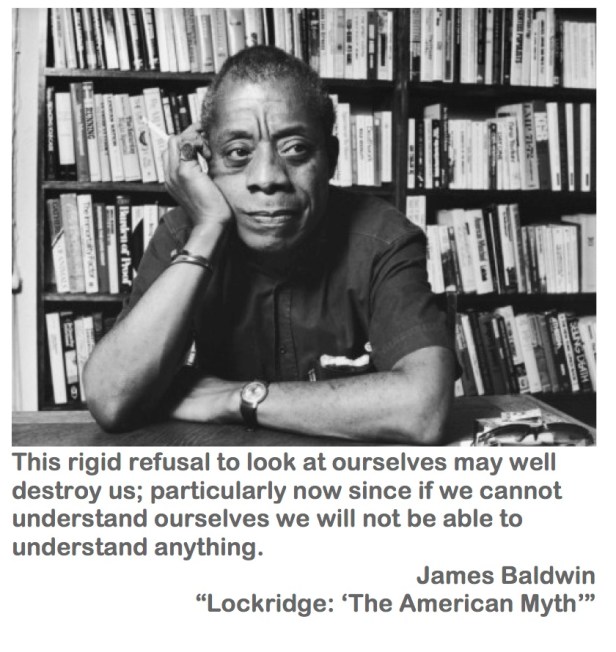
Republican leaders and those who support them persist to prove James Baldwin correct:

rigid refusal

Lies and deception are the foundational strategies of Republicans, reaching back to William F. Buckley.

They can’t handle the truth—a truth that, once again, Baldwin asserted:

Every white person in this country—and I do not care what he or she says—knows one thing. They may not know, as they put it, “what I want,” but they know they would not like to be black here. If they know that, then they know everything they need to know, and whatever else they say is a lie.

On Language, Race and the Black Writer, James Baldwin (Los Angeles Times, 1979)

The Big Lies of the Republican Party are really not about denying racism, but about protecting their white advantages.

Thus, as Perry implores, “We cannot be held to their terms because their terms are deceptive.”

There Can Be No Equity without Community and Empathy

[D]espite overwhelmingly good intentions, most of what passes for intercultural education practice, particularly in the US,
accentuates rather than undermines existing social and political hierarchies.

Paul Gorski, Good intentions are not enough: a decolonizing intercultural education

A split second of awareness kept me from stepping into my apartment’s elevator, the floor covered in vomit, recently.

I thought about this moment yesterday while standing in that same elevator filled with an unpleasant smell as I also noticed a new orange-brown stain on the floor.

A week or so ago, I was unloading two bicycles from my car rack, going up and down the elevator and walking through the enclosed garage of the complex a couple of times. I encountered twice a women with her small dog on a lease, and in both cases, she paused while the dog urinated on a steel beam in the garage.

It isn’t uncommon to see dog droppings scattered down the hallway carpet in this complex either.

Having lived almost four decades in my own homes before becoming an apartment dweller, these experiences are new but not shocking, and they remind me of the general lack of concern for others I experienced in dorm life in college. I also recognize these behaviors are typical of the American character, one grounded in rugged individualism and lacking any real sense of community.

It is the trash carelessly tossed out of car windows or dropped on the sidewalk.

It is the “I got mine so you get yours!” ethos of the good ol’ U.S. of A.

As I stepped out of the elevator yesterday, I was thinking about #TransDayofVisibility and about why people are so antagonistic about diverse sexualities and races, about gender fluidity and transexuality.

A type of awareness for me that helped move me past the bigotry and intolerance of my upbringing was coming to peace with my own self-awareness, being able to articulate that I did not make choices about my gender identification or sexuality but that I came to recognize my gender identification and sexuality.

To be blunt, I cannot fathom denying other people that recognition because I want my awareness to be honored. I also had to come to terms with differences being simply different and having nothing to do with right or wrong, or normal or abnormal.

What is “right” or “normal” for me is not in any way a template or commentary on anyone else, and vice versa.

While this may not be uniquely American, it is certainly true of Americans that we have a fatal lack of community and empathy.

And that “we” is statistically white Americans who exist in a sort of fear that if the “normal” white America has constructed isn’t the only way of being then maybe it isn’t “right.”

Rugged individualism is a significant part of the enduring presence of racism, sexism, homo-/trans-phobia, and all sorts of bigotry in the U.S.

But the negative consequences of rugged individualism are more than the narcissism inherent in racism and other types of bigotry (the provincialism that leads a person to see themselves as “right” and “normal” and people unlike them as “Other”).

What may be worse is that a society that centers the individual maintains inequity even when trying to expand diversity, equity, and inclusion (DEI) if the centering remains.

I have been involved in DEI initiatives at my university for many years, and since I actively incorporate anti-racism/anti-bias elements in my scholarly and public work, I find myself regularly confronting the misguided “good intentions” of my colleagues, my progressive white colleagues.

My first rude awakening about DEI in colleges and universities came early on when I discovered that my department and DEI structures across campus used the strongly debunked “framework of poverty” promoted by Ruby Payne.

Payne’s work is steeped in racist and classist stereotyping, and it suffers from the centering of whiteness and an idealized middle-class “normal.” When I challenged using Payne’s workbooks, I also encountered the other level of centering: “But it works,” I was told, “with our population of students.”

“Our population of students” happens to privileged and white.

Almost twenty years later, I faced the same situation and same justification again.

An event was held for students examining the storming of the U.S. Capitol in January 2021. The featured speaker was a former white nationalist. When I raised concerns about centering a former white nationalist, I heard the exact same justification I heard in my first weeks of coming to my university—but our (white) students.

What if we created opportunities for growth in DEI by centering those people experiencing the unfair weight of inequity? What if we considered a Black student sitting in the audience while a former white nationalist was given center stage and honored as an authority?

If we were organizing an event on sexual assault would we invite a former rapist to speak to that audience? If not, I imagine some of that decision is grounded in considering those people who have experienced sexual assault.

I included the central point from Gorski above this blog because I am disheartened by DEI efforts; I am witnessing Gorski’s recognition that “good intentions” often still perpetuate inequity by refusing to confront it, not resisting the urge to center whiteness and privilege.

While I no longer see Payne’s materials around campus, many still eagerly guide students through poverty simulations, poverty tours, and “pretend to be a minority” activities; these are all dehumanizing and offensive approaches that are grounded in stereotyping while continuing to center the sensibilities of the “normalized” group.

No one needs to pretend to be poor or minoritized is they are willing and eager to listen to people with lived experiences in poverty or being a minority.

Days ago I avoided stepping into that elevator because I was looking beyond myself instead of assuming the world was centered on me.

That elevator would have been clean and safe to enter, however, if everyone else lived with a sense of community and empathy.

MLK and “the Guaranteed Income”

[Header Photo by Katie Harp on Unsplash]

“President-elect Joe Biden will seek to increase the federal minimum wage to $15 an hour as part of his relief bill,” reported Alina Selyukh for NPR.

Across social media, people began doing calculations of what $15/hour translates into for annual salaries, and here are a couple responses from white Christian conservatives:

McChristian, personifying the relationship between a McNugget and real chicken, seems to be aware that teachers are underpaid, but lacks any Christian compassion for other workers also being underpaid (such as minimum-wage workers often constituting the working poor and living without healthcare or retirement—or job security).

Rachel, hollow mouthpiece for the equally vapid TPUSA, doesn’t just lack compassion; she also lacks any grasp of basic facts, embodying not only the hypocrisy of the Christian conservative movement but also the complete misunderstanding of how the free market works.

Note that “[r]aising wages for fast-food workers to $15 an hour would lead to a noticeable but not substantial increase in food prices, according to a new study by Purdue University’s School of Hospitality and Tourism Management,” as reported by Sally French at Market Watch.

Social media, as well, was quick to point out that in areas such as DC and the San Francisco Bay, where the minimum wage is already $15 and above, Taco Bell burritos remain below $4 at the most expensive.

In the U.S., we are well beyond the point of needing to acknowledge that there is nothing Christian or honest about the conservative movement in the U.S.

And few times a year are more likely to expose that than Martin Luther King Jr. Day—when those on the Right scramble to cherry-pick one or two quotes from MLK to wave in front of their hypocrisy and lies.

The debate about the $15/hour minimum wage (as well as college debt relief and universal healthcare) is an ideal opportunity to examine the MLK that almost everyone in mainstream America chooses to ignore.

brown concrete statue during daytime
Photo by Clay Banks on Unsplash

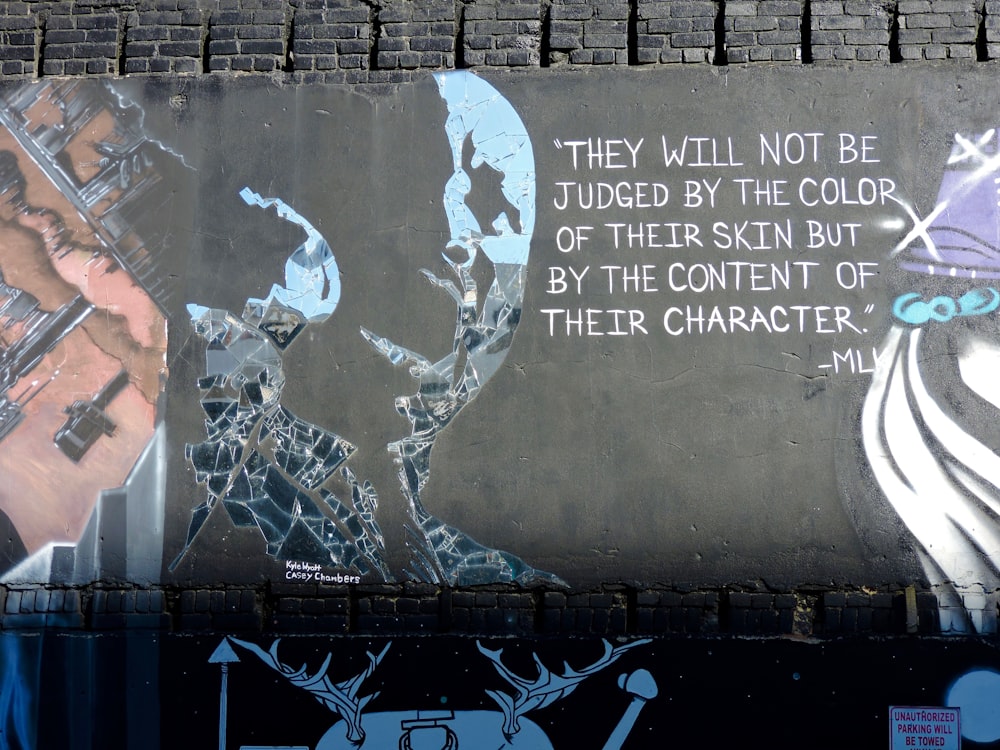
A couple favorite mis-uses and distortions of appropriating MLK is, first, characterizing King as a “passive radical” in order to violence-shame groups or paint a distorted “both sides” false equivalency between right-wing white nationalism and social justice advocates focusing on race and racism, and second, plastering the “content of their character” quotes everywhere to perpetuate the colorblind argument that, in fact, is itself racist.

text
Photo by LeeAnn Cline on Unsplash

Rare is the reference to King who strongly rejected the Vietnam War, but almost entirely absent from the public consciousness in the U.S. is King’s 1967 work, Where Do We Go from Here: Chaos or Community?

Here, King offers his criticism of the standard approach to eradicating poverty (approaches that persist in 2021):

Up to recently we have proceeded from a premise that poverty is a consequence of multiple evils:

• lack of education restricting job opportunities;

• poor housing which stultified home life and suppressed initiatives;

• fragile relationships which distorted personality development.

The logic of this approach suggested that each of these causes be attacked one by one. Hence a housing program to transform living conditions, improved educational facilities to furnish tools for better job opportunities, and family counseling to create better personal adjustments were designed. In combination these measure were intended to remove the causes of poverty.

Wealth and Want

King was confronting that U.S. political will could only admit indirect ways to address poverty—despite, as King pointed out, that more whites than Black people suffered under the weight of economic inequity.

“In addition to the absence of coordination and sufficiency, the programs of the past all have another common failing — they are indirect. Each seeks to solve poverty by first solving something else,” King noted, adding: “I am now convinced that the simplest approach will prove to be the most effective — the solution to poverty is to abolish it directly by a now widely discussed measure: the guaranteed income.”

Not only did King call for a guaranteed income, he asserted the essential need to be direct:

We are likely to find that the problems of housing and education, instead of preceding the elimination of poverty, will themselves be affected if poverty is first abolished. The poor transformed into purchasers will do a great deal on their own to alter housing decay. Negroes, who have a double disability, will have a greater effect on discrimination when they have the additional weapon of cash to use in their struggle.

Wealth and Want

Unlike McChristian and Rachel above, MLK as a progressive, as a Leftist (often slurred as a “communist”), understood the foundational need in a capitalist society that all people have capital:

Beyond these advantages, a host of positive psychological changes inevitably will result from widespread economic security. The dignity of the individual will flourish when the decisions concerning his life and in his own hands, when he has the assurance that his income is stable and certain, and when he know that he has the means to seek self-improvement. Personal conflicts between husband, wife and children will diminish when the unjust measurement of human worth on a scale of dollars is eliminated.

Wealth and Want

But King was profoundly aware of the problems with “minimum” wages, arguing about the guaranteed income:

Two conditions are indispensable if we are to ensure that the guaranteed income operates as a consistently progressive measure.

• First, it must be pegged to the median income of society, not the lowest levels of income. To guarantee an income at the floor would simply perpetuate welfare standards and freeze into the society poverty conditions.

• Second, the guaranteed income must be dynamic; it must automatically increase as the total social income grows. Were it permitted to remain static under growth conditions, the recipients would suffer a relative decline. If periodic reviews disclose that the whole national income has risen, then the guaranteed income would have to be adjusted upward by the same percentage. Without these safeguards a creeping retrogression would occur, nullifying the gains of security and stability.

Wealth and Want

King makes a purely Christian argument about economic policy in a capitalist democracy that should and could center human dignity and equity over greed:

The curse of poverty has no justification in our age. It is socially as cruel and blind as the practice of cannibalism at the dawn of civilization, when men ate each other because they had not yet learned to take food from the soil or to consume the abundant animal life around them. The time has come for us to civilize ourselves by the total, direct and immediate abolition of poverty.

Wealth and Want

The Right is wrong about what it means to be Christian.

The Right is wrong about what makes democracy and capitalism work for people and not against human dignity.

And the Right over the next few days will once again be offensively wrong about MLK.

One-Time
Monthly
Yearly

Make a one-time donation

Make a monthly donation

Make a yearly donation

Choose an amount

$5.00
$15.00
$100.00
$5.00
$15.00
$100.00
$5.00
$15.00
$100.00

Or enter a custom amount

$

Your contribution is appreciated.

Your contribution is appreciated.

Your contribution is appreciated.

DonateDonate monthlyDonate yearly

MLK Jr. Day Reader 2021

Photo by History in HD on Unsplash

From 1984 until 2002, 18 years, I taught high school English in the town and school where I grew up and graduated, moving into the classroom of my high school English teacher, Lynn Harrill, where I had sat as a student just six years earlier.

My first few years were overwhelming and at times terrifying; I taught five different preparations—managing fifteen different textbooks—and several of the classes were filled to capacity, 35 students packed into the room.

Throughout those two decades spanning the 1980s and past the 1990s, I was a student-centered teacher who had a wonderful relationship with my students—lots of mutual love and respect. However, there was always some tension between me and white redneck boys.

Again, these white redneck boys were who I had been growing up, and even the least aware among them likely sensed deep down inside that I knew who they were.

One of the worst days of my teaching career—sitting among having to confront a student gunman and returning to school after three children burned down the school building—included the actions of one white redneck boy.

A significant sub-unit of my nine-week non-fiction unit included walking students through the concept of civil disobedience, starting with Emerson and Thoreau but spending far more time on a mini-unit in Black history grounded in ideas and texts by Marcus Garvey, Booker T. Washington, W.E.B. Du Bois, Malcolm X, and Martin Luther King Jr.

We capped off that unit with Gandhi, but the grounding text of this nine weeks was always King’s “Letter from Birmingham City Jail” paired with different excerpts from Malcolm X.

One day as I was passing out King’s “Letter” (I always provided students their own copies of texts to annotate and keep), a white redneck boy slapped the handout off his desk and announced, “I ain’t reading that [N-word].”

In many ways, this was a defining moment for me as a teacher and a human. I was very aware that I had Black students in the room and that this teenager was much larger and angrier than was safe for me or the classroom of students.

I calmly returned the handout to the desk, my hand firmly on the paper while I leaned toward the student, and I said without hesitation that he would read the essay and that he would never utter that word in class again.

It seems odd to me now, but that is exactly what happened as I continued handing out the essay before we began reading and discussing the essay as a class.

This is no after-school special, and I never had any sort of deep conversation with that student—and I suspect he never changed his beliefs, except keeping his bigotry to himself, at least in my class.

I do suspect that for him and others in the classroom, I was the first white man to take a stand against racism and racist language that they had ever experienced.

It is embarrassing to admit, but that unit was a huge risk for me throughout my 18 years teaching. It even prompted not-so-veiled attacks from local preachers during sermons that my students attended on Sunday mornings (oddly, Southern Baptists seemed very offended by students studying Gandhi, who they dismissed as “not a Christian”).

There are many things I would change about my first two decades of teaching, being charged with the learning of hundreds of teenagers; there are many things I did inexcusably wrong, things for which I remain embarrassed and wish I had the power to return to those moments in order to make amends.

But that sub-unit, and specifically how I taught MLK and what works of his I exposed students to, is important still to me because we did not read “I Have a Dream,” and we did not mythologize MLK as a passive radical, rejecting the whitewashing far too common with King’s ideas and life.

I also exposed students to a wide range of Black writers and thinkers, emphasizing the importance of recognizing Malcolm X and taking his arguments seriously.

None the less, I could have done better—and even today in 2021, King’s life and legacy are woefully mis-served, especially in classrooms (as well as crossing the lips of politicians who cannot even for one day practice an iota of the ideals of King).

Here, then, is a reader for serving King better and expanding the voices and ideas with which we invite our students to engage:

Martin Luther King Jr., “The Drum Major Instinct” Sermon

Final Words of Advice/ “Where do we go from here?” (1967), Martin Luther King Jr.

The Trumpet of Conscience, Martin Luther King Jr.

“Letter from Birmingham City Jail,” Martin Luther King Jr.

Read This Before Co-Opting MLK Jr., Jose Vilson

The Revisionist’s Martin Luther King Jr., “I Have A Dream For Most Of Us,” Jose Vilson

Harlem, Langston Hughes

Let America Be America Again, Langston Hughes

The Forgotten, Radical Martin Luther King Jr., Matt Berman

James Baldwin: “the time is always now”

“Every white person in this country…knows one thing,” James Baldwin (1979) (incl. What Can a Sincere White Person Do? Malcolm X)

James Baldwin from “The Negro and the American Promise”

They Can’t Turn Back, James Baldwin

A Report from Occupied Territory, James Baldwin

“Peculiar Benefits,” Roxane Gay

You Want a Confederate Monument? My Body Is a Confederate Monument, Caroline Randall Williams

Lockridge: “The American Myth,”James Baldwin

If Black English Isn’t a Language, Then Tell Me, What Is? James Baldwin

“The Baldwin Stamp,” Adrienne Rich

Black Body: Rereading James Baldwin’s “Stranger in the Village,” Teju Cole

The Transformation of Silence into Language and Action, Audre Lorde

Bayard Rustin (March 17, 1912 – August 24, 1987): A Reader

The Mis-Education of the Negro, Carter Godwin Woodson

Nina Simone on the Role of the Artist

One-Time
Monthly
Yearly

Make a one-time donation

Make a monthly donation

Make a yearly donation

Choose an amount

$5.00
$15.00
$100.00
$5.00
$15.00
$100.00
$5.00
$15.00
$100.00

Or enter a custom amount

$

Your contribution is appreciated.

Your contribution is appreciated.

Your contribution is appreciated.

DonateDonate monthlyDonate yearly

Equity Politics: Life, Liberty, and the Pursuit of Happiness

I am not free while any woman is unfree, even when her shackles are very different from my own. And I am not free s long as one person of Color remains chained. Nor is any of you.

“The Uses of Anger,” Audre Lorde

The U.S. has elected Joe Biden president, ending the presidency of Donald Trump.

This is a return to the standard failure of the democratic process in a country that is primarily committed to the free market, rugged individualism, and guns.

Biden is the normal but truly awful presidential candidate, replacing the uniquely horrible election of Trump.

As many people have noted, changing presidents typically means only small differences in the daily lives of people. Those with some affluence and privilege continue to have really good lives, lives that allow them to focus on trivial matters that seem huge because of that affluence or privilege.

People in poverty, working class people, and the many different categories of people living in what we have euphemized as “diverse” identities, however, will mostly continue to live barely in the margins of the American dream—even when these people also attain some level of wealth or privilege in their accomplishments.

The American democracy is a failed and failing experiment because it has allowed inequity to flourish, and those living with the most privilege, white Americans, refuse still even to acknowledge that inequity because they are so enamored with their own pettiness and convinced that they too face disenfranchisement and disadvantage.

It is the “war on Christmas” rhetoric that arrives every holiday season by people who benefit from being in a majority and Christian-centric nation; there is no rational basis for such nonsense, but white America is still a majority of delusion, clinging to the one thing they will not relinquish—their white privilege.

Having never been a Republican or Democrat, and having never drunk the Kool Aid of idealism about the founding of the U.S. or the American Dream, I have always none the less found one possibility of the U.S. not only beautiful but also worth believing in—life, liberty, and the pursuit of happiness.

There is a poetic brilliance to that phrase that genuinely can and should be a map for the country the U.S. could become.

Even as I acknowledge Biden is a horrible candidate, I have found that his willingness to admit the U.S. has not yet reached our ideals and his charge to be the president for all Americans and not just those who elected him to be some of the better political rhetoric we can hear.

Those of us, especially those of us on the authentic Left, who embrace the possibility of human equity guaranteed by and for a free people have no real political party for our allegiance, but I do think we can use this moment in history to commit to a politics of equity built around the ideals of life, liberty, and the pursuit of happiness.

A first step to making equity a reality in the U.S. is an education campaign, one specifically targeting the demonizing and fear-mongering around “socialism.”

First, there must be an honest distinction made between regimes that are identified as socialism or communism—regimes rules by dictators or de facto dictators—and democratic socialism.

Fear-mongering around the former U.S.S.R., China, and Castro’s Cuba is purposefully distracting the voting public from democracies that embrace first publicly funded and democratically chosen institutions that make the free market and personal freedom possible in equitable ways for all citizens.

Pure socialism and communism would mean the end of private business and private property, and frankly, I see no avenue to that sort of shift under either Republicans or Democrats. I also see no Leftist movement in the U.S. that calls for rule by a dictator; only the Trump movement and his followers (all occurring on the Right, not the Left) appear eager for a dictator.

The sort of totalitarian “socialism” that the Right is using to fear-monger voters would be equally rejected by the Left, including the seemingly growing belief among young Americans that democratic socialism is preferable to the Social Darwinism of the unfettered free market in the U.S.

“Socialism” as a concept, then, is quite different than how that term has been folded into dishonest political rhetoric or even claimed improperly (or misleadingly) by political movements more concerned about totalitarian control.

I do support democratic socialism; I also embrace the idea that a robust publicly funded network of institutions must be established in order for the free market and individual freedom to be equitable and accessible to all people regardless of their identity or status.

I am essential public institutions first, and then free market and individual liberty.

And thus, equity politics must be policy first, and not partisan politics first.

Life?

Universal healthcare.

Women’s reproductive rights.

De-militarizing and reforming policing and the judicial system.

Liberty?

Fully publicly funded K-16 education (student loan debt relief).

De-criminalizing, legalizing marijuana (releasing prisoners trapped in the war on drugs).

Removing the Electoral College and reforming representation across the U.S. that is equitable for rural and urban Americans.

Expanding access to voting and guaranteeing all Americans can vote without threat.

The pursuit of happiness?

Full rights to LGBTQ+ Americans.

De-coupling healthcare and retirement from employment.

Increasing the minimum wage and reducing the work week as well as expanding guaranteed paid vacation and family leave policies.

I cast a (worthless) vote for Biden/Harris in South Carolina (a self-defeating conservative state) as a symbolic gesture to end the reign of Trump. There is little hope in the Democratic Party, but the Republican Party is aggressively against all of the policies above that would move the U.S. closer to the ideal of human equity for all.

If the Senate remains in Republican hands, there will be little Democrats can do to move the moral arc toward equity.

But unless we have the political will as a people to form a new and stronger party built on principles of equity, we have only one option, transforming the Democratic Party into a genuine movement for change that serves all people.

And this cannot be achieved by compromising with Trump Republicans who do not value equity, human agency, or human dignity (except for themselves and those who look like them).

Biden as a person and a politician is only marginally preferable to Trump; this election should be seen as a mandate rejecting Trump, but it cannot be seen as an endorsement of returning to the normal that allowed the killing of George Floyd and Breanna Taylor.

White men and women in a majority and over 70,000,000 Americans voted for Trump, angrily and with a middle finger voted against equity for all because they belong to the cult of individuality and wealth that Trump represents.

This is a disturbing cancer on the American way of life; this is why the American Dream remains a nightmare for many and a fantasy for most.

Equity politics is a moral imperative, one driven by this proclamation by one of the most famous socialists in U.S. history, Eugene V. Debs:

Your Honor, years ago I recognized my kinship with all living beings, and I made up my mind that I was not one bit better than the meanest on earth. I said then, and I say now, that while there is a lower class, I am in it, and while there is a criminal element I am of it, and while there is a soul in prison, I am not free.

Without equity for all, there is equity for none.

Without the American Dream for all, there is no dream for anyone.

Life, liberty, and the pursuit of happiness must be extended to each and every American or we are failing our charge as humans.

Bully Politics, Eugenics, and the Last Days of American Pretense

If the American character included the ability to admit that the country’s founding was deeply flawed but aspirational—life, liberty, and the pursuit of happiness as goals we are still trying to achieve for all, not just some—we would not have to admit in 2020 that much of what America believes is simply lies.

Instead, the American character is often trapped in James Baldwin‘s “rigid refusal to look at ourselves,” now disturbingly embodied by the Trump/Pence administration and their bully politics.

Of the many lies at the founding of the U.S. that continue to poison our aspirations for individual liberty and robust democracy, possibly the most disturbing and immediately damning is that people fled England in pursuit of religious liberty.

For some frustrating reason, throughout my 18 years of teaching high school English, students were bombarded by American literature focusing on the Puritans, specifically reading/viewing both Nathaniel Hawthorne’s The Scarlet Letter and Arthur Miller’s The Crucible.

Students tended to recognize after these works that those first Puritans were not so much interested in religious freedom for all, but fled England in order to be no longer the oppressed, but the oppressor.

Chillingly, Hester Prynne and an assortment of women condemned as witches suffer religious tyranny that sends a powerful message to students about the role of religion in misogyny and sexism.

A novel written mid-nineteenth century and a play written mid-twentieth century (during the McCarthy Era), both set in seventeenth century North America, serve in 2020 as stark reminders that religious liberty in the U.S. is not something we aspire to but a bald-faced lie.

That bald-faced lie has no better representative than Mike Pence on the stage with Kamal Harris for the only vice presidential debate of the 2020 election.

Pence pandering for Trump and their white evangelical base evoked a false narrative that Christian faith works as a disadvantage in the U.S.—now embodied by the nomination of Amy Coney Barrett.

This flipping of the oppressor as the oppressed parallels the white nationalist message embraced by Trump; angry white Americans are emboldened under Trump because he echoes and speaks to the lie that being white in the U.S. is some sort of disadvantage.

While a great deal of evidence has supported the idea that mainstream (“moderate”) Democrats and Republicans are nearly impossible to distinguish from each other, the election of Trump has not only exposed a difference but also spurred the last days of American pretense.

If we look carefully at the nomination of Amy Coney Barrett, for example, Trump/Pence and the Trump-led Republican Party are pushing a distinctly minority agenda; 60%+ of Americans support waiting to fill Ruth Bader Ginsberg’s seat until after the election, and nearly 70% of Americans support maintaining Roe v. Wade (one of the goals of the rush to confirm Barrett is allowing states to ban abortion).

Next, consider, for example, legalizing/decriminalizing marijuana, gay marriage, trans rights, laws protecting separation of church and state (such as those governing forced prayer in public schools).

All of these expand religious and individual liberty; and notably, Republicans reject all of these while Democrats support them.

Also consider the #BlackLivesMatter movement as it has been confronted by white nationalists, neo-Nazis, and mostly white self-proclaimed militia.

Here a strong and important distinction is needed. #BlackLivesMatter is a call for extending life, liberty, and the pursuit of happiness to Black Americans—not a claim that Black people are superior to white people, not a call to take life, liberty, and the pursuit of happiness from white people.

#BlackLivesMatter, in fact, has some strong similarities with the Black Nationalist movement of the mid-twentieth century that, again, is distinct from white nationalism.

White nationalism (not only but the worst of which includes the KKK and neo-Nazis) argues for white exceptionalism and white purity. These are the vestiges of eugenics, parroted by Trump’s nod to “good genes” in his supporters and his belief in his own superior genes.

Black Nationalism and the #BlackLivesMatter movement are not about Black people being superior, but about a recognition that assimilation and equity among races have been and are currently being resisted by white Americans.

Over the past couple weeks, the country has been confronted with the Trump/Biden and Pence/Harris debates; of the four people on those stages, only Harris has displayed the highest standards of preparedness, poise, and respect for the offices, the aspirations of the U.S., and the American people.

Of those four people only Harris has had the highest bar for her performance.

Mediocre white men, Trump and Pence have been uniquely dishonest, even in the context of mainstream U.S. politics.

Like the iron-fisted tyranny of the Puritans, Trump/Pence are poised to use bully politics to impose the minority tyranny of evangelical whites on the U.S. while waving the Bible in one hand and wrapped in the American flag—a warning so compelling that we evoke it like a fact that can’t be confirmed.

We may or may not be witnessing the fall of U.S. democracy, but we are staring directly into the last days of American pretense.

And possibly the greatest pretense of all—or at least the one that best illustrates the anti-democratic aims of the Trump-led Republican Party—is that there is a pro-life movement.

“Pro-life” sloganism is not just a veneer for anti-abortion, but for forced pregnancy and birth.

Overturning Roe v. Wade and denying women reproductive rights are efforts to impose religious dogma above national ideology, an admission that religious tyranny is the goal of the Right in the U.S.—not religious or individual freedom.

Four more years of Trump/Pence may close the door to American aspirations, but it certainly will toss aside American pretense to expose what America is willing to allow for some at the expense of others, once again.

Uncritical Erase Theory Seminars: Presented by Trump University and Khan Academy [Satire]

It has come to the President’s attention that Executive Branch agencies have spent millions of taxpayer dollars to date “training” government workers to believe divisive, anti-American propaganda….

The President has a proven track record of standing for those whose voice has long been ignored and who have failed to benefit from all our country has to offer, and he intends to continue to support all Americans, regardless of race, religion, or creed. The divisive, false, and demeaning propaganda of the critical race theory movement is contrary to all we stand for as Americans and should have no place in the Federal government.

Memorandum, Russell Vought, Director

Col Jessup: You want answers?!

LTJG Kaffee: I want the truth!

Col Jessup: You can’t handle the truth!

“A Few Good Men” (1992)


Partially funded by a Freedom Grant, and in conjunction with the U.S. Department of Education, the following seminars are now available in an effort to correct years of damage done by diversity and anti-racism training that included Critical Race Theory.

The seminars are available live through Trump University via Zoom (https://trumpu.zoom.us/djt/06141946666) each Tuesday at 4 PM EST or available through recorded on-demand via the Khan Academy.

Register for individual seminars ($189 and include access to the recorded seminar for an additional $29) or for the entire series ($1799 and include access to recorded seminars for an additional $69).

Concurrently, book clubs are also available and will be conducted via Zoom throughout the month designated. Register for book clubs for $139 (participants must purchase their own book copies).

Seminars

Slavery: A Necessary Evil

Presenter: Tom Cotton, Senator (Arkansas)

Canceling “Cancel Culture” and Reverse Racism

Presenter: Herman Cain (via Twitter)

It’s Just a Joke: Reclaiming Comedy in Trump’s America

Presenters: Louis CK and Bill Cosby

America: Land of Racial Harmony (Except for Our Stories of Overcoming)

Presenters: Nikki Haley and Tim Scott with a special recorded message from Ben Carson

The Law Is Colorblind: Beyond Affirmative Action

Presenter: Clarence Thomas

Policing: Overcoming the Dangers of Black Boys and Black Men’s Backs

Presenter: Roland Fryer

Put American Workers First

Presenter: Melania Trump and Ivanka Trump

Returning Women’s Reproductive Roles through Household Voting

Presenter: Abby Johnson

All Lives Matter: Standing Our Ground

Presenter: George Zimmerman

Why Can’t I Use the N-Word?: Language Fairness in Trump’s America

Presenter: Sgt. Chad Walker

Book Club

October 2020

John Howard Griffin’s Black Like Me

Facilitators: Jessica A. Krug and Rachel Dolezal

BONUS: Movie Marathon (Free)

November 2, 2020 / 8 AM EST thru November 3, 2020 / 8 AM

The Help (2011)

Hosted by Netflix

Measuring the Unmeasurable: Racism by the Numbers

Several years ago, women faculty at my university raised concerns about gender inequity across hiring, retention, and pay. The data suggested those concerns were valid so the university brought in an outside team to examine if gender inequity, in fact, existed at the university.

The university faculty was composed of fewer than 40% women (well below the percentage of women in society) and women faculty had been leaving the university at a higher rate than men faculty for several years. Although the university culture discouraged the sharing of salaries, women faculty were able to establish that women did in fact make less than men—in part, because there was also inequity of rank by gender.

These gender imbalances are common across higher education in the U.S. as well.

The external review gathered more data, mostly interviewing across campus different stakeholders in the university. That report confirmed gender inequity and offered reform strategies to address the imbalances.

Almost immediately upon its release, white male faculty questioned the review on the grounds that it did not meet the high standards of scientific inquiry (quantitative experimental/quasi-experimental research).

This scenario is playing out nationally in a similar way, but focusing on racial inequity (racism) in policing, specifically in the use of deadly force by police officers.

First, it is important to start a consideration of statistic and quantitative data by clarifying language. At the crux of a statistical analysis of gender inequity or racism (incredibly complex phenomena), we must distinguish between equality and equity.

For example, equality as a goal would dictate that universities hire the exact same number of men and women, maintain the same number of men and women at each rank, and pay men and women the exact same at those steps. Equality (in a much darker view of the world) would mean that police officers shoot and kill the same number of white citizens as black citizens (note that such a quantitative approach fails the ethical issue of whether or not police offices should kill any citizens).

Equality, however, is the wrong standard since it fails to acknowledge proportionality; this is especially important when trying to measure racism in the U.S.

Race demographics in the U.S. are significantly imbalanced since there are about 5-6 times more white people than Black people. Here is the importance of starting an investigation of racism in policing with equity.

The data on policing and race, then, become extremely complicated since police do kill more white people than Black people, but that measurement is also inequitable since the imbalance falls well below the race imbalance in society; as Bronner explains: “That’s how you get studies that show 96 out of 100,000 Black men and boys will be killed by police over the course of their lifetimes, compared to 39 out of 100,000 white men and boys — a risk that is 2.5 times higher.”

Two statistical facts (police kill more white people than Black people and police killing are racially inequitable) are simultaneously true, seem to discredit racism in policing for some people, and prove racial inequity. This last point is incredibly important and at the root of the problem with measuring racism in policing.

Once there is credible evidence of inequity (data on gender inequity at my university or policing in the U.S.), the challenge of conducting research on that inequity is identifying why the inequity exists and then establishing if that inequity is justifiable or if that inequity can and should be eradicated.

Another paradox of conducting so-called high quality research on inequity is that experimental and quasi-experimental research (designed to isolate and capture causal relationships between factors) often finds no causal significance in the data, but that doesn’t necessarily mean that the condition doesn’t exist.

This brings me to the work of Roland Fryer, who I first encountered through his research on education (charter schools and teacher quality). Measuring teaching and learning has similar problems to measuring inequity since teaching and learning are highly complex and pose real challenges for isolating relationships among factors.

Fryer’s research on education garnered a great deal of uncritical media and political attention since that research reinforced uninformed and overly simplistic views of teaching and learning among the media, the public, and political leaders.

Bruce Baker, for example, noted about Fryer’s work in education: “But, each of these studies suffers from poorly documented and often ill-conceived comparisons of costs and/or marginal expenditures.”

Here is a pattern that is essential to understand: Experimental/quasi-experimental research fails to show a causal relationship in an examination of inequity, the media rush to cover the research by misrepresenting the conclusion (“didn’t find” doesn’t mean that something doesn’t exist), and public/political biases are triggered and reinfocred.

Fryer, who seems to revel in having surprising outcomes to his research, has recently shifted to studying policing and racism, but the pattern has remained intact.

Recently, Fryer promoted a surprising study that seemed to fail to show racism in police killings of citizens, and the media jumped on board despite the research not yet being peer reviewed.

A paradox of research on inequity is that as long as a culture is inequitable all evidence that seems to disprove inequity benefits from that inequity and even the most intentionally “unbiased” research is likely tainted by that inequity.

Once other scholars, most of whom have more expertise in race and policing than Fryer, began to interrogate Fryer’s research, the “surprise” in his conclusion fell apart—in similar ways as his research on charter schools and teacher quality.

Two aspects of scholarly challenges to Fryer’s research on policing and racism are important to highlight.

First, once Fryer was challenged, he responded in a way that clearly discredits the media interpretation of his findings; Fryer wrote a rebuttal to his critics and concluded:

The time has come for a national reckoning on race and policing in America. But, the issues are thorny and the conclusions one can draw about racial bias are fraught with difficulty. The most granular data suggest that there is no bias in police shootings (Fryer (forthcoming)), but these data are far from a representative sample of police departments and do not contain any experimental variation [emphasis added]. We cannot rest. We need more and better data. With the advances in natural language processing and the increased willingness of police departments to share sensitive data, we can make progress.

Once again, probably due to the use of a non-representative sample, Fryer did not find causal proof of racism in fatal policing, but that is a statistical fact that cannot and should not be used to claim that racism does not exist in policing or in fatal police interactions with citizens.

In a response to Fryer’s response, in fact, Ross, Winterhalder, and McElreath conclude in a review of Fryer and other research that seem to fall outside the standard view that racism does impact policing:

We establish that: (1) the analyses of Ross (2015) and Fryer (2016) are in general agreement concerning the existence and magnitude of population-level anti-black, racial disparities in police shootings; (2) because of racial disparities in rates of encounters and non-lethal use-of-force, the encounter-conditional results of Fryer (2016) regarding the relative frequency of the use of lethal force by police are susceptible to Simpson’s paradox. They should probably not be interpreted as providing support for the idea that police show no anti-black bias or even an unexpected anti-white bias in the use of lethal force conditional on encounter [emphasis added]; and, (3) even if police do not show racial bias in the use of lethal force conditional on encounter, racial disparities in encounters themselves will still produce racial disparities in the population-level rates of the use of lethal force, a matter of deep concern to the communities affected.

A more fair response to Fryer (and others) is that his work—despite its weaknesses—raises challenges about the complexity of systemic racism when trying to determine how racism does or does not impact policing.

Systemic racism pervades virtually every aspect of U.S. society, therefore, teasing out and isolating racism may be nearly impossible to do (see Fryer’s emphasis on “granular data” which allows a scientist to focus on a grain of sand while ignoring the beach and the nearby ocean).

Ultimately, a more disturbing paradox may be that interrogating racism by the numbers will never allow us to consider the importance of human witnessing.

The lived experiences of women and of Black people can be silenced when numbers are allowed to trump the complexities of inequity.

“Granular data” and rigorous experimental research are neither fool-proof nor inconsequential. Scientific inquiry isn’t the problem.

The problem is there is inequity entrenched in the type of “science” that is allowed to count, and that is a cycle that itself maintains the inequity that is often nearly impossible to measure.

Fryer’s research along with the media, public, and political engagement with that research does prove one very troubling thing—a confirmation of Audre Lorde‘s warning: “[T]he master’s tools will never dismantle the master’s house.”

For Further Reading

Why Statistics Don’t Capture The Full Extent Of The Systemic Bias In Policing

To “Be” or Not To “Be”: Moving Beyond Correctness and Stigmatized Language

ESPN radio has recently shaken up their on-air personalities across the daily schedule, notably replacing the morning slot held for many years by Mike & Mike (and a recent fractured version after Mike Greenberg left) with a clear signal toward diversity— as reported by Andrew Marchand:

And now, look who is moving into the predominantly white sports-radio neighborhood beginning Monday. It’s Keyshawn, Jay Williams & Zubin Mehenti….

How will it be different?

“First of all, we are three minorities,” Keyshawn said. “That is No. 1. There haven’t been three minorities that I know of on a morning national sports show.”

One of the traditional areas where radio and television in the U.S. has had a strict lack of diversity is the use of language; talking heads—even late-night talk show hosts—practice something of a radio voice (lacking distinct regional pronunciations) and so-called “standard English.”

While listening to the new and more diverse morning radio show on ESPN, I heard Keyshawn Johnson say about a river they were discussing that people “be jet-skiing” in it. The trio’s reactions made it clear this waterway was not safe for recreation.

Since it is early in my first-year writing seminars, I am still helping students re-orient their attitudes and assumptions about reading, writing, and language. A foundational re-orientation for my courses is moving away from seeing language use as “correct” or “incorrect” (as well as rejecting terms such as “standard English” and “non-standard dialect”) and cautioning students not to stigmatize language use as some distinct flag for intelligence or moral/ethical character.

Johnson’s use of “be” to capture a continuous “presentism” of an action along with the omission of “to be” verbs (“Keyshawn home all day”) are often markers for what some call “Black English” (I was taught about Black English through the work of Dillard in the 1970s, but “Ebonics” and “AAVE” have also been used to designate this language usage pattern).

Few people are likely to recognize that ESPN’s new line up is more than racial or cultural diversity; Johnson embodies the importance of language use diversity as well—and he also embodies my cautions to students about “correctness” and stigmatizing language.

While there are people who may have flinched and drawn unfair and racist conclusions about Johnson’s verb usage, I suspect that there will be no professional consequences for Johnson’s language usage.

As I noted to my class, everyone listening knew the meaning of Johnson’s usage, and thus, the primary value of language—clear and precise communication—was completely achieved.

Writing from France in 1979, James Baldwin explained: “The argument concerning the use, or the status, or the reality, of black English is rooted in American history and has absolutely nothing to do with the question the argument supposes itself to be posing. The argument has nothing to do with language itself but with the role of language.”

A few paragraphs later, Baldwin elaborated, focusing on French:

What joins all languages, and all men, is the necessity to confront life, in order, not inconceivably, to outwit death: The price for this is the acceptance, and achievement, of one’s temporal identity. So that, for example, thought it is not taught in the schools (and this has the potential of becoming a political issue) the south of France still clings to its ancient and musical Provençal, which resists being described as a “dialect.” And much of the tension in the Basque countries, and in Wales, is due to the Basque and Welsh determination not to allow their languages to be destroyed. This determination also feeds the flames in Ireland for many indignities the Irish have been forced to undergo at English hands is the English contempt for their language.

It goes without saying, then, that language is also a political instrument, means, and proof of power. It is the most vivid and crucial key to identify: It reveals the private identity, and connects one with, or divorces one from, the larger, public, or communal identity. There have been, and are, times, and places, when to speak a certain language could be dangerous, even fatal. Or, one may speak the same language, but in such a way that one’s antecedents are revealed, or (one hopes) hidden.

In her work to move teachers of English away from “correctness” and the “error hunt,” Connie Weaver has highlighted Baldwin’s point about language usage being about power and that some forms of language usage have social, economic, and political consequences (often grounded in inequity such as racism, classism, etc.).

Often the use of “status marking” in language usage is accompanied by an uncritical acceptance of “standard English” and the inherent context that some language usage (“She is home”) is more complete and “better” than other language usage (“She home”) (see Pullum).

And language usage as status marking (some threat of observable consequences) is used to justify teaching students about code switching instead of stigmatizing any form of language usage.

The code switching argument has stood for many years as a progressive way to teach language that avoids “correctness” and appears to avoid stigma (which it doesn’t).

Again, Baldwin’s key point—”People evolve a language in order to describe and thus control their circumstances, or in order not to be submerged by a reality that they cannot articulate”—is simply side-stepped when we teach disenfranchised and marginalized young people to code switch because that approach allows us to avoid discussing the larger issues of power and inequity that govern the status marking.

Johnson’s use of “be” comes in a time of high social unrest over race, but also intersects with another harsh reality about language and teaching language: Language use is always in a state of flux, and the loose conventions that structure different groups of language usage are tenuous at best.

“People evolve a language in order to describe and thus control their circumstances, or in order not to be submerged by a reality that they cannot articulate,” Baldwin acknowledges. Language change, then, is also about power, not necessarily who has power but the dormant or repressed power of marginalized humans (children and teens manufacturing slang to build a linguistic wall between them and adults or racial minorities reshaping and reappropriating language as defiance and to claim power denied).

Although language can be racist, homophobic, misogynistic, etc., language also can shift toward equity. For example, many publications have now embraced “they” as a gender-neutral singular pronoun. Although some people are pulling out their hair in protest, that usage of “they” is centuries old in the English language because it fills a need left vacant in so-called “standard English.”

This door opened to “they” as singular and gender-neutral is in part about diversity, of course, and we can imagine that some racialized usages of language will walk through a similar door.

Language change is often very slow; it seems to happen organically, and then those with power eventually and some times reluctantly acknowledge a thing that has existed for decades or even centuries.

If this were a case for communication and standardization in the name of that communication, we may find the reluctance more compelling.

But Baldwin’s 1979 confrontation of Black English remains true in 2020 when the world and our language usages are all tinted by racism.

Because all teaching is political, and the very best teaching is activism, re-orienting students’ understanding of language does not have to be slow or organic, as demonstrated by The Conference on College Composition and Communication (CCCC):

We DEMAND that:

  1. teachers stop using academic language and standard English as the accepted communicative norm, which reflects White Mainstream English!
  2. teachers stop teaching Black students to code-switch! Instead, we must teach Black students about anti-Black linguistic racism and white linguistic supremacy!
  3. political discussions and praxis center Black Language as teacher-researcher activism for classrooms and communities!
  4. teachers develop and teach Black Linguistic Consciousness that works to decolonize the mind (and/or) language, unlearn white supremacy, and unravel anti-Black linguistic racism!
  5. Black dispositions are centered in the research and teaching of Black Language!

In K-16 formal education, language usage still falls on a continuum from correctness/standard English at one end and encouraging code switching at the other; the radical dismantling of language usage as status marking is rare, but some evidence exists that culturally we are ready for it.

This demand by CCCC is not simply about equity and authentic diversity, however, because the 5 demands are more linguistically sound than traditional approaches to framing language usage as “correct” or “wrong.”

Once again, Baldwin remains painfully true as he ends his essay:

The brutal truth is that the bulk of white people in American never had any interest in educating black people, except as this could serve white purposes. It is not the black child’s language that is in question, it is not his language that is despised: It is his experience. A child cannot be taught by anyone who despises him, and a child cannot afford to be fooled. A child cannot be taught by anyone whose demand, essentially, is that the child repudiate his experience, and all that gives him sustenance, and enter a limbo in which he will no longer be black, and in which he knows that he can never become white. Black people have lost too many black children that way.

And, after all, finally, in a country with standards so untrustworthy, a country that makes heroes of so many criminal mediocrities, a country unable to face why so many of the nonwhite are in prison, or on the needle, or standing, futureless, in the streets–it may very well be that both the child, and his elder, have concluded that they have nothing whatever to learn from the people of a country that has managed to learn so little.

Those of us who teach language usage have a moral obligation to refuse the norm of “correctness” and to dismantle the stigmatizing of language usage. Otherwise we are abdicating our own agency in the service of inequity and at the expense of our students.