Category Archives: book banning

IndoctriNation: Can We Avoid Our Dystopian Republican Future?

“I guess irony can be pretty ironic sometimes,” Commander Buck Murdock (William Shatner) muses in Airplane 2: The Sequel.

I immediately thought of this iconic Shatner scene from the Jerry Zucker-Jim Abrahams-David Zucker film when I saw a brilliant and urgently serious post on Facebook from a former student of mine currently advocating for all that is Good and Right in her crumbling state of Virginia:
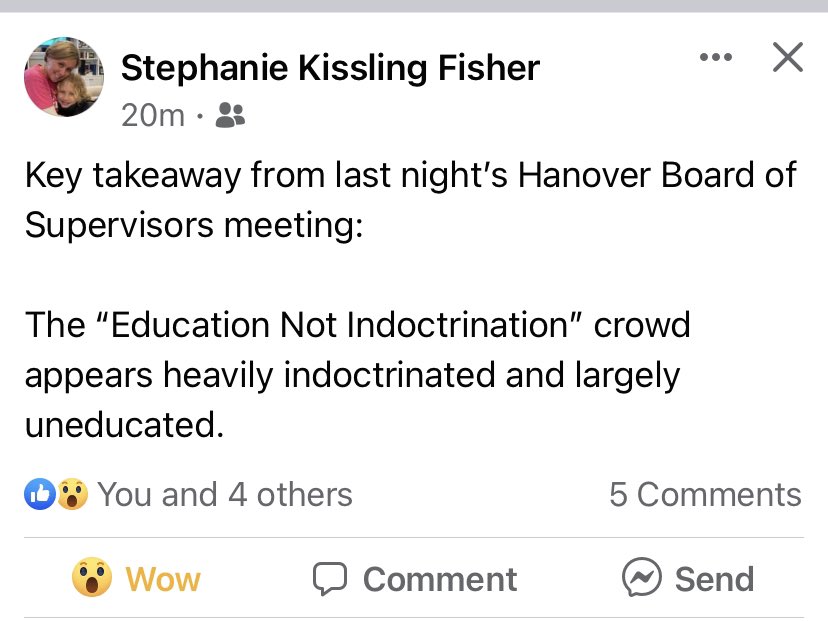
While Stephanie hits succinctly right at the heart of the irony surrounding the current push by Republicans to mandate educational gag orders, parental trigger bills, and a wide range of censorship for not only school and colleges but also throughout society, I want to highlight how the irony is a veneer for the Republican long game.

Many people have now exposed that the Republican use of “Critical Race Theory” is an orchestrated lie for larger political goals since their definitions of CRT are distortions and misinformation.

But what exactly is that end game?

First, let’s unpack the monumental irony in the “Education Not Indoctrination” claims of Republicans.

A related element of the anti-CRT movement is linking CRT to “Marxism” (itself a distortion bordering on a lie), but the more telling aspect of that connection is that Marxist and critical educators forefront a genuine and resolute rejection of indoctrination. As Joe Kincheloe details, seeking out and exposing those who indoctrinate is a “central tenet” of being critical:

Thus, proponents of critical pedagogy understand that every dimension of schooling and every form of educational practice are politically contested spaces. Shaped by history and challenged by a wide range of interest groups, educational practice is a fuzzy concept as it takes place in numerous settings, is shaped by a plethora of often-invisible forces, and can operate even in the name of democracy and justice to be totalitarian and oppressive….

Recognition of these educational politics suggests that teachers take a position and make it understandable to their students. They do not, however, have the right to impose these positions on their students. This is a central tenet of critical pedagogy.

In this context it is not the advocates of critical pedagogy who are most often guilty of impositional teaching but many of the mainstream critics themselves. When mainstream opponents of critical pedagogy promote the notion that all language and political behavior that oppose the dominant ideology are forms of indoctrination, they forget how experience is shaped by unequal forms of power. To refuse to name the forces that produce human suffering and exploitation is to take a position that supports oppression and powers that perpetuate it. The argument that any position opposing the actions of dominant power wielders is problematic. It is tantamount to saying that one who admits her oppositional political sentiments and makes them known to students is guilty of indoctrination, while one who hides her consent to dominant power and the status quo it has produced from her students is operating in an objective and neutral manner. Critical pedagogy wants to know who’s indoctrinating whom. (pp. 2, 11)

JOE KINCHELOE, CRITICAL PEDAGOGY PRIMER

Therefore, if an educator is leftist, Marxist, or critical, they are dedicated to not only seeking out and contesting anyone who indoctrinates, but also working continuously to avoid allowing their own teaching to devolve into indoctrination.

To indoctrinate is to be authoritarian (see Paulo Freire’s distinction between “authoritarian” and “authoritative” in the context of critical pedagogy).

Along with the foundational strategy of using lies and mischaracterized terms to advance a political agenda, Republicans also are guilty of projection: Almost everything Republicans attribute to the “Left” is what they actually do (Republicans decry a false specter of “cancel culture” while actually passing legislation that censors, cancels, and bans materials and ideas) or what they would do given the opportunity and the power.

And that leads to the end game.

To understand the Republican end game, you must address that “Education Not Indoctrination” is yet another Orwellian misdirection. Republicans are not anti-indoctrination; in fact, Republicans are actually seeking a world in which they completely control the indoctrinating.

In short, Kincheloe’s “who’s indoctrinating whom” can be addressed simply by acknowledging that given the opportunity and power (see legislation in Republican-led states) the “who” will always be Republicans and the “whom” will be the rest of us.

Republicans are organizing and enacting a broad campaign to create their dystopia, IndoctriNation.

They are counting on a common flaw in the U.S.: “The best lack all conviction, while the worst/Are full of passionate intensity” (“The Second Coming,” William Butler Yeats).
Gag Orders, Loyalty Oaths, and the New McCarthyism

Out of the rack and ruin of our gangster death,
The rape and rot of graft, and stealth, and lies,
We, the people, must redeem
The land, the mines, the plants, the rivers.

“Let America Be America Again,” Langston Hughes

An avalanche of gag order bills are being proposed in South Carolina—H.4325H.4343H.4392H.4605, and H.4799. While my home state of SC often likes to brag about being the first state to secede in order to maintain slavery (an uncomfortable fact many of these laws would ban from being taught), these bills represent the sort of crass copy-cat legislation that is also sweeping across other Republican-led states.

Not only is there nothing original in these bills (or even evidence-based or logical), but also there is a profoundly disturbing repetition of one of the lowest points in U.S. history—the New McCarthyism.

Let’s start with facts, which Republican legislation seeks to censor:

  • “Critical Race Theory” as it is mischaracterized by Republicans does not exist in K-12 schools.
  • CRT as properly defined (a scholarly theory created primarily by Black scholars for the the field of law and adapted in a few other fields such as education and sociology) does not exit in K-12 schools.
  • Systemic racism is a fact of the founding of the U.S. and a fact of the U.S. in 2022, supported by irrefutable evidence that defies simplistic explanations (such as individual racism).
  • Race is a social construct and not a matter of biology.
  • History is a living field for considering the facts of the past; there is no one true history.
  • Intellectual discomfort is often a necessary aspect of new learning when anyone must confront misconceptions or missing knowledge in order to better understand and navigate the world.

The gag orders such as those listed above in SC are blunt partisan politics driven by orchestrated lies that have nothing to do with protecting students or with teaching factual history or excellent literature/texts.

Curriculum and book censorship in 2022 is our New McCarthyism because the CRT veneer is being used to promote ideological agendas aimed at Black people and LGBTQ+ people.

The McCarthy Era, also known as the Red Scare, was confronted in The Crucible by Arthur Miller, who uses allegory to warn the U.S. at mid-twentieth century that McCarthy’s cries of “communism” were partisan lies similar to the Salem witch trials.

There were no witches.

There were no lists of communists.

There is no CRT poisoning U.S. schools.

Yet, in their extreme forms, some gag orders include requirements for loyalty oaths and mechanisms for withholding state funding for a decade. Even for private organizations.

The ultimate horror of these gag orders from Republicans is that by legislating censorship of what history and texts students are allowed to learn, we will be insuring the most damning of ideas about history itself—those who ignore history are doomed to repeat it, often the very worst of it.

Yesterday I saw the following Tweet about the Russia invasion of Ukraine:

While I endorse the sentiment, I have been watching for over a year while most of the U.S. fails to resist censorship right here in the so-called land of the free and home of the brave.

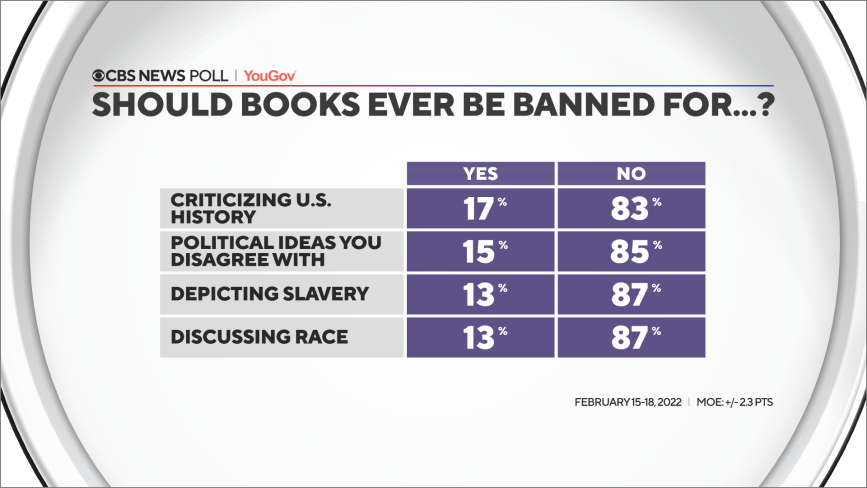
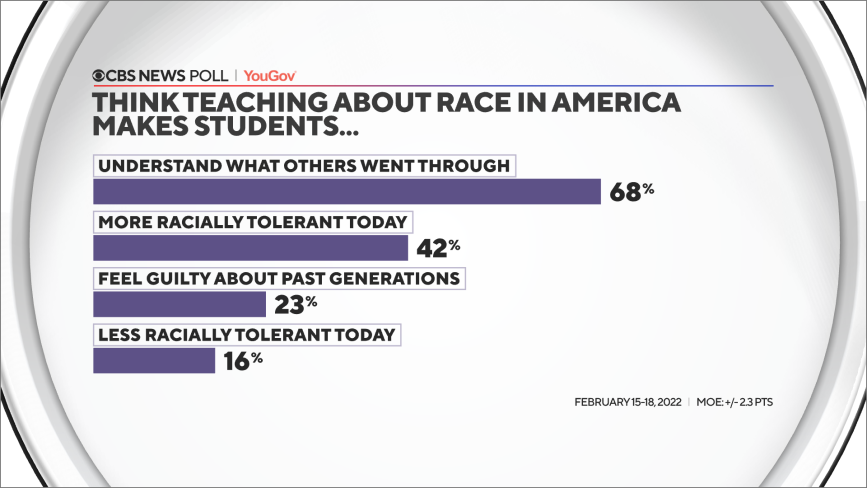
Republicans are running roughshod over freedom, pushing the U.S. toward banning abortion (despite a majority of Americans supporting maintaining Roe v. Wade) and enacting curriculum and book bans (despite large majorities of Americans rejecting censorship):

CBS news poll

Ultimately, gag orders, loyalty oaths, and censorship are un-American and anti-democratic, as ALAN notes in their Intellectual Freedom Statement:

We know that intellectual freedom is foundational to an educated citizenry and essential to the preservation and practice of democracy. We are dedicated to protecting this natural human right, and therefore, we insist on open access to all school reading materials for all students.

Intellectual Freedom Statement

The New McCarthyism exposes the Republican Party as a party of oppression, the exact sort of fact that should make everyone of us uncomfortable.


National Days of Teaching Truth to Power

Speaking at a recent hearing on yet another copy-cat bill in South Carolina to censor curriculum (targeting Critical Race Theory [CRT]), Dr. Susi Long, professor of early childhood education (University of South Carolina) offered a measured but pointed dismantling of the partisan misinformation in this legislation:

Not to oversimplify, but Long clarifies that CRT is not taught in K-12 (or even K-16) education, adding specifically that the laundry list of issues addressed in these bills are not how teachers teach or treat our students.

Last summer, I emphasized similar points, adding what does occur in schools in terms of race and equity. At one point, Long calmly suggests legislators should be learning from educators instead of legislating what teachers can and cannot teach, what students can and cannot learn.

One of the great ironies of efforts to ban CRT (beyond that CRT isn’t something taught in K-12 education) is that a key tenet of CRT is in order to overcome racism/inequity, everyone needs to be better educated, better informed—exactly what teachers offer students across the U.S.

Here, then, is my modest proposal: National days of teaching truth to power.

As a recent post of mine details, students and teachers are vividly aware of the rise in censorship as well as the potential negative consequences of those bans, such as self-censorship grounded in fear.

Will, for example, Paul Laurence Dunbar be erased from classrooms or will teachers be fired for honoring Dunbar’s voice that continues to resonate in 2022?:

“We Wear the Mask,” Paul Laurence Dunbar

Let’s identify days when we will target lessons and texts that are being misrepresented purely for political gain.

Lessons on race and racism, lessons on academic freedom and censorship, lessons on gender and sexuality—ultimately lessons one what it means to be educated in a country that claims to be free.

This semester I plan to dedicate a day in my courses to Langston Hughes’s “Let America Be America Again.”

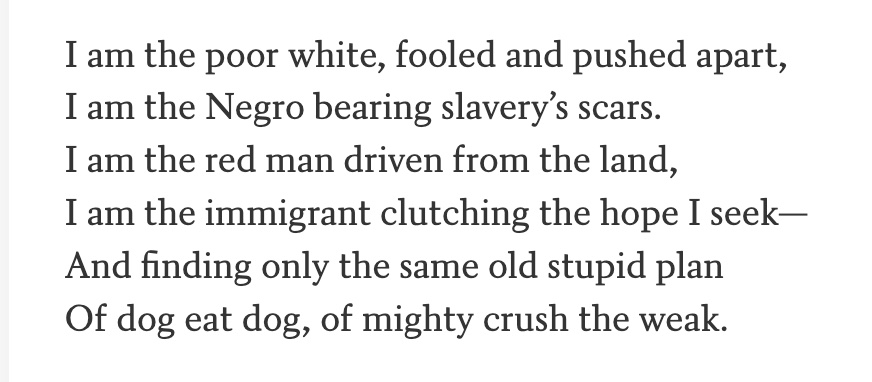
Like Dunbar’s poem reflecting the realities of being Black during Reconstruction and Jim Crow, Hughes creates a complex unpacking of many minoritized groups during the 1930s:

And Hughes also resonates today in his confronting of the failures of the American Dream, an ideal not yet realized even in 2022:

“The land that never has been yet” is facing us all now in the U.S. as Republicans are in denial and have turned to the antithesis of freedom, censorship, in order to cling to power.

As educators, as professionals charged with honoring the dignity of every student’s mind, we have only truth to break the cycle of oppressive power.

Teaching truth is the key. Can we do this, and do this now?

As James Baldwin implored, “[T]he time is always now.”

If you will join me, I will identify dates and lessons below, updating over the coming weeks with full lesson plans, texts being taught, etc.

[email: paul.thomas@furman.edu]


P.L. Thomas, Furman University

Lesson: “Let America Be America Again,” Langston Hughes

Date: TBD


Teaching in a Time of Conservative Tyranny

My spring 2022 schedule includes three classes, two sections of upper-level writing/research and one first-year writing seminar. During my second class today, while students were completing individual work before a class discussion, I scrolled through Twitter and found this:

I quickly Googled the poem, and decided to interject an impromptu mini-lesson between students completing the individual assignment and the class discussion.

Although I have been a teacher educator (and first-year writing professor) for twenty years now, I quickly put on my high school English teacher hat and conducted a lesson on Dunbar’s poem, reading it aloud and asking students questions along the way.

I repeated the lesson (also not on the schedule) in my third class, where students offered similar responses to the discussion.

Overwhelmingly, students identified the mask motif as an exploration of putting on an emotional front, noting, for example, the juxtaposition of “smile” and “cry” in the line “We smile, but, O great Christ, our cries.” (Interestingly, one student immediately contextualized the mask motif in the current Covid era.)

When I directly asked students to identify the “we,” most immediately spoke about a universality of the poem being about “society” or anyone who identifies with the speaker in the poem.

After walking through the poem (and confirming that students were not familiar with the poem or Dunbar), I pulled up the Wikipedia page on the poem to highlight that it had been published in 1895 and that Dunbar was a Black poet who was born during U.S. Reconstruction and published in the Jim Crow Era.

I then noted the poem is about Black people masking for white people—the core of Chanea Bond‘s Tweet and the student’s awareness that at least 4 out of 10 students in the U.S. are now being taught in states with educational gag orders, a growing list of state-level legislation being proposed and passed by Republicans from Florida to Virginia to Texas to Oklahoma to Indiana and anywhere Republicans have unlimited power.

These educational gag orders include curriculum bans (often directly and indirectly invoking Critical Race Theory), book/text bans, and so-call parental rights bills that allow any parent to trigger censorship or reprimanding a teacher. While this legislation is devastating to public institutions (K-16), some bills include potential fines for private schools who take any public funds.

Attacks on books have spread beyond assigned reading, classroom libraries, and school libraries to include public libraries as well.

This wave of gag orders and censorship has included violence and threats as well as overwhelmingly impacting Black texts and topics along with any writers or works that deal with LGBTQ+ topics or experiences.

The mask being used to hide the racism and bigotry of these complaints and legislation is an insincere claim that student discomfort must be curtailed.

Some of the most extreme versions of gag order bills include requirements that teachers provide a year of lesson plans before the academic year in order for parents and others to review and approve them.

First, let me confront that last point; my impromptu lesson today was one of the best I have done in recent memory. Students were engaged, and I watched in real time as my students confronted ideas, as my students learned and became different people than when they walked into class today.

While lesson plans are important, they simply are not as valuable as being prepared to teach, and being prepared to engage with your students; a fundamental misunderstanding about teaching is that (as these gag orders and parental rights bills reveal) too many people think the job of the teacher is to transfer knowledge/content to students.

As most any teacher will tell you, we teach students—not lessons, not history or English or even The Great Gatsby.

As students and as future educators, my students today needed and deserved the lesson that came from a teacher’s Tweet. They also benefitted from a brief experience with how to read and engage with poetry along with the tyranny of partisan politics that is shutting the door on their lives as free individuals.

But my impromptu lesson today grounded in a text that may soon be banned from classrooms exposes the catastrophic misunderstanding of texts. Not a single student today recognized the powerful racial message intended by Dunbar because those students lacked historical and literacy context that is already missing from their formal education without the educational gag orders.

As I have stressed during this manufactured outrage from the Right, traditional education is already incredibly conservative.

Reading Dunbar’s poem, in fact, for its universal appeal strips it of its radical power—and cheats students from confronting the historical realities of Reconstruction and Jim Crow for Black Americans.

In 2022, students, teachers, teaching/learning, and academic freedom are under assault by conservative tyranny. There is nothing American or noble about censorship.

“A mind is a terrible thing to waste” is a seven-decades long slogan of the UNCF, and with the greatest of ironies, it now seems a central goal of Republicans to insure all minds are wasted.

Bond’s student is our canary in a coal mine, and soon, every classroom may be just as dangerous, literally, as a coal mine if we refuse to heed that student’s concern.

Just in Time: Wonder Woman Historia: The Amazons

[See repost: Wonder Woman Historia: The Amazons…arrives just in time]

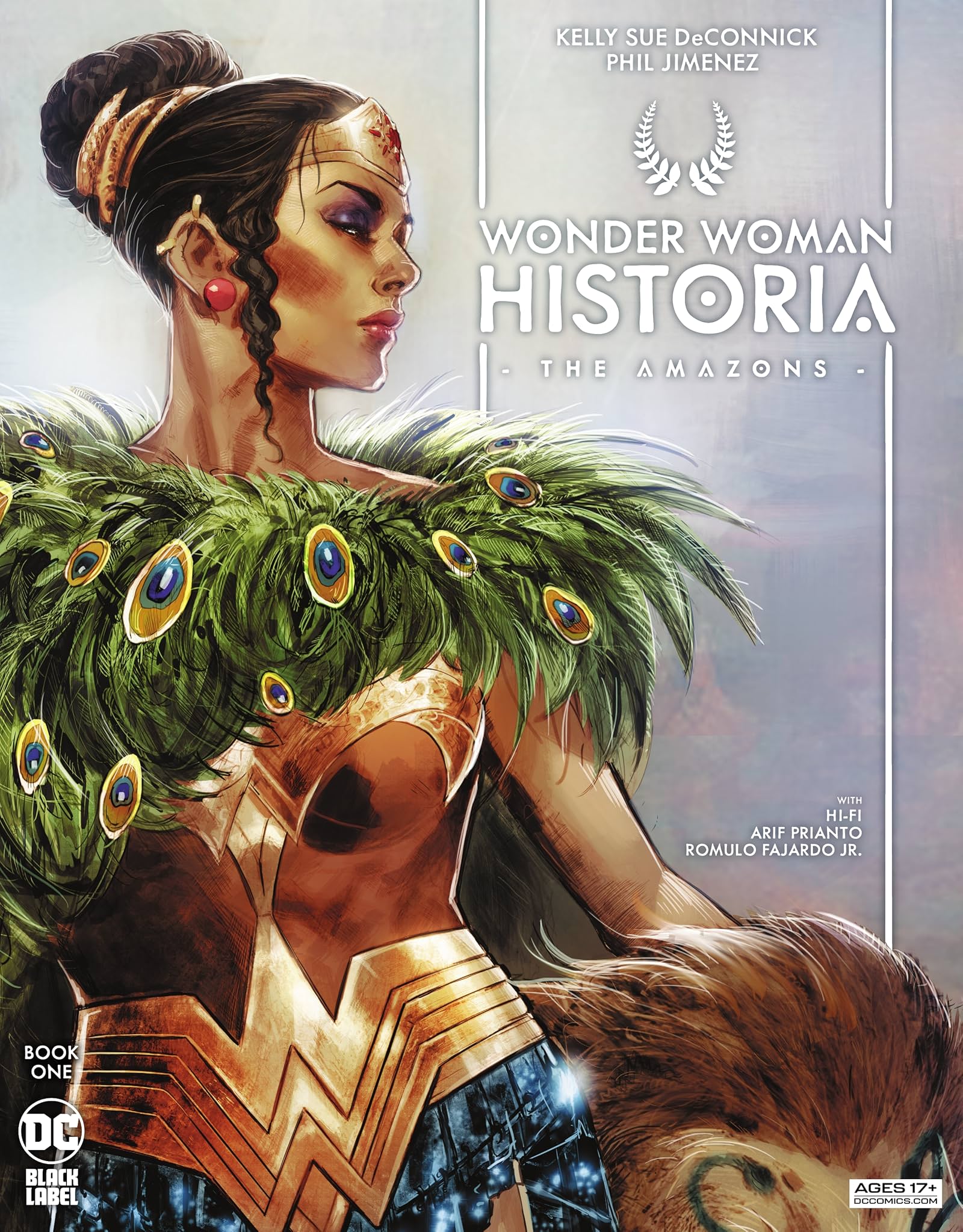
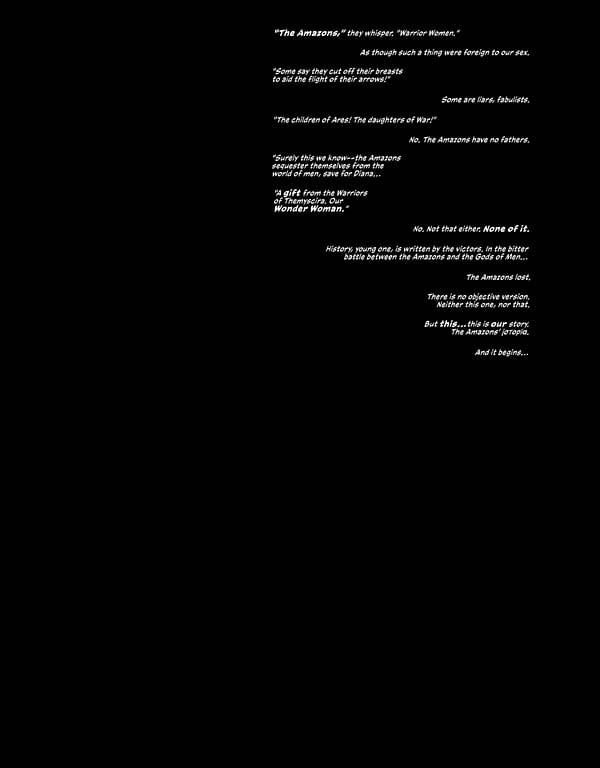
The oversized format and stunning cover by Phil Jimenez and Romulo Fajardo Jr. suggest something special from DC Black Label, but the black text-only first page signals Kelly Sue DeConnick’s Wonder Woman Historia: The Amazons has arrived just in time:

Wonder Woman Historia: The Amazons (2021-) #1 - Comics by comiXology
Interior preview page from WONDER WOMAN HISTORIA THE AMAZONS #1 (OF 3) CVR A PHIL JIMENEZ (MR)

Available December 1, 2021, Historia Book One on its first page speaks into a darkness begun in the waning days of the Trump administration, a ham-fisted attack on the 1619 Project that has escalated into state-level legislation by Republicans across the U.S. banning books and canceling the teaching of history.

The “Some say…” reply of “Some are liars, fabulists” can be read as a critique of the Trump-poisoned Right today. But the most powerful lines speak to the exact source of why conservatives in 2021 are seeking to control what children are taught and how, echoing the essence of Critical Race Theory and vilified historians such as Howard Zinn:

History, young one, is written by the victors. In the bitter battle between the Amazons and the Gods of Men…

The Amazons lost.

There is no objective version. Neither this one, nor that.

But this…this is our story.

Wonder Woman Historia: The Amazons (Book One)

The creative team of DeConnick (writer); Jimenez (artist); Hi-Fi, Arif Prianto, and Fajardo (colorists); and Clayton Cowles (letterer) remind me of J.H. Williams III and Kelly Thompson’s run on Black Widow—although in many ways, Historia proves to be dramatically unique.

Occasionally calling a work a feminist read on a topic can seem reductive, or insubstantial—how many feminist reads [1] has there been of Wonder Woman?—but in a world darkened by censorship and the looming threat of overturning women’s reproductive rights nearly 50 years after Roe v. Wade, a feminist manifesto is not just in time, but essential.

“For the Institutions of Men Care Not for the Weal of Women“: Just in Time?

After a beautifully rendered introduction of Goddesses, the narrator admits, “The subjugations and abuses of not-men by men are too numerous to catalog in a library…let alone a book.”

This powerful refrain not only sets the focus of Historia, but carries an eerie weight in a time of book censorship—books ripped from classrooms and libraries, school board members calling for book burnings—as well as the threat of of the State denying women reproductive rights, “the subjugations and abuses of not-men by men” and the women who do men’s bidding.

Next, an admission more sober: “For the institutions of men care not for the weal of women. You don’t have to be the Queen of Gods to recognize injustice.”

Book One moves from introduction to an exchange between Hera and Zeus, where Hera requests the elimination of not humankind but all men.

“The history of men is a chronicle of crimes against women,” Hera proclaims to protestations that history too includes “tales of love and beauty,” followed by:

“Herodotus 1.93. Every daughter of Lydia will work as a prostitute until she has raised sufficient money for a dowry and can secure a husband.”

Wonder Woman Historia: The Amazons (Book One)

To which, Aphrodite counters:

The indignity lies not in the commerce of love, goat…

…but in the irony of whoring yourself to many to earn the privilege of whoring yourself to one.

Wonder Woman Historia: The Amazons (Book One)

The arguments are an excellent dramatization of concepts such as justice as well as privilege. Hera, indignant, asks, “Do you mean to suggest that women have done something to deserve this station?” Zeus concedes, condescendingly, “You’ve made your point, girls. Women do suffer—historically and undeniably—at the hands of men. But their world is not justice.”

Finally, the main narrative of Book One focuses on childbirth and vividly portrays Hera’s protestations—in short, “Hell is a state of being,” and we can add for women.

An unwanted girl is birthed, an excessively bloody event confirming:

In every birth, there is risk and pain. This is true of creatures, ideas, and tragedies.

Mortal births are particularly gruesome. They enter the world unprotected, screaming, suited for inevitable suffering.

Wonder Woman Historia: The Amazons (Book One)

But the birth itself is not the only “pain”; Hippolyta is tasked with discarding the unwanted baby girl.

DC First Look: Wonder Woman Historia: The Amazons • AIPT

After leaving the baby in the river—”‘The Gods will decide, as they decide the fates of us all. They will choose wisely. Yes.'”—Hippolyta balks on that faith and runs until collapsing in hopes of saving the child.

This tale of the burden of women and the inescapable fate of women as self-sacrificing builds to her being saved by the Amazons, setting up Book Two in a dramatic final page:

Wonder Woman Historia: The Amazons review: Every page of DC's comic is epic  - Polygon

Historia is beautiful and compelling as another contribution to the long history of Wonder Woman, but this is a work that speaks to “not-men” and “men” in the U.S. during the final month of 2021. It is a call to confront the “the institutions of men [that] care not for the weal of women.”

Just in time?


[1] Thomas, P.L. (2018). Wonder Woman: Reading and teaching feminism with an Amazonian princess in an era of Jessica Jones. In S. Eckard (ed.), Comic connections: Reflecting on women in popular culture (pp. 21-37). New York, NY: Rowman and Littlefield.

Freedom and the Politics of Canceling Teachers and Curriculum

By mid-December of 2021, Matthew Hawn, a former teacher in Tennessee, will once again have his appeal heard after being fired for violating the state’s restrictions on curriculum:

The Tennessee General Assembly has banned the teaching of critical race theory, passing a law at the very end of the legislative session to withhold funding from public schools that teach about white privilege.

Republicans in the House made the legislation a last-minute priority, introducing provisions that ban schools from instructing students that one race bears responsibility for the past actions against another, that the United States is fundamentally racist or that a person is inherently privileged or oppressive due to their race.

Tennessee bans public schools from teaching critical race theory amid national debate, Natalie Allison

As Allison reported in May, several states across the U.S. have filed or passed copy-cat legislation aimed at banning the teaching of Critical Race Theory.

By October and November, the consequences of Tennessee’s law have moved from silencing and canceling teachers to attempts to cancel curriculum [1]:

The Tennessee Department of Education recently declined to investigate a complaint filed under a new state law prohibiting the teaching of certain topics regarding race and bias.

The complaint, the first directed to the state under the new law passed this spring, was filed by Robin Steenman, chair of the Moms for Liberty Williamson County chapter, a conservative parent group sweeping the nation. 

The 11-page complaint alleged that the literacy curriculum, Wit and Wisdom, used by Williamson County Schools and at least 30 other districts, has a “heavily biased agenda” that makes children “hate their country, each other and/or themselves.”

Tennessee Department of Education rejects complaint filed under anti-critical race theory law, Meghan Mangrum

Although the complaint was rejected, Mangrum noted, “The group detailed concerns with four specific books on subjects like the Rev. Martin Luther King Jr.’s March on Washington, the integration of California schools by advocate Sylvia Mendez and her family, and the autobiography of Ruby Bridges, adapted for younger learners.”

A teacher fired for teaching Ta-Nehisi Coates, parents calling for bans on MLK and teaching about Ruby Bridges—these events are not unique to Tennessee, but they reflect a pattern of efforts to control not only teachers, but what students are allowed to learn and read.

Notable in these examples is that many of the consequences of legislation are canceling Black writers and key aspects of Black history; additionally, legislation and calls for book banning are targeting LGBTQ+ writers and topics.

Teaching and curriculum in the U.S. are being systematically and politically whitewashed.

One aspect not being addressed often is that political dynamic. Parents, political activists, and politicians are impacting who teaches and what is being taught in the context of a historical and current demand that teachers themselves remain apolitical, both in their classrooms and their lives beyond school.

As I have discussed often, teaching is necessarily political, and teaching as well as writing are necessarily types of activism.

For teachers, then, we must recognize that calls for teachers to be objective, neutral, and apolitical are themselves political acts. Currently, laws being passed and parents/activists confronting school boards are exercising their political power at the expense of teachers and schools—both of which are required to remain somehow politically neutral.

From historian/activist Howard Zinn to critical scholars such as Joe Kincheloe and to poet Adrienne Rich, we have ample evidence that taking a neutral stance is a political act that passively endorses the status quo and that silencing words is an act of canceling thought, eradicating ideas.

Zinn’s commitment to transparency as a teacher and activist is hauntingly relevant to the current political attack on teachers and curriculum:

This mixing of activism and teaching, this insistence that education cannot be neutral on the critical issues of our time, this movement back and forth from the classroom to the struggles outside by teachers who hope their students will do the same, has always frightened the guardians of traditional education. They prefer that education simply prepare the new generation to take its proper place in the old order, not to question that order [emphasis added]….

From the start, my teaching was infused with my own history. I would try to be fair to other points of view, but I wanted more than “objectivity”; I wanted students to leave my classes not just better informed, but more prepared to relinquish the safety of silence, more prepared to speak up, to act against injustice wherever they saw it. This, of course, was a recipe for trouble.

You Can’t Be Neutral on a Moving Train: A Personal History of Our Times, Howard Zinn

And Kincheloe confronted not only who is actually indoctrinating students but the imperative that teachers recognize teaching as inherently political:

Thus, proponents of critical pedagogy understand that every dimension of schooling and every form of educational practice are politically contested spaces. Shaped by history and challenged by a wide range of interest groups, educational practice is a fuzzy concept as it takes place in numerous settings, is shaped by a plethora of often-invisible forces, and can operate even in the name of democracy and justice to be totalitarian and oppressive [emphasis added].

Critical Pedagogy Primer, Joe L. Kincheloe

The great irony is that critical educators (often smeared as “Marxists”) are committed, as Kincheloe asserts, to a foundational concern: “Critical pedagogy wants to know who’s indoctrinating whom.”

The Orwellian named “Moms for LIberty,” then, by calling for canceling curriculum are in fact being “totalitarian and oppressive,” calling for not education, but indoctrination. To ban words and ideas is to ban the possibility of thinking, of learning:

The study of silence has long engrossed me. The matrix of a poet’s work consists not only of what is there [emphasis in original] to be absorbed and worked on, but also of what is missing, desaparecido [emphasis in original], rendered unspeakable, thus unthinkable.

Arts of the Possible, Adrienne Rich

A final powerful point is that many of these political acts to silence teachers and cancel curriculum are occurring in right-to-work states controlled by Republicans. Teachers not only are expected to be neutral, objective, and apolitical, but also work with a distinct awareness they have almost no job security.

Hawn fired in Tennessee simply taught a text and now is fighting for his career; the text in most ways just a year ago was considered non-controversial and even celebrated as Coates had attained recognition as one of the country’s leading Black voices.

During this holiday season at the end of 2021, teachers honestly have no decision about whether or not to be political. We are faced with only two political choices: conform to the demand that we take a neutral pose, resulting in endorsing whatever status quo legislators and parents/activist impose on schools; or recognize and embrace the essential political nature of being a teacher by actively opposing efforts to cancel teachers and curriculum.


[1] Twitter thread:

Banning Books Is Un-American

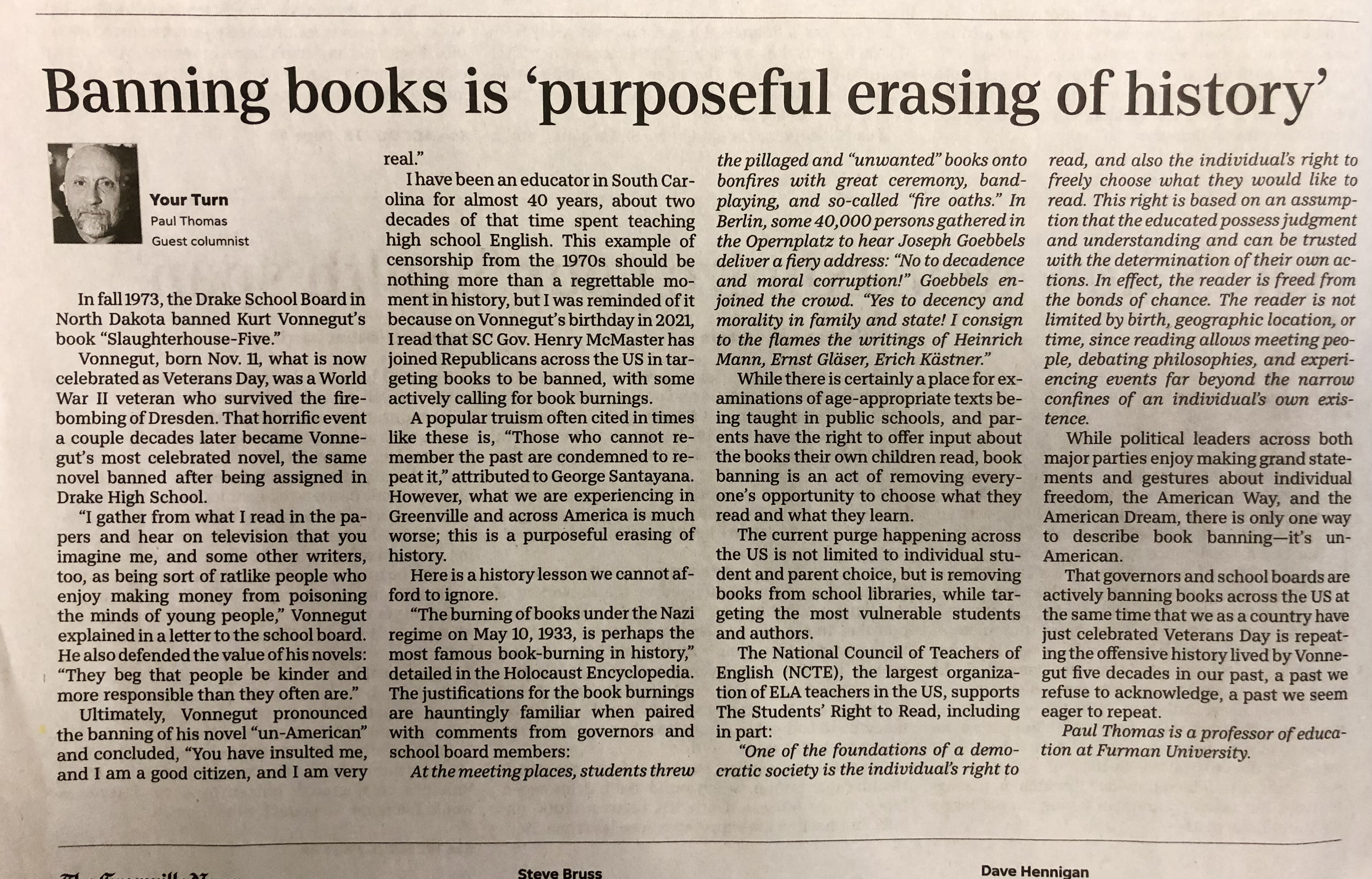
[Update: Published at the Greenville News (SC); see PDF at end of post with hyperlinks]

person holding Ray Bradbury book
Photo by Will Porada on Unsplash

In the fall of 1973, the Drake School Board in North Dakota banned Kurt Vonnegut’s Slaughterhouse-Five.

Vonnegut, born November 11, what is now celebrated as Veterans Day, was a World War II veteran who survived the firebombing of Dresden. That horrific event a couple decades later became Vonnegut’s most celebrated novel, the same novel banned after being assigned in Drake High School.

“I gather from what I read in the papers and hear on television that you imagine me, and some other writers, too, as being sort of ratlike people who enjoy making money from poisoning the minds of young people,” Vonnegut explained in a letter to the school board. There he also defended the value of his novels: “They beg that people be kinder and more responsible than they often are.”

Ultimately, Vonnegut pronounced the banning of his novel “un-American” and concluded, “you have insulted me, and I am a good citizen, and I am very real.”

I have been an educator in South Carolina for almost 40 years, about two decades of that time spent teaching high school English. This example of censorship from the 1970s should be nothing more than a regrettable moment in history, but I was reminded of it because on Vonnegut’s birthday in 2021 I read that SC Governor Henry McMaster has joined Republicans across the U.S. who are not only banning books, but actively calling for book burnings.

A popular truism often cited in times like these is “Those who cannot remember the past are condemned to repeat it,” attributed to George Santayana. However, what we are experiencing in Greenville, SC and across America is much worse; this is a purposeful erasing of history.

Here is a history lesson we cannot afford to ignore.

“The burning of books under the Nazi regime on May 10, 1933, is perhaps the most famous book burning in history,” detailed at the Holocaust Encyclopedia. The justifications for the book burnings are hauntingly familiar when paired with comments from governors and school board members:

At the meeting places, students threw the pillaged and “unwanted” books onto bonfires with great ceremony, band-playing, and so-called “fire oaths.” In Berlin, some 40,000 persons gathered in the Opernplatz to hear Joseph Goebbels deliver a fiery address: “No to decadence and moral corruption!” Goebbels enjoined the crowd. “Yes to decency and morality in family and state! I consign to the flames the writings of Heinrich Mann, Ernst Gläser, Erich Kästner.”

Holocaust Encyclopedia

While there is certainly a place for examinations of age-appropriate texts being taught in public schools, and parents have the right to offer input about the books their own children read, book banning is an act of removing everyone’s opportunity to choose what they read and what they learn.

The current purge happening across the U.S. is not limited to individual student and parent choice, but banning books from school libraries, while targeting the most vulnerable students and authors.

The National Council of Teachers of English (NCTE), the largest organization of ELA teachers in the U.S., supports The Students’ Right to Read, including in part:

One of the foundations of a democratic society is the individual’s right to read, and also the individual’s right to freely choose what they would like to read. This right is based on an assumption that the educated possess judgment and understanding and can be trusted with the determination of their own actions. In effect, the reader is freed from the bonds of chance. The reader is not limited by birth, geographic location, or time, since reading allows meeting people, debating philosophies, and experiencing events far beyond the narrow confines of an individual’s own existence.

The Students’ Right to Read (NCTE, 2018)

While political leaders across both major parties enjoy making grand statements and gestures about individual freedom, the American Way, and the American Dream, there is only one way to describe book banning—un-American.

That governors and school boards are actively banning books across the U.S. at the same time that we as a country were celebrating Veterans Day is repeating the offensive history lived by Vonnegut five decades in our past, a past we refuse to acknowledge, a past we seem eager to repeat.

Greenville News (SC) 5 December 2021

Censorship and Book Burning: A Reader [Updated]

UPDATE: Efforts to Ban Critical Race Theory Now Restrict Teaching for a Third of America’s Kids (Education Week)

See the report: The Conflict Campaign (UCLA)

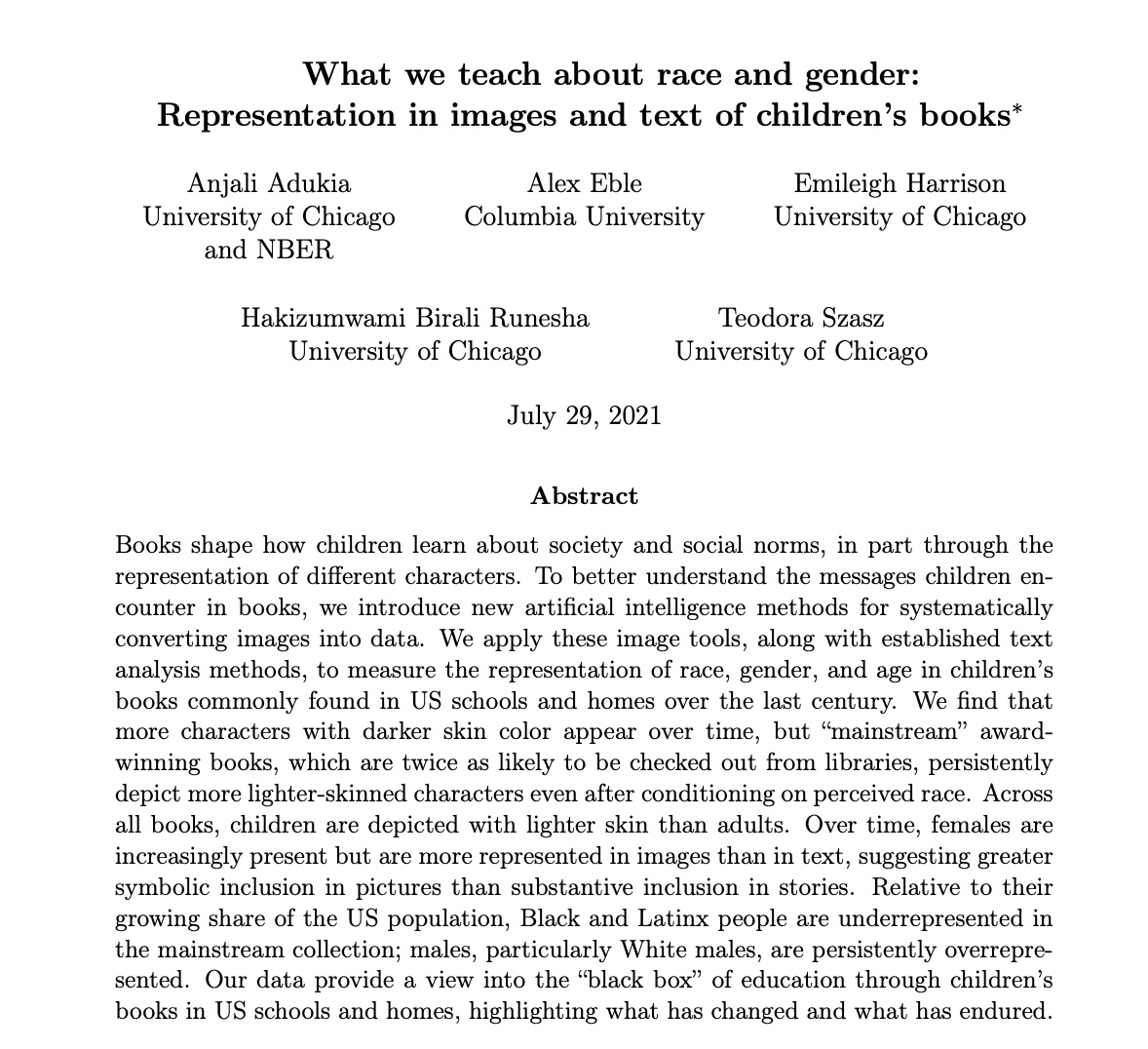
Note: See re: why resisting censorship, especially as banning disproportionately impacts diverse authors and texts: What we teach about race and gender: Representation in images and text of children’s books:

The fall of 2021 has seen a surge in book banning and even calls for book burnings. See below for the increased number of cases and why we should all resist:

Resources

[Update]

[Update – Tennessee]

“Moms For Liberty” says book about MLK violates new law banning CRT in Tennessee


Banned in the U.S.A. Redux 2021: “[T]o behave as educated persons would”

Should South Carolina Ban Critical Race Theory and the 1619 Project?

“Fahrenheit 451” 60 Years Later: “Why do we need the things in books?”

The 451 App (22 August 2022)

Banned in the U.S.A. Redux 2021: “[T]o behave as educated persons would”

We know of course there’s really no such thing as the ‘voiceless’. There are only the deliberately silenced, or the preferably unheard.

–  Arundhati Roy

The matrix of a poet’s work consists not only of what is there to be absorbed and worked on, but also of what is missing, desaparecido, rendered unspeakable, thus unthinkable. It is through these invisible holes in reality that poetry makes it way—certainly for women and other marginalized subjects and for disempowered and colonized peoples generally, but ultimately for all who practice art at any deep levels. The impulse to create begins—often terribly and fearfully—in a tunnel of silence.

“Arts of the Possible,” Adrienne Rich

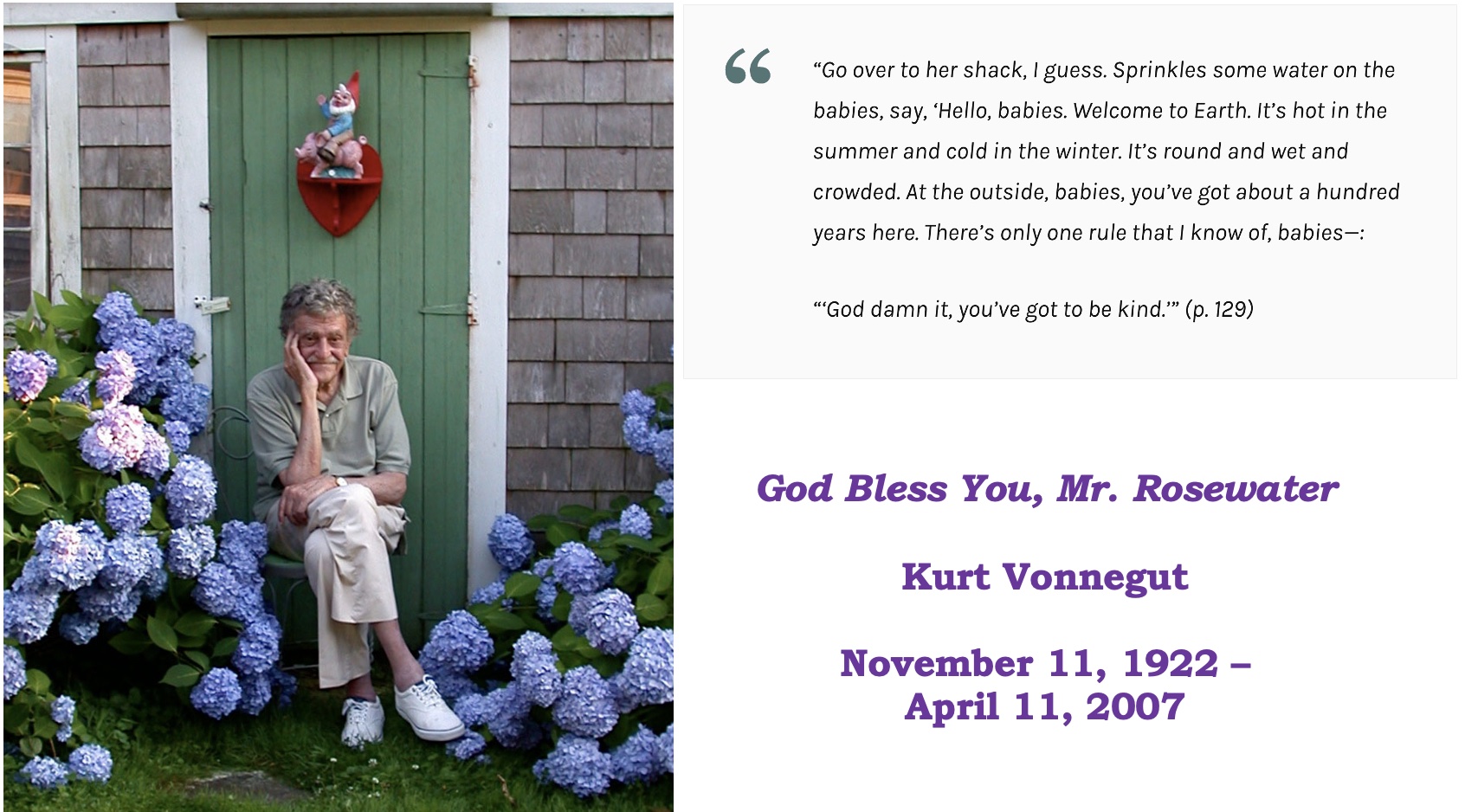
It is the morning of November 11, 2021, and I spend some of that time creating gentle memes to post in honor of Kurt Vonnegut’s day of birth:

I wanted to highlight Vonnegut’s career-long plea for a secular kindness, rooted in his faith in humanism, and I have long admired Vonnegut as an anti-war crusader.

Celebrating the birthday of a person after their death is always bittersweet, but on this morning, the act was awash in a very ugly sort of irony. As I loaded The State (Columbia, SC) web page, I saw this as the lead story:

My home state of South Carolina is heavily conservative—first to secede and uniformly conservative in politics throughout the decades of Democratic control of the South and then Republican in the wake of Strom Thurmond changing parties and later Ronald Reagan leading a conservative Christian shift in the South.

Gov. McMaster is not often “first to” about anything, but he is an uncritical and resolute soldier in the Republican culture war regardless of what that means.

Vonnegut—while alive and since his death—has often had his works challenged and even banned; one of the most enduring things he ever wrote, in fact, was a response to censorship:

In October of 1973, Bruce Severy — a 26-year-old English teacher at Drake High School, North Dakota — decided to use Kurt Vonnegut‘s novel, Slaughterhouse-Five, as a teaching aid in his classroom. The next month, on November 7th, the head of the school board, Charles McCarthy, demanded that all 32 copies be burned in the school’s furnace as a result of its “obscene language.” Other books soon met with the same fate. On the 16th of November, Kurt Vonnegut sent McCarthy the following letter. He didn’t receive a reply.

Letters of Note

In part, Vonnegut replied as follows:

Certain members of your community have suggested that my work is evil. This is extraordinarily insulting to me. The news from Drake indicates to me that books and writers are very unreal to you people. I am writing this letter to let you know how real I am.

I want you to know, too, that my publisher and I have done absolutely nothing to exploit the disgusting news from Drake. We are not clapping each other on the back, crowing about all the books we will sell because of the news. We have declined to go on television, have written no fiery letters to editorial pages, have granted no lengthy interviews. We are angered and sickened and saddened. And no copies of this letter have been sent to anybody else. You now hold the only copy in your hands. It is a strictly private letter from me to the people of Drake, who have done so much to damage my reputation in the eyes of their children and then in the eyes of the world. Do you have the courage and ordinary decency to show this letter to the people, or will it, too, be consigned to the fires of your furnace?…

If you were to bother to read my books, to behave as educated persons would, you would learn that they are not sexy, and do not argue in favor of wildness of any kind. They beg that people be kinder and more responsible than they often are. It is true that some of the characters speak coarsely. That is because people speak coarsely in real life. Especially soldiers and hardworking men speak coarsely, and even our most sheltered children know that. And we all know, too, that those words really don’t damage children much. They didn’t damage us when we were young. It was evil deeds and lying that hurt us….

If you are an American, you must allow all ideas to circulate freely in your community, not merely your own.

I am very real, Kurt Vonnegut, November 16, 1973

Reading about the censorship wildfire spreading to SC on Vonnegut’s birthday adds insult to injury, but this is not mere partisan politics, not something as innocuous or abstract as a “culture war.”

Just as Vonnegut ends his letter with “I am very real,” I want to stress that the missionary zeal behind removing and burning books from school libraries is also “very real”:

Calls for censorship, book removal from school libraries, and book burning are the logical next step in the Republican/conservative assault on Critical Race Theory and the 1619 Project; at the core of this movement is a misguided demand for parental rights that grows beyond any parents’ children to all children.

Some parents and political leaders on the Right have mistaken Ray Bradbury’s Fahrenheit 451 as a manual for partisan politics instead of, as Neil Gaiman (born a day before Vonnegut 38 years later) explains in the 60th anniversary edition of the novel:

This is a book of warning. It is a reminder that what we have is valuable, and that sometimes we take what we value for granted….

People think—wrongly—that speculative fiction is about predicting the future, but it isn’t; or if it is, it tends to do a rotten job of it….

What speculative fiction is really good at is not the future but the present—taking an aspect of it that troubles or is dangerous, and extending and extrapolating that aspect into something that allows the people of that time to see what they are doing from a different angle and from a different place. It’s cautionary.

Fahrenheit 451 is speculative fiction. It’s an “If this goes on…” story. Ray Bradbury was writing about his present, which is our past.

Introduction, Fahrenheit 451, Neil Gaiman

In my early days as a public high school English teacher, I had a book challenge targeting John Gardner’s Grendel, but it was clearly mostly about attacking me as a young teacher. While I think we are careless and even cavalier in the U.S. about any parents’ right to control what their children read and learn, I experienced first-hand the power of a few parents to determine what all students read and learn.

I must return to Vonnegut here and stress, “If you are an American, you must allow all ideas to circulate freely in your community, not merely your own.”

Removing books from libraries, banning books from schools, and book burnings are never justified; these are acts of tyranny, of fascism—and not in any way a gesture of what we like to call “American.”

There is no individual freedom without the freedom of the mind. Banning a book is closing the mind.

In Athens-based R.E.M.’s “Its the End of the World as We Know It (And I Feel Fine),” the lyrics include a verse that is haunting in 2021:

Six o’clock, TV hour, don’t get caught in foreign tower
Slash and burn, return, listen to yourself churn
Lock him in uniform, book burning, blood letting
Every motive escalate, automotive incinerate
Light a candle, light a votive, step down, step down
Watch your heel crush, crushed, uh-oh
This means no fear, cavalier renegade and steering clear
A tournament, a tournament, a tournament of lies
Offer me solutions, offer me alternatives, and I decline

“Its the End of the World as We Know It (And I Feel Fine)”

The Republican assault on teaching, learning, reading, and thinking is nothing more than a “tournament of lies” aimed at partisan political power.

Simply put, censorship and book burning are UnAmerican; to ban a book is to dismantle the American Dream.


Resources

Statement on Censorship and Professional Guidelines (NCTE)

Guidelines for Dealing with Censorship of Instructional Materials (NCTE)

NCTE Intellectual Freedom Center

The Students’ Right to Read (NCTE)

See Also

The 451 App (22 August 2022)

Teen’s Eyes Begin Glowing Red While Reciting Forbidden Knowledge From Book On Critical Race Theory