Category Archives: CCSS

What We Know (and Ignore) about Standards, Achievement, and Equity

Calling for, establishing, and implementing high (or higher) standards has been a part of U.S. public education at least since the 1890s when the Committee of Ten called for higher standards for high schools to prepare students for college.

The more recent accountability era built on standards (and multiple versions of revised standards) and high-stakes tests (and multiple versions of those tests) began in the 1980s.

Common Core as a reform initiative is a federalization, then, of that state-based accountability paradigm; there is noting in the Common Core initiative that distinguishes it from the state-based approach except for unsubstantiated and untested claims that the standards and tests are superior to the state versions.

Since we have had a standards-based accountability system for three decades, we have ample evidence of the relationship between the presence and quality of standards and their impact on achievement and equity.

In Research-based options for education policymaking, Mathis (2012) highlights what we know about standards, achievement, and equity.

First, Mathis notes the larger context of Common Core and their potential for reform:

The actual effect of the CCSS, however, will depend much less on the standards themselves than on how they are used. Two factors are particularly crucial. The first is whether states invest in the necessary curricular and instructional resources and supports, and the second concerns the nature and use of CCSS assessments developed by the two national testing consortia. (1 of 5)

Key here are several important points: (1) Common Core standards are not and cannot be separated from implementation or the related high-stakes tests, and (2) nothing in the Common Core initiate guarantees that implementation and testing will be any different than what has occurred over the previous thirty years of state-based accountability.

Currently, we already know some things about implementation and testing related to Common Core:

  • Every state adopting Common Core is also using high-stakes tests, committing to either of two companies charged with creating those tests. There is no mechanism in the Common Core initiative to insure that the standards will not become “what is tested is what is taught”—which is exactly what did happen to all standards at the state levels, which is what must happen when any set of standards are linked to high-stakes tests and punitive consequences for that data.
  • Despite calls for a need to have a common set of standards for the entire nation (a call that has never been verified by evidence), the Common Core is being implemented in a wide variety of ways across the states. If “common” is really our goal (and I suspect it isn’t a worthy goal), it is not happening—even with the tests since they come from two different companies.
  • Common Core implementation is costing states millions and even billions of dollars—with no evidence of their quality, no vetting by educators, no guarantee that this version of standards and tests will be any less a failure than the ones that have come before.

So what do we know about standards and achievement?:

There is, for example, no evidence that states within the U.S. score higher or lower on the NAEP based on the rigor of their state standards. [4] Similarly, international test data show no pronounced tests core advantage on the basis of the presence or absence of national standards. [5] Further, the wave of high-stakes testing associated with No Child Left Behind (NCLB) has resulted in the “dumbing down” and narrowing of the curriculum. [6]

It bears emphasizing that there is no correlation between the presence or quality of standards and student achievement, and that high-stakes testing has created a dynamic in which we ask less of students not more.

At the very least, Common Core implementation should not move forward until clear mechanisms are in place to insure that this round of standards and testing does not replicate the history of standards and testing so far.

As of now, no such guarantees exist. None.

So what do we know about standards and equity?:

As the absence or presence of rigorous or national standards says nothing about equity, educational quality, or the provision of adequate educational services, there is no reason to expect CCSS or any other standards initiative to be an effective educational reform by itself. [13]

As I have noted above about no safeguards that Common Core and the related tests will impact achievement any differently than all the other standards and tests before, there is absolutely nothing in the Common Core initiative that addresses equity—which remains the greatest problem facing education, school, and teacher impact on student achievement.

With Common Core, African American, Latino/a, and impoverished students will continue to be disproportionately funneled into test-prep courses with high student-teacher ratios and inexperienced as well as un-/under-certified teachers

With Common Core, African American and Latino boys will continue to be disproportionately suspended and expelled.

With Common Core, African American, Latino/a, and impoverished students will continue to be disproportionately blocked from advanced courses.

Standards-based reform has never and will never address equity. Common Core is no different.

Since Common Core as a reform initiative in no way offers solutions to identifiable problems with student achievement and equity, we must stop that train, get off, and try something new.

Some are calling for a pause button. I urge delete.

Notes (retaining original report numbering)

[4] Whitehurst, G, (2009, October 14). Don’t forget curriculum. Brown Center Letters on Education, #3, 6. Washington, DC: Brown Center on Education Policy, Brookings Institution. Retrieved February 11, 2010, from http://www.brookings.edu/papers/2009/1014_curriculum_whitehurst.aspx/

Bandeira de Mello, V. D., Blankenship, C., & McLaughlin D. (2009, October). Mapping state proficiencies onto NAEP scales: 2005-2007. Washington, DC: U.S. Department of Education, National Center for Education Statistics. Retrieved March 20, 2010, from http://nces.ed.gov/nationsreportcard/pubs/studies/2010456.asp/

[5] Kohn, A. (2010, January 14). Debunking the case for national standards: one size fits all mandates and their dangers. Retrieved January 13, 2010, from http://www.alfiekohn.org/teaching/edweek/national.htm/

McCluskey, N. (2010, February 17). Behind the curtain: Assessing the case for national curriculum standards, Policy analysis 66. Washington: CATO Institute. Retrieved February 18, 2010, from http://www.cato.org/pub_display.php?pub_id=11217/

[6] Robelen, E. (December 8, 2011) Most teachers see the curriculum narrowing, survey finds (blog post). EdWeekOnline. Retrieved October 2, 2012, from http://blogs.edweek.org/edweek/curriculum/2011/12/most_teachers_see_the_curricul.html/

Wisconsin Center for Educational Research. (1999, Fall). Are state-level standards and assessments aligned? WCER Highlights, 1–3. Madison, WI: Author.

Amrein, A. & Berliner, D. (2002). High-stakes testing, uncertainty, and student learning. Education Policy Analysis Archives, 10(18). Retrieved October 4, 2012, from http://epaa.asu.edu/epaa/v10n18

Shepard, L. (2000). The role of assessment in a learning culture. Educational Researcher, 29(7), 4–14.

Phillip Harris, Bruce M. Smith,B. M. & Harris, J. (2011) The Myths of Standardized Tests: Why They Don’t Tell You What You Think They Do. Rowman and Littlefield, 100-109.

[13] Whitehurst, 2009 (see note 4); McCluskey, 2010 (see note 5);

Mathis, W. J. (July, 2010). The “Common Core” Standards Initiative: An Effective Reform tool? Retrieved October 2, 2012, from nepc.colorado.edu/files/PB-NatStans-Mathis.pdf

On Public Schools and Common Core: Graff’s Critique of Ravitch

Are U.S. public schools failing, and if so, will implementing Common Core and next-generation tests as part of school accountability correct those failures?

At Valerie Strauss’s The Answer Sheet, Gerald Graff, an English professor at the University of Illinois at Chicago, has challenged Diane Ravitch’s stance on the both public schools and Common Core, which he characterizes as follows:

“Public education is not broken,” says Diane Ravitch in her new book, “Reign of Error: The Hoax of the Privatization Movement and the Danger to America’s Public Schools.”  The “diagnosis” of the corporate reformers “is wrong,” Ravitch writes, and their solutions are also wrong.  “Our urban schools are in trouble because of concentrated poverty and racial segregation.  But public education as such is not ‘broken,’” and “the solutions proposed by the self-proclaimed reformers have not worked as promised.”

Ravitch’s argument — that the real problem is not public education but its would-be reformers — has become a familiar one for opponents of current attempts to reform the American educational system.  Like most such opponents, Ravitch concedes that the system is far from perfect, but she argues that the causes lie in social conditions outside education, in “concentrated poverty and racial segregation,” as she puts it, and in the false story of a broken system that reformers disseminate in order to justify privatizing education and enriching themselves.  So goes this argument.

Graff concludes: “I don’t buy it.”

While he concedes that Ravitch is correct about the negative impact of poverty and inequity on schools as well as the failure of many aspects of the reform movement (“more charters, more standardized tests and fetishized test data, all of it used punitively, more privatization”), Graff argues that, based on his experiences as a professor, public schools are failing and poverty cannot be the sole cause: “Few of the college students I teach are poor and many are white, middle class, and relatively privileged, yet their command of basic skills of reading, writing, and critical thinking falls far short of their potential.”

And thus, Graff aligns himself with the promise of Common Core standards, “which focus on precisely these ‘college readiness’ skills that my students not only struggle with but don’t seem to have been told are important” (See Mercedes Schneider’s response to Graff’s endorsing Common Core).

First, Graff’s characterization of Ravitch, I think, distorts how public school effectiveness should be described (and likely Ravitch’s position).

Public education is not failing the ways that reformers claim, typically based on raw test score comparisons (year-to-year in the U.S., international, state-to-state) and sweeping charges about “bad” teachers, public school monopolies (and lack of choices), and the negative influences of the status quo (often code for “unions”).

However, public schools are failing as they are overburdened by out-of-school influences (as long as we focus on standardized test scores, that influence remains the dominate problem facing education reform) and in the ways in which they perpetuate those social inequities (for example, tracking, inequitable discipline practices such as zero tolerance policies, rising segregation in public and charter schools, and inequitable teacher assignment including commitments to Teach for America for high-poverty minority students).

But the larger public school failure (the one I believe at the root of Ravitch’s “Public education is not broken”), however, is not that public education is failing the U.S., but that so far, we have failed public education. In other words, Ravitch’s argument is a call to reconsider our commitment to public education as part of the essential Commons and the need to reject market-based critiques and reform for that institution.

Here, Graff ignores that much of Ravitch’s Reign is, in fact, a call for reforms—which would be an odd thing to do if she in fact held as Graff claims that public schools are fine as they are.

Next, Graff’s reasons for endorsing the Common Core are ironically the reasons Common Core standards will never address the failures of public schools.

Since Graff and Ravitch highlight that public education struggles under the weight of poverty and inequity, we must acknowledge that there is nothing about Common Core (or any aspect of the accountability movement based on standards and testing) that addresses those inequities; in fact, a great deal of evidence suggests that high-stakes accountability simply labels inequity and often increases inequity—along with failing to achieve the goals often associated with accountability-based reform.

For example, there is nothing in Common Core that will change African American males being disproportionally suspended and expelled, nothing that will change African American and impoverished students attending majority-minority schools that are underfunded and staffed by inexperienced and un-/under-certified teachers, nothing that will insure that minority and high-poverty students will have access to high-quality courses (such as Advanced Placement and International Baccalaureate), and nothing that will end the disproportionate retention of minority and male students (in fact, a growing trend of the accountability movement is retaining third grade students based on high-stakes test scores).

Finally, and directly drawn from Graff’s concerns about college students not burdened by poverty, is the claim that those students are not well prepared by public education.

Setting aside that every generation has bemoaned the failure of the children coming after them (including Aristotle), we must ask why those students appear not prepared for the demands of college work.

The answer, for example, lies in Graff’s experience with students analyzing text and writing original essays.

Applebee and Langer have explored what students are asked to do as student writers in middle and high schools. Their research reveals a powerful, but damning dynamic: English teachers of middle and high school know more than ever about best practices in the teaching of writing, but students do little extended writing and much of that best practice is never implemented in U.S. classrooms.

Applebee and Langer’s research appears to expose why Graff finds his students ill prepared for college demands related to text analysis and writing, but the most important pattern found by Applebee and Langer is the reasons students are not be challenged are the inordinate high-stakes demands of the standards and testing era under which U.S. public schools function.

College-bound students, currently and over the past thirty years, have disproportionately spent their time in English classes learning to write to prompts for AP exams, high-stakes state tests, and, since 2005, the one-draft, 25-minute essay on the SAT.

As a writing teacher of freshman at a selective liberal arts university, I can attest that Graff’s characterization of students’ ability to write autonomously and with authority is lacking, but unlike Graff, I recognize that the problem is grounded in high-stakes accountability.

I also recognize that the historical record of standards and testing reveal that Common Core and next-generation tests will not change the entrenched failures of the accountability era, and Common Core has no mechanism to shift traditional failures of public schools (the inequities I have identified above).

In the end, Common Core is continuing to dig even after we have found ourselves in a pointless hole.

As Deborah Meier explains, even if Common Core standards do align better with college readiness (and that claim falls short), we are still asking too little of students with that goals.

And that is the problem, ultimately, with standards-based education and education reform.

If schools are failing to meet the needs of children living in a free society—and they are—that failure can be traced to the narrowing of teacher and student expectations—the one guaranteed consequence of standards-based education about which we have ample evidence.

In ten years, political leaders and the public will be decrying the failures of public education, professors such as Graff will still bemoan the inadequacies of their students, and we will again hear demands for yet another round of new standards and new tests—standards and tests that must be world-class and address college readiness. And Common Core will be placed on the shelf with all the other disappointing trophies to how we continue to fail universal public education.

Dream Deferred, MLK Day 2014: “This rigid refusal to look at ourselves”

“What happens to a dream deferred?” asks Langston Hughes in “Harlem.”

As a poem of social consciousness, “Harlem” may often be reduced to literary analysis or an artifact of the Harlem Renaissance; as schools become more and more focused on the Common Core and raising scores on the related next-generation tests, the poem is likely to be (if at all) just one more text for close reading practice.

But on MLK Day in 2014, “Harlem” remains a powerful and necessary question—and a disturbing harbinger, as Hughes answers his opening question with more questions:

Does it dry up
like a raisin in the sun?
Or fester like a sore—
And then run?
Does it stink like rotten meat?
Or crust and sugar over—
like a syrupy sweet?

Maybe it just sags
like a heavy load.

Or does it explode?

In her “Diving into the Wreck,” Adrienne Rich explores a personal and social wreck, confronting “the wreck and not the story of the wreck/the thing itself and not the myth.” She concludes with a recognition that echoes a recurring theme found in Hughes, Ralph Ellison, and countless artists aware of otherness, invisibility:

We are, I am, you are
by cowardice or courage
the one who find our way
back to this scene
carrying a knife, a camera
a book of myths
in which
our names do not appear.

The history students have been and are currently taught remains a controlled, if not contrived, story; where once many “names [did] not appear”—names of African Americans, names of women, names of anyone from the “the deliberately silenced, or the preferably unheard”—now students are presented with a version of names that serves to keep Hughes’s question in “Harlem” relevant, not only as a dream deferred, but also as a dream ignored.

Students will certainly discuss King in these days around his birthday and holiday; and students will likely, as noted above, be lead through “I Have a Dream” as a text ripe for close reading, possibly also analyzing “Letter from Birmingham City Jail” for its technical precision but not its call for civil disobedience in the face of inequity.

Few students will be asked to look behind the official view of King as the passive radical, a masking narrative used to control whose name is allowed into the “book of myths” as well as how students are allowed to see those names—a pattern repeated in the life and death of Nelson Mandela:

Education, in this era in which the dream is ignored, you see, is about rigor, “no excuses,” and (above all else) raising test scores—as our leaders chastise us about why the U.S. pales in comparison to the rest of the world: “We talk the talk, and they walk the walk.”

Education is not about raising fists.

If education were about raising fists—a social contract with a people’s children that every person matters, that every voice has equal volume, that equity of opportunity is the essential element of human dignity—MLK Day would include the King of The Trumpet of Conscience, read for his messages and calls to action and not as a close reading activity.

If education were about raising fists, names would be added to the “book of myths,” no longer ignoring the echo of James Baldwin‘s power during the Civil Rights movement that tends to be reduced to repeatedly published images of King walking arm in arm with white men to his left and right:

But education in the U.S. is not about raising fists, and the great disturbing irony is that political leaders who are shaming the people of this country for talking the talk, but not walking the walk are themselves masters of only talking the talk.

On this MLK Day 2014, then, there remains much of King unexplored, and the days and weeks around his birthday and holiday are ideal for reading and listening to King with both reverence for his sacrifices and seeking ways in which to fulfill the dream.

But we must move beyond the ceremonial, and we must expand the “book of myths.”

And we must raise Hughes’s existential questions along with asking the truly hard questions about mass incarceration and in-school academic and discipline policies that are destroying the dreams of hundreds of thousands of young African American men week after week after week.

Where are the voices and where is the political will, we must ask, that will confront that white males outnumber African American males in the U.S. about 6 to 1, but that African American males outnumber white males about 5 to 1 in our prison system—an incarceration machine that dwarfs prison systems in countries against which political leaders use to shame the U.S. public.

In 2004, Rich called for including Baldwin in the “book of myths,” highlighting his words from “Lockridge: ‘The American Myth'”:

The gulf between our dream and the realities that we live with is something that we do not understand and do not wish to admit. It is almost as though we were asking that others look at what we want and turn their eyes, as we do, away from what we are. I am not, as I hope is clear, speaking of civil liberties, social equality, etc., where indeed strenuous battle is yet carried on; I am speaking instead of a particular shallowness of mind, an intellectual and spiritual laxness….This rigid refusal to look at ourselves may well destroy us; particularly now since if we cannot understand ourselves we will not be able to understand anything. (p. 52; Baldwin, 1998, p. 593)

Let’s place before our students, then, King metaphorically arm in arm with Baldwin—the King of The Triumph of Conscience, decrying the tragedy of Vietnam and the failure of enormous wealth turning a blind eye to inexcusable poverty, and the confrontational Baldwin, like Hughes, offering words that remain relevant today:

The truth is that the country does not know what to do with its black population now that the blacks are no longer a source of wealth, are no longer to be bought and sold and bred, like cattle; and they especially do not know what to do with young black men, who pose as devastating a threat to the economy as they do to the morals of young white cheerleaders. It is not at all accidental that the jails and the army and the needle claim so many, but there are still too many prancing around for the public comfort. Americans, of course, will deny, with horror, that they are dreaming of anything like “the final solution”—those Americans, that is, who are likely to be asked: what goes on in the vast, private hinterland of the American heart can only be guessed at, by observing the way the country goes these days. (No Name in the Street; Baldwin, 1998, pp. 432-433)

“The truth is” what will set you free.

“The truth is,” we can’t handle the truth, and “[t]his rigid refusal to look at ourselves may well destroy us.”

References

Baldwin, J. (1998). James Baldwin: Collected essays. New York, NY: The Library of America.

Rich, A. (2009). A human eye: Essays on art in society 1997-2008. New York, NY: W.W. Norton and Company.

Should SC Ditch Common Core?

Reporting at Education Week, Andrew Ujifusa notes:

In a clear signal that the Common Core State Standards are in hot water in South Carolina, Gov. Nikki Haley told a meeting of a local Republican Party women’s club that she was determined to ditch the standards this year because, she said, “We don’t ever want to educate South Carolina children like they educate California children.”

In response to the article and one comment, I posted (with edits and additions):

SC is a high-poverty state (bottom quarter, around 10th most impoverished), and thus, historically and currently, people incorrectly use metrics that reflect that poverty to bash the state as having “bad” education. [SC has a poverty problem, reflected in our schools.]

Should SC dump CC? Of course, as all states should.

But as is typical, political leaders have all the wrong reasons (Haley playing to her rightwing, Tea Party base in the state).

In a high-poverty state such as SC—that will now be on our 4th iteration of standards and testing (none of which have “worked” apparently)—the incredible COST of implementing CC and the new tests is unpardonable.

Dump CC, SC, but do so as a commitment to being better stewards of public funds and as a shift to addressing the poverty scar that plagues the state, the children, and the schools.

Haley is in candidate mode, and she has chosen education as a key focus of her reelection campaign, possibly as a pre-emptive strike against her democratic opponent. This stand against CC is mis-guided in the reasons, but remains the right action in SC.

The irony of Haley’s comments lies in her swipe at California: “‘We don’t ever want to educate South Carolina children like they educate California children.'” While Haley is triggering the conservative caricature of the “left coast,” within her populist bating is a kernel of truth.

California has dedicated at least 1.2 billion dollars of public funds to implementing CC (more funding will be required). This pattern of millions and billions of tax payers’ dollars dedicated to new standards and new tests is being replicated, almost silently, across the U.S.

Thus, SC does not, in fact, want to educate our children as California does—spending millions on an accountability system that has already failed the state for thirty years.

Valerie Strauss reports, for example, that Maryland needs $100 million in funding for online testing related to CC.

Education reform built on an accountability system driven by (perpetually new) standards and (perpetually new) tests has never worked; it is the wrong approach to reform.

SC should drop CC and the new tests; SC should end similar investments in charter schools, teacher evaluation and merit pay, and a wide array of policies already tried time and again without success.

Haley’s motivation (reelection) and her reasons (Tea Party misinformation about CC) are both deeply misguided, but the best first step SC could make for a new era of genuine school reform is ditch CC.

And then, start anew by admitting SC has a poverty problem, and having the political will to design social and educational policy that addresses directly that real problem.

I Don’t Need Standards To Teach, I Need Students

Just days ago, I completed my twenty-eighth year as a teacher [1]—eighteen as a high school teacher of English followed by ten years as a professor of education.

And I am excited about the coming semesters because, as I have felt every year of my teaching life, I know I failed in some ways this past academic year and I am confident I will be better in my next opportunities to teach.

As a teacher, I am far from finished—and I never will be.

On this Mother’s Day*, I want to make a statement to the many and powerful leaders in education reform, all of whom have either no experience or expertise, or very little, as teachers:

I don’t need standards to teach, I need students.

If You Have Never Taught, You Simply Don’t Understand

Governors, policy wonks, and think tanks, I don’t need the Common Core State Standards (CCSS).

Secretary Duncan, I have no interest in racing to the top, when that means the top of the pile of my fellow teachers trampled by the policies you have created and promoted.

Bill Gates, I don’t want a dime of your billions; in fact, I am not even interested in what you do (I have always used Apple products) as long as you drop education as your hobby.

Michelle Rhee, I have no interest in my students having mouths forcibly shut by me. I am here to hear their open minds and mouths.

Pearson, Macmillan/McGraw-Hill, and every company seeking to sell me anything to support my implementing CCSS or preparing my students for NAEP, state high-stakes tests, or the SAT, I am not interested in buying anything. No software, no hardware, no textbooks, no worksheets. Nothing.

Professional organizations and unions, I need you to stop racing for a place at the table with the reformers and corporations noted above, and instead, to seek ways to support my autonomy and agency as a professional so that the autonomy and agency of the children in our schools can become the primary focus of universal public education for free people.

And, finally, to anyone who thinks you know what I should teach and how, please seek a place at the front of a classroom filled with other people’s children, teach for a few years, and then let’s get together and talk. I am eager to be collegial in the pursuit of community as a key part of teaching and learning.

Then What?

Becoming and being a teacher is a constant state of becoming. A teacher must be always a student and scholar of her/his field(s), her/his pedagogy, and her/his students.

What the people and groups identified above seem not to understand is that for my eighteen years of teaching high school English, I probably taught about 2000 students; thus, I taught about 2000 different classes. And not a single measurable outcome of any of those students predicts much of anything about my effectiveness or if I’ll succeed with any future student. Some of the students who appear successful did so in spite of my failures. Some of the students who appear to have failed were provided my very best as a teacher. Almost all of the good and bad I have created as a teacher are not measurable or apparent in manageable ways.

I wasn’t concerned about meeting anyone’s standards or preparing any student for a test or making sure any student was prepared for the next grade, college, or the workforce.

And I never will be.

Instead of standards, testing, competition, labeling, ranking, and sorting (all the cancerous elements of traditional schooling and the current accountability era), as a teacher, I need to offer my students authentic learning opportunities in which they produce artifacts of their understanding and expertise. My students need from me my authoritative feedback to those authentic artifacts.

I have no interest in competing with my fellow teachers for whose students score highest on tests so I can earn more money than my colleagues. I don’t, either, want to join forces with my in-school colleagues to outperform other schools in order to compete for their customers. I couldn’t care less how my state’s schools compare with other states or how U.S. schools compare on international tests.

Absolutely none of that matters.

While not unique to Howard Gardner, we have a very clear idea of what it is teachers should do in the pursuit of learning. Gardner’s The Disciplined Mind examines a conception of education not distracted by accountability.

Teaching and learning must be primarily collaborative, a community of learners.

The goals of learning must be the broad and clear—although always evolving—defining qualities of the fields of knowledge we honor in academia.

Every history course, for example, would pursue, What does it mean to be a historian? Every science class, What does it mean to be a scientist? Every writing class, What does it mean to be a writer?

Teaching and learning are the collaborative pursuit of questions. Anything else is indoctrination, dehumanizing, and antithetical to democratic ideals and human agency.

Humans never will—and never should—learn the same box of knowledge. Humans never will—and never should—learn in linear, sequential ways.

And there is no need for any of that anyway as long as we seek to be a community instead of barbaric individuals committed to the conquest of goods at the expense of others.

There, I think, is the harsh and ugly fact. Those privileged elites—again the people and groups noted above—have acquired their status on the backs of others, corrosive evidence for them that they somehow deserve that and that it all is the way things should be. It is theirs then to perpetuate dehumanizing ways of being—labeling, sorting, ranking against the rules that gave them their power.

I choose otherwise.

I don’t need standards to teach, I need students.

* My becoming a teacher can be traced directly to the wonderful and rich influence of my mother, and that influence is inextricable from the powerful and enduring influence of my father.

[1] Originally posted at Daily Kos (May 13, 2012), and re-posted at The Answer Sheet (May 17, 2012)

Supporting Common Core Is Supporting Entire Reform Machine

Supporting Common Core is supporting either an increase or diversion of education tax dollars for funding CC-aligned textbooks, CC-aligned materials, CC-based high-stakes tests, CC-related teacher inservice and workshops, and expanded analysis of CC-based test data.

Supporting Common Core is supporting a continuation (at least) or an expansion (likely) of high-stakes testing for children, despite standardized testing negatively impacting the schooling and futures of African American, Latino/a, high-poverty, ELL, and special needs students—as standardized testing remains class, gender, and race biased and overwhelmingly a reflection of out-of-school factors.

Supporting Common Core is supporting the move to VAM-style teacher evaluations and merit pay.

Supporting Common Core is supporting the belief that teachers are inadequate, both lacking and not deserving professional autonomy.

Supporting Common Core is supporting Arne Duncan, Bill Gates, Michelle Rhee, and edu-governors across the U.S.

Ultimately supporting Common Core is a concession, an abdication to the education is in “crisis” rhetoric reaching back to the mid-twentieth century, built on claims that standards are low, schools are failing, teachers have low expectations, and everyone is depending on excuses.

If you remain committed to Common Core, I invite you to read and respond to the following:

Corporations Are Behind The Common Core State Standards — And That’s Why They’ll Never Work

Are Common Core and Testing Debates “Two Different Matters”?

Faith-Based Education Reform: Common Core as Standards-and-Testing Redux

GUEST POST: Literature, Young Adult Fiction, and the Common Core, Lauren Girouard

Lauren Girouard is a student in my first year seminar (writing intensive). Lauren is an avid reader—a Neil Gaiman fan—and when she chose to write about Common Core, I asked her permission to post this as a rare voice of a student. I hope you enjoy this fine essay by a student who has come to love reading in the way we often claim we are seeking.

Literature, Young Adult Fiction, and the Common Core

Lauren Girouard

I have never been one to appreciate the adage that “we are what we read.” Undoubtedly, we are informed by what we read, we can learn from and be inspired by our choice in reading material, but are we really what we read?

Literature certainly has the ability to ignite our passions and spark our imaginations. As a child, I adored C.S. Lewis’ The Chronicles of Narnia, and while I was far too young to understand the deeper meaning behind the words I was reading, all I knew was that the world he created was beautiful. As I grew older, I was fortunate enough to have an English teacher who, while he taught all the literary standards inside the classroom, dispensed booklists of young adult fiction we should read to better appreciate the beauty and value of the written word in our lives. From a young age, I viewed literature as a beautiful notion to place on a pedestal and adore. Unfortunately, many students are not so fortunate and they struggle to achieve that same love for literature.

Goodreads, a social networking site based on sharing and categorizing literature, serves as an organizational tool for avid readers, English teachers, and authors, and features lists of books that have been frequently organized into the same category. Goodreads’ list of Popular High School Literature Books is very starkly contrasted with Goodreads’s list of Popular Young Adult Fiction Books, suggesting a widening gap between what adolescents must read in school and what they consider enjoyable literature. This disconnect between the texts most often read in a classroom setting and the books students choose to read in their free time would not be concerning if the works selected for the classroom were truly superior examples of how students should write or offered deeper insight than that offered by popular young adult fiction. However, recent findings and a blossoming in the field of adolescent literature suggests that the disparity between what young adults want to read and what they read as a part of their curriculum need not be so large.

Some will always adhere staunchly to the classics. The Argumentative Old Git suggests that literature must be taken much more seriously, that we even go so far as to diminish literature as a subject when we allow students to select their own reading material. The idea that adolescents should not be responsible for their own curriculum in the English classroom is spawned from the notion that serious literature, that is to say what is commonly accepted as classroom literature, will make students feel that literature is a graver, more important subject. Yet a recent article in “The Telegraph” suggests that students are less well-versed in literature than they used to be because they are dropping the core subject in favor of lighter fare. This runs in direct contrast to the arguments of The Argumentative Old Git and those like him who continue to fight for a curriculum rooted solidly in the literature that has become canon for high school teachers.

While Great Britain struggles to work out whether literature should be taught at all, the United States system of education is embroiled in a feud over Common Core, which would shift the study of reading in high school even further away from fiction and certainly from young adult fiction, and focus more squarely on informative texts. The program has been widely instituted, as this map from their official website shows:

Untitled

While some would prefer to make the debate over these new standards political, even going so far as to substitute Common Core for Obamacore, others are more willing to consider the pros and cons of such a program more fairly, even when they come to the same conclusion: the program is detrimental for most literature in the public education system. Common Core simply cannot seem to win on any front, even when it tries to introduce “The Hobbit” as a piece of fiction suitable for classroom reading.

If it is abundantly apparent to many that these Common Core standards, which stifle a teacher’s ability to select their own literature or allow their students to have a voice in the standard curriculum, are harmful to schools, why then do so many still insist upon keeping such a wide range of young adult literature out of the classroom? The American Library Association seems to wonder as well, going so far as to tout the literature most frequently banned in the classroom each year. The comparison of these lists to the Goodreads lists above reveal that far more Young Adult Fiction is being banned than the tried and true literary standards that so many have become comfortable with.

Some teachers continue to fight against regulated reading standards that stifle the freedom of students to choose what they read. In radical steps, some like teacher Lorrie McNeill are implementing a new reading workshop strategy where children pick their own titles for discussion in the classroom. These attempts to combine education and pleasure have not gone unnoticed, but the continued implementation of Common Core standards suggest that these methods are simply not accepted in as wide a context as would be necessary to put choice of literature in the hands of the students.

Despite the backlash against Common Core standards and curriculum, there seems to be relatively few voices championing teacher and student choice in crafting an educational list of literature for use in the classroom each year. No wonder students are increasingly opposed to even taking an additional English class, when popular young adult fiction is being stifled, whether by petitioning parents or government regulation.

Faith-Based Education Reform: Common Core as Standards-and-Testing Redux

Let’s start with irony:

Compelling research suggests that the public in the U.S. is unique in its commitment to belief, often at the expense of evidence—leading me to identify the U.S. as a belief culture.

Additionally, while I remain convinced that the U.S. is a belief culture, I also argue that, below, the political cartoon posted at Truthout captures another important dynamic: Many committed to their own beliefs both do not recognize that they are committed to belief and belittle others for being committed to their beliefs:

By Clay Bennett, Washington Post Writers Group | Political Cartoon

And this brings me to advocacy for Common Core standards, with one additional point: Along with embracing belief over evidence, the public (along with political leadership) in the U.S. tends to lack historical context.

Placed in the century-plus commitment to pursuing new and supposedly higher standards for public schools, then, Common Core advocacy falls into only two possible characterizations:

  1. Common Core is a response to the historical failure of all the many standards movements that have come before, and thus, the success of CC depends on CC being somehow a different and better implementation of an accountability/standards/testing paradigm.
  2. CC advocacy is yet another example of finding oneself in a hole and persisting with digging despite evidence to the contrary. In other words, CC may well be yet another commitment to a reform paradigm that isn’t appropriate regardless of how it is implemented, as John Thompson details in his review of The Allure of Order:

Jal Mehta’s masterpiece, The Allure of Order, answers the question, “Why have American [school] reformers repeatedly invested such high hopes in these instruments of control despite their track record of mixed results?” He starts with the review of how the bloom fell off the NCLB rose, explaining why its results in the toughest schools have been “miserable.” In the highest poverty schools the predictable result has been “rampant teaching to the test” which has robbed children of the opportunity to be taught in an engaging manner.

Mehta explains that this “outcome might have been surprising if it were the first time policymakers tried to use standards, tests, and accountability to remake schooling from above.” The contemporary test-driven reform movement is the third time that reformers have used the “alluring but ultimately failing brew” of top down accountability to “rationalize” schools and, again, they failed [emphasis added].

These two claims are themselves evidence-based (and it will be interesting to watch as others respond, as they have to my previous work on CC, by either ignoring evidence or garbling evidence to support what proves to be faith-based commitments to CC), and thus should provide a foundation upon which to continue the debate about CC.

CC advocacy and criticism are often based on false narratives and baseless claims (see Anthony Cody for one example of this problem and Ken Libby‘s [@kenmlibby] cataloguing on Twitter #corespiracy)—again reinforcing the pervasive and corrosive consequences of faith-based, but not evidence-based debates.

Instead, we should start with an evidence-based recognition about standards-driven education reform.

For example, the existence and/or quality of standards are not positively correlated with NAEP or international benchmark test data—leading Mathis (2012) to conclude about CC: “As the absence or presence of rigorous or national standards says nothing about equity, educational quality, or the provision of adequate educational services, there is no reason to expect CCSS or any other standards initiative to be an effective educational reform by itself [emphasis in original]” (p. 2 of 5).

Therefore, CC advocacy has some principles within which it should continue if that advocacy is to be credible and thus effective:

  • Claims that CC advocacy is separate (and can be separated) from high-stakes testing must show evidence of when standards have been implemented without high-stakes tests (and how that was effective) or evidence of some state implementing CC without high-stakes tests connected. Otherwise, this is a faith-based claim.
  • Claims that accountability built on standards and high-stakes testing is an effective education reform strategy must show evidence of how that has worked in the previous state-based accountability era and then explain why those examples of success must now be replaced by the new CC set of standards. Otherwise, this is a faith-based claim.
  • CC advocacy has been endorsed as a logical next step built on the call in NCLB for scientifically based education reform; thus, CC advocates must either comply with the two points above or concede that the CC era is a break from evidence-based reform.

I am no advocate for remaining only within rational, evidence-based, and quantifiable norms for decision making, by the way, but I am convinced we must make clear distinctions between evidence and belief—and I am equally convinced that many education reformers enjoy a flawed freedom to call for evidence from their detractors while practicing faith-based reform themselves.

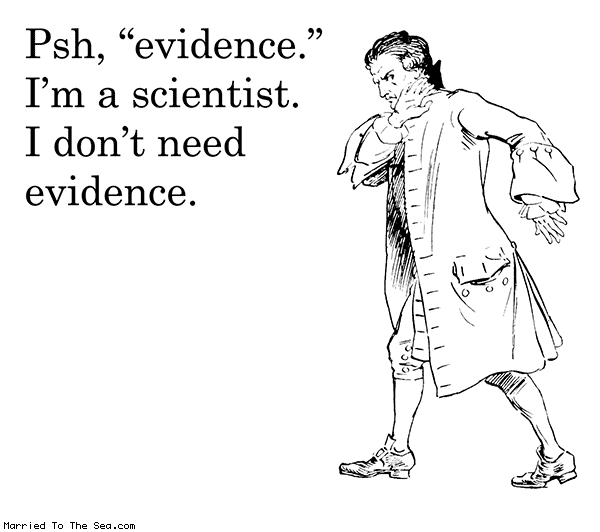
It is the hypocrisy that bothers me, the hypocrisy of power:

scientist evidence – Married to the Sea

Let’s acknowledge that teachers currently work under the demand of measurable evidence of their impact on students while CC advocates impose faith-based policies such as CC, new generation high-stakes testing, merit pay, charter schools, value-added methods of teacher evaluation, and a growing list of commitments to education reform at least challenged if not refuted by evidence.

CC advocates now bear the burden of either offering the evidence identified above or admitting they are practicing faith-based education reform.

RECOMMENDED: English Journal, Vol. 103, No. 2, November 2013

English Journal, a flagship publication from NCTE, is currently under the outstanding editorship of Julie and David Gorlewski—who have followed the stellar work of the previous editor, Ken Lindblom.

I want to urge special attention to the current issue: English Journal, Vol. 103, No. 2, November 2013—Choices and Voices: Teaching English in a Democratic Society.

As well, I must highlight some of the articles:

Children Giving CluesSusan Ohanian

Abstract: Frustrated with the restrictive nature of the Common Core Standards, the author calls on teachers to resist a system that denies them and their students access to what teaching and learning should be about.

Access to Books and Time to Read versus the Common Core State Standards and TestsStephen Krashen

Abstract: The author argues that access to books and time to read play a vital role in literacy development and explains why standardized tests are detrimental to students’ literacy development.

Evaluating the Democratic Merit of Young Adult Literature: Lessons from Two Versions of Wes Moore’s MemoirAmanda Haertling Thein, Mark A. Sulzer, and Renita Schmidt

Abstract: The authors compare a memoir intended for adults with another on the same subject meant for a teen readership and argue that didactic YA literature grounded in a developmental stage model of adolescence is undemocratic.

Speaking Truth to Power: Our American Future: Creating Critical Citizens in a Democratic NationAmanda Pepper

Abstract: This column seeks to explore the experiences and possibilities that arise when educators speak Truth to power.