
Category Archives: CCSS

A Call for Non-Cooperation: So that Teachers Are Not Foreigners in Their Own Profession

Gandhi’s views on enhancing the vernaculars…so that Indians are “not foreigners in their own land” are directly tied to his opinions on developing communities (for “the poorest of the poor” ) and making community service an integral part of any education. (Ramanathan, 2006, pp. 235-236)

Standing in the middle of the road offers some statistical advantage to avoiding being run over since you aren’t in the prescribed lanes of traffic, but standing in the middle of the road can never assure the safety that refusing to walk into the road to begin with does.

Writing about a call for a moratorium on implementing and testing Common Core State Standards (CCSS) from union leadership, Anthony Cody ends his blog post with three questions:

What do you think? Should we join Randi Weingarten in pushing for one year’s delay in the harsh consequences attached to Common Core assessments? Will this year put the project on sound footing?

These questions about CCSS have been joined by two other calls for compromise and civility—Matthew Di Carlo challenging charges that value-added methods (VAM) of teacher evaluation are “junk science” and Jennifer Jennings penning an apology to Secretary of Education Arne Duncan for protests at his 2013 talk at American Educational Research Association (AERA). [1]

Weingarten, Di Carlo [2], and Jennings share a call for standing in the middle of the road, a quest for ways to compromise, and these all appear reasonable positions. Ultimately, however, moratoriums, compromise, and civility are all concessions to the current education reform movement and the policies at the center of those reforms, specifically CCSS and VAM.

Teachers as Foreigners in Their Own Profession

Briefly, I want to identify how arguments about a CCSS moratorium, implementing VAM properly and cautiously, and the need for civility are concessions that render teachers foreigners in their own profession.

As long as the debate about CCSS and VAM remain how best to implement them, the essential questions remain unasked, and the agenda behind both are assured success. While I want to address the civility argument next, let me note here that calls for CCSS and VAM are inherently civil and derogatory, exposing the myopic concern for the civility of those rejecting Duncan’s discourse and policies.

The implied and stated messages of calls for CCSS and more high-stakes testing include the following: (1) Teachers do not know what to teach, or how, and (2) teachers are unlikely to perform at the needed levels of effort in their profession unless they are held accountable by external and bureaucratic means.

The implied and stated messages of calls for VAM and merit pay include the following: (1) The most urgent problem at the core of educational outcomes is teacher quality, and (2) teachers are unlikely to perform at the needed levels of effort in their profession unless they are held accountable by external and bureaucratic means.

Calls for CCSS and VAM also share another implied and stated message: Failed educational outcomes are the result of in-school deficiencies; in effect, out-of-school factors are irrelevant in the pursuit of education reform.

These messages are factually false and, despite the civility of the language, irrevocably offensive.

Standing in the middle of the road of bureaucratic, accountability-based school reform, then, may decrease the likelihood of being run over, but it concedes the road itself to those who have built it, to those who govern the laws of transportation.

To answer Cody’s second and third questions, then, No. And now to his first.

Civility: Standing in the Middle of the Road of Accountability

The call for civility exposes a foundational problem with the current education reform debate because, for all practical purposes, there is no debate.

Civility, CCSS, and VAM may all have some appeal in theory, but all of them fall apart in reality, in their implementation.

Civility is the last recourse of the powerful, those who can afford to appear civil because they hold all the power.

Through the lens of history, we must recognize that CCSS will become “what is testing is what is taught,” as all standards movements have shown.

VAM also sits in a long history of the corrosive consequences of stack ranking, merit pay, and competition.

And this brings us back to standing in the middle of someone else’s road.

Education reform and policy have been historically and are currently under the control of political and corporate leadership who are not educators—many of whom did not even attend public schools, many of whom send their own children to schools unlike the environments they promote and implement.

The locus of power in education is catastrophically inverted; thus, we do not need more or different mechanisms for accountability-based education reform, but we do need a new era of non-cooperation.

The goal of non-cooperation must include seeking ways in which to shift the priorities of the locus of power:

  • First, the central locus of power in education is the student, situated in her/his home and community.
  • Next in importance is the locus of power afforded the teacher in her/his unique classrooms.
  • These must then merge for a locus of power generated within the community of the school.
  • Finally, the locus of power in this school-based community must radiate outward.

A Call for Non-Cooperation

Non-cooperation, as found in the philosophy and actions of Gandhi, represents another inversion—away from in-school only education reform and toward, as Ramanathan explains, “communal and educational change”:

As is evident, the take on “education” presented here is not the usual one—of teaching and learning in formal contexts of classrooms and institutions—but one that is intended to move us toward becoming collectively open to realizing that very valuable “education” often goes on outside the constraints of classrooms: in ashrams, in madrassas, in extracurricular programs, by local, politically minded youth, all drawing on local vernacular ways of healing rifts. Indeed, “education” in both these institutions is civic and community education that seems to assume Gandhian ideals of “Non-Cooperation” (and nonformal education) and that is aimed at primarily effecting changes in the community, sometimes before addressing issues relevant to formal education. (p. 230)

Non-cooperation, then, moves beyond a call for teacher autonomy; instead, non-cooperation is the act of the autonomy by “people directly involved” (Ramanathan, p. 231):

Not only do they have Gandhi’s larger philosophy of Non-Cooperation against political hegemonies  [emphasis added] at their core…, but they also opened up for me a way of understanding both how Gandhianism is situated and how particular dimensions of the identities of participants (Kanno, 2003; Menard-Warwick, 2005; Norton, 2000; Pavlenko & Blackledge, 2004) get laminated. I was able to see how Gandhianism is first collaboratively interpreted in workshops, then applied and translated on the ground in most local of contexts, and then recast and reinterpreted by individuals and groups as they regroup. (Ramanathan, p. 232)

Non-cooperation is a new paradigm that begins with those most directly impacted by the institution (here, education)—parents, students, teachers. In other words, the people most directly impacted ask the foundational questions: Do we need formal education? And if so, what does that include and how should that be implemented?

This is not about seeking compromise at someone else’s table, not about standing still in the middle of someone else’s road.

The purposes of universal public education, then, is refocused in the ways that address the needs of the least among us, as Gandhi envisioned:

[Nonformal education] … will check the progressive decay of our villages and lay the foundation for a juster social order in which there is no unnatural division between the “haves” and the “have nots” and everybody is assured a living wage and the rights to freedom.…It will provide a healthy and a moral basis of relationship between the city and village and will go a long way towards eradicating some of the worst evils of the present social insecurity and poisoned relationship between the classes. (Harijan, 9-10-37, cited in Prasad, 1924…). (qtd. in Ramanathan, p. 236)

Bureaucratic accountability-based reform is ill equipped to address inequity, mismatched with goals of social justice since the paradigm is authoritarian, the locus of power exclusively with the “haves.”

Non-cooperation seeks instead, as Ramanathan explains:

[an orientation] toward viewing education in broader, community-oriented terms to draw out “the best in children,” to build a “healthy and moral” base for both “the city and the village,” to be entirely secular in its orientation (with “no room … for sectional religious training,” and to eventually transform the “homes of the pupils”[)]. (p. 237)

As well, this call for non-cooperation reframes the civility debate, as Gandhi recognized: “We must welcome them to our political platforms [emphasis added] as honoured guests. We must meet them on neutral platforms as comrades” (qtd. in Ramanathan, p. 237). Civility then follows the re-imagining of the locus of power: “Non-Cooperation…emerges as a deeply historicized awareness committed to doing the opposite of repressive, silencing ills. The quiet way in which both projects bridge perceived gulfs are reminiscent of Gandhi’s insistence on responding to tyranny by searching for nonviolent, quiet alternatives that tap the moral instincts of humans” (Ramanathan, p. 238).

Currently, since calls for CCSS, VAM, and civility all work as “repressive,” “silencing,” and “tyranny,” non-cooperation is the only alternative remaining.

The results must be “interpreting all education as ‘civic education’ and on attending to the most basic of human needs—food, clothing, shelter—before addressing any issues related to formal learning”  (Ramanathan, pp. 241-242) as direct action refusing to compromise on in-school only education reform that drives arguments for how best to implement CCSS and VAM:

This close attention to “educating oneself,” of figuring out and questioning one’s own default assumptions, has echoes of Gandhi’s Non-Cooperation, and finds interesting articulation in the idea that we each need to “not cooperate” with our default views but attempt to step outside them by “educating ourselves” by learning from others. (Ramanathan, pp. 244)

In the West, specifically in the United States, we are deeply entrenched in our “default views,” most of which are tinted by commitments to competition, authoritarian structures, and the sanctity of the individual. This call, however, is a call to recognize the importance of community and social justice in our national pursuit of democracy.

Arundhati Roy confronts the tensions at the core of why compromise, moratoriums, and civility fail the narrow education debate as well as the broader democracy:

Fascism is about the slow, steady infiltration of all the instruments of state power. It’s about the slow erosion of civil liberties, about unspectacular, day-to-day injustices.…It means keeping an eagle eye on public institutions and demanding accountability. It means putting your ear to the ground and listening to the whispering of the truly powerless. It means giving a forum to the myriad voices from the hundreds of resistance movements across the country that are speaking about real issues….It means fighting displacement and dispossession and the relentless, every violence of abject poverty. (Roy, 2002; qtd. Ramanathan, pp. 246)

Now is the time for non-cooperation, not moratoriums, not compromise, and not civility on other people’s terms.

Now is the time for non-cooperation so that teachers are not foreigners in their own profession and students are not foreigners in their own classrooms.

[1] See also Jeff Bryant.

[2] Of the three calls for moderation, I do not place Di Carlo’s position as essentially equal to those by Weingarten and Jennings. Di Carlo’s nuanced and detailed discussion of VAM contributes a credible position that I find compelling to a point (such as Di Carlo conceding: “Now, I personally am not opposed to using these estimates in evaluations and other personnel policies”); however, Weingarten and Jennings present far more problems and suffer from a much greater degree of lacking credibility.
Seeking Common Ground?

A few years after I joined my university, following 18 years as an English teacher at a rural SC public high school, the faculty ventured into the task of reforming the curriculum and academic calendar. The changes included a revised set of general education requirements, a first year seminar model, and a significant shift in the calendar from three terms and Monday-Friday class sessions to a more traditional fall/spring semester format with an optional May experience and M/W/F or T/Th class sessions.

The university now has experienced several years of the new curriculum and calendar, and is poised to assess how well the changes have been implemented. One concern among faculty and administration rests with the first year seminars. Currently, our students are required to take one first year seminar (FYS) and one first year seminar that is writing intensive (FYW).

Anecdotal and gathered evidence suggests a wide range of how the FYS/W courses are being implemented—some are strong examples of the intended goals of the seminars and how effective they can be, but many miss the goals and appear ineffective. A recent survey also shows that faculty are mixed on the effectiveness of the FYS/W courses for our curriculum and students.

As a writing teacher, I was an early and eager supporter of the move toward first year seminars, especially since that curricular change opened the door for faculty across disciplines to teach FYW classes (I am in the education department, and thus had not been teaching writing for the university since freshman writing had been under the English department). I have taught an FYW each of the academic years of the new curriculum, and have worked as closely as possible with the university to support the effectiveness of writing instruction in those courses.

This current academic year, I have chaired our faculty FYS Oversight Committee, and then was recently asked to take on a small administrative role to guide the assessment and implementation of our first year seminars. One of my first tasks has been to draft and share a common experience document [1] with FYS/W faculty in order to start a conversation about what experiences we believe are essential for FYS/W courses and how to insure all students have these experiences and how to support faculty teaching the courses.

Some of the responses from my colleagues have included strong concerns about attempts to “look over professors’ shoulders” and “dictating” what and how professors teach. When I received those responses, I have been forced to consider a powerful and important tension that now faces me in my roles as an academic at my university and as a public intellectual who spends a great deal of my time engaging in the public sphere about public education policy—a tension that required me to check myself for the very hypocrisy I have claimed about public education reformers.

The question I have asked myself: How can I justify my early and consistent rejecting of Common Core State Standards (CCSS) against my role within my university advocating for common experiences within out FYS/W courses in order to insure all students receive the highest quality education we can offer?

On the surface, the motivation for CCSS in K-12 public schools and common experiences in our FYS/Ws appear to be the same: Identify and implement standard expectations for a commonality of educational experiences by all students.

Setting aside my deep skepticism about the sincerity of those advocating for CCSS, especially at their inception, I can concede only that similarity, and I believe that my experience at the university level with changing and then implementing the curriculum offers the current failed K-12 education reform movement some key lessons about how to reform the reform movement.

Seeking common ground among educational settings must include the following paradigm shifts away from the accountability/corporate model and toward an academic/collegial model:

  • Curriculum change and implementation at the university level are grounded in professor expertise, professor autonomy, and academic freedom. These foundational beliefs provide the central tension necessary for genuine education reform. As Tierney explains, K-12 public school teachers are denied these essentials—and thus current education reform fails:

“In this country, we lurch back and forth between efforts to professionalize and efforts to infantilize public-school teachers, and have been doing so since the beginning of public schools in America. Neither kind of effort accords teachers much respect. Because teachers are chiefly employed by local governments  (unlike doctors or lawyers who are typically employed in private enterprise), there has always been a tendency on the part of some groups of people to try to exert greater central control over teachers, not believing them to be professionals who can be left to do their jobs according to their own judgment. When those skeptics hold sway, the ‘solutions’ they impose favor quantitative/metrics-based ‘accountability,’ top-down management, limitations on teachers’ autonomy, and the substitution of external authority (outside measurers and evaluators) for the expertise of educators themselves.”

  • Thus, curriculum and pedagogical changes as well as on-going evaluation of those changes are prompted and driven by faculty, in collegial (not authoritarian) partnership with administration.
  • Course development and approval are conducted by the faculty. Professors design the courses they teach, propose them to the departments and faculty committees, and then the entire faculty approves those courses.
  • Curriculum change remains “in house,” in that the changes are related to the unique mission of the university and outside political and corporate influences are essentially absent from the process (notably the influence of commercial interests related to textbooks, resources, and testing).
  • Curriculum change and the subsequent evaluation of the implementation are necessarily slow. A great deal of public deliberation (at faculty meetings and committee meetings) went into the initial changes, and that process has continued into the evaluation of the implementation.
  • A constant refrain through the change process has been: Who are our students and how well are we serving them? This is another “in house” element that honors the belief that faculty knows best the students they teach.
  • The pursuit of “common,” “challenging,” “foundational,” and “essential” is not conflated with rote standardization. In other words, faculty are both aware of and honor that a common experience may look different among the faculty teaching the seminars while students still receive high-quality common experiences. For example, our FYWs seek to provide foundational writing instruction for all our students, but the ways in which that can be achieved are varied since each professor must articulate the common experiences for the 12 students in that particular FYW (again “common” is not rote sameness).
  • Absent in the reform and implementation are issues of bureaucratic accountability or concerns about high-stakes testing.

Let me note here, however, that I am not trying to paint the university curriculum change process as some sort of ideal: We now know that despite the deliberateness of the initial process, we likely still moved too quickly, particularly in implementing the first years seminar program, and too often the practical elements of change (for example, having the necessary FYS and FYW courses, all new to the curriculum) overshadowed the issues of insuring faculty were prepared to teach the courses and that courses were being implemented as proposed.

Ultimately, however, I have a great deal of optimism about the curricular change and ongoing efforts to maintain high quality in our courses at my university, but remain deeply skeptical (even cynical) of and nearly hopeless about the failed mechanisms of current K-12 educational changes.

While I am not yet convinced, as Tierney is, that the accountability/corporate reform movement is on its last legs, I am convinced that the model I have noted above is one way that we can and should reform the reform movement.

[1] See a model of common experiences detailed at Cornell University.

Consumed by Manufactured Demons: The “-ism’s” that Blind

Science fiction and horror are two genres that often find themselves intersecting where some form of power reduces humans to mere cogs in the machine. Technology, the future, aliens, and the like, it seems, can be terribly frightening.

George Orwell’s Nineteen Eighty-Four stands as one of the most comprehensive and enduring examinations of when that power abuse is in the hands of a totalitarian government. Dystopian SF that explores the dangers of “big government” resonates with the Libertarian thread running through the American public, but SF also aims its detailed satire and allegory at the nuances of just how governments become totalitarian.

Ridley Scotts’ Alien and more recent Prometheus share more than a director and some sort of lineage in their narratives: Both SF films are horrifying tales of oppressive corporations. [Scott’s Blade Runner can be included here are these films also include the dangers of megalomaniacs, especially corporatists and industrialists who use their ill-got billions for something other than the common good.]

While the mid-1950s spawned SF/horror films as thinly disguised propaganda matching the public hysteria about the Red Scare—the immediate and insidious threat of Communism (see Invasion of the Body Snatchers for a tour de force of such)—the Cold War eventually proved that the creeping cancer of Communism wasn’t as powerful as political leadership and pop culture claimed.

What, then, does SF say about more credible fears facing humanity?

In Cat’s Cradle, Kurt Vonnegut (1963) introduces into his fictional world Bokononism, a religion in which its messiah through the sacred text, The Books of Bokonon, confesses: “‘All of the true things I am about to tell you are shameless lies'” (p. 5).

The government of San Lorenzo finds its stability built on a fabricated conflict between General McCabe and the founder of Bokononism, Bokonon:

“‘Well, when it became evident that no governmental or economic reform was going to make the people much less miserable, the religion became the one real instrument of hope. Truth was the enemy of the people, because the truth was so terrible, so Bokonon made it his business to provide the people with better and better lies.'” (p. 172)

The charade driven by McCabe outlawing Bokononism and declaring Bokonon a fugitive continues at the expense of McCabe and Bokonon as men until their manufactured war between the righteous McCabe and renegade holy man Bokonon becomes essential itself:

“‘McCabe was always sane enough to realize that without the holy man to war against, he himself would become meaningless.'” (p. 175)

Cat’s Cradle examines the power of creating a demon for the public in order to keep that public distracted while the privileged remain privileged. Yet, Vonnegut’s often slapstick and always raucous narrative could just as easily be about the U.S. at almost any point in the past century.

What should be feared about the U.S. government and society is better captured, in fact, by Cat’s Cradle, Alien, and Prometheus than Invasion of the Body Snatchers. In other words, Communism and Socialism remain much invoked demons, but the dangers lie somewhere else entirely.

In 2013, two ideologies are intersecting—not unlike SF and horror—the progressive and often liberal education community and the libertarian and populist rightwing commentators and public. The common demon?

Common Core State Standards (CCSS).

While the progressive education community tends to reject CCSS as yet more of the failed accountability, standards, and high-stakes testing paradigm (the insanity of doing the same thing over and over while expecting different results) as well as a distraction from the need to address poverty and inequity, the libertarian/populist rejections of CCSS tend toward a fear of an Orwellian Big Brother or subversive curriculum as pods placed beside the beds of our children; thus, all over Facebook, CCSS are being linked to the Great Evils—Communism and Socialism.

While there is much to be feared about CCSS, that fear need not be grounded on its use to instill communism and/or socialism in America’s youth.

“Communism” and “Socialism” are terms tossed about without much regard for what they mean, but like Bokononism in San Lorenzo, the terms are “ism’s” that blind; they are manufactured demons that allow genuine threats to exist and prosper.

In both Alien and Prometheus, main characters and the audience soon discover that under the guise of science and exploration, the evils of corporate greed—controlling government and its military—are far more horrifying and real than any Red Scare or any form of government, in fact.

Ironically, while I contend we don’t need CCSS, the ability of corporate America to so easily and persistently manipulate the public’s lack of understanding of “-ism’s” seems to beg for a close inspection of just what is being taught in our schools. And if I were going to implement a core curriculum in the U.S., it would include a careful and extensive consideration of some foundational terms:

  • Communism
  • Socialism
  • Capitalism
  • Fascism
  • Oligarchy
  • Indoctrination
  • Consumerism

Condemning CCSS as a government plot to brainwash America’s children with Communism or Socialism ignores some basic points of fact:

  1. Socialists and communists have no power and almost no voice in the U.S.; for at least sixty years, both terms have been used in public discourse to demonize and marginalize (even as both terms are almost always misused in that discourse).
  2. The CCSS were created by and are overwhelming endorsed by the power and corporate elite—who benefit from a consumer culture, not a communist or socialist society.

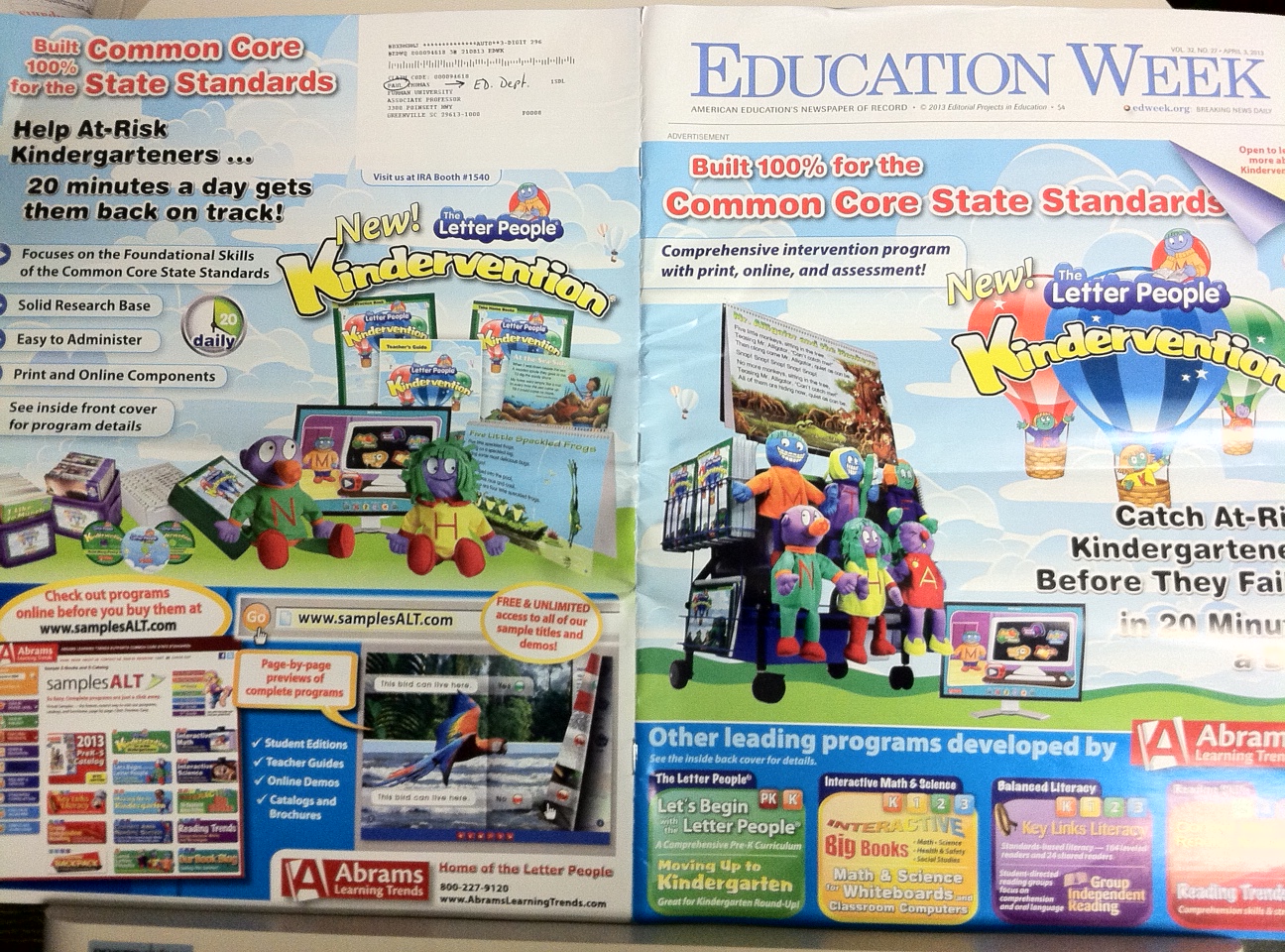
For those who fear the CCSS, I want to remind you once again: Look carefully at this entire cover of Education Week exposing that CCSS is consumerism and commodification—not communism and socialism:

EW.CCSS

The crass commercialism covering a major education publication reads like an infomercial:

“Catch At-Risk Kindergarteners Before They Fail…in 20 Minutes a Day!”

“Help At-Risk Kindergarteners…20 minutes a day gets them back on track!”

But a letter from the company vice president doesn’t inspire much confidence about high standards: “Kindervention is the most unique program in our history…,” it opens.

Most unique? Maybe words that can’t be qualified aren’t in the CCSS.

Ultimately, CCSS are a distraction.

And cries that CCSS are a communist, socialist, or government plot are distractions.

So the odd intersection of progressives and libertarians rejecting the CCSS fails ultimately since the reasons are deeply divided, but there is a reason that we all—every citizen of the U.S. regardless of ideology—should unite against CCSS and most other corporate manipulations of our Commons:

Being consumed by manufactured demons is a self-defeating American tradition that needs to be set aside.

Like the crews in both Alien and Prometheus, Americans are blinded, and often asking the wrong questions (“Why is Common Core not requiring cursive writing instruction?”)—or worse yet, not asking any questions at all about the power of corporate America over the government we fail to see as “we the people.”

Conservative Leadership Poor Stewardship of Public Funds

In South Carolina and across the U.S., conservative leadership of education reform has failed to fulfill a foundational commitment to traditional values, good stewardship of public funds. [1]

The evidence of that failed stewardship is best exposed in commitments to three education reform policies: Adopting and implementing Common Core State Standards (CCSS), designing and implementing new tests based on CCSS, and proposing and field-testing revised teacher evaluations based on value-added models (VAM).

SC committed a tremendous amount of time and public funding to the accountability movement thirty years ago as one of the first states to implement state standards and high-stakes testing. After three decades of accountability, SC, like every other state in the union, has declared education still lacking and thus once again proposes a new round of education reform primarily focusing on, yet again, accountability, standards, and high-stakes testing.

Several aspects of committing to CCSS, new high-stakes tests, and teacher evaluation reform that are almost absent from the political and public debate are needs and cost/benefit analyses of these policies.

More of the Same Failed Policies?

If thirty years of accountability has failed, why is more of the same the next course of reform? If thirty years of accountability has failed, shouldn’t SC and other states first clearly establish what the problems and goals of education are before committing to any policies aimed at solving those problems or meeting those goals?

Neither of these questions have been adequately addressed, yet conservative political leadership is racing to commit a tremendous amount of public funding and public workers’ time to CCSS, an increase in high-stakes testing never experienced by any school system, and teacher evaluations proposals based on discredited test-based metrics.

Just as private corporations have reaped the rewards of tax dollars in SC during the multiple revisions of our accountability system, moving through at least three versions of tests and a maze of reformed state standards, the only guaranteed outcomes of commitments to CCSS, new tests, and reformed teacher evaluations are profits for textbook companies, test designers, and private consultants—all of whom have already begun cashing in on branding materials with CCSS and the yet-to-be designed high-stakes tests that will eventually be implemented twice a year in every class taught in the state.

SC as a state and as an education system is burdened by one undeniable major problem, inequity of opportunities in society and in schools spurred by poverty.

Numerous studies in recent years have shown that schools across the U.S. tend to reflect and perpetuate inequity; thus, children born into impoverished homes and communities are disproportionately attending schools struggling against and mirroring the consequences of poverty.

Commitments in SC to CCSS, new high-stakes tests, and reforming teacher evaluations based in large part on those new tests are at their core poor stewardship of public funding in a state that has many more pressing issues needing the support of state government.

A further problem with conservative leadership endorsing these education reforms is that much of the motivation for CCSS, new test, and reforming teacher evaluations comes from funding mandates by the federal government.

Misguided education reform is not only a blow to conservative economics but also a snub to traditional trust in local government over federal control.

Recently, as well, a special issue on VAM from Education Policy Analysis Archives (EPAA) includes two analyses that should give policy makers in SC and all states key financial reasons to pause if not halt commitments to education reform based on student test scores—the potential for legal action from a variety of stakeholders in education.

Baker, Oluwole, and Green explain: “Overly prescriptive, rigid teacher evaluation mandates, in our view, are likely to open the floodgates to new litigation over teacher due process rights. This is likely despite the fact that much of the policy impetus behind these new evaluation systems is the reduction of legal hassles involved in terminating ineffective teachers.”

Further, Pullin warns: “For public policymakers, there are strong reasons to suggest that high-stakes implementation of VAM is, at best, premature and, as a result, the potential for successful legal challenge to its use is high. The use of VAM as a policy tool for meaningful education improvement has considerable limitations, whether or not some judges might consider it legally defensible.”

Do schools across SC need education reform? Yes, just as social policy in the state needs to address poverty as a key mechanism for supporting those schools once they are reformed.

But in a state driven by traditional values and conservative political leadership, current commitments to CCSS, new high-stakes tests, and reforming teacher evaluations are neither educationally sound nor conservative.

[1] Expanded version of Op-Ed published in The State (Columbia, SC), March 8, 2013: “Conservatives poor stewards of education funds”

Lessons from the Zombie Apocalypse

At the intersection of horror and science fiction (SF) lies a haunting lesson in the allegory rising from narratives such as The Invasion of the Body Snatchers (1956): By the time the apocalypse happens, it won’t look like we expect, and political and public recognition of the event will come way too late.

As a life-long SF fan and educator for three decades, then, I have found that Max Brooks, in his World War Z, has inadvertently written a series of lessons for the education reform apocalypse that is already happening, and almost no one is willing to admit it.

I think we must not ignore that the zombie genre is a mythology about the brain: The infection attacks the brain and the only way to kill a zombie is to destroy the brain. For an educator, these are not trivial matters.

Brooks crafts an oral history that looks back on the human race barely surviving a zombie apocalypse. As the snippets of interviews reveal, the political and military elites around the world failed to act with clarity and often hid the rising zombie plague from the public in calculated and horrifying ways: Decisions were made, for example, about who should survive and who was expendable.

In one section we learn that to identify infected zombies, air planes killed hundreds of people so that the infected could rise from the carnage and be easily identified.

Another response to the zombie outbreak involves the government and Big Pharma. Initially, the zombie infection is identified as rabies so a rabies vaccine is mass-produced, primarily to allay fear although the government and pharmaceutical companies knew the vaccine to be ineffective. Money was to be made and the ends justified the means.

But one of the most powerful lessons to me is in the Great Panic section, an interview with Maria Zhuganova. This oral history focuses on the actions of the military in conjunction with civilian oversite, a man call “Rat Face.”

In Zhuganova’s explanation, we discover that the soldiers are forced to enact decimation, as she explains:

“To ‘decimate’…I used to think it meant just to wipe out, cause horrible damage, destroy…it actually means to kill by a percentage of ten, one out of every ten must die…and that’s exactly what they did to us….

“We would be the ones to decide who would be punished. Broken up into groups of ten, we would have to vote on which one of us was going to be executed. And then we…the soldiers, we would be the ones to personally murder our friends….

“Brilliance….Conventional executions might have reinforced discipline, might have restored order from the top down, but by making us all accomplices, they held us together not just by fear, but by guilt as well. We could have said no, could have refused and been shot ourselves, but we didn’t. We went right along with it….We relinquished our freedom that day, and we were more than happy to see it go. From that moment on we lived in true freedom, the freedom to point to someone else and say ‘They told me to do it! It’s their fault, not mine.’ The freedom, God help us, to say ‘I was only following orders.'” (pp. 81-83)

And here we sit in the second decade of the twenty-first century, with a film version of World War Z and pretending that a horror/SF tale has no value beyond our entertainment.

While our government conspires with Big Testing to implement scorched-earth policies with our children because the public is afraid of our international competitiveness and does not question the effectiveness of testing, despite the evidence to the contrary.

And like the soldiers, teachers are compelled to be accomplices in Common Core State Standards implementation and preparing our students for the tests to follow.

The decimation of public education has infected us all.

The only real antidote, unlike the zombie apocalypse, is that educators, students, and parents must all choose not to follow orders, not to become the accomplices that allow the decimation.

Educators: “[N]ot the Time. . .to Follow the Line of Least Resistance”

In a major journal from the National Council of Teachers of English (NCTE), a teacher and scholar laments the current state of implementing the research in language: “A brief consideration will indicate reasons for the considerable gap between the research currently available and the utilization of that research in school programs and methods” (p. 87). [1]

And the discussion of that gap between research and classroom practices leads to this conclusion:

“Most thinking persons agree that the existence of civilized man is threatened today. While language is not food or drink, and will not satisfy the hungry and thirsty, it is the medium by which we must do much of our learning and panning, and by which we must think out solutions to our problems if we are not to solve them by the direct method of force. No sensible person believes that language will cure all difficulties; but the thoughtful person will certainly agree that language is a highly important factor in promoting understanding, and a most dangerous factor in promoting understanding between individuals and between the countries individuals represent. Moreover, language is a significant factor in the psychological adjustment of the individual. This is not the time for the teacher of any language to follow the line of least resistance, to teach without the fullest possible knowledge of the implications of his medium [emphasis added]. Before we, either as individuals or as a Council, experiment with methods of doing specific things or block out a curriculum, let us spend some time with the best scholars in the various fields of language study to discover what they know, what they believe uncertain and in need of study. Let us go to the best sources and study the answers thoughtfully. The game of Gossip is not for us.” (p. 94)

While those of us living our lives as teachers, especially teachers of literacy in K-12 settings or in teacher education, may recognize many points above in our current debates about education reform—including some of the debates that simmer below the surface of the workings of NCTE—this piece is by Lou LaBrant and was published in the January 1947 issue of Elementary English (now Language Arts).

More than six decades after LaBrant wrote about the gap between research and practice, More than six decades after she implores us that “[t]his is not the time for the teacher of any language to follow the line of least resistance,” educators across the U.S. are faced with the failure of leaders, the public, and professional organizations in the face of the promise of universal public education and its potential to drive the great hope we call democracy.

The Locus of Authority: Our Time for Resistance

At the 100th anniversary annual convention for NCTE in Chicago (November 2011), I presented during a panel on the Council’s century of leadership in the field of literacy—reading from the essay above by LaBrant and suggesting how she would have responded to the current calls for Common Core State Standards (CCSS), increased testing, intensified value-added methods (VAM) for teacher accountability linked to those tests, and accelerating mandates driving teacher preparation and accreditation of colleges and departments of education.

I know from my work as the biographer of LaBrant that she was a powerful voice for the professionalism, scholarship, and teacher autonomy—including herself and every teacher with whom she interacted. LaBrant, in fact, during the early 1930s when enrolled in her doctoral program at Northwestern University, faced pressure while teaching English to implement required reading lists, textbooks, and benchmark testing, all of which she knew to be flawed practices.

What did LaBrant do?

She fabricated lesson plans with her roommate, the foreign language teacher, and submitted them each week while practicing the pedagogy she embraced—student choice in what they read and wrote, holistic instruction and assessment of literacy. At the end of the year, LaBrant and her students (yes, in the early 1930s) faced end-of-course testing, and LaBrant’s students received top scores. Consequently, she was praised by the principal in front of the entire faculty for her dedication to the prescribed policies.

This tension between bureaucratic mandates that seek to shift the locus of authority (consider Freire’s distinction between “authoritarian” and “authoritative”) away from the teacher and within the standards and tests designed and prescribed by the state is not entirely new (except for the intensity), but neither is the need for teachers to own their autonomy, their professionalism—to be that resistance.

Also at the 2011 NCTE annual convention, a convention of celebration, Susan Ohanian, Stephen Krashen, Carol Mikoda, Bess Altwerger, Joanne Yatvin, and Richard J. Meyer proposed a resolution: NCTE will oppose common core standards and national tests. [2] This act of resistance, this act of teacher autonomy and professionalism resulted in what Catherine Gewertz in the Curriculum Matters blog at Education Week describes as: “The National Council of Teachers of English was asked by a group of its members to take a strong stand against the common standards, but it declined to do so.”

This is a time when political leaders, the public, and national organizations have abdicated their moral obligation to create and maintain universal public education for all children as a sacred trust between a free people and the promise of democracy.

As the faculty of Garfield High School (Seattle, WA) take a principled stand against MAP testing as a beacon of hope in the fog of corporate education reform, this is also a time for all educators to shine every light of our autonomy on what is right and what is wrong in the day-to-day pursuit of teaching children.

“This is not the time for the teacher of any [student] to follow the line of least resistance, to teach without the fullest possible knowledge of the implications of his medium.”

References

Freire, P. (2005). Teachers as cultural workers: Letters to those who dare to teach. Trans. D. Macedo, D. Koike, & A. Oliveira. Boulder, CO: Westview Press.

Freire, P. (1993). Pedagogy of the oppressed. New York: Continuum.

Freire, P. (1998). Pedagogy of freedom: Ethics, democracy, and civic courage. Trans. P. Clarke. Lanham, MD: Rowman and Littlefield Publishers, Inc.

LaBrant, L. (1947, January). Research in language. Elementary English, 24(1), 86-94.

[1] Originally posted at Daily Kos (November 21, 2011) and cross-posted at Truthout (November 28, 2011). Reposting here as a call for solidarity among educators inspired by the resistance of Garfield High School faculty (Seattle, WA) to the corrosive impact of MAP and other elements of high-stakes testing in U.S. education. The original piece has been revised.

[2] Revised resolution passed: Resolution Proposal to Support: No Confidence in United States Department of Education Secretary Arne Duncan

Howard Zinn and the Failure of Standards Movements in Education

The Zinn Education Project notes, “Howard Zinn passed away three years ago, on January 27, 2010. At the time, writer and activist Naomi Klein spoke for many of us: ‘We just lost our favorite teacher.'”*

The life and work of Zinn represents the personification of confronting the world from roles of authority that have historically been positioned as neutral—historian, teacher. But as Zinn came to understand and then to confront and embody, neutral is not an option:

When I became a teacher I could not possibly keep out of the classroom my own experiences. . . .Does not the very fact of that concealment teach something terrible—that you can separate the study of literature, history, philosophy, politics, the arts, from your own life, your deepest convictions about right and wrong?. . .In my teaching I never concealed my political views. . . .I made clear my abhorrence of any kind of bullying, whether by powerful nations over weaker ones, governments over their citizens, employers over employees, or by anyone, on the Right or the Left, who thinks they have a monopoly on the truth. . . .From that moment on, I was no longer a liberal, a believer in the self-correcting character of American democracy. I was a radical, believing that something fundamental was wrong in this country—not just the existence of poverty amidst great wealth, not just the horrible treatment of black people, but something rotten at the root. The situation required not just a new president or new laws, but an uprooting of the old order, the introduction of a new kind of society—cooperative, peaceful, egalitarian. (You Can’t Be Neutral on a Moving Train, Howard Zinn, 1994, pp. 7, 173)

As the Common Core State Standards (CCSS) movement, as well as the concurrent new and expanded battery of high-stakes tests, seem inevitable (as some continue to debate), Zinn’s radical stance as a historian and teacher offers a powerful window into why any standards movement is a failed process in education, particularly in universal public education designed to serve democracy and individual freedom.

Standards as Acquiring Some Authority’s Mandates

Zinn as historian and teacher personified the act of challenging content. For Zinn, our obligation as teachers and students is to ask questions—notably questions about the sources of power—about not only the world around us but also the narratives of the world around, narratives cast about the past, narratives being cast about the present, and narratives envisioning the future.

Who was Christopher Columbus—in his own words, in the narratives built around him by centuries of historians, in the narratives of textbooks, and in narratives of state-mandated curriculum? Why are there so many versions of Columbus, which ones are true (if any), and who benefits from these narratives?

Who was Martin Luther King Jr.—in his own words, in the narratives built around him by decades of historians, in the narratives of textbooks, and in narratives of state-mandated curriculum? Why are there so many versions of King, which ones are true (if any), and who benefits from these narratives?

Narratives, whether they be history or mandated curriculum in the form of CCSS, are manufactured myths, and ultimately, manufactured myths are created by some authority to suit some goal, some goal that benefits the designer of the myth.

And therein lies the ultimately failure of all standards movements.

A standards paradigm masks the locus of power (some authority some where decides what knowledge matters and then creates the accountability structure that makes that knowledge the goal of passive implementation [teachers] and compliant acquisition [students]) and creates a teaching and learning environment that can assume a neutral pose while in fact replacing education with indoctrination.

Authentic education for democracy and individual freedom is a continual asking: What knowledge matters and why? It is a journey, an adventure, a perpetual gathering to confront, to challenge, to debate, and to serve the teacher and learner in their joint re-reading and re-writing of the world.

CCSS, just as the dozens of standards movements before them, discount the need to confront, to ask, to re-imagine because standards are an act of authoritarian mandates. “Who decides” is rendered unnecessary, and the curriculum becomes a faux-neutral set of content that teachers must implement and students must acquire so that the ultimate faux-neutral device can be implemented—high-stakes testing.

Like the “‘remarkable apparatus'” in Franza Kafka’s “In the Penal Colony,” high-stakes testing ultimately becomes all that matters, “a mechanism of objectification” (Foucault, 1984), the inevitable abdication of authority and autonomy to a mechanism—”what is tested is what is taught” superseding any possibility of asking “why?” or examining who decides and by what authority they made the decisions.

Kafka’s nightmare allegory has been and will be replayed time and again as adopting and implementing CCSS along with the high-stakes tests uncritically, passively, and with a pose of neutrality (“I am simply doing as I have been mandated as well as I can”) feed the machine that consumes all who come near it, just as the Officer who implements the apparatus of punishment eventually acquiesces to it himself:

The Traveller, by contrast, was very upset. Obviously the machine was breaking up. Its quiet operation had been an illusion. He felt as if he had to look after the Officer, now that the latter could no longer look after himself. But while the falling gear wheels were claiming all his attention, he had neglected to look at the rest of the machine. However, when he now bent over the Harrow, once the last gear wheel had left the Inscriber, he had a new, even more unpleasant surprise. The Harrow was not writing but only stabbing, and the Bed was not rolling the body, but lifting it, quivering, up into the needles. The Traveller wanted to reach in to stop the whole thing, if possible. This was not the torture the Officer wished to attain; it was murder, pure and simple.

The American Character, Inscribed: “A Monopoly on the Truth”

While the education establishment, both progressives and conservatives, race to see who can implement CCSS the fastest, concurrent education reform initiatives such as charter schools and Teach for America help reinforce the worst elements of the standards and accountability movement.

Embedded in the charter school commitment is a parallel pursuit of standards: Character education.

In the “no excuses” model (made popular in the Knowledge Is Power Program [KIPP] charter chain), the standard for character and “good behavior,” again, is not something teachers and students explore, discover, and debate, but rules that must be implemented and followed.

For example, consider the “National Heritage Academies (NHA) and its approach to character and citizenship education,” highlighted by Rick Hess at Education Week; Hess, by the way, notes, “I think I’m wholly behind what NHA is doing.” What does a standardized approach to character and civic education look like?:

“I pledge allegiance to the flag of the United States of America,” chant the students of Ridge Park Elementary School in Grand Rapids, Michigan. “And to the Republic for which it stands . . .”

In the back of the room, a dozen parents stand with their hands over their hearts. Some are US citizens by birth, others by naturalization, and some by aspiration. Their children recite: “One nation, under God, with liberty and justice for all.”

A National Heritage Academies (NHA) charter school, Ridge Park starts every day with the Pledge of Allegiance, the Star-Spangled Banner, and the school creed: “I am a Ridge Park scholar. I strive to achieve academic excellence. I exemplify high moral character. I work diligently to prepare for the future . . .”

Character education is ubiquitous and relentless at NHA schools. Each month is assigned a “moral focus” or virtue, which teachers are supposed to weave into their lessons and students write about from kindergarten through eighth grade. Signs in classrooms and hallways honor examples of virtue….

Students troop out of the gym to start their day. (“Counting on Character: National Heritage Academies and Civic Education,” Joanne Jacobs)

“Chant,” “recite,” “ubiquitous,” “relentless,” “troop”—these are the bedrocks of a standards-driven school environment, but this is indoctrination, not education—whether the standard is character or curriculum.

And what sort of history curriculum does a character-driven model embrace? The work of E. D. Hirsch:

The patriotic spirit of Hirsch’s US history and civics curriculum fit NHA’s philosophy. ‘The ideals that created the United States were glorious,’ writes Hirsch in The Making of Americans: Democracy and Our Schools. ‘Patriotic glorifications are very much to be encouraged in the early grades, so long as they retain a firm connection with truth.’ While US history and civics are not wrapped in the flag, says Nick Paradiso, vice president of government relations and partner services for the charter management company, “the basic idea is that America is a great country that learns from its mistakes. We need to embrace our country’s history.”

No, let’s not confront the histories of the U.S., not here at NHA, because that may lead to the sorts of questions Zinn would ask: Who decides and why, and then who benefits from these narratives of character and history? [Hint: “National Heritage Academies, a for-profit charter management company, runs 74 schools in Michigan and eight other states, making it the second largest charter network in the country.”]

Further into Jacobs’ description of NHA “America-centric” core curriculum, Martin Luther King Jr. is highlighted as an example for students of character. King as martyr for Hirsch’s glorious U.S.A.? Consider “Martin Luther King Was a Radical, Not a Saint” by Peter Dreier:

In fact, King was a radical. He believed that America needed a ‘radical redistribution of economic and political power.’ He challenged America’s class system and its racial caste system.  He was a strong ally of the nation’s labor union movement.  He was assassinated in April 1968 in Memphis, where he had gone to support a sanitation workers’ strike.  He opposed U.S. militarism and imperialism, especially the country’s misadventure in Vietnam.

Do you suppose this is the King NHA students study and are encouraged to emulate?

And it is here I will end with the ultimate caution about being neutral in regards to CCSS, charter schools, character education, and a whole host of education reform mandates and commitments that seem inevitable: The powerful control the narratives and those narratives control the rest of us—all for the profit of the powerful.

“I made clear my abhorrence of any kind of bullying, whether by powerful nations over weaker ones, governments over their citizens, employers over employees, or by anyone, on the Right or the Left, who thinks they have a monopoly on the truth.” Howard Zinn, 1922-2010, R.(adical) I.(n) P.(eace)

*Updated in honor of the 50th Anniversary March on Washington and Howard Zinn’s birth date, August 24. Please visit and read:

howardzinn.org

Zinn Education Project

Remembering Howard Zinn by Meditating on Teacher Unions and Tenure?

“A Realistic, Pragmatic Approach” to Rejecting CCSS

“Should Teachers Resist the Common Core?” asks a blog post at Education Week, continuing the debate about CCSS among Larry Ferlazzo, Stephen Krashen, David Cohen, and me.

This posting highlights a point made by David that I want to return to (again) because I agree strongly with David’s focus: “And as for the critics I’ve cited, to my knowledge, none of them is currently a K-12 teacher. That fact does not invalidate their criticisms, but I think it colors their perceptions regarding a realistic, pragmatic approach, here and now, for those of us trying to serve our current students and schools most productively.”

I have argued repeatedly that the central flaw with the current education reform movement and its major elements—CCSS, new high-stakes testing, Teach for America (TFA), value-added methods (VAM) of teacher evaluation, and charter school advocacy, such as Knowledge Is Power Program (KIPP) and the Harlem Children’s Zone (HCZ)—is that these reforms-as-solutions are not based on any clearly identified problems and that the leading advocates themselves have no (or very little) experience and expertise in education.

Let me repeat: I have almost thirty years of combined public high school teaching (18 years), college teaching, teacher education, and scholarship in education that all have occurred during the thirty-year cycle of accountability-driven education reform.

I have ample experience with state standards, state and national (SAT) high-stakes testing, teacher certification, and education accreditation. A central thread of my scholarship over those years has included the negative impact of accountability, standards, and testing on literacy instruction (notably writing) and high-poverty students and schools.

Also let me repeat my answer to the blog title above: Yes, teachers should resist CCSS.

I have already argued for our resistance as part of our teacher agency so I want here to address the obligation teachers have to resist CCSS grounded firmly in our classroom experiences.

I began teaching in the fall of 1984, the exact academic year South Carolina first introduced accountability based on state standards and high-stakes testing. Over the next thirty years, SC has revised those standards three or more times, as well as reformulating our testing at least three times—from BSAP to PACT to PASS (with part of that testing reform driven by a desire to move beyond “basic” [the “B” of BSAP] and to the glory of “challenge” [the “C” of PACT]). In education, it seems, it is all about the branding.

SC and virtually every state in the nation has had decades and multiple versions of standards and high-stakes tests implemented. What is the result? Today no one is satisfied with the outcomes, and the dominant solution is to try the exact same strategy, except at the federal level.

And here is where I wish to assert David’s point as support for my argument: Teachers across the U.S. know from their lived experiences as educators that the bureaucracy of implementing and revising standards and tests over the past thirty years has wasted a tremendous amount of time and funding as well as inhibited our ability to teach and ruined learning opportunities for students—especially in high-needs schools.

Three decades of the accountability era with its standards and high-stakes testing have not improved teaching, have not increased learning, have not closed the achievement/opportunity gap, have not solved the drop-out problem, and have not succeeded in a single claim of made by political advocates of any aspect of this movement.

Why? Because the accountability model built on standards and high-stakes testing is the wrong solution and a complete failure of acknowledging the problem. Educational problems in the U.S. are not a lack of accountability, a lack of standards, or a lack of testing. In fact, increasing all three has increased the real problems because they are distractions from facing the tremendous inequity of opportunity facing children in the U.S. both in their lives and then in their schools.

Teachers must reject CCSS, and we must do so in a collective voice of our experiences in the exact environments of accountability that we know have done more harm than good to the children we serve every day.

Nothing is more real or practical than that.

Teacher Agency in a Time of High-Stakes Accountability

I entered the classroom as a high school English teacher in 1984, the exact fall that South Carolina implemented the first incarnation of high-stakes accountability built on standards and standardized testing. I taught in that rural, moderately impoverished community—my home town—for the next eighteen years, during which the state revised and changed standards as well as tests multiple times.

I taught, chaired the English department, and coached for many of those eighteen years while also being a college adjunct and completing my doctorate, and my wife still teaches K-2 PE as well as coaches, as she has since 1995

In 2002, I became a teacher educator, and thus directly involved with classroom teachers in my graduate courses and teacher candidates certifying and then entering the field.

From those experiences I can attest to a few clear realities of being a teacher during a time of high-stakes accountability:

• Teachers have rarely had much power for the past century, and that agency has significantly deteriorated as the accountability era has accelerated.

• The goals and claims about the potential for standards (including Common Core State Standards [CCSS]) and high-stakes testing are irrelevant once they are implemented since how schools, districts, and states tend to implement standards and testing is far more prescriptive, corrosive, and dehumanizing than advocates for standards and testing are apt to acknowledge. “What is tested is what is taught” will be the consequences of CCSS once tests are administered as high-stakes mechanisms in the schools. Teachers and students will lose in that, again.

• Teachers have historically been told not to be political and are conditioned to be implementers of policy, not designers of policy. That de-professionalizing and marginalizing of teacher agency has increased proportionately with the rise of high-stakes accountability and the deterioration of worker’s rights for teachers (especially in right-to-wrok states where unionization has been and is absent).

• Teachers tend to be incredibly practical, and predisposed to functioning in survivor mode since the conditions of teaching often ask more of any teacher than can be humanly accomplished. I lived that and I have a great deal of respect and empathy for that fact.

With all that said, let me return to the current CCSS debate among Larry Ferlazzo, Stephen Krashen, and now David Cohen.

First, I want to clarify that I have a great deal of respect for Larry, Stephen, and David as exemplary educators, scholars, and advocates. Since I cannot say I have the same respect for many of the leading personalities in the education reform debate, I want to be clear that when I agree or disagree with this particular group of educators, the debate is about the topic, and there is not implied any challenge to the people or their credibility intended. None.

Yet, I remain in disagreement with Larry and now David—both of whom have offered solid and thoughtful arguments about their skepticism regarding CCSS but also their belief in compromise that includes setting aside trying to stop CCSS and the coming tests being implemented.

Two points from David’s post are important to address, I think.

The end of David’s post repeats the fatalism that I have addressed:

“And I might agree with Thomas (and Friere) in the abstract, but here’s the problem: such a transformation of public education could not happen in a vacuum, could not happen solely by the willpower of teachers even if we all agreed with each other, and could not happen quickly – maybe not even in one generation.”

Many practitioners balk at theory and philosophy, and to discount Freire and my concern as “abstract” is part of the problem of classroom practitioners being predisposed to the practical and trapped in survivor mode.

To me, David’s comment highlights the worst aspect of adopting, implementing, and testing CCSS—education is in a constant state of adopting and implementing new standards and new tests, a process that keeps teachers busy, busy, busy. In fact, too busy to be professionals.

On this point, I believe David is hitting a key problem, but my response is not to agree. In fact, I think David’s point proves why we must simply all say “No,” as the teachers at Garfield High have about MAP testing.

Is it easy to say “No” as a teacher? No. Is it risky to say “No” as a teacher? Yes, very.

But taking principled stands is necessary for our profession. A collective and principled stand by teachers could in fact bring about the change David has grown fatalistic about.

A second point, which is related to the first, is that David and Larry are advocating compromise, a stance that always appears reasonable and tends also to seem practical.

Here, I must state again that a compromise between wrong and right can equal only wrong.

In the CCSS debate, the problem with compromise is that the frame within which teachers are being asked to compromise has been set for them, not by them.

In 2013, standards and tests have had ample time (and consumed more than enough funding) to show that they are effective reform strategies. They have never worked, and they never will.

The CCSS movement is a tremendous waste of time and money. Implementing and testing CCSS will further erode teacher agency and student achievement.

No compromise will stem those realities, but teachers claiming their own agency as professionals, collectively, can stop these consequences if we all agree to stop saying “can’t.”