Category Archives: Charter schools

Conservative Talking Points Wrong for SC Education

Political science professor Brent Nelsen argues Conservatives should support public school reform. However, this commentary proves to be not credible commitments for needed education reform in South Carolina but a series of unsubstantiated conservative talking points.

After opening by defining conservatism and establishing that conservatives recognize the need for education reform, Nelsen misrepresents significantly a foundational issue facing SC: “The recent Supreme Court decision highlighting the failure of many public schools puts education at the top of the policy agenda.”

The Supreme Court in SC, in fact, finally ruled on a court case made infamous by the documentary Corridor of Shame [1], true, but the ruling addresses inadequate state support for high-poverty communities and their schools:
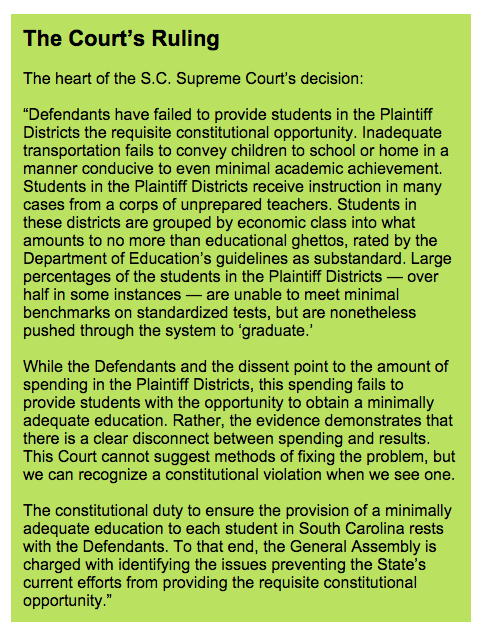
SC SC Corridor ruling

As Eva Moore reports:

In a narrow 3-2 decision, the court said South Carolina needs to fix the way it funds education….

“As the court pointed out, it’s a fragmented, inefficient, ineffective method of funding,” Epps says. “Historically the General Assembly has played shell games with the funding. It’s inconsistent and extremely inefficient.”…

The school districts themselves bear some blame, according to the court. They’re administration-heavy and should explore consolidation.

But the bulk of the blame lies with the state of South Carolina.

All parties must work together to create a fairer funding model “within a reasonable amount of time,” the court ruled. In the meantime, the court retains jurisdiction in the case.

A fair but complex representation of SC’s need for education reform, then, must address a historical failure by the conservative political leadership of the state to support adequately both high-poverty communities and the schools that serve those children.

Immediately following this glossing of a major issue facing the state, Nelsen makes a disturbing claim:

But conservatives have allowed liberals to monopolize the public education conversation, promoting private and home school options while leaving the debate over public schools to less conservative voices. Not only does this lead to bad policy, it is also bad politics.

SC’s political and cultural history is solidly conservative, leaning toward a Tea Party conservatism that clings to state’s rights. Even when the South was voting Democrat, SC was conservative, and in the recent years, SC politics is dominated by Republicans.

There are in fact no issues in the state of SC “monopolized” by liberals because progressive and liberal voices are nearly absent from politics, the media, or public debate.

However, Nelsen’s opening shot at “liberals” is solid evidence that this commentary is mostly conservative talking points designed to trigger a targeted political base—the tried-and-true straw men of political discourse in SC linked with the more recent straw men of conservative education reform: liberals and unions along with “bad” teachers, “status quo,” “trap[ped] students in failing schools,” and “throw[ing] tax dollars at problems.”

In SC and across the U.S., these are both common refrains and mostly without merit. For example, the union bashing in SC seems misplaced since we are a right-to-work state. Striking out at liberals and unions in SC is boxing with ghosts.

How about, then, the policy recommendations tagged as “conservative”?

High-stakes uses of teacher VAM scores could easily have additional negative consequences for children’s education. These include increased pressure to teach to the test, more competition and less cooperation among the teachers within a school, and resentment or avoidance of students who do not score well. In the most successful schools, teachers work together effectively (Atteberry & Bryk, 2010). If teachers are placed in competition with one another for bonuses or even future employment, their collaborative arrangements for the benefit of individual students as well as the supportive peer and mentoring relationships that help beginning teachers learn to teach better may suffer. (p. 24)

  • Nelsen also endorses increasing support for public charter schools and “expanding the ability of low-income students to attend private schools” (which appears to avoid the how, vouchers, because vouchers are unpopular and discredited). Charter schools are the new school-choice-light for conservatives and market-committed Democrats, but there is a problem with that advocacy, highlighted by SC. Of the 50+ charter schools each year in SC, about 95% of charter schools have student outcomes the same or worse than comparable public schools. As well, in SC and across the U.S., charter schools avoid mandates public schools cannot; charter schools underserve English language learners and special needs students; and charter schools tend to be highly segregated by race and social class. Charter school advocacy is the hollow politics of waving the “parental choice” flag without doing the hard work called for by SC’s Supreme Court—fully funding and supporting the existing public school system that SC has failed.
  • Finally, Nelsen builds to the most troubling conservative option: closing, as Nelsen’s curious word choice identifies, “[p]oor schools” and adopting state take-over practices such as the Tennessee Achievement School District (ASD). Setting aside that Nelsen is associating state government take-over as conservative while opening with a nod toward “small government,” endorsing the ASD is deeply flawed. Nelsen claims inaccurately: “The results in Tennessee are impressive so far. Students have posted double-digit gains in math, science and literacy — outpacing improvements in other public schools”—when actually, like charter schools in general, the ASD has not performed much different than public schools, according to a 2014 analysis:

My analysis suggests that ASD schools aren’t doing significantly better in terms of student growth than they were before state takeover. In fact, in many cases the schools’ pre-takeover growth outperformed the ASD. These findings have significant implications for the future of the ASD, how we should move forward with continued takeovers, and for future turn-around efforts in general.

From Tennessee to New Orleans to Los Angeles, claims of successful take-over strategies have been discredited, but those take-overs have resulted mostly in disenfranchised children and communities while providing political capital for advocates.

SC education reform doesn’t need conservative talking points, then. Although as I have argued, fiscally conservative principles do support SC changing course in education reform, but that commitment requires acknowledging the accountability movement has not worked and then taking the Supreme Court’s ruling seriously.

SC has an entrenched poverty problem linked to lingering racial and economic inequity that destroys communities and overburdens the schools designed to serve those communities. Partisan conservative political leadership has created and maintained that status quo, and conservative doubling-down would be yet more remedies as part of the disease.

See Also

The Sad History of State Takeovers of Schools and School Districts, Jan Resseger

Opinion: New Orleans takeover is a model — of what not to do with Georgia schools, J. Celeste Lay

VAM Remedy Part of Inequity Disease

Review [UPDATED]: “How to Evaluate and Retain Effective Teachers” (League of Women Voters of SC)

‘Race to the Top’ for education a flop, report finds, Nirvi Shah

The Fatal Flaw Of Education Reform, Matthew Di Carlo

Value-Added, For The Record, Matthew Di Carlo

Time to End the ASD Fiasco

South Carolina and Education Reform: A Reader

Sorry, Kirp’s Fix Another Flawed Discourse on Ed Reform

What We Know Now (and How It Doesn’t Matter)

NPR Whitewashes Charter Schools and Disaster Capitalism in New Orleans

Preventing Arson Instead of Putting Out Fires

[1] In the original trial, a lawyer for the underfunded school districts used the “Allegory of the River” to confront the state’s failure to address root causes of failing schools; I recommend that allegory and believe the Op-Ed above calls for policies that continue those failures:
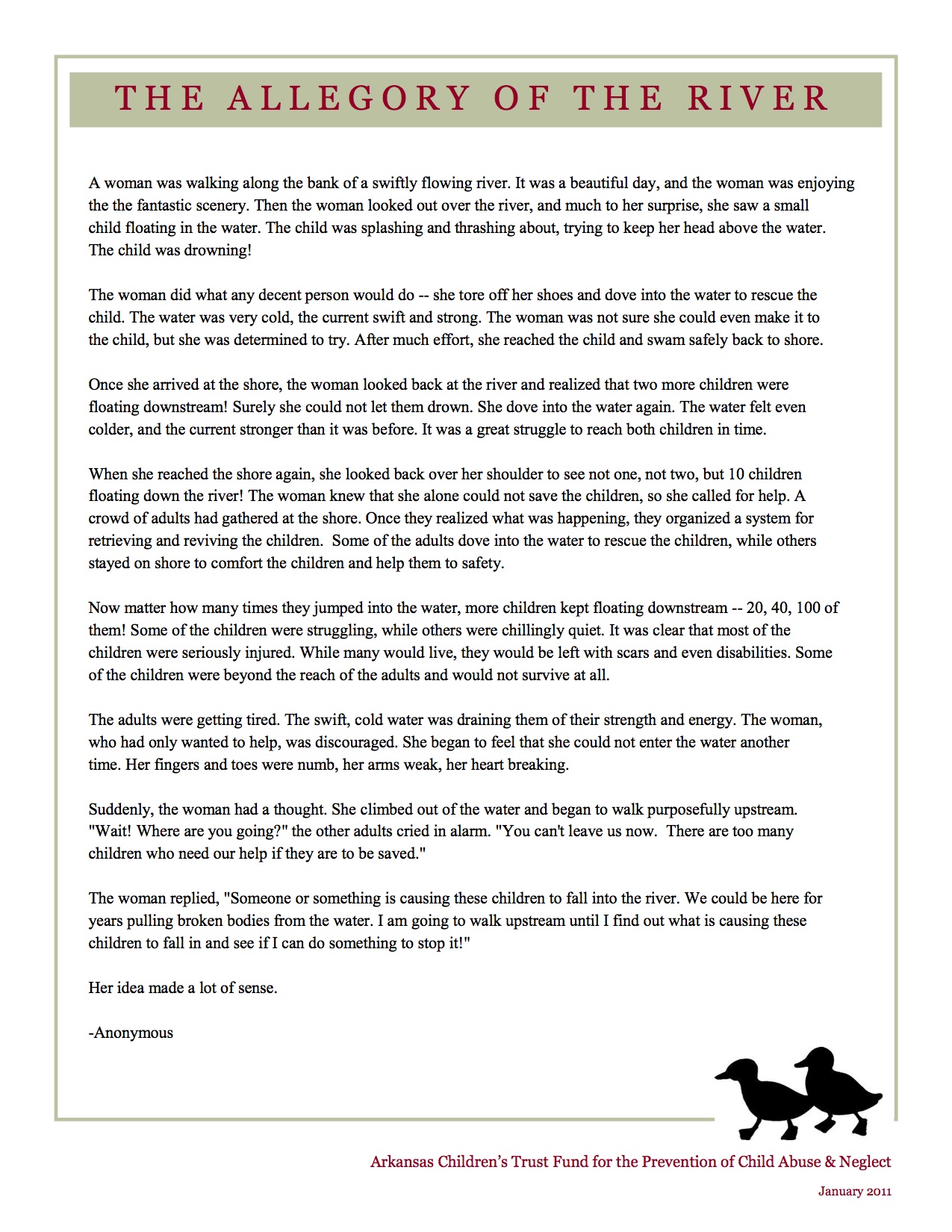
_allegory_of_the_river copy

Public School, Charter Choice: More Segregation by Design

Academic Magnet High School serves the Charleston school district on the coast of South Carolina. The school functions under a choice umbrella, but requires students to submit to an admissions process.

SC is relatively more diverse than the U.S. on average in terms of white (+/- 70%)/black (+/- 30%) demographics, while less diverse in Hispanic/Latino (although those groups are growing significantly). Charleston certainly is even more diverse racially and culturally than the state.

Those realities have now prompted students at Academic Magnet to challenge the lack of diversity at their school:

Calls for a change in the admissions process at Academic Magnet High School continued Monday, with students urging the Charleston County School Board to tackle diversity issues at their school.

“Is the system that has produced an overwhelmingly white, upper-middle-class school in place of an equal opportunity magnet school for all Charleston County students fair?” asked Academic Magnet student Natalie Davidson….

Davidson said that although the school’s admissions process is “in a vacuum unbiased,” it has produced a “homogeneous” student body that is only 2 percent black in a school district that is 42 percent black.

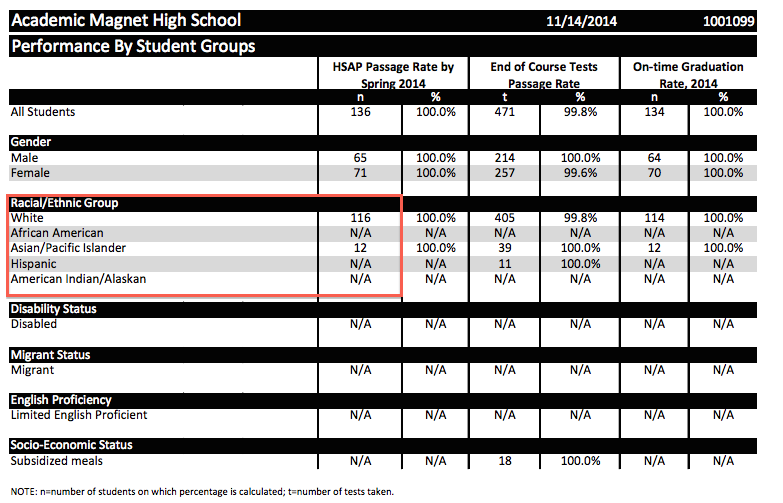
The 2014 SC school report card for Academic Magnet shows absolute and growth ratings of excellent, but tested students included no African American or Hispanic/Latino students:

AMHS test 2014

Magnet and charter schools, however, are not the only choice mechanisms in SC since Greenville County school district offers (and aggressively markets) public school choice:

GCSD choice market

What has public school choice and charter choice produced in Greenville County?

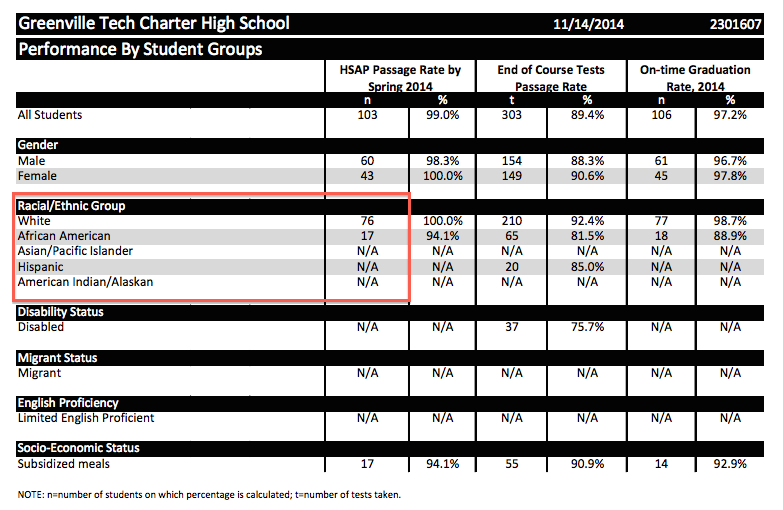
Greenville Tech Charter High School, like Academic Magnet, has 2014 school report card ratings of excellent/excellent, but just over 80% of the students tested are white with no limit English proficiency students included:

GTCHS tested 2014 race

Public school choice has also resulted in highly segregated schools within the same district.

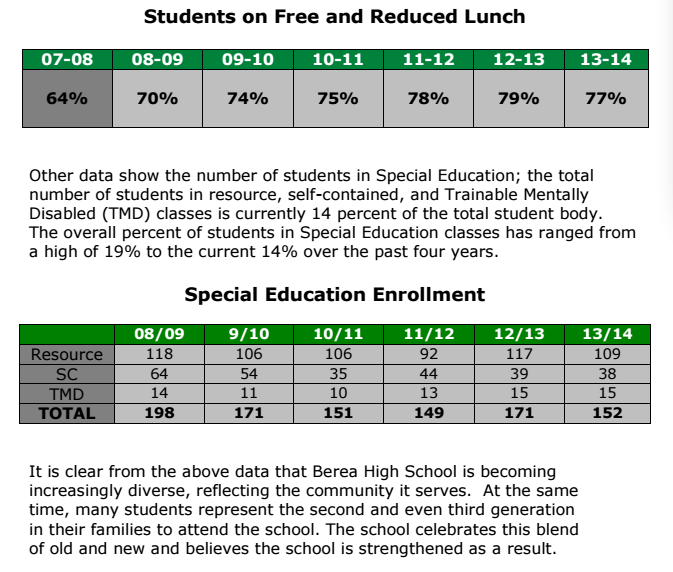
Berea High School has a consistent record of being a majority-minority school and also serves a diverse population of students by poverty and special needs:

BHS race

BHS poverty special needs

As a result, Berea High’s 2014 school report card looks quite different when compared to Academic Magnet or Greenville Tech Charter—good (absolute) and below average (growth) ratings, and a much different tested demographic of students:

BHS tested 2014

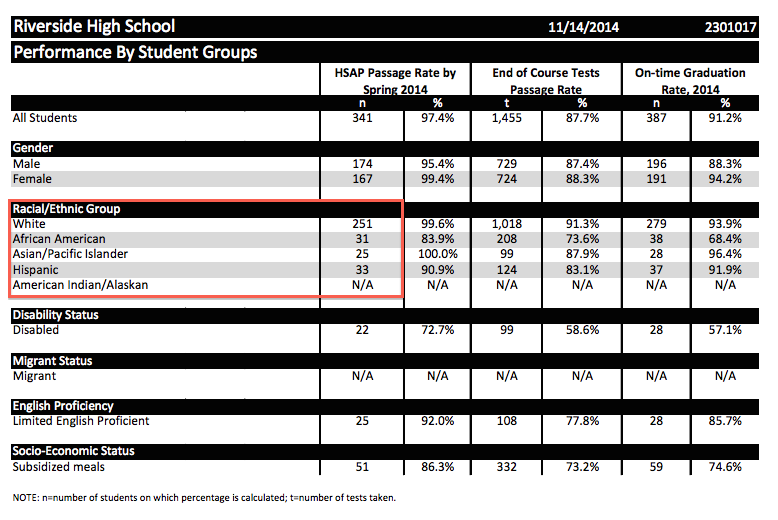
However, Riverside High School looks much more like Academic Magnet or Greenville Tech Charter—an excellent/excellent rating in 2014 and serving/testing a population 73% white:

RHS race

RHS tested 2014

Choice, then, in a variety of forms such as public school choice, charter schools, and magnet schools/academies are isolating students by race and class within highly diverse regions of a highly diverse state.

No longer vouchers or tuition tax credits, choice is now masked behind the allure of misleading labels—public, charter, magnet, academy—but ultimately resulting in one disturbing fact: choice segregates by design.

More choice will result in greater segregation and more shuffling, but market forces will never address equity and will always create winners and losers instead of establishing opportunities for all—as Academic Magnet demonstrates.

The call for fairness and diversity by students at Academic Magnet should be a call among all in SC and across the U.S.

See Also

Why Sending Your Child to a Charter School Hurts Other Children

Don’t Buy School Choice Week

When I wrote Why Advocacy and Market Forces Fail Education Reform almost four years ago, I had recently spent a great deal of time researching and writing about school choice within the focus of parental choice.

Then as well as now, the ever-growing body of evidence shows that school choice, parental choice, and market forces never achieve the outcomes advocates claim. And yet, each year we must suffer through School Choice Week, which is just a slightly heightened and compressed example of the same sort of misleading advocacy that exists every week of the year in the U.S.

Choice, we must acknowledge, in the U.S. is a sort of consumer choice: We must allow people the choice of either a Honda Accord or a Toyota Camry (but choosing not to drive shall not be on the table).

So when any school choice advocate launches into the typical blather that we must give all parents the sort of choice that wealthy parents have (one of the most insincere and distorted examples of manipulative rhetoric you’ll hear), we must not allow the debate to remain within a skewed choice-only context.

As I have stated before, democracy depends on social contracts that rise above the necessity of choice:

choice quote

Since School Choice Week slips into the wake of celebrating Martin Luther King Jr. (see also how parental choice has been manipulated in the “no excuses” charter school debate), we must also note that choice is a hollow call dedicated to the Invisible Hand and a pale hope that market forces may accomplish indirectly what a moral people can accomplish directly—as King confronted in the last days of his life:

In addition to the absence of coordination and sufficiency, the programs of the past all have another common failing — they are indirect. Each seeks to solve poverty by first solving something else.

I am now convinced that the simplest approach will prove to be the most effective — the solution to poverty is to abolish it directly by a now widely discussed measure: the guaranteed income.

Again, the evidence is overwhelming that public, charter, and private schools have about the same impact on students once we adjust measurable student learning by external factors.

Private schools appear to be better mostly because they are selective (think of judging hospitals that admit only healthy patients compared to hospitals that admit all patients), charter schools waving higher achievement fail to note that such measurable gains tend to equal the longer days/years and are not attributable to any aspect of “charterness” (my analysis of two years of charter schools in SC shows that fewer than a handful of over 50 charters outperform comparable public schools), and both private and charter schools reveal that choice often contributes to negative outcomes such as segregation, teacher and student churn, and inequitable opportunities for marginalized students such as English language learners and special needs students.

And while private schools as powerful models of what market forces produce fail to show that type of schooling impacts significantly student achievement, that parental choice advocates ignore the qualities of private schools most attractive to parents illustrates the insincerity of school choice proponents: private schools popular with the affluent have very low student/teacher ratios, yet class size is routinely discounted as important among reformers who embrace choice; private schools offer rich curricular offerings including so-called electives that are being cut and marginalized in public and “no excuses” charter schools.

School choice lacks credible evidence for advocates’ claims, and choice advocates’ constantly shifting commitments also reveal questionable credibility: vouchers, tuition tax credits, public school open enrollment, and charter schools as primary mechanisms as well as higher grades, graduation rates, and college enrollment as moving targets of “success.”

Choice in education is an ideological lie driven by an idealized faith that ignores the negative consequences of choice: some parents choose for their children to drop out of school, some parents choose to smoke with their children in the car, some parents choose to place their children in schools based on racist and classist beliefs.

School Choice Week, then, is a marketing scam. Don’t buy it.

The Public School Advantage, Christopher A. and Sarah Theule Lubienski

Parental choice?: A critical reconsideration of choice and the debate about choice

Choice

Charter schools

“School Choice Week” is a Good Time to Review the Evidence (NEPC)

No Excuses for Advocacy Masquerading as Research

“I guess irony can be pretty ironic sometimes.”

Commander Buck Murdock (William Shatner), Airplane 2: The Sequel

A rallying mantra of politicians, education reform advocates, and many charter schools is “no excuses”—a mask for an ideology steeped in classism and racism and targeting mostly black, brown, and poor children.

In the spirit of Commander Buck Murdock, we now have ample evidence that there should be no excuses for the pattern of advocacy masquerading as research used to justify “no excuses” charter schools.

First, let me remind everyone of a 2007 report on school choice from Wisconsin Policy Research Institute (WPRI), which promotes itself as Wisconsin’s free-market think tank.

Despite the study finding choice ineffective, George Lightbourn introduced the report as a Senior Fellow, admitting:

The report you are reading did not yield the results we had hoped to find. We had expected to find a wellspring of hope that increased parental involvement in the Milwaukee Public Schools (MPS) would be the key ingredient in improving student performance.

And later on the WPRI web site (although no longer available online), Lightbourne emphasized:

So that there is no misunderstanding, WPRI is unhesitant in supporting school choice [emphasis added]. School choice is working and should be improved and expanded. School choice is good for Milwaukee ‘s children.

For many, if not most, school choice advocates, ideology trumps evidence.

In the more narrow commitment to charter schools as a market mechanism and then “no excuses” charter schools specifically, the evidence is overwhelming that not only think tanks but also university departments have relinquished academic freedom for masking advocacy as research.

The latest can be found in No Excuses Charter Schools: A Meta-Analysis of the Experimental Evidence on Student Achievement from the Department of Education Reform (University of Arkansas)—founded and funded by the pro-choice Walton family.

In a review of the report, Jeanne M. Powers finds:

The working paper reviewed here seeks to assess the extent to which “No Excuses” charter schools raise student achievement in English language arts and math and thereby close the achievement gap. The paper defines such schools as having: a) high academic standards, b) strict disciplinary codes, c) extended instructional time, and d) targeted supports for low-performing students. From their meta-analysis of 10 quasi-experimental studies , the authors concluded students who attended No Excuses charter schools had average achievement gains of 0.16 standard deviations in English language arts and 0.25 in mathematics. While conceding that charter schools with lotteries and No Excuses charter schools are not representative of all charter schools, the authors did not address whether or how students who apply to lottery charter schools might not be representative of all charter school students. They also did not address the possible relevance of student attrition for the individual studies’ findings and their own analysis. As a result, the claim that No Excuses schools can close the achievement gap substantially overstates their findings. Moreover, the report’s relatively small sample of schools concentrated in Northeast Coast cities suggests the current research base is too limited to draw conclusions about the effectiveness of No Excuses charter schools.

This is not, however, an isolated situation, as I have documented, so I offer below the full record:

Bankrupt Cultural Capital Claims: Beware the Roadbuilders, pt. 3

For the Record: Should We Trust Advocates of “No Excuses”?

Pulling a Greene: Why Advocacy and Market Forces Fail Education Reform [Redux]

The Charter Sham Formula: Billionaires + Flawed “Reports” + Press Release Media = Misled Public

Buying the Academy, Good-Bye Scholarship

Criticizing KIPP Critics

When a “Visit” Trumps Expertise and Experience: A New Deal

The Rise of the Dogmatic Scholar: “A Cult of Ignorance” pt. 2

Beware Reports Claiming “No Excuses”

Media Fail, 10,000 hours, and Grit: The Great Media-Disciplines Divide, pt. 2

In his The Danger of Delegating Education to Journalists: Why the APS Observer Needs Peer Review When Summarizing New Scientific Developments [1], K. Anders Ericsson makes several key points about how the mainstream media present disciplinary knowledge to the public, focusing on Malcolm Gladwell’s misleading but popular 10,000 hour rule.

Ericsson’s key point includes:

Although I accept that the process of writing an engaging popular article requires considerable simplification, I think it is essential that the article does not contain incorrect statements and misinformation. My primary goal with this review is to describe several claims in Jaffe’s article that were simply false or clearly misleading and then discuss how APS might successfully develop successful methods for providing research summaries for non-specialists that are informative and accurately presents the major views of APS members and Fellows. At the very least they should not contain factually incorrect statements and avoid reinforcing existing misconceptions in the popular media.

Through the Gladwell/10,000 hour rule example, Ericsson provides an important argument relevant to the current (and historical) public debate about school quality, teaching and learning, and education reform.

Much in the same way Gladwell has misrepresented research (which is typical within the media), and how that has been uncritically embraced by the media and public (as well as many if not most practitioners), a wide array of issues have received the same fate: learning styles, “grit,” collaborative learning, progressive education, charter schools, school choice, language gap, and so on.

Even when a claim or practice has a kernel of research at its source, popular oversimplification (often by journalists, but practitioners as well) and then commercialization/politicizing (creating programs and policies through publishers, “star” advocates, and legislation) significantly distort that research.

Education Has Failed Research, Historically

John Dewey represents an odd paradox in that he is possibly the most mentioned educator in the U.S. (either as the source of all that is wrong in education or idealistically cited as all that is right about how school could be), despite the reality that Dewey is mostly misunderstood and misrepresented; and thus his philosophy, progressivism, remains mostly absent in U.S. public schools.

Dewey can be blamed, in part, for this reality because he refused on principle to allow his experiments in education to be carefully catalogued because he believed no educational practice should be come a template for others.

Throughout much of the twentieth century, Lou LaBrant, a vigilant progressive educator, spent much of her career practicing and advocating for progressive literacy instruction, but LaBrant also confronted the many instances of how progressivism was misrepresented.

Broadly, and early, LaBrant recognized the public confusion about progressivism:

Two adults speak of “progressive education.” One means a school where responsibility, critical thinking, and honest expression are emphasized; the other thinks of license, lack of plans, irresponsibility. They argue fruitlessly about being “for” or “against” progressive education. (LaBrant, 1944, pp. 477-478)

But she also confronted how progressivism was mostly distorted in its application. LaBrant’s criticisms still reflect why education has failed research, and why research has not failed education.

Credible educational research-based philosophy, theory, and pedagogy are often corrupted by oversimplification.

In 1931, LaBrant published a scathing criticism of the popularity of the project method, an oversimplification of Dewey that resulted in students doing crafts in English class instead of reading or writing:

The cause for my wrath is not new or single. It is of slow growth and has many characteristics. It is known to many as a variation of the project method; to me, as the soap performance. With the project, neatly defined by theorizing educators as “a purposeful activity carried to a successful conclusion,” I know better than to be at war. With what passes for purposeful activity and is unfortunately carried to a conclusion because it will kill time, I have much to complain. To be, for a moment, coherent: I am disturbed by the practice, much more common than our publications would indicate, of using the carving of little toy boats and castles, the dressing of quaint dolls, the pasting of advertising pictures, and the manipulation of clay and soap as the teaching of English literature. (p. 245)

Credible educational research is often corrupted by commercialization/politicizing, reducing that research to misguided programs/legislation.

“[L]anguage behavior can not be reduced to formula,” LaBrant (1947) argued (p. 20)—emphasizing that literacy growth was complicated but flourished when it was child-centered and practical (for example, in the ways many privileged children experience in their homes because one or more of the parents are afforded the conditions within which to foster their children’s literacy).

By mid-twentieth century, LaBrant (1949) had identified the central failure of teaching reading: “Our language programs have been set up as costume parties and not anything more basic than that” (p. 16).

For at least 80-plus years since LaBrant fought this fight, the same patterns of media, political, public, and practitioners failing educational research have continued

Oversimplification, Commercialization/Politicizing: Recovering the Evidence

The list is incredibly long, too long to be exhaustive here, but consider the following: sloganism (“Work hard. Be nice.”), silver-bullet ideologies (“grit,” 10,000-hour rule), miracle schools (KIPP), evidence-based programs (Dibbles, 4-block, 6-traits), common sense claims and policy absent evidence (Common Core), and trendy legislation (3rd-grade retention policies as reading policy, merit pay) as well as politicized government reports (National Reading Panel).

Each of these can be traced to some kernel of research (sometimes robust bodies of research, and sometimes cherry-picked research), but all of these represent a current and historical fact: Education has failed research, but research has not failed education.

When educational research is reduced to scripts or programs/legislation, that knowledge base is invariably distorted, corrupted—as Ericsson details well above.

Journalists, politicians, and commercial education entities have all played a fundamental and crippling role in this reality; thus, as Ericsson argues, educators, scholars and researchers must not allow the fate of educational research to remain primarily in the wrong hands.

We have a public and professional obligation to confront these oversimplifications as well as the commercialization/politicizing of educational research. And we must do this through our public work that speaks to those failures and the public simultaneously.

As LaBrant and Ericsson reveal, unless we take that call seriously, we too are part of the reason education continues to fail research.

References

LaBrant, L. (1949). A genetic approach to language. Unpublished manuscript, Institute of General Semantics, Lakeville, CT.

LaBrant, L. (1947). Um-brel-la has syllables three. The Packet, 2(1), 20-25.

LaBrant, L. (1944, November). The words they know. The English Journal, 33(9), 475-480.

LaBrant, L. (1931, March). MasqueradingThe English Journal, 20(3), pp. 244-246.

For Further Reading

U.S. and Education Reform Need a Critical Free Press

My Open Letter to Journalists: A Critical Free Press, pt. 2

NPR Whitewashes “Grit” Narrative

Shiny Happy People: NPR, “Grit,” and “Myths that Deform” pt. 2

How I Learned to Distrust the Media (about Education)

My (Often Painful) Online Education

[1] See original and downloadable link to the paper here.

Idealizing, Misreading Impoverished and Minority Parental Choice

In his The Charter School Paradox, Walt Gardner asks: “If charter schools are guilty of all the sins described in the multi-part cover story, then why are there waiting lists across the country of mostly poor black and Hispanic parents who are desperate to get their children enrolled in these schools?” And then he concludes:

I continue to be a strong supporter of traditional public schools for reasons I’ve explained in this column and in other venues over the past two decades.  But I also support parental choice. I don’t see this as a contradiction in terms. Yes, parents often make mistakes in their decisions.  However, I maintain it is their right alone to decide what is best for their offspring. Charter schools are accused of increasing racial segregation, but that does not seem to bother poor black and Hispanic parents who want to enroll their children.  I wish The Nation had addressed this paradox in its cover story.  It’s too important to brush aside.

I recognized the role of parental choice in the larger school choice debate as well as how that element complicates both advocacy and rejecting a wide range of school choice initiatives, resulting in my writing an extended examination of the issue in Parental Choice?

Despite spending a great deal of time on school choice research and finding little to support advocacy for choice options such as tuition tax credits, public school choice, or charter schools, I too was baffled by the apparent appeal of charter schools, notably among impoverished and minority parents—particularly in the context of my own claim that “no excuses” ideologies are racist and my concurrent rejecting of paternalism. I was able to understand that tension, however, once I read Michelle Alexander’s The New Jim Crow, in which she confronts the same tension over mass incarceration and intensive (as well as disproportionate) policing of high-poverty minority neighborhoods.

In Education Reform in the New Jim Crow Era, I reached the following conclusion:

Since market-oriented education reform is producing evidence highlighting the ineffectiveness and even negative outcomes associated with those policies, that the agendas remain robust suggests, again like mass incarceration, education reform fulfills many of the dynamics found in the New Jim Crow.

Just as mass incarceration from the war on drugs continues institutional racism once found in slavery and Jim Crow, education reform, especially the “no excuses” charter school movement, resurrects a separate but equal education system that is separate, but certainly isn’t equal. The masked racism of mass incarceration and education reform share many parallels…

This last point—that African Americans seem to support both the war on crime and “no excuses” charter schools—presents the most problematic aspect of charges that mass incarceration and education reform are ultimately racist, significant contributions to the New Jim Crow. [emphasis added]

For example, [Sarah] Carr reports [in her Hope Against Hope] that African American parents not only choose “no excuses” charter schools in New Orleans, but also actively cheer and encourage the authoritarian policies voiced by the schools’ administrators. But Alexander states, “Given the dilemma facing poor black communities, it is inaccurate to say that black people ‘support’ mass incarceration or ‘get-tough’ policies” because “if the only choice that is offered blacks is rampant crime or more prisons, the predictable (and understandable) answer will be ‘more prisons'” (p. 210).

New Orleans serves as a stark example of how this dynamic works in education reform: Given the choice between segregated, underfunded and deteriorating public schools and “no excuses” charters—and not the choice of the school environments and offerings found in many elite private schools—the predictable answer is “no excuses” charters.

The charter school movement, specifically the “no excuses” versions, represents a skewed choice environment; again one that does not include the qualities found in many selective and expensive private schools.

We must be careful, then, not to idealize parental choice and not to misread the choices in limited contexts of impoverished and minority parents who in fact are not being offered the sorts of choices that would likely erase their apparent support for charter schools.

Well-funded, safe, and high-quality public schools would negate the need for choice, and that should be what we are pursuing, as I have detailed before:

People in poverty deserve essential Commons—such as a police force and judicial system, a military, a highway system, a healthcare system, and universal public education—that make choice unnecessary. In short, among the essentials of a free people, choice shouldn’t be needed by anyone.

No child should have to wait for good schools while the market sorts some out, no human should have to wait for quality medical care while the market sorts some out, no African American teen gunned down in the street should have to wait for the market to sort out justice—the Commons must be the promise of the essential equity and justice that both make freedom possible and free people embrace.

NPR Whitewashes Charter Schools and Disaster Capitalism in New Orleans

It was bad enough when NPR whitewashed the “grit” narrative, but now NPR is whitewashing charter schools and disaster capitalism in New Orleans.

Framed as “remarkable changes,” erasing public schools and firing all public school faculty (a significant percentage of the black middle class in New Orleans) are whitewashed beneath a masking narrative embracing all things market forces as essentially good, even though the actions taken against pubic schools and teachers in the name of the mostly minority and disproportionately impoverished families and children of New Orleans have not accomplished what advocates claim.

In the NPR piece, “no teaching experience” is passed over as if this couldn’t possibly be a problem; however, when public schools were dismantled and all the faculty fired, the second disaster swept over New Orleans in the form of “no excuses” charter schools (KIPP and their cousins) and a swarm of Teach For America recruits who were not native to New Orleans and have lived lives mostly unlike the children they teach.

As well, that black and poor children are “part of an experiment” remains unexamined in this piece. Instead, the entire New Orleans experiment is called “kind of a miracle.”

At 5 minutes in, NPR allows a critic to call claims of success “overblown,” and then 7 minutes in, one disgruntled parent announces that charter advocates “won’t be able to fool me this time.” But overall, this NPR whitewashing of the New Orleans education reform experiment fails as most education journalism does—absent as it is any real critical questions, absent as it is any effort to honor the weight of evidence in the pursuit of “balance.”

I find here the exact same pattern I confronted in my criticism of the NPR “grit” piece. While the 8-plus minutes do technically include “both sides,” the less credible position (pro- charter, pro-market forces) is clearly given the greater weight while the stronger position is posed as mere “criticism.”

Education reform in New Orleans in the wake of Katrina is a model of disaster capitalism and an ugly lesson in how we should not reform public education. The lessons ignored in the NPR piece include the following:

  • New Orleans education reform is yet another “miracle” narrative that is driven by political advocacy and then bolstered by a complicit media. Yet, claims of education miracles have all crumbled under scrutiny. The Texas Miracle, the Chicago Miracle, the Harlem Miracle, the Florida Miracle, and now the New Orleans Miracle—all are political lies and media trivializations of policies and practices that harm children, families, and society.
  • Charter school advocacy in New Orleans and across the U.S. remains unwarranted, as Gerald N. Tirozzi explains:

Consider the reality that, as a nation, we continue to follow and accept the declarations of education reformers in their relentless promotion and implementation of “cures” that generally have no documented research base for school improvement. Conversely, these same strategists apparently have little time to consider existing research and evaluation findings, which rebut the very reform strategies and initiatives they are espousing.

A prime example of such “evidence avoidance” is apparent in the accelerating growth of the high-profile charter school movement. It is truly difficult to comprehend the escalating commitment to, and major infusion of federal and state funds for, this movement—especially in the absence of supportive data on its effectiveness in the education of young people.

  •  Dismantling a foundational public institution and stripping professionals of their careers send important—but ignored—messages about commitments to the ruling elite at the expense of workers, families, and children. Education reform within the context of disaster capitalism parallels the exact reduced circumstances used to manipulate marginalized people, exposed by Michelle Alexander’s examination of mass incarceration, as I have presented before:

For example, Carr reports that African American parents not only choose “no excuses” charter schools in New Orleans, but also actively cheer and encourage the authoritarian policies voiced by the schools’ administrators. But Alexander states, “Given the dilemma facing poor black communities, it is inaccurate to say that black people ‘support’ mass incarceration or ‘get-tough’ policies” because “if the only choice that is offered blacks is rampant crime or more prisons, the predictable (and understandable) answer will be ‘more prisons'” (p. 210).

New Orleans serves as a stark example of how this dynamic works in education reform: Given the choice between segregated, underfunded and deteriorating public schools and “no excuses” charters – and not the choice of the school environments and offerings found in many elite private schools – the predictable answer is “no excuses” charters.

The breezy “fair and balanced” mainstream media tone remains a mask, a whitewashing of narratives and policies that serve those with wealth and privilege on the backs of workers and marginalized populations reduced to competing among themselves (within their marginalized group and against other marginalized groups) for a thin slice of pie controlled by the 1%.

While Audre Lorde’s “The Master’s Tools Will Never Dismantle the Master’s House” addresses a different context specifically, key elements here inform how both the uncritical NPR piece and the actual circumstances of education reform in New Orleans fail children, families, and democracy:

It is a particular academic arrogance to assume any discussion of feminist theory without examining our many differences, and without a significant input from poor women, Black and Third World women, and lesbians….It means that only the most narrow parameters of change are possible and allowable….

Without community there is no liberation, only the most vulnerable and temporary armistice between an individual and her oppression. But community must not mean a shedding of our differences, nor the pathetic pretense that these differences do not exist….

For the master’s tools will never dismantle the master’s house. They may allow us temporarily to beat him at his own game, but they will never enable us to bring about genuine change. And this fact is only threatening to those women who still define the master’s house as their only source of support….

Women of today are still being called upon to stretch across the gap of male ignorance and to educated men as to our existence and our needs. This is an old and primary tool of all oppressors to keep the oppressed occupied with the master’s concerns.

As long as our mainstream media refuse to examine the evidence and take sides with that evidence, as long as that media remain one of the “master’s tools,” as long as the media work “to keep the oppressed occupied with the master’s concerns,” we are lost as a democracy, as a community of ethical people in the service of each other.

Charter schools replacing public schools, TFA supplanting career educators—these are not “miracles,” these are “the master’s concerns” imposed on marginalized people in the name of those people.

Why do we tolerate and champion the mass firing of black professional?

Why do we tolerate and champion experimenting with the lives and education of “other people’s children,” who are mostly black, brown, and poor?

Why do we tolerate and champion demanding that “other people’s children” chant and stay always inside the lines?

And then, why do mainstream journalists refuse to ask these questions? In whose service is the press?

Why do these questions ring hollow in the only echo chamber we are allowed, the one built by disaster capitalism?

For context please see:

Recommended: Hope Against Hope, Sarah Carr

Endgame: Disaster Capitalism, New Orleans, and the Charter Scam

Andre Perry

Mercedes Schneider

Education myth busters: Do criticisms of U.S. schools rely on bad information and distortions?, Peter Smagorinsky

“Other People’s Children” v. “They’re All Our Children”

Optimism, seeing the light at the end of the tunnel—these are not my proclivities.

And while I wallow in the self-delusion that I am a Skeptic, the truth is that I have long ago slipped over into the abyss of cynicism.

There are moments, however, when I hope.

One such moment was during the Sandy Hook school shooting tragedy—when I wanted desperately to believe that President Obama’s call for seeing every child as “all our children” would resonate against the recurring din of gunfire killing children—but not only the uniquely American slaying of school children but the daily loss of mostly black and brown children and young adults to gunfire in the homes and streets of U.S. inner cities.

But that has not happened. Michael Brown was shot and killed by a police officer, Brown’s body left callously in the street—adding to the seemingly endless cataloguing of similar tragedies. And those tragedies are daily magnified by our collective refusal to see each death in the same way we would see the death of our own children, our collective refusal to see how “other people’s children” live, learn, and die is just as precious as if they were “all our children.”

So my cynicism is driven by the stark realization that if we cannot come together as a community over the shooting of “other people’s children,” how will we ever come together about the less dramatic but just as tragic conditions such as what we allow for the education of “other people’s children”?

The powerful phrase “other people’s children” comes from the work of Lisa Delpit, who confronts the inequity of educational opportunities for minority and impoverished children. Delpit highlights that marginalized students receive disproportionately test-prep and worksheet-driven instruction, unlike their white and affluent peers. While some have claimed her as a champion of traditional practice because her criticisms have included failures by progressives, Delpit counters:

I do not advocate a simplistic “basic skills” approach for children outside of the culture of power. It would be (and has been) tragic to operate as if these children were incapable of critical and higher-order thinking and reasoning. Rather, I suggest that schools must provide these children the content that other families from a different cultural orientation provide at home. This does not mean separating children according to family background [emphasis added], but instead, ensuring that each classroom incorporate strategies appropriate for all the children in its confines.

And I do not advocate that it is the school’s job to attempt to change the homes of poor and nonwhite children to match the homes of those in the culture of power [emphasis added]. That may indeed be a form of cultural genocide. I have frequently heard schools call poor parents “uncaring” when parents respond to the school’s urging, saying, “But that’s the school’s job.” What the school personnel fail to understand is that if the parents were members of the culture of power and lived by its rules and codes, then they would transmit those codes to their children. In fact, they transmit another culture that children must learn at home in order to survive in their communities.

Delpit’s call, however, must be distinguished from not only traditionalists but also popular but flawed programs such as those provided by Ruby Payne, who promotes uncritical teaching of middle class codes to impoverished students. Not grounded in research but driving professional development of teachers in many states across the U.S., Payne’s self-published workbooks and workshops speak to and perpetuate stereotypes of people in poverty and racial minorities. And as Monique Redeaux clarifies:

At first glance, this seems to be the message conveyed by Payne: poor students of color need to be explicitly taught the hidden rules or codes of the middle/upper class in order to be successful in school, work, etc. When examined more closely, this could not be further from the truth. Both terms, the “culture of poverty” (Payne) and the “culture of power” (Delpit) locate the problem in culture—but in different ways/places [emphasis added]. Although Payne and other “culture of poverty” advocates see the problem as residing with the cultural attributes of those living in poverty, the “culture of power” perspective suggests that the middle/upper class hold the power and key to institutional success, partly through their monopolization of educational skills, and that they do all they can to make sure that they and their offspring maintain that power.

When Delpit began her work on “other people’s children” she predicted that her purpose would be misunderstood. People criticized her for “vindicating” teachers who subjected students of color to isolated, meaningless, sub-skills day after day. However, what she was actually advocating when she referred to “skills-based instruction” was the “useful and usable knowledge that contributes to a student’s ability to communicate effectively in standard, generally acceptable literary forms” and she proposed that this was best learned in meaningful contexts. In other words, Delpit argued that both technical skills and critical thinking are essential: a person of color who has no critical thinking skills becomes the “trainable, low-level functionary of the dominant society, simply the grease that keeps the institutions which orchestrate his or her oppression running smoothly.” At the same time, those who lack the technical skills demanded by colleges, universities, and employers will be denied entry into these institutions. Consequently, they will attain financial and social success only within the “disenfranchised underworld.”

The key distinction between Delpit and Payne is the reason why [emphasis added] they believe students should be taught the “hidden rules.” Payne argues that their educational and economic success depend on their being able to conform to the rules of the middle/upper class. While Delpit, too, makes this argument, she does not believe that students should passively adopt an alternate code simply because it is the “way things are,” especially if they want to achieve a particular economic status. Instead, Delpit asserts that students need to know and understand the power realities of this country with the purpose of changing these realities.

We are confronted, then, with the continuing rise in programs funded by the government and supported by a wide range of political, public, and media ideologies and interests that submit only “other people’s children” to teachers produced by alternative pathways (such as Teach For America, but also copycats) and to school structures (usually charter schools, labeled “public” but functioning within a market dynamic) and policies driven by “no excuses” ideologies (such as KIPP, but also numerous copycats) demanding “grit.”

Yet, affluent children, mostly white, find themselves in classrooms with low class size, experienced and qualified/certified teachers, and rich curricula often not linked to the standards-of-the-moment or high-stakes testing—and do not find themselves disproportionately retained, suspended, expelled, or shot while unarmed walking down the street.

Our education dilemma is a subset of our greater cultural dilemma—one that pits our traditional commitments to the rugged individual, Social Darwinism, and consumerism against our potential moral grounding in community and cooperation.

No child should need to depend on the choices her/his parents make, and no parents should be faced with making choices about those foundational things that all humans deserve—one of which is access to the exact same conditions for learning and living that the privileged among us have before them.

Today, the U.S. remains a dog-eat-dog culture that perpetuates and allows one world for “other people’s children” that would never be tolerated for “my child.” A great moral lapse of our time is that we refuse to act in ways that prove “they’re all our children.”

GreenvilleOnline: SC should choose Oklahoma, not Florida

SC should choose Oklahoma, not Florida [1]

What do third-grade retention policies based on reading tests and charter schools have in common?

First, they have a great deal of public and political support.

But, second, the research base on these policies has shown repeatedly that they do more to fail students than to achieve any of the lofty goals advocates claim.

South Carolina is a typical example of how education policy not grounded in evidence continues to fail students. For example, charter schools advocacy remains robust but deeply misleading:

We know that choice in education changes lives. We must work together to develop a culture in South Carolina that values education — from our families to funding at the State House. All students deserve access to a high-quality education regardless of their ZIP code, and excellent public charter schools are part of the solution in transforming South Carolina’s future.

This sort of incomplete advocacy [2] is commonplace despite charter schools in SC reinforcing discrediting patterns found across the U.S.:

Charter schools—like grade retention—are politically compelling, but neither effective nor appropriate for the essential problems facing public education.

Nonetheless, SC also models reform on Florida’s third-grade retention and reading policies discredited when reviewed. However, as John Thompson details:

Oklahoma’s Republican Legislature overrode the veto of Republican Governor Mary Fallin, and overwhelmingly rejected another cornerstone of Jeb Bush’s corporate reform agenda. The overall vote was 124 to 21….

Oklahoma’s victory over the test and punish approach to 3rd grade reading is a win-win team effort of national importance. The override was due to an unexpected, grassroots uprising started by parents, joined by superintendents and teachers, organized on social media, and assisted by anti- corporate reform educators and our opposite, Stand for Children, as well as Tea Party supporters, and social service providers who are increasingly coming to the rescue of the state’s grossly underfunded schools.

The rise of grade-retention policy and  charter schools shares the flawed combination of popularity and a solid research base discrediting those policies. Deborah Stipek and Michael Lombardo pose some key points about the need to reject grade-retention policy, points that should guide needed movements against charter schools and other misguided policy:

  • Before policy is implemented, the problem needs to be clearly defined with the research base on the appropriate policies for that problem identified by experts in the field (not political leaders or policy advocates). If, for example, reading achievement is an identified problem in a state, what do we know about grade retention as a policy solution? According to Stipek and Lombardo:

A majority of peer-reviewed studies over the past 30 years have demonstrated that holding students back yields little or no long-term academic benefits and can actually be harmful to students. When improvements in achievement are linked to retention, they are not usually sustained beyond a few years, and there is some evidence for negative effects on self-esteem and emotional well-being.

Moreover, there is compelling evidence that retention can reduce the probability of high school graduation. According to a 2005 review of decades of studies by Nailing Xia and Elizabeth Glennie: “Research has consistently found that retained students are at a higher risk of leaving school earlier, even after controlling for academic performance and other factors such as race and ethnicity, gender, socioeconomic status, family background, etc.”

  • Once we establish the problem and the evidence base on the reform, what concept should guide adopting new policy? Again, about retention, Stipek and Lombardo explain: “Instead of giving children the same treatment that failed them the first time, alternative strategies provide different kinds of learning opportunities.” In other words, policies that reinforce or replicate the identified problems must be ended, and then something different needs to be implemented.

If reading achievement is a problem, grade retention guarantees to cause more harm than good.

If public school segregation and student achievement are problems, charter schools actually fuel segregation and offer about the same student achievement (and even worse) as public schools.

Currently, the public and political leaders rail against failing schools and failing students, but the truth is that public and political support for misguided policy is failing students.

SC needs to choose the sorts of public school policies that will insure that no child and no parent needs to choose the school best for any child. In SC and across the U.S., we need to choose Oklahoma, not Florida.

[1] Op-Ed originally published at The Greenville News, and included here to add hyperlinks for support.

[2] See Review of The Productivity of Public Charter Schools

The Charter Sham Formula: Billionaires + Flawed “Reports” + Press Release Media = Misled Public

Late in 2013, I shared my own experience with the disaster capitalism tactics employed by the Walton-funded Department of Education Reform (University of Arkansas), asking: For the Record: Should We Trust Advocates of “No Excuses”?

I detailed reasons why the answer is clearly “No”: the funding determines the claims in the so-called reports (see Pulling a Greene: Why Advocacy and Market Forces Fail Education Reform [Redux]), the nasty and unmerited swipes misrepresenting my view of children and parents in poverty (swipes I directly refuted but were allowed to remain in print; see For the Record noted above), and the racist/classist underpinnings of the practices practiced among “no excuses” charters (see Criticizing KIPP Critics).

But billionaires buying the appearance of credible scholarly research on education reform would not go very far without the blind allegiance of press release journalism (see HERE, HERE, HERE and HERE).

And all of those factors combined reveal the Charter Sham Formula: Billionaires + Flawed “Reports” + Press Release Media = Misled Public.

That formula is business as usual, regretfully, and one of the most recent and egregious examples can be found at The Post and Courier (Charleston), a frequent contributor to misinforming the public due to a failure to examine the credibility of reports: A bigger bang for school bucks:

An increasing number of parents who shop around before choosing a school for their children are opting for charter schools because they like the academic environment. But they might not be aware that those same schools also are giving the public a bigger bang for their buck than traditional schools.

Research at the University of Arkansas shows that charter schools in 30 states are neck-and-neck with traditional schools on eighth grade standardized tests. But they achieve those scores for significantly less money.

Imagine what they might do if charter schools were funded equitably.

Or better yet, imagine what we could do in our public schools if the mainstream media didn’t continue to follow blindly the lead of billionaires determined to dismantle those schools.

About that “Research at the University of Arkansas,” which the P&C could have easily found by just googling, let’s consider a critique by Bruce Baker, Professor in the Graduate School of Education at Rutgers, who first notes the flaws in similar claims found in an earlier report about charter schools from the same source:

The University of Arkansas Department of Education Reform has just produced a follow up to their previous analysis in which they proclaimed boldly that charter schools are desperately uniformly everywhere and anywhere deprived of thousands of dollars per pupil when compared with their bloated overfunded public district counterparts (yes… that’s a bit of a mis-characterization of their claims… but closer than their bizarre characterization of my critique).

I wrote a critique of that report pointing out how they had made numerous bogus assumptions and ill-conceived, technically inept comparisons which in most cases dramatically overstated their predetermined, handsomely paid for, but shamelessly wrong claims.

That critique is here: http://nepc.colorado.edu/files/ttruarkcharterfunding.pdf

The previous report proclaiming dreadful underfunding of charter schools leads to the low hanging fruit opportunity to point out that even if charter schools have close to the same test scores as district schools – and do so for so00000 much less money – they are therefore far more efficient. And thus, the nifty new follow up report on charter school productivity – or on how it’s plainly obvious that policymakers get far more for the buck from charters than from those bloated, inefficient public bureaucracies – district schools.

After detailing the repeated flaws in the report cited as credible by the P&C, Baker concludes:

Yes – that’s right – either this is an egregious display of complete ignorance and methodological ineptitude, or this new report is a blatant and intentional misrepresentation of data. So which is it? I’m inclined to believe the latter, but I guess either is possible.

Oh… and separately, in this earlier report, Kevin Welner and I discuss appropriate methods for evaluating relative efficiency (the appropriate framework for such comparisons)…. And to no surprise the methods in this new UARK report regarding relative efficiency are also complete junk. Put simply, and perhaps I’ll get to more detail at a later point, a simple “dollars per NAEP score” comparison, or the silly ROI method used in their report are entirely insufficient (especially as some state aggregate endeavor???).

And it doesn’t take too much of a literature search to turn up the rather large body of literature on relative efficiency analysis in education – and the methodological difficulties in estimating relative efficiency. So, even setting aside the fact that the spending measures in this study are complete junk, the cost effectiveness and ROI approaches used are intellectually flaccid and methodologically ham-fisted.

But if the measures of inputs suck to begin with, then the methods applied to those measures really don’t matter so much.

To say this new UARK charter productivity study is built on a foundation of sand would be offensive… to sand.

And I like sand.

No, charter schools are not offering a bigger bang for school bucks. In fact, charter schools are often nearly identical to public schools in both strengths and weaknesses (including the return of resegregation in both).

What is getting a bigger bang for the bucks? The Walton family and a wide assortment of other billionaire/edu-reformers.

What is providing that bang? The mainstream media that have chosen press release journalism because googling* is simply too much to expect, I suppose.

* Or just follow Bruce Baker (@SchlFinance101), Shanker Institute (@shankerinst), and NEPC (@NEPCtweet) on Twitter.

NOTE: See how corrosive these reports are as they become part of how the public responds to critical examinations of education and education reform: comment at AlterNet.