[Header Photo by Josue Michel on Unsplash]
all the silent children
watched the dismantling
all the carelessness
all the negligence
of all the adults
who should have known better
—P.L. Thomas

[Header Photo by Josue Michel on Unsplash]
all the silent children
watched the dismantling
all the carelessness
all the negligence
of all the adults
who should have known better
—P.L. Thomas
[Header Photo by Brian McGowan on Unsplash]
May 4 has become a special day in pop culture, especially for fans and nerds who love Star Wars. May 4, 2024, proved to be a doubly special day since it fell on Free Comic Book Day.
That morning, I had two of my grandchildren—my granddaughter, 9, and my grandson, 7. With some trepidation that they would be far less excited than I was, I offered to take them to Free Comic Book Day at my local comic book shop, The Tangled Web.
The store was filled with adult faces I knew from visiting the shop at least weekly, but I was pleased to see many children there also as we weaved through the pay line to reach the back room tables stacked with free comic books.
The sign read “Three Books Only,” and the store owner greeted us, adding that the comics for children were on the first table.
My grandson said he saw the book he wanted, Pokemon, as we shuffled forward in line.
When we reached the end, where the owner was sitting, my granddaughter was holding three books when she saw one at the end she wanted so we told her she could swap out one she was holding.
The owner heard us and told her to keep all four.
We looked around a bit—my grandson wanted to see the high-priced Pokemon cards behind the case—and then as we walked to the car, my granddaughter took my hand and said the owner was nice for letting her have an extra book.
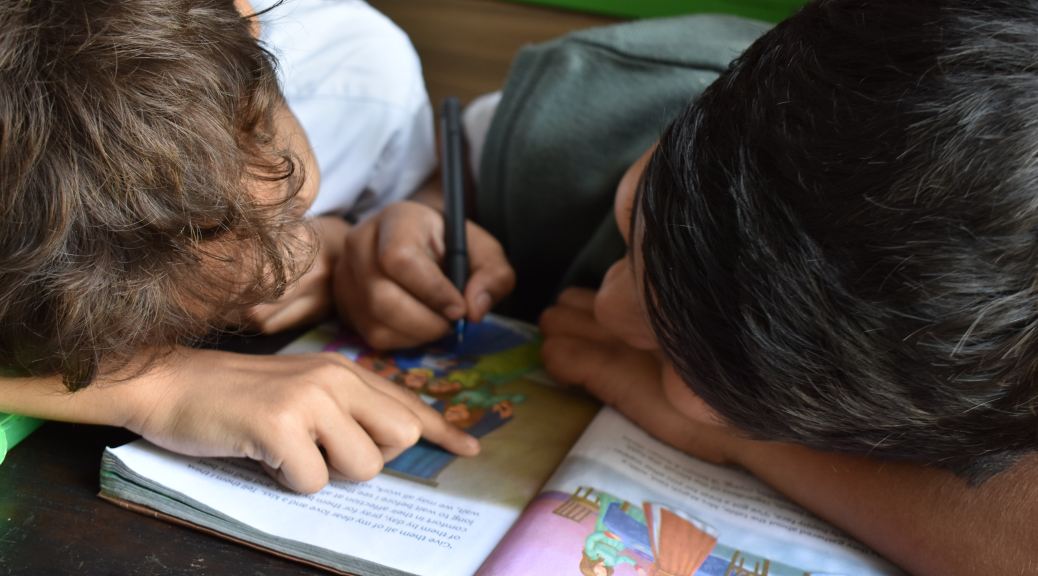
Immediately in the car, my grandson began flipping through his Pokemon book, saying some times he just likes to look at the pictures. I told him that over my comic book life sine the 1970s, I almost always do a first “read” of the books just looking at the artwork.
Back at the apartment, my granddaughter took one book in to read, a teaser copy of Monster High (IDW). My partner was setting up for her and the children to play Smash Bros. on the TV while my granddaughter consumed her new comic book.
Soon, she moved over to the couch, sitting down heavily and sighing. The story ended in a cliff hanger, and she was sad there wasn’t more.
My granddaughter was hooked. The magic of free comic book day.
No tests. No assignments. No chastising children not to look at pictures while making meaning.
Just a few encouraging adults, access to books, and the freedom to read for pleasure.
We had to drop the children off with their father just after midday to head to my partner’s book club. I tend to be a passive observer, although I did read their first book.
The book club consists of mostly friends in a gamer group, and the anchor for the monthly gathering is a series of wines for tasting.
The discussions are relatively haphazard, often wandering off into very interesting tangents punctuated with attending to children and dogs or grabbing snacks provided by everyone.
This Saturday the food was supposed to be Star Wars themed because of May 4.
As time passed and some needed to leave, the group chose the next book—this month had been nonfiction and the next category is works in translation (something I was particularly excited about)—by sharing blurbs about several suggested books (including three from my partner).
As they worked through the summaries, I ordered the first two options—Frankenstein in Baghdad: A Novel and Kim Jiyoung, Born 1982: A Novel. But the group chose the novel most enthusiatiscally recommended by my partner, Kafka on the Shore by Haruki Murakami.
My partner taught that novel for several years, and I have a co-edited volume on Murakami, just submitted an invited chapter on Murakami’s Men Without Women based on this blog post, and am currently re-reading 1Q84.
To say the least, my partner and I are as excited as my grandchildren were in the wake of Free Comic Book Day.
The next day, however, I read Dan Kois writing about the “Decline by 9”:
[A] child’s attitude towards reading enjoyment and importance is a predictor of reading frequency, which is why it also is striking to note the drop between ages eight and nine in the percentage of kids who think reading books for fun is extremely or very important (from 65% to 57%). Similarly, the number of kids who say they love reading drops significantly from 40% among eight-year-olds to 28% among nine-year-olds.
Kois acknowledges some of the standard reasons cited for children not reading—often over many decades blaming technology such as smartphones today—but then makes this point:
But others also pointed to the way reading is being taught to young children in an educational environment that gets more and more test-focused all the time. “I do not blame teachers for this,” said O’Sullivan, but the transformation of the reading curriculum means “there’s not a lot of time for discovery and enjoyment in reading.” She noted a change I, too, had noticed: Reading in the classroom has moved away from encouraging students to dive into a whole book and moved toward students reading excerpts and responding to them. “Even in elementary school, you read, you take a quiz, you get the points. You do a reading log, and you have to read so many minutes a day. It’s really taking a lot of the joy out of reading.”
The specific reference is to the “science of reading” (SOR) movement that has targeted reading programs by banning some and mandating those that are often scripted curriculum and phonics-heavy.
As Kois’s article acknowledges, the SOR movement is sacrificing important aspects of reading, including pleasure, rich texts, and diversity [1].
Yes, possibly even more intensely than at any point over the past 40 years of high-stakes accountability in education, the SOR movement has sacrificed reading for pleasure to reading as task.
But this is a matter of intensity because formal schooling has always been one of the places where pleasure reading goes to die.
I taught high school English for 18 years throughout the 1980s and 1990s, witnessing first-hand that most of my very bright students had become non-readers even though you could visit any K-1 classroom and see a room full of children eager to read.
My high school students all had one thing in common—formal schooling.
This May the Fourth was a truly wonderful day for reading that I was gifted to witness. On a Saturday and nowhere near a school.
I watched children and adults choose to be readers, eager and excited.
And again, no tests. No assignments. No chastising anyone about how to make meaning or what mattered about what they were reading.
This May the Fourth was about The Force, not some Jedi skill set, but reading for pleasure and not reading as a task.
[1] Does the “Science of Reading” Fulfill Social Justice, Equity Goals in Education? (pt. 1)
America Dishonors MLK By Refusing to Act on Call for Direct Action (pt. 2)
The power of touch is vital for both reading and writing, Naomi S. Baron (The Conversation)
The Guardian view on English lessons: make classrooms more creative again
Not Lost in a Book, Dan Kois
[Header Photo by Joshua Hoehne on Unsplash]
Having watched Shiny Happy People a second time, I cannot emphasize enough that the documentary is far more than an expose on the Duggar family, Bill Gothard, or the Institute in Basic Life Principles (IBLP).
This is a warning for people living in a free society, a warning about the essential threat that authoritarian movements pose for a democracy grounded in the rights of individuals.
And it is a horrifying portrayal of the ways in which children are indoctrinated and groomed by organized religion and parents, the ways women are reduced to serving the purposes of men (primarily by reproduction).
For fundamentalists, there is a fixed Truth and it is their sacred duty to impose that fixed Truth not only on those within their belief community but everyone.
I grew up in the fundamentalist South, and repeatedly was taught that to be Christian you must witness. That sacred duty to witness, in part because media has helped promote fundamentalists as shiny happy people, has exploded into an aggressive political machine poised for national indoctrination.
As the documentary explains, IBLP built a political movement as part of its mission, a mission that is inherent across the US in all sorts of fundamentalist denominations.
Several so-called mainstream Republicans have started openly saying that the separation of church and state isn’t really a founding principle in the US; the same group that treats the Second Amendment as sacred, by the way.
Imposing dogma is the goal of fundamentalism, the only goal, by any means necessary.
Nothing represents that ends-justify-the-means mentality more than the idolatry around Trump among fundamentalists. Trump the person is irrelevant as long as he remains an effective mechanism for imposing their dogma.
Two realities face Americans.
First, the separation of church and state, religious freedom, asserts that everyone has the right to embrace or reject whatever religious dogma they choose, but no one has the right to impose that dogma on others, notably not through the mechanism of government.
Therefore, the separation of church and state is a threat to the essential mandates of fundamentalism, witnessing and converting everyone to a singular way of thinking and living.
Second, fundamentalism is at the core of all organized religion at varying degrees of intensity; fundamentalism also by its nature is authoritarian.
And as the documentary on the Duggars dramatizes, authoritarianism is a mechanism of centering male authority—women and children must be subservient. (See also Sister Wives.)
Authoritarianism is a threat to democracy and individual freedom—especially in the form of religious fundamentalism that asserts dogma as the word and will of God.
These tensions now represent the primary core of politics in the US. We are no longer faced with choosing the best candidate (if we ever were), we are no longer faced with choosing between Democrats or Republicans, but we are faced with choosing between democracy and authoritarianism.
The parental rights movement built on charges of indoctrination and grooming has its roots in fundamentalism, but that political movement is not about actual indoctrination or grooming of children in the public sphere (specifically K-16 education).
The parental rights movement is projection because fundamentalists are indoctrinating and grooming; any alternative to a fundamentalist way of thinking and living, again, is a threat to fundamentalist goals for everyone conforming to that singular world view.
Like “Shiny Happy People,” “Losing My Religion” is associated with the alternative rock group R.E.M., who introduced the Southern saying to the world.
“Losing my religion” isn’t about religion, but a metaphorical statement of exasperation. “Son, you’re about to make me lose my religion” is a warning that someone is about to lose patience, to act in ways counter to how they believe they should act.
So let me be clear here: I am calling for a literal use of “losing our religion.”
Despite their numerous flaws, the so-called Founding Fathers were mostly secular men who valued human reason; many of them ascribed to a non-dogmatic view of “god” and belief that allowed for a free people to govern themselves.
In many ways, this is idealistic but a wonderful thing, I think. The problem is that granting fundamentalists religious free is a paradox since fundamentalists will not (cannot) honor the freedom for the rest of us to believe or not as we choose.
No child or woman in a fundamentalist church or home is given that freedom, and fundamentalists believe that their soul depends on them demanding compliance from the rest of us.
Between democracy and authoritarianism, only democracy allows everyone life, liberty, and the pursuit of happiness.
Everyone should watch Shiny Happy People.
Everyone should step back and recognize this documentary is not a narrow snapshot of an outlier family or some rare religious cult.
Authoritarianism is coming for us. All of us.
If fundamentalists get their way, there is no choice.
This is our future.
Reading Wars and Censorship Have a Long and Shared History
Christian Nationalists Can’t Wait for This School in Oklahoma to Open
For Boebert and Greene, faith — and Christian nationalism — sells
Former Bob Jones University students describe experience, exit from evangelical college
Open Letter to Teachers of Young Children
Dr. Diane Stephens
June 23, 2023
I have become increasingly concerned about states (and, in the past, the federal government) making decisions/passing laws about the practices associated with teaching reading and writing. I believe that teachers should step up and assert their right to be treated as professionals. To accomplish this, teachers need to
In so doing, we will honor our responsibility to ensure that, in turn, children have rights as readers and writer. We are the only ones who can do this.
We need to stand up and demand that decision-makers at the local, state and national level resist what has been a long-established practice of telling one professional group, teachers, what to do while honoring the right of every other profession to establish their own standards and scientifically based practices.
Below I have drafted a list of the rights of children as readers and writers. If you have classroom footage to go with #2, #3, #4, #5, and/or #11 and consent from parents to use that footage for educational purposes, please send the videos and copy of the consent forms and I will select one for each of those rights. Also please weigh in on your thoughts about books to name for #10. You can contact me at stephens.diane@gmail.com.
The Rights of Children as Readers and Writers
in Pre-K, K and 1st grade Classrooms
1. Children have the right to fall in love with books (if they haven’t already) and know that books make sense, so teachers read books to and with children (this is called an Interactive Read-Aloud). The teacher chooses books that are easy for the children to understand. This is referred to as their Listening Comprehension. Via Read Aloud, children also learn that Reading is a Meaning-Making Process. To see an Interactive Read Aloud in Brooke Bridges’ Kindergarten classroom, see Additional Video #2: Interactive Read-Alouds https://www.scholastic.com/content/educators/en/pro/readingrevealed.html#additionalvideos. The password is learners.
2. Children have the right to understand how books work so teachers read large-sized versions of books which allow every child see the pages clearly and then teachers read the books to them, pointing to words as they read. This is called Interactive Shared Reading. This helps children learn that books in English are read top to bottom and right to left. This is referred to as Book Knowledge. It also helps the children understand that there is a relationship between what the teacher “says” and what is written on the page. This is often referred to as Print-to-Speech Matching.
3. Children have the right to understand that oral and written language can be segmented and blended so teachers teach them songs, rhymes, and word games – oral and written. This is referred to as Phonemic Awareness.
4. Children have the right to understand how language works e.g., that some sound/symbol relationships are constant. Teachers help young children learn this through alphabet cards with pictures of objects the children have brought in and pictures of each other under the first letter of their names, through songs and rhymes and large group discussion of Morning Message, and via word hunts for words that contain consistent patterns, e.g., /an/, /am/, /at/ and also for words in which two letters make the one sound like /th/, /sh/, /ch/. Children also learn about this by reading and writing. This particularly understanding is referred to as Phonics.
5. Children have the right to understand that written language is as predictable as the oral language they hear around them, so teachers read and provide access to books that sound like the language they know. This reinforces the idea that Reading is a Meaning-Making Process and it helps children develop Fluency – the ability to read smoothly and meaningfully, in thought units.
6. Children have the right to understand that writing (and therefore reading) are ways of communicating, so teachers encourage children to use their emergent understanding of sound/symbol relationships to write labels, letters, and books. This allows students to understand that Writing is a Meaning-Making Process. To see kindergarten teacher Brooke Bridges introduce and carry out book-making early in the third month of school, see Additional Video #9 – Creating Books with Children https://www.scholastic.com/content/educators/en/pro/readingrevealed.html#additionalvideos. The password is learners.
7. Children have the right to believe in their ability to make sense of text, so teachers provide books with which they will be successful and, as children’s skills and strategies develop, teachers ensure that those books are matched to children’s evolving strengths. This helps children develop Agency – a belief that they are capable of making sense of print. Children without a sense of agency often stop trying and claim they do not “like” reading. These students all too often eventually drop out of school. To see kindergartners reading together in Resi Suehiro’s Kindergarten classroom, see Additional Video #1 – Buddy Reading in Kindergarten https://www.scholastic.com/content/educators/en/pro/readingrevealed.html#additionalvideos. The password is learners.
8. Children have the right to choose books during an independent reading time. This increases their interest in books and in their Motivation to read. To see how Nicole Bishop helps her first graders choose books, see Additional Video #5 – Look, Think, Pass https://www.scholastic.com/content/educators/en/pro/readingrevealed.html#additionalvideos. The password is learners.
9. Children have the right to have ample time to read because volume of reading is directly related to Reading Achievement. To see Independent Reading in Brooke Bridges’ Kindergarten classroom, see Additional Video #18 – Independent Reading in Kindergarten https://www.scholastic.com/content/educators/en/pro/readingrevealed.html#additionalvideos. Password is learners.
10. Children have the right to have their uniqueness recognized, so their teachers provide whole group support based on the strengths and needs of the whole group, flexible small group support for children with similar strengths and one-on-one support. This means not subjecting children to one-size-fits-all instruction. This insures Authenticity of Instructional Support to each child as opposed to fidelity to a program that may help only a few children.
To get an idea of the diversity of one kindergarten classroom in which there seems to be little ethnic diversity, listen to this intro by Brooke Bridges about the characteristics of her students during academic year 2018-2019: https://drive.google.com/file/d/1FyZpkm4tAg8glex7khLzPnK5U_VYY8Rs/view?usp=sharing.
To see how Ms. Bridges responses to children vary (a) during independent reading, see Additional Video #18 – Independent Reading in Kindergarten https://www.scholastic.com/content/educators/en/pro/readingrevealed.html#additionalvideos and (b) during independent writing, see Additional Video #9 – Creating Books with Children https://www.scholastic.com/content/educators/en/pro/readingrevealed.html#additionalvideos.
Both of these videos show how she supports children based on her knowledge of them.
The password for the last two videos is learners.
11. Children have the right to learn problem-solving skills and strategies to figure out unfamiliar words, see, for example, Scanlon and Anderson’s (2010) Interactive Strategies List (below). This fosters Reading Independence.
Interactive Strategies:
It would be great if legislators (and some publishers of reading materials for pre-K to 3), already understood that they should be stepping back from mandating or selling curriculum to teachers – that they should instead be encouraging teachers to make their own informed curricular decisions and to choose materials based on their knowledge of the broad field of research on reading and writing and on their knowledge of children in their classrooms.
But that’s not going to happen spontaneously. It is only going to happen if informed teachers get themselves involved in the decision-making process by writing letters, making phone calls, and scheduling appointments with decision-makers.
I realize that taking political action is not comfortable. If it helps just think of it as having a conversation (through the mail, on the phone, in an office) with someone who does not yet know enough about teaching reading and writing.
Think of legislators as learners who need our help.
It is our responsibility to ensure that children have the at least the eleven rights outlined in this letter. If a law limiting these rights has already been passed in your state, learn the process for submitting amendments and propose them. If a bill is in process (see, for example South Carolina Senate Bill 518), write, call, visit your legislator and the members of the House and Senate Education Committees. And be sure to be in contact with the legislative aide for both Committees. Those individuals are lawyers who put pen to paper. And, in my experience, they really listen.
Please, step up for your rights as professionals and for the rights of the children you serve. If enough of us stand up, there is no limit to how much we can improve our own lives and the lives of children.
Thanks.
Diane Stephens, Ph.D.
Distinguished Professor Emerita
John E. Swearingen, Sr. Professor Emerita in Education
University of South Carolina
D.M. Scanlon and K.L. Anderson (2010). “Using the Interactive Strategies Approach to Prevent Reading Difficulties in an RTI Context” (p. 49). In M.Y. Lipson and K.K. Wixson (Eds.), Successful Approaches to RTI: Collaborative Practices for Improving K–12 Literacy, Newark, DE: International Reading Association.
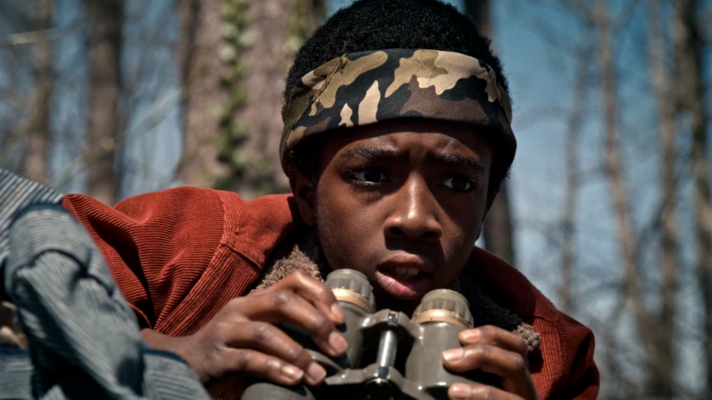
South Park has Token, and Stranger Things has Lucas Sinclair.
Having come (very) late to Stranger Things, this was one of my first thoughts when Lucas sets off on his own to find the gate (S1E6).
Since Stranger Things is a pop culture referential series, my experience includes immediately thinking of WandaVision (also referential and driven by pastiche) and how Stranger Things includes more than a passing debt to superhero narratives, along with gaming culture as well as the broader 1980s TV and movie references.
I am a child of the 1960s and 1970s, but the love affair Stranger Things has for the 1980s speaks to vivid elements of my young adulthood spent navigating marriage, fostering a career, and fathering my only child in 1989.
The power of this series and the enduring elements of pop culture in the U.S. have been confirmed for me as I continue to make asynchronous connections (Stranger Things as the child of The X-Files and Mayor of Easttown).
Even though I haven’t watched the show until mid-2021 (I just began Season 2), I do have a good deal of fringe knowledge about the series and essential spoiler knowledge that likely dulls some of the tension created in the show when watched in real time.
I know, for example, certain characters persist even when they are put in serious danger in the first season. In S1E6 mentioned above, whether the show’s creators intended this or not, having a lone Black character placed in danger triggers one of the worst aspects of pop culture, linked to Star Trek (redshirt characters) and the use of “throw-away” characters that are too often Black and other racial minorities.
Lucas isn’t sacrificed, however (Barbara isn’t so lucky).
And like Mare of Easttown, Stranger Things represents a much larger problem in the U.S.—the eternal whiteness of the pop culture mind.
Also like Mare of Easttown, Stranger Things has a white people gaze that is strongly linked to white people dysfunction and the ever-creeping danger surrounding children (mostly white).
Eleven is remarkably frail (the camera work shifting from her intense face to her full-bodied spindly self is excellent), and fantastically powerful (at great expense to herself).

But the white problem in Stranger Things (Indiana) also sits beside the superhero genre obsession with white Middle America (see also the whiteness of South Park in Colorado and Mare in Pennsylvania).
Superhero narratives in the world of comic books are grounded in (and recursively obsessed with) origin stories, and the origin story of the superhero narrative serves an important purpose as I navigate Stranger Things.
Michael Chabon beautifully fictionalizes who and how superhero comics came to be in his The Amazing Adventures of Kavalier & Clay.
I was a comic book collector throughout my teen years, the 1970s, and although the rise of the MCU is relatively recent, I have always felt comic book narratives have been incredibly important contributors to and reflective of pop culture in the U.S.
Those original creators, as Chabon dramatizes, were often Jewish and/or immigrants (Joseph Shuster and Jerry Siegel [Superman], Jack Kirby and Stan Lee [Marvel], Joe Simon [with Kirby, Captain America], and Bob Kane [Batman], for example).
These origins are steeped in a singular American Dream by men of aspirational backgrounds, and they seem to have chosen white Middle America as their only template; just think of Superman, an alien expelled from his home planet and landing in the Great Farm Land (Smallville) to be raised by an earnest working class white couple.
Kurt Vonnegut—a pop culture icon referenced in Stranger Things—writes on the first page of Mother Night:
This is the only story of mine whose moral I know. I don’t think it’s a marvelous moral; I simply happen to know what it is: We are what we pretend to be, so we must be careful about what we pretend to be. (p. v)
Mother Night, Kurt Vonnegut
I think Vonnegut has a point not only for anyone (especially children and teens) existing in the so-called “real world,” but especially for those imagined worlds, the ones that seem struck in time and place—and race.
The many powerful themes of Stranger Things driven by the stellar acting must not be reduced to the simplistic “universal” praise—although childhood and the dangers of being a child or teen are shared among viewers regardless of race, etc.
Nancy Wheeler, for example, is yet another spindly white girl/young woman (like Eleven) who directly personifies Vonnegut’s warning; Jonathan Byers confronts her about pretending to be someone she isn’t in Season 1.
Her experiences are valid, and even compelling—although they pale beside Eleven’s.
Ultimately, I am left uncomfortable that Stranger Things has fallen into the well-worn rut (from Superman to Mare of Easttown) because too many people continue to believe the viewing public has empathy primarily for the frailty of whiteness.
With public schools poised to reopen for the 2021-2022 academic year, South Carolina faces the challenges of dealing with another wave of a Covid variant, a challenge made more complicated because of political theater by Republicans.
Columbia (SC) Mayor Steve Benjamin issued a mask requirement for students in the city, and immediately Governor Henry McMaster responded: “’This is another attempt to force children to wear masks in schools without a bit of consideration for a parent’s right to make that decision,’” said Brian Symmes, McMaster’s spokesman.”
The political theater of invoking “parental rights” by Republicans and conservatives falls apart at several levels.
First, if parents do have the right to demand that their children not wear masks (see below), those parents do not have the right to endanger other people—and the mask mandate in schools is primarily about community safety.
“Freedom” in this case is once again not license; parents choosing to keep their children unmasked must also address the consequences of that decision. Those parents then are obligated to provide their children proper education since the unmasking means those children cannot attend K-12 public schooling.
Just as adults are free to drink alcohol, but restricted from driving while impaired (a mandate that addresses community safety), parents and their children may remain unmasked but that means there are restrictions on where they can go and what they can do.
Choice has consequences.
But, there is a much larger issue here about parental rights and how that impacts the rights of children.
Republicans such as McMaster either are unaware of the law or are intentionally dishonest with their “parental rights” rhetoric.
In The Parent as (Mere) Educational Trustee: Whose Education Is It, Anyway?, Jeffrey Shulman details that parental rights and the education of their children are in many ways “circumscribed,” restricted or limited.
Broadly, Shulman explains:
What role should the state play in the transmission of values? What values can the state successfully transmit? How can it do so? To approach these questions, this Article begins with principles laid down by the Supreme Court. It is the state’s duty to ensure that all schools, public or private, inculcate habits of critical reasoning and re- flection, a way of thinking that implies a tolerance of and respect for other points of views. In pursuit of this lofty goal, the state need not make public schooling compulsory. However, the state must see that all children are provided an education that is, in the fullest sense, public—a schooling that gives children the tools they will need to think for themselves, a schooling that exposes children to other points of view and to other sources of meaning and value than those they bring from home. This effort may well divide child from parent, not because socialist educators want to indoctrinate children, but because learning to think for oneself is what children do. It is one facet of the overall movement toward the individuation and autonomy that is “growing up” and is, perhaps, the most natural and vital part of healthy maturation.
The Parent as (Mere) Educational Trustee: Whose Education Is It, Anyway?
There is, then, a long legal history in the U.S. that simply doesn’t recognize parental rights as monolithic, or even sacred.
One way parental rights are limited is directly embedded in the commitment to universal public education:
The state as educator, then, is no ideologically neutral actor. The philosophical foundations supporting a truly public education are the liberal biases of our nation’s intellectual forbearers, biases in favor of a non-authoritarian approach to truth, of free argument and debate (what Jefferson called truth’s “natural weapons”), and of a healthy sense of human fallibility—the foundation, in other words, of our nation’s governmental blueprint. Unless children are to live under “a perpetual childhood of prescription,” they must be exposed—intellectually, morally, and spiritually—to the dust and heat of the race. Whether one considers the formation of moral commitments a matter of choice or duty, of reflective self-directedness or cultural embeddedness, the child must not be denied the type of education that will allow him, as an adult, to choose whether (and in what way and to what degree) to honor those commitments. A public education is the engine by which children are exposed to “the great sphere” that is their world and legacy. It is their means of escape from, or free commitment to, the social group in which they were born. It is their best guarantee of an open future.
The Parent as (Mere) Educational Trustee: Whose Education Is It, Anyway?
The great irony here is that the courts have recognized that public education, the state, has the obligation to protect the individual intellectually freedom of children, even when that conflicts with parental wants or demands that are framed in rugged individualism rhetoric.
That legal recognition creates a tension that is rarely voiced in public discussions:
We are cautioned by family law historian Barbara Bennett Woodhouse that “[s]tamped on the reverse side of this coinage of family privacy and parental rights are the child’s voicelessness, objectification, and isolation from the community.” It is often assumed that state control of education “disserve[s] the values of pluralism and experimentation,” but public education can bring its students a much needed respite from the ideological solipsism of the enclosed family. Public education can physically and intellectually transport the child across the boundaries of home and community. Of course, this transportation comes at a cost. It disrupts the intramural transmission of values from parent to child. It threatens to dismantle a familiar world by introducing the child to multiple sources of authority—and to the possibility that a choice must be made among them.
The Parent as (Mere) Educational Trustee: Whose Education Is It, Anyway?
And thus, the masking debate exposes a couple elements of legal obligations to the community, to children, and to parents since the requirement (or not) to mask impacts children’s opportunities to learn in contexts where academic freedom is protected and where all the people involved are safe as reasonably possible from infectious disease.
However, ultimately, the rights of children must be protected:
No one would suggest that parents may not introduce their children to personal sources of moral or religious meaning. However, to those parents who want their children untouched by other points of view, the state must say that the rights of parents, while profound, are circumscribed—contingent, as the Supreme Court has always noted, on preparing the young for the additional obligations they will take on as members of a pluralistic society. “In a democracy,” political theorist William Galston writes, “parents are entitled to introduce their children to what they regard as vital sources of meaning and value, and to hope that their children will come to share this orientation.” Yet, children have freestanding intellectual and moral claims of their own, claims that Galston goes on to remind us, “imply enforce- able rights of exit from the boundaries of community defined by their parents.” If children are granted this right of exit, they must be able to exercise it freely. They must not be disempowered from making their own intellectual and moral claims in the first place. The state has a duty to make sure they are not disempowered, and one of its best resources to that end is public schooling.
The Parent as (Mere) Educational Trustee: Whose Education Is It, Anyway?
The state is charged with protecting children intellectually and physically when parents do not share that goal (risking the child’s health by refusing to mask, indoctrinating the child in singular beliefs by restricting that child’s access to knowledge and critical thinking):
The full capacity for individual choice is the presupposition of First Amendment freedoms. It is for this reason that the state has a strong obligation to see that free choice is not strangled at its source. The state may not sponsor particular religious or political beliefs, but that is not enough; it must protect children from being forced to adopt particular religious or political beliefs. The state must work to protect the moral and intellectual autonomy of all children. Further, if the state has the obligation to ensure the child’s opportunity to become autonomous, that obligation, as educational theorist Harry Brighouse has pointed out, “cuts against the differential regulation of public and private schools with respect to religious instruction.” Children are owed this obligation “regardless of whether it is the state, their parents, or a religious foundation that pays for their education, and regardless of whether they attend privately-run or government-run schools.” The constitutional freedom to choose is not guaranteed only to be so circumscribed that it exists in principle but not in fact.
The Parent as (Mere) Educational Trustee: Whose Education Is It, Anyway?
The Republican political theater of “parental rights” rhetoric exposes that conservatives are intellectually and legally bankrupt, but it also exposes the essential need for the state to protect children, who have essentially no political power.
McMaster and other Republican governors are clearly speaking to the adults who are likely to vote for them, and not in any way addressing the education and health of children.
The continuing political theater surrounding Covid and public schooling is too often ignoring the children at the center of that storm.
Since children have no political authority or autonomy, the state must function in ways that support parents who honor their children’s intellectual freedom and personal health and safety but also protect children when their parents have motives not in the interest of their children’s ability to think critically and live safely.
While on vacation, a friend and I were discussing the paradox of parenting.
A parent often feels a tension between fostering and supporting a child to be the person they want to be as that contrasts with dictating what is best for the child (knowing as adults do that children, teens, and young adults often make decisions necessarily without the context of experience that would certainly change many decisions).
That paradox, that tension has existed for me as a teacher/professor, parent, grandparent, and coach.
I am constantly checking myself in roles of authority to determine if I am imposing my authority onto children and young people (authoritarian) or if I am mentoring and fostering those humans in the cone of my authority in ways that support their own autonomy and development along lines they actively choose for themselves (authoritative).
This is a dichotomy examined by Paulo Freire [1], and a central concern for any critical educator.
The current misguided attacks on anything “critical” is particularly frustrating for critical educators since these attacks are designed to fulfill the demands of authoritarian systems, partisan politics and formal education.
It has occurred to me recently that I have been in roles of authority for a very long time, beginning with working as a lifeguard in my mid- to late teens. My role of authority literally began, then, with the expectations that I would guard human life—any human life that came into the sphere of the pool where I was charged with monitoring swimming and the safety of not only individual swimmers but all of the people in the pool.
I was a very good and capable swimmer, and for a teen, I was reasonably responsible (although I cringe thinking about being a head lifeguard when only 17 or so). But having the level of authority and responsibility that being a lifeguard entails was quite likely asking far more of me that I deserved.
Those days of lifeguarding set me on course for being the responsible person for the next 40-plus years, exacting a significant toll on me psychologically and emotionally.
Maintaining a critical authoritative pose when in positions of authority is extremely hard, much harder than being authoritarian.
Way back in the 1980s and 1990s, I was practicing in many ways the sort of critical teaching that is coming under attack in 2021, even resulting in a teacher in Tennessee being fired:
At issue was Hawn assigning the essay “The First White President” by Ta-Nehisi Coates to students in his Contemporary Issues class in February, and later in March, playing a video of “White Privilege,” a spoken word poem by Kyla Jenée Lacey to the same students.
A Tennessee teacher taught a Ta-Nehisi Coates essay and a poem about white privilege. He was fired for it
Many conservatives see the work of Coates, for example, as radical, while those of us on the left would argue Coates’s work is quite mainstream and accessible—but far from radical. This is the same dynamic around Barack Obama, for example; Obama is a moderate and an incrementalist, but certainly not a radical leftist or Marxist (as conservatives like to suggest).
While I taught high school English in the very conservative rural South, I was mostly allowed to teach texts with only occasional complaints from parents. What looks quite odd now is that I included Howard Zinn in my classes for many years without a peep from anyone (Zinn is a key target of the ant-CRT movement now).
But I also included Joseph Campbell’s comparative mythology in my classes in order to help students navigate metaphorical approaches to narratives (a key skill needed in the Advanced Placement course I taught and as preparation for college).
Including Campbell did cause problems since his work complicated the literalism many of students experienced in their religious lives. Fundamentalist Christianity was the background of nearly all my students, and Campbell’s casual claims that all religions and mythologies told similar archetypal stories stepped on the toes of arguments that accepting Jesus was the only way into heaven.
I aroused similar complaints by including Gandhi in my Emerson/Thoreau/MLK unit.
The parental challenges to Campbell and Gandhi were grounded in a type of insecurity that had never been examined critically by those parents, all of which was the result of having been raised in authoritarian environments.
I did have my students interrogate that Sunday school and preaching were not places where they were encouraged to ask questions or challenge any of the “lessons” they received.
So in 2021, I cannot stress too much that the Republican attack on critical race theory and how history is taught is simply a battle for the integrity of the mind of children, teens, and young adults.
Learning and knowledge—especially if we genuinely believe in human autonomy and democracy—are not simply about accumulating facts determined to be true or important by some authority, but are about learning how to know what we believe is true and why.
Human freedom is most threatened by unexamined beliefs, not by the act of questioning itself.
Authority doesn’t just resist questioning, but entirely rejects it as an act.
Republicans and the conservatives drawn to authoritarianism do not trust human agency, do not believe in the free exchange of ideas, and do not believe in the essential power of questioning, especially when the questions are aimed at their authority.
Nothing is as simple as “both sides,” and certainly we should never fall into traps of “only know this.”
There can never be free people, however, without free minds cultivated in the guarantee of academic freedom.
And the free exchange of ideas will never be spaces without discomfort, which now seems to be a smokescreen used by Republicans in their pursuit of securing authority.
Suddenly, Republicans are concerned about uncomfortable white students, but seem oblivious to the discomfort, for example, of thousands and thousands of Black students experience reading The Adventures of Huckleberry Finn or To Kill a Mockingbird.
Teachers must now tip-toe around the uncomfortable texts and conversations about race and racism because of the possibility of white discomfort (note that Black discomfort about Huck Finn has been repeatedly swept aside under the guise of “classic literature”)—a stance once again disregarding the daily discomfort of Black children experiencing racism.
Intellectual discomfort (what texts and discussions prompt in formal schooling) is often necessary for learning, but existential discomfort (what targets of racism and sexism experience) are not necessary and are essentially harmful.
Authoritarian education is willing to sacrifice the existential comfort of marginalized children in order to shield some children from intellectual discomfort.
Even more disturbing, however, is that what is really being protected is the frailty of those students’ parents and those people in authority who are not willing to risk being challenged or questioned in any way.
[1] Paulo Freire and Peace Education, Lesley Bartlett:
Freire’s early call for a “horizontal” relationship generated a staggering amount of debate over the teacher’s role in a democratic classroom. In his later writings, Freire refined his notion of directivity and the teacher-student relationship. In Pedagogy of Hope, he explained: “Dialogue between teachers and students does not place them on the same footing professionally; but it does mark the democratic position between them” (Freire, 1994, p. 116-117). In his “talking” books of the 1980s and 90s, Freire distinguished between authoritative and authoritarian teachers:
“I have never said that the educator is the same as the pupil. Quite the contrary, I have always said that whoever says that they are equal is being demagogic and false. The educator is different from the pupil. But this difference, from the point of view of the revolution, must not be antagonistic. The difference becomes antagonistic when the authority of the educator, different from the freedom of the pupil, is transformed into authoritarianism. This is the demand I make of the revolutionary educator. For me, it is absolutely contradictory when the educator, in the name of the revolution, takes power over the method and orders the pupil, in an authoritarian way, using this difference that exists. This is my position, and therefore it makes me surprised when it is said that I defend a nondirective position. How could I defend the fact that the nature of the educational process is always directive whether the education is given by the bourgeoisie or the working class” (Freire 1985, p. 76).
You said “I think I’m like Tennessee Williams”
“City Middle,” The National
I wait for the click. I wait, but it doesn’t kick in
A refrain by my father throughout my childhood and into my adolescence has shaped how I try to live my life; it remains possibly the strongest impulse I have as an adult.
My father’s parenting philosophy was possibly as misguided as it was reflective of the essential problem with how adults interact with children and teens: “Do as I say, not as I do.”
As a child growing up in the rural crossroads of Enoree, South Carolina, I witnessed my father announcing his dictum, sitting in our living room with a glass of Crown Royal in one hand and a cigarette in the other.
By the time I was a teen, the scenes were often far more physical, occasionally ending with me on the floor as my father attempted to wrestle me into compliance.
A game of him demanding, “Don’t say another word,” and me replying, “Word,” as he tightening his hold on me against the faux-brick linoleum of a different living room floor.
Adulthood for me has included a career in education, where I have taught and coached, and I am a father and grandfather. I am routinely tested, then, by interacting with children and young adults—challenged not to give into the adult hypocrisy of my father, of nearly every adult I encounter.
When the now-former president of the University of South Carolina was exposed as having plagiarized the end of his graduation speech, I immediately thought of my father and adult hypocrisy, certain that little or nothing would come of the plagiarism by the head of an institution that routinely holds students to draconian expectations for plagiarism and academic honesty.
In this case—unlike many high-profile examples that include Joe Biden, Melania Trump, and Rand Paul—Bob Caslen resigned, but there appeared to be nothing to suggest he was going to be held accountable by the system. And honestly, little consequences will occur to Caslen’s power, wealth, or status.
The university-level equivalent of this for students would be if a student were caught plagiarizing and that student were allowed to drop the course without any academic penalty, continuing on with coursework from there.
In academia, however, plagiarism for students tends to result in an assignment zero, a course F, or expulsion. Caslen is experiencing nothing equivalent to these consequences for students.
Since I teach writing, primarily first-year and upper-level writing at the university level, I often write about plagiarism and citation because these aspect of academic writing are both essential and deeply problematic.
I have even referred to the citation/plagiarism trap since consequences for plagiarism and the gauntlet of citation in college scholarship are disproportionately elements of stress for both students and professors.
The tension for me as a teacher, scholar, and writer is that I recognize how academic honesty and the mechanics of citation serve a writer’s credibility even while citation formatting and style guides are unnecessarily complex and often arbitrary to the point of inanity.
When we are dealing with citation, I find myself telling students that I recognize that APA, for example, is often mind-numbingly complex and essential in academic contexts that require formal citation (students also write using hyperlinks as citation, which emphasizes the possibility of citing that is academically honest and not tedious and pedantic).
The harsh reality about adulthood is that accountability, despite all the grandstanding adults do about it, is heaped mostly upon the youngest, the weakest, and the most marginalized. People with status—Biden, Paul, Melania Trump, Caslen—breeze through life little troubled by the bar we set for children, teens, and young adults in formal schooling.
Especially for those of us charged with the care and education of children, teens, and young adults, we must lead by example; nothing is a worse lesson for young people than rhetoric that contradicts action.
If academic honesty and the proper attribution of other people’s words and ideas matter—and I think they do—certainly those standards must be higher for adults than children.
Otherwise, we are proving children right when they realize—as I did one day as a child standing in a smokey living room in Enoree, SC—that adult words are too often bullshit.
Despite all the jumbled mess that is the work and life of William Faulkner, I side with Addie from As I Lay Dying:
So I took Anse. And when I knew that I had Cash, I knew that living was terrible and that this was the answer to it. That was when I learned that words are no good; that words dont ever fit even what they are trying to say at.
As I Lay Dying (p. 171)
“Words are no good,” that is, when actions reveal that they are merely words that serve to ask more of some than of others.
First, Bean Dad (as he would become known) posted a Twitter thread about teaching his daughter a lesson. The thread was flippant, snarky—and about a child not knowing how to use a can opener.
I was, frankly, surprised that Bean Dad took a beating on this because his approach to his child is essentially the foundational belief system in the U.S. about child rearing: The world is dangerous so I better pound on my kid before the world does so she/he is prepared for the Real World.
In far too much of the U.S., that pounding is literal—corporal punishment—but the pounding takes many forms such as grade retention and “no excuses” policies and practices in K-12 schooling.
Gradually, the clever thing to do about the Bean Dad trending on social media was to interrogate the phenomenon as an example of everything-that-is-wrong-with-Twitter. While a valid take, I think, it is also careless to set aside how this thread (whether it was hyperbole, as he claims, or not) is one small but ugly picture of how we mistreat children in the U.S., both in our families and in our institutions such as formal schools.
Let me offer an analogy.
One of the most important moments in the U.S. for the safety of children was recognizing the dangers of lead paint. This moment also is a powerful illustration of the need to target the external danger and not the child.
Instead of teaching children a lesson about lead paint—somehow toughening up those kids so that when they did consume lead paint, they would survive the experience—we used the power of public policy to remove lead from paint—to eradicate the danger, instead of pounding on the children.
Bean Dad quipped about his own compulsion to prepare his daughter for the apocalypse—some sort of version of The Road where the child is always alone?—but there seems never to be any consideration, as Maggie Smith concludes, for a better world: “This place could be beautiful,/right? You could make this place beautiful.”
A child is not an inherently flawed human that must be “fixed,” corrected, or improved. A child is a developing human that must be nurtured, and nurturing requires love, patience, and safe spaces.
If nothing else, we must all check our impulses to be Bean Dad so I offer here some reading to reconsider the many ways we fail that calling:
Rethinking grade retention
Rethinking corporal punishment
Rethinking “grit”
Rethinking growth mindset
Resisting deficit ideologies
I am deeply indebted to the academic and personal kindness and mentoring afforded me during my undergraduate education by one of my English professors, Dr. Nancy Moore.
Dr. Moore combined an admirable ability to challenge students academically while also being sincerely supportive and encouraging. I probably did not need or even deserve her praise, but Dr. Moore always made me feel like a successful student, budding scholar, and most of all, credible writer.
She was one of the first people to treat me as a poet, inviting me to read and share my work in various settings.
But I also recall that she regularly chided me about my literary affections, warning me that I would grow out of some of my favorite authors. Part of that rested on one of my proclivities for authors who dwelled on innocence, such as J.D. Salinger and e.e. cummings.
While my literary tastes have in fact changed and even matured (in the sense that my critical sensibilities are sharper as I have aged), as I am staring down the barrel of turning 60, I remain deeply drawn still to the poetry of cummings, even as my discomfort with him as a person has grown with each biography I read.
This blog post title refers directly to William Blake’s major poetry collection that remains also a favorite of mine since it captures why these works still resonate with me; the tension between innocence/youth and experience/maturity fascinates me since both phases of life are often simultaneously idealized and criticized.

And, of course, it is an existential fact of being human that we experience both phases as well as live through the transition in ways that are often difficult.
I have recently written about the difficulties of physical decline as I age, and that experience sits beside major life changes and being an active grandfather for a five-year-old girl and three-year-old boy.
So yesterday, while spending a few hours with my grand-daughter after picking her up from school before taking her back to her father, I was struck by one of those sudden realizations that she is securely into childhood, no longer any sort of baby. She is very bright, energetic, incredibly loving, and distinctly sensitive in the ways that suggest she has inherited some of the anxiety that runs through my side of the family.
My grand-children have spent their lives navigating fractured families, and she has come to see the world through “whose week is it?” This is sad, but it also shows how she is coming to know the complexity of the world, how she is experiencing the transition from innocence to experience even at the tender age of five.
As our afternoon unfolded, the time together was ripe with the tensions of being a small child in the harsh reality of living. We saw a homeless man sitting by the highway on our way to dinner. At the restaurant, a woman making balloon animals gave her a balloon butterfly that filled her with dread over the probability that the balloons would burst.
I took a picture of her with the balloon butterfly:

Ad even a video of her talking about navigating the fear of the balloon popping. Eventually, I wrote a new poem, a theory of balloons, which is heavily influenced by [in Just-] by cummings.
On the video, my grand-daughter explains her theory of balloons (slightly edited in the poem):
balloons pop if there’s something spiky
then you cry & cry & then you get one later
i’ve got a balloon butterfly
& i’m never going to pop it
sometimes i’m going to pop it
& that’s okay i’m going to stop thinking about it
Listening to my grand-daughter and thinking about the balloon woman, I was immediately reminded of cummings and [in Just-], which still represents my key moment in life when I made the turn toward English student and writer.
I left high school only modestly drawn to so-called literature, even as I was a voracious reader of science fiction and comic books. I was tepid on poetry and had written some, but it wasn’t until a speech class in my first year of college when discussing this poem by cummings really struck me.
Unlike many poems by cummings, this one is very accessible and powerful in its seeming simplicity. But it also is an effective glimpse into the tension between innocence (the children playing in the poem) and the allure of the balloonman (a real-world Pied Piper and Pan hyrbid that represents the allure of maturity, including budding sexuality).
But I had never, I think, really considered the genius of using the balloon symbolically in the poem until my impromptu philosophical moments with my grand-daughter and the complete accident of her being given a balloon butterfly.
Like a ballon, like a butterfly, our humanity is very frail and fleeting, regardless of where we are on the continuum from innocence to experience.
And as I worked on the poem, blending things that really happened with my own fabrications for effect, I became more and more aware of the bond between my frailty of aging and my grand-daughter’s frailty of being just a child.
She is tiny and very thin, but she also has the tenderest of hearts.
Finding form is always a challenge of poetry, but I also feel the pressure of making sure every poem ends some way that is fulfilling without stooping to anything heavy-handed.
Satisfying to me at least, the last section pulls together an image of heaviness and lightness to combine with the tension of innocence (my grand-daughter) and experience (me) as I carried her inside after our afternoon together:
she falls asleep as we drive
the balloon butterfly clinging
to her tiny child’s arm
too beautiful & terribly frail
i carry her in sleep-heavy in my arms
like a balloon or a butterfly
This morning when I checked on her, I also asked if her balloon butterfly had survived the night.
I am relieved to find out that it has as I recall her sleep-heavy in my arms, completely dependent on my care in that moment, this old man who loves her.

 dr. p.l. (paul) thomas