Category Archives: Childhood

Stop Normalizing, Idealizing “Exceptional”

My granddaughter loves Disney Junior, and while she was watching and eating breakfast, a transition commercial announced with excessive glee: “Dream big and never give up!”

And all I can think is: What total and harmful crap.

Because our cultural narrative that normalizes and idealizes “exceptional” has been gnawing at me lately.

I have always bristled a the horse manure sloganification we heap on children: You can be anything you want to be! Reach for the stars!

Part of my concern is that this idealizing of exceptional to the degree that we make it the norm that everyone must aspire to be exceptional (a result impossible since once everyone achieved that, no one would be exceptional) feeds into our cultural ignorance about outliers: Make any generalized claim about a topic people don’t believe despite the evidence or don’t understand, and the typical response will be something like: “O, yea, see this anecdote of mine about an outlier!”

But my direct concern about “Dream big and never give up!” is how this cultural hokum drives our alienation and anxiety, especially among children.

Why can’t we allow people to be happy and content with their mediocrity, their normalcy, their average abilities and aspirations?

George Clooney and I are about the same age, but he has mega-dollars and mega-fame—and, damn it, he is very pretty.

If his exceptionality is the basis for my self-worth, my happiness, I am royally screwed, languishing under the anxiety that I just didn’t dream big enough and I gave up in my quest to be pretty, popular, and wealthy.

So, all you kids out there, and all you languishing adults trapped under the avalanche of “Dream big and never give up!,” let me offer a much healthier dictum: Dream big and never give up? No! Dream appropriate to you and then give it your best effort; and then, feel free to change your mind and levels of effort—and you may want to be OK with not making any of that work.

And feel free to tell all those Dream-Big merchants to kiss off.

On This Day: Nothing Justifies Physical Intimidation of Children

Today, March 11, is my daughter’s birthday.

I could write blog after blog about my failures as a parent, failures that my child has apparently mostly decided to ignore.

But I want to take a moment to write about some things I did well, some things that created a new family tradition that will be a legacy about which I can be proud.

Even in our dark periods, my daughter was very quick to let people know two things: we allow no racism and we do not hit children. Her adamant defense of my commitment in these areas always rose above the other failures of mine plaguing us at any moment.

And she made it clear we have no tolerance for racism or violence of any kind toward children in other people. These moments were always judgmental—the sort of daily moments of activism that go mostly unnoticed because they are spontaneous.

My granddaughter is a marvelous biracial child who, like my daughter, will be raised without the threat of physical intimidation in her home and among her family. We, of course, cannot make her that same promise about her community, her state, or her country.

These glorious humans and the legacy we have joined together in creating help me navigate all my failures.

However, that familial promise is not the case for many children—and that is nearly unbearable because this legacy isn’t about only my family.

This legacy about racial harmony and kindness to children, for me, is informed by Eugene V. Debs: Statement September 18, 1918:

Your Honor, years ago I recognized my kinship with all living beings, and I made up my mind that I was not one bit better than the meanest on earth. I said then, and I say now, that while there is a lower class, I am in it, and while there is a criminal element I am of it, and while there is a soul in prison, I am not free.

As long as one human suffers under the plague of racism, as long as one child lives under the fear of physical violence, we are not safe or free despite the gifts we may have in our daily lives.

See the work of Stacey Patton at Spare the Kids.

See Also

Jesusland?: Bible Belt Raises Welt of Corporal Punishment

The Stream: Should parents spare the spank

There is no debate about hitting children – it’s just wrong

Spare the Rod, Respect the Child: Abuse Is Not Discipline

How We Raise Our Children: On “Because” and “In Spite Of”

“Please—a little less love, and a little more common decency.”

I wish that people who are conventionally supposed to love each other would say to each other, when they fight, “Please—a little less love, and a little more common decency.”

Slapstick or Lonesome No More!, Kurt Vonnegut

I was a public high school English teacher for almost two decades in the rural upstate of South Carolina.

My first years were nearly overwhelming—as they are for most beginning teachers. And I would concede that much of that struggling could easily be categorized as classroom management challenges (although having five different preps, 15 different textbooks, and classes as large as 35 students certainly didn’t help).

Yet, then and now, as I approach the middle of my third decade teaching, I tend to reject the terms “discipline” and “classroom management” because they carry connotations I cannot endorse.

First, framing classroom management as something separate from pedagogy, I believe, is a mistake. In other words, effective and engaging pedagogy creates the environment that renders so-called (and generic) classroom management strategies unnecessary.

Next, most claims about “discipline” and “classroom management” remain trapped in reductive behavioristic ideology as well as authoritarian views of the teacher (in which authority is linked by default to the position).

As a critical educator, I seek to be authoritative, not authoritarian (see Paulo Freire). In other words, I forefront the human dignity and agency of my students, I seek always to model the person and learner I feel my students should emulate, and I work diligently to earn the respect of my students, in part, because of my expertise and credibility in terms of what content I am teaching.

But having taught public school, I know the real world is messy: students become confrontational with their peers and even teachers. School can be (and in some places often is) a physically and psychologically dangerous and uncomfortable place, rendering learning less important.

And I also recognize that each teacher is legally and morally the central figure of authority in any classroom. Yes, as a teacher, I must assert that authority any time the safety, health, or opportunity to learn of any students is threatened.

So when I am teaching pre-service teacher candidates, I urge them to take certain steps in their day-to-day interactions with students as well as in confrontational events.

I urge them always to speak to students with “please” and “thank you.” I stress that whenever students become loud, belligerent, or threatening, the teacher must lower her/his voice, mediate her/his language, increase her/his patience, and seek ways to give the student space and time in order to protect all innocent students and the upset student.

I say “yes, sir” and “no ma’am” to students because my father raised me that way. However, my father’s own authoritarian style (“do as I say, not as I do”) also imprinted on me my fear of hypocrisy; therefore, I seek always to have higher standards for my own behavior than for the behavior of my students.

All of that—and more—is to say that when I read A ‘No-Nonsense’ Classroom Where Teachers Don’t Say ‘Please’ I was horrified because of both the abusive treatment of children and the (not surprising) cavalier endorsement by NPR.

The problems are almost too numerous to list, but I’ll try.

First, the so-called “unique teaching method”—”no-nonsense nurturing”—is a program (from “Center for Transformative Teacher Training, an education consulting company based in San Francisco”), and thus, NPR’s reporting proves to be little more than a PR campaign for that company.

Next, these harsh and dehumanizing methods are yet more of the larger “no excuses” ideology that targets primarily children in poverty and black/brown children. In other words, there is a general willingness to endorse authoritarian methods as long as the children are “other people’s children”—code for the poor and racial minorities.

And then, related, the direct justification for that authoritarianism is that parents choose this for their children.

Here, I want to stress again what I have examined before (see here and here):

  • Be skeptical of idealizing parental choice. Parents can and do make horrible choices for their children, and children should not be condemned only to the coincidences of their births.
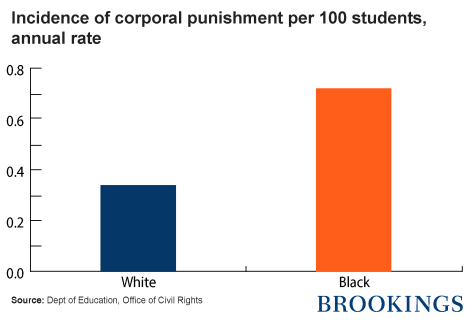
  • Many scholars have addressed the self-defeating choices within racial minority communities that stem from unhealthy dynamics related to being a marginalized and oppressed people; see Michelle Alexander on black neighborhoods calling for greater police presence and Stacy Patton (here and here) on blacks disproportionately embracing corporal punishment. I have applied that same dynamic to blacks choosing “no excuses” charter schools.

While the NPR article notes that these practices “[make] some education specialists uncomfortable,” I must note this is not about being “uncomfortable.”

These practices are not providing “structure,” but are dehumanizing.

As well, these practices are racist and classist, and ultimately abusive. Period.

Our vulnerable populations of students already have unfair and harsh lives outside of school. Doubling down on indignity during the school day is not the answer.

If we cannot change the world (and I suspect we can’t), we can provide all children the sorts of environments all children deserve in their school day—environments of kindness, compassion, safety, and challenges.

To paraphrase Vonnegut, then, Please—a little less “no nonsense,” and a little more common decency.

See Also

If you’re a teacher, say “please” and “thank you,” Ray Salazar

Schools, black children, and corporal punishment

figure-1

UPDATED: The Martian: Allegory of Whose Lives Matter

[Spoiler Alert: This post begins at the end of Andy Weir’s The Martian. Those who have not read the novel or watched the film are duly warned. Also, profanity.]

UPDATE: In the wake of the Brock Turner rape case and verdict—in which the judge and Turner’s father are more concerned about Turner than his victim—I am moved to suggest that the examination of The Martian below serves as a powerful allegory for rape culture in the U.S. as a subset of how white male lives matter above everyone else’s. As well, this novel speaks to the Baylor University scandal.

See also: Wealthy Teen Nearly Experiences Consequence and College Basketball Star Heroically Overcomes Tragic Rape He Committed (when parody is true and thus less funny).


As I was reading Andy Weir’s The Martian, I had an increasingly uneasy feeling—but not the one I assume Weir intended.

41-ykfaghdl-_sx302_bo1204203200_
Weir’s novel gained popularity when made into a film starring Matt Damon.

The uneasiness came in part from my realization that I did not like the main character marooned on Mars, Mark Watney, growing to complete dislike when near the end as Watney is nerd-whining, he hopes that if he survives, his notoriety will finally snare him plenty of women.

But the greater part of the uneasiness came from not worrying about Watney’s suvival—or moving methodically from each intricately detailed disaster and then to the miraculous Watney solution (science!)—but from stepping back from the novel’s premise into the real world to ask, How much money do we spend to make clear whose lives matter in the U.S.?

And then the novel ends with a final log entry from Watney, an entry that confirms my uneasiness:

The cost of my survival must have been hundreds of millions of dollars. All to save one dorky botanist. Why bother?

Well, okay. I know the answer to that. Part of it might be what I represent: progress, science, and the interplanetary future we’ve dreamed of for century. But really, they did it because every human being has a basic instinct to help each other out. It might not seem that way sometimes, but it’s true. (pp. 368-369)

This motif of how much a society will spend to save a life has also been applied to Matt Damon, star of the film; it costs $200 billion to save him in The Martian and $1 trillion in all his movies. Appears in Hollywood, this is a bit of a joke.

Weir’s novel is mostly compelling for the quick read and science, but Michael Crichton’s The Andromeda Strain does some of the same techniques, and much better. All in all, Weir’s novel is an interesting idea not fully formed as art—somewhat because of a lack of craft, but mostly because it appears Weir, Watney (and all the characters), and the intended audience suffer from a complete lack of critical awareness—punctuated by Watney’s hokey claim about our “basic human instinct to help each other out.”

The big problem with The Martian is what Robin James calls the “white interpretive horizon”; in the novel/film, that means Watney embodies all that is glorious about the Great White Male. What Watney represents is the vapid Ayn Rand rugged individual myth that is as thin a veil of white privilege as the rigged tarp ripped free when Watney launches away from Mars. And with a significant edit, we must confront that our “basic human instinct” is to help those who look like us—but not other people’s children.

The “white interpretive horizon” is so entrenched in popular culture that films such as Gravity contort the female lead into, well, the Great White Male. And of course, Hollywood can turn anyone into a hero (as long as he is white).

James builds to this conclusion, highlighting, I think, the essential failure of The Martian:

Both Trump’s conservativism and “Hello”’s liberalism expect everyone in the universe, and the universe itself, to reflect their interpretive horizon back to them because this horizon is “natural”; other horizons are disgusting or hilariously awful. This is no mere naturalistic fallacy, which assumes that natural means good. Shaped by the lived experience of white people and whiteness, these horizons are themselves white. Both fandoms treat whiteness as the natural foundation of their respective communities, and this common white supremacy is what makes liberal “Hello” fandom as dangerous as reactionary Trump fandom. We need to disrupt neoliberal white supremacist interpretive horizons in the same way #BlackLivesMatter interrupt Trump rallies.

Writing a year ago about the fatal shooting of Tamir Rice by a police officer, Charles Blow admits:

An extended video released last week of the shooting death of Tamir Rice in Cleveland appears to show an unconscionable level of human depravity on the part of the officer who shot him, a stunning disregard for the value of his life and a callousness toward the people who loved him.

And thus: “His black life didn’t seem to matter. But it does.”

As I finished The Martian, the Tamir Rice narrative continued, darker but just as predictable as the Watney story. Kirtsen West Savali reported:

Today, a grand jury in Cleveland, Ohio does what this system does. They put an exclamation point on the statement that black lives don’t matter. That black children do not matter. That being young, black and free is a crime punishable immediately by death.

For over a year, there has been a chorus of people demanding some semblance of justice for 12-year-old Tamir Rice’s family, without daring to acknowledge that impossible hope that flickers each time another black person falls victim to state-sanctioned terror.

Let’s set aside the thought experiment of a Great White Male marooned on Mars for a moment. I simply do not doubt we’d spend billions to save that astronaut as it plays out in the fictional world.

Instead, let’s try another thought experiment.

How much money are we willing to commit to saving one black male in any city across the U.S.?

But this isn’t even a thought experiment. We have already spoken.

The U.S. spends billions and billions to wage war, drop bombs from drones killing men, women, and children who are simply victims of geographical proximity (and are overwhelmingly brown and “not Christian”).

All the while the political and public will resists increasing minimum wage, welfare, or any use of funds that would prove that black and brown lives matter right here on our own fertile soil.

Blow ended his piece with: “The world must be made to acknowledge that Tamir Rice’s life mattered.”

And more, I’d argue—to prove lives matter by preventing the seemingly inevitable lives cut down literally by bullets but figuratively because Watney’s claim about our basic instinct is the stuff of the “white interpretive horizon”; in other words, bullshit.

See Also

What to do when you’re not the hero any more, Laurie Penny

The people who are upset that the faces of fiction are changing are right to worry. It’s a fundamental challenge to a worldview that’s been too comfortable for too long. The part of our cultural imagination that places white Western men at the centre of every story is the same part that legitimises racism and sexism. The part of our collective mythos that encourages every girl and brown boy to identify and empathise with white male heroes is the same part that reacts with rage when white boys are asked to imagine themselves in anyone else’s shoes.

Portrait of the Artist under High Capitalism: Lidia Yuknavitch’s The Small Backs of Children

Any child is stronger than a mother, since the love we have for our children could kill us.

The Small Backs of Children, Lidia Yuknavitch

About a quarter into Lidia Yuknavitch’s The Small Backs of Children, the reader discovers the novels’ title as the playwright sits in the hospital while his sister, the writer, is mysteriously wasting away: as children, the playwright has the pair perform Shakespeare, her as Romeo and him as Juliet, and once she improvises the line, “Pity the small backs of children” (p. 59).

And it is here also in this chapter that along with the central image of the girl, the dominant motif of the narrative is exposed:

The playwright stops typing for a second and stares at his hands on the laptop. He can’t believe he’s already writing this. Already twisting it into art. Cannibal. He feels a pang of guilt. You’re in a hospital. Your poor sister is dying. But even has his heart is beating him up in his chest, he can’t not do it. He can’t….If he doesn’t get it down now, it will blur and hum away like a train. (p. 58)

This novel came to me through a tweet by Laurie Penny, and then the cover and title demanded I read:

I was transfixed by that cover and title—and would come to realize the brilliant and awful paradox of the cover since the novel’s central image is that of an Eastern European girl blown free of her family killed in that blast, the ceaseless violence of her native land, a photograph captured by the photographer, a photograph that brings disruptive and uncomfortable praise and an award:

Remember what Virginia Woolf said: Give back the awards, should you be cleverly tricked into believing they mean something. Do not forget that the door you are being ushered through has a false reality on the other side. Do not forget that the door is opening only on someone else’s terms, someone else’s definition of open. (pp. 48-49)

Yuknavitch crafts a gut-wrenching and heart-wrenching work that reads simultaneously as narrative fiction, non-fiction, and poetry, but also blurs stark realism with allegory.

The characters are all status: the writer, the girl, the widow, the playwright, the filmmaker, the photographer, the performance artist, the poet, and the painter.

Tying everything together, however, is “[e]veryone I love is an artist” (p. 9). While the novel weaves a gripping story around the orphaned and abused girl who is inextricably linked to the main American artists of the narration, the overarching message of the novel is a portrait of the artist under high capitalism, what the playwright identifies above as cannibalism (see the link between zombies and capitalism here) and what the writer admits in the second chapter:

We make art, but in relation to what exactly? All the artists we admired from the past came out of the mouths of wars and crises. Life and Death. We come out of high capitalism. Consumerist monsterhood. Even when our lives went to shit, they were still just our lives. Our puny, overdramatic, American lives. (p. 10)

Like Roxane Gay’s An Untamed StateThe Small Backs of Children is both hard to put down and hard to read because the abuse and violence juxtaposed in the horrors of the girl’s life and the narcissism and folly of the American artists’ lives are equally compelling and repelling.

Throughout the story, the essential nature of love, sex, and art seems corrupted by the high capitalism of the American artists, especially as their lives contrast with the Eastern European girl, who out of repeated rape, the obliteration of her family, and years spent living with a widow herself becomes the sort of artist that the writer has framed against the recurring awareness found in, for example, the performance artist:

She sighs the big sigh of twenty-six, wondering if we are all trapped inside identity, genetics, and narrative—some whacked-out Kafka god handwriting our unbearable little life stories. Then she thinks an American-artist thought, the rough-and-tumble kind: how can I use this? (p. 111)

Ultimately, the novel is as often poetic (“The girl is so beautiful it feels violent. Like god appearing to an atheist” [p. 171]) as it is graphic and caustic. It proves to be the sort of redeeming art about art that frets over the soulless consequences of capitalism and consumerism:

This is what’s bad: The Nixon administration. The Reagan administration. The Bush administrations. War. Poverty. Injustice. Christians. Oils. Racists. Global warming. Homophobia. Corporations. The plight of third world nations.

This is money. (pp. 193-194)

And like the girl, the reader is left with a powerful and even uplifting view of art’s potential:

The widow tells the girl, “Do not listen to what any society tells you about the body—the body is the metaphor for all experience. A woman’s body more than any other. Like language, its beautiful but weaker sister. Look at this poem. This painting. Look at these photographs. The body doesn’t lie.” (p. 117)

Neither does this novel as a meditation on art as well as the violence that is the lives of children and women.

See Also

death bed (the silent spines of books)

Criminalizing Black Children and #BlackLivesMatter: A Reader

The Essence of Innocence: Consequences of Dehumanizing Black Children

The social category “children” defines a group of individuals who are perceived to be distinct, with essential characteristics including innocence and the need for protection (Haslam, Rothschild, & Ernst, 2000). The present research examined whether Black boys are given the protections of childhood equally to their peers. We tested 3 hypotheses: (a) that Black boys are seen as less “childlike” than their White peers, (b) that the characteristics associated with childhood will be applied less when thinking specifically about Black boys relative to White boys, and (c) that these trends would be exacerbated in contexts where Black males are dehumanized by associating them (implicitly) with apes (Goff, Eberhardt, Williams, & Jackson, 2008). We expected, derivative of these 3 principal hypotheses, that individuals would perceive Black boys as being more responsible for their actions and as being more appropriate targets for police violence. We find support for these hypotheses across 4 studies using laboratory, field, and translational (mixed laboratory/field) methods. We find converging evidence that Black boys are seen as older and less innocent and that they prompt a less essential conception of childhood than do their White same-age peers. Further, our findings demonstrate that the Black/ape association predicted actual racial disparities in police violence toward children. These data represent the first attitude/behavior matching of its kind in a policing context. Taken together, this research suggests that dehumanization is a uniquely dangerous intergroup attitude, that intergroup perception of children is underexplored, and that both topics should be research priorities.

In America, black children don’t get to be children, Stacey Patton

In 1955, after 14-year-old Emmett Till was beaten and killed by a group of white men, one of his killers said Till “looked like a man.” I’ve found this pattern in news accounts of lynchings of black boys and girls from 1880 to the early 1950s, in which witnesses and journalists fixated on the size of victims who ranged from 8 to 19 years old. These victims were accused of sexually assaulting white girls and women, stealing, slapping white babies, poisoning their employers, fighting with their white playmates, or protecting black girls from sexual assault at the hands of white men. Or they were lynched for no reason at all.

Study: For Behavioral Problems, Black Students See Cops, Whites See Docs, Kenrya Rankin Naasel

A study in the latest issue of Sociology of Education found what many parents already know: When black students exhibit behavioral problems at school, administrators are more likely to call the police than to secure medical interventions. In fact, the study found that the more black students who attend a school, the more likely the people in charge are to call the police, rather than a doctor. It also revealed that schools with larger populations of black students have overall higher suspension rates, while their whiter counterparts had more kids enrolled in special needs programs. Schools with large Hispanic populations were less likely to call the either the police or a doctor.

The Social Structure of Criminalized and Medicalized School Discipline, David M. Ramey

In this article, the author examines how school- and district-level racial/ethnic and socioeconomic compositions influence schools’ use of different types of criminalized and medicalized school discipline. Using a large data set containing information on over 60,000 schools in over 6,000 districts, the authors uses multilevel modeling and a group-mean modeling strategy to answer several important questions about school discipline. First, how do school- and district-level racial and ethnic compositions influence criminalized school discipline and medicalization? Second, how do levels of school and district economic disadvantage influence criminalized school discipline and medicalization? Third, how does district-level economic disadvantage moderate the relationship between school racial/ethnic composition and criminalized school discipline and medicalization? The results generally support hypotheses that schools and districts with relatively larger minority and poor populations are more likely to implement criminalized disciplinary policies, including suspensions and expulsion or police referrals or arrests, and less likely to medicalize students through behavioral plans put in place through laws such as Section 504 of the Rehabilitation Act and the Individuals with Disabilities Education Act. However, results from cross-level interaction models suggest that district-level economic disadvantage moderates the influence of school racial composition on criminalized school discipline and medicalization.

Schools with higher black, minority populations call cops, not docs

The study builds on prior research that looked at how educators assessed the behavior of individual students based on race.

“The bulk of my earlier research looked at how, for the same minor levels of misbehaviors — for example, classroom disruptions, talking back — white kids tend to get viewed as having ADHD, or having some sort of behavioral problem, while black kids are viewed as being unruly and unwilling to learn,” said Ramey.

Police in the Hallways: Discipline in an Urban High School, Kathleen Nolan

Review: Police in the Hallways: Confronting the “Culture of Control,” P. L. Thomas

The State (Columbia, SC): Entrenched racism drives down SC child-well-being scores

Entrenched racism drives down SC child-well-being scores

[full unedited text below]

Two facts about children and poverty are especially disturbing: children make up about 1/3 of people in the U.S. in poverty, but raising children expands those in poverty to 43%.

For South Carolina, children and poverty present a particularly challenging reality, captured by the Annie E. Casey Foundation’s 2015 Kids Count data book.

Our state has long suffered in the bottom quartile of impoverished states in the U.S., but SC’s 2015 Kids Count profile reveals a grim picture with the state ranking 42nd in the nation in terms of child well-being:

  • SC children’s economic status has mostly worsened from 2008 to 2013 with 290,000 children in poverty, 376,000 children with parents lacking secure employment, and 349, 000 children in households with burdensome housing costs.
  • SC children’s educational opportunities remain inequitable. The percentage of children attending preschool has worsened, and so-called proficiency levels in math and reading have mixed results while high school graduation remains, although improved overall, elusive to those young people most in need of education.
  • Healthcare for SC’s children has improved, but 73,000 children remain without healthcare in the state.
  • SC’s children also face harsh community challenges. 420,000 children live in single-parent homes, an increase from 2008 to 2013, and more children, 161,000, live in high-poverty communities now than a few years ago.

The summer of 2015 has brought an intense spotlight on SC with the racist shooting of nine black citizens gathered in their church. Along with that tragedy, many in the state have continued to claim that we as a people embrace heritage and not hate.

However, political leaders and the public rarely identify the exact and real conditions behind claims of “heritage” and “tradition.” In SC and all across the South, our heritage includes crippling economic inequity and entrenched racism—both of which condemn our children to their ZIP codes, not the content of their character, being their destiny.

In the U.S., despite lingering and false stereotypes of “welfare queens,” 80% of people in poverty are from vulnerable populations: children, the elderly, the disabled, students, and the working poor.

As well, despite educational attainment, racial inequity remains powerful. Even with the same level of education, whites earn more than Hispanics and blacks. And blacks with some college have the same probability of employment as white high school dropouts.

Congressman James E. Clyburn has called for SC both to appreciate the symbolism of removing the Confederate battle flag from state grounds and to commit to substantive policy addressing the great weight of poverty and racism that our state still carries, a weight that is particularly harmful to our children.

Clyburn identifies healthcare and voting rights as policy SC must address, but there are many commitments to the lives of our children we could make to give substance to refrains of “heritage”:

  • Insure, as Clyburn notes, that all children in SC have healthcare from conception until their early 20s.
  • Seek public policy that supports all families with children, focusing on ensuring that having children doesn’t push any family into poverty.
  • Abandon the fruitless education accountability process and replace our school reform efforts with a focus on equity of opportunity: equitable K-12 and higher education funding across the state, equitable teacher assignments for all students, access to high-quality courses for all students, and quality alternatives for anyone to complete high school and college degrees despite age or background with substantial financial support.
  • Create stable and well-paying work for the people of SC that reinforces everyone’s access to healthcare and retirement/savings.
  • Confront directly and comprehensively the reality in SC that the state has enough money, but that our problem is the inequitable distribution of that capital. The infamous Corridor of Shame was not created by our school system, but the education inequity that it reveals is a reflection of the larger socioeconomic injustice across our state.

American novelist and public intellectual James Baldwin confronted Noble Prize winning author William Faulkner in the early years of the civil rights struggle in the U.S. because Faulkner called for patience among blacks in the South.

Baldwin responded with words that should resonate today in SC: “There is never time in the future in which we will work out our salvation. The challenge is in the moment, the time is always now.”

Time Machine and the Callousness of Being Human

If one operates on the principle that everything can be a learning experience, then of course aging needn’t be so painful.

Hear the Wind Song, Haruki Murakami

My granddaughter, Skylar, is a time machine for my heart.

Having just turned one year old a few weeks ago, Skylar has begun sleeping all night in her crib and is now being weaned off breast feeding. Her world, her reality is changing at an incredible rate.

When I keep her for my daughter and son-in-law, I arrive at their house about 6:45 AM, and now Skylar sleeps until about 8:30. So in that quiet time of just her and me, I often slip into her room—even thought there is a monitor—to watch her sleep.

It is then that I am transported back in time.

Skylar, especially while she is sleeping, is the exact sort of heart-twisting beautiful my daughter Jessica was about 25 years ago.

When Jessica was a baby and a child, I often did the same sort of stealthy watching and even eavesdropping. Jessica slept like a brick—an extremely warm brick. I was able, then, to walk into her dark room to watch her sleeping face and also squeeze her tiny warm feet, kiss her face. She would not budge.

Since Jessica’s room was upstairs, I often sat on the steps but out of sight to listen to her play. And she played hard, talking and singing and laughing out loud.

Time has passed incredibly fast, to this point of my daughter a young adult and her glorious gift of her daughter.

Skylar is a walking, babbling bundle of energy, but she remains in the baby phase of fighting sleep. She often cries as she falls asleep and then wakes crying.

While rocking her yesterday—and she never did give into a nap—I kissed the top of her head, her matted baby hair. Skylar raised her head toward me when I stopped kissing. So I kissed again and then over her forehead and eyes.

She was eager to move her head and face to encourage more kissing.

And then I was transported into the future.

I have been gifted life long enough to share adulthood with my daughter. While I desperately miss her as a baby and child, it is a wonderful thing to share adulthood with a daughter.

But the math and life work against me with my granddaughter, and I spend a small amount of my anxious nature contemplating how long I will be here to witness Skylar. I have begun to contemplate not a sadness about my mortality and how that will deny me the long view of Skylar’s life, but an awareness of being human, a state that too often lacks humanity.

Parenthood is spent for most of us simultaneously with young adulthood and early marriage.

While entirely lacking experience in any of those endeavors, we must learn to raise a child, become the person we are or want to be, and manage the nearly impossible task of sharing this world with another.

That magnificent and cruel combination accelerates time to a blur. And we often stumble under the weight of our selfishness.

In the bright and harsh light of hindsight, I see that I did much of those duties badly, with the crippling intensity of a deeply anxious, self-conscious, and insecure human.

The paradox of past-50 grand-parenting is that time continues to accelerate exponentially, but you gain the power of focus that allows you to observe that world as if time has shifted into slow motion.

In these moments of lucidity, time slowed, I have been keenly aware of how all of us who love Skylar behave in her presence—feeding her, changing her diapers, rocking her to sleep, sitting with her sleeping against our chests, listening intensely as she babbles and points, and staying within arm’s length to be sure she is safe.

When Jessica was a small child, she came down stairs one day while I was sitting on the couch. She climbed onto the coffee table and said, “Watch this.”

Before I could even tell her not to climb onto the table, Jessica dove off and into a perfect head roll—spinning up to her feet as if she had been doing such gymnastics for years.

I probably nearly passed out since this all happened so quickly and since my only gear is anticipating the worst outcome for any situation.

Skylar does not only look like Jessica, but also she has the daredevil gene, climbing onto any- and everything, pushing your arm away when you try to help her or keep her from falling.

The one clear good thing I did as a parent is pass on to my daughter that adults should never hit children. Jessica wasn’t spanked beyond a couple early smacks on the leg that came in those early years of parenting and immediately left me feeling less human (I still would take them back if given the option).

So Skylar is being raised in a very kind environment. No spankings to come, mostly very gentle “no’s” that make her smile and then us smile.

And here is my greatest question about time.

When—or better yet, why—do we stop this tenderness about the Other, this compassionate selflessness of raising a baby?

Take just a few moments to watch humans interacting with humans, especially adults with children.

We are often very harsh and impatient, accusatory and condemning.

You are sitting at a restaurant, and a family is nearby eating. Some time during the meal, one of the family’s children spills a drink.

What happens?

Often, I think, the adults act as if the child has committed a mortal sin.

Now, the same scenario, except only adults are at the table. How does that go?

Why such antagonism toward children? And when do those children cross the line so that we no longer treat them as we do babies?

One day when Jessica was in high school and had just gotten her own car to drive to school, I heard a terrible noise just after she walked out the door to leave that morning.

In a few seconds, Jessica was at the door again, sobbing uncontrollably and looking frantic.

She had just backed her car into mine in the driveway.

Jessica was raised in an incredibly permissive environment, allowed always to eat whatever she wanted and given many, many opportunities to make her own and often bad decisions.

That incident with the cars was predictable because she was always leaving too late and always distracted.

But I hugged her, telling her they were just cars, that’s why we have insurance. (By the way, it is easy for me to recall my good parenting moments as they were more rare.)

Backing her car into mine was just spilled milk; no need to cry.

My granddaughter, Skylar, is a time machine for my heart.

But this world afforded me—rushing me back and forth and throughout time—gives me pause about all of us.

The callousness of being human, and the high cost of forgetting how it feels to treat another human being as we treat a baby.

Eyes of the Beholder

Rain and cold at the beginning of my holiday break this late December forced me onto the bicycle trainer, something I loath doing. But to off-set that torture, I was pleased to find Eternal Sunshine of the Spotless Mind (2004), one of my short list of favorite movies that I watch over and over: Blade Runner (1982), Solaris (2002), Lost Highway (1997).

These films draw me in part because of genre—surrealism, fantasy, science fiction—and the allure of considering alternate worlds, alternate consciousness, alternate minds. But there are thematic threads pulling these films together as well.

The folding of time, or the urge and then opportunity to relive, revisit opportunities; questions about reality and what constitutes basic humanity (specifically the human mind and will/spirit); the complicated relationship/tension with each person between mind and heart—these are dramatized and personified in those films in ways that continue to help me wrestle with those realities, but also imagine beyond this temporal existence that is inevitably linear and cumulative.

As a university professor, I am each semester reminded of how perception shapes reality when I read my student feedback forms, almost always including both a few students who think I am the best professor ever and a few students who think I was pure torture and failure. In the same course, the same classroom.

As a parent, I experienced similar swings from my daughter’s own perception of me, especially in those volatile teen years.

Few things sting, hurt as much as disappointing those you love, care for, or are seeking to do nothing except the best in their interests.

I still flinch a bit each time (and it happens regularly) students inform me that I seem “mean,” that students are “afraid of me.” How, o how, could I have possibly sent such completely opposite messages?

In a recent post about the death of Gwen Stacy in The Amazing Spider-Man, I touched on superheroes’ internal struggles as those intersect with the duality motif common in superhero narratives (Peter Parker/Spider-Man, Bruce Wayne/Batman, etc.).

But another pattern found especially in the Spider-Man narrative is the contrast between what Peter Parker/Spider-Man intends and how Spider-Man is perceived. The graphic novel Death of the Stacys collects The Amazing Spider-Man #s 88-92, 121-122, combining the deaths of Captain Stacy and his daughter/Peter’s girlfriend Gwen. The stories are about the collateral damage of vigilante justice.

After Captain Stacy’s death, the public and Gwen begin to view Spider-Man as the villain, and thus, Peter’s internal struggle over great power/great responsibility is magnified by the social construction of him as evil.

Since I have just finished a semester, I am typically concerned about what students I have failed to reach as I intended, which students are apt to see the professor I never intended to be. This cycle is very powerful in teaching, and although somewhat anxiety triggering, it also helps drive me to be a better teacher next time; teaching affords us those opportunities of another chance without having to be in a dystopian future or a mind-bending David Lynch nightmare.

This winter of 2014, however, has offered me the most significant moment yet in terms of having another chance: my granddaughter, who has recently begun to look at me (and everything) quite intensely.

I have, then, begin to contemplate what she will come to think of me—who will I be in here eyes?

I still walk extremely fast—I do almost everything extremely fast—and I admit to having raced through much of my 20s, 30s, and 40s (sometimes dragging my daughter along the way).

A granddaughter’s five-month-old stare has made the world slow down, some, or at least those eyes have asked of me: Who do I think I am? Who do I want to be? (Yes, these existential questions remain throughout our lives; they are not things to be answered in youth.)

In my advancing age, I am more capable (I hope) and at least more aware that there isn’t necessarily a tension between who we are and who others think we are/want us to be but the need to negotiate those parallel realities.

I will continue to gift myself re-watching the films I love, re-reading the books that move me, but through those, I hope to live better, recognizing that today is the only today I will have, and then tomorrow—not as an act of regret but as an act of being fully human.

The Epilogue in The Amazing Spider-Man #122 is one page of nine panels. In the wake of Gwen’s death, for which he feels responsible, Peter Parker lashes out at Mary Jane, who turns to leave but in the final three wordless panels (except for the onomatopoeia “click” in the final panel) she closes the door and turns back to Peter.

Mary Jane is looking at the distraught Peter. In her eyes, he is worth it.

I think that is what we are hoping for from the ones we love. I think that is what is ours to offer.

Winter Solstice 2014: Each Child, Each Student a Sacred Trust

That’s me in the corner.
“Losing My Religion,” R.E.M.

The Christmas season has always been the lowest point of the year for me. It has taken years and years to figure out all the elements, and coming to understand hasn’t really changed anything, except for recognizing why, unlike the majority of people being festive, I suffer the gray weeks around Christmas and New Year’s, longing for the other side.

The contracting of daylight toward the Winter Solstice, the rise of holiday gatherings, the interruption of the glorious and predictable pattern of the work schedule, and the pervasive sense of being always the stranger in the room—all this conspires against my proclivities toward introversion, anxiety, and the solitary demands of books and writing.

And this holiday season of 2014 has inevitably tumbled onto me like a load of bricks, triggered by worrying (my daughter sick one night, the mother of my five-month-old granddaughter, thus double worry) and then the stiff neck spawned like a Medieval belief.

However, as I mentioned above, my world is not the same as any other year before because my daughter has gifted me and the world a child, my granddaughter.

My daughter has taught me a great deal about myself—often those things that I would have preferred not to learn—and then after sitting in the delivery room watching her give birth followed by the past five months of her being a mother, wife, and daughter, she has again left me in awe (something she has done often before as baby, child, teen).

Because of me (and all her family, of course) and often in spite of me , she is the adult all parents both imagine and cannot imagine their child becoming.

Middle-age, an adult daughter, a grandchild, and over thirty years of teaching—these are the sorts of things that we must not ignore; the sorts of lessons that call out to us and offer us every single day yet another chance to do this only life right.

And so in the midst of my holiday blues, against the contortions of anxiety and the overwhelming urge to seek anywhere except here (when here includes people), and in defiance of my inherent pessimism, my granddaughter without the capacity for language yet speaks to me, provokes me, reminds me.

While I admit to flaws and significant, too frequent disappointment in my own Self, I also truly embrace the thing that grounds me most: each child, each student is a sacred trust.

Those anchors my daughter and granddaughter are joined in my life by that wonderful and demanding renewal known to teachers as students.

Once our student, always our student, and until that last class I mostly try not to think about, these students will be followed by new students—the bittersweet end of one semester or course replaced by the possibilities of that next semester, that next course, that room of students ours.

My granddaughter now helps me hold onto why I teach, why I live: every day, every moment, and every student, a new opportunity to be the person I want to be, to be a better person, one who can always look her in the eyes.

I think people call that hope.