Category Archives: Childhood

Nastiness, Failed Logic of Racism Denial

While we can never make statistically valid claims about who and what is posted in online comments, I believe those comments represent common beliefs more than we’d like to admit.

Possibly the nastiest and most troubling comments occur when I publish something about race and racism, as in this piece in The State (Columbia, SC) about racial inequity in school discipline and mass incarceration.

Let’s consider some of the failed logic:

  • “I don’t believe your statistics and here are some statistics that prove my point”—this comment reveals the power of seeking support for a belief someone will never release. What is also interesting is that this approach almost always shifts entirely the discussion, not actually refuting the original statistical evidence: to reject racism in mass incarceration, for example, single-mother birth rates are cited.
  • Racism denial almost always plays the poverty card, but in the racial inequity of mass incarceration, that point falls flat. Impoverished white males outnumber black males 2 to 1; thus, incarceration is not more significantly a function of poverty than race, since black males outnumber white males 6 to 1 in prison.
  • Racism denial also has a favorite statistic: black on black crime rates. However, white on white crime rates are about the same as black on black crime rates, both over 80%. In fact, crime in the U.S. is typically within race and by someone the victim knows (often family). If within-race crime rates explained mass incarceration, then blacks and whites would be about equally represented in prisons.
  • And finally, I have been told by email that I don’t know anything about being a police officer since I have never been a police officer—these denials are by white former officers who, of course, know nothing about being black (using their logic). Much of what I offer about the racism of school discipline and the judicial system is based on the research and lived experienced of blacks, to me a much more credible source of understanding the inequity.

The raw data on school discipline and mass incarceration are undeniable in terms of racial inequity. As I noted, that requires a careful and nuanced consideration of the many reasons that inequity exists. In the case of mass incarceration, Michelle Alexander has offered a detailed examination that uncovers significant racism in who is arrested, how (and if) people are charged, and what sentences are handed down.

Decades of research also shows racial inequity in school discipline and then high and disturbing correlations between school discipline and incarceration rates.

Denial of racism in school discipline and incarceration, from the nasty to the illogical, is embracing school and judicial realities that mis-serve black children and black young adults—and then mis-serves us all.

Asking why these inequities exist so that they can be eradicated is a call for justice, not a plea for anarchy.

How We Raise Our Children: On “Because” and “In Spite Of”

While I am disheartened by the cultural tolerance of all sorts of violence that remains in the U.S.—and then particularly in my home region, the South—I am deeply puzzled by a distinction between the public discussions surrounding the NFL’s twin scandals so far this season related to domestic violence and child abuse.

In the domestic violence public discourse, one refrain is prominent: “No man should ever hit a woman.” As well, although some people do support a husband’s right to hit his wife (often calling on Biblical passages, however manipulated), that perspective has been given no credible space in the controversy, and domestic violence has not be framed as a debate.

However, in the child abuse discourse, the public and media have embraced the issue as a debate, and those endorsing some appropriate use of physical punishment of children have been given space as credible perspectives.

Justification for spanking or paddling children, and the concurrent claims that those practices can be distinguished from abuse, include two dominant lines of reasoning: one is (again however manipulated) calling on Biblical scripture (“spare the rod, spoil the child”), and another is personal reflection: “I was spanked as a child and I turned out OK.”

Corporal punishment continues to be relatively common and widespread in homes across the U.S. and even legal in public schools in about 20 states, most of those in the South.

That corporal punishment is legal at all in the U.S. is a scar on a country that continues to hold itself up as exceptional, a country that invokes God and Flag as if its people have some moral authority over the rest of the world. But the two typical justifications above simply fail when unpacked.

Biblical justification for all sorts of unjustifiable acts—slavery, most notably, but racists stances as well—certainly make claims that hitting a child can be viewed as Christ-like nothing more than twisted theology.

But the common-sense personal arguments remain pervasive, despite the weight of research that leads Jessica Samakow to clarify:

However, there is overwhelming evidence that physical punishment is both ineffective and harmful to child development. Former HuffPost Senior Columnist Lisa Belkin has argued that the word “debate” should be left out of the spanking conversation, because the science against it is so clearly one-sided.

“There aren’t two sides. There is a preponderance of fact, and there are people who find it inconvenient to accept those facts,” Belkin wrote in a 2012 column.

So I want to focus for a moment on my South—where I spent my childhood in the 1960s and 1970s, followed by teaching throughout the 1980s and 1990s in my hometown. Consider for a moment my first-hand account of how children were commonly raised over those four decades, and also consider that the vast majority of these children grew up and “turned out OK”:

  • Many of us were spanked, paddled, and even beaten with belts until welts were visible on our backsides and legs. These acts of corporal punishment were also part of our school experiences—large wooden paddles, some with holes drilled in them to make the case more clear. As a student teacher in the early 1980s (and although my university would not allow us to witness or participate in corporal punishment), I was placed with a teacher who, while 6 or 7 months pregnant, would take middle schoolers out in the hall and paddle them.
  • Many of us sat in homes and cars while our parents chain smoked.
  • During my childhood years, most of us rode in cars with no seatbelts.
  • Most of us rode our bicycles for hours a day without wearing helmets.
  • And in my South, many of us who were white were raised in homes aggressively teaching us racist and homophobic beliefs, typically grounded in Biblical principles. Once while I was teaching high school English, a student wrote a persuasive essay arguing against interracial relationship. The student’s support was simply stating, “It’s in the Bible.” I refused to accept the essay on the grounds he didn’t have evidence for his claim, and after a few rounds of my stressing that if that were true, he would have to quote and cite his evidence, his father, enraged, asked for a conference. With the student, my principal, and me in the room, the father explained that he and his son had reached out to their preacher who assured them the Bible did denounce interracial relationships, but that he was unable to find the scripture.

I tuned out OK, and so did most of the children who lived these childhoods. But does it make any sense to argue for any of these practices to continue—including hitting children?

Absolutely not. And anyone who does is confusing their own nostalgia (they turned out OK because of these experiences) with the stark reality that they turned out OK in spite of these experiences.

As Jeb Lund examines, those justifying the hitting of children because they were hit are likely dealing not with the credibility of the practice, but their own demons:

The pernicious, toxic and inescapable lifelong effect of being disciplined physically – either to the point of abuse, or to the point that the distinction between acceptable and unacceptable blurs in your mind – is that you almost have to say you turned out fine, just to redeem the fact of being who you are. That you “turned out fine” is the only way to make sense of having once felt total terror or uncontrollable shaking rage at the sight of one (or both) of the two people expected to care most for you in the world. The thought that you might have ended up relatively OK or perhaps even better without all that fear is almost unbearable: the suffering only doubles if you admit that it truly had no purpose.

“My parents spanked me and I turned out OK so I support spanking” has the moral equivalence of “My parents raised me to be a racist and I turned out OK so I support raising children to be racists.”

If you use corporal punishment on your children because your parents practiced it with you, the truth is you didn’t turn out OK. You have failed to learn the lesson that often we must set aside the mistakes of those raising us in order to create a better world, especially a better world for children.

Spare the Rod, Respect the Child: Abuse Is Not Discipline

As a teenager and then a young adult, I witnessed in two different contexts a powerful and publicly praised adult who was not what he appeared. Particularly when I was a young adult, early in my career, I was able to fully recognize that this person was the embodiment of hypocrisy and was certainly not suited for his role dealing with teens in multiple roles of authority.

While I raised my concerns often, being essentially powerless, I had little impact on this situation.

During the seemingly endless controversies surrounding the NFL in the past year—bullying, domestic abuse, child abuse—I am reminded of those experiences and a central lesson I learned: Those in power on the inside know the truth, but will never admit the truth, and will only confront what they are forced to confront when small moments of truth are revealed.

The domestic abuse video and the child abuse photographs (and admissions) are merely the tip of the iceberg of the essential violence fostered and tolerated by the NFL, a culture of violence that spills over into the lives and families of NFL players beyond the playing field.

And to act as if those on the inside of the NFL are not aware of that iceberg below the surface, below the tip the public sees occasionally is more willful ignorance by the public.

NFL owners know. Coaches knows. NFL bureaucrats know. Teammates know.

But to all involved, the NFL matters more, and collateral damage remains something tolerated, something ignored, something hidden.

This, however, is not an indictment of the NFL only, but that this NFL is a reflection of the U.S. widely, an essentially violent nation that has little regard for the dignity and safety of our children.

And thus we have NFL leaders speaking on Adrian Peterson’s behalf, calling for his right to due process—despite photographs capturing abuse and despite Peterson’s own admissions about his actions, admissions that include:

I have to live with the fact that when I disciplined my son the way I was disciplined as a child, I caused an injury that I never intended or thought would happen. I know that many people disagree with the way I disciplined my child.

I know Peterson has been handled, that these public statements have been vetted and manipulated, but I also know that no amount of framing his actions as “discipline” can mask that his actions are abuse.

Just as there is no justification for a powerful and athletic man to hit his spouse or partner, knocking her unconscious, there is no justification for an adult hitting a child. None.

I must stress here that I am also not only condemning Peterson and his actions (although I strongly condemn those specific action) because Peterson’s attitude and behavior are being replicated across the U.S. daily, justified as the rights of parents, justified by Biblical scripture.

Corporal punishment remains allowed in schools in more than a third of the U.S., in fact.

Hitting children remains a cultural norm of not only the home but the state.

Hitting children (distinct from domestic violence) is framed as a debate [1]—while we seem not to concede credibility to those endorsing husbands hitting their wives, we do allow those advocating spanking children credibility.

And that calls into question not just the NFL, but our entire nation, our cultural norms that appear mostly negligent about the safety and health of our children—the least powerful beings in our democracy.

Just as we continue to embrace grade retention despite decades of research showing it is harmful to children—again allowing the topic to be framed as a debate—we are no better than the powers that be in the NFL who certainly know about the iceberg below the surface that we also willfully ignore because we not only turn a blind eye to child abuse in the form of corporal punishment, we pretend that the research doesn’t exit—research from the APA that concludes:

“Until researchers, clinicians, and parents can definitively demonstrate the presence of positive effects of corporal punishment, including effectiveness in halting future misbehavior, not just the absence of negative effects, we as psychologists can not responsibly recommend its use,” Gershoff writes.

The U.S. is a violent nation and our national sport is the extension of our violent selves, a people not overly concerned about the weak, the powerless, the frail.

In Raising Arizona, H.I. laments, “Sometimes it’s a hard world for small things.” While this is true, it appears it remains upon us, the adults, to make sure in every way we can control that the world doesn’t have to be so.

Our response to Adrian Peterson must be that we are not simply disagreeing with him about his choices involving his children; we see abuse where he is unable to recognize it, unable to admit it.

It simply isn’t any parent’s right to decide about abuse. To call it “discipline” and to claim no intent do not matter.

But it would be adding insult to injury even if we take a stand against Peterson (although it appears we won’t) without taking a much wider stance against any form of physical abuse of children.

Ultimately, the only clear line we must take is zero tolerance for corporal punishment.

[1] Consider how we seem to ignore the significant danger tobacco smoke poses to children, highlighted by how rare bans on smoking with children in the care remain in the U.S. Laws prohibit children buying cigarettes, but because of parental rights, children must suffer second-hand smoke in cars and homes.

See Also

On Spanking and Abuse, Charles Blow

What Science Says About Using Physical Force To Punish A Child

However, there is overwhelming evidence that physical punishment is both ineffective and harmful to child development. Former HuffPost Senior Columnist Lisa Belkin has argued that the word “debate” should be left out of the spanking conversation, because the science against it is so clearly one-sided.

“There aren’t two sides. There is a preponderance of fact, and there are people who find it inconvenient to accept those facts,” Belkin wrote in a 2012 column.

Adrian Peterson and what our fathers did to us: we have not turned out fine

19 states still allow corporal punishment in school

Our Practice, Our Selves

In my undergraduate introductory education course, I read aloud the first or second class Sandra Cisneros’s “Eleven.”

The central character is Rachel, and the setting is her school day on her eleventh birthday. School that day strips all the shine from what should be a day of celebration and joy for this child because her math teacher, Mrs. Price, demands that Rachel not only claim but also wear a red sweater the teacher is certain belongs to Rachel (although, as the readers, the teacher, and students discover, it doesn’t). A key moment in the story highlights the power dynamic between Mrs. Price and Rachel: “Because she’s older and the teacher, she’s right and I’m not.”

Even for college students (and especially for my sophomores when I taught high school in rural South Carolina), I am hard to take those first days, and even weeks. My teacher persona and my class ask a great deal of students, who often feel overwhelmed, disoriented, and even angry.

So this semester I have just had “the talk” with that introductory class (and I also teach two first years seminars that are writing intensive); it includes acknowledging that I recognize how disorienting my class and I are for them as well as reminding them of “Eleven” and Rachel.

I very consciously want my students to be intellectually and ideologically rattled, but I also am committed to a much more important and foundational imperative: Students must always feel and be physically, emotionally, and psychologically safe in their learning spaces that I orchestrate.

Rachel in Cisneros’s story cannot learn on that day when she feels tiny, powerless, dehumanized. And the agent of those feelings are Mrs. Price, her callous attitude toward her students (children), and ultimately her practice.

Our Practice, Our Selves

Those of us who teach are now likely beginning new academic years, whether at the K-12 or higher education levels. As a result, I have read many posts and conversations on social media about our practices.

For my first year students, for example, I shared John Warner’s really fine piece, New Cell Phone/Computer Policy Draft Version. The transition from high school (significantly rule-based) to college is often difficult for students for reasons beyond the greater academic expectations. I have found that the transition to making decisions and being self-sufficient is far more disorienting for our students than even the challenges of college academics.

I have also come across online debates about handling late work from students and even a Tweet about a professor banning students from emailing except for emergencies.

After 31 years of teaching, then, I have been thinking again about how our practice teaches our students who we are and sends lessons that may not be in either our or our students’ best interests. I want here to outline a few of these in order to highlight what has always driven me as a teacher, coach, and parent: Seeking ways in which to avoid practicing what I believe is the greatest failure among adults, hypocrisy—holding children to standards that we ourselves never meet:

  • Let me start with Warner’s topic: cell phones and computers in class. Over my three decades as an educator, I have never attended a meeting with teachers or professors in which all of those attending paid full attention. In recent years, computers and cell phones are always out, and a significant number of teachers and professors are either multi-tasking or simply not paying attention. Thus, instead of imposing rules because I can, I discuss with students how and why their cell phones and laptops can be either productive or distracting in class—and how that is their decision, one that impacts everyone else in the room. I had similar talks with my high school students about needing to leave class to use the bathroom (automatic demerits where I taught, by the way). While teachers and schools are prone to embrace hard-line black-and-white rules, justifying them by invoking the real world, that approach to “rules” is in fact nothing like the real world.
  • The professor banning email from students struck me hard because I not only encourage students to email me, but also give them my cell number and mention texting. In fact, I want communication from my students—and I expect that a significant amount of it will be frustrating (asking me information they should know) and even so-called “disrespectful” (emails with “BTW” and other such text-ese). But I encourage these communications because I seek as many opportunities to teach students as I can, and I also am committed to doing so with patience and affording them the dignity they deserve. I often say in class that they should feel free to say what they want in class, in part so I can warn them never to utter such again, especially in a college classroom.
  • Both of the above, I think, are informed by my greatest pet peeve about (possibly) the most repeated commandment we make to teachers: Don’t be friends with your students. This always baffles and infuriates me because I cannot fathom what there is about friendship that isn’t appropriate for the teacher/student relationship. Kindness? Compassion? Attentiveness? I suspect that this dictum confuses a rightful restriction to the level of intimacy between teacher and student, but I also notice many teachers work so hard to maintain some artificial pose of professional distance between them and their students that all the humanity is drained out of teaching and learning. My students are my friends by default, and I love them. Again, I cannot comprehend how any of that should be avoided.
  • And just to address one practice linked more directly to instruction: How do we treat late work? [1] First, I have already examined high and reasonable expectations for student work—in which I made an important point related to the first bullet above: While editing several scholarly volumes, I have yet to have all work submitted complete and on time by college professors and scholars. In fact, in each situation, a number of the pieces were late (not just one or two) and many had significant citation problems (including not using the requested style sheet) as well as most needing heavy copyediting and feedback. So once again, while meeting deadlines and high-quality work are obviously important to instill in students, both are not as pervasive in the adult world as many teachers model in their classes: “I don’t accept late work,” “Late work starts at a B (or C),” and such. I no longer grade work, but if I did, I would never put a grade on an artifact of learning that didn’t represent the quality of the artifact (and not outside aspects unrelated to that quality). I did include considerations of habitually late work in quarter grades when teaching high school, but the key there was “habitually late,” and the need to address that habit.

Basic human kindness and dignity—these are the lessons I want my students to learn. And I don’t see those lessons in rules, and certainly not embedded in adult hypocrisy. I feel compelled as a teacher to work against both extremes confronted by Paulo Freire:

It is in this sense that both the authoritarian teacher who suffocates the natural curiosity and freedom on the student as well as the teacher who imposes no standards at all are equally disrespectful of an essential characteristic of our humanness, namely, our radical (and assumed) unfinishedness, out of which emerges the possibility of being ethical. (p. 59)

How often under the considerable weight of being a teacher do we bend to the callousness of Mrs. Price (“the authoritarian teacher”) and her ultimate failure—”Because she’s older and the teacher, she’s right and I’m not”—at the expense of a child’s or young adult’s respect or dignity?

How often do we fall victim to what LaBrant confronted: “On the other hand, we should not, under the guise of developing literary standards, merely pass along adult weariness” (p. 276)?

Let us be vigilant in recognizing that our practice is our Selves. Let us seek always to avoid any of our students feeling as Rachel does on her eleventh birthday, a victim of “adult weariness”:

Today I’m eleven. There’s a cake Mama’s making for tonight and when Papa comes home from work we’ll eat it. There’ll be candles and presents and everybody will sing Happy birthday, happy birthday to you, Rachel, only it’s too late.

[1] See Late Work: A Constructive Response, Rick Wormeli

“Other People’s Children” v. “They’re All Our Children”

Optimism, seeing the light at the end of the tunnel—these are not my proclivities.

And while I wallow in the self-delusion that I am a Skeptic, the truth is that I have long ago slipped over into the abyss of cynicism.

There are moments, however, when I hope.

One such moment was during the Sandy Hook school shooting tragedy—when I wanted desperately to believe that President Obama’s call for seeing every child as “all our children” would resonate against the recurring din of gunfire killing children—but not only the uniquely American slaying of school children but the daily loss of mostly black and brown children and young adults to gunfire in the homes and streets of U.S. inner cities.

But that has not happened. Michael Brown was shot and killed by a police officer, Brown’s body left callously in the street—adding to the seemingly endless cataloguing of similar tragedies. And those tragedies are daily magnified by our collective refusal to see each death in the same way we would see the death of our own children, our collective refusal to see how “other people’s children” live, learn, and die is just as precious as if they were “all our children.”

So my cynicism is driven by the stark realization that if we cannot come together as a community over the shooting of “other people’s children,” how will we ever come together about the less dramatic but just as tragic conditions such as what we allow for the education of “other people’s children”?

The powerful phrase “other people’s children” comes from the work of Lisa Delpit, who confronts the inequity of educational opportunities for minority and impoverished children. Delpit highlights that marginalized students receive disproportionately test-prep and worksheet-driven instruction, unlike their white and affluent peers. While some have claimed her as a champion of traditional practice because her criticisms have included failures by progressives, Delpit counters:

I do not advocate a simplistic “basic skills” approach for children outside of the culture of power. It would be (and has been) tragic to operate as if these children were incapable of critical and higher-order thinking and reasoning. Rather, I suggest that schools must provide these children the content that other families from a different cultural orientation provide at home. This does not mean separating children according to family background [emphasis added], but instead, ensuring that each classroom incorporate strategies appropriate for all the children in its confines.

And I do not advocate that it is the school’s job to attempt to change the homes of poor and nonwhite children to match the homes of those in the culture of power [emphasis added]. That may indeed be a form of cultural genocide. I have frequently heard schools call poor parents “uncaring” when parents respond to the school’s urging, saying, “But that’s the school’s job.” What the school personnel fail to understand is that if the parents were members of the culture of power and lived by its rules and codes, then they would transmit those codes to their children. In fact, they transmit another culture that children must learn at home in order to survive in their communities.

Delpit’s call, however, must be distinguished from not only traditionalists but also popular but flawed programs such as those provided by Ruby Payne, who promotes uncritical teaching of middle class codes to impoverished students. Not grounded in research but driving professional development of teachers in many states across the U.S., Payne’s self-published workbooks and workshops speak to and perpetuate stereotypes of people in poverty and racial minorities. And as Monique Redeaux clarifies:

At first glance, this seems to be the message conveyed by Payne: poor students of color need to be explicitly taught the hidden rules or codes of the middle/upper class in order to be successful in school, work, etc. When examined more closely, this could not be further from the truth. Both terms, the “culture of poverty” (Payne) and the “culture of power” (Delpit) locate the problem in culture—but in different ways/places [emphasis added]. Although Payne and other “culture of poverty” advocates see the problem as residing with the cultural attributes of those living in poverty, the “culture of power” perspective suggests that the middle/upper class hold the power and key to institutional success, partly through their monopolization of educational skills, and that they do all they can to make sure that they and their offspring maintain that power.

When Delpit began her work on “other people’s children” she predicted that her purpose would be misunderstood. People criticized her for “vindicating” teachers who subjected students of color to isolated, meaningless, sub-skills day after day. However, what she was actually advocating when she referred to “skills-based instruction” was the “useful and usable knowledge that contributes to a student’s ability to communicate effectively in standard, generally acceptable literary forms” and she proposed that this was best learned in meaningful contexts. In other words, Delpit argued that both technical skills and critical thinking are essential: a person of color who has no critical thinking skills becomes the “trainable, low-level functionary of the dominant society, simply the grease that keeps the institutions which orchestrate his or her oppression running smoothly.” At the same time, those who lack the technical skills demanded by colleges, universities, and employers will be denied entry into these institutions. Consequently, they will attain financial and social success only within the “disenfranchised underworld.”

The key distinction between Delpit and Payne is the reason why [emphasis added] they believe students should be taught the “hidden rules.” Payne argues that their educational and economic success depend on their being able to conform to the rules of the middle/upper class. While Delpit, too, makes this argument, she does not believe that students should passively adopt an alternate code simply because it is the “way things are,” especially if they want to achieve a particular economic status. Instead, Delpit asserts that students need to know and understand the power realities of this country with the purpose of changing these realities.

We are confronted, then, with the continuing rise in programs funded by the government and supported by a wide range of political, public, and media ideologies and interests that submit only “other people’s children” to teachers produced by alternative pathways (such as Teach For America, but also copycats) and to school structures (usually charter schools, labeled “public” but functioning within a market dynamic) and policies driven by “no excuses” ideologies (such as KIPP, but also numerous copycats) demanding “grit.”

Yet, affluent children, mostly white, find themselves in classrooms with low class size, experienced and qualified/certified teachers, and rich curricula often not linked to the standards-of-the-moment or high-stakes testing—and do not find themselves disproportionately retained, suspended, expelled, or shot while unarmed walking down the street.

Our education dilemma is a subset of our greater cultural dilemma—one that pits our traditional commitments to the rugged individual, Social Darwinism, and consumerism against our potential moral grounding in community and cooperation.

No child should need to depend on the choices her/his parents make, and no parents should be faced with making choices about those foundational things that all humans deserve—one of which is access to the exact same conditions for learning and living that the privileged among us have before them.

Today, the U.S. remains a dog-eat-dog culture that perpetuates and allows one world for “other people’s children” that would never be tolerated for “my child.” A great moral lapse of our time is that we refuse to act in ways that prove “they’re all our children.”

Howard Zinn: “education cannot be neutral on the critical issues of our time”

[Header Photo by Ankush Minda on Unsplash]

24 August 1922—Howard Zinn was born. His life and career spanned the twentieth century and into the first decade of the twenty-first. It is his memoir, You Can’t Be Neutral on a Moving Train: A Personal History of Our Times, for me, that speaks to the enduring power of Zinn’s metaphor, particularly for teachers.

Historically and currently, teacher remain under the demand that their teaching—and even their lives—remain neutral, not political. University professors—such as Zinn—also face disciplinary and public expectations of objectivity, dispassion—their work as public intellectuals either shunned or unrecognized.

In that context, K-12 education and university education suffer the same ultimate failure found in journalism, a flawed pursuit of objectivity, the faux-neutral pose of representing both sides.

So on the day of Zinn’s birth, it continues to be important not only to read and listen to Zinn, but also to act on Zinn, for it is action, after all, that Zinn lived and called for.

“When I became a teacher,” Zinn explains in You Can’t Be Neutral on a Moving Train, “I could not possibly keep out of the classroom my own experiences”:

I have often wondered how so many teachers manage to spend a year with a group of students and never reveal who they are, what kind of lives they have led, where their ideas come from, what they believe in, or what they want for themselves, for their students, and for the world.

Does not the very fact of that concealment teach something terrible—that you can separate the study of literature, history, philosophy, politics, the arts, from your own life, your deepest convictions about right and wrong?

Concealment is a political act, and in the face of the tragedy surrounding the police shooting of Michael Brown, the educational response has been exactly that, concealment. But as poet Adrienne Rich has confronted:

The study of silence has long engrossed me. The matrix of a poet’s work consists not only of what is there to be absorbed and worked on, but also of what is missing, desaparecido, rendered unspeakable, thus unthinkable.

Instead of striking the masked political poses of neutrality, objectivity, and dispassion, Zinn called for transparency:

In my teaching I never concealed my political views: my detestation of war and militarism, my anger at racial inequality, my belief in democratic socialism, in a rational and just distribution of the world’s wealth. I made clear my abhorrence of any kind of bullying, whether by powerful nations over weaker ones, governments over their citizens, employers over employees, or by anyone, on the Right or the Left, who thinks they have a monopoly on the truth.

Having taught in rural Southern public schools for 18 years and then 13 more years in higher education, I can attest that Zinn’s argument is challenged only because of the positions he holds and not because he took positions. You see, in K-12 classrooms, especially in history classes, textbooks, curriculum, and teachers always represented positions by framing as neutral the mainstream perspectives found among them all: a blind allegiance to capitalism, representing the U.S. as a righteous military victor, whitewashing every struggle in the country’s history, celebrating the wealthy and powerful while turning a blind eye to their many sins.

It has never been that our classrooms are neutral, as Zinn confronts, but that our classrooms have been passive passengers on the moving train of social and cultural indoctrination, the sort of indoctrination that benefits the few who have wealth and power built on their privilege at the expense of the many—workers, racial minorities, women, children, and the impoverished.

As Zinn recognized:

This mixing of activism and teaching, this insistence that education cannot be neutral on the critical issues of our time, this movement back and forth from the classroom to the struggles outside by teachers who hope their students will do the same, has always frightened the guardians of traditional education. They prefer that education simply prepare the new generation to take its proper place in the old order, not to question that order.

And although written well before the current education reform movement built on accountability, standards, and high-stakes testing, Zinn’s memoir has identified the Orwellian reality of that movement: Those decrying the status quo are those in service of the status quo. Education reform is the pursuit of maintaining, not reforming.

This call for teaching as activism was join by Zinn’s disciplinary challenge as well:

History can come in handy. If you were born yesterday, with no knowledge of the past, you might easily accept whatever the government tells you. But knowing a bit of history—while it would not absolutely prove the government was lying in a given instance—might make you skeptical, lead you to ask questions, make it more likely that you would find out the truth.

Here, Zinn recognizes both the power of disciplinary knowledge and the concurrent danger of codified disciplinary knowledge (prescriptive standards, curriculum). Zinn’s confrontation, then, speaks to the foundational principles expressed by critical scholar Kincheloe:

Thus, proponents of critical pedagogy understand that every dimension of schooling and every form of educational practice are politically contested spaces. Shaped by history and challenged by a wide range of interest groups, educational practice is a fuzzy concept as it takes place in numerous settings, is shaped by a plethora of often-invisible forces, and can operate even in the name of democracy and justice to be totalitarian and oppressive.

These critical principles replace the dissembling of neutrality in the classroom, as Kincheloe explains:

Recognition of these educational politics suggests that teachers take a position and make it understandable to their students. They do not, however, have the right to impose these positions on their students [emphasis in original]….

In this context it is not the advocates of critical pedagogy who are most often guilty of impositional teaching but many of the mainstream critics themselves. When mainstream opponents of critical pedagogy promote the notion that all language and political behavior that oppose the dominant ideology are forms of indoctrination, they forget how experience is shaped by unequal forms of power. To refuse to name the forces that produce human suffering and exploitation is to take a position that supports oppression and powers that perpetuate it. The argument that any position opposing the actions of dominant power wielders is problematic. It is tantamount to saying that one who admits her oppositional political sentiments and makes them known to students is guilty of indoctrination, while one who hides her consent to dominant power and the status quo it has produced from her students is operating in an objective and neutral manner.

“Critical pedagogy wants to know who’s indoctrinating whom,” Kincheloe concludes. Teaching and history as activism, for Zinn, were moral imperatives, and thus:

From that moment on, I was no longer a liberal, a believer in the self-correcting character of American democracy. I was a radical, believing that something fundamental was wrong in this country—not just the existence of poverty amidst great wealth, not just the horrible treatment of black people, but something rotten at the root. The situation required not just a new president or new laws, but an uprooting of the old order, the introduction of a new kind of society—cooperative, peaceful, egalitarian.

Zinn, activist, radical, speaks to us now, the “us” of any classroom, the “us” charged with the learning and lives of any child:

From the start, my teaching was infused with my own history. I would try to be fair to other points of view, but I wanted more than “objectivity”; I wanted students to leave my classes not just better informed, but more prepared to relinquish the safety of silence, more prepared to speak up, to act against injustice wherever they saw it. This, of course, was a recipe for trouble.

Today on the date of Zinn’s birth, I argue, it is a recipe we must follow.

GUEST POST: Denny Taylor, Garn Press

GUEST POST: Denny Taylor, Garn Press

 Dear Friends and Colleagues,

I am writing to urgently request your help. If you find the political circumstance and the research base for the four propositions that I have outlined in this letter are compelling, and you support the course of action suggested here please send this letter to friends and colleagues. Use your websites, Facebook, and any other means to get the message out. Given that I rarely enter the public sphere my friends will know that the situation of which I write is pressing. Time is of the essence, I fear.

Some of you will have read books I have written based on forty years of longitudinal research in family, community, and schools settings with children, families, and teachers who live and work in challenging social and physical environments. Except for my doctoral dissertation, all my research has taken place in sites of urban and rural poverty.

About fifteen years ago I became more focused on catastrophic events, including extreme weather events, industrial disasters, war and armed conflict, and acts of mass violence that occur with little warning and in a matter of a few seconds change the lives of children, teachers, and their families forever.

I haven’t published during this fifteen year time period, but I have been working as a researcher and writing on a daily basis. Much of the time I have spent studying the research on trauma and mass trauma with a mentor in the field. Still more time has been spent studying Earth system science, and eventually writing qualitative research papers that were peer reviewed by researchers in the physical sciences. Based on the reviews, I have participated in research conferences and meetings with Earth system scientists whose research focuses on quantitative studies on the anthropogenic changes that are taking place to the planet.

My own research has evolved, and I have found my place between scientists, policy makers, and the public. The mix of social and physical sciences is making it possible for me to share the findings of these fifteen years of daily study, which are firmly grounded in scientific evidence, and in the lived knowledge that has come from living and working in places where catastrophic events have taken place.

There are eight book length manuscripts on my bookshelf and the first three books based on them are being published this summer. These books are very different from each other, but they all focus on the interconnections between two of the greatest threats to our children’s future:

  1. The dismantling of the US public education system; and
  2. The acceleration of anthropogenic change to the planet.

The Earth system scientists from the global scientific community who participated in the IPCC 5th Assessment Report categorized climate change as “unequivocal”, and 195 countries signed documents in agreement with these scientists. In addition, the US Government Accountability Office (GAO) has produced 40 reports, the first in 2005, raising concerns about climate change and in the 2014 report the GAO has elevated the impacts of climate change to “high risk” status. The Department of Defense (DOD) has issued similar reports and warnings and is preparing for catastrophic events that might occur because of climate change.

But the US Congress still refuses to act. Many members of Congress are still denying that climate change is unequivocal, and they refuse to acknowledge that both the people of the United States and the entire global community are at “high risk”.

Even more inexplicable is the fact that there is now one political party in the US Congress that is not only denying climate change, but has powerful members on Congressional sub-committees convened to focus on climate change who are also outspoken in denying basic science.

The three books connect the dots between the dismantling of the US public education system and the denial of climate change, and they present four propositions:

First Proposition: By defunding public education the federal government is selling the future of children in the US to private corporations, creating huge revenues for companies and a bonanza for shareholders, while at the same time undermining and destabilizing the neighborhoods and communities in which schools are privatized.

Second Proposition: By profligating denial of climate change, defunding and limiting expenditures on mitigating climate and environmental problems, the US Congress is actively engaged in protecting the corporate interests that have supported their political campaigns, while willfully ignoring the very real and very grave threat that exists to the American people, especially children, and to all human life on the planet.

Third proposition: By defunding public education and selling the children in the US to private corporations that are in large part responsible for climate change and the destruction of the environment, the federal government is ensuring the indoctrination of America’s children into the State-Corporate Complex that is threatening their future, while at the same time actively interfering with their capacity to develop the problem-solving capabilities they will need to tackle the potentially life-threatening anthropogenic changes to the planet that they will experience in their lifetime.

Fourth proposition:If we are serious about preparing our children for an uncertain future, in which they will be confronted by many perils, then we must stop the corporate education revolution immediately and recreate the public school system based on democratic principles, ensuring equality and opportunity for all children to participate in projects and activities that will ensure their active engagement in re-visioning and re-imagining human life on Earth.

For our children and the planet, the third and fourth propositions are far reaching in their implications. The three books unpackage the political propaganda, and focus on the scientific research that is being obfuscated for political power, and corporate revenues and profits. Each book explores the relationships that exist between what Noam Chomsky calls “the State-Corporate Complex” and the acceleration of climate change, and the defunding and corporatization of public education. Together they provide compelling evidence why the Common Core should be abandoned and Pearson’s “global education revolution” immediately ended.

Here are the titles of the three books:

Nineteen Clues: Great Transformation Can Be Achieved Through Collective (just published in paper and also available in electronic formats for Amazon, B&N, Kobo, and iBooks).

Save Our Children, Save Our School, Pearson Broke the Golden Rule (proof copies of this political satire have arrived and the actual book should be available in two weeks with eBooks to follow).

Keys to the Future: A Parent-Teacher Guide to Saving the Planet (is in the final edit stage and will be available in paper by September, again with eBooks to follow).

Together, based on the evidence, these books make the case that there are three things we know for sure:

  1. What happens to the future lives of our children and grandchildren depends on us;
  2. We should not expect the powerbrokers of the State-Corporate Complex to come to our aid or rescue our children;
  3. Extreme inequality is not only bad for people it is bad for the planet – the poor are at greater peril than the rich.

Many teachers and parents are already leading the way in the struggle for equality and more humane learning environments for children. Their courageous activism is the struggle not only for the re-establishment of the public education system, but also for the future of humanity.

The dangers to our children are real, and at Garn we volunteering our time to work for the Press, because we regard ourselves as first responders in an emergency situation. Our mission is to publish books with actionable knowledge that can be of use to educators and the public. We are hopeful for the future and we put our trust in the people, especially parents and teachers, who are working to make the planet a child safe zone.

Please consider supporting Garn Press by sharing this letter with everyone in your social networks and encouraging your friends and colleagues to read the books. Reviews are welcome!

Our hope at Garn is that when our children and grandchildren ask us what we did to respond to climate change we will be able to tell them that:

  1. We saved their schools and made them sites of equity and justice;
  2. We made their schools places where every child developed the capacity to be resourceful and resilient;
  3. We insisted that they had the opportunity to participate in great projects about the Earth and about the Universe;
  4. We made sure their education included both the scientific and the literary so they could see the deep connections between these ways of thinking and ways of being;
  5. We were adamant that they learned together in classrooms that valued the ways in which they could support one another;
  6. We insisted that their classes included the arts, dance, music, drama, painting and drawing in seamless lessons that encouraged joyfulness and a sense of belonging to a community.

We will be able to tell them that because of the ways in which we insisted they were educated the ethos of the nation changed. Because of their children the public began to regard the Earth differently. People began to reassess what was important to them. They acted on what they already knew, that liberty cannot exist without justice, and that the price of great wealth for a few was too high for the public to pay and would no longer be tolerated.

We will tell them we stood strong, and we used these newfound beliefs in our re-Imagining of the ways we live on the planet. We will tell them because we love our children so much the world changed.

We must do whatever we can to make this happen, so we can tell our children, “We worked together and we made the Earth a child-safe zone.”

Denny Taylor

New York

July 15, 2014

George Saunders’s Allegory of Scarcity and Slack

The stories themselves, literally, are powerful and engaging or George Orwell’s 1984 and Arthur Miller’s The Crucible would not have endured as they have as literature people read again and again—and possibly should read again and again.

However, ultimately, 1984 is not about the future (especially since we have long since passed the future Orwell may have envisioned), and The Crucible is not about the past (although Miller built his play on the very real and troubling history of Puritan witchcraft hysteria). These works are about the complicated present of both authors’ worlds as that speaks to the enduring realities of the human condition.

All of that may seem weighty stuff to step into a look at what appears to be a children’s book, but the paragraphs above should be more than a hint that looks can be deceiving—and enlightening.

The Very Persistent Gappers of Frip, written by George Saunders and wonderfully illustrated by Lane Smith (whose It’s a Book I cannot recommend highly enough), is a fanciful and satirical tale that proves in the end to be an allegory of scarcity and slack—a perfect companion read to Ursula K. Le Guin’s allegory of privilege, “The One’s Who Walk Away from Omelas.”

The Very Persistent Gappers of Frip

Realizing that the Human Heart Is Capable

“Ever had a burr in your sock?” sets the story in motion—one sentence centered on the page over a giant question mark. It is an opening worthy of a child and all of us who cling to the wonder of childhood.

While Le Guin is often described as a science fiction writer, in her work I recognize the blurring of genres that joins science fiction, speculative fiction, and fantasy; it is that “other world” about which Le Guin and Margaret Atwood appear to argue, and it a stark but rich other world Saunders conjures and Lane pictures.

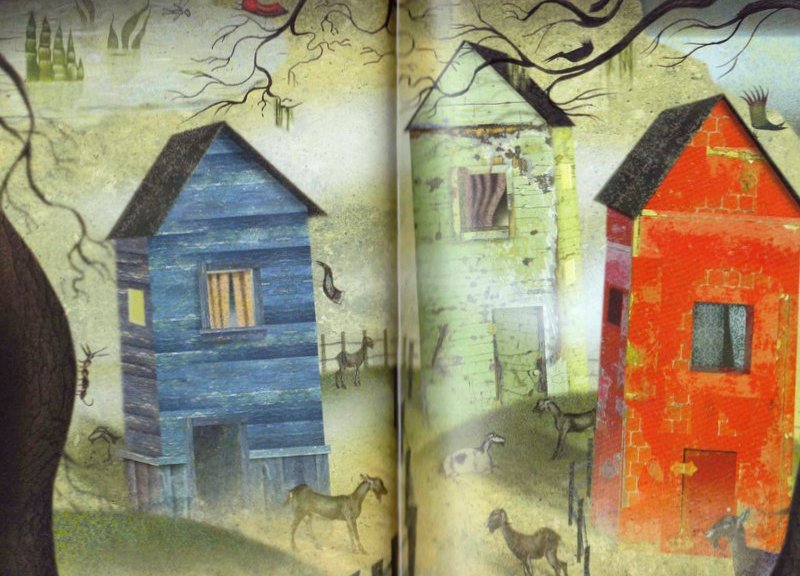
The story of Frip involves three houses for three families, all with children at the center. The houses are distinguished with primary colors—child-like blue, green, and red—but Lane’s artwork adds the ominous to Saunders’ seemingly simple narrative tinged with more than a bite of satire. The illustrations echo the haunting works about and for children found in Neil Gaiman and Tim Burton.

“Frip was three leaning shacks by the sea.” (p. 6) Artwork by Lane Smith

A child standing precariously close to the end of a slanted cliff over an angry ocean catches the eye on page 7 and then the crux of the story pulls you back to the text on page 6:

Frip was three leaning shacks by the sea. Frip was three tiny goat-yards into which eight times a day the children of the shacks would trudge with gapper-brushes and cloth gapper-sacks that tied at the top. After brushing the gappers off the goats, the children would walk to the cliff at the edge of town and empty their gapper-sacks into the sea. (p. 6)

Gappers, orange burr-like creatures with many eyes and the size of a baseball, come to represent throughout the story the power of the systemic inevitable: The presence of the gappers determines the lot of the families (and their goats), but most of the people in the tale remain unable to see beyond their own fixed and mostly misguided worldviews.

“A gapper’s like that, only bigger, about the size of a baseball, bright orange, with multiple eyes like the eyes of a potato.” (p. 2) Artwork by Lane Smith

When the gappers cling to the goats of all three families, there is an ironic appearance of equality among them. But when the fortune of one family shifts, the gappers fulfill their name by creating the gap:

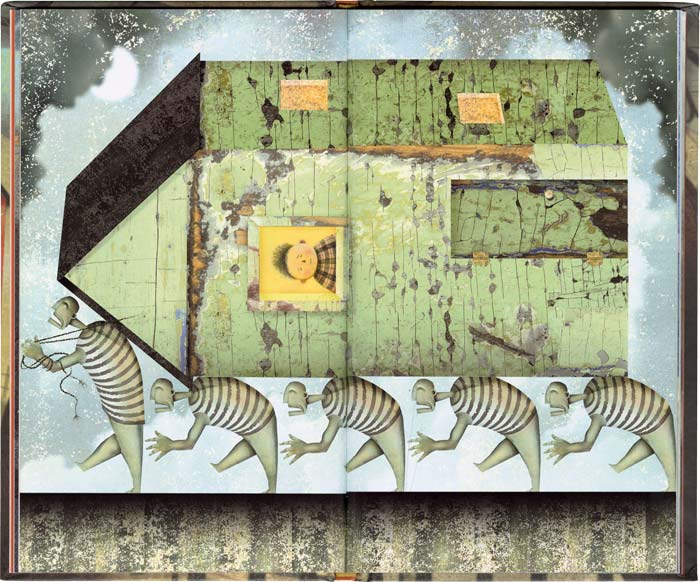
So that night, instead of splitting into three groups, the gappers moved into one very large and impressive shrieking group directly into Capable’s yard. (p. 12)

Before this shift in how the gappers behave, of course, the three families are not equal because Capable is an only child living with her father and who has lost her mother. Capable works as all the children are expected to work (removing gappers in a daily Sisyphean nightmare of chores) and seeks to serve the needs of her grieving father, who along with his grief is a prisoner of nostalgia:

“I myself was once an exhausted child brushing off gappers. It was lovely! The best years of my life. The way they fell to the sea from our bags! And anyway, what would you do with your time if there were no gappers?” (p. 11)

This nostalgia masking an unnecessarily burdensome childhood, however, is but one ideology weighing on Capable because as soon as the other two families are relieved of gappers on their goats, those families reveal themselves to be very much like the people of Le Guin’s Omelas:

“It’s a miracle!” Mrs. Romo shouted next morning, when she came out and discovered that her yard was free of gappers. “This is wonderful! Capable, dear, you poor thing. The miracle didn’t happen to you, did it? I feel so sorry for you. God has been good to us, by taking our gappers away. Why? I can’t say. God knows what God is doing, I guess! I suppose we must somehow deserve it!” (p. 17)

Capable becomes the sacrificed child, and despite her misfortune, the relieved families read the events as their merit (and of course the ugly implication that Capable and her father deserve the burden of the gappers).

What follows from this shift in fate is the central story of Frip with Capable as our main character. The message becomes clear, and Saunders and Lane make the ride one you’ll want to visit again and again. If you are lucky, the book could become one of those read alouds requested by son or daughter, or by a classroom of children.

And while I will leave the rest of the story to you, I think it is necessary to note here that this allegory is both a cautionary tale about how we view children and childhood as well as a brilliant call to reconsider how we view education and education reform.

George Saunders’s Allegory of Scarcity and Slack

The U.S., like the characters (except for Capable) in Saunders’s story, is tragically blinded by a belief in cultural myths that have little basis in evidence: That we live and work in a meritocracy, that competition creates equity, that children need to be “taught a lesson” about the cold cruel world lest they become soft, and such.

As a result of these beliefs, schools often reflect and perpetuate rather harsh environments for children—or to be more accurate, schools often reflect and perpetuate rather harsh environments for other people’s children, as Capable personifies.

Here, then, I want to make the case that The Very Persistent Gappers of Frip is a powerful allegory of scarcity and slack as examined by Sendhil Mullainathan and Eldar Shafir in their Scarcity: Why Having Too Little Means So Much.

Mullainathan and Shafir detail that the conditions of poverty, scarcity, so overburden people psychologically, mentally, and physically that their behavior is often misread (poor people are lazy, poor people make bad decisions, etc.). In Saunders’s story, scarcity and its burden are portrayed by the gappers, and readers witness how the coincidence of the onslaught of the gappers changes the families involved. In other words, the behavior of people is determined by the environment, and not by the inherent goodness or deficiencies of any individual.

The Very Persistent Gappers of Frip goes further, however, by showing that one person’s scarcity (Capable) allows other person slack: privilege is built on the back of others, and those conditions are mostly arbitrary. While Mullainathan and Shafir argue that the slack enjoyed by those living in relative privilege provides the sort of cognitive space needed to excel, Saunders speaks to more than the slack enjoyed by the two families relieved of gappers and the compounding scarcity suffered by Capable (her lot in life and the addition of the gappers):

“And the men succeeded in lifting the house and moving it very very close to the third and final house in Frip, which belonged to Sid and Carol Ronsen, who stood in their yard with looks of dismay on their nearly identical frowning faces.” (p. 23) Artwork by Lane Smith
  • Capable represents a counter-narrative to claims that impoverished children lack “grit.” As her name suggests, this child is more than capable, but the world appears determined to defeat her.
  • Capable also embodies Lisa Delpit’s confrontation of “other people’s children”—that those with privilege (slack) are willing to allow one set of standards for other people’s children (often living and learning in scarcity), standards they will not tolerate for their own.

As I stated in the opening, allegory seeks to open our eyes by diversion, creating an other world that helps us see both the flaws with our now and the enduring failures of humans to embrace our basic humanity, a failure Capable teeters on the edge of making herself but cannot:

And [Capable] soon found that it was not all that much fun being the sort of person who eats a big dinner in a warm house while others shiver on their roofs in the dark.

That is, it was fun at first, but then got gradually less fun, until it was really no fun at all. (p. 70).

In the end, it is this sort of charity, this sort of recognition of the community of humanity, a call for the kindness found in Kurt Vonnegut’s similar mix of dark humor that Saunders appears to suggest we are all capable.

Companion Reads for The Very Persistent Gappers of Frip

Scarcity: Why Having Too Little Means So Much, Sendhil Mullainathan and Eldar Shafir

“The Ones Who Walk Away From Omelas,” Ursula K. Le Guin

“The Soul of Man under Socialism,” Oscar Wilde (1891)

“The Silenced Dialogue: Power and Pedagogy in Educating Other People’s Children,” Lisa Delpit

Other People’s Children: Cultural Conflict in the Classroom, Lisa Delpit

“NPR Whitewashes ‘Grit’ Narrative” 

Competition: A Multidisciplinary Analysis, Wade B. Worthen, A. Scott Henderson, Paul R. Rasmussen and T. Lloyd Benson, Eds.

No Country for Young Children of Color

While I have argued that we basically do not like children in the U.S., there is considerable evidence that being born a child of color puts those children at a disadvantage relative to white children.

Based on the Kids Count report, Race for Results, Smriti Sinha has declared:

Black families pondering a move to the Midwest might want to read this, especially if they have young children. According to a national report, Wisconsin has been ranked the worst state in the country when it comes to racial disparities for children.

But the entire U.S. does not fare well in terms of addressing the needs faced by children of color.

“Opportunity has been a constant theme in our country’s narrative, beginning with the waves of immigrants who arrived from across the globe in search of a better life,” the report begins, adding, “Last year, for the first time, more children of color were born in the United States than white children” (p. 1).

Opportunity, then, in the future of the U.S. will be increasingly multi-racial, but access to opportunity does not have to remain a race, a competition among those races.

Yet, children who happen to be born white in the U.S., and especially if they are born affluent, start well ahead in the so-called race of life.

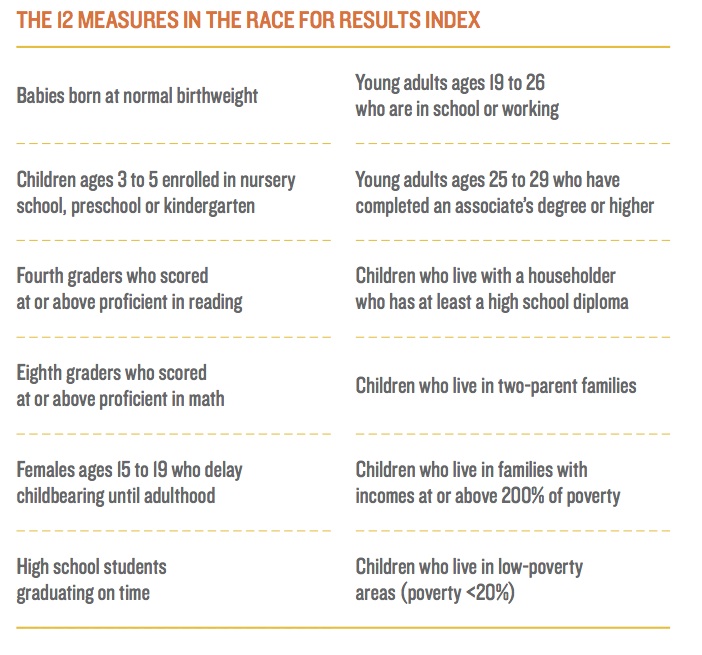
Social inequity remains grounded significantly in race and class, as measured in 12 indicators in The Race for Results Index (see p. 6):

12 indicators of The Race for Results Index

[click to enlarge]

Broadly, the report finds:

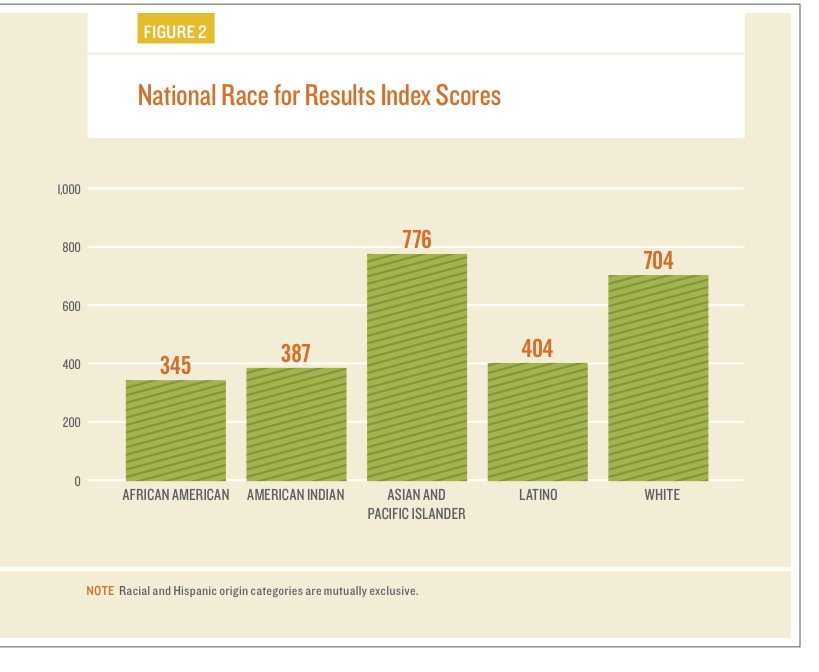
As the national data show, no one group has all children meeting all milestones. African-American, American Indian and Latino children face some of the biggest obstacles on the pathway to opportunity. As Figure 2 illustrates, Asian and Pacific Islander children have the highest index score at 776, followed by white children at 704. Scores for Latino (404), American Indian (387) and African-American (345) children are considerably lower. (p. 8)

Index scores by race

[click to enlarge]

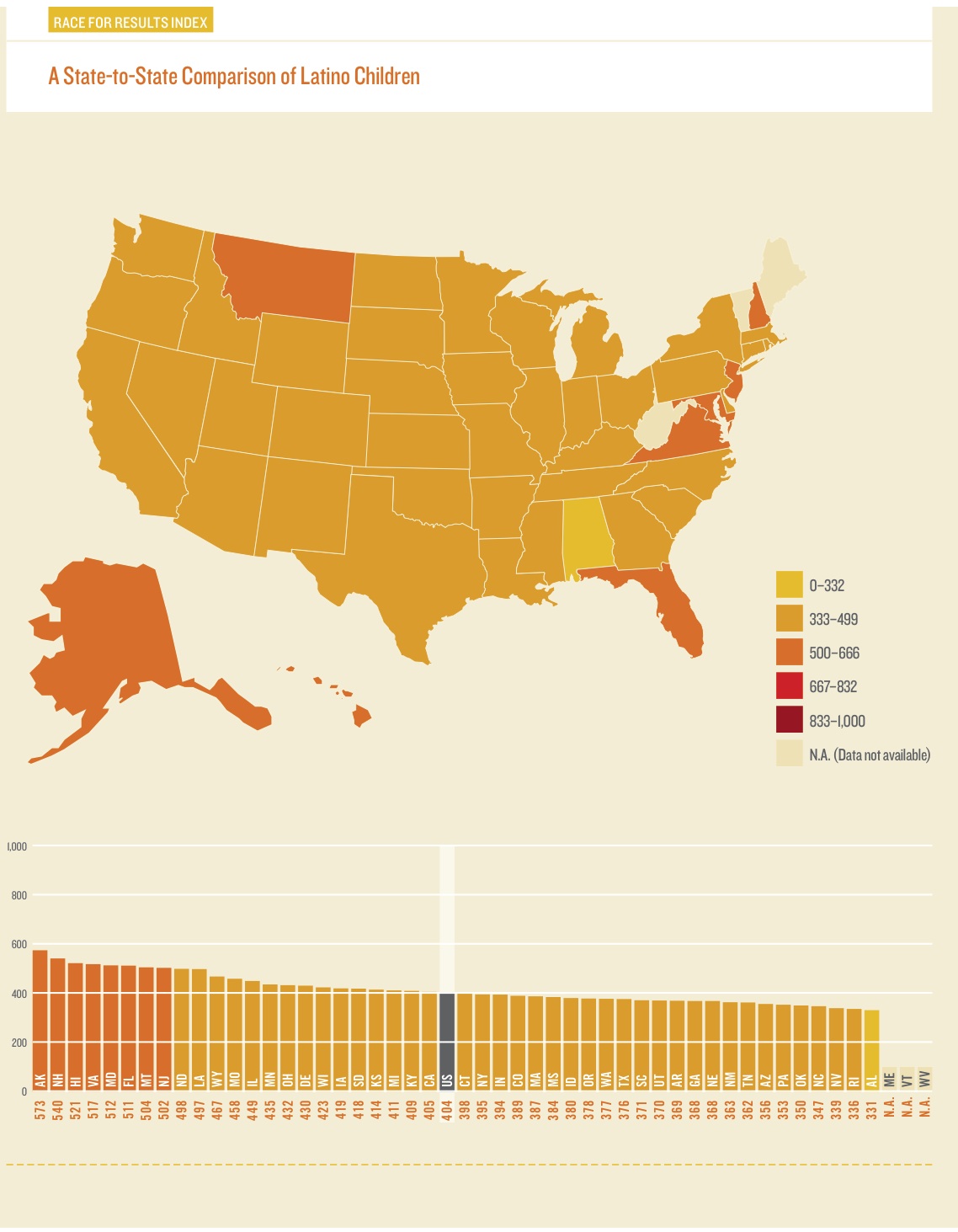
While the overall inequity for African American and Latino/a children [1] is nation-wide, many states—often high-poverty and high-minority states (such as my home state of SC)—rank low in childhood opportunity for children of color:

state by state Afican American

[click to enlarge]

state by state Latino/a

[click to enlarge]

The report concludes with four recommendations:

RECOMMENDATION 1

Gather and analyze racial and ethnic data to inform all phases of programs, policies and decision making….

RECOMMENDATION 2

Use data and impact assessment tools to target investments to yield the greatest impact for children of color….

RECOMMENDATION 3

Develop and implement promising and evidence-based programs and practices focused on improving outcomes for children and youth of color….

RECOMMENDATION 4

Integrate economic inclusion strategies within economic and workforce development efforts….(pp. 22-28)

Ultimately, the report argues:

As profound demographic shifts, technological advances and changes in global competition race toward us, no individual can afford to ignore the fact that regardless of our own racial background or socioeconomic position, we are inextricably interconnected as a society. We must view all children in America as our own — and as key contributors to our nation’s future. (p. 28)

As I have stated about the paradox of race, the U.S. is neither a post-racial country, nor should that be our goal. Along with genuinely acting as if “they’re all our children,” we must see race as a part of an equitable society and set aside reducing life to a race to the top that must sacrifice some for the good of a few.

[1] This post focuses on the racial dynamic of white, African American, and Latino/a since my work primarily addresses SC, where that dynamic is dominant. Not addressing the remaining ethnic groups in the report is not intended to marginalize those children or the significance of any racial minority.

On Children and Childhood

children guessed(but only a few
and down they forgot as up they grew

“[anyone lived in a pretty how town],” e.e. cummings

In one of those early years of becoming and being a teacher, when I was still teaching in the exact room where I had been a student (a school building that would eventually be almost entirely destroyed by a fire set by children), it was the first day of school, and I was calling that first roll—a sort of silly but important ritual of schooling for teachers and students.

Toward the back of the room and slightly to my left sat a big young man, a white male student typical of this rural upstate South Carolina high school in my home town; like me, he would accurately be considered in that context as a Redneck.

Just about everyone knows everyone in my hometown, and we are very familiar with the common names of that town. So when I came to this young man’s name—Billy Laughter (it rhymes with “slaughter”)—I said “Billy Laughter” (rhyming the last name with “after”).

Smiling, I scanned the room and then turned my eyes back to Billy; he was red-faced and on the edge of having a very bad first day, one that was likely going to result in his being punished for my having done a very stupid thing. I raised my hand, palm facing him, and said, “Billy, my mistake. I’m sorry. I was trying to be funny but it wasn’t.” And then I said his name correctly.

Billy had suffered a life of people mangling his name, and he wasn’t in any mood for my being clever on the first day of school.

Several years later, when I was teaching a U.S. history class as part of  my usual load as a member and chair of the English department, while I was having students form small groups, two young white males bumped into each other, back to back, while moving their desks. I caught the moment out of the corner of my eye and had to rush over to deter the fight that was about to occur.

I wasn’t surprised—this was typical of my small community, along with fights starting because “he/she looked at me wrong”—but some time after this, I saw a research study that explained how people in the South and North handled personal space differently. In the South, bumping into someone or looking at someone wrong is often interpreted as challenging someone’s honor, requiring a response. People in the North, conditioned by mass transit and crowded cities (I suspect the study was as much about rural and urban, as South and North), are not as apt to find acts of close proximity anything other than that.

So setting aside the urge to examine the Redneck honor code, I want to add just one more event from my coaching life in those middle years of my teaching.

While running a drill at soccer practice, I heard a comment from a player in a group behind me. My mind heard a player with whom I had been having trouble. He was difficult in class and on the team, and worst of all, he was very disruptive at practice.

I turned and, without hesitating, I announced, “You are out of here,” pointing with my finger up the hill. Throwing him out of practice? No, I kicked him off the team.

As the young man was walking up that hill, a timid player on the team said, “Coach, that was me.”

I had just kicked a young man off the team who had, in fact, not said a thing.

A day or so ago, I received an email from Alfie Kohn about his new book, The Myth of the Spoiled Child. Alfie was apologetic about self-promotion so I replied, thanked him for the book, and noted a book I am co-editing that appears to be of a similar mind about children and childhood, Pedagogies of Kindness and Respect: On the Lives and Education of Children.

I also noted that our perspectives on children—on how parents, teachers, and society treat children—appears to be a minority view.

I have been mulling, then, or more likely stewing about this for some time: What makes adults—even the ones who choose to spend their lives with children—so damned negative and hateful about those children?

That, I must admit, is the source of my palpable anger at the “grit,” “no excuses,” and “zero tolerance” narratives and policies.

I grew up and live in the South where the default attitude toward children remains that they are to be seen and not heard, that a child’s role is to do as she/he is told. If a child crosses those lines, then, we must teach her/him a lesson, show her/him who is boss—rightfully, we are told, by hitting that child: spare the rod spoil the child.

That Christ’s love comes in the form of corporal punishment has never made any sort of sense to me, but I find that same deficit view of children is not some backwoods remnant of the ignorant South; it is the dominant perspective of children throughout the U.S.

Barbara Kingsolver explains in “Everybody’s Somebody’s Baby”:

This is not the United States.

For several months I’ve been living in Spain, and while I have struggled with the customs office, jet lag, dinner at midnight and the subjunctive tense, my only genuine culture shock has reverberated from this earthquake of a fact: People here like kids. They don’t just say so, they do. Widows in black, buttoned-down c.e.o.’s, purple-sneakered teen-agers, the butcher, the baker, all have stopped on various sidewalks to have little chats with my daughter. Yesterday, a taxi driver leaned out his window to shout ” Hola, guapa !” My daughter, who must have felt my conditioned flinch, looked up at me wide-eyed and explained patiently, “I like it that people think I’m pretty.”

With a mother’s keen myopia, I would tell you, absolutely, my daughter is beautiful enough to stop traffic. But in Santa Cruz de Tenerife, I have to confess, so is every other person under the height of one meter. Not just those who agree to be seen and not heard. When my daughter gets cranky in a restaurant (and really, what do you expect at midnight?), the waiters flirt and bring her little presents and nearby diners look on with that sweet, wistful gleam of eye that before now I have only seen aimed at the dessert tray. Children are the meringues and eclairs of this culture. Americans, it seems to me now, sometimes regard children as a sort of toxic-waste product: a necessary evil, maybe, but if it’s not their own they don’t want to see it or hear it or, God help us, smell it.

I just don’t get it.

A child is not a small adult, not a blank slate to be filled with our “adult weariness,” or a broken human that must be repaired (I won’t belabor, but the whole Original Sin idea doesn’t help and justifies the drive to use the rod).

But it is also certainly true that children are not angels, not pure creatures suited to be simply set free to find the world on their own.

Seeing children through deficit or ideal lenses does not serve them—or anyone—well.

And within the U.S. culture there is a schizophrenia—we worship young adulthood in popular media, but seem to hate children—that is multiplied exponentially by a lingering racism and classism that compounds the deficit view of childhood. Consider the research showing how people view children of color:

Asked to identify the age of a young boy that committed a felony, participants in a study routinely overestimated the age of black children far more than they did white kids. Worse: Cops did it, too….

The correlation between dehumanization and use of force becomes more significant when you consider that black boys are routinely estimated to be older than they are….

The less the black kids were seen as human, the less they were granted “the assumption that children are essentially innocent.” And those officers who were more likely to dehumanize black suspects overlapped with those who used more force against them.

In the enduring finger-pointing dominant in the U.S.—blaming the poor for their poverty, blaming racial minorities for the burdens of racism, blaming women for the weight of sexism—we maintain a gaze that blinds us to ourselves, allows us to ignore that in that gaze are reflections of the worst among us.

Why do the police sweep poor African American neighborhoods and not college campuses in search of illegal drugs? Why do we place police in the hallways of urban high schools serving mostly poor African American and Latino/a students, demanding “zero tolerance”? Why are “grit” narratives and “no excuses” policies almost exclusively targeting high-poverty, majority-minority schools (often charter schools with less public oversight)?

When I raise these questions, I can rest assured I will inspire the same sort of nasty response I often encounter when cycling. A few motorists make their anger known when we are riding our bicycles, and I am convinced that while some are genuinely frustrated with our blocking temporarily the road, the real reason they are angry is that we are enjoying ourselves as children do.

And nothing angers a bitter adult as much as the pleasures of a child.

Children are not empty vessels to be filled, blank hard drives upon which we save the data we decide they should have. Children are not flawed or wild, needing us neither to repair nor break them.

And children are not to be coddled or worshipped.

They are children, and they are all our children.

Yes, there are lessons to be taught, lessons to be learned. But those driven by deficit or idealized views are corrupted and corrupting lessons.

Each and every child—as all adults—deserves to have her/his basic dignity respected, first, and as adults charged with the care of any child, our initial question before we do anything with or to a child must be about ourselves.

In 31 years of teaching, I can still see and name the handful of students I mis-served, like Billy above. Those faces and names serve as my starting point: With any child, first do no harm.

The ends can never justify the means.