Category Archives: communism

The Unbearable Lightness of Lying: Renaming What We Value, Fear

“Who is more to be pitied,” muses artist and main character Rabo Karabekian in Kurt Vonnegut’s Bluebeard, “a writer bound and gagged by policemen or one living in perfect freedom who has nothing more to say?”

As in most of Vonnegut’s fiction, there is a tension of tone between the narration and the weight of the circumstances—a tug-of-war between light and dark, or better phrased Light and Dark.

Karabekian’s failed autobiography is an adventure in What is art? with the specters of Nazi Germany, fascism, and World War II as well as the rise and fall of the U.S.S.R. (the novel was published in 1987) lurking forever in the background.

“The history of writers working under tyranny or in exile is long, and each example involves its own particular cruelties,” writes Nathan Scott McNamara, adding:

From 1968 until 1989, Czech writers like Milan Kundera and Bohumil Hrabal were put in a particularly impossible position. They spoke and wrote in Czech, a language limited to a very small part of Central Europe—and a language that had fallen under the control of a sensitive and authoritarian government….

One of the major successes of the Soviet regime’s control of Czechoslovakia was the creation of a generalized fear, making the Czech people suspicious of each other. Kundera has been largely disavowed by his native land, and in 2008, he was dubiously accused of once working with the Communist Police. Toward the end of his life, Hrabal came to see himself as a coward. At the age of 82, he jumped from the fifth story window of a hospital and died.

In the very real world, Kundera and Hrabal represent what Vonnegut fictionalizes, but struggled against in some ways himself as a writer.

Also as McNamara recognizes, the terrors found in Vonnegut’s novel as well as Kundera and Hrabal’s lives and careers are not something of history:

The survival of the writer under an unpredictable government is no less a serious concern today….

Warning flares are going up in the United States, too, where our President-elect threatens his competitors, intimidates private citizens, and warns that he’ll alter libel laws so journalists can be “sued like they’ve never been sued before.” This past week brought us another painful parallel between the 2016 US Presidential Election and the 1968 invasion of Czechoslovakia: the role of Russia. We don’t have tanks rolling through our streets, but a digital hack and a manipulated election nonetheless feel like a kind of 21st-century echo. It’s almost Hrabalesque in its absurdity. It’s almost darkly comic.

Yes, in some ways, Trumplandia feels too much like a black comedy penned by Vonnegut, even more absurd than the political theater and political-religious propaganda in Cat’s Cradle.

2016 in the U.S. has become not just reality TV as politics but a thin and distracting public debate about fake news and post-truth America—as Sarah Kendzior explains:

“Fake news” is a term that entered the vernacular following the election of Donald Trump. Allegedly coined to bemoan the terrible reporting that helped facilitate Mr. Trump’s rise, it actually serves to stabilize his rule. “Fake news” poses a false binary, blurring the distinction between political propaganda, intentional disinformation, attention-seeking click-bait, conspiracy theories, and sloppy reporting.

When the United States elects a man who peddles falsehoods, obfuscates critical information about his business transactions and foreign relationships, and relies on both mass media outlets and untraditional venues like conspiracy websites to maintain his power, the manifold ways he lies are as important as the lies themselves.

Kendzior recognizes, however, that naming fake news and post-truth actual works—as McNamara notes (“the creation of a generalized fear, making the Czech people suspicious of each other”)—to further solidify Trump:

However, Mr. Trump’s most powerful lies contain a grain of truth that plays to the preconceptions of his audience. When Mr. Trump lies about the conditions of inner cities, about the economy, or about Hillary Clinton, he exploits the vulnerability of some citizens while telling others what they want to hear. These lies are propaganda: false information with a political purpose, tailored to incite.

The mostly unspoken problems facing the U.S. include the fact that the country has always been post-truth, mostly mythology and narrative bluster, and has always mis-named what we value and what we fear.

For example, considered the jumbled responses to healthcare in the U.S., as unpacked by Robert H. Frank:

The same logic explains why private/government hybrid programs — like Obamacare, and its predecessor in Massachusetts, Romneycare — include an individual mandate. Opponents of the mandate argue that it limits individual freedom, which of course it does. But traffic lights and homicide laws also limit individual freedom; everyone celebrates liberty, but sometimes we must choose among competing freedoms. Failure to include a mandate would eliminate the freedom of citizens to purchase affordable health insurance. In such cases, we must decide which of the competing freedoms is more important.

If we frame the overly simplistic embracing of “individual freedom” that is central to the American Myth against McNamara’s consideration of Soviet communism as totalitarianism, there appears to be a powerful space for renaming what we value and what we fear.

And our fears, in fact, have little to do with communism or socialism—but everything to do with totalitarianism, authoritarianism, and fascism. The Soviet labeled their totalitarianism “communism,” but as critical educators know, institutions of a free people (such as formal education and the judicial system) “can operate even in the name of democracy and justice to be totalitarian and oppressive.”

Like “communism” and “socialism,” “democracy” and “capitalism” can be veneers for totalitarianism and oppression; and in the U.S., that “can be” often proves to be “is.”

The nastiness of “Make America Great Again” reflects and then seeps into the fabric of a people without real moral grounding, and with a superficial faith in freedom tinted with a cartoonish fear of the Other.

Renaming, we must call for making America great for everyone, finally.

Renaming, we must reject totalitarianism and authoritarianism.

If we return to Vonnegut-as-Karabekian, we in the U.S. are confronted with neither a formal police state nor “perfect freedom,” but none the less, we are unwilling and unable to say unvarnished what we value and what we fear so that we can gain the former and cast out the latter.

I, Too, Am a Dangerous Professor if You Covet Ignorance, Hatred

We Marxists are rightfully criticized for being idealistic, but we are unfairly demonized by those across the U.S. who wrongly associate Marxism, socialism, and communism with totalitarian governments and human oppression.

You see, Marxism as a scholarly stance is a moral stance—unlike the amoral pose of capitalism.

We Marxist academics and scholars are all about the good, the right, and the equitable—including creating intellectually challenging classrooms in which every student feels physically and psychologically safe.

But this is 2016 Trumplandia, a sort of Bizarro World in which reality TV has become a real-life nightmare, including a professor watch list promoted by an Orwellian right-wing organization that claims to be protecting free speech and academic freedom by identifying dangerous professors.

George Yancy, professor of philosophy at Emory University, has responded with the powerful I Am a Dangerous Professor, and my home state of South Carolina has had three professors included on the list.

The responses to the list have run a range from fear (because professors have received very serious threats) to bemusement to anger about not being included.

I am a white male full professor with tenure, but I teach in the South—where before I joined a university faculty, I was an intellectually closeted public school teacher for 18 stressful years.

As a leftist and atheist, I was constantly vigilant to mask who I was, what I believe and live, because I was fearful of losing my job and career (SC is an Orwellian-named “right to work” state) that I dearly love.

When I interviewed for my current position, I was about as naive and idealistic as a person could be about the golden fields of higher education.

During my model lesson for my day-long interview, I explained to the class I was a critical pedagogue, and thus offering a Marxist perspective on literacy and power.

Later in the day, at the debriefing and in hushed tones, I was told I may want to not share the whole Marxist thing if hired at the university.

I was hired—although my being a critical educator, scholar, and public intellectual have all been problematic throughout my second career as a professor.

And I have bull-headedly remained true to my ethics as both a professor/teacher and a critical pedagogue, best expressed by my dear friend and mentor Joe Kincheloe:

Thus, proponents of critical pedagogy understand that every dimension of schooling and every form of educational practice are politically contested spaces. Shaped by history and challenged by a wide range of interest groups, educational practice is a fuzzy concept as it takes place in numerous settings, is shaped by a plethora of often-invisible forces, and can operate even in the name of democracy and justice to be totalitarian and oppressive. (p. 2)

Recognition of these educational politics suggests that teachers take a position and make it understandable to their students. They do not, however, have the right to impose these positions on their students [emphasis in original]….

In this context it is not the advocates of critical pedagogy who are most often guilty of impositional teaching but many of the mainstream critics themselves. When mainstream opponents of critical pedagogy promote the notion that all language and political behavior that oppose the dominant ideology are forms of indoctrination, they forget how experience is shaped by unequal forms of power. To refuse to name the forces that produce human suffering and exploitation is to take a position that supports oppression and powers that perpetuate it. The argument that any position opposing the actions of dominant power wielders is problematic. It is tantamount to saying that one who admits her oppositional political sentiments and makes them known to students is guilty of indoctrination, while one who hides her consent to dominant power and the status quo it has produced from her students is operating in an objective and neutral manner. Critical pedagogy wants to know who’s indoctrinating whom. (p. 11)

In fact, yesterday in my foundations of education course, I reiterated to the class that as a Marxist I often seem obnoxious, even dogmatic because I teach and speak with a moral imperative, an impassioned moral imperative—seeking that which is right, good, and equitable.

About this watch list, then, I am torn, struggling between embracing Yancy’s brilliant rebuttal and my own belief that I am in fact not the dangerous one because the dangerous thing about this world is to remain both ignorant and without a moral grounding.

As a Marxist educator and scholar/public intellectual, as a critical pedagogue, I am not the person hiding who I am or what I am seeking.

The dishonest are those who claim to be objective when in fact they are endorsing uncritically an inequitable status quo.

The dishonest are those claiming a non-political pose that is itself a political pose.

The dishonest are waving flags and chanting the entirely dishonest “Make America Great Again.”

That is dangerous stuff—endangering the faint promise of life, liberty, and the pursuit of happiness that I, in fact, hold sacred.

So I am left with this paradox: I, too, am a dangerous professor if you covet ignorance, hatred.

If you are seeking the Truth, however, as well as the right, the good, and the equitable, please call me comrade because I am no danger to you at all.

O Captain America! Our Captain America!

Every woman adores a Fascist,
The boot in the face, the brute
Brute heart of a brute like you.

“Daddy,” Sylvia Plath

Camille Paglia has confronted her own prescience about the direct line from Arnold Schwarzenegger being elected governor of California to Donald Trump now being a serious candidate for president: “This is how fascism is born.”

And while these political realities—possibly catastrophic to a people clinging to life, liberty, and the pursuit of happiness—will likely not receive very much attention by the mainstream public, please don’t **** with an iconic comic book superhero:

The goal, of course, is to shock readers into buying the next issue, and presumably that’s what comics scribe Nick Spencer and his colleagues at Marvel Comics hoped to do when they executed a final-page revelation in last Wednesday’s Captain America: Steve Rogers No. 1: We learned that Cap is actually … evil? The Star-Spangled Avenger uttered the words, “Hail Hydra,” the fascistic slogan of longtime villain collective Hydra. Say it ain’t so!

Comic books (and more recently graphic novels and the film adaptation of superhero comic books) have always been both a reflection of and fuel for pop culture in the U.S.

And the primary subgenre of comic books, superhero narratives, has done far more to perpetuate the very worst of our society than to confront or seek to rise above xenophobia, racism, sexism, homophobia, and warmongering.

Marvel Comics claimed the comic book throne in the 1960s—over long-time powerhouse DC—but has since experienced a renaissance through film adaptations.

Iron Man and Captain America, for example, have recaptured the public’s imagination—but only a few have offered that their appeal is strongly grounded in our militarism, our patriotism that is strongly tainted with nationalism and even jingoism.

These film adaptations have carried on a tradition of the comic book industry—one that is primarily market driven: the reboot.

Now, however, pop culture has two competing set of fans, clashing nerdoms—those who worship at the alter of the comic book universe(s) and those who worship at the alter of the film universe(s).

Captain America being outed as a life-long fascist, then, in the pages of the comic book reboot of Steve Rogers as Captain America along side Sam Wilson as the replacement Captain America (see below) has drawn the ire of fans.

However, that anger lacks a grasp of both the history of Captain America and that Captain America has always been our fascist.

The general public in the U.S. suffers under a lazy understanding of terminology—such as “communism,” “socialism,” and “fascism”—and under the weight of an idealized (and misleading) faith in capitalism, one that confuses the “free market” with freedom, liberty.

The horrors of fascism include its embracing totalitarianism and militarism in order to sustain corporatism. It is fascism, in fact, that is perfectly reflected in Captain America.

In a chapter I recently completed and is now in publication, I examine race in superhero comic books, and focus on the ascension of Sam Wilson, black and formerly The Falcon, to being Captain America. In that discussion, I researched and unpacked the history of Captain America.

Here is an excerpt of that unpacking from the section subhead “Comic Book Superheroes: From Gods to White Knights”:

While gaining a much larger cultural status because of the rise of Marvel films, Captain America may best represent how superhero comics represent race and racism—as the ultimate White Knight. “Captain America, an obviously Aryan ideal,” McWilliams (2009) poses, “has always had a curious relationship with racial ideals” (p. 66) [emphasis added]. In fact, Golden Age (from the 1940s), Silver Age (later mid-twentieth century), and contemporary Captain America each represents well the comic book industry (and Marvel Comics specifically) as well as how popular culture reflects/perpetuates and confronts race and racial stereotypes.

As superhero archetype, Captain America embodies the masked duality (Brown, 1999), the white ideal, the masculine norm, and the periodic rebooting of superhero origins as part marketing strategy and part recalibration that helps mend the tear between the official canon of the comic book universe with the changing real world. The rebooted origin stories of Captain America/Steve Rogers are powerful lessons in race and the comic book industry (Hack, 2009; McWilliams, 2009).

The 1940s Captain America arrived in the wake of Superman, Batman, and Wonder Woman from the minds and pencil of Joe Simon and Jack Kirby. Uber-patriotic, these foundational stories, including the original origin of Steve Rogers’ transformation into Captain America, are xenophobic and perversely fueled by eugenics (Hack, 2009). Somehow the medically altered superhuman maneuvers in the U.S. were morally superior to Hitler’s parallel ethnic cleansing [emphasis added]. The 1970s Marvel recasting of Captain America by Kirby and Stan Lee reflected the changing social mood about war (Vietnam)[i], and laid the foundation for coming face-to-face with race and civil rights with the addition of Sam Wilson/The Falcon (to be explored in detail below). Although this new Captain America in the Silver Age incorporated the best and worst of Blaxploitation conventions found in films of the era (McWilliams, 2009; Nama, 2011), this new origin sought to erase traces of eugenics from the Captain America mythos (Hack).

From the 1980s (a hot decade for rebooting origins, highlighted by Frank Miller’s Batman) and into the early 2000s, Captain America’s origin continued to be reshaped. Notable for a consideration of race is Truth: Red, White and Black from 2003, which details a remarkable alternate origin as a medical experiment on black men (echoing Tuskegee), resulting in Isaiah Bradley ascension as the actual first Captain America (Connors, 2013; Hack, 2009; McWilliams, 2009; Nama, 2011). While the Truth/Bradley side-narrative is important in an investigation of race in comic books, Captain America provides an even more important entry point into race and superhero comic books through the 1970s teaming with Sam Wilson/The Falcon, and then the more recent and new origin story in which Wilson becomes the new (and black) Captain America (see below). However, the entire Captain America mythos, as Hack (2009) concludes, “begs the question as to whether comics such as CA [Captain America] knowingly presented a different America from the one that actually existed [and exists], or if the creators of these books believed a version of reality in which eugenics was a boon to civic virtue and in which no American would knowingly profit from Nazism. …Good and evil were [and are] presented in reductionist terms, and offered little of what contemporary conservatives decry as moral relativism; yet these distinctions were no less blurry in pre-war America as they are today: war, as always, is business” (p. 88).

It is in that broader context, I believe, that the Falcon and Wilson’s donning the cowl of Captain America are central pieces of the complex puzzle revealing how comic books address race.

So Captain America has always been a fascist. But we actually didn’t need Marvel’s newest reveal to know that.

Captain America has always been our fascist, and that is all that matters.


See Also

Hydra the Beautiful: The American Roots of Captain America’s Quasi-Nazi Revelation, Noah Berlatsky

Having the good guys turn out to be bad guys is fun as a plot device. But, as Truth shows, the actual implications aren’t fun at all. When Captain America beats up Hitler, it’s a blow against white supremacy. But given the twisted origin and development of the protagonist, it can also be seen as a blow for white supremacy, Jim Crow, segregation, racism and the eugenic fantasies that helped inspire Hitler to begin with. Hate’s a big part of what made Captain America into Captain America, with his blonde hair and perfect muscles. “Hail Hydra” is as American as apple pie, or superheroes.

LGBT Visibility: This Fucking Week, Matt Santori-Griffith

Oyola, O. (2015, November 3). The Captain white America needs [Web log]. The Middle Spaces. Retrieved from https://themiddlespaces.wordpress.com/2015/11/03/the-captain-white-america-needs/

References

Brown, J.A. (1999, Spring). Comic book masculinity and the new black superhero. African American Review, 33(1), 25-42.

Connors, S.P. (2013). “It’s a bird … It’s a plane … It’s … a comic book in the classroom?”: Truth: Red, white, and black as test case for teaching superhero comics. In P.L. Thomas (Ed.), Science fiction and speculative fiction: Challenging genres (pp. 165-184). Boston, Ma: Sense Publishers.

Hack, B.E. (2009). Weakness is a crime: Captain America and the Eugenic ideal in early twentieth-century America. In R.G. Weiner (Ed.), Captain America and the struggle of the superhero: Critical essays (pp. 79-89). Jefferson, NC: McFarland and Company, Inc.

McWilliams, O.C. (2009). Not just another racist honkey: A history of racial representation in Captain America and related publications. In R.G. Weiner (Ed.), Captain America and the struggle of the superhero: Critical essays (pp. 66-78). Jefferson, NC: McFarland and Company, Inc.

Nama, A. (2011). Super black: American pop culture and black superheroes. Austin: University of Texas Press.

[i] Corresponding as well with Dennis O’Neil and Neil Adam’s Green Lantern Co-Starring Green Arrow, DC, 1970-1972, identified by most comic books scholars as a key moment in the cultural awareness of the medium.

Cinco de Mayo 2016: A Reader

Let us hope we can resist the urge to trivialize and appropriate the wonderful history, traditions, and people of Mexico because of the silliness that is making a holiday another way to churn up crass commercialism (a redundant term). [Also, lost in the shuffle, today is the birthday of Karl Marx.]

So below, please read a gathering of important articles, somewhat loosely connected because they have crossed my path.

First, let me note that since I have relentlessly criticized edujournalism of late (and it is well deserved criticism), I start with an edujournalism unicorn—a very good piece on NAEP.

Read on:

The simple truth is that NAEP is not designed to provide causal explanations. It’s a test given every two years to a representative sample of students who happen to be in fourth, eighth, or twelfth grade that particular year. It does not follow students over time, so it’s impossible to say that a policy or practice “caused” the results….

Put together, the findings paint a picture of unequal opportunities to learn challenging content. Low-performing students spend less time explaining their reading or doing projects, and more time on test prep. Once again, these are correlations: they do not suggest that these patterns caused the low performance. But why do they exist? What can be done about them? That’s the challenge for educators and policy makers.

Clinton has been a card-carrying feminist for decades, she started her career doing advocacy for children and women, she’s famous for her UN speech about women’s rights are human rights, she’s been reliably pro-choice and so on. So if that all fits into this sort of recognition side, she’s been there, and in a more explicit, and front-and-center way than Sanders. But, on the other hand, What kind of feminism is this? Clinton embodies a certain kind of neoliberal feminism that is focused on cracking the glass ceiling, leaning in. That means removing barriers that would prevent rather privileged, highly educated women who already have a high amount of cultural and other forms of capital to rise in the hierarchies of government and business. This is a feminism whose main beneficiaries are rather privileged women, whose ability to rise in a sense relies on this huge pool of very low-paid precarious, often racialized precarious service work, which is also very feminized that provide all the care work

It’s called the American Dream because you have to be asleep to believe it.

Black students will always underachieve when they are perceived as needing fixing.

The irony is that black students aren’t the ones who need fixing.

Deficit thinking corrupts the potential effectiveness of even the most competent teachers.

White folk must unlearn their negative expectations. That’s the only way we’re ever going to change the structures that really hold students back.

And now, a musical extra:

https://youtu.be/Cl4jJF1-HV4

Beyond Toilet Seat Etiquette

In her The Airplane Seat Theory of Education post, Nancy Flanagan asks:

When did we stop cherishing our small communities in favor of looking out for number one? When did we lose the idea that we have accomplished great things collaboratively, as a nation of small communities–the GI Bill, the Hoover Dam, the middle class–not as individual, high-profile wealth-producers?

Schools, too, are temporary communities, that function best when the folks involved understand the importance of consideration for our fellow humans, which leads to the rising tide that lifts all boats.

Within a week of my reading this, I was sitting at my sister-in-law’s, surrounded by my niece, daughter, wife, and sister-in-law as well as my niece’s two children while I held my granddaughter. In the flow of unrelated discussions, the women in the room had a quick but notable discussion of the age-old anger at men who leave the toilet seat up. The consensus of the women in the room was that such acts are essentially rude, an inconsiderate act that fails to recognize the basic human dignity of other people using the toilet differently.

I think it is fair to say that these women felt as if leaving the toilet seat up was a statement that suggested they simply don’t exist—a pretty awful feeling for a loved one to have.

Since then, I have found myself contemplating the toilet seat in a similar way to Flanagan’s consideration of the airplane seat, and I think her question deserves a fuller reply.

Community and collaboration, I think, are not concepts we have lost in the U.S., but ideals we have never really embraced. And the reason why lies with our essential materialistic consumerism linked to our embracing the rugged individual myth.

The problem with materialism, consumerism, and broadly ownership in Western and U.S cultures can best be revealed through toilet seat etiquette, but let’s start somewhere else—the car.

In the U.S. (and especially in the rural areas), we not only covet our cars, but also each person old enough in the family has his/her own car—and mass transit isn’t even an option. To have your own car in the U.S. is a teenage rite of passage—often a very public marker of class that further ostracizes young people.

Much the same can be said about iPods (and earbuds) or smartphones.

But the toilet is a different matter.

Even in our own homes, the toilet can and will be a communal possession—guests have access to the toilet as do all who live in a home.

Just as death and bodily functions level (and thus humanize) people despite their class, race, gender, or ideologies (we all die and we all must evacuate our bladders), the toilet challenges our individualistic sense of ownership—or at least it should.

“Ownership is an entirely human construct,” writes Barbara Kingsolver in “Making Peace” from her collection High Tide in Tucson, adding:

At some point people got along without it. Many theorists have addressed the question of how private property came about, and some have gone so far as to suggest this artificial notion has led us into a mess of trouble….[T]o own land, plants, other animals, more stuff than we need—that is the particular product of a human imagination.

In the beginning, humans were communal and social creatures. (p. 26)

I would add to Kingsolver’s excellent essay that this tipping point in which, as she explains, humans have come to see ownership “as a natural condition, right as rain” (p. 30) is the imbalance at the foundation of our loss of community, our honoring of individual ownership to the exclusion of communal property and thus eroding the very individual rights we claim to cherish.

The problem is one John Dewey, William James, and others have confronted in philosophical terms—the fabricated choice between the individual and the collective, an either/or in which the U.S. and most Westerners have lined up to support only the individual.

And thus, men lift toilet seats and leave them up as if no one else exists—especially and most damning, as if no women will need to use that particular toilet in a way different than he has.

Failure to honor basic toilet etiquette is simply callousness, selfishness, and a lack of self- as well as collective awareness. It is a very impersonal and undignified “Up yours,” offered in absentia.

As Kingsolver notes, we have abandoned collaboration for competition and championed “I” over “we” to the detriment of each of us as well as all of us.

Again, to Dewey—the individual/community dynamic is not a choice, but an inseparable and symbiotic relationship. To honor the individual, we must simultaneously honor the community, and to honor the community, we must not ignore the individual.

Thus, to recognize the toilet as mine (either literally as in “I bought it” or temporally as in “I am currently on it”) as well as always someone else’s is the toilet seat compact that would benefit all of humanity if we were to expand that premise to essentially everything. This, of course, is the argument Kurt Vonnegut offered over and over in the waning years of his life about the planet: It is in each of our selfish interests to treat the planet as if it belongs to everyone.

“Life is better,” ends Kingsolver, “since I abdicated the throne*. What a relief, to relinquish ownership of unownable things” (p. 33). And I am certain that if we could balance our sense of individual ownership with communal ownership, we would have a similar response because life would be better if we humans lived each moment with the simple compassion and awareness found in toilet seat etiquette that honors communal dignity while also challenging the patriarchy of lifted seats.

* Yes, “abdicated the throne….”

George Saunders’s Allegory of Scarcity and Slack

The stories themselves, literally, are powerful and engaging or George Orwell’s 1984 and Arthur Miller’s The Crucible would not have endured as they have as literature people read again and again—and possibly should read again and again.

However, ultimately, 1984 is not about the future (especially since we have long since passed the future Orwell may have envisioned), and The Crucible is not about the past (although Miller built his play on the very real and troubling history of Puritan witchcraft hysteria). These works are about the complicated present of both authors’ worlds as that speaks to the enduring realities of the human condition.

All of that may seem weighty stuff to step into a look at what appears to be a children’s book, but the paragraphs above should be more than a hint that looks can be deceiving—and enlightening.

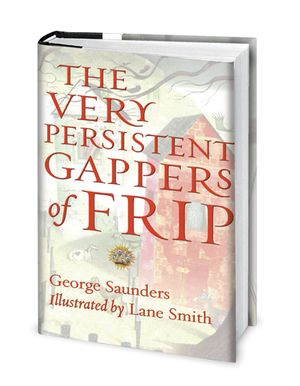
The Very Persistent Gappers of Frip, written by George Saunders and wonderfully illustrated by Lane Smith (whose It’s a Book I cannot recommend highly enough), is a fanciful and satirical tale that proves in the end to be an allegory of scarcity and slack—a perfect companion read to Ursula K. Le Guin’s allegory of privilege, “The One’s Who Walk Away from Omelas.”

The Very Persistent Gappers of Frip

Realizing that the Human Heart Is Capable

“Ever had a burr in your sock?” sets the story in motion—one sentence centered on the page over a giant question mark. It is an opening worthy of a child and all of us who cling to the wonder of childhood.

While Le Guin is often described as a science fiction writer, in her work I recognize the blurring of genres that joins science fiction, speculative fiction, and fantasy; it is that “other world” about which Le Guin and Margaret Atwood appear to argue, and it a stark but rich other world Saunders conjures and Lane pictures.

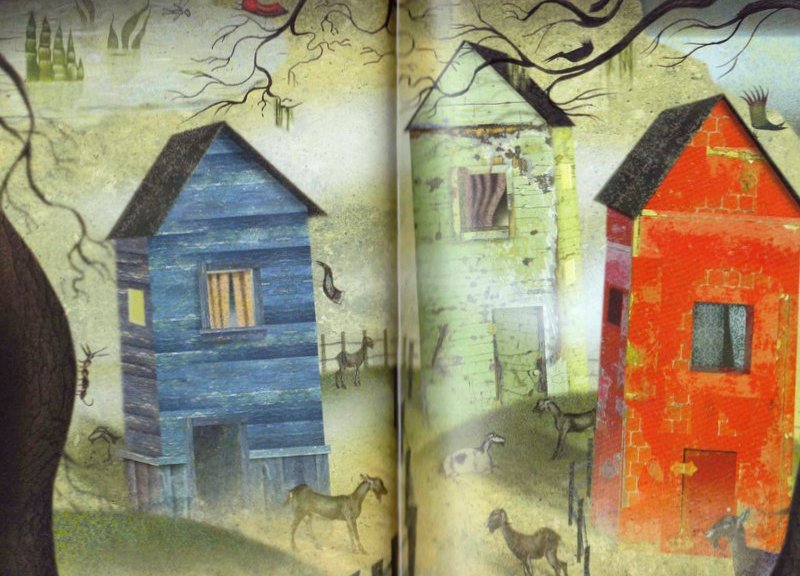
The story of Frip involves three houses for three families, all with children at the center. The houses are distinguished with primary colors—child-like blue, green, and red—but Lane’s artwork adds the ominous to Saunders’ seemingly simple narrative tinged with more than a bite of satire. The illustrations echo the haunting works about and for children found in Neil Gaiman and Tim Burton.

“Frip was three leaning shacks by the sea.” (p. 6) Artwork by Lane Smith

A child standing precariously close to the end of a slanted cliff over an angry ocean catches the eye on page 7 and then the crux of the story pulls you back to the text on page 6:

Frip was three leaning shacks by the sea. Frip was three tiny goat-yards into which eight times a day the children of the shacks would trudge with gapper-brushes and cloth gapper-sacks that tied at the top. After brushing the gappers off the goats, the children would walk to the cliff at the edge of town and empty their gapper-sacks into the sea. (p. 6)

Gappers, orange burr-like creatures with many eyes and the size of a baseball, come to represent throughout the story the power of the systemic inevitable: The presence of the gappers determines the lot of the families (and their goats), but most of the people in the tale remain unable to see beyond their own fixed and mostly misguided worldviews.

“A gapper’s like that, only bigger, about the size of a baseball, bright orange, with multiple eyes like the eyes of a potato.” (p. 2) Artwork by Lane Smith

When the gappers cling to the goats of all three families, there is an ironic appearance of equality among them. But when the fortune of one family shifts, the gappers fulfill their name by creating the gap:

So that night, instead of splitting into three groups, the gappers moved into one very large and impressive shrieking group directly into Capable’s yard. (p. 12)

Before this shift in how the gappers behave, of course, the three families are not equal because Capable is an only child living with her father and who has lost her mother. Capable works as all the children are expected to work (removing gappers in a daily Sisyphean nightmare of chores) and seeks to serve the needs of her grieving father, who along with his grief is a prisoner of nostalgia:

“I myself was once an exhausted child brushing off gappers. It was lovely! The best years of my life. The way they fell to the sea from our bags! And anyway, what would you do with your time if there were no gappers?” (p. 11)

This nostalgia masking an unnecessarily burdensome childhood, however, is but one ideology weighing on Capable because as soon as the other two families are relieved of gappers on their goats, those families reveal themselves to be very much like the people of Le Guin’s Omelas:

“It’s a miracle!” Mrs. Romo shouted next morning, when she came out and discovered that her yard was free of gappers. “This is wonderful! Capable, dear, you poor thing. The miracle didn’t happen to you, did it? I feel so sorry for you. God has been good to us, by taking our gappers away. Why? I can’t say. God knows what God is doing, I guess! I suppose we must somehow deserve it!” (p. 17)

Capable becomes the sacrificed child, and despite her misfortune, the relieved families read the events as their merit (and of course the ugly implication that Capable and her father deserve the burden of the gappers).

What follows from this shift in fate is the central story of Frip with Capable as our main character. The message becomes clear, and Saunders and Lane make the ride one you’ll want to visit again and again. If you are lucky, the book could become one of those read alouds requested by son or daughter, or by a classroom of children.

And while I will leave the rest of the story to you, I think it is necessary to note here that this allegory is both a cautionary tale about how we view children and childhood as well as a brilliant call to reconsider how we view education and education reform.

George Saunders’s Allegory of Scarcity and Slack

The U.S., like the characters (except for Capable) in Saunders’s story, is tragically blinded by a belief in cultural myths that have little basis in evidence: That we live and work in a meritocracy, that competition creates equity, that children need to be “taught a lesson” about the cold cruel world lest they become soft, and such.

As a result of these beliefs, schools often reflect and perpetuate rather harsh environments for children—or to be more accurate, schools often reflect and perpetuate rather harsh environments for other people’s children, as Capable personifies.

Here, then, I want to make the case that The Very Persistent Gappers of Frip is a powerful allegory of scarcity and slack as examined by Sendhil Mullainathan and Eldar Shafir in their Scarcity: Why Having Too Little Means So Much.

Mullainathan and Shafir detail that the conditions of poverty, scarcity, so overburden people psychologically, mentally, and physically that their behavior is often misread (poor people are lazy, poor people make bad decisions, etc.). In Saunders’s story, scarcity and its burden are portrayed by the gappers, and readers witness how the coincidence of the onslaught of the gappers changes the families involved. In other words, the behavior of people is determined by the environment, and not by the inherent goodness or deficiencies of any individual.

The Very Persistent Gappers of Frip goes further, however, by showing that one person’s scarcity (Capable) allows other person slack: privilege is built on the back of others, and those conditions are mostly arbitrary. While Mullainathan and Shafir argue that the slack enjoyed by those living in relative privilege provides the sort of cognitive space needed to excel, Saunders speaks to more than the slack enjoyed by the two families relieved of gappers and the compounding scarcity suffered by Capable (her lot in life and the addition of the gappers):

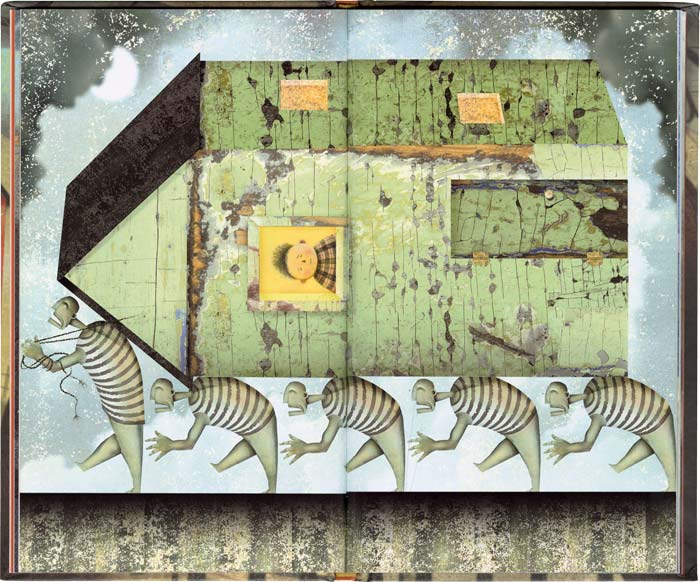
“And the men succeeded in lifting the house and moving it very very close to the third and final house in Frip, which belonged to Sid and Carol Ronsen, who stood in their yard with looks of dismay on their nearly identical frowning faces.” (p. 23) Artwork by Lane Smith
  • Capable represents a counter-narrative to claims that impoverished children lack “grit.” As her name suggests, this child is more than capable, but the world appears determined to defeat her.
  • Capable also embodies Lisa Delpit’s confrontation of “other people’s children”—that those with privilege (slack) are willing to allow one set of standards for other people’s children (often living and learning in scarcity), standards they will not tolerate for their own.

As I stated in the opening, allegory seeks to open our eyes by diversion, creating an other world that helps us see both the flaws with our now and the enduring failures of humans to embrace our basic humanity, a failure Capable teeters on the edge of making herself but cannot:

And [Capable] soon found that it was not all that much fun being the sort of person who eats a big dinner in a warm house while others shiver on their roofs in the dark.

That is, it was fun at first, but then got gradually less fun, until it was really no fun at all. (p. 70).

In the end, it is this sort of charity, this sort of recognition of the community of humanity, a call for the kindness found in Kurt Vonnegut’s similar mix of dark humor that Saunders appears to suggest we are all capable.

Companion Reads for The Very Persistent Gappers of Frip

Scarcity: Why Having Too Little Means So Much, Sendhil Mullainathan and Eldar Shafir

“The Ones Who Walk Away From Omelas,” Ursula K. Le Guin

“The Soul of Man under Socialism,” Oscar Wilde (1891)

“The Silenced Dialogue: Power and Pedagogy in Educating Other People’s Children,” Lisa Delpit

Other People’s Children: Cultural Conflict in the Classroom, Lisa Delpit

“NPR Whitewashes ‘Grit’ Narrative” 

Competition: A Multidisciplinary Analysis, Wade B. Worthen, A. Scott Henderson, Paul R. Rasmussen and T. Lloyd Benson, Eds.