
The stories themselves, literally, are powerful and engaging or George Orwell’s 1984 and Arthur Miller’s The Crucible would not have endured as they have as literature people read again and again—and possibly should read again and again.
However, ultimately, 1984 is not about the future (especially since we have long since passed the future Orwell may have envisioned), and The Crucible is not about the past (although Miller built his play on the very real and troubling history of Puritan witchcraft hysteria). These works are about the complicated present of both authors’ worlds as that speaks to the enduring realities of the human condition.
All of that may seem weighty stuff to step into a look at what appears to be a children’s book, but the paragraphs above should be more than a hint that looks can be deceiving—and enlightening.
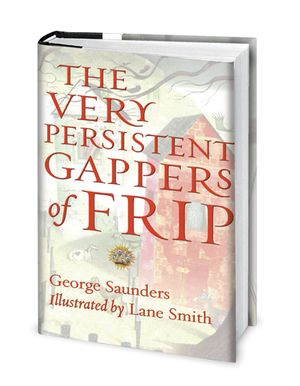
The Very Persistent Gappers of Frip, written by George Saunders and wonderfully illustrated by Lane Smith (whose It’s a Book I cannot recommend highly enough), is a fanciful and satirical tale that proves in the end to be an allegory of scarcity and slack—a perfect companion read to Ursula K. Le Guin’s allegory of privilege, “The One’s Who Walk Away from Omelas.”
Realizing that the Human Heart Is Capable
“Ever had a burr in your sock?” sets the story in motion—one sentence centered on the page over a giant question mark. It is an opening worthy of a child and all of us who cling to the wonder of childhood.
While Le Guin is often described as a science fiction writer, in her work I recognize the blurring of genres that joins science fiction, speculative fiction, and fantasy; it is that “other world” about which Le Guin and Margaret Atwood appear to argue, and it a stark but rich other world Saunders conjures and Lane pictures.
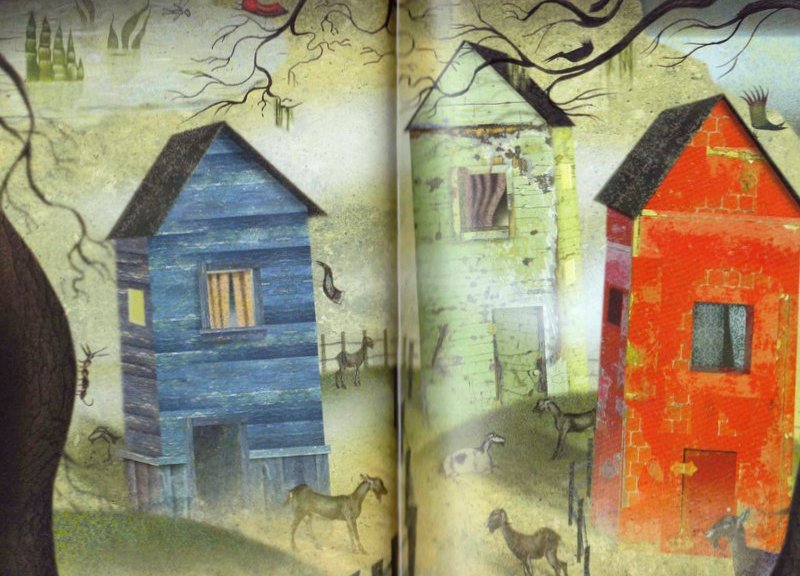
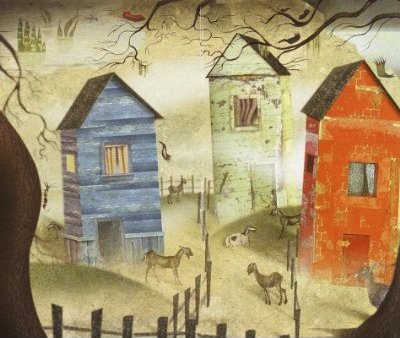
The story of Frip involves three houses for three families, all with children at the center. The houses are distinguished with primary colors—child-like blue, green, and red—but Lane’s artwork adds the ominous to Saunders’ seemingly simple narrative tinged with more than a bite of satire. The illustrations echo the haunting works about and for children found in Neil Gaiman and Tim Burton.
A child standing precariously close to the end of a slanted cliff over an angry ocean catches the eye on page 7 and then the crux of the story pulls you back to the text on page 6:
Frip was three leaning shacks by the sea. Frip was three tiny goat-yards into which eight times a day the children of the shacks would trudge with gapper-brushes and cloth gapper-sacks that tied at the top. After brushing the gappers off the goats, the children would walk to the cliff at the edge of town and empty their gapper-sacks into the sea. (p. 6)
Gappers, orange burr-like creatures with many eyes and the size of a baseball, come to represent throughout the story the power of the systemic inevitable: The presence of the gappers determines the lot of the families (and their goats), but most of the people in the tale remain unable to see beyond their own fixed and mostly misguided worldviews.

When the gappers cling to the goats of all three families, there is an ironic appearance of equality among them. But when the fortune of one family shifts, the gappers fulfill their name by creating the gap:
So that night, instead of splitting into three groups, the gappers moved into one very large and impressive shrieking group directly into Capable’s yard. (p. 12)
Before this shift in how the gappers behave, of course, the three families are not equal because Capable is an only child living with her father and who has lost her mother. Capable works as all the children are expected to work (removing gappers in a daily Sisyphean nightmare of chores) and seeks to serve the needs of her grieving father, who along with his grief is a prisoner of nostalgia:
“I myself was once an exhausted child brushing off gappers. It was lovely! The best years of my life. The way they fell to the sea from our bags! And anyway, what would you do with your time if there were no gappers?” (p. 11)
This nostalgia masking an unnecessarily burdensome childhood, however, is but one ideology weighing on Capable because as soon as the other two families are relieved of gappers on their goats, those families reveal themselves to be very much like the people of Le Guin’s Omelas:
“It’s a miracle!” Mrs. Romo shouted next morning, when she came out and discovered that her yard was free of gappers. “This is wonderful! Capable, dear, you poor thing. The miracle didn’t happen to you, did it? I feel so sorry for you. God has been good to us, by taking our gappers away. Why? I can’t say. God knows what God is doing, I guess! I suppose we must somehow deserve it!” (p. 17)
Capable becomes the sacrificed child, and despite her misfortune, the relieved families read the events as their merit (and of course the ugly implication that Capable and her father deserve the burden of the gappers).
What follows from this shift in fate is the central story of Frip with Capable as our main character. The message becomes clear, and Saunders and Lane make the ride one you’ll want to visit again and again. If you are lucky, the book could become one of those read alouds requested by son or daughter, or by a classroom of children.
And while I will leave the rest of the story to you, I think it is necessary to note here that this allegory is both a cautionary tale about how we view children and childhood as well as a brilliant call to reconsider how we view education and education reform.
George Saunders’s Allegory of Scarcity and Slack
The U.S., like the characters (except for Capable) in Saunders’s story, is tragically blinded by a belief in cultural myths that have little basis in evidence: That we live and work in a meritocracy, that competition creates equity, that children need to be “taught a lesson” about the cold cruel world lest they become soft, and such.
As a result of these beliefs, schools often reflect and perpetuate rather harsh environments for children—or to be more accurate, schools often reflect and perpetuate rather harsh environments for other people’s children, as Capable personifies.
Here, then, I want to make the case that The Very Persistent Gappers of Frip is a powerful allegory of scarcity and slack as examined by Sendhil Mullainathan and Eldar Shafir in their Scarcity: Why Having Too Little Means So Much.
Mullainathan and Shafir detail that the conditions of poverty, scarcity, so overburden people psychologically, mentally, and physically that their behavior is often misread (poor people are lazy, poor people make bad decisions, etc.). In Saunders’s story, scarcity and its burden are portrayed by the gappers, and readers witness how the coincidence of the onslaught of the gappers changes the families involved. In other words, the behavior of people is determined by the environment, and not by the inherent goodness or deficiencies of any individual.
The Very Persistent Gappers of Frip goes further, however, by showing that one person’s scarcity (Capable) allows other person slack: privilege is built on the back of others, and those conditions are mostly arbitrary. While Mullainathan and Shafir argue that the slack enjoyed by those living in relative privilege provides the sort of cognitive space needed to excel, Saunders speaks to more than the slack enjoyed by the two families relieved of gappers and the compounding scarcity suffered by Capable (her lot in life and the addition of the gappers):
- The families gifted slack remain trapped within the corrosive burden of competition and their inability to recognize the value of compassion and cooperation.
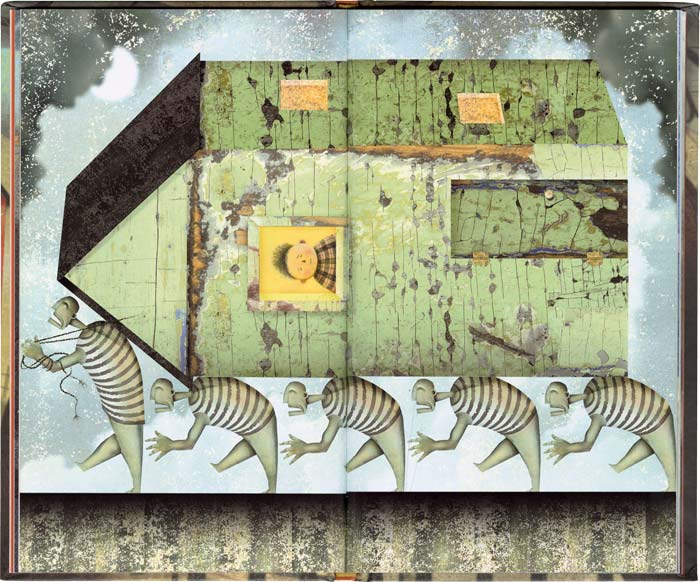
- Capable represents a counter-narrative to claims that impoverished children lack “grit.” As her name suggests, this child is more than capable, but the world appears determined to defeat her.
- Capable also embodies Lisa Delpit’s confrontation of “other people’s children”—that those with privilege (slack) are willing to allow one set of standards for other people’s children (often living and learning in scarcity), standards they will not tolerate for their own.
As I stated in the opening, allegory seeks to open our eyes by diversion, creating an other world that helps us see both the flaws with our now and the enduring failures of humans to embrace our basic humanity, a failure Capable teeters on the edge of making herself but cannot:
And [Capable] soon found that it was not all that much fun being the sort of person who eats a big dinner in a warm house while others shiver on their roofs in the dark.
That is, it was fun at first, but then got gradually less fun, until it was really no fun at all. (p. 70).
In the end, it is this sort of charity, this sort of recognition of the community of humanity, a call for the kindness found in Kurt Vonnegut’s similar mix of dark humor that Saunders appears to suggest we are all capable.
Companion Reads for The Very Persistent Gappers of Frip
Scarcity: Why Having Too Little Means So Much, Sendhil Mullainathan and Eldar Shafir
“The Ones Who Walk Away From Omelas,” Ursula K. Le Guin
“The Soul of Man under Socialism,” Oscar Wilde (1891)
“The Silenced Dialogue: Power and Pedagogy in Educating Other People’s Children,” Lisa Delpit
Other People’s Children: Cultural Conflict in the Classroom, Lisa Delpit
“NPR Whitewashes ‘Grit’ Narrative”
Competition: A Multidisciplinary Analysis, Wade B. Worthen, A. Scott Henderson, Paul R. Rasmussen and T. Lloyd Benson, Eds.
 dr. p.l. (paul) thomas