Category Archives: Critical Pedagogy

Media Manufactured Education Crisis? You Can Count on It

[Header Photo by American Jael on Unsplash]

This fall was the start to year 42 for me as an education, the first 18 as a high school English teacher and the rest as a college professor. I have been noting that career in my presentations at NCTE 2025 in Denver, adding that I am toying with at least making it to year 50.

As I ponder that number, I often return to the sense of awe I always feel when I mention my doctoral work, an educational biography of Lou LaBrant—a former NCTE president (1954) who lived to be 102 and taught for a staggering 65 years (1906-1971).

Approaching 100 and with declining eyesight, LaBrant typed her memoir for the head of the Museum of Education at the University of South Carolina and a key member of my doctoral committee, Craig Kridel.

I was thinking about LaBrant during my presentation yesterday, Recovering Our Reading Dream from a Long Crisis Nightmare, because in her memoir, LaBrant expressed her frustration with the back-to-basics movement during the Reagan administration that orchestrated the 80s education crisis with the melodramatic and misleading A Nation at Risk.

LaBrant noted that over eight decades as an educator she worked through several education crisis cycles and multiple back-to-basics movements—notably the 1940s reading crisis spurred by low literacy rates for draftees during WWII.

While my career pales in many ways compared to LaBrant’s, I feel her pain; with education crisis it is déjà vu all over again.

The only thing, it seems, as common as the media announcing yet another education crisis is people rejecting my arguments against education crisis rhetoric.

And right on cue, after my reading crisis presentation about Tomorrow’s Illiterates: The State of Reading Instruction Today (1961) where I mentioned that our colleagues in math education are now in the crisis crosshair, joining the hyper-intense reading crisis boiling over with “science of reading” advocacy, this morning, I saw this: Editorial: For too many American kids, math isn’t adding up.

The media obsession with declaring an education crisis is so commonplace that I started to just scroll on, but, regretfully, I began to read:

Math scores in the U.S. have been so bad for so long that teachers could be forgiven for trying anything to improve them. Unfortunately, many of the strategies they’re using could be making things worse. It’s a crisis decades in the making.

In the early 20th century, education reformers including John Dewey and William Heard Kilpatrick developed a theory – drawing from the work of Jean-Jacques Rousseau – that came to be known as constructivism. The idea was that learning happens best when students immerse themselves in a problem and find their own solution. By the late 1980s, math standards had embraced “discovery-based learning.”

I expected the lazy and unsupported “math scores” opening, but that second paragraph is the stunner. In 2025, the media still looks for a way to blame John Dewey for the education crisis they repeatedly manufacture.

It was at the core of the reading crisis in the 1940s, and again, in Tomorrow’s Illiterates (1961) noted above

Also in my presentation yesterday, I uttered Dewey’s name and suggested the attendees track down Alfie Kohn’s Progressive Education: Why It’s Hard to Beat, But Also Hard to Find, which does an excellent job of detailing how Dewey’s progressive education is simultaneously blamed and almost never implemented in formal schooling [1].

I immediately posted on social media that the editorial writers could have just search on Wikipedia and avoided the utter nonsense they wrote about constructivism.

Just a few weeks ago, as well, I covered in my 100-level educational philosophy course that behaviorism and constructivism are educational theories (grounded in the scientific method), distinct from philosophies (grounded in rhetoric and logic, such as Dewey’s progressivism).

Learning theories like educational philosophies are contested spaces, but as I plan to share tomorrow in a roundtable presentation, this math crisis editorial triggers several red flags, notably opening the commentary by exposing the editors lack the basic expertise on education to be making any claim of crisis.

If they wanted to blame constructivism, they could have and should have invoked Piaget and Vigotsky (and plenty of “science of learning” folk have already been doing that, often badly and with the sort of caricature I expect).

The media’s education crisis narrative, however, follows a script you can count on—including misunderstanding or misrepresenting test scores, ignoring social context for educational outcomes, and blaming some cartoon version of a leftist education system that, again, has never existed in the US.

When I mentioned Dewey in my presentation, I joked that almost nobody understood Dewey, including Dewey, which, I think, is a pretty good joke because Dewey (and LaBrant) represented a sort of beautiful and illusive scientific approach to their philosophy of education and their instructional practices.

You see, when Dewey progressives say “scientific,” they mean an organic type of experimentation whereby the educator is always in the process of experimenting and drawing real world conclusions that are evolving (it is better, in fact, to think of Dewey’s ideology as pragmatism, associated with William James).

Theirs is a science of teaching and learning that is grounded in and starts with each individual student in the pursuit of skills, knowledge, and critical awareness. This is distinct from essentialist and perrenialist beliefs that begin with knowledge, basic skills, and Great Books, for example.
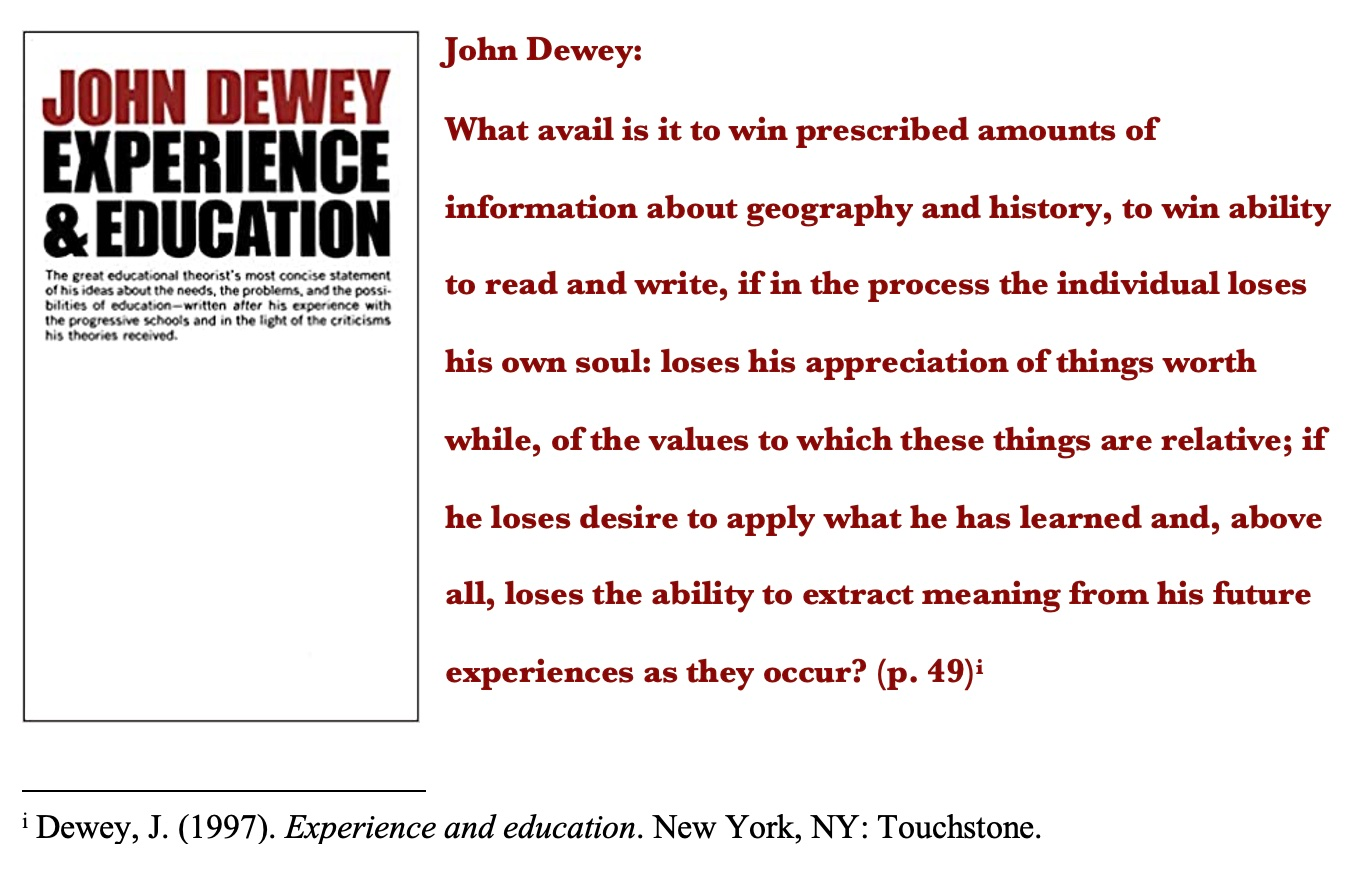
Teaching as an experiment only matters in the practical, not any Platonic ideal, and thus, is never settled (one red flag is when anyone makes a claim and bases that on settled science [2]).

A key reason blaming Dewey or progressive education for any education crisis is misguided is that Dewey himself refused to offer prescriptions, calling for every school and every teacher to seek what works best in the evidence before them, the unique set of students who always change.

In short, in teaching and learning, there is no silver bullet, no script, no program that can or will serve the needs of all students.

You can, if you must, insert any content area—math, reading, writing, civics, science, etc.—and shout “Crisis!” But you will be embarrassing yourself.

Just do a little searching, and I dare you to find a single moment over the past century when someone declared that “kids today” are excelling in math, reading, etc.

My point, which is often as misunderstood as Dewey, is not that current teaching and learning are fine, that I am somehow endorsing the status quo.

I am a critical educator; I became an educator to change teaching and learning, and I am disappointed to say that over my 5-decades career, very little has changed, including the popular urge to declare education crisis.

And what remains most disturbingly unchanged is that a vulnerable population of students have always been and continue to be under-served or nearly completely ignored.

But my point also includes that education reform alone (while needed, just not the mainstream way most often tried over and over) will never serve those vulnerable students, whose measurable education outcomes mostly reflect the inequity of their full lives of which the school day is only a fraction:

Almost 63% of the variance in test performance was explained by social capital family income variables that influence the development of background knowledge. Background knowledge is a known predictor of standardized test results. Family income variables are immutable by schools. Only public policies, outside the control of school personnel, can influence family income.

There is some math the education crisis folk never want to calculate.

If you find yourself worrying about your child’s ability to read or do math, I promise you that Dewey is not to blame.

If you find yourself worrying about other people’s children’s ability to read or do math, I promise you that Dewey is not to blame.

Crisis rhetoric, however, doesn’t help; it never has.

Finger pointing and blame probably aren’t very useful either, especially when those pointing fingers go out of their way to show their blame doesn’t quite add up.

In formal education, we have always had and will always have a range of students who excel, struggle, and fail.

As teachers, our job is to serve them all, and serve them better based on who they are and what they need.

However, teachers and schools alone can never be successful.

If evidence of student failure means anything (and those test scores often don’t), it is that we as a democracy are failing not only those students, but also those children, teens, and young adults—many of whom do not have adequate healthcare, food or home security, or the sorts of lives that universal public education, the so-called Founding Fathers, and, yes, John Dewey envisioned that a free people could guarantee.

If you are looking for someone to blame because of those disappointing math scores, well, I hate to tell you that the enemy is us.


[1] I highly recommend also: LaBrant, L. (1931, March). Masquerading. The English Journal, 20(3), 244-246. http://www.jstor.org/stable/803664. Here LaBrant rejects the misunderstood and misapplied project method in the teaching of literature:

The cause for my wrath is not new or single. It is of slow growth and has many characteristics. It is known to many as a variation of the project method; to me, as the soap performance. With the project, neatly defined by theorizing educators as “a purposeful activity carried to a successful conclusion,” I know better than to be at war. With what passes for purposeful activity and is unfortunately carried to a conclusion because it will kill time, I have much to complain. To be, for a moment, coherent: I am disturbed by the practice, much more common than our publications would indicate, of using the carving of little toy boats and castles, the dressing of quaint dolls, the pasting of advertising pictures, and the manipulation of clay and soap as the teaching of English literature. (p. 245)

[2] For example, the math crisis editorial announces authoritatively and with no links to proof:

Unfortunately, a robust body of research has since found that such approaches often fail early math learners (and readers, for that matter). Math rules and facts such as multiplication tables must be taught explicitly, memorized and mastered through practice. Only when this foundation is established can students progress to more complex concepts. Math, it’s often said, is cumulative.


Recommended

Beyond Caricatures: On Dewey, Freire, and Direct Instruction (Again)

Caricature, Faddism, and the Failure of “My Instruction Can Beat Up Your Instruction”

Deja Vu All Over Again: The Never Ending Pursuit of “Scientific” Instruction
Reading Matters

Republicans Seek IndoctriNation

[Header Photo by Markus Spiske on Unsplash]

Books, ideas, and knowledge are not inherently dangerous.

Political control of education, books, ideas, and knowledge, however, is likely the end of individual freedom as we know it, and which we claim to embrace.

Republicans have now fully committed to banning books, censorship, and mandating what can and cannot be taught in all levels of formal education.

Ironically, there are some dangerous books for Republicans: George Orwell’s 1984, Ray Bradbury’s Fahrenheit 451, and Margaret Atwood’s The Handmaid’s Tale.

These are cautionary tales about totalitarian governments, book banning and censorship, and theocracies. Yet, Republicans have apparently misread them as how-to manuals.

It is also important to recognize that Republicans have sought to control the teaching of history since banning novels is merely attacking imagined worlds.

Again, Republicans appear to have completely misunderstood what history is, why history is taught, and something that has now become nearly cliche to express: Those who ignore history are doomed to repeat it.

Consider the language and justification for book bans and burnings here:

At the meeting places, students threw the pillaged and “unwanted” books onto bonfires with great ceremony, band-playing, and so-called “fire oaths.” In Berlin, some 40,000 persons gathered in the Opernplatz to hear Joseph Goebbels deliver a fiery address: “No to decadence and moral corruption!” Goebbels enjoined the crowd. “Yes to decency and morality in family and state! I consign to the flames the writings of Heinrich Mann, Ernst Gläser, Erich Kästner.”

Holocaust Encyclopedia

If we sanitize the past—as Republicans demand in the name of objectivity—we find ourselves banning books and ideas in the name of protecting children and “morality.”

If we pay attention to Orwell, for example, we recognize that the Nazi’s were using “decency and morality” as a cover for totalitarian aims.

And then, when Republicans claim to be against politicizing education and indoctrination, we must recognize they are actually politicizing education and seeking indoctrination:

Most of us, especially on the left, completely agree with a sincere charge that “a university should not involve political indoctrination,” and therefore, we would be forced to point out that Florida and other Republican-led states are rushing to create exactly that—universities that are nationalistic and Christian-based political indoctrination.

It would behoove Republicans (most of whom have university degrees and ironically disprove their own claims that colleges brainwash students into being “woke” zombies) to sit in on any of my courses.

Republicans have a really hard time with words and concepts, especially the ones they are most angry about; they routinely cannot define the concepts they seek to control and ban—”CRT,” “woke,” and even “free.”

You see, education is not indoctrination because education is mostly about how to navigate knowledge, discourse, and the world—not about endorsing or embracing any predetermined set of ideas or ideologies.

For example, consider if a student expresses the two following brief claims:

“I do not believe in evolution because I do not think humans came from monkeys.”

“I believe God created humans because of my Christian faith.”

In an education setting (putting aside concerns for what the course may be), what would be appropriate responses to these claims by the teacher?

The first should be challenged—not because the student rejects evolution but because the claim is sloppy (scientific theory is not something to “believe” or not) and it makes an implication that incorrectly defines evolution (evolution is a theory, thus proven with evidence, that never claims humans “came from monkeys”).

Therefore, that first claim fails to fully and correctly define terms in order to make evidence-based claims, which has nothing to do with whether or not the student personally accepts evolution as a concept.

The second claim, of course depending on whether or not it is relevant to the course objectives, is completely solid, making no false implications and drawing a reasonable conclusion. Again, the credibility of that second claim has nothing to do with what the teacher believes (or not) and certainly isn’t in any way related to wanting a student to believe or not in any supreme being.

Rhetorically and logically the second statement is far more valid in an education setting than the first. The ideologies of the student and teacher are, therefore, irrelevant to how these fit into the student being educated (and not indoctrinated).

More complicated is whether these claims are relevant in specific fields of knowledge such as biology and religion; students well educated learn that field-based claims are not necessarily in conflict but based on different ways of thinking and knowing.

The first may be better suited for biology, and the second, for religion, but as the liberal arts embraces, these both may be better examined in a full range of disciplines and ideologies that understand science and religion as complimentary, not adversarial.

Faith-based people can understand evolution, of course, but those different ways of knowing may create tension in a person’s journey to understanding the world as a free person.

Education often involves and even requires discomfort, something Republicans seek to eliminate as part of their indoctrination package.

The problem facing the US, of course, is that Republicans cannot fathom a place where the human mind is trusted, where education is the goal and indoctrination is genuinely rejected.

Republicans can only envision people with power indoctrinating those over whom they have power so they are seeking complete control of education-as-indoctrination.

As I have noted often, those of us on the left were likely compelled to that ideological viewpoint because critical pedagogy (grounded in Marxism) is antithetical to indoctrination. As my all-too-brief mentor Joe Kincheloe explains, “Critical pedagogy wants to know who’s indoctrinating whom.”

I have been teaching across five decades, and I have never demanded that a student accept or endorse any ideologies or concepts. I have repeatedly offered challenges to students’ assumptions and worldviews in order for them to fully understand and live with whatever they choose to believe and accept.

Can students fully and accurately define the concepts and words they use? Can students make claims and draw conclusions baed on credible evidence or logic?

That’s it.

Nothing more nefarious or sinister than that.

Like Emerson and Thoreau, I believe in and trust the human mind when it is free of indoctrination, fear, and coercion.

I believe in the possibility of humans who have critically challenged themselves and the assumptions of their families, their communities, and their countries.

I believe in the beauty and power of the human imagination—often found in books, art, and all sorts of creations that bring us to tears, laughter, doubt, wonder, and a whole host of emotions that make us fully human.

And I know deep into my bones that “only cowards ban books” and ideas because cowards are seeking ways to hold onto their power or control over any and everyone else.

There can be no human dignity or freedom without a free mind, and a free mind deserves an education that is grounded in academic freedom and open access to all the possibilities found in books and lessons that cannot be mandated by or restricted by mere government (political) mandate.

Small-minded Republicans are the sort of cowards Orwell, Bradbury, and Atwell—among millions of others—have warned us about.

Cowards and bully politics are seeking an IndoctriNation that a free people must not allow.


Update

Rightwing ‘PragerU’ content is now available through SC education department portal

Paulo Freire: “Reading the world always precedes reading the word, and reading the word implies continually reading the world.”

[Header Photo by Greg Rosenke on Unsplash]

While Paulo Freire is strongly associated with critical pedagogy, I often remind myself that Freire came to his philosophy of teaching and learning through his commitment to teaching adults to read and write.

The U.S. finds itself repeatedly in a state of crisis-paralysis because people periodically discover illiteracy and aliteracy among our students and even adults.

The irony of the nearly nonstop and melodramatic cries of “reading crisis” is that the need for literacy always remains vital for human autonomy, human dignity, and human freedom, but the crisis approach always fails that need.

The problem is that public fears around illiteracy and aliteracy are often overly simplistic, and then calls for solving the “reading crisis” are equally simplistic.

The current Reading War driven by the “science of reading” movement is once again repeating that failed dynamic, notably by claiming that the simple view of reading (SVR) is the current and settled reading science (it isn’t; see here).

And concurrent with this Reading War is a dramatic rise in censorship and book banning—yet another layer of misunderstanding reading and teaching/learning.

Since we seem destined to remain stuck in misreading reading, I want to share Freire’s The Importance of the Act of Reading as an ideal text to reconsider what reading is and why literacy is central to the human condition.

First and vital to understanding literacy, Freire begins by asserting “the practice of teaching—which is political practice as well.”

In other words, teaching reading and any reading done by students (or anyone) are inherently political acts—behaviors that necessarily place humans in situations of power imbalances.

Freire’s meditation on reading was originally presented as a talk in Brazil in 1981. Then, Freire challenged the mechanical and reductive view of reading:

Reading is not exhausted merely by decoding the written word or written language, but rather anticipated by and extending into knowledge of the world. Reading the world precedes reading the word, and the subsequent reading of the word cannot dispense with continually reading the world. Language and reality are dynamically intertwined. The understanding attained by critical reading of a text implies perceiving the relationship between text and context.

The Importance of the Act of Reading, Paulo Freire

One side of the reading debate often focuses on isolated text-only approaches that argue for phonics-first and/or systematic phonics instruction for all before addressing comprehension (or critical comprehension, which is often only approached for some students deemed “advanced”).

Freire, however, grounds reading in the context of reading the world before beginning to decode text for meaning.

In short, context matters, and lived experiences form the basis of anyone acquiring reading and writing. This is key to understanding the problem with focusing exclusively or primarily on in-school reading and writing instruction.

If we in the U.S. value reading for all students and adults, we must acknowledge that addressing the lived experiences of all people—eliminating poverty, food insecurity, job insecurity, etc.—is an essential aspect of needed reading policy.

Simply changing how we teach reading will never achieve the goals we claim to have.

And in this talk, Freire used his own experiences to think aloud and complexly about reading:

I put objective distance between myself and the different moments in which the act of reading occurred in my existential experience: first, reading the world, the tiny world in which I moved; afterwards, reading the word, not always the word-world in the course of my schooling.

The Importance of the Act of Reading, Paulo Freire

Yes, young students must make the transition from reading their world to reading the word, but those acts of reading cannot (and should not) be separated (think of the reductive practice of having students pronounce nonsense words).

Freire speaks not only to acquiring reading, but also to why we read—and this is a powerful refuting of the rise in censorship and book bans being imposed by some parents onto all parents and students:

As I became familiar with my world, however, as I perceived and understood it better by reading it, my terrors diminished.

It is important to add that reading my world, always basic to me, did not make me grow up prematurely, a rationalist in boy’s clothing. Exercising my boy’s curiosity did not distort it, nor did understanding my world cause me to scorn the enchanting mystery of that world. In this I was aided rather than discouraged by my parents.

It was precisely my parents who introduced me to reading the word at a certain moment in this rich experience of understanding my immediate world.

The Importance of the Act of Reading, Paulo Freire

Like Freire, my journey to literacy was enthusiastically driven by my parents and their commitment to me having free access to essentially anything I wanted to read. And like Freire, I had that freedom significantly reinforced by teachers when I was in high school:

I would like to go back to a time when I was a secondary-school student. There I gained experience in the critical interpretation of texts I read in class with the Portuguese teacher’s help, which I remember to this day. Those moments did not consist of mere exercises, aimed at our simply becoming aware of the existence of the page in front of us, to be scanned, mechanically and monotonously spelled out, instead of truly read. Those moments were not reading lessons in the traditional sense, but rather moments in which texts were offered to our restless searching, including that of the young teacher, Jose Pessoa.

The Importance of the Act of Reading, Paulo Freire

Reading and all literacy as well as formal and informal education are human ways of coming to understand the world—including the dark and light—so that we gain agency in our living, so that we are not paralyzed by fear and ignorance.

The why and how of reading, then, are not mere mechanics, but a complex process of critical comprehension:

Mechanically memorizing the description of an object does not constitute knowing the object. That is why reading a text taken as pure description of an object (like a syntactical rule), and undertaken to memorize the description, is neither real reading, nor does it result in knowledge of the object to which the text refers.

The Importance of the Act of Reading, Paulo Freire

And regardless of the simplistic calls by Republicans and conservatives to “just teach” and to not be political, we must recognize that all teaching, learning, and literacy are political acts. As he did throughout his career, Freire denounced the banking concept of teaching that erases human agency and views students as empty piggy banks into which teachers deposit value:

First, I would like to reaffirm that I always saw teaching adults to read and write as a political act, an act of knowledge, and therefore as a creative act. I would find it impossible to be engaged in a work of mechanically memorizing vowel sounds, like in the exercises ba-be-bi-bo-bu, la-le-li-lo-lu. Nor could I reduce learning to read and write merely to learning words, syllables, or letters, a process of teaching in which the teacher fills the supposedly empty heads of the learners with his or her words. On the contrary, the student is the subject of the process of learning to read and write as an act of knowing and a creative act. The fact that he or she needs the teacher’s help, as in the pedagogical situation, does not mean that the teacher’s help annuls the student’s creativity and responsibility for constructing his or her own written language and reading this language.

The Importance of the Act of Reading, Paulo Freire

Freire builds to this: “Reading the world always precedes reading the word, and reading the word implies continually reading the world.”

Reading is not simply decoding text or recognizing whole words. Reading is context, and reading requires context—a context that is far more than letters, sounds, words, sentences, and paragraphs.

Reading is a very human and individual act because “reading always involves critical perception, interpretation, and re-wrìting what is read,” which is how Freire wrote his talk before sharing it aloud as yet another act of re-reading in order to re-write.


Freire’s essay anchors this award-winning volume: The SAGE handbook of critical pedagogies.

IndoctriNation: Can We Avoid Our Dystopian Republican Future?

“I guess irony can be pretty ironic sometimes,” Commander Buck Murdock (William Shatner) muses in Airplane 2: The Sequel.

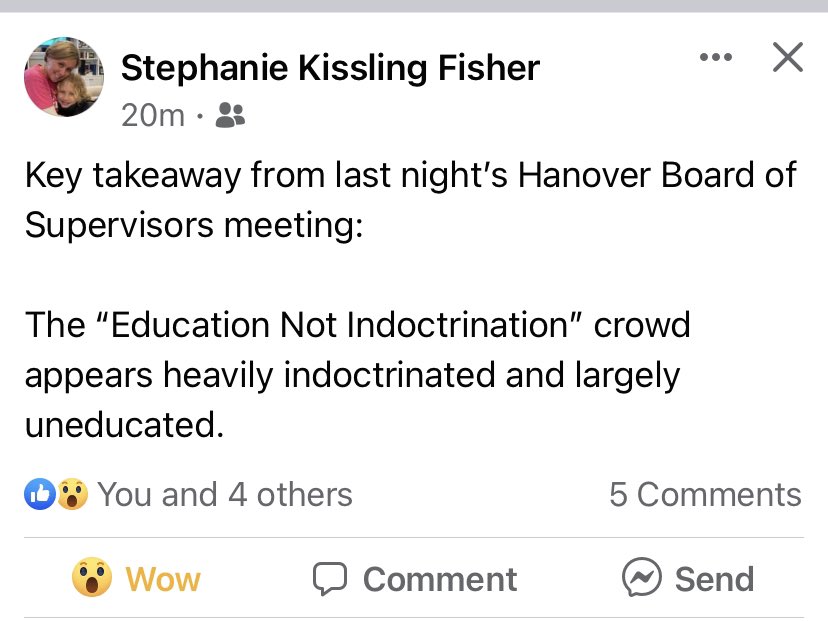
I immediately thought of this iconic Shatner scene from the Jerry Zucker-Jim Abrahams-David Zucker film when I saw a brilliant and urgently serious post on Facebook from a former student of mine currently advocating for all that is Good and Right in her crumbling state of Virginia:

While Stephanie hits succinctly right at the heart of the irony surrounding the current push by Republicans to mandate educational gag orders, parental trigger bills, and a wide range of censorship for not only school and colleges but also throughout society, I want to highlight how the irony is a veneer for the Republican long game.

Many people have now exposed that the Republican use of “Critical Race Theory” is an orchestrated lie for larger political goals since their definitions of CRT are distortions and misinformation.

But what exactly is that end game?

First, let’s unpack the monumental irony in the “Education Not Indoctrination” claims of Republicans.

A related element of the anti-CRT movement is linking CRT to “Marxism” (itself a distortion bordering on a lie), but the more telling aspect of that connection is that Marxist and critical educators forefront a genuine and resolute rejection of indoctrination. As Joe Kincheloe details, seeking out and exposing those who indoctrinate is a “central tenet” of being critical:

Thus, proponents of critical pedagogy understand that every dimension of schooling and every form of educational practice are politically contested spaces. Shaped by history and challenged by a wide range of interest groups, educational practice is a fuzzy concept as it takes place in numerous settings, is shaped by a plethora of often-invisible forces, and can operate even in the name of democracy and justice to be totalitarian and oppressive….

Recognition of these educational politics suggests that teachers take a position and make it understandable to their students. They do not, however, have the right to impose these positions on their students. This is a central tenet of critical pedagogy.

In this context it is not the advocates of critical pedagogy who are most often guilty of impositional teaching but many of the mainstream critics themselves. When mainstream opponents of critical pedagogy promote the notion that all language and political behavior that oppose the dominant ideology are forms of indoctrination, they forget how experience is shaped by unequal forms of power. To refuse to name the forces that produce human suffering and exploitation is to take a position that supports oppression and powers that perpetuate it. The argument that any position opposing the actions of dominant power wielders is problematic. It is tantamount to saying that one who admits her oppositional political sentiments and makes them known to students is guilty of indoctrination, while one who hides her consent to dominant power and the status quo it has produced from her students is operating in an objective and neutral manner. Critical pedagogy wants to know who’s indoctrinating whom. (pp. 2, 11)

JOE KINCHELOE, CRITICAL PEDAGOGY PRIMER

Therefore, if an educator is leftist, Marxist, or critical, they are dedicated to not only seeking out and contesting anyone who indoctrinates, but also working continuously to avoid allowing their own teaching to devolve into indoctrination.

To indoctrinate is to be authoritarian (see Paulo Freire’s distinction between “authoritarian” and “authoritative” in the context of critical pedagogy).

Along with the foundational strategy of using lies and mischaracterized terms to advance a political agenda, Republicans also are guilty of projection: Almost everything Republicans attribute to the “Left” is what they actually do (Republicans decry a false specter of “cancel culture” while actually passing legislation that censors, cancels, and bans materials and ideas) or what they would do given the opportunity and the power.

And that leads to the end game.

To understand the Republican end game, you must address that “Education Not Indoctrination” is yet another Orwellian misdirection. Republicans are not anti-indoctrination; in fact, Republicans are actually seeking a world in which they completely control the indoctrinating.

In short, Kincheloe’s “who’s indoctrinating whom” can be addressed simply by acknowledging that given the opportunity and power (see legislation in Republican-led states) the “who” will always be Republicans and the “whom” will be the rest of us.

Republicans are organizing and enacting a broad campaign to create their dystopia, IndoctriNation.

They are counting on a common flaw in the U.S.: “The best lack all conviction, while the worst/Are full of passionate intensity” (“The Second Coming,” William Butler Yeats).

Privilege as a Barrier to Learning

I am deeply skeptical about two things—criticism of “young people today” as if this younger generation is somehow significantly less capable than older generations and student evaluations of teaching (SETs).

So nothing would be worse, in my opinion, than launching into a “young people today” screed based on SETs. Therefore, what follows is intended as an evidence-based observation toward understanding, not a criticism, grounded in both recent SETs and my 20 years teaching at a selective liberal arts university (after teaching 18 years at a rural high school).

My almost four decades of teaching have been in two contexts with significant social class differences. My high school students were mostly working class and poor; my university students are quite privileged in terms of social class but also in terms of the quality of education they received before entering high education (many are from private school backgrounds).

Across both populations, I often am perceived (at first) as extremely demanding, and even harsh (or “mean”).

My high school students, many working class as I was (and I also attended the school where I taught), within a few weeks tended to flip in their opinion of my courses and even me. Many years later, I have very warm relationships with many of those students; and even those who still openly express that they aren’t fans of me as a person confirm that they appreciate the work I did as a teacher.

Achieving that level of connection and warmth with my university students has been rare to mostly absent. My university students, overwhelmingly privileged in many ways, are quite unlike me, having grown up working class and receiving my BA, MEd, and EdD from state universities.

I just reviewed my fall 2021 SETs, and despite efforts to address the negativity (and even antagonism) in my spring 2021 SETs, I once again read a significant amount of negative, angry, and harsh responses to my courses.

A few things are going on, I think. First, I believe the Covid-era has in many ways inflated student stress, which is reflected in the increase of negative comments (a point I am making not to criticize students, but to acknowledge the larger forces at work and how SET data are rarely about teacher quality).

Second, while I reject the credibility and validity of SETs (as reflected in research on the practice), I do think the data say less about teacher quality and more about the students themselves.

Now, putting those two points together allows me to draw some important conclusions about privilege as a barrier to learning.

Before I explore that thought, let me offer a few caveats.

Socioeconomic status is the strongest correlation to measurable student achievement; therefore, wealthy and white students disproportionately are labeled as “good” or “excellent” students.

However, if you dig deeper in that data, you discover that eduction is not the “great equalizer” but a marker for privilege; privilege itself actually trumps having more and so-called better education (extensive research supports that claim); for one example, see the following data:

People born into socioeconomic and/or race privilege tend to navigate and achieve advanced education degrees, but the privilege itself is the primary driver of their “success” (attaining high-paying jobs), not the education.

My university students often have backgrounds in selective private schools, and almost all of them have completed high school as top students (many having made As throughout their schooling).

When I examine the types of things students are critical of and even angry about, I am increasingly concerned that privilege is a barrier to learning even as these students successfully navigate college and continue to earn high grades.

Here are the types of things privileged students are critical of in my courses recently (again, I am not criticizing these students but offering this as a way to describe and understand why they are struggling):

  • Privileged students are disproportionately offended by feedback and requirements for revision*. Living in privilege that contributes to years of praise and success have created students who are very thin-skinned and frail. As I have examined before, many students perceive all feedback as negative. Many of these students want to submit work once and have it immediately praised, and assigned an A. Being show ways to revise and improve, being asked to revise—these approaches trigger students of privilege.
  • Privileged students have a “banking” concept of teaching and learning (that Paulo Freire criticized). In other words, my privileged students view my job as dispensing for them knowledge as capital; I, however, reject the “banking” concept of teaching and see the role of teacher as facilitator. Privileged students tend to resist having their autonomy as learners increased, viewing a teacher-as-facilitator as negligent or even lazy (not doing their job).
  • Privileged students are very skeptical of and often paralyzed by de-grading practices. Grades for privileged students have been positive experiences that confirm their belief that they are “good” students who have earned those grades. People in privilege often interpret success as mostly a reflection of their effort—and not their privilege. Removing grades removes their safety blanket. (One student from last fall claimed they were reduced to crying often in my course due to my non-grading practices.)
  • Privileged students prefer knowledge-based courses to process-and-product-based courses. Although certainly not exclusively so, privileged students seem to view knowledge as “objective” and process/product as “subjective”; therefore, the latter creates anxiety in them that they will not be successful (not make an A).
  • Privileged students perceive “being smart” as something you achieve and not a journey. Since they have often been told they are smart, they can misinterpret “smart” as their being “finished”; being challenged to learn more or, especially, to re-think their learning is perceived as an attack on their Selves.
  • Privileged students are hyper-sensitive to decorum, formality, and tone. While I recognize some of this point is grounded in my personality, I am increasingly aware that some of the tone tension between my students and me is class-based. I despise formality and do my work at a very high level of efficiency; my emails and my written feedback are terse and direct. Privileged students tend to interpret that style as mean, harsh, and discouraging. This issue with tone overlaps, I think, with my efforts to shift responsibility away from me doing work for students and toward students taking agency over their own learning (many students dislike my use of highlighting when I return written work, for example). As one of the most unexpected examples from my fall SETs, a student recommended I start using “Hi” to start my emails.
  • Privileged students cling desperately to playing school and performing as students. Tests, grades, assignment rubrics and grade scales/weights, lectures, etc., are the environment where they have flourished; anything that deviates from these traditional practices creates anxiety—and skepticism about the teacher.
  • Privileged students (like their conservative parents) fear radical ideas and change. This is basic human nature; when the world works for you, you fear change to that system. I am a critical educator and scholar so my approach to ideas and the world are perceived as not just radical, but threatening to their way of life.

In the grand scheme of my career as a teacher, I realize the folly in SETs because, once again, my fall SETs included dramatically contradictory responses side-by-side—praise for my feedback and willingness to help students learn followed by claims that my feedback is “vague” and “mean,” ultimately discouraging the student to learn.

Again, the feedback says far more about the students than my work as a teacher.

None the less, I believe I have turned a corner in my understanding of the complex nature of privilege in the teaching/learning dynamic.

Yes, on balance, of course, privilege is an incredible advantage, but like being labeled gifted, privilege can also be a barrier to learning—and being happy.


*

The Eternal Darkness of the Empty Mind

My childhood and adolescence were a paradox.

I was born in Woodruff, South Carolina, and spent some of my childhood in nearby Enoree. Both were very small (Enoree was essentially a cross roads, not far from even smaller Cross Anchor); both were mill towns that had not quite begun to crumble in the 1960s and 1970s.

Woodruff seems like parody now, an ugly parody since the town had literal racial divisions with the Black neighborhood, Pine Ridge, on the other side of the railroad tracks dividing the town.

Racism and a bitter fundamentalism were the norm among white people, although most of these cancers remained unspoken and carefully navigated.

What I heard and witnessed in white-only spaces, including my home, contrasted disturbingly with what I heard and witnessed in mixed-race spaces—notably the vibrant high school sports arenas that much of my hometown worshipped. Yes, my hometown was a high school Friday night football sort of world that, again, almost seems like parody now.

Tradition and authority governed schooling and parenting. Conservative ideology was so pervasive there was little to no evidence any other way of thinking was possible.

There was a bitterness and fatalism among white people, among my family members, that I am deeply aware of now. I see it in the far-right Trump movement, reminding me of my parents railing against Muhammad Ali and blaming Dan Rather for the fall of Richard Nixon.

A darkness of empty minds. Irrational and certain.

By some inexplicable twist of fate, the paradox, I found myself in a series of events that allowed me to rise above that emptiness, allowed me the freedom of the human mind that quite literally saved my life.

I wasn’t quite bookish as a child, but I grew up surrounded by books and reading; my mother was a very bright woman with sparse formal education, a natural teacher with a tendency toward nurturing and mothering (she spent a good bit of her life running an in-home daycare and raised my sister’s three sons).

The secular miracle of my life was that for some odd reason my parents never censored my world, especially my intellectual life. By the time I was a teenager, I had graduated from relentlessly watching science fiction B-movies with my mother to reading covertly hundreds of comic books and novels by Arthur C. Clarke, Larry Niven and Jerry Purnell, and other science fiction not assigned in school (and there were several assigned novels in school I simply did not read, like Charles Dickens, even though I fell in love with Thomas Wolfe’s You Can’t Go Home Again, which I read in a literal fever while home sick).

In tenth grade, the miracle of miracles, I entered Lynn Harrill’s English class. Lynn was a fairly new teacher, a kind and passionate educator who eventually became a mentor and the primary impetus for my life as a teacher, scholar, and writer.

Lynn was perceptive, and bold. I spent many days hanging out in Lynn’s room when I wasn’t in class (a kindness I learned and mimicked when I became a teacher, the first years in the exact room where Lynn taught me).

His perception was recognizing my proclivities and how traditional schooling wasn’t serving me fully. His boldness was whispering to me one day when I was taking up his valuable time that I should read D.H. Lawrence (he added that since he knew my parents the recommendation would be fine but Lawrence was a controversial writer).

Lynn was right about the recommendation and my parents.

By high school, in fact, my mother patiently wrote checks each month for my subscription to a few comic books and Playboy, delivered to my home as if this sort of thing was completely normal in 1970s SC.

Of course, as a teen, Playboy and Lawrence spoke to my sexual curiosity of adolescence, but that was a very small fraction of my intellectual life that they both spurred. I recall to this day several interviews I read in Playboy by thoughtful people dramatically unlike the adults of my hometown.

Lawrence became my first literary crush (Clark as well as Niven and Purnell was my first nerd-reading crush). Over the next few years, I read everything by Lawrence. In college as I drifted toward education and English, I gathered as much literary analysis of Lawrence as I could.

Hovering beneath all this, of course, was my comic book collecting. For almost 50 years, I have been a collector of some kind. When I discover a writer, I plow through all their work, proudly buying and displaying all their books.

From that first affair with Lawrence to the more recent obsessions with Haruki Murakami, there have been too many love affairs with authors’ works to list them all—Kurt Vonnegut, Milan Kundera, Margaret Atwood, James Baldwin, and on and on.

And as I noted many times, one of the pivotal moments of my life was finding a used copy of the non-economic writing of Karl Marx, including the foundational pieces that turned me on to being an educator.

Yes, Karl Marx inspired me to a life of service and a commitment as a teacher to foster in students a vibrant mind of possibilities and ideas—and a robust, unyielding repulsion for indoctrination, and even authority.

Many years later, I discovered Paulo Freire and bell hooks. Freire gave me an important framing—the choice of being authoritative (earning the respect of students and readers because I demonstrate authority over content) instead of authoritarian (demanding compliance because of my status).

It is 2022 and I am terrified.

That terror isn’t grounded in the never-ending threat of Covid (although that is certainly terrifying), but in the spreading threat from Republicans determined to censor and control curriculum and what books anyone has access too.

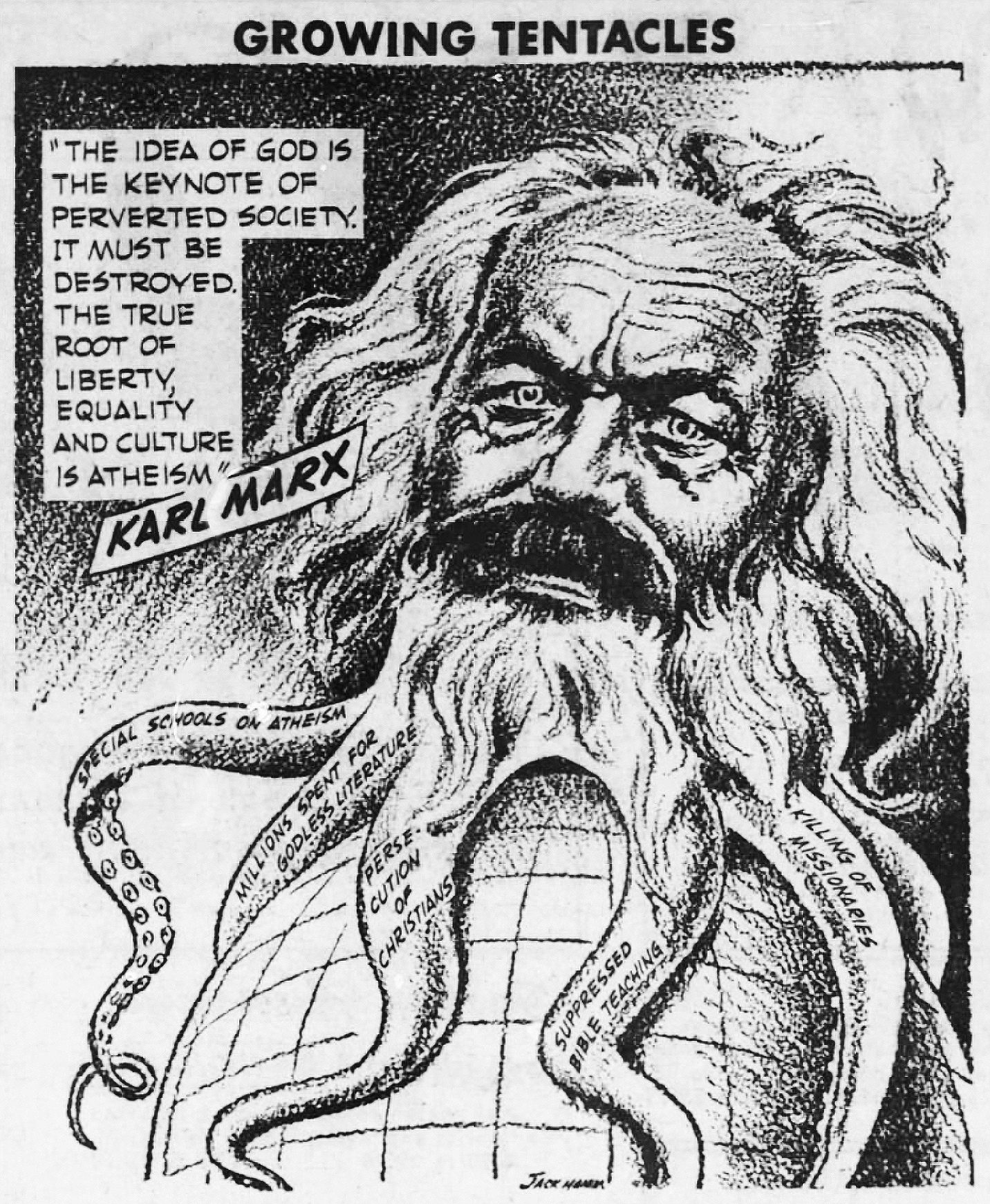
The current Republican playbook isn’t new. Consider this from 1961 in an Oklahoma newspaper:

Jack Hamm, Oklahoma City Star, 6/2/1961 (H/T Randall Stephens)

Notice the second tentacle from the left: “Millions spent for Godless literature.”

I was born about 6 months before this editorial cartoon, and today read the following from Judd Legum:

In Indiana, State Senator Scott Baldwin (R) has introduced sweeping legislation that Baldwin says is designed to ban Critical Race Theory (CRT) and related concepts in K-12 education. During a committee hearing on the bill earlier this month, Baldwin told a high school English teacher that he should be “impartial” when discussing Nazism. It is a case study about how the frantic efforts to ban CRT can quickly lead to absurd outcomes. 

Author of anti-CRT bill tells teacher he should stay “impartial” on Nazism

Republicans all across the U.S. are introducing and passing legislation censoring curriculum (targeting anti-racism content) and banning books from classrooms, school libraries, and public libraries (focusing on LGBTQ+ authors and works); some school board members have even called for book burnings.

My home state of SC is following the lead of other Republican-led states (notably Texas) by proposing guidelines that allow anyone to censor books for others.

It is incredibly important to emphasize that Republicans are actively removing books from school and public libraries—using government to decide what books and ideas people have access to.

These actions are tyranny. The antithesis of being free people.

There is no individual freedom without intellectual freedom.

No one should be held hostage to a life of an empty mind. Everyone deserves the accidental great fortune of my youth, including the kindness and boldness of my teacher, Lynn Harrill.

But none of this should be done in whispers, or with fear.

Republicans are calling for the eternal darkness of the empty mind, and we must resist because censorship erodes both American freedom and human dignity.

Also in 1961, Lou LaBrant recognized the failure of education as conformity:

Throughout our country today we have great pressure to improve our schools. By far too much of that pressure tends toward a uniformity, a conformity, a lock-step which precludes the very excellence we claim to desire….Only a teacher who thinks about his work can think in class; only a thinking teacher can stimulate as they should be stimulated the minds with which he works. Freedom of any sort is a precious thing; but freedom to be our best, in the sense of our highest, is not only our right but our moral responsibility. “They”—the public, the administrators, the critics—have no right to take freedom from us, the teachers; but freedom is not something one wins and then possesses; freedom is something we rewin every day, as much a quality of ourselves as it is a concession from others. Speaking and writing and exploring the books of the world are prime fields for freedom. (pp. 390-391)

LaBrant, L. (1961). The rights and responsibilities of the teacher of EnglishEnglish Journal, 50(6), 379–383, 391. Stable URL: http://www.jstor.org/stable/810824

We must rewin our freedom.

Freedom and the Politics of Canceling Teachers and Curriculum

By mid-December of 2021, Matthew Hawn, a former teacher in Tennessee, will once again have his appeal heard after being fired for violating the state’s restrictions on curriculum:

The Tennessee General Assembly has banned the teaching of critical race theory, passing a law at the very end of the legislative session to withhold funding from public schools that teach about white privilege.

Republicans in the House made the legislation a last-minute priority, introducing provisions that ban schools from instructing students that one race bears responsibility for the past actions against another, that the United States is fundamentally racist or that a person is inherently privileged or oppressive due to their race.

Tennessee bans public schools from teaching critical race theory amid national debate, Natalie Allison

As Allison reported in May, several states across the U.S. have filed or passed copy-cat legislation aimed at banning the teaching of Critical Race Theory.

By October and November, the consequences of Tennessee’s law have moved from silencing and canceling teachers to attempts to cancel curriculum [1]:

The Tennessee Department of Education recently declined to investigate a complaint filed under a new state law prohibiting the teaching of certain topics regarding race and bias.

The complaint, the first directed to the state under the new law passed this spring, was filed by Robin Steenman, chair of the Moms for Liberty Williamson County chapter, a conservative parent group sweeping the nation. 

The 11-page complaint alleged that the literacy curriculum, Wit and Wisdom, used by Williamson County Schools and at least 30 other districts, has a “heavily biased agenda” that makes children “hate their country, each other and/or themselves.”

Tennessee Department of Education rejects complaint filed under anti-critical race theory law, Meghan Mangrum

Although the complaint was rejected, Mangrum noted, “The group detailed concerns with four specific books on subjects like the Rev. Martin Luther King Jr.’s March on Washington, the integration of California schools by advocate Sylvia Mendez and her family, and the autobiography of Ruby Bridges, adapted for younger learners.”

A teacher fired for teaching Ta-Nehisi Coates, parents calling for bans on MLK and teaching about Ruby Bridges—these events are not unique to Tennessee, but they reflect a pattern of efforts to control not only teachers, but what students are allowed to learn and read.

Notable in these examples is that many of the consequences of legislation are canceling Black writers and key aspects of Black history; additionally, legislation and calls for book banning are targeting LGBTQ+ writers and topics.

Teaching and curriculum in the U.S. are being systematically and politically whitewashed.

One aspect not being addressed often is that political dynamic. Parents, political activists, and politicians are impacting who teaches and what is being taught in the context of a historical and current demand that teachers themselves remain apolitical, both in their classrooms and their lives beyond school.

As I have discussed often, teaching is necessarily political, and teaching as well as writing are necessarily types of activism.

For teachers, then, we must recognize that calls for teachers to be objective, neutral, and apolitical are themselves political acts. Currently, laws being passed and parents/activists confronting school boards are exercising their political power at the expense of teachers and schools—both of which are required to remain somehow politically neutral.

From historian/activist Howard Zinn to critical scholars such as Joe Kincheloe and to poet Adrienne Rich, we have ample evidence that taking a neutral stance is a political act that passively endorses the status quo and that silencing words is an act of canceling thought, eradicating ideas.

Zinn’s commitment to transparency as a teacher and activist is hauntingly relevant to the current political attack on teachers and curriculum:

This mixing of activism and teaching, this insistence that education cannot be neutral on the critical issues of our time, this movement back and forth from the classroom to the struggles outside by teachers who hope their students will do the same, has always frightened the guardians of traditional education. They prefer that education simply prepare the new generation to take its proper place in the old order, not to question that order [emphasis added]….

From the start, my teaching was infused with my own history. I would try to be fair to other points of view, but I wanted more than “objectivity”; I wanted students to leave my classes not just better informed, but more prepared to relinquish the safety of silence, more prepared to speak up, to act against injustice wherever they saw it. This, of course, was a recipe for trouble.

You Can’t Be Neutral on a Moving Train: A Personal History of Our Times, Howard Zinn

And Kincheloe confronted not only who is actually indoctrinating students but the imperative that teachers recognize teaching as inherently political:

Thus, proponents of critical pedagogy understand that every dimension of schooling and every form of educational practice are politically contested spaces. Shaped by history and challenged by a wide range of interest groups, educational practice is a fuzzy concept as it takes place in numerous settings, is shaped by a plethora of often-invisible forces, and can operate even in the name of democracy and justice to be totalitarian and oppressive [emphasis added].

Critical Pedagogy Primer, Joe L. Kincheloe

The great irony is that critical educators (often smeared as “Marxists”) are committed, as Kincheloe asserts, to a foundational concern: “Critical pedagogy wants to know who’s indoctrinating whom.”

The Orwellian named “Moms for LIberty,” then, by calling for canceling curriculum are in fact being “totalitarian and oppressive,” calling for not education, but indoctrination. To ban words and ideas is to ban the possibility of thinking, of learning:

The study of silence has long engrossed me. The matrix of a poet’s work consists not only of what is there [emphasis in original] to be absorbed and worked on, but also of what is missing, desaparecido [emphasis in original], rendered unspeakable, thus unthinkable.

Arts of the Possible, Adrienne Rich

A final powerful point is that many of these political acts to silence teachers and cancel curriculum are occurring in right-to-work states controlled by Republicans. Teachers not only are expected to be neutral, objective, and apolitical, but also work with a distinct awareness they have almost no job security.

Hawn fired in Tennessee simply taught a text and now is fighting for his career; the text in most ways just a year ago was considered non-controversial and even celebrated as Coates had attained recognition as one of the country’s leading Black voices.

During this holiday season at the end of 2021, teachers honestly have no decision about whether or not to be political. We are faced with only two political choices: conform to the demand that we take a neutral pose, resulting in endorsing whatever status quo legislators and parents/activist impose on schools; or recognize and embrace the essential political nature of being a teacher by actively opposing efforts to cancel teachers and curriculum.


[1] Twitter thread:

Reading Matters

[Header Photo by Christin Hume on Unsplash]

Polonius: What do you read, my lord?

Hamlet: Words, words, words.

Polonius: What is the matter, my lord?

Hamlet: Between who?

Polonius: I mean, the matter that you read, my lord.

Hamlet: Slanders, sir: for the satirical rogue says here that old men have grey beards….

Polonius: [Aside] Though this be madness, yet there is method in’t.

–Hamlet, Act II, Scene ii.

Reading matters.

I imagine you would be hard pressed to find anyone who would disagree with those two simple words. But the reality is that those two words have dramatically different meanings among people advocating for teaching children to read in schools.

“[S]ociety should get behind teaching everybody to read the right way,” explains John McWhorter, linguist turned public intellectual who uses his bully pulpit at the New York Times to join the long list of Black celebrities and notable people invited into the white mainstream of conservative thought cloaking racism and racial stereotyping.

The problem in McWhorter’s words, of course, is that “right way.”

Since early 2018, the U.S. has once again lifted the Reading War into public consciousness with a misleading refrain, “the science of reading” (SoR). The media has maintained a steady beat claiming that teacher education and practicing teachers have failed to embrace the SoR, and as a result, children are failing to learn to read.

The SoR media movement has merged with some aggressive parent advocacy groups, notably related to dyslexia, and the result is copy-cat SoR reading legislation being passed throughout the country. Ironically, and disturbingly, that legislation often codifies policies and practices that are strongly refuted by scientific research—grade retention, universal screening for and oversimplification of dyslexia [1], systematic intensive phonics programs for all students [2], bans on popular reading programs, and efforts to mimic policies implemented in Mississippi [3] (after one round of improved NAEP scores in reading at grade 4).

While I am certain that people advocating for improved reading instruction in our schools all have mostly good intentions (except for a powerful lobby for phonics programs and some media/journalists seeing an opportunity to cash in on SoR), the problem remains with what anyone means by “reading matters.”

We must acknowledge two contexts here.

One context is approaching a common term but a rare case that it may be accurate—crisis.

Since the SoR movement and advocates such as McWhorter are speaking into a conservative and traditional ideology about language, reading, and literature (used broadly to mean any texts students reading), the SoR movement has been swept into a concurrent movement against public education broadly begun under Trump with the purposeful and orchestrated attacks on the 1619 Project and Critical Race Theory (McWhorter’s “right way” comment sits inside his joining the anti-woke movement).

What merges the anti-woke education movement and the SoR movement is the focus on parental rights to monitor and control what students learn and how students learn.

The crisis we are approaching, I think, is the ironically disturbing part. The merging of the SoR movement with the anti-woke movement means that so-called advocates for better reading instruction have joined forces with a new rise in censorship that includes book banning, removing books from libraries (lists of 850+ books identified in Texas), proposing bans on terms deemed “woke,” and even calls for burn burnings.

A significant but less powerful group of literacy advocates, teachers, scholars, and writers have noted the problem with emphasizing the need for children to learn to read while simultaneously reducing what they can read, and even what those students are allowed to consider or think.

A second context is the contradiction between the narrow demands of the SoR movement and the likelihood that policies and practices being implemented in the name of SoR are likely to inhibit and even discourage children from reading.

I have detailed several times that I grew up in a racist and deeply conservative community and household. The conditions that saved my life, my mind, and my soul include the coincidence that my very misguided parents happened to respect intellectual freedom; I was allowed to read anything throughout my childhood and teen years.

Once I moved beyond my home and community—college—I was then liberated by reading Black authors assigned and recommended by wonderful professors, again a context that respected intellectual freedom and my mind.

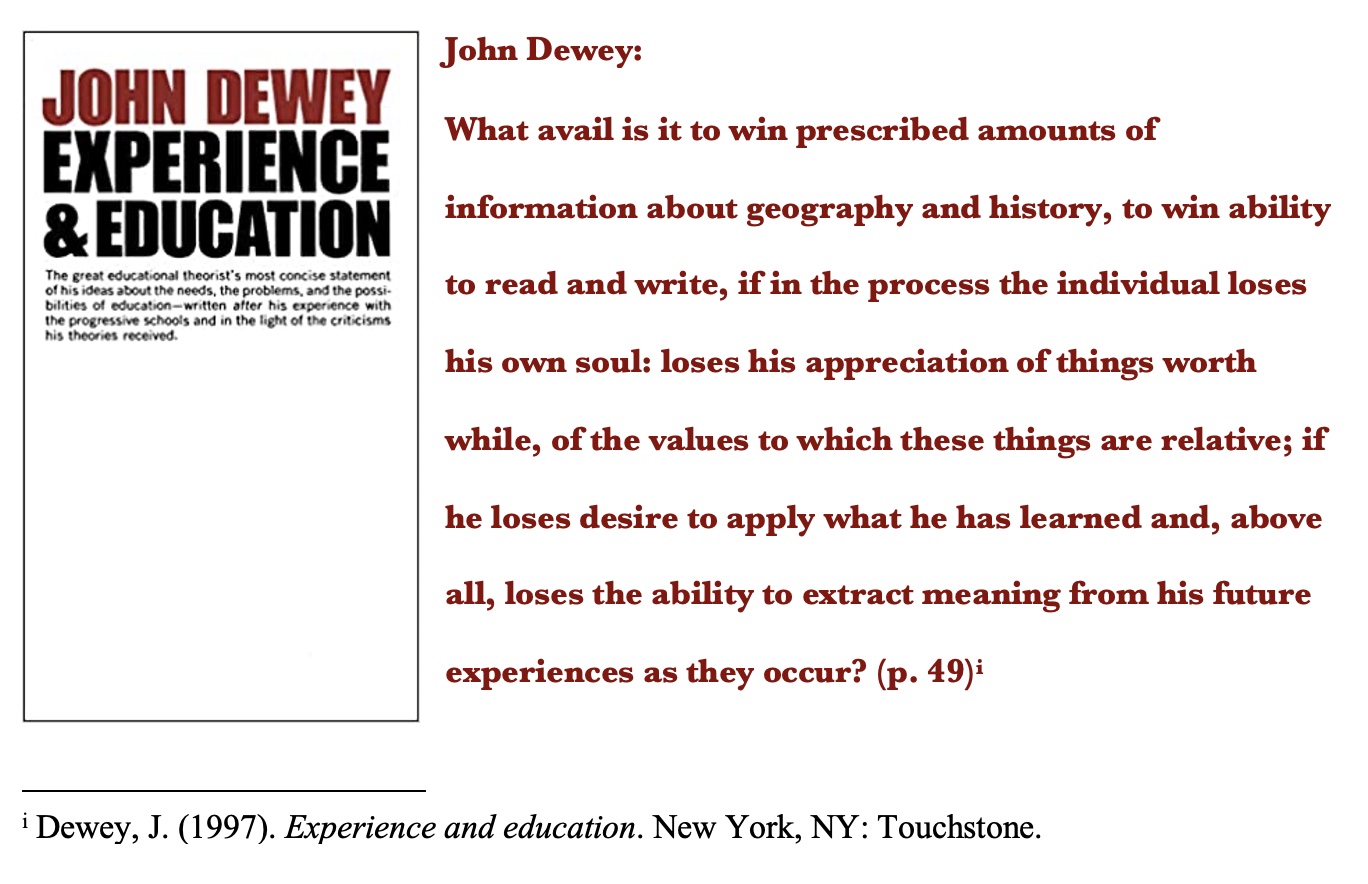
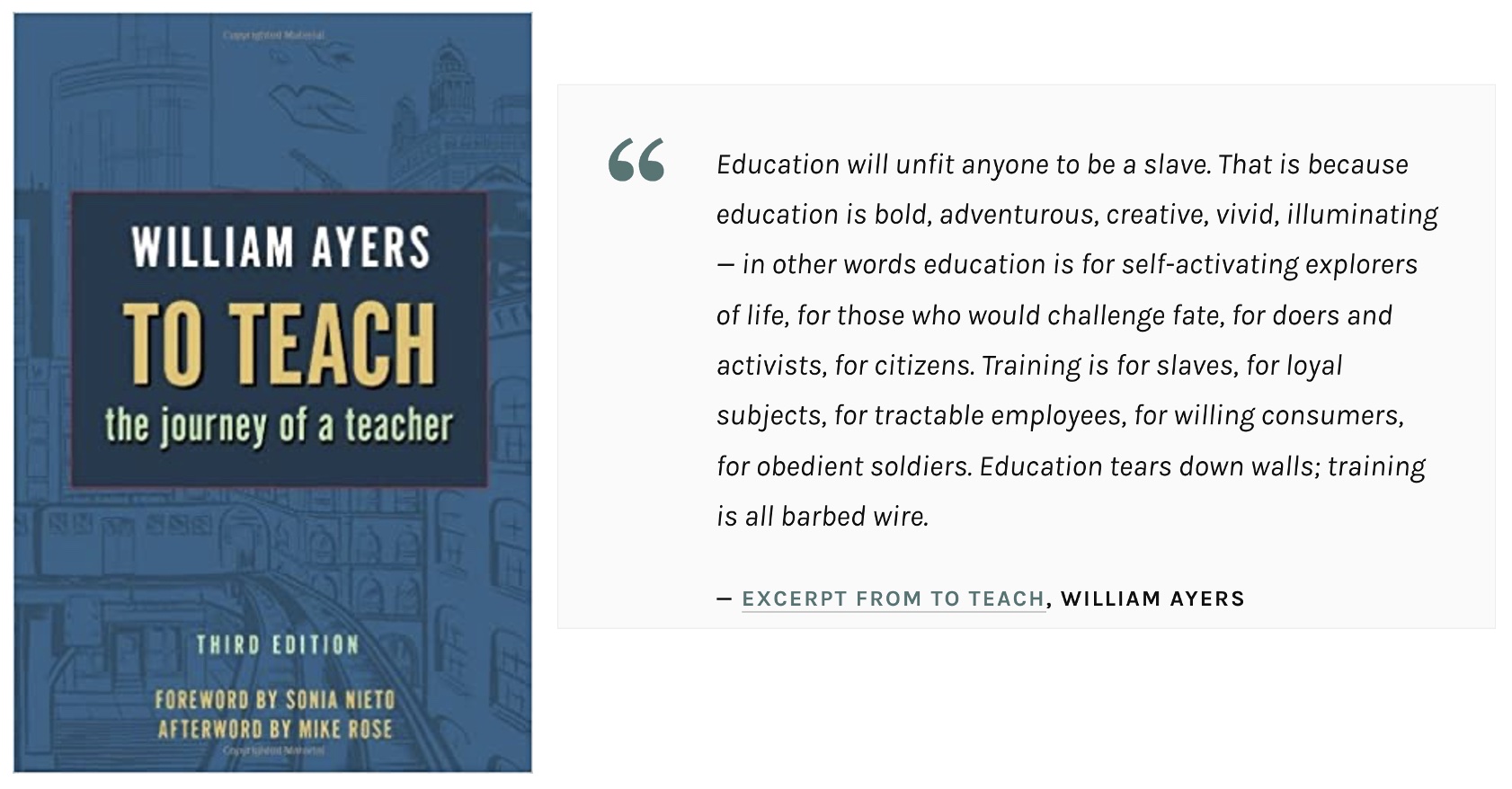
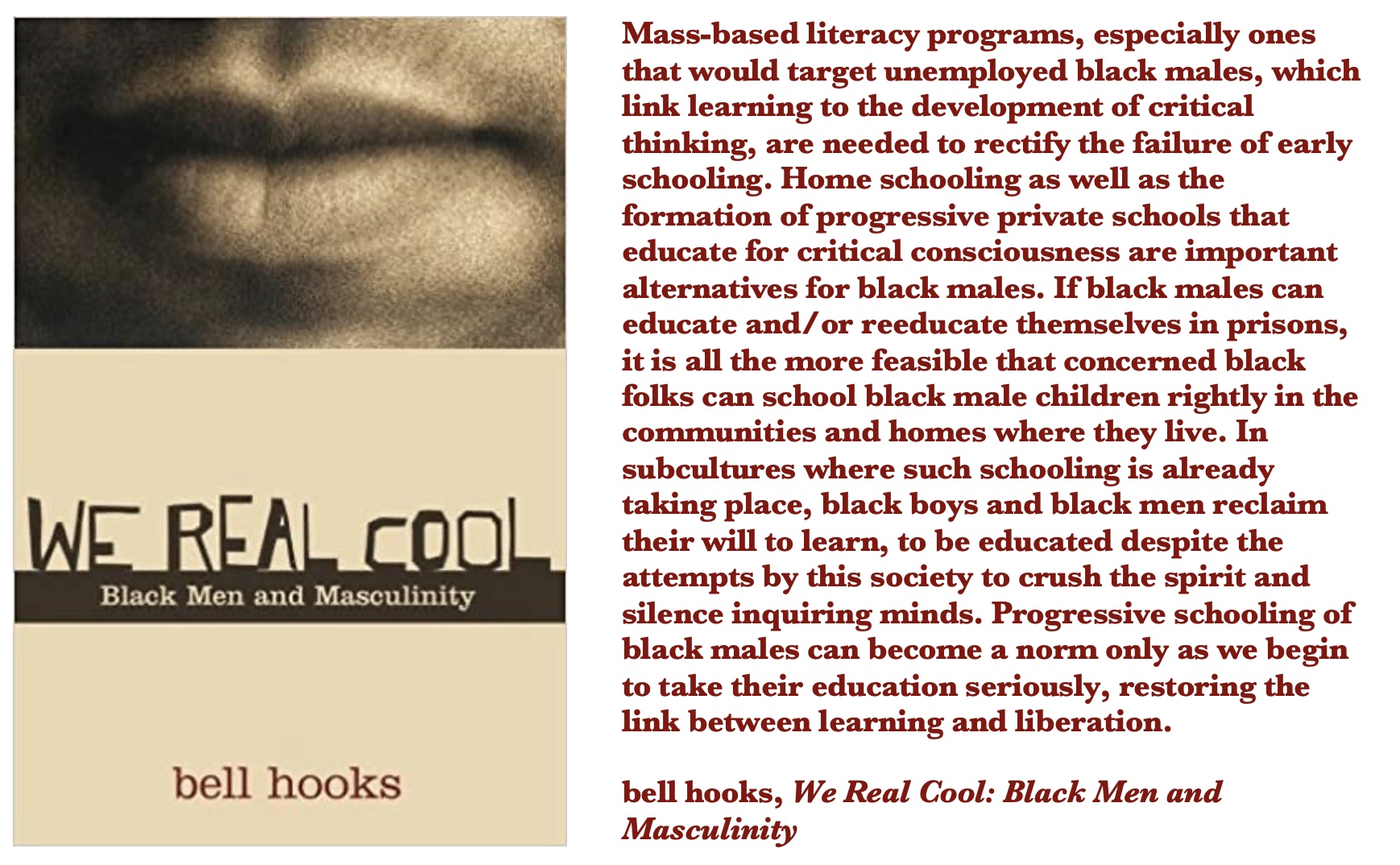
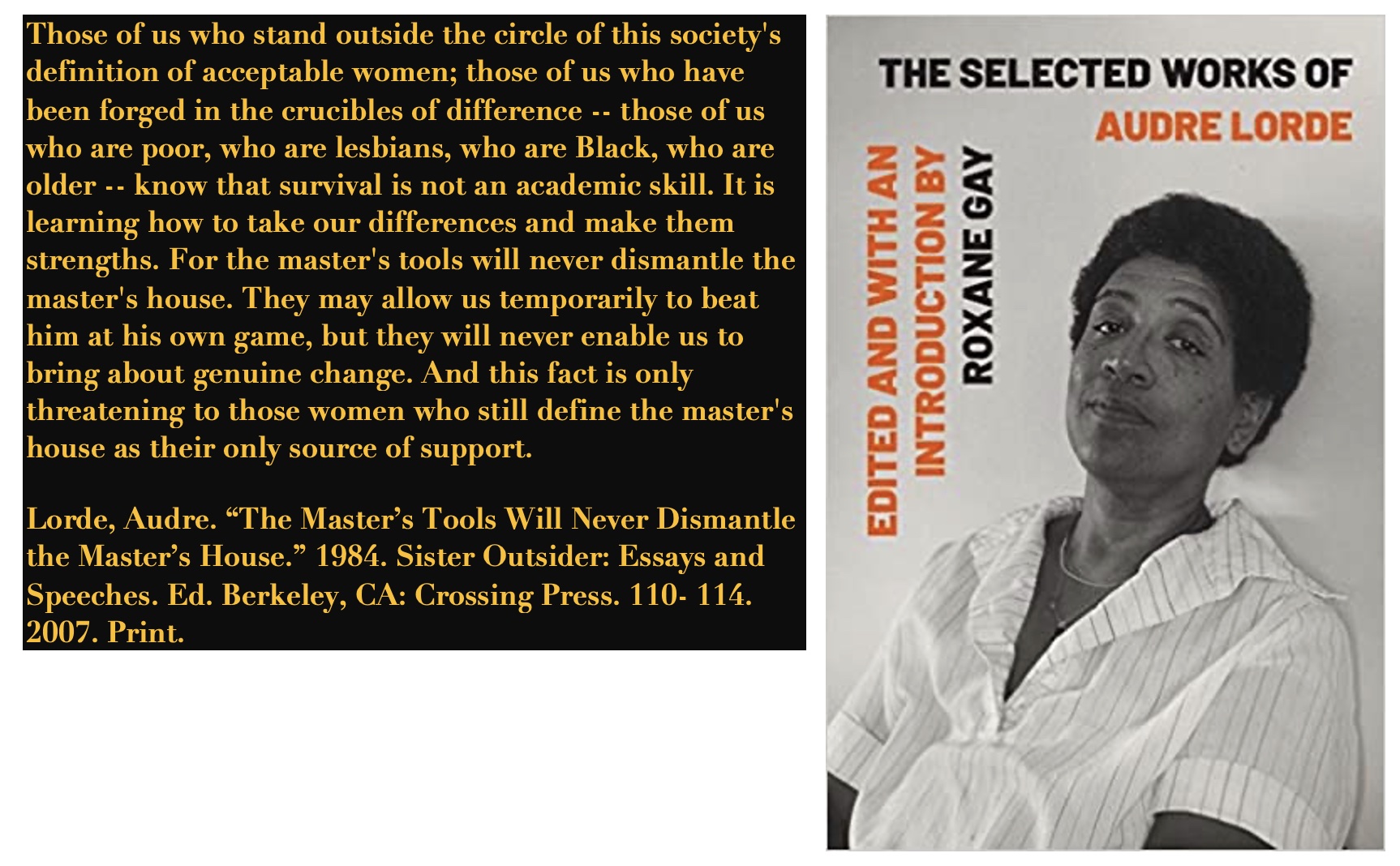
Not an exhaustive list, but for me, someone who has spent almost 40 years as a literacy educator, I want to offer some reasons reading matters for me, highlighting John Dewey, William Ayers, bell hooks, and Audre Lorde:

The allure of SoR for the media, parents, and politicians is grounded in silver-bullet “all students must” thinking that is antithetical to the reasons I believe reading matters.

At the core of the tension in debates about teaching reading and what texts students are assigned or allowed to read is those embracing indoctrination (“teaching everybody to read the right way”) versus those embracing education as liberation (from Dewey to Ayers to hooks and to Lorde).

Indoctrination depends on someone not only controlling what people read, hear, and think, but also erasing what people read, hear, and think.

The SoR movement ultimately fails because it resists being student centered and allows far too often for reading to be reduced to decoding (systematic intensive phonics for all); further, while SoR advocates often demonize popular reading programs (and I am a strong critic of all reading programs), they make the same essential mistake by simply choosing different programs to endorse as rigid expectations for students and teachers (LETRS, DIBLES).

Reading matters, but if we become distracted by raising reading test scores, our practices are likely to produce non-readers (Dewey).

Reading matters, but if we fail to distinguish between indoctrination and education for liberation (hooks), we reduce reading instruction to training (Ayers).

Reading matters, but our commitments must be to how reading matters for the individual, especially for those “who stand outside the circle of this society’s definition of acceptable” (Lorde).

If we truly believe every person deserves the human dignity of intellectual freedom, as my parents and teachers afforded me, then reading matters only if we refuse silver-bullet scripts, only if we protect all the books and ideas available to free people.

That is the only “right way” worth evoking.


[1] See the following:

An Examination of Dyslexia Research and Instruction, with Policy Implications, Peter Johnston and Donna Scanlon

Research Advisory: Dyslexia (ILA)

[2] See the following:

A Meta-Analysis of the Effects of Reading Comprehension Interventions on the Reading Comprehension Outcomes of Struggling Readers in Third Through 12th Grades, Marissa J. Filderman, Christy R. Austin, Alexis N. Boucher, Katherine O’Donnell, Elizabeth A. Swanson

“the simple view of reading does not comprehensively explain all skills that influence reading comprehension, nor does it inform what comprehension instruction requires.”

The Sciences of Reading Instruction, Rachael Gabriel (Educational Leadership)

The Trouble With Binaries: A Perspective on the Science of Reading, David B. Yaden Jr., David Reinking, and Peter Smagorinsky

Reconsidering the Evidence That Systematic Phonics Is More Effective Than Alternative Methods of Reading Instruction, Jeffrey S. Bowers (2020)

[3] UPDATED 23 February 2020: Mississippi Miracle or Mirage?: 2019 NAEP Reading Scores Prompt Questions, Not Answers

See Also

The Problem with Balanced Literacy

Failing Balanced Literacy Is Failing Readers, Katie Kelly and Paul Thomas

The Trap: The Ends v. Means Tension in the Pursuit of Content Knowledge

Over the course of almost 40 years, I have taught writing/composition to high school, undergraduate, and graduate students. I am well aware of the cumulative toll of reading and responding to 10s of thousands of essays by students who are both learning to think and learning to write.

Those essays are often vapid and jumbled, and thus, the work of a writing teacher can be incredibly tedious.

The Onion parody of student writing, Since The Beginning Of Time, Mankind Has Discussed What It Did On Summer Vacation, is too accurate for me to laugh since, despite sharing the piece with students, I still often read essays that begin with the same sort of dramatic and over-simplified claims fictitious Jeremy Ryan offers:

For as far back as historians can go, summer vacations have been celebrated by people everywhere as a time for rest and relaxation. Many advancements have been made in summer breaks since these early times, but it is also true that many different traditions have lived on and continue to remain with us today. This is why, since the beginning of time, mankind has discussed what it did on its summer vacation.

This is what I intend to prove within the course of this essay.

Since The Beginning Of Time, Mankind Has Discussed What It Did On Summer Vacation

So when I noticed a Twitter thread about teachers/professors struggling with responding to student essays, I offered the following responses:

The trap, as I note above, results from any teacher’s perception of the role of content knowledge and the acquisition of the knowledge in the teaching/learning process.

Is that content knowledge the ends of instruction and learning, or the means of instruction and learning?

I think Rod Graham speaks for many teachers who incorporate student writing in order to assess whether or not students have acquired essential content knowledge as an ends of the lesson, unit, or course.

However, I have a different view of what constitutes “content” and I tend to place that content in the context of the means of learning.

For example, this week in my first-year writing seminars we have begun our journey toward their submitting a formally cited essay. My guiding goals for this assignment is helping students make the transition from high school thinking and writing to behaving and thinking as writers and scholars (especially in ways that are expected in undergraduate education).

First, I cautioned students about what it means to gather sources in order to write a cited essay. Students tend to begin their search of sources with a predetermined outcome in mind (they will lament, often, that they didn’t find what they wanted to find) so I tell them they are seeking a body of evidence in order to learn more deeply about a topic (thus, start with a question, not a conclusion/claim); and then, their job as student-scholars is to credibly represent what the evidence shows (whether that is what they “wanted” to find or not).

Next, I introduce them to the difference between mainstream approaches to topics (the “both sides” approach) and scholarly approaches to topics (more nuanced, and often resulting in only one credible “side”).

To engage with the problems of “both sides” approaches, I shared the current controversy in Texas: Books on Holocaust should be balanced with ‘opposing’ views, Southlake school leader tells teachers.

Several students were visibly shocked by the “both sides” mandate about the Holocaust (much to my relief) so we explored exactly what those “sides” might be, and then applied that to other topics such as slavery in the U.S., sexual assault, etc.

However, when I shared my own work on corporal punishment and the negative backlashes I experience for my public work against corporal punishment, the student reactions shifted dramatically; as is typical, several students argued for corporal punishment (although I clearly noted the evidence overwhelmingly rejects any positive outcome for corporal punishment).

Of course, this is an ideal example of the power of cultural norms and ideology (specifically religious training and beliefs) to trump empirical evidence, and it serves my larger instructional goals, but this dynamic is troubling none the less.

This lesson as well as the cited essay assignment represents my practice of using content as a means to acquiring authentic ways of thinking and writing (a different type of “content”) regardless of the content knowledge being interrogated or explored.

Students are free to choose any topic for this essay, and ultimately, I will be assessing how well they explore and incorporate sources and then how credibly they represent their sources over the course of synthesizing a coherent essay; I also trust that these students will acquire content knowledge (ends) as a result of interacting with that content as a means.

I do recognize that many teachers will and should continue to use writing as a mechanism for assessing the acquisition of content/knowledge, but I also must stress that this dynamic will necessarily be tedious for teachers and students—and that it likely inhibits many important goals for students as independent thinkers/scholars and writers.

As I Tweeted above, students experience content as an ends far too often, and are invited to use content as a means far too rarely.

Prompts and rubrics do most of the work for students, and in effect, infantilize those students, guaranteeing any acquisition of content is superficial and transitory.

If we want students to think and write with sophistication and nuance, we must provide students many, many opportunities to choose what content they engage with and then practice those sophisticated and nuance moves with content/knowledge as a means to their own growth as scholars and writers.

Conservatives Seeking Education as a Buffet of Ignorance

Several decades ago, the following true story about teaching in a small, conservative Southern town, seemed like a once-in-a-career experience: A new social studies teacher at my high school was challenged by a parent because this new teacher covered Middle East geography by detailing the regional tensions correlated with religion among Christians, Jews, and Muslims.

Ultimately, the parent wanted their child removed from the class because, as the parent announced to the principal, “I don’t want my son knowing religions other than Christianity exist.”

Fast forward about three decades—passing through several rounds of school choice movements (which I will connect later)—and now public school teachers and college professors across the U.S. find themselves challenged in a similar but far more extensive and organized way concerning Critical Race Theory (CRT).

Mike Gonzalez, for example, at the Heritage Foundation, has constructed Try This “Critical Race Theory” Checklist for conservative and Christian parents who, like the parent above, want to opt their children out of knowledge.

Along with explosive and even violent school board meetings about mask mandates, Covid, and, yes, CRT, parents are now organizing to opt their children out of education; for example, the Orwellian-named Families for Educational Freedom offer a CRT Lessons Letter and a Intrusive Survey Letter; the former outlines what parents want their children to have freedom from [1]:

We/I,________________________________, the parent(s) of _______________________________, grade ________, are/is exercising our/my fundamental parental rights under the First Amendment of the U.S. Constitution, Title VI of the Civil Rights Act of 1964, the Family Educational Rights and Privacy Act (FERPA), the Protection of Pupil Rights Amendment, and/or any other state and federal laws to opt our/my child out of any instruction in Critical Race Theory (CRT), including but not limited to the following ideas or principles —

• That any race, gender, sexual orientation, national origin, and/or socioeconomic status is inherently superior or inferior to any other race, gender, sexual orientation, national origin and/or socioeconomic status.

• That any race, gender, sexual orientation, and/or national origin is privileged or oppressed.

• That race-based stereotyping and labeling are acceptable as part of “anti-racism” education.

• That an individual should be discriminated against or receive adverse treatment because of the individual’s race.

• That an individual’s moral character is determined by the individual’s race.

• That America and its institutions are fundamentally racist.

• That the values, principles, and/or ideals of one’s own family or religion are fundamentally incorrect, racist, and/or preventing them from social and emotional growth. 

These teachings of CRT foster discrimination and harassment on the basis of race and are a violation of our family’s values and religious beliefs.  It is well-established that parents have a fundamental right to direct the religious upbringing and education of their children.  Wisconsin v. Yoder, 406 U.S. 205 (1972).  You are not to instruct or inculcate my child on the aforementioned or following subjects, without providing me at least fifteen (15) days prior written notice and providing me with the intended materials and lesson plans. 

The prohibition extends to any promotion, legitimization, or normalization of CRT, no matter how your program or approach is defined or packaged, including but not limited to any instruction, materials, or conversations related to “equity,” “privilege,” “intersectionality,” “diversity, tolerance and inclusion,” “anti-racism,” “microaggressions,” “white privilege,” “white adjacency,” “hate speech,” “hate crimes,” “critical social justice,” “postcolonial theory,” “postcolonialism,” “sensitivity education,” or the like.

CRT Lessons Letter

The bullet points may look familiar since they are occurring, often verbatim, in state legislation attacking CRT directly and indirectly as well as banning the use of the 1619 Project.

These misleading but purposeful strategies parents are using to censor curriculum in public schools is a logical evolution from how a minority of parents have been leveraging control over public education for decades—opting students out of sex education, book challenges and banning, a revolving door of school choice schemes that pander to what parents want their children to learn (without the price tag of private schools that are often appealing because there parents can and do monitor and control what is and isn’t taught), periodic challenges to the teaching of evolution, etc.

If polls are even remotely good indicators, the current Republican Party remains about 40% loyal to Trump, suggesting about 10-15% of Americans constitute this movement against CRT (likely a similar percentage to the Moral Majority movement coinciding with the Reagan presidency).

While this is a significant minority, the U.S. has long had a powerful and very vocal conservative and Christian influence that is solidly anti-education.

One of the great ironies (similar to the organization’s name noted above, Families for Educational Freedom) of the backlash against CRT (beyond that CRT doesn’t really exist in K-12 education) is that it rests on an old and tired argument that leftist teachers are indoctrinating students; this is projection from conservatives who are, in fact, seeking to indoctrinate students.

While leftists are extremely rare in K-12 education, marginalized in higher education, and nearly powerless in the economic/political system of the U.S., as I have noted often, true leftists, critical educators, are adamantly opposed to indoctrination and recent efforts by Republicans mirror commitments to indoctrination found in China.

Ultimately, this CRT mania isn’t about CRT, but is part of the steady and determined effort by an anti-education minority to dismantle universal public education and academic freedom because at their core, as William Ayers concludes:

Education will unfit anyone to be a slave. That is because education is bold, adventurous, creative, vivid, illuminating — in other words education is for self-activating explorers of life, for those who would challenge fate, for doers and activists, for citizens. Training is for slaves, for loyal subjects, for tractable employees, for willing consumers, for obedient soldiers. Education tears down walls; training is all barbed wire.

excerpt from To Teach, William Ayers

Conservatives and Christians embrace education as training, indoctrination, as mere preparation for work or passive compliance with the dogma of religion.

The attacks on CRT and efforts by parents to opt out of curriculum deemed “indoctrination” or claimed to cause “racial discomfort” are poised to turn education into a buffet of ignorance leaving our children and teens intellectually starved and the status quo safely protected.


[1] See:

There is more than one kind of freedom, said Aunt Lydia. Freedom to and freedom from. in the days of anarchy, it was freedom to. Now you are being given freedom from. Don’t underrate it….

We were a society dying, said Aunt Lydia, of too much choice. (pp. 24, 25)

Margaret Atwood’s The Handmaid’s Tale