Category Archives: Critical Pedagogy

The Politics of Childhood in an Era of Authoritarian Education

While on vacation, a friend and I were discussing the paradox of parenting.

A parent often feels a tension between fostering and supporting a child to be the person they want to be as that contrasts with dictating what is best for the child (knowing as adults do that children, teens, and young adults often make decisions necessarily without the context of experience that would certainly change many decisions).

That paradox, that tension has existed for me as a teacher/professor, parent, grandparent, and coach.

I am constantly checking myself in roles of authority to determine if I am imposing my authority onto children and young people (authoritarian) or if I am mentoring and fostering those humans in the cone of my authority in ways that support their own autonomy and development along lines they actively choose for themselves (authoritative).

This is a dichotomy examined by Paulo Freire [1], and a central concern for any critical educator.

The current misguided attacks on anything “critical” is particularly frustrating for critical educators since these attacks are designed to fulfill the demands of authoritarian systems, partisan politics and formal education.

It has occurred to me recently that I have been in roles of authority for a very long time, beginning with working as a lifeguard in my mid- to late teens. My role of authority literally began, then, with the expectations that I would guard human life—any human life that came into the sphere of the pool where I was charged with monitoring swimming and the safety of not only individual swimmers but all of the people in the pool.

I was a very good and capable swimmer, and for a teen, I was reasonably responsible (although I cringe thinking about being a head lifeguard when only 17 or so). But having the level of authority and responsibility that being a lifeguard entails was quite likely asking far more of me that I deserved.

Those days of lifeguarding set me on course for being the responsible person for the next 40-plus years, exacting a significant toll on me psychologically and emotionally.

Maintaining a critical authoritative pose when in positions of authority is extremely hard, much harder than being authoritarian.

Way back in the 1980s and 1990s, I was practicing in many ways the sort of critical teaching that is coming under attack in 2021, even resulting in a teacher in Tennessee being fired:

At issue was Hawn assigning the essay “The First White President” by Ta-Nehisi Coates to students in his Contemporary Issues class in February, and later in March, playing a video of “White Privilege,” a spoken word poem by Kyla Jenée Lacey to the same students.

A Tennessee teacher taught a Ta-Nehisi Coates essay and a poem about white privilege. He was fired for it

Many conservatives see the work of Coates, for example, as radical, while those of us on the left would argue Coates’s work is quite mainstream and accessible—but far from radical. This is the same dynamic around Barack Obama, for example; Obama is a moderate and an incrementalist, but certainly not a radical leftist or Marxist (as conservatives like to suggest).

While I taught high school English in the very conservative rural South, I was mostly allowed to teach texts with only occasional complaints from parents. What looks quite odd now is that I included Howard Zinn in my classes for many years without a peep from anyone (Zinn is a key target of the ant-CRT movement now).

But I also included Joseph Campbell’s comparative mythology in my classes in order to help students navigate metaphorical approaches to narratives (a key skill needed in the Advanced Placement course I taught and as preparation for college).

Including Campbell did cause problems since his work complicated the literalism many of students experienced in their religious lives. Fundamentalist Christianity was the background of nearly all my students, and Campbell’s casual claims that all religions and mythologies told similar archetypal stories stepped on the toes of arguments that accepting Jesus was the only way into heaven.

I aroused similar complaints by including Gandhi in my Emerson/Thoreau/MLK unit.

The parental challenges to Campbell and Gandhi were grounded in a type of insecurity that had never been examined critically by those parents, all of which was the result of having been raised in authoritarian environments.

I did have my students interrogate that Sunday school and preaching were not places where they were encouraged to ask questions or challenge any of the “lessons” they received.

So in 2021, I cannot stress too much that the Republican attack on critical race theory and how history is taught is simply a battle for the integrity of the mind of children, teens, and young adults.

Learning and knowledge—especially if we genuinely believe in human autonomy and democracy—are not simply about accumulating facts determined to be true or important by some authority, but are about learning how to know what we believe is true and why.

Human freedom is most threatened by unexamined beliefs, not by the act of questioning itself.

Authority doesn’t just resist questioning, but entirely rejects it as an act.

Republicans and the conservatives drawn to authoritarianism do not trust human agency, do not believe in the free exchange of ideas, and do not believe in the essential power of questioning, especially when the questions are aimed at their authority.

Nothing is as simple as “both sides,” and certainly we should never fall into traps of “only know this.”

There can never be free people, however, without free minds cultivated in the guarantee of academic freedom.

And the free exchange of ideas will never be spaces without discomfort, which now seems to be a smokescreen used by Republicans in their pursuit of securing authority.

Suddenly, Republicans are concerned about uncomfortable white students, but seem oblivious to the discomfort, for example, of thousands and thousands of Black students experience reading The Adventures of Huckleberry Finn or To Kill a Mockingbird.

Teachers must now tip-toe around the uncomfortable texts and conversations about race and racism because of the possibility of white discomfort (note that Black discomfort about Huck Finn has been repeatedly swept aside under the guise of “classic literature”)—a stance once again disregarding the daily discomfort of Black children experiencing racism.

Intellectual discomfort (what texts and discussions prompt in formal schooling) is often necessary for learning, but existential discomfort (what targets of racism and sexism experience) are not necessary and are essentially harmful.

Authoritarian education is willing to sacrifice the existential comfort of marginalized children in order to shield some children from intellectual discomfort.

Even more disturbing, however, is that what is really being protected is the frailty of those students’ parents and those people in authority who are not willing to risk being challenged or questioned in any way.


[1] Paulo Freire and Peace Education, Lesley Bartlett:

Freire’s early call for a “horizontal” relationship generated a staggering amount of debate over the teacher’s role in a democratic classroom. In his later writings, Freire refined his notion of directivity and the teacher-student relationship. In Pedagogy of Hope, he explained: “Dialogue between teachers and students does not place them on the same footing professionally; but it does mark the democratic position between them” (Freire, 1994, p. 116-117). In his “talking” books of the 1980s and 90s, Freire distinguished between authoritative and authoritarian teachers:

“I have never said that the educator is the same as the pupil. Quite the contrary, I have always said that whoever says that they are equal is being demagogic and false. The educator is different from the pupil. But this difference, from the point of view of the revolution, must not be antagonistic. The difference becomes antagonistic when the authority of the educator, different from the freedom of the pupil, is transformed into authoritarianism. This is the demand I make of the revolutionary educator. For me, it is absolutely contradictory when the educator, in the name of the revolution, takes power over the method and orders the pupil, in an authoritarian way, using this difference that exists. This is my position, and therefore it makes me surprised when it is said that I defend a nondirective position. How could I defend the fact that the nature of the educational process is always directive whether the education is given by the bourgeoisie or the working class” (Freire 1985, p. 76).

Who’s Indoctrinating Whom?

The best way I can express it, I think, is that I have always wanted to be smart.

“Always” in the sense of whenever I first had something like independent awareness, which I assume occurred gradually as my autonomous self slowly and painfully separated myself from the powerful urge to remain at the center of my mother’s universe.

I idealized being “smart,” and thus “knowing stuff,” as essential for that autonomy.

I have never wanted to be smart to lord it over others (although I am still accused of being arrogant, a misreading of passion, I think), but I have always sought out and consumed knowledge as my lifelong quest to be my own person.

This urge has put me in a sort of Emerson/Thoreau camp that cherishes the individual mind and rejects organizations and group-think—a sort of libertarian intellectualism that now sits uncomfortably where that intellectual individuality has led me.

Over my first couple years of college—spent at a junior college where more of my energy was dedicated to playing pick-up basketball and drinking beer than my studies—I was eagerly reading and studying on my own existential philosophy and literature.

On the day Ronald Reagan was shot, I sat in the college library reading Sartre.

My mind and soul teetered on a dangerous edge during my teen years and into early adulthood; I was a perfect candidate for the sort of adolescent Ayn Rand know-it-all-ism many young white men fall into—and never escape.

Something, maybe just dumb luck, never allowed me to stop learning and thinking; something never allowed me to think I was “finished” learning or to assume that my current state of knowing was finished.

This is where my story includes Karl Marx. This is where the story of my mind looks absolutely nothing like what conservative Americans think Marxism and “critical” look like.

I found a copy of Marx’s non-economic writing that included a section on education. Having grown up in the rural South in the 1960s and 1970s, I picked up Marx with all the misconceptions you can imagine about communism, socialism, and such.

That paperback still sits on my shelf in my office and is heavily underlined with (mostly embarrassing) comments scribbled in the margins.

Just as I self-taught about existentialism, I was becoming a Marxist educator on my own time while I went through my final 2.5 years of college, majoring in secondary English education.

My certification program was extremely moderate even though my education professors were uniformly white progressives who tip-toed around being confrontational or in any way revolutionary.

These experiences were steeped in idealism and painful naivety.

I entered the K-12 classroom as a high school English teacher in 1984, none the less, with the belief that I could help change the lives of my students and even change the world. This ambition was based on my own experiences since my life was profoundly changed by formal education, teachers and professors, and my own relentless self-education.

That belief was grounded in wanting not to shape what my students thought but in helping them develop the tools needed for how to think independently, including how to step back from beliefs and assumptions about the world in order to make their knowledge their own.

As an English teacher, I knew those tools were mostly literacy—reading and writing as essential for human autonomy and dignity.

Over about a decade, I did this work often badly but with a great deal of earnestness. College had humbled me so I was determined to help my students avoid skipping off to college with the sort of redneck provincialism that had shot out of my mouth in several college classes.

Again, contrary to what conservatives often claim, the only places I was indoctrinated had been in my home, my community, and my church. The students in my hometown had also experienced mostly authoritarian homes, authoritarian schools and classes, and authoritarian churches.

They had lived unexamined lives because that had been demanded of them.

At times, then, I was a very unpopular redneck among rednecks.

Things changed dramatically for me as a person, an educator, and a scholar when I entered my doctoral program in 1995.

Dots were connected from those naive days reading the non-economic writings of Marx and discovering that a complex and vibrant world of Marxist education scholars existed.

Reading Paulo Freire was switching on a light in my brain and my soul. Freire had thought through all the lazy and careless ideas that had led me to the classroom. But Freire also confirmed that my intentions were valid even as they needed a great deal of development and rethinking.

Another decade passed before one of my scholarly mentors, Joe Kincheloe, wrote exactly what it means to be a critical educator, an explanation that expresses almost perfectly the critical educator I had become:

Thus, proponents of critical pedagogy understand that every dimension of schooling and every form of educational practice are politically contested spaces. Shaped by history and challenged by a wide range of interest groups, educational practice is a fuzzy concept as it takes place in numerous settings, is shaped by a plethora of often-invisible forces, and can operate even in the name of democracy and justice to be totalitarian and oppressive.

Joe Kincheloe, Critical Pedagogy Primer

Critical pedagogy was, then, a body of thought that aggressively rejected indoctrination and recognized that traditional approaches to education were in fact mostly indoctrination, as Kincheloe adds:

Recognition of these educational politics suggests that teachers take a position and make it understandable to their students. They do not, however, have the right to impose these positions on their students [emphasis in original]….

In this context it is not the advocates of critical pedagogy who are most often guilty of impositional teaching but many of the mainstream critics themselves. When mainstream opponents of critical pedagogy promote the notion that all language and political behavior that oppose the dominant ideology are forms of indoctrination, they forget how experience is shaped by unequal forms of power. To refuse to name the forces that produce human suffering and exploitation is to take a position that supports oppression and powers that perpetuate it. The argument that any position opposing the actions of dominant power wielders is problematic. It is tantamount to saying that one who admits her oppositional political sentiments and makes them known to students is guilty of indoctrination, while one who hides her consent to dominant power and the status quo it has produced from her students is operating in an objective and neutral manner.

Joe Kincheloe, Critical Pedagogy Primer

In the most succinct expression of what it means to be a critical educator, Kincheloe concludes, ““Critical pedagogy wants to know who’s indoctrinating whom.”

As a critical educator whose teaching and scholarship are informed by Marxist ideology (although not exclusively), I enter my 40th year watching conservatives and Republicans present a cartoon version of what I actually practice in order to institutionalize further the indoctrination they seek.

Who’s indoctrinating whom?

If Republicans and conservatives have it their way, it will be conservatives indoctrinating everyone.

So here are the commitments of my work as a critical educator and scholar, commitments that refute the many and ugly lies coming from Republicans and conservative talking heads:

  • The most sacred thing is the autonomy of the human mind and life, especially when a person with power has authority over children and young adults.
  • The work of being “critical” must interrogate the role of power in all human action—who has power over whom and why.
  • Any idea or system that has become “normal” or dominant must be challenged regularly in order to protect the sacred nature of human autonomy.
  • All human interaction is political and no human action is “objective.”
  • The needs and interests of all and the needs and interests of one are not mutually exclusive, but interrelated realities that must be openly and freely negotiated by humans with protected autonomy (life, liberty, and the pursuit of happiness).
  • Love and kindness are the very best qualities of humans.

And the ultimately irony, I think, is that we critical educators are the ones most dedicated to the pursuit of democracy, as Freire expains:

To the extent that I become clearer about my choices and my dreams, which are substantively political and attributively pedagogical, and to the extent that I recognize that though an educator I am also a political agent, I can better understand why I fear and realize how far we still have to go to improve our democracy. I also understand that as we put into practice an education that critically provokes the learner’s consciousness, we are necessarily working against the myths that deform us. As we confront such myths, we also face the dominant power because those myths are nothing but the expression of this power, of its ideology. (p. 41)

Teachers As Cultural Workers, Paulo Freire

Today in the U.S. we have a choice to make between “the myths that deform us” and the possibility of a democracy yet realized.

But without critical education, there will only be those myths.

Dear Parents, Your Children’s K-12 Education Is Already Very Conservative

I entered public education in the fall of 1984, a naive and idealistic first-year English teacher vividly aware of the literary significance of that year.

Of course, I was not yet aware that I was completely wrong about the essential purposes of public education because I had been gifted parents who trusted not only my intellect but the foundational good of knowledge and academic freedom.

My parents were wrong about quite a lot, it turns out, but they were magnificent in the freedom they allowed my mind and the support they gave to my often wonderful teachers.

The first few years of my teaching career included a series of visits to the principal’s office to discuss complaints from parents. It was something akin to the hazing period people experience when joining fraternities.

One of the earliest clashes I had with parents—and I should note that my students were often deeply appreciative of my classes, supportive of the work I was doing—centered on complaints about my assigning John Gardner’s Grendel to my advanced tenth graders (students on track to take Advanced Placement their senior year).

Grendel is a retelling of the Beowulf epic poem in novel form, and it does include a few graphic scenes and some so-called adult language. But these were 15 and 16 year olds planning to go to college, and unbeknownst to their parents, many of these students were sexually active and used language that was far more profane that the few “offensive” words in the novel. (Treating young adults as intellectual children when they are asserting adult behavior in their lives outside of school is inexcusable, I think.)

Yet, a few (maybe only two) parents launched a campaign to teach this new teacher a lesson about what parents expected from their children’s teachers.

Of course, the short version of this is that the novel was removed from my required list (although I left copies on my shelf and many students continued to choose the novel along with many other commonly banned works).

This pattern continued for several years: I was challenging my students intellectually, often seeking ways to prepare them for college, and parents here and there asserted disproportionate influence on whether or not I was allowed to do my work as an educator.

A key moment in those first years was me sitting once again in the principal’s office listening to Mr. Simpkins (also the man who was principal when I attended this school and father of two of my childhood friends) chastise me about crossing lines parents created; these sessions were also punctuated with not-so-subtle threat that my teaching career could be ended at any moment (South Carolina is a right-to-work state, by the way).

One time, exasperated, I responded with, “Mr. Simpkins, I am simply trying to teach these students to think.”

With a half-smile and without hesitation, Mr. Simpkins replied, “Paul, some parents don’t want their children to think.”

It is important to emphasize here that his comment carried the implication “and thus, we have no right to make those students think.”

Fast forward almost 40 years, over which I have been in education in SC the entire time, and consider that those experiences I encountered in the mid-1980s are now how the entire nation is dealing with K-12 education in the U.S.

Republicans are creating a false narrative about public schools indoctrinating students in leftwing ideologies (often mislabeled as Critical Race Theory or Marxism) and whipping up parental anger at their local schools.

And the paradox, of course, is that Republicans are passing and signing legislation that is designed to indoctrinate:

Florida Gov. Ron DeSantis announced new state programs for students Tuesday that will require civics and patriotism education as well as CPR training.

“Once students graduate high school, some will go to college, some of them will do other things…whatever you do, this civics is gonna be relevant because you are going to be a citizen,” DeSantis said at an afternoon news briefing in Fort Myers.

It will also require high school students to learn about “the evils of communism and totalitarian ideologies.”

Florida will require schools to teach civics and ‘evils of communism’

Currently, about 25 states are doing something similar to Florida—mandating what and how schools teach about race, racism, and history.

Two points need to be made about these efforts.

First, K-12 public education in the U.S. has always been and remains very conservative.

Let me emphasize that my experience noted above is common for new teachers, who quickly learn to self-censor and avoid parental complaints and administrative reprimands.

As I have written about before, I taught with a wonderful young teacher, himself a well-known and well-loved active Christian in the church just across the street from the high school, who taught geography. He found himself “in trouble” because he taught Middle East geography, including how the countries were aligned with different religions.

One parent was outraged, and asked that his son be moved to another teacher because the parent didn’t want his son to know there were religions other than Christianity.

What did the principal do? Moved the student to a geography class taught by a coach (a very conservative man who taught in ways that would likely thrill Republicans).

This leads to a second point: Conservatives are deeply confused about indoctrination and education.

And a great example of that misconception comes from an unlikely place, a brilliant response from chairman of the Joint Chiefs of Staff, Gen. Mark Milley, about charges by Republicans that the military is “woke” (another misuse of a term designed by conservatives to be a criticism):

“I’ve read Mao Zedong. I’ve read Karl Marx. I’ve read Lenin. That doesn’t make me a communist. So what is wrong with understanding — having some situational understanding about the country for which we are here to defend?” Milley said.

He continued brusquely: “And I personally find it offensive that we are accusing the United States military, our general officers, our commissioned, noncommissioned officers of being, quote, ‘woke’ or something else, because we’re studying some theories that are out there.”…

“I want to understand white rage, and I’m white, and I want to understand it,” he said. “So what is it that caused thousands of people to assault this building and try to overturn the Constitution of the United States of America? What caused that? I want to find that out.”

Top General Defends Studying Critical Race Theory In The Military

Gen. Milley understands—like my parents—that knowledge, reading, and awareness are powerful, but that simply being exposed to an idea doesn’t mean anyone is immediately indoctrinated by those ideas.

Most of us have studied the Holocaust, and we know the ideology of Hitler and the Nazis. Yet, most people decide to reject those ideas and beliefs.

I also want to emphasize that Gen. Milley is defending academic freedom, the essential nature of an academic institution and the sacredness of the human mind.

These are concepts entirely lost on Republicans who seek ways to use schools to decide for students what they learn and what they believe.

I want to end by returning to the central point everyone should understand, especially parents: U.S. K-12 public education is extremely conservative.

A vivid example of that is the enduring ways that children are taught about Hellen Keller, through the play The Miracle Worker.

Keller has been and remains a tool of educational indoctrination aimed at inculcating into children a belief in rugged individualism; if a person such as Keller can overcome her many sensory challenges, the message goes, then anyone can pull themselves up by the bootstraps.

But just like the mis-teaching of Martin Luther King Jr. in public schools (the overemphasis on his “I Have a Dream” speech and the de-contextualizing of his “content of their character” assertion), Keller of The Miracle Worker is not the full and complicated (or even accurate) story of this woman.

Keller was a socialist and political activist—something I am certain most students never hear in a K-12 classroom.

The Miracle Worker is the sort of “safe” text that most teachers default to, like King’s “I Have a Dream,” in order to avoid the relentless interference of parents and administrators.

K-12 public education is mostly conservative because teachers learn to self-censor, to tip-toe around anything that the most extreme parents may complain about.

Critical Race Theory and liberal indoctrination simply do not exist in K-12 public schools in the U.S.

But there is a problem parents should be concerned about; your children are often being cheated out of knowledge and awareness because academic freedom died a long time ago when the first administrator defaulted to parental complaints at the expense of any student’s right to read and think widely and openly.

Understanding the Conservative Backlash against Critical Race Theory (and Diversity, Equity, and Inclusion Initiatives)

I was recently asked on Twitter if there can be any valid criticisms of Critical Race Theory (CRT), and that question was couched in a belief that everyone challenging CRT was being broadly (and unfairly) painted as racists.

In my own posts about CRT, I have in fact noted that a foundational part of anything “critical” is the essential and perpetual challenging of assumptions; the paradox of CRT and critical pedagogy is that to be critical one must continually step back to challenge the very thing being used to interrogate the world.

Simply put, CRT scholars are as apt to reconsider CRT as anything and everything else. Those of us working under the mantle “critical” are vigilant about identifying and avoiding indoctrination—or else we are not being critical.

However, since I have repeatedly noted the CRT is essentially non-existent in K-12 public education and extremely rare in higher education (mostly at the fringes of some graduate programs such as law, education, and sociology), I pushed against the question by asking for specific examples of CRT being misused, and thus deserving criticism.

What followed confirmed part of what I expected but also something I could not have predicted: CRT is under attack in expensive private schools, specifically in New York.

The example shared with me focuses on one parent whose charges about the misuse of CRT has gone viral.

First, let me stress that I still have had no one prove that CRT is common or even present in how K-12 public school students are taught (more about this below), but this example is fraught with problems since all I can find is conservative sensationalistic media covering what parents are claiming their children have told them.

Next, these examples of backlash in very expensive private schools does prove one of my point offered in another post: people take personal and individual offense when systems are challenged.

From the New York Post, for example, consider this:

“First and foremost, neither I, nor my child, have ‘white privilege,’ nor do we need to apologize for it,” Goldman wrote last September. “Suggesting I do is insulting. Suggesting to my 9-year-old child she does is child abuse, not education.”

Inside the growing underground network of parents fighting ‘anti-racism’ in NYC schools

Using this private-school based backlash as a basis, then, let’s unpack what is going on in order to understand the conservative perspective of CRT.

The most important aspect of trying to understand this controversy is recognizing that the challenges to CRT are not about CRT specifically (since CRT is a theoretical lens and not a program—and since CRT simply doesn’t exist in K-12 schooling). Conservatives are misusing the term “CRT” as a marker for any and all diversity, equity, and inclusion (DEI) initiatives or any and all lessons addressing race and racism in schools.

However, a central tenet of CRT proposes that racism in the U.S. is systemic, built into many (if not most) laws, policies, and unconscious behaviors of everyone in the country.

Here is the great irony of the attack on CRT: Since racism is systemic (built into the system), anti-racism practices are designed to reform those systems (not to attack individual people), and as I noted in a previous post, for example about Tamir Rice, “A police officer shooting and killing a Black boy, then, does not have to be a consciously racist individual to have acted in a way that is driven by systemic racism.”

Two components of anti-racism efforts trigger conservatives—asserting the fact of systemic racism and acknowledging the reality of white privilege (see the parent’s comment above).

Again, conservatives see these assertions as blaming and condemning them personally and all white people broadly.

Setting aside that DEI programs and teaching about race/racism often are not directly driven by CRT, in order to understand the conservative backlash against CRT, we must unpack the concept of “blame” in terms of racism and white privilege.

In 2021, systemic inequity based on race (and gender) are incredibly hard to refute. White people earn more than Black people even when they have the same level of education, do the same work; this holds true for the pay gap between men and women.

Using the lens of CRT, we can conclude from those race gaps that systemic racism impacts human behaviors even when individuals are not actively or consciously racist; again, this actually alleviates automatic individual blame for a racist society.

At the core of this backlash is that conservatives view simply acknowledging systemic racism and white privilege as a direct attack on the fact of “whiteness”; to conservatives DEI initiatives and teaching about race and racism feel like a personal assault on their identity and not their behavior.

Conservatives in the U.S. are strongly individualistic so much of this tension is grounded in the conservative belief in individualism and rejecting of collectivism (systemic forces).

This explains the parent above adamantly proclaiming that he and his child do not have white privilege and his adding, “we [don’t] need to apologize for [being white].”

Further, this also explains why Republicans are successful when they proclaim the U.S. is not a racist country, despite the overwhelming evidence of racial inequity.

Finally, then, we must confront the problem of blame and culpability, which I think falls into these broad categories:

  • Individual racists. Some people in the U.S. are genuinely and openly racist, and of course, they actively perpetuate systemic racism and deserve blame, and condemnation.
  • Racism/white privilege deniers. As demonstrated in the NYP article above, some people strongly reject that systemic racism and white privilege exist; they are likely to believe that the U.S. is a meritocracy and that success/failure are rooted in individual effort and capacity. In other words, they believe rich people deserve to be rich and poor people deserve to be poor. Many of these people genuinely believe they are not racist and freely espouse that no one race is superior to the other; however, since the data overwhelming show racial inequities in terms of success and failure in the U.S., this position implies patterns of stereotypes (racism and sexism) that are hard to ignore (i.e., Black people and poor people are lazy). Racism and white privilege denial perpetuates racism, and thus, that denial (not simply being white) deserves blame.
  • People who are “color blind” MLK “race neutralists.” NRP has reported that “[n]early half of the speakers at the Republican news conference in May invoked Martin Luther King Jr., expressing their desire to be judged ‘by the content of their character, not the color of their skin.'” It is common to hear among people who reject CRT/DEI that they “do not see race.” While this is a compelling argument, especially when paired with the MLK quote oversimplified and taken out of context, race neutrality is another form of racism denial that perpetuates racism. The problem is not seeing race, but having negative (and racist) responses to acknowledging race. The irony here is that King was clearly speaking to conservative American values (“content of their character” is the language of rugged individualism and meritocracy), but its rhetorical value can be oversimplified and, as the current climate proves, manipulated for the exact opposite effect King intended. Race neutrality (not simply being white) also deserves blame.
  • People who act on their awareness of systemic racism/white privilege. The goal of teaching about race and racism as well as DEI programs is to create the very meritocracy conservatives already believe the U.S. has attained. These lessons and programs are designed to raise awareness about how to behave differently, how to contribute to bringing an end to inequity (racism and white privilege). What is required, I suspect, is empathy, a willingness to listen to other people’s experiences and value them as much as your own. Conservatives often express a contradictory rugged individualism that inhibits that empathy, especially when confronted with concepts such as micro-aggressions. “X doesn’t bother me so I don’t see why X would bother anyone else,” they exclaim. For those who are willing to listen and then willing to act (even when they are white), they have found the road to not being blamed. And another irony because this isn’t about the color of your skin, but about the content of your character and your individual behavior.

CRT is not the problem, but it has become a powerful code for conservatives who are nearly permanently inward looking, unable to hear and see the very systemic problems that CRT helps us identify in order to change.

CRT and DEI programs can, of course, be misused, and then, would deserve criticism. But that isn’t what is in front of us or the parents at elite private schools.

The problem is us even though it isn’t every single one of us.

Unpacking Nonsense: Knowledge as Commodity

Make your money with a suit and tie
Make your money with shrewd denial
Make your money expert advice…
You can lie
As long as you mean it

“King of Comedy,” R.E.M.

The school choice debate, reaching back into the twentieth century, tends to be framed around either/or concepts such as the free market (the Invisible Hand) versus public institutions (the Commons). But school choice that pits universal public education against private schools, charter schools, and homeschooling (as well as unschooling) is at its core a debate about the autonomy and humanity of children and teens along with a rarely interrogated idealism about parents and parental choice.

The U.S. has a long history of struggling badly with childhood and exactly when a human is an autonomous adult—from child labor to the garbled array of ages at which teens and young adults are allowed to behave as full adults (15-16 for driving, 18 for voting and joining the military, 21 for alcohol, and dozens of conflicting ages and laws across the country governing sexual autonomy, etc.).

If anyone clings to the foundational commitment to universal public education (often associated with the arguments posed by Thomas Jefferson) as necessary for creating and preserving a democracy, a so-called free people, then we must admit that a public education grounded in knowledge that is critically interrogated must be preserved against the forces of indoctrination.

Education is about asking, What do we know? How do we know it? And who does this knowledge benefit (or leave out)?

This final point is one of the tensions with religious education or church-grounded schools. I have taught in a graduate program that included teachers from a nearby Christian school where every lesson taught had to be linked directly to passages from the Bible.

Regardless of your faith or lack thereof, this is a necessarily distorted education—one that is being presented to children and teens as facts or t/Truth.

I have taught many students at my university, also, who came from religious schooling and noted that they had never been taught evolution (for example) or, when we covered evolution in my foundations course, they explained that their education had presented the scientific concept significantly differently than what we examined.

Whether we call what students learn in school “knowledge” or “content” or “curriculum,” we always must be aware that what students are taught is always chosen by someone for some reason; in other words, there is no politically, ethically, or intellectually neutral “knowledge.”

In fact, every classroom is by its nature of humans interacting with different levels of power a political space.

All of this lies beneath the current attack from conservatives and Republicans on Critical Race Theory (CRT) and the 1619 Project (what we teach in U.S. history).

The reasons these attacks on public schooling are relevant to the school choice debate are, as I recently noted, that all alternatives to universal public schooling (private schools, charter schools, homeschooling, and unschooling) benefit from a discredited (and demonized) public education system.

Now one of the natural consequences of the rightwing attack on schooling is waving the “For Sale” sign:

Let me note here that this isn’t parody, but a very real addition to the school choice/homeschooling movement.

Elements of this “anti-woke” version of U.S. history are stunning, although predictable.

First, Anzaldua frames herself as an early career high school history teacher, who “was not just a leftist, but a full-blown socialist, intersectional feminist, and ‘antiracist’.” She adds (seemingly unaware of the irony) that her own anti-woke wokeness can be attributed to one of the most discredited academics of our time, Jordan Peterson.

But more importantly, the course that is being advertised as “fact based history” has several supporting links that perpetuate misinformation—scary uses of red and imagery linking CRT to “communism!” and CRT resources that are simply a list of links to misinformation and more scare tactics.

From “communism” and “socialism” to “CRT” and any use of the term “critical,” conservatives are uniformly misinformed [1], and thus, all of their arguments are invalid since they start with a false premise—the most significant of which is that essentially no one in public education is teaching history/social studies from a CRT lens.

Even in higher education, CRT is rare.

Setting aside that the exact people accusing public education of being politicized by the Left are themselves politicizing the teaching of history, what is wrong with this entry into the market place of ideas for education children and young adults in the U.S.?

How about considering the textbook choice—published in 1888!

Here is a fundamental problem with the long history of debates about the teaching of history in the U.S., a complete misunderstanding about what history is, how history is always biased and evolving.

Conservatives are often some of the loudest about combating the “rewriting of history” (consider the debates about statues and memorials to Confederate generals and the Civil War)—as if there is anything other than the perpetual rewriting of history.

In other words, history is the writing and rewriting of history.

Offering seventh graders a textbook 133 years old is educational malpractice; it is making a conscious decision to deny children (who have no political power and very little intellectual autonomy) the wealth of historical thinking that has occurred in the century-plus.

Consider that in 1888, women could not vote and the U.S. existed under Jim Crow laws of segregation.

So a U.S. history course grounded in a textbook from 1888 can be yours (or your children’s) for a mere $900.

While many (too many) culture war debates in the U.S. are overly simplistic—Us v. Them—a reasonable person can recognize that some aspects of human existence are well suited for the free market while others are not (the military or legal system working for the highest bidder).

This brings us back to the Commons. Tax-funded roads and highway systems are some of the most powerful and important contributions to the free market thriving, for example, and thus, evidence that the free market and the Commons are not in competition, but symbiotic.

But just as essential are public schools, and I would argue, universal healthcare.

As this homeschooling course proves, knowledge can be a commodity—truth determined by the consumer (and even for the consumer).

But knowledge must not be a mere commodity if we value learning and a well-informed citizenry, populated continually by children growing through adolescence into whatever moment we deem them adults.

Counter to the cartoon version of critical educators (as Leftist, Marxist indoctrinators), all aspects of critical education are in fact committed above all else to this: “Critical pedagogy wants to know who’s indoctrinating whom.”

Critical educators are invested in helping foster critical students; these are acts of interrogating knowledge, not indoctrinating anyone.

While the attacks from conservatives and Republicans are both an affront to the discipline of history and the founding principles of teaching and learning, this is another example of idealizing parental choice over the autonomy of children, adolescence, and young adults.

I have explained often that I was raised in a home and community that taught me directly and indirectly incredibly harmful “knowledge” as t/Truth (much of it racism, and a great deal of it sexist). I am biased about the value of universal public education because my school and teacher experiences were opportunities for me to discover knowledge and embrace my own intellectual autonomy that was corrupted and even stunted by the choices made by my parents and community.

As a career-long educator, a critical educator, I must tell you when it comes to “anti-woke, pro-American, and fact based history education,” don’t buy it.


[1] Consider that Anzaldua identifies as a “freethinker,” a term that has a meaning I suspect she is completely unaware exists: “freethinking is most closely linked with secularism, atheism, agnosticism, humanism, anti-clericalism, and religious critique.”

What Do White Folk Fear?

Consider this description of public schools in the U.S.:

[P]ublic schools … [are] a “dragon … devouring the hope of the country as well as religion.” Secular public education … [is filled with] “Socialism, Red Republicanism, Universalism, Infidelity, Deism, Atheism, and Pantheism—anything, everything, except religion and patriotism.”

Freethinkers: A History of American Secularism, Susan Jacoby, (pp. 257-258)

Some of this language is archaic, but the attack on public schools here is little different than the current climate in the U.S. where Republicans in several states are taking aim at Critical Race Theory (CRT) and the 1619 Project, as Sarah Schwartz reports:

In total, lawmakers in at least 15 states have introduced bills that seek to restrict how teachers can discuss racism, sexism, and other social issues.

The legislation, all introduced by Republican lawmakers, uses similar language as an executive order former President Donald Trump put in place to ban diversity training for federal workers. The order has since been rescinded by President Joe Biden.

Supporters of these laws say they’re designed to get schools to stop teaching critical race theory, an academic framework that examines how racism has shaped the U.S. legal system. The Idaho legislation specifically mentions critical race theory by name. Lawmakers claim that teachers have adopted its tenets, and are teaching about race, gender, and identity in ways that sow division among students.

Four States Have Placed Legal Limits on How Teachers Can Discuss Race. More May Follow

The current conservative attack on confronting racism in the U.S. is little different than the opening condemnation of public schools, which comes from John Hughes, Catholic bishop in New York in the mid-1800s. Hughes was known as the “‘father of Catholic education,'” Susan Jacoby adds, and if we dig deep enough, this attack on public schools had little basis in facts but was a market response to the creeping threat of public schools to Catholic education.

For well over 150 years, then, conservatives in the U.S. have been launching false claims that public schooling is liberal indoctrination, home to socialism, communism, and anti-religious bigotry. The recent attacks on CRT and the 1619 Project are nothing new, except now public schools are accused of being anti-white (despite about 80% of public school teachers being white).

While simplistic, provocative messaging is effective because it triggers an emotional response, the truth about K-12 public education in the U.S. is that it has always been and is now extremely conservative.

I make this claim in several important contexts: I have been an educator for 37 years (18 years as a public school teacher and another 19 years as a teacher educator at a private university, both in South Carolina), and my scholarly background is rooted in the history of public education.

But here is the most important element of my background; I am a critical educator. Critical pedagogy and CRT (among many other critical lenses) do inform my teaching.

Until the Trump-inspired attack on CRT, however, almost no one outside of graduate programs in the U.S. had even heard of CRT, much less were implementing it in any way in K-12 schools.

Certainly, in recent years concurrent with the increased media and public awareness of police killing Black Americans at a disproportionate rate—and with the rise of the Black Lives Matter movement—K-12 and higher education has begun to adopt programs and teaching that address diversity, equity, and inclusion.

The rabid assault on CRT is mostly a solution in search of a problem; however, many schools have adopted, for example, concepts such as culturally relevant teaching (the work of Gloria Ladson-Billings) and have sought ways to diversity the field of teaching and the curriculum.

All of this is also occurring as the U.S. becomes more racially diverse—less white—and as public schools have become majority-minority populations (more Black and brown than white students).

So we have a problem. Again, CRT essentially doesn’t exist in K-12 education, and the 1619 Project is not an adopted curriculum, although some teachers (probably very few) likely have used the materials as a resource for teaching history.

That means something else is behind these efforts to control what is taught in schools—just as the attack by a Catholic bishop in the 1800s was more about turf than any real moral failure (or creeping socialism) in public schools.

What is behind the current attack on public schools addressing racism? In other words, what do white folk fear?

As I recently wrote, the attacks on CRT and the 1619 Project are grounded in white people (notably those with the most power and wealth) fearing a loss of the white privilege they claim doesn’t exist (in the same way they claim the U.S. isn’t a racist country):

White privilege is a system of advantage that benefits all white people (or to be more clear, all people who are perceived of as white).

That racial privilege, however, is no guarantee of success or shield of protection for some individual people who are white. White people fail, white people suffer inequity and disadvantages (such as poverty), and white people in some individual cases are substantially worse off than individual Black people.

Racism is a system of power and race that disadvantages all Black people in the U.S. (or to be more clear, all people who are perceived of as Black).

Racism is not a universal barrier to success or happiness or achievement, but it is a pervasive burden that tints every aspect of living for any Black person.

Black people are typically more starkly aware of racism (nearly moment by moment) than white people are of white privilege; white privilege works in an invisible way for white people while racism is a blunt object for Black people. …

To be blunt, reaching a state of equity and equality in the U.S. would be a material change in the lives of white people. Change is terrifying to those who are born into a state of advantage.

Equity and meritocracy realized, then, in the U.S. is a threat to white privilege.

A Case for Critical Race Theory, and More

On Busted Pencil with Tim Slekar this week, we confronted that fear by noting that the conservative attack on teaching about race and racism is an effort to avoid facing the reality than many wealthy and powerful white people in the U.S. in fact did not earn that power and wealth by their superior effort and character; they may not even deserve that power and wealth.

White people in power are afraid of other people recognizing that the U.S. is not a meritocracy, and that if we work toward true equity and meritocracy, many of the elite will no longer be among the elite.

The game is rigged in the U.S. in the favor of white and male Americans, resulting in this reality:

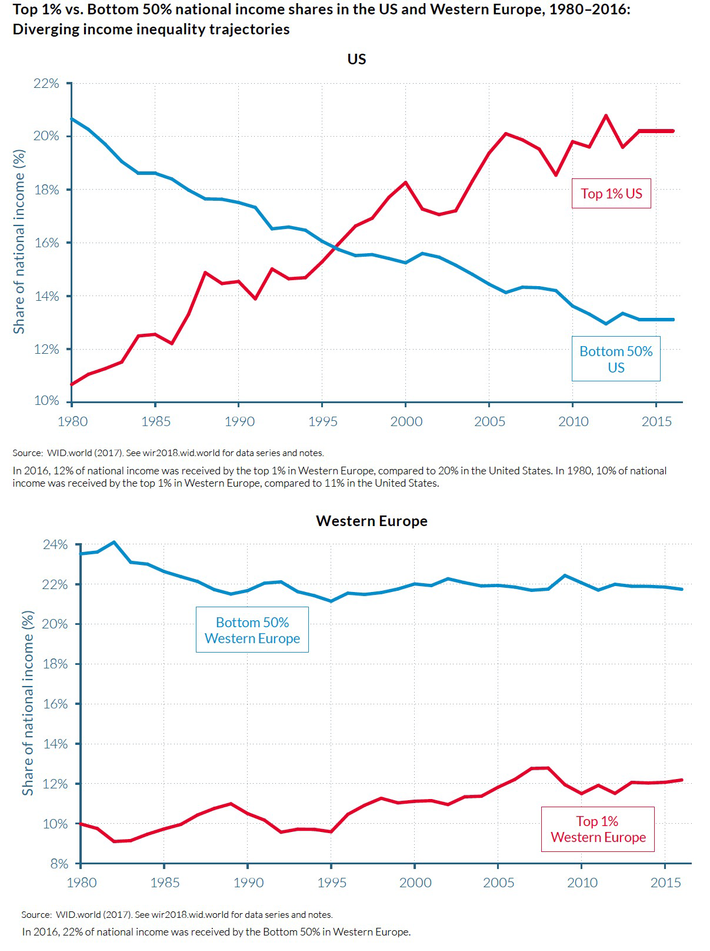
New Study Confirms That American Workers Are Getting Ripped Off

The rich (mostly white) is getting richer while everyone else (increasingly Black and brown) is being cheated by the rich.

Much of this tension has been increased during Covid because the shut downs highlighted just which workers in the U.S. are essential—the least well paid (such as service workers) and those living in the most vulnerable conditions (hourly laborers without guaranteed insurance or retirement).

If all the service workers in the U.S. did not go to work tomorrow, the country would shut down; if all the CEOs stayed home, no one would notice.

White people are afraid of losing their unfair advantage of simply being white, and that fear is driven by a changing world, a changing country.

Attacks by Republicans on CRT and the 1619 Project are crass fear-mongering and a distraction, driven by white fear.

CRT and the 1619 Project are not any significant part of K-12 schooling, and white students are not being taught they are inherently evil because they are white.

White folk perpetuating these lies are doing so because they are afraid; they are afraid of what they see in any mirror they face.

A Case for Critical Race Theory, and More

White privilege is a system of advantage that benefits all white people (or to be more clear, all people who are perceived of as white).

That racial privilege, however, is no guarantee of success or shield of protection for some individual people who are white. White people fail, white people suffer inequity and disadvantages (such as poverty), and white people in some individual cases are substantially worse off than individual Black people.

Racism is a system of power and race that disadvantages all Black people in the U.S. (or to be more clear, all people who are perceived of as Black).

Racism is not a universal barrier to success or happiness or achievement, but it is a pervasive burden that tints every aspect of living for any Black person.

Black people are typically more starkly aware of racism (nearly moment by moment) than white people are of white privilege; white privilege works in an invisible way for white people while racism is a blunt object for Black people.

Race, however, is not biological; race is a social construction that has very real consequences because of the systems of white privilege and racism.

Conservative white men with power, political power, have launched a campaign against their own distorted and purposefully misleading characterization of critical race theory (CRT), a narrow and complicated legal and academic term and concept.

First, CRT is not practiced or implemented in the vast majority of K-12 schools, and is rare in higher education. I am speaking as someone who has taught about 20 years each in K-12 and higher education while being a critical educator.

Critical educators are rare, and at best, we are tolerated; but being a critical educator has professional negative consequences because being “critical” is a commitment to challenging systemic forces.

As the attack on CRT shows, people take personal and individual offense when systems are challenged.

Even though white people in the U.S. on average earn more and hold disproportionate positions of power than Black people, white people perceive anti-racism efforts (which are designed to dismantle white privilege) as an attack; white people perceive a creeping loss of their privilege even as they deny that privilege exists.

To be blunt, reaching a state of equity and equality in the U.S. would be a material change in the lives of white people. Change is terrifying to those who are born into a state of advantage.

Equity and meritocracy realized, then, in the U.S. is a threat to white privilege.

Anti-racism efforts, which include concepts such as CRT, are not some sort of reverse racism, not a blanket condemnation of white people.

Again, white privilege and racism are systemic, as CRT argues, built into the fabric of most if not all institutions in the U.S. including policing and the judicial system (which CRT specifically addresses). But white privilege and racism are also built into formal education and, as the 1619 Project proposes, into the very core of capitalism and the U.S. economic system.

Anti-racism efforts, including those found in K-12 and higher education, ask educators and students to consider how racism happened (historically) and to examine critically how white privilege and racism remain in our contemporary daily lives in the U.S.

The backlash against CRT has had some high-profile consequences, including Nikole Hannah-Jones being denied tenure at the University of North Carolina through a process that is overtly partisan politics—the same conservatives decrying CRT punishing the most prominent face of the 1619 Project, which sits at the center of this storm.

That politically partisan denial of tenure occurred around the birthday of Malcolm X, who I think serves an important point here.

Malcolm X was considered during his life a radical, in today’s language “critical,” and despite his careful and powerful rhetoric when positioned in the mainstream media of his day, he was demonized as the exact embodiment of racial threat that white Americans were openly embracing in the 1960s.

To understand racism in the U.S., consider this from Malcolm X: “History proves that the white man is a devil.”

For knee-jerk conservatives, this is proof of Malcolm X himself being racist.

But read in its full and clear language, the comment is not racist since it is grounded in “history proves.” Malcolm X is drawing a valid generalization about white people based on Black people living in the reality of active individual and systemic racism in the U.S.—from slavery to Jim Crow, from separate bathrooms and water fountains to segregated schools, from lynchings and the rise of the KKK to interracial marriage being illegal until the mid-1960s.

Racism is a set of race-based generalizations based on stereotypes, not evidence. I won’t list them here, but white racism toward Black people includes the very ugliest of claims about Black people that have no basis in fact, no historical, biological, or sociological evidence.

Part of the backlash against CRT is simply denial and racial discomfort, but that backlash is also a profound misconception about the fact of racism. Conservatives are apt to claim that the U.S. is not a racist country, and that any racism in the U.S. is merely a thing of the past.

Let me offer here two examples of why CRT and anti-racism efforts are valid, and must be central to formal education.

First, CRT argues that our current systems have racism baked into them because they were designed and created when, in fact, being virulently racist was not only socially and politically acceptable, but often a social and political advantage.

For example, Ben Tillman had a long successful political career in South Carolina (1890-1918), as governor and U.S. Senator. Tillman is something of an extreme example, but he was one of may white men who were racist and creating the laws that govern this county.

Detailed at Historic Columbia are some of the key elements of Tillman as racist politician who helped created our current systemic racism:

In a 1909 speech at the Red Shirt Reunion in Anderson, SC, Tillman boasted about his role in the 1876 murder of six Black militia members, whom he called “negro thugs.” White leaders celebrated the “Hamburg Riot” as a key victory of the 1876 Red Shirt paramilitary campaign, which successfully intimidated Black voters and stuffed ballot boxes to ensure the election of Wade Hampton III, and with it, the end of Reconstruction. Today, these murders are known as the Hamburg Massacre, one of the earliest lynchings in South Carolina.

Although he began as a perpetrator, Tillman later used his platform as governor and senator to serve as an instigator of and advocate for racial violence. Perhaps his most well-known pronouncement occurred in an 1892 speech, when, as governor [emphasis added], he vowed that “I would lead a lynching”–a claim carried by the state’s leading newspapers. His election to the governorship in 1890 unleashed what human rights activist Modjeska Monteith Simkins later called “an era of lynching.” By the end of the decade, at least 53 men, 51 of whom were Black, were lynched in South Carolina.

Yet, Tillman was most proud of his role in the Constitutional Convention of 1895, which introduced an “understanding clause” and poll tax as barriers to the vote, designed to eradicate Black participation in government. In a speech to his fellow United States Senators [emphasis added] five years later, he reminded them that, “We [South Carolinians] did not disfranchise [sic] the negroes until 1895. Then we had a constitutional convention convened which took the matter up calmly, deliberately, and avowedly with the purpose of disenfranchising as many of them as we could under the fourteenth and fifteenth amendments….” This speech affirmed a sentiment repeated throughout his career on the national stage about the role of African Americans in American democracy:

“We of the South have never recognized the right of the negro to govern white men, and we never will. We have never believed him to be the equal of the white man, and we will not submit to his gratifying his lust on our wives and daughters without lynching him.”

Historic Columbia

Today, we all live in a country under systems intentionally designed to be racist—some as overt as Tillman but others far more subtle (consider the sentencing differences between powder and crack cocaine and racial disparities in police shootings).

CRT and anti-racism efforts ask us to consider how these racial disparities came to be, how they continue to exist in today’s society, and what we can do to dismantle the inequities.

Denial and neutrality allow racism and racial inequity to remain; only naming, exploring critically, and confronting racism can erase racism.

Consider this second example, drawn from headlines within the last decade.

How did the killing of Tamir Rice by a police officer occur?:

“Shots fired, male down,” one of the officers in the car called across his radio. “Black male, maybe 20 [emphasis added], black revolver, black handgun by him. Send E.M.S. this way, and a roadblock.”

But the boy, Tamir Rice, was only 12. Now, with the county sheriff’s office reviewing the shooting, interviews and recently released video and police records show how a series of miscommunications, tactical errors and institutional failures by the Cleveland police cascaded into one irreversible mistake.

In Tamir Rice Case, Many Errors by Cleveland Police, Then a Fatal One

A racist stereotype (Black males are inherently dangerous and violent) combined with implicit bias (Black children are viewed as much older and more mature than their biological ages) led to the death of Rice. This tragic event is a real-life manifestation of what CRT argues, systemic forces with material consequences for Black people.

A police officer shooting and killing a Black boy, then, does not have to be a consciously racist individual to have acted in a way that is driven by systemic racism.

As further evidence, just a few years later, Kyle Rittenhouse, then 17, shot and killed two people during protests in Wisconsin. The same conservatives attacking CRT refer to Black boys as “men” and Rittenhouse as a “boy.”

Attacks on CRT and anti-racism initiatives are embarrassing and offensive caricatures; these attacks are themselves racist and provide the evidence proving why CRT and anti-racism practices remain necessary.

We are now facing a paradox because the misleading attacks on CRT are justification for increasing CRT and other anti-racism efforts in K-12 and higher education.

CRT is incredibly rare in any formal education setting. More K-12 and higher education situations are incorporating (often begrudgingly) anti-racism practices and examinations (which may or may not have elements informed by CRT).

Diversity, equity, and inclusion experiences for children are not blaming all white people or white students simply for being white; but those discussions are designed, as noted above, to critically explore how evidence-based racial disparities came to be, how they continue to exist in today’s society, and what we can do to dismantle the inequities.

Being white is not a crime, but denying racism is itself an act of racism.

To take a stand against anti-racism (against CRT) is taking a stand for racism.

In this case, we can say “not all white people,” but clearly identify those people white or Black who are to blame when they seek ways to deny and perpetuate the racism that remains in our daily lives.

The Problem of Student Engagement in Writing Workshop

Imagine you are a teacher who says to students, “You can revise your work as often as you want to learn as much as you can and achieve the grade you want.”

Imagine you are student who replies, “No thanks.”


As a critical teacher and teacher educator, I have spent about 40 years not swimming against the stream but floating, isolated, in an entirely different body of water.

I have not graded assignments or given tests for about 30 of those years, and for nearly all of my teaching career, my students have experienced a workshop format for learning. Distinct from writer’s workshop in creative writing, the workshop I implement is grounded in concepts often associated with Nancie Atwell, who popularized workshop as designing instruction/learning around time, ownership, and response.

The instructional workshop model I practice allows students large blocks of time (during class sessions and between the start and end of an assignment), varying degrees of choice in how to focus an assignment, and ample as well as repeated feedback from me and their peers to foster revision.

When I taught high school English, students spent most of class time engaged in modified versions of reading or writing workshop. For almost two decades at the university level, I have primarily been implementing writing workshop in my first-year writing seminar and more recently in an upper-level writing/research seminar.

Since I don’t grade assignments or give tests, my students submit portfolios at the end of each semester; those portfolios in writing-intensive courses are primarily final drafts of major writing assignments. Also central to having a course that is non-graded, students have minimum expectations for participating in courses that I frame as non-negotiable for being allowed to submit the final portfolio/exam and for being assigned a grade in the course [1].

The short version is that students who do not meet minimum requirements are assigned a failing grade for the course.

Grading from those final portfolios is fairly easy and quick since I have been responding to the assignments throughout the semester; however, part of my process is to review each student’s folder of assignments to note how often they have revised and resubmitted their work.

I am often frustrated, even disappointed, that several students participate only in the minimum requirements although I allow and encourage students to revise and resubmit as often as they want.

Student participation in revising/resubmitting tends to fall into four categories: students who revise/resubmit far too quickly and too often, resulting in me doing more of the revising than them (I do address this); students who eventually “get it” and revise/resubmit with care and purpose while embracing their own autonomy and role in revising; students who do the bare minimum and cannot rise above the role as “dutiful student” to embrace being an engaged writer/scholar; and then, students who actively and passively refuse to participate.

Especially when teaching at the secondary and college levels, those of us practicing non-traditional approaches (non-grading, workshop) are asking (imploring?) students to set aside a decade-plus of learned behavior that is grounded more in student behavior than authentic behavior (seeking grades instead of focusing on learning, turning in paper assignments instead of writing an essay they choose to an audience they imagine or have provided).

Even when I stress in nearly every class session that students are required to revise and resubmit major writing assignments, that students are also allowed to revise and resubmit throughout the course, and that ultimately full engagement in the workshop model tends to result in higher course grades, I find a significant number of students doing the bare minimum and have to nearly drag kicking and screaming a few out of their insistence to fail the course.

As one extreme example, I had a first-year writing student who turned in no essays throughout the semester, even though they attended class, and then submitted all four essays in the final portfolio; that student was stunned and upset at receiving an F.

It is from the barely engaged and not engaged students that I learned the following reasons some (too many) students never fully commit to writing workshop:

  • Misunderstanding the differences between editing and revising.
  • Perceiving formal schooling as product-oriented, not process-oriented.
  • Viewing feedback as criticism.
  • Failure to recognize that when one is becoming a writer, there is no finish line.
  • Misunderstanding the role of teachers (seeing teachers as evaluators instead of mentors).
  • Having little or no sense of autonomy as a learner (or a human).
  • Functioning in the defensive student pose of avoiding mistakes (not submitting work means nothing can be identified as “wrong”); being risk-averse instead of risk-embracing.
  • Viewing the relationship between a teacher and student as antagonistic instead of collaborative.
  • Being trapped in the paralysis of perfectionism.

As I approach the end of four decades teaching, mostly focusing on teaching writing, I am faced with a burdensome paradox about my non-graded workshop approaches to teaching: students learn more and earn higher grades when they are fully engaged in the non-graded workshop approach, but many remain unable or unwilling to make the commitment necessary to realize those advantages.

Teaching writing well in a workshop model is incredibly labor intensive, but also extremely rewarding; however, it is also easy to be discouraged by the students who simply cannot or will not allow the process to benefit them.

For those students, the negative consequences of traditional approaches to teaching and grading have failed them, possibly irrevocably.


[1] My minimum requirement statement from my upper-level writing/research course (recently revised):

Course Minimum Requirements

As a student in an upper-level writing/research course, you are required to meet the following minimum requirements in order to receive credit (have a grade assigned) in the course:

  1. Submit all assignments and meet deadlines throughout the semester.
  2. All major writing assignments (annotated bibliography, cited essay, and public commentary) must be submitted in multiple drafts (first full submission and at least one revision) that include at least one conference per assignment with the professor. 
  3. The second half of the course is a writing/research workshop; all students are required to submit multiple drafts during the course (before the last course session) in order to fulfill the course minimum requirements. Failure to participate fully in the workshop for the major assignments (annotated bibliography, cited essay, and public commentary) will result in an F for the course and students may not submit a final portfolio.
  4. Scholarly work must be properly cited and free of plagiarism; scholarly work should be formatted and submitted as required and should conform to the APA 7e style manual when appropriate.

Thinking Critically about Critical Thinking in the Era of Trump and TikTok

While it now seems like generations ago, in the spring of 2008, I joined other faculty at Furman University in an organized protest labeled “We Object.” Through the university’s connections with FU graduate and former governor of South Carolina Mark Sanford, George W. Bush was invited to speak at commencement.

Recent university tradition was to have two students speak, but did not include outside speakers. None the less, students and the community (overwhelmingly conservative) seemed to welcome the opportunity to have a two-term Republican president speak to graduates.

The protest took many forms, including reaching out to the media, posting an official “We Object” statement, and wearing a “We Object” shirt, revealed from beneath professor’s gowns during the speech.

I did not yet have tenure as an assistant professor, but I was active in the organized resistance that included a wide range of reasons why professors were objecting. I attended meetings, helped with the statement, and provided interviews to the media (I did not stand and protest during graduation, however).

One aspect of that spring that now looks like a harbinger of the world in which we live today was an Op-Ed published by two conservative professors in political science. In that piece, they discounted the professors protesting as postmodernists.

Two problems stand out from that commentary. First, as is typical of conservative thinkers, they either did not understand postmodernism or willfully misrepresented postmodernism in order to have a strawman to attack. Second, when those of us protesting gathered after the piece was published, we uniformly confirmed that not a single one of us considered ourselves postmodernists (an intellectual movement now well in the past, supplanted by the ever-inane, in fact, post-postmodernism).

Conservatives have long posed postmodernism as a full rejection of truth/Truth (which it isn’t), but the great irony of being falsely slandered as postmodernists is that we objecting were all doing so on very clear ethical grounds.

A logical and dangerous extension of postmodernism’s challenge to the nature of truth/Truth is, of course, that there is no truth; many academics quickly rejected that path. In its purest form, however, postmodernism attempted to emphasize that truth/Truth is never objective but always a pawn of those in power.

In other words, postmodernism posed that truth/Truth is almost always what people in power say is truth regardless of empirical evidence (truth couched in power versus truth gleaned from evidence).

While scholars in philosophy, literature, and the arts had moved through and past postmodernism in many ways, this moment in 2008 certainly was a harbinger for the conservative and popular bastardization of postmodernism by Trump and the youngest generations in the U.S.—fake news and the power of social media to create (distort) truth/Truth.

The paradox of Trump is that he has become the embodiment of “there is no truth except what I declare is true” (even when those claims are baseless and repeatedly self-contradictory). Yes, Trump’s appropriating “fake news” to prop up his pathological lies and power-mania are exactly the worst of problems with truth/Truth that postmodernism was confronting.

Even Trump’s use of the term “fake news” is itself false (an ignorant or willfully planned use similar to the one used by the two conservative professors), but Trump’s mendacity and megalomania have both spoken to and emboldened a much wider and more insidious faction of the U.S. who function with the same sort of misguided approach to truth/Truth as Trump.

Not so long ago, Fox News and Rush Limbaugh seemed like mostly harmless sideshows, things of a very small minority of people in the U.S.

In 2021, Parler and Breitbart have far surpassed what was once rightwing media—and then there is QAnon.

Just as there was a logical and dangerous natural conclusion to postmodernism, there is now a very real and dangerous outcome of simplistic approaches to critical thinking as well as honoring the democracy of ideas.

The Right in the U.S. has leveraged challenging any and every idea, fact, and authority into a chaos that allows even a greater concentration of power among very few (mostly white and male) Americans.

Republicans have aligned themselves with both Evangelical Christian conservatism and authoritarianism; democrats have increasingly become the party of ethical challenges to the status quo (a party that at least pays lip service to gender, race, and sexuality equity).

Trump’s “fake news” ploy is a scorched-Earth policy for political and financial gain.

What has happened, however, in the wider society is much more disturbing in the sense that we can see some possible end to Trump as president.

Here is just one odd and troubling example: Young people (often expressed on TikTok) in the U.S. do not “believe” in Hellen Keller.

Writing on Medium, Isabella Lahoue concludes:

Maybe we [Gen Z] don’t believe in her [Hellen Keller] because we’re growing up in a world of fake news. We know the power of manipulation and lies in the media, and we’re losing faith in the sources everyone once trusted. There’s too much data and too many lies circulating for us to process and believe it all….

We don’t have to believe in Helen Keller, and it shouldn’t be surprising if we don’t. The world we were born into makes us profoundly different than other generations, and hopefully, it will also make us into change agents.

The Generation that Doesn’t Believe Helen Keller Existed by Isabella Lahoue

In 2021, then, there are now at least three Hellen Kellers: the historical Keller (the radical socialist and activist), the myth of Keller as rugged individual [1] (the distorted version often taught in school through The Miracle Worker), and the “fake news” Keller who did not (could not?) exist.

At the root of this is critical thinking, how formal education fails to teach it by mis-teaching it (see here and here).

Questioning authority and hearing all sides have long been a part of American culture.

Like postmodernism, “critical” is too often misunderstood and almost entirely absent from formal education.

Traditional schooling has reduced “critical thinking” to skills (such as HOTS, high-order thinking skills). This approach reduced being critical to a checklist of skills and a mechanical approach to interrogating texts and ideas.

But while education has been lazy and superficial in its approach to being critical, popular culture has gone off the rails, specifically because of the power of social media to allow and foster insular communities in which that community establishes truth/Truth and controls what counts as evidence (Facebook, Twitter, reddit, etc.).

To be blunt, the anti-vaccination movement has gone mainstream—and widespread [2].

Since the insurrection at the Capitol, I have circled back to 2008, when I was mis-labled a postmodernist.

Not a postmodernist, I am a critical educator, my work grounded in Paulo Freire’s critical pedagogy.

Unlike those who suggest I believe there is no truth/Truth, my critical teaching and writing are a pursuit of both truth/Truth and that which is ethical and moral.

Critical thinking, then, is not about rejecting truth/Truth, but acknowledging that truth/Truth is always couched in power. Critical thinking, then, is not about hearing all sides, but recognizing that it is a complicated but necessary thing to recognize what is credible and what is not when interrogating a text or idea.

Critical think allows anyone to realize that Hellen Keller was a real person, a complicated human made exceptional due to challenges beyond her control. But critical thinking also allows anyone to know that rugged-individual Keller is in many ways a lie, part theater and part ideological myth-making—and that Keller denial is a dangerously frivolous thing (several magnitudes less so but overlapping with Holocaust denial).

Critical thinking allows anyone to realize there is a wide and complicated gray area between “Believe no one” and “Listen to everyone.”

Those two extremes, in fact, have joined hands and are poised to destroy democracy and the sort of slow and painful arc of history reaching for justice on a darkening horizon.

If and when Trump leaves office, and if and when he fades from public spaces, we will still have TikTok (or something like it) and Parler (or something like it) and tens of millions of people who don’t believe in Keller but do believe Trump (or someone like him).

It is again a critical time for truth/Truth.


[1] See also how Pat Tillman suffered a similar fate, being misrepresented for ideological/political purposes.

[2] I recommend A Game Designer’s Analysis Of QAnon by Rabbit Rabbit as one interesting look at how this happen with QAnon.

Making the Transition from Writing in High School to Writing in College

Three behaviors have over the course of about 40 years come to constitute a significant percentage of who I am—writing, teaching, and cycling.

Of those three, I have received the most formal education in teaching, completing all three of my degrees (BA, MEd, EdD) in education; in many ways, I am self-taught as a writer and a cyclist even though I would argue that I have developed a level of expertise in all three that are comparable.

Recently, I bought my first gravel bicycle and have been making the small but noticeable transition to gravel riding that has forced me to experiment with decades of cycling knowledge built on road and mountain bicycling in order to ride gravel at a level comparable to road cycling (my first and deepest cycling love).

This, I think, is at the core of all of my personas as writer, teacher, and cycling—behaviors that are all journeys and not aspects of my life that I can (or should) finish.

Even though, as I noted above, teaching is my primary career and what I have the most education in, I am perpetually learning to teach; and I count on my students to guide me along that path.

My teacher Self is grounded and guided by critical pedagogy; Paulo Freire‘s concepts of the teacher/student and student/teacher have always resonated with me since I started as a tinkerer in my first days as a high school English teacher and continue to depend on my students by inquiring at regular intervals “Is this working?” and “What can I do better?”

While the primary focus of all my teaching is the student, of all the content I teach, I remain most enamored with and frustrated by teaching writing.

I have now spent about equal amounts of time teaching high school students and first-year college student to write.

During the pandemic, I have also shifted one of my assignments slightly (from their final portfolio to their final essay)—requiring first-year writing students to submit as their final essay a reflection on what they have learned as writers as well as what they think they need to continue to address moving forward in their college careers.

I have read the first submissions of those reflections (and will blog about those in a week or so), but I also use the last class session to brainstorm on what worked for students in the seminars and what I can do differently (in this case, for spring 2021).

Several students during the brainstorming session requested that I provide some of the key elements of the course—those addressing their transition from high school writing to college writing—earlier.

One of the foundational lessons I learned about teaching, during my years as a high school English teacher, was the need to reduce upfront teacher-led instruction and replace that with students producing authentic artifacts of learning (essays, for example) combined with direct instruction grounded in their writing after the first submission of their work.

The feedback I received this fall suggests I have moderated too far, and thus, I am including below the first draft of a checklist I will provide students on the first day of class this spring, encouraging them to keep this throughout the semester as a focal point as they revisit these lessons and come to understand them better.

Here, then, is my Checklist: Making the Transition from Writing in High School to Writing in College:

Writing Process and Drafting

  • Writing a couple quick drafts the night before an essay is due is not genuinely engaging in the drafting process, and likely will not be effective in college (even if you received high grades in high school for this practice). Last-minute essay writing is behaving as a student (dutifully preparing an assignment as the teacher as required), and not as a writer or scholar.
  • Drafting from an approved, direct thesis (common in high school) may be a less effective writing strategy than other drafting approaches, such as the following: (1) “vomit” drafting (free writing as much as you can to create text you can reorganize and revise) or (2) discovery drafting (writing with a general idea of your topic and focus, but allowing yourself to discover and evolve your topic and focus). One commitment to the drafting process that may be different than when in high school is making the decision to abandon large sections of drafting, or even entire essays. Starting over after a discovery draft is not wasting a draft, but coming to see that writing is a way to better understand even if the text you created is not directly included in the submitted draft.
  • Committing to several days for drafting is necessary, and establishing a routine for revising that focuses on one revision strategy at a time (diction and tone, paragraphing, etc.) is often effective.
  • Reading and using as models published academic and scholarly essays along with public and creative nonfiction essays increases your toolbox as a writer. The symbiotic relationship between reading and writing should become more purposeful during college—notably that the reading and writing are for you and your learning, and not simply to complete an assignment.

Essay Writing

  • A five-paragraph essay with a one-paragraph introduction (and direct thesis), three body paragraphs, and a one-paragraph conclusion that restates the introduction is inadequate in college; the form is simplistic thinking (most topics do not have only 3 points) and writing, and guarantees you will under-develop your discussion. The essay form is far more complex that a template, and your thinking as a college student needs also to rise above reducing all arguments and explanations to a direct statement (thesis) supported by three points.
  • Write to a clear audience (not your teacher or professor), recognizing that academic writing often has a well-informed (expert), specialized audience and that a public audience can range from being poorly informed or misinformed to being highly experienced and knowledgeable (public writing, then, may require you to navigate a much more complex audience than your academic writing).
  • Avoid overstatements, especially in the first sentences of the essay and in the last few sentences. Overstatements include “since the beginning of time” (or suggesting long periods of time such as “throughout history”), “many/most people argue/debate,” and “[topic x] is important [or unique or a hot topic].” See this brilliant parody from The OnionSince The Beginning Of Time, Mankind Has Discussed What It Did On Summer Vacation.
  • Your word choice (diction) creates the tone of your essay; many scholarly/academic topics are serious so take great care that your diction/tone matches the seriousness of your topic. The relationship between your tone and your topic impacts your credibility as a writer. Focus on vivid, active, concrete verbs (instead of forms of “get” and “be”), and take care not to write as you talk, avoiding slang and flippant phrases when examining a serious topic.
  • Always prefer active, vivid, and specific/concrete over vague or general. “Anger” instead of “how he felt”; for example: “John was upset that he couldn’t control his anger” is more effective than “John was upset that he couldn’t control how he felt.”
  • Rethink the essay form and paragraphing not as a set number of sentences but as important and purposeful parts of engaging your reader/audience while establishing your credibility. Your essays should have a multiple-paragraph opening the engages and focuses your reader by being specific and vivid, several body paragraphs with purposeful paragraph lengths (sentence and paragraph length variety are effective), and a multiple-paragraph closing that leaves the reader with specific and vivid language that parallels the opening (framing) but doesn’t simply repeat your initial thoughts.
  • Learn to use the tools available in Word (or other word processors): formatting using menus (and not simply inserting spaces, returns, and tabs to manipulate text), running your essay through the grammar and spell check (be careful not to leave your essay with the colored underlinings when submitting an assignment), and saving your text files purposefully (include your last name and assignment type in the file name) and in an organized way on your computer system (making sure you have a back-up process for all files).
  • Most academic essay writing is built from claims, evidence, and elaboration; however, the types of evidence required varies a great deal in writing among the many disciplines of the academy (history, sociology, economics, physics, etc.). For example, direct quotes are often necessary as evidence when writing a text-based analysis (analyzing a poem or an essay in philosophy), but many disciplines (social sciences and hard sciences) expect evidence that is data or paraphrasing/synthesis of concepts and conclusions from multiple sources at a time (synthesis). When writing a text analysis, quotes are necessary, but your own claims and elaboration should be the majority of the essay, and take great care to integrate quotes with your own words (avoid stand-alone sentences that are quotes only and be careful to limit block quoting).; when writing about topics (not specific texts) or making arguments, you should limit quoting.
  • Academic citation (MLA, APA, etc.) is different among the disciplines (you may not use MLA again after entering college, for example), and expectations for high-quality sources also vary among disciplines. Some fields such as literature and history require older sources, yet social (sociology, psychology, education) and hard (physics, biology, chemistry) sciences tend to prefer only peer-reviewed journal articles from within 5-10 years. Across most of academia, however, journal articles and peer-reviewed publications are preferred to books and public writing.
  • Text formatting impacts your credibility as a writer; set your font preferences to one standard font and size (Times New Roman, 12 pt.) and maintain that formatting throughout a document (only using bold or italics as appropriate for subheads or emphasis), including headers/footers.
  • Always submit essays with vivid and specific titles and your name where required on the document itself.

Another aspect of my class that requires students to thing and behave differently is that I do not grade assignments even though I do assign grades for the course (per university requirements)—what I have characterized as de-grading and delaying grades.

On the last day of class, we discussed what would eventually shape their course grades, and below is something I share to help think about grades assigned in a class where assignments are not graded.

When I think about final grades in a writing-intensive course, here are some guiding principles:

  • A work: Participating by choice in multiple drafts and conferences beyond the minimum requirements; essay form and content that is nuanced, sophisticated, and well developed (typically more narrow than broad); a high level demonstrated for selecting and incorporating source material in a wide variety of citation formats; submitting work as assigned and meeting due dates (except for illness, etc.); attending and participating in class-based discussion, lessons, and workshops; completing assigned and choice reading of course texts and mentor texts in ways that contribute to class discussions and original writing.
  • B work: Submitting drafts and attending conferences as detailed by the minimum requirements; essay form and content that is solid and distinct from high school writing (typically more narrow than broad); a basic college level demonstrated for selecting and incorporating source material in a wide variety of citation formats; submitting work as assigned and meeting most due dates; attending and participating in class-based discussion, lessons, and workshops; completing assigned and choice reading of texts and mentor texts in ways that contribute to class discussions and original writing.

This spring, with the guidance of my fall students, I am going to re-think and experiment with some of my core beliefs as a teacher—when to offer direct instruction and how to navigate the tension between my de-graded courses and the reality of grades in formal schooling.

Recommended

Advice on Writing, Trish Roberts-Miller