Category Archives: Critical Pedagogy

Teacher Education and A Call to Activism

If such a thing existed, education as a profession and discipline would easily take Gold, Silver, and Bronze in the Low Self-Esteem Olympics.

Historically viewed as a woman’s profession—and thus a “second” salary—and as merely a professional discipline, education has labored under a secondary status in both the professional and academic worlds.

As a result, education chose early to be a scientific profession and discipline to counter the perception of softness—and thus, as Kliebard details, the heart and soul of education (child-centered commitments and social activism) were marginalized for the more conservative and “hard” elements (efficiency and core curriculum).

In the early decades of the twentieth century, then, a paradox developed: while many who demonized and championed education associated U.S. public schools with John Dewey, the reality was that very little progressivism was practiced but that standardized testing was established as the engine driving the education machine.

Throughout the twentieth century, IQ testing and then the SAT and similar gate-keeping standardized tests (such as the Iowa Test of Basic Skills) significantly influenced how students were labeled and then what courses students were assigned—and even if they had real access to higher education. By the early 1980s, a new era of hyper-accountability was established within which the locus of power shifted entirely to standards and high-stakes tests.

In short, teachers have been reduced to implementing the standards prescribed for them and to conducting test-prep—while the discipline of education has been almost entirely bureaucratized since education courses serve as vehicles for fulfilling certification and accreditation mandates.

In the Preface to Regenerating the Philosophy of Education (edited by Kincheloe and Hewitt, Peter Lang USA, 2011), Hewitt confesses:

Seriously. I never thought I would ever have to justify the moral importance of social foundations courses—particularly philosophy of education courses—in Ph.D. and Ed.D. programs to a committee of colleagues, all holding Ph.Ds. (p. ix)

What Hewitt and the volume are addressing, however, is the new reality about teacher education: education philosophy and foundations courses are disappearing (are gone) because more and more course work in education degrees has to fulfill demands of certification and accreditation.

No more Dewey, Greene, and Freire. But a relentless drumbeat of validity, reliability, teacher impact, and rubrics (my God, the rubrics).

Teacher educators, teacher candidates, and practitioners—all are now not in the business of investigating and building/re-building the profession and discipline of education, but are soldiers taking marching orders from bureaucrats and technocrats.

No more “What is the purpose of universal public education in a free society?” but instead “How do we raise test scores among poor and black/brown students?”

And as I have pointed out before, among those of us in teacher education—who work in higher education where many of us have tenure and are full professors“we have met the enemy and he is us.”

Teacher education has continued the most self-defeating aspects of being a low self-esteem profession and discipline by trying way too hard to prove we are like “hard” disciplines—scrambling to be like psychology while sacrificing our sociological roots, battering our majors and candidates with statistics and measurement while reducing educational philosophy to surveys at best and eliminating it entirely at worst.

And to drift a bit into irony, philosophy is extremely illustrative of the problem facing education. Gilles Deleuze explains:

We are in a generalized crisis in relation to all the environments of enclosure—prison, hospital, factory, school, family. The family is an “interior,” in crisis like all other interiors—scholarly, professional, etc. The administrations in charge never cease announcing supposedly necessary reforms [emphasis added]: to reform schools, to reform industries, hospitals, the armed forces, prisons….

In the disciplinary societies one was always starting again [emphasis added] (from school to the barracks, from the barracks to the factory), while in the societies of control one is never finished with anything—the corporation, the educational system, the armed services being metastable states coexisting in one and the same modulation, like a universal system of deformation. (pp. 3-4, 5)

Education, then, as bureaucratic and technocratic has characteristics of both societies of control and disciplinary societies—”always starting again” and “never finished with anything” as characteristics of the accountability paradigm driven by ever-new standards and ever-new high-stakes tests.

But for all the bluster about being “scientific” and the relentless mantra of “crisis,” bureaucratic and technocratic education has failed to examine the data and re-evaluate the process: after nearly a century of standardized testing and over three decades of accountability, most “problems” all of that has been fashioned to address remain the same: poverty and inequity, racism, sexism, and homophobia still plague society and the schools designed to serve and even change that society.

The short version is that bureaucratic and technocratic education has not worked—except to destroy the heart and soul of education as a profession and discipline.

At both the K-12 and higher education levels, the school year is beginning all across the U.S. We in teacher education are spending much if not most of our time as soldiers in the certification and accreditation wars—recalibrating syllabi to standards and rewriting our rubrics to meet those new standards as well.

We in teacher education are so busy complying to bureaucratic and technocratic mandates, and so-long beaten down by the demand that we avoid being political (and thus remain compliant and silent), that we are embodying the very caricature of what educators and education professors are, paradoxically, as we rush to prove our profession and discipline are “hard,” scientific: rarely scholarly, superficial, and simplistic. 

K-12 teachers are increasingly even less powerful than the profession has been forever; therefore, teacher education—where we are tenured and full professors—is the last best hope for reclaiming the heart and soul of universal public education from the bureaucrats and technocrats.

We must reclaim the coursework and the discipline—ripping off our low self-esteem and standing proudly with our philosophy, theory, history, and methodology.

As a profession, education is a human endeavor, guided by our hearts and anchored by our souls. Teaching daily is messy, unpredictable, and chaotic.

None of that is “soft,” or hedging accountability.

As a discipline, education is rich and still in a constant state of becoming.

I cannot stress enough that over a thirty-plus-year career as first a public school English teacher and now a teacher educator, I don’t need standards, I don’t need tests, and I damn well don’t need rubrics to teach.

I do need students, and I do need courses to teach.

But these are trivial matters, irrelevant, as long as teacher educators remain dedicated soldiers in the bureaucratic and technocratic education war.

Now, we do need defectors, conscientious objectors—teacher educators willing to resist, to speak up, and act out.

Especially those of us with tenure and who are full professors, we need not be the enemy—we can and should do better.
 

Failing Still to Address Poverty Directly: Growth Mindset as Deficit Ideology

Reporting in Education Week, Evie Blad explains:

Having a growth mindset may help buffer students from low-income families from the effects of poverty on academic achievement, researchers found in a first-of-its kind, large-scale study of 168,000 10th grade students in Chile.

But poor students in the study were also less likely to have a growth mindset than their higher-income peers, researchers found.

Similar to the popularity of “grit” and “no excuses” policies, growth mindset has gained a great deal of momentum as a school-based inoculation for the negative impact of poverty on children.

The binaries of growth and fixed mindsets are often grounded in the work of Carol Dwek, and others, who defines each as follows:

According to Dweck, “In a fixed mindset, people believe their basic qualities, like their intelligence or talent, are simply fixed traits. They spend their time documenting their intelligence or talent instead of developing them. They also believe that talent alone creates success—without effort.”…

Alternatively, “In a growth mindset, people believe that their most basic abilities can be developed through dedication and hard work—brains and talent are just the starting point. This view creates a love of learning and a resilience that is essential for great accomplishment,” writes Dweck.

However, the media, the public, and educators often fail to acknowledge two significant flaws with growth mindset: (1) the essential deficit ideology that focuses all of the blame (and thus the need for a cure) in the individual child, and (2) the larger failure to see the need to address poverty directly instead of indirectly through formal education.

First, then, let’s consider deficit ideology [1], as examined by Paul Gorksi:

Briefly, deficit ideology is a worldview that explains and justifies outcome inequalities— standardized test scores or levels of educational attainment, for example—by pointing to supposed deficiencies within disenfranchised individuals and communities (Brandon, 2003; Valencia, 1997a; Weiner, 2003; Yosso, 2005). Simultaneously, and of equal importance, deficit ideology discounts sociopolitical context, such as the systemic conditions (racism, economic injustice, and so on) that grant some people greater social, political, and economic access, such as that to high-quality schooling, than others (Brandon, 2003; Dudley-Marling, 2007; Gorski, 2008a; Hamovitch, 1996). The function of deficit ideology, as I will describe in greater detail later, is to justify existing social conditions by identifying the problem of inequality as located within, rather than as pressing upon, disenfranchised communities so that efforts to redress inequalities focus on “fixing” disenfranchised people rather than the conditions which disenfranchise them (Weiner, 2003; Yosso, 2005).

Any person’s success or failure can be traced to a number of factors, but in the U.S., our blind faith in the rugged individual defaults to ascribing credit and blame at least initially if not totally to the individual’s character traits such as “grit” and a growth mindset.

Student X is successful because of Quality A, and thus, Student Y’s failure is due to a lack (deficit) of Quality A; therefore, formal education must instill Quality A into Student Y.

This formula is compelling, again, because of our cultural myths, but also because the formula is manageable and seemingly efficient—and since efficiency is at the core of how we design and run schooling, the media, the pubic, and most educators fail to step back critically in order to reimagine how to deal with students holistically and generatively instead of through the traditional deficit model.

As a simple but representative example, most of us have taken a paper-and-pencil test in our schooling, one on which the teacher marks answers wrong with an X and then calculates our grade at the top of our papers—as in “100 – 30 = 70.”

This process is the deficit ideology that starts with every student having 100 and then defines that student’s learning on the test by what is missed, what is lacking.

One way to flip this ideology is to recognize that all students actually begin each assessment with 0 (no work has been done), and then the grade should be built on what learning and understanding the student demonstrates: simply checking the accurate responses and then giving credit for those positives.

The entire traditional approach to formal education in the U.S. is a deficit ideology, but the hyper-emphasis on children living in poverty, and black/brown students and English language learners, has increased the power of deficit approaches through growth mindset, “grit,” and “no excuses.”

Consequently, we routinely demand of children in the worst situations of life—through no fault of their own—that they somehow set aside those lives when they magically walk into school and behave in ways (growth mindset, “grit”) that few adults do who are also burdened by forces more powerful than they are.

Despite the enduring power of the rugged individual and meritocracy myths, the burden of evidence shows that privilege (race, class, and gender) continues to trump effort and even achievement in the real world: less educated whites earn more than more educated blacks, men earn more than equally educated women, and so forth.

But research also refutes the claims of growth mindset and “grit” that achievement is primarily the result of the character of the individual. The same person, in fact, behaves differently when experiencing slack (privilege) or scarcity (poverty).

As Sendhil Mullainathan and Eldar Shafir detail extensively, living in scarcity (poverty) drains a person of mental capacities the same as being sleep deprived; therefore, the solution to “buffer students from low-income families from the effects of poverty on academic achievement” is to address poverty directly instead of trying to “fix” the students who are victims of that poverty.

In other words, if we relieve children of food insecurity, home transience, etc., we are likely to find that those students in poverty who appeared to lack “grit” and growth mindset would then demonstrate those treasured qualities.

We are currently misdiagnosing growth mindset and “grit” (as deficit ideologies) as causal characteristics instead of recognizing them as outcomes of slack (privilege).

The deficit ideologies of formal schooling—particularly those (growth mindset, “grit”) targeting impoverished and black/brown students—are the entrenched indirect approaches to alleviating poverty criticized by Martin Luther King Jr. in 1967:

At no time has a total, coordinated and fully adequate program been conceived. As a consequence, fragmentary and spasmodic reforms have failed to reach down to the profoundest needs of the poor.

In addition to the absence of coordination and sufficiency, the programs of the past all have another common failing — they are indirect [emphasis added]. Each seeks to solve poverty by first solving something else.

I am now convinced that the simplest approach will prove to be the most effective — the solution to poverty is to abolish it directly [emphasis added] by a now widely discussed measure: the guaranteed income.

Ultimately, teaching disenfranchised and struggling students growth mindset and “grit” come from, mostly, good intentions that are tragically trapped in deficit ideologies.

The great and tragic irony of growth mindset advocates is that they are also victims of deficit ideologies—as they focus their “scornful gaze” on poor children and children of color.

And just as we have allowed coded racism such as “thug” to replace the now taboo racial slur “nigger,” we are embracing deficit ideology cloaked as scientism to label students as lacking growth mindset and “grit” to mask the very ugly suggestion that these children are simply lazy.

Let us embrace instead as educators a redirected focus—as Gorski implores:

Hegemony is a difficult thing to break. In order to break it, we must consider our own complicity with it and our socialization for compliance. We must avoid the quick fix and the easy answer. We must bare the price of refusing compliance, knowing that by looking up, by training our gaze toward the top of the power hierarchy, we might strain our necks, not to mention our institutional likeability, more so than we do when we train it downward, where we pose no threat to the myths that power the corporate-capitalist machine. But if we do not break hegemony, if we do not defeat deficit ideology, we have little chance of redressing, in any authentic way, its gross inequities. This, we must realize, is the very point of the redirected gaze: to ensure and justify the maintenance of inequity and to make us— educators—party to that justification and maintenance.

The social and educational inequities in the U.S. must be our targets for repair—not our students. And thus, we are left with a dilemma confronted by Chris Emdin: “The time will always come when teachers must ask themselves if they will follow the mold or blaze a new trail. There are serious risks that come with this decision. It essentially boils down to whether one chooses to do damage to the system or to the student.”


[1] See also Dudley-Marling, C. (2007). Return of the deficit. Journal of Educational Controversy, 2(1).

Why Education: Critical Literacy, Freedom, and Equity

The presidential election cycle provides one powerful and disturbing lesson in the U.S.: formal education has failed to accomplish the single most important aspect of why universal public education is essential for a free and just people.

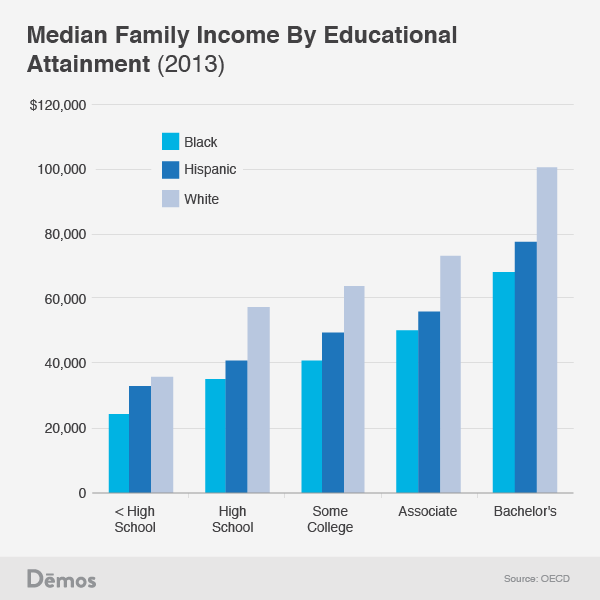
Often, we view formal education as a key to economic success, emphasizing the strong correlation between higher educational attainment and greater income. But we also remain committed to our mythologies and cultural narratives about education being the “great equalizer.”

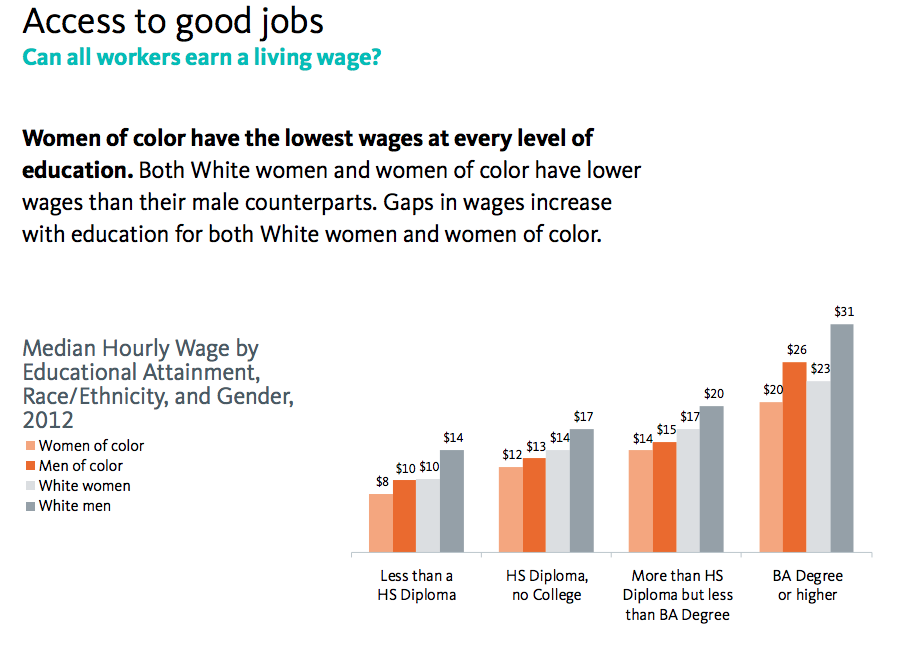
However, as this discussion will examine further, these beliefs are not supported by evidence. Yes, greater educational attainment correlates well with income, but schooling does not create equity; for example, see the inequity remaining by race:

fig_2

And the inequity remaining by race and gender:

access to good jobs race gender

While the relationship between formal education and any person’s career and earning potential remains incredibly important in a capitalistic society, the single most important aspect of why universal public education is essential for a free and just people remains the relationship between formal education and freedom as well as social equity.

Integral to the role of formal education as it contributes to individual freedom and societal equity is critical literacy: “challeng[ing] the status quo in an effort to discover alternative paths for self and social development.” For Paul Freire, a founding thinker in critical pedagogy, critical literacy is the ability to read and re-read the world along with the ability to write and re-write the world (see Freire’s The Pedagogy of the Oppressed).

In more accessible language, critical literacy is the ability of any person to act on her/his world instead of being a slave to that world.

Critical literacy is living instead of simply surviving.

Here I want to offer one caveat: As I note often, formal schooling is not the only way to being educated. Many people (writers notably) have achieved a high level of awareness and education in spite of formal schooling.

Yet, universal public education—as created by our very flawed founding fathers—was rightfully placed as essential if people were to achieve freedom and if a country were to ever become equitable (in our inception, we were far from that; today, equity remains a goal of the U.S., not something we have achieved).

But being well educated is not simply about the acquisition of knowledge (what Freire rejected as the “banking” concept of education). Being well educated is about being able to acquire knowledge in order to investigate and interrogate that knowledge: What is the source of that knowledge? Whose interest does that knowledge serve?

Despite being economically and militarily powerful, the U.S. remains stagnated, when compared to other democracies, in a belief culture—stubbornly clinging to unwarranted beliefs despite an abundance of evidence easily accessible to anyone.

My public writing is dominated by interacting with well-educated people (often edujournalists) who are committed to provably false claims, and daily I interact with family, friends, and students who also cling to falsehoods and function while holding contradictory beliefs.

These experiences are vivid to me because they reflect my own journey, having been raised in the South and indoctrinated with beliefs that I now reject strongly—racism, classism, sexism, homophobia.

Much of my life over the past thirty years has been stepping back from beliefs that I discover are false, flawed. That process is hurtful, disappointing, even embarrassing.

Even though I am 55 and well educated, it still happens.

When teaching writing, I am so aware of the power of misconceptions and false beliefs, that I teach students to focus on misconceptions when doing public writing—a dependable pattern of “you likely think X is true, but consider this.”

And throughout all my teaching, grounded in critical pedagogy, I foster critical literacy as a foundational commitment to individual freedom and equity.

Let me end with a couple examples.

Critical literacy is an awareness of and investigation of codes. For example, why are blacks often called “thugs,” but whites demonstrating similar behaviors are not? Because “thug” is a code for “nigger” that remains socially acceptable only because of a lack of critical literacy.

And research shows that when whites are confronted with the fact of racism, they immediately emphasize their own hardships. This also is a lack of critical literacy.

Critical literacy allows an understanding of percentages: more whites are shot by police because whites outnumber blacks about 5 to 1, but blacks are more likely to be shot by police in terms of percentages—a fact of racial inequity.

Finally, as well, that whites suffer hardships isn’t the issue—because whites do. Racism is about power, and the fact that white hardship is not because of being white while black hardship often is because of being black.

Belief is dangerous because it oversimplifies the world to the point of being harmful.

Critical literacy is about being able to step back from those simple beliefs in order to negotiate and even change the real and complex world.

This is the more important why of education, more important than what job or salary anyone will have or achieve.

Education is about taking control of life so that it doesn’t happen to you, so that it doesn’t steamroll over you.

Without critical literacy, a people become pawns to demagogues and buffoons.

We are a people without critical literacy and that may result in our being the pawns we deserve to be.

Bigotry, George Carlin, and My Critical Journey

As I have noted many times, George Carlin and Richard Pryor were instrumental in saving me from my redneck past.

As a frail, anxious, and highly insecure teen, I sat in my room alone listening to their comedy albums over and over—memorizing, yes, but listening very carefully because I wanted to understand what these men were saying.

These were revolutionary ideas to a redneck in South Carolina in the 1970s.

With the death of Muhammad Ali, I have been drawn back to my Classic Gold collection of Carlin’s first three albums, anchored for me by his “Muhammad Ali – America the Beautiful” on Class Clown:

But as I have been listening, my recognition that Carlin and Pryor are foundational to my critical journey—especially as an educator—has been shaken by coming back to Carlin as I sit in my mid fifties.

Two routines—”White Harlem” and “Black Consciousness” on Occupation: Foole—have pushed me even further into the tension that exists in pop culture, a tension I have examined regarding Marvel Comics Captain America:

And as I have been contemplating these routines, mostly about race and the politics of race, the Orlando massacre has forced me to highlight what is possibly the most important joke from Carlin for me in terms of everything it represents about why I was drawn to his work, why it still speaks to me, and why I am deeply concerned about both of those.

Carlin was born a couple years before my father and we are separated significantly by regional and religious backgrounds; however, we still share some commonalities that distinguish us from younger generations.

During Carlin’s riff on his old neighborhood—Morningside Heights bounded by Columbia University and Harlem, and labeled as “White Harlem”—he offers his sharp observation about language, noting that in his time, the words “fag” and “queer” meant different things: A fag, Carlin explains, is someone who wouldn’t go down town with you to beat up queers.

The audience roars on the albums—and I am forced to contemplate the ugliness beneath the laughter.

Carlin as social critic and master wordsmith always laid the world before us—and in his routines, characters, and rants, I believed him to be critical of that world he portrayed.

But just as Captain America’s popularity reveals the very worst of mainstream U.S. bigotry (regardless of the creators’ and many writers’ and artists’ since intentions), I see beneath Carlin’s routine that the audience response is about laughing at marginalized people due to sex or sexual identification.

Carlin’s race riffs seem to be as problematic. White Harlem? Really?

Carlin also explains that if you put five really white guys with black dudes for a while, the white guys will start to talk, act, and walk as the black guys do.

I think Carlin genuinely valued his growing up close to and in black culture, but I am not sure he understood appropriation—and I am certain his audience did not.

When a Sport Illustrated article repeated praises a female Olympic swimmer by framing her as “like a man” (at the subtle and seemingly harmless-but-not end of the scale) and when fifty people are slaughtered for being in a gay nightclub just a year after nine people were slaughtered in a church for being black, I have to ask are these routines by Carlin funny? Were they ever funny?

And, for me this is important, how complicit is Carlin in perpetuating the horrors of homophobia, sexism, misogyny, and racism?

It seems a very privileged thing to sit in a theater and laugh at a man, self-proclaimed foole, telling jokes and using dirty words:

I memorized Carlin and Pryor—and I took their routines to school everyday as a shield against getting beat up, probably not against the threat of physical abuse but getting beat up socially and psychologically because I was skinny and insecure—I simply was not man enough, I feared.

In the late 1970s, I was entirely unaware that I was already shielded from those threats in most ways, being white, male, and heterosexual.

I was entirely unaware of how cruel and wrong this world was and is, even though Carlin and Pryor had opened the door for me to discover all that in the coming years of college.

My critical journey has been a tremendously privileged one—one in which I have been afforded the role of witness, informed by James Baldwin and many others who have been passengers.

Just as Kurt Vonnegut taught me the sacred value of kindness, Carlin and Pryor proved to me that words matter—but our critical journey must step beyond words even as we correct them.

In a year, we have placed at our feet the Charleston Massacre and the Orlando Massacre. I find little joy in listening to Carlin because I must ask: What are we going to fucking do?

Christopher Emdin Confronts “White Folks’ Pedagogy”: “whether one chooses to do damage to the system or to the student”

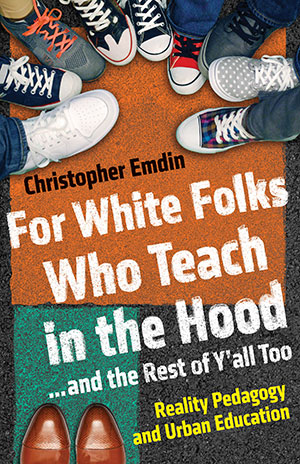
In his For White Folks Who Teach in the Hood…and the Rest of Y’all Too, Christopher Emdin confronts “classroom colonialism” (p. 14), and clarifies earlier in his Preface:

What I am suggesting is that it is possible for people of all racial and ethnic backgrounds to take on approaches to teaching that hurt youth of color….

I argue that there must be a concerted effort…to challenge the “white folks’ pedagogy” that is being practiced by teachers of all ethnic and racial backgrounds. (pp. viii-ix)

978-080700640-5

Among K-12 educators and the general public, terms such as “colonialism,” “critical pedagogy,” and even “racism” may seem merely academic—ideas teased out among scholars in their ivory towers. However, as Emdin carefully details and interrogates, vulnerable populations of students (mostly black, brown, and poor) as well as the teachers charged with serving those students experience daily the realities of “white folks’ pedagogy” that demands assimilation and compliance from those students.

For vulnerable populations of students, formal schooling at the K-12 levels, Emdin argues, is stunningly similar to “[t]he Carlisle School [that] employed a militaristic approach to ‘helping’ the Indigenous Americans assimilate to the white norm” (p. 4). Then and now, many educators participating in education-as-assimilation were and are motivated by good intentions (consider Teach For America core members today).

Emdin focuses his work on how all educators (including white folks who teach in the hood) should reconsider their views of race and social class while teaching the “neoindigenous,” his term for students of color and living in poverty who are currently the target of re-segregation in “no excuses” charter schools.

For White Folks arrives as more voices are pushing against education reform that claims to serve vulnerable populations while mis-serving them. Zoé Samudzi argues We Need A Decolonized, Not A “Diverse”, Education because “diversity agendas are hindrances rather than stepping stones to justice and equity.” And Joanne Golann explains about her extensive research embedded at a “no excuses” charter serving mostly black and poor students:

In a tightly regulated environment, students learned to monitor themselves, hold back their opinions, and defer to authority. These are very different skills than the ones middle-class kids learn—to take initiative, be assertive, and negotiate with authority. Colleges expect students to take charge of their learning and to advocate for themselves. One of the students I talk about in the article learned to restrain herself to get through, to hold herself back and not speak her mind. She ended up winning the most-improved student award in 8th grade for her changed behavior.

Golann also makes connections similar to Emdin’s:

Bowles and Gintis wrote this famous study where they were looking at the history of mass public education in the US. They argue that schooling expanded in large part to quell social unrest. You had these immigrant populations coming into the cities in the mid-nineteenth century, and Bowles and Gintis basically make the argument that factory owners and the professional class wanted a docile workforce. They wanted people who would be obedient and man these factories, and so they used schools as a way to socialize children to follow rules and show deference. Looking at the school I studied, I found the same behaviors but with a very interesting twist. In a new era of accountability, instead of creating workers for the factories, schools are creating *worker-learners* to close the achievement gap. Schools are emphasizing obedience because they need to create order to raise test scores and they see that as the way to social mobility. It’s the same behaviors but for a different purpose.

At the core of Emdin’s experiences as a student of color, a teacher of color, and a scholar as well as teacher educator is his antidote to the failures of both traditional education and the recent thirty years of education reform, reality pedagogy:

Reality pedagogy is an approach to teaching and learning that has a primary goals of meeting each student on his or her own cultural and emotional turf. It focuses on making the local experiences of the student visible and creating contexts where there is a role reversal of sorts that positions the student as the expert in his or her own teaching and learning, and the teacher as the learner. (p. 27)

Echoing and refining Paulo Freire’s critical pedagogy concepts of teacher-student and student-teacher, Emdin carefully walks the reader through his own journey to embracing and practicing reality pedagogy while detailing in very concrete ways what this looks like in real classrooms with real students and teachers.

I could argue that Emdin’s book is a wonderful critical pedagogy primer, and that could mislead you into thinking his is just more of the “merely academic”—but this book certainly is not that.

This recommendation and review cannot adequately cover everything Emdin accomplishes—and I really don’t want to take away from educators and anyone who cares about education and children, especially vulnerable populations of children, reading carefully Emdin’s own words—but I want to highlight a few key reasons to consider carefully For White Folks:

  • First, Emdin’s reality pedagogy is both a call for embracing culturally relevant education with the neoindigenous and a powerful argument for the essential elements of how all teachers should teach all students.
  • This book in total is an outstanding entry point to confronting stereotypes about race and class while also stepping away from deficit perspectives about neoindigenous students as well as teaching and learning in general.
  • Emdin speaks to a possible revolution in education that rejects accountability built on standards and high-stakes tests in order to embrace holding everyone responsible for teaching children; this is about authentic and challenging student-centered education in the name of individual and community liberation.
  • Reality pedagogy seeks ways in which students and their teachers can form a classroom and school cosmopolitanism that is unlike the inequities of their surrounding communities, states, and country: “cosmopolitanism is an approach to teaching that focuses on fostering socioemotional connections in the classroom with the goal of building students’ sense of responsibility to each other and to the learning environment” (p. 105).
  • The many practical aspects of Emdin’s work forces teachers to reconsider daily practice with the neoindigenous and all students: instruction, content, evidence of student learning, technology, pop culture, and social media. I could also say this is a great methods primer, but again, that could be misleading.

Emdin’s For White Folks is often a confessional memoir in which Emdin speaks to his own experiences as a black male student rendered invisible, but who became an agent of “white folks’ pedagogy” when he began to teach. Much of this book is about his transformation that has become teacher education and teaching as activism—activism in the name of neoindigenous and all students.

In his brief conclusion, Emdin shares his own touchstones for teaching, and in one he strikes a note we cannot, we must not ignore:

The way that a teacher teaches can be traced directly back to the way that the teacher has been taught. The time will always come when teachers must ask themselves if they will follow the mold or blaze a new trail. There are serious risks that come with this decision. It essentially boils down to whether one chooses to do damage to the system or to the student [bold emphasis added]. (p. 206)


Recommended Companion Texts

Reaching and Teaching Students in Poverty: Strategies for Erasing the Opportunity Gap (Teachers College Press, 2013), Paul Gorski

You Can’t Be Neutral on a Moving Train: A Personal History of Our Times, Howard Zinn

NOTE: As I read, I found myself stuck at the beginning of Chapter 1 because my copy of For White Folk is an early printing that names the narrator of Ralph Ellison’s Invisible Man as Bigger Thomas, who is actually the main character in Richard Wright’s Native Son. After I posted about Emdin’s book on the NCTE Connected Community, I heard from another ELA teacher concerned about the error. I reached out to Emdin, who explained this was an editorial error to be corrected in newer printings. Please don’t let this mistake distract from Emdin’s great work and scholarship.

Even Technocrats with Good Intentions Sustain Classroom Colonialism

Kassie Benjamin offers a powerful confession at Jose Vilson’s blog. Benjamin—like many educators including myself—became an educator firmly holding to the belief that education is the great equalizer, the lever that changes people’s lives and society for the better.

However, Benjamin explains: “Slowly, I came to the belief I have today: education is assimilation. Still.”

In his For White Folks Who Teach in the Hood…and the Rest of Y’all Too, Chris Emdin names the assimilation Benjamin confronts as “classroom colonialism” (p. 14), and clarifies earlier in his Preface:

What I am suggesting is that it is possible for people of all racial and ethnic backgrounds to take on approaches to teaching that hurt youth of color….

I argue that there must be a concerted effort…to challenge the “white folks’ pedagogy” that is being practiced by teachers of all ethnic and racial backgrounds. (pp. viii-ix)

Emdin points a finger at urban “no excuses” charter schools as contemporary versions of traditional schooling created to “fix” Native Americans. For example, Joanne Golann explains about her extensive research embedded at a “no excuses” charter serving mostly black and poor students:

In a tightly regulated environment, students learned to monitor themselves, hold back their opinions, and defer to authority. These are very different skills than the ones middle-class kids learn—to take initiative, be assertive, and negotiate with authority. Colleges expect students to take charge of their learning and to advocate for themselves. One of the students I talk about in the article learned to restrain herself to get through, to hold herself back and not speak her mind. She ended up winning the most-improved student award in 8th grade for her changed behavior.

Golann also makes connections similar to Emdin’s:

Bowles and Gintis wrote this famous study where they were looking at the history of mass public education in the US. They argue that schooling expanded in large part to quell social unrest. You had these immigrant populations coming into the cities in the mid-nineteenth century, and Bowles and Gintis basically make the argument that factory owners and the professional class wanted a docile workforce. They wanted people who would be obedient and man these factories, and so they used schools as a way to socialize children to follow rules and show deference. Looking at the school I studied, I found the same behaviors but with a very interesting twist. In a new era of accountability, instead of creating workers for the factories, schools are creating *worker-learners* to close the achievement gap. Schools are emphasizing obedience because they need to create order to raise test scores and they see that as the way to social mobility. It’s the same behaviors but for a different purpose.

But we should also look at a number of policies that are thinly veiled mechanisms for assimilation/colonialism.

Just as one example, tracking remains a robust practice in U.S. education, I believe, because it appears to help the so-called top students (mostly white and relatively affluent) even though a great deal of evidence shows tracking hurts the so-called struggling students (mostly black/brown and impoverished).

Further, like Benjamin and Emdin, Zoé Samudzi argues We Need A Decolonized, Not A “Diverse”, Education because “diversity agendas are hindrances rather than stepping stones to justice and equity.”

Policy makers, administrators, and teachers promoting and implementing practices, then, who are in effect perpetuating classroom colonialism may often have good intentions.

Charlotte Danielson provides us here an ironic and important model as she confronts teacher evaluation:

The idea of tracking teacher accountability started with the best of intentions and a well-accepted understanding about the critical role teachers play in promoting student learning. The focus on teacher accountability has been rooted in the belief that every child deserves no less than good teaching to realize his or her potential.

Danielson, of course, continues to criticize the recent push for extended accountability, standards, and high-stakes testing into how we evaluate, retain, and pay teachers (popularly known as VAM, for using “value added methods”).

The irony comes as Danielson slips into what I believe is the central problem driving much of the classroom colonialism challenged by Benjamin, Emdin, Samudzi, and Paul Gorski: Danielson’s alternative to the failed good intentions of teacher evaluation is just another technocratic version of teacher evaluation.

Colonialism in traditional schooling survives because education is a reflection of our society. Schools will never be transformative at the social level until formal education is unlike our inequitable social structures—until formal schooling serves our vulnerable students’ needs first by honoring them as fully human instead of framing them through deficit lenses.

School discipline begins and reflects the racially inequitable mass incarceration of the wider society. Tracking reflects and perpetuates our class stratifications.

Nearly every aspect of school policy and practice is a mechanism for assimilation—not transformation.

Education and education reform are trapped in a technocratic vision that can only replicate our society.

Education reform and the commodification of education are bound by the mantra “My technocratic vision is better than your technocratic vision.”

It isn’t about standards, but the new and better standards.

It isn’t about high-stakes testing, but the new and better high-stakes tests.

And not once, not once, has the promise of the new been realized in any ways that serve impoverished students, black/brown students, or English language learners.

However, nearly always, the policies and practices in place have served well (or at least not impeded) the whitest and wealthiest.

Emdin invokes the metaphor of invisibility throughout his dismantling of “white pedagogy” and call for “reality pedagogy.” But I am drawn to my English teacher and existential roots by the concluding image of Albert Camus’s The Stranger: the guillotine.

Camus’s main character Meursault describes that “the guillotine looked like such a precision instrument, perfect and gleaming….[T]he machine destroyed everything: you were killed discretely , with a little shame and with great precision” (p. 112).

The efficiency of the technocratic mind, the guillotine, that served the interests of the ruling elites at the expense of anyone else who did not conform, assimilate.

The technocrats, even with good intentions, maintain a classroom colonialism that honors “assimilate or die.”


Reclaiming “Direct Instruction”

After I posted two blogs on authentic literacy instruction (see here and here), several readers tripped over my use of the term “direct instruction.”

Before examining the value in that term (and what it means), let me offer a couple of anecdotes.

While I was teaching high school English, a colleague teaching math had a classroom directly across from my room, separated by a court yard. With, I think, equal parts joking and judgment, that teacher used to say often, “I wish I could teach while sitting at my desk.”

Not unimportant here is the distinct pedagogical differences among math and English teachers—one that I believe we can fairly say is a tension between math teachers being teacher-centered and sequential while English teachers can lean more often toward student-centered and workshop approaches (although my caveat here is that English teachers can be some of the most traditional teachers I have ever met).

In my story above, the math teacher’s comment is an excellent example of the confusion over “direct instruction.” Yes, many people see direct instruction as lecture—thus, mostly if not exclusively teacher-centered with students relatively passive.

For this colleague, my students working in a writing workshop with me responding to drafts, conferencing, and the other purposeful elements of workshopping did not meet her definition of “teaching.”

Another illustrative story involves my daughter.

Her second grade teacher was a colleague of my wife, who teaches PE at the primary school. One day in passing my daughter’s second grade teacher told my wife that my daughter had been doing extremely well on her spelling tests until she began intensive and direct phonics instruction. Since then, she noted, my daughter’s spelling grades had suffered significantly.

This second example represents the ultimate failure of a narrow view of teaching having to be a certain limited type of direct instruction.

Now, when I use the term “direct instruction,” as one person perfectly commented about my blog post, I am addressing purposeful and structured or organized instruction, but I am not using the term as only teacher-centered practices.

To be direct, or purposeful, then, I see teaching as an act with several goals: curricular (including standards and high-stakes tests addressing those standards), disciplinary, and student-centered.

In any given class, teachers must address all three, but pedagogically, teachers often have some degree of autonomy over how to address these goals.

As I champion “direct instruction,” I am cautioning against placing curriculum and discipline above student, but I am also calling for building all instruction on some evidence of need.

Curriculum guides and standards justify a need; the discipline (ELA as literacy, literature, and composition) justifies a need; and students come to all courses with needs.

“Direct instruction,” then, is purposeful and organized teaching targeting one or all of these needs.

As a critical constructivist, I maintain that we must start with allowing students to produce artifacts demonstrating what they know, what they don’t know, and what they are confused about in the context of our curricular and disciplinary obligations.

Direct instruction is simply teaching with purpose to address those needs.

A failed view of direct instruction is grounded in covering the curriculum or the obligations of the discipline regardless of the students in the course.

Teaching algebra sequentially, likely with the textbook determining the structure, in order to document that you taught algebra; teaching a phonics program, again, in order to document that you taught reading—this is the failure of a narrow view of “direct instruction” that supplants the needs of the students with the needs of curriculum and the discipline.

If and when a child is spelling and decoding well, to go over phonics is a waste of time, but also very likely harmful—just as many studies of isolated grammar instruction show students becoming more apt to make “errors” after the instruction.

So here we can begin to unpack that the problem is not with “direct,” but with “isolated.”

The problem is with teaching the discipline, teaching a program, teaching to the standards and/or high-stakes tests instead of teaching students.

I am advocating for direct instruction built primarily on student needs—purposeful and structured lessons designed after gathering evidence of student strengths, weaknesses, and confusions.

And I must stress that my argument here is wonderfully confronted and unpacked by Lisa Delpit, who came to this debate because she recognized the other side of the coin I haven’t addressed yet: so-called student-centered practices that cheat students (mostly our vulnerable populations of students) by misunderstanding the role of direct instruction, by misreading progressive and critical practices as “naturalistic” or unstructured.

Writing and reading workshop are not about giving students free time to read and write; workshops are about time, ownership, and response that is purposeful and structured.

Student-centered practices are not about letting children do whatever the hell they want.

As Delpit has addressed, that isn’t teaching, and it certainly cheats students in similar ways that bullheaded and narrow uses of teacher-centered practices harm students.

If a teacher isn’t guided by needs and grounding class time in purpose, that teacher isn’t teaching.

But until you have a real breathing student in front of you, you cannot predict what that direct (purposeful) instruction will (should) look like.

Ultimately, I believe narrow uses of the term “direct instruction” are designed to shame student-centered and critical educators.

I refuse to play that game because I am directly (purposefully) teaching when I place the needs of my students before but not exclusive of the needs of the curriculum and the discipline.

And, yes, while I also hope someday more teachers can teach while sitting at their desks, I am more concerned about how we can come to embrace teaching as purposeful and structured without reducing it to a technocratic nightmare for both teachers and students.

Sunday 20 March 2016 Reader: in Just-/spring?

In many regions of this planet, humans are gifted the changing seasons, including the drift into hibernation and then the rebirth of spring.

One of my favorite poems has always been [in Just-] by e.e. cummings—in part because I read the “Just” as both “only” and the root of “justice,” wondering if in fact spring is just in the human sense of that justice or more so in the less ethics-grounded justice of natural dynamics.

As we slip into spring, then, I offer a smattering of varied readings, many of which should help in meditating on our human sense of justice.

Confronting and Rejecting Jargon and Practices Reinforcing Racism/Classism in Education

Doreen Massey recounts her experience with a “customer liaison” at an art exhibition, leading her to note:

This is a crucial part of the way that neoliberalism has become part of our commonsense understanding of life. The vocabulary we use to talk about the economy is in fact a political construction, as Stuart Hall, Michael Rustin and I have argued in our Soundings manifesto.

In other words, the words we use reflect and reinforce the dominant ideologies of a society, a culture, an organization, or a field.

What is troubling about the power of the language we use—often unconsciously and uncritically—is that we are in a constant state of maintaining the status quo, including bigotry and inequity.

If we shift our attention to formal education, what would you consider the primary differences between struggling or failing students (mostly poor and black or brown) and successful or excelling students (mostly financially secure or affluent and white)?

Despite the current jargon of the day and the bombardment of programs, materials, and experts being sold to educators and schools, those primary differences are not a lack of grit, the absence of a growth mindset, a failure of rigor in the curriculum and the teachers’ expectations, or some combination of these.

“Grit,” “growth mindset,” and “rigor”—to name a few—are veneer, marketable veneer, for the truth about what students succeed/excel and what students struggle/fail. These terms force all the attention of educators and education on the student, creating in those students who struggle and fail (and the teachers who teach them, the schools who serve them) a deficit identity—they lack rigor, they lack a growth mindset, they aren’t being exposed to rigorous curriculum or expectations. In short, these terms and practices are about fixing broken children.

The problem with these terms and practices is that veneer masks the existing racism and classism at the root of who fails and who succeeds in our schools and in our society.

The primary reasons some people flourish and some people flounder are not in those people but in the conditions of their lives—often conditions not of their making.

Wealthy white students flourish in the slack provided them because of their privilege, and poor children of color flounder in the scarcity of living under the weight of racism and classism.

As I have noted often, if we use level of educational attainment as a marker of effort (more education equals greater effort), why do two people with the same education, one black and one white, result in the black person earning less?

The evidence is overwhelming that class and race (as well as gender) trump significantly manufactured silver bullets such as grit, a growth mindset, or rigor.

To claim that academic success dominated by white and wealthy students is mostly from their effort is a nasty lie, and to suggest that struggling and failing among student populations dominated by poor and black/brown students is mostly from their lack of effort, their lack of vision for success, and a failure to demand enough of them is even nastier.

“Grit,” “growth mindset,” and “rigor” are coded words for classist and racist ideologies and practices. They work to make the victims of bigotry and inequity turn all their attention and effort inward so that they are too distracted, too frantic to see the unearned fruits of privilege.

“Grit,” “growth mindset,” and “rigor” are about embracing and perpetuating “you must work twice as hard to have half as much.”

If we believe in education that is liberatory and a source of change, we must confront the language, stop using it, and then totally reject the practices that mislabel privilege as achievement and impose deficit identities on our most vulnerable students.

Massey ends her examination of the words we use with a call relevant to education:

Above all, we need to bring economic vocabulary back into political contention, and to question the very way we think about the economy in the first place. For something new to be imagined, let alone to be born, our current economic “common sense” needs to be challenged root and branch.

We must question the very way we think about, talk about, and practice education. To fail in that regard is to maintain an education system that reflects and reinforces on the backs of other people’s children the bigotry and inequity that still plagues us as a people.