
Category Archives: Critical Pedagogy
On Misreading: The Critical Need to Step Back and See Again
The moment a person forms a theory, his imagination sees, in every object, only the traits which favor that theory.
Teaching literature as a high school English teacher often requires covering the canon through survey courses. This means, of course, we teachers of English often assign and discuss writers and works we simply do not like.
One writer I don’t particularly care for is [gasp] Robert Frost—the poems aren’t my cup of tea and his attitude about free verse rubs me the wrong way.
But unlike my ambivalent thoughts about Frost’s poetry and snobbery, I simply detest misreading Frost and those incessant posters:

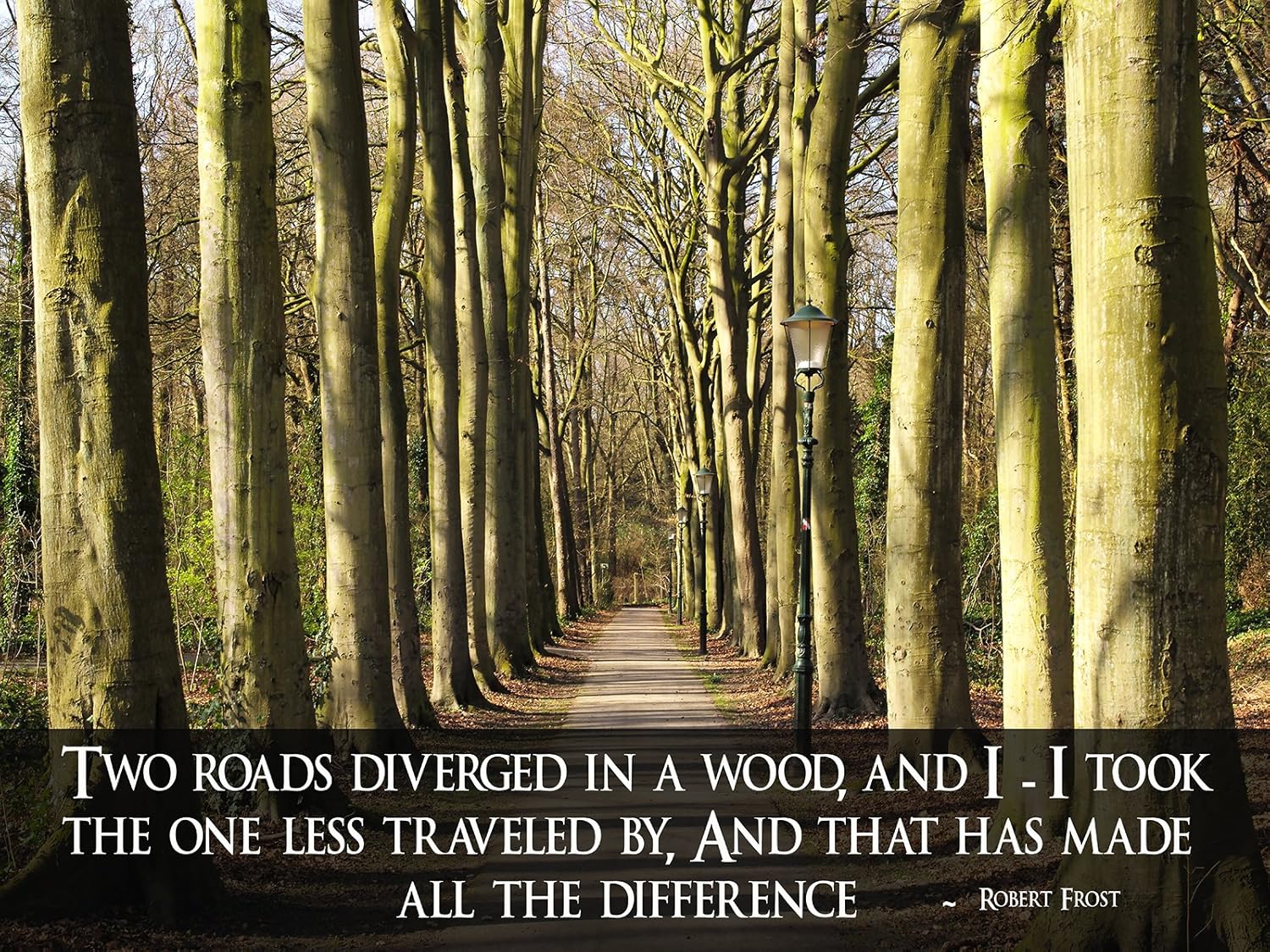
In fact, one of my favorite, ironically, poems to teach was “The Road Not Taken”—first, because it lends itself to stressing the importance of reading the text carefully to students, and second because many if not most of my students had seen the posters and had the poem mis-taught to them in previous grades.
Typically, the end of the poem is used to make vapid and inspirational claims about being different, taking the path others have failed to try.
However, even a slightly careful reading of the poem reveals that the text itself no fewer than three times states the two roads are essentially the same: “as just as fair,” “Had worn them really about the same,” and “And both that morning equally lay.”
So when I came across Stephen Lynch’s article on David Orr’s The Road Not Taken, I was nearly giddy:
The poem is praised as an ode of individuality, to not follow the pack even though the path may be more difficult.
Except Frost notes early in the poem that the two roads were “worn . . . really about the same.” There is no difference. It’s only later, when the narrator recounts this moment, that he says he took the road less traveled.
“This is the kind of claim we make when we want to comfort or blame ourselves by assuming that our current position is the product of our own choices (as opposed to what was chosen for us, or allotted to us by chance),” Orr writes.
“The poem isn’t a salute to can-do individualism,” he continues. “It’s a commentary on the self-deception we practice when constructing the story of our own lives.”
And thus we are forced to confront the Jefferson quote above: many in the U.S. see a message of rugged individualism in everything they see regardless of that theme existing or evidence confirming that ideology.
If this were confined to poetry, we could simply let it lie, but consider two aspects of Ronald Reagan’s political career—long enough in the past to view somewhat dispassionately but recent enough to remain relevant during the 2015-2016 presidential campaign years.
Reagan gained a tremendous amount of political capital on his “welfare queen” refrain, and somehow maintained his Teflon image despite George H.W. Bush’s charge that Reaganomics was “voodoo economics.”
Both can be traced to the public’s tendency to see what they want to see despite evidence to the contrary. The U.S. public believes poverty is the result of laziness and continue to harbor racist associations with both poverty and that laziness. As I have shared, just recently I received a negative response to a piece I wrote on racism that blamed inequity on single black mothers, despite single white mothers far outnumbering and Hispanic/Latino single mothers surpassing single black mothers.
The Great American Myth includes that the wealthy have earned their wealthy, the poor (lazy) deserve their poverty, education is the great equalizer, and anybody can succeed if he/she would just work hard enough, and evidence (the abundance of evidence) to the contrary is nearly worthless against that mythology.
This is not simply about partisan politics—because the same proclivity to see what we believe and thus not recognize systemic forces corrupts mainstream efforts at both education reform and daily teaching.
Just as a few examples, policies and practices built on “grit” research and narratives as well as “growth mindset” are essentially flawed because they fall victim to gazing on the individual, diagnosing deficits, and then correcting those deficits—a misdiagnosis that misread the consequences of systemic inequity as individual culpability.
The harsh reality is that in the U.S. educational and social/economic success are the result not of effort or merit, but the coincidence of any person’s socioeconomic and racial backgrounds.
Claims that teaching poor and black/brown children “grit” and a “growth mindset” will reap great rewards for those students are trapped in the deficit gaze narrowly on individuals—not unlike those who misread Frost or continue to cling to Reagan’s nasty “welfare queen” scapegoat.
This is where the critical imperative requires that we always step back from our belief systems and force ourselves to consider the entire and complex reality driven by both systemic and individual dynamics.
So if we loop back to the actual woman Reagan used to create the “welfare queen” smear campaign on all single black mothers who are poor, we discover a very complicated reality about this individual woman, but we also must temper ourselves against drawing sweeping generalizations that are not supported by easily accessible evidence.
And we should also ask why many are apt to make such damning jumps from one black woman to all black women when those same people do not make such leaps about individual serial killers, often white males who are well educated.
It is a trivial nerd/teacher fantasy to hope that we stop the misreading of a rather boring Robert Frost poem, but it is no small thing to expect us to stop allowing claims that are at their core racist and classist (“grit,” “growth mindset,” the “word gap,” etc.) to hide behind the mask of science or the cult of celebrity driving them, it is no small thing to speak against presidential candidates who continue to race-bait (black-on-black crime) and poverty-bait (dead-beats on welfare) the public as Reagan did.
To do so, we must have the courage to choose a road “less traveled by,” a journey that begins with taking one step back.
Please View (and Listen)
James Baldwin and Black Lives, Eddie Glaude
More on Critical Pedagogy, Critical Thinking, and the Other: “Critical pedagogy wants to know who’s indoctrinating whom”
Students at my university are required to attend Cultural Life Programs (CLPs) as part of their graduation requirements. Once several years ago, I was the featured speaker at a CLP on education reform, and during that talk I noted I was against accountability.
The Q and A prompted by the talk was vibrant, but after the talk, I was approached by a colleague who asked if I were being provocative—not serious, in other words—about being against accountability. I assured him I was in fact against accountability, which left him so frazzled the discussion ended there.
After posting a blog about critical pedagogy and the Other, I received similar and numerous comments about critical thinking—educators who likely believe that they and I are mostly in agreement on education but cannot fathom my rejecting how traditional schooling approaches so-called “critical thinking skills.”
As well, the Twitter conversation among Angela Dye, Sherri Spelic, and me exposed the need to examine more fully the concept of the Other.
First, there is no way to frame identifying and teaching (as well as lessons involving worksheets and testing) critical thinking skills and remain critical.
The essential flaw with critical thinking skills (see HERE and HERE) is, as I noted in the previous post, the reductive nature of a technocratic approach to knowledge, teaching, and learning. In other words, to isolate (and thus, approach analytically) a series of “critical” skills in order to deposit them in students in the hopes that those skills added up equal critical thinking is the problem.
And as I have noted about accountability, that skills approach is at least the dominant, if not the only way in which “critical thinking” is framed in traditional schooling.
Being critical is not a collection of isolated skills, but a way of being that can be fostered, not imposed (see Paulo Freire on the banking concept of education). Therefore, at best we can model being critical and provide for students examples of critical confrontations such as Ta-Nehisi Coates on the film Crash or Son of Baldwin on Straight Outta Compton.
Let me stress, then, that my rejecting the technocratic approach to “critical thinking” cannot be solved through technocratic means: defining, teaching skills, etc.
Next, and more complex, I think, is the concept of the Other in terms of how that relates to critical pedagogy.
My critical scholarship and my critical public work prompt oddly parallel responses, for example.
Traditional scholarship frames my critical work as the Other because critical perspectives reject the norms of the academy—quantitative data and objectivity most significantly. Instead, critical pedagogy starts here:
Thus, proponents of critical pedagogy understand that every dimension of schooling and every form of educational practice are politically contested spaces. Shaped by history and challenged by a wide range of interest groups, educational practice is a fuzzy concept as it takes place in numerous settings, is shaped by a plethora of often-invisible forces, and can operate even in the name of democracy and justice to be totalitarian and oppressive.
Joe Kincheloe, Critical Pedagogy Primer
The claimed apolitical pose of traditional scholarship marginalizes as the Other critical perspectives. However, Kincheloe explains:
Recognition of these educational politics suggests that teachers take a position and make it understandable to their students. They do not, however, have the right to impose these positions on their students [emphasis in original]….
In this context it is not the advocates of critical pedagogy who are most often guilty of impositional teaching but many of the mainstream critics themselves. When mainstream opponents of critical pedagogy promote the notion that all language and political behavior that oppose the dominant ideology are forms of indoctrination, they forget how experience is shaped by unequal forms of power. To refuse to name the forces that produce human suffering and exploitation is to take a position that supports oppression and powers that perpetuate it. The argument that any position opposing the actions of dominant power wielders is problematic. It is tantamount to saying that one who admits her oppositional political sentiments and makes them known to students is guilty of indoctrination, while one who hides her consent to dominant power and the status quo it has produced from her students is operating in an objective and neutral manner.
“Critical pedagogy wants to know who’s indoctrinating whom,” Kincheloe concludes.
But my public work is often challenged for being too academic, too scholarly since critical perspectives are prone to wax philosophic (using “the Other,” for example) or depend on terms such as “hegemony.”
Regardless of the context, then, critical perspectives are themselves likely to be marginalized (not rigorous or too esoteric), ignored, or silenced—especially as Dye and Spelic have stressed if you are a woman, or even more significantly, if you are a black woman.
And therein lies the next level of the Other I haven’t teased out well enough so far.
Yes, critical perspectives are brushed off as the Other, but more importantly, to be critical means to always listen [1] to, consider, and be empathetic to the perspective of the Other.
Being critical means that we take the pose of the Other in all the forms that exist. This requires the setting aside of ones privilege and even ones status as the Other.
It is in that context that Paulo Freire confronts how norms act against the Other:
To the extent that I become clearer about my choices and my dreams, which are substantively political and attributively pedagogical, and to the extent that I recognize that though an educator I am also a political agent, I can better understand why I fear and realize how far we still have to go to improve our democracy. I also understand that as we put into practice an education that critically provokes the learner’s consciousness, we are necessarily working against the myths that deform us. As we confront such myths, we also face the dominant power because those myths are nothing but the expression of this power, of its ideology. (p. 41)
Being critical is about self-awareness, empathy, and the perpetual state of questioning the nature of assumptions in the context of how those assumptions work to perpetuate power as well as to deny power.
Being critical becomes in traditional contexts, both academic and public, simultaneously the state of being the Other as well as assuming the perspective(s) of the Other.
Posters, worksheets, skills lists, and tests—none of these address being critical because all of these are trapped inside the so-called objective and analytic assumptions about knowledge, teaching, and learning.
They are as lifeless as they are void of critical—and they do not serve students or anyone well.
Any questions?
—
See Also
“Click, Clack, Moo”: Why the 1% Always Wins
Revisiting “Theme for English B” by Langston Hughes
[1] For example, in whose interest is it to shame a writer for splitting an infinitive? And what is the historical and linguistic context of that so-called rule? How does focusing on a linguistically questionable construction allow the masking of the substance of the claims?
Critical Pedagogy: Being the Other
Last week, I began my fall semester a few weeks before my university because we place our teacher certification candidates in year-long placements, including the first couple weeks of school, during their senior year. As a result I conducted four school visits to talk with our candidates and their cooperating teachers about the program and what to expect over this academic year that culminates in the spring with an extended practicum experience that looks a great deal like student teaching.
While walking out of one school, I noticed a series of posters hanging from the ceiling, and the final one facing me as I was heading out read “Find a way to think critically.”
I turned and noticed the back of the same slogan was “Find a way to be on time.”
Throughout my 18 years teaching public high school, I resisted the focus on school and classroom rules; we were supposed to post them in our room prominently, we had to lay them out for students on the first day, and our students had to pass a school handbook test before they could begin their classes each year (which meant we spent days reviewing the handbook with our advisees).
Part of my resistance included that instead of posting rules in my room, I made my own poster announcing:
Any fool can make a rule, and any fool will mind it.
Henry David Thoreau
The reality is that if we consider the front-and-back poster above, schools (and businesses) do not really want critical thinking from students (workers), but instead want compliance.
After teaching and resisting for over a decades, I discovered in my doctoral program William Ayers’s To Teach, which was the first organized confrontation of education-as-compliance I had ever read and likely my first step into critical pedagogy.
As I have discussed before, the term “critical thinking” and its companion “higher order thinking skills (HOTS)” are in fact not about being critical, but are technocratic ways of defining and thus controlling what counts as appropriate thinking. “Critical thinking” as a learning objective in formal schooling is an ironic term, much like the two-sided poster stressing punctuality on the flip side of thinking critically.
Critical pedagogy is a wholesale rejection of those technocratic approaches to teaching (objectivity, behaviorism, high-stakes testing, prescriptive standards, rote lesson plans) that requires each of us to investigate, interrogate (see Ta-Nehisi Coates), witness (see James Baldwin), challenge, and confront knowledge, claims, texts, people, and even (or especially) ourselves about the nature of power being served.
Unlike the systematic “critical thinking,” a critical perspective asks, “Whose interests are being served by punctuality and what power dynamic does that punctuality preserve or create?”
In other words, a directive—”Find a way to think critically”—can never be critical since the essential critical pose is the question.
2015 is the twentieth year of my critical journey as an educator, student, and person—marked formally by beginning a doctoral program in 1995.
This year has been punctuated by an ongoing discussion with Angela Dye on Twitter about what it means to be a critical educator.
Dye and I have been joined lately by Sherri Spelic while we all wrestle with holding critical perspectives in the midst of education reform wars that demand somewhat extreme binaries [1], both of which struggle under the bright light of critical investigation
As we struggle through social media with critical pedagogy in practice, I have stated to Dye directly that being critical puts anyone always in the position of the Other, and that necessity is alienating, isolating—suggesting the possibility of futility since large-scale change in a democracy tends to require numbers, some sort of collaboration.
Being critical is essential for social and education justice and equity, but I can also attest that maintaining a critical grounding creates tension among those on the so-called “both sides” of traditional and progressive arguments—such as the current education reform war.
I’m afraid I do not yet have a solution to this problem, except among Dye, Spelic, and me, while we likely have substantive disagreements about this or that, we have found community in the struggle itself.
And that in fact may be the answer, but even so, we must continue to question even that.
—
See Also
remnant 17: “we came to the world in order to remake the world” Paulo Freire
[1] See Dye’s The Need for a Deeper Dive and Reformers and Anti-Reformers: An Underwater Perspective, Spelic’s Knee-Jerk vs. A Stone’s Throw, and my Beware the Roadbuilders Redux: Education Reform Wars Fail Race, Again, which is strongly influenced by Andre Perry’s Education reform is working in New Orleans – just like white privilege.
Our Practice, Our Selves
In my undergraduate introductory education course, I read aloud the first or second class Sandra Cisneros’s “Eleven.”
The central character is Rachel, and the setting is her school day on her eleventh birthday. School that day strips all the shine from what should be a day of celebration and joy for this child because her math teacher, Mrs. Price, demands that Rachel not only claim but also wear a red sweater the teacher is certain belongs to Rachel (although, as the readers, the teacher, and students discover, it doesn’t). A key moment in the story highlights the power dynamic between Mrs. Price and Rachel: “Because she’s older and the teacher, she’s right and I’m not.”
Even for college students (and especially for my sophomores when I taught high school in rural South Carolina), I am hard to take those first days, and even weeks. My teacher persona and my class ask a great deal of students, who often feel overwhelmed, disoriented, and even angry.
So this semester I have just had “the talk” with that introductory class (and I also teach two first years seminars that are writing intensive); it includes acknowledging that I recognize how disorienting my class and I are for them as well as reminding them of “Eleven” and Rachel.
I very consciously want my students to be intellectually and ideologically rattled, but I also am committed to a much more important and foundational imperative: Students must always feel and be physically, emotionally, and psychologically safe in their learning spaces that I orchestrate.
Rachel in Cisneros’s story cannot learn on that day when she feels tiny, powerless, dehumanized. And the agent of those feelings are Mrs. Price, her callous attitude toward her students (children), and ultimately her practice.
Our Practice, Our Selves
Those of us who teach are now likely beginning new academic years, whether at the K-12 or higher education levels. As a result, I have read many posts and conversations on social media about our practices.
For my first year students, for example, I shared John Warner’s really fine piece, New Cell Phone/Computer Policy Draft Version. The transition from high school (significantly rule-based) to college is often difficult for students for reasons beyond the greater academic expectations. I have found that the transition to making decisions and being self-sufficient is far more disorienting for our students than even the challenges of college academics.
I have also come across online debates about handling late work from students and even a Tweet about a professor banning students from emailing except for emergencies.
After 31 years of teaching, then, I have been thinking again about how our practice teaches our students who we are and sends lessons that may not be in either our or our students’ best interests. I want here to outline a few of these in order to highlight what has always driven me as a teacher, coach, and parent: Seeking ways in which to avoid practicing what I believe is the greatest failure among adults, hypocrisy—holding children to standards that we ourselves never meet:
- Let me start with Warner’s topic: cell phones and computers in class. Over my three decades as an educator, I have never attended a meeting with teachers or professors in which all of those attending paid full attention. In recent years, computers and cell phones are always out, and a significant number of teachers and professors are either multi-tasking or simply not paying attention. Thus, instead of imposing rules because I can, I discuss with students how and why their cell phones and laptops can be either productive or distracting in class—and how that is their decision, one that impacts everyone else in the room. I had similar talks with my high school students about needing to leave class to use the bathroom (automatic demerits where I taught, by the way). While teachers and schools are prone to embrace hard-line black-and-white rules, justifying them by invoking the real world, that approach to “rules” is in fact nothing like the real world.
- The professor banning email from students struck me hard because I not only encourage students to email me, but also give them my cell number and mention texting. In fact, I want communication from my students—and I expect that a significant amount of it will be frustrating (asking me information they should know) and even so-called “disrespectful” (emails with “BTW” and other such text-ese). But I encourage these communications because I seek as many opportunities to teach students as I can, and I also am committed to doing so with patience and affording them the dignity they deserve. I often say in class that they should feel free to say what they want in class, in part so I can warn them never to utter such again, especially in a college classroom.
- Both of the above, I think, are informed by my greatest pet peeve about (possibly) the most repeated commandment we make to teachers: Don’t be friends with your students. This always baffles and infuriates me because I cannot fathom what there is about friendship that isn’t appropriate for the teacher/student relationship. Kindness? Compassion? Attentiveness? I suspect that this dictum confuses a rightful restriction to the level of intimacy between teacher and student, but I also notice many teachers work so hard to maintain some artificial pose of professional distance between them and their students that all the humanity is drained out of teaching and learning. My students are my friends by default, and I love them. Again, I cannot comprehend how any of that should be avoided.
- And just to address one practice linked more directly to instruction: How do we treat late work? [1] First, I have already examined high and reasonable expectations for student work—in which I made an important point related to the first bullet above: While editing several scholarly volumes, I have yet to have all work submitted complete and on time by college professors and scholars. In fact, in each situation, a number of the pieces were late (not just one or two) and many had significant citation problems (including not using the requested style sheet) as well as most needing heavy copyediting and feedback. So once again, while meeting deadlines and high-quality work are obviously important to instill in students, both are not as pervasive in the adult world as many teachers model in their classes: “I don’t accept late work,” “Late work starts at a B (or C),” and such. I no longer grade work, but if I did, I would never put a grade on an artifact of learning that didn’t represent the quality of the artifact (and not outside aspects unrelated to that quality). I did include considerations of habitually late work in quarter grades when teaching high school, but the key there was “habitually late,” and the need to address that habit.
Basic human kindness and dignity—these are the lessons I want my students to learn. And I don’t see those lessons in rules, and certainly not embedded in adult hypocrisy. I feel compelled as a teacher to work against both extremes confronted by Paulo Freire:
It is in this sense that both the authoritarian teacher who suffocates the natural curiosity and freedom on the student as well as the teacher who imposes no standards at all are equally disrespectful of an essential characteristic of our humanness, namely, our radical (and assumed) unfinishedness, out of which emerges the possibility of being ethical. (p. 59)
How often under the considerable weight of being a teacher do we bend to the callousness of Mrs. Price (“the authoritarian teacher”) and her ultimate failure—”Because she’s older and the teacher, she’s right and I’m not”—at the expense of a child’s or young adult’s respect or dignity?
How often do we fall victim to what LaBrant confronted: “On the other hand, we should not, under the guise of developing literary standards, merely pass along adult weariness” (p. 276)?
Let us be vigilant in recognizing that our practice is our Selves. Let us seek always to avoid any of our students feeling as Rachel does on her eleventh birthday, a victim of “adult weariness”:
Today I’m eleven. There’s a cake Mama’s making for tonight and when Papa comes home from work we’ll eat it. There’ll be candles and presents and everybody will sing Happy birthday, happy birthday to you, Rachel, only it’s too late.
—
[1] See Late Work: A Constructive Response, Rick Wormeli
Beyond Caricatures: On Dewey, Freire, and Direct Instruction (Again)
A former colleague while we both taught high school in rural South Carolina, Ed Welchel, and I addressed [1] the continuing importance of both John Dewey and Paulo Freire, despite the decrease in requirements for education philosophy in certification and degree programs, in “The Practitioner Has No Clothes: Resisting Practice Divorced from Philosophy in Teacher Education and the Classroom” for Kincheloe and Hewitt’s Regenerating the Philosophy of Education.
While Dewey (Progressivism) and Freire (Critical Pedagogy) share significance for how we should implement universal public education, they also share a pattern of being discounted and discredited through caricature more often than through valid criticisms of their faults.
I have noted several times the work of Lou LaBrant, who I would identify as a “true” progressive, specifically her own efforts to unmask misguided and mislabeled progressive practices (see “Masquerading”). LaBrant’s work and career help expose (i) that progressive claims have often been misrepresentative of progressivism and Dewey and (ii) that some progressives (LaBrant) offer more accurate representations of just what being a progressive educator looks like in the real-world classroom.
Complicating the matter is the century-plus struggle to reform education, which I have represented as four competing arenas (also well teased out by Jack Hassard):
Education reform camps fall into two broad categories—Mainstream and Radical—with two divisions within each broad category: Mainstream Reform includes bureaucratic reformers and technocratic reformers; Radical Reform includes libertarian reformers and critical reformers.
Whether debates are addressing Dewey/progressives or Freire/critical educators, the issues tend to focus on the role of the student, the role of the teacher, the nature of curriculum, and the nature of instruction.
As a thirty-plus year educator who has worked through my progressive stage and settled solidly into critical pedagogy, I want to highlight the central misrepresentations of Freire with the following excerpt from the co-authored chapter noted above:
“My theoretical explanation of such practice ought to be also a concrete and practical demonstration of what I am saying,” Freire (1998) explains, thus connecting the philosophical with the practical (p. 49). Without a careful consideration of what we believe about teaching and learning, we are ill equipped to measure what we do with any precision, a precision unlike the traditional view of the term (not mechanistic quantification, but holding the real against the ideal as an act of qualitative validity). Teaching and our classrooms, then, must be “something witnessed, lived” (Freire, p. 49).
The progressive challenge that pushed against the traditional and mechanistic assumptions of teaching and learning offers practitioners a consideration of alternative views of education, but without a critical perspective, practitioners are left vulnerable to a dualistic and thus incomplete understanding of a classroom that creates the conditions necessary for the pursuit of democracy and freedom. Here, we find the necessity for the critical perspective that becomes a way of being, one that is “ethical” as teaching and learning are acts of empowerment—“to ‘spiritualize’ the world, to make it either beautiful or ugly” (Freire, 1998, p. 53).
The most damning result of either/or thinking is believing, falsely, that classrooms must be either authoritarian or chaotic. Freire (1998) explains the critical alternative:
“It is in this sense that both the authoritarian teacher who suffocates the natural curiosity and freedom on the student as well as the teacher who imposes no standards at all are equally disrespectful of an essential characteristic of our humanness, namely, our radical (and assumed) unfinishedness, out of which emerges the possibility of being ethical.” (p. 59)
The empowering classroom is far more complex than any either/or dynamic as such dynamics oversimplify and necessarily distort human endeavors (Kohn, 1993). But it is Freire’s recognition “of being ethical” that poses the greatest argument for the need to explore philosophy fully and rigorously.
A wrestling with the ethical implications of teaching and learning exposes “the dilemma arising from the tension between authority and freedom. And we invariably confuse authority and authoritarianism, freedom and license” (Freire, 1998, p. 60). And this, I believe, is the crux of why practitioners balk at any pursuits they deem impractical. They are trapped by the false dichotomy of what a classroom can be, primarily because they themselves have experienced and excelled in those exact settings that critical pedagogy challenges for being mechanistic and oppressive. When practitioners call for “practical” over “philosophical,” that call is masking a fear of deconstructing the exact assumptions that housed their own success as students—and often their own physical and psychological safety as professionals.
The practical becomes in effect a perpetuation of the status quo, a fixed thing. A philosophical perspective, one augmented with a critical lens, however, is an embracing of a state of flux: “This permanent movement of searching creates a capacity for learning not only in order to adapt to the world but especially to intervene, to re-create, and to transform it” (Freire, 1998, p. 66). With the practical, we have a sense of security; with the theoretical, a sense of risk. The classroom that seeks and embraces risk is a classroom that confronts authority; thus, the practitioner trapped by dualistic assumptions believes confronting authority can only lead to chaos. Without a critical perspective, the practitioner is left without the possibility of authoritative (instead of authoritarian), without the possibility of freedom (without slipping into license).
Classrooms guided by practitioners who have ignored a careful consideration of philosophy—of progressivism and critical pedagogy—slip into an authoritarian, and thus oppressive, dynamic that contradicts democratic ideals by silencing students. The mechanistic assumptions of these classrooms embrace a traditional view of objectivity as both attainable and preferable to the contextual arguments made by critical pedagogy: Freire (1998) maintains “that the school. . .cannot abstract itself from the sociocultural and economic conditions of its students, their families, and their communities” (p. 62). Education without a rich philosophical understanding embraces a clinical view of humanity—oppressive in its narrow view of “scientific.” [2]
And thus we come to some clarifications:
- Progressive educators and critical educators—while embracing many overlapping concerns, beliefs, and practices—are not the same as unschoolers, exsitential educators, and “naturalist” educators.
- For critical educators, a teacher seeks to serve as teacher/student while a student serves as student/teacher. Key here is where authority lies (not that it is absent). Authority for a teacher should grow from that teacher’s expertise, and not primarily or solely from that teacher’s status as “teacher.” Critical educators are skeptical of authoritarianism, but embrace their authoritative status.
- Progressive and critical educators do not reject direct instruction, but are skeptical of direct instruction that is isolated and determined for students without any evidence of student need/interest or input. Again, the problem is isolated direct instruction, and the question is not if we use direct instruction, but when, how, and why. (Read carefully again the quote from Freire [1998], p. 59.)
So rejecting Dewey/progressivism or Freire/critical pedagogy with caricatures ignores the need to criticize both on substantive grounds (bell hooks has taken Freire to task well, and Lisa Delpit has dismantled failed progressivism, for example) while also perpetuating a reality that I find most troubling: Neither progressivism nor critical pedagogy has ever had any real and substantial place in U.S. public education.
The irony of this is that those who are most apt to criticize both progressivism and critical pedagogy by relentlessly calling U.S. public education a failure are in fact criticizing the policies and ideologies they claim will “reform” schools because those classrooms have been dominated by transmissional practices, content- and teacher-centered commitments, and technocratic policies driven by prescriptive standards/curriculum and high-stakes testing.
I end, then, with the final paragraphs in the essay excerpted above:
The empowered student necessarily requires the classroom offered by the empowered teacher. Any who teaches must first work through the philosophical evolution that Dewey and Freire represent—as well as continuing beyond the possibilities offered by Dewey’s progressivism and Freire’s critical pedagogy. The pursuit of an educational philosophy, then, is a journey that inseparable from being a practitioner—not something we “finish” in undergraduate courses and then mindlessly build upon.
Choosing between the status quo (norms and traditions) and progressive as well as critical possibilities is a choice between the moribund and the fecund. Norms and traditions are moribund—but the mind requires the fecund classroom that works against norms and traditions (thus progressive and critical) instead of bowing mindlessly to them. Philosophy is not something merely academic, something that wastes a teacher’s time better spent on the practical. Again, as Freire (1998) argues, “Critical reflection on practice is a requirement of the relationship between theory and practice. Otherwise theory becomes simply ‘blah, bah, blah,’ and practice, pure activism” (p. 30). The soul of teaching, then, is an act of the mind and the heart that rises above the limitations falsely separating theory from practice.
[1] Co-authored with Welchel, E. (2011). The practitioner has no clothes: Resisting practice divorced from philosophy in teacher education and the classroom. In Eds. J. Kincheloe & R. Hewitt, Regenerating the philosophy of education: Whatever happened to soul (pp. 43-54). New York: Peter Lang USA.
[2] See Freire, P. (1998). Pedagogy of freedom: Ethics, democracy, and civic courage. (Trans.) P. Clarke. New York: Rowman & Littlefield;
Kohn, A. (1993, September). Choices for children: Why and how to let students decide. Phi Delta Kappan. Retrieved from http://www.alfiekohn.org/teaching/cfc.htm

Howard Zinn: “education cannot be neutral on the critical issues of our time”
[Header Photo by Ankush Minda on Unsplash]
24 August 1922—Howard Zinn was born. His life and career spanned the twentieth century and into the first decade of the twenty-first. It is his memoir, You Can’t Be Neutral on a Moving Train: A Personal History of Our Times, for me, that speaks to the enduring power of Zinn’s metaphor, particularly for teachers.
Historically and currently, teacher remain under the demand that their teaching—and even their lives—remain neutral, not political. University professors—such as Zinn—also face disciplinary and public expectations of objectivity, dispassion—their work as public intellectuals either shunned or unrecognized.
In that context, K-12 education and university education suffer the same ultimate failure found in journalism, a flawed pursuit of objectivity, the faux-neutral pose of representing both sides.
So on the day of Zinn’s birth, it continues to be important not only to read and listen to Zinn, but also to act on Zinn, for it is action, after all, that Zinn lived and called for.
“When I became a teacher,” Zinn explains in You Can’t Be Neutral on a Moving Train, “I could not possibly keep out of the classroom my own experiences”:
I have often wondered how so many teachers manage to spend a year with a group of students and never reveal who they are, what kind of lives they have led, where their ideas come from, what they believe in, or what they want for themselves, for their students, and for the world.
Does not the very fact of that concealment teach something terrible—that you can separate the study of literature, history, philosophy, politics, the arts, from your own life, your deepest convictions about right and wrong?
Concealment is a political act, and in the face of the tragedy surrounding the police shooting of Michael Brown, the educational response has been exactly that, concealment. But as poet Adrienne Rich has confronted:
The study of silence has long engrossed me. The matrix of a poet’s work consists not only of what is there to be absorbed and worked on, but also of what is missing, desaparecido, rendered unspeakable, thus unthinkable.
Instead of striking the masked political poses of neutrality, objectivity, and dispassion, Zinn called for transparency:
In my teaching I never concealed my political views: my detestation of war and militarism, my anger at racial inequality, my belief in democratic socialism, in a rational and just distribution of the world’s wealth. I made clear my abhorrence of any kind of bullying, whether by powerful nations over weaker ones, governments over their citizens, employers over employees, or by anyone, on the Right or the Left, who thinks they have a monopoly on the truth.
Having taught in rural Southern public schools for 18 years and then 13 more years in higher education, I can attest that Zinn’s argument is challenged only because of the positions he holds and not because he took positions. You see, in K-12 classrooms, especially in history classes, textbooks, curriculum, and teachers always represented positions by framing as neutral the mainstream perspectives found among them all: a blind allegiance to capitalism, representing the U.S. as a righteous military victor, whitewashing every struggle in the country’s history, celebrating the wealthy and powerful while turning a blind eye to their many sins.
It has never been that our classrooms are neutral, as Zinn confronts, but that our classrooms have been passive passengers on the moving train of social and cultural indoctrination, the sort of indoctrination that benefits the few who have wealth and power built on their privilege at the expense of the many—workers, racial minorities, women, children, and the impoverished.
As Zinn recognized:
This mixing of activism and teaching, this insistence that education cannot be neutral on the critical issues of our time, this movement back and forth from the classroom to the struggles outside by teachers who hope their students will do the same, has always frightened the guardians of traditional education. They prefer that education simply prepare the new generation to take its proper place in the old order, not to question that order.
And although written well before the current education reform movement built on accountability, standards, and high-stakes testing, Zinn’s memoir has identified the Orwellian reality of that movement: Those decrying the status quo are those in service of the status quo. Education reform is the pursuit of maintaining, not reforming.
This call for teaching as activism was join by Zinn’s disciplinary challenge as well:
History can come in handy. If you were born yesterday, with no knowledge of the past, you might easily accept whatever the government tells you. But knowing a bit of history—while it would not absolutely prove the government was lying in a given instance—might make you skeptical, lead you to ask questions, make it more likely that you would find out the truth.
Here, Zinn recognizes both the power of disciplinary knowledge and the concurrent danger of codified disciplinary knowledge (prescriptive standards, curriculum). Zinn’s confrontation, then, speaks to the foundational principles expressed by critical scholar Kincheloe:
Thus, proponents of critical pedagogy understand that every dimension of schooling and every form of educational practice are politically contested spaces. Shaped by history and challenged by a wide range of interest groups, educational practice is a fuzzy concept as it takes place in numerous settings, is shaped by a plethora of often-invisible forces, and can operate even in the name of democracy and justice to be totalitarian and oppressive.
These critical principles replace the dissembling of neutrality in the classroom, as Kincheloe explains:
Recognition of these educational politics suggests that teachers take a position and make it understandable to their students. They do not, however, have the right to impose these positions on their students [emphasis in original]….
In this context it is not the advocates of critical pedagogy who are most often guilty of impositional teaching but many of the mainstream critics themselves. When mainstream opponents of critical pedagogy promote the notion that all language and political behavior that oppose the dominant ideology are forms of indoctrination, they forget how experience is shaped by unequal forms of power. To refuse to name the forces that produce human suffering and exploitation is to take a position that supports oppression and powers that perpetuate it. The argument that any position opposing the actions of dominant power wielders is problematic. It is tantamount to saying that one who admits her oppositional political sentiments and makes them known to students is guilty of indoctrination, while one who hides her consent to dominant power and the status quo it has produced from her students is operating in an objective and neutral manner.
“Critical pedagogy wants to know who’s indoctrinating whom,” Kincheloe concludes. Teaching and history as activism, for Zinn, were moral imperatives, and thus:
From that moment on, I was no longer a liberal, a believer in the self-correcting character of American democracy. I was a radical, believing that something fundamental was wrong in this country—not just the existence of poverty amidst great wealth, not just the horrible treatment of black people, but something rotten at the root. The situation required not just a new president or new laws, but an uprooting of the old order, the introduction of a new kind of society—cooperative, peaceful, egalitarian.
Zinn, activist, radical, speaks to us now, the “us” of any classroom, the “us” charged with the learning and lives of any child:
From the start, my teaching was infused with my own history. I would try to be fair to other points of view, but I wanted more than “objectivity”; I wanted students to leave my classes not just better informed, but more prepared to relinquish the safety of silence, more prepared to speak up, to act against injustice wherever they saw it. This, of course, was a recipe for trouble.
Today on the date of Zinn’s birth, I argue, it is a recipe we must follow.

My Open Letter to Journalists: A Critical Free Press, pt. 2
Dear Journalists (especially those who write about education):
After posting my U.S. and Education Reform Need a Critical Free Press, which represents a recurring effort in my public work to address the problems with journalism about education and education research/reports, I continued to interact with Juana Summers (NPR) and Stephen Sawchuk (Education Week) on Twitter. Those exchanges have suggested to me that I need to examine more fully what my concerns raised specifically about mainstream coverage of NCTQ’s reports mean to my wider call for a critical free press.
First, I think I need to establish the foundational context of my complaints about journalism/education journalism.
I believe journalists and teachers should be (must be) comrades in arms because a free press and universal public education are essential foundational institutions for a free people.
I am not, however, suggesting that this camaraderie is some sort of wink-wink, nod-nod collusion between the two professions in which we “cover” for each other, but that we are comrades joined by the same mission to build the free society that many claim the U.S. seeks. In fact, as comrades I expect we should be each other’s most vigilant and accurate critics to insure that we both stay the course.
And that builds on my second larger context for my concerns about journalism and my call for a critical free press. My use of the term “critical” is the source of my calls for reform of both education and journalism—two fields that reach their potential when critical, but fail when they are bound by traditional expectations of impartiality, calls that teachers and journalists avoid being “political.” Critical teachers and critical journalists are activists; they use their professions as mechanisms for change. Apolitical teachers and journalists are essentially defenders of the status quo (thus, the calls for impartiality are always loudest from those with power and wealth).
So I want to return briefly to my criticisms of mainstream media coverage of NCTQ’s latest report.
While Summers, Sawchuk, and I exchanged Tweets related to my post, Adam Bessie, whose important public work refuting the “bad” teacher meme is central to my points here, offered a Tweet that simply identified a fact about Gates funding among NPR, Education Week, and NCTQ:
@jmsummers @plthomasEdD @Stephen_Sawchuk Gates Funds NPR: http://t.co/L2YMLobtRn NCTQ: http://t.co/HCb8OrQ6ps EdWeek: http://t.co/INKq8Kp39s
— Adam Bessie (@AdamBessie) June 19, 2014
This Tweet represents the central issue to my concerns: Among the New Media (blogs, Twitter, Facebook, etc.), many critical educators have been confronting the disproportionate and inappropriate (because Gates has no credibility in the field of education, but nearly endless funds) influence of Gates on education reform—an influence that I have confronted often with a question: If Bill Gates had no money, who would listen to him about education reform? No one.
Also, Bessie’s Tweet about the ubiquity of Gates funding has finally begun to gain some traction in the mainstream press. But bloggers still carry the greatest weight for being critical about the influence of Gates on education reform. (The most common places now to find critical journalism is in the New Media, such as blogs at Education Week [see Anthony Cody and Nancy Flanagan] and The Washington Post [see Valerie Strauss] or alternative press such as Truthout and AlterNet.)
Despite Bessie’s Tweet only stating facts, Sawchuk immediately responded with this:
@AdamBessie @jmsummers @plthomasEdD As someone who works to be scrupulously fair I find that pretty offensive.
— Stephen Sawchuk (@Stephen_Sawchuk) June 19, 2014
It is at “offensive” that I think we should all pause and consider carefully.
I do not in any way think Sawchuk is a careless, “bought,” or shoddy journalist. In fact, as I stated to him, I have interacted with Sawchuk because I respect him, his work, and his profession (I do not interact with others about whom I cannot say the same).
I must add that my concern with Sawchuk’s coverage of NCTQ (as well as the other coverage I identified) is that the work fails because it conforms to the flawed traditional convention of fairness that Sawchuk mentions directly.
The traditional view of fairness in journalism has been brilliantly skewered recently by John Oliver on his HBO show: Oliver exposes that being “fair” in the climate change debate—having one person for “both sides” debate the issue—actually greatly misrepresents the current understanding within the field of science for the lay public. Mainstream journalists committed to this sort of “fair and balanced” are doomed to fail the much more important goal of accuracy. As Oliver demonstrated, the ratio of for and against climate change within the sciences is not 1 to 1 as a “fair” debate implies, but about 97 for and 3 against (and while Oliver didn’t explore this, a careful look at the against shows that even those 3% are less credible within the field).
If we extrapolate the Oliver Rule, then, to education reform, we do not find an equal 1 to 1 ratio of research on using value-added methods (VAM) to evaluate and dismiss teachers because the field overwhelmingly refutes using VAM in highs-stakes situations (even pro-VAM researchers call for “modest” uses of VAM) and mostly ideological advocates and political leaders (without expertise) endorse VAM for high-stakes education policy. However, VAM advocacy garners primary coverage in the mainstream press with little attention paid to the more credible research refuting its high-stakes and disproportionate use.
So let me be very clear here about both Sawchuk being offended and the difference between critical journalists and fair journalists.
I’m sorry, but journalists and journalism will always look bad when money speaks louder than expertise (see again Gates).
Now, imagine, journalists, if every day your field was repeatedly and inaccurately trashed for all the public: U.S. public education is a failure because our tests scores rank poorly internationally (misleading), schools with impoverished students have low test scores because of low expectations by the teachers (untrue), U.S. public education is failing because of corrupt teachers’ unions (untrue and basically opposite of the evidence), to improve public schools we need to identify “bad” teachers and fire them (untrue), public school teachers are “bad” mostly because they have tenure (untrue) [1], and the list goes on.
I genuinely regret Sawchuk being offended because he doesn’t deserve it, but I must emphasize that Sawchuk is among the media who are complicit in offending teachers, teaching, and schools everyday because journalists are quick to assume the misguided pose of “fair” and unwilling to assume the needed position of critical.
Many issues simply do not have “sides” (rape, genocide), and to be honest, most issues do not have equally credibly sides.
Does teacher education/certification need to be reformed (full disclosure: I am a teacher educator)? Absolutely.
But NCTQ has no credibility and garners its influence through the impact of money and media endorsement, and not validity (just as Gates has done).
Louann Reid, Chair of NCTE’s Conference on English Education, has identified this problem perfectly in her rebuttal of NCTQ’s recent report:
The recommendations are, however, backed by considerable funding, which helps extend NCTQ’s reach. CEE doesn’t have that kind of funding, but we do have reliable researchers and educators who can mobilize to tell the true stories of effective English teacher education. And I believe we must do so.
And herein lies the problem. While I also spurred some offense by my use of “press-release journalism,” the inordinate and uncritical coverage of NCTQ by the mainstream press proves my point that mainstream journalists respond to press releases (funding) while the experts (NCTE/CEE) remain mostly ignored.
And that’s the problem with “fairness” as the journalist’s guide instead of “critical.”
As researcher and scholar Bruce Baker added to the Twitter discussion, critical journalism would have responded to NCTQ quite differently:
@Stephen_Sawchuk @plthomasEdD To be really blunt, my point is that NCTQ report is so obviously junk, it shldn’t be covered by media at all
— Bruce Baker (@SchlFinance101) June 19, 2014
It may appear “fair” to respond to NCTQ as one perspective in the education reform debate, but it isn’t beneficial to afford an organization and a report without merit more credence (or even the same) as the contributions of those who have credibility.
And choosing to cover a topic is a political choice; coverage is never unbiased. And framing a topic is also a political choice (what perspective to present first, how to frame in the headline and lede, etc.). In truth, assuming a dispassionate pose is always dishonest since as humans we are always being political. I suggest we are all better off being openly and purposefully political instead of conforming to misleading norms of “neutrality.”
Yet, this is how the mainstream media carry on day after day—especially in the misguided assault on teachers, public schools, and now higher education.
Legions of hardworking and dedicated classroom teachers are offended daily by the mainstream media being complicit in a false story being told by those with money and an agenda—while that same mainstream media either offer secondary equal time [2] or ignore a powerful group of educators, researchers, and scholars who have the experience and expertise to reform education as it needs to be reformed.
Journalists, if you are ever offended, I would add that coincidentally you are now educators’ comrades for another reason.
As a lifelong teachers (31 years with 13 years teaching journalism to wonderful high school students), I am asking that you join us in the fight instead of taking your impartial stance that allows the well-funded but misguided reformers to keep on keeping on.
Any takers?
—
[1] How many mainstream journalists covering the Vergara ruling in California addressed that the judge issuing the ruling has job security himself?
[2] As “fair,” we are occasionally allowed to rebut the “reformers” somewhere in the middle or bottom third of the coverage, but even then we are framed as “critics.”
U.S. and Education Reform Need a Critical Free Press
Few things are worse than mainstream media coverage of education.
Except for that sentence above, which stretches hyperbole beyond credibility.
But that is exactly where the mainstream media finds itself when covering education. Journalists, in their quest to maintain the traditional commitment to “fair and balanced” journalism [1], consistently endorse and perpetuate organizations without credibility (such as NCTQ) and baseless claims (such as cries of “bad” teacher, “bad” teacher certification, and “bad” unions).
With yet another report released by NCTQ, that failure of the mainstream media has been highlighted once again—notably at NPR [2] and Education Week: Study Delivers Failing Grades For Many Programs Training Teachers, Claudio Sanchez and Juana Summers; Alternative Certification Deemed Weak by NCTQ in New Teacher-Prep Report, Stephen Sawchuk; Most Teacher Preparation Falls Short on Strategies for ELLs, NCTQ Finds, Lesli A. Maxwell.
First, the mainstream coverage of NCTQ’s reports remains trapped inside assumed crises that have no basis in fact; NCTQ’s reports and then the media begin with the givens that education suffers under the burden of “bad” teachers, “bad” teacher certification, and “bad” unions. However, at the very least, these claims are disproportional, if not outright erroneous:
- If we maintain the current context that student achievement is accurately reflected in test scores (and it isn’t), then we must acknowledge that teacher quality (10-15%) and school quality account for only about 20% of that measurement, but “60 percent of achievement outcomes is explained by student and family background characteristics (most are unobserved, but likely pertain to income/poverty),” as Di Carlo details.
- If we accept that value-added methods (VAM) can accurately and consistently identify “good” and “bad” teachers (and the evidence is that it cannot) and if we accept the much repeated claim by Chetty et al. that teacher quality can add $50,000 to the lifetime earning potential of a student (and that also is a significantly contested claim, as well as another example of advocacy and media hyperbole since that lifetime earning figure equates to about 1.5-2 tanks of gas per month), the enormity of the claims about “bad” teachers and the urgency expressed about creating and implementing huge and expensive test-based systems to address teacher quality are at best overstated. No rational person would endorse the cost-benefit analysis of such schemes.
- Finally, claims that teachers unions are primary or significant negative influences on educational quality are powerfully refuted by the historical and current fact that the states in the U.S. with the lowest standardized test scores tend to be those that are right-to-work (non-union) states. Unionization correlates positively with measurable student achievement, in fact, while poverty is the greatest correlation with low measurable student outcomes (for the record, union bashing is a straw man because U.S. public education has a poverty problem, not a union problem).
Next, NCTQ has established a sort of immediate appearance of credibility through three strategies: partnering itself with U.S. News & World Report, garnering significant and influential sources of funding, and bombarding the mainstream media with a series of reports without vetting those reports as is common in traditional scholarship (which slows down and greatly harnesses higher-quality research from reaching the public [3]. But scholars don’t issue press releases, and apparently, journalists respond primarily to press releases instead of conducting investigative journalism [4].)
Finally, once I engaged Sawchuck (EdWeek) and then Summers (NPR) on Twitter, several key aspects of this phenomenon were highlighted. Both journalists argued that their pieces on NCTQ were fair, and even critical—which I will examine below—but even more significant is a comment on Twitter from Summers:
@plthomasEdD I’m not sure it’s my place to say whether the study is credible, but we both note the significant criticism of the methods.
— Juana Summers (@jmsummers) June 18, 2014
My two reactions to Summers deferring from examining the credibility of NCTQ are, first, to strongly disagree, and second, note that no journalists need to do any real investigative journalism to uncover that NCTQ has no credibility because all of that work has been done already by a number of scholars (see those critiques catalogued here and here).
As disturbing, however, as that stance is, examining carefully the coverage of NCTQ reveals that the mainstream media does in fact endorse NCTQ implicitly (despite claims of impartiality) and also marginalizes the credible critiques of NCTQ.
All three articles (see above) have headlines that establish immediately for any reader that NCTQ’s report is worthy of major media coverage. Next, all three articles have ledes that also present NCTQ positively:
The nation’s teacher-preparation programs have plenty of room for improvement, according to a new report. (Sanchez and Summers)
Alternative-certification programs for preparing teachers suffer from many of the same problems that the National Council on Teacher Quality has identified in traditional, university-based programs, the Washington-based group concludes in a new pilot study. (Sawchuk)
More than 75 percent of elementary teacher-preparation programs are failing when it comes to readying future teachers to work effectively with English-language learners, a new report from the National Council on Teacher Quality contends. (Maxwell)
Sanchez and Summers (again, note that Summers argues it isn’t her job to assign credibility to the study) certainly imply that the study is credible by using this language: “The study is a dismal read, given that the U.S. spends more than $6 billion each year to prepare teachers for the classroom.”
The NCTQ study is only a “dismal read” if it is accurate (and it isn’t). NCTQ has been carefully discredited in scholarship (for example, see Fuller here and here) for serious conflicts of interest (Teach For America and KIPP leaders sit on the Advisory Board, for example), for a flawed study design, and for shoddy methodology [5].
So how are credible academic critiques of NCTQ characterized in the journalism that claims not to take evaluative positions?:
When NCTQ released a version of this report last year, it was met with some skepticism among educators and those responsible for preparing teachers. Critics said the advocacy group should have visited individual teacher-prep programs and talked to graduates and students, rather than relying on syllabi. (Sanchez and Summers)
Last year’s inaugural teacher-prep review was immediately rejected by most teacher colleges and, especially, by their main membership body, the American Association of Colleges for Teacher Education.
Criticism focused on the NCTQ’s tack of reviewing syllabi and other course materials rather than visiting institutions; its use of open-records requests and current students to obtain documents; the complaint that its standards weren’t agreed to by the profession; and the fact that its research products aren’t peer reviewed. Additionally, critics have claimed that the project is ideologically driven, given NCTQ’s role as incubator of an alternative-certification group, the American Board for Certification of Teacher Excellence (ABCTE), which received federal funding from the George W. Bush administration.
The latter complaint seems less viable now that the NCTQ has turned its green eyeshade toward alternative-certification programs. (Sawchuk)
“Some skepticism” and “critics” clearly position credible scholarship negatively while maintaining the implied endorsement of NCTQ as an organization and NCTQ’s reports. And while Sawchuk appears to address more directly NCTQ’s lack of credibility, he still marginalizes scholars as “critics” and then in the last paragraph above, simply discounts the criticism [6].
Further in Sawchuk’s piece, the contrast between lacking credibility (NCTQ) and credibility (scholarship discrediting NCTQ) is reduced to a simple misunderstanding and a matter of tone (not substance):
Notably, the report’s introduction this year contains a number of mea culpas regarding the bad blood between the NCTQ and teacher colleges. And Walsh agreed that her group bore some of the blame.
“At times we were a bit arrogant about what it is we think teacher education should be doing,” she said. “Even if we agree to disagree, we can be more respectful.”
Again, this trivializes criticism of NCTQ and further equates NCTQ (an advocacy think tank) with scholarship—while also painting NCTQ as apologetic (despite the organization maintaining its threat of ranking programs whether they cooperate or not; a powerful tool afforded NCTQ because of its media partnership with U.S. News & World Report).
One of my strongest criticisms of teachers is that we far too often allow ourselves to be trapped within traditional calls that we take neutral stances; however, the U.S. needs critical teachers (political teachers) if our public schools are to be a foundation for our democracy.
What I have detailed above is that journalists in the U.S. have bowed to the same call for neutrality, one that cannot be accomplished but can serve as a shield for maintaining the status quo.
The U.S. needs critical journalists, ones who see their job as maintaining a commitment to seeking out and identifying the credibility of things they report. Only those in power benefit when the free press is mostly free of taking to task those in power.
Nowhere is that more apparent than in how the mainstream media fails the education reform debate.
—
[1] Journalists and teachers share the burden of traditional expectations that they should never be “political,” but taking a neutral stance is, in fact, taking a passive stance endorsing the status quo. In other words, taking a dispassionate pose is a political stance (see The Politics of Calling for No Politics).
[2] See a similar example with NPR’s coverage of “grit.”
[3] See the following in terms of how the mainstream media disproportionately reports on think tank (non-peer reviewed) reports as compared to peer-reviewed and university-based research:
Molnar, A. (2001, April 11). The media and educational research: What we know vs. what the public hears. Milwaukee, WI: Center for Education Research, Analysis, and Innovation. Retrieved from http://epsl.asu.edu/epru/documents/cerai-01-14.htm
Yettick, H. (2009). The research that reaches the public: Who produces the educational research mentioned in the news media? Boulder, CO and Tempe, AZ: Education and the Public Interest Center & Education Policy Research Unit. Retrieved from http://epicpolicy.org/publication/research-that-reaches
[4] I make this claim not as a direct attack on any journalists, but teachers and journalists now experience very similar and negative influences on their ability to conduct their professions. While education reform tends to impeded good teaching, the contracting media market has tended to overburden journalists. As a result of newspapers and magazines disappearing and contracting their staffs, many journalists resort to press-release journalism as a survival technique, similar to teachers teaching to the tests. The conditions of both professions, teaching and journalism, are stark reasons why both teachers and journalists must exert their political selves in their professional work.
[5] As a brief glimpse into NCTQ’s accidental admission of their methodology, in an effort to twist criticism of their practices, this post adds at the end “As one teacher candidate who is working on our office this summer said,” highlighting that anecdote is enough for NCTQ, as long as it matches their advocacy.
[6] Sawchuk fails to recognize that NCTQ is working within a scorched-earth policy as part of the large disaster capitalism driving education reform in the U.S. For a vivid example of how this works, and why NCTQ, TFA, and KIPP benefit once the traditional education system is dismantled, see the events that have occurred since Katrina in New Orleans where the public school system has been replaced by charters schools, many KIPP and many staffed by TFA recruits.
Critical Pedagogy or Core Knowledge?
For those of us committed to critical pedagogy (CP) as scholars and classroom teachers, Tait Coles’s call for CP instead of commitments to core knowledge (CK) is a rare moment in the mainstream press, as Coles concludes:
Education has the power to change social inequality by nurturing a generation with an educated mistrust of everything that has been indoctrinated before. This educational stance is one that we must all strive for as the moral purpose of education.
This call by Coles also prompted Twitter debates and blogs addressing CK (and E.D. Hirsch) and CP—including tweets and blogging from Harry Webb, Daisy Christodoulou, and Christina Milos (see here and here), for example.
One important lesson from the debates focusing on CP and CK is that often what scholars such as Hirsch (CK) and Paulo Freire (CP) embrace is either (consciously and unconsciously) misrepresented by critics, never examined by critics, or distorted in its application by practitioners.
In short, that first lesson creates a mess for everyone involved, especially those of us who have very similar educational goals but distinct disagreements about how to achieve those goals.
I embrace CP, and like many who do, I came to CP through the traditional assumptions about teaching, learning, and knowledge. My education conformed far more closely to Hirsch’s vision of education than to Freire’s.
Thus, I began grounded in positivism, behaviorism, cultural literacy, New Criticism, and mastery learning. And as many CP scholars and practitioners have come to understand, all of these societal and educational norms have significant blind spots that work against educational goals related to democracy, liberation, community, and autonomy.
The second lesson from the debate is that CP—as is the case with progressivism—is routinely discredited by straw man claims that confuse CP with reductive versions of postmodernism and existentialism.
Setting aside the cult of personality involved in this debate (adherents to either Hirsch or Freire who feel compelled to protect the honor of the scholars), I want to address several key points about CP so that those who wish to reject CP can do so fairly—not with baseless stereotypes and straw man arguments.
First, CP is philosophical and theoretical, and thus, most of the foundational work on CP reads as philosophy and theory do—the language is often prone to technical terms, if not jargon, and the elaboration of ideas is equally dense, sometimes to the point of being impenetrable.
If we wish to discount CP for those qualities, then we might as well do so for all philosophical and theoretical examinations of knowledge—which strikes me as counter to the entire argument of CK advocates that knowledge is primary, often because that knowledge is complex, challenging.
I wish CP scholars and advocates would work to make the ideas accessible to more people, to all people, so in that part of the debate, I am certainly acknowledging the message problem found in CP.
But to careless claims that CP isn’t credible because it isn’t based on scholarship, research, sound theory, or other expectations for so-called “rigorous” standards is simply inaccurate. CP does acknowledge and include ways of knowing outside the norms critics tend to use to make those charges—which of course, proves CP’s point: Whether or not knowledge matters is controlled by whoever has the power; in other words, knowledge is never a value-free body:
Thus, proponents of critical pedagogy understand that every dimension of schooling and every form of educational practice are politically contested spaces. Shaped by history and challenged by a wide range of interest groups, educational practice is a fuzzy concept as it takes place in numerous settings, is shaped by a plethora of often-invisible forces, and can operate even in the name of democracy and justice to be totalitarian and oppressive. (Kincheloe, 2005, p. 2)
For advocates of CP, then, the question is not about the value of knowledge—or, as many critics of CP carelessly claim, that knowledge doesn’t matter—but about who decides what knowledge matters and that education must never be allowed to be reduced to indoctrination, as Kincheloe explains:
Recognition of these educational politics suggests that teachers take a position and make it understandable to their students. They do not, however, have the right to impose these positions on their students [emphasis in original]….
In this context it is not the advocates of critical pedagogy who are most often guilty of impositional teaching but many of the mainstream critics themselves. When mainstream opponents of critical pedagogy promote the notion that all language and political behavior that oppose the dominant ideology are forms of indoctrination, they forget how experience is shaped by unequal forms of power. To refuse to name the forces that produce human suffering and exploitation is to take a position that supports oppression and powers that perpetuate it. The argument that any position opposing the actions of dominant power wielders is problematic. It is tantamount to saying that one who admits her oppositional political sentiments and makes them known to students is guilty of indoctrination, while one who hides her consent to dominant power and the status quo it has produced from her students is operating in an objective and neutral manner. Critical pedagogy wants to know who’s indoctrinating whom. (p. 11)
And so we come to the key problems found in CK for those of us embracing CP.
CK and cultural literacy are inherently flawed because they rest on claims that CK and cultural literacy can be easily and objectively identified. CP advocates recognize that CK and cultural literacy are suspect, as is all knowledge.
As two brief examples—both of how CP challenges CK and cultural literacy as well as how CP embraces the power of knowledge—are the work of Howard Zinn as a radical historian and Eugene F. Provenzo, Jr. as a critic of Hirsch and cultural literacy.
In Zinn’s A People’s History of the United States, a powerful case is made for both the importance of knowledge and that who tells the story of history determines what that knowledge is. Advocates of CP are not saying knowledge doesn’t matter, but that all knowledge and truth claims are suspect and must be investigated by students, not simply determined for the learner and transmitted to the learners.
All historical claims likely benefit some group over others. Traditional history, Zinn shows us, has been told by the winners and to benefit those winners. History told from the perspective of the people (and including the voices of those people, people who have often been the losers and thus silenced) is much different than the version told from the winners and more likely to be closer to true for the great majority of people.
Provenzo offers a parallel exercise to Zinn’s wider body of work in history by demonstrating that Hirsch’s cultural literacy is bound by cultural assumptions, one of which is that cultural literacy must be passed on from one generation to the next in order to sustain that culture (and here is the most damning aspect of CK/cultural literacy for CP advocates).
In his Critical Literacy: Challenging E. D. Hirsch, Jr. and the Cultural Literacy Movement, Provenzo offers an alternative to Hirsch’s endorsing a Western canon of core knowledge. In other words, no body of knowledge is value-free; change the assumptions about what knowledge matters, and the “core” changes also.
Briefly then, CP does not reject the value of knowledge, but in fact, highlights that knowledge is foundational while always being suspect. The point of education is not to consume or attain knowledge (indoctrination) but to identify and challenge it (critical literacy)—and all students must be provided the exact same opportunities to identify and challenge the knowledge bases of disciplines.
A final misrepresentation of CP concerns the role of teachers. A common criticism of CP is that teachers play a small or even no role in the learning of students. Nothing could be farther from the truth; as well, the role of knowledge is also central to how CP defines the teacher.
CP argues that teachers should guide learning in an authoritative role (authority gained from the teacher’s status built on her/his knowledge and as a model for students) and not an authoritarian role (authority gained from the teacher’s status primarily or solely for being identified as the teacher). In CP, the ideal roles are teacher/student and students/teachers—everyone involved in the teaching-learning process are both learners and teachers, but the teacher has the primary role as authoritative in the discipline being addressed (Paulo Freire, Pedagogy of the Oppressed).
As Freire (1998) argues, “Teachers who do not take their own education seriously, who do not study, who make little effort to keep abreast of events have no moral authority to coordinate the activities of the classroom” (p. 85). In CP, teachers are expected to be experts in their fields. Period.
Teachers must personify authoritative knowledge, then—which contradicts charges CP is somehow promoting ignorance. But another equally false change is how teachers interact with student learning, as in Christodoulou’s misrepresention: Freire’s “critical pedagogy involves teachers working with the knowledge pupils already have and with the knowledge pupils are able to discover independently.”
What does Freire actually say on this?:
It is in this sense that both the authoritarian teacher who suffocates the natural curiosity and freedom of the student as well as the teacher who imposes no standards at all [emphasis added] are equally disrespectful of an essential characteristic of our humanness, namely, our radical (and assumed) unfinishedness, out of which emerges the possibility of being ethical. (p. 59)
Rejecting CP for not honoring knowledge, refusing some children access to knowledge, and discounting the role of the teacher in learning is simply all false, straw man arguments.
I think the best way to understand CP is to consider that Michel Foucault, a renowned French philosopher, criticized CP for being political and often polemic, but CP scholars likely cite Foucault as much if not more than any other thinker.
As included above from Kincheloe, CP is not about ignoring knowledge or even discrediting all knowledge, but ultimately, CP is this: “Critical pedagogy wants to know who’s indoctrinating whom.”
And to do so cannot happen without authoritative teachers and a rich body of knowledge—one that may of course include CK, but certainly asks that we move beyond that as well.
References
Buras, K.L. (1999). Questioning core assumptions: A critical reading of and response to E. D. Hirsch’s The schools we need and why we don’t have them. Harvard Educational Review, 69(1).
Foucault, M. (1984). The Foucault reader. Ed. P. Rabinow. New York: Pantheon Books.
Freire, P. (1998). Pedagogy of freedom: Ethics, democracy, and civic courage. P. Clarke (Trans.). Lanham, MD: Rowman and Littlefield.
Freire, P. (1993). Pedagogy of the oppressed. M.B. Ramos (Trans.). New York: Continuum.
Greene, M. (1995). Releasing the imagination: Essays on education, the arts, and social change. San Francisco: Jossey-Bass.
Kincheloe, J. L. (2005). Critical pedagogy primer. New York: Peter Lang.
 dr. p.l. (paul) thomas