Category Archives: Critical Race Theory

A Response to NCTE Statement on the Doublespeak Award and Anti-Censorship Efforts

Today is 8 February 2022. One year ago today the National Council for the Social Studies (NCSS) released a pointed and powerful statement: “Saving” American History? Start by Teaching American History.

This public statement by NCSS was bold and proved the organization was willing to place professional commitments to the fields of history and social studies over the fear of taking so-called “political” risks.

Labeled “A Current Events Response,” the statement begins: “National Council for the Social Studies (NCSS), the largest professional association in the country devoted solely to social studies education, strongly rejects the recent development of proposed bills in state legislatures which are designed to censor specific curricular resources from being used for instruction in K-12 schools.”

On 7 February 2022, the National Council of Teachers of English (NCTE) released NCTE Statement on the Doublespeak Award and Anti-Censorship Efforts, a reaction to a series of concerns raised by former members of NCTE’s Public Language Awards Committee and others (including my blog post and an Open Letter now soliciting signatures of support).

After I posted my blog raising concerns about NCTE’s silence and inaction during the rise of book/text and curriculum censorship as well as the controversy over putting the Doublespeak Award on hiatus (resulting in some committee members resigning), I have heard from many NCTE members, former NCTE members, and even past presidents of NCTE—all agreeing with the concerns being raised.

In the context of NCSS’s direct and early response, I want to address a few of the points in NCTE’s statement from 7 February 2022, a year after NCSS’s public stance.

First, this statement is a reaction to criticism, not a proactive stance against book/text and curriculum censorship. Others and I have been calling for proactive and public statements.

Second, the statement, ironically in the context of the Doublespeak and Orwell Awards, seems to be massaging if not rewriting the history of putting the Doublespeak Award on hiatus; I am not aware of a single person claiming NCTE “canceled” the award (their first bullet point). The concern was clearly that the hiatus seems to have been an effort to avoid making NCTE look “political,” again an ironic context given the awards.

Next, the statement feels to many of us as an unfair framing of the committee members who resigned on principle; we do not have to agree with those members (I do), but I think we must respect the professional ethics involved in resigning.

Ideally, NCTE would have better served the Council by simply admitting that the hiatus and how it occurred was a mistake that would be corrected—instead of putting so much focus on the principled committee members.

Finally, I want to address a comment in the statement’s penultimate paragraph: “We want NCTE members to know—NCTE has not remained on the sidelines in regard to intellectual freedom and censorship matters, and has no intention of doing so in the future.”

Let me be very clear again: I deeply respect and appreciate my colleagues who signed the statement as the faces and names of leadership for NCTE; however, I respectfully disagree and think the statement as a reaction to criticism and the continued lack of a public statement similar to NCSS (a year later) are proof that NCTE leadership continues to fail the larger fields of literacy and literature, students across the U.S., and all teachers of English/ELA.

Yes, as some NCTE members have noted on social media, NCTE has been a stellar organization inwardly with powerful position statements and a diversity-rich 2021 annual convention. But that serves and speaks to a very small fraction of teachers of English/ELA—and likely has no impact on public opinion/discourse or political policy.

NCTE needs to back up and re-address the Doublespeak mistake again, but also, NCTE must acknowledge the larger concern about remaining on the sidelines because that is where the organization is while our classrooms are being dismantled and our professions are being destroyed.

Many NCTE members are frustrated because NCTE has a powerful infrastructure to speak Truth to power the way NCSS did. Currently, we are in the final days of members voting on a new and important resolution: Resolution on Supporting Educators’ Right and Responsibilities to Engage in Antiracist Teaching.

But what good is all this if NCTE keeps the work inward and refuses to take the principled stands needed to change the public and political narratives about books, texts, and curriculum?

Laws are being passed; books are being removed from classrooms, school libraries, and public libraries because of the complaint of a single parent; teachers are being fired; and board members have called for book burnings.

If you Google “governor” and “pornography” today, you do not find articles on scandal but dozens of media articles on multiple governors across the U.S. (Texas and South Carolina, notably) calling award-winning literature “pornography.”

And as the report from UCLA clearly notes, the anti-CRT movement is itself an Orwellian attack on facts as well as teaching and learning:

We put “CRT” in quotation marks throughout this report because so often the conflict campaign’s definition of “CRT” (like its description of actual K–12 practice) is a caricatured distortion by loud opponents as self-appointed “experts.” The conflict campaign thrives on caricature — on often distorting altogether both scholarship and K–12 educators’ efforts at accurate and inclusive education, deeming it (and particularly K–12 efforts to discuss the full scope of racism in our nation) wholly inappropriate for school. (Pollock, & Rogers, et al., 2022, p. vi)

Pollock, M., & Rogers, J., et al. (2022, January). The conflict campaign: Exploring local Experiences of the campaign to ban “Critical Race Theory” in public K-12 education in the U.S., 2020-2021. UCLA’s Institute for Democracy, Education, and Access. https://idea.gseis.ucla.edu/publications/the-conflict-campaign/

Regretfully, 2021 and now 2022 are demanding principled stands such as the Doublespeak and Orwell Awards from NCTE; but students, teachers, literacy, and literature need NCTE to take a principled stand beyond the NCTE bubble.

Many of us remain concerned that NCTE is content with being reactionary and, yes, there on the sidelines.

O NCTE, NCTE, Wherefore Art Thou NCTE? [Update]

[UPDATE: Please see and support this open letter to NCTE Executive Committee.]

[UPDATE 2: NCTE Statement on the Doublespeak Award and Anti-Censorship Efforts.]

[UPDATE 3: Public statement from NCSS 8 February 2021: “Saving” American History? Start by Teaching American History]

I have been a literacy educator for 38 years and counting; throughout the 1980s and 1990s, I taught high school English in rural South Carolina, and then I moved to higher education in 2002, where I am in teacher education and teach first-year and upper-level writing.

Along with being a career educator, I am a writer. I can identify the beginning of my real life as a writer and scholar with three publications: first, Oregon English (published by a state affiliate of the National Council of Teachers of English [NCTE]) in 1989, and then English Journal (a flagship journal of NCTE) in 1991 and 1998.

When I made my move to higher education, I also began a twenty-year and counting relationship with NCTE that has been among the most rewarding elements of my career as teacher and writer/scholar.

While my colleagues and friends discovered through NCTE are too many to list here, at NCTE San Francisco (2003), I attended a presentation and met Ken Lindblom; we began talking, and eventually our connection led to my editing/co-editing a column in English Journal for 10 years under several editors (also counted among my friends and colleagues), including Ken.

In 2013, NCTE named me recipient of their George Orwell Award—one of the proudest moments of my career—acknowledging not only my work that spoke truth to power but highlighting the significance of my public work (blogging, which is often marginalized in academia). Then, after my work on the committee preparing for NCTE’s Centennial at the Chicago annual convention (2011), I served as the Council Historian from 2013-2015.

Until the interruptions of Covid, one of the highlights of each year included attending and presenting at NCTE’s annual conventions.

I share all this not to aggrandize myself, but to establish a fact of my life and career: I love NCTE and the people who have enriched my life because NCTE brought us together.

And thus, I write here in the spirit of James Baldwin: “I love America more than any other country in this world, and, exactly for this reason, I insist on the right to criticize her perpetually” (Notes of a Native Son).

Since I do love NCTE, and since I am troubled at this moment of literary and educational crisis, I feel obligated to criticize NCTE, asking, Wherefore art thou, NCTE?

Novices to Shakespeare often misread “wherefore” as simply “where,” but, of course, Juliet is asking “why” Romeo exists, specifically why is she being confronted with the challenge of Romeo’s family name.

Why, I am asking, does NCTE exist? And more pointedly, why is NCTE choosing silence, why is NCTE choosing to take a false apolitical pose—at this moment of literary and educational crisis?

First, let me stress the context of my question.

Across the U.S., Pollock and Rogers, et al., have authored a report from UCLA that analyses the wildfire spreading across the U.S.—curriculum, instruction, and book/text bans:

We found that at least 894 school districts, enrolling 17,743,850 students, or 35% of all K–12 students in the United States, have been impacted by local anti “CRT” efforts. Our survey and interviews demonstrate how such restriction efforts have been experienced inside schools as well as districts. We found that both state action and local activity have left many educators afraid to do their work.

(Pollock, & Rogers, et al., 2022, p. vi)

As I have been cataloging, censorship and even calls for book burnings are nearly a daily event into 2022.

Notable, these attacks on what and how teachers teach, on what and how students learn, are grounded in dishonest claims and misrepresentations, as the UCLA report notes:

We put “CRT” in quotation marks throughout this report because so often the conflict campaign’s definition of “CRT” (like its description of actual K–12 practice) is a caricatured distortion by loud opponents as self-appointed “experts.” The conflict campaign thrives on caricature — on often distorting altogether both scholarship and K–12 educators’ efforts at accurate and inclusive education, deeming it (and particularly K–12 efforts to discuss the full scope of racism in our nation) wholly inappropriate for school.

(Pollock, & Rogers, et al., 2022, p. vi)

The news reports are chilling: A teacher fired in Tennessee for teaching Ta-Nehisi Coates (a featured speaker at an annual NCTE convention); a superintendent of education in North Carolina banning a book from one parent complaint, and without reading the book; and high-profile coverage by NBC and The Atlantic detailing the magnitude of the censorship movement, which has included bans of one of the most celebrated graphic novels ever, Maus.

With that context in mind, I want to add I am guided by two more commitments.

Martin Luther King Jr., in Strength to Love (1963), warned: “The ultimate measure of a man is not where he stands in moments of comfort and convenience, but where he stands at times of challenge and controversy. The true neighbor will risk his position, his prestige, and even his life for the welfare of others.”

And Howard Zinn [1], whose work has been prominent at NCTE’s annual convention, who titled his memoir, You Can’t Be Neutral on a Moving Train, argued:

This mixing of activism and teaching, this insistence that education cannot be neutral on the critical issues of our time, this movement back and forth from the classroom to the struggles outside by teachers who hope their students will do the same, has always frightened the guardians of traditional education. They prefer that education simply prepare the new generation to take its proper place in the old order, not to question that order.

You Can’t Be Neutral on a Moving Train

As of today, I am deeply concerned that NCTE, as the premiere national professional organization for literacy and literature in the U.S., has chosen the path of neutrality, of silence, to strike an apolitical pose in order to avoid risk.

In November before the 2021 annual convention, I reached out to some leaders of NCTE and implored that NCTE take a leadership role in speaking out against the creeping threat of state legislation banning curriculum and the rising number of books being banned across the country.

Although I was assured this would happen, there has only been silence.

And then, this: Members of NCTE’s Public Language Awards Committee posted on social media that NCTE has put the Doublespeak Award on hiatus indefinitely in order to avoid looking “political.”

Some members have resigned in protest.

The disappointment and irony of this move is that the Doublespeak Award, a companion of the Orwell Award, is designed to offer an “ironic tribute to public speakers who have perpetuated language that is grossly deceptive, evasive, euphemistic, confusing, or self-centered.”

If you return to the report from UCLA, it is obvious we are in the midst of an educational and literary/literature crisis that screams for the Doublespeak Award (“[t]he conflict campaign thrives on caricature”), that demands public-facing, risk-embracing leadership from NCTE.

Why does NCTE exist, if not for this moment?

The current anti-CRT/book banning movement is politically partisan only because Republicans have chosen to make it so. And as King and Zinn noted throughout their careers, taking a neutral pose, pretending to be apolitical, is a political concession to support the status quo.

Since curriculum bans, book censorship, and parental oversight legislation are occurring exclusively among Republican-controlled states, the teachers and students impacted are mostly in right-to-work (non-union) situations; therefore, they are the most vulnerable, and most in need of advocacy from organizations and people with power.

NCTE is the collective voice of literacy educators, scholars, and creators.

I want to remain hopeful, but I am deeply disappointed and increasingly skeptical of that hope.

NCTE’s leaders must look in the mirror, ask “why,” and then act.

Returning to Baldwin, I end with this: “There is never time in the future in which we will work out our salvation. The challenge is in the moment, the time is always now” (Nobody Knows My Name).


[1] Trying to confirm if/when Zinn spoke at an annual NCTE convention [edit].

Questions Skew Answers about White Privilege

At first, this seems like a really simple question: Do you believe in Santa Claus?

But scholars and researchers know that this question is actually a mine field of problems.

“Believe” is a problematic verb, and before anyone can answer or anyone can interpret the answers, we must all agree on what “Santa Claus” means.

Does “Santa Claus” mean a literal man who travels the world and crawls down chimneys to deliver toys? Or does it mean some historical “Santa Claus” who has become mythologized and represents a spirit of Christmas?

In other words, especially in polling designed to uncover better understanding of an issue or phenomenon, the questions asked and how the terms in those questions are defined (if at all) create the answers and thus shape the conclusions drawn from those answers.

Take for example Toplines and Crosstabs December 2021 National Poll: CRT & Race in America.

This poll gathers data on several aspects of the Critical Race Theory debates driven by Republicans and conservatives across the U.S. But the framing skews (and likely distorts) what people know, what people think, and what people believe about CRT and white privilege. Consider the following:

Two problems are created by the framing above. First, note how “white privilege” is defined for the respondents: “White people in the U.S. have certain advantages [emphasis added] because of the color of their skin.”

Notably during the Trump era, certain segments of white people who support Trump have been very vocal about rejecting the concept of “white privilege.” Typically, these white people point to white poverty and white failure to reject—with evidence, they think—the concept of “advantage.”

The question defining “white privilege” as an “advantage” very likely reduces the number of respondents expressing support for or nuanced understanding of the concept. And that framing is inaccurate.

“White privilege” is better defined as the lack of barriers that are race-based for white people.

When white people find themselves in poverty, it is rarely because they are white; when white people fail, it is rarely because they are white.

There is not pop culture rhetoric about “driving while white” or “jogging while white” because race is rarely the key factor in negative interactions for white people, notably interacting with police or other authority figures (or other white people).

Systemic racism manifests itself in pervasive ways for Black people in that being Black is often the key factor in life experiences for Black people. Black people do fail and suffer primarily because they are Black, and not because of their behavior or character.

White privilege is about an absence (lack of race-based barriers) and about being allowed to exist as if your race doesn’t define you. Black people do not have that opportunity; being Black is a state of perpetual awareness of being Black.

Unlike white people, then, Black people do experience existentially and systematically barriers that are race-based.

Describing “white privilege” as an advantage suggests guarantees of wealth or success that simply are not true—and thus easy to reject.

Framing “white privilege” as the absence of race-based barriers both better defines the concept and increases the likelihood that respondents can acknowledge that reality.

The second problem is the use of the word “beliefs” with CRT, which distorts and misrepresents CRT as a “theory.”

Similar to the jumbled discourse around evolution (people often claim “I don’t believe in evolution”), respondents are likely misled by the word “beliefs” since it implies the lack of empirical data and suggests CRT is simply someone’s beliefs—and not a carefully formulated theory based on rigorous scholarship.

CRT, as a scholarly theory, has a set of claims, or principles. The use of those words, “claims” or “principles,” provides, again, a fairer framing and should provide more valid data.

Together, these examples show how research erodes the validity (do the data and conclusions drawn reflect what they claim to reflect?) of a poll by the questions asked, the framing and defining of the key terms.

In the “CRT beliefs” data also note that the “white privilege” framing as an “advantage” is reinforced by the use of “enjoy”: “Whites Enjoy Certain Privileges.”

Creating a set of questions for polling requires statistical expertise, but also scholarly knowledge and experience. In this case, the poll itself seems poorly reviewed for framing in terms of fully understanding either “white privilege” or “CRT.”

Since the entire cultural debate around race, racism, white privilege, and CRT is being driven by dishonest actors and misinformed media, politicians, and members of the public, a valid poll of those topics requires accurate and nuanced clarity on the questions being asked and definitions of the terms being examined.

This poll is ambitious, but it is likely doing more harm than good for that debate.

Anti-CRT Movement Built on Lies

Republicans and conservatives have been depending for a long time on a truism with an ambiguous source: “A lie can travel halfway around the world while the truth is still putting on its shoes.”

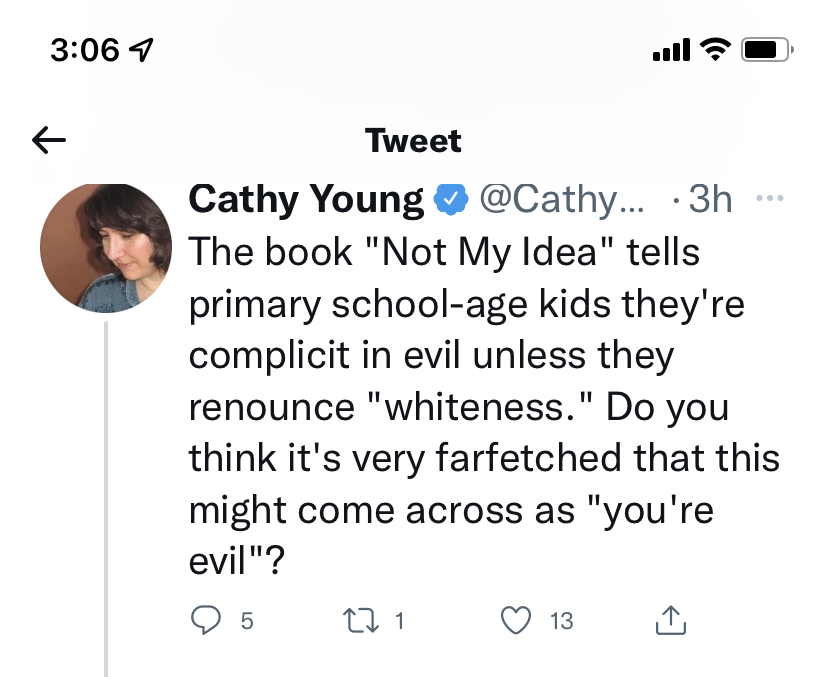
The anti-Critical Race Theory movement has fully committed to this strategy; just lie quickly and then spend most of your time ranting as if the lie is true.

Here is but one of many examples:

While the claim here is a blatant lie, we should note that anti-CRT advocates are the ones who repeatedly conflate “whiteness” with “racism.”

Not My Idea, by Anastasia Higginbotham, in fact, goes to great lengths to recognize white people throughout history who have stood firm against racism; in other words, one of the strongest messages of the book is “not all white people.” The title and motif of the book is that white children are not the ones who created racism, “not my idea”—“Racism was not your idea. You don’t need to defend it.”

And here is the real issue: The book makes a strong case not for rejecting whiteness, but for rejecting racism when you are white.

As is the case is almost all efforts to censor, people have likely never read the book. So here you are, listen and hear the truth:

If you have to advance your beliefs through lies, you should interrogate those beliefs.

The anti-CRT movement is built on lies.

Critical Race Theory: The Facts and Irony (for White People)

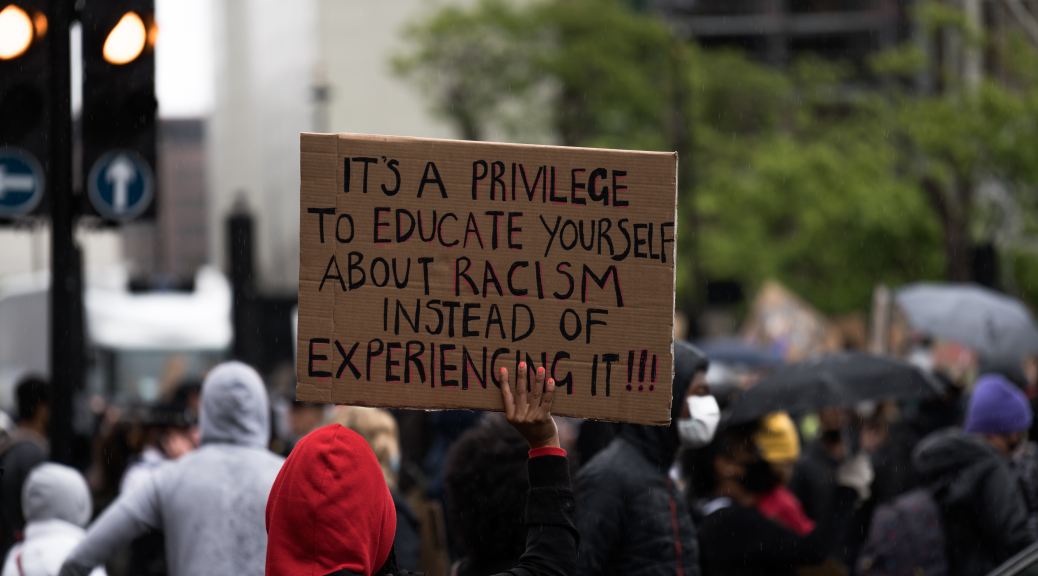
[Header Photo by James Eades on Unsplash]

As nearly daily reporting highlights, the manufactured anger over Critical Race Theory (CRT) continues to influence directly and indirectly both public discourse as well as teaching and learning in U.S. schools.

Books are being banned, and state legislation is restricting curriculum and teaching (see here), often in response to outcries against the non-existent influence of CRT on education.

The anti-CRT movement is mostly a political event grounded in misinformation. The essential misinformation includes how CRT is defined and the misunderstanding that CRT is taught in K-12 curriculum.

Let me offer an analogy for understanding what CRT is and why “teaching CRT” is mostly a misrepresentation of the scholarly theory.

For scientists, particularly in the field of medicine, seeking ways to understand disease, an initial challenge was not being able to see microscopic viruses and bacteria. Those scientist had come to the conclusion that the illness being confronted could not be explained by the visible and assumed causes of that disease and its transmission.

In other words, they needed a different way to see the disease. Enter the microscope, a tool for seeing differently in order to understand a complex phenomenon (a disease and its transmission).

CRT is the microscope; in short, CRT is a theoretical lens that scholars use to focus on race and racism as a tool for better understanding a phenomenon that traditional explanations have not adequately explained.

To clarify, then, CRT is a scholarly tool (a set of claims about race and racism) that helps examine phenomena, typically related to institutional dynamics (U.S. legal system, policing, public education). CRT has its origin in legal studies, and at its core, CRT examines phenomenon under the assumption that racial inequities cannot often be understood by simplistic explanations such as individual racism.

As Adrienne Dixon explains for NEPC, CRT does influence some elements of legal and educational scholarship:

CRT is a theoretical framework that originated in legal scholarship in the late 1980s. The founding CRT scholars were dissatisfied with anti-discrimination laws and the legal scholarship that informed it because they felt it didn’t adequately address the role of race and racism and relied too heavily on incremental change. CRT was introduced to education in the 1990s to address similar dissatisfaction with research in education that scholars believed did not fully account for race and racism. Moreover, scholars felt that multicultural education had become co-opted and no longer had the potential to adequately address inequities in education writ large.

Critical Race Theory: What It Is. And What It Is Not. A Q&A With Adrienne Dixson

To clarify about the widespread misinformation about CRT, here are some key facts:

  • CRT is a theoretical lens used by scholars to understand phenomenon impacted by race; CRT is not taught in K-12 education (or undergraduate education), and may or may not have influenced any text or curriculum that addresses systemic racism.
  • CRT centers race in the spectrum of theories that fall under the label “CRT,” and thus, since Marxism centers social class (and often takes a color-blind stance), CRT and Marxist theoretical lenses are in tension. In short, calling CRT “Marxist” is misleading at best, and simply false as worst. [1]
  • Very few students, even graduate students, are assigned readings and lessons that examine what CRT is and how to use it in research. Most students will only ever experience CRT examined formally in graduate courses (law school, graduate education), and even then, CRT remains mostly in elective courses. [2]

Now, let me explore why the attacks on CRT by white conservatives is ironic.

Let’s start with Ta-Nehisi Coates, whose writing is at the center of one of the most dramatic consequences of anti-CRT legislation—a teacher in Tennessee being fired for teaching an essay by Coates.

Coates gained much of his fame as a contemporary writer on race while working at The Atlantic; one of his most powerful pieces examined the Donald Sterling controversy, an NBA owner who lost his ownership because of documented racist behavior.

Sterling represents, according to Coates, oafish racists, individuals who express and act on explicit racism (think David Duke). The oafish racist, the individual racist, as Coates explains, is likely far less common in the U.S., but also far easier to identify and address.

As a CRT scholar would acknowledge, oafish racists pose no problem to scholars; however, racism and racial inequity persist in ways that cannot be linked to individual racist behavior (more below). CRT, then, would be a useful framework for trying to explain what Coates labels as “elegant racism”:

Elegant racism is invisible, supple, and enduring. It disguises itself in the national vocabulary, avoids epithets and didacticism. Grace is the singular marker of elegant racism. One should never underestimate the touch needed to, say, injure the voting rights of black people without ever saying their names. Elegant racism lives at the border of white shame. Elegant racism was the poll tax. Elegant racism is voter-ID laws.

This Town Needs a Better Class of Racist, Ta-Nehisi Coates

Here are a few examples of just exactly how CRT is useful and even necessary for understanding situations exposing racial inequity.

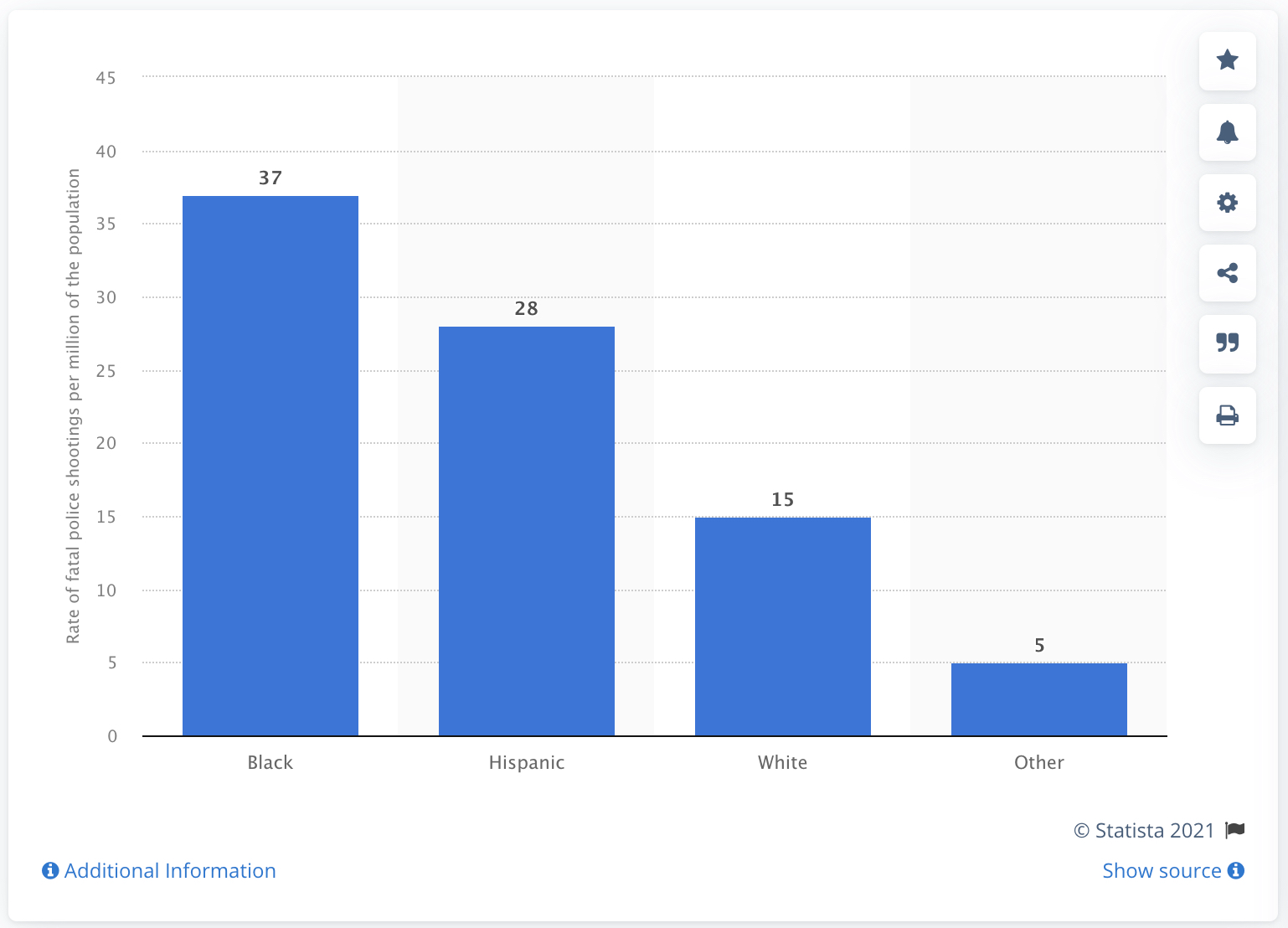
First, consider the death of Tamir Rice, a 12-year-old who was identified by a police officer as a “‘Black male, maybe 20, black revolver, black handgun by him.'” Rice was shot and killed in just seconds by that officer.

The shooting and killing of Rice fits into a large body of research showing that Black people are shot and killed at much higher rates than other races (for example, Black people shot 2.5 x more often than White people):

For legal scholars who have concluded that this racial rate inequity cannot be explained by simply identifying individual police officers as racists, CRT provides a process for understanding how and why the police officer shot and killed 12-year-old Rice.

Part of that explanation is systemic racism that influences everyone (regardless of race); Black children are viewed as older than their biological ages:

The social category “children” defines a group of individuals who are perceived to be distinct, with essential characteristics including innocence and the need for protection (Haslam, Rothschild, & Ernst, 2000). The present research examined whether Black boys are given the protections of childhood equally to their peers. We tested 3 hypotheses: (a) that Black boys are seen as less “childlike” than their White peers, (b) that the characteristics associated with childhood will be applied less when thinking specifically about Black boys relative to White boys, and (c) that these trends would be exacerbated in contexts where Black males are dehumanized by associating them (implicitly) with apes (Goff, Eberhardt, Williams, & Jackson, 2008). We expected, derivative of these 3 principal hypotheses, that individuals would perceive Black boys as being more responsible for their actions and as being more appropriate targets for police violence. We find support for these hypotheses across 4 studies using laboratory, field, and translational (mixed laboratory/field) methods. We find converging evidence that Black boys are seen as older and less innocent and that they prompt a less essential conception of childhood than do their White same-age peers. Further, our findings demonstrate that the Black/ape association predicted actual racial disparities in police violence toward children. These data represent the first attitude/behavior matching of its kind in a policing context. Taken together, this research suggests that dehumanization is a uniquely dangerous intergroup attitude, that intergroup perception of children is underexplored, and that both topics should be research priorities.

The Essence of Innocence: Consequences of Dehumanizing Black Children

So here is our first example of irony: While anti-CRT advocates attack CRT as itself racist and argue CRT labels all White people as racist, CRT actually poses that the killing of Rice is not dependent on a racist police offer, but unexamined and unaddressed systemic biases against Black children.

Again, ironically, training for police officers informed by CRT is the most effective mechanism for helping police officers recognize unconscious bias (viewing Black children as adults) and then change their behavior (resulting in fewer lives taken).

Finally, consider a couple more phenomenon and the need for CRT as a tool to understand and address these inequities.

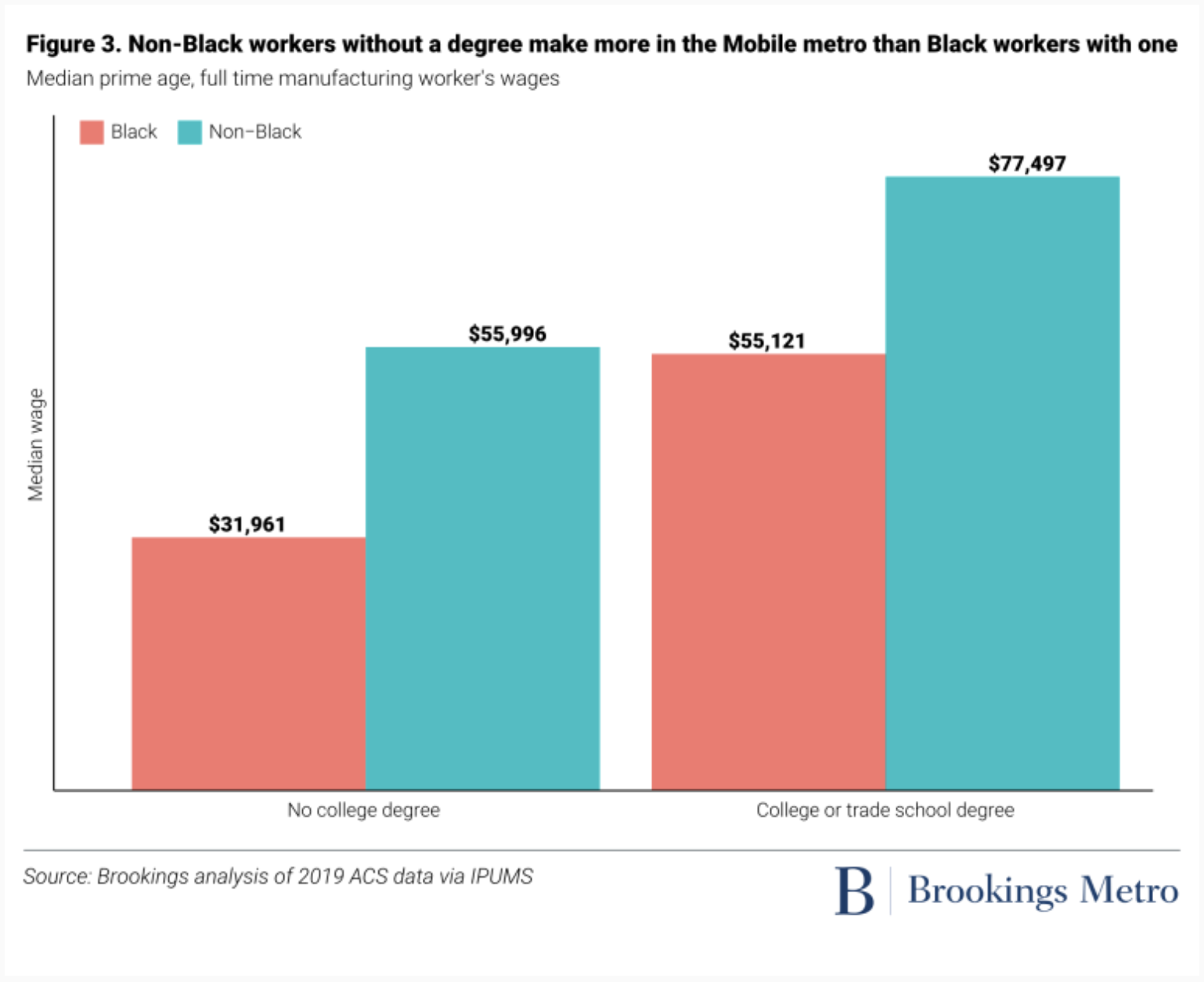
Consider this report from Brookings that identifies racial inequities between education and income (a racial gap identified in a large body of research):

Perry, Barr, and Romer, then, confront a problem that cannot be explained simply by the impact of individual racists on income:

Our research reveals that the median earnings for Black workers in the manufacturing industry are a staggering $25,629 less than the median for non-Black workers. This racial earnings gap is so large that it is even more pronounced than the earnings gap between workers with degrees versus without. And education does not make up for the racial income gap [emphasis added]; our analysis shows that the median Black worker with a college or trade school degree in the manufacturing industry still makes $875 less than the median white worker with no degree.

Three lessons for boosting postsecondary education and wages in Black-majority cities

Next, consider racial inequity in terms of education, detailed in a report from The Education Trust:

Black students are more likely to attend schools that have high percentages of novice teachers in almost every state across the country. For example:

• In Mississippi, about 25% of Black students attend schools with high percentages of novice teachers, compared to 7% of non-Black students.

• In Maryland, nearly 40% of Black students attend schools with high percentages of novice teachers, compared to about 20% of non-Black students.

• And in eight states (Arizona, Florida, Kentucky, Louisiana, Maryland, Oklahoma, Pennsylvania, and Texas), 30% or more of Black students attend schools with high percentages (greater than 20%) of novice teachers.

Not only do Black students have more novice teachers, but they also have more first-year teachers. On nationwide average, schools serving the highest percentages of Black students have 8% first-year teachers; whereas, schools serving the lowest percentages of Black students have 5% first-year teachers. In 25% of states, schools serving the greatest percentages of Black students have at least twice the percentage of first-year teachers as schools serving the fewest.

• In Louisiana and Mississippi, for example, schools serving the greatest percentages of Black students have almost three times the percentage of first-year teachers as schools serving the fewest.

See Getting Black students Better Access to Non-Novice Teachers

The Education Trust finds a similar disparity for Latino students.

In all three phenomena above—racial inequities in police shootings, income, and access to non-novice teachers—CRT allows a tool for examining and addressing these problems that begins with the claim they are not the result from individual racism, but from systemic (and complicated) dynamics that everyone participates in.

For White people, then, CRT informed research on racial inequity that can unpack and identify the dynamics creating systemic racism can then be translated into policy and practices that eradicate those inequities—all without blaming individuals as racists.

Understanding and incorporating CRT as a tool for research and policy, then, is not a process for condemning all White people as racist, but a pathway to racial harmony.

Being White is not a self-condemning status, then; however, refusing to acknowledge systemic racism and the need to find policies that create equity is a choice, one that perpetuates racism regardless of anyone’s beliefs about race.

The ultimate and ugly irony is that White refusal to understand and embrace CRT is self-defeating, harmful to everyone regardless of race.


[1] See “Claim 2” HERE.

[2] As a critical scholar who identifies with Marxist educational theory, I must emphasize that although I have completed every level of formal education through a doctorate, I have never once been assigned any CRT text or lesson. Further, my understanding and study of Marxism have primarily been on my own, beginning with Marx’s non-economic writings (which I read by choice as an undergraduate after finding the book at a used book sale).

Resources from NEPC

Understanding the Attacks on Critical Race Theory

Critical Race Theory: What It Is. And What It Is Not. A Q&A With Adrienne Dixson

NEPC Review: How to Regulate Critical Race Theory in Schools: A Primer and Model Legislation (Manhattan Institute, August 2021)

Freedom and the Politics of Canceling Teachers and Curriculum

By mid-December of 2021, Matthew Hawn, a former teacher in Tennessee, will once again have his appeal heard after being fired for violating the state’s restrictions on curriculum:

The Tennessee General Assembly has banned the teaching of critical race theory, passing a law at the very end of the legislative session to withhold funding from public schools that teach about white privilege.

Republicans in the House made the legislation a last-minute priority, introducing provisions that ban schools from instructing students that one race bears responsibility for the past actions against another, that the United States is fundamentally racist or that a person is inherently privileged or oppressive due to their race.

Tennessee bans public schools from teaching critical race theory amid national debate, Natalie Allison

As Allison reported in May, several states across the U.S. have filed or passed copy-cat legislation aimed at banning the teaching of Critical Race Theory.

By October and November, the consequences of Tennessee’s law have moved from silencing and canceling teachers to attempts to cancel curriculum [1]:

The Tennessee Department of Education recently declined to investigate a complaint filed under a new state law prohibiting the teaching of certain topics regarding race and bias.

The complaint, the first directed to the state under the new law passed this spring, was filed by Robin Steenman, chair of the Moms for Liberty Williamson County chapter, a conservative parent group sweeping the nation. 

The 11-page complaint alleged that the literacy curriculum, Wit and Wisdom, used by Williamson County Schools and at least 30 other districts, has a “heavily biased agenda” that makes children “hate their country, each other and/or themselves.”

Tennessee Department of Education rejects complaint filed under anti-critical race theory law, Meghan Mangrum

Although the complaint was rejected, Mangrum noted, “The group detailed concerns with four specific books on subjects like the Rev. Martin Luther King Jr.’s March on Washington, the integration of California schools by advocate Sylvia Mendez and her family, and the autobiography of Ruby Bridges, adapted for younger learners.”

A teacher fired for teaching Ta-Nehisi Coates, parents calling for bans on MLK and teaching about Ruby Bridges—these events are not unique to Tennessee, but they reflect a pattern of efforts to control not only teachers, but what students are allowed to learn and read.

Notable in these examples is that many of the consequences of legislation are canceling Black writers and key aspects of Black history; additionally, legislation and calls for book banning are targeting LGBTQ+ writers and topics.

Teaching and curriculum in the U.S. are being systematically and politically whitewashed.

One aspect not being addressed often is that political dynamic. Parents, political activists, and politicians are impacting who teaches and what is being taught in the context of a historical and current demand that teachers themselves remain apolitical, both in their classrooms and their lives beyond school.

As I have discussed often, teaching is necessarily political, and teaching as well as writing are necessarily types of activism.

For teachers, then, we must recognize that calls for teachers to be objective, neutral, and apolitical are themselves political acts. Currently, laws being passed and parents/activists confronting school boards are exercising their political power at the expense of teachers and schools—both of which are required to remain somehow politically neutral.

From historian/activist Howard Zinn to critical scholars such as Joe Kincheloe and to poet Adrienne Rich, we have ample evidence that taking a neutral stance is a political act that passively endorses the status quo and that silencing words is an act of canceling thought, eradicating ideas.

Zinn’s commitment to transparency as a teacher and activist is hauntingly relevant to the current political attack on teachers and curriculum:

This mixing of activism and teaching, this insistence that education cannot be neutral on the critical issues of our time, this movement back and forth from the classroom to the struggles outside by teachers who hope their students will do the same, has always frightened the guardians of traditional education. They prefer that education simply prepare the new generation to take its proper place in the old order, not to question that order [emphasis added]….

From the start, my teaching was infused with my own history. I would try to be fair to other points of view, but I wanted more than “objectivity”; I wanted students to leave my classes not just better informed, but more prepared to relinquish the safety of silence, more prepared to speak up, to act against injustice wherever they saw it. This, of course, was a recipe for trouble.

You Can’t Be Neutral on a Moving Train: A Personal History of Our Times, Howard Zinn

And Kincheloe confronted not only who is actually indoctrinating students but the imperative that teachers recognize teaching as inherently political:

Thus, proponents of critical pedagogy understand that every dimension of schooling and every form of educational practice are politically contested spaces. Shaped by history and challenged by a wide range of interest groups, educational practice is a fuzzy concept as it takes place in numerous settings, is shaped by a plethora of often-invisible forces, and can operate even in the name of democracy and justice to be totalitarian and oppressive [emphasis added].

Critical Pedagogy Primer, Joe L. Kincheloe

The great irony is that critical educators (often smeared as “Marxists”) are committed, as Kincheloe asserts, to a foundational concern: “Critical pedagogy wants to know who’s indoctrinating whom.”

The Orwellian named “Moms for LIberty,” then, by calling for canceling curriculum are in fact being “totalitarian and oppressive,” calling for not education, but indoctrination. To ban words and ideas is to ban the possibility of thinking, of learning:

The study of silence has long engrossed me. The matrix of a poet’s work consists not only of what is there [emphasis in original] to be absorbed and worked on, but also of what is missing, desaparecido [emphasis in original], rendered unspeakable, thus unthinkable.

Arts of the Possible, Adrienne Rich

A final powerful point is that many of these political acts to silence teachers and cancel curriculum are occurring in right-to-work states controlled by Republicans. Teachers not only are expected to be neutral, objective, and apolitical, but also work with a distinct awareness they have almost no job security.

Hawn fired in Tennessee simply taught a text and now is fighting for his career; the text in most ways just a year ago was considered non-controversial and even celebrated as Coates had attained recognition as one of the country’s leading Black voices.

During this holiday season at the end of 2021, teachers honestly have no decision about whether or not to be political. We are faced with only two political choices: conform to the demand that we take a neutral pose, resulting in endorsing whatever status quo legislators and parents/activist impose on schools; or recognize and embrace the essential political nature of being a teacher by actively opposing efforts to cancel teachers and curriculum.


[1] Twitter thread:

Reading Matters

[Header Photo by Christin Hume on Unsplash]

Polonius: What do you read, my lord?

Hamlet: Words, words, words.

Polonius: What is the matter, my lord?

Hamlet: Between who?

Polonius: I mean, the matter that you read, my lord.

Hamlet: Slanders, sir: for the satirical rogue says here that old men have grey beards….

Polonius: [Aside] Though this be madness, yet there is method in’t.

–Hamlet, Act II, Scene ii.

Reading matters.

I imagine you would be hard pressed to find anyone who would disagree with those two simple words. But the reality is that those two words have dramatically different meanings among people advocating for teaching children to read in schools.

“[S]ociety should get behind teaching everybody to read the right way,” explains John McWhorter, linguist turned public intellectual who uses his bully pulpit at the New York Times to join the long list of Black celebrities and notable people invited into the white mainstream of conservative thought cloaking racism and racial stereotyping.

The problem in McWhorter’s words, of course, is that “right way.”

Since early 2018, the U.S. has once again lifted the Reading War into public consciousness with a misleading refrain, “the science of reading” (SoR). The media has maintained a steady beat claiming that teacher education and practicing teachers have failed to embrace the SoR, and as a result, children are failing to learn to read.

The SoR media movement has merged with some aggressive parent advocacy groups, notably related to dyslexia, and the result is copy-cat SoR reading legislation being passed throughout the country. Ironically, and disturbingly, that legislation often codifies policies and practices that are strongly refuted by scientific research—grade retention, universal screening for and oversimplification of dyslexia [1], systematic intensive phonics programs for all students [2], bans on popular reading programs, and efforts to mimic policies implemented in Mississippi [3] (after one round of improved NAEP scores in reading at grade 4).

While I am certain that people advocating for improved reading instruction in our schools all have mostly good intentions (except for a powerful lobby for phonics programs and some media/journalists seeing an opportunity to cash in on SoR), the problem remains with what anyone means by “reading matters.”

We must acknowledge two contexts here.

One context is approaching a common term but a rare case that it may be accurate—crisis.

Since the SoR movement and advocates such as McWhorter are speaking into a conservative and traditional ideology about language, reading, and literature (used broadly to mean any texts students reading), the SoR movement has been swept into a concurrent movement against public education broadly begun under Trump with the purposeful and orchestrated attacks on the 1619 Project and Critical Race Theory (McWhorter’s “right way” comment sits inside his joining the anti-woke movement).

What merges the anti-woke education movement and the SoR movement is the focus on parental rights to monitor and control what students learn and how students learn.

The crisis we are approaching, I think, is the ironically disturbing part. The merging of the SoR movement with the anti-woke movement means that so-called advocates for better reading instruction have joined forces with a new rise in censorship that includes book banning, removing books from libraries (lists of 850+ books identified in Texas), proposing bans on terms deemed “woke,” and even calls for burn burnings.

A significant but less powerful group of literacy advocates, teachers, scholars, and writers have noted the problem with emphasizing the need for children to learn to read while simultaneously reducing what they can read, and even what those students are allowed to consider or think.

A second context is the contradiction between the narrow demands of the SoR movement and the likelihood that policies and practices being implemented in the name of SoR are likely to inhibit and even discourage children from reading.

I have detailed several times that I grew up in a racist and deeply conservative community and household. The conditions that saved my life, my mind, and my soul include the coincidence that my very misguided parents happened to respect intellectual freedom; I was allowed to read anything throughout my childhood and teen years.

Once I moved beyond my home and community—college—I was then liberated by reading Black authors assigned and recommended by wonderful professors, again a context that respected intellectual freedom and my mind.

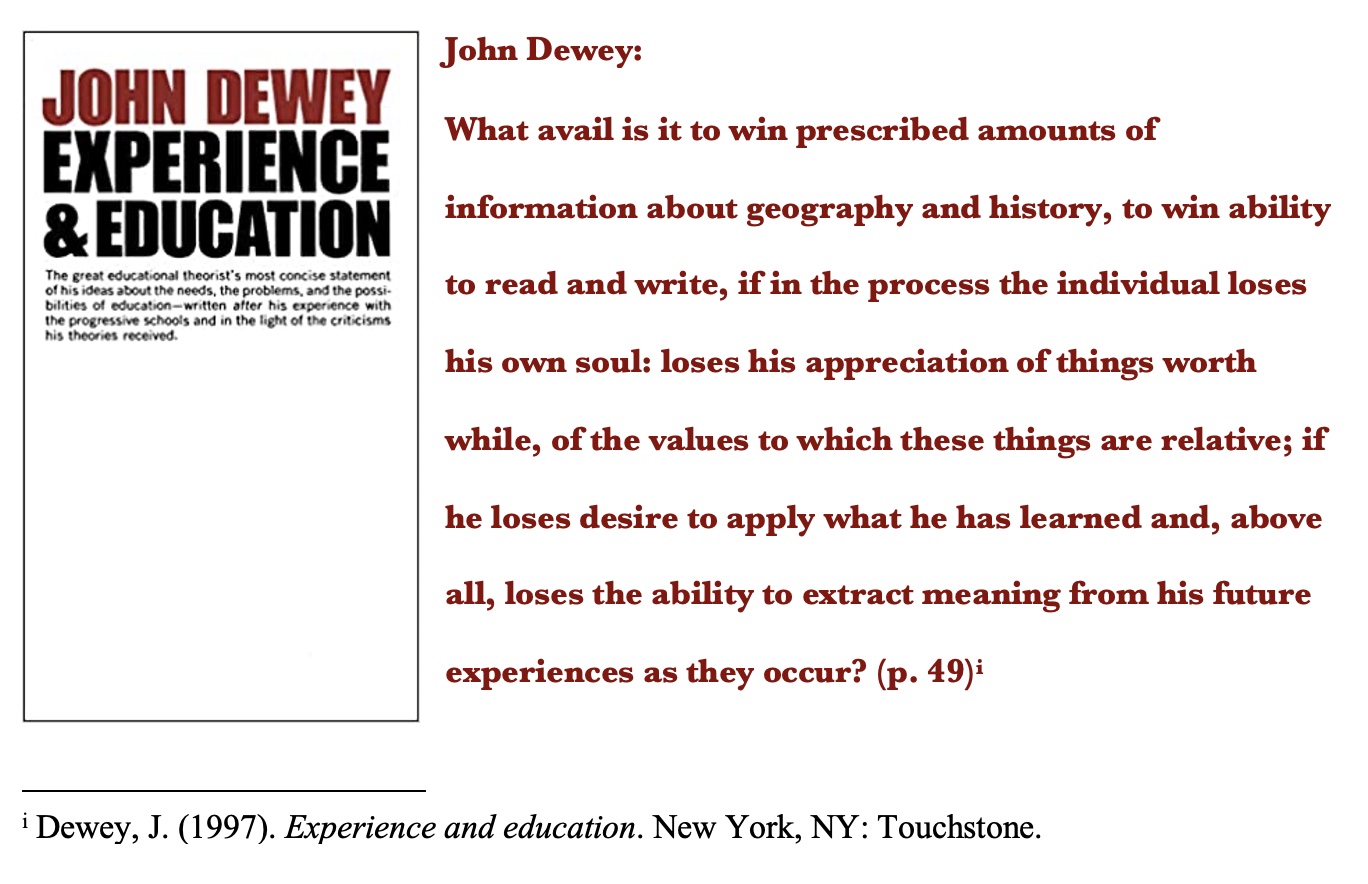
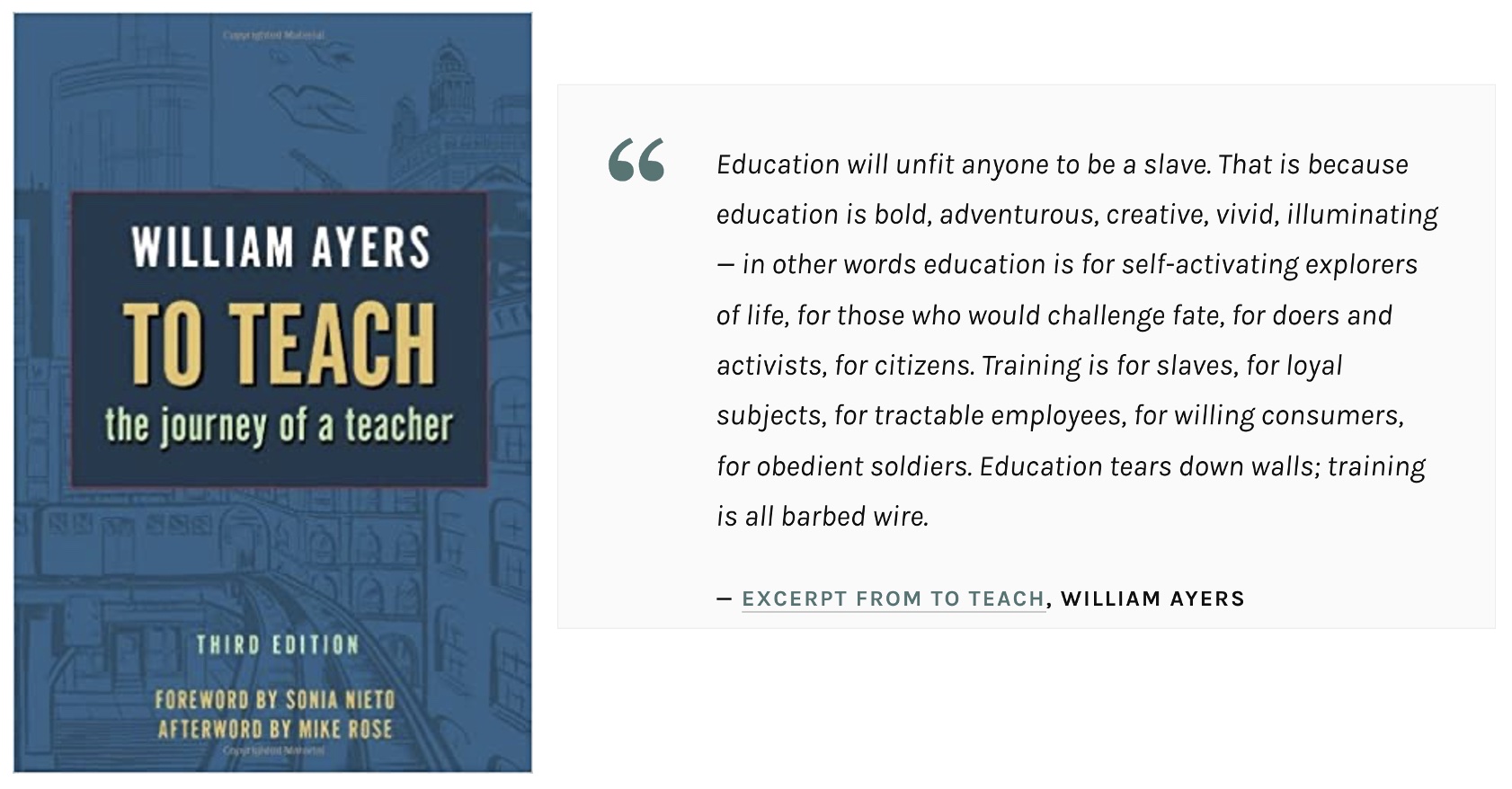
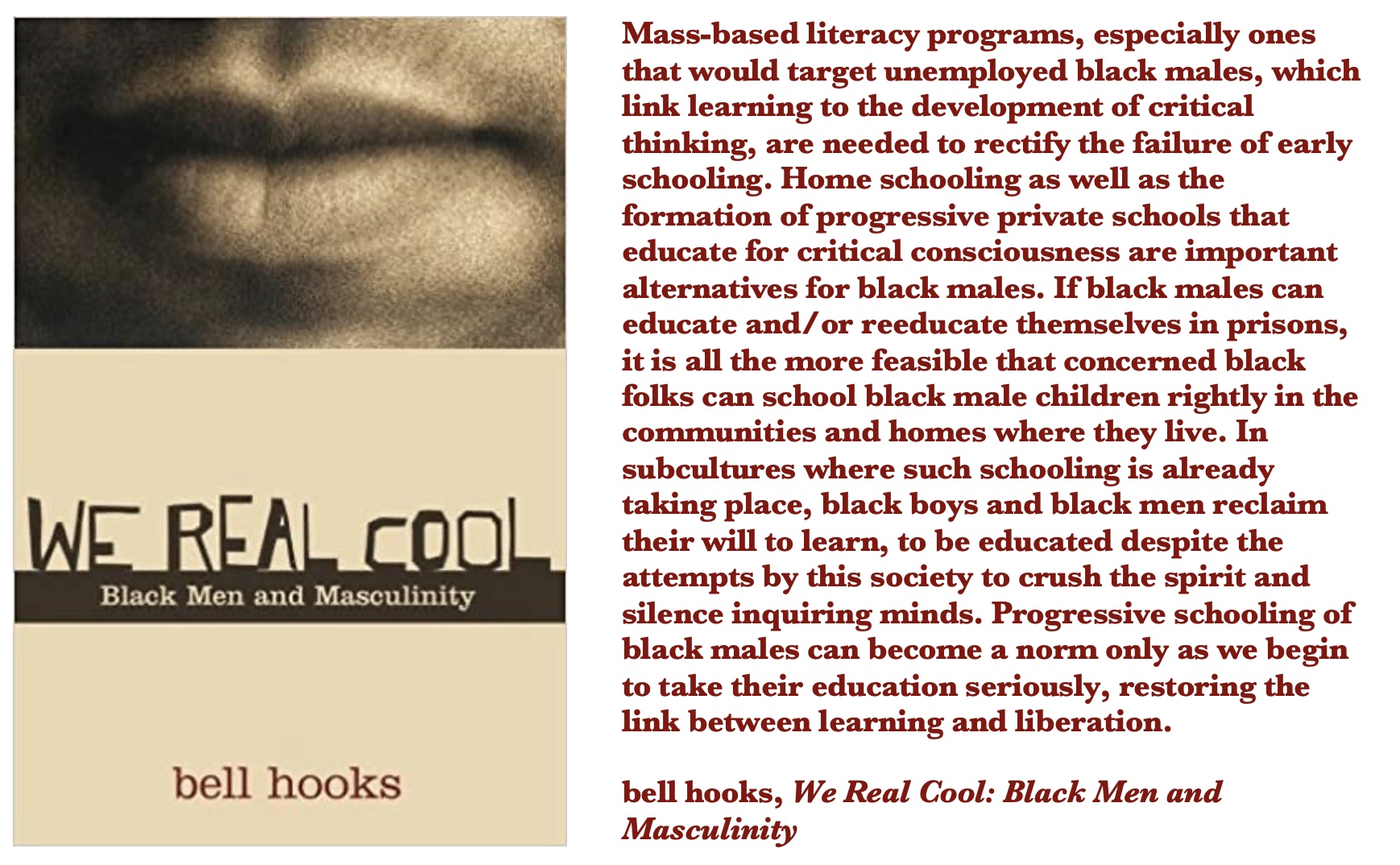
Not an exhaustive list, but for me, someone who has spent almost 40 years as a literacy educator, I want to offer some reasons reading matters for me, highlighting John Dewey, William Ayers, bell hooks, and Audre Lorde:

The allure of SoR for the media, parents, and politicians is grounded in silver-bullet “all students must” thinking that is antithetical to the reasons I believe reading matters.

At the core of the tension in debates about teaching reading and what texts students are assigned or allowed to read is those embracing indoctrination (“teaching everybody to read the right way”) versus those embracing education as liberation (from Dewey to Ayers to hooks and to Lorde).

Indoctrination depends on someone not only controlling what people read, hear, and think, but also erasing what people read, hear, and think.

The SoR movement ultimately fails because it resists being student centered and allows far too often for reading to be reduced to decoding (systematic intensive phonics for all); further, while SoR advocates often demonize popular reading programs (and I am a strong critic of all reading programs), they make the same essential mistake by simply choosing different programs to endorse as rigid expectations for students and teachers (LETRS, DIBLES).

Reading matters, but if we become distracted by raising reading test scores, our practices are likely to produce non-readers (Dewey).

Reading matters, but if we fail to distinguish between indoctrination and education for liberation (hooks), we reduce reading instruction to training (Ayers).

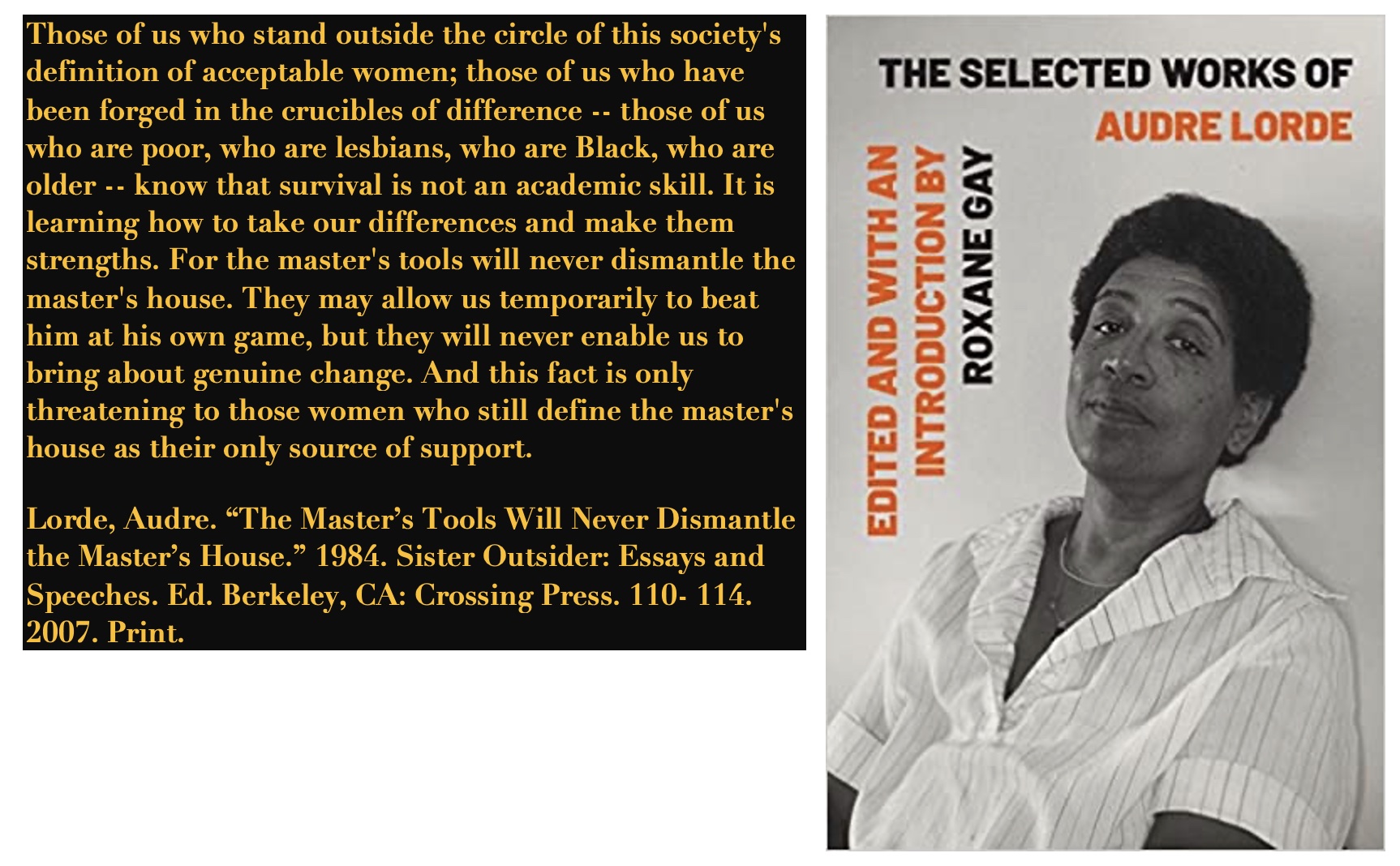
Reading matters, but our commitments must be to how reading matters for the individual, especially for those “who stand outside the circle of this society’s definition of acceptable” (Lorde).

If we truly believe every person deserves the human dignity of intellectual freedom, as my parents and teachers afforded me, then reading matters only if we refuse silver-bullet scripts, only if we protect all the books and ideas available to free people.

That is the only “right way” worth evoking.


[1] See the following:

An Examination of Dyslexia Research and Instruction, with Policy Implications, Peter Johnston and Donna Scanlon

Research Advisory: Dyslexia (ILA)

[2] See the following:

A Meta-Analysis of the Effects of Reading Comprehension Interventions on the Reading Comprehension Outcomes of Struggling Readers in Third Through 12th Grades, Marissa J. Filderman, Christy R. Austin, Alexis N. Boucher, Katherine O’Donnell, Elizabeth A. Swanson

“the simple view of reading does not comprehensively explain all skills that influence reading comprehension, nor does it inform what comprehension instruction requires.”

The Sciences of Reading Instruction, Rachael Gabriel (Educational Leadership)

The Trouble With Binaries: A Perspective on the Science of Reading, David B. Yaden Jr., David Reinking, and Peter Smagorinsky

Reconsidering the Evidence That Systematic Phonics Is More Effective Than Alternative Methods of Reading Instruction, Jeffrey S. Bowers (2020)

[3] UPDATED 23 February 2020: Mississippi Miracle or Mirage?: 2019 NAEP Reading Scores Prompt Questions, Not Answers

See Also

The Problem with Balanced Literacy

Failing Balanced Literacy Is Failing Readers, Katie Kelly and Paul Thomas

Conservatives Seeking Education as a Buffet of Ignorance

Several decades ago, the following true story about teaching in a small, conservative Southern town, seemed like a once-in-a-career experience: A new social studies teacher at my high school was challenged by a parent because this new teacher covered Middle East geography by detailing the regional tensions correlated with religion among Christians, Jews, and Muslims.

Ultimately, the parent wanted their child removed from the class because, as the parent announced to the principal, “I don’t want my son knowing religions other than Christianity exist.”

Fast forward about three decades—passing through several rounds of school choice movements (which I will connect later)—and now public school teachers and college professors across the U.S. find themselves challenged in a similar but far more extensive and organized way concerning Critical Race Theory (CRT).

Mike Gonzalez, for example, at the Heritage Foundation, has constructed Try This “Critical Race Theory” Checklist for conservative and Christian parents who, like the parent above, want to opt their children out of knowledge.

Along with explosive and even violent school board meetings about mask mandates, Covid, and, yes, CRT, parents are now organizing to opt their children out of education; for example, the Orwellian-named Families for Educational Freedom offer a CRT Lessons Letter and a Intrusive Survey Letter; the former outlines what parents want their children to have freedom from [1]:

We/I,________________________________, the parent(s) of _______________________________, grade ________, are/is exercising our/my fundamental parental rights under the First Amendment of the U.S. Constitution, Title VI of the Civil Rights Act of 1964, the Family Educational Rights and Privacy Act (FERPA), the Protection of Pupil Rights Amendment, and/or any other state and federal laws to opt our/my child out of any instruction in Critical Race Theory (CRT), including but not limited to the following ideas or principles —

• That any race, gender, sexual orientation, national origin, and/or socioeconomic status is inherently superior or inferior to any other race, gender, sexual orientation, national origin and/or socioeconomic status.

• That any race, gender, sexual orientation, and/or national origin is privileged or oppressed.

• That race-based stereotyping and labeling are acceptable as part of “anti-racism” education.

• That an individual should be discriminated against or receive adverse treatment because of the individual’s race.

• That an individual’s moral character is determined by the individual’s race.

• That America and its institutions are fundamentally racist.

• That the values, principles, and/or ideals of one’s own family or religion are fundamentally incorrect, racist, and/or preventing them from social and emotional growth. 

These teachings of CRT foster discrimination and harassment on the basis of race and are a violation of our family’s values and religious beliefs.  It is well-established that parents have a fundamental right to direct the religious upbringing and education of their children.  Wisconsin v. Yoder, 406 U.S. 205 (1972).  You are not to instruct or inculcate my child on the aforementioned or following subjects, without providing me at least fifteen (15) days prior written notice and providing me with the intended materials and lesson plans. 

The prohibition extends to any promotion, legitimization, or normalization of CRT, no matter how your program or approach is defined or packaged, including but not limited to any instruction, materials, or conversations related to “equity,” “privilege,” “intersectionality,” “diversity, tolerance and inclusion,” “anti-racism,” “microaggressions,” “white privilege,” “white adjacency,” “hate speech,” “hate crimes,” “critical social justice,” “postcolonial theory,” “postcolonialism,” “sensitivity education,” or the like.

CRT Lessons Letter

The bullet points may look familiar since they are occurring, often verbatim, in state legislation attacking CRT directly and indirectly as well as banning the use of the 1619 Project.

These misleading but purposeful strategies parents are using to censor curriculum in public schools is a logical evolution from how a minority of parents have been leveraging control over public education for decades—opting students out of sex education, book challenges and banning, a revolving door of school choice schemes that pander to what parents want their children to learn (without the price tag of private schools that are often appealing because there parents can and do monitor and control what is and isn’t taught), periodic challenges to the teaching of evolution, etc.

If polls are even remotely good indicators, the current Republican Party remains about 40% loyal to Trump, suggesting about 10-15% of Americans constitute this movement against CRT (likely a similar percentage to the Moral Majority movement coinciding with the Reagan presidency).

While this is a significant minority, the U.S. has long had a powerful and very vocal conservative and Christian influence that is solidly anti-education.

One of the great ironies (similar to the organization’s name noted above, Families for Educational Freedom) of the backlash against CRT (beyond that CRT doesn’t really exist in K-12 education) is that it rests on an old and tired argument that leftist teachers are indoctrinating students; this is projection from conservatives who are, in fact, seeking to indoctrinate students.

While leftists are extremely rare in K-12 education, marginalized in higher education, and nearly powerless in the economic/political system of the U.S., as I have noted often, true leftists, critical educators, are adamantly opposed to indoctrination and recent efforts by Republicans mirror commitments to indoctrination found in China.

Ultimately, this CRT mania isn’t about CRT, but is part of the steady and determined effort by an anti-education minority to dismantle universal public education and academic freedom because at their core, as William Ayers concludes:

Education will unfit anyone to be a slave. That is because education is bold, adventurous, creative, vivid, illuminating — in other words education is for self-activating explorers of life, for those who would challenge fate, for doers and activists, for citizens. Training is for slaves, for loyal subjects, for tractable employees, for willing consumers, for obedient soldiers. Education tears down walls; training is all barbed wire.

excerpt from To Teach, William Ayers

Conservatives and Christians embrace education as training, indoctrination, as mere preparation for work or passive compliance with the dogma of religion.

The attacks on CRT and efforts by parents to opt out of curriculum deemed “indoctrination” or claimed to cause “racial discomfort” are poised to turn education into a buffet of ignorance leaving our children and teens intellectually starved and the status quo safely protected.


[1] See:

There is more than one kind of freedom, said Aunt Lydia. Freedom to and freedom from. in the days of anarchy, it was freedom to. Now you are being given freedom from. Don’t underrate it….

We were a society dying, said Aunt Lydia, of too much choice. (pp. 24, 25)

Margaret Atwood’s The Handmaid’s Tale

Indoctrination by Omission

While attacks on Critical Race Theory (CRT) by Republicans and conservatives have many different claims, one consistent element of these attacks is misinformation.

One of those false associations can be found at the persistently misleading Discovery Institute (infamous for stoking the evolution debate): Critical Race Theory – The Marxist Trojan Horse writes Walter Myers III for the “institute.”

Recently I gave a presentation for a learning in retirement session at my university—The 1619 Project:  Should we “reframe” our country’s history to include the consequences of slavery?”

In the opening of the presentation I explain what CRT is, focusing on the Big Lie of the attacks by assuring everyone that CRT is not taught in K-12 schools.

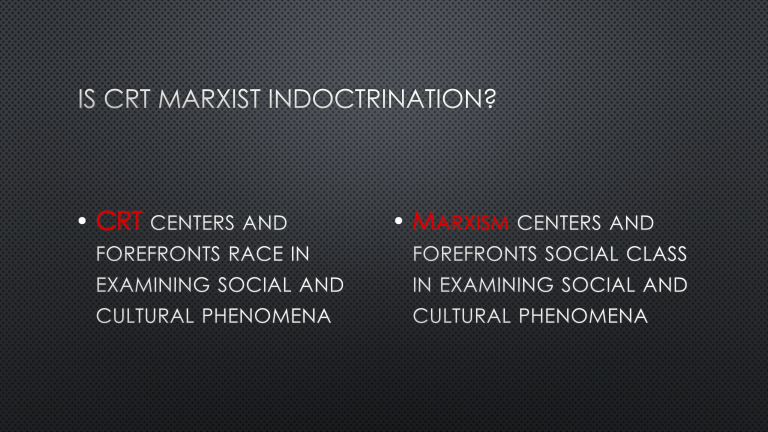
But I also focused on the claim that CRT is Marxist indoctrination:

While some overlap does exist among CRT scholars and Marxist scholars, there often is considerable tension between the focus on centering race and centering social class.

While this slide sparked some important dialogue among the audience, I had begun the presentation (not planned) by noting that the session began with a short video that included a dramatic reading that included the phrase “black-on-black crime.”

I noted that while crime in the U.S. is overwhelmingly within race—the white-on-white crime rate is about the exact same as the black-on-black rate—media, public, and political discourse only utters “black-on-black crime.”

This is indoctrination by omission, and this phenomenon in education raises an important question:

Similar to what I have raised before—Who’s indoctrinating whom?—”Are we worried about ideology or just one ideology?” is an important question to confront, and we are left with only one real answer.

Conservatives are seeking ways to indoctrinate students within the parameters of their ideology; therefore, the attacks on CRT and the 1619 Project are not calls for academic freedom, the marketplace of ideas, or even “both sides.”

Republicans and conservatives are seeking indoctrination by omission.

As I responded to the Tweet above, I noted that since I teach many students with private religious K-12 schooling, I regularly am asked to “go over” evolution because these very bright and high-achieving students were never taught evolution in biology while attending private religious schools.

Whether its our schooling or our political, media, or public discourse, what is not spoken is just as powerful as what is spoken.

Poet Adrienne Rich writes in her “Arts of the Possible,” the eponymous essay of her 2001 collection of essays:

The matrix of a poet’s work consists not only of what is there to be absorbed and worked on, but also of what is missing, desaparecido, rendered unspeakable, thus unthinkable. It is through these invisible holes in reality that poetry makes it way—certainly for women and other marginalized subjects and for disempowered and colonized peoples generally, but ultimately for all who practice art at any deep levels. The impulse to create begins—often terribly and fearfully—in a tunnel of silence.

On Lies, Secrets, and Silence: Selected Prose 1966-1978

In the Bizarro world of conservative thought, simply exposing students to ideas that do not conform to a narrow conservative ideology is a type of indoctrination.

Republicans are trying to control K-12 and higher education in ways that honor mythologizing/idealizing the past and speaking of U.S. history and day-to-day realities of the U.S. through aspirational language—from “Founding Fathers” to “the U.S. is not a racist country.”

Ultimately, what offends Republicans/conservatives about academic freedom and critical approaches to history, literature, etc., is that being critical is inherently a challenge to power and a rejecting of indoctrination.

There is no such thing as objective history, no such thing as de-politicized “facts.”

Contemporary historians are well aware that history tends to be written by the winners, by those with power and authority, and that these versions of history are in the interests of those with that power and authority.

Current attacks on CRT have included direct attacks on the work of Howard Zinn, who popularized seeing history from the perspectives of the losers and marginalized.

Returning to the Tweet above, conservatives are not angry that Zinn’s history is ideological, but that Zinn’s history challenges their singular ideology of mythologizing, idealizing, and aspiring to the detriment of marginalized populations in the U.S.

If we in the U.S. genuinely value individual freedom, each child and young adult deserves education grounded in academic freedom, and academic freedom requires that we attend to not only what is taught but also what is omitted.

K-12 and higher education are not indoctrinating children and teens, certainly not into Marxist ideology, but Republicans/conservatives are endorsing indoctrination by omission—something that if we want to be aspirational is not very American.


Recommended

Conceptualizing color-evasiveness: using dis/ability critical race theory to expand a color-blind racial ideology in education and society

“Racial Discomfort” in an Era of Erasing Curriculum

My neighboring state of North Carolina has filed copy-cat legislation being proposed across the U.S. by Republicans as part of the manufactured Critical Race Theory (CRT) crisis.

As Justin Parmenter explains, “Among other things, the bill would make it illegal for teachers to promote feelings of racial discomfort and would require schools to prominently post information about diversity training on their websites for public review.”

Republicans and conservatives have launched a campaign grounded primarily in several false claims, including a drastic misrepresentation of what CRT is (a graduate-level theoretical lens primarily found in law schools) and that CRT exists in any significant way in K-12 public education (it doesn’t).

Since the public and political rhetoric is both misleading and false, and since the legislation is written in coded ways, those of us who recognize that this movement is an insidious lie (political leaders claiming to be protecting academic freedom by banning CRT from academic spaces) must now call Republicans on their bluff, specifically addressing the concept of “racial discomfort.”

As an educator for almost 40 years, I find no real evidence that white third graders across the U.S. are being told in schools that they are personally culpable for racism and slavery simply because they are white.

And as a scholar who understands and embraces CRT, I also know if CRT were being practiced with children across the U.S. in public school, that theoretical lens focuses on systemic racism, not individual racism. In other words, white students in U.S. public education would be well served by CRT that emphasizes the role of systemic racism regardless of individual beliefs.

CRT is one way to raise everyone’s awareness of racism and inequity so that we can all behave in ways that lead the country toward equity and meritocracy.

The only blame anyone should suffer (in the context of CRT) is a refusal to recognize systemic racism and then a refusal to behave in ways that are equitable.

Republican legislation is prescribing, then, that students remain ignorant, and ironically, passively complicit in systemic racism.

But the primary unwritten/unspoken given in the claimed concern about “racial discomfort” is that the term addresses only white racial discomfort—as if being white is somehow a greater burden, for example, than being Black and actually experiencing racism.

Is hearing or reading “n—–” not a form of racial discomfort?

Is being told you are “articulate” while Black not a form of racial discomfort?

Is being asked “Can I touch your hair?” while Black not a form of racial discomfort?

Is being paid less even though you the same educational attainment while Black not a form or racial discomfort?

Since this movement is ambiguous on the surface, we must call their bluff by acknowledging “racial discomfort” among all races.

Black students, for examples, must not be asked to read The Adventures of Huckleberry Finn, To Kill a Mockingbird, Of Mice and Men, or The Great Gatsby.

Imagine being a Black teenager in a room filled with white peers and a white teacher, reading from Gatsby [1]:

“Civilization’s going to pieces,” broke out Tom violently. “I’ve gotten to be a terrible pessimist about things. Have you read The Rise of the Colored Empires by this man Goddard? … Well, it’s a fine book, and everybody ought to read it. The idea is if we don’t look out the white race will be – will be utterly submerged. It’s all scientific stuff; it’s been proved … This fellow has worked out the whole thing. It’s up to us, who are the dominant race, to watch out or those other races will have control of things … The idea is that we’re Nordics. I am, and you are, and … And we’ve produced all the things that go to make civilization – oh, science and art, and all that. Do you see?”

The Great Gatsby, F. Scott Fitzgerald

Or the repeated use of “n—–” in Huck Finn, Mockingbird, and Of Mice and Men.

And let’s not stop there.

Shakespeare is filled with sexism, bigotry, and racism It must go. No more Shakespeare because children and teens might feel discomfort.

And honestly, who didn’t feel discomfort when confronted with the Pythagorean Theorem.

It must go also.

In the context of the legislation being proposed and passed, we must demand that all texts and topics causing anyone (regardless of race) “racial discomfort” be removed from the curriculum.

The logical extension of this nonsense is the total erasure of curriculum; there simply is nothing left to teach if we mobilize and demand that legislation be applied evenly for everyone.

It shouldn’t be on the shoulders of minoritized peoples to call this bluff, but a widespread effort to take this legislation to its logical conclusions would cause the movement to collapse under its own dishonesty.

Republicans and conservatives do not care about everyone’s discomfort, let’s note. How trans students feel has been repeatedly disregarded, for example.

Legislation aimed at CRT is a Great White Lie, but if we call them on their bluff, that lie will be exposed when we find ourselves with a total erasure of the curriculum.


[1] See When W. E. B. Du Bois Made a Laughingstock of a White Supremacist